1. Introduction
In 1965, Lotfi Zadeh [
1] proposed the theory of fuzzy sets. This theory has been widely generalized by multiple authors for a variety of reasons, and it continues to be crucial to current research. Kramosil et al. [
2] first proposed the idea of a fuzzy metric space (commonly referred to as an
-space) by incorporating fuzzy set theory, adapting the probabilistic metric space framework to suit a fuzzy context. It was demonstrated that each conventional metric can be associated with a corresponding fuzzy metric. In line with the framework established by Kramosil et al. [
2], Grabiec [
3] extended the study by proving many fixed point results, specifically the Banach contraction theorem on complete
-spaces and the Edelstein contraction theorem on compact
-spaces. Subsequently, George and Vermani [
4] introduced a revised version of the
-space. Later, Gregori and Sapena [
5] formulated several fixed-point results (
theorems) within the framework of
-spaces. The concept of a Hausdorff metric on
-spaces was later introduced by Rodriguez-Lopez and Romaguera [
6], utilizing the approach of George and Veeramani [
4] for compact subsets. Several fixed-point and endpoint results were derived by Kiany et al. [
7] in 2011 through the application of fuzzy multi-valued contractions in a complete framework. Lately, unique
theorems have been formulated by a group of researchers that includes Shamas and collaborators [
8,
9], involving applications in both integral and differential frameworks. Further relevant findings within this framework are available in [
10,
11,
12,
13,
14,
15] and the citations within.
Huang and Zhang [
16] presented the concept of cone metric spaces in 2007, offering an extension to the traditional structure of metric spaces by employing Banach spaces as the range set rather than real numbers. They established certain theorems that address fixed points of nonlinear contractive operators under the condition of cone normality. Al Rawashdeh in [
17] defined E-metric spaces and characterized the concept of cone metric spaces in a general way by defining an ordered normed space. Then, he defined some of the results of Huang and Zhang [
16]. Also, [
18] proved some new results for E-metric spaces. Subsequently, Cakalli et al. [
19] demonstrated that any cone metric space valued in a topological vector space is metrizable and provided several results in this context. The concept of a cone metric space (
-space) over
s was introduced by Liu et al. [
20] in 2013, wherein Banach spaces were replaced by
s. (Hereafter, we use ‘
’ as an abbreviation for Banach algebras.) They established
results through the use of employing generalized Lipschitz mappings, under less restrictive and more natural assumptions related to the spectral radius of the generalized Lipschitz constant. Yan et al. [
21] extended these results to partially ordered
-spaces over
s in 2016, focusing on
and C
theorems. Rashid et al. [
22] presented E(s)-distance spaces as a broader concept that generalizes E-metric [
17,
18] spaces, and established several coincidence point results within this framework.
Oner et al. [
23] presented the notion of a fuzzy cone metric space (
-space), establishing key properties and formulating a ‘fuzzy cone Banach contraction theorem’. According to this theorem, a self-map defined on a complete
-space that involves Cauchy sequences with fuzzy cone contractive criteria ensures the existence of exactly one fixed point. Following this, Oner et al. [
24] proposed the notions related to closed balls and relatively compact subsets within the structure of
-spaces, and formulated a version of Baire’s theorem for complete
-spaces. Rehman and Li [
25] in 2017 further expanded and refined the ’fuzzy cone Banach contraction theorem’ by proving generalized
theorems in complete
-spaces without requiring fuzzy cone contractive sequences to be Cauchy. Following this, Jabeen and collaborators [
26] established several common
theorems for
-spaces and explored their applications. In this sequel, many researchers established
and coupled
results, focusing on a variety of applications (for example, see [
27,
28,
29,
30,
31,
32]). In 2024, Rashid et al. [
33] introduced the concept of multi-valued mappings in C*-algebra-valued metric spaces. By applying the lower bound property, their study extended the Banach, Kannan, and Chatterjea theorems for such mappings in these spaces.
This study presents the idea of an intuitionistic
-space over
, deriving its fundamental topological aspects and defining a Hausdorff metric on the space. In prior studies, the fuzzy metric was defined as
, with
X being a non-void set. In their work, Oner et al. [
23] substituted
with a cone-based setting, defining the fuzzy cone metric (
) mapping as
, where
represents a cone lying in a Banach space
E over the real field. In the current manuscript, this framework was extended by replacing
with a
in an
-space, introducing
mapping over
,
. By utilizing this novel concept, we explored fundamental aspects and proved an
theorem on a

-complete
-space over
. This approach offers significant potential for advancing fixed-point theory. This new framework allows for the exploration of additional properties and
results in the aforementioned spaces, with various possible applications.
This paper is organized as follows. After presenting the necessary preliminaries, we introduce intuitionistic fuzzy metric spaces over Banach algebras (Definition 6) and investigate their fundamental topological properties (Theorems 4–8). We then established fixed-point results for intuitionistic fuzzy Z-contractions (Theorems 9–10) and applied the developed theory to a nonlinear fractional Volterra integral equation, supported by numerical validation.
2. Preliminaries
This section aims to provide readers with essential background information, to help them understand the main results. Throughout the paper, the symbols , and are used to represent the sets of non-negative real numbers, real numbers, and natural numbers, respectively. We begin by recalling the definitions of triangular norms (†-norms) and conorms (†-conorms), commonly referred to as the axiomatic frameworks for defining fuzzy intersections and unions.
Definition 1 ([34]). A binary operation 🟉 mapping into is referred to as a continuous †-norm whenever it fulfills the axioms listed below:
- 1.
🟉 satisfies commutativity and associativity;
- 2.
🟉 is continuous;
- 3.
for all ;
- 4.
whenever and , and .
The three fundamental types of continuous †-norms are given as follows:
The minimum †-norm, defined as .
The product †-norm, given by .
The Lukasiewicz †-norm, expressed as .
Definition 2 ([34]). A binary operation ♢ mapping into is said to be a continuous †-conorm whenever ♢ fulfills the properties listed below:
- 1.
♢ is commutative, associative, and continuous;
- 2.
for all ;
- 3.
whenever and , and .
Three typical examples of †-conorm are , , and
The following remark is taken from [
35], and it might prove helpful in proving the main results.
Remark 1. - (a)
For any with , there exist such that and .
- (b)
For any , there exist such that and .
Definition 3 ([35]). A 5-tuple is considered an intuitionistic fuzzy metric space (abbreviated as an -space) if χ is a non-specific set; 🟉 and ♢ represent a continuous †-norm and †-conorm, respectively; and Π and ℵ are fuzzy sets on that satisfy the conditions listed below whenever belong to χ and :
- (a)
- (b)
;
- (c)
if, and only if, are equal;
- (d)
;
- (e)
;
- (f)
is continuous;
- (g)
;
- (h)
if, and only if, ;
- (i)
;
- (j)
;
- (k)
is a continuous mapping.
Then, is referred to as an intuitionistic fuzzy metric on χ. The functions and represent the degree of nearness and non-nearness, respectively, between ς and η with respect to †.
Remark 2 ([35]). Each -space can equivalently be seen as an -space represented by , in which 🟉 and ♢ are related by the equation for any .
Example 1. Let be a normed linear space and let . Define the mappings byfor all and . Let the continuous t-norm and t-conorm be given byThen, is an intuitionistic fuzzy metric space. Definition 4 ([36]). A complex algebra is defined as a vector space Λ over the complex field , satisfying the following properties:
- (1)
- (2)
- (3)
for all , and υ in Λ and any scalar .
In the case where Λ is a Banach space with a norm that meets the multiplicative inequality condition,
- (4)
,
then Λ is called a , and if there exists a unit element I in Λ such that
- (5)
and
then Λ is called unital algebra. Λ is called commutative if for all ς and η in Λ.
Example 2. Let denote the set of all complex-valued continuous functions on the interval . Define addition and scalar multiplication pointwise, and define multiplication by Endow X with the supremum normThen, is a complex Banach space. Moreover, X is a Banach algebra, since The constant function for all acts as the multiplicative identity. Hence, is a unital commutative complex Banach algebra.
Assume that Λ is a unital algebra with the identity element I. An involution on Λ is a conjugate-linear map on Λ such that and for all . The pair is referred to as a 🟉-algebra. A Banach 🟉-algebra (in short, -algebra) is a 🟉-algebra Λ equipped with a complete, sub-multiplicative norm that satisfies (for all ). A -algebra satisfying the condition is called a -algebra.
Set . An element is called a positive element, denoted by , if and its spectrum lies within . A partial ordering ⪯ on can be defined through positive elements in the following way: if, and only if, , with θ representing the zero element in Λ. Hereafter, let represent the set with the norm given by .
Given below are some theorems taken from [
36] that are helpful in proving the main results.
Theorem 1 (Theorem 11.5(e), [36]). Let Λ be a commutative , and let Δ denote the set of all complex homomorphisms of Λ. Then, if, and only if, for some .
Theorem 2 (Theorem 11.18, [36]). Suppose Λ is a commutative -algebra with a maximal idea space Δ. The Gelfand transform is then an isometric isomorphism of Λ onto (the algebra of all complex continuous functions on Δ), which has the property that Theorem 3 (Theorem 10.7, [36]). Suppose Λ is a , . Then, for every complex homomorphism ζ on Λ.
According to a recent analysis, Khojasteh et al. [
37] introduced a family of auxiliary (referred to as simulations) functions, in an attempt to standardize different forms of contractions.
Definition 5 ([37]). A simulation function is defined as a mapping that meets the requirements stated below:
- (S1)
;
- (S2)
for all ;
- (S3)
if and are two sequences with terms in the interval in such a way that , then,
The collection of all simulation functions is denoted by Z.
Remark 3 ([37]). It is clear from the definition of the simulation function that for all .
Hausdorff Property in Fuzzy and Intuitionistic Fuzzy Metric Spaces
The Hausdorff property is a fundamental topological requirement that ensures the uniqueness of limits and plays a crucial role in fixed-point theory. In classical metric spaces, Hausdorffness follows naturally from the metric structure, while in fuzzy metric spaces, it was systematically established by George and Veeramani [
4] and further developed by Park [
35] and others, showing that the topology induced by a fuzzy metric is Hausdorff under mild conditions. For intuitionistic fuzzy metric spaces, the presence of both nearness and non-nearness functions necessitates the careful treatment of separation properties; nevertheless, suitable assumptions on the underlying t-norm and t-conorm guarantee the Hausdorffness of the induced topology. In the present work, this property was particularly important due to the algebra-valued nature of the intuitionistic fuzzy metric, as it ensured the uniqueness of the limits and the well-posedness of fixed points in the Banach algebra setting. This justified the explicit use of Hausdorffness in the main results, including Theorem 6.
The algebras that we consider throughout this article included the commutative unital -algebra, represented by , and we will use to denote .
3. Main Results
This section is dedicated to introducing the concept of -spaces within the context of , along with the necessary definitions and some results.
With the framework of an -space over established, we now explore the convergence properties within such spaces. The following definitions formalize the notions of convergence and Cauchy sequences, which are essential for establishing fixed-point theorems in this generalized setting.
Definition 6. A 6-tuple is referred to as an -space over algebra Λ if χ is any non-specific set, 🟉 is a continuous †-norm, ♢ is a continuous †-conorm, Λ is a unital -algebra, and are fuzzy sets on satisfying the following conditions: for all ,
- (a)
- (b)
;
- (c)
if, and only if, ;
- (d)
;
- (e)
;
- (f)
is continuous;
- (g)
;
- (h)
if, and only if, ;
- (i)
;
- (j)
;
- (k)
is continuous.
Example 3. Let χ be a non-empty set and let be the unital commutative -algebra of all complex-valued continuous functions on , endowed with the supremum normThe unit element of Λ is the constant function . Let be the product t-norm defined byand let be the t-conorm given by Define the mappings byfor all , , and , where d is a metric on χ. Then, the 6-tupleis an intuitionistic fuzzy metric space over the algebra Λ. Indeed, for all and ,
;
and ;
and if, and only if, ;
and ;
The functions and are continuous on .
Hence, all the conditions of Definition 6 are satisfied.
Definition 7. Assume that is an - space defined over Λ and consider a sequence in χ. Then converges to a point if for any and , there exists such thatfor all . We write, as or . Definition 8. Assume that is an -space defined over Λ, and is a sequence contained in χ. Then,
- 1.
A sequence within χ is called a Cauchy sequence if, for every and any , there exists for which and for all ;
- 2.
The space χ is called complete if every Cauchy sequence converges to some point in χ.
Having defined convergence and completeness, we turn our attention to the topological structure induced by the intuitionistic fuzzy metric. The next result shows that open balls in this space are indeed open sets, a fundamental property that supports the development of a Hausdorff topology.
Definition 9. Assume that is an -space defined over Λ. An open ball in is defined asfor any and . Theorem 4. An open ball in is an open set if, for every , there exists in Λ such that .
Proof. Let denote an open ball centered at with radius ⋎ relative to † in an -space . Let , which implies that and .
Let us take
in
, with
such that
and
. Let
. Then, we have
. Since
, there exists
such that
. Now, for a given
and
such that
, there exist
such that
and
. Put
and take the open ball
. We have to show the following:
Let
, which implies that
and
. Therefore,
and
This implies that
, and hence,
which completes the proof. □
It is important to note that not every open set in can be represented as an open ball, due to the algebraic constraints on the parameter †. This subtlety motivates a deeper investigation into the topological properties of -spaces, including their separation axioms.
Remark 4. It is worth noting that not every open set in χ corresponds to an open ball. This is because the condition for the existence of , such that for every , is not necessarily satisfied for all † within the set Λ.
From now onwards, we assume to be a unital -algebra.
Lemma 1. Let be an -space over Λ and . Then, for any and whenever .
Proof. Since
, we have
and
. For
, the element
is self-adjoint and
Hence,
is self-adjoint and positive.
Let
be any character on
. Then,
which implies that
, and therefore,
.
Moreover,
since
implies that
. Thus,
, and hence,
. □
Lemma 2. Let be an -space over commutative algebra Λ. Then, for each , there exists such that and .
Proof. As
, find
with
; we have from the previous lemma that
. Choose
such that
Let
so
, which implies that
. Also, we claim that
, because
and
Since
, we get
. Thus,
. This implies that
. Hence, this is proven. □
With these foundational lemmas established, we now construct a topology on based on the family of open balls. The following theorem confirms that this collection indeed forms a topology, paving the way for further topological analyses.
Theorem 5. Let be an -space over Λ. If we definethen forms a topology on χ. Proof. - (i)
If , it follows that . Therefore, . So, for each , and such that , we have .
- (ii)
Let and . Then, for some , we get . So, by definition, there exist and such that . Since , we have , which means that .
- (iii)
Assume that
and
. Consequently,
and
, so there exist
and
such that
and
. By choosing
such that
(that is,
) and
, we have
; this is because, for any
, we have
and
Similarly, one can show that
, which implies that
, and hence,
. Also,
; thus,
Hence, and the proof is completed.
□
Equipped with a topology, we next examine the separation properties of
-spaces. The following theorem demonstrates that such spaces are Hausdorff, an important feature for ensuring the uniqueness of limits and fixed points. In the following, we extend the Hausdorff property given in [
4,
35] for the class of
-spaces over
.
Theorem 6. Every -space is Hausdorff.
Proof. Let
and
be any two distinct points in
. Since
, by the definition of an
-space, we have
and
for
. Let
and
for some
. Let
. Then, for each
, there exist
such that
and
. Let
. Now consider two open sets
and
. We have to show that
Suppose by contradiction,
Then, there exists some
, which implies that
and
. By definition, we can write it as
Now,
and
form a contradiction. Thus,
which implies that
is a Hausdorff space. □
We now consider boundedness and compactness in -spaces. The next theorem shows that compact subsets are both closed and bounded in the intuitionistic fuzzy sense, aligning with classical topological intuition.
Definition 10. Let denotes an -space defined on Λ. A subset B of χ is referred to as IF-bounded over Λ provided there exist and such that and for all .
Theorem 7. Every compact subset of an -space is closed and IF-bounded over Λ.
Proof. Let
be compact. Fix
and
. Consider the family of open sets
forming an open cover of
B. Since this collection is indeed an open cover, there exist
such that
For any
, there exist some
such that
and
. Then, by definition, we have
,
, and
for
. Now, let
and
. So we have
and
Let
and choose
such that
and
. Let
. Then,
and
Thus,
B is IF-bounded. On the basis of Theorem 6, we know that each
-space over
possesses the Hausdorff property. Therefore, given that compact subsets in a Hausdorff space are closed,
B must also be closed. □
Having established the key topological properties, we return to the study of sequences. The following lemma reveals the monotonicity properties of the fuzzy metric functions, which are useful in analyzing contractive mappings.
Theorem 8. Consider an -space over Λ. We say that a sequence in χ converges to if and , as for each .
Proof. Assume that the sequence converges to in . Then, for every and each , there exists an index such that and for all . Hence, and as .
Conversely, suppose that
and
as
. Then, for any
and
, there exists
such that
and
for all
, which implies that
for all
. Thus,
as
. □
Lemma 3. Let be an -space over Λ. Then, behaves as a non-decreasing function, while is non-increasing.
Proof. On the contrary, suppose that the function
is decreasing and the function
is increasing. That is,
for all
with
and
for all
with
. Then,
which is a contradiction. Also,
which is again a contradiction. Thus, the functions
and
are non-decreasing and non-increasing, respectively. □
We now introduce the concept of -Cauchy sequences and -completeness, which are tailored to the algebraic structure of . This leads naturally to the definition of intuitionistic fuzzy Z-contractions, a generalized class of mappings suited for fixed-point analyses.
Definition 11. A sequence in an -space over Λ is called a  Λ-Cauchy sequence if and for each and . χ is called
  Λ-complete if every Cauchy sequence is convergent in χ.
 Definition 12. Let be an -space over Λ and be a self mapping. Then, T is said to satisfy an intuitionistic fuzzy Z-contraction over Λ ifandfor each and and . With these definitions in place, we are now prepared to present our main fixed-point theorem. The following result guarantees the existence and uniqueness of fixed points for intuitionistic fuzzy Z-contractions in complete -spaces.
Definition 13. Let be an -space over Λ, and consider a sequence in χ. The sequence is termed as an intuitionistic fuzzy Z-contractive sequence over Λ provided that the following holds:andfor all , . Now, let us prove the following main theorem related to fixed points.
Theorem 9. Let be a  Λ-complete -space over Λ in which intuitionistic fuzzy sequences are
  Λ-Cauchy. Assume that is an intuitionistic fuzzy Z-contraction mapping over Λ. Then, there exists a unique fixed point of T in χ.
 Proof. Let
be fixed in
, and define the iteration by
for
, that is,
. For
, it holds that
implying
and
which shows that
Similarly, we have
and
Generalizing for
, we get
and
Hence,
is an intuitionistic fuzzy Z-contractive sequence, and by assumption, it is a
 Λ
Λ-Cauchy sequence. Since
is a
 Λ
Λ-complete space, there exists
such that
and
for each
. Next, we show that
serves as a fixed point of
T. By the contraction property, we can write
which implies that
The only possibility is
Using same arguments, we find out that
By (
1), (
2), and (8),
. Since
, we get that
. But
, so we have
.
Take
to be a fixed point of
T different from
. So,
and
. Then,
which gives a contradiction from Remark 3. Thus,
, which completes the proof. □
As a special case of the above result, we obtained a simpler contraction theorem in which the simulation function is replaced by a linear factor . This corollary bridges our work with classical Banach contraction principles in fuzzy settings.
Theorem 10. Consider a  Λ-complete -space over Λ. Consider a mapping such thatandfor all and . In this case, T possesses a unique fixed point in χ.
 Proof. Let
be a fixed element in
and set
for all
, that is,
. For
, it holds that
implying
Similarly,
Generalizing for
, we get
In a similar pattern,
Hence,
is an intuitionistic fuzzy Z-contractive sequence. Now, from (
3), we can further proceed as follows:
Thus,
which implies that
and
Now,
and
Thus, it can be seen that
forms a
 Λ
Λ-Cauchy sequence. Given that
is
 Λ
Λ-complete, there exists
to which
converges, that is,
and
for each
. We proceed to show that
serves as the fixed point of
T. By the contraction property, one can write
Similarly,
Then,
and
for each
, and therefore,
, that is,
and then
.
To demonstrate uniqueness, let us assume
for some
. Then, for
,
Hence,
and then
. □
These results unify and extend several known theorems in fuzzy fixed point theory, as illustrated by the following corollaries, which recover earlier results by appropriate choices of parameters and structures. Consequently, we deduced the following special cases.
Corollary 1. By choosing and defining , we see that Theorems 4–8 in this paper are reduced to the results proven in [4]. Corollary 2. By taking , the results mentioned in Theorems 4–8 are reduced into the ones given by Park [35]. 5. Conclusions
In this paper, we introduced a new structure of intuitionistic fuzzy metric spaces over a Banach algebra, which extends and unifies several existing frameworks, including classical fuzzy metric spaces and fuzzy cone metric spaces. Within this algebra-valued intuitionistic fuzzy setting, we established fundamental topological properties such as openness, boundedness, completeness, and the convergence of sequences, thereby providing a solid analytical foundation for further investigations. Building on these preliminaries, we developed fixed-point results for intuitionistic fuzzy (Z)-contractions and algebra-valued fuzzy contraction mappings, and proved that such mappings admit unique fixed points in ()-complete -spaces. These results not only generalize several well-known fixed-point theorems in the existing literature, but also offer a unified and flexible approach for analyzing contraction-type operators in intuitionistic fuzzy environments endowed with algebra-valued metrics.
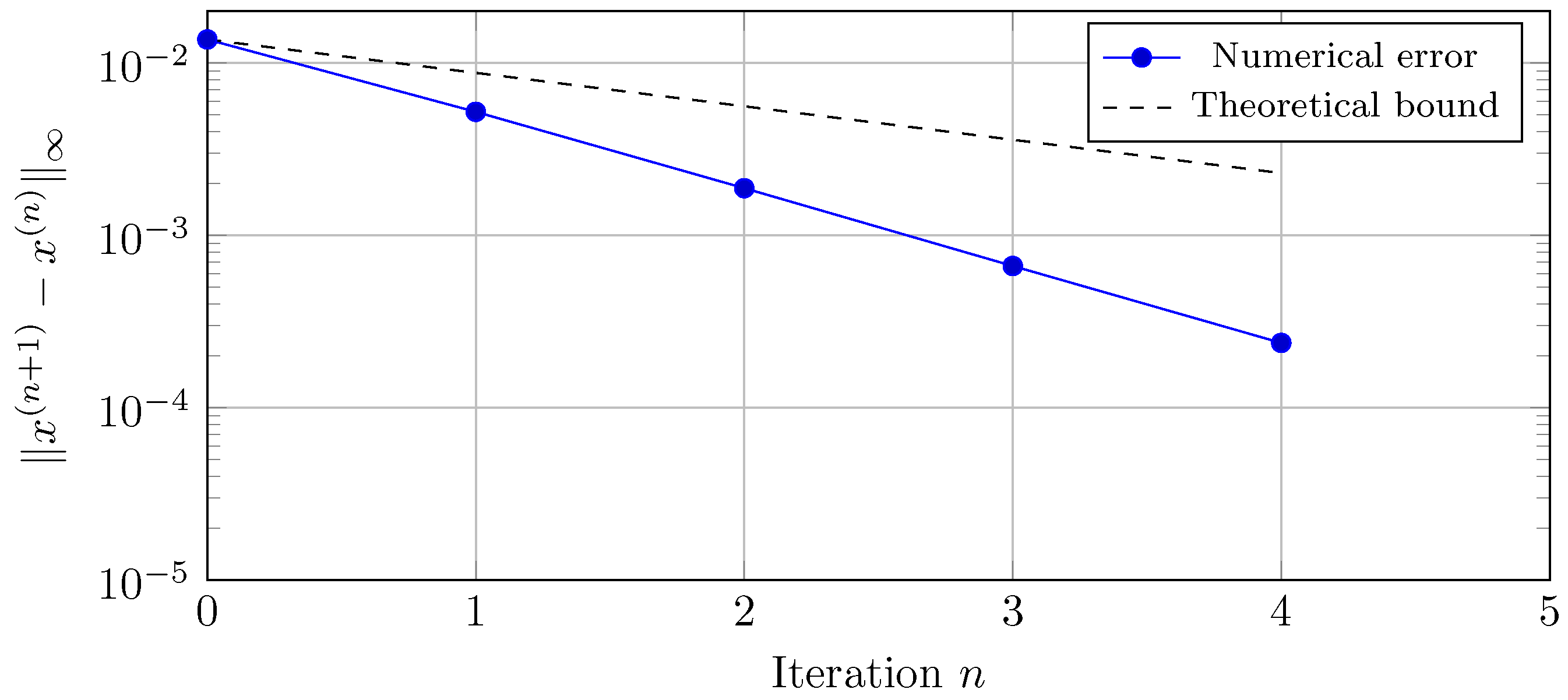
To demonstrate the practical relevance of the proposed theory, we applied the established fixed-point framework to a nonlinear fractional Volterra integral equation of the Caputo type. The intuitionistic fuzzy metric approach ensured the existence and uniqueness of the solution under mild contractive conditions, while the accompanying numerical simulation confirmed the rapid convergence of the corresponding iterative scheme. Moreover, the observed monotonic increase in the fuzzy nearness measure and the corresponding decay in the fuzzy non-nearness measure were fully consistent with the analytical predictions, highlighting the stability and effectiveness of the -based methodology for fractional dynamical systems.
The results presented in this work open several promising directions for future research. One natural extension is the study of multi-valued mappings and set-valued contractions in spaces, which would significantly broaden the applicability of the theory to optimization problems and differential inclusions. Another important direction concerns the application of the proposed framework to fractional differential inclusions and integro-differential systems, where uncertainty and memory effects coexist and algebra-valued intuitionistic fuzzy structures may offer deeper analytical insight. Furthermore, potential connections with machine learning and data science merit exploration, particularly in the modelling and analysis of fuzzy dynamical systems, adaptive algorithms, and learning processes under uncertainty. Incorporating intuitionistic fuzzy metrics over Banach algebras into such data-driven frameworks may lead to new tools for stability analyses, convergence assessments, and uncertainty quantification in complex systems.
Overall, the proposed intuitionistic fuzzy metric framework over Banach algebras provides a powerful and versatile analytical tool, with significant potential for further theoretical development and interdisciplinary applications.





 -complete -space over . This approach offers significant potential for advancing fixed-point theory. This new framework allows for the exploration of additional properties and results in the aforementioned spaces, with various possible applications.