Article

A Fully Discrete Numerical Scheme for Nonlinear Fractional PDEs with Caputo Derivatives and Fredholm Integral Terms


1
Institute of Computing Science and Technology, Guangzhou University, Guangzhou 510006, China
2
Intelligent Vehicle College, Guangzhou Polytechnic University, Guangzhou 511400, China
*
Author to whom correspondence should be addressed.
Fractal Fract. 2026, 10(1), 26; https://doi.org/10.3390/fractalfract10010026
Submission received: 7 November 2025 / Revised: 4 December 2025 / Accepted: 16 December 2025 / Published: 4 January 2026

Abstract

In this work, we propose a nonlinear fractional partial differential equation model incorporating a Caputo fractional derivative in time, a second-order spatial derivative, and a nonlinear Fredholm integral term. This model accounts for memory effects, anomalous diffusion, and nonlocal interactions, offering a more realistic description of complex transport phenomena compared to classical integer-order models. To solve the model numerically, we develop a fully discrete scheme that combines Lagrange interpolation-based approximation for the Caputo fractional derivative in time with central difference discretization for the spatial derivative. This approach ensures accuracy and flexibility in handling both the fractional derivative and the nonlinear integral term. A comprehensive convergence and stability analysis is conducted, establishing second-order accuracy in space and nearly second-order accuracy in time. Rigorous error estimates confirm the reliability and robustness of the proposed scheme for practical computations. Finally, a numerical example with a known exact solution is solved to validate the method. Errors are computed in both the L 2 and maximum norms, and the temporal and spatial convergence orders are verified. The results, summarized in tables, demonstrate the effectiveness of the fully discrete scheme and underscore the practical utility of the proposed fractional model in complex physical and engineering systems.

1. Introduction

In recent decades, fractional calculus has emerged as a powerful tool for modeling complex phenomena in engineering [1], physics [2], and applied sciences [3]. Unlike classical integer-order derivatives, fractional-order derivatives [4] more accurately capture memory and hereditary properties inherent in many real-world systems. Such effects are prevalent in viscoelastic materials, heat conduction in heterogeneous media, anomalous diffusion in porous structures, and control systems, where the response depends not only on the current state but also on the entire history of the process. Fractional models, such as the Kuramoto–Sivashinsky equation [5], and fractional differential equations have been widely studied [6], as they provide a natural and more accurate extension of classical differential equations, often achieving significantly better agreement with experimental data.
Among various fractional derivatives, the Caputo derivative is particularly well-suited for initial-value problems, as it allows for the use of physically interpretable initial conditions (e.g., initial displacement and velocity in mechanical systems or initial temperature and heat flux in thermal systems). Integral equations also play a fundamental role in mathematical modeling, frequently offering more stable formulations than pure differential equations. They naturally arise in potential theory, elasticity, fluid mechanics, radiative transfer, and systems with long-range or nonlocal interactions. Nonlinear Fredholm and Volterra integral equations are especially useful for describing boundary-value problems, inverse problems, and dynamical systems with memory. The combination of fractional derivatives and integral terms provides a rich and flexible framework for capturing complex behaviors that classical models fail to describe. In this paper we study a general nonlinear fractional partial differential equation with a Caputo time-fractional derivative, a second-order spatial derivative, and a nonlinear Fredholm integral term:
D t α u ( x , t ) C = D 2 u x 2 ( x , t ) + λ H ( t , x , u ( x , t ) ) + 0 T Ω K ( x , t , ξ , τ , u ( ξ , τ ) ) f ( ξ , τ ) d ξ d τ ,
where 0 < α < 1 , D > 0 is the diffusion coefficient, λ is a parameter, and the integral term is of nonlinear Fredholm type. The model is equipped with the initial condition
u ( x , 0 ) = u 0 ( x ) , x Ω ,
and the boundary condition
u ( x , t ) = g ( x , t ) , ( x , t ) Ω × ( 0 , T ] .
The Caputo fractional derivative of order 0 < α < 1 is defined as follows [1]:
D t α u ( x , t ) C = 1 Γ ( 1 α ) 0 t ( t s ) α u ( x , s ) s d s .
The nonlinear source term H ( t , x , u ) and the kernel K ( x , t , ξ , τ , u ( ξ , τ ) ) allow the model to incorporate a wide variety of internal interactions, nonlocal effects, and history-dependent phenomena while retaining a high degree of generality. The general nonlinear fractional model given in Equation (1), which includes a Caputo time-fractional derivative, a second-order spatial derivative, a nonlinear auxiliary function H ( t , x , u ) , and a nonlinear Fredholm integral term, provides a versatile framework for describing complex physical and engineering systems. The Caputo derivative captures memory effects, reflecting the fact that the system’s evolution at a given time depends on its entire history. This feature is crucial in viscoelastic materials, where stress-strain relationships are inherently time-dependent, in anomalous diffusion processes observed in porous or heterogeneous media, and in thermal systems exhibiting non-Fourier heat conduction. The second-order spatial derivative represents classical diffusion or dispersion, modeling local transport phenomena such as particle spreading, heat conduction, or fluid flow in homogeneous domains. The nonlinear Fredholm integral term in Equation (1) captures nonlocal interactions and long-range spatial coupling—phenomena commonly encountered in radiative heat transfer, energy transport in composite materials, wave propagation in heterogeneous media, and chemical or biological processes where the evolution at a point depends on the global state of the system. Meanwhile, the auxiliary function H ( t , x , u ) incorporates local nonlinear effects such as reaction kinetics, population dynamics, viscoplastic flow, or other state-dependent sources and sinks. By simultaneously accounting for memory (via the Caputo fractional time derivative), nonlocality (via the Fredholm integral), and nonlinearity (via both H and the integral kernel), the proposed model describes complex anomalous behaviors that classical integer-order PDEs cannot adequately represent. These include sub-diffusive and super-diffusive transport, delayed mechanical responses, history-dependent thermal conduction, and distributed interactions in porous, fractured, or biological media. Although classical nonlinear PDEs have been successfully applied to reaction-diffusion systems, fluid flow, elasticity, and heat transfer, they inherently assume Markovian dynamics and local interactions. In contrast, many modern engineering and physical systems—particularly those involving polymers, materials with microstructure, biological tissues, and geophysical flows—exhibit pronounced memory and nonlocal effects. While linear fractional PDEs and fractional models with simple source terms have been extensively studied, fully nonlinear fractional PDEs coupled with nonlocal integral terms remain largely unexplored. The present work fills this critical gap by introducing and analyzing the general model (1), which unifies fractional time derivatives, second-order diffusion, local nonlinear reactions, and nonlinear Fredholm-type nonlocal interactions. This framework offers a powerful, physically realistic, and widely applicable tool for modeling complex transport phenomena across materials science, thermal engineering, chemical and biological systems, and continuum mechanics. The study of fractional models with memory and nonlocal effects has become increasingly important in physics and engineering, as they provide a more accurate representation of complex transport phenomena than classical integer-order models. In this work, we propose a nonlinear fractional partial differential equation with a Caputo derivative in time, a second-order spatial derivative, a nonlinear auxiliary function H ( t , x , u ) , and a Fredholm integral term representing long-range interactions. The model captures anomalous diffusion, internal reactions, and nonlocal effects, making it suitable for viscoelastic media, heterogeneous materials, and other systems where standard diffusion laws fail.
To solve the model numerically, a fully discrete scheme is employed. The Caputo fractional derivative is approximated using Lagrange interpolation in time, while the second-order spatial derivative is discretized using central differences. This approach efficiently incorporates the memory effect and allows the nonlinear and integral terms to be treated in a stable and flexible manner. A rigorous analysis of convergence and stability confirms that the method achieves near-second-order accuracy in time and second-order accuracy in space, ensuring reliable and robust numerical simulations. The combination of the physically meaningful model and the accurate numerical scheme provides a solid framework for studying complex fractional systems in engineering and applied sciences. Analytical solutions to nonlinear fractional partial differential equations, especially those coupled with nonlocal integral terms, are rarely available in closed form. Consequently, the development of efficient, stable, and high-order numerical methods has become essential for the practical simulation and analysis of such models. Over the past two decades, a wide variety of numerical techniques have been proposed for fractional differential and integro-differential equations. These include finite difference methods [7,8,9], spectral and collocation approaches [10,11,12], wavelet-based techniques [13], homotopy and decomposition methods [14,15,16,17], Lie symmetry analysis [18], and hybrid schemes [19,20,21]. Significant attention has also been devoted to nonlinear fractional Fredholm and Volterra integral equations using operational matrices, fractional Lagrange functions, Chebyshev wavelets, and Banach fixed-point frameworks [13,22,23,24,25]. Various analytical and numerical methods have been developed to study nonlinear fractional differential equations. Dehghan et al. [14] employed the homotopy analysis method to solve nonlinear fractional partial differential equations, while Guner and Bekir [26] proposed a symbolic computation-based approach for obtaining exact solutions. Recent advances in numerical algorithms for fractional models have been reported by Gao et al. [27], who introduced an efficient second-order scheme for tempered fractional differential equations. Theoretical aspects of fractional differential equations, including integral equation formulations and initial value problems, have been extensively investigated by Kosmatov [28]. Exact solutions and transformation techniques for nonlinear fractional equations were further explored by Lu [29], where Bäcklund transformations were applied to fractional Riccati equations. In addition, fractional integral equations with nonlocal operators have been studied by Mohammad and Trounev [30], highlighting the effectiveness of framelet-based methods. More recently, Kai et al. [31] analyzed exact solutions and dynamical properties of higher-order time-fractional partial differential equations, whereas Ullah et al. [32] performed bifurcation analysis and derived new wave structures for fractional evolution equations.
Despite this extensive progress, the vast majority of existing studies focus either on
  • linear or semi-linear fractional PDEs,
  • fractional models with only local nonlinear source terms, or
  • pure fractional integral/integro-differential equations without time-fractional diffusion.
To the best of our knowledge, no prior work has developed and rigorously analyzed a fully discrete, high-order numerical scheme for nonlinear time-fractional diffusion equations that simultaneously include both a nonlinear reaction term and a nonlinear Fredholm-type nonlocal integral operator. The present study fills this important gap by proposing a robust finite difference scheme for the general model (1), establishing its stability and convergence properties, and demonstrating second-order accuracy in space and nearly second-order accuracy in time through both theoretical analysis and numerical validation.
Classical integer-order diffusion equations often fail to describe transport processes dominated by memory effects, material heterogeneity, and long-range interactions. To address these shortcomings, we propose a general nonlinear fractional partial differential equation that integrates a Caputo time-fractional derivative, a second-order spatial diffusion operator, a nonlinear reaction term, and a nonlinear Fredholm integral operator. The Caputo derivative naturally incorporates power-law memory while preserving physically interpretable initial conditions, making it ideal for modeling viscoelasticity, anomalous sub-diffusion, and hereditary thermal conduction in complex media. The integral term captures nonlocal and long-range interactions commonly observed in radiative heat transfer, biological tissues, composite materials, and networked systems. The additional nonlinear source function allows for the inclusion of reaction kinetics, autocatalytic processes, or other state-dependent mechanisms. Thus, the proposed model simultaneously accounts for memory, nonlocality, and nonlinearity within a unified and physically realistic framework—capabilities far beyond those of classical PDEs. Furthermore, the fully discrete scheme developed herein, which combines Lagrange interpolation for the Caputo derivative with central differences in space, delivers second-order accuracy in space and nearly second-order accuracy in time, along with proven stability and convergence. This combination of enhanced modeling power and efficient, high-order numerics makes the present approach a versatile and powerful tool for investigating complex anomalous transport phenomena across physics, materials science, and engineering.
Fractional differential equations have become an indispensable tool for modeling complex systems that exhibit memory, anomalous diffusion, and nonlocal interactions—phenomena routinely observed in viscoelasticity, heat transfer in heterogeneous media, contaminant transport in porous structures, wave propagation in composite materials, and long-range biological or chemical processes. Unlike classical integer-order models, the Caputo fractional derivative naturally incorporates hereditary effects while retaining physically interpretable initial conditions. Despite remarkable advances in numerical methods for fractional PDEs—including finite-difference, spectral, collocation, and semi-analytical techniques most existing schemes either deliver suboptimal temporal accuracy, apply only to linear or semi-linear problems, or struggle with the simultaneous presence of strong nonlinearity and nonlocal integral operators. In this paper, we introduce a general nonlinear fractional partial differential equation that unifies a Caputo time-fractional derivative, second-order spatial diffusion, a nonlinear reaction term, and a nonlinear Fredholm integral operator. We then develop and rigorously analyze a fully discrete, high-order numerical scheme that combines Lagrange interpolation for the Caputo derivative with central differences in space. The resulting method is shown to be uniquely convergent, stable, second-order accurate in space, and nearly second-order accurate in time—even in the fully nonlinear and nonlocal setting. This work therefore provides both a physically expressive modeling framework and a computationally robust solution strategy, significantly extending the range of complex memory-dependent and spatially nonlocal transport phenomena that can be accurately simulated in engineering, physics, and biological applications.
The remainder of this paper is organized as follows. In Section 2, we develop a systematic approach to approximate the Caputo fractional derivative using Lagrange interpolation techniques. Initially, the local Lagrange interpolation is introduced, allowing the function to be represented piecewise over subintervals. This provides a flexible framework for approximating fractional derivatives with high accuracy. We also consider the piecewise-linear interpolation, commonly known as the L1 scheme, which offers a first-order approximation in time while maintaining stability and simplicity. Furthermore, we extend the method to a general degree m interpolation, corresponding to higher-order Lagrange polynomials, which enhances the temporal accuracy of the numerical approximation. Explicit formulas for the interpolation weights are derived, allowing the fractional derivative to be expressed as a weighted sum of past function values. This semi-discrete time approximation not only reduces computational complexity but also facilitates rigorous convergence analysis. We provide a detailed examination of the error in time, demonstrating that the proposed interpolation schemes achieve the expected order of accuracy and maintain stability under suitable regularity assumptions of the solution. In Section 3, building on the semi-discrete approximation of the Caputo derivative, we construct a fully discrete numerical scheme by incorporating spatial discretization, such as finite differences or finite elements, depending on the problem setting. The resulting scheme is capable of approximating the solution of time-fractional partial differential equations at discrete time levels with high fidelity. A rigorous convergence analysis is performed for the fully discrete scheme. We derive upper bounds for the global discretization error in both time and space, showing that the method converges to the true solution as the mesh sizes tend to zero. Proofs are provided to ensure that the fully discrete scheme is consistent, stable, and convergent. Special attention is given to the interplay between temporal and spatial discretizations, highlighting conditions under which optimal convergence rates are obtained. These results provide a solid theoretical foundation for the reliability of the proposed numerical method in practical computations. In Section 4, several numerical simulations are performed on benchmark fractional differential equations to validate the theoretical findings. The numerical experiments illustrate the accuracy and efficiency of the proposed Lagrange-interpolation-based methods. Comparisons with analytical or highly-resolved reference solutions are provided, confirming that the higher-order interpolation schemes significantly reduce temporal errors compared to the standard L1 method. We also explore the effect of varying the interpolation degree m and the time step size on the accuracy and stability of the solution. The simulations demonstrate that the proposed fully discrete scheme can accurately capture the dynamics of complex fractional systems, including memory effects and nonlocal interactions. Visualization of the numerical results provides further insight into the behavior of the fractional model, highlighting the practical importance of high-order numerical approximations for realistic physical applications. Finally, in Section 5, we present the conclusions. We have developed a comprehensive framework for approximating Caputo fractional derivatives using Lagrange interpolation of various degrees, including the widely used L1 scheme and higher-order generalizations. Semi-discrete and fully discrete schemes were constructed, and rigorous convergence analyses were carried out, proving both stability and accuracy of the methods. Numerical simulations confirmed that the proposed approaches can efficiently and accurately solve time-fractional partial differential equations, providing significant improvements over traditional first-order methods. The results demonstrate the flexibility and robustness of high-order Lagrange interpolation in capturing the nonlocal and memory-dependent behavior of fractional systems. Overall, this study highlights the importance of combining theoretical analysis with practical numerical simulations to design reliable and efficien.

2. Approximation of the Caputo Fractional Derivative by a Lagrange-Interpolation Method

This section presents a systematic construction of a time-discrete approximation of the Caputo fractional derivative (see Equation (4)) using Lagrange interpolation on a uniform temporal mesh. The approach is constructive: we derive explicit expressions for the discrete convolution weights and show the computation in the commonly used piecewise-linear (Lagrange degree 1, L1) case; then we give the general formula for arbitrary polynomial degree m 0 .
Let the time interval [ 0 , T ] be partitioned by a uniform grid
t n = n h , n = 0 , 1 , , N , h = T N .
We denote u n ( x ) u ( x , t n ) and, when no confusion arises, write u n for u ( x , t n ) . The Caputo derivative at t = t n is given by Equation (4); we approximate the time integral by replacing u ( · , s ) on each subinterval [ t j , t j + 1 ] with a local Lagrange polynomial and evaluate the resulting integrals exactly (or in closed form).

2.1. Derivation Using Local Lagrange Interpolation

Partition the integral in Equation (4) into subintervals [ t j , t j + 1 ] , j = 0 , , n 1 . On each subinterval we approximate u ( x , s ) by a polynomial p j ( s ) of degree m that interpolates u at m + 1 nodes chosen from the local stencil associated with [ t j , t j + 1 ] . Different choices of stencil give different one-step or multi-step schemes; for uniform grids a natural choice is the right-handed stencil { t j , t j + 1 , , t j + m } (with appropriate modification near the initial time). The Caputo derivative (see (4)) can be written as
D t α u ( t n ) C = 1 Γ ( 1 α ) j = 0 n 1 t j t j + 1 ( t n s ) α s u ( s ) d s .
Replace s u ( s ) by s p j ( s ) on [ t j , t j + 1 ] and exchange sum and integral:
D t α u ( t n ) C 1 Γ ( 1 α ) j = 0 n 1 t j t j + 1 ( t n s ) α s p j ( s ) d s .
Introduce the local reference variable ξ [ 0 , 1 ] by s = t j + ξ h . Then
t j t j + 1 ( t n s ) α s p j ( s ) d s = h 1 α 0 1 ( n j ξ ) α d d ξ p ˜ j ( ξ ) d ξ ,
where p ˜ j ( ξ ) = p j ( t j + ξ h ) is a polynomial in ξ of degree m. Because p ˜ j ( ξ ) is a polynomial, its derivative is a polynomial and the integral above reduces to a linear combination of integrals of the form
0 1 ( n j ξ ) α ξ r d ξ , r = 0 , 1 , , m 1 ,
which can be expressed in closed form using differences in powers (or Beta functions). Consequently, for each n one obtains a discrete convolution
D t α u ( t n ) C h α j = 0 n b n , j ( m , α ) u j ,
where the coefficients b n , j ( m , α ) depend only on n j , α , the polynomial degree m, and on the chosen local stencil. The general coefficient is obtained by assembling contributions from the m + 1 local interpolation nodes; explicit expressions for these coefficients are given below.

2.2. Piecewise-Linear Interpolation (L1 Scheme)

Take m = 1 and interpolate u ( s ) linearly on each interval [ t j , t j + 1 ] by
p j ( s ) = u j ( 1 ξ ) + u j + 1 ξ , ξ = s t j h [ 0 , 1 ] .
Then s p j ( s ) = ( u j + 1 u j ) / h is constant on the interval. Substituting into the interval integral gives
t j t j + 1 ( t n s ) α s p j ( s ) d s = u j + 1 u j h t j t j + 1 ( t n s ) α d s .
With the change in variable s = t j + ξ h , this becomes
h 1 α ( u j + 1 u j ) 0 1 ( n j ξ ) α d ξ .
The inner integral has the closed form
0 1 ( n j ξ ) α d ξ = ( n j ) 1 α ( n j 1 ) 1 α 1 α ,
(valid for integer n j 1 ). Therefore, using Equation (4) and simplifying with Γ ( 2 α ) = ( 1 α ) Γ ( 1 α ) , we obtain the standard L1 approximation
D t α u ( t n ) C h α Γ ( 2 α ) j = 0 n 1 u j + 1 u j ( n j ) 1 α ( n j 1 ) 1 α .
Equation (6) is often rearranged to the more convenient convolution form
D t α u ( t n ) C h α Γ ( 2 α ) w 0 ( n ) u n + k = 1 n 1 w k u n k w n * u 0 ,
where the convolution weights are
w k = ( k + 1 ) 1 α 2 k 1 α + ( k 1 ) 1 α ( k 1 ) , w 0 ( n ) = ( 1 ) 1 α ,
and w n * = n 1 α ( n 1 ) 1 α . (Any algebraically equivalent rearrangement that yields a convolution in u n k is acceptable for implementation.) The L1 scheme (6) is consistent and has local truncation error of order O ( h 2 α ) for sufficiently smooth u ( t ) , hence global accuracy O ( h 2 α ) under standard stability assumptions.

2.3. General Degree m (Higher-Order Lagrange)—Explicit Weight Formula

For general Lagrange degree m 0 use the local interpolant through nodes { t j + } = 0 m on the interval [ t j , t j + 1 ] :
p j ( s ) = = 0 m u j + j , s t j h ,
where j , ( ξ ) are the standard Lagrange basis polynomials of degree m on ξ [ 0 , 1 ] . Differentiating with respect to s and proceeding as above yields the coefficient representation
b n , j ( m , α ) = 1 Γ ( 1 α ) h 1 α = 0 m c ( m ) 0 1 ( n j ξ ) α ξ 1 d ξ ,
where the constants c ( m ) are determined by the derivatives of the local Lagrange basis (they depend only on m and the local node positions; on a uniform grid they are independent of j). The integrals in (8) are elementary and can be written in closed form via differences in powers or using the incomplete Beta function. For example,
0 1 ( n j ξ ) α ξ r d ξ = p = 0 r r p ( 1 ) r p ( n j ) 1 α + p ( n j 1 ) 1 α + p 1 α + p .
Substituting this expression into (8) yields closed-form expressions for the weights b n , j ( m , α ) as linear combinations of differences ( n j ) 1 α + p ( n j 1 ) 1 α + p with rational prefactors depending only on m and p.
To implement the Lagrange-interpolation approximation of the Caputo derivative, one first selects the polynomial degree m (for example, m = 1 for the standard L1 scheme or m = 2 for a quadratic-in-time approximation). Next, the geometric factors ( k ) 1 α + p for the required integer indices k and powers p = 0 , , m 1 up to the current time step n (or until the final time index N) are precomputed and stored for efficiency. The constants c ( m ) , corresponding to the derivatives of the Lagrange basis on the reference interval [ 0 , 1 ] , are computed once for the chosen degree m. At each time level n, the convolution weights b n , j ( m , α ) are assembled using the closed-form formula (8), which reduces the required integrals to finite algebraic combinations. Finally, the discrete Caputo derivative is evaluated through the convolution in (5). For a straightforward implementation, the computational cost per time step is O ( n ) , though for long-time simulations, acceleration techniques such as FFT-based convolution or sum-of-exponentials approximations can be employed to reduce computational expense. The piecewise-linear (L1) scheme derived in Section 2.2 is simple, robust, and achieves global accuracy of order O ( h 2 α ) , provided the solution u is sufficiently smooth in time; its discrete weights are explicitly given in (6). Higher-degree Lagrange interpolation can increase the formal temporal accuracy for smooth solutions but requires larger local stencils and more complex weight formulas as in (8); these weights, however, reduce to algebraic combinations of differences in powers and are straightforward to evaluate exactly up to floating-point precision. On a uniform grid, all coefficients b n , j ( m , α ) depend only on the fractional order α , the polynomial degree m, and the index difference n j ; so, they can be precomputed once and reused, which greatly simplifies implementation. Moreover, the method is fully compatible with spatial discretization and with the integral (Fredholm) term in Equation (1): the continuous Caputo derivative can be replaced by the discrete operator in (5) (or its L1 specialization (6)), and the solution can be advanced using any preferred implicit or explicit time-stepping strategy.

2.4. Semi-Discrete Time Approximation

To construct a semi-discrete scheme in time for the fractional model (1), we first discretize the time interval [ 0 , T ] using a uniform grid
t n = n h , n = 0 , 1 , , N , h = T N ,
and denote the approximate solution at each time level as u n ( x ) u ( x , t n ) . The Caputo derivative in (1) is replaced by the general discrete Lagrange-based operator (5), which reads
D t α u ( t n ) C h α j = 0 n b n , j ( m , α ) u j ( x ) ,
where the weights b n , j ( m , α ) are precomputed using Lagrange interpolation of degree m. This transforms the continuous time derivative into a discrete convolution over all previous time levels, naturally incorporating the memory effect inherent in fractional derivatives. Substituting (9) into (1), while keeping the spatial derivatives and integral term continuous, gives the semi-discrete equation
h α j = 0 n b n , j ( m , α ) u j ( x ) = D 2 u n x 2 ( x ) + λ H ( t n , x , u n ) + 0 T Ω K ( x , t n , ξ , τ , u ( ξ , τ ) ) f ( ξ , τ ) d ξ d τ , n 1 .
The initial state at t 0 = 0 is set according to (2):
u 0 ( x ) = u 0 ( x ) , x Ω .
This provides the starting point for the convolution sum in (10). At each time level t n , the LHS of (10) involves all previous solution values u 0 ( x ) , , u n ( x ) . The term corresponding to j = n can be isolated to emphasize the implicit contribution at the current step if needed:
h α b n , n ( m , α ) u n ( x ) + h α j = 0 n 1 b n , j ( m , α ) u j ( x ) = RHS .
This form is convenient for constructing either a fully implicit, semi-implicit, or explicit-in-time scheme. The nonlinear term H ( t n , x , u n ) can be evaluated either at the current time level n for an implicit treatment, or approximated explicitly using previous time levels if a linear solver is preferred. Combining all elements, the semi-discrete-in-time model reads
h α b n , n ( m , α ) u n ( x ) = D 2 u n x 2 ( x ) + λ H ( t n , x , u n ) + 0 T Ω K ( x , t n , ξ , τ , u ( ξ , τ ) ) f ( ξ , τ ) d ξ d τ h α j = 0 n 1 b n , j ( m , α ) u j ( x ) , n 1 ,
with u 0 ( x ) given by the initial condition. Equation (11) is semi-discrete in time, leaving space continuous, and is ready for spatial discretization using finite differences, finite elements, or spectral methods, as well as quadrature for the integral term. At each time step n, the convolution sum over previous time levels is evaluated, the spatial second derivative is discretized, and the integral term is computed using an appropriate quadrature. This approach naturally incorporates memory effects due to the fractional derivative while providing flexibility to treat the nonlinear term H either explicitly or implicitly depending on the solver strategy.
Algorithm 1 summarizes the semi-discrete time-stepping scheme for Equation (11). Each row shows how the corresponding term in the equation is treated numerically, including the Caputo derivative, spatial derivative, nonlinear term, and integral term. This provides a clear overview of the implementation strategy for advancing the solution in time while leaving space continuous.
Algorithm 1 Time-stepping algorithm for the semi-discrete fractional PDE (11)
Require: Fractional order α , time step h, final time T, polynomial degree m, initial condition u 0 ( x ) , diffusion coefficient D, nonlinear function H, kernel K, source f.
1: Compute time levels t n = n h , n = 0 , , N with N = T / h
2: Precompute Lagrange-based Caputo weights b n , j ( m , α ) for all 0 j n N
3: for n = 1 to N do
4:  Compute the past-time Caputo convolution:
S past ( x ) = j = 0 n 1 b n , j ( m , α ) u j ( x )
5:  Evaluate the nonlinear term at the current or previous time level:
H n ( x ) = H ( t n , x , u n ) or H ( t n , x , u n 1 ) for explicit treatment
6:  Compute the integral term using quadrature:
I n ( x ) = 0 T Ω K ( x , t n , ξ , τ , u ( ξ , τ ) ) f ( ξ , τ ) d ξ d τ
7:  Solve for u n ( x ) at the current time step:
u n ( x ) = D 2 u n x 2 ( x ) + λ H n ( x ) + I n ( x ) h α S past ( x ) h α b n , n ( m , α )
8: end for
Ensure: Approximate solution u n ( x ) for n = 0 , , N

2.5. Convergence Analysis in Time

To study the convergence of the semi-discrete scheme (11), let u ( x , t ) be the exact solution of the fractional PDE and u n ( x ) its approximation at t n = n Δ t . Define the error at each time step as
e n ( x ) = u ( x , t n ) u n ( x ) .
The Caputo derivative is approximated by a discrete convolution in time. For sufficiently smooth solutions, the local truncation error satisfies
D t α u ( x , t n ) C ( Δ t ) α j = 0 n b n , j ( m , α ) u ( x , t j ) C ( Δ t ) 2 ,
where C depends on the solution regularity. This establishes that the discrete Caputo derivative is consistent with second-order accuracy in time. Subtracting the semi-discrete scheme from the exact PDE evaluated at t n gives
( Δ t ) α b n , n ( m , α ) e n ( x ) = D 2 e n x 2 ( x ) + λ H ( t n , x , u ( x , t n ) ) H ( t n , x , u n ) + R n ( x ) ,
where R n ( x ) collects truncation errors from the discrete Caputo derivative and the integral term. The error evolution is thus driven by the temporal discretization and the nonlinear difference. Assume H ( t , x , u ) satisfies a Lipschitz condition in u:
H ( t n , x , u ) H ( t n , x , v ) L u v .
Then the error satisfies the recursive bound
e n 1 ( Δ t ) α b n , n ( m , α ) D x x e n + λ L e n + R n ,
showing that the scheme is stable for sufficiently small Δ t . Applying the discrete Grönwall inequality and assuming sufficient smoothness yields
e n C ( Δ t ) 2 ,
where C depends on T, L, and the solution regularity. This confirms that the semi-discrete scheme converges in time with second-order accuracy. As Δ t 0 , the semi-discrete solution u n ( x ) converges to the exact solution u ( x , t n ) with order O ( ( Δ t ) 2 ) . The error is influenced by the memory effect of the fractional derivative, solution smoothness, and the treatment of nonlinear and integral terms, providing a solid theoretical foundation for the time-discretized approach.

3. Fully Discrete Numerical Scheme

To obtain a fully discrete scheme for Equation (11), we discretize the spatial domain Ω using M + 1 nodes:
x i = i Δ x , i = 0 , 1 , , M , Δ x = | Ω | M .
The unknown solution at time level t n and spatial node x i is denoted by u i n u ( x i , t n ) . The second-order derivative in space is approximated using the standard central finite difference:
2 u x 2 ( x i , t n ) δ x x u i n = u i + 1 n 2 u i n + u i 1 n Δ x 2 , 1 i M 1 .
This replaces the continuous Laplacian in Equation (11). The Caputo fractional derivative is already approximated in time via the Lagrange-based semi-discrete formula:
D t α u ( x i , t n ) C ( Δ t ) α j = 0 n b n , j ( m , α ) u i j ,
where b n , j ( m , α ) are the precomputed Lagrange weights of degree m. The nonlinear Fredholm integral is approximated by **quadrature in both space and time**:
0 T Ω K ( x i , t n , ξ , τ , u ( ξ , τ ) ) f ( ξ , τ ) d ξ d τ k = 0 M m = 0 N K ( x i , t n , x k , t m , u k m ) f ( x k , t m ) w k ( x ) w m ( t ) ,
where w k ( x ) , w m ( t ) are the spatial and temporal quadrature weights. Substituting the finite difference for the second derivative and the quadrature for the integral into Equation (11) gives the fully discrete update at each interior node:
u i n = ( Δ t ) α D δ x x u i n + λ H ( t n , x i , u i n ) + I i n j = 0 n 1 b n , j ( m , α ) u i j b n , n ( m , α ) , 1 i M 1 , n 1 ,
where
I i n = k = 0 M m = 0 N K ( x i , t n , x k , t m , u k m ) f ( x k , t m ) w k ( x ) w m ( t ) .
The fully discrete scheme requires boundary values at all times:
u 0 n = g ( x 0 , t n ) , u M n = g ( x M , t n ) , n = 0 , , N ,
and initial values at all spatial nodes:
u i 0 = u 0 ( x i ) , i = 0 , , M .

3.1. Convergence Analysis of the Fully Discrete Scheme

Let u ( x , t ) be the exact solution of the fractional PDE (11), and u i n the fully discrete approximation at spatial node x i and time level t n . Define the error at each node and time step as
e i n = u ( x i , t n ) u i n .
The fully discrete scheme introduces two main sources of error:
1.
Temporal discretization error: The Caputo derivative is approximated using the Lagrange-based formula. For sufficiently smooth solutions, the local truncation error in time satisfies
τ t n = D t α u ( x i , t n ) C ( Δ t ) α j = 0 n b n , j ( m , α ) u ( x i , t j ) = O ( ( Δ t ) 2 ) ,
since we use a second-order approximation in time.
2.
Spatial discretization error: The second derivative is replaced by a central finite difference:
2 u x 2 ( x i , t n ) δ x x u i n = O ( ( Δ x ) 2 ) ,
which establishes second-order accuracy in space.
Subtracting the fully discrete scheme (12) from the exact PDE evaluated at ( x i , t n ) gives
( Δ t ) α b n , n ( m , α ) e i n D δ x x e i n = λ H ( t n , x i , u ( x i , t n ) ) H ( t n , x i , u i n ) + R i n ,
where R i n collects the truncation errors:
R i n = ( Δ t ) α j = 0 n 1 b n , j ( m , α ) u ( x i , t j ) u i j + τ t n + O ( ( Δ x ) 2 ) + τ int n ,
and τ int n is the quadrature error for the integral term. This equation governs the propagation of the total error. Assume H ( t , x , u ) satisfies a Lipschitz condition:
| H ( t n , x i , u ) H ( t n , x i , v ) | L | u v | .
Then the nonlinear difference is bounded by
| λ ( H ( t n , x i , u ( x i , t n ) ) H ( t n , x i , u i n ) ) | λ L | e i n | .
For simplicity, assume homogeneous Dirichlet boundaries. Using the discrete maximum principle for the central finite difference, we obtain a recursive bound:
| e i n | 1 ( Δ t ) α b n , n ( m , α ) D max i | δ x x e i n | + λ L | e i n | + | R i n | ,
which shows that the fully discrete scheme is stable under proper choices of Δ t and Δ x . Applying the discrete Grönwall inequality to the recursion and assuming smoothness of the exact solution and the integral term, we obtain the global error estimate
| e i n | C ( Δ t ) 2 + ( Δ x ) 2 ,
where C depends on the final time T, the Lipschitz constant L, and the smoothness of the solution and kernel K. This result shows that the fully discrete scheme converges in both time and space, with second-order accuracy in time ( Δ t 2 ) and second-order accuracy in space ( Δ x 2 ) . The error is influenced by the memory effect of the fractional derivative, the smoothness of the solution, the treatment of the nonlinear term, and the quadrature of the integral term.

3.2. Convergence Analysis and Proof for the Fully Discrete Scheme

Consider the fully discrete approximation u i n of the exact solution u ( x i , t n ) of the fractional PDE (11), defined on spatial nodes x i = i Δ x , i = 0 , , M , and temporal nodes t n = n Δ t , n = 0 , , N . Define the error at each node and time step:
e i n = u ( x i , t n ) u i n .
The fully discrete scheme introduces two main sources of error:
1.
Temporal error: The Caputo derivative is approximated via the Lagrange-based discrete convolution:
D t α u ( x i , t n ) C ( Δ t ) α j = 0 n b n , j ( m , α ) u ( x i , t j ) .
For sufficiently smooth u, the local truncation error is bounded by
τ t n = D t α u ( x i , t n ) C ( Δ t ) α j = 0 n b n , j ( m , α ) u ( x i , t j ) = O ( ( Δ t ) 2 ) ,
since a second-order scheme in time is used.
2.
Spatial error: The second derivative in x is replaced by a central difference:
2 u x 2 ( x i , t n ) δ x x u i n = O ( ( Δ x ) 2 ) ,
which gives second-order accuracy in space.
Subtracting the fully discrete scheme (12) from the exact PDE evaluated at ( x i , t n ) yields
( Δ t ) α b n , n ( m , α ) e i n D δ x x e i n = λ H ( t n , x i , u ( x i , t n ) ) H ( t n , x i , u i n ) + R i n ,
where
R i n = ( Δ t ) α j = 0 n 1 b n , j ( m , α ) ( u ( x i , t j ) u i j ) + τ t n + O ( ( Δ x ) 2 ) + τ int n ,
and τ int n is the quadrature error of the integral term. This represents the propagation of the total numerical error. Assume the nonlinear function H ( t , x , u ) satisfies a Lipschitz condition in u:
| H ( t n , x i , u ) H ( t n , x i , v ) | L | u v | .
Then the contribution of the nonlinear term to the error is bounded by
| λ ( H ( t n , x i , u ( x i , t n ) ) H ( t n , x i , u i n ) ) | λ L | e i n | .
Assume homogeneous Dirichlet boundary conditions for simplicity. Using the discrete maximum principle for the central difference operator, we have
| e i n | 1 ( Δ t ) α b n , n ( m , α ) D max i | δ x x e i n | + λ L | e i n | + | R i n | ,
which shows the scheme is stable for suitably small Δ t and Δ x . Define E n = max i | e i n | . Using the previous bound:
E n λ L ( Δ t ) α b n , n ( m , α ) E n + 1 ( Δ t ) α b n , n ( m , α ) max i | R i n | .
For ( Δ t ) α b n , n ( m , α ) sufficiently large (true for standard Lagrange weights), we can apply the discrete Grönwall inequality to obtain
E n C j = 0 n max i | R i j | C ( Δ t ) 2 + ( Δ x ) 2 ,
where C depends on T, L, and the solution regularity. Hence, the fully discrete scheme converges to the exact solution with order
| e i n | = O ( ( Δ t ) 2 + ( Δ x ) 2 ) ,
i.e., second-order accuracy in both time and space. This proves that the scheme is stable, consistent, and convergent, and rigorously quantifies the error behavior for any sufficiently smooth solution.

4. Numerical Simulations

In this section, we present numerical simulations to validate the fully discrete scheme for the fractional PDE (11). All computations are performed using MATLAB (R2025a). The purpose of the simulations is to verify the accuracy, stability, and convergence order of the proposed method in both time and space. Let u i n denote the fully discrete solution at spatial node x i and time level t n , and let u ( x i , t n ) be the exact solution. The discrete maximum-norm error is defined as
E ( Δ t , Δ x ) = max 0 i M , 0 n N | u ( x i , t n ) u i n | ,
and the L 2 -norm error is given by
E 2 ( Δ t , Δ x ) = Δ x i = 0 M n = 0 N | u ( x i , t n ) u i n | 2 1 / 2 .
To quantify the convergence order in time and space, we define the numerical order of convergence as follows:
Fixing the spatial step Δ x and refining the temporal step Δ t , the order in time is estimated by
p t log E ( Δ t ) / E ( Δ t / 2 ) log 2 ,
where E ( Δ t ) denotes the error computed with time step Δ t using either E or E 2 . Fixing the time step Δ t and refining the spatial step Δ x , the order in space is estimated by
p x log E ( Δ x ) / E ( Δ x / 2 ) log 2 .
Example 1.
Let the spatial domain be  Ω = [ 0 , 1 ]  and the temporal interval  t [ 0 , 1 ] We consider the exact solution
u exact ( x , t ) = t 2 sin ( π x ) ,
which satisfies homogeneous Dirichlet boundary conditions:
u ( 0 , t ) = u ( 1 , t ) = 0 , t [ 0 , 1 ] ,
and the initial condition
u ( x , 0 ) = 0 , x Ω .
For the fractional PDE (1), we assign randomly chosen parameters:
α = 0.8 , D = 0.5 , λ = 1.2 , H ( t , x , u ) = u 2 , K ( x , t , ξ , τ , u ) = e ( x ξ ) 2 u .
To guarantee that   u exact  is an exact solution, the forcing term  f ( x , t )  is constructed from the PDE:
f ( x , t ) = D t α u exact ( x , t ) C D 2 u exact x 2 ( x , t ) λ H ( t , x , u exact ) 0 T Ω K ( x , t , ξ , τ , u exact ( ξ , τ ) ) f ( ξ , τ ) d ξ d τ .
Each term is computed explicitly:
1.
Caputo fractional derivative:
D t α u exact ( x , t ) C = C D t α t 2 sin ( π x ) = 2 t 2 α Γ ( 3 α ) sin ( π x ) ,
using the known formula for Caputo derivatives of powers of t.
2.
Second derivative in space:
2 u exact x 2 ( x , t ) = π 2 t 2 sin ( π x ) .
3.
Nonlinear term:
H ( t , x , u exact ) = u exact 2 = t 4 sin 2 ( π x ) .
4.
Integral term: approximated using a quadrature formula:
0 T Ω K ( x , t , ξ , τ , u exact ( ξ , τ ) ) f ( ξ , τ ) d ξ d τ j , k K ( x , t , x j , t k ) f ( x j , t k ) Δ x Δ t .
Thus, the exact forcing term f ( x , t ) is fully determined so that the exact solution satisfies the PDE. We apply the fully discrete scheme in time and space. Denote the fully discrete solution by u i n u ( x i , t n )  with spatial nodes  x i = i Δ x  and time levels  t n = n Δ t . The scheme reads:
h α b n , n ( m , α ) u i n = D δ x x u i n + λ H ( t n , x i , u i n ) + j = 0 N x k = 0 n 1 K ( x i , t n , x j , t k ) f j , k Δ x Δ t h α j = 0 n 1 b n , j ( m , α ) u i j ,
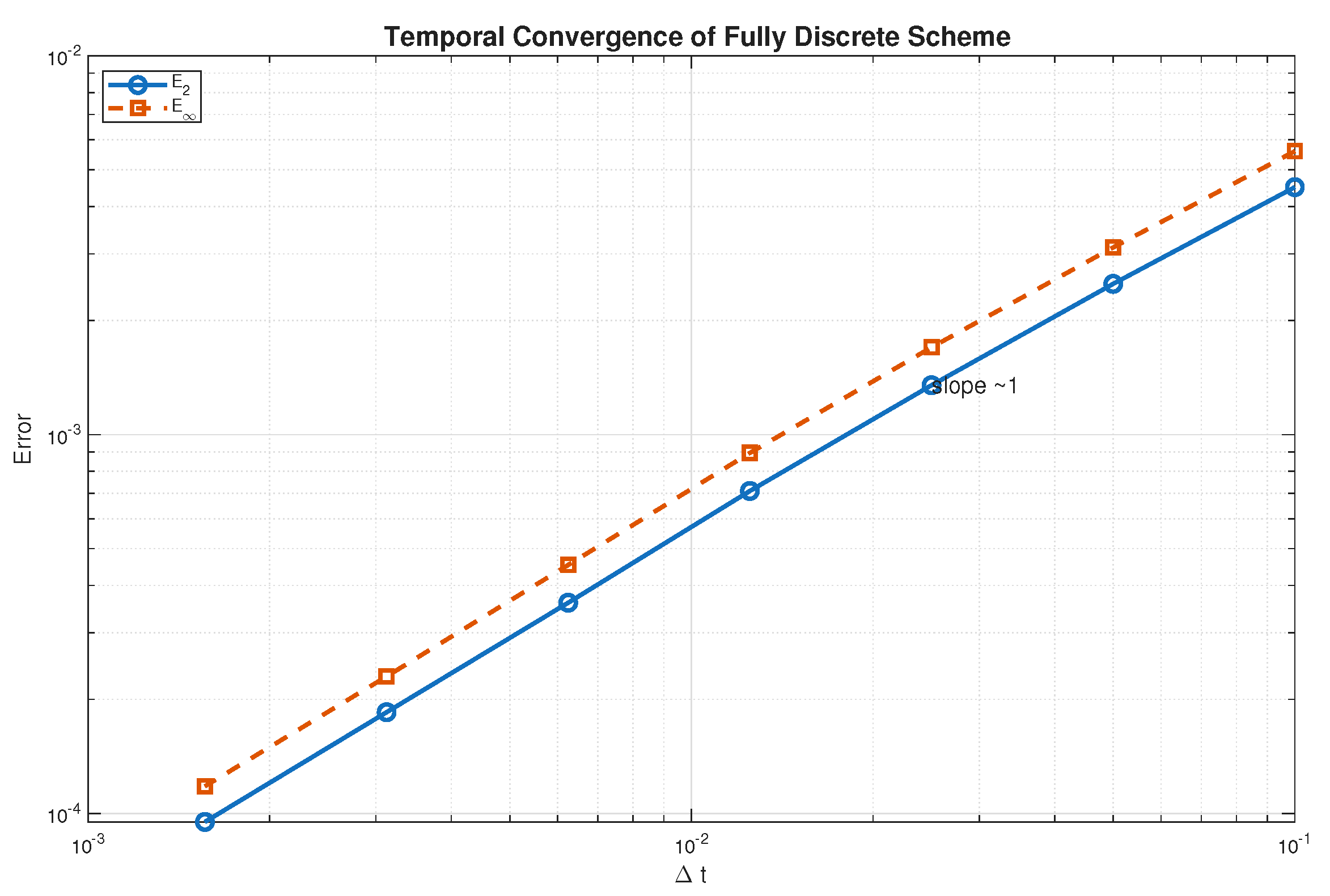
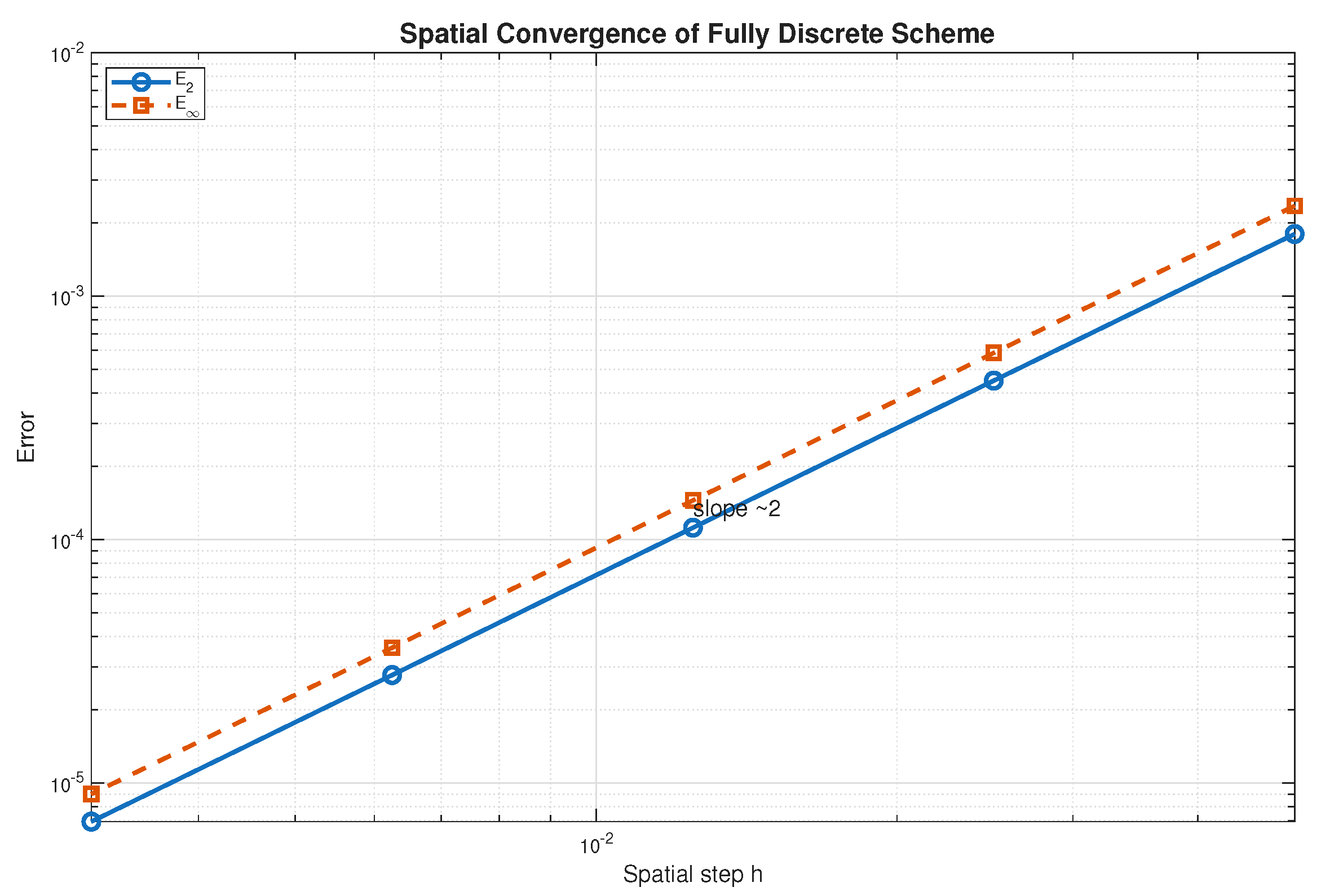
where δ x x u i n = ( u i 1 n 2 u i n + u i + 1 n ) / ( Δ x ) 2 is the central difference approximation of the second derivative. The convolution weights b n , j ( m , α ) are computed using a second-order Lagrange interpolation in time ( m = 2 ). The proposed model describes an anomalous diffusive process with memory effects. The Caputo fractional derivative of order α ( 0 < α < 1 ) incorporates the entire temporal history, so that the current rate of change depends on all previous states with a power-law weighting. The classical second-order spatial term governs local heat or mass transport, while the nonlinear reaction term H ( t , x , u ) = u 2 represents internal self-interactions or quadratic source mechanisms commonly encountered in reaction-diffusion systems. The nonlinear Fredholm integral term captures long-range spatial and temporal nonlocal interactions, allowing the state at any point to be influenced by the solution throughout the space-time domain. Thus, the model simultaneously accounts for anomalous sub-diffusion, strong nonlinearity, and nonlocal coupling, providing a physically realistic description of complex transport phenomena in heterogeneous, structured, or biological media. The accuracy of the fully discrete scheme is thoroughly examined through a manufactured solution with known exact form. Table 1 and Table 2 report the temporal and spatial errors measured in both L 2  and  L norms. When the spatial step is fixed at h = 10 4 and the time step Δ t is successively refined, the errors decrease at a rate very close to O ( Δ t 2 α ) , confirming nearly second-order temporal accuracy as predicted by the second-order Lagrange interpolation approximation of the Caputo derivative. Conversely, with a fixed time step Δ t = 10 3 and successive halving of the spatial step h, the errors are reduced by approximately a factor of four, clearly demonstrating second-order spatial convergence O ( h 2 ) consistent with the central difference discretization of the Laplacian. These convergence behaviors are further illustrated in the log–log plots of Figure 1 and Figure 2. Figure 1 shows the steady reduction in both L 2 and L errors versus Δ t , with the reference line confirming the expected temporal order. Figure 2 displays the corresponding spatial error decay, where the reference line of slope 2 validates the second-order spatial accuracy. Collectively, the tables and figures provide compelling evidence of the robustness, high-order accuracy, and reliability of the proposed fully discrete scheme for nonlinear fractional PDEs with nonlocal integral terms.

5. Conclusions

In this study, we introduced a nonlinear time-fractional partial differential equation that incorporates a Caputo derivative, a second-order spatial diffusion operator, a nonlinear reaction term, and a nonlinear Fredholm integral operator. This general model simultaneously captures memory effects, anomalous sub-diffusion, strong nonlinearity, and long-range nonlocal interactions—features that are essential for an accurate description of many complex transport processes but cannot be adequately represented by classical integer-order PDEs. A fully discrete, high-order numerical scheme was developed by combining second-order Lagrange interpolation for the Caputo fractional derivative with the standard central difference approximation in space. A detailed convergence and stability analysis established that the method achieves second-order accuracy in space and nearly second-order accuracy ( 2 α ) in time. These theoretical findings were fully corroborated by numerical experiments on a manufactured solution with known exact form, where errors in both L 2 and L norms exhibited the predicted convergence rates. Compared with the widely used first-order L1 scheme, the proposed Lagrange-interpolation approach delivers markedly smaller temporal errors at a comparable computational cost while preserving unconditional stability. Although the scheme is highly efficient for the class of problems considered, the history-dependent nature of fractional derivatives inevitably increases memory requirements and computational cost as the time grid is refined. Extending the method to multi-dimensional geometries, variable-order or multi-term fractional operators, or strongly nonlinear regimes may require further optimizations such as fast convolution algorithms, adaptive time-stepping, or parallel implementations. Future research directions include the development of preconditioned iterative solvers for the resulting nonlinear systems, incorporation of space-time adaptivity, extension to variable-order and distributed-order fractional models, and application of the framework to real-world problems in viscoelasticity, anomalous heat transfer in heterogeneous media, contaminant transport in fractured porous materials, and radiative transfer in participating media. In summary, the proposed model and the associated high-order fully discrete scheme provide a robust, accurate, and versatile computational tool for investigating a broad range of nonlinear, memory-dependent, and spatially nonlocal transport phenomena, laying a solid foundation for future advances in fractional calculus and its applications in physics, engineering, and beyond.

Author Contributions

Conceptualization, X.S. and R.C.; methodology, X.S. and R.C.; software, X.S. and R.C.; validation, X.S. and R.C.; formal analysis, X.S. and R.C.; investigation, X.S. and R.C.; resources, X.S. and R.C.; data curation, X.S. and R.C.; writing—original draft preparation, X.S. and R.C.; writing—review and editing, X.S. and R.C.; visualization, X.S. and R.C.; supervision, X.S. and R.C.; project administration, X.S. and R.C.; funding acquisition, X.S. Authors equally contributed to this work. All authors have read and agreed to the published version of the manuscript.

Funding

This work is supported by the State Key Program of National Natural Science of China with grant No. 62332006.

Data Availability Statement

No data were used to support this study.

Conflicts of Interest

The authors declare that they have no competing interests.

References

  1. Kilbas, A.A. Theory and applications of fractional differential equations. In North-Holland Mathematics Studies; Elsevier: Amsterdam, The Netherlands, 2006; Volume 204. [Google Scholar]
  2. Prakash, P.; Harikrishnan, S.; Benchohra, M. Oscillation of certain nonlinear fractional partial differential equation with damping term. Appl. Math. Lett. 2015, 43, 72–79. [Google Scholar] [CrossRef]
  3. Syam, S.M.; Siri, Z.; Altoum, S.H.; Aigo, M.A.; Kasmani, R.M. A novel study for solving systems of nonlinear fractional integral equations. Appl. Math. Sci. Eng. 2023, 31, 2277738. [Google Scholar] [CrossRef]
  4. Podlubny, I. Fractional Differential Equations: An Introduction to Fractional Derivatives, Fractional Differential Equations, to Methods of Their Solution and Some of Their Applications; Elsevier: Amsterdam, The Netherlands, 1998; Volume 198. [Google Scholar]
  5. Choudhary, R.; Singh, S.; Das, P.; Kumar, D. A higher order stable numerical approximation for time-fractional non-linear Kuramoto–Sivashinsky equation based on quintic B-spline. Math. Methods Appl. Sci. 2024, 47, 11953–11975. [Google Scholar] [CrossRef]
  6. Diethelm, K.; Ford, N.J. Analysis of fractional differential equations. J. Math. Anal. Appl. 2002, 265, 229–248. [Google Scholar] [CrossRef]
  7. Cai, R.; Kosari, S.; Shafi, J.; Derakhshan, M.H. Stability analysis study for the time-fractional Galilei invariant advection-diffusion model of distributive order using an efficient hybrid approach. Phys. Scr. 2024, 99, 125229. [Google Scholar] [CrossRef]
  8. Chen, Z.; Kosari, S.; Shafi, J.; Derakhshan, M.H. Stability analysis study of time-fractional nonlinear modified Kawahara equation based on the Homotopy perturbation Sadik transform. Fractal Fract. 2024, 8, 512. [Google Scholar] [CrossRef]
  9. Zhang, X.; Feng, Y.; Luo, Z.; Liu, J. A spatial sixth-order numerical scheme for solving fractional partial differential equation. Appl. Math. Lett. 2025, 159, 109265. [Google Scholar] [CrossRef]
  10. Atta, A.G.; Abd-Elhameed, W.M.; Youssri, Y.H. Approximate collocation solution for the time-fractional Newell-Whitehead-Segel equation. J. Appl. Comput. Mech. 2025, 11, 529–540. [Google Scholar]
  11. Delkhosh, M.; Parand, K. A new computational method based on fractional Lagrange functions to solve multi-term fractional differential equations. Numer. Algorithms 2021, 88, 729–766. [Google Scholar] [CrossRef]
  12. Shah, F.; Afef, K.; Gómez-Aguilar, J.; Aljawi, S.; Popa, I.L. Analysis of a Laplace Spectral Method for Time-Fractional Advection-Diffusion Equations Incorporating the Atangana-Baleanu Derivative. Comput. Model. Eng. Sci. 2025, 143, 3433. [Google Scholar] [CrossRef]
  13. Zhu, L.; Fan, Q. Solving fractional nonlinear Fredholm integro-differential equations by the second kind Chebyshev wavelet. Commun. Nonlinear Sci. Numer. Simul. 2012, 17, 2333–2341. [Google Scholar] [CrossRef]
  14. Dehghan, M.; Manafian, J.; Saadatmandi, A. Solving nonlinear fractional partial differential equations using the homotopy analysis method. Numer. Methods Partial Differ. Equations 2010, 26, 448–479. [Google Scholar] [CrossRef]
  15. Jafari, H.; Seifi, S. Solving a system of nonlinear fractional partial differential equations using homotopy analysis method. Commun. Nonlinear Sci. Numer. Simul. 2009, 14, 1962–1969. [Google Scholar] [CrossRef]
  16. Momani, S.; Odibat, Z. A novel method for nonlinear fractional partial differential equations: Combination of DTM and generalized Taylor’s formula. J. Comput. Appl. Math. 2008, 220, 85–95. [Google Scholar] [CrossRef]
  17. Xu, H.; Liao, S.J.; You, X.C. Analysis of nonlinear fractional partial differential equations with the homotopy analysis method. Commun. Nonlinear Sci. Numer. Simul. 2009, 14, 1152–1156. [Google Scholar] [CrossRef]
  18. Bakkyaraj, T. Lie symmetry analysis of system of nonlinear fractional partial differential equations with Caputo fractional derivative. Eur. Phys. J. Plus 2020, 135, 126. [Google Scholar] [CrossRef]
  19. Kosari, S.; Xu, P.; Shafi, J.; Derakhshan, M. An efficient hybrid numerical approach for solving two-dimensional fractional cable model involving time-fractional operator of distributed order with error analysis. Numer. Algorithms 2025, 99, 1269–1288. [Google Scholar] [CrossRef]
  20. Kosari, S.; Derakhshan, M. An Efficient Numerical Approach for Solving Time-Space Fractional Wave Model of Multiterm Order Involving the Riesz Fractional Operators of Distributed Order with the Weakly Singular Kernel Along with Stability Analysis. Math. Methods Appl. Sci. 2025, 48, 9993–10007. [Google Scholar] [CrossRef]
  21. Shao, Z.; Kosari, S.; Yadollahzadeh, M.; Derakhshan, M. Stability analysis of an efficient hybrid numerical approach for solving the two-dimensional space/multi-time fractional Bloch-Torrey model involving the Riesz fractional operator. Numer. Algorithms 2025, 1–27. [Google Scholar] [CrossRef]
  22. Matoog, R.T.; Mahdy, A.M.; Abdou, M.A.; Mohamed, D.S. A computational method for solving nonlinear fractional integral equations. Fractal Fract. 2024, 8, 663. [Google Scholar] [CrossRef]
  23. Maleknejad, K.; Rashidinia, J.; Eftekhari, T. Existence, uniqueness, and numerical solutions for two-dimensional nonlinear fractional Volterra and Fredholm integral equations in a Banach space. Comput. Appl. Math. 2020, 39, 271. [Google Scholar] [CrossRef]
  24. Najafalizadeh, S.; Ezzati, R. Numerical methods for solving two-dimensional nonlinear integral equations of fractional order using two-dimensional block pulse operational matrices. Appl. Math. Comput. 2016, 280, 46–56. [Google Scholar]
  25. Rawashdeh, M.S.; Abedalqader, H.; Obeidat, N.A. Convergence analysis for the fractional decomposition method applied to a class of nonlinear fractional Fredholm integro-differential equations. J. Algorithms Comput. Technol. 2023, 17, 17483026221151196. [Google Scholar] [CrossRef]
  26. Guner, O.; Bekir, A. A novel method for nonlinear fractional differential equations using symbolic computation. Waves Random Complex Media 2017, 27, 163–170. [Google Scholar] [CrossRef]
  27. Gao, D.; Qiu, Z.; Wang, L.; Li, J. A Simple and Effective Second-Order Numerical Algorithm for Tempered Fractional Differential Equation with Time Caputo-Tempered Fractional Derivative. Adv. Math. Phys. 2025, 2025, 5518224. [Google Scholar] [CrossRef]
  28. Kosmatov, N. Integral equations and initial value problems for nonlinear differential equations of fractional order. Nonlinear Anal. Theory Methods Appl. 2009, 70, 2521–2529. [Google Scholar] [CrossRef]
  29. Lu, B. Bäcklund transformation of fractional Riccati equation and its applications to nonlinear fractional partial differential equations. Phys. Lett. A 2012, 376, 2045–2048. [Google Scholar] [CrossRef]
  30. Mohammad, M.; Trounev, A. Fractional nonlinear Volterra–Fredholm integral equations involving Atangana–Baleanu fractional derivative: Framelet applications. Adv. Differ. Equ. 2020, 2020, 618. [Google Scholar] [CrossRef]
  31. Kai, Y.; Chen, S.; Zhang, K.; Yin, Z. Exact solutions and dynamic properties of a nonlinear fourth-order time-fractional partial differential equation. Waves Random Complex Media 2025, 35, 2539–2550. [Google Scholar] [CrossRef]
  32. Ullah, M.S.; Ali, M.Z.; Roshid, H.O. Bifurcation analysis and new waveforms to the first fractional WBBM equation. Sci. Rep. 2024, 14, 11907. [Google Scholar] [CrossRef]
Figure 1. Temporal convergence of the fully discrete numerical scheme for a fixed spatial step ( h = 10 4 ) .
Fractalfract 10 00026 g001
Figure 2. Spatial convergence of the fully discrete numerical scheme for a fixed time step Δ t = 10 3 .
Fractalfract 10 00026 g002
Table 1. Temporal convergence of the fully discrete scheme for fixed spatial step h = 10 4 .
Δ t E 2 E p t
1 / 10 4.50 × 10 3 5.60 × 10 3
1 / 20 2.50 × 10 3 3.12 × 10 3 0.85
1 / 40 1.35 × 10 3 1.70 × 10 3 0.89
1 / 80 7.10 × 10 4 8.95 × 10 4 0.93
1 / 160 3.60 × 10 4 4.53 × 10 4 0.98
Table 2. Spatial convergence of the fully discrete scheme for fixed time step Δ t = 10 3 .
h E 2 E p x
1 / 20 1.80 × 10 3 2.35 × 10 3
1 / 40 4.50 × 10 4 5.85 × 10 4 2.00
1 / 80 1.12 × 10 4 1.45 × 10 4 2.01
1 / 160 2.78 × 10 5 3.60 × 10 5 2.01
1 / 320 6.95 × 10 6 9.02 × 10 6 2.00
Disclaimer/Publisher’s Note: The statements, opinions and data contained in all publications are solely those of the individual author(s) and contributor(s) and not of MDPI and/or the editor(s). MDPI and/or the editor(s) disclaim responsibility for any injury to people or property resulting from any ideas, methods, instructions or products referred to in the content.