Article

Fractional Grey Breakpoint Model for Forecasting PM2.5 Under Energy Policy Shock

by
Haolei Gu
1,
Yuchen Wang
2,* and
Tongyang Yang
3
1
School of Management Engineering and Business, Hebei University of Engineering, Handan 056107, China
2
School of Management Science and Engineering, Shandong University of Finance and Economics, Jinan 250014, China
3
School of Business Administration, Widener University, One University Place, Chester, PA 19013, USA
*
Author to whom correspondence should be addressed.
Fractal Fract. 2026, 10(1), 24; https://doi.org/10.3390/fractalfract10010024 (registering DOI)
Submission received: 15 November 2025 / Revised: 19 December 2025 / Accepted: 26 December 2025 / Published: 30 December 2025
(This article belongs to the Special Issue Applications of Fractional-Order Grey Models, 2nd Edition)

Abstract

Traditional fossil fuel consumption is the main contributor increased atmospheric PM2.5 concentration. In 2014, China designated 81 new-energy demonstration cities, aiming to replace traditional fossil fuel energy with renewable energy. This research aimed to forecast PM2.5 trends. Fractional policy shock term was introduced into grey model to simulate the temporal variability. This model was compared with several existing models to confirm its accuracy and efficacy. We also assessed the robustness characteristics of key parameter. This research found the following: (1) The new-energy demonstration policy achieved stable PM2.5 reductions in the Beijing-Tianjin-Hebei agglomeration. The policy showed strong regional linkages and marginal mitigation effects. (2) The fractional breakpoint grey model (FBGM(s,t)) outperformed existing classical forecasting models and neural networks in fitting and generalization capability. FBGM(s,t) decreased the MAPE by over 2% across all four cities. (3) Robustness analyzes confirmed that the model’s performance advantage remained stable under reasonable parameter variations.

1. Introduction

Haze is a meteorological phenomenon provoked by pollutants. These pollutants will cause nasal congestion, coughing, and other related symptoms [1]. Haze even contributes to respiratory and cardiovascular diseases [2]. Public health expenditures resulting from these adverse effects account for about 2% of a city’s GDP [3]. Haze largely arises from various pollution sources, especially fine particulate matter (PM2.5). Therefore, air quality improvement depends on reducing PM2.5 emissions [4]. The Chinese Ecological Environment Bulletin revealed that 86 cities still exceeded the prescribed standards for PM2.5, and 55 cities still exceeded the prescribed standards for respirable particulate matter. The environmental Kuznets curve suggests that the elevated atmospheric PM2.5 levels in China can be attributed to the nation’s economic progress. Energy demand has increased fossil fuel consumption, thus deteriorating the air quality. In particular, coal-driven fossil fuel emissions are the main contributor to haze pollution in China [5]. Therefore, fossil fuel substitution is key to addressing the atmospheric PM2.5 concentration problem.
Renewable energy sources’ widespread adoption is pivotal for reducing excessive atmospheric PM2.5 concentrations [6,7]. Renewable energy can have minimal environmental effects with advanced energy technology. Renewable energy combined with fossil energy can promote energy structural optimization and drive low-carbon transformation [8]. In addressing excessive PM2.5 emissions from traditional fossil fuels [9] and the associated ecological degradation [10], renewable energy proportion increases can also reduce the environmental footprint of energy consumption. This will not only reduce energy-consumption costs [11] but also promote industrial structural upgrading [12] and curtail greenhouse gas emissions [13,14]. Recognizing air quality’s health implications, the public has indicated a willingness to bear an additional electricity cost of USD 4.39 to bolster renewable electricity [15] and to pay a premium of 30% for cleaner air [16]. However, the energy sector remains hindered by government funding constraints [17]. The renewable energy sector lacks low-interest credit support. This constraint hinders energy structural transition and air quality improvement [18]. Therefore, the energy authority hopes to find ways to modify the energy structure, boost renewable energy investment, address public air quality concerns, and reduce atmospheric PM2.5 concentrations.
According to social contract theory, a government emerges from the public’s willingness to cede some individual rights in exchange for social order and public services. Government policy should represent the public interest and address societal concerns. As a public product, the air quality product is noncompetitive and nonexclusive. Free market transactions cannot effectively allocate resources, thus necessitating policy intervention [19]. To mitigate atmospheric PM2.5 concentrations, various countries have adopted renewable energy policies intended to reduce fossil fuel consumption, greenhouse gas emissions, and PM2.5 discharge. A solar energy subsidy program for rural households in Poland encouraged residents to purchase solar power systems [20]. Renewable energy policy has spurred economic growth and reduced deaths from air pollution [21]. China’s air pollution prevention and control law phased out conventional, inefficient combustion systems, promoting energy system reform [22]. Residents switching from coal to electricity or natural gas have significantly reduced PM2.5 emissions [23]. Since China’s coal-to-gas policy was implemented, PM2.5 emissions have decreased at 1.2% annually [24]. Province-level renewable energy policies can not only reduce local air pollutant emissions but also promote emission reduction in neighboring provinces [25]. Therefore, government support for new energy is critical for upgrading the energy structure, elevating renewable energy’s role, and decreasing PM2.5 emissions. In 2014, the renewable energy demonstration city pilot policy promoted renewable energy’s application and fostered sustainable development.
Although the Beijing-Tianjin-Hebei agglomeration has deep historical roots, administrative and economic differences impede its collaborative management [26]. Hebei Province is a major exporter of metals, nonmetals, electricity, gas, and other resources while Beijing and Tianjin are net energy importers [27]. Hebei bears ecological pressure without receiving corresponding benefits [28]. Since environmental costs are not reflected in market transactions, the coal utilization efficiency of the Beijing-Tianjin-Hebei agglomeration is low. This not only wastes resources but also increases PM2.5 emissions [29]. Therefore, PM2.5 emission trends identified in the new-energy demonstration city policy requires understanding policy shock effects and temporal variability.
PM2.5 emission trends are subject to multiple factors, showing complex, multiattribute characteristics. PM2.5 emission trend forecast in small datasets and incomplete information environment are key to policy effect evaluation in Beijing-Tianjin-Hebei agglomeration. Grey forecasting models can mitigate the data stochasticity effect, achieving a high accuracy. These models have shown a good forecasting performance in various scenarios and are adaptable when combined with other statistical and economic models. Wu et al. [30] extend traditional integer-order buffering operators to fractional-order buffering operators. Zeng et al. [31] proposed an unbiased grey forecasting model for shale gas production using the grey weakening buffer operator. Zheng et al. [32] proposed a grey forecasting model combining the nonlinear grey Bernoulli model with the Cobb–Douglas production function. Using real-time data from coal stockpile sensors, Li et al. [33] proposed a metabolic model to update the sequence cyclically, accurately predicting heat loss capacity using real-time coal stockpile data. Chen et al. [34] introduced a fractional Hausdorff grey model, demonstrating its independence from the initial value by establishing the relationship between fractional order and error. Based on the principle of traffic flow mechanics, Xiao and Duan [35] developed a grey model using differential equations to predict the short-term traffic flow on roads. Javed et al. [36] applied a grey model to demonstrate that biofuel is more likely to serve as a complementary fuel than an alternative. Xie et al. [37] combined an optimization algorithm with a fractional grey model to reduce the error in predicting annual Chinese electricity consumption. To reduce the complexity of landslide displacement simulation, Wu et al. [38] proposed a univariate model that incorporated time influences. Zhou et al. [39] applied a discrete grey model accounting for nonlinearity and fluctuations to analyze the low natural gas consumption in Jiangsu. Given the threats of energy shortages and environmental problems, several grey forecasting models have been introduced to estimate nuclear energy consumption [40] and photovoltaic power generation [41] in China. Given their unique advantages for small datasets, grey forecasting models have been widely used to forecast trends of transportation, construction, and energy. Therefore, PM2.5 models should be adapted to policy shock characteristics for enhanced adaptability.
The structure of this paper is as follows. Section 2 proposed a novel FBGM(s,t) model and analyzed its characteristics. In Section 3 applied the novel model to pilot cities within the Beijing-Tianjin-Hebei agglomeration. We also analyzed the statistical performance and stability of the novel model. Section 4 summarizes the findings and makes policy recommendations. At the end, we analyze the limitations of this research.

2. Fractional Breakpoint Grey Model

2.1. Novel Fractional Breakpoint Grey Model FBGM(s,t)

Existing grey breakpoint models typically assume that policy shocks exert a constant influence on the system’s evolutionary path across subsequent periods once implemented. However, policy effects demonstrate a markedly nonlinear temporal evolution, gradually diminishing or intensifying over time. If this characteristic is overlooked, it may lead to an inaccurate portrayal of the evolutionary trends in policy-driven system dynamics. To overcome these limitations, this research introduced a fractional-order adjustment parameter S within the breakpoint grey model framework, thereby constructing a novel fractional breakpoint grey model (FBGM(s,t)) to capture the dynamic temporal characteristics of policy shock effects. FBGM(s,t) provided a non-integer-scale temporal adjustment of the policy shock term through the fractional-order parameter S , thereby reflecting the memory and persistence of the policy effect.
We modelled the original non-negative time series by applying a single accumulation operation (1-AGO) in accordance with the GM(1,1) model’s conceptual framework. It will attenuate random fluctuations and accentuate the system’s overall evolutionary trend. Assuming a policy shock occurred at time t * , this shock is represented as a structural perturbation to the original grey system, expressed as shown in Equation (1).
ϕ = S k t + 1 , k t * 0 , k < t *
Based on the generated accumulation sequence, the corresponding grey background value sequence satisfied the following relationship:
X ( 0 ) ( k ) + ( a ^ + ε S k t * + 1 ) Z ( 1 ) ( k ) = b ^ + c S k t * + 1
where a ^ and b ^ , which represent the characteristics of the original grey system, are derived from the parameter estimation of the GM(1,1) model over the period of 1 to t 1 where no policy shock has occurred. S is estimated by fitting the time-series data using a particle swarm algorithm. ε ^ and c ^ are estimated with the least-squares method. The estimation process is shown below.
First, the following formulas for the grey system hold when no policy shock is exerted:
a ^ b ^ = min i = t n X ( 0 ) ( k ) + a Z ( 1 ) ( k ) b a ^ b ^ = ( B T B ) 1 B T Y B =   Z ( 1 ) ( t * )   1 Z ( 1 ) ( t * + 1 ) 1 Z ( 1 ) ( n ) 1   Y = X ( 0 ) ( t * ) X ( 0 ) ( t * + 1 ) X ( 0 ) ( n )
Second, when considering the perturbation of a policy shock on the original grey system, we can separate the perturbation terms ε ^ and c ^ as follows:
ε ^ c ^ = min i = 1 n X ( 0 ) ( k ) + ( a ^ + ε S k t * + 1 ) Z ( 1 ) ( k ) b ^ c S k t * + 1
The parameter S is employed to regulate the intensity of policy shock dynamics across the temporal dimension. When the policy shock effect exhibited time adjustment characteristics on a non-integer scale, it revealed the model’s fractional-order property.
The final forecast is
X ^ ( 1 ) ( k ) = ( X ( 0 ) ( 1 ) b a ) e a ( k 1 ) + b a , t < t * X ^ ( 1 ) ( k ) = ( X ( 0 ) ( t * 1 ) b ^ + b ^ b ^ S k t * + 1 a ^ + a ^ a ^ S k t * + 1 ) e ( a ^ + a ^ a ^ S k t * + 1 ) ( k t * + 1 ) + b ^ + b ^ b ^ S k t * + 1 a ^ + a ^ a ^ S k t * + 1 , t t *

2.2. Model Application Hypothesis

Hypothesis 1.
Before the breakpoint, the system remained in a state prior to the policy shock. The grey system structure should remain relatively stable within a finite sample window.
Proof. 
There exists in the parameter estimation process
θ ^ = a ^ b ^ = ( B T B ) 1 B T Y θ = [ a , b ] T
When the matrix is full rank, the solution is unique. At this moment, Y = B θ + ε . ε represents an unobservable disturbance term. Both sides multiply ( B T B ) 1 B T , and there is θ ^ = θ + ( B T B ) 1 B T ε . Consequently, the parameter estimation error is solely determined by the disturbance term and does not stem from structural parameter variability. Therefore, before the policy shock has occurred, it is reasonable to assume structural stability within the grey system. The model parameters possess identifiability and estimation are stability. □
Hypothesis 2.
Within finite observation and forecasting windows that policy shock effect evolution is smooth and controllable.
Proof. 
According to the definition of the FBGM(s,t) model, the sample size under policy shocks is T = n t * + 1 , and the fractional disturbance term forms a finite set. Therefore, there must exist a constant M > 0 , satisfying ϕ ( k ) M , k > t * . Furthermore, consider the variation magnitude in shock effects across neighboring periods. Because ϕ ( k ) is evolving sequentially within a finite window, its neighboring period differences likewise take values from a finite set. Consequently, there exists a constant L > 0 such that ϕ ( k + 1 ) ϕ ( k ) = S k t * + 2 S k t * + 1 L , k > t * . Therefore, within the research window, the policy shock effect not only has a bounded magnitude but also exhibits controlled temporal variation, satisfying shock smoothness requirements. □
Hypothesis 3.
The policy shock disturbance term in FBGM(s,t) exhibits an optimal temporal evolution intensity that minimizes the overall model fitting error.
Proof. 
Define the objective function as
J ( ξ ) = k = t * n ( x ( 0 ) ( k ) x ^ ( 0 ) ( k ; ξ ) ) 2
ξ denotes the temporal evolution intensity of the policy shock term, with its search range confined to the finite interval Ω = [ ξ min , ξ max ] . As ξ approaches its lower bound, the influence of the policy shock disturbance term on the system’s evolution significantly diminishes. The model tends towards a traditional GM(1,1) model. In the presence of policy shocks, this specification will induce systematic deviation, preventing modelling from sufficiently capturing structural variation post-breakpoint. This will result in residuals continuing to accumulate during the post-shock period. When ξ is approaching the upper limit, the policy shock disturbance term becomes excessively amplified, rendering the model highly sensitive to localized changes post-breakpoint and prone to overfitting at select time points. Although local fitting errors may have decreased, model stability has diminished across the entire sample range, with residuals at other time points being amplified. Under finite samples, x ^ ( 0 ) ( k ; ξ ) is a continuous function of ξ . The objective function is continuous on the finite interval. Since the set Ω is compact, according to Weierstrass’s extremum theorem, there exists
ξ Ω             s . t . J ( ξ * ) = min ξ Ω   J ( ξ )
Therefore, within a finite observational sample and finite forecasting window, the optimal temporal evolution intensity of the policy shock disturbance term is theoretically possible. □

2.3. FBGM(s,t) Empirical Framework Design

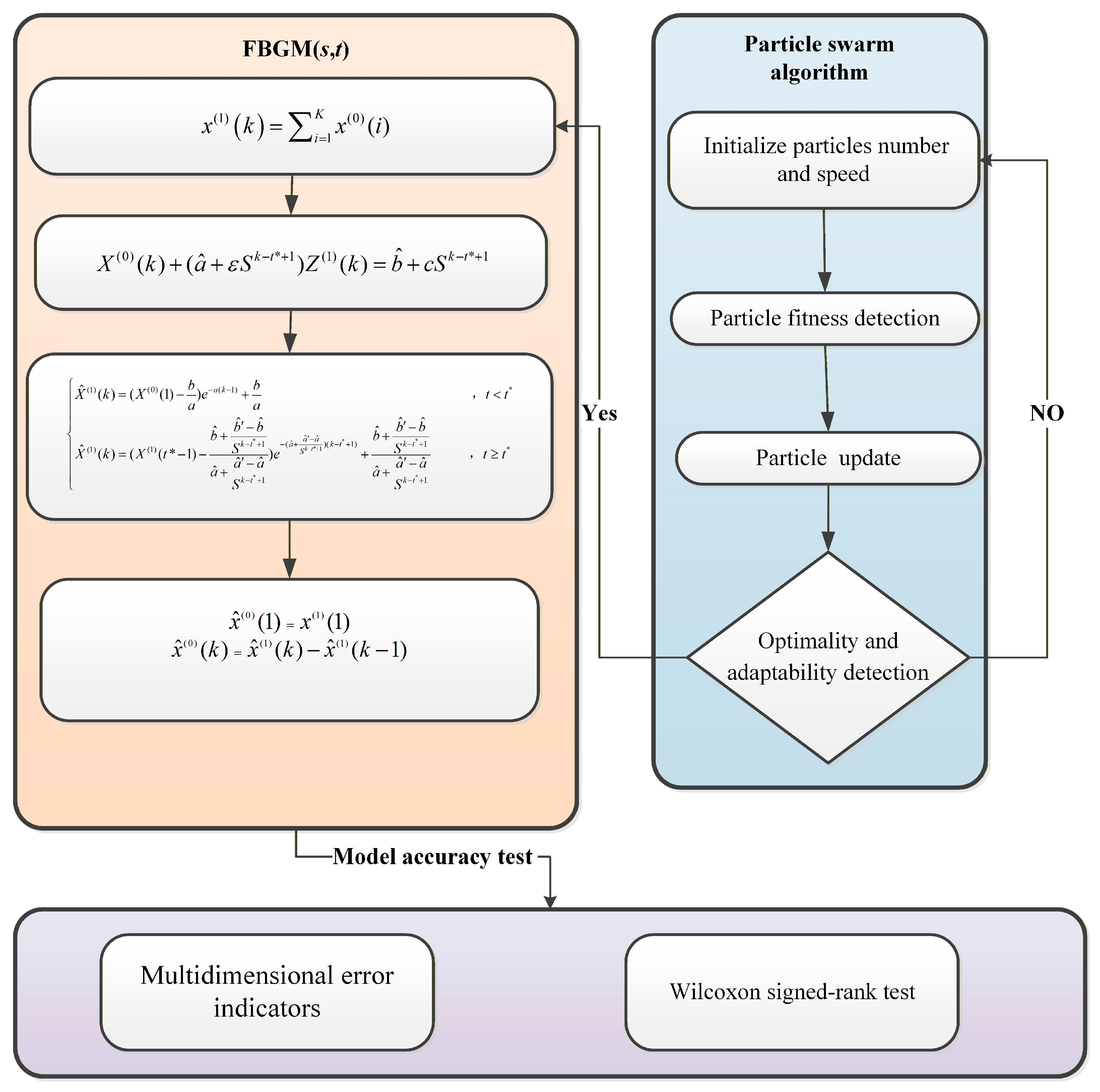
Having completed FBGM(s,t) model structural design and applicable hypothesis formulation, this research further constructed a model solution workflow from the parameter estimation and empirical implementation perspectives. The model’s breakpoint parameter S entered the system equations in a non-linear form, and it influenced the system’s structural and dynamic response term. For parameter S selection, the traditional analytical estimation approach struggles to directly obtain its optimal value. Therefore, this research introduced particle swarm optimization for key parameters.
This research adopted a particle swarm optimization algorithm to refine model parameters. The search dimension was set to 1, with a particle size of 30 and a maximum iteration count of 50. The parameter search interval was constrained to [0.9, 1.1]. The maximum particle velocity was set at 20% of the search interval width to mitigate excessive vibration during the search process. Both the individual learning factor and group learning factor are set to 2. The inertia weight is reduced linearly from 0.9 to 0.4 to balance the global search capability with the local convergence performance. The algorithm adopted a convergence accuracy threshold of 10−8 and a maximum stagnation generation limit of 100 to ensure the stability and effectiveness of the optimization process.
During the parameter optimization stage, MAPE has the advantages of being dimensionless and highly comparable, effectively reflecting the relative magnitude of forecast accuracy at the original data scale. It is particularly suitable for comparing the accuracy across different time points or samples. Therefore, MAPE is adopted as the optimization objective. It will help guide the algorithm towards reducing the model’s relative forecast bias in an overall sense. However, a single accuracy indicator cannot comprehensively portray the model’s forecasting performance. Therefore, this research further introduced the in-sample and out-of-sample root mean square relative forecast errors (RMSPEPR and RMSPEPO) during the model evaluation stage. RMSPEPR reflected the model’s in-sample fitting capability, while RMSPEPO assessed its out-of-sample forecasting performance. Both of them provided supplementary evaluations of the FBGM(s,t) forecasting effectiveness from the dual dimensions of fitting accuracy and forecasting stability. Specifically, data was applied to compute RMSPEPR from 2011-2018, while data was applied to compute RMSPEPO from 2019–2020. MAPE, RMSPEPR, and RMSPEPO are calculated as follows:
M A P E = 1 n i = 1 n x ^ ( 0 ) ( i ) - x ( 0 ) ( i )   x ( 0 ) ( i ) R M S P E P R = 1 n i = 1 n ( x ^ ( 0 ) ( i ) - x ( 0 ) ( i )   x ( 0 ) ( i ) ) 2 R M S P E P O = 1 n f i = n + 1 n + n f ( x ^ ( 0 ) ( i ) - x ( 0 ) ( i )   x ( 0 ) ( i ) ) 2
Following multidimensional error indicators’ comparison, this research further evaluated statistically significant differences in forecast errors between FBGM(s,t) and control models using the Wilcoxon signed-rank test. Let y t denote the observed value at period t , with y ^ t ( f ) and y ^ t ( m ) representing the forecast value of FBGM(s,t) and the baseline model in period t , respectively. The corresponding absolute forecast error per period is defined as
e t ( f ) = y t y ^ t ( f )           e t ( m ) = y t y ^ t ( m )
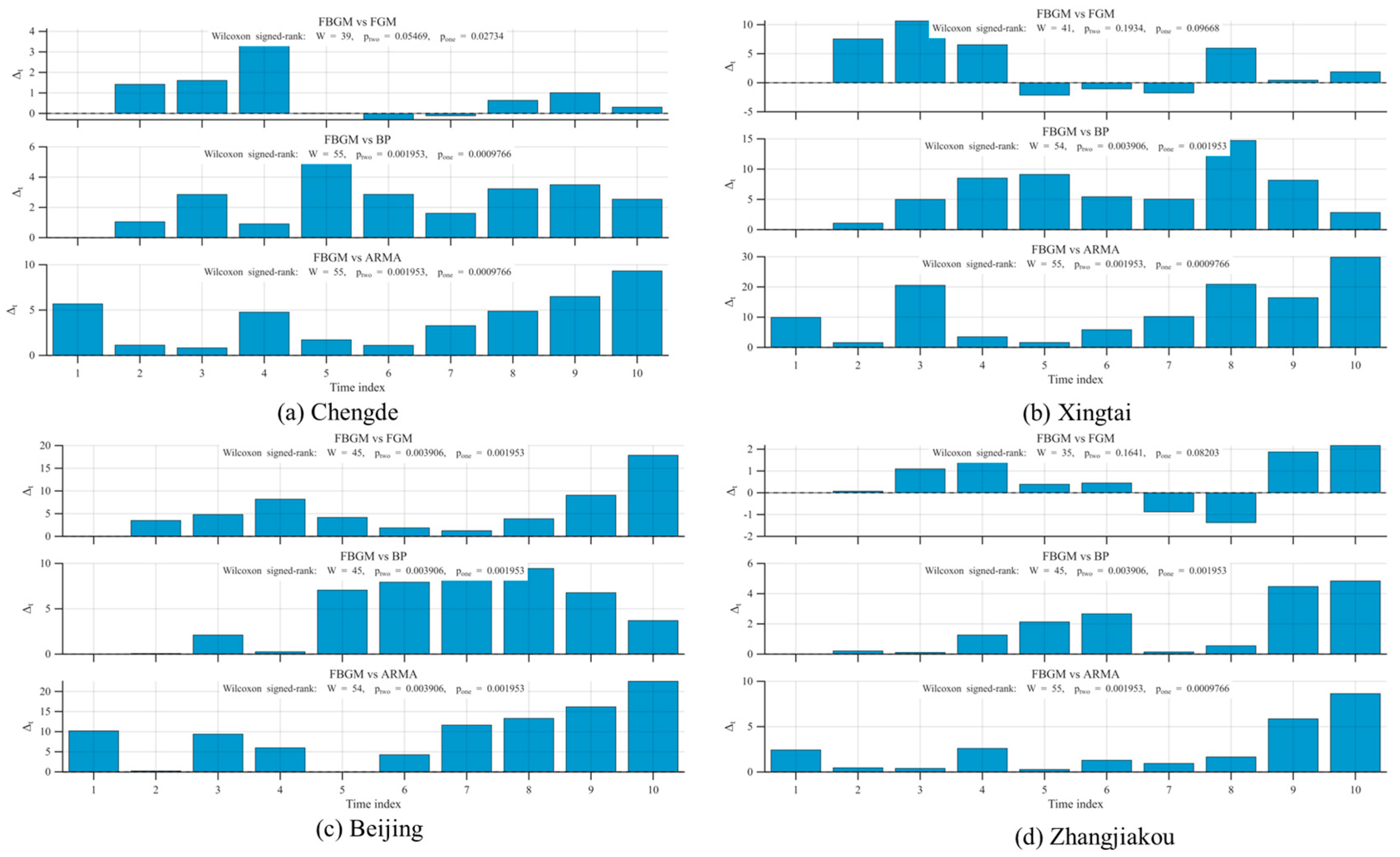
To portray FBGM(s,t)’s error improvement over the time dimension, this paper further constructs a time-phased error difference.
Δ t = e t ( m ) e t ( f )
When Δ t is positive, it indicates that the FBGM(s,t) forecast error in period t is smaller than the benchmark model. When Δ t is on the contrary, it indicates that the FBGM(s,t) forecast error in period t is larger than the benchmark model. To avoid interference from zero differences on rank information, observations of zero are excluded during the verification process. The sign rank statistic W represents a rank-sum measure derived from the Wilcoxon signed-rank test, calculated based on the rank order and sign information of the difference Δ t in period-to-period errors. p t w o is employed to examine the median of the error difference Δ t . This measured the overall statistically significant difference in forecast errors between models. The unilateral p-value p o ne corresponds to an alternative hypothesis with a specified directionality. It is used to examine the error difference for systematic bias towards the FBGM(s,t) side over the time dimension. Specifically, the FBGM(s,t) empirical framework is presented in Figure 1.

3. Empirical Research

3.1. Case Characteristics

The new-energy demonstration city pilot policy has formed a sustainable and systematic suppression force on PM2.5 through the multi-mechanism linkage of “energy structural adjustment-terminal energy consumption transformation-infrastructural matching-governance capability enhancement”. This policy focuses on prioritizing renewable energy development as a core principle, embedding new-energy sources at scale and institutionally within high-emission end-use sectors such as urban power supply, heating, transport, and buildings. It can achieve substantial substitution from the supply side, directly reducing PM2.5 emission intensity. Meanwhile, the policy has strengthened the grid integration capacity and coordinated infrastructural development. The policy is designed to alleviate new-energy transition bottlenecks by refining distributed grid integration conditions and local consumption mechanisms, enhancing clean energy’s stable penetration rate in urban end-use consumption. At the institutional level, pilot cities are integrated into a unified framework encompassing coordinated planning, binding indicator setting, and dynamic monitoring and assessment. This fosters endogenous incentives for local governments to enhance cross-departmental coordination, strengthen implementation efforts, and ensure governance continuity.
The Beijing-Tianjin-Hebei agglomeration has long been a highly sensitive region for complex atmospheric pollution in China. Multiple sources, such as industrial production, transportation, and district heating, are highly intertwined, rendering the air quality responsive to energy structure and end-use variations. Policy intervention has had significant marginal pollution reduction effects. Cities within the Beijing-Tianjin-Hebei agglomeration maintain close interconnections. Regional air pollution has significant cross-boundary transmission characteristics. New-energy demonstration policy implementation not only effects individual cities’ emission structures but may also generate spillover effects through regional coordination and power system integration, providing an appropriate case for analyzing the demonstration city effect.
Within the Beijing-Tianjin-Hebei regional sample, the four cities showed distinct differences in energy structure and governance characteristics: As a national hub city, Beijing has high-level new-energy technology diffusion, grid absorption capacity, and comprehensive governance standards. This reflected a pronounced policy-led effect. As a district under the jurisdiction of Beijing, Changping’s new-energy demonstration project was integrated into the unified municipal governance system in terms of planning coordination, investment and financing support, grid infrastructural provision, and assessment mechanisms. Moreover, air quality statistics and releases are predominantly conducted at the city level. Therefore, Beijing’s PM2.5 data serves as a suitable proxy for the demonstration effect in Changping. It allowed for a reasonable portrayal of the overall evolution of the policy shock. Chengde and Zhangjiakou are located in the northern ecological functional region. These have prominent renewable energy resources, and are better positioned to achieve pollution reduction through clean energy supply expansion. Xingtai relies on coal consumption and has a high industrial emission intensity. New-energy substitution processes often appear as policy responses against high emissions. Therefore, the four pilot cities have markedly different characteristics. It is necessary to test the proposed model’s validity by examining these cities as a research sample.

3.2. Model Validation

Table 1 compared the forecasting accuracy of FBGM(s,t) with FGM(r,1), BP, and ARMA(1,1) across the four pilot cities: Chengde, Xingtai, Beijing, and Zhangjiakou. Model accuracy indicators (MAPE, RMSPEPR, RMSPEPO) are compared, showing that FBGM(s,t) achieved favorable error levels across all four cities. Compared to traditional grey models, FBGM(s,t) decreased the MAPE by over 2% across all four cities. This result reflected the proposed FBGM(s,t) model’s enhanced capability in portraying small-sample, non-stationary series. Compared with data-driven models such as neural networks and statistical models, FBGM(s,t) has advantages in RMSPEPR and RMSPEPO. This phenomenon reflected the robustness of FBGM(s,t) in out-of-sample forecasting and policy perturbation scenarios. In general, Table 1’s results verified the comprehensive forecasting superiority of FBGM(s,t) across multiple indicator dimensions in diverse urban scenarios. This advantage is not driven by a single indicator or individual city, but has a strong consistency and generalizability.
After multi-dimensional error indicator comparing the forecast accuracy across models, we further tested the Wilcoxon signed-rank indicator. The Wilcoxon signed-rank test serves to examine FBGM(s,t)’s statistically significant systematic advantage over the control model. Considering the limited sample size and possible deviation from the normal distribution hypothesis, a non-parametric experiment based on paired samples can avoid a distribution setting bias. This is suitable for testing model robustness, thereby providing supplementary statistical evidence comparing multidimensional error indicators. Figure 2 showed positive residuals for the period error difference across most time points in each city, clearly indicating that FBGM(s,t) generally outperformed the other models over time. The Wilcoxon signed-rank statistic and one-tailed p-value further indicated that this advantage reached a significant level when compared with the neural network and ARMA(1,1). Moreover, this model also reached the significance threshold when compared with traditional FGM(r,1). This result indicated that FBGM(s,t)’s performance improvement was not driven by individual extreme observations, but rather persisted consistently over most periods. Therefore, Wilcoxon signed-rank indicator validated FBGM(s,t)’s systematic forecasting advantage under policy shock scenarios in a small sample.

3.3. Robustness Analyze

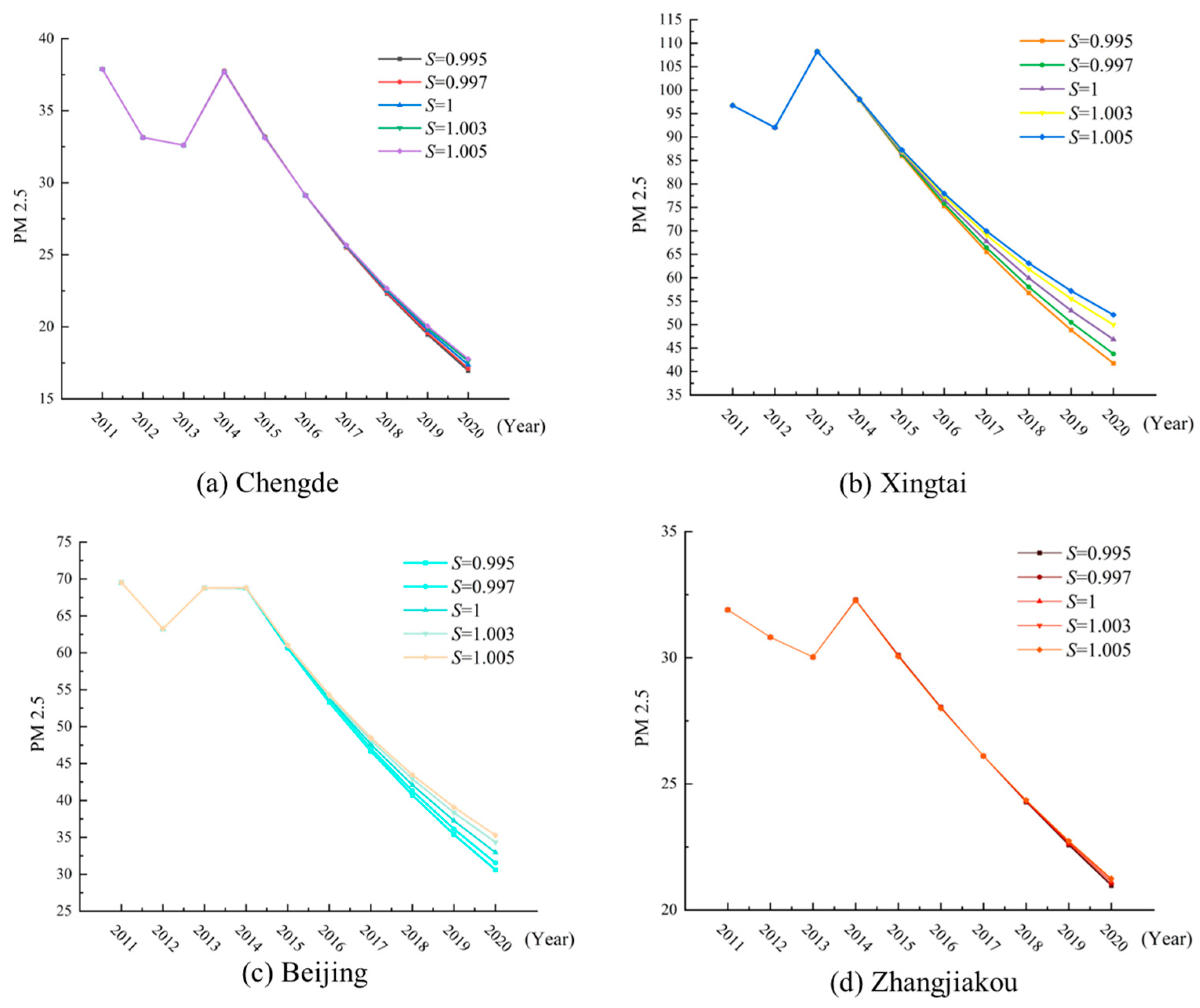
When forecasting models are constructed under small sample sizes and strong policy disturbances, it is difficult to fully assess the reliability and generalizability of the model based on single parameter setting. Therefore, it is necessary to assess the sensitivity of the results through a robustness analyze of key parameters to determine the novel model’s structural advantage. The FBGM(s,t) parameter serves as the core conditioner describing the policy shock intensity and temporal evolution characteristics. It is embedded within response functions in nonlinear forms, directly influencing the system memory depth and attenuation rate for external shocks. By adjusting within a reasonable range, it is possible to systematically examine the model’s forecast performance under different shock intensity hypotheses, assessing the model’s sensitivity and stability to this parameter. The selections in this research are confined within both the theoretically feasible domain and the numerically stable range. This approach avoided breaking model structural hypotheses while covering typical scenarios, rendering it appropriate as a representative parameter combination for robustness testing. The model robustness analyze for the pilot cities is shown in Figure 3.
Based on the empirical results from Chengde, Xingtai, Beijing, and Zhangjiakou, it can be observed that under varying conditions, the forecast accuracy ranking and relative advantage of the FBGM(s,t) model remain highly consistent. The error levels demonstrate only limited smooth fluctuations, with no performance mutation or reversal. This suggests that the model was insensitive to shock parameters. Its forecasting performance improvement does not depend on any specific parameter setting. Further, when comparing different cities, although the samples have significant differences in energy structure, emission characteristics, and policy response intensity, FBGM(s,t) demonstrated a relatively stable performance range across all cities. This indicated that the model could maintain structural consistency under heterogeneous scenarios. The results reflect that FBGM(s,t) has a good robustness to parameters. The forecasting advantage is derived from model structures effectively capturing the policy shock evolution mechanism, rather than relying on specific parameters. This validation enhanced the reliability and practical value of FBGM(s,t).

4. Conclusions and Policy Recommendations

4.1. Research Conclusions

Focusing on forecasting haze pollutant emissions, we examined PM2.5 emission trends in four new-energy demonstration pilot cities in the Beijing-Tianjin-Hebei agglomeration form 2011–2020. Drawing on the existing grey breakpoint model, we innovatively considered temporal variability in the policy shock effect by introducing a fractional policy shock term. We compared our proposed grey forecasting model with other classical models, confirming its superior fitting and forecasting performance when working on a small time-series dataset with breakpoints. This work contributes to the growing body of research on fractional-order grey models and highlights their flexibility and applicability in complex energy and environmental systems. The main findings are as follows:
(1)
The new-energy demonstration policy has effectively reduced high-emission fossil fuels’ proportion in end-use sectors through multiple synergistic mechanisms, including energy structural adjustment, end-use transformation, and infrastructural coordination. It has created stable PM2.5 emission reduction effects over time. Because of the highly concentrated pollution emissions and significant cross-boundary transmission within the Beijing-Tianjin-Hebei agglomeration, the policy shock presents strong marginal emission reduction flexibility and regional linkage characteristics in this region. This study has validated the demonstration policies’ practical effectiveness in highly sensitive regions.
(2)
Multidimensional error indicators showed that FBGM(s,t) significantly outperformed traditional grey models, neural network models, and statistical models across all four pilot cities. Its superiority manifested not only in in-sample fitting accuracy but also in out-of-sample forecasting and stability under policy shock scenarios. Furthermore, the Wilcoxon signed-rank test indicated that the advantage was statistically significant over time.It suggested that the model performance improvement was not driven by individual extreme observations, but rather possessed systematicity and generalizability.
(3)
Robustness analyzes revealed largely unchanged relative performance ranks of FBGM(s,t) across cities when adjusting the shock parameter S within a reasonable range. Forecast errors only showed smooth fluctuations. This result indicated that the model’s policy shock evolution mechanism benefitted primarily from structural design rather than a reliance on specific parameters. This characteristic enhanced the model’s applicability and credibility within heterogeneous city scenarios.

4.2. Policy Recommendations

(1)
Government department. Considering that the new-energy demonstration policy has continuous and systematic suppression effects on PM2.5 in highly pollution-sensitive regions, government departments should integrate new-energy substitution with air quality improvement targets into a medium-to-long-term coordinated governance framework. This approach will mitigate policy ineffectiveness risks. In regions with significant cross-boundary pollution, governments should leverage unified planning, coordinated assessment, and information-sharing mechanisms to expand the new-energy policy’s spillover emission reduction effect, enhancing policy implementation stability and continuity.
(2)
Energy system. New-energy policy effectiveness is highly contingent upon end-use energy structures and the system integration capacity. Therefore, grid operators and energy infrastructural companies should concurrently promote the new-energy grid integration capacity and end-use substitution capacity. The energy system should focus on enhancing distribution network flexibility, improving distribution energy grid integration conditions, and elevating the multi-energy complementary dispatch capability. This will avoid clean energy’s structural constraints, transforming the policy shock into a sustainable emission reduction.
(3)
City governance participant. Industrial actors and urban governance stakeholders should implement a specialized low-carbon transition strategy based on the respective energy structures and emission characteristics. High emission cities should promote clean substitution in their industrial and transport sectors as the first priority. Cities endowed with renewable energy resources should enhance the coordination between clean energy transmission and local consumption. Meanwhile, urban development processes should enhance public awareness of the energy transition’s environmental benefit, establishing a mutually reinforced emission reduction mechanism driven by policy and the market response.

5. Limitations

Although the proposed FBGM(s,t) effectively captured the nonlinear temporal evolution of PM2.5 under new-energy policy shocks, several possible aspects remain to be explored. (1) This research adopted a deterministic fractional modelling framework, with forecast results presented as a point estimation without an explicit uncertainty quantification instrument. Atmospheric pollution diffusion processes have stochastic fluctuation characteristics. Future research may incorporate a probabilistic structure to more systematically portray forecast uncertainty. (2) This research does not address the time lag or introduce a generalized fractional operator to simulate potential hysteresis effects between the policy implementation and pollution response. This choice is primarily based on a trade-off between model identifiability and numerical stability under small-sample conditions. In future studies with more extensive data, incorporating delays or more general fractional operators is expected to further enrich the policy shock’s dynamic representation. (3) Model comparison primarily focused on the forecast accuracy and robustness, without systematically comparing different models across dimensions such as interpretability, computational scalability, or large-scale data applicability. (4) The empirical verification of this study focuses on the Beijing-Tianjin-Hebei new-energy demonstration cities in China. Their applicability in other countries or different institutional backgrounds remains to be further research.

Author Contributions

Conceptualization, H.G. and Y.W.; methodology, H.G. and Y.W.; software, H.G.; validation, H.G., Y.W. and T.Y.; formal analysis, H.G.; investigation, H.G. and Y.W.; resources, H.G. and Y.W.; data curation, H.G. and Y.W.; writing—original draft preparation, H.G.; writing—review and editing, H.G. and Y.W.; visualization, H.G. and Y.W.; supervision, Y.W. and T.Y.; project administration, Y.W. and T.Y.; funding acquisition, Y.W. All authors have read and agreed to the published version of the manuscript.

Funding

This research was supported by the Hebei Natural Science Foundation (E2024402142).

Data Availability Statement

Data will be made available on request.

Conflicts of Interest

The authors declare no conflict of interest.

References

  1. Zeng, J.; Caplliure-Giner, E.-M.; Adame-Sánchez, C. Individualized evaluation of health cost and health risks. J. Bus. Res. 2019, 101, 828–835. [Google Scholar] [CrossRef]
  2. Qu, W.; Qu, G.; Zhang, X.; Robert, D. The impact of public participation in environmental behavior on haze pollution and public health in China. Econ. Model. 2021, 98, 319–335. [Google Scholar] [CrossRef]
  3. Hao, Y.; Zhao, M.; Lu, Z. What is the health cost of haze pollution? Evidence from China. Int. J. Health Plan. Manag. 2019, 34, 1290–1303. [Google Scholar] [CrossRef]
  4. Li, C.; van Donkelaar, A.; Hammer, M.S.; McDuffie, E.E.; Burnett, R.T.; Spadaro, J.V.; Chatterjee, D.; Cohen, A.J.; Apte, J.S.; Southerland, V.A.; et al. Reversal of trends in global fine particulate matter air pollution. Nat. Commun. 2023, 14, 5349. [Google Scholar] [CrossRef] [PubMed]
  5. Man, Y.; Han, Y.; Hu, Y.; Yang, S.; Yang, S. Synthetic natural gas as an alternative to coal for power generation in China: Life cycle analysis of haze pollution, greenhouse gas emission, and resource consumption. J. Clean. Prod. 2018, 172, 2503–2512. [Google Scholar] [CrossRef]
  6. Shen, G.; Ru, M.; Du, W.; Zhu, X.; Zhong, Q.; Chen, Y.; Shen, H.; Yun, X.; Meng, W.; Liu, J.; et al. Impacts of air pollutants from rural Chinese households under the rapid residential energy transition. Nat. Commun. 2019, 10, 3405. [Google Scholar] [CrossRef] [PubMed]
  7. Huang, X.; Tian, P. Polluting thy neighbor or benefiting thy neighbor: Effects of the clean energy development on haze pollution in China. Energy 2023, 268, 126685. [Google Scholar] [CrossRef]
  8. Zou, C.; Ma, F.; Pan, S.; Zhao, Q.; Fu, G.; Zhang, G.; Yang, Y.; Yu, H.; Liang, Y.; Lin, M.; et al. Global energy transition revolution and the connotation and pathway of the green and intelligent energy system. Pet. Explor. Dev. 2023, 50, 722–740. [Google Scholar] [CrossRef]
  9. Li, L.; Hong, X.; Wang, J. Evaluating the impact of clean energy consumption and factor allocation on China’s air pollution: A spatial econometric approach. Energy 2020, 195, 116842. [Google Scholar] [CrossRef]
  10. Chien, F.; Sadiq, M.; Nawaz, M.A.; Hussain, M.S.; Tran, T.D.; Le Thanh, T. A step toward reducing air pollution in top asian economies: The role of green energy, eco-innovation, and environmental taxes. J. Environ. Manag. 2021, 297, 113420. [Google Scholar] [CrossRef]
  11. Jacobson, M.Z.; Cameron, M.A.; Hennessy, E.M.; Petkov, I.; Meyer, C.B.; Gambhir, T.K.; Maki, A.T.; Pfleeger, K.; Clonts, H.; McEvoy, A.L.; et al. 100% clean and renewable wind, water, and sunlight (WWS) all-sector energy roadmaps for 53 towns and cities in north America. Sustain. Cities Soc. 2018, 42, 22–37. [Google Scholar] [CrossRef]
  12. Sarkodie, S.A.; Adams, S. Renewable energy, nuclear energy, and environmental pollution: Accounting for political institutional quality in South Africa. Sci. Total Environ. 2018, 643, 1590–1601. [Google Scholar] [CrossRef] [PubMed]
  13. Liu, Y.; He, L.; Shen, J. Optimization-based provincial hybrid renewable and non-renewable energy planning—A case study of shanxi, China. Energy 2017, 128, 839–856. [Google Scholar] [CrossRef]
  14. Adedeji, A.R.; Zaini, F.; Mathew, S.; Dagar, L.; Petra, M.I.; De Silva, L.C. Sustainable energy towards air pollution and climate change mitigation. J. Environ. Manag. 2020, 260, 109978. [Google Scholar] [CrossRef]
  15. Yu, Y.; Yamaguchi, K.; Thuy, T.D.; Kittner, N. Will the public in emerging economies support renewable energy? evidence from ho chi minh city, vietnam. Renew. Sustain. Energy Rev. 2022, 169, 112942. [Google Scholar] [CrossRef]
  16. Sergi, B.; Azevedo, I.; Xia, T.; Davis, A.; Xu, J. Support for emissions reductions based on immediate and long-term pollution exposure in China. Ecol. Econ. 2019, 158, 26–33. [Google Scholar] [CrossRef]
  17. Balsalobre-Lorente, D.; Driha, O.M.; Leitão, N.C.; Murshed, M. The carbon dioxide neutralizing effect of energy innovation on international tourism in EU-5 countries under the prism of the EKC hypothesis. J. Environ. Manag. 2021, 298, 113513. [Google Scholar] [CrossRef]
  18. Tan, Z.; Koondhar, M.A.; Nawaz, K.; Malik, M.N.; Khan, Z.A.; Koondhar, M.A. Foreign direct investment, financial development, energy consumption, and air quality: A way for carbon neutrality in China. J. Environ. Manag. 2021, 299, 113572. [Google Scholar] [CrossRef]
  19. Li, L.; Zheng, Y.; Zheng, S.; Ke, H. The new smart city programme: Evaluating the effect of the internet of energy on air quality in China. Sci. Total Environ. 2020, 714, 136380. [Google Scholar] [CrossRef]
  20. Kaya, O.; Klepacka, A.M.; Florkowski, W.J. Achieving renewable energy, climate, and air quality policy goals: Rural residential investment in solar panel. J. Environ. Manag. 2019, 248, 109309. [Google Scholar] [CrossRef]
  21. Koengkan, M.; Fuinhas, J.A.; Kazemzadeh, E.; Alavijeh, N.K.; De Araujo, S.J. The impact of renewable energy policies on deaths from outdoor and indoor air pollution: Empirical evidence from latin American and caribbean countries. Energy 2022, 245, 123209. [Google Scholar] [CrossRef]
  22. Shi, Q.; Zheng, B.; Zheng, Y.; Tong, D.; Liu, Y.; Ma, H.; Hong, C.; Geng, G.; Guan, D.; He, K.; et al. Co-benefits of CO2 emission reduction from China’s clean air actions between 2013–2020. Nat. Commun. 2022, 13, 5061. [Google Scholar] [CrossRef]
  23. Meng, W.; Zhong, Q.; Chen, Y.; Shen, H.; Yun, X.; Smith, K.R.; Li, B.; Liu, J.; Wang, X.; Ma, J.; et al. Energy and air pollution benefits of household fuel policies in northern China. Proc. Natl. Acad. Sci. USA 2019, 116, 16773–16780. [Google Scholar] [CrossRef] [PubMed]
  24. Zeng, J.; Bao, R.; McFarland, M. Clean energy substitution: The effect of transitioning from coal to gas on air pollution. Energy Econ. 2022, 107, 105816. [Google Scholar] [CrossRef]
  25. Zeng, J.; Liu, T.; Feiock, R.; Li, F. The impacts of China’s provincial energy policies on major air pollutants: A spatial econometric analysis. Energy Policy 2019, 132, 392–403. [Google Scholar] [CrossRef]
  26. Liu, G.; Yang, Z.; Chen, B.; Zhang, Y.; Su, M.; Ulgiati, S. Prevention and control policy analysis for energy-related regional pollution management in China. Appl. Energy 2016, 166, 292–300. [Google Scholar] [CrossRef]
  27. Chen, W.; Wu, S.; Lei, Y.; Li, S. Interprovincial transfer of embodied energy between the Jing-Jin-Ji area and other provinces in China: A quantification using interprovincial input-output model. Sci. Total Environ. 2017, 584–585, 990–1003. [Google Scholar] [CrossRef] [PubMed]
  28. Zhan, L.; Lei, Y.; Li, L.; Ge, J. Interprovincial transfer of ecological footprint among the region of Jing-Jin-Ji and other provinces in China: A quantification based on MRIO model. J. Clean. Prod. 2019, 225, 304–314. [Google Scholar] [CrossRef]
  29. Liu, G.; Casazza, M.; Tian, X.; Zhang, Y.; Hao, Y.; Zhang, L.; Liang, S.; Giannetti, B.F. Tracing the inter-regional coal flows and environmental impacts in Jing-Jin-Ji region. Ecol. Model. 2017, 364, 98–112. [Google Scholar] [CrossRef]
  30. Wu, L.; Liu, S.; Yang, Y. Using the fractional order method to generalize strengthening buffer operator and weakening buffer operator. IEEE/CAA J. Autom. Sin. 2018, 5, 1074–1078. [Google Scholar] [CrossRef]
  31. Zeng, B.; Duan, H.; Bai, Y.; Meng, W. Forecasting the output of shale gas in China using an unbiased grey model and weakening buffer operator. Energy 2018, 151, 238–249. [Google Scholar] [CrossRef]
  32. Zheng, H.-H.; Li, Q.; Wang, Z.-X. Predicting the capital intensity of the new energy industry in China using a new hybrid grey model. Comput. Ind. Eng. 2018, 126, 507–515. [Google Scholar] [CrossRef]
  33. Li, S.; Ma, X.; Yang, C. Prediction of spontaneous combustion in the coal stockpile based on an improved metabolic grey model. Process Saf. Environ. Prot. 2018, 116, 564–577. [Google Scholar] [CrossRef]
  34. Chen, Y.; Lifeng, W.; Lianyi, L.; Kai, Z. Fractional hausdorff grey model and its properties. Chaos Solitons Fractals 2020, 138, 109915. [Google Scholar] [CrossRef]
  35. Xiao, X.; Duan, H. A new grey model for traffic flow mechanics. Eng. Appl. Artif. Intell. 2020, 88, 103350. [Google Scholar] [CrossRef]
  36. Javed, S.A.; Zhu, B.; Liu, S. Forecast of biofuel production and consumption in top CO2 emitting countries using a novel grey model. J. Clean. Prod. 2020, 276, 123997. [Google Scholar] [CrossRef]
  37. Xie, W.; Wu, W.-Z.; Liu, C.; Zhao, J. Forecasting annual electricity consumption in China by employing a conformable fractional grey model in opposite direction. Energy 2020, 202, 117682. [Google Scholar] [CrossRef]
  38. Wu, L.Z.; Li, S.H.; Huang, R.Q.; Xu, Q. A new grey prediction model and its application to predicting landslide displacement. Appl. Soft Comput. 2020, 95, 106543. [Google Scholar] [CrossRef]
  39. Zhou, W.; Wu, X.; Ding, S.; Pan, J. Application of a novel discrete grey model for forecasting natural gas consumption: A case study of jiangsu province in China. Energy 2020, 200, 117443. [Google Scholar] [CrossRef]
  40. Ding, S.; Li, R.; Wu, S.; Zhou, W. Application of a novel structure-adaptative grey model with adjustable time power item for nuclear energy consumption forecasting. Appl. Energy 2021, 298, 117114. [Google Scholar] [CrossRef]
  41. Ding, S.; Li, R.; Tao, Z. A novel adaptive discrete grey model with time-varying parameters for long-term photovoltaic power generation forecasting. Energy Convers. Manag. 2021, 227, 113644. [Google Scholar] [CrossRef]
Figure 1. FBGM(s,t) empirical framework.
Fractalfract 10 00024 g001
Figure 2. Wilcoxon signed-rank assessment for pilot cities.
Fractalfract 10 00024 g002
Figure 3. Model robustness analyzes for pilot cities.
Fractalfract 10 00024 g003
Table 1. Model accuracy assessment for pilot cities.
CityIndicatorFBGM(s,t)FGM(r,1)BPARMA(1,1)
ChengdeMAPE (%)2.7615.48511.55717.459
RMSPEPR (%)1.6525.51710.43112.201
RMSPEPO (%)4.3155.88810.62720.344
XingtaiMAPE (%)2.7055.94911.02320.467
RMSPEPR (%)2.1216.98912.46917.075
RMSPEPO (%)3.1584.2007.65423.000
BeijingMAPE (%)2.56615.30012.86724.386
RMSPEPR (%)1.2857.75013.82217.794
RMSPEPO (%)4.58123.71011.08430.711
ZhangjiakouMAPE (%)1.0223.1947.76811.188
RMSPEPR (%)2.3462.3075.4766.608
RMSPEPO (%)0.1744.3519.82415.625
Disclaimer/Publisher’s Note: The statements, opinions and data contained in all publications are solely those of the individual author(s) and contributor(s) and not of MDPI and/or the editor(s). MDPI and/or the editor(s) disclaim responsibility for any injury to people or property resulting from any ideas, methods, instructions or products referred to in the content.