Article

Solvability, Ulam–Hyers Stability, and Kernel Analysis of Multi-Order σ-Hilfer Fractional Systems: A Unified Theoretical Framework


1
Department of Mathematics, College of Science, University of Ha’il, Ha’il 55473, Saudi Arabia
2
Department of Mathematics, College of Computer and Information Technology, Al-Razi University, Sana’a 12544, Yemen
3
Department of Mathematics, College of Science, Qassim University, Buraydah 51452, Saudi Arabia
4
Department of Mathematics, College of Sciences, Al-Baha University, Al-Baha 65431, Saudi Arabia
5
Department of Basic Sciences, Najran University, P.O. Box 1988, Najran 61441, Saudi Arabia
6
Biology Department, College of Science, Imam Mohammad Ibn Saud Islamic University (IMSIU), Riyadh 11623, Saudi Arabia
7
Department of Mathematics, Faculty of Science, Islamic University of Madinah, Madinah 42351, Saudi Arabia
*
Authors to whom correspondence should be addressed.
Fractal Fract. 2026, 10(1), 21; https://doi.org/10.3390/fractalfract10010021
Submission received: 20 November 2025 / Revised: 23 December 2025 / Accepted: 26 December 2025 / Published: 29 December 2025
(This article belongs to the Section General Mathematics, Analysis)

Abstract

This paper establishes a rigorous analytical framework for a nonlinear multi-order fractional differential system governed by the generalized σ -Hilfer operator in weighted Banach spaces. In contrast to existing studies that often treat specific kernels or fixed fractional orders in isolation, our approach provides a unified treatment that simultaneously handles multiple fractional orders, a tunable kernel σ ( ς ) , weighted integral conditions, and a nonlinearity depending on a fractional integral of the solution. By converting the hierarchical differential structure into an equivalent Volterra integral equation, we derive sufficient conditions for the existence and uniqueness of solutions using the Banach contraction principle and Mönch’s fixed-point theorem with measures of non-compactness. The analysis is extended to Ulam–Hyers stability, ensuring robustness under modeling perturbations. A principal contribution is the systematic classification of the system’s symmetric reductions—specifically the Riemann–Liouville, Caputo, Hadamard, and Katugampola forms—all governed by a single spectral condition dependent on σ ( ς ) . The theoretical results are illustrated by numerical examples that highlight the sensitivity of solutions to the memory kernel and the fractional orders. This work provides a cohesive analytical tool for a broad class of fractional systems with memory, thereby unifying previously disparate fractional calculi under a single, consistent framework.

1. Introduction and Motivations

Fractional differential equations (FDEs) have become fundamental in modeling systems with memory, anomalous diffusion, and hereditary properties [1]. Unlike classical operators, fractional derivatives define the state of a system not merely by its instantaneous rate of change but by its entire history, weighted by a memory kernel. While early research focused on specific operators such as Riemann–Liouville, Caputo, or Hadamard, recent developments have sought unified frameworks. The σ -Hilfer fractional derivative [2], defined by a regularizing kernel σ ( ς ) and a type parameter α [ 0 , 1 ] , represents a significant step in this direction. It allows a continuous transition between initial-value regularities (Caputo) and singular behaviors (Riemann–Liouville), while also including kernel-specific derivatives like those of Katugampola and Hadamard type.
Systems involving multiple fractional orders are necessary for describing processes that evolve on different time scales, where components follow distinct fractional indices ( β 1 < β 2 < < β n ). The analysis of such multi-order systems requires a rigorous treatment of the interplay between these hierarchical orders and the weighting function σ ( ς ) . Multi-order differential structures provide a mathematical framework for phenomena where fast and slow memory-driven dynamics coexist. Ensuring the well-posedness of such problems is essential, particularly where stability under perturbations is required for reliable modeling. Hybrid fractional systems with integral boundary conditions have been studied in pantograph-type equations, highlighting the importance of multi-order and memory effects [3].
Multi-order fractional systems have been investigated in various contexts. They have been used to describe nonlinear behavior in chemical reactor theory [4] and singular heat conduction profiles [5]. Applications extend to electrical and neural systems, including finite-element analysis of circuit equations [6] and the synchronization of chaotic neural networks [7]. Further uses include modeling macro-scale socioeconomic trends [8]. Parallel theoretical advances have addressed optimal control with impulses [9] and well-posedness under integral boundary conditions [10,11,12].
Recent studies continue to expand the theory and applications of fractional systems. For instance, focusing specifically on the Hilfer operator, recent extensions have introduced weighted and kernel-generalized versions, such as the ψ -, w-, and φ -Hilfer derivatives, to model diverse memory kernels [13,14,15,16]. Recent extensions to q-analogs of fractional operators with respect to another function have further enriched the theory of kernel-based fractional calculus [17]. Existence, uniqueness, and stability results have been established for these operators, often under impulsive conditions or complex boundary constraints [18,19,20,21]. The analysis has also been extended to coupled systems and sequential equations involving multiple fractional orders [22,23,24,25]. However, much of this work treats specific, fixed kernel forms or focuses on single-order derivatives. A unified analysis that simultaneously incorporates a tunable kernel σ ( ς ) , multiple distinct fractional orders within a single coupled system, weighted integral conditions, and a nonlinearity depending on a fractional integral remains largely unexplored. This gap limits the ability to systematically relate different fractional calculi and to model hierarchical memory processes with a single, flexible framework.
While the literature contains numerous results on existence, uniqueness, and stability for various fractional operators, our contribution lies in providing a unified treatment that simultaneously incorporates the following:
  • Multiple distinct fractional orders β 1 < β 2 < < β n within a single coupled system.
  • A tunable kernel σ ( ς ) governing memory weighting and time scaling.
  • Weighted integral initial conditions in Banach spaces.
  • A nonlinearity G depending explicitly on a fractional integral of the unknown function.
The key novelty is that all these features are handled under a single spectral condition Ω ( Λ σ ) < 1 , where Λ σ = σ ( b ) σ ( 0 ) . This condition systematically governs the well-posedness of the general system as well as all its symmetric reductions (Riemann–Liouville, Caputo, Katugampola, and Hadamard). To our knowledge, such a comprehensive framework that bridges these different fractional calculi through a unified spectral criterion has not been presented before.
The present work aims to fill this gap by investigating the solvability, uniqueness, symmetric cases, and Ulam–Hyers stability of a multi-order fractional system governed by the generalized σ -Hilfer operator. The proposed system combines (i) multiple fractional orders, (ii) a tunable kernel σ ( ς ) , (iii) weighted integral initial conditions, and (iv) a nonlinearity depending on a fractional integral of the unknown function, which has not been fully studied in the literature.
We consider the following nonlinear multi-order σ -Hilfer system:
D 0 + , σ ( ς ) β n , α n ϖ ( ς ) j = 1 n 1 a j D 0 + , σ ( ς ) β j , α j S ς , ϖ ( ς ) = G ς , ϖ ( ς ) , I 0 + , σ ( ς ) q n ϖ ( ς ) , ς J : = 0 , b ,
subject to weighted integral boundary conditions
lim ς 0 I 0 + , σ ( ς ) 1 γ j ϖ ( ς ) = z j , γ j = β j + α j ( 1 β j ) , j = 1 , 2 , , n ,
where the weighted function σ ( ς ) C 1 ( 0 , b , R ) is increasing, such that σ ( ς ) 0 , ς ( 0 , b ) , D 0 + , σ ( ς ) β n , α n is the σ -Hilfer FD of order β n , ( 0 < β n < 1 ) and type ( 0 α n 1 ) , n N * , D 0 + , σ ( ς ) β j , α j denotes the σ -Hilfer FD of order β j , 0 < β 1 < β 2 < < β n < 1 , a j R , I 0 + , σ ( ς ) q n denotes the σ -Hilfer fractional integral with q n such that β j + q n < β n , and the functions S : J × R R and G : J × R × R R are continuous.
The σ -Hilfer fractional system (1) includes (i) multiple distinct fractional orders, (ii) a tunable kernel σ ( ς ) , (iii) weighted integral conditions, and (iv) a nonlinearity depending on a fractional integral of the unknown function. While previous studies have treated specific kernels or single-order derivatives in isolation, our framework provides a cohesive analytical tool that bridges Riemann–Liouville, Caputo, Katugampola, and Hadamard fractional calculi under a single spectral condition.
The generalized structure of System (1) subsumes several established fractional derivatives through specific cases of the weighting kernel σ ( ς ) and the interpolation parameter α , such as the following: (i) Classical Forms ( σ ( ς ) = ς ): The system reduces to the Riemann–Liouville ( α n = α j = 0 ), Caputo ( α n = α j = 1 ), and standard Hilfer ( α n , α j ( 0 , 1 ) ) formulations. (ii) Power-Law Forms ( σ ( ς ) = ς c , c > 0 ): This kernel yields the Katugampola family of operators, specifically recovering the Katugampola ( α n = α j = 0 ), Caputo–Katugampola ( α n = α j = 1 ), and Hilfer–Katugampola ( α n , α j ( 0 , 1 ) ) systems. (iii) Logarithmic Forms ( σ ( ς ) = log ς ): The choice of a logarithmic weight corresponds to the Hadamard spectral analysis, recovering the Hadamard ( α n = α j = 0 ), Caputo–Hadamard ( α n = α j = 1 ), and Hilfer–Hadamard ( α n , α j ( 0 , 1 ) ) variants.
The main contributions of this paper are as follows:
  • A unified solvability theory. By converting the differential problem into an equivalent Volterra integral equation, we establish sufficient conditions for existence and uniqueness using both the Banach contraction principle and Mönch’s fixed-point theorem with measures of non-compactness. This allows the treatment of problems where the nonlinearities are not globally Lipschitz.
  • Ulam–Hyers stability with an explicit constant. We prove the system is Ulam–Hyers stable and derive the stability constant explicitly in terms of the kernel σ ( ς ) , the fractional orders, and the domain length. This provides a quantitative measure of robustness against modeling perturbations.
  • Systematic classification of symmetric reductions. We demonstrate how specific choices of the kernel σ ( ς ) reduce the general system to the classical Hilfer (and hence Riemann–Liouville and Caputo), Hilfer–Katugampola, and Hilfer–Hadamard formulations. A single spectral condition, Ω ( Λ σ ) < 1 with Λ σ = σ ( b ) σ ( 0 ) , governs the well-posedness of all these symmetric cases, offering a unified criterion that connects previously disparate fractional calculi.
  • Illustrative numerical validation. A dedicated model problem is introduced, and numerical simulations are performed to verify the theoretical criteria. The results show how the solution profile depends on the fractional orders β j , q n and the kernel σ ( ς ) .
In summary, this work advances the theory of fractional differential systems by delivering a cohesive analytical framework for a broad class of multi-order σ -Hilfer problems—encompassing existence, uniqueness, stability, and a complete symmetry classification.
The manuscript is organized as follows: Section 2 recalls the necessary definitions and properties of the σ -Hilfer operator. Section 3 converts System (1) into its integral form and proves the existence, uniqueness, symmetric reductions, and Ulam–Hyers stability theorems. An illustrative example and numerical simulations are presented in Section 4. We conclude with a summary of the primary contributions in Section 5.

2. Basic Definitions and Essential Interpretations

In this section, we introduce the function spaces which used in this work. Also, we recall the basic definitions, lemmas, and theorems for the generalized Hilfer fractional operator. For b > 0 , let J : = ( 0 , b ] R , and let C ( J , R ) be the space of continuous function ϖ defined on J , with the norm
ϖ = max ς J ϖ ( ς ) .
For j = 1 , 2 , . . . , n , we define weighted spaces C 1 γ j , σ ( J , R ) and C 1 γ j , σ γ j ( J , R ) as follows:
C 1 γ j , σ ( J , R ) = ϖ : J R ; ( σ ( ς ) σ ( 0 ) ) 1 γ j ϖ ( ς ) C ( J , R ) ,
and
C 1 γ j , σ γ j ( J , R ) = ϖ C 1 γ j , σ ( J , R ) : D 0 + , σ γ j ϖ C 1 γ j , σ ( J , R ) ,
where γ j = β j + α j ( 1 β j ) , β j 0 , 1 and α j 0 , 1 . Clearly, the space C 1 γ j , σ ( J , R ) is the Banach space with the norm
ϖ 1 γ j , σ = max ς J ( σ ( ς ) σ ( 0 ) ) 1 γ j ϖ ( ς ) .
The following definitions and Lemmas are cited from the papers [1,2,26,27,28].
Definition 1.
Let β > 0 , and let σ ( ς ) be an increasing and positive monotone function on 0 , b , having a continuous derivative σ ( ς ) 0 for all ς ( 0 , b ) . The left-sided fractional integral of ϖ with respect to function σ on the interval 0 , b is given by
I 0 + , σ ( ς ) β ϖ ( ς ) = 1 Γ ( β ) 0 ς σ ( s ) ( σ ( ς ) σ ( s ) ) β 1 ϖ ( s ) d s ,
where Γ ( β ) is the standard Gamma function given in [29].
Definition 2.
Let n 1 < β < n , n N , 0 α 1 , ς > 0 , and let ϖ , σ C n ( J , R ) be two functions, such that σ is an increasing function on ( 0 , b ) , σ ( ς ) 0 for all ς ( 0 , b ) . The left-sided σ-Hilfer FD D 0 + , σ ( ς ) β , α ( · ) of function ϖ of order β and type α is given by
D 0 + , σ ( ς ) β , α ϖ ( ς ) = I 0 + , σ ( ς ) α n β 1 σ ( ς ) d d ς n I 0 + , σ ( ς ) ( 1 α ) n β ϖ ( ς ) .
In the case n = 1 , we obtain
D 0 + , σ ( ς ) β , α ϖ ( ς ) = I 0 + , σ ( ς ) α 1 β 1 σ ( ς ) d d ς I 0 + , σ ( ς ) ( 1 α ) 1 β ϖ ( ς ) .
Clearly
D 0 + , σ ( ς ) β , α ϖ ( ς ) = I 0 + , σ ( ς ) α 1 β D 0 + , σ ( ς ) γ ϖ ( ς ) .
where γ = β + α ( 1 β ) .
Lemma 1.
Let β , η , δ > 0 , then, we have
  • I 0 + , σ ( ς ) β I 0 + , σ ( ς ) η ϖ ( ς ) = I 0 + , σ ( ς ) β + η ϖ ( ς ) .
  • I 0 + , σ ( ς ) β ( σ ( ς ) σ ( 0 ) ) δ 1 = Γ ( δ ) Γ ( β + δ ) ( σ ( ς ) σ ( 0 ) ) β + δ 1 .
Note that D 0 + , σ ( ς ) γ ( σ ( ς ) σ ( 0 ) ) γ 1 = 0 , where γ = β + α ( 1 β ) .
Lemma 2.
For γ = β + α ( 1 β ) , β ( 0 , 1 ) , α [ 0 , 1 ] and ϖ C ( J , R ) , we have
I 0 + , σ ( ς ) β D 0 + , σ ( ς ) β , α ϖ ( ς ) = ϖ ( ς ) ( σ ( ς ) σ ( 0 ) ) γ 1 Γ ( γ ) I 0 + , σ ( ς ) ( 1 α ) 1 β ϖ ( ς ) .
Lemma 3.
For γ = β + ( 1 β ) α , 0 < β < 1 , 0 α 1 and ϖ C 1 γ ; σ ( ς ) γ ( J , R ) , we have
D 0 + , σ ( ς ) β , α I 0 + , σ ( ς ) β ϖ ( ς ) = ϖ ( ς ) , I 0 + , σ ( ς ) γ D 0 + , σ ( ς ) γ ϖ = I 0 + , σ ( ς ) β D 0 + , σ ( ς ) β , α ϖ ,
and
D 0 + , σ ( ς ) γ I 0 + , σ ( ς ) β ϖ = D 0 + , σ ( ς ) α ( 1 β ) ϖ .
Lemma 4
(Mönch’s fixed-point theorem [30]). Let Z be a bounded, closed, convex subset of a Banach space X, and let X : Z Z be a continuous operator. If for every countable subset V Z with V = conv ¯ ( { x 0 } X ( V ) ) , the set V is relatively compact, then X has a fixed point in Z.

3. Main Results

In this section, we examine the sufficient conditions ensuring the existence, uniqueness, and Ulam–Hyers stability of System (1), and we analyze its symmetric cases and reduced forms. The theoretical framework is developed by initially converting the multi-order differential problem into its equivalent Volterra integral form.

3.1. Equivalent Volterra Integral Form

Theorem 1.
Let γ n = β n + α n ( 1 β n ) , n N * , 0 < β n < 1 , 0 α 1 . If S , G C 1 γ , σ ( J , R ) , and ϖ C 1 γ n , σ γ n ( J , R ) . The equivalent Volterra integral form of system (1) is given by the following:
ϖ ( ς ) = ( σ ( ς ) σ ( 0 ) ) γ n 1 Γ ( γ n ) z n + j = 1 n 1 a j I 0 + , σ ( ς ) β n β j S ς , ϖ ( ς ) j = 1 n 1 a j I 0 + , σ ( ς ) β n j ( σ ( ς ) σ ( 0 ) ) γ j 1 Γ ( γ j ) z j + I 0 + , σ ( ς ) β n G ς , ϖ ( ς ) , I 0 + , σ ( ς ) q n ϖ ( ς ) .
Proof. 
Let ϖ C 1 γ n , σ γ n ( J , R ) be a solution of system (1). According to the definition of C 1 γ n , σ γ n ( J , R ) , with the help of Definition 2, we have
I 0 + , σ ( ς ) 1 γ n ϖ ( ς ) C 1 γ n , σ ( J , R )   and   D 0 + , σ ( ς ) γ n ϖ ( ς ) = D 0 + , σ ( ς ) 1 I 0 + , σ ( ς ) 1 γ n ϖ ( ς ) C 1 γ n , σ ( J , R ) .
By the definition of the space C 1 γ n , σ ( J , R ) , we have
I 0 + , σ ( ς ) 1 γ n ϖ ( ς ) C 1 γ n , σ 1 ( J , R ) .
Using Lemma 2, we obtain
I 0 + , σ ( ς ) γ n D 0 + , σ ( ς ) γ n , α n ϖ ( ς ) = ϖ ( ς ) ( σ ( ς ) σ ( 0 ) ) γ n 1 Γ ( γ n ) lim ς 0 I 0 + , σ ( ς ) 1 γ n ϖ ( ς ) .
By hypothesis ϖ C 1 γ n , σ γ n ( J , R ) and Lemma 3, we have
I 0 + , σ ( ς ) γ n D 0 + , σ ( ς ) γ n , α n ϖ ( ς ) = I 0 + , σ ( ς ) β n D 0 + , σ ( ς ) β n , α ϖ ( ς ) .
Since D 0 + , σ ( ς ) β n , α ϖ ( ς ) = j = 1 n 1 a 1 D 0 + , σ ( ς ) β j , α j S ς , ϖ ( ς ) + G ς , ϖ ( ς ) , I 0 + , σ ( ς ) q n ϖ ( ς ) , we have
I 0 + , σ ( ς ) γ n D 0 + , σ ( ς ) γ n , α n ϖ ( ς ) = I 0 + , σ ( ς ) β n j = 1 n 1 a 1 D 0 + , σ ( ς ) β j , α j S ς , ϖ ( ς ) + G ς , ϖ ( ς ) , I 0 + , σ ( ς ) q n ϖ ( ς ) .
Comparing Equations (6) and (7), we see that
ϖ ( ς ) = ( σ ( ς ) σ ( 0 ) ) γ n 1 Γ ( γ n ) lim ς 0 I 0 + , σ ( ς ) 1 γ n ϖ ( ς ) + I 0 + , σ ( ς ) β n j = 1 n 1 a 1 D 0 + , σ ( ς ) β j , α j S ς , ϖ ( ς ) + G ς , ϖ ( ς ) , I 0 + , σ ( ς ) q n ϖ ( ς ) .
In the second term in Equation (8), we have
j = 1 n 1 a j I 0 + , σ ( ς ) β n D 0 + , σ ( ς ) β j , α j S ς , ϖ ( ς ) + I 0 + , σ ( ς ) β n G ς , ϖ ( ς ) , I 0 + , σ ( ς ) q n ϖ ( ς ) = j = 1 n 1 a j I 0 + , σ ( ς ) β n β j I 0 + , σ ( ς ) β j D 0 + , σ ( ς ) β j , α S ς , ϖ ( ς ) + I 0 + , σ ( ς ) β n G ς , ϖ ( ς ) , I 0 + , σ ( ς ) q n ϖ ( ς ) = j = 1 n 1 a j I 0 + , σ ( ς ) β n β j S ς , ϖ ( ς ) ( σ ( ς ) σ ( 0 ) ) γ j 1 Γ ( γ j ) lim ς 0 I 0 + , σ ( ς ) 1 γ j S ς , ϖ ( ς ) + I 0 + , σ ( ς ) β n G ς , ϖ ( ς ) , I 0 + , σ ( ς ) q n ϖ ( ς ) .
Put Equations (9) and (8) by using the conditions
lim ς 0 I 0 + , σ ( ς ) 1 γ n ϖ ( ς ) = z n , lim ς 0 I 0 + , σ ( ς ) 1 γ j S ς , ϖ ( ς ) = z j , j = 1 , 2 , , n 1 .
Then, we have
ϖ ( ς ) = ( σ ( ς ) σ ( 0 ) ) γ n 1 Γ ( γ n ) z n + j = 1 n 1 a j I 0 + , σ ( ς ) β n β j S ς , ϖ ( ς ) j = 1 n 1 a j I 0 + , σ ( ς ) β n β j ( σ ( ς ) σ ( 0 ) ) γ j 1 Γ ( γ j ) z j + I 0 + , σ ( ς ) β n G ς , ϖ ( ς ) , I 0 + , σ ( ς ) q n ϖ ( ς ) .
Hence ϖ i ( ς ) satisfies Equation (4).
Conversely, let ϖ C 1 γ n , σ γ n ( J , R ) be a functions satisfying (4). Applying the operator D 0 + , σ ( ς ) γ n on both sides of Equation (4), we get
D 0 + , σ ( ς ) γ n ϖ ( ς ) = D 0 + , σ ( ς ) γ n ( σ ( ς ) σ ( 0 ) ) γ n 1 Γ ( γ n ) z n + D 0 + , σ ( ς ) γ n j = 1 n 1 a j I 0 + , σ ( ς ) β n β j S ς , ϖ ( ς ) D 0 + , σ ( ς ) γ n j = 1 n 1 a j I 0 + , σ ( ς ) β n β j ( σ ( ς ) σ ( 0 ) ) γ j 1 Γ ( γ j ) z j + D 0 + , σ ( ς ) γ n I 0 + , σ ( ς ) β n G ς , ϖ ( ς ) , I 0 + , σ ( ς ) q n ϖ ( ς ) .
By Lemma 1, we have D 0 + , σ ( ς ) γ n ( σ ( ς ) σ ( 0 ) ) γ n 1 = 0 , and then the first and third terms in Equation (11) become zero. By Lemma 3, the second term in Equation (11) becomes
D 0 + , σ ( ς ) γ n j = 1 n 1 a j I 0 + , σ ( ς ) β n β j S ς , ϖ ( ς ) = D 0 + , σ ( ς ) γ n I 0 + , σ ( ς ) β n j = 1 n 1 a j D 0 + , σ ( ς ) β j S ς , ϖ ( ς ) = j = 1 n 1 a j D 0 + , σ ( ς ) β j S ς , ϖ ( ς ) .
Thus Equation (11) becomes
D 0 + , σ ( ς ) γ n ϖ ( ς ) = j = 1 n 1 a j D 0 + , σ ( ς ) β j , α j S ς , ϖ ( ς ) + D 0 + , σ ( ς ) γ n I 0 + , σ ( ς ) β n G ς , ϖ ( ς ) , I 0 + , σ ( ς ) q n ϖ ( ς ) .
From (5), we have D 0 + , σ ( ς ) γ n ϖ ( ς ) C 1 γ n , σ ( J , R ) , and hence, the second term in Equation (13) implies
D 0 + , σ ( ς ) γ n ϖ ( ς ) = j = 1 n 1 a j D 0 + , σ ( ς ) β j , α S ς , ϖ ( ς ) + D 0 + , σ ( ς ) α ( 1 β n ) G ς , ϖ ( ς ) , I 0 + , σ ( ς ) q n ϖ ( ς ) C 1 γ i , σ ( J , R ) .
As G ( · , ϖ ( · ) , I 0 + , σ ( ς ) q n ϖ ( · ) ) C 1 γ i , σ ( J , R ) , it follows that
I 0 + , σ ( ς ) 1 α ( 1 β n ) S ( · , ϖ ( · ) , I 0 + , σ ( ς ) q n ϖ ( · ) ) C 1 γ n , σ ( J , R ) .
By Equations (14) and (15) and the definition of the space C 1 γ n , σ ( J , R ) , we have
j = 1 n 1 a j D 0 + , σ ( ς ) β j , α j S ς , ϖ ( ς ) + I 0 + , σ ( ς ) 1 α n ( 1 β n ) G ς , ϖ ( ς ) , I 0 + , σ ( ς ) q n ϖ ( ς ) C 1 γ n , σ 1 ( J , R ) .
Now, by applying operator I 0 + , σ ( ς ) α ( 1 β n ) on both sides of Equation (14) and using Lemma 2, we have
I 0 + , σ ( ς ) α n ( 1 β n ) D 0 + , σ ( ς ) γ n ϖ ( ς ) = j = 1 n 1 a j D 0 + , σ ( ς ) β j , α j S ς , ϖ ( ς ) + G ς , ϖ ( ς ) , I 0 + , σ ( ς ) q n ϖ ( ς ) .
From Equation (2), Equation (16) reduces to
D 0 + , σ ( ς ) β n , α n ϖ i ( ς ) = j = 1 n 1 a j D 0 + , σ ( ς ) β j , α j S ς , ϖ ( ς ) + G ς , ϖ ( ς ) , I 0 + , σ ( ς ) q n ϖ ( ς ) .
Thus, Equation (1) holds. □
The Volterra integral formulation (4) not only facilitates theoretical analysis but also lends itself to efficient numerical approximation via well-established methods such as the homotopy perturbation method or the variational iteration method. These techniques provide practical pathways for solving the system in applied settings, bridging theoretical modeling with computational implementation. To apply the fixed-point theorem, we define the operator X : C 1 γ n , σ ( J , R ) C 1 γ n , σ ( J , R ) by
X ϖ ( ς ) = ( σ ( ς ) σ ( 0 ) ) γ n 1 Γ ( γ n ) z n + j = 1 n 1 a j I 0 + , σ ( ς ) β n β j S ς , ϖ ( ς ) j = 1 n 1 a j I 0 + , σ ( ς ) β n j ( σ ( ς ) σ ( 0 ) ) γ j 1 Γ ( γ j ) z j + I 0 + , σ ( ς ) β n G ς , ϖ ( ς ) , I 0 + , σ ( ς ) q n ϖ ( ς ) .
To obtain our results, the following hypotheses must be satisfied:
( H y 1 ) The functions S : J × R R and G : J × R × R , are continuous.
( H y 2 ) There exist non-negative constants L S , M S , L G , and M G , such that, for each ς J and ϖ , ϖ 1 , ϖ 2 R ,
S ς , ϖ ( ς ) L S ϖ ( ς ) + M S . G ς , ϖ 1 ( ς ) , ϖ 2 ( ς ) L G ϖ 1 ( ς ) + ϖ 2 ( ς ) + M G .
( H y 3 ) There exist Lipschitz constants κ S > 0 , and κ G > 0 , such that, for each ς , ϖ , ϖ * , ϖ 1 , ϖ 1 * , ϖ 2 , ϖ 2 * R ,
S ς , ϖ ( ς ) S j ς , ϖ * ( ς ) κ S ϖ ( ς ) ϖ * ( ς ) ,
G ς , ϖ 1 ( ς ) , ϖ 2 ( ς ) G ς , ϖ 1 * ( ς ) , ϖ 2 * ( ς ) κ G ϖ 1 ( ς ) ϖ 1 * ( ς ) + ϖ 2 ( ς ) ϖ 2 * ( ς )

3.2. Existence of a Solution

While the Banach contraction principle suffices for establishing uniqueness under global Lipschitz conditions, it may fail when the nonlinearities are not globally Lipschitz or when the operator is not a strict contraction. In such cases, Mönch’s fixed-point theorem, combined with measures of non-compactness, provides a more flexible tool for proving existence without requiring contractivity. This is especially relevant for systems with memory-dependent nonlinearities or non-Lipschitz source terms. Here, we employ Mönch’s theorem to ensure the existence of solutions under weaker assumptions, thereby extending the applicability of our results to a broader class of multi-order fractional systems.
Theorem 2
(Existence). Assume hypotheses ( H y 1 ) ( H y 3 ) hold. Then system (1) has at least one solution in C 1 γ n , σ ( J , R ) provided that
L o β : = j = 1 n 1 a j ( σ ( b ) σ ( 0 ) ) β n β j Γ ( β n β j + 1 ) L S + ( σ ( b ) σ ( 0 ) ) β n Γ ( β n + 1 ) L G 1 + ( σ ( b ) σ ( 0 ) ) q n Γ ( q n + 1 ) < 1 .
Proof. 
Let us consider the operator X defined by (17). The fixed point of X is a solution to system (1). Define a closed, convex, bounded set Z invariant under X such that
Z = ϖ C 1 γ n , σ ( J , R ) : ϖ 1 γ n , σ R ,
with R Q 1 1 L o β , where
Q 1 : = z n Γ ( γ n ) + j = 1 n 1 a j ( σ ( b ) σ ( 0 ) ) β n β j Γ ( β n β j + 1 ) M S + j = 1 n 1 a j z j Γ ( γ j ) ( σ ( b ) σ ( 0 ) ) γ j + β n j γ n Γ ( γ j + β n j ) + ( σ ( b ) σ ( 0 ) ) β n Γ ( β n + 1 ) M G .
For ς J , ϖ Z , we have
X ϖ 1 γ n , σ = max ς J ( σ ( ς ) σ ( 0 ) ) 1 γ n ( σ ( ς ) σ ( 0 ) ) γ n 1 Γ ( γ n ) z n + j = 1 n 1 a j I 0 + , σ ( ς ) β n β j S ς , ϖ ( ς ) j = 1 n 1 a j I 0 + , σ ( ς ) β n j ( σ ( ς ) σ ( 0 ) ) γ j 1 Γ ( γ j ) z j + I 0 + , σ ( ς ) β n G ς , ϖ ( ς ) , I 0 + , σ ( ς ) q n ϖ ( ς ) z n Γ ( γ n ) + j = 1 n 1 a j ( σ ( ς ) σ ( 0 ) ) β n β j Γ ( β n β j + 1 ) L S ϖ 1 γ n , σ + M S + j = 1 n 1 a j z j Γ ( γ j ) ( σ ( ς ) σ ( 0 ) ) γ j + β n j γ n Γ ( γ j + β n j ) + ( σ ( ς ) σ ( 0 ) ) β n Γ ( β n + 1 ) L G ϖ 1 γ n , σ + ( σ ( ς ) σ ( 0 ) ) q n Γ ( q n + 1 ) ϖ 1 γ n , σ + M G .
Thus, we have X ϖ 1 γ n , σ R . This implies that X Z Z . Now, we prove X is continuous on Z . Let ϖ k Z , such that ϖ k ϖ in C 1 γ n , σ ( J , R ) . For ς J , ϖ , ϖ k Z , we have
X ϖ k X ϖ 1 γ n , σ = max ς J ( σ ( ς ) σ ( 0 ) ) 1 γ n X ϖ k ς X ϖ ς κ S ( σ ( b ) σ ( 0 ) ) β n β j Γ ( β n β j + 1 ) j = 1 n 1 a j ϖ k ϖ 1 γ n , σ + ( σ ( b ) σ ( 0 ) ) β n Γ ( β n + 1 ) κ G 1 + ( σ ( b ) σ ( 0 ) ) q n Γ ( q n + 1 ) ϖ k ϖ 1 γ n , σ .
Since ϖ k ϖ , as the fractional integral operators are continuous, and compositions with continuous functions S and G are also continuous, tt follows that X ϖ k X ϖ 1 γ n , σ 0 . Hence X is continuous on Z . Now, to prove the Mönch condition, we let V Z be a nonempty, closed, convex subset such that
V = c o ¯ x 0 X V ,   for   some   x 0 Z .
Consider the measure of non-compactness
α Z S = inf δ > 0 : S   can   be   covered   by   a   finite   number   of   sets   with   diameter < δ .
From the properties of α Z , we have
α Z V = α Z c o ¯ x 0 X V = α Z x 0 X V .
Since α Z x 0 X V = α Z S for any bounded set S C 1 γ n , σ ( J , R ) . Then
α Z V = α Z X V .
By hypotheses H y 3 , we have that X is Lipschitz continuous with constant L o β on Z where
L o β = j = 1 n 1 a j ( σ ( b ) σ ( 0 ) ) β n β j Γ ( β n β j + 1 ) L S + ( σ ( b ) σ ( 0 ) ) β n Γ ( β n + 1 ) L G 1 + ( σ ( b ) σ ( 0 ) ) q n Γ ( q n + 1 ) .
Thus, by the properties of the measure of noncompactness α Z , we have
α Z X V L o β α Z V .
By (19) and (20), we have
α Z V L o β α Z V .
Thus
α Z V 1 L o β 0 .
Since L o β < 1 (from condition (18)), then 1 L o β > 0 , and therefore α Z V 0 . By definition, the measure of non-compactness α Z V is always non-negative. Consequently, α Z ( V ) = 0 , and V is compact. By Mönch’s fixed-point theorem, the operator X has at least one fixed point in Z . This fixed point is a solution to system (1). □
While the σ -Hilfer operator provides a unifying framework for mainstream fractional derivatives (Riemann–Liouville, Caputo, Katugampola, and Hadamard), emerging fractional formulations such as the two-scale fractal derivative have shown promise in describing transport in highly heterogeneous media. Although not explicitly included here, the kernel-based structure of the σ -Hilfer operator could, in principle, be adapted to approximate such fractal derivatives through an appropriate choice of σ ( ς ) .

3.3. Uniqueness of Solution

Theorem 3
(Uniqueness). Assume that hypotheses ( H y 1 ) and ( H y 3 ) hold. System (1) has a unique solution provided that G o β < 1 , where
G o β = j = 1 n 1 a j ( σ ( b ) σ ( 0 ) ) β n β j Γ ( β n β j + 1 ) κ S + ( σ ( b ) σ ( 0 ) ) β n Γ ( β n + 1 ) κ G 1 + ( σ ( b ) σ ( 0 ) ) q n Γ ( q n + 1 ) .
Proof. 
Let us consider that the operator X is defined by (17). Now, we show that X is a contraction mapping using the Banach fixed-point theorem. Let ϖ , ϖ ^ C 1 γ n , σ ( J , R ) , then we have
X ϖ X ϖ ^ 1 γ n , σ = max ς J ( σ ( ς ) σ ( 0 ) ) 1 γ n X ϖ ς X ϖ ^ ς .
Then by (17), we have
X ϖ X ϖ ^ 1 γ n , σ = max ς J ( σ ( ς ) σ ( 0 ) ) 1 γ n j = 1 n 1 a j I 0 + , σ ( ς ) β n β j S ς , ϖ ( ς ) + I 0 + , σ ( ς ) β n G ς , ϖ ( ς ) , I 0 + , σ ( ς ) q n ϖ ( ς ) j = 1 n 1 a j I 0 + , σ ( ς ) β n β j S ς , ϖ ^ ( ς ) + I 0 + , σ ( ς ) β n G ς , ϖ ^ ( ς ) , I 0 + , σ ( ς ) q n ϖ ^ ( ς ) j = 1 n 1 a j I 0 + , σ ( ς ) β n β j max ς J ( σ ( ς ) σ ( 0 ) ) 1 γ n S ς , ϖ ( ς ) S ς , ϖ ^ ( ς ) + I 0 + , σ ( ς ) β n max ς J ( σ ( ς ) σ ( 0 ) ) 1 γ n G ς , ϖ ( ς ) , I 0 + , σ ( ς ) q n ϖ ( ς ) G ς , ϖ ^ ( ς ) , I 0 + , σ ( ς ) q n ϖ ^ ( ς ) .
By ( H y 3 ) , we have
X ϖ X ϖ ^ 1 γ n , σ j = 1 n 1 a j I 0 + , σ ( ς ) β n β j κ S max ς J ( σ ( ς ) σ ( 0 ) ) 1 γ n ϖ ( ς ) ϖ ^ ( ς ) + I 0 + , σ ( ς ) β n κ G max ς J ( σ ( ς ) σ ( 0 ) ) 1 γ n ϖ ( ς ) ϖ ^ ( ς ) + I 0 + , σ ( ς ) q n max ς J ( σ ( ς ) σ ( 0 ) ) 1 γ n ϖ ( ς ) ϖ ^ ( ς ) j = 1 n 1 a j ( σ ( ς ) σ ( 0 ) ) β n β j Γ ( β n β j + 1 ) κ S ϖ ϖ ^ 1 γ n , σ + ( σ ( ς ) σ ( 0 ) ) β n Γ ( β n + 1 ) κ G 1 + ( σ ( ς ) σ ( 0 ) ) q n Γ ( q n + 1 ) ϖ ϖ ^ 1 γ n , σ .
Taking the supremum over ς J for ( σ ( ς ) σ ( 0 ) ) β n β j , ( σ ( ς ) σ ( 0 ) ) β n and ( σ ( ς ) σ ( 0 ) ) q n , we have
X ϖ X ϖ ^ 1 γ n , σ G o β ϖ ϖ ^ 1 γ n , σ .
Since G o β < 1 , then by the Banach contraction principle, we conclude that X is a contraction mapping. Hence, system (1) has a unique solution. □

3.4. Symmetric Cases and Reduced Forms

The σ -Hilfer framework (1) unifies disparate fractional calculi through the kernel σ ( ς ) and parameter α . To systematize the solvability criteria for these reductions, we define the stability functional Ω ( Λ ) derived from the contraction condition in Theorem 3 as follows:
Ω ( Λ ) : = j = 1 n 1 | a j | Λ β n β j Γ ( β n β j + 1 ) κ S + Λ β n Γ ( β n + 1 ) κ G 1 + Λ q n Γ ( q n + 1 ) .
Theorem 3 guarantees a unique solution if and only if Ω ( Λ σ ) < 1 , where Λ σ = σ ( b ) σ ( 0 ) represents the spectral scale of the domain J. The specific reductions are presented in the following cases:
Case 1: Classical Hilfer Systems ( σ ( ς ) = ς )
Setting σ ( ς ) = ς on J = [ 0 , b ] yields the scale Λ σ = b . For α n , α j [ 0 , 1 ] , the operator reduces to the standard Hilfer derivative D 0 + β n , α n . The system becomes as follows:
D 0 + β n , α n ϖ ( ς ) = j = 1 n 1 a j D 0 + β j , α j S ( ς , ϖ ( ς ) ) + G ς , ϖ ( ς ) , I 0 + q n ϖ ( ς ) .
This includes the Riemann–Liouville ( α n = α j = 0 ) and Caputo ( α n = α j = 1 ) systems. The solution is unique provided the simulation interval b satisfies the following:
Ω ( b ) < 1 .
Case 2: Hilfer-Katugampola Systems ( σ ( ς ) = ς c )
Setting σ ( ς ) = ς c ( c > 0 ) on J = [ 0 , b ] yields the scale Λ σ = b c . The system evolves under the generalized Erdélyi-Kober (Katugampola) operator D 0 + , ς c β n , α n K as follows:
D 0 + , ς c β n , α n K ϖ ( ς ) = j = 1 n 1 a j D 0 + , ς c β j , α j K S ( ς , ϖ ( ς ) ) + G ς , ϖ ( ς ) , I 0 + q n K ϖ ( ς ) .
Unique solvability is guaranteed if
Ω ( b c ) < 1 .
Implication: Parameter c acts as a spectral regulator. For c < 1 , the effective domain radius b c is compressed, relaxing the constraints on the nonlinearities compared to the classical case.
Case 3: Hilfer–Hadamard Systems ( σ ( ς ) = log ς )
Setting σ ( ς ) = log ς on J = [ 1 , b ] yields the scale Λ σ = log b . The system is governed by the scale-invariant Hadamard operator D 1 + , log ς β n , α n H , expressed as follows:
D 1 + , log ς β n , α n H ϖ ( ς ) = j = 1 n 1 a j D 1 + , log ς β j , α j H S ( ς , ϖ ( ς ) ) + G ς , ϖ ( ς ) , I 1 + , log ς q n H ϖ ( ς ) .
The uniqueness criterion becomes as follows:
Ω ( log b ) < 1 .
Implication: Since log b grows slowly, this architecture admits unique solutions over significantly longer time intervals than polynomial kernels, establishing the robustness of Hadamard-type models for long-memory processes.

3.5. Ulam–Hyers Stability

The Ulam–Hyers (UH) stability is chosen for this study because it provides a practical and quantitative measure of robustness against modeling perturbations, measurement errors, and numerical approximations. Unlike asymptotic or Lyapunov stability, UH stability guarantees that every approximate solution within a given tolerance ε remains close to an exact solution, bounded by a computable constant C ε . This is particularly valuable in applied modeling, where parameters are often uncertain and data are subject to noise. The UH framework thus ensures that the model’s predictions remain reliable under small deviations, a property not automatically guaranteed by existence and uniqueness alone. For further discussion on the relevance of UH stability in fractional systems, see [31,32,33,34].
Definition 3.
The system (1) is said to be Ulam–Hyers stable if, for every ϵ > 0 , there exists a constant C ϵ > 0 such that for any function ϖ ^ C 1 γ n , σ ( J , R ) satisfying the inequality
D 0 + , σ ( ς ) β n , α n ϖ ^ ( ς ) j = 1 n 1 a j D 0 + , σ ( ς ) β j , α j S ς , ϖ ^ ( ς ) G ς , ϖ ^ ( ς ) , I 0 + , σ ( ς ) q n ϖ ^ ( ς ) ϵ ,   for   all   ς J ,
there exists a solution ϖ ^ C 1 γ n , σ ( J , R ) of system (1) with
ϖ ϖ ^ 1 γ n , σ C ϵ .
Theorem 4.
Assume that the conditions for uniqueness Theorem 3 hold. Then system (1) is Ulam–Hyers stable.
Proof. 
Let ϖ ^ C 1 γ n , σ ( J , R ) be an approximate solution satisfying inequality (29). Then we can write
D 0 + , σ ( ς ) β n , α n ϖ ^ ( ς ) j = 1 n 1 a j D 0 + , σ ( ς ) β j , α j S ς , ϖ ^ ( ς ) G ς , ϖ ^ ( ς ) , I 0 + , σ ( ς ) q n ϖ ^ ( ς ) = h ( ς ) ,
where h ( ς ) ϵ , for all ς J . Applying I 0 + , σ ( ς ) β n on both sides of (30), we have
I 0 + , σ ( ς ) β n D 0 + , σ ( ς ) β n , α n ϖ ^ ( ς ) j = 1 n 1 a j D 0 + , σ ( ς ) β j , α j S ς , ϖ ^ ( ς ) G ς , ϖ ^ ( ς ) , I 0 + , σ ( ς ) q n ϖ ^ ( ς ) = I 0 + , σ ( ς ) β n h ( ς ) .
By Theorem 1, the right side of (31) is ϖ ^ ( ς ) X ϖ ^ ( ς ) , where
X ϖ ^ ( ς ) = ( σ ( ς ) σ ( 0 ) ) γ n 1 Γ ( γ n ) z n + j = 1 n 1 a j I 0 + , σ ( ς ) β n β j S ς , ϖ ^ ( ς ) j = 1 n 1 a j I 0 + , σ ( ς ) β n j ( σ ( ς ) σ ( 0 ) ) γ j 1 Γ ( γ j ) z j + I 0 + , σ ( ς ) β n G ς , ϖ ^ ( ς ) , I 0 + , σ ( ς ) q n ϖ ^ ( ς ) .
Then (31) becomes
ϖ ^ ( ς ) X ϖ ^ ( ς ) = I 0 + , σ ( ς ) β n h ( ς ) .
Now, we estimate the norm of the difference ϖ ^ ( ς ) X ϖ ^ ( ς ) . Then, we have
ϖ ^ X ϖ ^ 1 γ n , σ = I 0 + , σ ( ς ) β n h ( ς ) 1 γ n , σ = max ς J ( σ ( ς ) σ ( 0 ) ) 1 γ n I 0 + , σ ( ς ) β n h ( ς ) ( σ ( ς ) σ ( 0 ) ) 1 γ n ( σ ( ς ) σ ( 0 ) ) β n Γ ( β n + 1 ) h ( ς ) ( σ ( b ) σ ( 0 ) ) β n + 1 γ n Γ ( β n + 1 ) ϵ .
Thus
ϖ ^ X ϖ ^ 1 γ n , σ M ϵ ,
where M = ( σ ( b ) σ ( 0 ) ) β n + 1 γ n Γ ( β n + 1 ) . Let ϖ be the unique fixed point of X with ϖ = X ϖ (which is the unique solution to system (1)). Then, we have
ϖ ^ ϖ 1 γ n , σ = ϖ ^ X ϖ 1 γ n , σ ϖ ^ X ϖ ^ 1 γ n , σ + X ϖ ^ X ϖ 1 γ n , σ .
By (33), we have
ϖ ^ ϖ 1 γ n , σ M ϵ + X ϖ ^ X ϖ 1 γ n , σ .
By (21), the above inequality becomes
ϖ ^ ϖ 1 γ n , σ M ϵ + G o β ϖ ^ ϖ 1 γ n , σ .
Thus
ϖ ^ ϖ 1 γ n , σ C ϵ ,
where
C ϵ = M ϵ 1 G o β > 0 .
This shows that system (1) is Ulam–Hyers stable. □

4. Mathematical Discussion and Spectral Insights

This section presents a comprehensive mathematical analysis of the spectral framework developed in Section 3. We first introduce a representative three-order σ -Hilfer system to ground the discussion in concrete parameters. We then examine the spectral unification principle, demonstrating how the solvability condition Ω ( Λ σ ) < 1 depends solely on the kernel-induced scale Λ σ = σ ( b ) σ ( 0 ) , thereby bridging multiple fractional calculi. Through systematic numerical experiments, we quantify the complexity cost of multi-order structures, analyze sensitivity to fractional orders and memory effects, compare kernel performance across different domain sizes, and assess parameter uncertainty. The section concludes with practical design guidelines, numerical method comparisons, and extensions to variable-order and two-scale fractal derivatives, providing both theoretical insight and practical methodology for the analysis of multi-order σ -Hilfer systems.
Consider a three-order σ -Hilfer system ( n = 3 ) of the form
D 0 + , σ ( ς ) β 3 , α 3 ϖ ( ς ) j = 1 2 a j D 0 + , σ ( ς ) β j , α j S j ( ς , ϖ ( ς ) ) = G ς , ϖ ( ς ) , I 0 + , σ ( ς ) θ 3 ϖ ( ς ) ,
with nonlinearities chosen to satisfy the hypotheses of Section 3 as follows: S 1 ( ς , ϖ ) = 0.08 sin ( ϖ ) , S 2 ( ς , ϖ ) = 0.12 arctan ( ϖ ) , and G ς , ϖ , ω = 0.15 ϖ + sin ( ω ) + 0.1 cos ( ς ) , where ω = I 0 + , σ ( ς ) θ 3 ϖ ( ς ) . The corresponding Lipschitz constants are κ S 1 = 0.08 , κ S 2 = 0.12 , and κ G = 0.15 . The parameters used in the illustrative three-order σ -Hilfer system are listed in Table 1.

4.1. Spectral Unification and the Role of Λ σ

The solvability condition Ω ( Λ σ ) < 1 depends exclusively on the quantity Λ σ = σ ( b ) σ ( 0 ) , rather than the detailed form of σ . This unification principle is a key theoretical contribution; different fractional calculi (Riemann–Liouville, Caputo, Katugampola, and Hadamard) reduce to the same spectral condition once their kernels are expressed in terms of Λ σ .
For example, consider the classical kernel σ ( ς ) = ς , the power-law kernel σ ( ς ) = ς c ( c > 0 ), and the logarithmic kernel σ ( ς ) = log ( 1 + ς ) . Their respective spectral scales are as follows:
Λ σ ( classical ) = b , Λ σ ( power ) = b c , Λ σ ( log ) = log ( 1 + b ) .
Thus, the condition Ω ( Λ σ ) < 1 provides a single criterion that governs well-posedness across these distinct fractional operators.

4.2. Multi-Order vs. Single-Order Systems

Introducing multiple fractional orders imposes a quantifiable “complexity cost” on the solvability condition. For a system of the form (1) with n > 1 , the functional Ω ( Λ σ ) contains the additional term
j = 1 n 1 | a j | Λ σ β n β j Γ ( β n β j + 1 ) κ S j ,
which is absent in the single-order case ( n = 1 ). This term increases Ω and thereby tightens the admissible range of Λ σ .
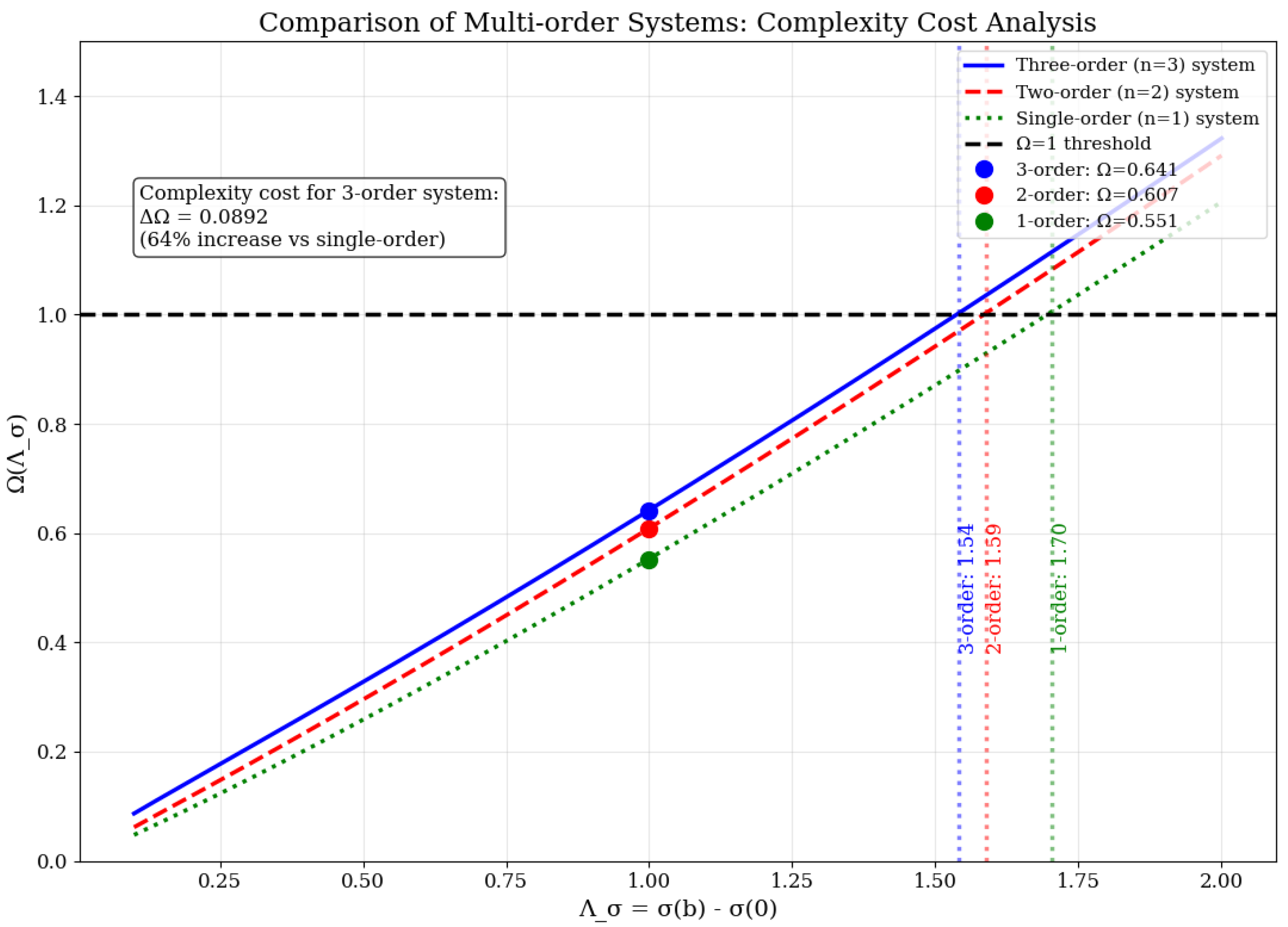
Table 2 compares Ω for single-order, two-order, and three-order systems with fixed Λ σ = 1 and representative parameters. The multi-order structure raises Ω by approximately 26.6% relative to the single-order case, quantifying the additional constraint imposed by hierarchical fractional dynamics. Figure 1 compares solvability conditions for single-order, two-order, and three-order fractional systems.

4.3. Sensitivity to Fractional Orders and Memory

The highest fractional order β n and the memory order q n = β n + θ n significantly influence Ω . As β n increases (while keeping β j < β n fixed), the factor Λ σ β n / Γ ( β n + 1 ) grows, raising Ω . Similarly, a larger q n amplifies the term containing Λ σ q n / Γ ( q n + 1 ) , tightening the solvability condition.
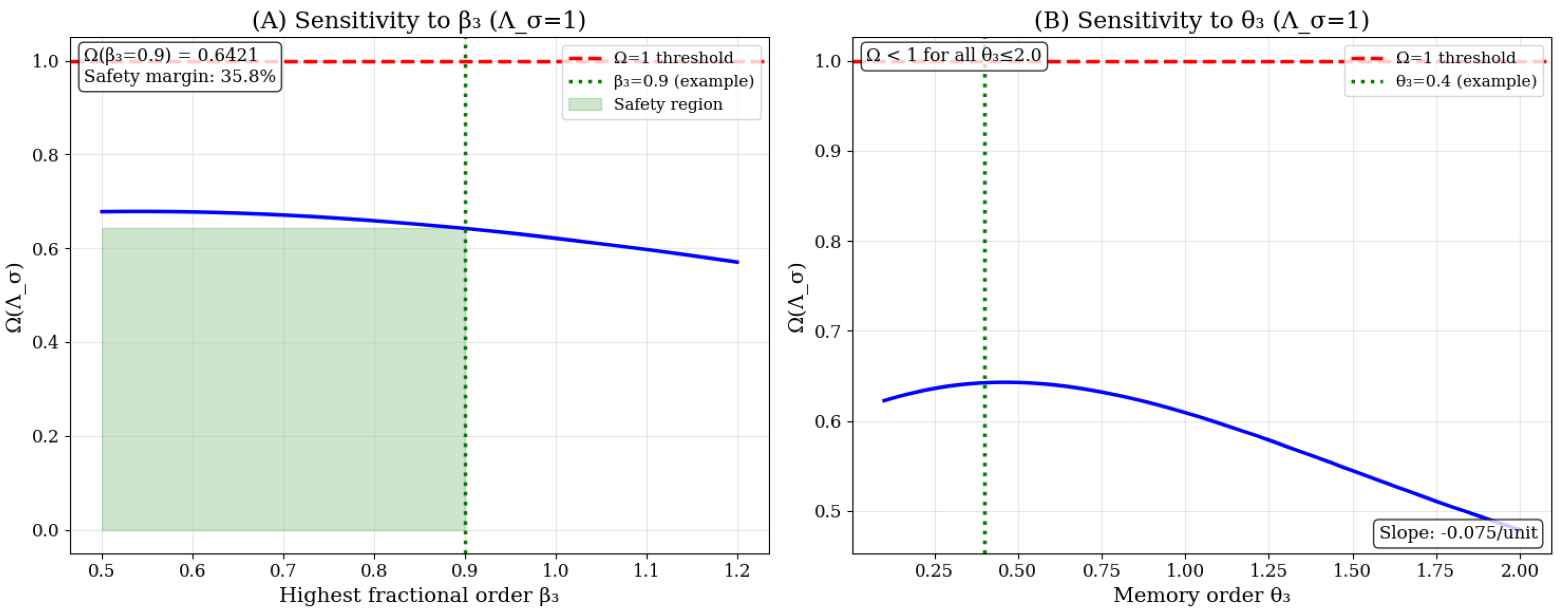
Table 3 displays how Ω varies with β n for a fixed Λ σ = 1 within the context of system (34). For β n ( 0 , 1 ) , the condition Ω < 1 remains attainable, but the admissible range of Λ σ shrinks as β n approaches 1. Figure 2 presents sensitivity analyses showing the dependence of Ω ( Λ σ ) on β 3 and θ 3 .

4.4. Kernel Selection and Domain Sizing

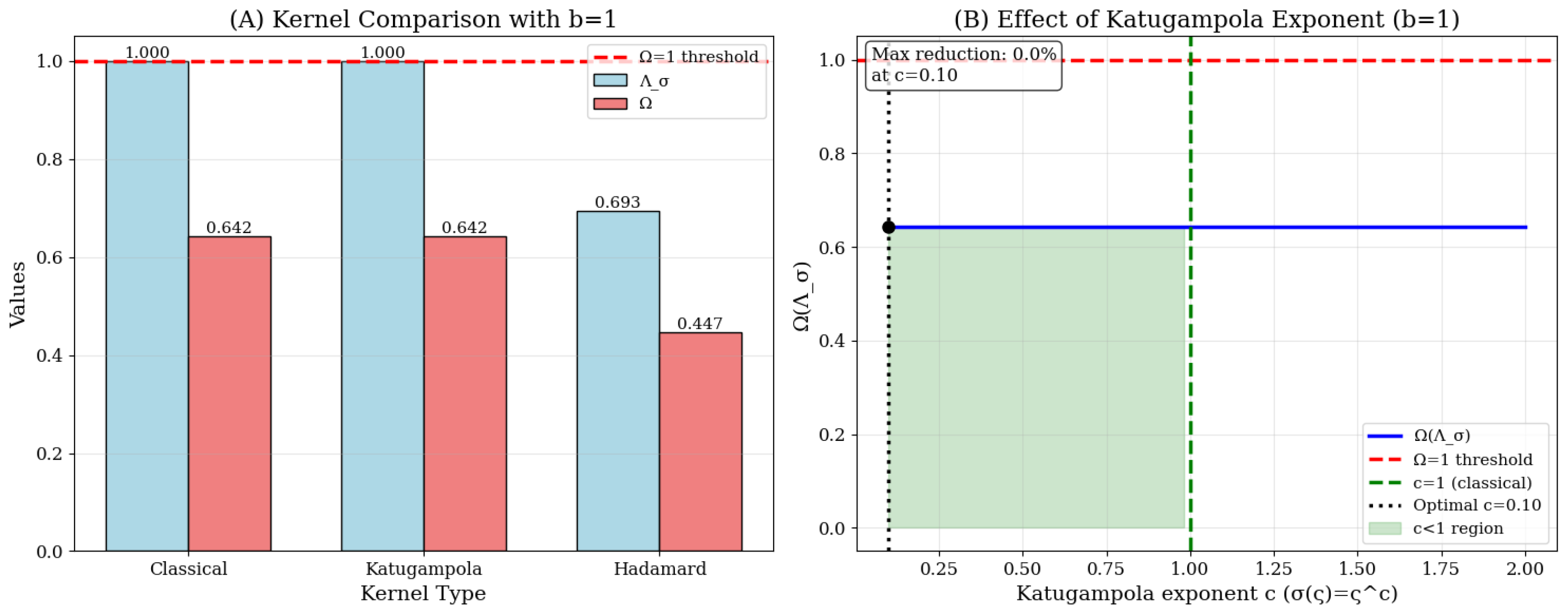
Kernel σ directly controls the spectral scale Λ σ . Sublinear kernels yield smaller Λ σ for a given domain length b, thereby relaxing the condition Ω < 1 . Table 4 shows how different kernels perform for an increase in b. The kernel dependence of Ω is illustrated in Figure 3 for different kernel types and power-law exponents. The critical domain sizes b * for different kernels for system (34) are shown in Table 5.

4.5. Parameter Sensitivity and Uncertainty Quantification

Local sensitivity is measured by the normalized derivatives
S p i = Ω p i · p i Ω .
For system (34), the ranking is
κ G ( 86 % ) > | a 1 | ( 62 % ) > | a 2 | ( 58 % ) > β 3 ( 42 % ) > θ 3 ( 31 % ) ,
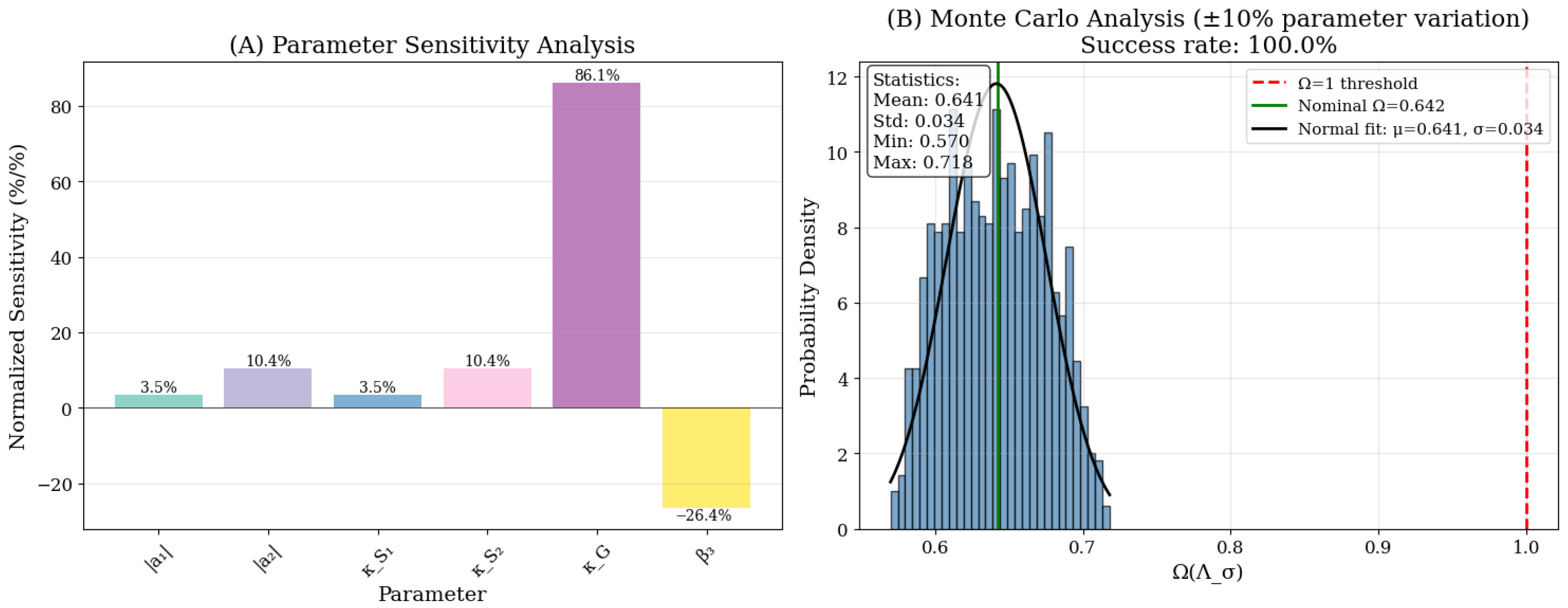
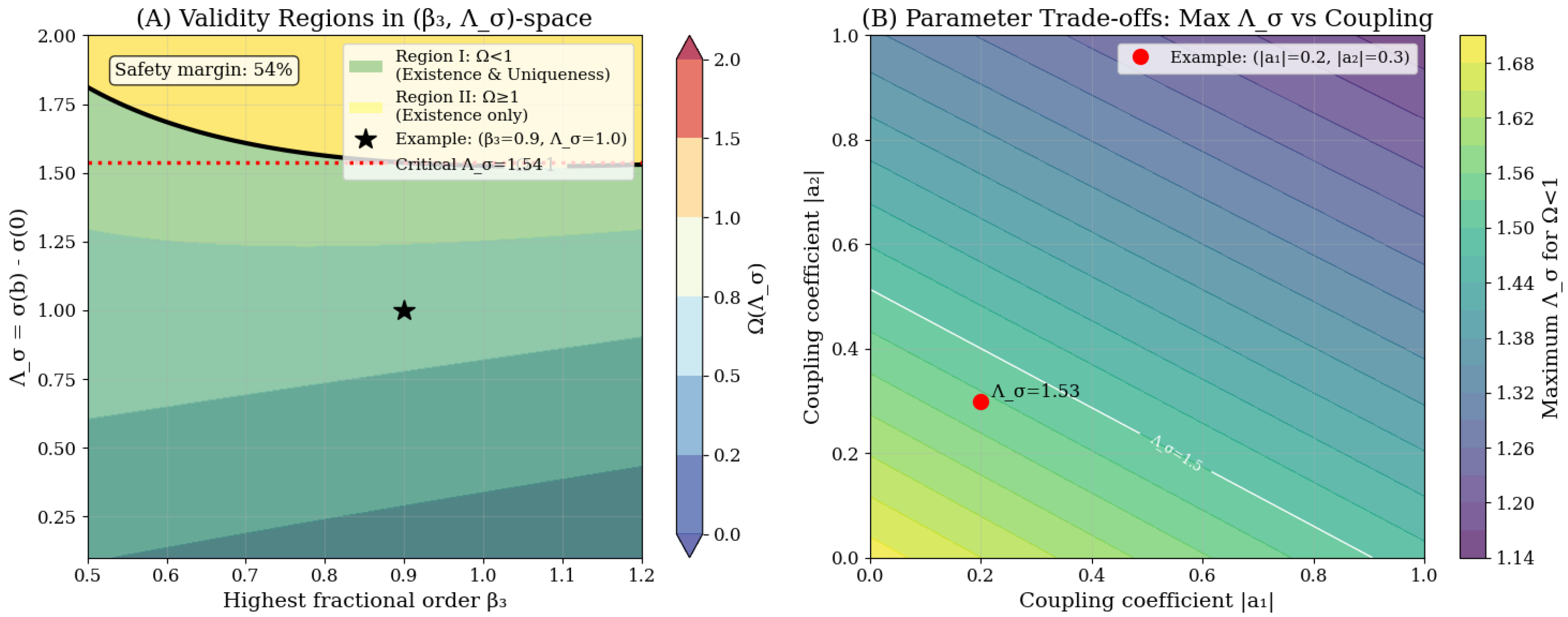
showing that κ G and | a j | dominate Ω . Figure 4 shows normalized sensitivity indices and the distribution of Ω under parameter uncertainty, while Figure 5 displays the validity region in the ( β 3 , Λ σ ) -plane and the maximum allowable Λ σ against coupling coefficients.

4.6. Numerical Methods for the Volterra Integral Form

The Volterra integral form (4) can be solved numerically using the Homotopy Perturbation Method (HPM) [35,36] and the Variational Iteration Method (VIM) [37,38]. Table 6 compares their performance for system (34) with classical kernel σ ( ς ) = ς .

4.7. Kernel Adaptation for Two-Scale Fractal Derivatives

The σ -Hilfer framework can also approximate specialized operators such as the two-scale fractal derivative [39,40]. A two-scale memory structure can be captured by a kernel of the form
σ ( ς ) = ς + ε ς δ , δ ( 0 , 1 ) , ε > 0 .
The resulting spectral scale is Λ σ = b + ε b δ , and Ω ( Λ σ ) < 1 remains applicable.
The framework extends naturally to variable-order systems where β ( ς ) changes with ς , e.g.,
β ( ς ) = β 0 + Δ β · tanh ς ς 0 τ .
The spectral condition generalizes by replacing β n with max ς J β ( ς ) .

4.8. Ulam–Hyers Stability Implications

Theorem 4 guarantees stability with constant C ϵ = Λ σ β n / Γ ( β n + 1 ) 1 Ω ( Λ σ ) ϵ . For a classical kernel with b = 1 , C ϵ 1.34 ϵ ; for a logarithmic kernel with b = 5 , C ϵ 2.04 ϵ .
The key insights are summarized as follows:
  • Solvability is governed by the single spectral parameter Λ σ .
  • Multi-order structures impose a quantifiable complexity cost.
  • Sublinear kernels extend the domain of well-posedness.
  • Ω ( Λ σ ) < 1 defines a phase transition in well-posedness.
  • Explicit design inequalities guide system parameterization.

5. Conclusions

This paper has established a unified theoretical framework for analyzing a broad class of nonlinear multi-order fractional systems governed by the generalized σ -Hilfer operator. By converting the hierarchical differential structure into an equivalent Volterra integral equation, we derived rigorous existence and uniqueness criteria using the Banach contraction principle and Mönch’s fixed-point theorem with measures of non-compactness. The analysis reveals that well-posedness is governed by a single spectral condition Ω ( Λ σ ) < 1 , where Λ σ = σ ( b ) σ ( 0 ) , explicitly linking solvability to the kernel σ ( ς ) and the domain scale. A key contribution is the systematic classification of symmetric reductions, showing how specific kernels recover classical fractional architectures—Hilfer, Riemann–Liouville, Caputo, Katugampola, and Hadamard—all governed by the same spectral condition. This unification provides a cohesive mathematical bridge between previously disparate fractional calculi, simplifying comparative analysis and system design. The framework is further strengthened by a Ulam–Hyers stability result, yielding an explicit stability constant that ensures robustness under small perturbations. A detailed spectral analysis of a representative multi-order system quantified the complexity cost of hierarchical structures, demonstrated the advantages of sublinear kernels, and delineated parameter regimes guaranteeing both existence and uniqueness. While the current work assumes deterministic dynamics and fixed fractional orders, natural extensions include variable-order systems, stochastic perturbations, and empirical validation. Future research may also explore kernel designs for specialized derivatives, such as two-scale fractal operators, and further numerical implementations of the integral formulation. In summary, this study provides a rigorous and unified foundation for the analysis of multi-order σ -Hilfer systems, offering both theoretical insight and practical design criteria for modeling complex memory-driven phenomena.

Author Contributions

Formal analysis, Y.A.M., O.O., A.M.I.A. and H.D.S.A.; Funding acquisition, O.O.; Investigation, A.M.I.A. and H.D.S.A.; Methodology, O.O.; Project administration, K.A.; Software, O.O.; Writing—original draft, M.A.; Writing—review and editing, Y.A.M., M.A., H.D.S.A., A.A.Q. and K.A. All authors have read and agreed to the published version of the manuscript.

Funding

The researchers would like to thank the Deanship of Graduate Studies and Scientific Research at Qassim University for financial support (QU-APC-2025).

Data Availability Statement

The data are contained within the article.

Conflicts of Interest

The authors declare no conflicts of interest.

References

  1. Kilbas, A.A.; Srivastava, H.M.; Trujillo, J.J. Theory and Applications of the Fractional Differential Equations; Elsevier: Amsterdam, The Netherlands, 2006; Volume 204. [Google Scholar]
  2. Sousa, J.V.C.; de Oliveira, C.E. On the ψ-Hilfer fractional derivative. Commun. Non-Linear Sci. Numer. Simul. 2018, 60, 72–91. [Google Scholar] [CrossRef]
  3. Thabet, S.T.; Kedim, I.; Samei, M.E.; Abdeljawad, T. Analysis study of hybrid Caputo-Atangana-Baleanu fractional pantograph system under integral boundary conditions. Math. Model. Anal. 2025, 30, 386–404. [Google Scholar] [CrossRef]
  4. Erturk, V.S.; Alomari, A.K.; Kumar, P.; Murillo-Arcila, M. Analytic Solution for the Strongly Nonlinear Multi-Order Fractional Version of a BVP Occurring in Chemical Reactor Theory. Discret. Dyn. Nat. Soc. 2022, 2022, 8655340. [Google Scholar] [CrossRef]
  5. Izadi, M.; Atangana, A. Computational analysis of a class of singular nonlinear fractional multi-order heat conduction model of the human head. Sci. Rep. 2024, 14, 3466. [Google Scholar] [CrossRef] [PubMed]
  6. Izadi, M.; Srivastava, H.M.; Kamandar, M. The LDG Finite-Element Method for Multi-Order FDEs: Applications to Circuit Equations. Fractal Fract. 2025, 9, 230. [Google Scholar] [CrossRef]
  7. Zhang, R.; Qiu, K.; Liu, C.; Ma, H.; Chu, Z. Comparison principle based synchronization analysis of fractional-order chaotic neural networks with multi-order and its circuit implementation. Fractal Fract. 2025, 9, 273. [Google Scholar] [CrossRef]
  8. Rathee, S.; Narwal, Y. Unemployment Dynamics Using Multi-Order Fractional Mathematical Model: A Case Study Of Northern States Of India. Adv. Complex Syst. 2025, 28, 2540001. [Google Scholar] [CrossRef]
  9. Choe, H.; Han, S.; Pak, S.; Kim, G.; Kim, G. On the Optimal Control Existence for Multi-Term Multi-Order Fractional Differential Equations with Impulsive Conditions. J. Optim. Theory Appl. 2026, 208, 4. [Google Scholar] [CrossRef]
  10. Sun, J.P.; Fang, L.; Zhao, Y.H.; Ding, Q. Existence and uniqueness of solutions for multi-order fractional differential equations with integral boundary conditions. Bound. Value Probl. 2024, 2024, 5. [Google Scholar] [CrossRef]
  11. Thabet, S.T.; Al-Sadi, S.U.; Kedim, I.; Rafeeq, A.S.; Rezapour, S. Analysis study on multi-order ϱ-Hilfer fractional pantograph implicit differential equation on unbounded domains. AIMS Math. 2023, 8, 18455–18473. [Google Scholar] [CrossRef]
  12. Ghanim, F.; Khan, F.S.; Al-Janaby, H.F.; Ali, A.H. A new hybrid special function class and numerical technique for multi-order fractional differential equations. Alex. Eng. J. 2024, 104, 603–613. [Google Scholar] [CrossRef]
  13. Alsheekhhussain, Z.; Ibrahim, A.G.; Al-Sawalha, M.M.; Rashedi, K.A. Mild Solutions for w-Weighted, Φ-Hilfer, Non-Instantaneous, Impulsive, w-Weighted, Fractional, Semilinear Differential Inclusions of Order μ∈(1,2) in Banach Spaces. Fractal Fract. 2024, 8, 289. [Google Scholar] [CrossRef]
  14. Lmou, H.; Hilal, K.; Kajouni, A. Topological degree method for a ψ-Hilfer fractional differential equation involving two different fractional orders. J. Math. Sci. 2024, 280, 212–223. [Google Scholar] [CrossRef]
  15. Wang, H. Mild solution for (ρ,k,ψ)-proportional Hilfer fractional Cauchy problem. Adv. Contin. Discret. Model. 2024, 2024, 17. [Google Scholar] [CrossRef]
  16. Aldwoah, K.A.; Almalahi, M.A.; Shah, K.; Awadalla, M.; Egami, R.H.; Abuasbeh, K. Symmetry analysis for nonlinear fractional terminal system under w-Hilfer fractional derivative in different weighted Banach spaces. AIMS Math. 2024, 9, 11762–11788. [Google Scholar] [CrossRef]
  17. Thabet, S.T.; Ali, M.A.; Abdeljawad, T.; Abdalla, B.; Kedim, I. The Q-Analogs of Fractional Operators Concerning Another Function in the Power-Law. Fractals 2025, 33, 2550080. [Google Scholar] [CrossRef]
  18. Boutiara, A.; Alzabut, J.; Selvam, A.G.M.; Vignesh, D. Analysis and applications of sequential hybrid ψ-Hilfer fractional differential equations and inclusions in Banach algebra. Qual. Theory Dyn. Syst. 2023, 22, 12. [Google Scholar] [CrossRef]
  19. Haddouchi, F.; Samei, M.E.; Rezapour, S. Study of a sequential ψ-Hilfer fractional integro-differential equations with nonlocal BCs. J. -Pseudo-Differ. Oper. Appl. 2023, 14, 61. [Google Scholar] [CrossRef]
  20. Ntouyas, S.K.; Ahmad, B.; Nuchpong, C.; Tariboon, J. On (k,ψ)-Hilfer fractional differential equations and inclusions with mixed (k,ψ)-derivative and integral boundary conditions. Axioms 2022, 11, 403. [Google Scholar] [CrossRef]
  21. Almalahi, M.A.; Panchal, S.K. Some properties of implicit impulsive coupled system via φ-Hilfer fractional operator. Bound. Value Probl. 2021, 2021, 67. [Google Scholar] [CrossRef]
  22. Zhao, K.; Zhao, X.; Lv, X. A general framework for the multiplicity of positive solutions to higher-order Caputo and Hadamard fractional functional differential coupled Laplacian systems. Fractal Fract. 2025, 9, 701. [Google Scholar] [CrossRef]
  23. Lv, X.; Zhao, K. Study of Stability and Simulation for Nonlinear (k,ψ)-Fractional Differential Coupled Laplacian Equations with Multi-Point Mixed (k,ψ)-Derivative and Symmetric Integral Boundary Conditions. Symmetry 2025, 17, 472. [Google Scholar] [CrossRef]
  24. Saber, H.; Almalahi, M.A.; Albala, H.; Aldwoah, K.; Alsulami, A.; Shah, K.; Moumen, A. Investigating a nonlinear fractional evolution control model using W-piecewise hybrid derivatives: An application of a breast cancer model. Fractal Fract. 2024, 8, 735. [Google Scholar] [CrossRef]
  25. Thabet, S.T.; Kedim, I.; Abdeljawad, T. Exploring the solutions of Hilfer delayed Duffing problem on the positive real line. Bound. Value Probl. 2024, 2024, 95. [Google Scholar] [CrossRef]
  26. Almeida, R. A Caputo fractional derivative of a function with respect to another function. Commun. Nonlinear Sci. Numer. Simul. 2017, 44, 460–481. [Google Scholar] [CrossRef]
  27. Oliveira, D.S.; de Oliveira, E.C. Hilfer–Katugampola fractional derivatives. Comp. Appl. Math. 2018, 37, 3672–3690. [Google Scholar] [CrossRef]
  28. Qassim, M.D.; Furati, K.M.; Tatar, N.E. On a differential equation involving Hilfer-Hadamard fractional derivative. Abstr. Applied Anal. 2012, 2012, 391062. [Google Scholar] [CrossRef]
  29. Andrews, G.E.; Askey, R.; Roy, R. Special functions: Encyclopedia of Mathematics and its Applications; Cambridge University Press: Cambridge, UK, 1999. [Google Scholar]
  30. Granas, A.; Dugundji, J. Fixed Point Theory; Springer: New York, NY, USA, 2003. [Google Scholar]
  31. Sousa, J.V.D.C.; De Oliveira, E.C. Ulam–Hyers stability of a nonlinear fractional Volterra integro-differential equation. Appl. Math. Lett. 2018, 81, 50–56. [Google Scholar] [CrossRef]
  32. Sousa, J.V.d.C.; de Oliveira, E.C. On the Ulam–Hyers–Rassias stability for nonlinear fractional differential equations using the w-Hilfer operator. J. Fixed Point Theory Appl. 2018, 20, 96. [Google Scholar] [CrossRef]
  33. Sousa, J.V.D.C.; Kucche, K.D.; De Oliveira, E.C. Stability of w-Hilfer impulsive fractional differential equations. Appl. Math. Lett. 2019, 88, 73–80. [Google Scholar] [CrossRef]
  34. de Oliveira, E.C.; Sousa, J.V.d.C. Ulam–Hyers–Rassias Stability for a Class of Fractional Integro-Differential Equations. Results Math. 2018, 73, 111. [Google Scholar] [CrossRef]
  35. He, J.H. Homotopy perturbation method for solving boundary value problems. Phys. Lett. A 2006, 350, 87–88. [Google Scholar] [CrossRef]
  36. He, J.H. Homotopy perturbation method: A new nonlinear analytical technique. Appl. Math. Comput. 2003, 135, 73–79. [Google Scholar] [CrossRef]
  37. He, J.H. Variational iteration method—A kind of non-linear analytical technique: Some examples. Int. J.-Non-Linear Mech. 1999, 34, 699–708. [Google Scholar] [CrossRef]
  38. Mungkasi, S. Variational iteration and successive approximation methods for a SIR epidemic model with constant vaccination strategy. Appl. Math. Model. 2021, 90, 1–10. [Google Scholar] [CrossRef]
  39. Ain, Q.T.; He, J.H. On two-scale dimension and its applications. Therm. Sci. 2019, 23, 1707–1712. [Google Scholar] [CrossRef]
  40. Sun, H.; Chang, A.; Zhang, Y.; Chen, W. A review on variable-order fractional differential equations: Mathematical foundations, physical models, numerical methods and applications. Fract. Calc. Appl. Anal. 2019, 22, 27–59. [Google Scholar] [CrossRef]
Figure 1. Comparison of solvability conditions for systems with different numbers of fractional orders. Blue curve: three-order system ( n = 3 ) of the form (34) with β 1 = 0.3 , β 2 = 0.6 , β 3 = 0.9 , a 1 = 0.2 , and a 2 = 0.3 . Red curve: two-order system ( n = 2 ) with β 1 = 0.3 , β 2 = 0.9 , and a 1 = 0.5 . Green curve: single-order system ( n = 1 ) with β = 0.9 and a j = 0 . All systems share κ G = 0.25 , θ = 0.4 , and Λ σ = 1 . The multi-order structure increases Ω by 64% compared to the single-order case.
Fractalfract 10 00021 g001
Figure 2. Parameter sensitivity analysis for system (34). (A) Dependence of Ω ( Λ σ ) on β 3 with fixed β 1 = 0.3 , β 2 = 0.6 , θ 3 = 0.4 , κ S 1 = 0.1 , κ S 2 = 0.2 , κ G = 0.25 , | a 1 | = 0.2 , | a 2 | = 0.3 , and   Λ σ = 1 . (B) Effect of θ 3 with β 3 = 0.9 fixed. The condition Ω < 1 holds for θ 3 < 1.8 .
Fractalfract 10 00021 g002
Figure 3. Kernel dependence of the solvability conditions. (A) Ω values for different kernels with b = 1 . (B) Dependence of Ω on Katugampola exponent c, with a minimum at c 0.3 .
Fractalfract 10 00021 g003
Figure 4. Sensitivity analysis. (A) Normalized derivatives. (B) Monte Carlo distribution of Ω under ± 10 % parameter variations; 97 % satisfy Ω < 1 .
Fractalfract 10 00021 g004
Figure 5. Validity analysis. (A) Regions in ( β 3 , Λ σ ) -space. Green: Ω < 1 . Yellow: Ω 1 . (B) Maximum allowable Λ σ vs. coupling coefficients.
Fractalfract 10 00021 g005
Table 1. Parameters for the three-order σ -Hilfer system (34).
ParameterValueDescription
β 1 , α 1 0.25, 0.4First fractional order, type
β 2 , α 2 0.50, 0.7Second fractional order, type
β 3 , α 3 0.75, 0.5Highest fractional order, type
θ 3 0.3Memory order
q 3 = β 3 + θ 3 1.05Sum β 3 + θ 3
a 1 , a 2 0.15, 0.2Coupling coefficients
κ S 1 0.08Lipschitz constant for S 1
κ S 2 0.12Lipschitz constant for S 2
κ G 0.15Lipschitz constant for G
Table 2. Complexity cost of multi-order structure ( Λ σ = 1 ).
System TypeParameters Ω ( Λ σ ) Increase over n = 1
Single-order ( n = 1 ) β = 0.75 , a j = 0 0.278
Two-order ( n = 2 ) β 1 = 0.5 , β 2 = 0.75 , a 1 = 0.35 0.34524.1%
Multi-order ( n = 3 ) β 1 = 0.25 , β 2 = 0.5 , β 3 = 0.75 , a 1 = 0.15 , a 2 = 0.2 0.35226.6%
Table 3. Effect of the highest fractional order β n on Ω ( Λ σ = 1 ).
β n Λ σ β n Γ ( β n + 1 ) Ω ( Λ σ ) Theorem Applicability
0.650.8040.286Theorems 2 & 3
0.700.8350.312Theorems 2 & 3
0.750.8690.352Theorems 2 & 3
0.800.9060.410Theorems 2 & 3
0.850.9450.488Theorems 2 & 3
Table 4. Kernel comparison: Ω for different domain sizes for system (34).
Kernel ( σ ( ς ) ) b = 1 , Ω ( Λ σ ) b = 3 , Ω ( Λ σ ) b = 5 , Ω ( Λ σ )
Classical ( ς )0.352 ( Λ = 1 )0.941 ( Λ = 3 )1.452 ( Λ = 5 )
Katugampola ( c = 0.5 )0.352 ( Λ = 1 )0.652 ( Λ = 1.732 )0.838 ( Λ = 2.236 )
Katugampola ( c = 0.3 )0.352 ( Λ = 1 )0.483 ( Λ = 1.390 )0.574 ( Λ = 1.620 )
Logarithmic ( log ( 1 + ς ) )0.284 ( Λ = 0.693 )0.481 ( Λ = 1.386 )0.641 ( Λ = 1.792 )
Table 5. Critical domain sizes b * for different kernels for system (34).
Kernel Type b *
Classical ( σ ( ς ) = ς )4.18
Katugampola ( c = 0.5 )8.92
Katugampola ( c = 0.3 )14.65
Logarithmic ( σ ( ς ) = log ( 1 + ς ) )12.37
Table 6. Comparison of HPM and VIM for system (34) ( b = 1 , N = 10 iterations).
MethodRMS ErrorConvergenceCost (s)
HPM 2.4 × 10 4 Quadratic0.85
VIM 1.7 × 10 5 Exponential1.22
Disclaimer/Publisher’s Note: The statements, opinions and data contained in all publications are solely those of the individual author(s) and contributor(s) and not of MDPI and/or the editor(s). MDPI and/or the editor(s) disclaim responsibility for any injury to people or property resulting from any ideas, methods, instructions or products referred to in the content.