
Article

Fractal Dimension-Based Multi-Focus Image Fusion via AGPCNN and Consistency Verification in NSCT Domain

1
School of Computer Science and Technology, Xinjiang University, Urumqi 830046, China
2
Xinjiang Sky-Ground Integrated Intelligent Computing Technology Laboratory, Changji 831199, China
3
Key Laboratory of Signal Detection and Processing, Xinjiang University, Urumqi 830046, China
4
School of Computer and Artificial Intelligence, Zhengzhou University, Zhengzhou 450001, China
5
Department of Electronic Engineering, Tsinghua University, Beijing 100084, China
*
Author to whom correspondence should be addressed.
Fractal Fract. 2026, 10(1), 1; https://doi.org/10.3390/fractalfract10010001
Submission received: 24 August 2025 / Revised: 5 December 2025 / Accepted: 9 December 2025 / Published: 19 December 2025

Abstract

Multi-focus images are essential in various computer vision applications. To mitigate artifacts and information loss in multi-focus image fusion, we propose a novel algorithm based on AGPCNN and fractal dimension in the NSCT domain. The source images are decomposed into low- and high-frequency sub-bands via NSCT; the low-frequency components are fused using an averaging rule, while the high-frequency components are fused through fractal dimension and the AGPCNN model, followed by consistency verification to refine the results. Experiments on the Lytro and MFI-WHU datasets show that the proposed method outperforms existing approaches in terms of both visual quality and quantitative metrics. Furthermore, its successful application to multi-sensor and multi-modal image fusion tasks demonstrates the algorithm’s robustness and generality.

1. Introduction

In the field of computer vision, image fusion has emerged as a pivotal technique for enhancing image quality and information content by integrating complementary data from multiple source images [1,2]. The primary objective of image fusion is to generate a single composite image that retains the most informative and salient features from all input sources, thereby improving visual clarity, contrast, and interpretability. This process effectively mitigates the limitations of individual imaging systems, such as restricted depth of field, low contrast, or incomplete spectral information [3,4,5].
By combining data from different imaging modalities, such as visible, infrared, medical, and multi-focus images, image fusion significantly enhances human visual perception and facilitates subsequent image analysis tasks, including segmentation, detection, and classification [6,7,8,9,10]. For instance, in medical imaging, fusion of modalities such as MRI, CT, and PET provides comprehensive diagnostic information by combining structural and functional details [11,12]. In multi-focus image processing [13,14,15], image fusion overcomes the limited depth of field in optical systems by merging focused regions from different images to obtain an all-in-focus result. Similarly, in remote sensing [16,17], the fusion of multispectral and panchromatic or hyperspectral data enhances spatial resolution and spectral integrity, thereby improving land use classification, environmental monitoring, and resource management [18,19,20,21].
The methodology of image fusion can be broadly categorized into three primary levels: pixel-level, feature-level, and decision-level fusion [22,23,24,25]. Pixel-level fusion directly combines raw pixel data to retain fine spatial details, ensuring high-resolution outputs [26,27,28,29]. In contrast, feature-level fusion integrates extracted features—such as edges, textures, or regions—to emphasize salient image characteristics and enhance interpretability. Decision-level fusion, meanwhile, synthesizes high-level decisions derived from multiple sources to produce more reliable and robust results. Each fusion level is designed for specific application requirements, striking a balance between computational complexity and the desired quality of the fused output [30,31,32,33].
Despite these significant developments, multi-focus image fusion (MFIF) remains a challenging and active research topic [34,35,36]. In real-world imaging systems, the limited depth of field often causes different regions of a scene to appear in or out of focus in different source images [37]. The goal of multi-focus image fusion is therefore to combine multiple images focused at different depths into a single all-in-focus image, preserving sharp details across the entire scene while avoiding artifacts and information loss [38,39,40]. Achieving this objective requires efficient representations and fusion strategies that can effectively distinguish focused from defocused regions and maintain structural consistency in the fused result.
In multi-focus image fusion, techniques based on pixel-level classification, encompassing both traditional algorithms and deep learning approaches, have been extensively applied and are experiencing rapid advancement [41,42,43]. In terms of the traditional algorithms, the curvelet [44], contourlet [45], shearlet [46], etc., are widely used in image fusion. Sengan et al. [47] introduced the multi-modal image fusion method using the nonsubsampled shearlet transform (NSST) and deep learning. Vajpayee et al. [48] introduced the medical image fusion by adaptive Gaussian PCNN and improved Roberts operator in NSST domain. Similarly, Satyanarayana et al. [49] also proposed a multi-modal image fusion model based on shearlet and pulse coded neural network, which achieved impressive fusion results. Fractal [50] and fractional [51,52,53] methods have also achieved remarkable results in the fields of image fusion [54] and image enhancement [55,56].
Recent advancements in machine learning, particularly deep learning, have significantly advanced image fusion techniques [57,58,59,60]. Typical deep learning networks such as CNNs [57], GANs [57], transformer [61], and Mamba [62] enable more precise feature extraction and data synthesis, addressing challenges such as noise reduction, spatial misalignment, and information loss. Jiang et al. [61] proposed the optimizing multi-focus image fusion through convolutional attention vision transformers and spatial consistency models. Wu et al. [62] introduced the Mamba-based hybrid dual-branch network for multi-focus image fusion. Bai et al. [63] proposed the learning image fusion from reconstruction with learnable loss via Meta-learning. These deep learning algorithms have demonstrated remarkable effectiveness in the field of multi-focus image fusion.
As the demand for high-quality, information-rich images continues to grow, image fusion has become a critical research area that addresses challenges in real-time processing, scalability, and adaptability to complex imaging conditions. To overcome the issues of artifacts and information loss in multi-focus image fusion, this paper proposes a novel fusion algorithm based on AGPCNN combined with fractal dimension analysis in NSCT domain. In the proposed framework, the source images are first decomposed into low- and high-frequency sub-bands using NSCT. The low-frequency sub-bands are fused using an average-based rule, while the high-frequency sub-bands are integrated through a combination of fractal dimension features and the AGPCNN model to better preserve texture and structural details. A consistency verification process is then applied to enhance the sub-bands and ensure structural coherence in the fused image. The main innovation of this paper lies in the effective integration of fractal dimension (FD), AGPCNN, and consistency verification, which are jointly applied to the fusion of high-frequency sub-bands.

2. Related Works

2.1. NSCT

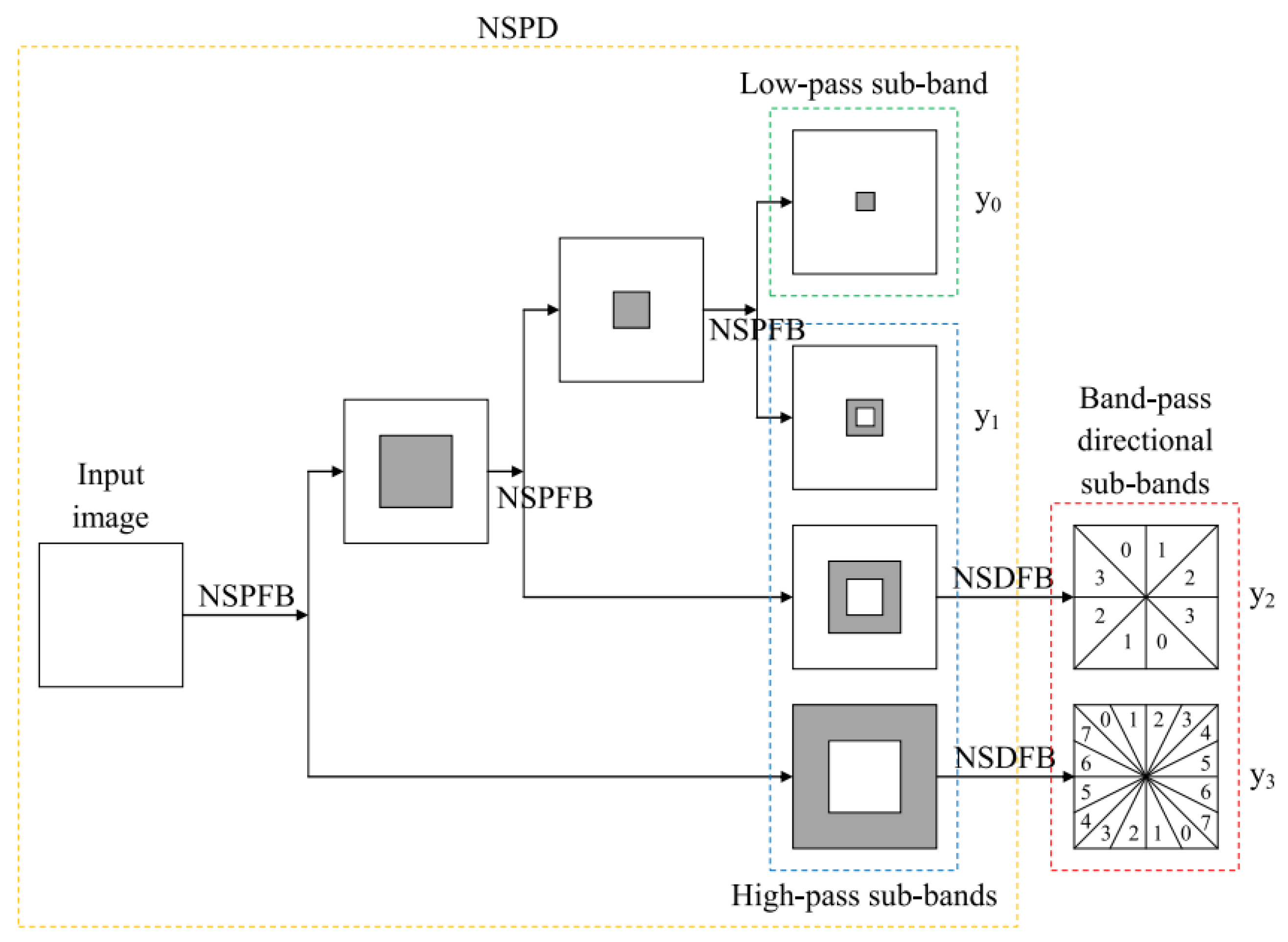
The NSCT is a shift-invariant, multiscale, and multidirectional image decomposition technique, developed as an improvement over the standard contourlet transform [64]. It is particularly well-suited for image processing tasks that require robust directional and edge representation, such as image denoising, enhancement, fusion, and watermarking. NSCT consists of two main stages: (1) Nonsubsampled Pyramid Filter Bank (NSPFB): This stage provides multiscale decomposition by splitting the image into low-pass and high-pass subbands at each level without downsampling. This ensures shift-invariance, which is crucial for many image processing applications. (2) Nonsubsampled Directional Filter Bank (NSDFB): The directional decomposition is applied to the high-pass subbands from the NSP using directional filter banks without downsampling. This enables the extraction of directional information at multiple orientations and scales. Figure 1 shows the structure of nonsubsampled contourlet transform. Yang et al. [65] proposed Image fusion with structural saliency measure and content adaptive consistency verification in NSCT domain, and this algorithm has achieved remarkable fusion performance in multi-focus and multi-modal image fusion.

2.2. AGPCNN

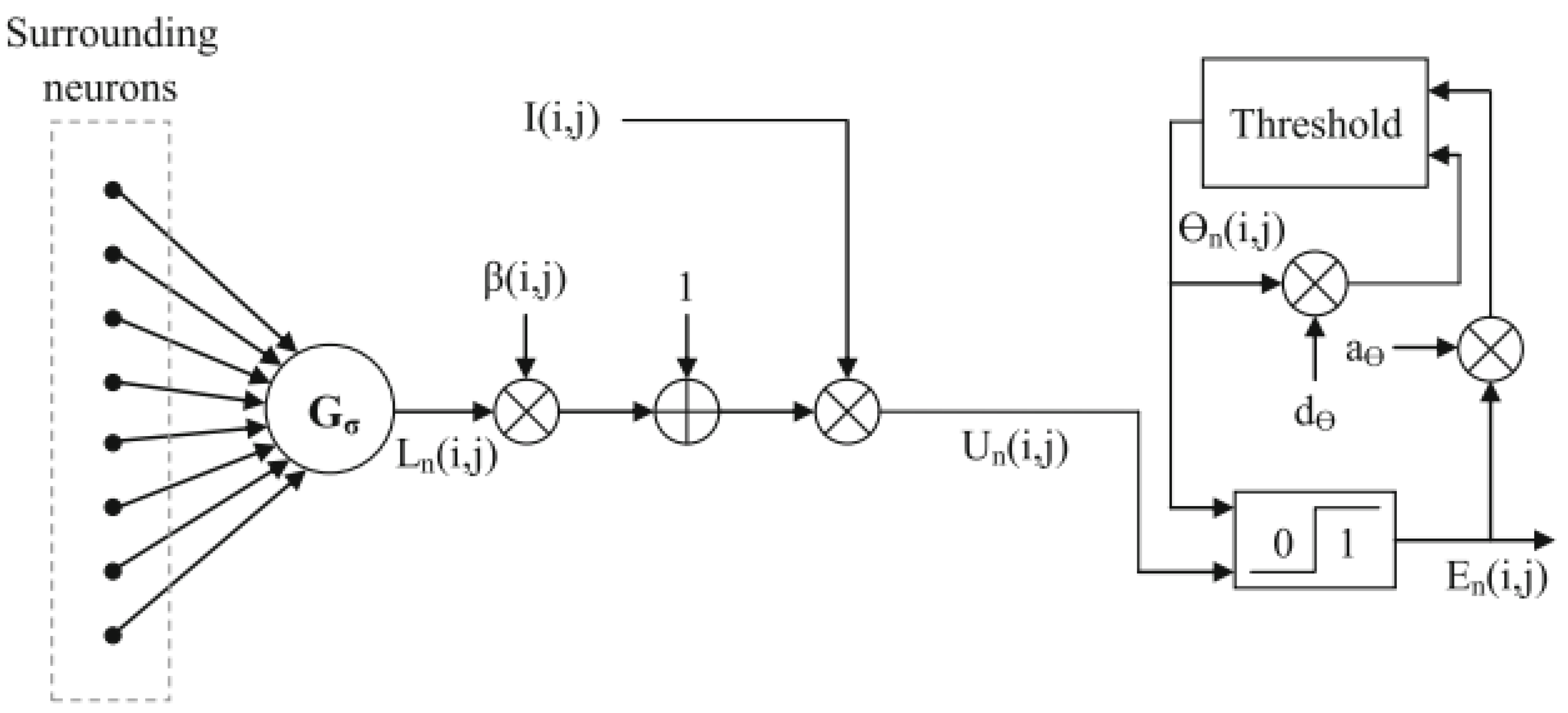
The adaptive Gaussian pulse coupled neural network (AGPCNN) [48] model constitutes the five same-sized 2D components, namely feeding input, linking input, internal state of neurons, binary output, and dynamic threshold, which are symbolized by F , L , U , E , and Θ , respectively. Figure 2 shows the structure of AGPCNN. The corresponding equations are represented by the follows [48]:
F n i , j = I i , j
L n i , j = x = 1 1 y = 1 1 G σ x + 2 , y + 2 E n 1 i + x , j + y
U n i , j = F i , j 1 + β i , j L n i , j
E n i , j = 1 ,   if   U n i , j > Θ n 1 i , j 0 ,   else
Θ n i , j = d Θ Θ n 1 i , j + a Θ E n i , j
Here, G shows the 3 × 3 Gaussian filter with standard deviation σ , n depicts the iteration number, and the i , j specifies the location of a neuron. d Θ and a Θ present the decay and normalizing constants, respectively. I shows the external input of the AGPCNN model for all the iterations. β shows the linking strength that is computed adaptively from I utilizing the following:
β i , j = I S F i , j = I R F i , j 2 + I C F i , j 2
where I S F i , j shows the local spatial frequency (SF) of the i , j th neuron of I , calculated by a 3 × 3 neighborhood centered at the i , j th neuron. Here, I R F and I C F depict the corresponding row and column frequencies, respectively. The corresponding equations are defined as follows:
I R F i , j = 1 9 p = 1 1   q = 1 1 I i + p , j + q I i + p , j + q 1 2
I C F i , j = 1 9 p = 1 1   q = 1 1 I i + p , j + q I i + p 1 , j + q 2
As the pulsing time of a particular neuron of the AGPCNN model after the n th iteration, P n is computed by
P n i , j = P n 1 i , j + E n i , j

3. Proposed Image Fusion Method

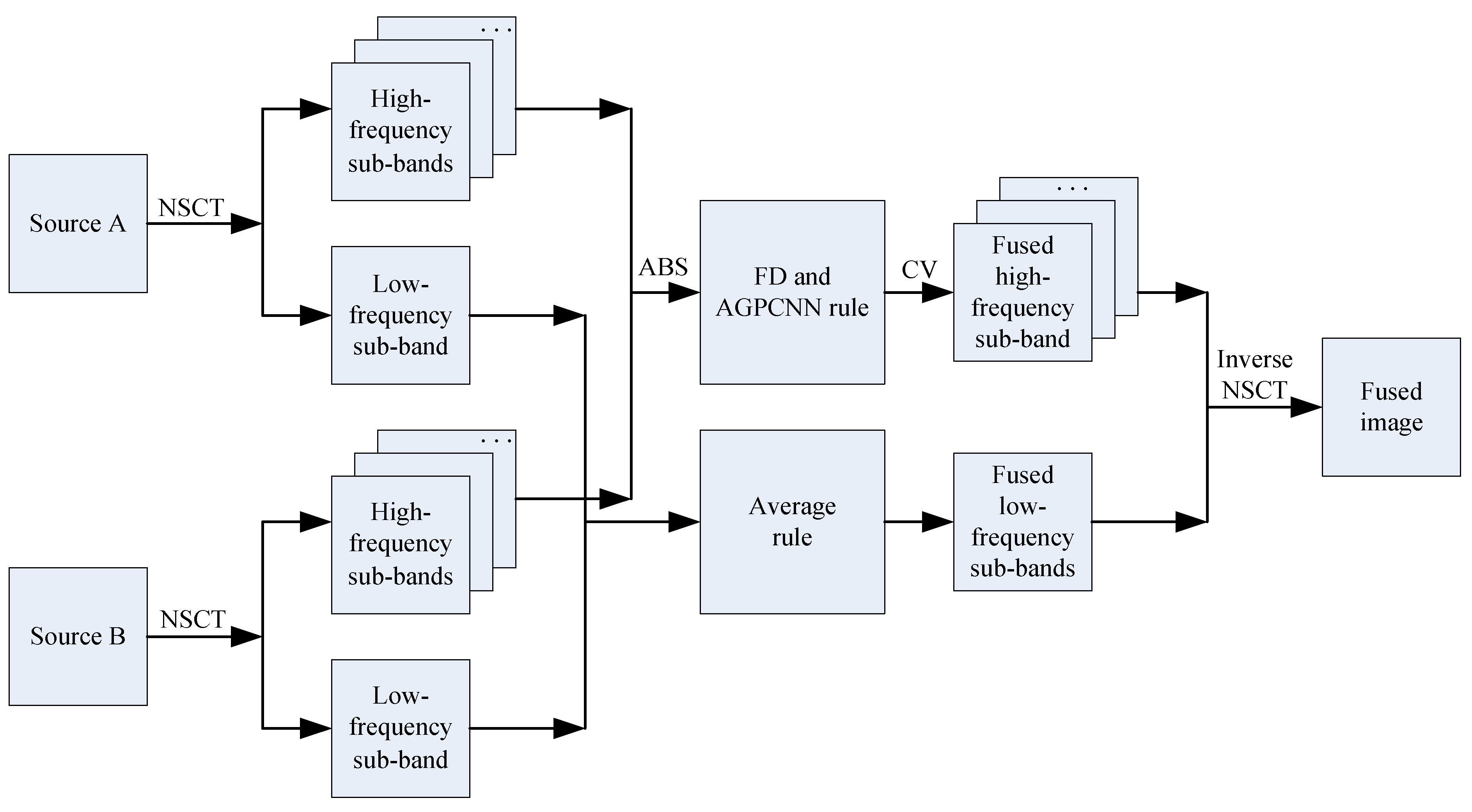
The proposed multi-focus image fusion algorithm is mainly divided into four parts: NSCT decomposition, low-frequency fusion, high-frequency fusion, and NSCT reconstruction. The flowchart of the proposed algorithm is shown in Figure 3, and the specific implementation steps are as follows:

3.1. NSCT Decomposition

For the input source images A and B, they are decomposed by NSCT into the low-pass sub-bands L A , L B and high-pass sub-bands H A l , d , H B l , d , respectively. H X l , d X A , B represents the detailed features of X at the d-th direction corresponding to l-th decomposition level.

3.2. Low-Frequency Fusion

The low-frequency sub-bands contain the main energy and background information of the image. In this sub-section, the average-based fusion rule is used to fuse the low-frequency components, and the fused low-frequency L F i , j is obtained by the following [45]:
L F i , j = L A i , j + L B i , j 2

3.3. High-Frequency Fusion

The high-frequency components contain the detail features and noise of the image. In terms of the high-frequency sub-bands fusion, the fractal dimension-based focus measure (FDFM) is defined as follows [66]:
F D F M X i , j = g max X i , j g min X i , j X H A l , d , H B l , d
where g max X i , j and g min X i , j show the maximum and minimum intensities, respectively, over a 3 × 3 window centered at the (i,j)-th pixel of X .
The AGPCNN-based fusion rule is loaded with F n i , j = F D F M X i , j , U 0 i , j = 0 , E 0 i , j = 0 , Θ 0 i , j = 1 , and P 0 i , j = 0 . The value of β is computed by Equation (6). After N time iterations of the AGPCNN model, the decision matrix D is calculated by:
D i , j = 1 ,   if   P N F D F M H A l , d i , j P N F D F M H B l , d i , j 0 ,   else  
where N shows the total number of iterations, while P N F D F M X i , j | X H A l , d , H B l , d denotes the total pulse times of (i,j)-th neuron of F M F M X i , j after N iterations.
In view of the integrity of the object, the decision map D i , j can be refined through a consistency verification (CV) operation [67]:
C V D i , j = 1 ,   if a , b θ D i + a , j + b 0 ,   else
where C V D i , j presents the final decision map at position i , j , and θ shows a square neighborhood centered at i , j with a size of 9 × 9 .
The fused high-frequency sub-bands H F l , d can be constructed from C V D i , j as follows:
H F l , d i , j = H A l , d i , j ,   if   C V D i , j = 1 H B l , d i , j ,   else

3.4. NSCT Reconstruction

The fused image F I is reconstructed by applying the inverse NSCT to the fused low- and high-frequency sub-bands.
The main steps of the proposed image fusion method are summarized in Algorithm 1.
Algorithm 1 Proposed image fusion method
Input: the source images: A and B
Parameters: the number of NSCT decomposition levels: L , the number of directions at each decomposition level: D l , l 1 , L , the number of AGPCNN iterations: N
Step 1: NSCT decomposition
For each source image S = A , B
  Perform NSCT decomposition on S to obtain L S , H S l , d , l 1 , L , d 1 , D l
End
Step 2: Low-frequency fusion
Merge L A and L B using Equation (10) to obtain L F ;
Step 3: High-frequency fusion
For each level l = 1 : L
  For each direction d = 1 : D l
   For each source image S = A , B
    Compute the F D F M X | X H A l , d , H B l , d using Equation (11);
    Initialize the AGPCNN model: U 0 i , j = 0 , E 0 i , j = 0 , Θ 0 i , j = 1 , P 0 i , j = 0 and F n i , j = F D F M X i , j , X H A l , d , H B l , d , n 1 , N ;
    Estimate the AGPCNN parameters using Equations (6)–(9);
    For each iteration n = 1 : N
     Calculate the AGPCNN model using Equations (2)–(5) and (9);
    End
   End
   Get the decision map D i , j using Equation (12);
   Perform the consistency verification operation on decision map D i , j to guarantee the consistency via Equation (13);
   Compute the fused high-frequency sub-bands H F l , d via Equation (14);
  End
End
Step 4: NSCT reconstruction
Perform inverse NSCT on L F , H F l , d to obtain fused image F I ;
Output: the fused image F I .

4. Experimental Results and Discussion

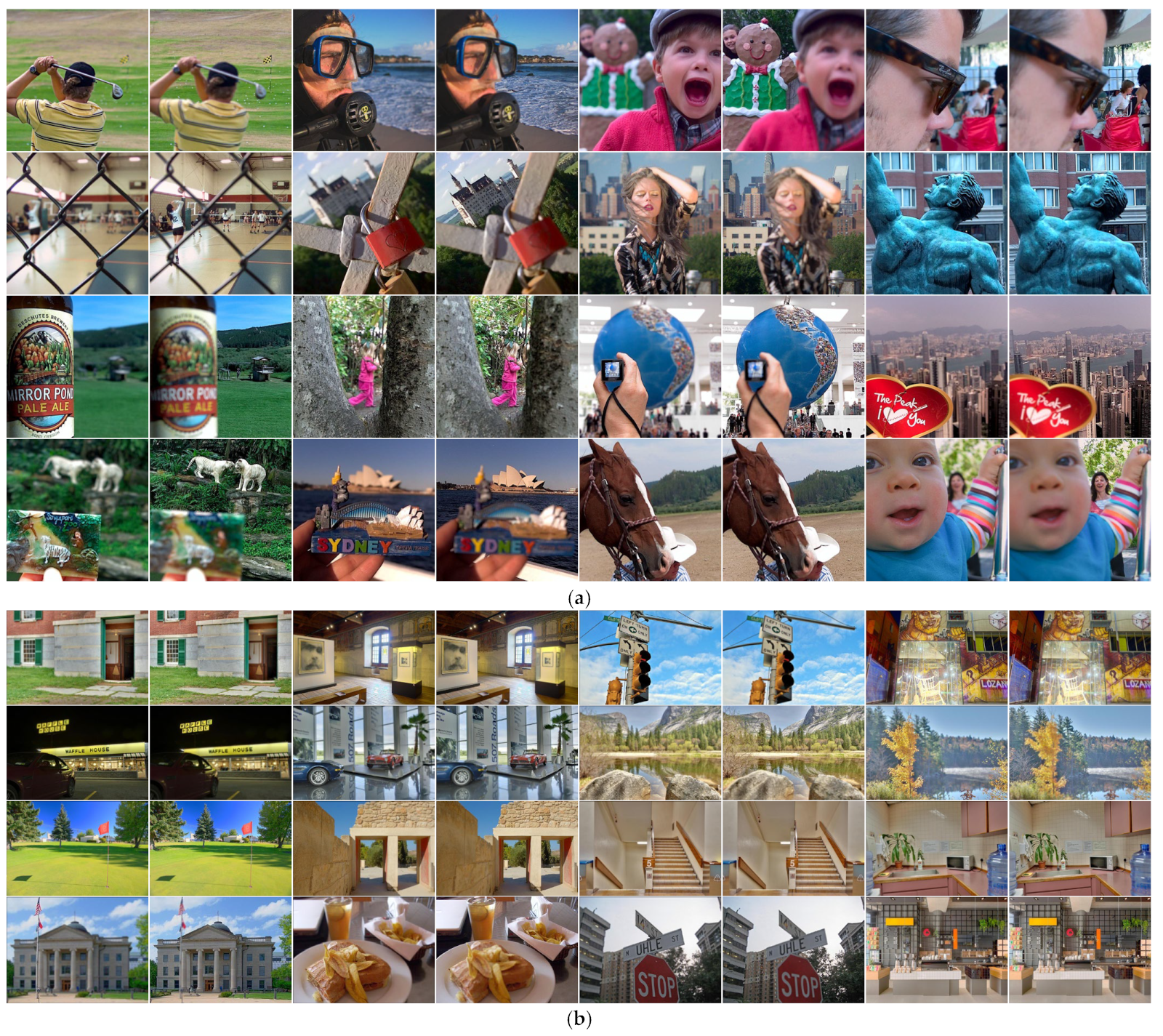
In this section, the Lytro [68] and MFI-WHU [69] datasets are employed to evaluate the proposed method and the compared approaches. Specifically, 20 and 30 pairs of images from the Lytro and MFI-WHU datasets, respectively, are used for testing. Examples from these multi-focus datasets are shown in Figure 4. These comparative fusion algorithms include RPCNN [70], MFFGAN [69], U2Fusion [71], TITA [72], MMAE [73], SwinMFF [74], DDBFusion [75], and ReFusion [63] as the subjective evaluation. The ten metrics Q A B / F [76], Q C B [77], Q F M I [78], Q G [77], Q M I [76], Q N C I E [77], Q N M I [77], and Q Y [77], Q P [77] and Q P S N R [79,80,81] as the objective evaluation. The larger metric values indicate better fusion algorithms. In NSCT, the pyramid filter is set to ‘9–7′, and the directional filter is set to ‘pkva’. For the Gaussian filter, σ = 0.6 . For the AGPCNN, d Θ = 0.6 , a Θ = 20 , and N = 110 .

4.1. Discussion of NSCT Decomposition Levels

In this section, we analyze the effect of varying the number of NSCT decomposition levels on the overall fusion performance. To this end, the proposed method is tested on both the Lytro and MFI-WHU datasets under multiple decomposition configurations, and the corresponding quantitative outcomes are summarized in Table 1. The results reveal a consistent trend: when the NSCT decomposition level is set to 4, the proposed fusion model obtains the highest scores on 10 metrics for the Lytro dataset and on 4 metrics for the MFI-WHU dataset, demonstrating superior capability in preserving structural details, suppressing artifacts, and maintaining visual sharpness.
Given these observations, we determine that a four-level decomposition structure offers the best balance between computational complexity and fusion quality. Therefore, decomposition level 4 is adopted as the default setting in subsequent experiments. Specifically, the directional subbands are arranged as 2, 2, 4, and 4 directions from the coarsest to the finest scales, enabling rich directional representation while effectively capturing multi-scale focus information. This configuration ensures that both global features and fine-grained details are adequately extracted and fused, thus contributing to stable and high-quality fusion performance across diverse scenes.

4.2. Results on Lytro Dataset

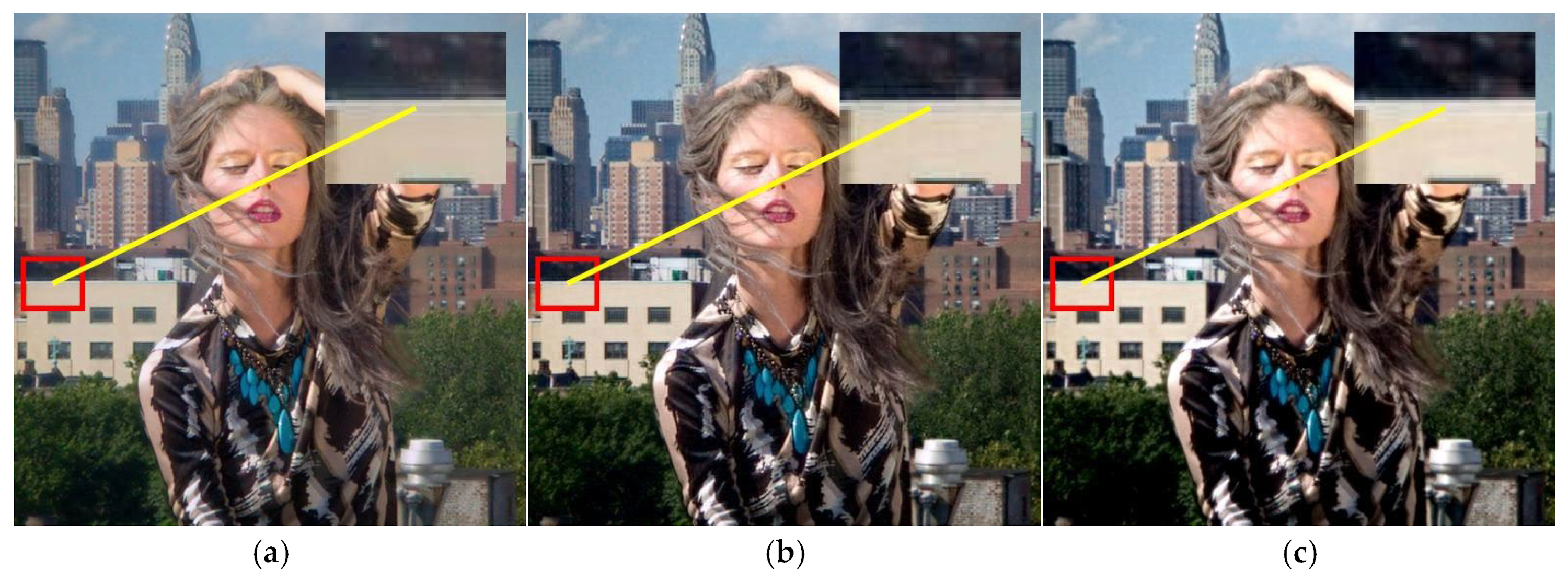
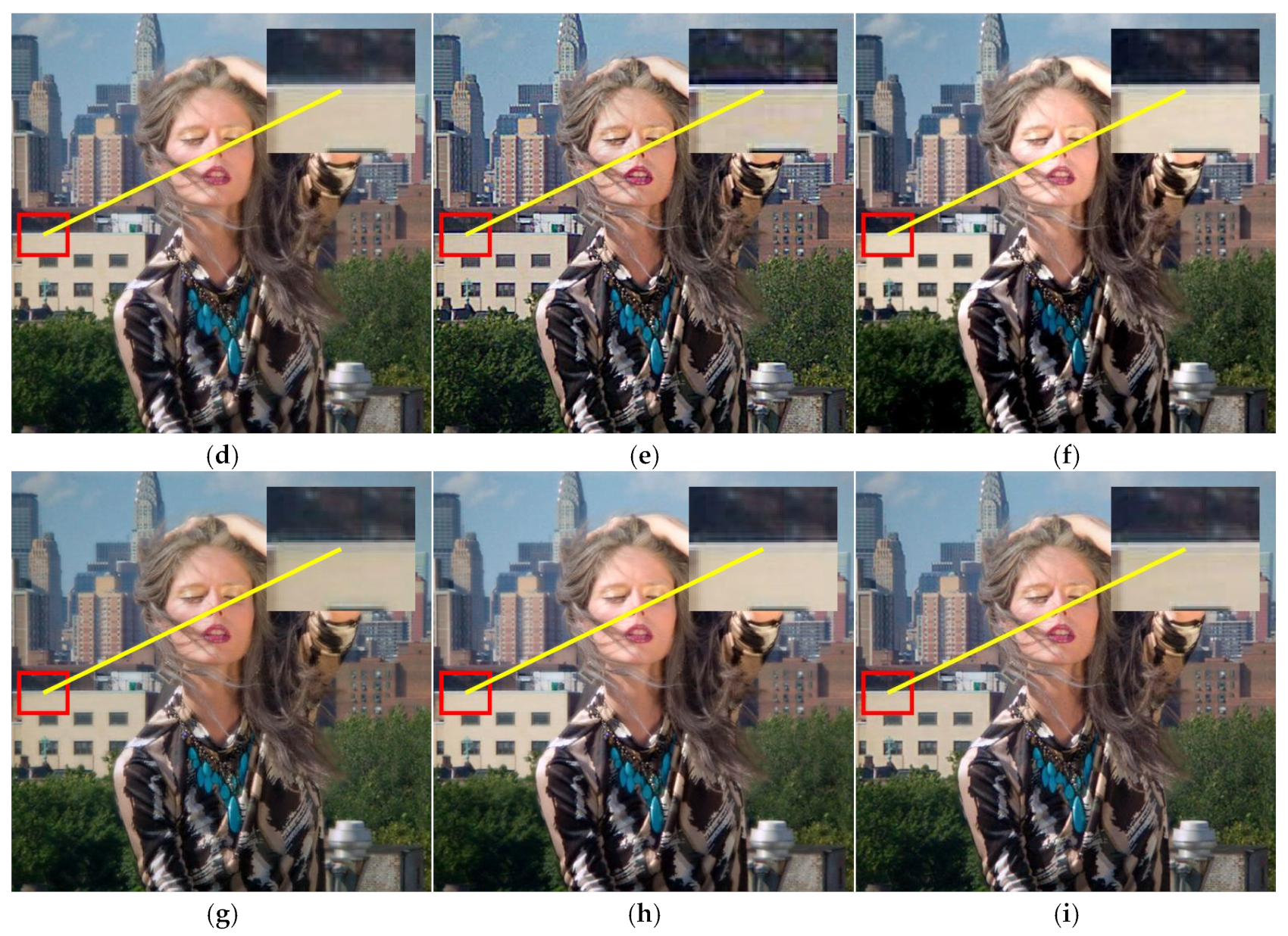
Figure 5, Figure 6 and Figure 7 present the fusion results of different methods on three datasets, respectively. To better observe the image details, certain regions of the fusion results in Figure 5 are magnified three times. As shown in Figure 5, the fused image generated by the RPCNN algorithm appears blurry and suffers from a significant loss of information. The fused images produced by the MFFGAN, U2Fusion, and SwinMFF methods exhibit excessively high brightness in the character’s arm region and undesirably low brightness in the lower-left tree area. Although the fusion results obtained by the TITA and DDBFusion algorithms show some improvement over PMGI, they still appear blurry and lose considerable detail information. The MMAE algorithm produces a relatively sharper fused image with improved clarity and better preservation of fine details. In contrast, the image fused by the ReFusion algorithm remains relatively blurry and shows overly bright arm regions. Overall, the fusion result generated by our proposed algorithm demonstrates well-balanced brightness and achieves optimal integration of complementary information.
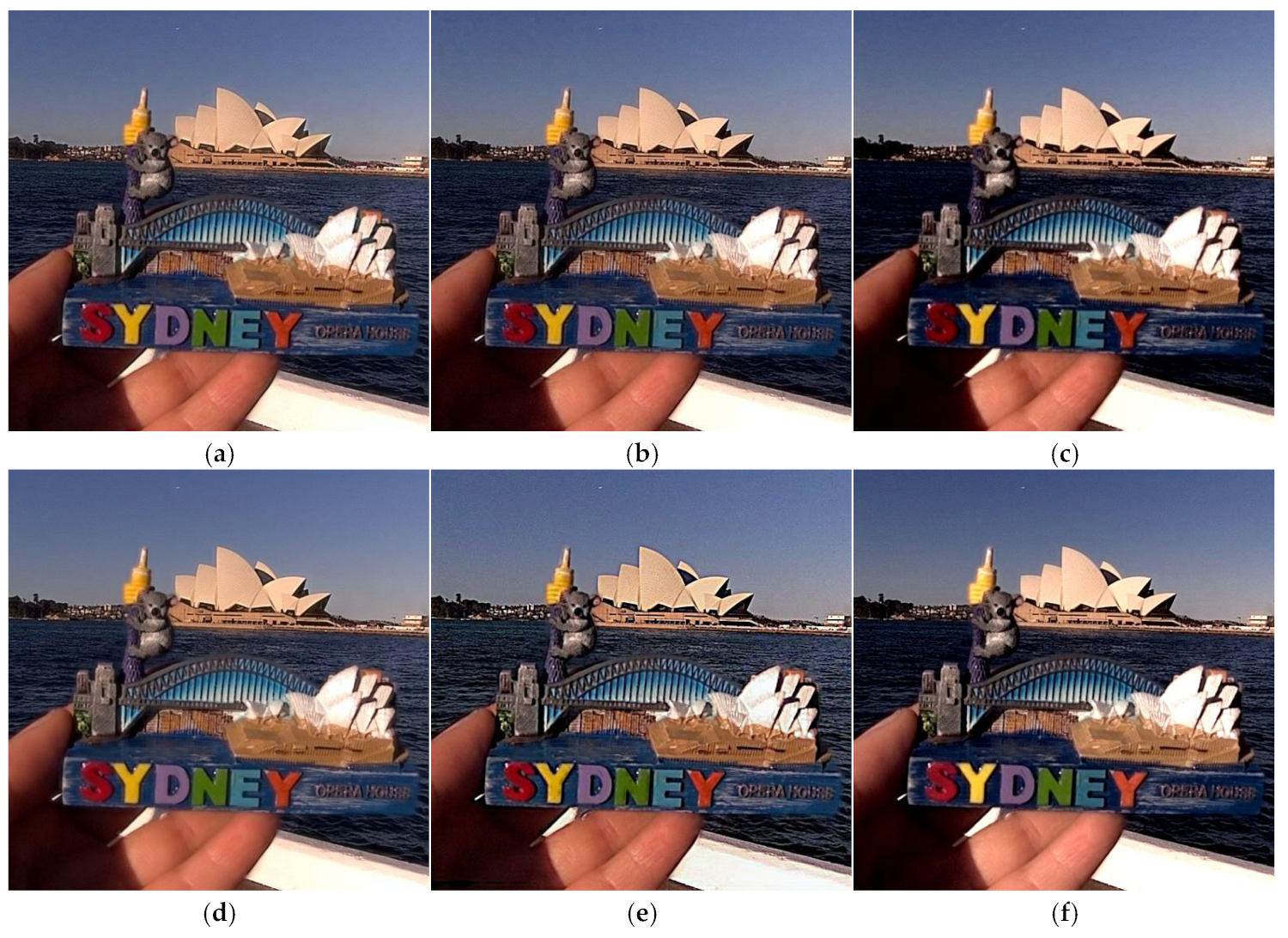
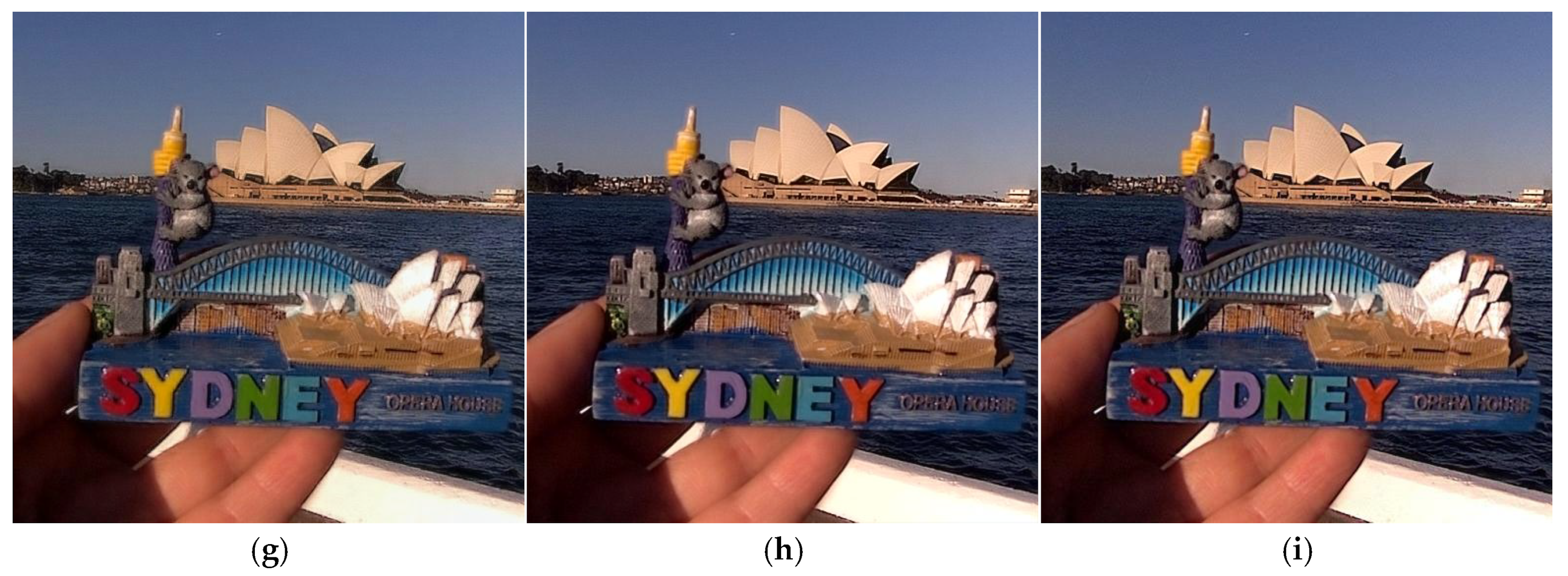
From Figure 6, it can be observed that the fused image produced by the RPCNN algorithm appears blurry. The fused images generated by MFFGAN, U2Fusion, and SwinMFF exhibit excessively low brightness in the left sea region, leading to partial information loss. The fusion results obtained by the TITA and MMAE algorithms display undesirably low brightness in the person’s hand region. Meanwhile, the DDBFusion and ReFusion algorithms introduce noticeable artifacts in the yellow-colored areas of the model within the fused image. In contrast, our proposed algorithm achieves superior fusion performance, effectively eliminating artifacts while ensuring comprehensive and complementary integration of information.
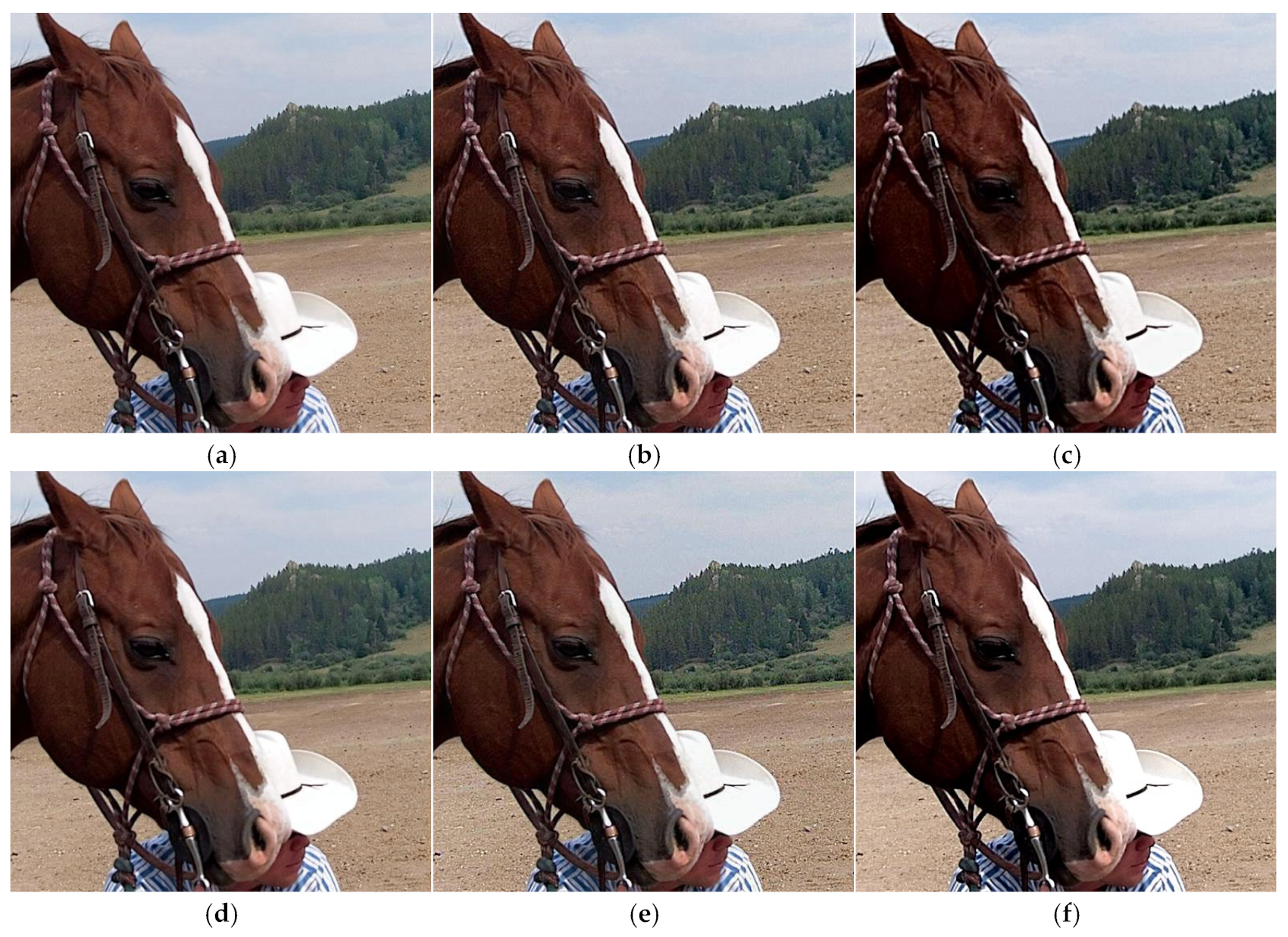
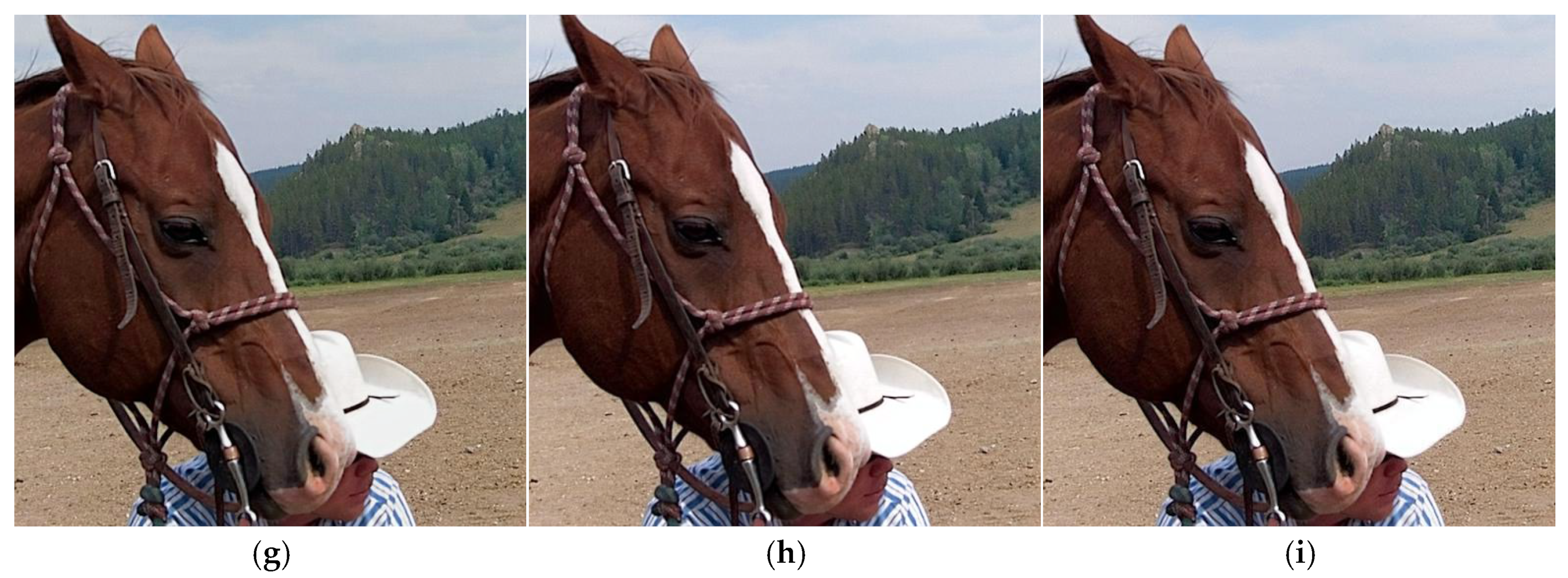
From Figure 7, it can be observed that the RPCNN and TITA algorithms lead to the loss of detailed information in distant grass areas. The MFFGAN algorithm introduces artifacts in the hat region. The U2Fusion algorithm causes some regions of the fused image to appear darker, such as the distant forest and the horse’s head. The MMAE algorithm enhances image details but introduces artifacts in the sky region. The SwinMFF, DDBFusion, and ReFusion algorithms generate artifacts in parts of the person’s clothing. In contrast, our algorithm achieves the best fusion performance, preserving information completely while effectively suppressing noise interference.
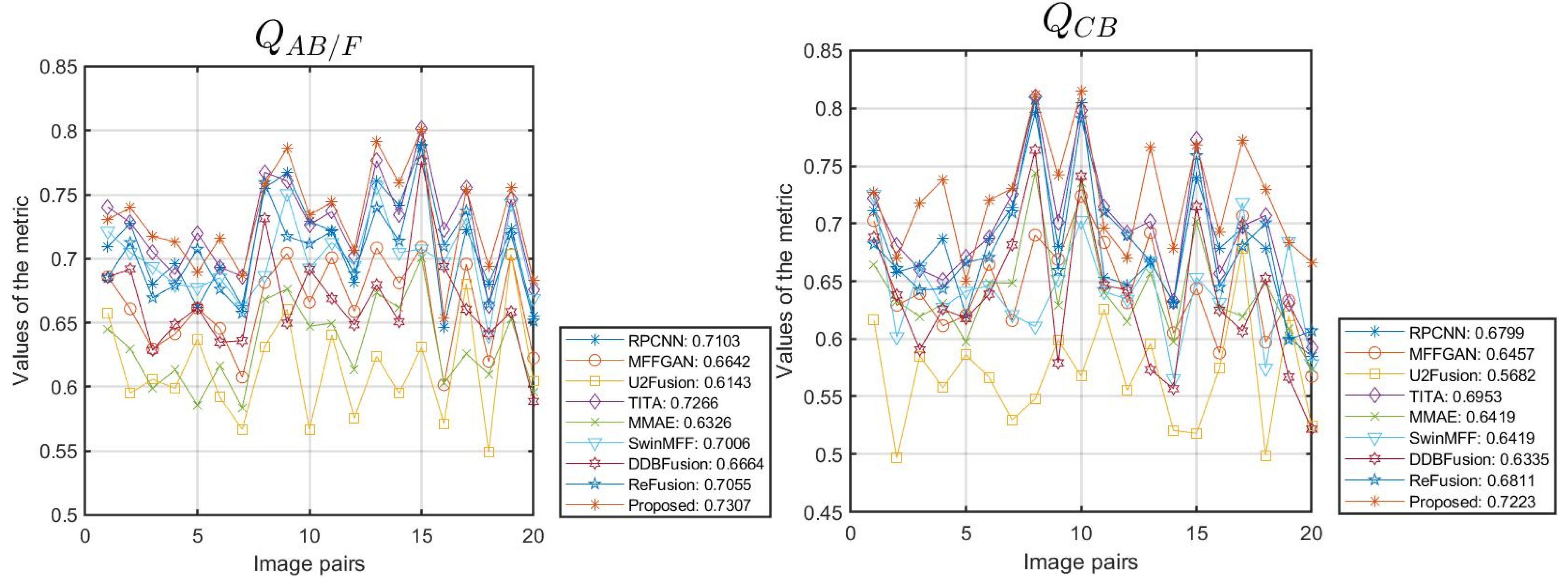
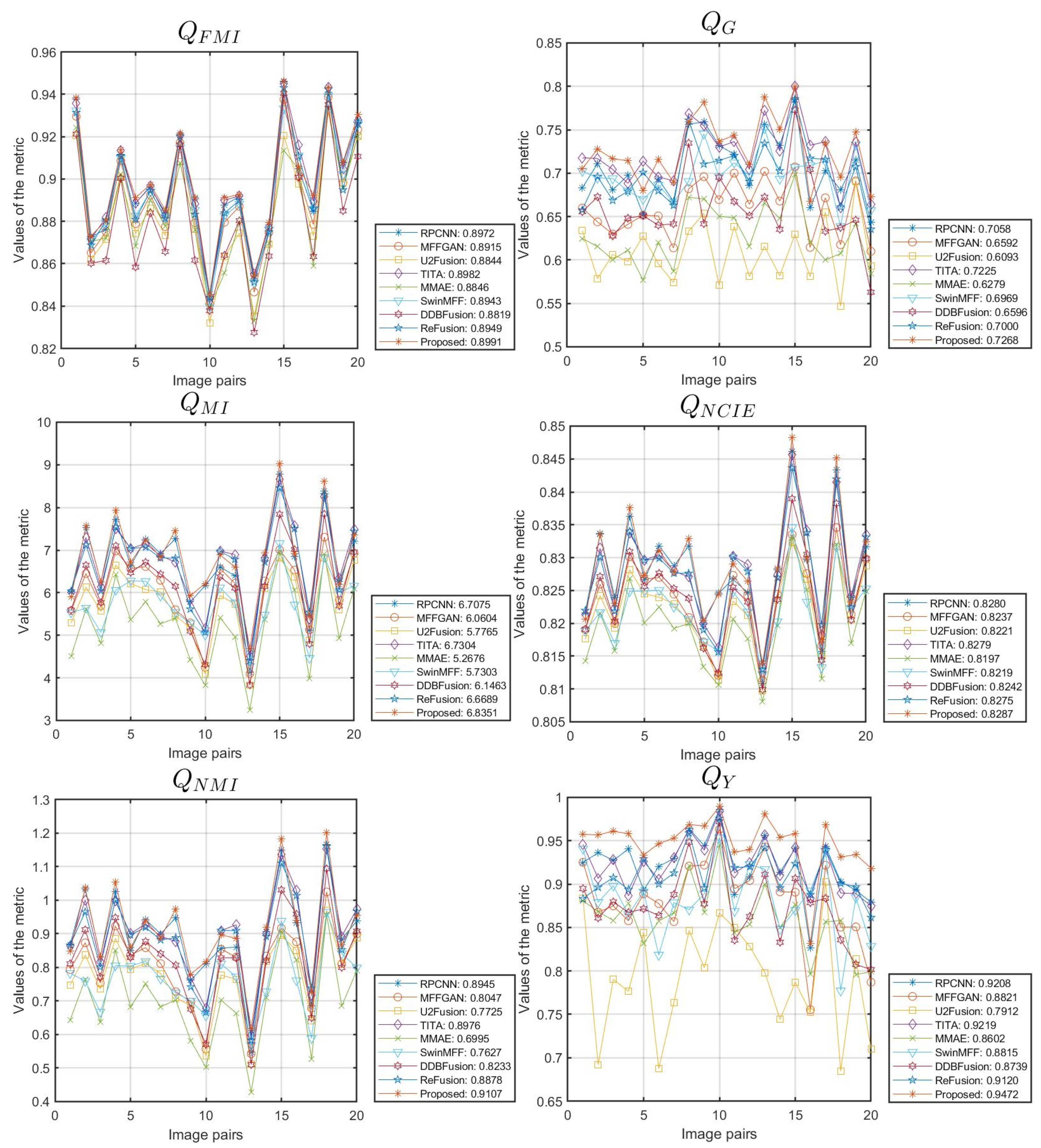
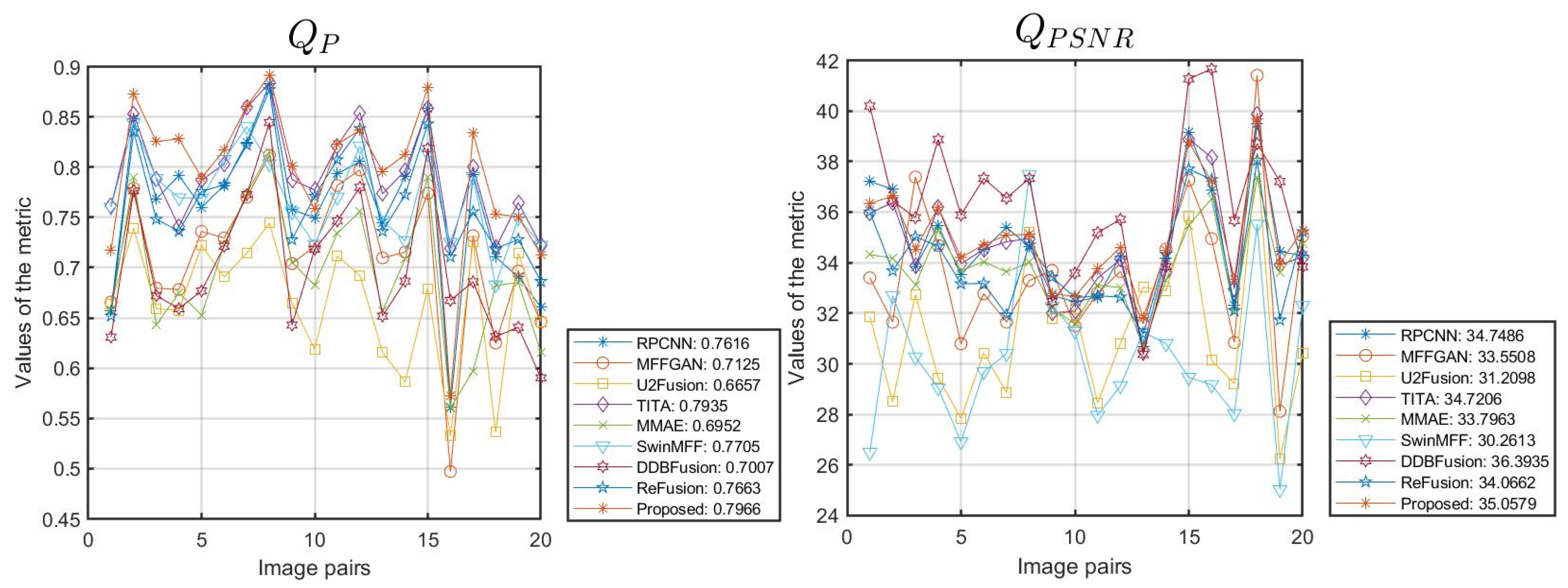
Figure 8 illustrates the performance of various fusion methods on the Lytro dataset, which contains 20 image pairs. The horizontal axis represents the image pair index, while the vertical axis denotes the corresponding metric value. For each metric, the results are plotted as continuous curves representing individual image pairs, with the average scores shown in the legend. Most methods exhibit consistent trends and stable performance with few outliers, confirming the reliability of the average values reported in Table 2. As shown in Table 2, except for the Q P S N R metric, our method achieves the highest scores across all other evaluation metrics on this dataset. Nevertheless, our method still ranks second in terms of Q P S N R .

4.3. Results on MFI-WHU Dataset

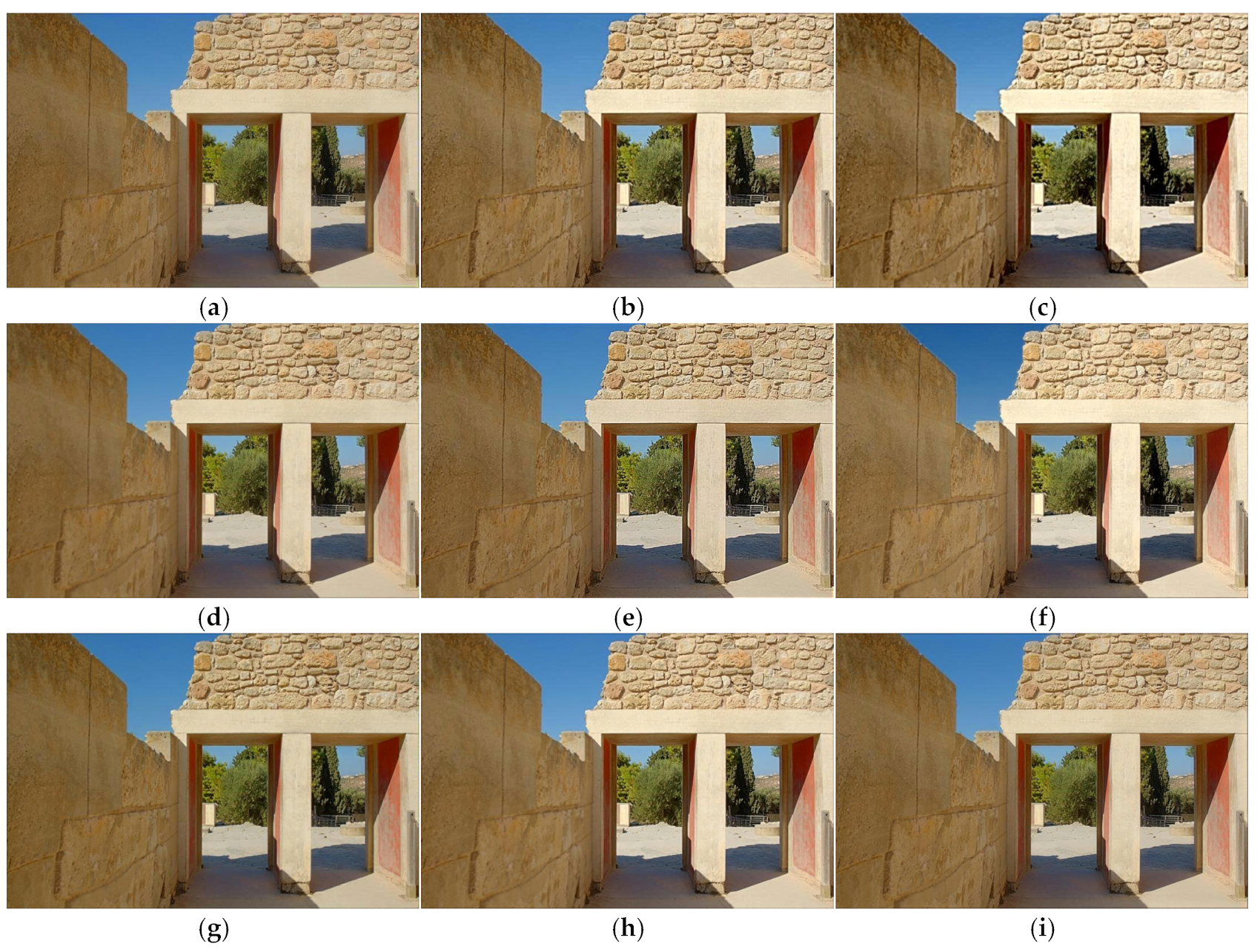
Figure 9, Figure 10 and Figure 11 show the fusion results of different methods on three datasets, respectively. As illustrated in Figure 9, the RPCNN algorithm produces a blurred image, while the MFFGAN algorithm enhances the brightness of the fused image. The U2Fusion algorithm causes a loss of fine details, resulting in a certain degree of blurriness, and the image generated by the TITA algorithm also exhibits relatively low clarity. The MMAE and SwinMFF algorithms introduce excessive shadows in the distant tree regions of the fused images. Additionally, the DDBFusion and ReFusion algorithms generate artifacts in the left wall region of the fused image. In contrast, our algorithm achieves superior fusion performance, producing clearer and more visually consistent results.
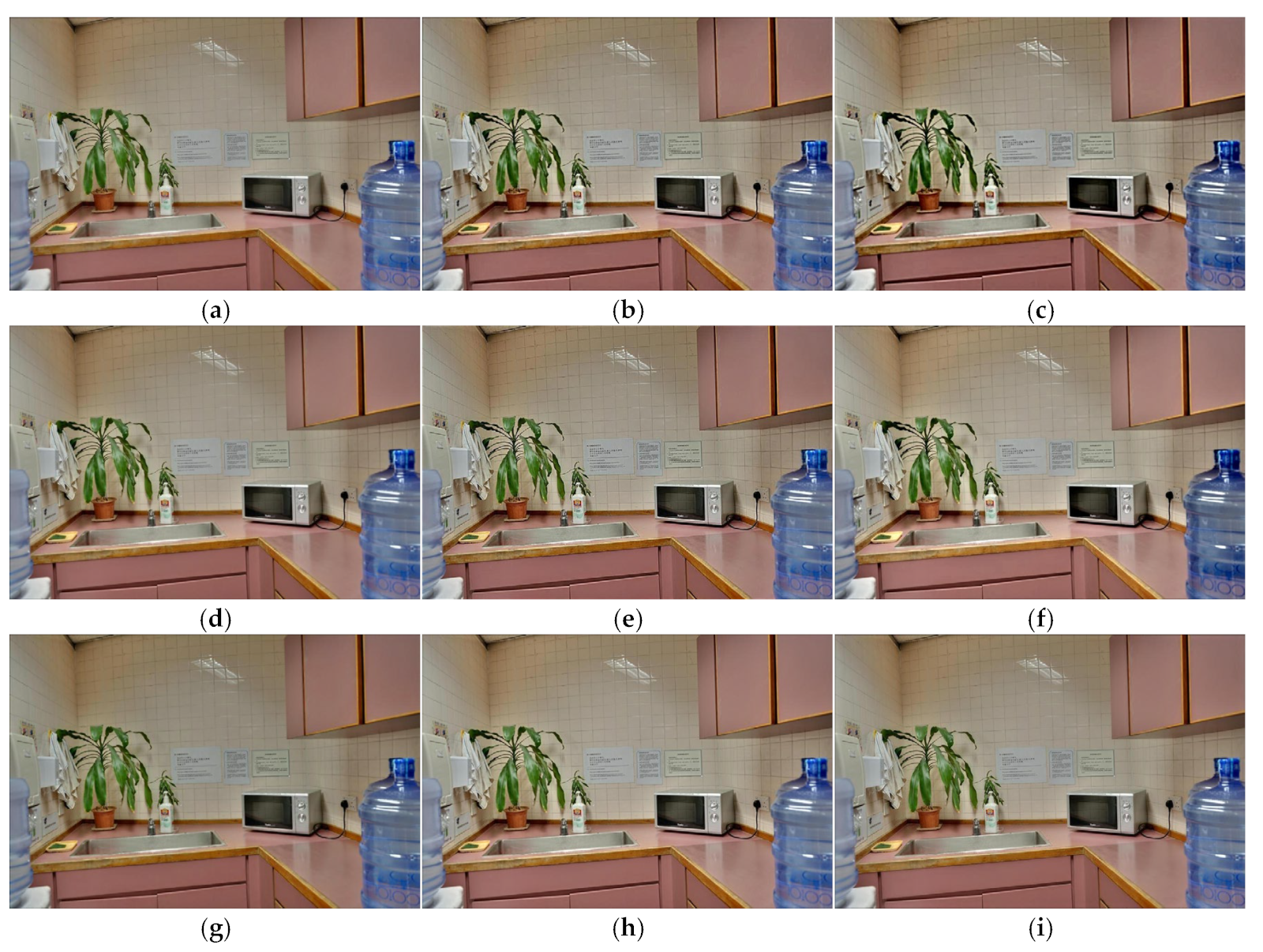
From Figure 10, it can be observed that the RPCNN and DDBFusion algorithms produce relatively blurred fused images. The fusion results obtained by MFFGAN, U2Fusion, and SwinMFF exhibit insufficient brightness around the sealing area at the top of the right bucket. The TITA and ReFusion algorithms introduce artifacts in the right bucket region of the fused image. Both the MMAE and the proposed algorithm achieve superior fusion performance, effectively avoiding artifacts while ensuring comprehensive integration of complementary information and minimizing information loss.
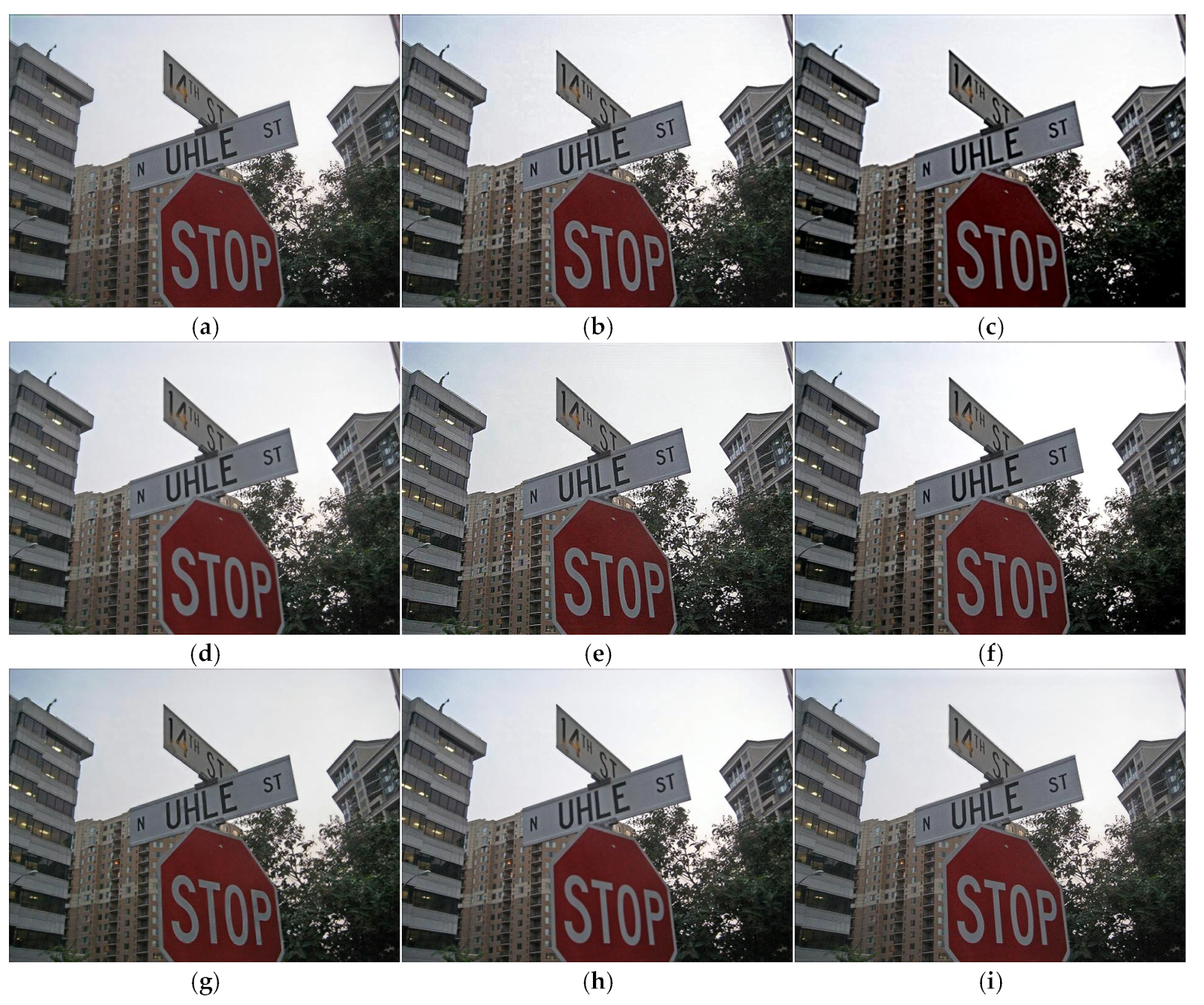
From Figure 11, it can be observed that the RPCNN and MFFGAN algorithms produce blurred fused images, particularly in the central building region. The U2Fusion algorithm causes certain areas of the fused image to appear darker, leading to significant information loss. The TITA algorithm makes the text in the warning sign region slightly blurred. The MMAE algorithm introduces ghosting artifacts in the middle of the warning sign. The SwinMFF and DDBFusion algorithms cause the balcony and tree regions of the central building to appear darker. The ReFusion algorithm results in overall blurriness in the fused image. In contrast, our algorithm achieves better fusion performance, enhancing image clarity while avoiding artifacts and effectively suppressing noise.
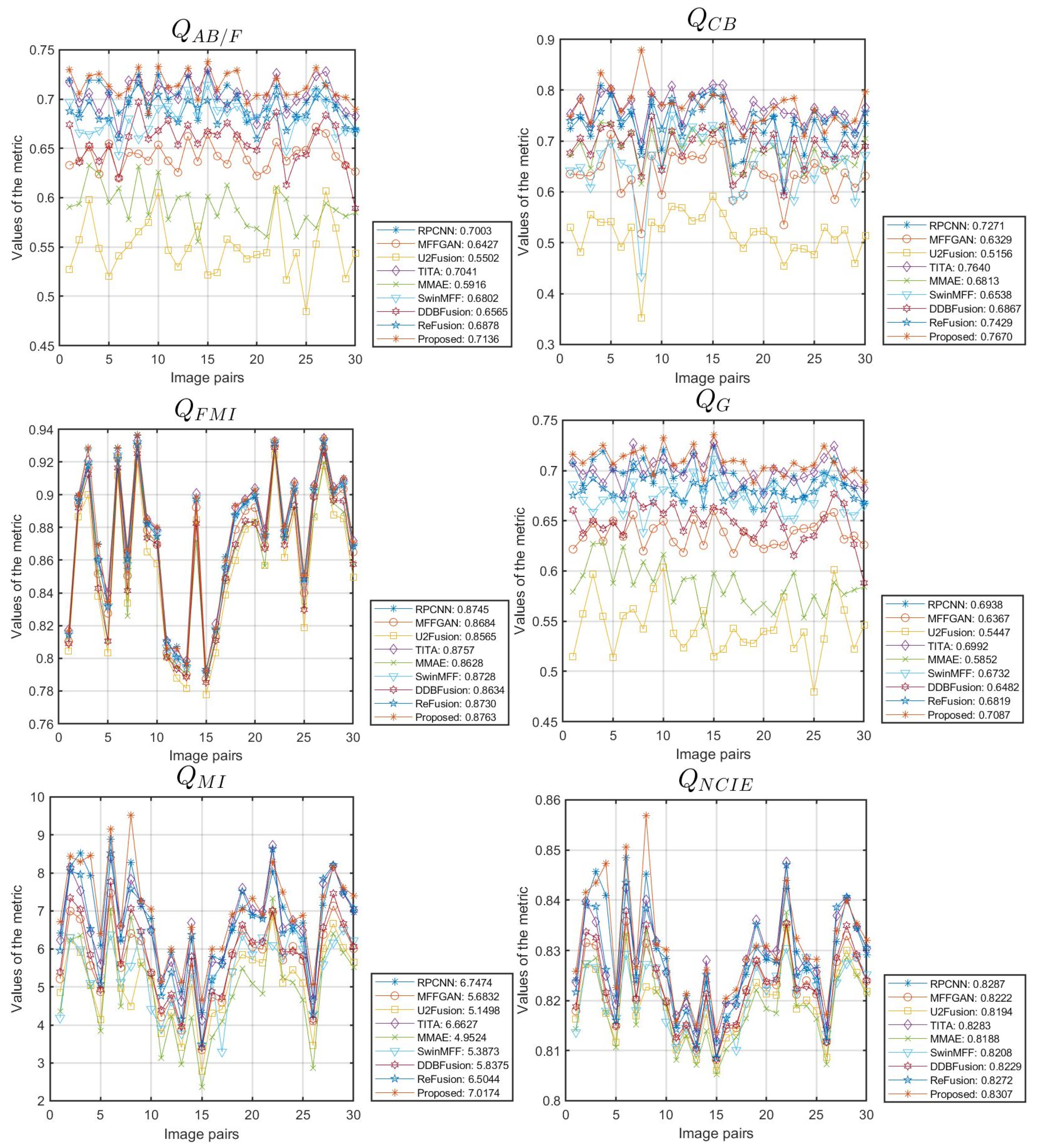
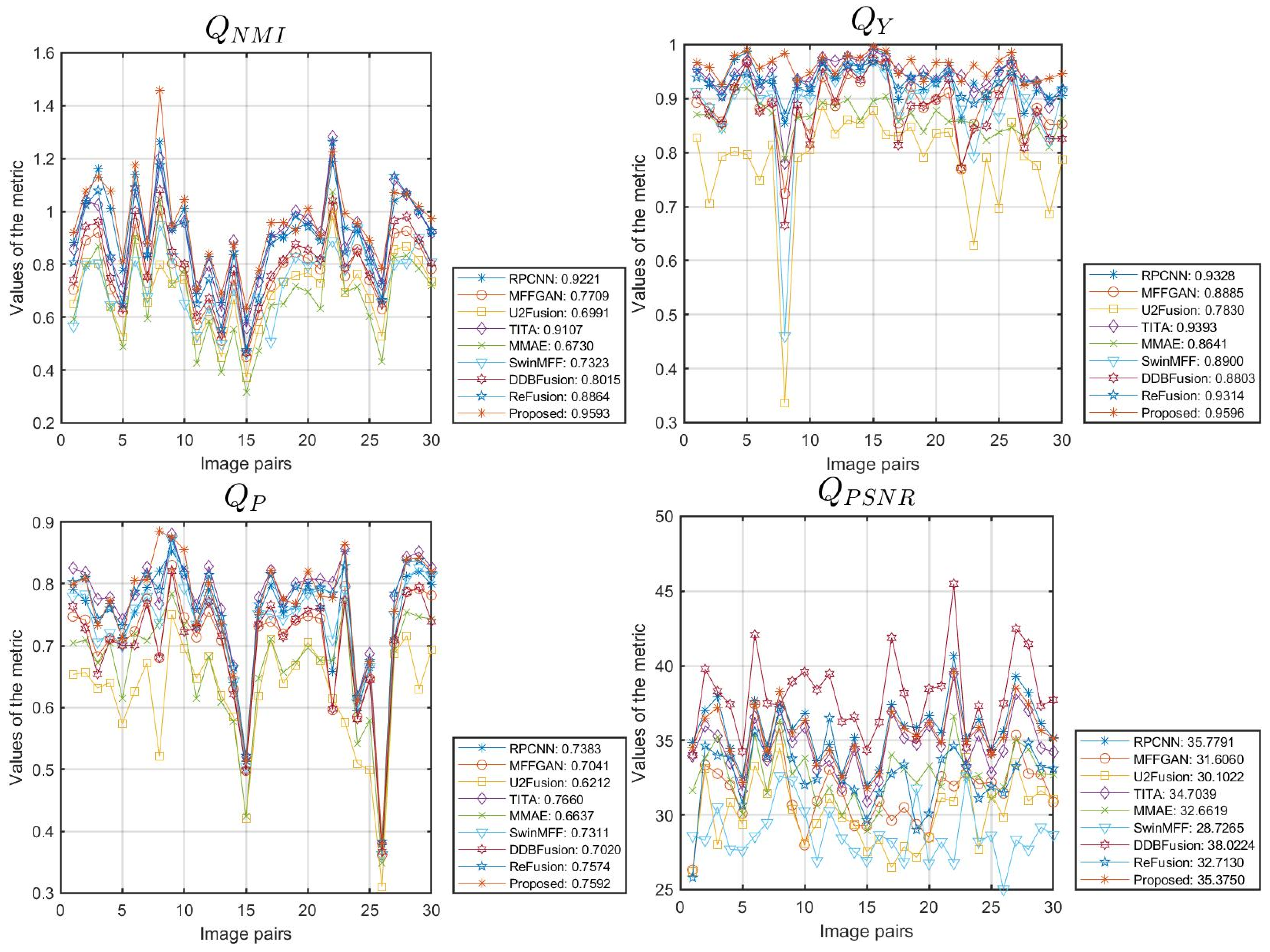
Figure 12 presents a comparative visualization of the performance of various image fusion methods on the MFI-WHU dataset, from which 30 image pairs were randomly selected. For each evaluation metric, the performance trends across different image pairs are illustrated as continuous curves, with the average results over all pairs annotated in the legend for reference. It can be observed that most methods exhibit relatively consistent behavior and maintain stable fusion quality across the dataset, with only minor deviations or occasional outliers. This stability confirms the representativeness and reliability of the aggregated average results summarized in Table 3. As quantitatively shown in Table 3, except for Q P and Q P S N R , the proposed method outperforms all other approaches, achieving the highest scores across the remaining evaluation metrics on this dataset. However, our algorithm ranks second and third in terms of Q P and Q P S N R , respectively.

4.4. Ablation Experiment

In this subsection, we present ablation studies to evaluate the effectiveness of the fractal dimension (FD) module within the proposed multi-focus image fusion framework. Experiments are conducted on both the Lytro and MFI-WHU benchmark datasets, and the corresponding quantitative indicators are summarized in Table 4. The comparative results clearly demonstrate that integrating the FD component significantly enhances fusion performance across all evaluation metrics. Specifically, the full model consistently outperforms the variant without the FD module, confirming that the FD mechanism plays an essential role in improving detail preservation, focus discrimination, and overall visual fidelity. These findings validate the contribution of the FD module to the robustness and superiority of our fusion strategy.

4.5. Application Extension

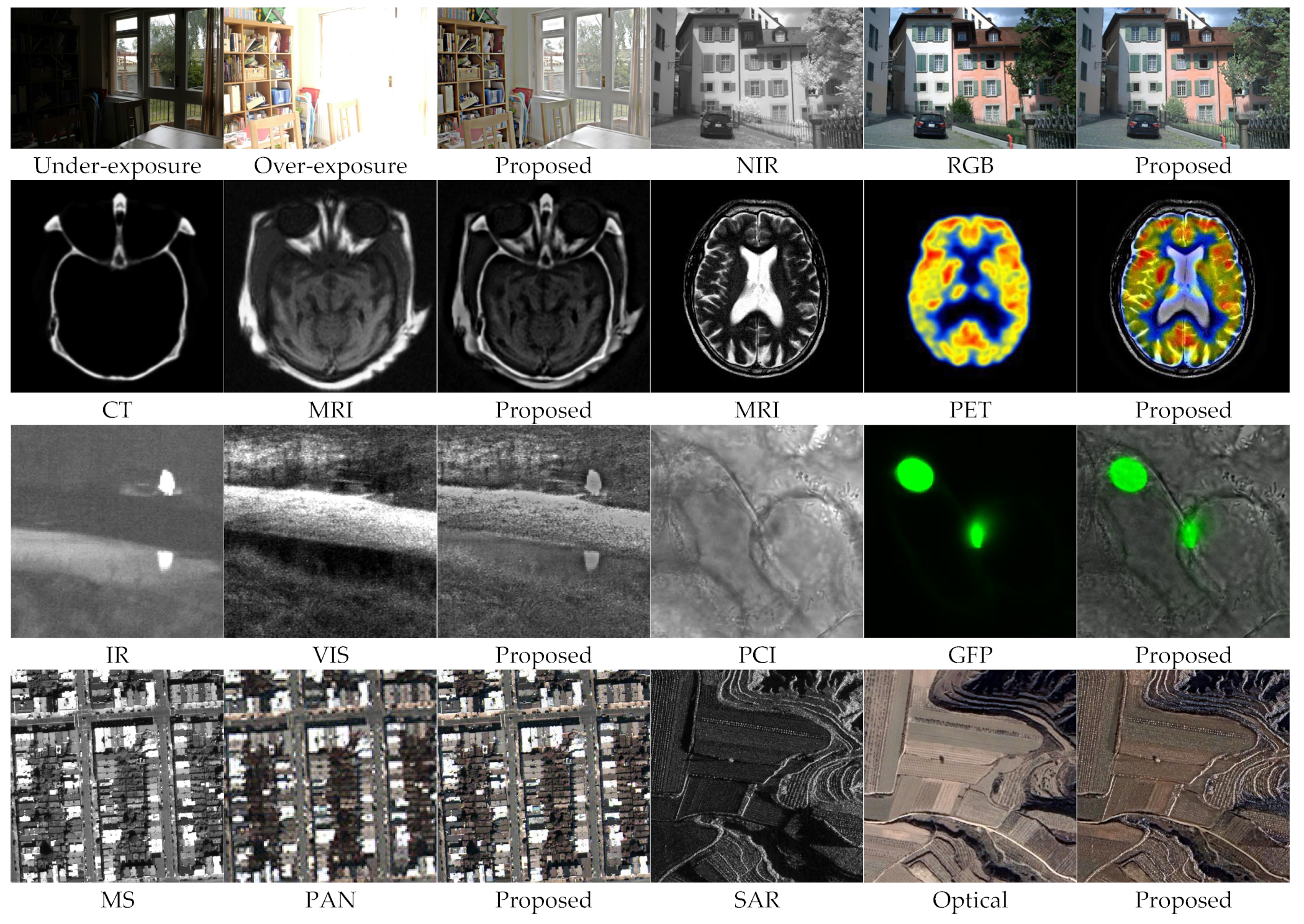
To verify the generality of the proposed fusion algorithm, we conduct experiments on multi-exposure images [82], infrared and visible images [26], medical images [83,84], and remote sensing image data [85,86] in this subsection, as shown in Figure 13. The results demonstrate that the algorithm achieves good fusion performance across these different types of images. When processing near-infrared and RGB images [26], MRI and PET images [83], PCI and GFP images [85], MS and Pan images [85], as well as SAR and optical images [86], we perform color space conversions between RGB and YUV [83]. The Y channel of the color images is fused with grayscale images to obtain a new Y channel. Then, we perform a YUV to RGB color space conversion to obtain the final color fused image.

5. Conclusions

To tackle the challenges of artifacts and information loss in multi-focus image fusion, we introduce a novel fusion algorithm that integrates an adaptive Gaussian pulse-coupled neural network (AGPCNN) with fractal dimension analysis within the non-subsampled contourlet transform (NSCT) domain. The source images are first decomposed into low- and high-pass sub-bands via NSCT. The low-pass sub-bands are fused using an averaging strategy, while the high-pass sub-bands are merged through a mechanism combining fractal dimension and AGPCNN. A consistency verification step is further applied to refine the fused high-pass sub-bands. The proposed method is evaluated both qualitatively and quantitatively against state-of-the-art approaches on the publicly available Lytro and MFI-WHU datasets. Results demonstrate that our method achieves superior fusion performance in terms of both visual quality and objective metrics. We also carried out a series of application extensions for multi-sensor and multi-modal image fusion, further verifying the generality of the proposed algorithm. In future work, we will explore its applications in hyperspectral-panchromatic and -multispectral image fusion, as well as in downstream tasks such as classification and object detection [87,88]. In addition, change detection based on fusion models is also a direction worth exploring [89]. Since the proposed algorithm employs NSCT and AGPCNN, its computational efficiency still needs to be improved. This is also one of the issues we plan to address in our future work.

Author Contributions

Conceptualization, M.L.; Methodology, M.L., Z.J. and H.M.; Software, M.L.; Validation, Z.J. and H.M.; Formal analysis, L.L.; Investigation, Z.J. and H.M.; Resources, L.L.; Data curation, M.L., L.L. and H.M.; Writing—original draft, M.L.; Writing—review & editing, Z.J., L.L. and H.M.; Supervision, Z.J., L.L. and H.M.; Funding acquisition, Z.J. All authors have read and agreed to the published version of the manuscript.

Funding

This research was funded by the National Natural Science Foundation of China under Grant No. 62261053, the Tianshan Talent Training Project-Xinjiang Science and Technology Innovation Team Program (2023TSYCTD0012), and the Research Project of Xinjiang Sky-Ground Integrated Intelligent Computing Technology Laboratory under Grant No.2025A05-1.

Data Availability Statement

The original contributions presented in this study are included in the article. Further inquiries can be directed to the corresponding author.

Conflicts of Interest

The authors declare no conflicts of interest.

References

  1. Wang, Z.; Zhao, L.; Zhang, J. Multi-Text Guidance Is Important: Multi-modality image fusion via large generative vision-language model. Int. J. Comput. Vis. 2025, 133, 4646–4668. [Google Scholar] [CrossRef]
  2. Xie, X.; Lin, Z.; Guo, B.; He, S.; Gu, Y.; Bai, Y.; Li, P. LightMFF: A simple and efficient ultra-lightweight multi-focus image fusion network. Appl. Sci. 2025, 15, 7500. [Google Scholar] [CrossRef]
  3. Zhao, L.; Zhang, X.; Wang, Z. Focusing on neglected natural images: A self-supervised learning model for pan-sharpening. Inf. Process. Manag. 2025, 62, 104246. [Google Scholar] [CrossRef]
  4. Tang, L.; Li, C.; Ma, J. Mask-DiFuser: A masked diffusion model for unified unsupervised image fusion. IEEE Trans. Pattern Anal. Mach. Intell. 2025. Early Access. [Google Scholar]
  5. Cao, Z.; Liang, Y.; Deng, L.; Vivone, G. An efficient image fusion network exploiting unifying language and mask guidance. IEEE Trans. Pattern Anal. Mach. Intell. 2025, 47, 9845–9862. [Google Scholar] [CrossRef] [PubMed]
  6. Yan, H.; Zhang, J.; Zhang, X. Injected infrared and visible image fusion via L1 decomposition model and guided filtering. IEEE Trans. Comput. Imaging 2022, 8, 162–173. [Google Scholar] [CrossRef]
  7. Zhu, Z.; Wang, Z.; Qi, G.; Mazur, N.; Yang, P.; Liu, Y. Brain tumor segmentation in MRI with multi-modality spatial information enhancement and boundary shape correction. Pattern Recognit. 2024, 153, 110553. [Google Scholar] [CrossRef]
  8. Liu, Y.; Chen, X.; Ward, R.K.; Wang, Z.J. Image fusion with convolutional sparse representation. IEEE Signal Process. Lett. 2016, 23, 1882–1886. [Google Scholar] [CrossRef]
  9. Xie, X.; Guo, B.; He, S.; Gu, Y.; Li, Y.; Li, P. One-shot multi-focus image stack fusion via focal depth regression. Eng. Appl. Artif. Intell. 2025, 162, 112667. [Google Scholar] [CrossRef]
  10. Xie, X.; Guo, B.; Li, P. Multi-focus image fusion with visual state space model and dual adversarial learning. Comput. Electr. Eng. 2025, 123, 110238. [Google Scholar] [CrossRef]
  11. Zhu, Z.; He, X.; Qi, G.; Li, Y.; Cong, B.; Liu, Y. Brain tumor segmentation based on the fusion of deep semantics and edge information in multimodal MRI. Inf. Fusion 2023, 91, 376–387. [Google Scholar] [CrossRef]
  12. Li, L.; Ma, H. Pulse coupled neural network-based multimodal medical image fusion via guided filtering and WSEML in NSCT domain. Entropy 2021, 23, 591. [Google Scholar] [CrossRef] [PubMed]
  13. Wang, Z.; Li, X.; Duan, H.; Zhang, X. A self-supervised residual feature learning model for multifocus image fusion. IEEE Trans. Image Process. 2022, 31, 4527–4542. [Google Scholar] [CrossRef] [PubMed]
  14. Zhao, L.; Zhang, X.; Huang, B.; Tian, M.; Wang, Z. MFANet: Multi-feature aggregation network for multi-focus image fusion. In Proceedings of the 2025 IEEE International Conference on Acoustics, Speech and Signal Processing (ICASSP), Hyderabad, India, 6–11 April 2025; pp. 1–5. [Google Scholar]
  15. Xie, X.; Jiang, Q.; Chen, D. StackMFF: End-to-end multi-focus image stack fusion network. Appl. Intell. 2025, 55, 503. [Google Scholar] [CrossRef]
  16. Wu, X.; Cao, Z.; Huang, T.; Deng, L.; Chanussot, J.; Vivone, G. Fully-connected transformer for multi-source image fusion. IEEE Trans. Pattern Anal. Mach. Intell. 2025, 47, 2071–2088. [Google Scholar] [CrossRef]
  17. Vivone, G.; Deng, L. Deep learning in remote sensing image fusion: Methods, protocols, data, and future perspectives. IEEE Geosci. Remote Sens. Mag. 2025, 13, 269–310. [Google Scholar] [CrossRef]
  18. Matteo, C.; Giuseppe, G.; Gemine, V. Hyperspectral pansharpening: Critical review, tools, and future perspectives. IEEE Geosci. Remote Sens. Mag. 2025, 13, 311–338. [Google Scholar]
  19. Vivone, G.; Garzelli, A.; Xu, Y.; Liao, W.; Chanussot, J. Panchromatic and hyperspectral image fusion: Outcome of the 2022 WHISPERS hyperspectral pansharpening challenge. IEEE J. Sel. Top. Appl. Earth Obs. Remote Sens. 2023, 16, 166–179. [Google Scholar] [CrossRef]
  20. Wen, X.; Ma, H.; Li, L. A three-branch pansharpening network based on spatial and frequency domain interaction. Remote Sens. 2025, 17, 13. [Google Scholar] [CrossRef]
  21. Wen, X.; Ma, H.; Li, L. A Multi-stage progressive pansharpening network based on detail injection with redundancy reduction. Sensors 2024, 24, 6039. [Google Scholar] [CrossRef]
  22. Jin, X.; Zhu, P.; Yu, D.; Wozniak, M.; Jiang, Q.; Wang, P.; Zhou, W. Combining depth and frequency features with Mamba for multi-focus image fusion. Inf. Fusion 2025, 124, 103355. [Google Scholar] [CrossRef]
  23. Zhai, H.; Ouyang, Y.; Luo, N. MSI-DTrans: A multi-focus image fusion using multilayer semantic interaction and dynamic transformer. Displays 2024, 85, 102837. [Google Scholar] [CrossRef]
  24. Ouyang, Y.; Zhai, H.; Hu, H. FusionGCN: Multi-focus image fusion using superpixel features generation GCN and pixel-level feature reconstruction CNN. Expert Syst. Appl. 2025, 262, 125665. [Google Scholar] [CrossRef]
  25. Liu, J.; Wu, G.; Liu, Z.; Wang, D.; Jiang, Z.; Ma, L.; Zhong, W.; Fan, X.; Liu, R. Infrared and visible image fusion: From data compatibility to task adaption. IEEE Trans. Pattern Anal. Mach. Intell. 2025, 47, 2349–2369. [Google Scholar] [CrossRef] [PubMed]
  26. Li, L.; Lv, M.; Jia, Z.; Jin, Q.; Liu, M.; Chen, L.; Ma, H. An effective infrared and visible image fusion approach via rolling guidance filtering and gradient saliency map. Remote Sens. 2023, 15, 2486. [Google Scholar] [CrossRef]
  27. Zhang, X.; Chen, S.; Zhang, J. Adaptive sliding mode consensus control based on neural network for singular fractional order multi-agent systems. Appl. Math. Comput. 2022, 434, 127442. [Google Scholar] [CrossRef]
  28. Zhang, J.; Ding, J.; Chai, T. Cyclic performance monitoring-based fault-tolerant funnel control of unknown nonlinear systems with actuator failures. IEEE Trans. Autom. Control 2025, 70, 6111–6118. [Google Scholar] [CrossRef]
  29. Zhang, J.; Yang, G. Low-complexity tracking control of strict-feedback systems with unknown control directions. IEEE Trans. Autom. Control 2019, 64, 5175–5182. [Google Scholar] [CrossRef]
  30. Li, L.; Shi, Y.; Lv, M.; Jia, Z.; Liu, M.; Zhao, X.; Zhang, X.; Ma, H. Infrared and visible image fusion via sparse representation and guided filtering in Laplacian pyramid domain. Remote Sens. 2024, 16, 3804. [Google Scholar] [CrossRef]
  31. Li, H.; Yang, Z.; Zhang, Y.; Jia, W.; Yu, Z.; Liu, Y. MulFS-CAP: Multimodal fusion-supervised cross-modality alignment perception for unregistered infrared-visible image fusion. IEEE Trans. Pattern Anal. Mach. Intell. 2025, 47, 3673–3690. [Google Scholar] [CrossRef]
  32. Zhang, X.; Yan, H.; He, H. Multi-focus image fusion based on fractional-order derivative and intuitionistic fuzzy sets. Front. Inf. Technol. Electron. Eng. 2020, 21, 834–843. [Google Scholar] [CrossRef]
  33. Zhang, X. Deep learning-based multi-focus image fusion: A survey and a comparative study. IEEE Trans. Pattern Anal. Mach. Intell. 2022, 44, 4819–4838. [Google Scholar] [CrossRef] [PubMed]
  34. Fang, L.; Wang, X. An unsupervised multi-focus image fusion method via dual-channel convolutional network and discriminator. Comput. Vis. Image Underst. 2024, 244, 104029. [Google Scholar] [CrossRef]
  35. Liu, Y.; Wang, L. Multi-focus image fusion: A Survey of the state of the art. Inf. Fusion 2020, 64, 71–91. [Google Scholar] [CrossRef]
  36. Li, B.; Zhang, L.; Liu, J.; Peng, H. Multi-focus image fusion with parameter adaptive dual channel dynamic threshold neural P systems. Neural Netw. 2024, 179, 106603. [Google Scholar] [CrossRef] [PubMed]
  37. Lv, M.; Jia, Z.; Li, L.; Ma, H. Multi-focus image fusion via PAPCNN and fractal dimension in NSST domain. Mathematics 2023, 11, 3803. [Google Scholar] [CrossRef]
  38. Lv, M.; Li, L.; Jin, Q.; Jia, Z.; Chen, L.; Ma, H. Multi-focus image fusion via distance-weighted regional energy and structure tensor in NSCT domain. Sensors 2023, 23, 6135. [Google Scholar] [CrossRef]
  39. Lin, H.; Lin, Y. Fusion2Void: Unsupervised multi-focus image fusion based on image inpainting. IEEE Trans. Circuits Syst. Video Technol. 2025, 35, 3328–3341. [Google Scholar] [CrossRef]
  40. Li, L.; Ma, H.; Jia, Z. A novel multiscale transform decomposition based multi-focus image fusion framework. Multimed. Tools Appl. 2021, 80, 12389–12409. [Google Scholar] [CrossRef]
  41. Li, L.; Lv, M.; Jia, Z.; Ma, H. Sparse representation-based multi-focus image fusion method via local energy in shearlet domain. Sensors 2023, 23, 2888. [Google Scholar] [CrossRef]
  42. Li, L.; Si, Y.; Wang, L. A novel approach for multi-focus image fusion based on SF-PAPCNN and ISML in NSST domain. Multimed. Tools Appl. 2020, 79, 24303–24328. [Google Scholar] [CrossRef]
  43. Li, H.; Yuan, M.; Li, J.; Liu, Y.; Lu, G.; Xu, Y.; Yu, Z.; Zhang, D. Focus affinity perception and super-resolution embedding for multifocus image fusion. IEEE Trans. Neural Netw. Learn. Syst. 2025, 36, 4311–4325. [Google Scholar] [CrossRef]
  44. Li, L.; Song, S.; Lv, M.; Jia, Z.; Ma, H. Multi-focus image fusion based on fractal dimension and parameter adaptive unit-linking dual-channel PCNN in curvelet transform domain. Fractal Fract. 2025, 9, 157. [Google Scholar] [CrossRef]
  45. Lv, M.; Song, S.; Jia, Z.; Li, L.; Ma, H. Multi-focus image fusion based on dual-channel Rybak neural network and consistency verification in NSCT domain. Fractal Fract. 2025, 9, 432. [Google Scholar] [CrossRef]
  46. Li, L.; Ma, H. Saliency-guided nonsubsampled shearlet transform for multisource remote sensing image fusion. Sensors 2021, 21, 1756. [Google Scholar] [CrossRef] [PubMed]
  47. Sengan, S.; Gugulothu, P.; Alroobaea, R. A non-sub-sampled shearlet transform-based deep learning sub band enhancement and fusion method for multi-modal images. Sci. Rep. 2025, 15, 29472. [Google Scholar] [CrossRef] [PubMed]
  48. Vajpayee, P.; Panigrahy, C.; Kumar, A. Medical image fusion by adaptive Gaussian PCNN and improved Roberts operator. SIViP 2023, 17, 3565–3573. [Google Scholar] [CrossRef]
  49. Satyanarayana, V.; Mohanaiah, P. A novel MRI PET image fusion using shearlet transform and pulse coded neural network. Sci. Rep. 2025, 15, 6349. [Google Scholar] [CrossRef]
  50. Zebari, D.A.; Ibrahim, D.A.; Zeebaree, D.Q.; Mohammed, M.A.; Haron, H.; Zebari, N.A.; Damaševičius, R.; Maskeliūnas, R. Breast cancer detection using mammogram images with improved multi-fractal dimension approach and feature fusion. Appl. Sci. 2021, 11, 12122. [Google Scholar] [CrossRef]
  51. Zhang, J.; Zhang, X.; Boutat, D.; Liu, D. Fractional-order complex systems: Advanced control, intelligent estimation and reinforcement learning image-processing algorithms. Fractal Fract. 2025, 9, 67. [Google Scholar] [CrossRef]
  52. Wang, X.; Zhang, X.; Pedrycz, W.; Yang, S.; Boutat, D. Consensus of T-S fuzzy fractional-order, singular perturbation, multi-agent systems. Fractal Fract. 2024, 8, 523. [Google Scholar] [CrossRef]
  53. Zhang, X.; Chen, Y. Admissibility and robust stabilization of continuous linear singular fractional order systems with the fractional order α: The 0 < α < 1 case. ISA Trans. 2018, 82, 42–50. [Google Scholar] [PubMed]
  54. Li, L.; Zhao, X.; Hou, H.; Zhang, X.; Lv, M.; Jia, Z.; Ma, H. Fractal dimension-based multi-focus image fusion via coupled neural P systems in NSCT domain. Fractal Fract. 2024, 8, 554. [Google Scholar] [CrossRef]
  55. Zhang, X.; Liu, R.; Ren, J.; Gui, Q. Adaptive fractional image enhancement algorithm based on rough set and particle swarm optimization. Fractal Fract. 2022, 6, 100. [Google Scholar] [CrossRef]
  56. Zhang, X.; Dai, L. Image enhancement based on rough set and fractional order differentiator. Fractal Fract. 2022, 6, 214. [Google Scholar] [CrossRef]
  57. Gwendal, B.; Godefroy, B.; Sébastien, R.; Mohsen, A.; Emmanuel, D. A comprehensive survey on image fusion: Which approach fits which need. Inf. Fusion 2026, 126, 103594. [Google Scholar]
  58. Song, Y.; Xie, X.; Guo, B.; Xiong, X.; Li, P. MLP-MFF: Lightweight pyramid fusion MLP for ultra-efficient end-to-end multi-focus image fusion. Sensors 2025, 25, 5146. [Google Scholar] [CrossRef]
  59. Liu, J.; Li, S.; Liu, H.; Dian, R.; Wei, X. A lightweight pixel-level unified image fusion network. IEEE Trans. Neural Netw. Learn. Syst. 2024, 35, 18120–18132. [Google Scholar] [CrossRef]
  60. Cheng, C.; Xu, T.; Wu, X. FusionBooster: A unified image fusion boosting paradigm. Int. J. Comput. Vis. 2025, 133, 3041–3058. [Google Scholar] [CrossRef]
  61. Jiang, S.; Yu, S. Optimizing multi-focus image fusion through convolutional attention vision transformers and spatial consistency models. Appl. Soft Comput. 2025, 181, 113507. [Google Scholar] [CrossRef]
  62. Wu, P.; Tang, J. MHDBN: Mamba-based hybrid dual-branch network for multi-focus image fusion. Neural Netw. 2025, 192, 107916. [Google Scholar] [CrossRef]
  63. Bai, H.; Zhao, Z.; Zhang, J. ReFusion: Learning image fusion from reconstruction with learnable loss via meta-learning. Int. J. Comput. Vis. 2025, 133, 2547–2567. [Google Scholar] [CrossRef]
  64. Da, A.; Zhou, J.; Do, M. The nonsubsampled contourlet transform: Theory, design, and applications. IEEE Trans. Image Process. 2006, 15, 3089–3101. [Google Scholar] [CrossRef] [PubMed]
  65. Yang, B.; Sun, Y.; Li, Y. Image fusion with structural saliency measure and content adaptive consistency verification. J. Electron. Imaging 2020, 29, 013014. [Google Scholar] [CrossRef]
  66. Panigrahy, C.; Seal, A.; Mahato, N.K. Fractal dimension based parameter adaptive dual channel PCNN for multi-focus image fusion. Opt. Lasers Eng. 2020, 133, 106141. [Google Scholar] [CrossRef]
  67. Li, X.; Zhou, F.; Tan, H. Multi-focus image fusion based on nonsubsampled contourlet transform and residual removal. Signal Process. 2021, 184, 108062. [Google Scholar] [CrossRef]
  68. Nejati, M.; Samavi, S.; Shirani, S. Multi-focus image fusion using dictionary-based sparse representation. Inf. Fusion 2015, 25, 72–84. [Google Scholar] [CrossRef]
  69. Zhang, H.; Le, Z. MFF-GAN: An unsupervised generative adversarial network with adaptive and gradient joint constraints for multi-focus image fusion. Inf. Fusion 2021, 66, 40–53. [Google Scholar] [CrossRef]
  70. Das, S.; Kundu, M. A neuro-fuzzy approach for medical image fusion. IEEE Trans. Biomed. Eng. 2013, 60, 3347–3353. [Google Scholar] [CrossRef]
  71. Xu, H.; Ma, J.; Jiang, J. U2Fusion: A unified unsupervised image fusion network. IEEE Trans. Pattern Anal. Mach. Intell. 2022, 44, 502–518. [Google Scholar] [CrossRef]
  72. Hu, X.; Jiang, J.; Wang, C.; Jiang, K.; Liu, X.; Ma, J. Balancing task-invariant interaction and task-specific adaptation for unified image fusion. In Proceedings of the IEEE/CVF International Conference on Computer Vision (ICCV), Honolulu, Hawai’i, 19–23 October 2025; pp. 1–13. [Google Scholar]
  73. Wang, X.; Fang, L.; Zhao, J.; Pan, Z.; Li, H.; Li, Y. MMAE: A universal image fusion method via mask attention mechanism. Pattern Recognit. 2025, 158, 111041. [Google Scholar] [CrossRef]
  74. Xie, X.; Guo, B.; Li, P. SwinMFF: Toward high-fidelity end-to-end multi-focus image fusion via swin transformer-based network. Vis. Comput. 2025, 41, 3883–3906. [Google Scholar] [CrossRef]
  75. Zhang, Z.; Li, H.; Xu, T.; Wu, X.; Kittler, J. DDBFusion: An unified image decomposition and fusion framework based on dual decomposition and Bézier curves. Inf. Fusion 2025, 114, 102655. [Google Scholar] [CrossRef]
  76. Qu, X.; Yan, J.; Xiao, H. Image fusion algorithm based on spatial frequency-motivated pulse coupled neural networks in nonsubsampled contourlet transform domain. Acta Autom. Sin. 2008, 34, 1508–1514. [Google Scholar] [CrossRef]
  77. Liu, Z.; Blasch, E.; Xue, Z. Objective assessment of multiresolution image fusion algorithms for context enhancement in night vision: A comparative study. IEEE Trans. Pattern Anal. Mach. Intell. 2012, 34, 94–109. [Google Scholar] [CrossRef] [PubMed]
  78. Haghighat, M.; Razian, M. Fast-FMI: Non-reference image fusion metric. In Proceedings of the IEEE 8th International Conference on Application of Information and Communication Technologies, Astana, Kazakhstan, 15–17 October 2014; pp. 424–426. [Google Scholar]
  79. Wu, T.; Zhao, R. Efficient Mamba-attention network for remote sensing image super-resolution. IEEE Trans. Geosci. Remote Sens. 2025, 63, 5627814. [Google Scholar] [CrossRef]
  80. Wu, T.; Zhao, R. Lightweight remote sensing image super-resolution via background-based multiscale feature enhancement network. IEEE Geosci. Remote Sens. Lett. 2024, 21, 7509405. [Google Scholar] [CrossRef]
  81. Wang, Z.; Li, L.; Xue, Y. FeNet: Feature enhancement network for lightweight remote-sensing image super-resolution. IEEE Trans. Geosci. Remote Sens. 2022, 60, 5622112. [Google Scholar] [CrossRef]
  82. Zhang, X. Benchmarking and comparing multi-exposure image fusion algorithms. Inf. Fusion 2021, 74, 111–131. [Google Scholar] [CrossRef]
  83. Yin, M.; Liu, X.; Liu, Y.; Chen, X. Medical image fusion with parameter-adaptive pulse coupled neural network in nonsubsampled shearlet transform domain. IEEE Trans. Instrum. Meas. 2019, 68, 49–64. [Google Scholar] [CrossRef]
  84. Tang, W.; Liu, Y.; Cheng, J.; Li, C.; Chen, X. Green fluorescent protein and phase contrast image fusion via detail preserving cross network. IEEE Trans. Comput. Imaging 2021, 7, 584–597. [Google Scholar] [CrossRef]
  85. Liu, Y.; Wang, Z. A practical pan-sharpening method with wavelet transform and sparse representation. In Proceedings of the 2013 IEEE International Conference on Imaging Systems and Techniques (IST), Beijing, China, 22–23 October 2013; pp. 288–293. [Google Scholar]
  86. Li, J.; Zhang, J.; Yang, C.; Liu, H.; Zhao, Y.; Ye, Y. Comparative analysis of pixel-level fusion algorithms and a new high-resolution dataset for SAR and optical image fusion. Remote Sens. 2023, 15, 5514. [Google Scholar] [CrossRef]
  87. Li, J.; Zheng, K.; Gao, L.; Han, Z.; Li, Z.; Chanussot, J. Enhanced deep image prior for unsupervised hyperspectral image super-resolution. IEEE Trans. Geosci. Remote Sens. 2025, 63, 5504218. [Google Scholar] [CrossRef]
  88. Vivone, G. Multispectral and hyperspectral image fusion in remote sensing: A survey. Inf. Fusion 2023, 89, 405–417. [Google Scholar] [CrossRef]
  89. Li, L.; Ma, H.; Zhang, X.; Zhao, X.; Lv, M.; Jia, Z. Synthetic aperture radar image change detection based on principal component analysis and two-level clustering. Remote Sens. 2024, 16, 1861. [Google Scholar] [CrossRef]
Figure 1. The structure of nonsubsampled contourlet transform.
Fractalfract 10 00001 g001
Figure 2. The structure of AGPCNN.
Fractalfract 10 00001 g002
Figure 3. The structure of the proposed method.
Fractalfract 10 00001 g003
Figure 4. Examples of the multi-focus datasets: (a) Lytro; (b) MFI-WHU.
Fractalfract 10 00001 g004
Figure 5. Fusion results on the Girl data: (a) RPCNN; (b) MFFGAN; (c) U2Fusion; (d) TITA; (e) MMAE; (f) SwinMFF; (g) DDBFusion; (h) ReFusion; (i) Proposed.
Fractalfract 10 00001 g005aFractalfract 10 00001 g005b
Figure 6. Fusion results on the Sydney data: (a) RPCNN; (b) MFFGAN; (c) U2Fusion; (d) TITA; (e) MMAE; (f) SwinMFF; (g) DDBFusion; (h) ReFusion; (i) Proposed.
Fractalfract 10 00001 g006aFractalfract 10 00001 g006b
Figure 7. Fusion results on the Horse data: (a) RPCNN; (b) MFFGAN; (c) U2Fusion; (d) TITA; (e) MMAE; (f) SwinMFF; (g) DDBFusion; (h) ReFusion; (i) Proposed.
Fractalfract 10 00001 g007aFractalfract 10 00001 g007b
Figure 8. The objective performances of different fusion methods on the Lytro dataset.
Fractalfract 10 00001 g008aFractalfract 10 00001 g008bFractalfract 10 00001 g008c
Figure 9. Fusion results on the Stone Gate data: (a) RPCNN; (b) MFFGAN; (c) U2Fusion; (d) TITA; (e) MMAE; (f) SwinMFF; (g) DDBFusion; (h) ReFusion; (i) Proposed.
Fractalfract 10 00001 g009
Figure 10. Fusion results on the Kitchen data: (a) RPCNN; (b) MFFGAN; (c) U2Fusion; (d) TITA; (e) MMAE; (f) SwinMFF; (g) DDBFusion; (h) ReFusion; (i) Proposed.
Fractalfract 10 00001 g010
Figure 11. Fusion results on the Warning Sign data: (a) RPCNN; (b) MFFGAN; (c) U2Fusion; (d) TITA; (e) MMAE; (f) SwinMFF; (g) DDBFusion; (h) ReFusion; (i) Proposed.
Fractalfract 10 00001 g011
Figure 12. The objective performances of different fusion methods on the MFI-WHU dataset.
Fractalfract 10 00001 g012aFractalfract 10 00001 g012b
Figure 13. The application extensions of the proposed algorithm.
Fractalfract 10 00001 g013
Table 1. Analysis of NSCT decomposition levels.
LevelsDirection Number Q A B / F Q C B Q F M I Q G Q M I Q N C I E Q N M I Q Y Q P Q P S N R
Lytro120.61490.62050.88840.60856.24760.82470.83520.87070.678035.0198
22, 20.68940.63990.89410.68406.41900.82590.85670.92070.743234.8660
32, 2, 40.72550.70090.89870.72146.72490.82790.89650.94250.791634.9951
42, 2, 4, 40.73070.72230.89910.72686.83510.82870.91070.94720.796635.0579
MFI-
WHU
120.64880.74930.86640.64236.24290.82530.85580.93800.697835.0114
22, 20.70930.76440.87550.70446.85230.82940.93760.96460.759035.2781
32, 2, 40.71370.76720.87630.70867.01910.83050.95960.96060.762135.3111
42, 2, 4, 40.71360.76700.87630.70877.01740.83070.95930.95960.759235.3750
Notes: Bold text indicates the optimal values.
Table 2. The average metric values of different methods on the Lytro dataset.
Year Q A B / F Q C B Q F M I Q G Q M I Q N C I E Q N M I Q Y Q P Q P S N R
RPCNN20130.71030.67990.89720.70586.70750.82800.89450.92080.761634.7486
MFFGAN20210.66420.64570.89150.65926.06040.82370.80470.88210.712533.5508
U2Fusion20220.61430.56820.88440.60935.77650.82210.77250.79120.665731.2098
TITA20250.72660.69530.89820.72256.73040.82790.89760.92190.793534.7206
MMAE20250.63260.64190.88460.62795.26760.81970.69950.86080.695233.7963
SwinMFF20250.70060.64190.89430.69695.73030.82190.76270.88150.770530.2613
DDBFusion20250.66640.63350.88190.65966.14630.82420.82330.87380.700736.3935
ReFusion20250.70550.68110.89490.70006.66890.82750.88780.91210.766334.0662
Proposed 0.73070.72230.89910.72686.83510.82870.91070.94720.796635.0579
Notes: Bold text indicates the optimal values.
Table 3. The average metric values of different methods on the MFI-WHU dataset.
Year Q A B / F Q C B Q F M I Q G Q M I Q N C I E Q N M I Q Y Q P Q P S N R
RPCNN20130.70030.72710.87450.69386.74740.82870.92210.93280.738335.7791
MFFGAN20210.64270.63290.86840.63675.68320.82220.77090.88900.704131.6060
U2Fusion20220.55020.51560.85650.54475.14980.81940.69910.78300.621230.1022
TITA20250.70410.76400.87570.69926.66270.82830.91070.93940.766034.7039
MMAE20250.59160.68130.86280.58524.95240.81880.67300.86460.663732.6619
SwinMFF20250.68020.65380.87280.67325.38730.82080.73230.88990.731128.7265
DDBFusion20250.65650.68670.86340.64825.83750.82290.80150.88030.702038.0224
ReFusion20250.68780.74290.87300.68196.50440.82720.88640.93180.757432.7130
Proposed 0.71360.76700.87630.70877.01740.83070.95930.95960.759235.3750
Notes: Bold text indicates the optimal values.
Table 4. Ablation Experiment.
   Q A B / F Q C B Q F M I Q G Q M I Q N C I E Q N M I Q Y Q P Q P S N R
LytroW/o FD0.72730.72060.89880.72316.83380.82870.91060.94330.791035.0874
W/ FD0.73070.72230.89910.72686.83510.82870.91070.94720.796635.0579
MFI-WHUW/o FD0.70790.76280.87570.70276.93930.83020.94870.95670.753035.3496
W/ FD0.71360.76700.87630.70877.01740.83070.95930.95960.759235.3750
Notes: Bold text indicates the optimal values.
Disclaimer/Publisher’s Note: The statements, opinions and data contained in all publications are solely those of the individual author(s) and contributor(s) and not of MDPI and/or the editor(s). MDPI and/or the editor(s) disclaim responsibility for any injury to people or property resulting from any ideas, methods, instructions or products referred to in the content.