
Confidence-Guided Code Recognition for Shipping Containers Using Deep Learning


Abstract
1. Introduction
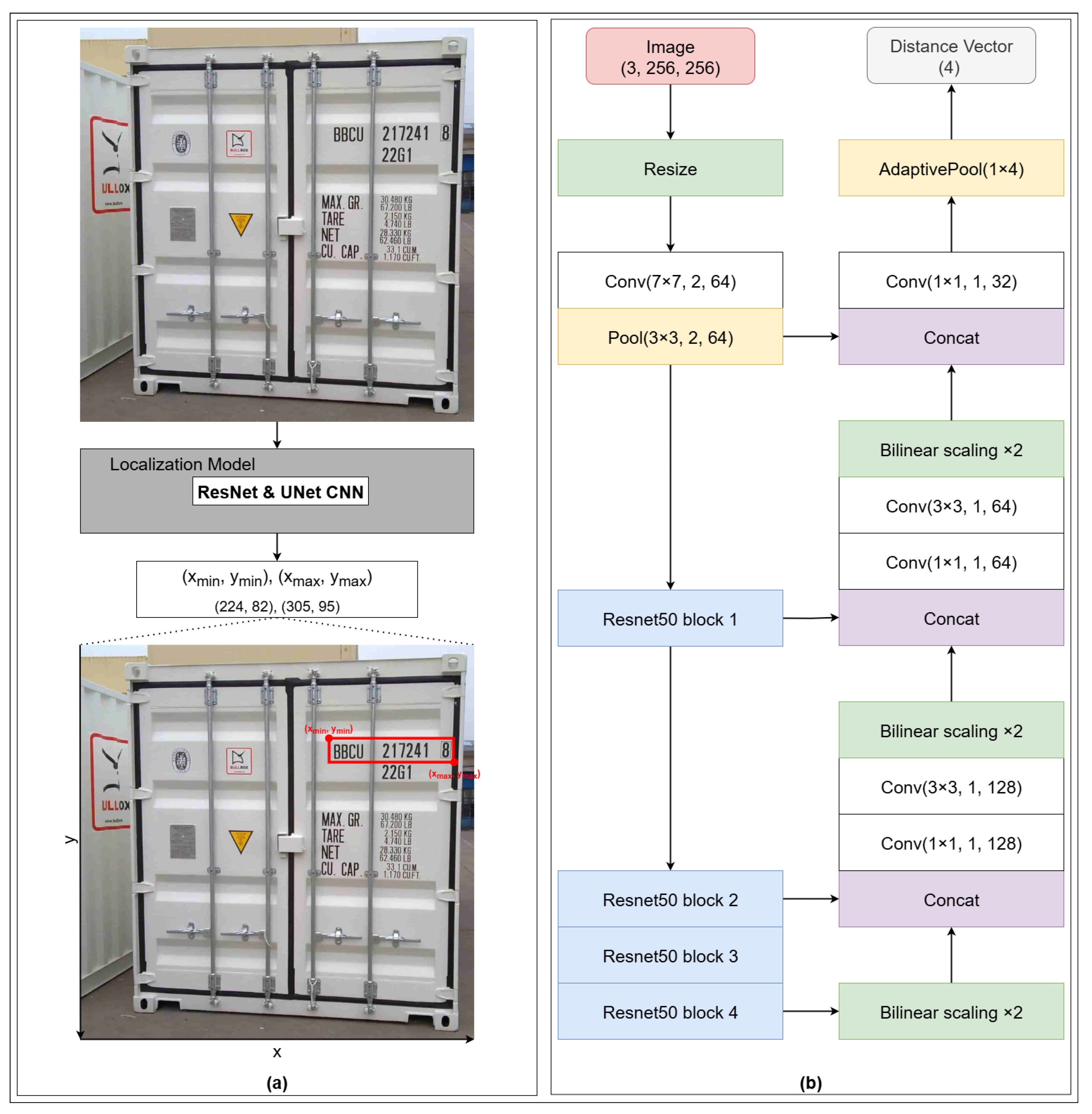
- Advanced Localization Model: We proposed the Container Code Localization Network (CCLN), modifying the model architecture in [7] by removing the last two hidden layers and changing the output from sliding windows to bounding box regression, as in [21], which enables the elimination of post-processing steps such as ASA and AMSR. This modification, combined with the use of a stricter loss function that caters for aspect ratio, results in a simpler and better-performing model.
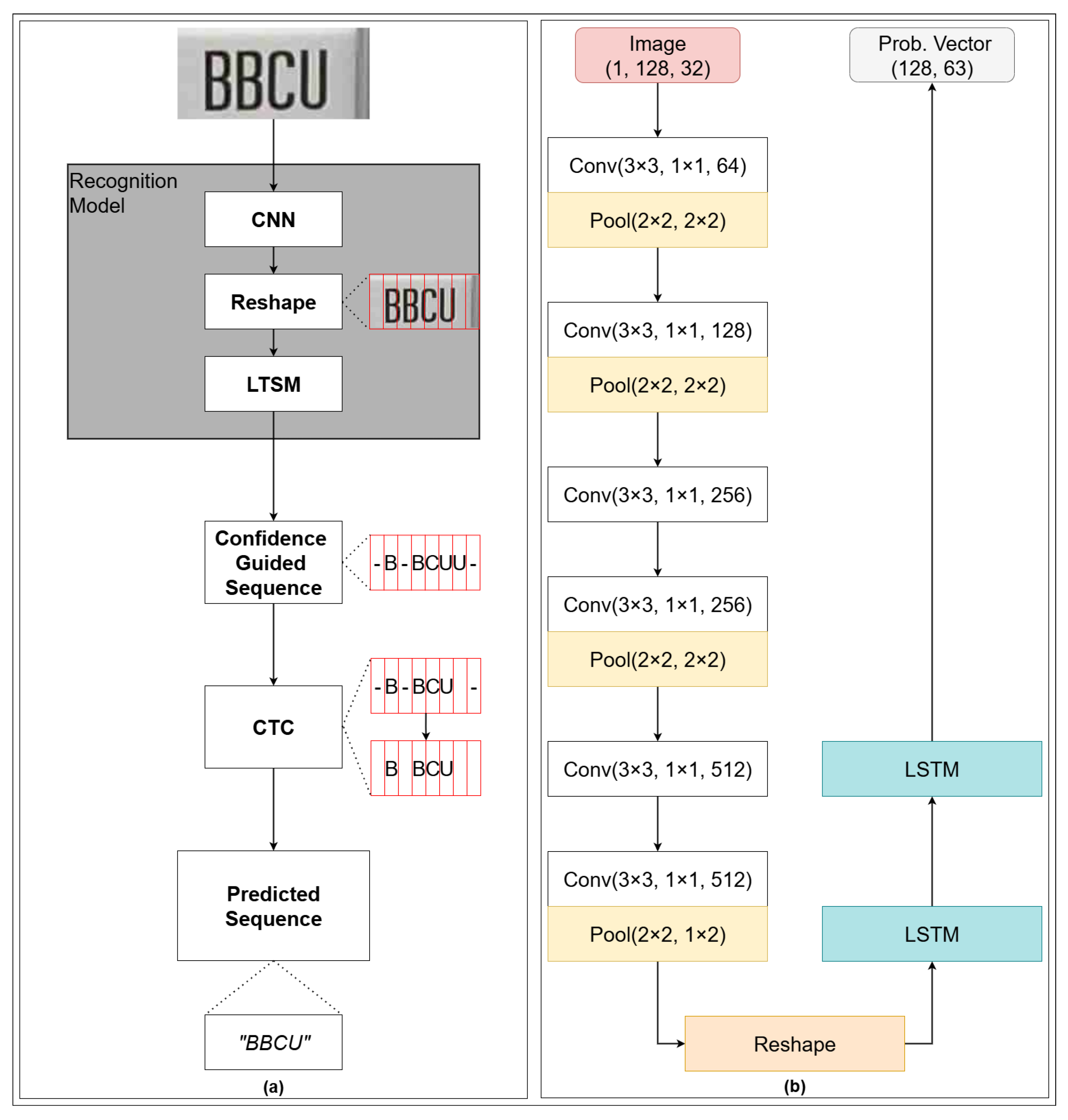
- Advanced Recognition Model: We proposed the Container Code Recognition Network (CCRN), modifying the model in [17] by incorporating LSTM as in [7], eliminating the last convolutional layer, and optimizing the image size, resulting in a model that demonstrates strong generalization capabilities when trained on the SynthText [26] dataset.
2. Related Works
3. Materials and Methods
3.1. Container Code Localization
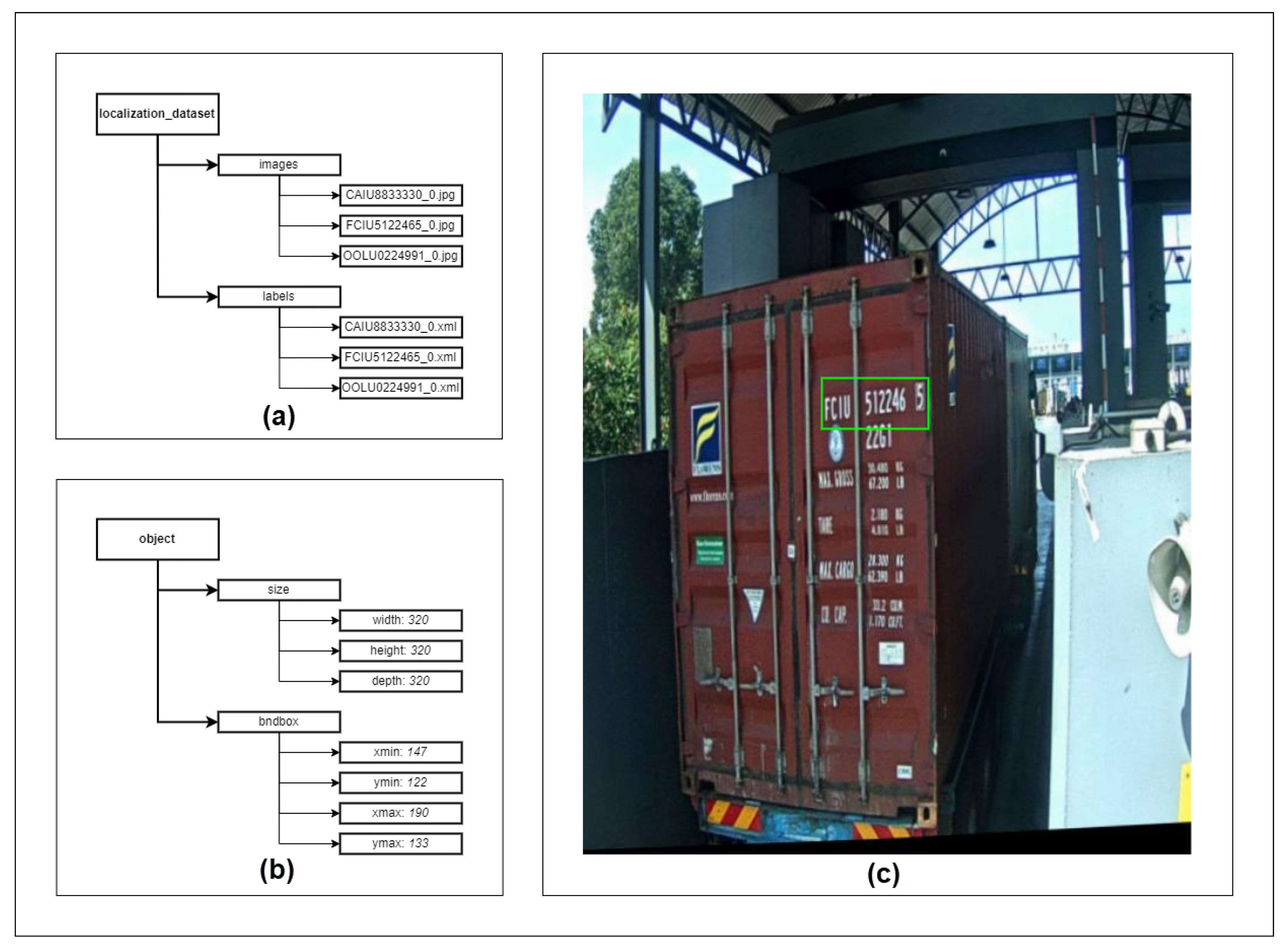
- indicates the distance from the left edge of the bounding box to the left side of the image.
- indicates the distance from the top edge of the bounding box to the top of the image.
- denotes the distance from the left side of the image to the right edge of the bounding box.
- signifies the distance from the top of the image to the bottom edge of the bounding box.
3.2. Container Code Recognition
4. Experimental Results and Discussion
4.1. Container Code Localization
- TP—True Positive
- FP—False Positive
- TN—True Negative
- FN—False Negative
| Algorithm 1 Computation of TP, FP, TN, and FN |
| Require: predicted_boxes, actual_boxes, IoU_threshold Ensure: TP, FP, TN, FN Initialize to 0 for each in do for each in do ComputeIoU(, ) if then end if end for if then else end if end for for each in do for each in do ComputeIoU(, ) if then end if end for if then end if end for return |
4.2. Container Code Recognition
4.3. Localization and Recognition Model Integration
5. Conclusions
Author Contributions
Funding
Institutional Review Board Statement
Informed Consent Statement
Data Availability Statement
Acknowledgments
Conflicts of Interest
Abbreviations
| ACCLR | Automatic Container Code Localization and Recognition |
| CCLN | Container Code Localization Network |
| CCRN | Container Code Recognition Network |
| CNN | Convolutional Neural Network |
| CRNN | Convolutional Recurrent Neural Network |
| CTC | Connectionist Temporal Classification |
| CV | Computer Vision |
| FPS | Frames Per Second |
| LSTM | Long Short Term Memory |
| RFI | Radio Frequency Identification |
| RoI | Region of Interest |
| RNN | Recurrent Neural Network |
| WSN | Wireless Sensor Network |
| YOLO | You Only Look Once |
References
- Hao, C.; Yue, Y. Optimization on Combination of Transport Routes and Modes on Dynamic Programming for a Container Multimodal Transport System. Procedia Eng. 2016, 137, 382–390. [Google Scholar] [CrossRef]
- World Shipping Council. Container Shipping: Facts and Information. Available online: https://www.worldshipping.org/ (accessed on 7 June 2024).
- Matsuda, T.; Hirata, E.; Kawasaki, T. Monopoly in the container shipping market: An econometric approach. Marit. Bus. Rev. 2022, 7, 318–331. [Google Scholar] [CrossRef]
- Yu, H.; Deng, Y.; Zhang, L.; Xiao, X.; Tan, C. Yard Operations and Management in Automated Container Terminals: A Review. Sustainability 2022, 14, 3419. [Google Scholar] [CrossRef]
- ISO 6346:2022; International Organization for Standardization (ISO). Freight Containers—Coding, Identification and Marking. ISO: Geneva, Switzerland, 2022.
- Chao, S.L.; Lin, Y.L. Gate automation system evaluation: A case of a container number recognition system in port terminals. Marit. Bus. Rev. 2017, 2, 21–35. [Google Scholar] [CrossRef]
- Zhang, R.; Bahrami, Z.; Wang, T.; Liu, Z. An Adaptive Deep Learning Framework for Shipping Container Code Localization and Recognition. IEEE Trans. Instrum. Meas. 2021, 70, 2501013. [Google Scholar] [CrossRef]
- Long, S.; He, X.; Yao, C. Scene Text Detection and Recognition: The Deep Learning Era. Int. J. Comput. Vis. 2021, 129, 161–184. [Google Scholar] [CrossRef]
- Abbate, S.; Avvenuti, M.; Corsini, P.; Vecchio, A. Localization of Shipping Containers in Ports and Terminals Using Wireless Sensor Networks. In Proceedings of the 9th ACM/IEEE International Conference on Information Processing in Sensor Networks, Washington, DC, USA, 13–16 April 2009; pp. 587–592. [Google Scholar]
- Narsoo, J.; Muslun, W.; Sunhaloo, M.S. Radio Frequency Identification (RFID) Container Tracking System for Port Louis Harbor: The Case of Mauritius. Issues Informing Sci. Inf. Technol. 2009, 6, 127–142. [Google Scholar] [CrossRef][Green Version]
- Li, C.; Liu, S.; Xia, Q.; Wang, H.; Chen, H. Automatic Container Code Localization and Recognition via an Efficient Code Detector and Sequence Recognition. In Proceedings of the 2019 IEEE/ASME International Conference on Advanced Intelligent Mechatronics (AIM), Hong Kong, China, 8–12 July 2019. [Google Scholar] [CrossRef]
- Mi, C.; Cao, L.; Zhang, Z.; Feng, Y.; Yao, L.; W, Y. A Port Container Code Recognition Algorithm under Natural Conditions. J. Coast. Res. 2020, 103, 822–829. [Google Scholar] [CrossRef]
- Klöver, S.; Kretschmann, L.; Jahn, C. A first step towards automated image-based container inspections. In Data Science and Innovation in Supply Chain Management: How Data Transforms the Value Chain. Proceedings of the Hamburg International Conference of Logistics (HICL); Kersten, W., Blecker, T., Ringle, C.M., Eds.; epubli GmbH: Berlin, Germany, 2020; Volume 29, pp. 427–456. [Google Scholar] [CrossRef]
- Bahrami, Z.; Zhang, R.; Rayhana, R.; Liu, Z. Deep Learning-based Framework for Shipping Container Security Seal Detection. In Proceedings of the 2021 Joint 10th International Conference on Informatics, Electronics & Vision (ICIEV) and 2021 5th International Conference on Imaging, Vision & Pattern Recognition (icIVPR), Kitakyushu, Japan, 16–20 August 2021; pp. 1–7. [Google Scholar]
- O’Shea, K.; Nash, R. An Introduction to Convolutional Neural Networks. arXiv 2015, arXiv:1511.08458. [Google Scholar] [CrossRef]
- Du, K.L.; Swamy, M.N.S. Recurrent Neural Networks. In Neural Networks and Statistical Learning; Springer: London, UK, 2014. [Google Scholar] [CrossRef]
- Shi, B.; Bai, X.; Yao, C. An end-to-end trainable neural network for image-based sequence recognition and its application to scene text recognition. IEEE Trans. Pattern Anal. Mach. Intell. 2016, 39, 2298–2304. [Google Scholar] [CrossRef]
- Girshick, R.; Donahue, J.; Darrell, T.; Malik, J. Rich feature hierarchies for accurate object detection and semantic segmentation. In Proceedings of the 2014 IEEE Conference on Computer Vision and Pattern Recognition, Columbus, OH, USA, 23–28 June 2014; pp. 580–587. [Google Scholar]
- Girshick, R. Fast R-CNN. In Proceedings of the IEEE International Conference on Computer Vision, Santiago, Chile, 7–13 December 2015; pp. 1440–1448. [Google Scholar]
- Ren, S.; He, K.; Girshick, R.; Sun, J. Faster r-cnn: Towards real-time object detection with region proposal networks. In Proceedings of the Advances in Neural Information Processing Systems 28 (NIPS 2015), Montreal, QC, Canada, 7–12 December 2015. [Google Scholar]
- Redmon, J.; Divvala, S.; Girshick, R.; Farhadi, A. You Only Look Once: Unified, Real-Time Object Detection. In Proceedings of the IEEE Conference on Computer Vision and Pattern Recognition, Las Vegas, NV, USA, 27–30 June 2016; pp. 779–788. [Google Scholar]
- Liu, W.; Anguelov, D.; Erhan, D.; Szegedy, C.; Reed, S.; Fu, C.-Y.; Berg, A.C. SSD: Single Shot multi-box Detector. In Proceedings of the Computer Vision–ECCV 2016: 14th European Conference, Amsterdam, The Netherlands, 11–14 October 2016; Volume 14, pp. 21–37. [Google Scholar]
- Lin, T.Y.; Goyal, P.; Girshick, R.; He, K.; Dollár, P. Focal loss for dense object detection. In Proceedings of the IEEE International Conference on Computer Vision, Venice, Italy, 22–29 October 2017; pp. 2980–2988. [Google Scholar]
- Project. Shipping Container Code Dataset. 2019. Available online: https://drive.google.com/drive/folders/13LpHEeFExmDJnw_U9peqLR-8uAAUMEzi (accessed on 1 February 2024).
- Project. New-Container-Number Dataset. 2023. Available online: https://universe.roboflow.com/project-ha37k/new-container-number (accessed on 4 February 2024).
- Gupta, A.; Vedaldi, A.; Zisserman, A. Synthetic Data for Text Localisation in Natural Images. In Proceedings of the IEEE Conference on Computer Vision and Pattern Recognition, Las Vegas, NV, USA, 27–30 June 2016. [Google Scholar]
- Liang, M.; Guo, J.; Liu, Q.; Lu, P. A Novel Framework for Container Code-Character Recognition Based on Deep Learning and Template Matching. In Proceedings of the 2016 International Conference on Industrial Informatics—Computing Technology, Intelligent Technology, Industrial Information Integration (ICIICII), Wuhan, China, 3–4 December 2016; pp. 78–82. [Google Scholar]
- Yoon, Y.; Ban, K.D.; Yoon, H.; Kim, J. Automatic Container Code Recognition from Multiple Views. ETRI J. 2016, 32, 767–775. [Google Scholar] [CrossRef]
- Zhang, Y. Support Vector Machine Classification Algorithm and Its Application. In Proceedings of the Information Computing and Applications; Liu, C., Wang, L., Yang, A., Eds.; Springer: Berlin/Heidelberg, Germany, 2012; pp. 179–186. [Google Scholar]
- Wu, Z.; Wang, W.; Xing, Y. Automatic Container Code Recognition via Faster-RCNN. In Proceedings of the 2019 5th International Conference on Control, Automation and Robotics (ICCAR), Beijing, China, 19–22 April 2019; pp. 870–874. [Google Scholar]
- Ren, S.; He, K.; Girshick, R.; Sun, J. Faster R-CNN: Towards Real-Time Object Detection with Region Proposal Networks. IEEE Trans. Pattern Anal. Mach. Intell. 2017, 39, 1137–1149. [Google Scholar] [CrossRef] [PubMed]
- Zhou, X.; Yao, C.; Wen, H.; Wang, Y.; Zhou, S.; He, W.; Liang, J. East: An efficient and accurate scene text detector. In Proceedings of the IEEE Conference on Computer Vision and Pattern Recognition, Honolulu, HI, USA, 21–26 July 2017; pp. 5551–5560. [Google Scholar]
- He, K.; Zhang, X.; Ren, S.; Sun, J. Deep Residual Learning for Image Recognition. In Proceedings of the 2016 IEEE Conference on Computer Vision and Pattern Recognition, Las Vegas, NV, USA, 27–30 June 2016; pp. 770–778. [Google Scholar]
- Sun, C.; Liu, K.; Chi, H.; Zareapoor, M. A Hybrid Model for Container-code Detection. In Proceedings of the 2020 13th International Congress on Image and Signal Processing, BioMedical Engineering and Informatics (CISP-BMEI), Chengdu, China, 17–19 October 2020; pp. 299–304. [Google Scholar]
- Wang, W.; Xie, E.; Li, X.; Hou, W.; Lu, T.; Yu, G.; Shao, S. Shape robust text detection with progressive scale expansion network. In Proceedings of the IEEE/CVF Conference on Computer Vision and Pattern Recognition, Long Beach, CA, USA, 15–20 June 2019; pp. 9336–9345. [Google Scholar]
- Ronneberger, O.; Fischer, P.; Brox, T. U-net: Convolutional networks for biomedical image segmentation. In Proceedings of the Medical Image Computing and Computer-Assisted Intervention–MICCAI 2015: 18th International Conference, Munich, Germany, 5–9 October 2015; Springer International Publishing: Cham, Switzerland, 2015; Volume 18, pp. 234–241. [Google Scholar]
- Zhang, R.; Bahrami, Z.; Liu, Z. A Vertical Text Spotting Model for Trailer and Container Codes. IEEE Trans. Instrum. Meas. 2021, 70, 5017313. [Google Scholar] [CrossRef]
- Lin, T.Y.; Dollár, P.; Girshick, R.; He, K.; Hariharan, B.; Belongie, S. Feature Pyramid Networks for Object Detection. In Proceedings of the IEEE Conference on Computer Vision and Pattern Recognition, Honolulu, HI, USA, 21–26 July 2017. [Google Scholar] [CrossRef]
- Hsu, C.C.; Yang, Y.Z.; Chang, A.; Salahuddin Morsalin, S.M.; Shen, G.T.; Shiu, L.S. Automatic Recognition of Container Serial Code. In Proceedings of the 2023 International Conference on Consumer Electronics—Taiwan (ICCE-Taiwan), PingTung, Taiwan, 17–19 July 2023; pp. 257–258. [Google Scholar] [CrossRef]
- Zhao, J.; Jia, N.; Liu, X.; Wang, G.; Zhao, W. A Practical Unified Network for Localization and Recognition of Arbitrary-Oriented Container Code and Type. IEEE Trans. Instrum. Meas. 2024, 73, 4505110. [Google Scholar] [CrossRef]
- Hlabisa, S.; Khuboni, R.L.; Tapamo, J.R. Automated Shipping Container Code Localization and Recognition Using Deep Learning. In Proceedings of the 2024 Conference on Information Communications Technology and Society (ICTAS), Durban, South Africa, 7–8 March 2024; pp. 198–203. [Google Scholar] [CrossRef]
- Yu, M.; Zhu, S.; Lu, B.; Chen, Q.; Wang, T. A Two-Stage Automatic Container Code Recognition Method Considering Environmental Interference. Appl. Sci. 2024, 14, 4779. [Google Scholar] [CrossRef]
- Lau, L.J.; Lim, L.T.; Tew, Y. Modelling Studies of Automatic Container Code Recognition System for Real Time Implementation. In Proceedings of the 2024 IEEE Symposium on Industrial Electronics & Applications (ISIEA), Kuala Lumpur, Malaysia, 6–7 July 2024; pp. 1–6. [Google Scholar] [CrossRef]
- Santos, J.; Canedo, D.; Neves, A.J.R. Automating Code Recognition for Cargo Containers. Electronics 2025, 14, 4437. [Google Scholar] [CrossRef]
- Cheng, R.; You, Z.; Chea, S.; Wu, G.; Xia, K.; Huang, S. Fast and Lightweight Automatic Shipping Container Attributes Spotting. IEEE Trans. Instrum. Meas. 2025, 74, 2531913. [Google Scholar] [CrossRef]
- Su, Z.; Li, J.; Pang, Q.; Su, M. China futures market and world container shipping economy: An exploratory analysis based on deep learning. Res. Int. Bus. Financ. 2025, 76, 102870. [Google Scholar] [CrossRef]
- Wang, H.; Zhou, H. Chinese Text Spotter Exploiting Spatial Semantic Information in Scene Text Images. In Proceedings of the 2023 5th International Conference on Robotics and Computer Vision (ICRCV), Nanjing, China, 15–17 September 2023; pp. 204–208. [Google Scholar] [CrossRef]
- Qin, R.; Wang, B. Scene Text Image Super-Resolution via Content Perceptual Loss and Criss-Cross Transformer Blocks. In Proceedings of the 2024 International Joint Conference on Neural Networks (IJCNN), Yokohama, Japan, 30 June– 5 July 2024; pp. 1–10. [Google Scholar] [CrossRef]
- Chen, H.; Wang, Y.; Guo, J.; Tao, D. VanillaNet: The Power of Minimalism in Deep Learning. arXiv 2023, arXiv:2305.12972. [Google Scholar] [CrossRef]
- Liu, K.; Sun, C.; Chi, H. Boundary-based Real-time Text Detection on Container Code. In Proceedings of the 2021 International Symposium on Computer Science and Intelligent Controls (ISCSIC), Rome, Italy, 12–14 November 2021; pp. 78–81. [Google Scholar]
- Tang, C.-M.; Chen, P. Container Number Recognition Method Based on SSD_MobileNet and SVM. Am. Sci. Res. J. Eng. Technol. Sci. (ASRJETS) 2020, 74, 1–12. Available online: https://asrjetsjournal.org/American_Scientific_Journal/article/view/6482 (accessed on 13 July 2024).
- Hochreiter, S.; Schmidhuber, J. Long short-term memory. Neural Comput. 1997, 9, 1735–1780. [Google Scholar] [CrossRef]
- Graves, A.; Fernández, S.; Gomez, F.J.; Schmidhuber, J. Connectionist temporal classification: Labelling unsegmented sequence data with recurrent neural networks. In Proceedings of the 23rd International Conference on Machine Learning, Pittsburgh, PA, USA, 25–29 June 2006; pp. 369–376. [Google Scholar]
- Everingham, M.; Van Gool, L.; Williams, C.K.I.; Winn, J.; Zisserman, A. The Pascal Visual Object Classes (VOC) Challenge. Int. J. Comput. Vis. 2010, 88, 303–338. [Google Scholar] [CrossRef]
- LeCun, Y.; Bottou, L.; Bengio, Y.; Haffner, P. Gradient-Based Learning Applied to Document Recognition. Proc. IEEE 1998, 86, 2278–2324. [Google Scholar] [CrossRef]
- Simonyan, K.; Zisserman, A. Very Deep Convolutional Networks for Large-Scale Image Recognition. arXiv 2015, arXiv:1409.1556. [Google Scholar] [CrossRef]
- Szegedy, C.; Liu, W.; Jia, Y.; Sermanet, P.; Reed, S.; Anguelov, D.; Erhan, D.; Vanhoucke, V.; Rabinovich, A. Going Deeper with Convolutions. arXiv 2014, arXiv:1409.4842. [Google Scholar] [CrossRef]
- Agrawal, S.; Rewaskar, V.; Agrawal, R.; Chaudhari, S.; Patil, Y.; Agrawal, N. Advancements in NSFW Content Detection: A Comprehensive Review of ResNet-50 Based Approaches. Int. J. Intell. Syst. Appl. Eng. 2023, 11, 41–45. [Google Scholar]
- Qian, X.; Lin, S.; Cheng, G.; Yao, X.; Ren, H.; Wang, W. Object Detection in Remote Sensing Images Based on Improved Bounding Box Regression and Multi-Level Features Fusion. Remote Sens. 2020, 12, 143. [Google Scholar] [CrossRef]
- Tian, Z.; Huang, W.; He, T.; He, P.; Qiao, Y. Detecting Text in Natural Image with Connectionist Text Proposal Network. In Proceedings of the European Conference on Computer Vision; Springer: Cham, Switzerland, 2016; pp. 56–72. [Google Scholar]
- Zheng, Z.; Wang, P.; Liu, W.; Li, J.; Ye, R.; Ren, D. Distance-IoU Loss: Faster and Better Learning for Bounding Box Regression. arXiv 2019, arXiv:1911.08287. [Google Scholar] [CrossRef]
- Paszke, A.; Gross, S.; Massa, F.; Lerer, A.; Bradbury, J.; Chanan, G.; Killeen, T.; Lin, Z.; Gimelshein, N.; Antiga, L.; et al. PyTorch: An Imperative Style, High-Performance Deep Learning Library. arXiv 2019, arXiv:1912.01703. [Google Scholar]



| Stage | Type | Reps | Out Ch. | Kernel/Stride | Act. | Fusion Source |
|---|---|---|---|---|---|---|
| Initial Block | ||||||
| 0 | Conv → BN → MaxPool | 1 | 64 | (Conv) | ReLU | N/A |
| Encoder (ResNet Bottleneck Blocks) | ||||||
| 1 | Bottleneck | 3 | 256 | ReLU | N/A | |
| 2 | Bottleneck | 4 | 512 | (Downsample) | ReLU | N/A |
| 3 | Bottleneck | 6 | 1024 | (Downsample) | ReLU | N/A |
| 4 | Bottleneck | 3 | 2048 | (Downsample) | ReLU | N/A |
| Decoder (Upsampling and Feature Fusion) | ||||||
| 5 | UpSample → Conv | 1 | 512 | L.ReLU | Stage 3 | |
| 6 | UpSample → Conv | 1 | 256 | L.ReLU | Stage 2 | |
| 7 | UpSample → Conv | 1 | 128 | L.ReLU | Stage 1 | |
| Output Layer | ||||||
| 8 | Final Conv | 1 | 4 | N/A | BBox | |
| ID | Layer | Out Ch. | K | S | Act. | Notes |
|---|---|---|---|---|---|---|
| CNN Backbone (Feature Extraction) | ||||||
| 1 | Conv/ReLU | 64 | ReLU | Input: 1 Ch. | ||
| 2 | MaxPool | 64 | N/A | |||
| 3 | Conv/ReLU | 128 | ReLU | |||
| 4 | MaxPool | 128 | N/A | |||
| 5 | Conv/ReLU | 256 | ReLU | |||
| 6 | Conv/ReLU | 512 | ReLU | |||
| 7 | MaxPool | 512 | N/A | Height Reduction | ||
| 8 | Conv/BN/ReLU | 1024 | ReLU | With BatchNorm | ||
| 9 | MaxPool | 1024 | N/A | Final Height Red. | ||
| RNN Head (Sequence Recognition) | ||||||
| 10 | Linear (Map) | 64 | N/A | N/A | N/A | Map from 2048 feats |
| 11 | Bi-LSTM 1 | 512 | N/A | N/A | N/A | units |
| 12 | Bi-LSTM 2 | 512 | N/A | N/A | N/A | units |
| 13 | Linear (Output) | 63 | N/A | N/A | N/A | Output Classes |
| Method | Accuracy | Precision | Recall | F1 Score | Average Precision |
|---|---|---|---|---|---|
| Chenghao et al. [11] | 96.14 | 94.19 | 93.66 | 93.24 | 92.98 |
| Ran et al. [7] | 96.58 | 94.82 | 94.01 | 94.50 | 94.31 |
| Hsu et al. [39] † | 96.54 | 95.26 | 93.72 | 93.87 | 94.97 |
| Zhao et al. [40] | 97.41 | 97.29 | 96.98 | 97.03 | 97.11 |
| Hlabisa et al. [41] | 95.00 | 96.33 | 93.24 | 95.11 | 96.14 |
| Yu et al. [42] † | 98.18 | 97.74 | 98.02 | 97.88 | 97.56 |
| Lau et al. [43] | 96.85 | 98.29 | 97.09 | 96.17 | 97.75 |
| Ours | 98.98 | 98.75 | 97.79 | 98.03 | 97.86 |
| Method | Accuracy |
|---|---|
| Chenghao et al. [11] | 93.98 |
| Ran et al. [7] | 94.37 |
| Hsu et al. [39] † | 93.41 |
| Zhao et al. [40] | 98.17 |
| Hlabisa et al. [41] | 95.41 |
| Yu et al. [42] † | 98.28 |
| Lau et al. [43] | 98.33 |
| Ours | 98.71 |
| System | Accuracy (%) | Processing Power (FPS) |
|---|---|---|
| Chenghao et al. [11] | 93.98 | 10.00 |
| Ran et al. [7] | 93.33 | 1.13 |
| Hsu et al. [39] † | 92.69 | 30.00 |
| Zhao et al. [40] | 97.57 | 4.86 |
| Hlabisa et al. [41] | 95.00 | 4.00 |
| Yu et al. [42] † | 97.39 | 53.21 |
| Lau et al. [43] | 89.20 | 31.72 |
| Ours | 97.93 | 64.11 |
Disclaimer/Publisher’s Note: The statements, opinions and data contained in all publications are solely those of the individual author(s) and contributor(s) and not of MDPI and/or the editor(s). MDPI and/or the editor(s) disclaim responsibility for any injury to people or property resulting from any ideas, methods, instructions or products referred to in the content. |
© 2025 by the authors. Licensee MDPI, Basel, Switzerland. This article is an open access article distributed under the terms and conditions of the Creative Commons Attribution (CC BY) license (https://creativecommons.org/licenses/by/4.0/).
Share and Cite
Hlabisa, S.; Khuboni, R.L.; Tapamo, J.-R. Confidence-Guided Code Recognition for Shipping Containers Using Deep Learning. Big Data Cogn. Comput. 2025, 9, 316. https://doi.org/10.3390/bdcc9120316
Hlabisa S, Khuboni RL, Tapamo J-R. Confidence-Guided Code Recognition for Shipping Containers Using Deep Learning. Big Data and Cognitive Computing. 2025; 9(12):316. https://doi.org/10.3390/bdcc9120316
Chicago/Turabian StyleHlabisa, Sanele, Ray Leroy Khuboni, and Jules-Raymond Tapamo. 2025. "Confidence-Guided Code Recognition for Shipping Containers Using Deep Learning" Big Data and Cognitive Computing 9, no. 12: 316. https://doi.org/10.3390/bdcc9120316
APA StyleHlabisa, S., Khuboni, R. L., & Tapamo, J.-R. (2025). Confidence-Guided Code Recognition for Shipping Containers Using Deep Learning. Big Data and Cognitive Computing, 9(12), 316. https://doi.org/10.3390/bdcc9120316