
Beyond Material Flow with Cognitive Waste Theory: Formalizing the Ninth Waste of Lean Manufacturing Through Quantitative Models of Cognitive Inefficiency




Abstract
1. Introduction
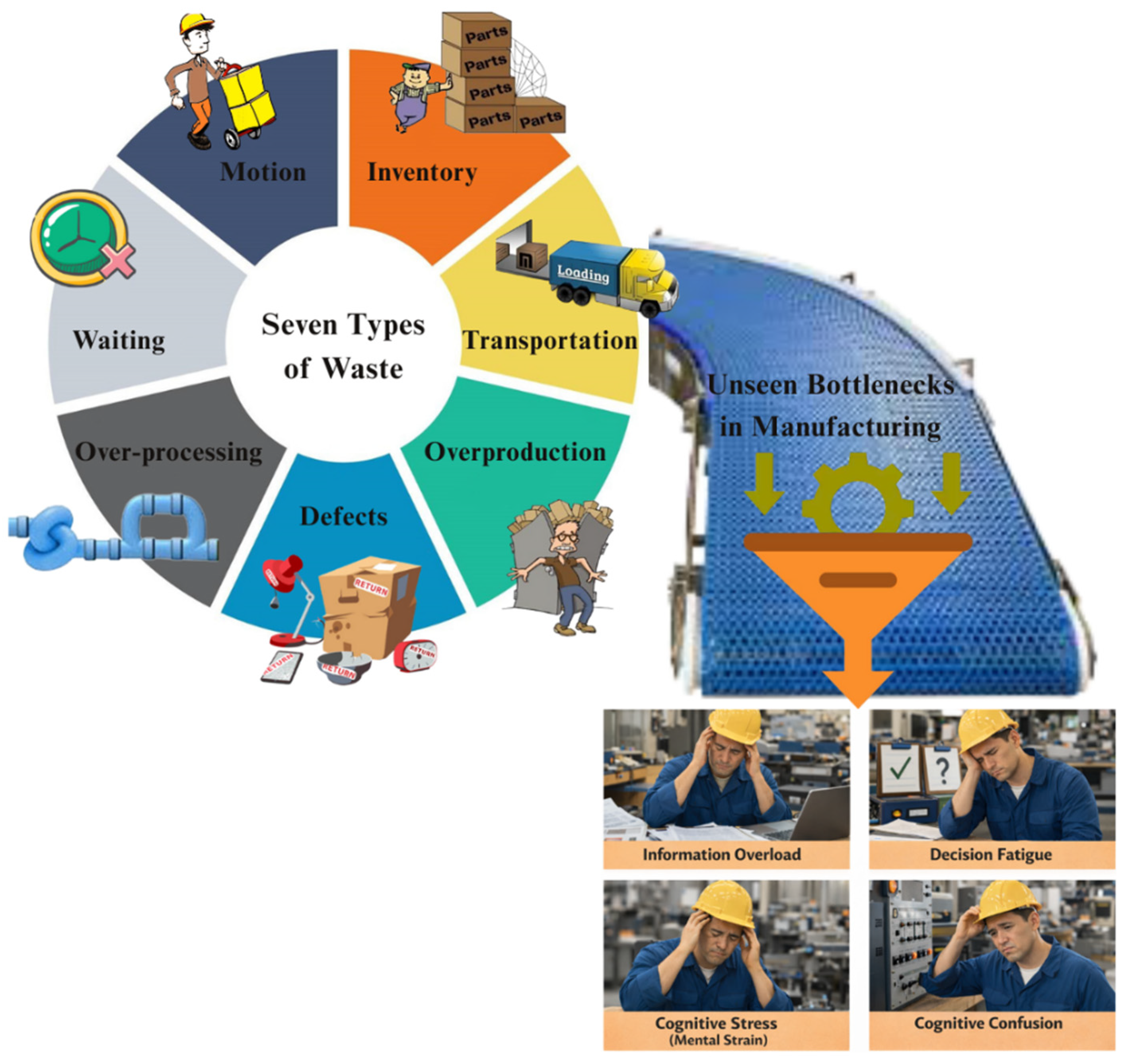
The Unseen Bottlenecks in Modern Manufacturing
- It integrates established cognitive and human-factor inefficiencies into the Lean waste framework, extending the traditional muda concept beyond physical and organizational domains to include cognitive dimensions of work.
- It develops a structured taxonomy of cognitive waste, comprising Information Overload, Context Switching, Knowledge Fragmentation, Cognitive Load, and Learning Lag, each grounded in and mapped to existing research in cognitive science and operations management.
- It proposes mathematical formulations for each cognitive waste category, enabling quantitative representation and comparative analysis of cognitive inefficiencies in operational settings.
- It adapts established Lean tools—such as Value Stream Mapping, 5S, and Kaizen—into cognitive-oriented analytical instruments while preserving methodological continuity with Lean practice.
- It introduces composite performance metrics, including the Cognitive Efficiency Index (CEI) and Information Flow Efficiency (IFE), to support the evaluation of cognitive performance within a Lean-compatible measurement structure.
2. Background
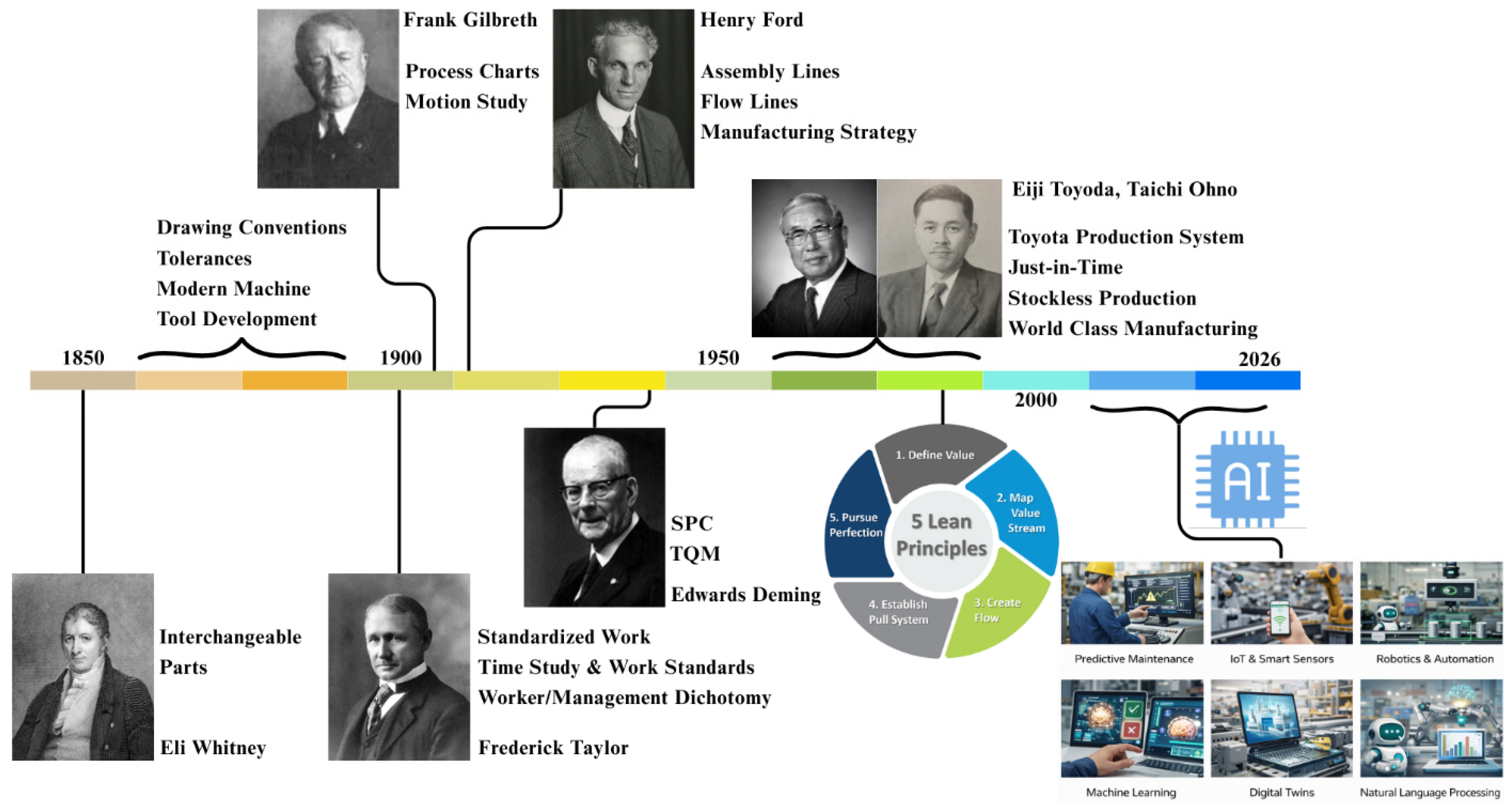
2.1. The Evolution of Lean Manufacturing Principles
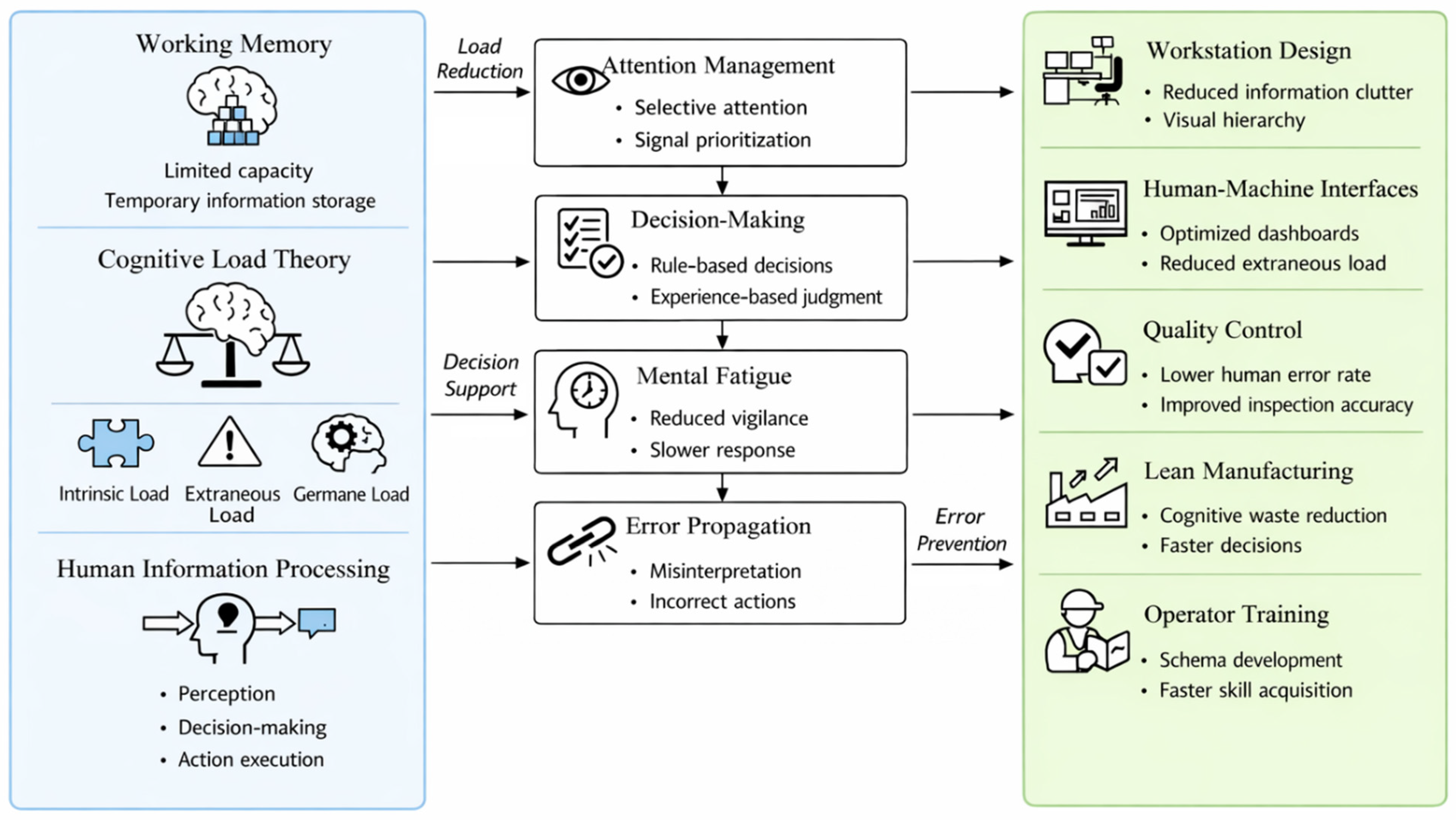
2.2. Cognitive Science and Human Information Processing
- Intrinsic Load: The inherent difficulty of the subject matter.
- Extraneous Load: The load generated by the way information is presented or the tasks required, which does not contribute to learning or performance.
- Germane Load: The load dedicated to the processing, construction, and automation of schemas (i.e., learning).
2.3. The Emerging Gap: Cognitive Factors in Manufacturing
3. Cognitive Waste Theory: The Ninth Waste of Lean
3.1. Defining Cognitive Waste
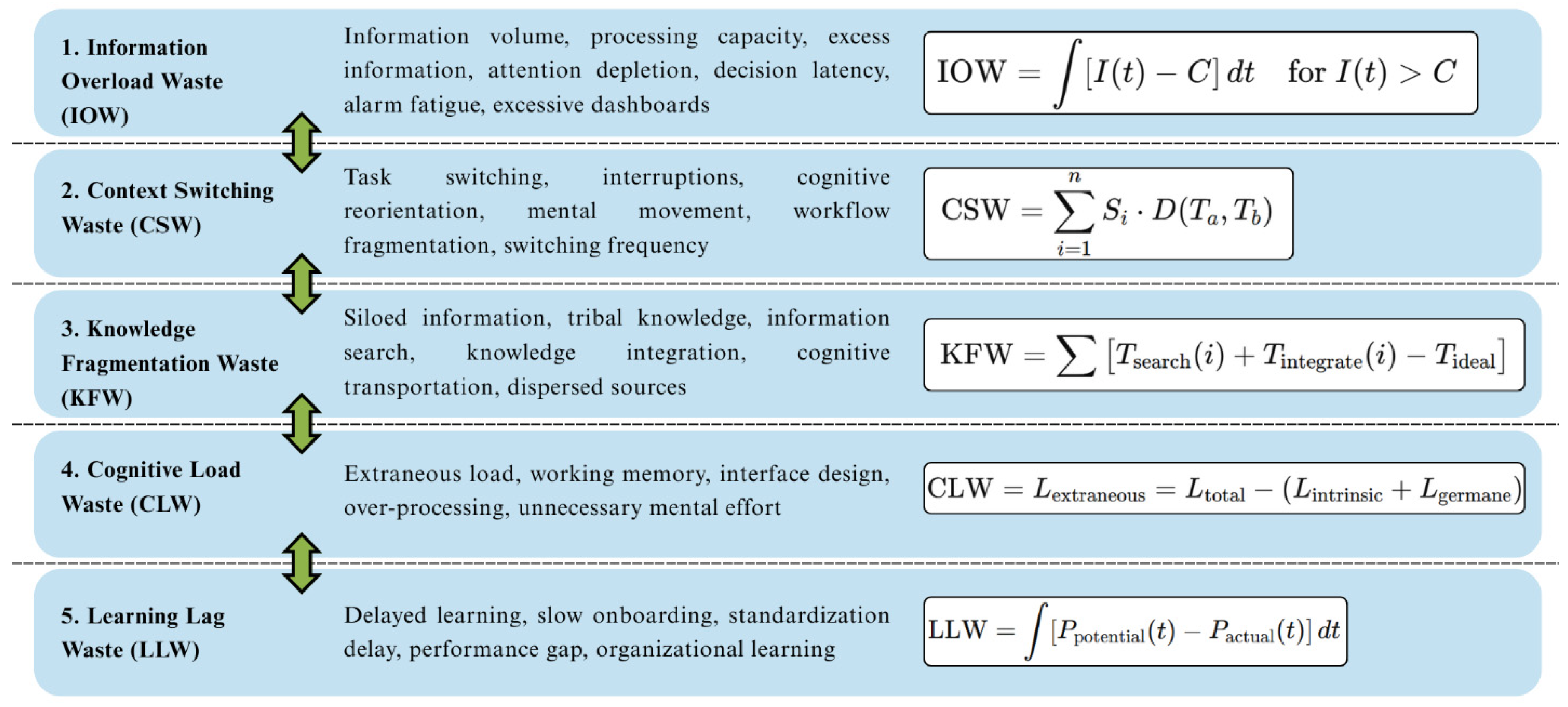
3.2. Defining and Modeling the Five Categories of Cognitive Waste
3.2.1. Information Overload Waste (IOW)
- I(t) is the rate of information inflow at time t (e.g., bits/sec, data points/min). In practice, I(t) may be operationalized using observable indicators such as alarm frequency, dashboard update rates, or message arrival density.
- C is the effective cognitive processing capacity of the operator, a constant that can be empirically estimated for a given context (e.g., under stable workload, fatigue, training level).
- is the arrival rate of item type (alarms, robot alerts, work-instruction lookups, etc.);
- is a weight reflecting processing cost.
3.2.2. Context Switching Waste (CSW)
- -
- Fragmented Workflows: An operator must stop a physical task to input data into a terminal, then consult a separate tablet for the next instruction, each requiring a mental re-calibration.
- -
- Multiple Logins: Accessing different systems (e.g., MES, ERP, QMS) requires separate authentication processes, interrupting the flow of work.
- -
- Frequent Interruptions: Operators are frequently interrupted by pages, alerts, or supervisor queries that are unrelated to their current task.
- ( ≥ 0) denotes the cost associated with the -th context switch, quantified in terms of additional time consumption, increased error likelihood, or both. Empirically, may be estimated using observed task delays, error rate changes, or recovery time following a switch. has units of time (seconds) or expected error cost. Higher per-switch penalties () increase CSW.
- represents a dimensionless cognitive distance function (0 ≤ D ≤1) capturing the degree of dissimilarity between , the task before the -th switch, and , the task after. Cognitive distance may be approximated using task similarity metrics, interface modality differences, or required shifts in mental representation. D = 0 when there is no “distance” when staying on the same task. Switching between more dissimilar tasks increases CSW.
- n is the total number of context switching tasks observed within a defined timeframe. More frequent switching (larger n) increases CSW.
3.2.3. Knowledge Fragmentation Waste (KFW)
- -
- Siloed Information: Process specifications are in one system, quality standards in another, and maintenance logs in a third.
- -
- Tribal Knowledge: Critical operational knowledge resides only in the minds of a few senior operators and has not been documented or made accessible to others.
- -
- Inconsistent Formats: Work instructions are a mix of paper documents, PDF files on a server, and videos on a separate platform.
- Tsearch,e,i is the time spent locating knowledge component i during task episode e such as navigation, query formulation, screen switching, document hunting.
- Tintegrate,e,i is the time spent reconciling that component with others such as format translation, terminology alignment, mental synthesis, cross-checking. Integration time reflects the cognitive effort required to reconcile formats, terminology, or contextual assumptions across sources.
- Tideal,e is the total knowledge-access time for a task episode e under unified access.
- Max is the positive part operator which was added, since in real data, some items might be faster than the benchmark; then a term becomes negative, which contradicts “waste” being nonnegative.
3.2.4. Cognitive Load Waste (CLW)
- -
- Poorly Designed Interfaces: A user interface on a machine controller is cluttered, uses inconsistent terminology, or requires a long sequence of steps for a simple function.
- -
- Complex Calculations: Operators are required to perform manual calculations that could easily be automated.
- -
- Ambiguous Instructions: Work instructions are poorly written, lack clear visuals, or are open to multiple interpretations, forcing operators to engage in mental problem solving for a routine task.
- Ltotal is the total measured cognitive load (e.g., using NASA-TLX or physiological sensors). Total cognitive load may be estimated using validated subjective workload instruments or objective physiological indicators. Ltotal is an aggregated scalar quantity and analytical approximation based on cognitive load theory.
- Lintrinsic is the inherent difficulty of the task → unavoidable.
- Lgermane is the load associated with learning and schema formation → value-adding.
- Lextraneous is the waste to be eliminated. Extraneous load represents the portion of cognitive demand that can be reduced through improved task, interface, or information design → non-value-adding.
- All L-terms must be expressed on the same measurement scale and must be ≥0.
3.2.5. Learning Lag Waste (LLW)
- -
- Slow Onboarding: New operators take an excessively long time to reach proficiency due to ineffective training materials and lack of structured on-the-job training.
- -
- Recurring Errors: The same process errors are made repeatedly by different shifts or operators because the lessons from the initial error were not effectively disseminated and integrated into standard work.
- -
- Delayed Improvement: A successful Kaizen event on one production line is not replicated on other lines for months or years due to a lack of a systematic process for sharing and adapting improvements.
- : time the improvement becomes known/available.
- : time the improvement is fully adopted/standardized.
- Ppotential(t) is the performance level achievable with a known best practice at time t. Potential performance may be estimated using benchmark data, pilot implementations, or demonstrated improvements in comparable processes.
- Pactual(t) is the actual performance level at time t. Actual performance reflects observed operational outcomes prior to full adoption and standardization of the improvement.
3.3. Measurement Foundations and Index Construction
3.3.1. Cognitive Efficiency Index (CEI)
Ratio-Based Cognitive Efficiency Index (RCEI)
- denotes the number of effective decisions—defined as decisions that are both correct and timely—made per unit time.
- represents the average total cognitive load experienced during the same period.
- The quality multiplier captures decision accuracy.
- The speed multiplier reflects decision timeliness relative to operational requirements.
Formative Composite-Based Cognitive Efficiency Index (FCCEI)
- represents normalized indicators of decision productivity, quality, and timeliness.
- Weights may be determined through expert elicitation, analytic hierarchy processes [92], or empirical calibration.
- Raw metric for component (e.g., decision throughput, accuracy, timeliness, or a waste magnitude).
- Define bounds and empirically (e.g., observed best/worst in the same line, shift, or month, or a benchmark standard).
3.3.2. Information Flow Efficiency (IFE)
- Availability refers to the ratio of time during which necessary information is accessible and cognitive resources are ready for processing. It is diminished by system downtime, prolonged knowledge search time due to KFW, and operator unavailability resulting from interruptions typical of CSW.
- Performance measures the speed of information processing and decision making against an optimal standard, hindered by IOW and CLW.
- Quality denotes the ratio of judgments or activities executed correctly on the initial attempt and is adversely influenced by all types of cognitive inefficiency.
3.3.3. Measurement Philosophy and Construct Validity
Scale Type and Permissible Operations
Normalization and Cross-Context Comparability
- denotes a specific cognitive waste component and the bounds are empirically determined within a defined operational context.
- , bounds are empirically determined within a given operational context.
4. Pathway to Integrating Cognitive Waste Reduction into Lean Practices
4.1. The Information Value Stream Mapping (IVSM) Process
- Identify the Cognitive Value Stream: Select a key decision-making or problem-solving process that runs parallel to a physical production process (e.g., responding to a quality alert, re-planning a production schedule).
- Map the Process Steps: Document each step in the information flow, from data acquisition to final decision or action.
- Add Cognitive Waste Metrics: For each step, collect data related to the five categories of cognitive waste. This includes:
- -
- Data volume and sources (for IOW).
- -
- Number of systems/interfaces used (for CSW).
- -
- Time spent searching for information (for KFW).
- -
- Operator-reported cognitive load (for CLW).
- -
- Time taken to complete the cognitive task (for LLW and overall efficiency).
- Create the Future State Map: Just as in traditional VSM, the team brainstorms a future state that dramatically reduces or eliminates the identified cognitive wastes. This might involve redesigning interfaces, integrating systems, or automating information gathering.
- Develop an Action Plan: Create a tangible plan to move from the current state to the future state, with clear responsibilities and timelines.
4.2. The 5S Methodology
- Sort (Seiri): Eliminate unnecessary information. Review dashboards, reports, and alerts. If a piece of information is not used for a specific, value-adding decision, remove it. This directly combats IOW.
- Set in Order (Seiton): Organize information for ease of use. Design user interfaces so that the most frequently needed information is the most accessible. Group related data together. This reduces KFW and CLW.
- Shine (Seiso): Keep the information environment clean. This means regularly validating data accuracy, archiving old and irrelevant information, and ensuring that information systems are running correctly. A clean information environment builds trust and reduces CLW.
- Standardize (Seiketsu): Create standards for how information is presented and managed. Use consistent terminology, color codes, and layouts across all systems. Standardize reporting formats and communication protocols. This reduces CSW and CLW.
- Sustain (Shitsuke): Make cognitive organization a habit. Regularly audit dashboards and reports (a “Cognitive 5S Audit”). Make information management a part of standard work and daily accountability.
4.3. Kaizen
- Theme: Reduce the time it takes for an operator to diagnose and respond to a machine stoppage.
- Team: A cross-functional team including the operator, a supervisor, an engineer, and an IT specialist.
- Process: The team uses IVSM to map the current diagnostic process. They identify significant waste: the operator has to check three different screens (CSW), the error codes are cryptic (CLW), and the troubleshooting guide is a 300-page PDF file (KFW).
- Countermeasures: The team designs a single, integrated diagnostic screen that presents the error code in plain language, displays relevant sensor data leading up to the stoppage, and provides a direct link to the specific page in the troubleshooting guide. They also implement a system for operators to add their own notes to the guide (reducing LLW).
- Possible Results: The average diagnostic time is reduced, and the cognitive load on the operator is significantly lowered, freeing up their mental capacity to focus on solving the root cause of the problem.
4.4. Potential Implications
5. Conclusions
Author Contributions
Funding
Institutional Review Board Statement
Informed Consent Statement
Data Availability Statement
Conflicts of Interest
References
- Saad, S.M.; Bahadori, R.; Bhovar, C.; Zhang, H. Industry 4.0 and Lean Manufacturing—A systematic review of the state-of-the-art literature and key recommendations for future research. Int. J. Lean Six. Sigma 2023, 15, 997–1024. [Google Scholar] [CrossRef]
- Shan, Y.; Shang, J.; Yan, Y.; Ye, X. Workflow interruption and nurses’ mental workload in electronic health record tasks: An observational study. BMC Nurs. 2023, 22, 63. [Google Scholar] [CrossRef] [PubMed]
- Lagomarsino, M.; Lorenzini, M.; De Momi, E.; Ajoudani, A. An Online Framework for Cognitive Load Assessment in Industrial Tasks. Robot. Comput.-Integr. Manuf. 2022, 78, 102380. [Google Scholar] [CrossRef]
- Skalli, D.; Charkaoui, A.; Cherrafi, A.; Garza-Reyes, J.A.; Antony, J.; Shokri, A. Industry 4.0 and Lean Six Sigma integration in manufacturing: A literature review, an integrated framework and proposed research perspectives. Qual. Manag. J. 2023, 30, 16–40. [Google Scholar] [CrossRef]
- Sony, M.; Naik, S. Industry 4.0 integration with socio-technical systems theory: A systematic review and proposed theoretical model. Technol. Soc. 2020, 61, 101248. [Google Scholar] [CrossRef]
- Carvalho, A.V.; Chouchene, A.; Lima, T.M.; Charrua-Santos, F. Cognitive Manufacturing in Industry 4.0 toward Cognitive Load Reduction: A Conceptual Framework. Appl. Syst. Innov. 2020, 3, 55. [Google Scholar] [CrossRef]
- Longo, L.; Wickens, C.D.; Hancock, G.; Hancock, P.A. Human Mental Workload: A Survey and a Novel Inclusive Definition. Front. Psychol. 2022, 13, 883321. [Google Scholar] [CrossRef] [PubMed]
- Maghanaki, M.; Keramati, S.; Chen, F.F.; Shahin, M. Generation of a Multi-Class IoT Malware Dataset for Cybersecurity. Electronics 2025, 14, 4196. [Google Scholar] [CrossRef]
- Maghanaki, M.; Keramati, S.; Chen, F.F.; Shahin, M. Systematic Evaluation of Machine Learning and Deep Learning Models for IoT Malware Detection Across Ransomware, Rootkit, Spyware, Trojan, Botnet, Worm, Virus, and Keylogger. Sensors 2026, 26, 1750. [Google Scholar] [CrossRef] [PubMed]
- Maghanaki, M.; Keramati, S.; Chen, F.F.; Shahin, M. Investigating Artificial Intelligence Approaches to Cybersecurity in Internet of Things Manufacturing Systems and a Deep Hybrid Learning Framework for Malware Detection. J. Manuf. Sci. Eng. 2026, 148, 051006. [Google Scholar] [CrossRef]
- Maghanaki, M.; Shahin, M.; Keramati, S.; Chen, F.F.; Contreras, E. Feature-Engineered Trojan Malware Detection on Windows-Based IoT Gateways Using a Custom Deep Neural Network and Automated Monitoring Pipeline. JCP 2026, 6, 90. [Google Scholar] [CrossRef]
- Shahin, M.; Chen, F.F.; Bouzary, H.; Krishnaiyer, K. Integration of Lean practices and Industry 4.0 technologies: Smart manufacturing for next-generation enterprises. Int. J. Adv. Manuf. Technol. 2020, 107, 5. [Google Scholar] [CrossRef]
- Rožman, M.; Tominc, P.; Štrukelj, T. Competitiveness Through Development of Strategic Talent Management and Agile Management Ecosystems. Glob. J. Flex. Syst. Manag. 2023, 24, 373–393. [Google Scholar] [CrossRef]
- Hartanti, L.P.S.; Gunawan, I.; Mulyana, I.J.; Herwinarso, H. Identification of Waste Based on Lean Principles as the Way towards Sustainability of a Higher Education Institution: A Case Study from Indonesia. Sustainability 2022, 14, 4348. [Google Scholar] [CrossRef]
- Salvadorinho, J.; Ferreira, C.; Teixeira, L. A technology-based framework to foster the lean human resource 4.0 and prevent the great resignation: The talent management lift. Technol. Soc. 2024, 77, 102510. [Google Scholar] [CrossRef]
- Fujishiro, K.; Heaney, C.A. ‘Doing what I do best’: The association between skill utilization and employee health with healthy behavior as a mediator. Social. Sci. Med. 2017, 175, 235–243. [Google Scholar] [CrossRef] [PubMed]
- Åhlström, P.; Danese, P.; Hines, P.; Netland, T.H.; Powell, D.; Shah, R.; Thürer, M.; van Dun, D.H. Is lean a theory? Viewpoints and outlook. Int. J. Oper. Prod. Manag. 2021, 41, 1852–1878. [Google Scholar] [CrossRef]
- Netland, T.H.; Powell, D.J. (Eds.) The Routledge Companion to Lean Management; Routledge: New York, NY, USA, 2016. [Google Scholar] [CrossRef]
- Hitch, G.J.; Allen, R.J.; Baddeley, A.D. The multicomponent model of working memory fifty years on. Q. J. Exp. Psychol. 2025, 78, 222–239. [Google Scholar] [CrossRef] [PubMed]
- Sweller, J.; van Merriënboer, J.J.G.; Paas, F. Cognitive Architecture and Instructional Design: 20 Years Later. Educ. Psychol. Rev. 2019, 31, 261–292. [Google Scholar] [CrossRef]
- Skulmowski, A.; Xu, K.M. Understanding Cognitive Load in Digital and Online Learning: A New Perspective on Extraneous Cognitive Load. Educ. Psychol. Rev. 2022, 34, 171–196. [Google Scholar] [CrossRef]
- Colombo, B.; Zanchi, M.; Gaiardelli, P. The role of Lean Management methodologies within the current Industry 5.0 manufacturing context: A bibliometric analysis. IFAC-Pap. 2025, 59, 1420–1425. [Google Scholar] [CrossRef]
- Shahin, M.; Maghanaki, M.; Chen, F.F. Integration of Lean Analytics and Industry 6.0: A Novel Meta-Theoretical Framework for Antifragile, Generative AI-Orchestrated, Circular–Regenerative, and Hyper-Connected Manufacturing Ecosystems. BDCC 2026, 10, 65. [Google Scholar] [CrossRef]
- Maghanaki, M.; Shahin, M.; Chen, F.F.; Hosseinzadeh, A. Using VAEs for Anomaly Detection Utilizing Synthetic Dataset. In Proceedings of the Fourth International Conference on Advances in Computing Research (ACR’26); Daimi, K., Alsadoon, A., Eds.; Lecture Notes in Networks and Systems; Springer Nature: Cham, Switzerland, 2026; Volume 1942, pp. 232–240. [Google Scholar] [CrossRef]
- Mattsson, S.; Fast-Berglund, Å.; Li, D.; Thorvald, P. Forming a cognitive automation strategy for Operator 4.0 in complex assembly. Comput. Ind. Eng. 2020, 139, 105360. [Google Scholar] [CrossRef]
- Miqueo, A.; Torralba, M.; Yagüe-Fabra, J.A. Lean Manual Assembly 4.0: A Systematic Review. Appl. Sci. 2020, 10, 8555. [Google Scholar] [CrossRef]
- Kiesel, A.; Steinhauser, M.; Wendt, M.; Falkenstein, M.; Jost, K.; Philipp, A.M.; Koch, I. Control and interference in task switching—A review. Psychol. Bull. 2010, 136, 849–874. [Google Scholar] [CrossRef] [PubMed]
- Neumann, W.P.; Winkelhaus, S.; Grosse, E.H.; Glock, C.H. Industry 4.0 and the human factor—A systems framework and analysis methodology for successful development. Int. J. Prod. Econ. 2021, 233, 107992. [Google Scholar] [CrossRef]
- Stasch, S.-M.; Mack, W. When automation fails—Investigating cognitive stability and flexibility in a multitasking scenario. Appl. Ergon. 2025, 125, 104461. [Google Scholar] [CrossRef] [PubMed]
- Myers, N.E.; Stokes, M.G.; Nobre, A.C. Prioritizing Information during Working Memory: Beyond Sustained Internal Attention. Trends Cogn. Sci. 2017, 21, 449–461. [Google Scholar] [CrossRef] [PubMed]
- Engel, C.; Ebel, P.; Leimeister, J.M. Cognitive automation. Electron. Mark. 2022, 32, 339–350. [Google Scholar] [CrossRef]
- Reiman, A.; Kaivo-oja, J.; Parviainen, E.; Takala, E.-P.; Lauraeus, T. Human factors and ergonomics in manufacturing in the industry 4.0 context—A scoping review. Technol. Soc. 2021, 65, 101572. [Google Scholar] [CrossRef]
- Thorvald, P.; Lindblom, J.; Andreasson, R. On the development of a method for cognitive load assessment in manufacturing. Robot. Comput.-Integr. Manuf. 2019, 59, 252–266. [Google Scholar] [CrossRef]
- Elafri, N.; Tappert, J.; Rose, B.; Yassine, M. Lean 4.0: Synergies between Lean Management tools and Industry 4.0 technologies. IFAC-Pap. 2022, 55, 2060–2066. [Google Scholar] [CrossRef]
- Olakotan, O.; Samuriwo, R.; Ismaila, H.; Atiku, S. Usability Challenges in Electronic Health Records: Impact on Documentation Burden and Clinical Workflow: A Scoping Review. J. Eval. Clin. Pract. 2025, 31, e70189. [Google Scholar] [CrossRef] [PubMed]
- Arnold, M.; Goldschmitt, M.; Rigotti, T. Dealing with information overload: A comprehensive review. Front. Psychol. 2023, 14, 1122200. [Google Scholar] [CrossRef] [PubMed]
- Maghanaki, M.; Chen, F.F.; Shahin, M.; Hosseinzadeh, A.; Bouzary, H. A Novel Transformer-Based Model for Comprehensive Text-Aware Service Composition in Cloud-Based Manufacturing. In Intelligent Production and Industry 5.0 with Human Touch, Resilience, and Circular Economy; Šormaz, D.N., Bidanda, B., Alhawari, O., Geng, Z., Eds.; Lecture Notes in Production Engineering; Springer Nature: Cham, Switzerland, 2025; pp. 313–321. [Google Scholar] [CrossRef]
- Xue, C.T.S. A Literature Review on Knowledge Management in Organizations. Res. Bus. Manag. 2017, 4, 30–41. [Google Scholar] [CrossRef]
- Tierney, M.; Adeyemi, E.O.; Bommer, S. A Systematic Literature Review: Cognitive Workload Assessment in Human Factors Research. Adv. Hum.-Comput. Interact. 2025, 2025, 9313239. [Google Scholar] [CrossRef]
- Basten, D.; Haamann, T. Approaches for Organizational Learning: A Literature Review. Sage Open 2018, 8, 2158244018794224. [Google Scholar] [CrossRef]
- Batwara, A.; Sharma, V.; Makkar, M.; Giallanza, A. Impact of smart sustainable value stream mapping—Fuzzy PSI decision-making framework. Sustain. Futures 2024, 7, 100201. [Google Scholar] [CrossRef]
- Shahin, M.; Maghanaki, M.; Chen, F.F. Evaluating Synthetic Cyber Deception Strategies Under Uncertainty via Game Theory Approach: Linking Information Leakage and Game Outcomes in Cyber Deception. Sensors 2026, 26, 1748. [Google Scholar] [CrossRef] [PubMed]
- Maghanaki, M.; Shahin, M.; Chen, F.F.; Hosseinzadeh, A. Detection and Classification of Skin Cancer Using Custom-Built CNN. In Proceedings of the Third International Conference on Innovations in Computing Research (ICR’24); Daimi, K., Al Sadoon, A., Eds.; Lecture Notes in Networks and Systems; Springer Nature: Cham, Switzerland, 2024; Volume 1058, pp. 605–617. [Google Scholar] [CrossRef]
- Keramati, F.; Mohammadi, H.R.; Shiran, G.R. Determining optimal location and size of PEV fast-charging stations in coupled transportation and power distribution networks considering power loss and traffic congestion. Sustain. Energy Grids Netw. 2024, 38, 101268. [Google Scholar] [CrossRef]
- Durst, S.; Foli, S.; Edvardsson, I.R. A systematic literature review on knowledge management in SMEs: Current trends and future directions. Manag. Rev. Q. 2022, 74, 263–288. [Google Scholar] [CrossRef]
- Schumacher, S.; Hall, R.; Bildstein, A.; Bauernhansl, T. Lean Production Systems 4.0: Systematic literature review and field study on the digital transformation of lean methods and tools. Int. J. Prod. Res. 2023, 61, 8751–8773. [Google Scholar] [CrossRef]
- Rojas, T.; Mula, J.; Sanchis, R. Quantitative modelling approaches for Lean manufacturing under uncertainty. Int. J. Prod. Res. 2024, 62, 5989–6015. [Google Scholar] [CrossRef]
- Eppler, M.J.; Mengis, J. The Concept of Information Overload: A Review of Literature from Organization Science, Accounting, Marketing, MIS, and Related Disciplines. Inf. Soc. 2004, 20, 325–344. [Google Scholar] [CrossRef]
- Weigl, M.; Müller, A.; Angerer, P.; Hoffmann, F. Workflow interruptions and mental workload in hospital pediatricians: An observational study. BMC Health Serv. Res. 2014, 14, 433. [Google Scholar] [CrossRef] [PubMed]
- Fan, J.; Flombaum, J.I.; McCandliss, B.D.; Thomas, K.M.; Posner, M.I. Cognitive and Brain Consequences of Conflict. NeuroImage 2003, 18, 42–57. [Google Scholar] [CrossRef] [PubMed]
- Shortle, J.F.; Thompson, J.M.; Gross, D.; Harris, C.M. Fundamentals of Queueing Theory; John Wiley & Sons: Hoboken, NJ, USA, 2018. [Google Scholar]
- Vayandade, K.; Pokarne, R.; Phaldesai, M.; Bhuruk, T.; Kumar, P.; Patil, T. A Review Paper on Progressive Approach to Reduce Context Switching in Round Robin Scheduling Algorithm. In High Performance Computing, Smart Devices and Networks; Malhotra, R., Sumalatha, L., Yassin, S.M.W., Patgiri, R., Muppalaneni, N.B., Eds.; Springer Nature: Singapore, 2024; pp. 237–248. [Google Scholar] [CrossRef]
- Barton, N.; Smyth, M. Context-switching in short-form videos: What is the impact on prospective memory? Memory 2025, 33, 788–801. [Google Scholar] [CrossRef] [PubMed]
- Siqi-Liu, A.; Egner, T. Contextual Adaptation of Cognitive Flexibility is driven by Task- and Item-Level Learning. Cogn. Affect. Behav. Neurosci. 2020, 20, 757–782. [Google Scholar] [CrossRef] [PubMed]
- Becker, L.; Kaltenegger, H.C.; Nowak, D.; Weigl, M.; Rohleder, N. Biological stress responses to multitasking and work interruptions: A randomized controlled trial. Psychoneuroendocrinology 2023, 156, 106358. [Google Scholar] [CrossRef] [PubMed]
- Schmitz, F.; Voss, A. Components of task switching: A closer look at task switching and cue switching. Acta Psychol. 2014, 151, 184–196. [Google Scholar] [CrossRef] [PubMed]
- Strobach, T. Cognitive control and meta-control in dual-task coordination. Psychon. Bull. Rev. 2024, 31, 1445–1460. [Google Scholar] [CrossRef] [PubMed]
- Schmitter-Edgecombe, M.; Langill, M. Costs of a Predictable Switch Between Simple Cognitive Tasks Following Severe Closed-Head Injury. Neuropsychology 2006, 20, 675–684. [Google Scholar] [CrossRef] [PubMed]
- Bailey, B.P.; Konstan, J.A. On the need for attention-aware systems: Measuring effects of interruption on task performance, error rate, and affective state. Comput. Human. Behav. 2006, 22, 685–708. [Google Scholar] [CrossRef]
- Monsell, S. Task switching. Trends Cogn. Sci. 2003, 7, 134–140. [Google Scholar] [CrossRef] [PubMed]
- Dickey, A.; Kosovac, A.; Fastenrath, S.; Acuto, M.; Gleeson, B. Fragmentation and urban knowledge: An analysis of urban knowledge exchange institutions. Cities 2022, 131, 103917. [Google Scholar] [CrossRef]
- Khapre, S.; Basha, M.S.S. Advancement in Information Foraging Theory. Intell. Inf. Manag. 2012, 4, 383–389. [Google Scholar] [CrossRef]
- Smith, C.L.; Hantula, D.A. Pricing effects on foraging in a simulated Internet shopping mall. J. Econ. Psychol. 2003, 24, 653–674. [Google Scholar] [CrossRef]
- Janssen, C.P.; Gould, S.J.J.; Li, S.Y.W.; Brumby, D.P.; Cox, A.L. Integrating knowledge of multitasking and interruptions across different perspectives and research methods. Int. J. Hum.-Comput. Stud. 2015, 79, 1–5. [Google Scholar] [CrossRef][Green Version]
- Kallinen, K.; Ekman, I.; Ravaja, N. Individual Differences in Work Load While Doing Multitasking with a Computer. In Human-Computer Interaction. Design and Development Approaches; Jacko, J.A., Ed.; Springer: Berlin/Heidelberg, Germany, 2011; pp. 351–358. [Google Scholar] [CrossRef]
- Stanton, N.A. Representing distributed cognition in socio-technical systems. IFAC-Pap. 2016, 49, 212–215. [Google Scholar] [CrossRef]
- Rogers, Y.; Ellis, J. Distributed Cognition: An Alternative Framework for Analysing and Explaining Collaborative Working. J. Inf. Technol. 1994, 9, 119–128. [Google Scholar] [CrossRef]
- Bento, F.; Tagliabue, M.; Lorenzo, F. Organizational Silos: A Scoping Review Informed by a Behavioral Perspective on Systems and Networks. Societies 2020, 10, 56. [Google Scholar] [CrossRef]
- Nathan, G.S.; Soni, P. Knowledge Management across permeable silos: A case at Wipro Technologies. In 2008 4th IEEE International Conference on Management of Innovation and Technology; IEEE: Piscataway, NJ, USA, 2008; pp. 965–969. [Google Scholar] [CrossRef]
- Rajkomar, A.; Mayer, A.; Blandford, A. Understanding safety–critical interactions with a home medical device through Distributed Cognition. J. Biomed. Inform. 2015, 56, 179–194. [Google Scholar] [CrossRef] [PubMed][Green Version]
- Wears, R.L.; Leveson, N.G. ‘Safeware’: Safety-Critical Computing and Health Care Information Technology. In Advances in Patient Safety: New Directions and Alternative Approaches (Vol. 4: Technology and Medication Safety); Henriksen, K., Battles, J.B., Keyes, M.A., Grady, M.L., Eds.; Advances in Patient Safety; Agency for Healthcare Research and Quality: Rockville, MD, USA, 2008. Available online: http://www.ncbi.nlm.nih.gov/books/NBK43774/ (accessed on 3 January 2026).
- White, R.W.; Roth, R.A. Exploratory Search: Beyond the Query-Response Paradigm; No. 3; Morgan & Claypool Publishers: Malvern, UK, 2009. [Google Scholar]
- Sweller, J. Cognitive load theory and individual differences. Learn. Individ. Differ. 2024, 110, 102423. [Google Scholar] [CrossRef]
- Sweller, J. Cognitive load theory. In Psychology of Learning and Motivation; Elsevier: Amsterdam, The Netherlands, 2011; Volume 55, pp. 37–76. [Google Scholar]
- Chen, O.; Paas, F.; Sweller, J. A Cognitive Load Theory Approach to Defining and Measuring Task Complexity Through Element Interactivity. Educ. Psychol. Rev. 2023, 35, 63. [Google Scholar] [CrossRef]
- Sweller, J. The Role of Evolutionary Psychology in Our Understanding of Human Cognition: Consequences for Cognitive Load Theory and Instructional Procedures. Educ. Psychol. Rev. 2022, 34, 2229–2241. [Google Scholar] [CrossRef]
- Sweller, J. The Development of Cognitive Load Theory: Replication Crises and Incorporation of Other Theories Can Lead to Theory Expansion. Educ. Psychol. Rev. 2023, 35, 95. [Google Scholar] [CrossRef]
- Han, J.; Wei, Z. Analysis and Research on Students’ Learning Behavior Based on Lag Sequence Analysis. In 2021 International Conference on Computer Information Science and Artificial Intelligence (CISAI); IEEE: Piscataway, NJ, USA, 2021; pp. 532–535. [Google Scholar] [CrossRef]
- Kim, S.; Ji, Y. Gap analysis. Int. Encycl. Strateg. Commun. 2018, 8, 3126. [Google Scholar] [CrossRef]
- Zheng, B.; He, Q.; Lei, J. Knowledge Construction in Problem-Based Learning: A Lag-Sequential Analysis of Teachers’ and Students’ Discourse Moves. Teach. Learn. Med. 2024, 36, 411–424. [Google Scholar] [CrossRef] [PubMed]
- Kaipa, R.M.; Kaipa, R.; Keithly, A. The role of lag effect in distributed practice on learning novel vocabulary. Logop. Phoniatr. Vocology 2023, 48, 117–128. [Google Scholar] [CrossRef] [PubMed]
- Serfaty, J.; Serrano, R. Lag effects in grammar learning: A desirable difficulties perspective. Appl. Psycholinguist. 2022, 43, 513–550. [Google Scholar] [CrossRef]
- Chakladar, D.D.; Roy, P.P. Cognitive workload estimation using physiological measures: A review. Cogn. Neurodyn 2024, 18, 1445–1465. [Google Scholar] [CrossRef] [PubMed]
- Marquardt, N. Situation awareness, human error, and organizational learning in sociotechnical systems. Human. Factors Ergon. Manuf. Serv. Ind. 2019, 29, 327–339. [Google Scholar] [CrossRef]
- Wickens, C.D.; Hollands, J.G.; Banbury, S.; Parasuraman, R. Engineering Psychology and Human Performance, 4th ed.; Psychology Press: New York, NY, USA, 2015. [Google Scholar] [CrossRef]
- Hancock, P.A.; Warm, J.S. A dynamic model of stress and sustained attention. Hum. Factors 1989, 31, 519–537. [Google Scholar] [CrossRef] [PubMed]
- Hart, S.G. Nasa-Task Load Index (NASA-TLX); 20 Years Later. Proc. Human. Factors Ergon. Soc. Annu. Meet. 2006, 50, 904–908. [Google Scholar] [CrossRef]
- Neely, A.; Gregory, M.; Platts, K. Performance measurement system design: A literature review and research agenda. Int. J. Oper. Prod. Manag. 1995, 15, 80–116. [Google Scholar] [CrossRef]
- Diamantopoulos, A.; Winklhofer, H.M. Index Construction with Formative Indicators: An Alternative to Scale Development. J. Mark. Res. 2001, 38, 269–277. [Google Scholar] [CrossRef]
- Bollen, K.; Lennox, R. Conventional wisdom on measurement: A structural equation perspective. Psychol. Bull. 1991, 110, 305–314. [Google Scholar] [CrossRef]
- Nardo, M.; Saisana, M.; Saltelli, A.; Tarantola, S.; Hoffman, A.; Giovannini, E. Handbook on Constructing Composite Indicators: Methodology and User Guide; Working Paper 2005/3; OECD Publishing: Paris, France, 2005; Available online: https://EconPapers.repec.org/RePEc:oec:stdaaa:2005/3-en (accessed on 4 January 2026).
- Saaty, T.L. Decision making with the analytic hierarchy process. Int. J. Serv. Sci. 2008, 1, 83–98. [Google Scholar] [CrossRef]
- Patro, S.; Sahu, K.K. Normalization: A preprocessing stage. arXiv 2015, arXiv:1503.06462. [Google Scholar]
- Jain, A.; Nandakumar, K.; Ross, A. Score normalization in multimodal biometric systems. Pattern Recognit. 2005, 38, 2270–2285. [Google Scholar] [CrossRef]
- Lyubchyk, L.; Grinberg, G.; Konokhova, Z.; Yamkovyi, K. Composite Indicators Building Based on Concordant of Expert-Statistical Information Using Biased Ridge Kernel Regression. In 2023 IEEE 12th International Conference on Intelligent Data Acquisition and Advanced Computing Systems: Technology and Applications (IDAACS); IEEE: Piscataway, NJ, USA, 2023; pp. 617–620. [Google Scholar] [CrossRef]
- Kalton, G.; Flores-Cervantes, I. Weighting methods. J. Off. Stat. 2003, 19, 81. [Google Scholar] [CrossRef]
- Muchiri, P.; Pintelon, L. Performance measurement using overall equipment effectiveness (OEE): Literature review and practical application discussion. Int. J. Prod. Res. 2008, 46, 3517–3535. [Google Scholar] [CrossRef]
- Melton, T. The Benefits of Lean Manufacturing: What Lean Thinking has to Offer the Process Industries. Chem. Eng. Res. Des. 2005, 83, 662–673. [Google Scholar] [CrossRef]
- Delone, W.H.; McLean, E.R. The DeLone and McLean Model of Information Systems Success: A Ten-Year Update. J. Manag. Inf. Syst. 2003, 19, 9–30. [Google Scholar] [CrossRef]
- Braarud, P.Ø. Investigating the validity of subjective workload rating (NASA TLX) and subjective situation awareness rating (SART) for cognitively complex human–machine work. Int. J. Ind. Ergon. 2021, 86, 103233. [Google Scholar] [CrossRef]
- Salwin, M.; Jacyna-Gołda, I.; Bańka, M.; Varanchuk, D.; Gavina, A. Using Value Stream Mapping to Eliminate Waste: A Case Study of a Steel Pipe Manufacturer. Energies 2021, 14, 3527. [Google Scholar] [CrossRef]




| Dimension | Lean–Industry 4.0 Literature | Cognitive Load/Human Factors | Knowledge Management Studies | This Work |
|---|---|---|---|---|
| Primary focus | Cloud-Based Manufacturing [37] | Mental workload, error, performance [7] | Knowledge transfer and learning [38] | Cognitive inefficiency as operational waste |
| Treatment of cognition | Implicit, indirect [1] | Explicit but isolated from operations [39] | Organizational, non-processual [40] | Explicit, process-embedded |
| Lean waste integration | Limited to classic wastes [41] | Not addressed [7] | Cyber Deception Strategies [42] | Formal ninth waste (cognitive waste) |
| Waste taxonomy | Lean-healthcare [43] | Not framed as waste [7] | Not framed as waste [40] | Five distinct cognitive waste categories |
| Quantification | OEE, cycle time, throughput [41] | Subjective/experimental metrics [39] | Qualitative or learning curves [38] | Mathematical waste models, CEI, IFE |
| Lean tool adaptation | VSM, 5S (physical) [41] | Not applicable | Not applicable | IVSM, Cognitive 5S, Cognitive Kaizen |
| Managerial actionability | High (physical domain) [44] | Low–moderate [7] | Moderate [45] | High, Lean-compatible |
| Theoretical integration | Operations-centric [46] | Cognition-centric [7] | Organization-centric [40] | Operations–cognition synthesis |
| Variable | Definition | Data Source | Measurement Method | Unit |
|---|---|---|---|---|
| Information inflow rate | System logs (MES/ERP/dashboards) | Event frequency per time window | events/time | |
| Cognitive processing capacity | Workload studies, calibration tests | Performance threshold estimation | normalized/events/time | |
| System/event logs | Count per category over time | events/time | ||
| Cognitive cost weight | Expert judgment, regression | AHP or statistical weighting | dimensionless | |
| Cost of switch event | Interaction logs | Time delay or error increase per switch | s | |
| Cognitive distance | Task analysis, expert rating | Similarity scoring (0–1 scale) | dimensionless | |
| Knowledge search time | System logs, observation | Timestamp-based duration | s | |
| Knowledge integration time | Task tracking | Time difference estimation | s | |
| Ideal access time | Benchmark/simulation | Best-case reference measurement | s | |
| Total cognitive load | NASA-TLX, sensors | Standardized workload scoring | index | |
| Observed performance | MES/KPI systems | Time-series performance tracking | output units | |
| Ideal performance | Benchmark data | Reference modeling | output units | |
| Effective decisions | Operational logs | Count of correct/timely decisions | count/time | |
| Quality & speed factors | Error logs, timestamps | Normalization vs. benchmark | 0–1 | |
| Normalized indicator | Derived metrics | Min–max scaling | 0–1 | |
| Composite weight | Regression/AHP | Coefficient normalization | dimensionless | |
| IFE components | System logs | Normalized ratios | 0–1 |
Disclaimer/Publisher’s Note: The statements, opinions and data contained in all publications are solely those of the individual author(s) and contributor(s) and not of MDPI and/or the editor(s). MDPI and/or the editor(s) disclaim responsibility for any injury to people or property resulting from any ideas, methods, instructions or products referred to in the content. |
© 2026 by the authors. Licensee MDPI, Basel, Switzerland. This article is an open access article distributed under the terms and conditions of the Creative Commons Attribution (CC BY) license.
Share and Cite
Shahin, M.; Maghanaki, M.; Chen, F.F. Beyond Material Flow with Cognitive Waste Theory: Formalizing the Ninth Waste of Lean Manufacturing Through Quantitative Models of Cognitive Inefficiency. Big Data Cogn. Comput. 2026, 10, 215. https://doi.org/10.3390/bdcc10070215
Shahin M, Maghanaki M, Chen FF. Beyond Material Flow with Cognitive Waste Theory: Formalizing the Ninth Waste of Lean Manufacturing Through Quantitative Models of Cognitive Inefficiency. Big Data and Cognitive Computing. 2026; 10(7):215. https://doi.org/10.3390/bdcc10070215
Chicago/Turabian StyleShahin, Mohammad, Mazdak Maghanaki, and F. Frank Chen. 2026. "Beyond Material Flow with Cognitive Waste Theory: Formalizing the Ninth Waste of Lean Manufacturing Through Quantitative Models of Cognitive Inefficiency" Big Data and Cognitive Computing 10, no. 7: 215. https://doi.org/10.3390/bdcc10070215
APA StyleShahin, M., Maghanaki, M., & Chen, F. F. (2026). Beyond Material Flow with Cognitive Waste Theory: Formalizing the Ninth Waste of Lean Manufacturing Through Quantitative Models of Cognitive Inefficiency. Big Data and Cognitive Computing, 10(7), 215. https://doi.org/10.3390/bdcc10070215