
DIKWP+BUG Architecture for Purpose-Aware Cognitive Computing



Abstract
1. Introduction
- G1.
- Existing AI architectures still lack a unified semantic–cognitive model that explicitly connects data acquisition, information interpretation, knowledge organization, wisdom-level evaluation, and purpose-oriented control.
- G2.
- Current cognitive architectures and applied AI systems do not sufficiently operationalize bounded imperfection as a controllable design factor for timely reasoning under uncertainty.
- G3.
- Semantic communication and internal semantic security are often treated as external add-ons rather than as intrinsic components of a purpose-aware cognitive cycle.
- G4.
- Available evaluations of artificial-consciousness-oriented systems remain limited in demonstrating how a shared semantic-purpose architecture behaves across multiple simulated domains and ablated configurations.
- C1.
- It formalizes the DIKWP semantic–cognitive model through mathematical definitions of cross-dimensional content spaces, transformation functions, content-network structure, and semantic flux.
- C2.
- It introduces BUG-aware formalization into the DIKWP processing loop, allowing bounded approximation, confidence miscalibration, and semantic inconsistency to be modeled, monitored, and corrected.
- C3.
- It proposes a full-stack DIKWP+BUG architecture integrating ACPU, ACOS, DIKWP semantic communication, and DIKWP concept–semantic fused security in one operational framework.
- C4.
- It implements a runtime emulation and evaluates the architecture in smart-city governance, autonomous-driving, and medical-assistant simulations, reporting quantitative comparisons with selected baseline configurations.
- C5.
- It clarifies the boundary between online runtime cost and offline model-preparation cost and adds a statistical reporting protocol to support more reproducible follow-up studies.
2. Related Work
2.1. Consciousness Theories in AI and Cognitive Science
2.2. DIKWP Model: Data–Information–Knowledge–Wisdom–Purpose
- Data (D). Data refer to raw observations, signals, or symbols that record properties of objects or events but are not yet sufficiently contextualized for higher-level reasoning [39,40]. In an artificial system, data may include sensor streams, logs, state variables, or discrete input tokens. The transformation from data to information may be represented as , through which raw observations are filtered, aggregated, or encoded into interpretable statements [15,16]. For example, a sequence of temperature readings constitutes data, whereas the statement “the room temperature is 18 °C” already reflects a more structured representation. Data therefore form the initial dimension of semantic–cognitive processing and provide the material basis for subsequent interpretation.
- Information (I). Information is data that have been contextualized, differentiated, or related to other semantic units so that a meaningful state, relation, or pattern becomes interpretable [15,39,40]. Information therefore does not merely accumulate data; it organizes data under a schema, intention, or relational frame. The mapping transforms information into knowledge through comparison, integration, and generalization. For instance, the propositions “the room is 18 °C”, “18 °C is below the comfort threshold”, and “20 °C is preferable for comfort” may, together, support the conclusion that “the room is colder than optimal.” Information thus serves as the immediate semantic bridge between raw input and conceptual understanding.
- Knowledge (K). Knowledge denotes organized information that has been stabilized into rules, models, categories, causal relations, or procedural structures that support inference and prediction [15,39,40]. In AI systems, knowledge may be instantiated in ontologies, knowledge graphs, rule sets, or learned models. Knowledge is more durable than transient information because it captures structured regularities rather than isolated observations. The transformation maps knowledge to wisdom by subjecting it to contextual evaluation, trade-off analysis, and value-sensitive judgment [15,16]. Knowledge therefore answers what is the case and how things are related, but not yet what ought to be done in a particular situation.
- Wisdom (W). Wisdom refers to contextual insight and judgment: the capacity to determine which knowledge should be applied, when it should be applied, and under what practical, ethical, or long-horizon constraints [15,39,40]. In DIKWP, wisdom is not simply an enlarged stock of knowledge, but an evaluative dimension that integrates knowledge with values, feasibility, and consequence awareness [16]. In an artificial-consciousness system, wisdom may be implemented as a deliberative mechanism that balances competing considerations—for example, comfort, safety, efficiency, and user preference—before selecting a course of action. From the knowledge that a room is cold, wisdom may infer that gradual heating is preferable because it better balances immediate comfort with energy efficiency. Wisdom is also the dimension most relevant to contextual correction, since it can override otherwise valid but contextually inappropriate knowledge application.
- Purpose (P). Purpose is the distinctive fifth element that differentiates DIKWP from classical DIKW. It denotes the aims, intentions, priorities, or goal conditions that orient the entire cognitive process [15,16,18,19]. Purpose is not merely the terminal output of reasoning; it is also a regulatory condition on reasoning. It influences what data are attended to, what information is extracted, which knowledge is activated, and what counts as a wise decision in a given context [16,18,19]. Formally, may be understood as the crystallization of evaluated understanding into goal-directed intent, while top-down feedback from P to D, I, K, and W ensures alignment between ongoing cognition and current objectives. For an autonomous medical assistant, for example, a purpose such as maximizing patient well-being or minimizing unnecessary intervention would directly affect diagnostic thresholds, decision priorities, and action policies.
2.3. BUG Theory of Consciousness and Semantic Imperfections
2.4. Existing Artificial Consciousness Architectures and the Need for Integration
3. Theoretical Framework: DIKWP Semantic Model and BUG Formalization
3.1. Formalization of the DIKWP Semantic–Cognitive Model
- Data space (D). Let D denote the data space. Elements of D (denoted ) can be raw sensory readings, bits, signals, or primitive facts. We can consider D to be a multi-dimensional space. For instance, if the system has multiple sensors, each sensor’s reading may be treated as a dimension.
- Information space (I). Let I denote the information space. Elements carry meaning. Formally, consistent with common tuple- or proposition-based representations used in symbolic knowledge representation and DIKW-style modeling, we can model an information element as a contextualized tuple [15,16,39,40]. For example,derived from raw data. We assume there is a transformation, adapted from the DIKWP account of Data-to-Information conversion [15,16,18],which may be many-to-one and maps data to information, representing interpretation or pattern extraction. In practice, may be implemented by signal processing algorithms, feature extraction, or simple recognition procedures such as edge detection in images or named entity recognition in text.
- Knowledge space (K). Let K denote the knowledge space. We treat knowledge as a collection of interconnected concepts, rules, or embeddings. An element might be represented by a node in a knowledge graph or a vector in a latent semantic space. A key aspect of K is structure: relationships such as causality, hierarchy, and correlation between information pieces. Following DIKWP treatments of information aggregation and knowledge construction [15,16,18], we defineas an operator that takes sets of information elements and transforms them into a knowledge element. This is many-to-one: multiple pieces of information can generate one knowledge concept, and one piece of information may contribute to multiple knowledge concepts. For simplicity, one can imagine knowledge elements as summarized patterns, such as a regression model or decision tree derived from multiple data points. Knowledge space K thus has internal structure such as taxonomy, rules, or learned models.
- Wisdom space (W). Let W denote the wisdom space. Wisdom elements represent evaluative or principle-based conclusions. We can formalize W as containing functions or higher-order predicates that map knowledge to recommended actions or categories of judgment. For instance, a wisdom element might encode a principle like “if knowledge indicates X and the goal is Y, then prefer action Z.” Following the DIKWP view that wisdom is evaluative and purpose-sensitive rather than merely accumulative [14,15,16,18], we definemeaning that wisdom is derived not only from knowledge but may also be directly influenced by the current purpose P. This reflects that what is wise depends on one’s goals. The mapping may involve logical reasoning, optimization algorithms, or ethical calculus that takes multiple knowledge items and the active purpose to output a wise judgment.
- Purpose space (P). Let P denote the purpose space. Elements are objectives or intents. We can formalize purpose as a state in the system that modulates all other transformations. For example, consistent with purpose-oriented DIKWP modeling and standard decision-theoretic abstraction, P may be represented by a vector of goal priorities or a utility function [14,18,19]that the system attempts to maximize. Unique among the dimensions, P is both an input and an output of transformations: some purpose is given, either by designers or by the agent updating its goals, and refined purpose may also be an output. We define an identity or update function for purpose refinement, following the DIKWP claim that purpose can both guide and be updated by higher-order evaluation [14,15,18,19]:This function produces refined purpose guidance from wisdom and prior purpose. In a stable scenario, this may simply preserve the top-level goal, whereas in learning or adaptive scenarios it may update goals.
- Aggregative vs. disaggregative. Does take many inputs to produce one output (aggregative), one input to produce many outputs (disaggregative), or many-to-many?
- Deterministic vs. non-deterministic. Is the transformation a fixed function, or does it involve randomness or learning, such that the same input may yield different outputs at different times?
- Lossy vs. lossless. Does the output preserve all information from the input? Most cognitive transformations are lossy, since summarizing data into information or knowledge discards detail.
3.2. Formalizing the “BUG” Theory Within DIKWP
- Use a machine learning classifier with known non-zero error rate for instead of a perfect sensor interpretation. This ensures some misinterpretations.
- Use compression techniques for such that not all information is carried upward, thereby introducing lossiness.
- Limit how much knowledge the W dimension can hold simultaneously, forcing it to simplify.
- Use stochastic sampling in the W dimension’s decision-making so that it does not always compute the theoretically optimal move, thereby introducing variability.
3.3. Integrated DIKWP+BUG Model
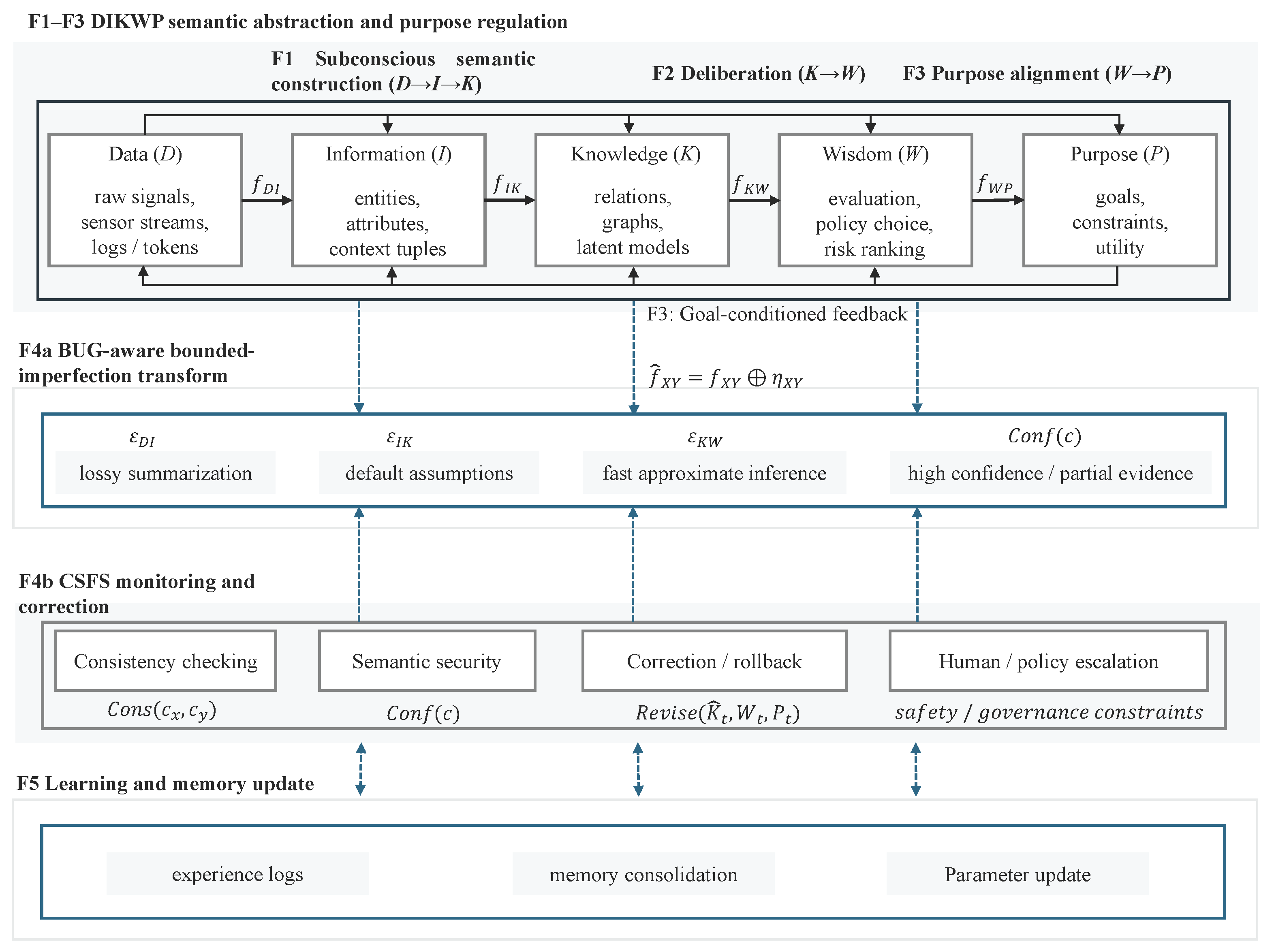
- F1.
- Subconscious processing (). The system collects new data D from sensors or input channels and also carries over some data from the previous cycle as short-term memory. It transforms D to I, imperfectly and with possible misinterpretations, and then aggregates I to update K, possibly compressing and losing details. During this phase, bug introduction is likely in the form of misinterpretation or overgeneralization. The output is a set of knowledge items K representing the system’s understanding of what is going on.
- F2.
- Conscious deliberation (). Given the knowledge base and the current purposes, the system formulates wisdom-level judgments. It may simulate various outcomes, check constraints, and incorporate guiding principles. Here, bug introduction may manifest as flawed reasoning shortcuts, such as ignoring a low-probability outcome or using an imperfect analogy. The result is one or more wisdom elements W, such as a recommended decision or a prediction of what will happen next.
- F3.
- Purpose alignment ( and update). The wisdom is then used to update or confirm the current actions corresponding to purpose. The system effectively asks: “Given what I conclude, what should I do or aim for next?” If the existing purpose fully covers the situation, the system may simply output an intention. Otherwise, it may refine the purpose by adding a sub-goal or adjusting priorities. These outputs can also be treated as data for the next cycle, forming a feedback loop.
- F4.
- BUG monitoring and semantic security. Concurrently with the above steps, the system runs consistency checks and monitors anomalies. For every critical transformation, especially those susceptible to bugs, there is a validation process. For example, if identifies an object as a human with high confidence, the system may cross-check using another method or sensor. If a large inconsistency is found, such as knowledge asserting both X and , the system flags it. Depending on severity, it may revise beliefs, query for more data, or alert a human operator. Minor bugs that do not cause significant inconsistencies are allowed to persist, as these are the illusions that can facilitate efficient cognition. Harmful bugs that create contradictions or conflict with core purposes are treated as security issues and trigger defensive measures.
- F5.
- Learning and memory update. Over longer timescales, the system learns from experience. BUG theory suggests that memory is reconstructed rather than stored as a perfect log. Accordingly, when consolidating knowledge into long-term memory, the system may compress episodes into narrative form, possibly introducing hindsight bias or other distortions. It stores not exactly what happened, but what it judges to have been important. Future decisions then draw on this compressed and possibly distorted memory, which is analogous to human memory.
4. System Architecture Design and Module Specifications
4.1. Overview of the Full-Stack AC Ecosystem Architecture
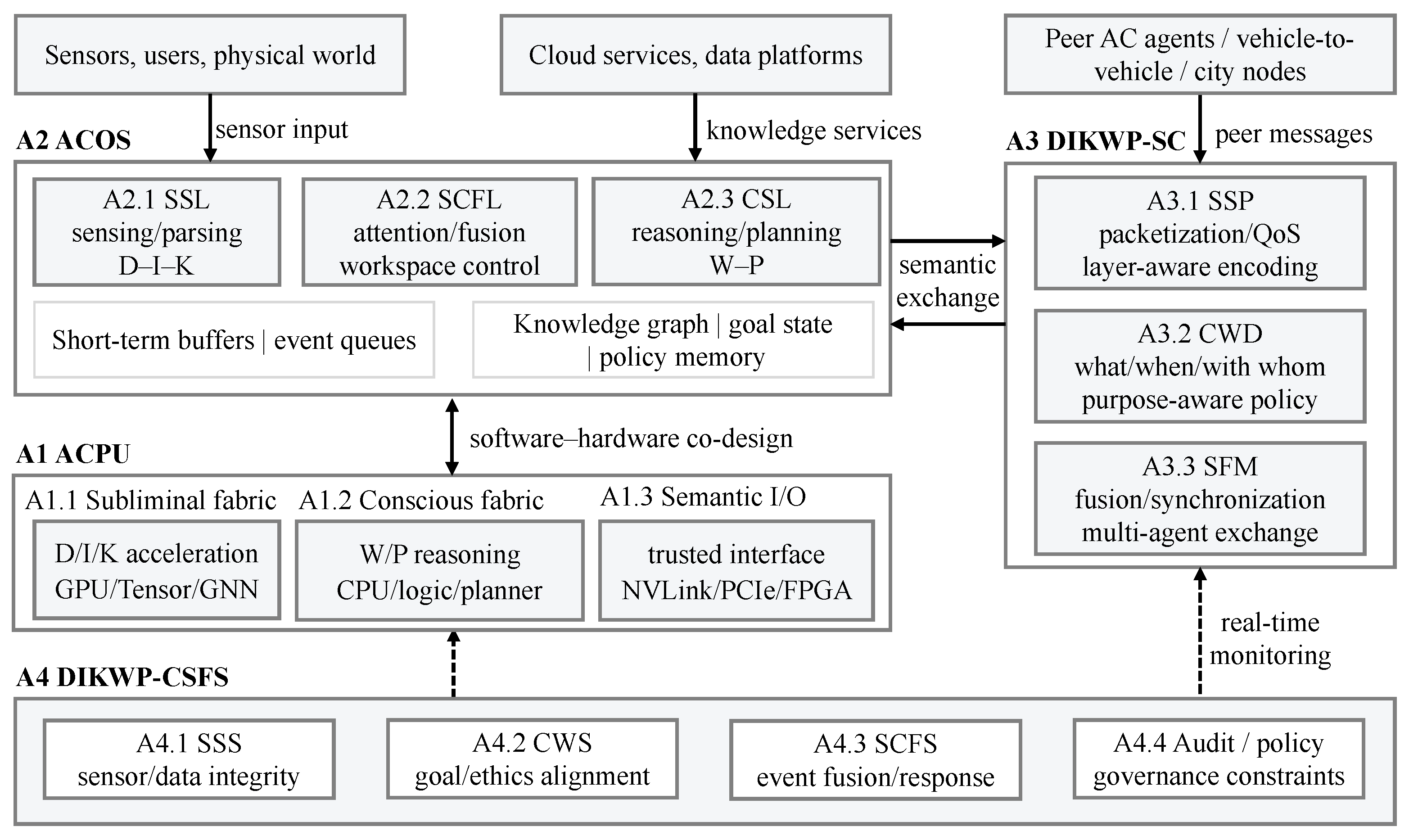
- A1.
- ACPU hardware layer.The ACPU provides the computational substrate, divided internally into specialized units for subconscious processing over D, I, and K, and conscious processing over W and P. It also includes interfaces for real-time semantic I/O and built-in security enforcement at the hardware level.
- A2.
- ACOS software layer.ACOS runs on the ACPU and manages cognitive processes, short-term and long-term memory, scheduling of subconscious versus conscious tasks, and APIs for communication and security modules. ACOS implements the DIKWP cognitive cycle in software by coordinating transformation flows across the layers.
- A3.
- DIKWP-SC semantic communication layer.DIKWP-SC connects the AC unit with external agents, conventional systems, and human interfaces. Unlike standard networks that transmit raw data or predefined messages, DIKWP-SC routes messages according to semantic content and DIKWP dimension, enabling knowledge- or wisdom-level exchange and low-latency coordination.
- A4.
- DIKWP-CSFS security layer.DIKWP-CSFS is interwoven across hardware, OS, and communication layers. It monitors both cybersecurity risks and cognitive-security risks, including data tampering, semantic inconsistency, dangerous BUG propagation, goal conflict, and unsafe high-level reasoning. It fuses low-level and high-level detections to enact real-time protective measures.
- S1.
- Subconscious space.This space encompasses the Data, Information, and Knowledge dimensions and their processing modules in ACPU/ACOS. It is responsible for perception, pattern recognition, and routine responses.
- S2.
- Conscious space.This space encompasses the Wisdom and Purpose dimensions and their processing modules. It is responsible for reasoning, planning, and goal management.
- S3.
- Communication space.This space is the semantic network connecting this AC system to other agents and human interfaces. It enables collective intelligence and multi-agent coordination through shared semantics.
- S4.
- Security space.This space consists of monitoring and intervention signals that overlap the other spaces to ensure integrity, semantic consistency, and purpose alignment.
4.2. ACPU (Hardware Layer)
4.2.1. Internal Architecture of ACPU
- (a)
- Subliminal Space Hardware Module. This corresponds to subconscious processing (D, I, and K dimensions). It includes GPU-enhanced tensor cores and transformer neural network accelerators for heavy AI computation. This module is suited to tasks such as signal processing, neural network inference, and graph processing for knowledge graphs. It operates analogously to the human brain’s sensory and pattern-recognition areas. By incorporating Transformer and Graph Neural Network (GNN) hardware, it natively supports deep learning and relational reasoning tasks on-chip, which are essential for implementing and . The design may resemble current GPU/TPU systems but extended with semantic tagging, such that each computed result can carry a tag indicating the relevant DIKWP dimension or concept.
- (b)
- Consciousness Space Hardware Module. This hardware is tailored for abstract, sequential, or symbolic processing, aligning with the W and P dimensions. It may be seen as a CPU-like decision module, possibly multi-core, focusing on complex logic, or incorporating neuromorphic elements for spiking neural networks that simulate attention. It may also integrate FPGA or ASIC blocks implementing logic inference or constraint-solving algorithms. This module takes outputs from the knowledge dimension and performs wisdom-level computation such as scenario simulation, logical reasoning, planning algorithms (e.g., search or linear programming), and goal arbitration. It is also explicitly aware of the BUG aspect: it may include approximate computing circuits that deliberately trade accuracy for speed, thereby introducing bounded imperfection by design. It interfaces with special registers that represent Purpose, where current goal parameters influence computation.
- (c)
- Real-time Semantic Fusion Interface and Security Engine. This module serves as both integration fabric and guardian. It provides high-bandwidth channels (e.g., NVLink, PCIe 5.0, or an on-chip bus) between the subliminal and conscious modules so that they can exchange data with minimal latency. It also connects the ACPU to external communication interfaces and sensor inputs. As data arrives, the interface may perform preprocessing such as encryption/decryption, packetization with semantic labels, or filtering of irrelevant data before the information reaches the main processors. Hardware-level security is also enforced here, including memory isolation, execution of security protocols, and anomaly monitoring. Components may include a hardware firewall, a random number generator for cryptographic needs, and a monitor core running diagnostic firmware separate from the main OS. This interface is designed to preserve real-time performance while providing a hardware root of trust.
4.2.2. Key Features and Design Strategies in ACPU
- Memory architecture. The memory system is likely heterogeneous, with one part being small and high-speed for conscious reasoning (analogous to working memory) and another part being large and slower for long-term knowledge storage. Technologies such as stacked DRAM or MRAM may be used for fast access to critical knowledge, while flash or off-chip memory may hold large data archives. The memory is unified in address space but managed so that different DIKWP dimensions mostly reside in specific regions.
- Parallel versus serial balance. Subliminal tasks such as deep learning inference run massively in parallel on tensor cores, whereas conscious tasks may be more single-thread intensive. The ACPU dynamically allocates power and clocking to these parts as needed.
- Support for DIKWP operations. The processor may introduce instruction-set extensions that directly support DIKWP operations. Examples include instructions to “promote data to information” or to “merge knowledge nodes,” analogous to how AI accelerators introduced instructions for matrix multiplication.
- Energy considerations. Since AC systems may run continuously under large workloads, power management is essential. The ACPU may incorporate neuromorphic or analog components, especially for subconscious processing, to reduce energy use. Purpose-aware control can also allow nonessential processing to be degraded when energy is low.
4.2.3. ACPU’s Role in DIKWP+BUG
4.3. ACOS (Software Layer)
4.3.1. Design Principles
4.3.2. Major Software Modules of ACOS
- (a)
- Subliminal Space Management Module (SSL). This module handles data, information, and knowledge processing in software. It includes device drivers for sensors, data fusion and filtering routines, information extraction pipelines, and a knowledge-base management system. The knowledge base may combine a relational database, a graph database, and a neural knowledge network. SSL is also responsible for short-term memory and intermediate caches. Most BUGs naturally arise here because heuristic algorithms dominate this layer. ACOS does not seek to eliminate all such quirks, but rather to monitor them. For example, the module may record confidence levels for each inferred information item and indicate whether a result was inferred from weak evidence. In implementation, SSL may be realized as multiple microservices, such as a vision service, an audio-processing service, and a world-model integration service.
- (b)
- Conscious Intelligence Decision-Making Module (CSL). This module corresponds to W-dimension processing and part of P-dimension processing. It serves as the executive reasoning component and may operate as a privileged service because it guides the overall system behavior. CSL integrates inputs from the knowledge base and the current goal state to perform higher-level reasoning, including deliberative planning for goal-directed action sequence generation, decision-making under uncertainty, conflict resolution when knowledge items or goals are inconsistent, ethical or legal reasoning where applicable, and self-modeling, such as updating beliefs about battery state or available capabilities. The CSL determines the system’s next intended action or conscious response. It may not run continuously at full intensity but instead be triggered by significant knowledge events or timing conditions. The BUG aspect also appears here: for the sake of speed, CSL may employ approximate reasoning, such as bounded search depth or heuristic evaluation, and may therefore produce a satisfactory rather than globally optimal action. ACOS may accordingly expose tunable parameters governing how much time CSL spends deliberating before acting under uncertainty.
- (c)
- Subconscious–Conscious Fusion Interaction Module (SCFL). This module mediates between SSL and CSL. It manages the upward flow of information and knowledge as well as the downward flow of commands, goals, and focus directives. Specifically, its responsibilities include attention allocation, namely deciding which subset of knowledge or information should be brought to conscious attention at a given time; broadcasting conscious decisions, that is, propagating CSL outputs to all relevant subconscious processes; synchronization, namely ensuring that CSL reads a coherent snapshot of the knowledge base; and interruption handling, namely allowing urgent sensor events to preempt ongoing conscious deliberation. SCFL therefore embodies a global-workspace-like function. At the implementation level, it may rely on shared memory or message queues and may follow a publish-subscribe design.
4.3.3. Additional Operating-System Services
- Memory Manager: allocates and garbage-collects memory for short-term information versus long-term knowledge.
- Process Scheduler: ensures that time-critical tasks such as sensor reading and safety checks receive high priority, while also allowing Purpose to influence scheduling decisions.
- Device Drivers and HAL: bridge the hardware specifics of ACPU to the OS, including access to tensor cores, neural accelerators, and semantic networking hardware.
4.3.4. ACOS and DIKWP Integration
- Data and Information: represented by sensor buffers and event lists and processed by dedicated threads.
- Knowledge: represented by an efficient knowledge base, such as an in-memory graph structure, triple store, or differentiable neural memory.
- Wisdom and Purpose: represented through explicit structures such as an agenda of pending decisions, active constraints, or an internal goal stack.
4.3.5. Fault Tolerance and BUG Handling in ACOS
- Redundant reasoning: running multiple algorithms for critical decisions and comparing their outputs;
- Checkpoints: maintaining previous stable states so that contradictions can trigger rollback;
- Introspection: background processes analyze logs to identify cognitive components that systematically produce errors;
- Parameter adjustment: the system can self-tune attention aggressiveness, deliberation depth, and similar parameters based on past performance, effectively adjusting BUG-related behavior such as .
4.4. DIKWP-SC: Semantic Communication Subsystem
4.4.1. Architecture of DIKWP-SC
- (a)
- Subliminal Semantic Communication Module (SSP). This module handles low-level, high-speed data transport while maintaining awareness of semantic segmentation. It extends physical- and data-link-layer functions by packetizing data with semantic labels and assigning differentiated QoS levels or communication channels to distinct content types. It also performs layer-appropriate encoding and compression. For instance, data-dimension content may adopt lossy compression, whereas knowledge dimension content may rely on stronger error-correction mechanisms to preserve exact symbolic meaning. SSP operates largely below the system’s conscious level and is primarily concerned with communication efficiency and transport reliability.
- (b)
- Consciousness-level Communication Decision Module (CWD). This module serves as the high-level control component for communication. It determines what should be communicated, when communication should occur, with whom communication should be established, and which modality should be used. In multi-agent scenarios, it may determine that one agent should periodically share knowledge summaries while transmitting raw data only on demand. In human-interaction settings, it may translate internal knowledge representations into natural-language explanations. CWD can further support semantic handshakes for establishing shared ontologies or mappings prior to information exchange, bandwidth and relevance management for selecting which content is worth transmitting under limited communication resources, and privacy and policy enforcement for determining whether information may be shared under purpose and security constraints.
- (c)
- Semantic-Intelligent Converged Communication Module (SFM). This module integrates SSP and CWD and manages the end-to-end communication process. It supports multiple modalities within a unified communication channel and is responsible for integrating outgoing messages from different layers into a coherent transmission stream, ensuring synchronization between communicating systems, adapting to changing network conditions, and applying advanced semantic-aware encoding strategies where appropriate.
4.4.2. Collaboration and Multi-Agent Considerations
4.4.3. Real-Time Semantic Communication
4.4.4. Handling BUGs over Communication
4.5. DIKWP-CSFS: Concept-Semantic Fused Security System
4.5.1. Components of DIKWP-CSFS
- (a)
- Subliminal Semantic Security Module (SSS). This module safeguards subconscious-layer activities associated with the Data, Information, and Knowledge dimensions. Its primary functions include sensor and data security, namely monitoring raw inputs for tampering, spoofing, or implausible values; information consistency checking, namely determining whether newly extracted information conflicts with established knowledge without sufficient explanation; knowledge-base integrity protection, namely preventing unauthorized or unexplained modification of stored knowledge; and load monitoring, namely identifying resource-exhaustion attacks or overload conditions and throttling lower-priority inputs when necessary.
- (b)
- Awareness Smart Security Module (CWS). This module corresponds to conscious-level security and alignment management. Its main functions include goal alignment, namely ensuring that Purpose remains consistent with externally imposed constraints and ethical rules; self-consistency and sanity checking, namely monitoring wisdom- and purpose-level reasoning for contradictions or irrational states; social and communication ethics control, namely preventing inappropriate disclosure, unauthorized commitments, or invalid external interactions; and cognitive security reflexes, namely triggering defensive responses when manipulation attempts or unsafe requests are detected.
- (c)
- Semantic-Intelligent Real-Time Security Fusion Module (SCFS). This module integrates signals from SSS and CWS and performs real-time monitoring of the entire system. Its main functions include event correlation, namely linking low-level anomalies to high-level decision irregularities; unified threat response, namely placing the system into safe states, issuing alerts, or restricting operation under serious threats; security policy enforcement, namely applying system-wide safety and governance rules; active threat learning, namely adapting detection strategies based on newly observed attacks or failure modes; and communication with external security authorities, namely transmitting alerts or receiving external threat intelligence where applicable.
4.5.2. Integration with ACOS and ACPU
- SSS uses ACPU features such as memory protection and secure enclaves and uses ACOS hooks to quarantine processes or isolate suspicious data flows.
- CWS is implemented through high-level algorithms such as rule evaluators or consistency checkers running under ACOS supervision.
- SCFS may be split across hardware and software so that rapid shutdown or isolation actions can occur at hardware speed while higher-level assessment remains available in ACOS.
4.5.3. Resilience Through CSFS
4.6. Overall Operational Workflow and Interaction of Modules
- 1.
- Perception and subconscious processing. Raw data streams from sensors or network inputs enter through the ACPU interface. The subliminal hardware accelerates initial processing such as object detection, parsing, and feature extraction, feeding results into ACOS’s SSL module. Data are transformed into information and then inserted into short-term memory and knowledge structures. During this stage, the SSS security component checks input authenticity and plausibility.
- 2.
- Attention and fusion. The SCFL module monitors newly generated knowledge and decides which items deserve conscious attention. For example, an obstacle detected ahead of a vehicle is highly relevant to the current purpose of safe driving. SCFL may also fuse evidence from multiple sensors, while SCFS may cross-check inter-sensor consistency.
- 3.
- Conscious reasoning and decision. Relevant knowledge is passed to CSL together with the current Purpose state. CSL performs wisdom-level reasoning, such as weighing options, simulating outcomes, and checking constraints through CWS. The result may be a decision such as “brake immediately,” which becomes a Wisdom-dimension conclusion and updates Purpose into a concrete action goal.
- 4.
- Action execution. SCFL disseminates the conscious decision to the relevant subconscious modules or actuator controllers. In the vehicle example, motion control receives a braking command. At the same time, DIKWP-SC may send knowledge-level messages to nearby agents, such as a warning that braking is underway because of an obstacle.
- 5.
- Feedback and learning. The action changes subsequent sensory data, and the cycle continues. Over longer time scales, the system may also learn from experience, adjusting parameters if it finds that bugs or simplifications previously caused near-failures or degraded performance.
- 6.
- Multi-agent interaction. In larger deployments, DIKWP-SC allows one agent’s knowledge to become part of another agent’s knowledge without requiring redundant perception. Higher-level Purpose alignment can also be broadcast across multiple units.
- 7.
- Security interventions. If malicious, inconsistent, or dangerous conditions are detected at any point, CSFS coordinates the response. This may include rejecting invalid commands, switching to backup sensing, quarantining data sources, or escalating to human supervision.
- the ACPU hardware actively supports ACOS’s timing and computation needs;
- ACOS software dynamically optimizes hardware usage according to context and purpose;
- semantic communication is integrated seamlessly with decision-making;
- the security system actively monitors and intervenes without undermining core functionality.
5. Implementation and Simulation Environment
5.1. Prototype Implementation of Core Components
5.1.1. Hardware Emulation
5.1.2. ACOS Software
5.1.3. Semantic Communication
5.1.4. Security Subsystem
5.2. Simulation Environment Setup
5.2.1. Smart-City Governance Simulation
5.2.2. Autonomous Vehicles (IoV) Simulation
5.2.3. Cognitive Medical System Simulation
5.2.4. Simulation Execution and Baselines
5.3. Runtime–Offline Cost Boundary and Reproducibility
5.4. Performance Metrics and Evaluation Methods
5.4.1. Cognitive Efficiency
5.4.2. Real-Time Decision Performance
5.4.3. Security and Reliability
5.4.4. Task Effectiveness
5.4.5. Statistical Reporting
6. Experimental Results and Discussion
6.1. Overall Performance and Efficiency Improvements
6.2. Decision-Making Quality and Response in Scenarios
6.2.1. Smart City Governance
6.2.2. IoV
6.2.3. Cognitive Medical Assistant
6.3. Security and Robustness Analysis
6.3.1. Attack Resilience and Active Safety
6.3.2. Context-Aware Anomaly Handling
6.3.3. Self-Recovery and Graceful Degradation
6.4. Comparative Analysis with State-of-the-Art Systems
6.4.1. Comparison with Representative System Classes
6.4.2. Ablation and Architectural Synergy
6.4.3. Scalability, Generality, and Remaining Challenges
6.5. Limitations and Future Research Directions
7. Conclusions
Author Contributions
Funding
Institutional Review Board Statement
Informed Consent Statement
Data Availability Statement
Conflicts of Interest
References
- Dehaene, S.; Lau, H.; Kouider, S. What is consciousness, and could machines have it? Science 2017, 358, 486–492. [Google Scholar] [CrossRef] [PubMed]
- Qin, R.; Zhou, C.; He, M. A comprehensive taxonomy of machine consciousness. Inf. Fusion 2025, 119, 102994. [Google Scholar] [CrossRef]
- Bickley, S.J.; Torgler, B. Cognitive architectures for artificial intelligence ethics. AI Soc. 2023, 38, 501–519. [Google Scholar]
- Chella, A. Artificial consciousness: The missing ingredient for ethical AI? Front. Robot. AI 2023, 10, 1270460. [Google Scholar] [CrossRef] [PubMed]
- Butlin, P.; Long, R.; Bayne, T.; Bengio, Y.; Birch, J.; Chalmers, D.; Constant, A.; Deane, G.; Elmoznino, E.; Fleming, S.M.; et al. Identifying indicators of consciousness in AI systems. Trends Cogn. Sci. 2026, 30, 488–501. [Google Scholar] [CrossRef] [PubMed]
- Naveed, H.; Khan, A.U.; Qiu, S.; Saqib, M.; Anwar, S.; Usman, M.; Akhtar, N.; Barnes, N.; Mian, A. A comprehensive overview of large language models. ACM Trans. Intell. Syst. Technol. 2025, 16, 106. [Google Scholar] [CrossRef]
- Marra, G.; Dumančić, S.; Manhaeve, R.; Raedt, L.D. From statistical relational to neurosymbolic artificial intelligence: A survey. Artif. Intell. 2024, 328, 104062. [Google Scholar] [CrossRef]
- Wang, X.; Wang, B.; Wu, Y.; Ning, Z.; Guo, S.; Yu, F.R. A survey on trustworthy edge intelligence: From security and reliability to transparency and sustainability. IEEE Commun. Surv. Tutor. 2024, 27, 1729–1757. [Google Scholar] [CrossRef]
- Guo, S.; Wang, Y.; Zhang, N.; Su, Z.; Luan, T.H.; Tian, Z.; Shen, X. A survey on semantic communication networks: Architecture, security, and privacy. IEEE Commun. Surv. Tutor. 2024, 27, 2860–2894. [Google Scholar]
- Harkat, H.; Camarinha-Matos, L.M.; Goes, J.; Ahmed, H.F.T. Cyber-physical systems security: A systematic review. Comput. Ind. Eng. 2024, 188, 109891. [Google Scholar] [CrossRef]
- Ghasemi, A.; Keshavarzi, A.; Abdelmoniem, A.M.; Nejati, O.R.; Derikvand, T. Edge intelligence for intelligent transport systems: Approaches, challenges, and future directions. Expert Syst. Appl. 2025, 280, 127273. [Google Scholar] [CrossRef]
- Wolniak, R.; Stecuła, K. Artificial intelligence in smart cities—Applications, barriers, and future directions: A review. Smart Cities 2024, 7, 1346–1389. [Google Scholar] [CrossRef]
- Gomez-Cabello, C.A.; Borna, S.; Pressman, S.; Haider, S.A.; Haider, C.R.; Forte, A.J. Artificial-intelligence-based clinical decision support systems in primary care: A scoping review of current clinical implementations. Eur. J. Investig. Health Psychol. Educ. 2024, 14, 685–698. [Google Scholar] [CrossRef] [PubMed]
- Duan, Y. Bridging the gap between purpose-driven frameworks and artificial general intelligence. Appl. Sci. 2023, 13, 10747. [Google Scholar] [CrossRef]
- Wu, K.; Duan, Y. Modeling and resolving uncertainty in DIKWP model. Appl. Sci. 2024, 14, 4776. [Google Scholar] [CrossRef]
- Mei, Y.; Duan, Y. The dikwp (data, information, knowledge, wisdom, purpose) revolution: A new horizon in medical dispute resolution. Appl. Sci. 2024, 14, 3994. [Google Scholar] [CrossRef]
- Mei, Y.; Duan, Y. Bidirectional Semantic Communication Between Humans and Machines Based on Data, Information, Knowledge, Wisdom, and Purpose Artificial Consciousness. Appl. Sci. 2025, 15, 1103. [Google Scholar] [CrossRef]
- Duan, Y.; Guo, Z. DIKWP-Driven Artificial Consciousness for IoT-Enabled Smart Healthcare Systems. Appl. Sci. 2025, 15, 8508. [Google Scholar] [CrossRef]
- Mei, Y.; Duan, Y. DIKWP Semantic Judicial Reasoning: A Framework for Semantic Justice in AI and Law. Information 2025, 16, 640. [Google Scholar] [CrossRef]
- Meyers, E.A.; Gretton, J.D.; Budge, J.R.C.; Fugelsang, J.A.; Koehler, D.J. Broad effects of shallow understanding: Explaining an unrelated phenomenon exposes the illusion of explanatory depth. Judgm. Decis. Mak. 2023, 18, e24. [Google Scholar] [CrossRef]
- Schacter, D.L.; Thakral, P.P. Constructive memory and conscious experience. J. Cogn. Neurosci. 2024, 36, 1567–1577. [Google Scholar] [CrossRef] [PubMed]
- Dings, R.; Newen, A. Constructing the past: The relevance of the narrative self in modulating episodic memory. Rev. Philos. Psychol. 2023, 14, 87–112. [Google Scholar]
- Macmillan-Scott, O.; Musolesi, M. (Ir)rationality in AI: State of the art, research challenges and open questions. Artif. Intell. Rev. 2025, 58, 352. [Google Scholar] [CrossRef]
- Sobetska, O. Irrationality in humans and creativity in AI. Front. Artif. Intell. 2025, 8, 1579704. [Google Scholar] [CrossRef] [PubMed]
- Yu, X.; Zhao, X.; Hou, Y. Cognitive flexibility and entrepreneurial creativity: The chain mediating effect of entrepreneurial alertness and entrepreneurial self-efficacy. Front. Psychol. 2023, 14, 1292797. [Google Scholar] [CrossRef] [PubMed]
- Spasokukotskiy, K. Synthetic consciousness architecture. Front. Robot. AI 2024, 11, 1437496. [Google Scholar] [CrossRef]
- Evers, K.; Farisco, M.; Chatila, R.; Earp, B.D.; Freire, I.T.; Hamker, F.; Németh, E.; Verschure, P.F.M.J.; Khamassi, M. Preliminaries to artificial consciousness: A multidimensional heuristic approach. Phys. Life Rev. 2025, 52, 180–193. [Google Scholar] [CrossRef] [PubMed]
- Arévalo-Royo, J.; Latorre-Biel, J.-I.; Flor-Montalvo, F.-J. Cognitive Systems and Artificial Consciousness: What It Is Like to Be a Bat Is Not the Point. Metrics 2025, 2, 11. [Google Scholar] [CrossRef]
- Baars, B.J. Global workspace theory of consciousness: Toward a cognitive neuroscience of human experience. Prog. Brain Res. 2005, 150, 45–53. [Google Scholar] [CrossRef] [PubMed]
- Dehaene, S.; Naccache, L. Towards a cognitive neuroscience of consciousness: Basic evidence and a workspace framework. Cognition 2001, 79, 1–37. [Google Scholar] [CrossRef] [PubMed]
- Dehaene, S.; Changeux, J.-P. Experimental and theoretical approaches to conscious processing. Neuron 2011, 70, 200–227. [Google Scholar] [CrossRef] [PubMed]
- Franklin, S.; Strain, S.; Snaider, J.; McCall, R.; Faghihi, U. Global workspace theory, its LIDA model and the underlying neuroscience. Biol. Inspired Cogn. Archit. 2012, 1, 32–43. [Google Scholar] [CrossRef]
- Tononi, G. An information integration theory of consciousness. BMC Neurosci. 2004, 5, 42. [Google Scholar] [CrossRef] [PubMed]
- Oizumi, M.; Albantakis, L.; Tononi, G. From the phenomenology to the mechanisms of consciousness: Integrated information theory 3.0. PLoS Comput. Biol. 2014, 10, e1003588. [Google Scholar] [CrossRef] [PubMed]
- Rosenthal, D.M. Two concepts of consciousness. In Consciousness and Emotion in Cognitive Science; Routledge: Abingdon, UK, 1998; pp. 1–31. [Google Scholar]
- Lau, H.; Rosenthal, D. Empirical support for higher-order theories of conscious awareness. Trends Cogn. Sci. 2011, 15, 365–373. [Google Scholar] [CrossRef] [PubMed]
- Altshuller, G.S. Creativity as an Exact Science; CRC Press: Boca Raton, FL, USA, 1984. [Google Scholar]
- Wu, K.; Duan, Y. DIKWP-TRIZ: A revolution on traditional TRIZ towards invention for artificial consciousness. Appl. Sci. 2024, 14, 10865. [Google Scholar] [CrossRef]
- Ackoff, R.L. From data to wisdom. J. Appl. Syst. Anal. 1989, 16, 3–9. [Google Scholar]
- Rowley, J. The wisdom hierarchy: Representations of the DIKW hierarchy. J. Inf. Sci. 2007, 33, 163–180. [Google Scholar] [CrossRef]
- Rozenblit, L.; Keil, F. The misunderstood limits of folk science: An illusion of explanatory depth. Cogn. Sci. 2002, 26, 521–562. [Google Scholar] [CrossRef] [PubMed]
- Simon, H.A. Invariants of human behavior. Annu. Rev. Psychol. 1990, 41, 1–20. [Google Scholar] [CrossRef] [PubMed]
- Gigerenzer, G.; Gaissmaier, W. Heuristic decision making. Annu. Rev. Psychol. 2011, 62, 451–482. [Google Scholar] [CrossRef] [PubMed]
- Huang, L.; Yu, W.; Ma, W.; Zhong, W.; Feng, Z.; Wang, H.; Chen, Q.; Peng, W.; Feng, X.; Qin, B.; et al. A survey on hallucination in large language models: Principles, taxonomy, challenges, and open questions. ACM Trans. Inf. Syst. 2025, 43, 42. [Google Scholar] [CrossRef]
- Rahman, S.S.; Islam, M.A.; Alam, M.M.; Zeba, M.; Rahman, M.A.; Chowa, S.S.; Raiaan, M.A.K.; Azam, S. Hallucination to truth: A review of fact-checking and factuality evaluation in large language models. Artif. Intell. Rev. 2026, 56, 70. [Google Scholar]
- Schacter, D.L. Constructive memory: Past and future. Dialogues Clin. Neurosci. 2012, 14, 7–18. [Google Scholar] [CrossRef] [PubMed]
- Schacter, D.L.; Addis, D.R. The ghosts of past and future. Nature 2007, 445, 27. [Google Scholar] [CrossRef] [PubMed]
- Seth, A.K. A predictive processing theory of sensorimotor contingencies: Explaining the puzzle of perceptual presence and its absence in synesthesia. Cogn. Neurosci. 2014, 5, 97–118. [Google Scholar] [CrossRef] [PubMed]
- Nave, K.; Deane, G.; Miller, M.; Clark, A. Expecting some action: Predictive processing and the construction of conscious experience. Rev. Philos. Psychol. 2022, 13, 1019–1037. [Google Scholar] [CrossRef]
- Gäb, S. Should You Upload Your Mind? Think 2023, 22, 33–37. [Google Scholar] [CrossRef]
- Weir, R.S. The Personal Identity Dilemma for Transhumanism. Philosophy 2024, 99, 351–377. [Google Scholar] [CrossRef]
- Mei, Y.; Duan, Y.; Nguyen, H.D. A Semantic Security and Controllability Framework for DIKWP Artificial Consciousness Oriented to External Semantics. Knowl.-Based Syst. 2026, 340, 115752. [Google Scholar] [CrossRef]
- Gabriel, I. Artificial Intelligence, Values, and Alignment. Minds Mach. 2020, 30, 411–437. [Google Scholar] [CrossRef]
- Langley, P.; Laird, J.E.; Rogers, S. Cognitive architectures: Research issues and challenges. Cogn. Syst. Res. 2009, 10, 141–160. [Google Scholar] [CrossRef]
- Kotseruba, I.; Tsotsos, J.K. 40 years of cognitive architectures: Core cognitive abilities and practical applications. Artif. Intell. Rev. 2020, 53, 17–94. [Google Scholar]
- Laird, J.E.; Newell, A.; Rosenbloom, P.S. Soar: An architecture for general intelligence. Artif. Intell. 1987, 33, 1–64. [Google Scholar] [CrossRef]
- Ritter, F.E.; Tehranchi, F.; Oury, J.D. ACT-R: A cognitive architecture for modeling cognition. Wiley Interdiscip. Rev. Cogn. Sci. 2019, 10, e1488. [Google Scholar] [PubMed]
- Franklin, S.; Madl, T.; Strain, S.; Faghihi, U.; Dong, D.; Kugele, S.; Snaider, J.; Agrawal, P.; Chen, S. A LIDA cognitive model tutorial. Biol. Inspired Cogn. Archit. 2016, 16, 105–130. [Google Scholar] [CrossRef]
- Furber, S.B.; Galluppi, F.; Temple, S.; Plana, L.A. The spinnaker project. Proc. IEEE 2014, 102, 652–665. [Google Scholar] [CrossRef]
- Painkras, E.; Plana, L.A.; Garside, J.; Temple, S.; Galluppi, F.; Patterson, C.; Lester, D.R.; Brown, A.D.; Furber, S.B. SpiNNaker: A 1-W 18-core system-on-chip for massively-parallel neural network simulation. IEEE J. Solid-State Circuits 2013, 48, 1943–1953. [Google Scholar] [CrossRef]
- Akopyan, F.; Sawada, J.; Cassidy, A.; Alvarez-Icaza, R.; Arthur, J.; Merolla, P.; Imam, N.; Nakamura, Y.; Datta, P.; Nam, G.J.; et al. Truenorth: Design and tool flow of a 65 mw 1 million neuron programmable neurosynaptic chip. IEEE Trans. Comput.-Aided Des. Integr. Circuits Syst. 2015, 34, 1537–1557. [Google Scholar] [CrossRef]
- Deng, Z.; Guo, Y.; Han, C.; Ma, W.; Xiong, J.; Wen, S.; Xiang, Y. AI agents under threat: A survey of key security challenges and future pathways. ACM Comput. Surv. 2025, 57, 182. [Google Scholar] [CrossRef]
- Vassilev, A.; Oprea, A.; Fordyce, A.; Andersen, H. Adversarial Machine Learning: A Taxonomy and Terminology of Attacks and Mitigations; NIST Trustworthy and Responsible AI, National Institute of Standards and Technology: Gaithersburg, MD, USA, 2024. [Google Scholar]
- Pelekis, S.; Koutroubas, T.; Blika, A.; Berdelis, A.; Karakolis, E.; Ntanos, C.; Spiliotis, E.; Askounis, D. Adversarial machine learning: A review of methods, tools, and critical industry sectors. Artif. Intell. Rev. 2025, 58, 226. [Google Scholar] [CrossRef]
- Shen, M.; Wang, J.; Du, H.; Niyato, D.; Tang, X.; Kang, J.; Ding, Y.; Zhu, L. Secure semantic communications: Challenges, approaches, and opportunities. IEEE Netw. 2023, 38, 197–206. [Google Scholar] [CrossRef]
- Mei, Y.; Duan, Y. A Review of Personalized Semantic Secure Communications Based on the DIKWP Model. Electronics 2025, 14, 3671. [Google Scholar] [CrossRef]
- Zhao, J.; Zhao, W.; Deng, B.; Wang, Z.; Zhang, F.; Zheng, W.; Cao, W.; Nan, J.; Lian, Y.; Burke, A.F. Autonomous driving system: A comprehensive survey. Expert Syst. Appl. 2024, 242, 122836. [Google Scholar] [CrossRef]



| Study/System Class | Approach Used | Major Findings or Contribution | Potential Limitations Relative to This Study |
|---|---|---|---|
| Classical cognitive architectures such as Soar, ACT-R, and LIDA [54,55,56,57,58] | Unified software architectures for perception, memory, learning, reasoning, attention, and action selection | Demonstrate that cognition can be organized through recurrent cycles, symbolic reasoning, memory structures, and global-workspace-like broadcast | Mainly emphasize cognitive organization and software realization; less focused on purpose-explicit semantic hierarchy, semantic communication, security fusion, and hardware–OS co-design |
| Neuromorphic and brain-inspired hardware such as SpiNNaker and TrueNorth [59,60,61] | Massively parallel, event-driven, and energy-efficient neural computation on specialized hardware | Provide scalable physical substrates for brain-like computation and low-power neural processing | Do not by themselves define a semantic–cognitive hierarchy linking data, information, knowledge, wisdom, and purpose |
| AI-agent security and adversarial machine-learning studies [62,63,64] | Taxonomies and mitigation strategies for adversarial input, poisoning, tool misuse, compromised resources, and lifecycle vulnerabilities | Clarify major threat classes and the need for robust security controls in autonomous AI systems | Usually treat security as a protection layer rather than as an internal semantic consistency mechanism of a cognitive cycle |
| Semantic-communication and semantic-security studies [9,52,65,66] | Meaning-oriented communication, knowledge alignment, semantic privacy, and controllability mechanisms | Show that communication can be organized around meaning, task relevance, and semantic trust rather than raw bit transmission alone | Often focus on communication or security separately, without full integration with purpose-oriented cognition and runtime architecture |
| Applied autonomous-driving and healthcare-agent systems [4,13,18,67] | Domain-specific perception–planning–control pipelines, clinical decision-support systems, and agentic planning/memory structures | Demonstrate practical value in embodied control and medical decision support under task-specific constraints | Usually rely on domain-specific integration and do not provide a general DIKWP-style semantic-purpose model across domains |
| DIKWP-based purpose-aware studies [14,15,16,17,18,19] | Purpose-extended DIKW modeling, uncertainty handling, semantic communication, healthcare reasoning, and legal reasoning | Provide theoretical and applied evidence that purpose can structure semantic transformation and explainable decision support | Prior studies do not yet provide a unified ACPU–ACOS–communication–security runtime emulation evaluated across multiple simulated domains |
| DIKWP Layer | Formal Construct | Operational Representation | Architecture/Implementation Component | Example Metadata or Output |
|---|---|---|---|---|
| Data (D) | Raw content items ; input subset of | Sensor streams, simulation events, logs, raw patient attributes, communication payloads before interpretation | P1/P2 input adapters; ACOS SSL sensor-input service; CARLA/CityFlow/triage streams | Timestamp, source, modality, raw value, integrity flag |
| Information (I) | Contextualized tuples ; | Parsed events, semantic tags, detected objects, extracted symptoms, state assertions | SSL perception and parsing services; YOLOv3, speech-to-text, intent recognition, DIKWP tagger | Entity label, confidence, provenance, DIKWP dimension, support evidence |
| Knowledge (K) | Structured concepts ; graph nodes and rules; | Knowledge graph nodes/edges, relations, learned state models, clinical or traffic rules | Neo4j knowledge graph, fusion daemon, rule store, shared semantic state in DIKWP-SC | Relation type, causal link, graph update, evidence count, uncertainty score |
| Wisdom (W) | Evaluative predicates or action-selection functions; | Ranked decisions, risk assessments, policy choices, recommended actions under constraints | ACOS CSL; Drools rules; PyTorch RL policy; CWS goal/ethics checks | Decision rationale, risk score, selected action, rejected alternatives |
| Purpose (P) | Goal or utility state; ; | Goal vector, priority weights, active constraints, sub-goals, policy memory | ACOS goal state; policy memory; CWD communication policy; CSFS governance constraints | Goal priority, utility estimate, safety constraint, revised sub-goal |
| BUG Mechanism | Formal Representation | Influence on Reasoning | CSFS Response |
|---|---|---|---|
| Lossy perception or summarization | Nonzero or deviation | May omit weak signals or compress raw inputs into incomplete information, allowing faster perception but risking missed events | Redundant sensor check, provenance tracking, and low-support tagging |
| Heuristic knowledge formation | Assumption edge or shortcut node in | May create a plausible knowledge hypothesis before all prerequisites are available | Mark as provisional; request corroboration when the hypothesis affects high-risk action |
| Bounded wisdom-level reasoning | Approximate with bounded search depth or stochastic policy selection | May choose a timely satisficing action rather than a globally optimal action | CWS veto rules and purpose-alignment checks prevent actions that violate safety or governance constraints |
| Confidence miscalibration | High with large or weak | May make partial evidence appear complete, especially under ambiguous or adversarial inputs | Confidence calibration, consistency checking, rollback, or human/policy escalation |
| Semantic-message propagation | Incorrect K- or W-level content transmitted through DIKWP-SC | May spread an erroneous belief across agents if accepted naively | Trust-weighted consensus, source validation, and cross-agent contradiction detection |
| Formal Element | Architectural Realization | Implementation Mechanism | Runtime Role |
|---|---|---|---|
| A2.1 SSL with A1.1 subliminal fabric | Sensor parsing, object detection, speech/intent recognition, input adapters | Converts raw streams into semantic events and information tuples | |
| SSL knowledge-fusion daemon and knowledge memory | Neo4j graph update, relation extraction, rule insertion, semantic aggregation | Stabilizes information into reusable knowledge structures | |
| A2.3 CSL with A1.2 conscious fabric | Drools rules, reinforcement-learning policy, scenario evaluation, constraint checking | Produces risk rankings, decisions, and recommended actions | |
| Goal state, policy memory, and CWD policy engine | Goal-priority update, communication policy selection, action–goal refinement | Aligns decisions with purpose and updates sub-goals | |
| BUG-aware processing across SSL, SCFL, CSL, and DIKWP-SC | Lossy compression, bounded search, provisional assumptions, confidence metadata | Enables timely approximate cognition while exposing imperfection metadata | |
| A4 DIKWP-CSFS and CWS/SCFS monitors | Threshold checks, one-class SVM, Drools veto rules, cross-agent corroboration | Detects harmful bugs, attacks, and semantic contradictions |
| Component | Prototype Realization | Reproducibility-Relevant Detail |
|---|---|---|
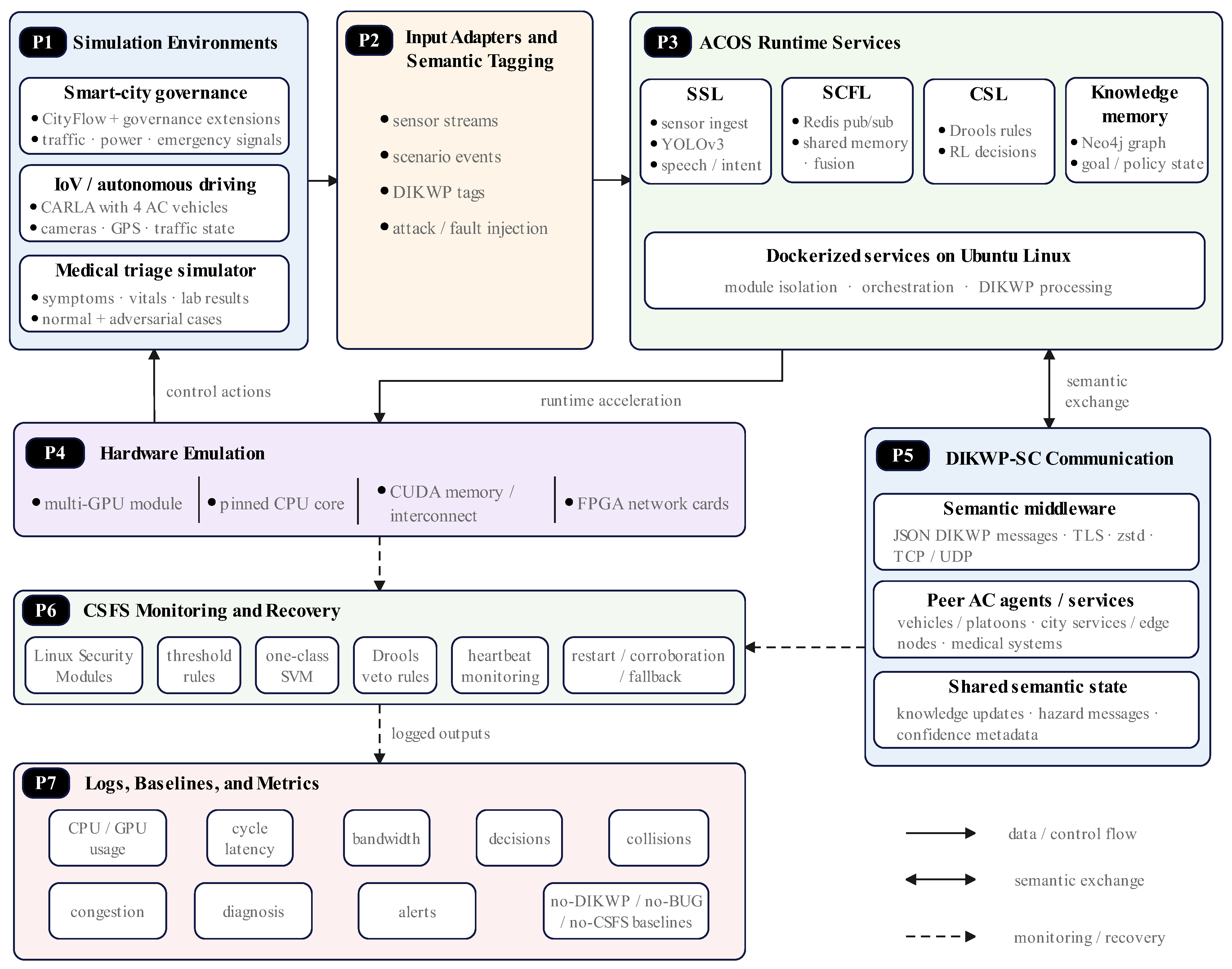
| Compute substrate | Multi-GPU CUDA server for subliminal processing; pinned CPU core for conscious processing; CUDA 11.8 unified memory and high-speed GPU–CPU interconnect; FPGA-based network cards for semantic I/O and monitoring | Used to emulate A1 ACPU partitioning; product-specific device identifiers and driver versions are recorded with the reproducibility metadata available upon reasonable request |
| Operating environment | Ubuntu Linux 22.04 LTS with Docker 24.0 services | Each cognitive service runs as an isolated container or process; service logs include start time, cycle ID, resource usage, and emitted DIKWP events |
| Data-processing pipeline | Simulation stream → input adapter → SSL parsing/perception → SCFL fusion → knowledge graph update → CSL decision → action or semantic message | The pipeline records source, timestamp, DIKWP dimension, confidence, provenance, and action outcome for each critical event |
| Model and reasoning modules | YOLOv3 vision, speech-to-text and intent recognition, Neo4j 5.14 graph database, Drools 7.73.0.Final rules, PyTorch 2.1.2 reinforcement-learning policy, GPT-2 diagnostic component in the medical scenario | Online evaluation uses initialized or pretrained components; offline preparation costs are reported separately from online latency |
| Communication protocol | JSON DIKWP-SC messages with source, target, dimension, content, optional confidence/provenance fields; TLS 1.3 encryption; zstd 1.5.5 compression; UDP/TCP and UDP multicast for timing-critical exchange | Hazards above confidence 0.8 are broadcast; events below 0.5 trigger corroboration requests rather than immediate broadcast |
| Security and recovery | Linux Security Modules, threshold rules, scikit-learn 1.3.2 one-class SVM detectors, Drools 7.73.0.Final veto rules, heartbeat monitoring, restart/corroboration/safe-fallback logic | Alerts are linked to content IDs and can trigger quarantine, corroboration, safe fallback, or human/policy escalation |
| Software/Library/Model | Version Used | Role in the Prototype |
|---|---|---|
| Ubuntu Linux | 22.04 LTS; Linux kernel 5.15 | Host operating environment and Linux Security Modules support |
| Docker | 24.0 | Containerization and isolation of ACOS runtime services |
| Python | 3.10.12 | Middleware, simulation adapters, SCFS coordinator, logging, and analysis scripts |
| C++/compiler toolchain | C++17; GCC 11.4 | Low-level monitoring hooks and performance-critical runtime components |
| OpenJDK/JNI | OpenJDK 17 | Java interface for invoking Drools rule services from the Python/C++ runtime |
| CUDA/cuDNN | CUDA 11.8; cuDNN 8.9 | GPU acceleration and emulation of the subliminal processing substrate |
| PyTorch | 2.1.2 | Reinforcement-learning policy and neural-model inference |
| scikit-learn | 1.3.2 | One-class SVM anomaly detection in the SSS/SCFS pipeline |
| YOLOv3 | Darknet-53 YOLOv3, COCO-pretrained weights | Vision object-detection component in SSL perception |
| Hugging Face Transformers/GPT-2 | Transformers 4.36.2; GPT-2 small checkpoint | Medical-language reasoning component in the triage simulation |
| Neo4j | 5.14 | Knowledge graph storage and update service |
| Drools | 7.73.0.Final | Rule engine for decision rules, ethical constraints, and veto rules |
| Redis | 7.0.15 | Publish/subscribe messaging and shared-memory-style coordination between SSL, SCFL, and CSL |
| CityFlow | 0.1 | Smart-city traffic simulation baseline and governance extensions |
| CARLA | 0.9.14 | Autonomous-driving and IoV simulation environment |
| zstd | 1.5.5 | Compression of DIKWP-SC semantic messages |
| OpenSSL/TLS | OpenSSL 3.0; TLS 1.3 | Encryption layer for DIKWP-SC communication |
| Scenario | Scale and Inputs | Perturbations/Adversarial Cases | Primary Metrics | Baseline Definitions |
|---|---|---|---|---|
| Smart-city governance | CityFlow 0.1 with governance extensions; 24 virtual hours per run; 50 sensors; 10,000 vehicles; traffic, power-grid, and emergency-call inputs | Accidents, congestion peaks, emergency-vehicle dispatch conflicts, inconsistent department-level signals | Congestion duration, emergency response time, decision latency, cross-department action conflicts, resource utilization | Default CityFlow 0.1 traffic-light optimization with simple emergency-priority rules; non-DIKWP stack with similar AI services but no shared semantic-purpose state |
| IoV/autonomous driving | CARLA 0.9.14 scenario with four AC-controlled vehicles plus background traffic; cameras, GPS, traffic state, lane-merging and obstacle events | Fake GPS, false traffic-jam reports, false hazard broadcasts, partial camera failure, environmental randomness | Collisions, travel time, peak deceleration, throughput, hazard-reaction latency, communication bandwidth | Conventional autonomous-driving stack with local perception and control but no DIKWP-SC; ablations without BUG and without CSFS |
| Medical triage | Synthetic emergency-room triage batches; 50 representative patient cases; symptoms, vitals, laboratory values, and partial patient records | Incomplete symptom sets, corrupted laboratory results, tampered patient IDs, clinically inconsistent medication recommendations | Diagnostic accuracy, diagnosis time, anomaly flags, false rejection, consistency-check overhead | Diagnostic pipeline with the same GPT-2/knowledge components but without DIKWP integration; ablations without BUG and without CSFS |
| Element | Realization in the Prototype | Evaluation Role |
|---|---|---|
| Hardware emulation | Multi-GPU subliminal module, pinned CPU consciousness core, CUDA unified memory/high-speed interconnect, FPGA-based network cards for semantic communication and monitoring | Approximates the intended ACPU-style hardware partition |
| ACOS runtime | Ubuntu Linux 22.04 LTS, Docker 24.0 services, sensor input pipeline, YOLOv3/Darknet-53 vision, speech-to-text and intent recognition, Neo4j 5.14 knowledge graph, fusion daemon, Drools 7.73.0.Final rule engine, PyTorch 2.1.2 RL agent, Redis 7.0.15/shared-memory interaction layer | Implements DIKWP processing, rule-based reasoning, and action execution |
| Semantic communication | JSON-based DIKWP-SC messages, custom Python 3.10.12 middleware, TLS 1.3/OpenSSL 3.0 encryption, zstd 1.5.5 compression, TCP/UDP transport, multicast for low-latency coordination | Supports semantic sharing and cooperative multi-agent behavior |
| Security subsystem | Linux Security Modules, threshold rules, scikit-learn 1.3.2 one-class SVM anomaly detection, Drools 7.73.0.Final veto rules, heartbeat monitoring, SCFS restart and corroboration logic | Supports anomaly detection, action validation, safe fallback, and self-recovery |
| Smart-city simulation | CityFlow 0.1 with governance extensions, one City Governor AI, traffic/power/emergency inputs, AC mode and baseline mode | Tests city-level coordination, congestion control, and emergency response |
| IoV simulation | CARLA 0.9.14 with four AC vehicles, lane merges, obstacles, traffic signals, fake GPS, and false traffic reports | Tests real-time control, cooperation, and adversarial robustness |
| Medical simulation | Emergency-room triage environment, symptom and vital-sign streams, medical knowledge base, GPT-2 small checkpoint via Transformers 4.36.2, incomplete and corrupted inputs | Tests diagnostic reasoning and semantic anomaly handling |
| Execution scale and baselines | 24-h city runs, dozens of traffic runs, batches of synthetic patient cases, 50 sensors, 10,000 vehicles, integrated and ablated baselines | Enables repeated-run comparison and component-wise assessment |
| Logged measurements | CPU/GPU usage, cycle latency, bandwidth, decisions, alerts, transmitted messages, collisions, travel time, and diagnostic outcomes | Supports the quantitative analyses in Section 6 |
| Cost Component | Examples in the Prototype | Included in Latency/Throughput Results? | Interpretation |
|---|---|---|---|
| Offline model preparation | Pretrained YOLOv3 weights, GPT-2 medical component preparation, RL policy training, one-class SVM fitting, rule/ontology construction | No | One-time or occasional setup cost; must be reported for lifecycle or resource-constrained deployment claims |
| Online inference and reasoning | Sensor parsing, graph update, Drools evaluation, RL action selection, DIKWP-SC message handling, CSFS checks | Yes | Basis of the online-runtime and scenario-level comparisons reported in Section 6 |
| Initialization and warm-up | Container launch, graph loading, model loading, middleware startup | Excluded from per-cycle latency; logged separately where available | Startup cost matters for cold-start deployment but not for steady-state online response |
| NGSO or other offline optimizer | Not used in the reported Figure 3 prototype | Not applicable | Any future optimizer with substantial training cost should be included in and reported separately |
| Metric Family | Unit of Analysis | Recommended Interval/Test | Interpretation in This Study |
|---|---|---|---|
| Latency, throughput, CPU/GPU usage | Run-level means and cycle-level traces | Mean ± CI; bootstrap CI for skewed latency distributions; Welch test for baseline comparison | Used as online-runtime indicators; not interpreted as lifecycle speedup including offline preparation |
| Collision, failure, and attack-mitigation counts | Scenario run or injected attack case | Wilson interval for proportions; Fisher’s exact test for small samples | Reported as controlled simulation evidence, with limited generalization outside the tested scenarios |
| Diagnostic accuracy and anomaly flags | Synthetic patient case | Wilson interval or binomial test where case-level labels are available | Indicates prototype behavior on the constructed triage cases, not clinical validation |
| Ablation and SOTA positioning | Component removal or system-class comparison | Matched-compute statistical comparison required for future work | Current ablation table is qualitative and should not be treated as definitive component attribution |
| Metric | DIKWP+BUG AC | Conventional | Improvement |
|---|---|---|---|
| Cognitive throughput | |||
| Perception–action latency | faster | ||
| CPU utilization | |||
| Peak memory usage | |||
| Knowledge sync bandwidth | N/A | Enabled sharing | |
| Human overrides | runs | runs | Better autonomy |
| Scenario | Representative Task-Level Outcomes | Comparison with Baseline | Robustness/Interpretability Evidence |
|---|---|---|---|
| Smart city governance | Accident recognized within ; average congestion duration lower; emergency response time improved by approximately | Lower congestion and faster dispatch than the baseline | No cross-department action conflicts were observed; logged reasoning traces explained actions in terms of city-level safety and efficiency goals |
| IoV | 0 collisions in the AC condition versus approximately baseline runs; peak deceleration vs. ; road throughput improved by approximately | Safer and smoother vehicle behavior together with higher traffic efficiency | False hazard messages were rejected through CSFS cross-verification; GPS spoofing triggered alternate localization rather than unstable lane behavior |
| Cognitive medical assistant | Diagnostic accuracy vs. on 50 simulated cases; average time per case vs. | Higher decision quality with a modest time overhead caused by additional consistency checking | Inconsistent laboratory data were flagged for re-test; bogus patient records were rejected before action was taken |
| Metric | DIKWP+BUG AC System | Baseline/Comparison | Interpretation |
|---|---|---|---|
| Injected cyber-attack scenarios | thwarted or mitigated; remaining 2 produced only mild transient effects | Baseline systems often experienced more serious consequences under comparable attacks | High attack tolerance with bounded residual impact |
| Safety-critical failures under malicious or faulty inputs | 0 observed | Several incidents observed, including unnecessary abrupt stops induced by false messages | Security controls preserved safe behavior even under adversarial signaling |
| False security alerts | Approximately 3 across all tests; minor overhead only | Not quantified consistently | Context-aware fusion limited the operational cost of false positives |
| Autonomous recovery after conscious-process failure | Watchdog restart within ; vehicle coasted safely and resumed operation | Baseline became unresponsive until fallback full stop | Fast self-recovery reduced disruption and preserved safety |
| Safety incidents or near-misses | About | About | Roughly reduction in active safety incidents |
| Human intervention during security events | None required | Not reported numerically | Issues were either resolved autonomously or driven to a safe state |
| System Class | Semantic/Symbolic Reasoning | Real-Time Embodied Deployment | Cross-Agent Coordination | Built-in Safety/Self-Correction | Main Limitation Relative to the Proposed System |
|---|---|---|---|---|---|
| Conventional deep learning systems | Limited or implicit | Often possible, but task-specific | Usually weak unless added externally | Typically external to the model | More brittle under out-of-distribution inputs; limited explainability and weak handling of novel situations |
| Cognitive architectures and LLM-based reasoning systems | Moderate to strong, but often text- or domain-centric | Usually not designed for tight closed-loop hardware control | Limited unless coupled to external orchestration | Inconsistency control is often not intrinsic | Weaker grounding in live devices, real-time control, and semantic self-correction |
| Integrated autonomous-driving stacks | Strong procedural control, but limited global semantics | Strong for single-vehicle closed-loop control | Usually limited to local coordination | Safety-oriented, but largely pipeline-specific | Less explicit sharing of intent and less purpose-level mediation across agents |
| Multi-agent systems and IoT frameworks | Rule- or protocol-level semantics | Strong for distributed orchestration | Strong communication, but often protocol-bound | Usually external or rule-based | Harder conflict resolution when objectives compete; less unified semantic integration |
| DIKWP+BUG AC system (proposed) | Unified DIKWP reasoning across data, knowledge, wisdom, and purpose | Designed for hardware–software co-deployment | Semantic communication with shared-purpose coordination | Embedded CSFS/SCFS monitoring, semantic validation, and safe fallback | Higher tuning complexity and greater system-integration effort |
| Removed Component | Main Degradation | Primary Role |
|---|---|---|
| BUG integration | Over-cautious behavior and delayed decisions under uncertainty, especially in dynamic city and IoV scenarios | Enables bounded action before complete certainty |
| Semantic communication | Agents operated in isolation and coordination quality deteriorated, most visibly in cooperative driving and city coordination | Provides shared situational awareness and intent exchange |
| Security subsystem | Normal-condition task output remained similar, but adversarial and inconsistent-input cases became much more damaging | Preserves anomaly rejection, self-correction, and safe fallback |
Disclaimer/Publisher’s Note: The statements, opinions and data contained in all publications are solely those of the individual author(s) and contributor(s) and not of MDPI and/or the editor(s). MDPI and/or the editor(s) disclaim responsibility for any injury to people or property resulting from any ideas, methods, instructions or products referred to in the content. |
© 2026 by the authors. Licensee MDPI, Basel, Switzerland. This article is an open access article distributed under the terms and conditions of the Creative Commons Attribution (CC BY) license.
Share and Cite
Guo, Z.; Duan, Y. DIKWP+BUG Architecture for Purpose-Aware Cognitive Computing. Big Data Cogn. Comput. 2026, 10, 196. https://doi.org/10.3390/bdcc10060196
Guo Z, Duan Y. DIKWP+BUG Architecture for Purpose-Aware Cognitive Computing. Big Data and Cognitive Computing. 2026; 10(6):196. https://doi.org/10.3390/bdcc10060196
Chicago/Turabian StyleGuo, Zhendong, and Yucong Duan. 2026. "DIKWP+BUG Architecture for Purpose-Aware Cognitive Computing" Big Data and Cognitive Computing 10, no. 6: 196. https://doi.org/10.3390/bdcc10060196
APA StyleGuo, Z., & Duan, Y. (2026). DIKWP+BUG Architecture for Purpose-Aware Cognitive Computing. Big Data and Cognitive Computing, 10(6), 196. https://doi.org/10.3390/bdcc10060196