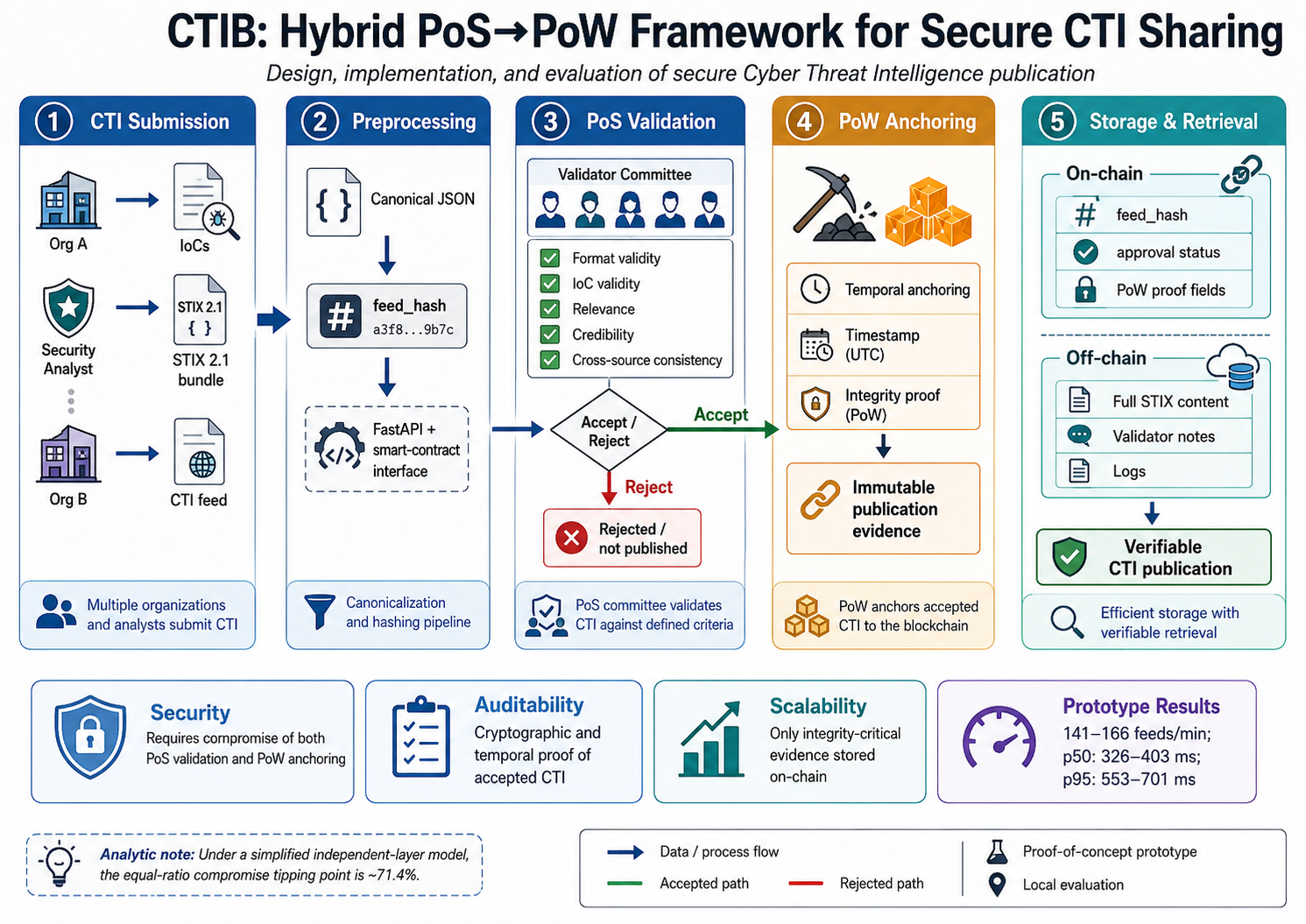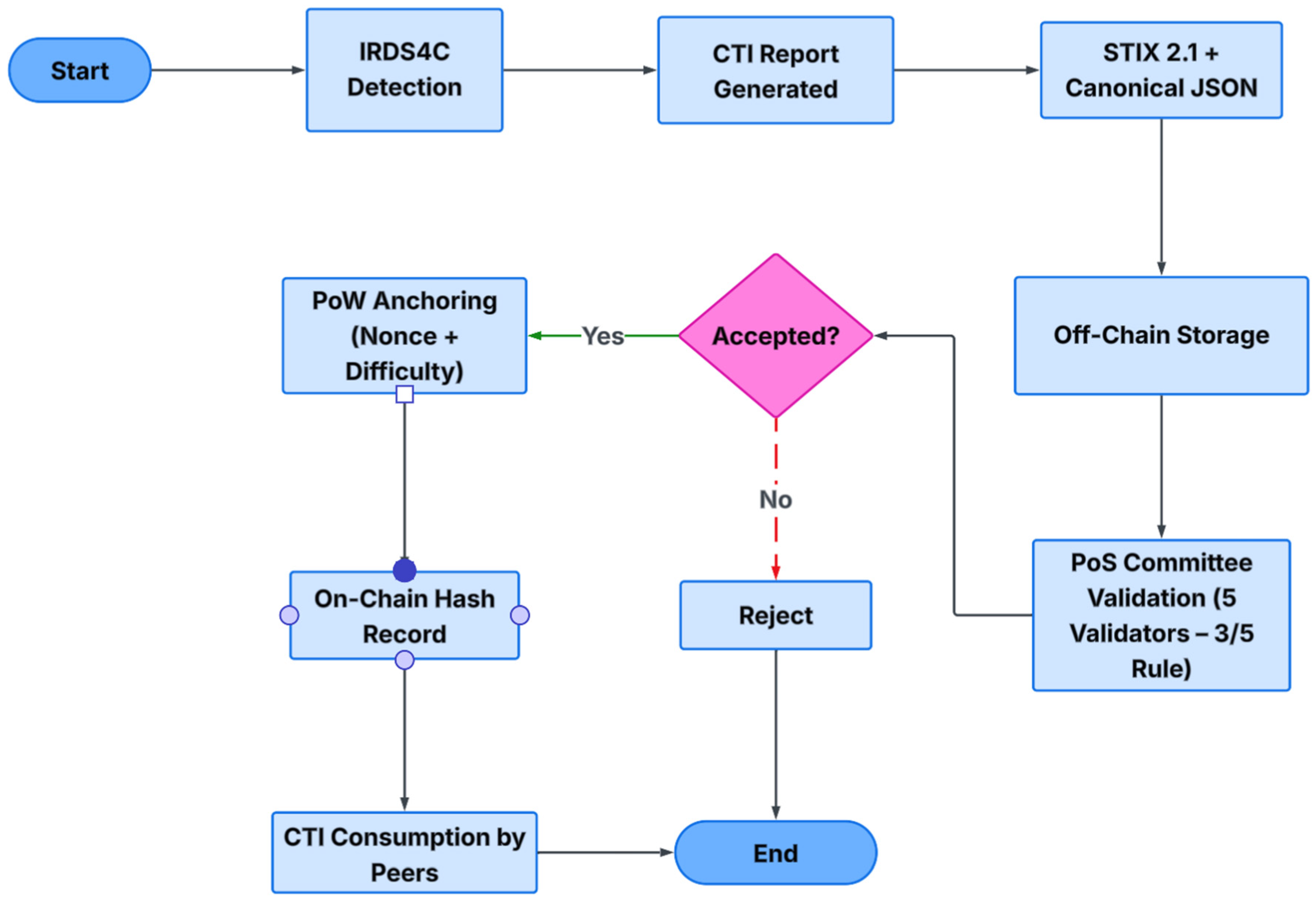

A Hybrid PoS–PoW Blockchain Framework for Secure Cyber Threat Intelligence Sharing: Design, Implementation, and Evaluation


Abstract
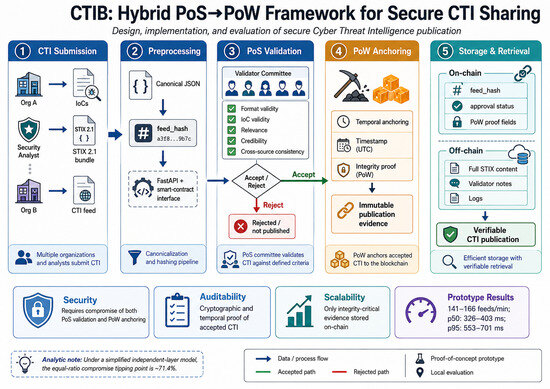
1. Introduction
2. Background and Related Work
2.1. Related Work
2.2. PoS vs. PoW Limitations
2.3. Permissioned and Permissionless Blockchains in CTI Sharing
3. Methodology Overview
3.1. Architectural Overview
- An off-chain backend layer, responsible for CTI processing, validation coordination, and benchmarking;
- An on-chain smart contract layer, responsible for recording immutable integrity evidence and final publication status.
3.2. On-Chain vs. Off-Chain Components
3.3. Backend and Smart Contract Interaction
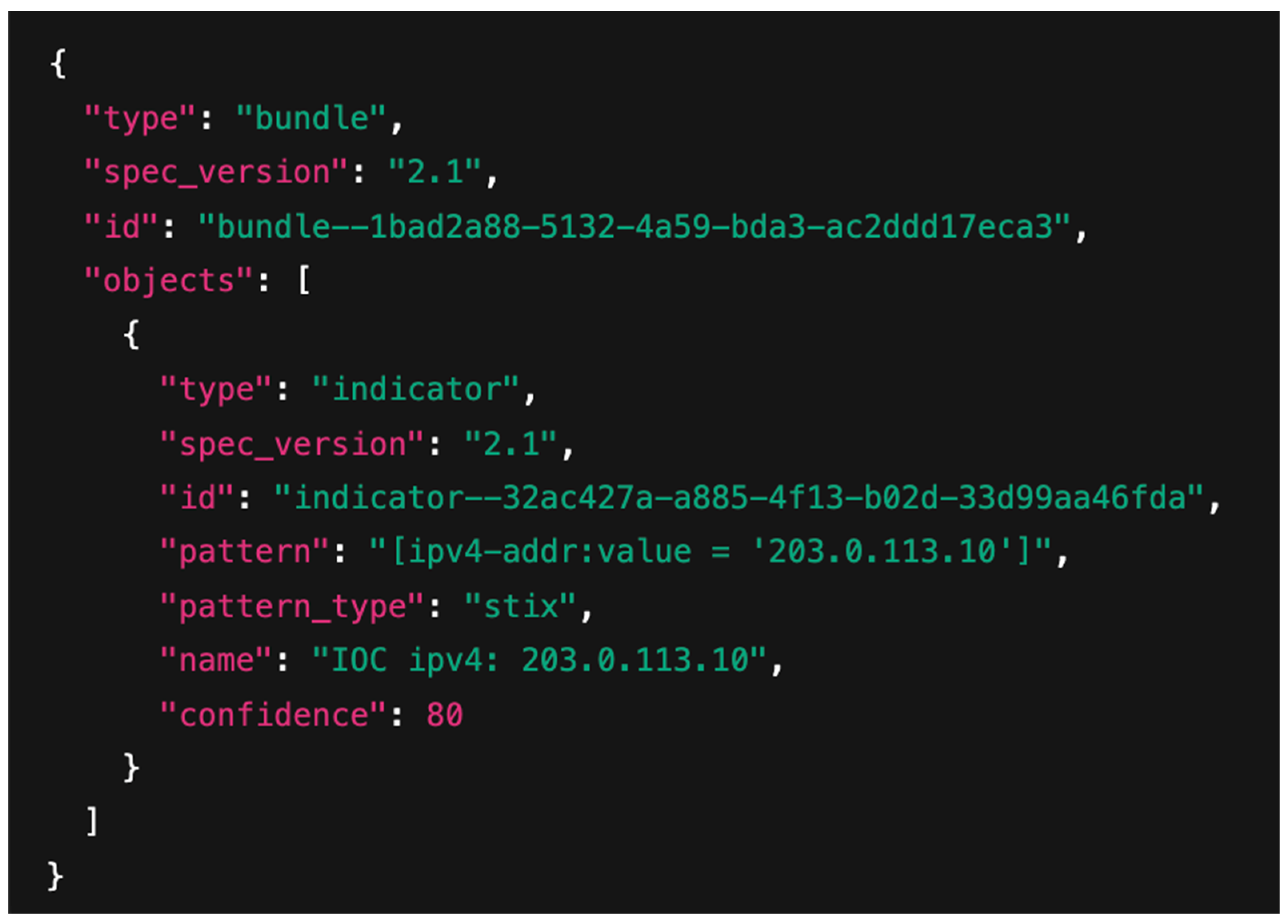
3.4. STIX-Based CTI Representation and Hash-Based Integrity
3.5. Design Principle: Why Two Consensus Layers
3.6. Formal CTI Validation Criteria for the PoS Committee
3.7. ABI and Smart Contract Interfacing
4. Prototype Implementation
4.1. Design and Architecture of the CTIB Framework
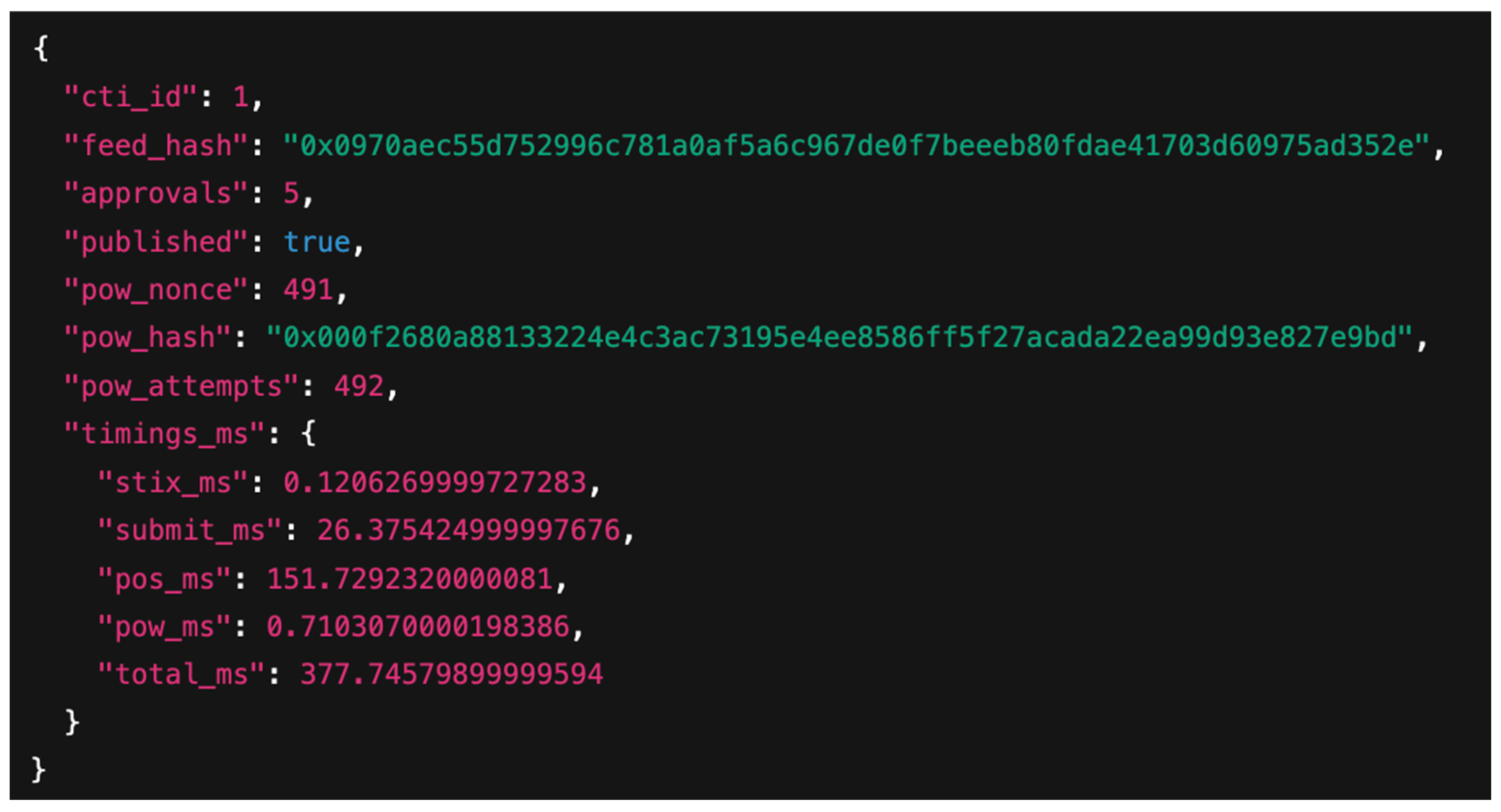
- cti_id: unique identifier of the CTI submission;
- feed_hash: SHA-256 hash of the canonical STIX bundle;
- Approvals: number of PoS validator approvals. In our prototype, we used five validators as a committee from a pool of validators;
- Published: final publication status;
- pow_nonce: nonce satisfying PoW difficulty;
- pow_hash: resulting PoW hash;
- pow_attempts: number of hash attempts.
4.2. Threat Model, Assumptions, and Scope
4.3. Hybrid Consensus Architecture (PoS → PoW)
4.4. Alpha-Constrained Effective Hash Power
- H′ is the total effective hash power of the network;
- hi is the raw hash power of miner i;
- hi′ is the effective hash power of miner i;
- si is the stake of miner i;
- f(si) is the maximum effective mining share allowed for miner i;
- S is the total stake in the system; and
- α is a system-level governance parameter.
4.5. CTI Representation and STIX Integration in Smart Contracts and Backend Integration
5. CTIB Validation, Performance, and Security Evaluation
| Algorithm 1. Prototype Output Example (End-to-End Execution) |
GET /health → {“ok”: true, “rpc_url”: “http://127.0.0.1:8545”, “contract_json”: “backend/chain/ctib_contract.json”} Example CTI submission (end-to-end PoS → PoW): POST /cti/submit?pow_difficulty_bits=12&pow_max_nonce=2000000 Body: {“ioc_type”:“ipv4”,”ioc_value”:“203.0.113.10”,”severity”:6,”confidence”:80} → { “cti_id”: 1, “feed_hash”: “0x0970aec55d752996c781a0af5a6c967de0f7beeeb80fdae41703d60975ad352e”, “approvals”: 5, “published”: true, “pow_nonce”: 491, “pow_hash”: “0x000f2680a88133224e4c3ac73195e4ee8586ff5f27acada22ea99d93e827e9bd”, “pow_attempts”: 492, “timings_ms”: { “stix_ms”: 0.1206269999727283, “submit_ms”: 26.375424999997676, “pos_ms”: 151.7292320000081, “pow_ms”: 0.7103070000198386, “total_ms”: 377.74579899999594 } } STIX retrieval (off-chain storage): GET /cti/1/stix → Returns the STIX 2.1 bundle for cti_id=1 (bundle + indicator object). |
5.1. Performance Benchmarking Results
5.2. Experimental Setup and Metrics
5.3. Single-Run Results (100 Submissions) and Multi-Run Aggregated Results (10 Runs)
5.4. Discussion
5.5. Security Evaluation Against 51% Attacks
5.6. Simple Analytical Baseline Theory Math vs. Simulation Model (The Independent Bernoulli Baseline)
- The validator pool is finite.
- Committees are sampled without replacement.
- The attacker’s success depends on how many corrupted validators appear inside a single committee, not just on an average corruption rate.
- It provides an exact analytical probability for committee capture that aligns with the actual PoS mechanism implemented in CTIB.
6. Prototype Scope and Limitations
6.1. Implemented and Evaluated Components
6.2. Analytical Scope, Design Limitations, and Advantages of the CTIB Framework
6.3. Discussion of Threat Coverage and Prototype Scope
6.4. Security Features Not Implemented in the Current Prototype
6.5. Experimental and Security Evaluation Challenges
6.6. Practical Implications and Future Deployment Requirements
7. Comparative Discussion with Existing CTI Blockchain Approaches
7.1. Comparative Analysis with Existing Systems
- A sequential hybrid PoS → PoW consensus architecture.
- Standardized CTI representation and deterministic hashing (STIX 2.1).
- Explicit on-chain/off-chain separation.
- Implementation-backed evaluation reporting application-level throughput/latency metrics alongside analytical and Monte Carlo security analysis.
7.2. Performance Comparison and Interpretation
8. Conclusions and Future Work
Author Contributions
Funding
Institutional Review Board Statement
Informed Consent Statement
Data Availability Statement
Conflicts of Interest
Appendix A. Bernoulli vs. Generic Random 0/1 Generation
| Random Draw | ? | Outcome |
| 0.13 | Yes | Success (True) |
| 0.76 | Yes | Success (True) |
| 0.92 | No | Failure (False) |
Appendix B. Committee-Based Probability Model and Monte Carlo Validation
Appendix C. Illustrative Example: Independent vs. Committee-Based Attack Probability
References
- Reittinger, T.; Grill, J.; Pernul, G. Share and benefit: Incentives for cyber threat intelligence sharing. Int. J. Inf. Secur. 2026, 25, 37. [Google Scholar] [CrossRef] [Scilit]
- Tolah, A. BlockIntelChain: A blockchain-based cyber threat intelligence sharing architecture. Sci. Rep. 2026, 16, 190. [Google Scholar] [CrossRef] [Scilit]
- Salazar, T.; Araújo, H.; Cano, A.; Abreu, P.H. A survey on group fairness in federated learning: Challenges, taxonomy of solutions and directions for future research. Artif. Intell. Rev. 2026, 59, 81. [Google Scholar] [CrossRef] [Scilit]
- Şafak, I.; Frantti, T.; Akgün, M. A Blockchain-Based Explainable Federated Learning System for the Trustworthy Collective Defense of IoT Networks in the European Union. In Cyber Security: Policy and Technology; Springer: Cham, Switzerland, 2026; pp. 359–384. [Google Scholar]
- Chatziamanetoglou, D.; Rantos, K. Cyber threat intelligence on blockchain: A systematic literature review. Computers 2024, 13, 60. [Google Scholar] [CrossRef] [Scilit]
- Jordan, B.; Piazza, R.; Darley, T. STIX; Version 2.1; OASIS Standard: Woburn, MA, USA, 2021. [Google Scholar]
- Ishfaq, M. An Open-Source SOC Architecture for Automated Detection and Threat Intelligence. Int. J. Comput. Data Sci. 2025, 1, 1–8. [Google Scholar]
- Adrian, A.Z.A.; Megantara, R.A.; Al Zami, F. Hybrid Multilayer Architecture Integrating Suricata, Wazuh, and Cyber Threat Intelligence for Drive-by-Download Malvertising Detection. Sink. J. Dan Penelit. Tek. Informat. 2026, 10, 161–168. [Google Scholar] [CrossRef] [Scilit]
- Chechkin, A.; Pleshakova, E.; Gataullin, S. A Hybrid Neural Network Transformer for Detecting and Classifying Destructive Content in Digital Space. Algorithms 2025, 18, 735. [Google Scholar] [CrossRef] [Scilit]
- Surve, T.; Tyagi, A.K. Balancing Blockchain Sustainability: Analyzing Consensus Mechanisms and Environmental Impact. In Blockchain Technology for Water and Environmental Systems; CRC Press: Boca Raton, FL, USA, 2026; pp. 56–72. [Google Scholar]
- Feng, X.; Hong, Y.; Guo, L.; Feng, G.; Chen, H. Blockchain-Based Business Model: Open Innovation Strategy for Smart Edge Data Flow. In Proceedings of the Blockchain–ICBC 2025: 8th International Conference, Held as Part of the Services Conference Federation, Hong Kong, China, 27–30 September 2025; Springer: Cham, Switzerland, 2025. [Google Scholar]
- Janani, K.; Udayakumar, K.; Ramamoorthy, S.; Ragu, G.; Poorvadevi, R. Blockchain with Cloud Computing. In Blockchain Technology for the Engineering and Service Sectors; Scrivener Publishing: Austin, TX, USA, 2026; pp. 133–175. [Google Scholar]
- Riesco, R.; Larriva-Novo, X.; Villagrá, V.A. Cybersecurity threat intelligence knowledge exchange based on blockchain: Proposal of a new incentive model based on blockchain and Smart contracts to foster the cyber threat and risk intelligence exchange of information. Telecommun. Syst. 2020, 73, 259–288. [Google Scholar] [CrossRef] [Scilit]
- Tanrıverdi, M. Implementation of Blockchain Based Distributed Web Attack Detection Application. In 1st International Informatics and Software Engineering Conference (UBMYK); IEEE: New York, NY, USA, 2020. [Google Scholar] [CrossRef] [Scilit]
- Gadekallu, T.R. Blockchain-Based Attack Detection on Machine Learning Algorithms for IoT-Based e-Health Applications. IEEE Internet Things Mag. 2021, 4, 30–33. [Google Scholar] [CrossRef] [Scilit]
- Rathore, S. BlockSecIoTNet: Blockchain-based decentralized security architecture for IoT network. J. Netw. Comput. Appl. 2019, 143, 167–177. [Google Scholar] [CrossRef] [Scilit]
- Suhail, S.; Jurdak, R. Towards Trusted and Intelligent Cyber-Physical Systems: A Security-by-Design Approach. arxiv 2021, arXiv:2105.08886v2. [Google Scholar] [CrossRef] [Scilit]
- Banerjeea, M.; Lee, J. A blockchain future for internet of things security: A position paper. Digit. Commun. Netw. 2018, 4, 149–160. [Google Scholar] [CrossRef] [Scilit]
- Homayoun, S.; Dehghantanha, A. A Blockchain-based Framework for Detecting Malicious Mobile Applications in App Stores. In Proceedings of the IEEE Canadian Conference of Electrical and Computer Engineering (CCECE), Edmonton, AB, Canada, 5–8 May 2019. [Google Scholar] [CrossRef] [Scilit]
- Aljihani, H. Standalone Behaviour-Based Attack Detection Techniques for Distributed Software Systems via Blockchain. Appl. Sci. 2021, 11, 5685. [Google Scholar] [CrossRef] [Scilit]
- Roy, D.G. A Blockchain-based Cyber Attack Detection Scheme for Decentralized Internet of Things using Software-Defined Network. Softw. Pract. Exp. 2021, 51, 1540–1556. [Google Scholar] [CrossRef] [Scilit]
- Si, H.; Sun, C. IoT information sharing security mechanism based on blockchain technology. Future Gener. Comput. Syst. 2019, 101, 1028–1040. [Google Scholar]
- Putz, B.; Pernul, G. Detecting Blockchain Security Threats. In Proceedings of the IEEE International Conference on Blockchain (Blockchain), Rhodes, Greece, 2–6 November 2020. [Google Scholar] [CrossRef] [Scilit]
- Falco, G.; Li, C. NeuroMesh: IoT Security Enabled by a Blockchain Powered Botnet Vaccine. In COINS ‘19: Proceedings of the International Conference on Omni-Layer Intelligent Systems; Association for Computing Machinery: New York, NY, USA, 2019; pp. 1–6. [Google Scholar] [CrossRef] [Scilit]
- Cha, J. Blockchain-Based Cyber Threat Intelligence System Architecture for Sustainable Computing. Sustainability 2020, 12, 6401. [Google Scholar] [CrossRef] [Scilit]
- Smys, S. Data Elimination on Repetition using a Blockchain based Cyber Threat Intelligence. J. Sustain. Wirel. Syst. 2021, 2, 149–154. [Google Scholar]
- Hajizadeh, M.; Afraz, N.; Ruffini, M. Collaborative Cyber Attack Defense in SDN Networks using Blockchain Technology. In Proceedings of the IEEE Conference on Network Softwarization (NetSoft), Ghent, Belgium, 29 June–3 July 2020. [Google Scholar] [CrossRef] [Scilit]
- Allouche, Y.; Tapas, N. Trade: Trusted anonymous data exchange: Threat sharing using blockchain technology. arXiv 2021, arXiv:2103.13158. [Google Scholar] [CrossRef] [Scilit]
- He, S.; Fu, J. BloTISRT: Blockchain-based Threat Intelligence Sharing and Rating Technology. In CIAT 2020: Proceedings of the 2020 International Conference on Cyberspace Innovation of Advanced Technologies; Association for Computing Machinery: New York, NY, USA, 2020; pp. 524–534. [Google Scholar] [CrossRef] [Scilit]
- Dunnett, K.; Pal, S.; Jadidi, Z. Challenges and Opportunities of Blockchain for Cyber Threat Intelligence Sharing. In Secure and Trusted Cyber Physical Systems: Recent Approaches and Future Directions; Springer: Cham, Switzerland, 2022; pp. 1–24. [Google Scholar] [CrossRef] [Scilit]
- Jiang, T.; Shen, G.; Guo, C.; Cui, Y.; Xie, B. BFLS: Blockchain and Federated Learning for sharing threat detection models as Cyber Threat Intelligence. Comput. Netw. 2023, 224, 109604. [Google Scholar] [CrossRef] [Scilit]
- Chatziamanetoglou, D.; Rantos, K. Blockchain-Based Cyber Threat Intelligence Sharing Using Proof-of-Quality Consensus. Adv. Cyber Threat. Intell. 2023, 2023, 3303122. [Google Scholar] [CrossRef] [Scilit]
- Dunnett, K.; Pal, S.; Jadidi, Z.; Jurdak, R. A Blockchain-Based Framework for Scalable and Trustless Delegation of Cyber Threat Intelligence. In IEEE International Conference on Blockchain and Cryptocurrency (ICBC); IEEE: New York, NY, USA, 2023. [Google Scholar] [CrossRef] [Scilit]
- Gong, S.; Lee, C. BLOCIS: Blockchain-Based Cyber Threat Intelligence Sharing Framework for Sybil-Resistance. Electronics 2020, 9, 521. [Google Scholar] [CrossRef] [Scilit]
- Wu, Y.; Qiao, Y. Towards Improved Trust in Threat Intelligence Sharing using Blockchain and Trusted Computing. In Proceedings of the 2019 Sixth International Conference on Internet of Things: Systems, Management and Security (IOTSMS), Granada, Spain, 22–25 October 2019. [Google Scholar] [CrossRef] [Scilit]
- El-Kosairy, A.; Aslan, H.; Abdelbaki, N. Transforming Cybersecurity: Leveraging Blockchain for Enhanced Threat Intelligence Sharing. Int. J. Saf. Secur. Eng. 2024, 14, 1139. [Google Scholar] [CrossRef] [Scilit]
- Verma, A.; Das, R.; Sekhawat, T. Next Generation Consensus Mechanisms: Innovations and Challenges in Distributed Systems. J. Blockchain Syst. Smart Contracts 2026, 1, 145–158. [Google Scholar]
- Mohammed, V.S.; Karthikeyan, M.M. Enhancing Mobile Network Security Through Blockchain Technology: A Zero Trust Approach Utilizing PoW, PoS, and BFT Algorithms. In Proceedings of the 2025 International Conference on Multi-Agent Systems for Collaborative Intelligence, Erode, India, 20–22 January 2025. [Google Scholar]
- Sharma, P.; Jindal, R.; Borah, M.D. Blockchain-based distributed application for multimedia system using Hyperledger Fabric. Multimed. Tools Appl. 2024, 83, 2473–2499. [Google Scholar] [CrossRef] [Scilit]
- Solat, S.; Calvez, P.; Naït-Abdesselam, F. Permissioned vs. Permissionless Blockchain: How and Why There Is Only One Right Choice. J. Softw. 2021, 16, 95–106. [Google Scholar] [CrossRef] [Scilit]
- Daranda, A.; Kankevičienė, L.; Daranda, J. Temporal Anomaly Detection and Threat Intelligence Analysis in Telegram Cybersecurity Channels. Balt. J. Mod. Comput. 2026, 14, 262–292. Available online: https://www.bjmc.lu.lv/fileadmin/user_upload/lu_portal/projekti/bjmc/Contents/14_2_01_Daranda.pdf (accessed on 12 May 2026).
- Siddique, M.M.; Galib, S.M.; Adnan, M.N.; Sheikh, M.N.A. DFedForest++: A Novel Privacy-Enhanced Framework for Integrating Cyber Threat Intelligence in IDS Using Federated Learning. Future Internet 2026, 18, 173. [Google Scholar] [CrossRef] [Scilit]
- Kirupanithi, D.N.; Arumugam, S.D.; Bosco, J.J. Blockchain based decentralized e-marketplace. In AIP Conference Proceedings; No. 1; AIP Publishing LLC: Melville, NY, USA, 2025; Volume 3257. [Google Scholar]
- El-Kosairy, A.; AbdelBaki, N. Next-Gen Cloud Security: IRDS4C’s Deception Strategy for Early Intrusion and Ransomware Detection. Int. J. Saf. Secur. Eng. 2025, 15, 873. [Google Scholar]
- Zhou, Q. Proof Staked Work—A Simple Hybrid PoW/PoS with Potential Stronger 51–Attack Resistant. Available online: https://ethresear.ch/t/proof-staked-work-a-simple-hybrid-pow-pos-with-potential-stronger-51-attack-resistant/4740 (accessed on 12 May 2026).
- Li, S.N.; Campajola, C.; Tessone, C.J. Statistical detection of selfish mining in proof-of-work blockchain systems. Sci. Rep. 2024, 14, 6251. [Google Scholar] [CrossRef] [Scilit] [PubMed]
- Rahman, M.R.; Wroblewski, B.; Matthews, Q.; Morgan, B.; Menzies, T.; Williams, L. Mining temporal attack patterns from cyberthreat intelligence reports. Knowl. Inf. Syst. 2025, 67, 8941–8981. [Google Scholar] [CrossRef] [Scilit]
- Singh, A.; Jha, A.K.; Kumar, A.N. Prediction of cryptocurrency prices through a path dependent Monte Carlo simulation. Commun. Stat. Simul. Comput. 2025, 1–20. [Google Scholar] [CrossRef] [Scilit]
- Hafid, A.; Hafid, A.; Makrakis, D. Sharding-Based Proof-of-Stake Blockchain Protocols: Key Components & Probabilistic Security Analysis. Sensors 2023, 23, 2819. [Google Scholar] [CrossRef] [Scilit]
- Homan, D.; Shiel, I.; Thorpe, C. A new network model for cyber threat intelligence sharing using blockchain technology. In 2019 10th IFIP International Conference on New Technologies, Mobility and Security (NTMS); IEEE: New ork, NY, USA, 2019. [Google Scholar]
- Provatas, K.; Tzannetos, I.; Vescoukis, V. Standards-based cyber threat intelligence sharing using private blockchains. In 2023 18th Conference on Computer Science and Intelligence Systems (fedCSIS); IEEE: New York, NY, USA, 2023. [Google Scholar]
- Gambo, M.; Khan, A.; Almulhem, A.; Almadani, B. An Efficient Framework for Automated Cyber Threat Intelligence Sharing. Electronics 2025, 14, 4045. [Google Scholar] [CrossRef] [Scilit]
- Ali, H.; Buchanan, W.; Ahmad, J.; Abubakar, M.; Khan, M.; Wadhaj, I. TrustShare: Secure and Trusted Blockchain Framework for Threat Intelligence Sharing. Future Internet 2025, 17, 289. [Google Scholar] [CrossRef] [Scilit]
- Jain, S. Cyber Threat Intelligence Sharing Using Blockchain for Critical Infrastructure. Int. J. Adv. Res. Comput. Sci. Eng. IJARCSE 2025, 1, 25–33. [Google Scholar]
- Imashev, A.I.D.A.R. Blockchain-enabled federated learning framework for privacy-preserving cyber threat intelligence sharing. IRE J. 2025, 9, 492. [Google Scholar]
- Chepurnoy, A.; Duong, T.; Fan, L.; Zhou, H.-S. Twinscoin: A cryptocurrency via proof-of-work and proof-of-stake. In Proceedings of the 2nd ACM Workshop on Blockchains, Cryptocurrencies, and Contracts, Incheon, Republic of Korea, 4 June 2018. [Google Scholar]
- de Almeida Martins, M. Blockchain governance: Reducing trusted third parties with Decred project. Int. J. Inf. Technol. Manag. 2025, 24, 162–189. [Google Scholar]



| Group | References | Consensus Specified | STIX/TAXII/CybOX | Rewards/Incentives Mentioned | Key Strengths | Key Limitations |
|---|---|---|---|---|---|---|
| Group 1: Blockchain Referenced Without Technical Details | [13] | Not specified | STIX referenced | Not specified | Recognizes the relevance of blockchain for CTI and the importance of structured intelligence | Lacks a consensus definition, incentive model, and full CTI system design |
| [14,15,16,17,18,19] | Not specified | Not specified | Not specified | Highlights blockchain as a sharing medium | No proof type, no rewards, no CTI standards; limited interoperability | |
| Group 2: Blockchain with Proof but Without CTI Standards | [20,21,22,23,24] | Specified | Not specified | Partially ([21,22]) | Clearer blockchain mechanics and consensus understanding | Absence of STIX/TAXII/CybOX limits structured intelligence exchange |
| Group 3: Blockchain Integrated with CTI Standards | [25,26,27,28,29,30,31,32,33] | Partially specified | STIX (some include TAXII, CybOX) | Mostly not specified | Supports structured, interoperable CTI sharing using standard formats | Incomplete blockchain incentive and consensus specifications |
| Group 4: Comprehensive Blockchain-Based CTI Systems | [34] | Specified | STIX/TAXII/CybOX | Specified | Smart contracts, CTI feed rating, incentive mechanisms | Increased system complexity |
| [27,30,31,35] | Specified | STIX (some include TAXII/CybOX) | Partially specified | Combines blockchain mechanics, CTI standards, and governance considerations | Some implementation details remain abstract |
| Aspect | Permissioned Blockchain (e.g., Hyperledger Fabric) | Permissionless Blockchain (e.g., Ethereum, Bitcoin) |
|---|---|---|
| Network Access | Restricted; participation requires prior authorization | Open; any participant can join the network |
| Participant Identity | Known and authenticated (organization-based identities) | Anonymous identities |
| Trust Model | Organizational and legal trust among participants | Cryptographic and economic trust enforced by consensus |
| Incentive Mechanism | Typically absent or externally managed | Financial incentives (e.g., mining or staking rewards) |
| 51% Attack Modeling | Not formally defined or analyzed due to the absence of a quantifiable adversarial resource | Core security concept with explicit probabilistic threat modeling |
| Decentralization Model | Governance-driven and permissioned; decentralization is limited to authorized organizations | Open, trust-minimized decentralization with no central authority |
| Openness to Adversarial Participation | Closed; not designed for open or adversarial environments | Open; explicitly designed to operate under adversarial conditions |
| Privacy and Data Control | Strong confidentiality through access control, channels, and private data mechanisms | Limited native privacy; data is globally visible unless additional techniques are used |
| Primary Application Domain | Enterprise, consortium systems, and CTI sharing | Cryptocurrencies and open decentralized applications |
| Threat | CTIB Treatment | Prototype Status |
|---|---|---|
| Majority/51% attack | Analytical model + Monte Carlo simulation (PoS → PoW dual-layer model) | Evaluated |
| Validator collusion | Modeled via PoS committee capture probability (hypergeometric + simulation) | Partially evaluated |
| False IoC publication | Addressed via PoS validation criteria (scoring model) | Not tested |
| Sybil attacks | Requires validator admission, stake binding, or identity governance | Future work |
| Reputation poisoning | Requires a reputation system, auditing, and slashing mechanisms | Future work |
| API denial-of-service | Requires rate limiting, authentication, replication, and monitoring | Future work |
| Metadata leakage | Reduced via hash-only on-chain storage, but not eliminated | Partially addressed |
| Encryption workflows | Deployment-level extension (confidentiality not evaluated) | Not implemented |
| Digital signatures | Required for contributor/validator authentication | Not implemented |
| TAXII transport | Standard interoperability mechanism for CTI exchange | Not implemented |
| Censorship by delay | Mitigated via PoW temporal anchoring (cost + observability) | Evaluated (analytical + experimental) |
| Fork attacks | Depends on underlying blockchain (Ethereum/Hardhat); not CTIB-specific | Partially evaluated |
| Publication reordering | Detectable and costly due to PoS → PoW separation and anchoring | Evaluated (conceptual + experimental) |
| Resource consumption | Measured via latency and throughput benchmarking | Evaluated |
| Phase | Name | Objective | Output |
|---|---|---|---|
| 0 | Design assumptions | Define threat model and scope | System assumptions |
| 1 | Environment setup | Hardhat + FastAPI | Local testnet |
| 2 | Contract design | CTIB smart contract | Deployed contract |
| 3 | STIX ingestion | CTI normalization | Canonical JSON |
| 4 | PoS validation | Committee review (3/5) | Accepted/rejected |
| 5 | PoW anchoring | Temporal finalization | Anchored block |
| 6 | Reward allocation | Incentives | Token balances |
| 7 | Run-all orchestration | Reproducibility | Deterministic runs |
| 8 | Benchmarking | Latency and throughput | Metrics |
| 9 | α-model testing | Hash power control | Effective hash |
| 10 | 51% evaluation | Security validation | Probabilities |
| Profile | difficulty_bits | Success Rate (%) | Throughput (Feeds/min) | p50 (ms) | p95 (ms) | Elapsed (s) |
|---|---|---|---|---|---|---|
| baseline | 8 | 94 | 120.02 | 382.06 | 1481.64 | 49.99 |
| medium | 12 | 97 | 115.26 | 450.72 | 994.62 | 52.05 |
| stress | 16 | 97 | 140.16 | 382.58 | 768.08 | 42.81 |
| Profile | difficulty_bits | Avg. Success Rate (%) | Avg. Throughput (Feeds/min) | Avg. p50 (ms) | Avg. p95 (ms) | Avg. Elapsed (s) |
|---|---|---|---|---|---|---|
| baseline | 8 | 93.6 | 162.49 | 334.28 | 700.82 | 38.58 |
| medium | 12 | 94.4 | 166.14 | 326.18 | 553.22 | 36.70 |
| stress | 16 | 94.8 | 141.13 | 403.09 | 660.77 | 42.57 |
| PoW Corrupted Ratio () | PoS Corrupted Ratio () | Outcome |
|---|---|---|
| 50% | 50% | 25% |
| 51% | 51% | 26% |
| 52% | 52% | 27% |
| … | … | … |
| 70% | 70% | 49% |
| 71% | 71% | 50% |
| 71.5% | 71.5% | 51% |
| rPoS | rPoW | Pmath (Equation (5)) | Psim | Abs. Error |
|---|---|---|---|---|
| 0.50 | 0.50 | 0.2500 | 0.2508 | 0.0008 |
| 0.50 | 0.70 | 0.3500 | 0.3495 | 0.0005 |
| 0.50 | 0.715 | 0.3575 | 0.3531 | 0.0044 |
| 0.50 | 0.75 | 0.3750 | 0.3748 | 0.0003 |
| 0.51 | 0.50 | 0.2550 | 0.2553 | 0.0003 |
| 0.51 | 0.51 | 0.2601 | 0.2613 | 0.0012 |
| 0.51 | 0.715 | 0.3647 | 0.3648 | 0.00015 |
| 0.52 | 0.52 | 0.2704 | 0.2719 | 0.0015 |
| 0.60 | 0.75 | 0.4500 | 0.4400 | 0.0100 |
| 0.70 | 0.75 | 0.5250 | 0.5357 | 0.0107 |
| rPoS | rPoW | Pcommittee-Math | Pcommittee-Sim | Abs. Error (Comm.) | Std. Error |
|---|---|---|---|---|---|
| 0.50 | 0.50 | 0.2500 | 0.2521 | 0.0021 | ≈0.0031 |
| 0.50 | 0.70 | 0.3500 | 0.3482 | 0.0018 | ≈0.0034 |
| 0.50 | 0.715 | 0.3575 | 0.3632 | 0.0056 | ≈0.0034 |
| 0.50 | 0.75 | 0.3750 | 0.3730 | 0.0020 | ≈0.0034 |
| 0.51 | 0.50 | 0.2594 | 0.2601 | 0.0007 | ≈0.0031 |
| 0.51 | 0.51 | 0.2646 | 0.2646 | 0.00003 | ≈0.0031 |
| 0.51 | 0.715 | 0.3709 | 0.3672 | 0.0038 | ≈0.0034 |
| 0.52 | 0.52 | 0.2795 | 0.2780 | 0.0016 | ≈0.0032 |
| 0.60 | 0.75 | 0.5122 | 0.5157 | 0.0035 | ≈0.0035 |
| 0.70 | 0.75 | 0.6281 | 0.6332 | 0.0051 | ≈0.0035 |
| Name | Stake | raw_hash | allowance | effective_hash | effective_share | Attacker |
|---|---|---|---|---|---|---|
| attacker | 10 | 60 | 0.2 | 12.0 | 0.2727272727272730 | TRUE |
| honest_1 | 30 | 20 | 0.6 | 12.0 | 0.2727272727272730 | FALSE |
| honest_2 | 60 | 20 | 1.0 | 20.0 | 0.45454545454545500 | FALSE |
| Alpha | Attacker Stake | Attacker Raw Hash | Attacker Effective Share | Interpretation |
|---|---|---|---|---|
| 1 | 10% | 60% | 25.00% | Strict stake-hash coupling |
| 2 | 10% | 60% | 27.27% | Reduced raw hash dominance |
| 3 | 10% | 60% | 32.14% | More relaxed constraint |
| 5 | 10% | 60% | 42.86% | Higher raw hash influence |
| Component | Implemented | Evaluated | Status |
|---|---|---|---|
| STIX 2.1 bundle generation | Yes | Yes | Prototype |
| Canonical JSON + SHA-256 feed_hash | Yes | Yes | Prototype |
| Solidity smart contract evidence recording | Yes | Yes | Prototype |
| PoS committee threshold 3/5 | Yes | Yes | Prototype |
| PoW nonce anchoring | Yes | Yes | Prototype |
| Solidity/FastAPI integration | Yes | Yes | Prototype |
| Local benchmarking | Yes | Yes | Controlled local evaluation |
| Majority-attack probability model | Yes | Yes | Analytical/simulation |
| α-constrained effective hash model | No runtime enforcement | Yes | Analytical governance exploration |
| Digital signatures | No | No | Future work |
| Encryption workflow | No | No | Future work |
| TAXII transport | No | No | Future work |
| Production admission control | No | No | Future work |
| Distributed multi-node deployment | No | No | Future work |
| API DoS testing | No | No | Future work |
| Metadata leakage evaluation | Partial | No | Future work |
| Threat Type | Single PoW | Single PoS | CTIB (PoS → PoW) |
|---|---|---|---|
| 51% Majority Attack | High risk | Medium risk | Significantly reduced (dual-layer model) |
| Sybil Attack | Medium | Medium | Not evaluated; requires admission control. |
| Censorship by Delay | High | High | Mitigated via PoW anchoring |
| Validator Collusion | N/A | High | Reduced via committee + PoW |
| Fork Attacks | Medium | Medium | Harder due to dual control |
| Publication Reordering | Possible | Possible | Detected and costly |
| Resource Consumption | High | Low | Medium (PoW anchoring only, not full mining |
| Security/Operational Aspect | Covered by CTIB | Table 1 [50,51] | [52] | [53] | [54] | [55] |
|---|---|---|---|---|---|---|
| Majority (51%) Attack Mitigation | Yes | No | N/A (non-blockchain DDS) | No permissioned | No | |
| Resistance to Censorship by Delay | Yes | No | No (focus is secure real-time dissemination, not anchoring-based anti-delay) | No (no explicit anchoring/delay-deterrence mechanism stated) | No (no explicit anti-delay deterrence; focuses on Fabric performance and resilience) | No (not discussed as a publication property) |
| Separation of Validation and Anchoring | Yes | No | No (no PoS/PoW split; DDS workflow) | No (no sequential validation → anchoring split described) | No (no explicit two-stage validation/anchoring separation) | No (not an explicit “validate then anchor” design) |
| On-Chain/Off-Chain Data Separation | Yes | Partial in DB | N/A (non-blockchain) | Yes (Fabric + IPFS off-chain storage is explicit) | Yes (stores metadata hashes on-chain; artifacts off-chain) | Partial (encrypted model updates + blockchain logging; no CTI artifact split) |
| Scalability of CTI Storage | Yes | Limited, based on Fabric DB | N/A (paper is not a blockchain storage design; focuses on dissemination) | Yes (IPFS used specifically for off-chain storage scaling) | Yes (off-chain storage + on-chain hashes to avoid ledger bloat) | N/A (model-sharing focus; no CTI storage architecture described) |
| α-Constrained Effective Hash Power | Yes | No | N/A (non-blockchain) | No (not present) | ||
| Performance Benchmarking | Yes | No | Yes (prototype evaluation reports latency/throughput/success) | Partial (prototype feasibility shown; simulation/economic analysis—no end-to-end CTI latency/throughput table like CTIB) | Yes (empirical stats + simulation; throughput/latency reported) | Partial (mentions latency/overhead measured, but no blockchain CTI publication benchmarks) |
| High Availability (HA) | Yes | Yes | Yes (DDS decentralization + continuous availability claims for Connext) | No (no explicit HA architecture described as a design feature) | Yes (Raft orderer cluster explicitly used for HA) | No (HA not explicitly described) |
| Multilayer Corruption Detection | Yes | No | No (threat model covers unauthorized pub/sub + tampering/replay, but not “multilayer corruption detection” as a named mechanism) | No (not described as multilayer corruption detection) | Partial (anomaly detection + reputation to detect poisoned updates) | |
| Sybil Attack Resistance | Architectural support only. | Partial | Partial (permissioned identities via certificates/permissions; not open-network Sybil modeling) | Partial. | ||
| Fork Attack Protection | Partial | Not described | N/A (non-blockchain) | No (not described) | ||
| Double Spending Protection | N/A (not a cryptocurrency spending model) | |||||
| Resource Consumption | Yes | Partial (mentions overhead increases “moderately” due to encryption/blockchain) | ||||
| System/Paper | Domain | CTI Scope | Consensus Model | CTI Standards | Implementation Evidence | Performance Evaluation | Security Evaluation |
|---|---|---|---|---|---|---|---|
| CTIB | CTI Sharing | Full CTI | Hybrid PoS → PoW (Sequential)• PoS committee (5, ≥3)• PoW anchoring only | STIX 2.1 | End-to-end prototype(Solidity + Hardhat + FastAPI) | Yes (measured)• 119–154 feeds/min• p50: 376–482 ms• p95: 478–708 ms | Quantitative Analytical model (Equation (5)), Monte Carlo (20 k trials), Committee capture + α-model |
| TwinsCoin [56] | Cryptocurrency | × | Hybrid PoW + PoS | × | Research implementation | Protocol micro-benchmarks only ~20–25 μs/opProof ≈960 bytes | Formal security reasoning |
| Decred [57] | Cryptocurrency/Governance | × | Hybrid PoW + PoS | × | Production network | Block-level metrics only | General majority-resistance rationale |
| Homan et al. [50] | CTI Sharing | CTI/Alert | Permissioned (Fabric) | STIX 2.0 | Testbed prototype | No throughput/latency reported | None (policy-based trust) |
| Provatas et al. [51] | CTI Sharing | Full CTI | Permissioned (Fabric) | STIX + TAXII | Prototype/conceptual | No numeric benchmarks | None (no adversarial model) |
| Gambo et al. [52] | CTI Sharing (real-time dissemination) | CTI Sharing (automated) | × (DDS pub/sub; non-blockchain) | STIX | Prototype framework | Yes (latency/throughput reported) | DDS security mechanisms (certificates/permissions/encryption discussed) |
| TrustShare [53] | CTI Sharing (CSIRT/organizational sharing) | CTI workflows for sharing | Permissioned | STIX + TAXII | Prototype (Fabric + IPFS + CP-ABE; benchmarked w/ Caliper) | Yes (Caliper benchmarking; latency/throughput) | CP-ABE access control + privacy/GDPR framing |
| IJARCSE [54] | CTI Sharing (critical infrastructure focus) | CTI sharing with STIX/TAXII framing | Permissioned | STIX + TAXII | Prototype/testbed + simulation | Yes (latency/throughput discussed) | DDoS/resilience discussion + simulation evidence |
| SSRN [55] | Learning-based CTI sharing | Model/learning updates (not a CTI publication pipeline) | Blockchain + smart contracts | STIX | Experimental framework (FL + blockchain logging) | ML evaluation (accuracy/robustness style), not CTI-submission latency | Poisoning/adversarial robustness focus + reputation/incentives |
| Paper | Metric | Their Value | CTIB Value (Exact) | Interpretation |
|---|---|---|---|---|
| Gambo et al. [52] | Latency (ms) | 0.822–0.986 ms @ 50 msg/s | p50 = 326.18–403.09 ms | Not comparable: DDS measures message delivery only, while CTIB includes validation and anchoring |
| Throughput | 50 msg/s | 141.13–166.14 feeds/min | Not comparable: DDS is transport-only; CTIB measures full publication workflow | |
| TrustShare [53] | Latency (ms) | 75 ms (Kubernetes cluster) | p50 = 326.18–403.09 ms | Not workload-equivalent (ledger transaction vs. end-to-end CTI publication) |
| Throughput (TPS) | 500 TPS | 141.13–166.14 feeds/min | TPS reflects ledger commits, not CTI validation + anchoring | |
| Latency under load | 70–175 ms | p50 = 326.18–403.09 ms | Metrics capture different pipeline stages | |
| IJARCSE [54] | Throughput plateau | ~192 tx/s | 141.13–166.14 feeds/min | Transaction rate is not equivalent to full CTI submission workflow |
| Typical latency | <500 ms up to 200 tx/s | p50 = 326.18–403.09 ms | Comparable: CTIB p50 falls within reported operational range | |
| Maximum latency cap | <800 ms (2 s block timeout) | p95 = 553.22–700.82 ms | Comparable tail behavior | |
| Latency under attack | ~900 ms | p95 = 553.22–700.82 ms | CTIB shows better tail latency in the controlled local setup and conditions (≈1.3×–1.6× lower) |
Disclaimer/Publisher’s Note: The statements, opinions and data contained in all publications are solely those of the individual author(s) and contributor(s) and not of MDPI and/or the editor(s). MDPI and/or the editor(s) disclaim responsibility for any injury to people or property resulting from any ideas, methods, instructions or products referred to in the content. |
© 2026 by the authors. Licensee MDPI, Basel, Switzerland. This article is an open access article distributed under the terms and conditions of the Creative Commons Attribution (CC BY) license.
Share and Cite
El-Kosairy, A.; Aslan, H.K. A Hybrid PoS–PoW Blockchain Framework for Secure Cyber Threat Intelligence Sharing: Design, Implementation, and Evaluation. Big Data Cogn. Comput. 2026, 10, 158. https://doi.org/10.3390/bdcc10050158
El-Kosairy A, Aslan HK. A Hybrid PoS–PoW Blockchain Framework for Secure Cyber Threat Intelligence Sharing: Design, Implementation, and Evaluation. Big Data and Cognitive Computing. 2026; 10(5):158. https://doi.org/10.3390/bdcc10050158
Chicago/Turabian StyleEl-Kosairy, Ahmed, and Heba Kamal Aslan. 2026. "A Hybrid PoS–PoW Blockchain Framework for Secure Cyber Threat Intelligence Sharing: Design, Implementation, and Evaluation" Big Data and Cognitive Computing 10, no. 5: 158. https://doi.org/10.3390/bdcc10050158
APA StyleEl-Kosairy, A., & Aslan, H. K. (2026). A Hybrid PoS–PoW Blockchain Framework for Secure Cyber Threat Intelligence Sharing: Design, Implementation, and Evaluation. Big Data and Cognitive Computing, 10(5), 158. https://doi.org/10.3390/bdcc10050158