
Teaching AI to Decode Vaccine Hesitancy Narratives: A Few-Shot Learning and Topic Modeling Approach
 , , ,
, , ,
Abstract
1. Introduction
1.1. Vaccine Hesitancy Detection Strategies
1.2. Few-Shot and Zero-Shot Learning for Stance Detection
1.3. Topic Modeling for Capturing Narratives
2. Materials and Methods
2.1. Data Collection
2.2. Few-Shot and Zero-Shot Learning
2.3. Instruction-Tuned Large Language Models
2.3.1. Prompt Design and Iterative Refinement
2.3.2. Explicit Classification Rules
2.3.3. Balanced Few-Shot Examples
2.4. Model Validation
2.4.1. Performance Metrics
2.4.2. Comparison Procedure
2.5. Topic Model
2.5.1. Text Cleaning
2.5.2. Tokenization, Stopword Removal, and Lemmatization
2.5.3. Collocation Modeling (Bigrams)
2.5.4. Dictionary Construction
2.6. Model Quality Assessment
2.6.1. Topic Coherence
2.6.2. Qualitative Topic Screening
2.6.3. Topic Export for Human Interpretation
3. Results
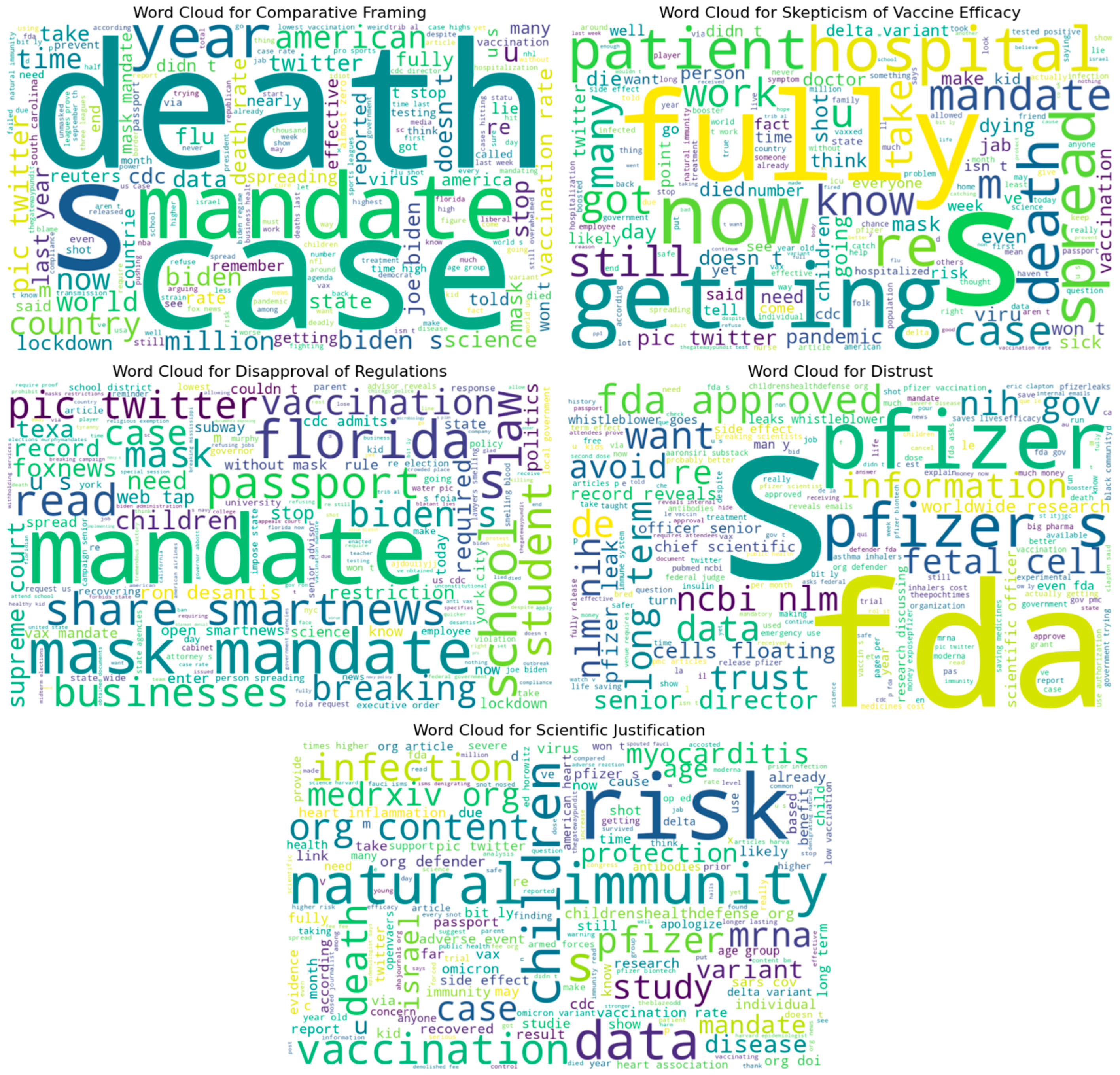
3.1. Skepticism of Vaccine Efficacy
3.1.1. Fear of Side Effects
“Well I finally know someone with Covid! Well 2! Fully vaccinated from early last year, was up in NY caught Covid! Hopefully it will be milder they are old! More lies people felt immune from vaccine! Will they ever tell the truth!”
“There have been fully vaccinated people that have died from Covid. Do an ounce of research. The vaccine that injured my son was fully FDA approved. That means absolutely nothing.”
3.1.2. Counter-Narratives of Transmission
3.1.3. Skepticism About Reporting Accuracy
“Why is that @Twitter doesn’t report on people who did fall ill after getting a COVID vaccine? Their one-sided reporting on all issues shows that they are just one more provider of useless corporate propaganda.”
“Just use your common sense. Always wash your hands, cover your cough in your elbow, keep your distance from people. I myself am unvaccinated as well, I have had Covid but survived!! Imagine that, something they don’t like to talk about, SURVIVAL RATES AMONG UNVACCINATED”
3.2. Distrust
3.3. Disapproval of Regulations
“The CDC ended masking on Friday, Congress ended masks on Sunday, New York & NYC ended masking & covid vaccine mandates this week. Now California, Washington, & Oregon end school masks today. Joe Biden speaks tomorrow. The “science” was all bullshit.”
3.4. Scientific Justification
“A new systematic review confirms that covid recovered patients have immunity as complete or better vs. reinfection than the vaccines do. There is no scientific justification for vaccine passports/mandates. medrxiv.org/content/10.110…”
3.5. Comparative Framing
3.5.1. Temporal Comparison
3.5.2. Geographic Comparison
“Why is Biden, @CDCgov & US media pushing/coercing every American to get vaccinated at the exact moment the vaxx experiment in Isreal is crashing/burning? Israel, the most vaccinated nation in the world, now has more COVID-19 infections per capita than any country in the world.”
“RT @sternbergh can’t stop staring in disbelief at this map of current global covid hot spots—the U.S., the wealthiest country in the world, where vaccines are freely available, has the highest per capita case rate right now of any country except Mongolia pic.”
4. Discussion
Limitation and Future Recommendation
5. Conclusions
Author Contributions
Funding
Institutional Review Board Statement
Informed Consent Statement
Data Availability Statement
Conflicts of Interest
Appendix A
References
- Increases in Vaccine-Preventable Disease Outbreaks Threaten Years of Progress, Warn WHO, UNICEF, Gavi. Available online: https://www.who.int/news/item/24-04-2025-increases-in-vaccine-preventable-disease-outbreaks-threaten-years-of-progress--warn-who--unicef--gavi (accessed on 24 April 2025).
- Wilson, S.L.; Wiysonge, C. Social Media and Vaccine Hesitancy. BMJ Glob. Health 2020, 5, e004206. [Google Scholar] [CrossRef] [Scilit]
- Robertson, R. Glocalization: Time–Space and Homogeneity–Heterogeneity. In Global Modernities; Featherstone, M., Lash, S., Robertson, R., Eds.; Sage: London, UK, 1995; pp. 25–54. [Google Scholar]
- Roudometof, V.; Dessì, U. Culture and Glocalization: An Introduction. In Handbook of Culture and Glocalization; Roudometof, V., Dessi, U., Eds.; Edward Elgar: Cheltenham, UK, 2022; pp. 1–26. [Google Scholar]
- Rossi, M.M.; Parisi, M.A.; Cartmell, K.B.; McFall, D. Understanding COVID-19 Vaccine Hesitancy in the Hispanic Adult Population of South Carolina: A Complex Mixed-Method Design Evaluation Study. BMC Public Health 2023, 23, 2359. [Google Scholar] [CrossRef] [Scilit]
- Rancher, C.; Moreland, A.D.; Smith, D.W.; Cornelison, V.; Schmidt, M.G.; Boyle, J.; Dayton, J.; Kilpatrick, D.G. Using the 5C Model to Understand COVID-19 Vaccine Hesitancy Across a National and South Carolina Sample. J. Psychiatr. Res. 2023, 160, 180–186. [Google Scholar] [CrossRef] [Scilit]
- Kanyangarara, M.; Vora, S.; Seck, F.; Dhankhode, N.; Mundagowa, P.T. COVID-19 Vaccination Coverage and Associated Factors Among Underserved Communities in South Carolina: Results from a Cross-Sectional Study. J. Racial Ethn. Health Disparities, 2025; in press. [CrossRef] [Scilit]
- Richman, A.R.; Schwartz, A.J.; Maness, S.B.; Sanchez, L.; Torres, E. Exploring Vaccine Hesitancy, Structural Barriers, and Trust in Vaccine Information Among Populations Living in the Rural Southern United States. Vaccines 2025, 13, 699. [Google Scholar] [CrossRef] [Scilit]
- Hornsey, M.J.; Harris, E.A.; Fielding, K.S. The Psychological Roots of Anti-Vaccination Attitudes: A 24-Nation Investigation. Health Psychol. 2023, 37, 307–315. [Google Scholar] [CrossRef] [Scilit]
- Goldenberg, M.J. Vaccines, Beliefs and Autarchy: The History and Philosophy of Vaccine Skepticism; Routledge: New York, NY, USA, 2021. [Google Scholar]
- South Carolina’s Measles Outbreak Illustrates Danger of Vaccine Misinformation. Available online: https://truthout.org/articles/south-carolinas-measles-outbreak-illustrates-danger-of-vaccine-misinformation/ (accessed on 26 November 2025).
- South Carolina’s Vaccination Rate Too Low as Measles Surges. Available online: https://www.thestate.com/opinion/article307032491.html (accessed on 27 May 2025).
- Zhang, H.; Zhang, X.; Huang, H.; Yu, L. Prompt-Based Meta-Learning for Few-Shot Text Classification. In Proceedings of EMNLP 2022; Association for Computational Linguistics: Stroudsburg, PA, USA, 2022; pp. 1342–1357. [Google Scholar] [CrossRef] [Scilit]
- Sasse, K.; Mahabir, R.; Gkountouna, O.; Crooks, A.; Croitoru, A. Understanding the Determinants of Vaccine Hesitancy in the United States: A Comparison of Social Surveys and Social Media. PLoS ONE 2024, 19, e0301488. [Google Scholar] [CrossRef] [Scilit]
- Li, L.; Wood, C.E.; Kostkova, P. Vaccine Hesitancy and Behavior Change Theory-Based Social Media Interventions: A Systematic Review. Transl. Behav. Med. 2022, 12, 243–272. [Google Scholar] [CrossRef] [Scilit] [PubMed]
- Limaye, R.J.; Holroyd, T.A.; Blunt, M.; Jamison, A.F.; Sauer, M.; Weeks, R.; Wahl, B.; Christenson, K.; Smith, C.; Minchin, J.; et al. Social Media Strategies to Affect Vaccine Acceptance: A Systematic Literature Review. Expert Rev. Vaccines 2021, 20, 959–973. [Google Scholar] [CrossRef] [Scilit] [PubMed]
- Allen, J.; Watts, D.J.; Rand, D.G. Quantifying the Impact of Misinformation and Vaccine-Skeptical Content on Facebook. Science 2024, 384, 978–984. [Google Scholar] [CrossRef] [Scilit] [PubMed]
- Taubert, F.; Meyer-Hoeven, G.; Schmid, P.; Gerdes, P.; Betsch, C. Conspiracy Narratives and Vaccine Hesitancy: A Scoping Review. BMC Public Health 2024, 24, 3325. [Google Scholar] [CrossRef] [Scilit]
- Neff, T.; Kaiser, J.; Wasserman, H.; Ghezzi, A.; Singh, A.; Scacco, A. Vaccine Hesitancy in Online Spaces: A Scoping Review of the Research Literature, 2000–2020. HKS Misinf. Rev. 2021, 2, 1–18. [Google Scholar] [CrossRef] [Scilit]
- Glandt, K.; Khanal, S.; Li, Y.; Caragea, D.; Caragea, C. Stance Detection in COVID-19 Tweets. In Proceedings of the 59th Annual Meeting of the Association for Computational Linguistics and the 11th International Joint Conference on Natural Language Processing; (Volume 1: Long Papers); Association for Computational Linguistics: Stroudsburg, PA, USA, 2021. [Google Scholar] [CrossRef] [Scilit]
- Balaji, S.; Joshi, S.; Hari, A.; Singam, A.; Varma, V. COVID-19 Vaccine Stance Classification from Tweets. CEUR Workshop Proc. 2022, 3180, 1–5. [Google Scholar]
- Wang, Z.; Lin, Y.; Shen, J.; Zhu, X. A Survey of Large Language Models for Text Classification: What, Why, When, Where, and How. TechRxiv 2025, preprint. [Google Scholar] [CrossRef] [Scilit]
- Barberia, L.G.; Lombard, B.; Roman, N.T.; Sousa, T.C.M. Clarifying Misconceptions in COVID-19 Vaccine Sentiment and Stance Analysis. arXiv 2025, arXiv:2503.18095. [Google Scholar] [CrossRef] [Scilit]
- Brown, T.B.; Mann, B.; Ryder, N.; Subbiah, M.; Kaplan, J.; Dhariwal, P.; Neelakantan, A.; Shyam, P.; Sastry, G.; Askell, A.; et al. Language Models Are Few-Shot Learners. Adv. Neural Inf. Process. Syst. 2020, 33, 1877–1901. [Google Scholar]
- Gera, P.; Neal, T. MLSD: A Novel Few-Shot Learning Approach to Enhance Cross-Target and Cross-Domain Stance Detection. arXiv 2025, arXiv:2509.03725. [Google Scholar] [CrossRef] [Scilit]
- Khiabani, P.J.; Zubiaga, A. Few-Shot Learning for Cross-Target Stance Detection by Aggregating Multimodal Embeddings. IEEE Trans. Comput. Soc. Syst. 2024, 11, 2081–2090. [Google Scholar] [CrossRef] [Scilit]
- Liu, R.; Lin, Z.; Ji, H.; Li, J.; Fu, P.; Wang, W. Target-Aware Contrastive Learning and Consistency Regularization for Few-Shot Stance Detection. In Proceedings of COLING 2022; International Committee on Computational Linguistics: Gyeongju, Republic of Korea, 2022; pp. 1234–1248. [Google Scholar]
- Kostina, A.; Dikaiakos, M.D.; Stefanidis, D.; Pallis, G. Large Language Models for Text Classification: Case Study and Comprehensive Review. arXiv 2025, arXiv:2501.08457. [Google Scholar] [CrossRef] [Scilit]
- Santos, D.P.D.; Mendonca, F.L.; Lustosa, J.P.; Serrano, A.; Torres, J.A.S.; da Silva, D.A. Large Language Models for Text Classification: A New Era of Accuracy and Efficiency. In CSCI Proceedings; Springer: Berlin/Heidelberg, Germany, 2025; pp. 1–8. [Google Scholar]
- Trust, P.; Minghim, R. A Study on Text Classification in the Age of Large Language Models. Mach. Learn. Knowl. Extr. 2024, 6, 2688–2721. [Google Scholar] [CrossRef] [Scilit]
- Krishnan, G.S.; Kamath, S.S.; Sugumaran, V. Predicting Vaccine Hesitancy and Vaccine Sentiment Using Topic Modeling and Evolutionary Optimization. In NLDB 2021 Proceedings; Springer: Berlin/Heidelberg, Germany, 2021. [Google Scholar]
- Melton, C.A.; Olusanya, O.A.; Ammar, N.; Shaban-Nejad, A. Public Sentiment Analysis and Topic Modeling Regarding COVID-19 Vaccines on Reddit. J. Infect. Public Health 2021, 14, 1505–1512. [Google Scholar] [CrossRef] [Scilit] [PubMed]
- Aivazpour, Z.; Zhan, Y. Exploring the Semantic and Linguistic Features of Vaccine Skepticism in Online Discourse. In AMCIS 2025 Proceedings; Association for Information Systems: Atlanta, GA, USA, 2025; Paper 20; Available online: https://aisel.aisnet.org/amcis2025/sig_odis/sig_odis/20 (accessed on 29 November 2025).
- Kabir, M.E. Topic and Sentiment Analysis of Responses to Muslim Clerics’ Misinformation Correction About COVID-19 Vaccine: Comparison of Three Machine Learning Models. Online Media Glob. Commun. 2022, 1, 497–523. [Google Scholar] [CrossRef] [Scilit]
- Sievert, C.; Shirley, K. LDAvis: A Method for Visualizing and Interpreting Topics. In Proceedings of the Workshop on Interactive Language Learning, Visualization, and Interfaces; Association for Computational Linguistics: Stroudsburg, PA, USA, 2014. [Google Scholar]
- Doshi-Velez, F.; Kim, B. Towards a Rigorous Science of Interpretable Machine Learning. arXiv 2017, arXiv:1702.08608. [Google Scholar] [CrossRef] [Scilit]
- Herrewijnen, E.; Nguyen, D.; Bex, F.; van Deemter, K. Human-Annotated Rationales and Explainable Text Classification: A Survey. Front. Artif. Intell. 2024, 7, 1260952. [Google Scholar] [CrossRef] [Scilit]
- Blei, D.M.; Ng, A.Y.; Jordan, M.I. Latent Dirichlet Allocation. J. Mach. Learn. Res. 2003, 3, 993–1022. [Google Scholar]
- Bail, C.A. Breaking the Social Media Prism: How to Make Our Platforms Less Polarizing; Princeton University Press: Princeton, NJ, USA, 2021. [Google Scholar]
- Gao, T.; Fisch, A.; Chen, D. Making Pre-Trained Language Models Better Few-Shot Learners. In Proceedings of the 59th Annual Meeting of the Association for Computational Linguistics; Association for Computational Linguistics: Stroudsburg, PA, USA, 2021; pp. 381–398. [Google Scholar]
- Kabir, M.E. #StopAsianHate Counterspeech on Twitter: Effectiveness of Counterspeech Strategies and Geospatial Analysis; Bowling Green State University: Bowling Green, OH, USA, 2023. [Google Scholar]
- Kabir, M.E.; Ha, L. Influencers Against Hate: A Comparison of Counter Speech Strategies Among South Asian, East Asian, and Non-Asian American Social Media Influencers. Howard J. Commun. 2025, 37, 543–561. [Google Scholar] [CrossRef] [Scilit]
- Yin, W.; Hay, J.; Roth, D. Benchmarking Zero-Shot Text Classification: Datasets, Evaluation and Entailment Approach. In Proceedings of EMNLP-IJCNLP 2019; Association for Computational Linguistics: Stroudsburg, PA, USA, 2019; pp. 3914–3923. [Google Scholar] [CrossRef] [Scilit]
- Laurer, M.; van Atteveldt, W.; Casas, A.; Welbers, K. Less Annotating, More Classifying: Addressing the Data Scarcity Issue of Supervised Machine Learning with Deep Transfer Learning and BERT-NLI. Polit. Anal. 2024, 32, 84–100. [Google Scholar] [CrossRef] [Scilit]
- Wolf, T.; Debut, L.; Sanh, V.; Chaumond, J.; Delangue, C.; Moi, A.; Cistac, P.; Rault, T.; Louf, R.; Funtowicz, M.; et al. Transformers: State-of-the-Art Natural Language Processing. In Proceedings of the 2020 Conference on Empirical Methods in Natural Language Processing: System Demonstrations; Association for Computational Linguistics: Stroudsburg, PA, USA, 2020; pp. 38–45. [Google Scholar] [CrossRef] [Scilit]
- Jiang, A.Q.; Sablayrolles, A.; Deleu, T.; Lachaux, M.A.; Mensch, A.; Bressand, M.; Bamford, C.; Chaplot, D.S.; de las Casas, D.; Lambert, N.; et al. Mistral 7B. arXiv 2023, arXiv:2310.06825. [Google Scholar] [CrossRef] [Scilit]
- Grattafiori, A.; Dubey, A.; Jauhri, A.; Pandey, A.; Kadian, A.; Al-Dahle, A.; Letman, A.; Mathur, A.; Schelten, A.; Vaughan, A.; et al. The Llama 3 Herd of Models. arXiv 2024, arXiv:2407.21783. [Google Scholar]
- Bi, X.; Chen, D.; Chen, G.; Chen, S.; Dai, D.; Deng, C.; Ding, H.; Dong, K.; Du, Q.; Fu, Z.; et al. DeepSeek LLM: Scaling Open-Source Language Models with Longtermism. arXiv 2024, arXiv:2401.02954. [Google Scholar] [CrossRef] [Scilit]
- Wei, J.; Wang, X.; Schuurmans, D.; Bosma, M.; Ichter, B.; Xia, F.; Chi, E.; Le, Q.V.; Zhou, D. Chain-of-Thought Prompting Elicits Reasoning in Large Language Models. Adv. Neural Inf. Process. Syst. 2022, 35, 24824–24837. [Google Scholar]
- Min, S.; Lewis, M.; Zettlemoyer, L.; Hajishirzi, H. MetaICL: Learning to Learn in Context. In Proceedings of the 60th Annual Meeting of the Association for Computational Linguistics; Association for Computational Linguistics: Stroudsburg, PA, USA, 2022; pp. 279–285. [Google Scholar]
- Kumar, S.; Goud, J.S.; Choudhury, M. Detecting Stance in Social Media: State-of-the-Art and Trends. Comput. Linguist. 2021, 47, 835–886. [Google Scholar]
- Touvron, H.; Lavril, T.; Izacard, G.; Martinet, X.; Lachaux, M.A.; Lacroix, T.; Rozière, B.; Goyal, N.; Hambro, E.; Azhar, F.; et al. Llama 2: Open Foundation and Fine-Tuned Chat Models. arXiv 2023, arXiv:2307.09288. [Google Scholar] [CrossRef] [Scilit]
- Sokolova, M.; Lapalme, G. A Systematic Analysis of Performance Measures for Classification Tasks. Inf. Process. Manag. 2009, 45, 427–437. [Google Scholar] [CrossRef] [Scilit]
- Gao, X.; Lin, Y.; Li, R.; Wang, Y.; Chu, X.; Ma, X.; Yu, H. Enhancing Topic Interpretability for Neural Topic Modeling Through Topic-Wise Contrastive Learning. arXiv 2024, arXiv:2412.17338. [Google Scholar] [CrossRef] [Scilit]
- Röder, M.; Both, A.; Hinneburg, A. Exploring the Space of Topic Coherence Measures. In Proceedings of the Eighth ACM International Conference on Web Search and Data Mining; Association for Computing Machinery: New York, NY, USA, 2015; pp. 399–408. [Google Scholar]
- Bird, S.; Klein, E.; Loper, E. Natural Language Processing with Python; O’Reilly Media: Sebastopol, CA, USA, 2009. [Google Scholar]
- Řehůřek, R.; Sojka, P. Software Framework for Topic Modelling with Large Corpora. In Proceedings of the LREC 2010 Workshop on New Challenges for NLP Frameworks; University of Malta: Msida, Malta, 2010; pp. 45–50. [Google Scholar]
- DiRusso, C.; Kabir, M.E.; Hagan, A.H.; Boatwright, B. Why Is the Southeastern United States Late to Adopt Electric Vehicles? Analyzing Trends in Social Media Conversation to Form Marketing Recommendations. Transp. Res. Interdiscip. Perspect. 2025, 32, 101509. [Google Scholar] [CrossRef] [Scilit]
- Diaz, P.; Zizzo, J.; Balaji, N.C.; Reddy, R.; Khodamoradi, K.; Ory, J.; Ramasamy, R. Fear About Adverse Effect on Fertility Is a Major Cause of COVID-19 Vaccine Hesitancy in the United States. Andrologia 2022, 54, e14361. [Google Scholar] [CrossRef] [Scilit] [PubMed]
- Gauna, F.; Raude, J.; Khouri, C.; Cracowski, J.-L.; Ward, J.K. Exploring the Relationship Between Experience of Vaccine Adverse Events and Vaccine Hesitancy: A Scoping Review. Hum. Vaccines Immunother. 2025, 21, 2471225. [Google Scholar] [CrossRef] [Scilit] [PubMed]
- Kuru, O.; Stecula, D.; Lu, H.; Ophir, Y.; Chan, M.-P.S.; Winneg, K.; Jamieson, K.H.; Albarracín, D. The Effects of Scientific Messages and Narratives About Vaccination. PLoS ONE 2021, 16, e0248328. [Google Scholar] [CrossRef] [Scilit]
- Corker, A. Vaccine Hesitancy Has Become a Nationwide Issue: What Can Science Do About It? MUSC Research. 10 April 2023. Available online: https://research.musc.edu/stories/news/2023/04/10/vaccine-hesitancy (accessed on 29 November 2025).
- Rosenberg, J.; Syed, S.; Reinecke, K.; DiSalvo, C. Viral Visualizations: How Coronavirus Skeptics Use Orthodox Data Practices to Promote Unorthodox Science Online. arXiv 2021, arXiv:2101.07993. [Google Scholar]
- Zimmerman, T.; Shiroma, K.; Fleischmann, K.R.; Xie, B.; Jia, C.; Verma, N.; Lee, M.K. Misinformation and COVID-19 Vaccine Hesitancy. Vaccine 2022, 41, 136–144. [Google Scholar] [CrossRef] [Scilit]
- Reid, J.C.; Brown, S.J.; Dmello, J. COVID-19, Diffuse Anxiety, and Public (Mis)Trust in Government: Empirical Insights and Implications for Crime and Justice. Crim. Justice Rev. 2023, 49, 117–134. [Google Scholar] [CrossRef] [Scilit]
- Okuhara, T.; Terada, M.; Okada, H.; Yokota, R.; Kiuchi, T. Experiences of Public Health Professionals Regarding Crisis Communication During the COVID-19 Pandemic: Systematic Review of Qualitative Studies. JMIR Infodemiology 2025, 5, e66524. [Google Scholar] [CrossRef] [Scilit]



Disclaimer/Publisher’s Note: The statements, opinions and data contained in all publications are solely those of the individual author(s) and contributor(s) and not of MDPI and/or the editor(s). MDPI and/or the editor(s) disclaim responsibility for any injury to people or property resulting from any ideas, methods, instructions or products referred to in the content. |
© 2026 by the authors. Licensee MDPI, Basel, Switzerland. This article is an open access article distributed under the terms and conditions of the Creative Commons Attribution (CC BY) license.
Share and Cite
Kabir, M.E.; Tanim, S.H.; Sellnow, D.D.; Luteria, G.L.P.; Rennert, L. Teaching AI to Decode Vaccine Hesitancy Narratives: A Few-Shot Learning and Topic Modeling Approach. Big Data Cogn. Comput. 2026, 10, 159. https://doi.org/10.3390/bdcc10050159
Kabir ME, Tanim SH, Sellnow DD, Luteria GLP, Rennert L. Teaching AI to Decode Vaccine Hesitancy Narratives: A Few-Shot Learning and Topic Modeling Approach. Big Data and Cognitive Computing. 2026; 10(5):159. https://doi.org/10.3390/bdcc10050159
Chicago/Turabian StyleKabir, Md Enamul, Shakhawat H. Tanim, Deanna D. Sellnow, Geneva Lei P. Luteria, and Lior Rennert. 2026. "Teaching AI to Decode Vaccine Hesitancy Narratives: A Few-Shot Learning and Topic Modeling Approach" Big Data and Cognitive Computing 10, no. 5: 159. https://doi.org/10.3390/bdcc10050159
APA StyleKabir, M. E., Tanim, S. H., Sellnow, D. D., Luteria, G. L. P., & Rennert, L. (2026). Teaching AI to Decode Vaccine Hesitancy Narratives: A Few-Shot Learning and Topic Modeling Approach. Big Data and Cognitive Computing, 10(5), 159. https://doi.org/10.3390/bdcc10050159