Effects of resistance training on the functional autonomy of middle-aged and older women: a systematic review and meta-analysis of randomized controlled trials

Background
Methods
Results
Conclusions
INTRODUCTION
METHODS
ELIGIBILITY CRITERIA
SEARCH STRATEGY
RESEARCH QUESTION
METHODOLOGICAL QUALITY ANALYSIS
RISK OF BIAS ANALYSIS
DATA COLLECTION PROCESS
META-ANALYSIS
EVIDENCE LEVEL ASSESSMENT
RESULTS
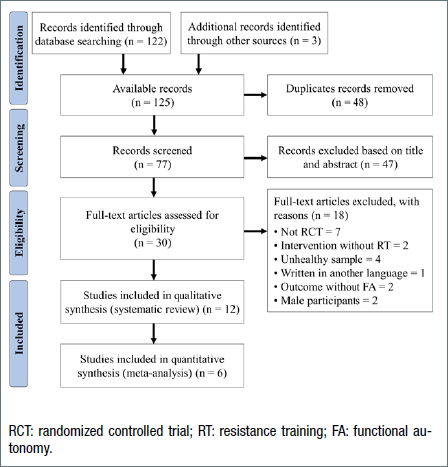
STUDY SELECTION
STUDY CHARACTERISTICS
METHODOLOGICAL QUALITY AND RISK OF BIAS
OUTCOMES
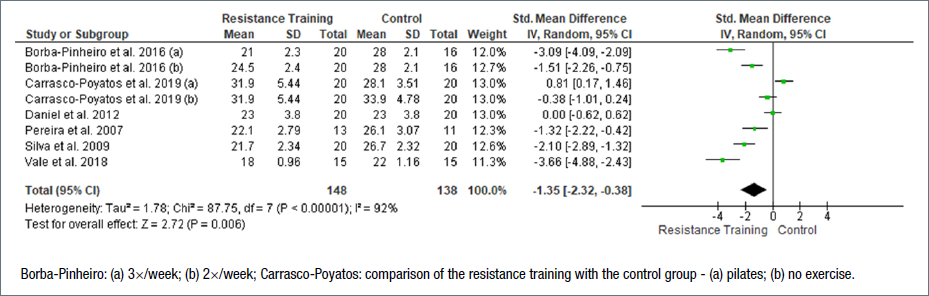
META-ANALYSIS
DISCUSSION
CONCLUSIONS
ACKNOWLEDGEMENTS
CONFLICT OF INTEREST STATEMENT
FUNDING
AUTHORS’ CONTRIBUTIONS
ETHICAL CONSIDERATION
Figures and tables


| Author | Year | Country | EG (n) | CG (n) | Total (n) | Age (years) |
|---|---|---|---|---|---|---|
| Borba-Pinheiro et al. 43 | 2016 | Brazil | EG1: 20 | 16 | 52 | EG1: 56.3 ± 5.2 |
| EG2: 16 | EG2: 60.6 ± 7.5 | |||||
| CG: 55.3 ± 6.8 | ||||||
| Carrasco-Poyatos et al. 21 | 2019 | Spain | 20 | CG1: 20 | 60 | EG: 73.36 ± 4.84 |
| CG2: 20 | CG1: 67.5 ± 3.87 | |||||
| CG2: 65.89 ± 4.54 | ||||||
| Daniel et al. 36 | 2012 | Brazil | 20 | 20 | 40 | EG: 68.51 ± 5.02 |
| CG: 67.01 ± 3.51 | ||||||
| Dib et al. 40 | 2020 | Brazil | EG1: 15 | – | 45 | EG1: 70.9 ± 6.1 |
| EG2: 15 | EG2: 68.9 ± 5.8 | |||||
| EG3: 15 | EG3: 67.9 ± 4.5 | |||||
| Geraldes et al. 39 | 2007 | Brazil | 12 | 12 | 24 | EG: 67.75 ± 6.21 |
| CG: 68.67 ± 8.87 | ||||||
| Lauzé et al. 41 | 2017 | Canada | 21 | 10 | 31 | EG: 80.1 ± 7.5 |
| CG: 83.2 ± 6.7 | ||||||
| Mazini Filho et al. 44 | 2018 | Brazil | 34 | 31 | 65 | EG: 70 ± 10.67 |
| CG: 70 ± 11.28 | ||||||
| Pereira et al. 20 | 2007 | Brazil | 13 | 11 | 24 | EG: 65.6 ± 5.3 |
| CG: 71.4 ± 5.7 | ||||||
| Ramírez-Campillo et al. 17 | 2014 | Chile | EG1: 15 | 15 | 45 | EG1: 66.3 ± 3.7 |
| EG2: 15 | EG2: 68.7 ± 6.4 | |||||
| CG: 66.7 ± 4.9 | ||||||
| Silva et al. 38 | 2009 | Brazil | 20 | 20 | 40 | EG: 65.62 ± 5.36 |
| CG: 71.45 ± 5.72 | ||||||
| Vale et al. 37 | 2018 | Brazil | 15 | 15 | 30 | EG: 68 ± 4.4 |
| CG: 69 ± 8.9 | ||||||
| Vreede et al. 42 | 2005 | Netherlands | 34 | CG1: 33 | 68 | EG: 74.8 ± 4.0 |
| CG2: 31 | CG1: 74.7 ± 3.5 | |||||
| CG2: 73.0 ± 3.2 |
| Study | Intervention | Training volume | FA assessment | Results |
|---|---|---|---|---|
| Borba-Pinheiro et al. 43 | EG1 and EG2: 60 to 90% of 10RM. Linear periodization with 3 sets per exercise | EG1: 3×/wk | GDLAM protocol | ↑ FA (EG1 and EG2, p < 0.01; EG1 vs EG2, p < 0.05 EG1 and EG2 vs CG, p < 0.05) |
| Exercises: leg press 45°; knee extension; plantar flexion; squats; hip adduction; glut; elbow flexion; elbow extension; shoulder adduction | EG2: 2×/wk | |||
| 1 h | ||||
| CG: no exercising | 13 months | |||
| Carrasco-Poyatos et al. 21 | EG: muscular exercise program, beginning at a moderate intensity (6-7 points of the OMNI scale) and finishing at a moderate-to-vigorous intensity (8-9 points). Sessions with 3 phases: 1) warm-up, consisting of dynamic range of motion exercises (10 min); 2) main part (40 min); 3) cool-down (10 min) | 2×/wk | GDLAM protocol | ↑ FA (EG and CG1 pre vs. post; p < 0.001; CG2 pre vs post; p < 0.05 CG1 vs CG2; p = 0.041 CG1 vs EG; p = 0.042) |
| 1 h | ||||
| CG1: structured mat Pilates-based exercises (same intensity and phases of the EG) | 18 wks | |||
| CG2: maintained normal physical activity habits | ||||
| Daniel et al. 36 | EG: exercise program, divided into the following five phases: a) 10 min warm-up with joint mobility exercises and light stretching of the main joints; b) 20 min walk; c) 15 min of localized exercises for the major muscle groups (2 sets of 15 repetitions: squats, elbow flexion and extension, shoulder horizontal flexion and extension, plantar flexion, and abdominal crunches; d) maximum static stretching for 10 min; e) neuromuscular relaxation for 5 min | 2×/wk | GDLAM protocol | ↑ FA (EG pre vs post; p < 0.05; CG pre vs post; p > 0.05). EG vs CG; p > 0.05) |
| 1 h | ||||
| 12 wks | ||||
| CG: no exercising | ||||
| Dib et al. 40 | EG1: multi-joint to single-joint | 3×/wk | 4 tests of the GDLAM protocol | ↑ FA (EG1; EG2 and EG3 pre vs post; p < 0.05. EG1 vs EG2 vs EG3; p > 0.05) |
| Order (MJ-SJ) | NI | |||
| EG2: single-joint to multi-joint order (SJ-MJ) | 24 wks | |||
| EG3: alternating between upper and lower body order | ||||
| Geraldes et al. 39 | EG: 50 to 70% of 10RM. Linear periodization with 3 sets per exercise. 10 exercises: leg press; front pull on the high pulley; knee flexion; straight supine with barbell; development with dumbbells; adduction chair; biceps curl; plantar flexion in the standing position; extension of both hips standing position; extension of both elbows on a high pulley; partial supraumbilical abdominal | 2×/wk | a) 10-meter walk | ↑ FA (EG pre vs post; p < 0.05) EG vs CG; p < 0.05) |
| 1 h | b) rise from the kneeling position | |||
| CG: maintained eating and physical activity habits | 12 wks | c) stand up and sit on a chair | ||
| Lauzé et al. 41 | EG: warm-up, 7 aerobic exercises, 8 resistance and balance exercises, and a cool-down period using gerontechnology | 2×/wk | SMAF | ↑ FA (EG vs CG; p = 0.05) |
| CG: no exercising | 45 min | TUG (p = 0.04 in EG vs CG) | ||
| 24 wks | ||||
| Mazini Filho et al. 44 | EG: 50 to 70% of 10RM. Linear periodization with 2 sets per exercise. Exercises: leg press, frontal high pulley, leg curl, chest fly machine, leg abduction machine, triceps (using pulley), barbell curl (biceps), and standing calf raise | 2×/wk | Rikli and Jones protocol | ↑ FA (EG pre vs post; p = 0.02) |
| 45 min | TUG: (CG pre vs post; p > 0.05) | |||
| CG: no exercising | 12 wks | TUG (EG vs CG; p = 0.03) | ||
| Pereira et al. 20 | EG: exercises program: knee extension, supine, sitting | 2×/wk | GDLAM protocol | ↑ FA (GE pre vs post; p < 0.05) (GC pre vs post; p > 0.05) |
| Unilateral knee flexion, and triceps work on the pulley | 45 min | |||
| CG: no exercising | 20 wks | (EG vs CG; p < 0.05) | ||
| Ramírez-Campillo et al. 17 | EG1: high-speed resistance training group, 45-75% of 1RM, concentric velocity: 1 s or less | 3×/wk | 8FUG and STS | ↑ FA (EG1 pre vs post; p < 0.05) (EG2 pre vs post; p < 0.05) (CG pre vs post; p > 0.05) EG1 and EG2 vs CG, p < 0.05) EG1 and EG2 vs CG, p < 0.05) |
| EG2: low-speed resistance training group, 75% of 1RM, concentric velocity: 3 s. | 70 min | |||
| EG1 and EG2: warm-up with stretching (10 min), 6 exercises (bench press, standing upper row, biceps curl, leg press, prone leg curl, leg extension), cool-down with abdominal crunches + prone superman. 3 sets of 8 reps. Eccentric velocity: 3 s. Rest between sets: 1 min. | 12 wks | |||
| CG: did not undergo any specific type of physical activity | ||||
| Silva et al. 38 | EG: 90 and 100% of 1RM. Exercises program: knee extension, right knee flexion, left knee flexion, straight supine, and triceps curl on the pulley | 3×/wk | GDLAM protocol | ↑ FA (EG pre vs post; p < 0.05) (CG pre vs post; p > 0.05) EG vs CG; p < 0.05) |
| CG: no exercising | 1 h | |||
| 20 wks | ||||
| Vale et al. 37 | EG: muscular exercise program, beginning at a moderate intensity (3-5 points of the OMNI scale) and finishing at a moderate-to-vigorous intensity (5-7 points). Sessions with 3 phases: 1) warm-up: submaximal stretching exercises and dynamic movements in the main joints (10 min); 2) resistance exercises: squats, elbow flexion and extension, knee and hip flexion and extension, horizontal flexion and extension of shoulders, plantar flexion, sit-ups (35 min); 3) cool-down: muscle release and relaxation exercises (5 min). | 3×/wk | GDLAM protocol | ↑ FA (EG and CG1 pre vs. post; p<0.05) |
| 50 min | ||||
| CG: structured walk-based exercises, divided into 3 phases: a) warm-up: submaximal stretching and dynamic mobility exercises to the main joints (10 min); b) main part: walking with exertion control (3-5 points on the Borg CR-10) (35 min); c) cool-down: muscle relaxation and release exercises (5 min). | 24 wks | |||
| Vreede et al. 42 | EG: warm-up (10 min): aerobic exercises; main part (40 min): intensity: 7-8 on a 10-point rating perceived exertion scale, strengthen the muscle groups important for ADL: elbow flexors and extensors; shoulder abductors, adductors, and rotators; trunk flexors and extensors; hip flexors, extensors, abductors, and adductors; knee flexors and extensors; and ankle dorsal and plantar flexors, 3 sets of 10 reps with dumbbells (0.5-8 kg), elastic tubing (3 resistances of elastic bands), ankle weights (0.25-10 kg), and body weight; cool-down (10 min): flexibility exercises for limbs and trunk. | 3×/wk | 1) ADAP | ↑ ADAP total score of CG1 vs EG (p = 0.007) or CG (p = 0.001). |
| CG1: core exercises to improve ADL performance, e.g., moving with a vertical/horizontal component, carrying an object, changing between lying-sitting-standing position. 3 sessions of 5–10 reps. Program divided into: practice phase (2 wks), variation phase (4 wks), daily tasks phase (6 wks). | 1 h | 2) TUG | ADAP total score (EG vs CG, p > 0.05) | |
| CG2: no exercising. | 12 wks | TUG (p > 0.05 in EG, CG1, and CG2) |
| Studies | 1a | 1b | 2a | 2b | 3 | Total |
|---|---|---|---|---|---|---|
| Carrasco-Poyatos et al. 21 | 1 | 1 | 1 | 1 | 1 | 5 |
| Vreede et al. 42 | 1 | 1 | 0 | 1 | 1 | 4 |
| Borba-Pinheiro et al. 43 | 1 | 1 | 0 | 0 | 1 | 3 |
| Lauzé et al. 41 | 1 | 1 | 0 | 0 | 1 | 3 |
| Silva et al. 38 | 1 | 1 | 0 | 0 | 1 | 3 |
| Dib et al. 40 | 1 | -1 | 0 | 1 | 1 | 2 |
| Geraldes et al. 39 | 1 | 1 | 0 | 0 | 0 | 2 |
| Daniel et al. 36 | 1 | -1 | 0 | 0 | 0 | 0 |
| Mazini Filho et al. 44 | 1 | -1 | 0 | 0 | 0 | 0 |
| Pereira et al. 20 | 1 | -1 | 0 | 0 | 0 | 0 |
| Ramírez-Campillo et al. 17 | 1 | -1 | 0 | 0 | 0 | 0 |
| Vale et al. 37 | 1 | -1 | 0 | 0 | 0 | 0 |
| Studies | 1 | 2 | 3 | 4 | 5 | 6 | 7 | Risk |
|---|---|---|---|---|---|---|---|---|
| Carrasco-Poyatos et al. 21 | Low | Low | Low | Low | Low | Low | Low | Low |
| Borba-Pinheiro et al. 43 | Low | Low | Uncertain | Low | Low | Low | Low | Uncertain |
| Daniel et al. 36 | Low | Uncertain | Uncertain | Uncertain | Uncertain | Uncertain | Uncertain | Uncertain |
| Dib et al. 40 | Low | Uncertain | Uncertain | Low | Low | Low | Low | Uncertain |
| Geraldes et al. 39 | Low | Low | Uncertain | Uncertain | Low | Low | Low | Uncertain |
| Mazini Filho et al. 44 | Low | Uncertain | Uncertain | Uncertain | Uncertain | Uncertain | Uncertain | Uncertain |
| Pereira et al. 20 | Low | Uncertain | Uncertain | Uncertain | Low | Low | Low | Uncertain |
| Ramírez-Campillo et al. 17 | Low | Uncertain | Uncertain | Uncertain | Low | Low | Low | Uncertain |
| Silva et al. 38 | Low | Low | Uncertain | Uncertain | Low | Low | Low | Uncertain |
| Vale et al. 37 | Low | Uncertain | Uncertain | Uncertain | Low | Low | Low | Uncertain |
| Vreede et al. 42 | Low | Low | Uncertain | Low | Low | Low | Low | Uncertain |
| Lauzé et al. 41 | Low | Low | High | High | Low | Low | Low | High |
| Studies | Group | GDLAM mean (SD) | Effect size | |
|---|---|---|---|---|
| Pre | Post | d | ||
| Borba-Pinheiro et al. 43 | EG1 (a) | 28.4 (3.53) | 21.0 (2.30) | 2.48 |
| EG2 (b) | ||||
| 28.1 (2.99) | 24.5 (2.40) | 1.32 | ||
| CG | 28.1 (2.18) | 28.0 (2.10) | 0.04 | |
| Carrasco-Poyatos et al. 21 | EG | 36.5 (6.59) | 31.9 (5.44) | 0.76 |
| CG1 (a) | 32.5 (4.57) | 28.1 (3.51) | 1.07 | |
| CG2 (b) | 36.2 (6.18) | 33.9 (4.78) | 0.41 | |
| Daniel et al. 36 | EG | 29.3 (3.37) | 23.0 (3.80) | 1.75 |
| CG | 30.1 (4.61) | 30.4 (4.42) | 0.06 | |
| Pereira et al. 20 | EG | 30.1 (5.05) | 22.1 (2.79) | 1.96 |
| CG | 25.2 (3.23) | 26.1 (3.07) | 0.28 | |
| Silva et al. 38 | EG | 29.4 (4.65) | 21.7 (2.34) | 2.09 |
| CG | 25.9 (2.35) | 26.7 (2.32) | 0.34 | |
| Vale et al. 37 | EG | 21.3 (1.85) | 18.0 (0.96) | 2.17 |
| CG | 21.6 (1.25) | 22.0 (1.16) | 0.33 | |
| Certainty assessment | No. of patients | Effect | Certainty | Importance | ||||||||
|---|---|---|---|---|---|---|---|---|---|---|---|---|
| No. of studies | Study design | Risk of bias | Inconsistency | Indirectness | Imprecision | Other considerations | EG | CG | Relative (95% CI) | Absolute (95% CI) | ||
| Functional autonomy (analyzed with GDLAM protocol) | ||||||||||||
| 8 | RCTs | not serious | not serious | not serious | not serious | none | 148 | 138 | – | mean -135 highest (2.32 lower to 0.38 higher) | ⊕⊕⊕⊕ HIGH | Important |
References
- Rogers WA Mitzner TL. Envisioning the future for older adults: autonomy, health, well-being, and social connectedness with technology support. Futures 2017;87:133-139. https://doi.org/10.1016/j.futures.2016.07.002 10.1016/j.futures.2016.07.002
- Sander M Oxlund B Jespersen A, et al. The challenges of human population ageing. Age Ageing 2015;44:185-187. https://doi.org/10.1093/ageing/afu189 10.1093/ageing/afu189
- Dantas EHM Figueira HA Emygdio RF, et al. Functional autonomy GDLAM protocol classification pattern in elderly women. Indian J Appl Res 2014;4:262-266.
- Giuliani C Sazzini M Pirazzini C, et al. Impact of demography and population dynamics on the genetic architecture of human longevity. Aging 2018;10:1947-1963. https://doi.org/10.18632/aging.101515 10.18632/aging.101515
- Khan SS Singer BD Vaughan DE. Molecular and physiological manifestations and measurement of aging in humans. Aging Cell 2017;16:624-633. http://doi.org/10.1111/acel.12601 10.1111/acel.12601
- Pataky MW Young WF Nair KS. Hormonal and metabolic changes of aging and the influence of lifestyle modifications. Mayo Clin Proc 2021;96:788-814. https://doi.org/10.1016/j.mayocp.2020.07.033 10.1016/j.mayocp.2020.07.033
- Sawlani S Saini R Vuppuluri R, et al. Endocrine changes with aging. Endocrinol Metab Int J 2016;3:133-143. https://doi.org/10.15406/emij.2016.03.00065 10.15406/emij.2016.03.00065
- Bondarev D Laakkonen EK Finni T, et al. Physical performance in relation to menopause status and physical activity. Menopause 2018;25:1432-1441. https://doi.org/10.1097/GME.0000000000001137 10.1097/GME.0000000000001137
- Silva RT Câmara SM Moreira MA, et al. Correlation of menopausal symptoms and quality of life with physical performance in middle-aged women. Rev Bras Ginecol Obstet 2016;38:266-272. https://doi.org/10.1055/s-0036-1584238 10.1055/s-0036-1584238
- Schoenaker DA Jackson CA Rowlands JV, et al. Socioeconomic position, lifestyle factors and age at natural menopause: a systematic review and meta-analyses of studies across six continents. Int J Epidemiol 2014;43:1542-1562. https://doi.org/10.1093/ije/dyu094 10.1093/ije/dyu094
- Jaspers L Daan NM van Dijk GM, et al. Health in middle-aged and elderly women: a conceptual framework for healthy menopause. Maturitas 2015;81:93-98. https://doi.org/10.1016/j.maturitas.2015.02.010 10.1016/j.maturitas.2015.02.010
- Cohen-Mansfield J Sommerstein M. Motivating inactive seniors to participate in physical activity: a pilot RCT. Am J Health Behav 2019;43:195-206. https://doi.org/10.5993/AJHB.43.1.16 10.5993/AJHB.43.1.16
- Lee PG Jackson EA Richardson CR. Exercise prescriptions in older adults. Am Fam Physician 2017;95:425-432.
- Bull FC Al-Ansari SS Biddle S, et al. World Health Organization 2020 guidelines on physical activity and sedentary behaviour. Br J Sports Med 2020;54:1451-1462. http://dx.doi.org/10.1136/bjsports-2020-102955 10.1136/bjsports-2020-102955
- Marcos-Pardo PJ Orquin-Castrillón FJ Gea-García GM, et al. Effects of a moderate-to-high intensity resistance circuit training on fat mass, functional capacity, muscular strength, and quality of life in elderly: a randomized controlled trial. Sci Rep 2019;9:7830. https://doi.org/10.1038/s41598-019-44329-6 10.1038/s41598-019-44329-6
- Carmona-Torres JM Rodríguez-Borrego MA Laredo-Aguilera JA, et al. Disability for basic and instrumental activities of daily living in older individuals. PLoS One 2019;14:e0220157. https://doi.org/10.1371/journal.pone.0220157 10.1371/journal.pone.0220157
- Ramírez-Campillo R Castillo A de la Fuente CI, et al. High-speed resistance training is more effective than low-speed resistance training to increase functional capacity and muscle performance in older women. Exp Gerontol 2014;58:51-57. https://doi.org/10.1016/j.exger.2014.07.001 10.1016/j.exger.2014.07.001
- Orssatto LBR Bezerra ES Schoenfeld BJ, et al. Lean, fast and strong: determinants of functional performance in the elderly. Clin Biomech 2020;78:105073. https://doi.org/10.1016/j.clinbiomech.2020.105073 10.1016/j.clinbiomech.2020.105073
- Tornero-Quiñones I Sáez-Padilla J Espina Díaz A, et al. Functional ability, frailty and risk of falls in the elderly: relations with autonomy in daily living. Int J Environ Res Public Health 2020;17:1006. https://doi.org/10.3390/ijerph17031006 10.3390/ijerph17031006
- Pereira FG Monteiro N Vale RGS, et al. Effects of a strength training program on functional status in healthy elderly women. Rev Esp Geriatr Gerontol 2007;42:342-347. https://doi.org/10.1016/S0211-139X(07)73573-4 10.1016/S0211-139X(07)73573-4
- Carrasco-Poyatos M Rubio-Arias JA Ballesta-García I, et al. Pilates vs muscular training in older women. Effects in functional factors and the cognitive interaction: a randomized controlled trial. Physiol Behav 2019;201:157-164. https://doi.org/10.1016/j.physbeh.2018.12.008 10.1016/j.physbeh.2018.12.008
- Abrantes R Monteiro ER Vale RGS, et al. The acute effect of two massage techniques on functional capability and balance in recreationally trained older adult women: a cross-over study. J Bodyw Mov Ther 2021;28:458-462. https://doi.org/10.1016/j.jbmt.2021.07.010 10.1016/j.jbmt.2021.07.010
- Rikli RE Jones CJ. Development and validation of criterion-referenced clinically relevant fitness standards for maintaining physical independence in later years. Gerontologist 2013;53:255-267. https://doi.org/10.1093/geront/gns071 10.1093/geront/gns071
- Hebert R Carrier R Bilodeau A. The functional autonomy measurement system (SMAF): description and validation of an instrument for the measurement of handicaps. Age Ageing 1988;17:293-302. https://doi.org/10.1093/ageing/17.5.293 10.1093/ageing/17.5.293
- Rikli RE Jones CJ. Development and validation of a functional fitness test for community-residing older adults. J Aging Phys Act 1999;7:129-161. https://doi.org/10.1123/japa.7.2.129 10.1123/japa.7.2.129
- Hallage T Krause MP Haile L, et al. The effects of 12 weeks of step aerobics training on functional fitness of elderly women. J Strength Cond Res 2010;24:2261-2266. https://doi.org/10.1519/JSC.0b013e3181ddacc6 10.1519/JSC.0b013e3181ddacc6
- Vreede PL Samson MM van Meeteren NL, et al. Functional tasks exercise versus resistance exercise to improve daily function in older women: a feasibility study. Arch Phys Med Rehabil 2004;85:1952-1961. https://doi.org/10.1016/j.apmr.2004.05.006 10.1016/j.apmr.2004.05.006
- Podsiadlo D Richardson S. The timed “Up & Go”: a test of basic functional mobility for frail elderly persons. J Am Geriatr Soc 1991;39:142-148. https://doi.org/10.1111/j.1532-5415.1991.tb01616.x 10.1111/j.1532-5415.1991.tb01616.x
- Marcos-Pardo PJ González-Gálvez N Vaquero-Cristóbal R, et al. Functional autonomy evaluation levels in middle-aged and older Spanish women: on behalf of the Healthy-Age Network. Sustainability 2020;12:9208. https://doi.org/10.3390/su12219208 10.3390/su12219208
- Ribeiro AS Nunes JP Schoenfeld BJ. Selection of resistance exercises for older individuals: the forgotten variable. Sports Med 2020;50:1051-1057. https://doi.org/10.1007/s40279-020-01260-5 10.1007/s40279-020-01260-5
- Page MJ McKenzie JE Bossuyt PM, et al. The PRISMA 2020 statement: an updated guideline for reporting systematic reviews. BMJ 2021;372:n71. https://doi.org/10.1136/bmj.n71 10.1136/bmj.n71
- Santos CMC Pimenta CAM Nobre MR. The PICO strategy for the research question construction and evidence search. Rev Lat Am Enfermagem 2007;15:508-511. https://doi.org/10.1590/S0104-11692007000300023 10.1590/S0104-11692007000300023
- Jadad AR Moore RA Carroll D, et al. Assessing the quality of reports of randomized clinical trials: is blinding necessary? Control Clin Trials 1996;17:1-12. https://doi.org/10.1016/0197-2456(95)00134-4 10.1016/0197-2456(95)00134-4
- Carvalho APV Silva V Grande AJ. Assessment of risk of bias in randomized controlled trials by the Cochrane Collaboration tool. Diagnóstico e Tratamento 2013;18:38-44.
- Guyatt GH Oxman AD Montori V, et al. GRADE guidelines: 5. Rating the quality of evidence – publication bias. J Clin Epidemiol 2011;64:1277-1282. https://doi.org/10.1016/j.jclinepi.2011.01.011 10.1016/j.jclinepi.2011.01.011
- Daniel FNR Vale RGS Giani TS, et al. Functional autonomy of elderly women enrolled in a physical activity program. Acta Sci, Health Sci 2012;34:151-156. https://doi.org/10.4025/actascihealthsci.v34i2.8387 10.4025/actascihealthsci.v34i2.8387
- Vale RGS Castro JBP Mattos RS, et al. Analysis of balance, muscle strength, functional autonomy, and quality of life in elderly women submitted to a strength and walking program. J Exerc Physiol Online 2018;21:13-24.
- Silva JG Cader SA Dopico X, et al. Strength training, level of muscular strength and functional autonomy in a population of elderly women. Rev Esp Geriatr Gerontol 2009;44:256-261. https://doi.org/10.1016/j.regg.2009.04.005 10.1016/j.regg.2009.04.005
- Geraldes AAR Dias Júnior NM Albuquerque RB, et al. Effects of a programme of resistance training with volume and intensity moderates and high speed on functional performance of old women. Rev Bras Ciênc Mov 2007;15:53-60. http://dx.doi.org/10.18511/rbcm.v15i3.760 10.18511/rbcm.v15i3.760
- Dib MM Tomeleri CM Nunes JP, et al. Effects of three resistance exercise orders on muscular function and body composition in older women. Int J Sports Med 2020;41:1024-1031. https://doi.org/10.1055/a-1192-5205 10.1055/a-1192-5205
- Lauzé M Martel DD Aubertin-Leheudre M. Feasibility and effects of a physical activity program using gerontechnology in assisted living communities for older adults. J Am Med Dir Assoc 2017;18:1069-1075. https://doi.org/10.1016/j.jamda.2017.06.030 10.1016/j.jamda.2017.06.030
- Vreede PL Samson MM van Meeteren NL, et al. Functional-task exercise versus resistance strength exercise to improve daily function in older women: a randomized, controlled trial. J Am Geriatr Soc 2005;53:2-10. https://doi.org/10.1111/j.1532-5415.2005.53003.x 10.1111/j.1532-5415.2005.53003.x
- Borba-Pinheiro CJ Dantas EH Vale RG, et al. Resistance training programs on bone related variables and functional independence of postmenopausal women in pharmacological treatment: a randomized controlled trial. Arch Gerontol Geriatr 2016;65:36-44. https://doi.org/10.1016/j.archger.2016.02.010 10.1016/j.archger.2016.02.010
- Mazini Filho ML Aidar FJ Matos DG, et al. Circuit strength training improves muscle strength, functional performance and anthropometric indicators in sedentary elderly women. J Sports Med Phys Fitness 2018;58:1029-1036. http://doi.org/10.23736/S0022-4707.17.06903-1 10.23736/S0022-4707.17.06903-1
- Cohen J. A power primer. Psychol Bull 1992;112:115-159. https://doi.org/10.1037/0033-2909.112.1.155 10.1037/0033-2909.112.1.155
- Pina FLC Cavalcante EF Tomeleri CM, et al. Order of resistance training, functional capacity and training load in trained elderly: randomized clinical trial. ConScientiae Saúde 2018;17:469-477. https://doi.org/10.5585/ConsSaude.v17n4.8753 10.5585/ConsSaude.v17n4.8753
- Huss A Stuck AE Rubenstein LZ, et al. Multidimensional preventive home visit programs for community-dwelling older adults: a systematic review and meta-analysis of randomized controlled trials. J Gerontol A Biol Sci Med Sci 2008;63:298-307. https://doi.org/10.1093/gerona/63.3.298 10.1093/gerona/63.3.298
- Patino CM Ferreira JC. Internal and external validity: can you apply research study results to your patients? J Bras Pneumol 2018;44:183. https://doi.org/10.1590/S1806-37562018000000164 10.1590/S1806-37562018000000164
- Angulo J El Assar M Álvarez-Bustos A, et al. Physical activity and exercise: strategies to manage frailty. Redox Biol 2020;35:101513. https://doi.org/10.1016/j.redox.2020.101513 10.1016/j.redox.2020.101513
- Mazini Filho M Venturini GRO Moreira OC, et al. Effects of different types of resistance training and detraining on functional capacity, muscle strength, and power in older women: a randomized controlled study. J Strength Cond Res 2022;36:984-990. https://doi.org/10.1519/JSC.0000000000004195 10.1519/JSC.0000000000004195
Società Italiana di Gerontologia e Geriatria (SIGG) This is an open access article distributed in accordance with the CC-BY-NC-ND (Creative Commons Attribution-NonCommercial-NoDerivatives 4.0 International) license. The article can be used by giving appropriate credit and mentioning the license, but only for non-commercial purposes and only in the original version. For further information: https://creativecommons.org/licenses/by-nc-nd/4.0/deed.en
Share and Cite
Miranda, F.B.; de Castro, J.B.P.; dos Santos, A.O.B.; da Silva, G.C.P.S.M.; Nogueira, C.J.; Guimarães, A.C.; Lima, V.P.; Vale, R.G.d.S.; Dantas, E.H.M. Effects of resistance training on the functional autonomy of middle-aged and older women: a systematic review and meta-analysis of randomized controlled trials. J. Gerontol. Geriatr. 2022, 70, 280-292. https://doi.org/10.36150/2499-6564-N508
Miranda FB, de Castro JBP, dos Santos AOB, da Silva GCPSM, Nogueira CJ, Guimarães AC, Lima VP, Vale RGdS, Dantas EHM. Effects of resistance training on the functional autonomy of middle-aged and older women: a systematic review and meta-analysis of randomized controlled trials. Journal of Gerontology and Geriatrics. 2022; 70(4):280-292. https://doi.org/10.36150/2499-6564-N508
Chicago/Turabian StyleMiranda, Fábio Batista, Juliana Brandão Pinto de Castro, Andressa Oliveira Barros dos Santos, Giullio César Pereira Salustiano Mallen da Silva, Carlos José Nogueira, Andréa Carmen Guimarães, Vicente Pinheiro Lima, Rodrigo Gomes de Souza Vale, and Estélio Henrique Martin Dantas. 2022. "Effects of resistance training on the functional autonomy of middle-aged and older women: a systematic review and meta-analysis of randomized controlled trials" Journal of Gerontology and Geriatrics 70, no. 4: 280-292. https://doi.org/10.36150/2499-6564-N508
APA StyleMiranda, F. B., de Castro, J. B. P., dos Santos, A. O. B., da Silva, G. C. P. S. M., Nogueira, C. J., Guimarães, A. C., Lima, V. P., Vale, R. G. d. S., & Dantas, E. H. M. (2022). Effects of resistance training on the functional autonomy of middle-aged and older women: a systematic review and meta-analysis of randomized controlled trials. Journal of Gerontology and Geriatrics, 70(4), 280-292. https://doi.org/10.36150/2499-6564-N508