INTRODUCTION
The period 2020-2030 has been declared by the World Health Organization (WHO) as the decade of healthy aging, in which a special and fundamental emphasis is given to physical exercise as a safe way to promote health in older adults
1. Spain, like the vast majority of industrialized countries, is in the process of aging. Thus, for example, in 1960 the percentage of people in Spain over the age of 65 out of the total population was 8.2%, while in 2021 it reached 22.9% of the population
2. However, the aging process, far from slowing down, continues growing up. The latest National Institute of Statistics
2 report indicates that, in 2050, 31.4% of the population in Spain will be over 65 years old and that 11.6% will be over 80 years old
3. The population pyramid in Spain between 2018 and 2033 supports a change in the decline in birth rates and mortality, which is why it is extremely important to advance education for older people, so that an important part of society is fully active, contributing and benefiting the development of society
4. Local authorities have a responsibility to promote physical activity among the elderly. However, appropriate strategies are not yet available to effectively stimulate regular physical exercise practice in these population group from a global and generalized perspective. This may be due to the absence of an adequate evaluation of the barriers and the specific motivators of this population
5.
Aging is associated with a deterioration of physical and cognitive function
6. Furthermore, it has been suggested in the literature that physical function and impaired cognitive function are related
7. For example, lower cognitive performance predicts decreases in gait speed
8, and slower gait speed predicts cognitive deterioration. These data seem to indicate that age-related changes in both domains are driven by a unified process
9. An important strategy that benefits both physical and cognitive health is physical exercise
10. Physical exercise is a proven effective intervention that helps improve physical and cognitive performance in older adults
11. Encouraging continued participation in physical exercise practices is a global public health priority
12. According to the same authors, in their study for the World Health Organization, less physical activity is still being performed on a daily basis today than is recommended to meet established minimums. Growing evidence points to the positive benefits of physical activity on functional health and overall quality of life. Despite these well-known benefits, older adults remain the least active age group, performing less than a third of the recommended level of physical activity
13,14.
The WHO has encouraged Europe member countries as Spain to develop policies and programs that foster improved fitness through healthy eating and physical exercise in people’s daily lives. An important aspect for the success of individual or community-based programs and interventions that promote physical activity is the identification of factors that limit participation and continuation in these programs
1. Within this context of need in terms of promoting physical exercise practice and healthy habits in older adults, a critical analysis of perceived barriers to practice can be useful for understanding and developing appropriate socio-cultural and environmental approaches aimed at promoting a more physically active lifestyle
15.
Effecting behavioral change towards physical exercise is complicated, and adherence to physical activity is driven by intrapersonal, interpersonal, environmental and structural factors
16. In this vein, convincing older adults to become physically active is a difficult task. While the importance of an active lifestyle is well known, this population group is often believed to be too old or frail for physical activity
17. Exercise is rarely considered a necessary prescription activity. In addition, older adults, due to the preponderance of health problems, encounter more barriers to physical activity and exercise than other age-specific population groups
18.
While the health consequences of physical inactivity are well documented, identifying the factors that prevent or hinder physical practice is a critical step
19 in achieving sustained behavioral change and reduction of attributable disease burden in older adults
20. There is consensus that a wide range of factors influence physical practice that span psychological, environmental, social, and personal domains
21. Individual psychological factors such as confidence and perceived competence predict physical exercise participation
22. In addition, the home and social environment, including lack of emotional support, as well as poor environmental factors and safety related to crime and access to safe spaces (i.e., trails, parks, and green spaces), modulate practice
23 also play a role.
Consequently, the aim of the study is to better understand older adults’ perceptions of the exercise programs in which they participate and to what the keys that will encourage their adherence to the practice. However, regardless of an individual’s beliefs about the benefits of regular exercise, there are many barriers, real or perceived, that represent obstacles to the adoption and maintenance of exercise behavior. Therefore, recognizing the unique challenges and clarifying the relevant issues is an essential step in developing an efficient strategy to facilitate exercise in the older population
24, found that 87% of older adults have at least one barrier to engaging in physical exercise. So, are there differences based on the barriers to exercise in older adults according to their socio-economic-locations? Understanding this population’s perceptions of barriers to exercise may help institutions and health professionals provide adequate information to help them improve their adherence.
MATERIALS AND METHODS
DESIGN
A qualitative descriptive design was used for this research on older adults attending directed physical exercise programs to maintain their physical function and quality of life.
CONTEXT AND PARTICIPANTS
Four focus groups were conducted with a total of 39 older adults, always keeping in mind the relevance of the environment and the programs they attend in providing information. Older adults were recruited for the study by reviewing the data offered by the social and training centers they attended to participate in the exercise programs and determining which ones met the inclusion and exclusion criteria previously established. Later they were contacted by telephone and cited to carry out the focus group.
There were three socio-economic locations, geographically located in the province of Granada, southern Spain. A differentiating point of the present study was the inclusion of a focus group composed only of men, a fact not commonly found in this type of study in which the participation and perceptions of men do not usually appear. There were three locations: 1) neighborhood at risk of social exclusion (12 participants), 2) city center environment with a high socioeconomic level (8 and 7 participants group), and 3) rural environment (12 participants). The homogeneity factors (
Tab. I) were: a) all the participants in the group would be elderly people over 60 years of age; b) all the participants in the group would be residents of the Andalusian community; c) all the participants in the group would have to have been in physical exercise programs for at least 2 years. There were five heterogeneity factors: age, gender, socioeconomic factor, socio-cultural factor and years of physical exercise; for the socio-cultural factor, three values were distinguished: basic education, secondary education and university studies. Regarding time: practice for more than 10 years, between 5 and 10 years and less than 5 years, and in relation to gender, female (F) and male (M).
The context in which this research takes place has been reliably chosen to establish the different differences that may exist in the most common environments (urban, rural and neighborhood at risk of exclusion) that older adults can find in their day to day in the south of Spain.
DATA COLLECTION PROCESS
The focus groups were developed with the participation of the principal investigator and an assistant for the transcription and annotation of the most important details in real time. Following Hamui Suiton et al.
25, the use of a thematic guide was deemed necessary as an instrument for the moderator in order to follow the topics of interest during the development of the focus group, which was to be composed of open-ended questions related to the subject of study. The role of the moderator was to show an attitude of attentive listening that helps to maintain the conversation of the participants and guide the discourse towards the participation and protagonism of all the subjects. Along these lines, it was important to take into account, in addition to the topics provided in the thematic guide, the new concepts, ideas or information that the group may generate itself. Some of the questions of the thematic guide were: a) What motivates you every morning, or almost every morning, to take your sportswear and come to do physical activities at the center? b) Is it hard for you to come to class? Why? c) Have you ever found a bump in the road by family or friends when doing physical activity? Or d) What other factors can prevent you from attending the physical exercise session?
Prior to the beginning of each focus group, the older adults were informed that the conversation would be recorded both on video, in order to take into account body expressions and interactions when carrying out each intervention, and in audio for later transcription and analysis. The room in which the focus groups were held tried to favor the proper functioning of the group, being a comfortable space, the participants organized for better dynamic communication in a U-shape and the provision of drinks for proper hydration.
DATA ANALYSIS
We then followed the approach of Vasilachis de Gialdino
26, which in turn draws on the contributions of Richardson and Pierre
27, in order to interpret the statements and their intersections with the formal and implicit theories of the researcher, the analysis being developed from a holistic viewpoint using the metaphor of crystallization. There were multiple intersecting faces reflecting different perspectives of the study, and we had to be aware that these would not be static, but in constant change and movement. Richardson (26, 135) tells us that “we do not triangulate; we crystallize… the central imaginary is the crystal, which combines symmetry and substance with an infinite variety of forms, substances, transmutations, multi-dimensionalities and angles of focus”. In short, what we are going to transmit is what we see and interpret, but we could not ignore that it must be a faithful reflection of what is observed from the angle that, as researchers, we were occupying in the study.
We have used a mixed methodological option for the analysis, starting from the previous questions marked in the Focus Group script (deductive) and an emergent inductive choice, by respecting the statements of the participants. We have used some of the guidelines marked in Grounded Theory
28, outlining the statements of the study from the particular to the general, through the process of categorization and subsequent coding following a non-linear two-way process that enriches the subsequent analysis and categorization (
Tab. II). The general emerges from the data themselves, in this case, from the statement of older adults. The information produced, from the video and audio recording of the four focus groups and the notes collected in the observation of each of them, were organized and prepared for processing with Nvivo software (Version 12, QSR International Pty Ltd, Melbourne, Australia). The direct transcription of the audiovisuals with the software allowed us to identify the real time line based on each intervention for further analysis. An axial coding has been carried out that was open, from the previous and emerging categories, fundamentally in the second and third level of categorization, from the interpretation of the researchers.
The analysis of the data, supported by NVivo software, has been based mainly on the coding matrices in order to make the relationships between the different categories emerge and to cross-reference these categories that are of interest throughout the analysis and the attributes that make up the criteria of homogeneity and heterogeneity. This has allowed us to compare, establish relationships and make visible the questions generated from the participants’ statements. The strategies used have allowed us to confront the implicit theories of the participants with those of the researchers, generating the substantive theories of the research.
Following Yardley
29,30, procedures for improving and demonstrating the quality of qualitative research can be broadly grouped into four key dimensions: context sensitivity; commitment and rigor; transparency and coherence; and impact and importance. Scientific commitment and rigor have been followed through a thorough engagement with the transcripts, with the subject matter, including comprehensive data collection, expert opinion about de transcription and analysis procedures and observation of participants’ reactions with audio-visual support. The axial coding and categorization of the interventions of the older adults was evaluated by two of the researchers and in case of discrepancy, it was the opinion of the experts that clarified each methodological and analytical step. The methods used for detailed and in-depth analysis, field notes on observation and audit trails guiding the process of data analysis and interpretation were verified.
RESULTS AND DISCUSSION
In this section, we present a main theme that reflects how older adults perceived and experienced their participation in physical exercise programs, and how this was influenced by various and often different barriers to physical exercise. Based on this theme, is reported which are the personal barriers to physical activity.
The present study seeks to understand what barriers are encountered in joining programs or maintaining physical exercise practice based on the perceptions of the Spanish older adults participating in the study. Many older adults feel that they already get enough exercise in their activities of daily life
31. Scant awareness of the role of exercise in disease prevention is seen not only among the older adults in this research, but also in other countries. For example, in Hong Kong, 812 older adults were surveyed as part of a study on knowledge about the benefits of physical exercise and the level of practice according to the age of the participants. The results revealed that levels of exercise and physical activity decreased with age. When asked to rate various behaviors as factors contributing to their health, Chinese older adults perceived any form of physical activity as unimportant to their quality of life and good health
32. In the study conducted by
33, similar results were found, such as the lack of knowledge about the benefits of physical exercise and the decrease in practice as age increases.
PERSONAL BARRIERS TO PHYSICAL PRACTICE
LACK OF KNOWLEDGE
One of the barriers referred to by the older adults in the present study was the lack of knowledge or information about the benefits of physical exercise. In this population group, lack of knowledge and understanding of the relationship between moderate exercise and health is a particularly relevant barrier, as many had experienced a period of time when exercise was not valued or considered necessary. We can see this in some of their statements:
“When my mother died, I was a bit down, so I didn’t go out on the street and I didn’t know anything. My son said to me: ‘Mum, sign up for everything there is and go out on the street because at that time I was very low. Seven years ago, and I still remember and I still fall apart, there are so many memories and gymnastics serves me very well because I go out and I don’t want to go back home because, although it’s hard for me to go out, it’s even harder for me to go back home” (23, Aura)”.
Formal theories show that older adults are unaware of the benefits of physical exercise, and this lack of knowledge is an important barrier when it comes to making the decision to take part in this type of activity
5,34. In the present research, it was recognized through the next contribution and it is probable that this decreases each time this situation of lack of information occurs: “Before, no, but now, more and more older people are becoming aware, there are more and more older people doing exercise and also more men are seen, although fewer than women” (36, Enio). These data confirm that sedentary behavior may be related to limited educational opportunities. Interestingly, in our research, personal barriers appear to have the greatest influence on older women with basic education (
Tab. III).
The above table clearly shows that women with a lower level of education are those who present the most barriers in all areas. Moreover, it appears in both the rural contexts and in the neighborhoods at risk of exclusion, since women in Granada-City group have a higher level of education. Therefore, this demonstrates there is a clear tendency towards patriarchal customs in populations with a lower socio-cultural level. Personal and family barriers appear with great prevalence, barriers that are exemplified in the statements of the participants on the macho behavior of their husbands and the problems they encounter when they want to carry out any activity outside of household chores. Likewise, personal barriers also similarly appear to have greater importance, since the childhood of most of today’s older adults has been lived in the patriarchy and they experienced macho customs.
PREVIOUS EXPERIENCES: PHYSICAL EDUCATION
The participants in the present research show that they have had hardly any opportunities to do physical exercise, as in their childhood there was no physical education subject in their schools: “In our time not all schools had gym class, it would be in the 1950s if there were” (132, Gea) or “In my case, in my girls’ school there was no gym” (129, Diana). Moreover, if it did exist, it was oriented towards sporting performance in which skilled students enjoyed the classes and the rest of the population suffered from this type of practice: “In some schools they encouraged you to participate in PA (Physical Activity) because they had good basketball and handball teams and they guided you, but more than anything to see if you were good enough and if not, well, I’m sorry” (64, Apolo).
In this context, older adults refer to a performance-oriented Physical Education and its name referred more to gymnastics and its skills than to a more general orientation on the achievement of a healthy lifestyle as this subject would be developed nowadays. As one of the older adults said: “Physical Education? Four jumps and that is how the classes worked in my time and now they are the same. In Spain there is no quality Physical Education in schools” (61, Proteo). Classes focused solely on training the gymnastic or sporting skills of school teams which then competed against each other. This conception of Physical Education led to a bad image of physical exercise that has been carried over to the present day, causing misinformation and a lack of appreciation on the part of older adults.
In the focus groups the participants from the city center and neighborhood at risk of exclusion groups referred to the role of Physical Education and previous experiences related to physical exercise and their possible relationship with physical practice as age progresses. Previous research has studied how to understand the possible effect of earlier experiences during youth and their influence on physical exercise practice at later stages
35-38.
PAIN
Aches and pains associated with physical activity reduce enjoyment and prevent people from remaining active. Some of the participants in this research referred to pain as a warning sign and something they should avoid, as one of the older participants highlighted: “Some days I find it hard to come because my back hurts so much, but come on, I try and if I don’t do more I do less” (56, Circe). The idea of avoiding pain in old age was also pointed out by two of the participants: “As you get older, they tell you that as soon as you have something, any pain or discomfort that you should stop and that’s what I’ve had to do sometime” (21, Moiras) and “I come to exercise because it was recommended to me to take away the pain” (50, Zeus). More active people are more familiar with training and perceived pain as normal and physical exercise as a way to reduce it.
However, the perception of pain varies due to the individual’s level of physical exercise
39. Regarding pain, people who do not suffer from any type of chronic pain are more likely to perform some type of physical exercise
40. Moreover, if physical exercise is performed, the sensation of bodily pain is reduced
41. In a study by Vincent et al. (2014), in which 49 older adults, mostly women with low back pain, participated in a strength exercise program, it was found that, with improved physical functioning, specifically physical strength, passive pain control strategies were significantly reduced. In addition, a decrease in the participants’ perceived disability caused by pain could also be observed.
LACK OF COMPANIONSHIP FOR TAKING EXERCISE
Several older adults perceived the lack of a practice partner as a barrier when it comes to exercise. For example, “now I am sadder because yesterday I went out for breakfast and at 10 o’clock I came back home. Because I am alone, I haven’t gone out again until today” (21, Tique). Another participant, in the same vein, said: “I’ve spent two days locked up in the house, doing nothing, without having anyone to talk to” (22, Diana). In this context, it can be observed that the older participants in the study find physical exercise an effective tool to avoid the loneliness they suffer at home every day. Many of the participants are widowed and have no family members nearby, so they live alone and are immersed in this routine of constant loneliness, a routine that is broken when they attend the directed physical exercise classes and meet their companions. These encounters are situations full of lively satisfaction in terms of physical, mental and social health. This type of intervention is the most emotionally charged and shows how important it is for this population group to escape from loneliness through this type of activity.
For example, one of the older male adults stated that “unfortunately 99% of the people who participate are women, the men are in the pensioner’s home and I am often alone” (36, Jano). This situation can be a significant barrier when continuing with physical practice. It also appears that moving to a new environment and not knowing anyone influences the opportunities for physical practice, “I spent many years looking after my mother with Alzheimer’s (she gets emotional), I am from a village and with her death and coming here I didn’t know anyone” (40, Selene). It is always difficult to integrate into a new environment and it can be even more complicated if we add that these are older adults, who in this case have suffered some bitter personal situation or are living this change alone, do not know the opportunities and activities on offer and have no one who can help them to make this reintegration more bearable.
Participants found the lack of companionship from their peers as a limiting factor in the practice of physical exercise, statements that are in agreement with those found in various studies
43,44. In this context, it can be observed that the older adults participating in this study found physical exercise an effective tool to avoid the loneliness they suffered at home every day
45. Related to the lack of companionship, it seems that moving to a new environment and not knowing anyone adversely influences the opportunities for physical practice
46.
LACK OF TIME
Lack of time may be a real or perceived barrier that could limit the participation of older adults in physical exercise practices. Some older adults in the present research were not motivated to adopt behavior related to physical practice in their lifestyles and therefore perceived that they had a limited amount of time before retirement: “Normally when you are working you don’t join in because you don’t have time, but when you leave work you have to continue living your life” (31, Hermes), and after retirement: “I’m going to make a point of doing more things, I’d like to come back, but now I don’t have much time “ (23, Atenea), or in the same way: “I’m going to make a point of coming back, I’d like to come back but I can’t now. I would like to take part in dance classes like samba, but now I don’t have enough time (61, Hécate).
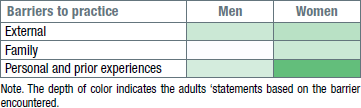
Finally,
Table IV shows that men hardly encounter any barriers in their daily lives when it comes to physical exercise. However, women, on the other hand, do encounter greater barriers in all areas, particularly in the personal sphere.
“We have reached a certain age, we have completed our lives, and women have the misfortune or the good fortune that we never finish so that we can retire. When I’m older I want to be my husband. Men retire and are retired “(124, Hestia).
In this case it is clear that retirement is a relative concept and will depend on many factors. If we analyze the statements of the focus group participants, we see that men seem to retire and be retired, using the time previously spent at work for leisure and free time. However, women, especially women who have already been doing housework and caring for grandchildren, cannot retire from these tasks. Therefore, women’s retirement tends to be partial, with a reduction in their free time proportional to their immersion in patriarchal customs that free men from domestic and family responsibilities, placing this work on the shoulders of women, as demonstrated in
Table IV.
Some older adults in the present research were not motivated to adopt physical practice-related behaviors in their lifestyles and therefore perceived that they had limited time before retirement. According to Rahman
47, lack of time could be either a real or perceived barrier that could limit older adults’ participation in physical exercise practices. On the other hand, if we take age into account the proportion of intrapersonal barriers towards physical practice seems to be higher as age increases
48. In this context, in older adults, the proportion of personal barriers was higher among women compared to men, data in agreement with those found in several studies
46,49,50.
CONCLUSIONS
Efforts to optimize health through physical fitness in older adults have prompted researchers to study barriers that prevent or curb exercise. Given that a one-size-fits-all strategy does not address the specific needs of a given population, identifying predictors of exercise is essential for adherence research. However, in the elderly population, barriers and facilitators are often intertwined, making it difficult to isolate factors specific to this population.
Because lifestyle habits and perceived barriers to exercise are often so ingrained in the older population, long-term maintenance of any newly acquired behavior, including exercise, is challenging. However, as the aging process continues, the frequency of contact among older adults and their healthy habits related to physical activity appears to be increasing. To achieve these changes in this population group, efforts are needed to educate and empower older adults regarding the benefits of interesting and enjoyable physical activities. In addition to achieve a more active lifestyle, requires more research and understanding in light of each person’s available resources and unique health and life circumstances, while trying to minimize the barriers mentioned in the present article.
Spanish municipalities and policies have a role to play and can encourage older adults to be physically active and strive to overcome social or cultural barriers by helping to develop or identify programs, environments, suitable nearby facilities, and to integrate them with any competitive responsibilities. This will increase the low proportion of older adults (17%) who continuously carry out physical exercise in sports centers or associations in Spain
51. Nowadays, most public administrations have physical exercise programs aimed at improving the physical functionality and well-being of older adults
52,53. Therefore, it seems necessary to direct efforts to provide information on the benefits and opportunities of physical exercise to older adults in a more direct and effective way, as well as to make the information on the benefits and opportunities of physical exercise more attractive.
A limitation of the study may be the type of activity offered and its influence on the practice barriers of older adults. The physical exercise professional delivering the training may also be a factor to take into account as she or he directly influences motivation and adherence to the program. Another limitation is that the perceptions of the physical exercise professionals who teach and conduct these practices could have been deepened. Data that would support the thoughts, opinions and experiences of the older adults and that, without a doubt, would help to better understand the contexts of practice and be able to address them with greater success. Therefore, it is proposed as a line of research to be followed in future studies.