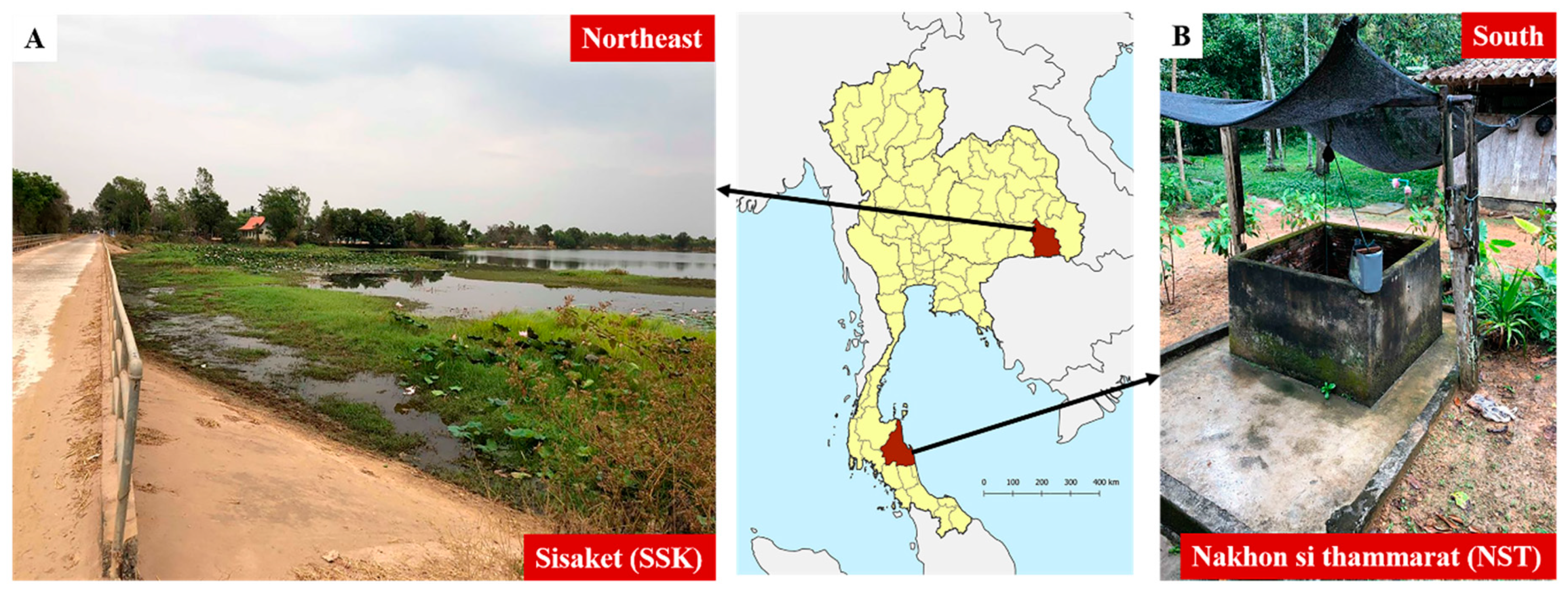
Optimization of Culture Protocols to Isolate Leptospira spp. from Environmental Water, Field Investigation, and Identification of Factors Associated with the Presence of Leptospira spp. in the Environment

 , , ,
, , ,
Abstract
1. Introduction
2. Materials and Methods
2.1. Spiking Experiment
2.1.1. Bacterial Strains and Water Samples Spiked with Leptospira
2.1.2. Leptospira Isolation by Culture
2.2. Pilot Testing
2.3. Field Investigation
2.4. Statistical Analysis
3. Results
3.1. Leptospira Isolation by Culture
3.2. Leptospira Isolation in the Pilot Study
3.3. The Presence of Leptospira in Environmental Water in the Field
3.4. Environment–Animal Interactions
4. Discussion
5. Conclusions
Author Contributions
Funding
Acknowledgments
Conflicts of Interest
References
- Levett, P.N. Leptospirosis. Clin. Microbiol. Rev. 2001, 14, 296–326. [Google Scholar] [CrossRef] [PubMed]
- Picardeau, M. Diagnosis and epidemiology of leptospirosis. Méd. Mal. Infect. 2013, 43, 1–9. [Google Scholar] [CrossRef]
- Vincent, A.T.; Schiettekatte, O.; Goarant, C.; Neela, V.K.; Bernet, E.; Thibeaux, R.; Ismail, N.; Mohd Khalid, M.K.N.; Amran, F.; Masuzawa, T.; et al. Revisiting the taxonomy and evolution of pathogenicity of the genus Leptospira through the prism of genomics. PLoS Negl. Trop. Dis. 2019, 13, e0007270. [Google Scholar] [CrossRef] [PubMed]
- Alemayehu, T.F.a.M. Leptospirosis and its Public Health Significance: A Review. Eur. J. Appl. Sci. 2012, 4, 238–244. [Google Scholar]
- Guerra, M.A. Leptospirosis: Public health perspectives. Biologicals 2013, 41, 295–297. [Google Scholar] [CrossRef]
- Haake, D.A.; Dundoo, M.; Cader, R.; Kubak, B.M.; Hartskeerl, R.A.; Sejvar, J.J.; Ashford, D.A. Leptospirosis, water sports, and chemoprophylaxis. Clin. Infect. Dis. 2002, 34, e40–e43. [Google Scholar] [CrossRef]
- Adler, B.; de la Pena Moctezuma, A. Leptospira and leptospirosis. Vet. Microbiol. 2010, 140, 287–296. [Google Scholar] [CrossRef]
- Cacciapuoti, B.; Ciceroni, L.; Maffei, C.; Di Stanislao, F.; Strusi, P.; Calegari, L.; Lupidi, R.; Scalise, G.; Cagnoni, G.; Renga, G. A waterborne outbreak of leptospirosis. Am. J. Epidemiol. 1987, 126, 535–545. [Google Scholar] [CrossRef]
- Wynwood, S.J.; Craig, S.B.; Graham, G.C.; Blair, B.R.; Burns, M.A.; Weier, S.L.; Collet, T.A.; McKay, D.B. The emergence of Leptospira borgpetersenii serovar Arborea as the dominant infecting serovar following the summer of natural disasters in Queensland, Australia 2011. Trop. Biomed. 2014, 31, 281–285. [Google Scholar]
- Morgan, J.; Bornstein, S.L.; Karpati, A.M.; Bruce, M.; Bolin, C.A.; Austin, C.C.; Woods, C.W.; Lingappa, J.; Langkop, C.; Davis, B.; et al. Outbreak of leptospirosis among triathlon participants and community residents in Springfield, Illinois, 1998. Clin. Infect. Dis. 2002, 34, 1593–1599. [Google Scholar] [CrossRef]
- Barragan, V.; Olivas, S.; Keim, P.; Pearson, T. Critical Knowledge Gaps in Our Understanding of Environmental Cycling and Transmission of Leptospira spp. Appl. Environ. Microbiol. 2017, 83. [Google Scholar] [CrossRef] [PubMed]
- Barragan, V.A.; Mejia, M.E.; Travez, A.; Zapata, S.; Hartskeerl, R.A.; Haake, D.A.; Trueba, G.A. Interactions of leptospira with environmental bacteria from surface water. Curr. Microbiol. 2011, 62, 1802–1806. [Google Scholar] [CrossRef] [PubMed]
- Benacer, D.; Woh, P.Y.; Mohd Zain, S.N.; Amran, F.; Thong, K.L. Pathogenic and saprophytic Leptospira species in water and soils from selected urban sites in peninsular Malaysia. Microbes Environ. 2013, 28, 135–140. [Google Scholar] [CrossRef] [PubMed]
- Saito, M.; Villanueva, S.Y.; Chakraborty, A.; Miyahara, S.; Segawa, T.; Asoh, T.; Ozuru, R.; Gloriani, N.G.; Yanagihara, Y.; Yoshida, S. Comparative analysis of Leptospira strains isolated from environmental soil and water in the Philippines and Japan. Appl. Environ. Microbiol. 2013, 79, 601–609. [Google Scholar] [CrossRef]
- Murgia, R.; Riquelme, N.; Baranton, G.; Cinco, M. Oligonucleotides specific for pathogenic and saprophytic leptospira occurring in water. FEMS Microbiol. Lett. 1997, 148, 27–34. [Google Scholar] [CrossRef]
- Ganoza, C.A.; Matthias, M.A.; Collins-Richards, D.; Brouwer, K.C.; Cunningham, C.B.; Segura, E.R.; Gilman, R.H.; Gotuzzo, E.; Vinetz, J.M. Determining risk for severe leptospirosis by molecular analysis of environmental surface waters for pathogenic Leptospira. PLoS Med. 2006, 3, e308. [Google Scholar] [CrossRef]
- Zhou, G.; Wen, S.; Liu, Y.; Li, R.; Zhong, X.; Feng, L.; Wang, L.; Cao, B. Development of a DNA microarray for detection and identification of Legionella pneumophila and ten other pathogens in drinking water. Int. J. Food Microbiol. 2011, 145, 293–300. [Google Scholar] [CrossRef]
- Riediger, I.N.; Hoffmaster, A.R.; Casanovas-Massana, A.; Biondo, A.W.; Ko, A.I.; Stoddard, R.A. An Optimized Method for Quantification of Pathogenic Leptospira in Environmental Water Samples. PLoS ONE 2016, 11, e0160523. [Google Scholar] [CrossRef]
- Schneider, A.G.; Casanovas-Massana, A.; Hacker, K.P.; Wunder, E.A., Jr.; Begon, M.; Reis, M.G.; Childs, J.E.; Costa, F.; Lindow, J.C.; Ko, A.I. Quantification of pathogenic Leptospira in the soils of a Brazilian urban slum. PLoS Negl. Trop. Dis. 2018, 12, e0006415. [Google Scholar] [CrossRef]
- Wynwood, S.J.; Graham, G.C.; Weier, S.L.; Collet, T.A.; McKay, D.B.; Craig, S.B. Leptospirosis from water sources. Pathog. Glob. Health 2014, 108, 334–338. [Google Scholar] [CrossRef]
- Thaipadungpanit, J.; Wuthiekanun, V.; Chierakul, W.; Smythe, L.D.; Petkanchanapong, W.; Limpaiboon, R.; Apiwatanaporn, A.; Slack, A.T.; Suputtamongkol, Y.; White, N.J.; et al. A Dominant Clone of Leptospira interrogans Associated with an Outbreak of Human Leptospirosis in Thailand. PLoS Negl. Trop. Dis. 2007, 1, e56. [Google Scholar] [CrossRef] [PubMed]
- Boonsilp, S.; Thaipadungpanit, J.; Amornchai, P.; Wuthiekanun, V.; Bailey, M.S.; Holden, M.T.G.; Zhang, C.; Jiang, X.; Koizumi, N.; Taylor, K.; et al. A Single Multilocus Sequence Typing (MLST) Scheme for Seven Pathogenic Leptospira Species. PLoS Negl. Trop. Dis. 2013, 7, e1954. [Google Scholar] [CrossRef] [PubMed]
- Slack, A.T.; Kalambaheti, T.; Symonds, M.L.; Dohnt, M.F.; Galloway, R.L.; Steigerwalt, A.G.; Chaicumpa, W.; Bunyaraksyotin, G.; Craig, S.; Harrower, B.J.; et al. Leptospira wolffii sp. nov., isolated from a human with suspected leptospirosis in Thailand. Int. J. Syst. Evol. Microbiol. 2008, 58, 2305–2308. [Google Scholar] [CrossRef] [PubMed]
- Thaipadungpanit, J.; Wuthiekanun, V.; Chantratita, N.; Yimsamran, S.; Amornchai, P.; Boonsilp, S.; Maneeboonyang, W.; Tharnpoophasiam, P.; Saiprom, N.; Mahakunkijcharoen, Y.; et al. Leptospira species in floodwater during the 2011 floods in the Bangkok Metropolitan Region, Thailand. Am. J. Trop. Med. Hyg. 2013, 89, 794–796. [Google Scholar] [CrossRef]
- India, W. Leptospirosis Laboratory Manual; WCO India: New Delhi, India, 2007. [Google Scholar]
- Luenam, A.; Puttanapong, N. Spatial and statistical analysis of leptospirosis in Thailand from 2013 to 2015. Geospat. Health 2019, 14. [Google Scholar] [CrossRef]
- Chaiwattanarungruengpaisan, S.; Suwanpakdee, S.; Sangkachai, N.; Chamsai, T.; Taruyanon, K.; Thongdee, M. Potentially Pathogenic Leptospira Species Isolated from a Waterfall in Thailand. Jpn. J. Infect. Dis. 2018, 71, 65–67. [Google Scholar] [CrossRef]
- Goarant, C. Leptospirosis: Risk factors and management challenges in developing countries. Res. Rep. Trop. Med. 2016, 7, 49–62. [Google Scholar] [CrossRef]
- Casanovas-Massana, A.; Pedra, G.G.; Wunder, E.A., Jr.; Diggle, P.J.; Begon, M.; Ko, A.I. Quantification of Leptospira interrogans Survival in Soil and Water Microcosms. Appl. Environ. Microbiol. 2018, 84. [Google Scholar] [CrossRef]
- Thibeaux, R.; Iraola, G.; Ferres, I.; Bierque, E.; Girault, D.; Soupe-Gilbert, M.E.; Picardeau, M.; Goarant, C. Deciphering the unexplored Leptospira diversity from soils uncovers genomic evolution to virulence. Microb. Genomics 2018, 4. [Google Scholar] [CrossRef]
- Thibeaux, R.; Girault, D.; Bierque, E.; Soupe-Gilbert, M.E.; Rettinger, A.; Douyere, A.; Meyer, M.; Iraola, G.; Picardeau, M.; Goarant, C. Biodiversity of Environmental Leptospira: Improving Identification and Revisiting the Diagnosis. Front. Microbiol. 2018, 9, 816. [Google Scholar] [CrossRef]
- Bourhy, P.; Collet, L.; Brisse, S.; Picardeau, M. Leptospira mayottensis sp. nov., a pathogenic species of the genus Leptospira isolated from humans. Int. J. Syst. Evol. Microbiol. 2014, 64, 4061–4067. [Google Scholar] [CrossRef]
- Thongdee, M.; Chaiwattanarungruengpaisan, S.; Lekcharoen, P.; Yimchoho, N.; Buathong, R.; Wiriyarat, W. A novel genotype of Leptospira interrogans recovered from leptospirosis outbreak in southern Thailand. Jpn. J. Infect. Dis. 2019. [Google Scholar] [CrossRef] [PubMed]
- Jittimanee, J.; Wongbutdee, J. Prevention and control of leptospirosis in people and surveillance of the pathogenic Leptospira in rats and in surface water found at villages. J. Infect. Public Health 2019, 12, 705–711. [Google Scholar] [CrossRef] [PubMed]
- Mohd Ali, M.R.; Mohamad Safiee, A.W.; Yusof, N.Y.; Fauzi, M.H.; Yean Yean, C.; Ismail, N. Isolation of Leptospira kmetyi from residential areas of patients with leptospirosis in Kelantan, Malaysia. J. Infect. Public Health 2018, 11, 578–580. [Google Scholar] [CrossRef] [PubMed]
- Chadsuthi, S.; Bicout, D.J.; Wiratsudakul, A.; Suwancharoen, D.; Petkanchanapong, W.; Modchang, C.; Triampo, W.; Ratanakorn, P.; Chalvet-Monfray, K. Investigation on predominant Leptospira serovars and its distribution in humans and livestock in Thailand, 2010–2015. PLoS Negl. Trop. Dis. 2017, 11, e0005228. [Google Scholar] [CrossRef] [PubMed]
- Suwanpakdee, S.; Kaewkungwal, J.; White, L.J.; Asensio, N.; Ratanakorn, P.; Singhasivanon, P.; Day, N.P.; Pan-Ngum, W. Spatio-temporal patterns of leptospirosis in Thailand: Is flooding a risk factor? Epidemiol. Infect. 2015, 143, 2106–2115. [Google Scholar] [CrossRef] [PubMed]
- Doungchawee, G.; Phulsuksombat, D.; Naigowit, P.; Khoaprasert, Y.; Sangjun, N.; Kongtim, S.; Smythe, L. Survey of leptospirosis of small mammals in Thailand. Southeast Asian J. Trop. Med. Public Health 2005, 36, 1516–1522. [Google Scholar]
- Kurilung, A.; Chanchaithong, P.; Lugsomya, K.; Niyomtham, W.; Wuthiekanun, V.; Prapasarakul, N. Molecular detection and isolation of pathogenic Leptospira from asymptomatic humans, domestic animals and water sources in Nan province, a rural area of Thailand. Res. Vet. Sci. 2017, 115, 146–154. [Google Scholar] [CrossRef]
- Meeyam, T.; Tablerk, P.; Petchanok, B.; Pichpol, D.; Padungtod, P. Seroprevalence and risk factors associated with leptospirosis in dogs. Southeast Asian J. Trop. Med. Public Health 2006, 37, 148–153. [Google Scholar]


| Strain | Conc. 1 | Length of Storage Time (Weeks) | ||||||||||||||||||||||||||||||||||||||
|---|---|---|---|---|---|---|---|---|---|---|---|---|---|---|---|---|---|---|---|---|---|---|---|---|---|---|---|---|---|---|---|---|---|---|---|---|---|---|---|---|
| 0 | 2 | 4 | ||||||||||||||||||||||||||||||||||||||
| Subclade P1 | L. interrogans | L13 | 106 | |||||||||||||||||||||||||||||||||||||
| 105 | ||||||||||||||||||||||||||||||||||||||||
| 104 | ||||||||||||||||||||||||||||||||||||||||
| 103 | ||||||||||||||||||||||||||||||||||||||||
| 102 | ||||||||||||||||||||||||||||||||||||||||
| L. weilii | LNT1194 | 106 | ||||||||||||||||||||||||||||||||||||||
| 105 | ||||||||||||||||||||||||||||||||||||||||
| 104 | ||||||||||||||||||||||||||||||||||||||||
| 103 | ||||||||||||||||||||||||||||||||||||||||
| 102 | ||||||||||||||||||||||||||||||||||||||||
| PA62-C1 | 106 | |||||||||||||||||||||||||||||||||||||||
| 105 | ||||||||||||||||||||||||||||||||||||||||
| 104 | ||||||||||||||||||||||||||||||||||||||||
| 103 | ||||||||||||||||||||||||||||||||||||||||
| 102 | ||||||||||||||||||||||||||||||||||||||||
| Subclade P2 | L. wolfii | H2 | 106 | |||||||||||||||||||||||||||||||||||||
| 105 | ||||||||||||||||||||||||||||||||||||||||
| 104 | ||||||||||||||||||||||||||||||||||||||||
| 103 | ||||||||||||||||||||||||||||||||||||||||
| 102 | ||||||||||||||||||||||||||||||||||||||||
| L. licerasiae | Q127 | 106 | ||||||||||||||||||||||||||||||||||||||
| 105 | ||||||||||||||||||||||||||||||||||||||||
| 104 | ||||||||||||||||||||||||||||||||||||||||
| 103 | ||||||||||||||||||||||||||||||||||||||||
| 102 | ||||||||||||||||||||||||||||||||||||||||
| Subclade S1 | L. biflexa | Patoc I | 106 | |||||||||||||||||||||||||||||||||||||
| 105 | ||||||||||||||||||||||||||||||||||||||||
| 104 | ||||||||||||||||||||||||||||||||||||||||
| 103 | ||||||||||||||||||||||||||||||||||||||||
| 102 | ||||||||||||||||||||||||||||||||||||||||
| Control | ||||||||||||||||||||||||||||||||||||||||
| Weeks after culture | 1 | 2 | 3 | 4 | 5 | 6 | 7 | 8 | 9 | 10 | 11 | 12 | 1 | 2 | 3 | 4 | 5 | 6 | 7 | 8 | 9 | 10 | 11 | 12 | 1 | 2 | 3 | 4 | 5 | 6 | 7 | 8 | 9 | 10 | 11 | 12 | ||||
| 0 | +1 | +2 | +3 | +4 | ||||||||||||||||||||||||||||||||||||
| Type of Water | Percentage of Water Samples Suspected to be Leptospira-Positive | |||||
|---|---|---|---|---|---|---|
| Sisaket (SSK) (n = 31) | Nakhon Si Thammarat (NST) (n = 78) | |||||
| Culture | Direct PCR | Overall * | Culture | Direct PCR | Overall * | |
| Puddle/pond/swamp | 12.5% (3/24) | 16.7% (4/24) | 29.2% (7/24) | 60.0% (3/5) | 40.0% (2/5) | 80.0% (4/5) |
| River/canal/waterfall | 0% (0/5) | 0% (0/5) | 0% (0/5) | 0% (0/3) | 33.3% (1/3) | 33.3% (1/3) |
| Tap water | 100.0% (2/2) | 0% (0/2) | 100.0% (2/2) | - | - | - |
| Ground water | - | - | - | 22.9% (16/70) | 18.6% (13/70) | 30.0% (21/70) |
| Total | 16.1% (5/31) | 12.9% (4/31) | 29.0% (9/31) | 24.4% (19/78) | 20.5% (16/78) | 33.3% (26/78) |
| Type of Water | Percentage of Water Samples Positive for Leptospira * (n = 35) | |
|---|---|---|
| Pathogenic Leptospira | Intermediate Leptospira | |
| Puddle/pond/swamp | - | 18.2% (2/11) |
| River/canal/waterfall | 100% (1/1) | - |
| Tap water | - | 100% (2/2) |
| Ground water | 47.6% (10/21) | 33.3% (7/21) |
| Total | 31.4% (11/35) | 31.4% (11/35) |
| Characteristics | N 1 (%) | Leptospira Positive 2 (%) | OR 3 (95% CI) | AOR 4 (95% CI) |
|---|---|---|---|---|
| Presence of Rodents | ||||
| No | 80 (88.89) | 28 (35.00) | Reference | Reference |
| Yes | 10 (11.11) | 5 (50.00) | 1.85 (0.49–6.96) | 0.24 (0.02–2.64) |
| Presence of cattle | ||||
| No | 73 (81.11) | 24 (32.88) | Reference | Reference |
| Yes | 17 (18.89) | 9 (52.94) | 2.29 (0.78–6.69) | 3.09 (0.43–22.29) |
| Presence of farm animals | ||||
| No | 66 (73.33) | 27 (81.82) | Reference | Reference |
| Yes | 24 (26.67) | 6 (18.18) | 0.48 (0.16–1.37) | 0.23 (0.06–0.88) |
| Presence of domestic pets | ||||
| No | 67 (74.44) | 20 (29.85) | Reference | Reference |
| Yes | 23 (25.56) | 13 (56.52) | 3.05 (1.15 –) | 5.25 (1.53 –18.03) |
| Drinking source | ||||
| No | 45 (50.00) | 17 (37.78) | Reference | Reference |
| Yes | 45 (50.00) | 16 (35.56) | 0.90 (0.38–2.14) | 1.40 (0.40–4.87) |
| Consuming source 5 | ||||
| No | 37 (41.11) | 17 (45.95) | Reference | Reference |
| Yes | 53 (58.89) | 16 (30.19) | 0.05 (0.12–1.21) | 0.37 (0.12–1.17) |
| Agricultural source | ||||
| No | 58 (64.44) | 18 (31.03) | Reference | Reference |
| Yes | 32 (35.56) | 15 (46.88) | 1.96 (0.80–4.77) | 1.56 (0.42–5.85) |
| Type of water source | ||||
| Closed system | 85 (94.44) | 31 (36.47) | Reference | Reference |
| Open system | 5 (5.56) | 2 (40.00) | 1.16 (0.18–7.33) | 1.34 (0.17–10.66) |
© 2020 by the authors. Licensee MDPI, Basel, Switzerland. This article is an open access article distributed under the terms and conditions of the Creative Commons Attribution (CC BY) license (http://creativecommons.org/licenses/by/4.0/).
Share and Cite
Narkkul, U.; Thaipadungpanit, J.; Srilohasin, P.; Singkhaimuk, P.; Thongdee, M.; Chaiwattanarungruengpaisan, S.; Krairojananan, P.; Pan-ngum, W. Optimization of Culture Protocols to Isolate Leptospira spp. from Environmental Water, Field Investigation, and Identification of Factors Associated with the Presence of Leptospira spp. in the Environment. Trop. Med. Infect. Dis. 2020, 5, 94. https://doi.org/10.3390/tropicalmed5020094
Narkkul U, Thaipadungpanit J, Srilohasin P, Singkhaimuk P, Thongdee M, Chaiwattanarungruengpaisan S, Krairojananan P, Pan-ngum W. Optimization of Culture Protocols to Isolate Leptospira spp. from Environmental Water, Field Investigation, and Identification of Factors Associated with the Presence of Leptospira spp. in the Environment. Tropical Medicine and Infectious Disease. 2020; 5(2):94. https://doi.org/10.3390/tropicalmed5020094
Chicago/Turabian StyleNarkkul, Udomsak, Janjira Thaipadungpanit, Prapaporn Srilohasin, Preeraya Singkhaimuk, Metawee Thongdee, Somjit Chaiwattanarungruengpaisan, Panadda Krairojananan, and Wirichada Pan-ngum. 2020. "Optimization of Culture Protocols to Isolate Leptospira spp. from Environmental Water, Field Investigation, and Identification of Factors Associated with the Presence of Leptospira spp. in the Environment" Tropical Medicine and Infectious Disease 5, no. 2: 94. https://doi.org/10.3390/tropicalmed5020094
APA StyleNarkkul, U., Thaipadungpanit, J., Srilohasin, P., Singkhaimuk, P., Thongdee, M., Chaiwattanarungruengpaisan, S., Krairojananan, P., & Pan-ngum, W. (2020). Optimization of Culture Protocols to Isolate Leptospira spp. from Environmental Water, Field Investigation, and Identification of Factors Associated with the Presence of Leptospira spp. in the Environment. Tropical Medicine and Infectious Disease, 5(2), 94. https://doi.org/10.3390/tropicalmed5020094