
Article

Global Trends and Attributable Risk Factors in the Disease Burden of Lower Respiratory Infections
Institute of Data Science and Big Data Technology, School of Mathematics and Physics, Wuhan Institute of Technology, Wuhan 430205, China
*
Author to whom correspondence should be addressed.
Trop. Med. Infect. Dis. 2025, 10(7), 180; https://doi.org/10.3390/tropicalmed10070180

Submission received: 25 April 2025 / Revised: 6 June 2025 / Accepted: 23 June 2025 / Published: 26 June 2025
(This article belongs to the Special Issue Respiratory Infectious Disease Epidemiology and Control)

Abstract

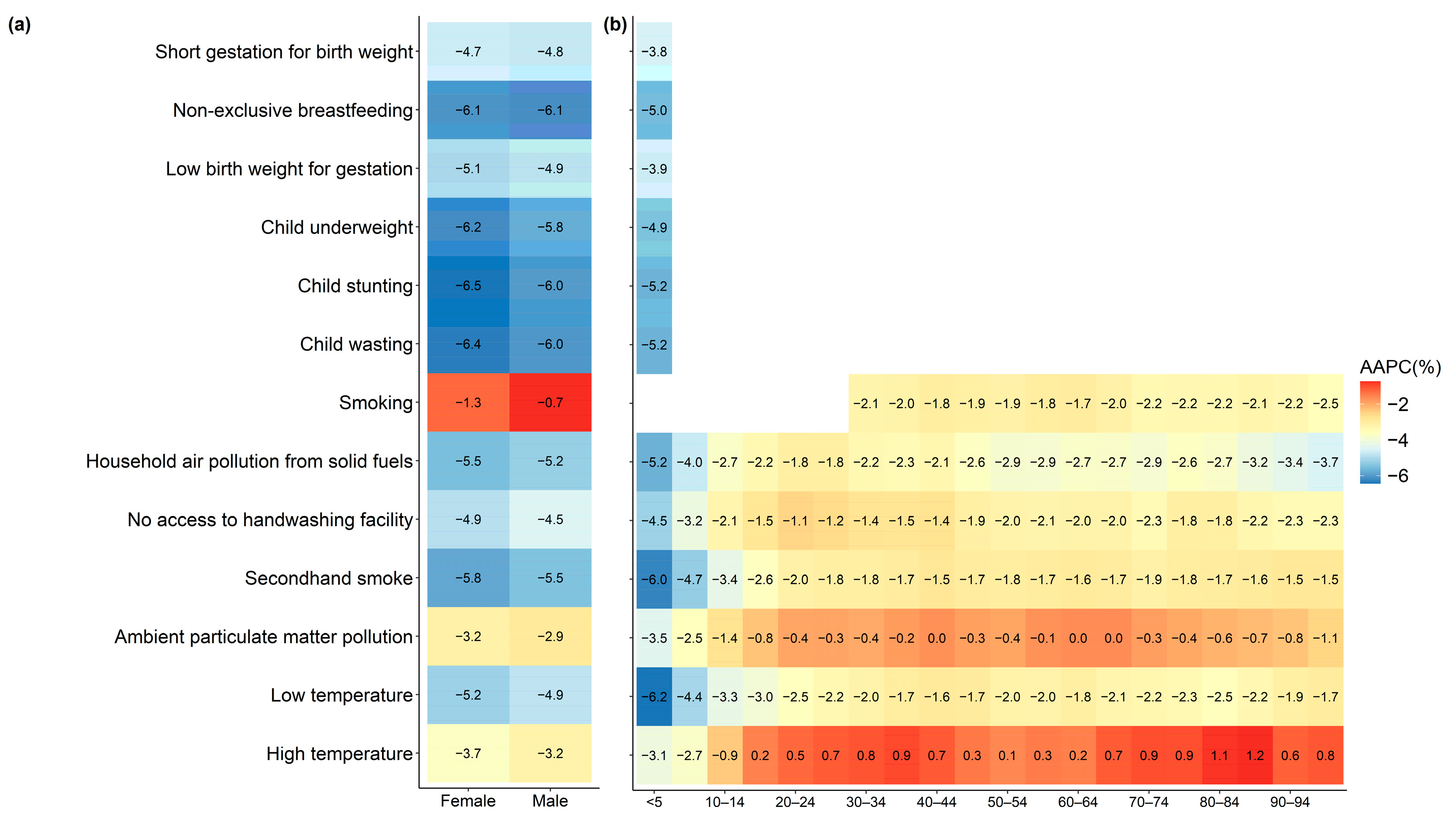
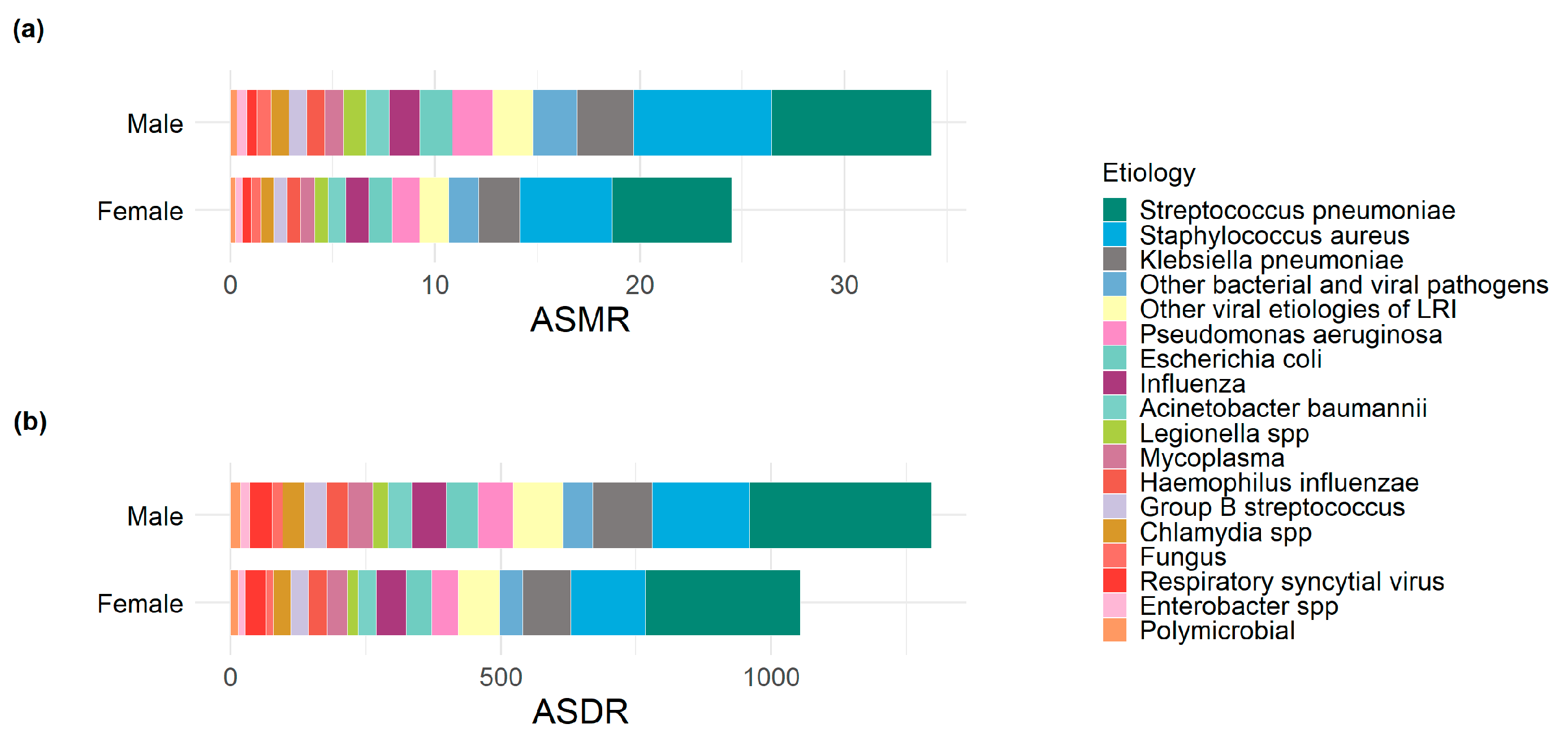
Background: Lower respiratory infections (LRIs) are the leading cause of the global disease burden, accounting for millions of deaths each year. Methods: Data on LRIs, including deaths, disability-adjusted life years (DALYs), and incidence, were obtained from the Global Burden of Disease Study 2021. Joinpoint regression was employed to assess temporal trends in the LRIs’ burden, while the age–period–cohort model was used to evaluate age, period, and cohort effects. Pearson’s correlation coefficients were calculated to examine the relationship between DALYs attributable to risk factors and the socio-demographic index (SDI). Results: Over recent decades, the average annual percentage change in age-standardized mortality rate, age-standardized DALYs rate, and age-standardized incidence rate of LRIs globally were −2.4%, −3.5%, and −1.3%, respectively. Notably, the LRIs’ burden dropped considerably from 2019 to 2021. The disease burden was higher among children under five and individuals over 60 compared to other age groups. In terms of gender, males had a higher burden. The age-standardized DALYs rate of LRIs was strongly and negatively correlated with SDI (r = −0.84; p < 0.05). Streptococcus pneumoniae remained the leading pathogen, followed by Staphylococcus aureus, and Klebsiella pneumoniae. Conclusions: In recent years, the global burden of LRIs has declined, but regional, gender, and age disparities persist. Targeted measures are needed to address high-risk populations and major risk factors.
Keywords: lower respiratory infections; worldwide disease burden; variation trend; age–period–cohort model; risk factors lower respiratory infections; worldwide disease burden; variation trend; age–period–cohort model; risk factors