Article

Short-Term Performance of Visual Attention Prompt Methods Across Driver Proficiency in a Driving Simulator


1
Major of Intelligent Information System Engineering, Graduate School of Engineering, Fukuoka Institute of Technology, Fukuoka 811-0295, Japan
2
Department of Computer Science and Engineering, Faculty of Information Engineering, Fukuoka Institute of Technology, Fukuoka 811-0295, Japan
*
Author to whom correspondence should be addressed.
Multimodal Technol. Interact. 2026, 10(3), 28; https://doi.org/10.3390/mti10030028
Submission received: 20 February 2026 / Revised: 9 March 2026 / Accepted: 9 March 2026 / Published: 11 March 2026

Abstract

In complex driving environments, drivers must continuously detect and respond to critical visual information such as traffic signs and pedestrians. However, important targets may sometimes be overlooked due to high cognitive load during driving. Therefore, visual attention prompt methods have been proposed to guide drivers’ gaze toward relevant targets. A visual attention prompt method is a visual cue presented in a key area in a user’s field of view to draw his/her visual attention. This study evaluates the short-term performance of five visual attention prompt methods (Point, Arrow, Blur, Dusk, and ModAF) in a driving simulator and compares their performance between novice and proficient drivers. Eye-tracking data and multiple analyses are used to examine whether the influence of these methods could be maintained after they are disabled and to clarify drivers’ response patterns across methods in consideration with their driving proficiency. The results indicate that visual attention prompt methods could induce a short-term transfer effect, as drivers still tend to fixate on target traffic signs earlier after the methods are disabled, and the elapsed-time analysis estimates that this effect lasts about 84.35 s. Overall, the Point, Arrow, and Dusk methods show relatively stronger performance with significant reductions in the elapsed time to fixate on the traffic sign. The clustering analysis further shows that drivers’ response patterns are not uniform, with two clusters for novice drivers and three clusters for proficient drivers. The results suggest that most novice drivers tend to benefit from explicit non-directional visual cues that enhance target salience, such as the Point method, whereas proficient drivers are more likely to benefit from explicit directional visual cues that provide clear directional guidance, such as the Arrow method. These findings suggest that visual attention prompt methods may be useful for developing driver training strategies tailored to different levels of driving proficiency, helping drivers maintain more effective visual attention allocation during driving and potentially contributing to improved driving safety.

1. Introduction

Driving is a highly visually dependent complex task, requiring drivers to swiftly identify and process critical information in dynamic environments, such as road signs, vehicles, and pedestrians. Visual attention is a primary step in information acquisition during driving activities, and insufficient attention causes delayed reactions or even traffic accidents. Based on field investigations, Lemonnier et al. [1] demonstrate that in intersection scenarios, drivers must divide visual attention between the forward roadway and lateral approaches, and improper attention allocation will significantly increase collision risk. Additionally, relevant research [2,3,4] also indicates that a driver’s useful field of view (UFOV) and attention allocation capacity not only determine their ability to detect and respond to potential hazards but also directly influence their efficiency in target discovery over time, their gaze distribution patterns in space, and their attention allocation strategies at the individual difference levels. Therefore, visual attention is not only a prerequisite for recognition and response but also a decisive factor influencing driving safety. However, during the driving process, the visual attention is often constrained by various factors such as environmental complexity, cognitive load, and individual differences. Due to safety risks and difficult experimental conditions to control, there are significant challenges in directly studying the visual attention allocation of drivers in real traffic environments. As an alternative, driving simulators provide a safe and controllable environment and can efficiently collect data. More importantly, the results obtained by the simulators have good consistency with real road driving. For instance, Calvi et al. [5] compare field driving and simulated driving in Italy, and results show no significant differences between the two in key eye movement parameters such as gaze duration and gaze distance, providing strong support for using simulators to study drivers’ visual behavior. Therefore, driving simulators have become an important tool for evaluating properties of visual attention in the context of driving.
On this basis, researchers have proposed various methods to enhance visual attention, aiming to reduce potential risks and improve the detection rate of key targets. One representative approach is the use of visual attention prompt methods, which present visual cues in key areas to draw visual attention. For example, Rusch et al. [6] examine drivers’ responses in a driving simulator and find that augmented reality cues directed to roadside hazards significantly improve the detection rate of pedestrians and warning signs while also facilitating faster reactions. Similarly, Li et al. [7] examine the effect of spatial and temporal visual cues in a goal-directed task. A goal-directed task is a task where a user is required to choose a series of appropriate actions to achieve a desired goal. In their experiment, a static arrow is presented as a spatial visual cue at the position where the target is supposed to be presented. In addition, a dynamic countdown is presented as a temporal visual cue as well at the same position to indicate the moment of appearance of the target. The user is asked to respond to the target by pressing the specified key. Their results show that the combination of those visual cues outperforms either of them or no visual cues. In summary, these studies emphasize the potential of visual attention prompt methods in effectively guiding drivers’ attention and enhancing their information processing.
Despite the positive findings of existing studies, visual attention prompt methods still face several unresolved issues. Firstly, it is currently unclear whether the improvement in attention allocation only holds when the visual attention prompt method is enabled or whether and how long the short-term transfer effect holds after the method is disabled. Secondly, the variability in how different driver populations respond to visual attention prompt methods has not been adequately examined. For example, Deng et al. [8] investigate the impact of driving experience on visual-relevant ability through questionnaires, comparing the differences in peripheral perception, visual response, and visual tracking between novice and proficient drivers. Their results show that proficient drivers outperform novice ones, and there are differences in their perception of the importance of visual factors. This indicates that differences in visual-relevant ability and importance perception among different driving populations may affect the effectiveness of visual attention prompt methods. Therefore, this study aims to address two main objectives. Firstly, evaluate the short-term transfer effect of different visual attention prompt methods in driving simulators. Secondly, explore the differences in response of different driving populations to these visual attention prompt methods in order to clarify the impact of population specificity.
Section 2 reviews prior studies on visual attention in driving and visual attention prompt methods in related domains. Section 3 describes our simulator hardware, scenario design, and the implementation details of five visual attention prompt methods. Section 4 sets out participant characteristics and the experimental protocol. Section 5 presents the obtained dataset and the analysis framework, including the metrics and methods used to evaluate the short-term transfer effect, as well as the approach to compare group differences between novice and proficient drivers. Section 6 reports empirical findings from survival analysis, spatial gaze redistribution, and responder-type clustering. Section 7 discusses the findings and their implications for driver attention and safety. Section 8 summarizes the study and outlines future research directions.

2. Related Work

2.1. Development and Applications of Visual Attention Prompt Methods

Visual attention prompt methods are widely used to guide people to focus their attention or viewpoint on task-related goals through prominent visual cues. By highlighting specific areas of interest or locations of visual target objects, they aim to improve the efficiency of finding the objects and help people make more accurate judgments. In recent years, the application of visual attention prompt methods gradually expands from original target search tasks to education, art, media, transportation, and other fields. For example, in the field of education, Hurzlmeier et al. [9] examine two types of visual attention prompt methods in a video-based circuit learning environment. They find that screen text and arrow cues effectively guide learners’ gaze: beginners will repeatedly turn their gaze back to the pop-up screen text for additional explanation, while advanced learners are more inclined to stare at the circuit components highlighted by the arrow for a long time. This suggests that such visual attention prompt methods support beginners and help advanced learners optimize their attention allocation. Similarly, in the media field, Liu et al. [10] discuss the role of visual attention prompt methods in immersive 360-degree video learning. The study finds that text annotation can improve learning performance and fixation time, while directional arrows effectively guide attention to areas beyond the initial visual field.
In the transportation domain, Pomarjanschi et al. [11] develop a crosshair-based visual attention prompt method in a driving simulator that aims to redirect drivers’ attention to suddenly appearing pedestrians by briefly displaying a visual cue when they fail to fixate on them. The experimental results show that this method significantly reduces drivers’ reaction time and lowers the incidence of accidents. Overall, visual attention prompt methods demonstrate the potential to guide user attention and improve task performance in multiple fields.
In virtual and immersive stereoscopic environments, the visual attention prompt method that is widely applied and validated is the Attention Funnel (AF) [12], which creates a dynamic three-dimensional tunnel through virtual planes and curved paths to quickly guide a user’s gaze toward target objects, people, or locations. The experimental results show that AF reduces search time by about 22% and lowers mental workload by 18%, outperforming traditional highlighting and verbal methods.
When AF is applied to driving simulators that primarily rely on flat displays, it exposes certain limitations. AF may be effective in certain contexts, but on flat-screen displays, they can introduce visual occlusion. As shown by Grahn et al. [13], occlusion alters fixation patterns and increases visual demand in driving, which can hinder drivers from comprehensively monitoring the road environment. For driving simulators, flat-screen displays are the most common platform for driving research, offering an everyday and affordable setup as well as a safe and controllable environment. We focus on validation of visual attention prompt methods, including the crosshair [11] and AF [12], in this environment.

2.2. Eye-Tracking for Driver Visual Attention Analysis

Driving is a highly visually dependent task, and eye movements directly reflect drivers’ attention allocation. Therefore, eye-tracking technology is an important tool widely used in driving research, objectively measuring how drivers allocate attention. Compared with subjective evaluation methods that rely on drivers’ self-perception, such as questionnaires or rating scales, eye-movement data more directly reveal cognitive activities during driving by capturing indicators such as gaze duration, scanning behavior, gaze distribution, and pupil changes. For example, Miljković and Sodnik [14] investigate the use of Time to Fixate (TTF) in a driving simulator to evaluate fitness to drive in neurological patients. They define TTF as the interval between the appearance of a hazard (such as children running from behind a bus) and the driver’s first fixation on it. In contrast, Perception–Response Time (PRT) denotes the elapsed time from the appearance of a hazard to the initiation of a control action such as braking. Their results show that TTF is more sensitive than traditional PRT in distinguishing between fit, unfit, and conditionally fit drivers, demonstrating its value as a robust indicator of processes of attentional allocation in driving. In addition to TTF, other studies also emphasize dwell time, which refers to the cumulative duration of fixations that drop within a single viewing AOI, and dwell proportion (DwellProp) is the ratio of dwell time to total duration spent for that AOI. Unlike TTF, which indicates the speed of the first fixation from the first appearance of a hazard, DwellProp quantifies sustained allocation after the first fixation. Thus, DwellProp complements TTF by including how long attention is maintained in AOIs. Vansteenkiste et al. [15] discuss the computation algorithm of DwellProp in a head-mounted environment.
Recent studies also employ a heatmap-based method to capture collective visual-attention dynamics in driving scenarios. For instance, Gerber et al. [16] conduct a simulator study on an uncertainty-based head-up display (HUD) for conditional automated driving, which shows what level of confidence the automation is currently on and briefly prompts the driver to look back at the road when the level of confidence drops. In their study, there are two designs for the HUD. One shows only the level of confidence, and the other additionally prompts it. Using a heatmap, they find that the former design encourages drivers to monitor the driving environment more frequently, while the latter design keeps attention longer on secondary tasks. Their results indicate that a heatmap analysis of gaze is an effective method for exploring changes in attention allocation under multitasking conditions such as driving. They also demonstrate the sensibility of a heatmap analysis of gaze in evaluating drivers’ attention allocation. Farhani et al. [17] conduct clustering analysis of driving data under different weather conditions and use a transition matrix to characterize dynamic changes between gaze areas. They find that rainy days induce more frequent attention and longer stays in the instrument area compared with sunny days. They also demonstrate that the clustering analysis successfully captures subtle attention shifts and strategy adjustments under changing situations. Overall, these studies highlight the usability of eye-tracking technology in driving research, particularly DwellProp, Heatmap, and Clustering analyses, and we employ these three analyses for the evaluation of the impact of visual attention prompt methods and driver proficiency on driving performance.

2.3. Transferability and Short-Term Effects of Attentional Interventions

From a psychological perspective, Attentional Control Theory (ACT) [18] posits that an individual’s attention is governed by the interplay between a goal-directed system and a stimulus-driven system. The goal-directed system is a top-down control of attention where an individual chooses a series of appropriate actions to achieve a desired goal. His/her attention is triggered by internally motivated objectives. In contrast, the stimulus-driven system is a bottom-up control of attention where his/her attention is triggered by external stimuli, such as unexpected events, to perform a series of actions. External stimuli can be regarded as cues that strengthen the goal-directed system.
In the context of driving, the external stimuli highlight locations or objects that are related to appropriate actions for the individual to take to the desired goal by reducing interference from irrelevant stimuli and improving the efficiency of processing tasks. In this way, the individual gets accustomed to performing attention allocation. The subsequent research suggests that the acquired behavior may persist briefly even after the external stimuli disappear, forming a short-term transfer effect. For example, Zhang et al. [19] use Masked Majority Functional Task (MFT-M) to investigate how attention regulation affects cognitive performance. Their finding indicates that exposure to attention manipulation leads to faster responses and higher accuracy in primary tasks, and more importantly, this effect extends to subsequent tasks, such as a cognitive task of the Stroop test. This phenomenon indicates that attention manipulation can go beyond an initial context and generate a short-term transfer effect. Matsukura et al. [20] examine how visual stimuli influence visual short-term memory (VSTM) using a series of change-detection experiments. Participants are briefly shown arrays of colored squares, followed by visual stimuli that are presented during the retention interval. Even after the visual stimuli disappear, participants show higher accuracy for the prompted locations. This finding suggests that attention can protect stored visual representations from decay during short delays—a phenomenon the authors term the protection effect. In other words, visual stimuli can temporarily maintain or strengthen relevant visual information even after the cue itself is gone, demonstrating a residual short-term enhancement of attention. Based on this psychological foundation, it can be inferred that similar short-term transfer effects may also occur in driving situations. Driving is a task that is highly dependent on visual attention, and when the driver’s attention is guided by visual stimuli, it may continue to affect the driver’s attention allocation performance. The current research on attention allocation in the context of driving mainly focuses on the promoting effect of visual stimuli on drivers’ attention during presentation, while the continuity of the promoting effect after the stimuli disappear still needs further exploration. Our study examines the short-term transfer effect of some visual attention prompt methods after they are disabled in a driving simulation scenario, aiming to deepen the understanding of dynamic characteristics of attention in driving and provide a reference for designing sustainable visual guidance systems that support and maintain drivers’ attention.

3. Design of the Driving Simulator and Visual Attention Prompt Methods

3.1. Hardware Configuration

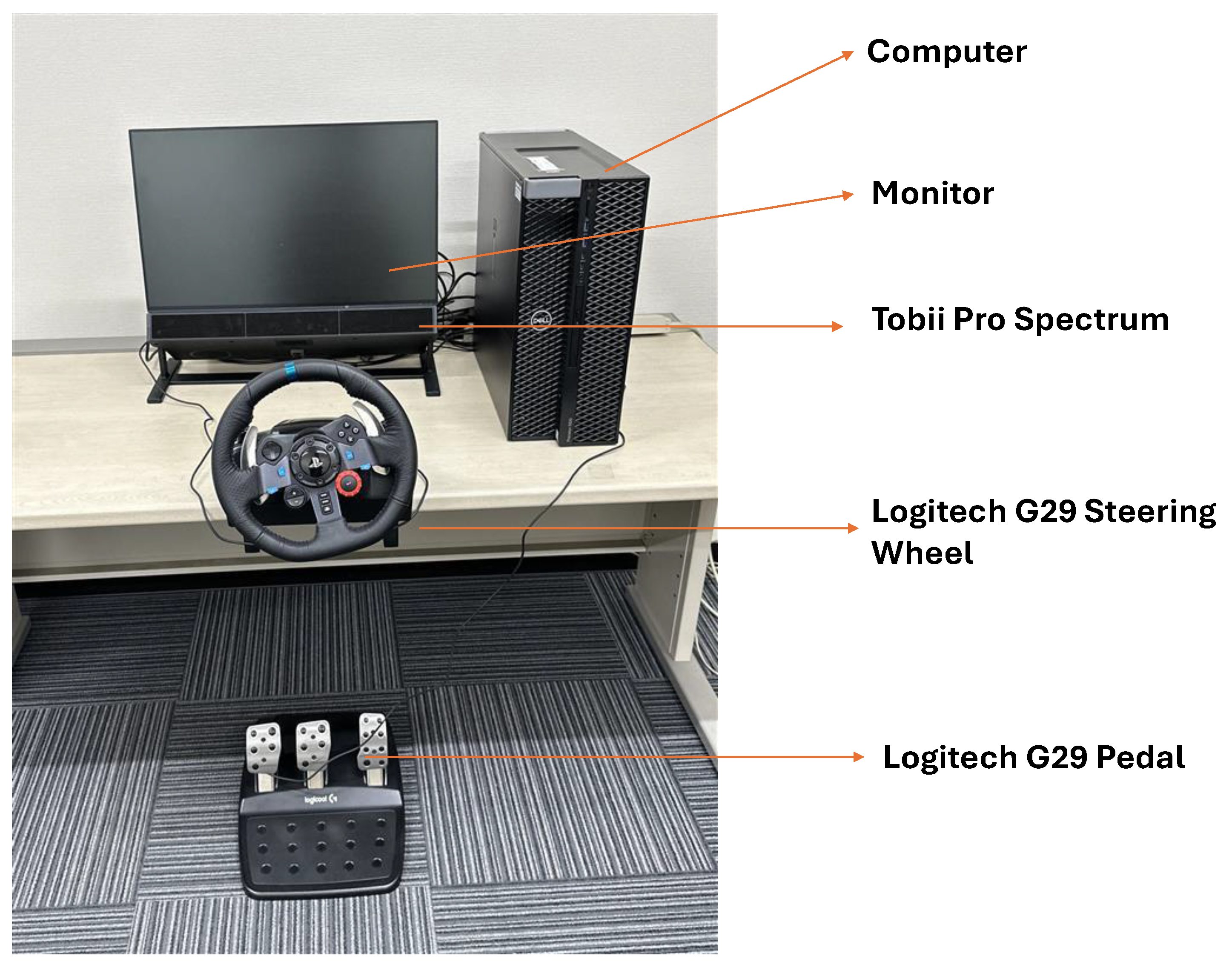
The core interactive device of our driving simulation system is a Logitech G29 Driving Force steering wheel and pedal set (Logitech International S.A., Lausanne, Switzerland), providing 900° rotation with dual-motor force feedback and a helical-gear mechanism, including clutch, brake, and throttle pedals. The visual display uses an Eizo EV2451 24.1-inch monitor (EIZO Corporation, Hakusan, Japan) at 1920 × 1080 resolution and a 60 Hz refresh rate. The simulation runs on a Dell Precision 5820 Tower workstation (Dell Inc., Round Rock, TX, USA) equipped with an Intel Xeon W-2123 (Intel Corporation, Santa Clara, CA, USA) (3.60 GHz), 32 GB of RAM, and a NVIDIA Quadro P2000 graphics card (NVIDIA Corporation, Santa Clara, CA, USA). Gaze data are recorded with a Tobii Pro Spectrum screen-based eye tracker (Tobii AB, Stockholm, Sweden). The device supports sampling at 60–1200 Hz and provides a freedom of head movement in space of approximately 34 cm (width) × 26 cm (height) × 55–75 cm (depth), enabling high-precision recording of gaze position and timing during driving. The hardware composition of the driving simulator is shown in Figure 1.

3.2. Driving Simulation Environment and Scenario Design

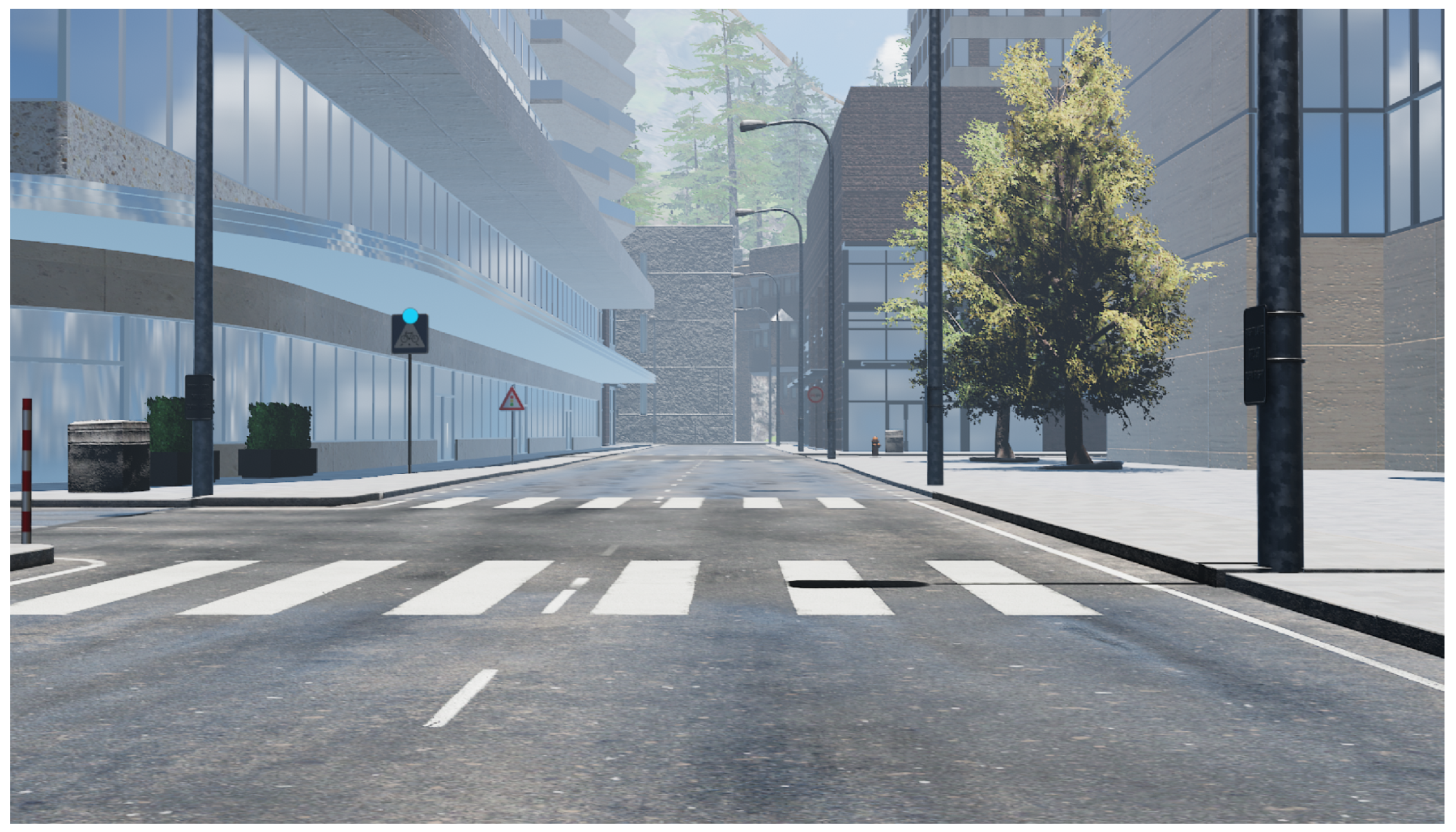
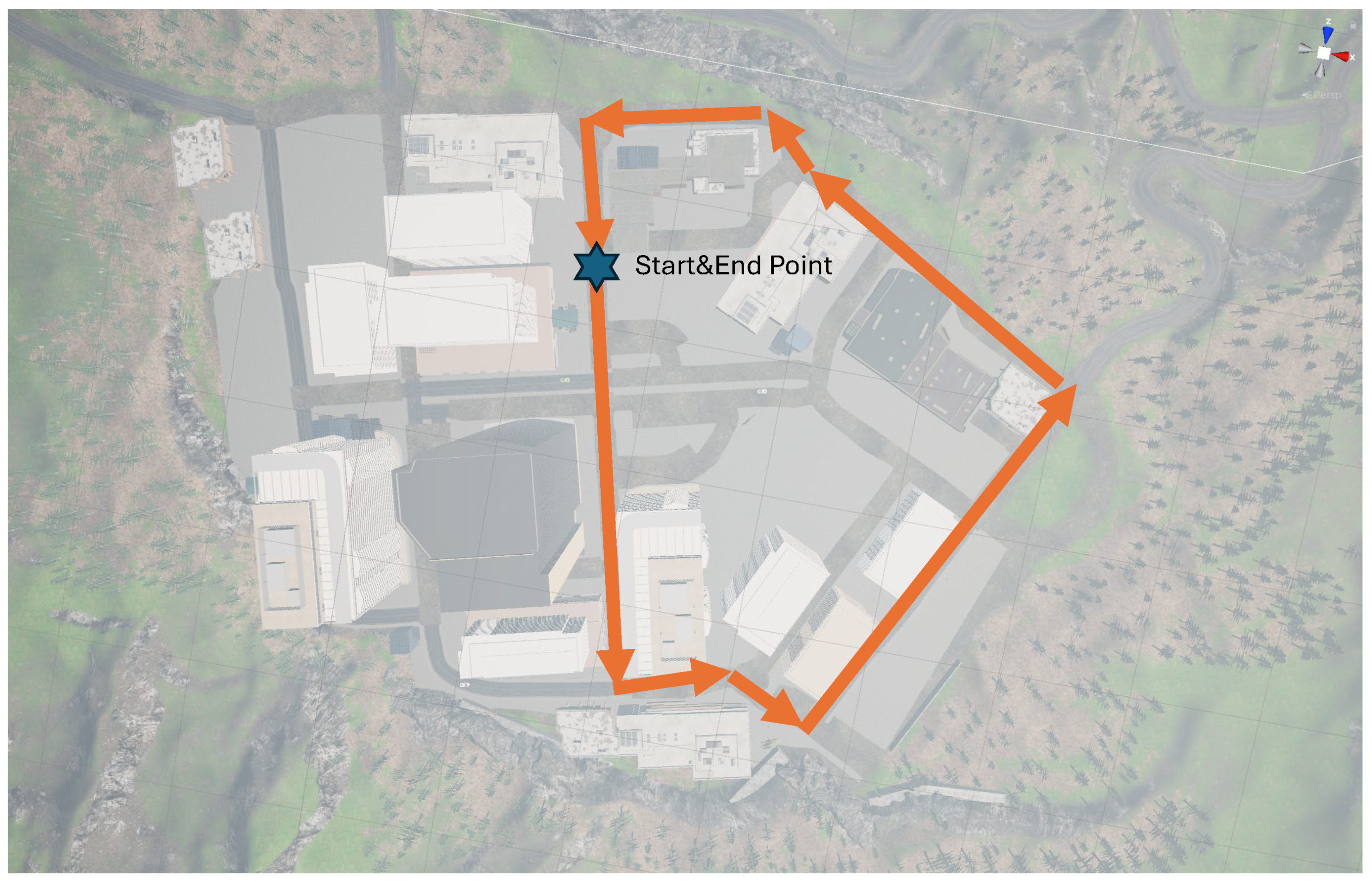
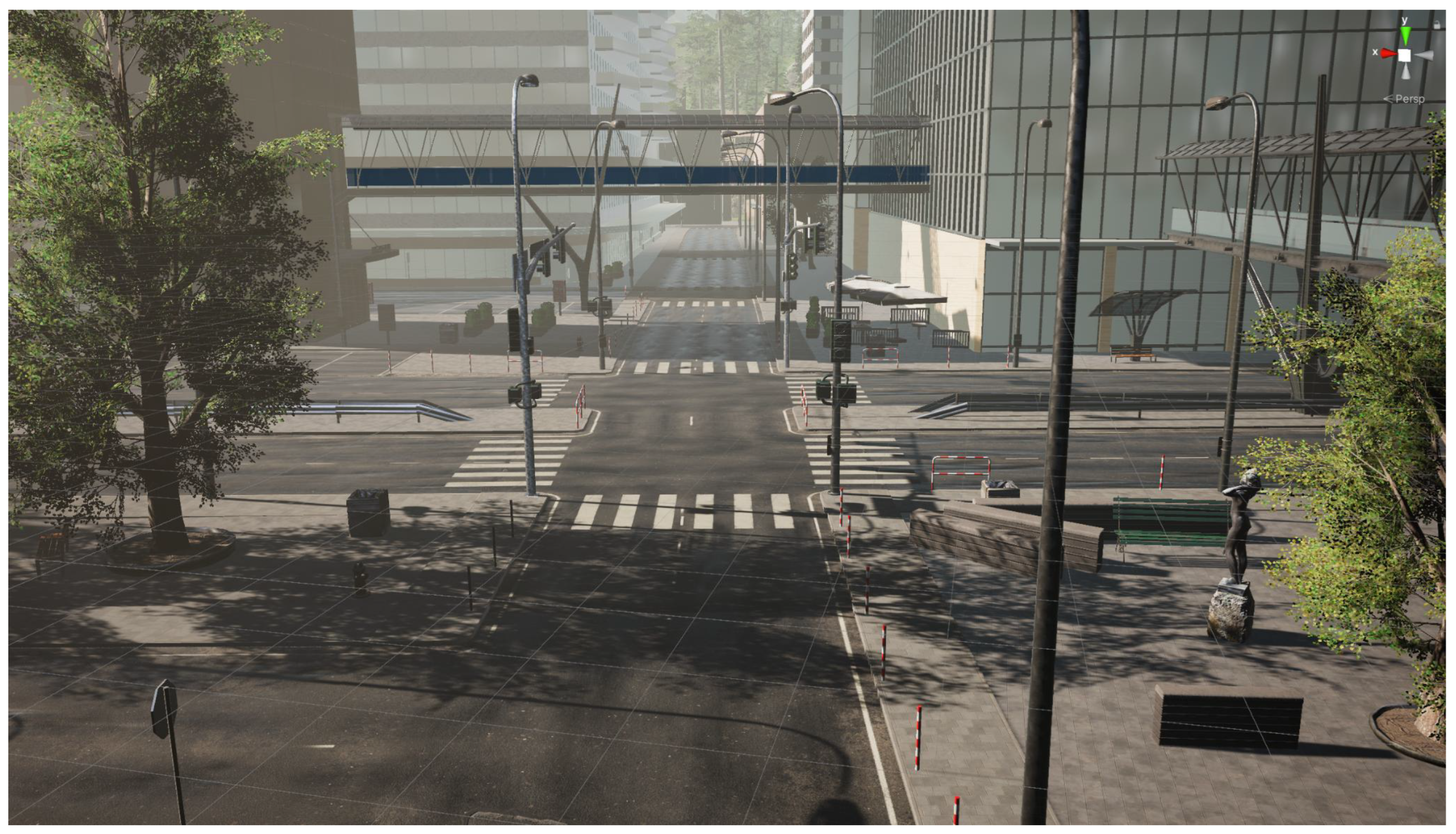
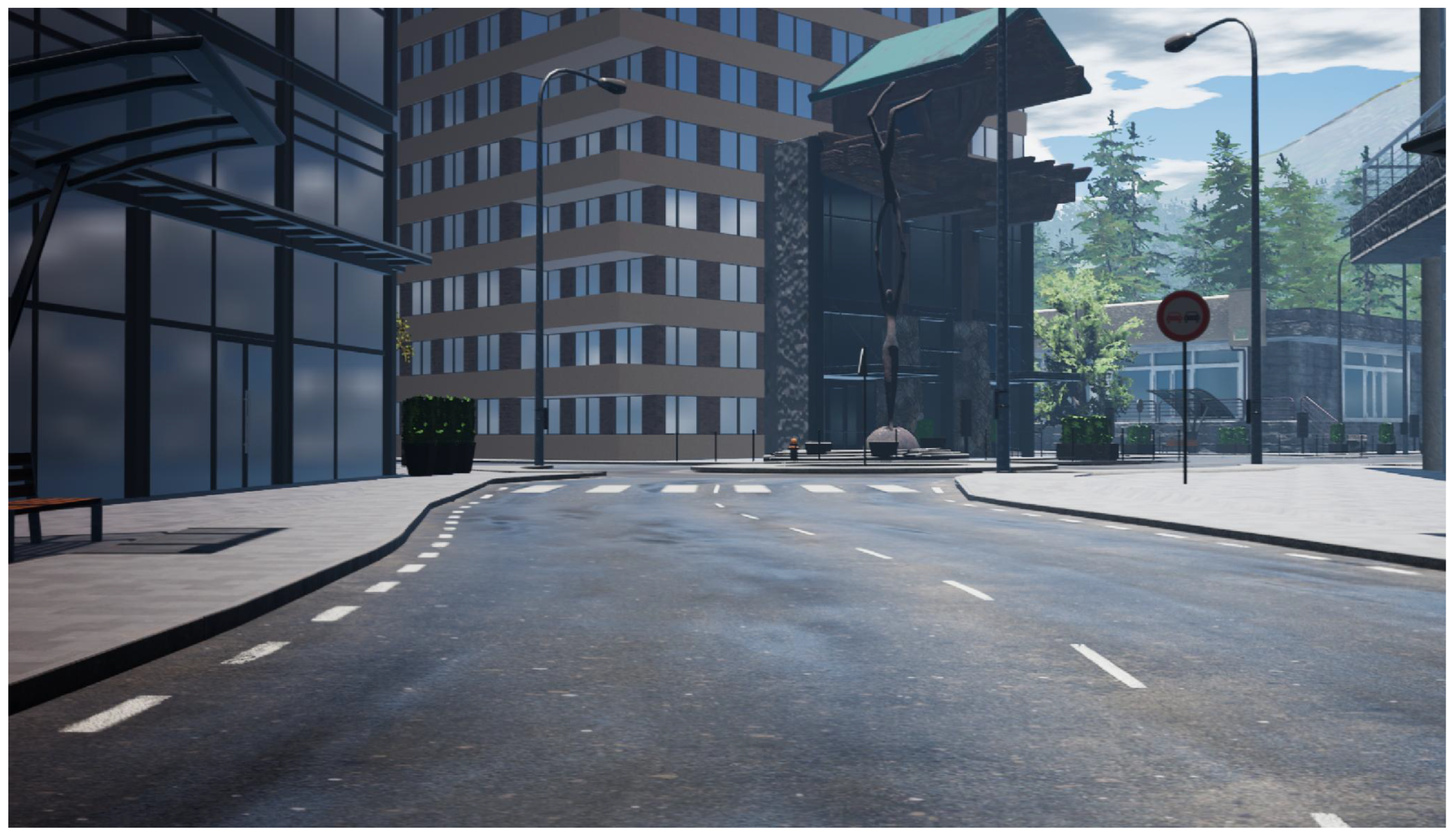
The driving simulation environment in this study is developed on the Unity platform and is designed to represent a typical urban road setting. A virtual city in that environment is constructed from the Unity asset Windridge City, which includes common urban features such as streetlights, intersections, and traffic signs. The city covers approximately 1.2 km × 0.8 km, and a 1.2 km circular urban route is used as the experimental course, yielding an average driving time of about five minutes. The route is generally flat, with an elevation difference of less than 1 m, and the overall layout of the route and the city is shown in Figure 2 and Figure 3. In the city, 30 traffic signs are placed along the route to simulate real-world driving conditions. To prevent participants from memorizing locations, the positions of the traffic signs are randomized at each map load, ensuring different spatial arrangements so that recognition relies on visual attention rather than memory.
To ensure physically realistic vehicle behavior, vehicle dynamics are modeled using Unity’s built-in wheel collider component to simulate realistic tire–road interactions [21]. The mass of each wheel is 20 kg, the radius is 0.35 m, and the suspension travel distance is 0.3 m. The damping rate is 0.25, and the suspension system uses a spring constant of 35,000 N/m and a damping coefficient of 4500 N/m. The target position is fixed at 0.5 to balance stability and responsiveness. The forward tire friction is modeled using a WheelCollider forward-friction curve with extremum slip 0.4, extremum value 1.0, asymptote slip 0.8, and asymptote value 0.5. The sideways tire friction is modeled with a separate curve with extremum slip 0.2, extremum value 1.0, asymptote slip 0.5, and asymptote value 0.75, with the stiffness coefficient set to 1.0 in both directions.

3.3. Visual Attention Prompt Methods Design

To examine the impact of different visual attention prompt methods on drivers’ attention and behavior, this study implements five visual attention prompt methods: Point, Arrow, Blur, Dusk, and a modified Attention Funnel (ModAF). These methods extend prior research on visual attention prompt methods, aiming to adapt previously validated mechanisms to a driving simulation scenario. The activation distance of the visual attention prompt methods is set to 32 m. According to the Japan Automobile Federation (JAF) [22], the stopping distance of a vehicle traveling at 50 km/h is approximately 32 m. Considering that the speed limit on ordinary roads in Japan is generally 40–60 km/h, 50 km/h was regarded as a representative driving speed. Based on this real-world reference, the activation distance in the simulator was set to 32 m.

3.3.1. Point

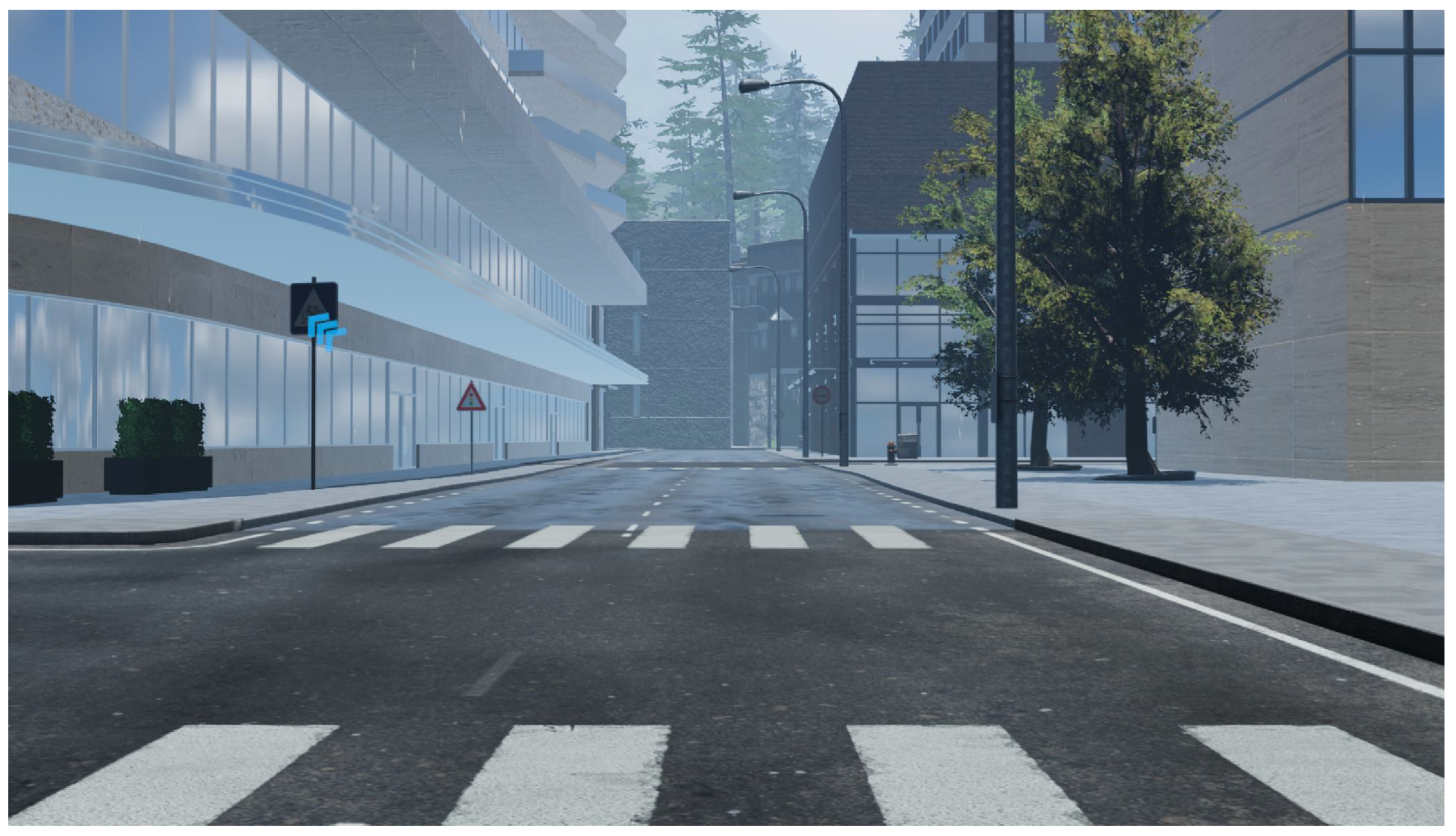
The Point method aims to guide drivers to focus their attention on task-relevant targets through locally high-contrast visual cues. Its design aligns with previous research on peripheral visual attention prompt methods, such as the work by Takahashi and Itoh [23], who demonstrate that a briefly presented visual stimulus in the peripheral field can prime attention and shorten response time to subsequent central visual events in driving simulations. Inspired by this principle, the Point method in our system uses a small blue dot that appears directly on the target traffic sign within the driver’s view, as shown in Figure 4. The blue color is chosen for its clarity and association with directive information in visual communication design [24]. In the simulation, this method activates when the vehicle approaches 32 m of the target and remains visible until the vehicle passes the target, providing a continuous yet unobtrusive reference for maintaining visual attention on critical areas.

3.3.2. Arrow

The Arrow method aims to utilize directional visual cues to guide drivers to gradually shift their attention towards targets closely related to the driving task during the driving process. The design of this method builds upon the findings of Ortega-Álvarez et al. [25], who demonstrate in immersive virtual environments that arrow-shaped visual cues can effectively draw the viewer’s gaze toward key information areas without disrupting the overall visual experience. Accordingly, in our system, a blue arrow is rendered at the screen center and moves smoothly along a straight path toward the target traffic sign, thereby indicating the intended locus of attention, as shown in Figure 5. The arrow appears when the vehicle approaches within 32 m of the target and disappears once the vehicle has passed it. The arrow position updates as follows:
P arw ( t ) = P arw ( t Δ t ) + P trg ( t ) P arw ( t Δ t ) Dist Sped · Δ t
where P arw ( t ) denotes the position vector of the arrow at time t, and P trg ( t ) represents the position vector of the target traffic sign, both expressed in screen coordinates. The parameters Sped and Dist correspond to the current vehicle speed and the distance from the vehicle to the closest point to the target, which is on the imaginary driving line, measured in the world coordinates of the virtual city. Δ t indicates the simulation refresh interval, which is set to 1 / 30 s.

3.3.3. Blur

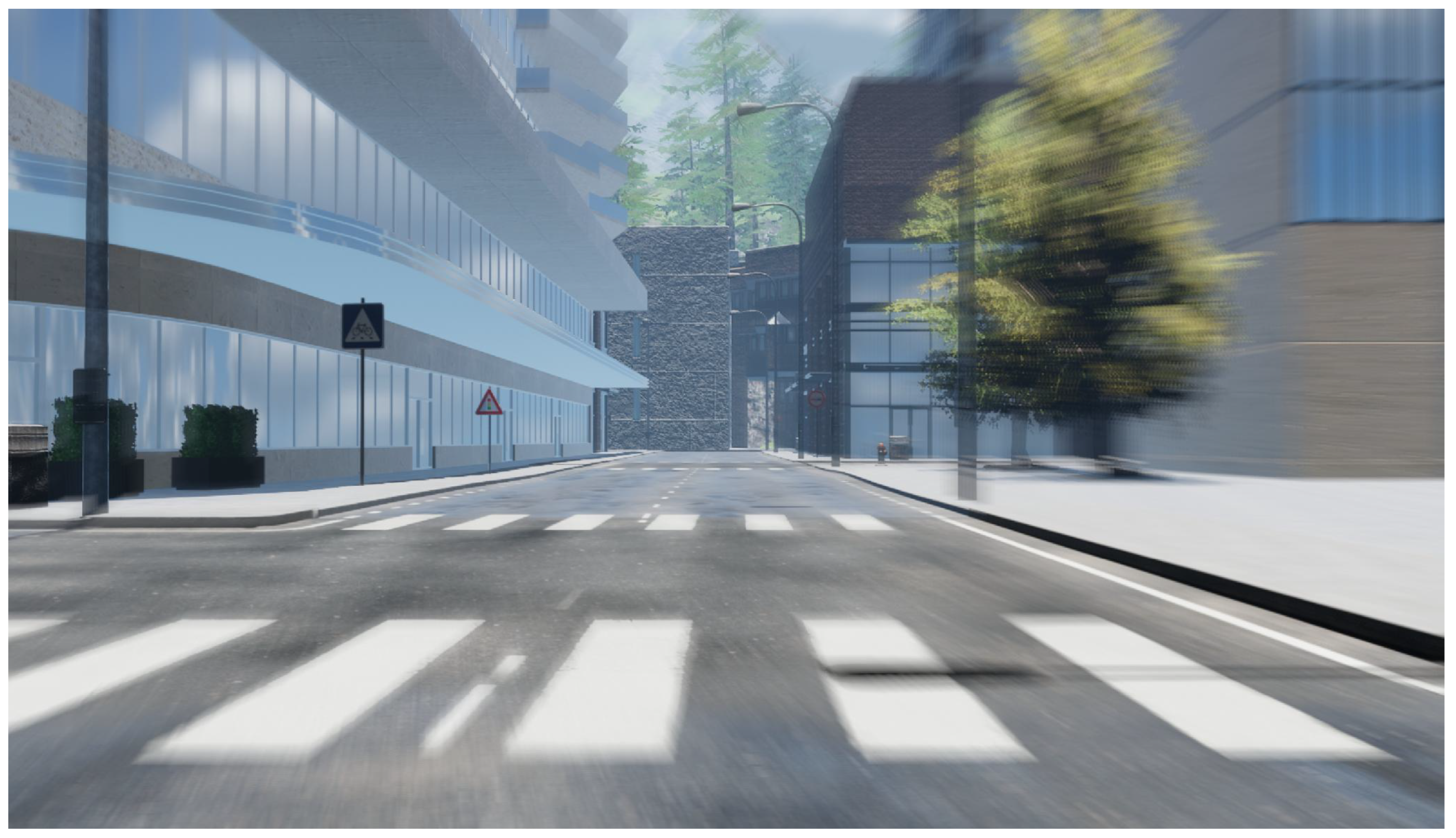
The Blur method guides drivers’ attention toward target areas by adjusting the intensity of visual clarity of non-target regions in the scene. Hata et al. [26] demonstrate that subtle control of visual clarity can effectively direct viewers’ attention to clear regions of an image without impairing overall visual perception. In our system, the Blur method applies a blur effect to the scene. As the distance between the position of the target traffic sign in the screen coordinates and each processing pixel increases, the intensity of the blur effect gradually increases, as illustrated in Figure 6. This mechanism allows drivers to naturally focus on the target traffic sign while maintaining overall visibility of the surrounding environment. The blur effect activates when the vehicle approaches within 32 m of the target and lasts for 1.0 s to prevent visual fatigue or dizziness. The computation of the blur effect is expressed as follows:
I out ( i , j ) = x y G ( x , y , i , j ) × I in ( i x , j y )
G ( x , y , i , j ) = 1 2 π σ ( i , j ) 2 × e x 2 + y 2 2 σ ( i , j ) 2
σ ( i , j ) = w cnt ( x trg i ) 2 + ( y trg j ) 2
where I out ( i , j ) denotes the output image at pixel ( i , j ) in the screen coordinates after applying the blur effect. It is obtained by aggregating the weighted contributions of neighboring pixels using the Gaussian blur function G ( x , y , i , j ) . I in ( i x , j y ) represents the input image intensity at the relative position ( i x , j y ) to pixel ( i , j ) . ( x trg , y trg ) specifies the coordinates of the target traffic sign on the screen. The constant w cnt is a scaling coefficient set to 0.141, which controls the spread of the blur kernel relative to the distance from the target position.

3.3.4. Dusk

The Dusk method guides drivers’ attention toward targets by applying a gradual peripheral shading around them. Similar attention-guidance techniques are used in immersive video research. For example, Danieau et al. [27] propose a “Fade-to-Black” effect in head-mounted display environments, in which peripheral regions are progressively darkened to emphasize the central area and direct viewers’ attention toward the region of interest. Accordingly, in our system, the Dusk method adopts a milder peripheral shading transition to maintain peripheral visibility while ensuring stable guidance toward the target traffic sign, as illustrated in Figure 7. The visual effect activates when the vehicle approaches within 32 m of the target and lasts for 1.0 s. During this period, the shadow intensity smoothly decreases from 0.141 to 0.0 (from 0.0 without shadows to 1.0 in complete darkness), ensuring that the peripheral area remains visible when attention is drawn to the illuminated target area. The adjustment of shadow intensity is calculated as follows:
I adj ( x , y ) = I org ( x , y ) × 1 w int × d ( x , y ) d max
d ( x , y ) = ( x trg x ) 2 + ( y trg y ) 2
where I adj ( x , y ) represents the adjusted pixel intensity at the screen coordinates ( x , y ) , and I org ( x , y ) denotes the original image intensity. d ( x , y ) is the distance between the target position ( x trg , y trg ) and the current pixel ( x , y ) , while d max indicates the maximum distance from the target to any pixel on the screen, serving as a reference for intensity scaling. The variable w int controls the darkness level, ranging from 0.0 to 1.0, and is set to 0.141 in this study.

3.3.5. ModAF

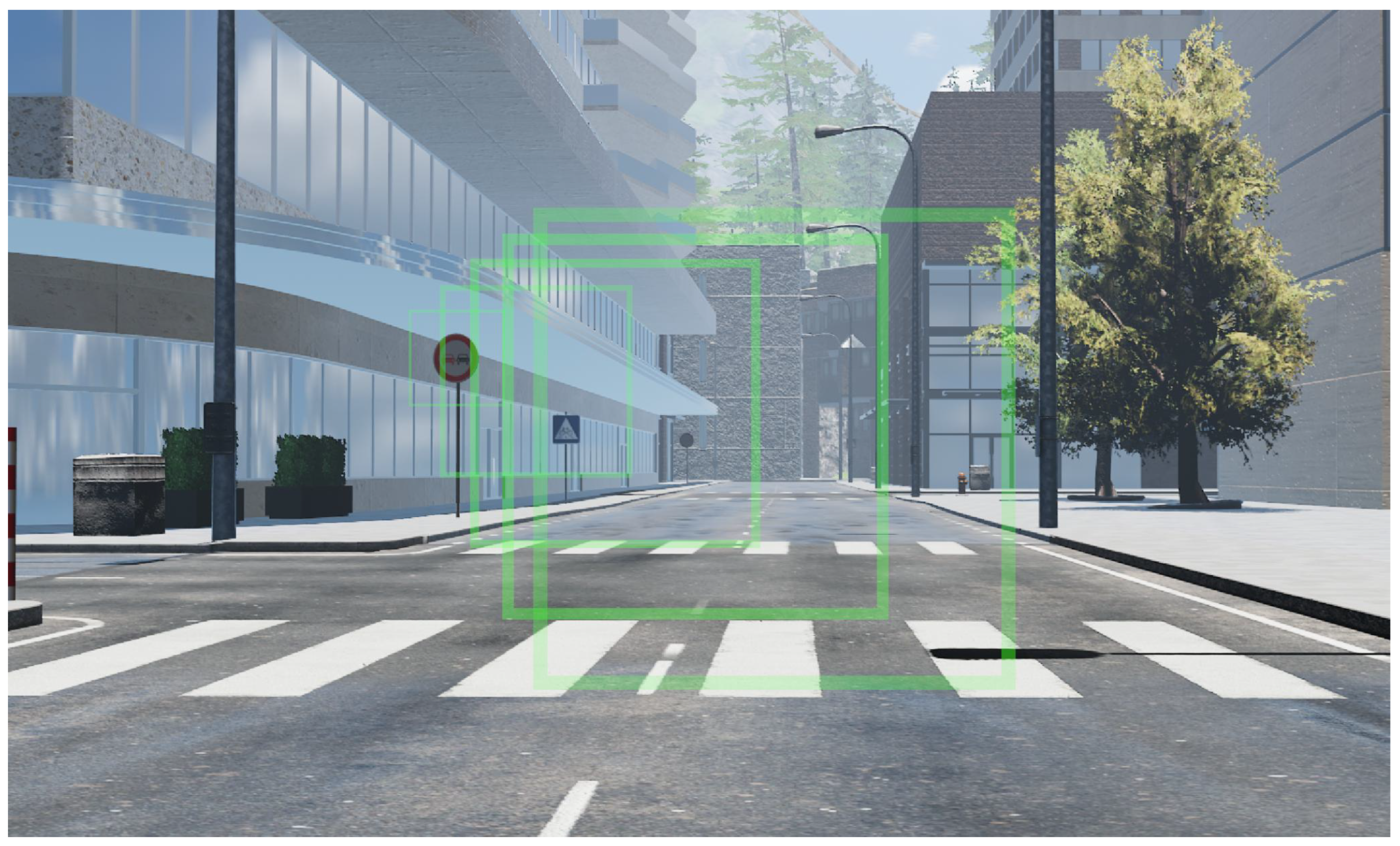
The ModAF method in this study extends and refines the original Attention Funnel [12] technique, which was originally developed to guide users’ attention in immersive and stereoscopic environments. On this basis, this study has made improvements to its planarization, making it suitable for driving simulators with non-stereoscopic flat displays. Our system renders five light-green squares whose center is on an imaginary line between the driver (the screen center) and the target traffic sign. Their relative positions along the line from the driver to the target are set to 0.0, 0.25, 0.5, 0.75, and 1.0, as illustrated in Figure 8. The size of those squares corresponds to 31.25%, 25.00%, 18.75%, 12.50%, and 6.25% of the screen width, which translates to the side lengths of 600, 480, 360, 240, and 120 pixels, respectively. To minimize visual obstruction, the opacity of each square is set to 50%. The visual cue appears when the vehicle approaches within 32 m from the target traffic sign and disappears once the vehicle passes it. The position of each square is calculated as follows:
P sqr ( i ) = d ( i ) × ( P trg P ctr ) + P ctr
where P sqr ( i ) denotes the position vector of the i-th square in the screen coordinates, d ( i ) takes values of 0.0, 0.25, 0.5, 0.75, and 1.0, P trg represents the position of the target traffic sign, and P ctr corresponds to the position of the screen center.

4. Experiment

4.1. Objective

The experiment aims to achieve the following objectives:
  • Evaluate the short-term transfer effect of different visual attention prompt methods in a driving simulation scenario, and examine whether the continuity of the promoting effect in attention allocation can be maintained even after the methods are disabled.
  • Explore the differences in response between novice and proficient drivers to these visual attention prompt methods in order to clarify the impact of population specificity.

4.2. Participants

A total of 18 male participants (aged 20–26 years; M = 23.1, SD = 1.9) participated in the experiment. Based on their driving experience, they were divided into two groups. The licensed driving group (N = 9) consisted of participants who already hold a valid driver’s license, while the unlicensed driving group (N = 9) consisted of participants who are currently undergoing driving training or preparing for a driver’s license exam. No participants reported any visual impairments or previous use of a driving simulator.
Participants were recruited within the institute through verbal and online invitations, and they were undergraduate and graduate students from various academic disciplines at Fukuoka Institute of Technology. Participants were required to have normal or corrected vision and be able to clearly observe the screen and visual attention prompt methods. Individuals who could not clearly perceive the displayed information were excluded from the experiment. Participation in the study was voluntary, and participants were informed that they could withdraw from the experiment at any time if they felt discomfort. The study was conducted in accordance with the ethical approval obtained from the Ethics Committee of Fukuoka Institute of Technology. Only male participants were included due to the limited availability of female volunteers with comparable driving experience during recruitment. The potential limitation will be further discussed in Section 7.4.

4.3. Experimental Procedure

Before the experiment, the eye tracker was calibrated, and participants were given approximately five minutes of practice driving time to familiarize themselves with the vehicle control and simulator interface. In all three driving laps, participants were instructed to focus their attention on the road ahead and observe traffic signs that appeared.
  • First lap (baseline driving): Participants drive without any visual attention prompt methods. The eye tracker is activated to record their natural gaze behavior while driving. The data in this lap serves as a baseline for future comparisons.
  • Second lap (visual attention prompt method presentation): The system randomly selects and presents a visual attention prompt method. The eye tracker is turned off to prevent potential interference with visual attention prompt methods. This lap aims to guide participants to form specific attention allocation patterns.
  • Third lap (post-test driving): The visual attention prompt method is disabled, the eye tracker is reactivated, and the participants continue driving under the same conditions. This lap is used to observe how the formed attention allocation pattern is maintained after disabling the method.
A series of three consecutive laps mentioned above is called a single session, and the participants perform every single session for each visual attention prompt method. Each participant performs five sessions (five visual attention prompt methods), and the order of the methods is randomly assigned by the system. Participants are given a 5 min break between consecutive sessions during which they can relax and rest their eyes. The duration of the break is set with reference to Lim and Kwok [28], who report that short rest intervals, such as around five minutes, can effectively mitigate attentional fatigue and help maintain stable performance in subsequent tasks. In addition, the locations of traffic signs that appear during each lap are random to prevent participants from remembering their positions and reduce potential learning effects in the experiment.
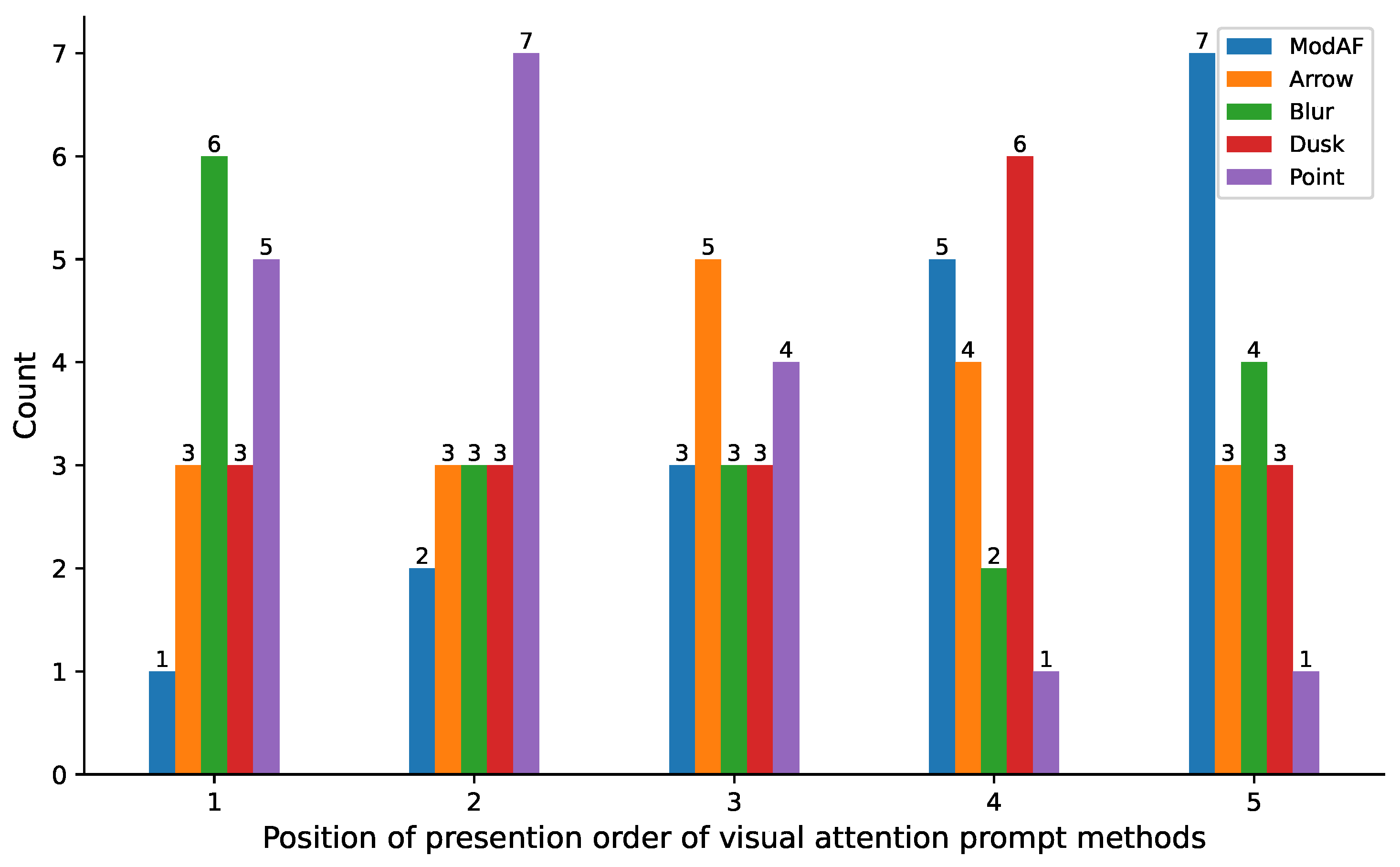
In addition, the distribution of the presentation order of the five visual attention prompt methods across participants is illustrated in Figure 9. The horizontal axis denotes the position of the presentation order of visual attention prompt methods, and the vertical axis denotes the count of presentations at each position for each visual attention prompt method. Each method appeared at multiple positions in the experimental sequence across participants. Minor variations in frequency occurred due to random assignment and the limited sample size. This potential imbalance and its possible implications for the interpretation of the results are further addressed in Section 7.2.

5. Data Collection and Analysis

5.1. Data Collection

In total, 180 laps of eye-tracking data are collected, corresponding to approximately 12 h of recorded driving time, which is recorded at sampling rates of 1200 Hz.
18 participants × 5 methods × 2 driving laps ( 1 s t , 3 r d ) = 180 valid driving data samples .
The eye-tracking data includes participant identification, time stamps, gaze points, pupil size in diameter, and data validity flags. In addition, the variables of Hit, Number, Targetpos_x, and Targetpos_y describe whether the current gaze point intersects a target traffic sign, the index of that sign, and its screen coordinates, respectively. In the driving simulation scenario, target traffic signs enter the 32 m detection window one at a time; the following target traffic sign appears only after the previous one has been passed. At any given moment, there is only one target traffic sign presented to drivers. Each period for a target traffic sign is called a trial. In this way, these variables can be interpreted unambiguously as referring to a single traffic sign and together provide a comprehensive description of visual attention behaviors. Table 1 summarizes the detailed contents of data entries.

5.2. Data Analysis Methods

5.2.1. Survival Analysis of Target Detection Time

Previous studies have shown that Time to Fixate (TTF) [14] effectively reflects drivers’ response speed to critical targets and serves as an important indicator for evaluating the efficiency of attention allocation. To emphasize the meaning of TTF in the context of our study, we call it Time to First Hit (TTFH), which is the time elapsed from the moment when a target traffic sign enters the detection window (32 m) to the moment when drivers’ gaze hits the traffic sign for the first time. To describe the temporal characteristics of drivers’ first attention allocation, let T i denote TTFH for the i-th trial, and let δ i denote whether the drivers succeed in making a hit or not.
δ i = 1 , if a hit occurred , 0 , if no hit occurred .
Note that when the value of δ i is zero, the value of T i is given by the full duration of the detection window for that trial, which is the elapsed time from the moment when the traffic sign enters the 32 m detection window to the moment when it leaves that window. Thus, the observed data consist of a pair of ( T i , δ i ) for the i-th trial. From a sequence of pairs, the survival function (Kaplan–Meier method [29]) S ( t ) is obtained, which represents the probability that drivers have not yet fixated on target traffic signs until the given time t.

5.2.2. Analysis of Changes in Visual Attention Distribution

To analyze changes in visual attention allocation between the first and third laps under different visual attention prompt methods, this study employs a log-odds transformation. This transformation is widely used in probabilistic modeling and medical image analysis [30]. It transforms probability distributions into a linear vector space, facilitating operations such as addition and scaling. In our study, the difference in log-odds( Δ log-odds) of fixation probability distributions of the third lap from the first one is calculated to quantitatively assess the degree of increase or decrease in fixation probability. To calculate the Δ log-odds, each fixation point ( g x , g y ) is first converted into a target-centered coordinate system relative to the target (traffic sign) position ( t x , t y ) :
d x = g x t x , d y = g y t y
Subsequently, all fixation points ( d x , d y ) are accumulated to construct a two-dimensional histogram H ( x , y ) , which is the number of fixation points at position ( x , y ) in the target-centered coordinate system. It is then normalized to obtain the fixation probability distribution:
p ( x , y ) = H ( x , y ) i , j H ( i , j )
where the summation in the denominator runs over all discrete positions ( i , j ) . The Δ log-odds between the first and third laps are then calculated for each position as
Δ log - odds ( x , y ) = log p t ( x , y ) 1 p t ( x , y ) log p f ( x , y ) 1 p f ( x , y )
where p f ( x , y ) and p t ( x , y ) denote the fixation probabilities in the first and third laps, respectively. A positive value of Δ log-odds ( x , y ) indicates an increase in fixation probability from the first to the third lap, whereas a negative value represents a decrease. This transformation provides a symmetric and scale-independent measure of attentional redistribution, enabling stable comparisons across participants and visual attention prompt methods.

5.3. Clustering Analysis of Responder Types to Different Visual Attention Prompt Methods

In our study, for each driver and each visual attention prompt method, four key performance indicators (KPIs) are calculated at each trial: hit rate (AnyHit), time-to-first-hit (TTFH), dwell proportion (DwellProp), and number of hit entries (HitEntries). For each trial, AnyHit equals 1 if the gaze intersects the target traffic sign at least once and 0 otherwise. DwellProp is the proportion of a duration in which the gaze lies within the target traffic sign to the duration of the trial. TTFH is the elapsed time from the appearance of the target traffic sign to the moment when the gaze intersects it for the first time (and equals the duration of the trial if no intersection occurs). HitEntries is the number of 0 1 transitions into the target traffic sign within the trial. Each of these four KPIs is averaged across 30 traffic signs at each lap (1st and 3rd), each driver, and each visual attention prompt method. The difference ( Δ ) of these KPIs between the first ( 1 s t ) and third ( 3 r d ) laps is computed for each driver and each visual attention prompt method, where positive values indicate improvement in driving performance:
Δ AnyHit = AnyHit 3 r d AnyHit 1 s t
Δ TTFH = ( TTFH 3 r d TTFH 1 s t )
Δ DwellProp = DwellProp 3 r d DwellProp 1 s t
Δ HitEntries = ( HitEntries 3 r d HitEntries 1 s t )
The four Δ indices ( Δ AnyHit , Δ TTFH , Δ DwellProp , and Δ HitEntries ) are concatenated to form a feature vector for each driver and each visual attention prompt method.
To absorb extrinsic factors such as susceptibilities and familiarity to driving activities from novice drivers (or proficient ones) to clarify properties of their visual attention allocation, novice drivers (or proficient ones) are partitioned into K clusters by minimizing the within-cluster sum of squared errors:
min { C k } k = 1 K x d C k x d μ k 2
where x d denotes the feature vector of driver d across all five methods and μ k represents the centroid of cluster C k . The optimal number of clusters K is determined using the silhouette coefficient to ensure clear separation and internal consistency.
After clustering, this study applies Principal Component Analysis (PCA) [31] within each cluster to determine the relative contributions of the four indicators to behavioral variation. For each cluster C, the four Δ indices at each visual attention prompt method m are standardized as follows:
z m , C ( n ) = x m , C ( n ) x ¯ , C ( n ) σ , C ( n ) ,
where x m , C ( n ) denotes the mean value of the Δ index n for method m in cluster C, and x ¯ , C ( n ) and σ , C ( n ) are the mean and standard deviation of that index across methods within the cluster C. The first principal component is extracted for each cluster C, and the normalized absolute loadings w C ( n ) are used as follows:
w C ( n ) = p C ( n ) [ 1 ] i = 1 4 p C ( i ) [ 1 ] .
where p C ( n ) [ 1 ] denotes the loading to the index n of the first principal component. Finally, the PCA-weighted score of each method within cluster C is calculated as follows:
S m , C = n = 1 4 w C ( n ) z m , C ( n ) .
where S m , C denotes the score of visual attention prompt method m in cluster C, w C ( n ) is the normalized weight of index n derived from the first principal component within cluster C, and z m , C ( n ) is the standardized mean value of index n for method m within cluster C.

6. Results

6.1. Result of Survival Analysis of Target Detection Time

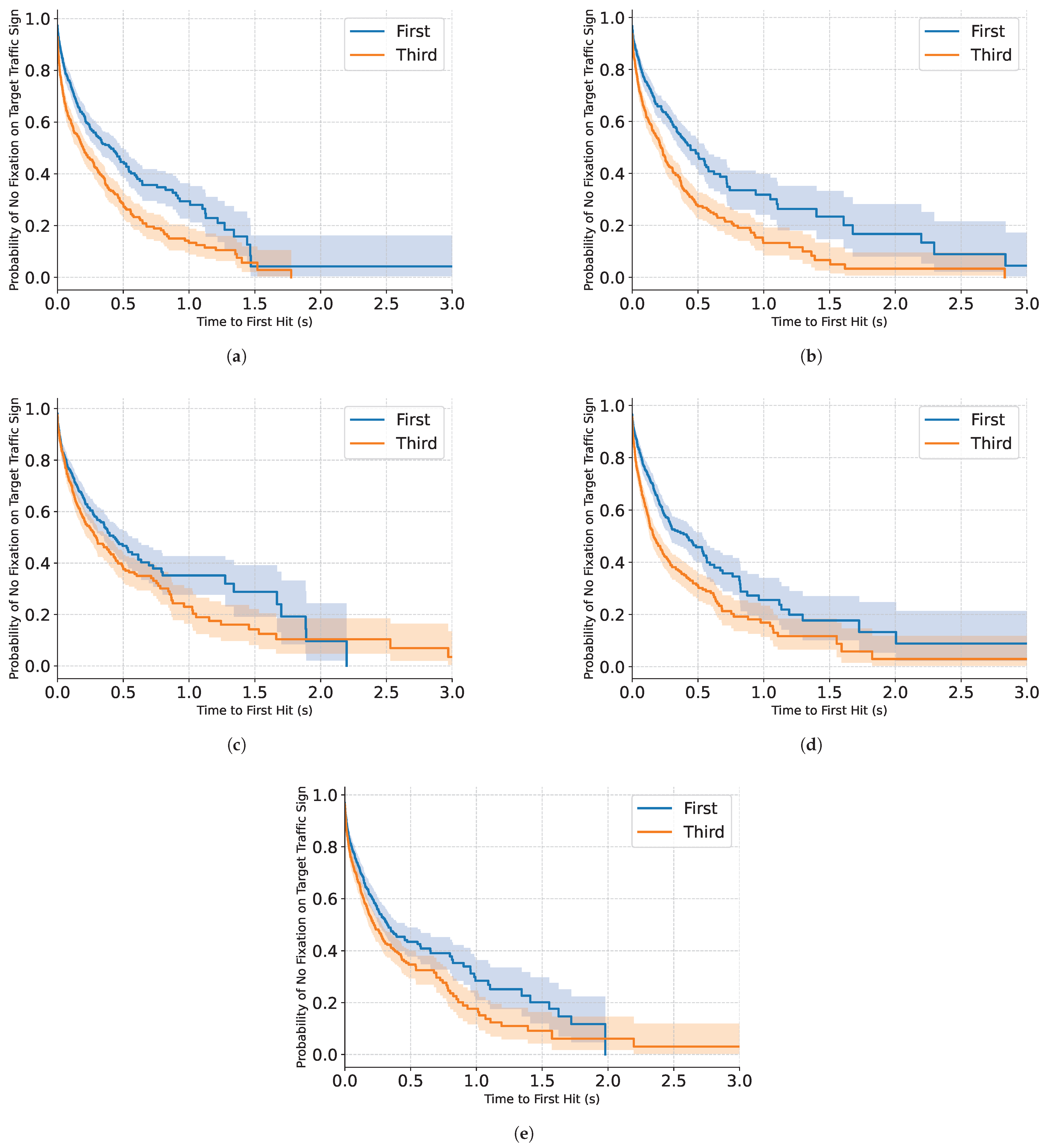
To compare drivers’ target detection speeds under different visual attention prompt methods, this study constructed a survival curve based on TTFH to describe the temporal distribution of first hits on the target. Figure 10 showed five survival curves. Each survival curve comes from the visual attention prompt method for the 1st and 3rd laps. In these curves, the vertical axis represented the survival probability S ( t ) , namely the probability that drivers had not yet fixated on the target traffic signs until the given time t, and the horizontal axis represented the elapsed time t from the appearance of the target traffic signs. The blue curve corresponded to the first lap, and the orange one corresponded to the third one. The shaded area around each survival curve indicates a 95% confidence interval. As the elapsed time t progressed, S ( t ) decreased, which implied that the probability of detections increased over time t. Therefore, the faster the survival curve dropped, the earlier drivers achieved fast hits, indicating higher detection efficiency and faster visual response.
As shown in the figure, the survival curves for all five visual attention prompt methods in the third lap dropped faster than those in the first lap. This indicated that even if the prompt methods were disabled, drivers fixated on target traffic signs earlier because of a short-term transfer effect on target detection.
Specifically, except for Blur, all the other methods showed pronounced drops of the survival probability in the third lap, rapidly to below 0.2 within 1 s. This suggested that these spatially guided methods could significantly accelerate drivers’ first fixation responses and maintain high efficiency of target detection even after the prompt methods were disabled. For the Point and Arrow methods, the survival curve showed a comparatively large reduction at the third lap from the first one during the early period of 1.0 s. The reduction in this early period was most prominent for these two methods, demonstrating the possibility of a stronger and more stable short-term transfer effect on target detection performance.
For the Dusk method, the survival curve showed a relatively fast drop at the very early period of 0.25 s. However, the reduction was less pronounced than that observed for the Point and Arrow methods. For the ModAF and Blur methods, the survival curves showed a relatively small gap between the first and third laps compared with the other methods.

6.2. Results of Visual Attention Distribution Changes Across Driver Proficiency

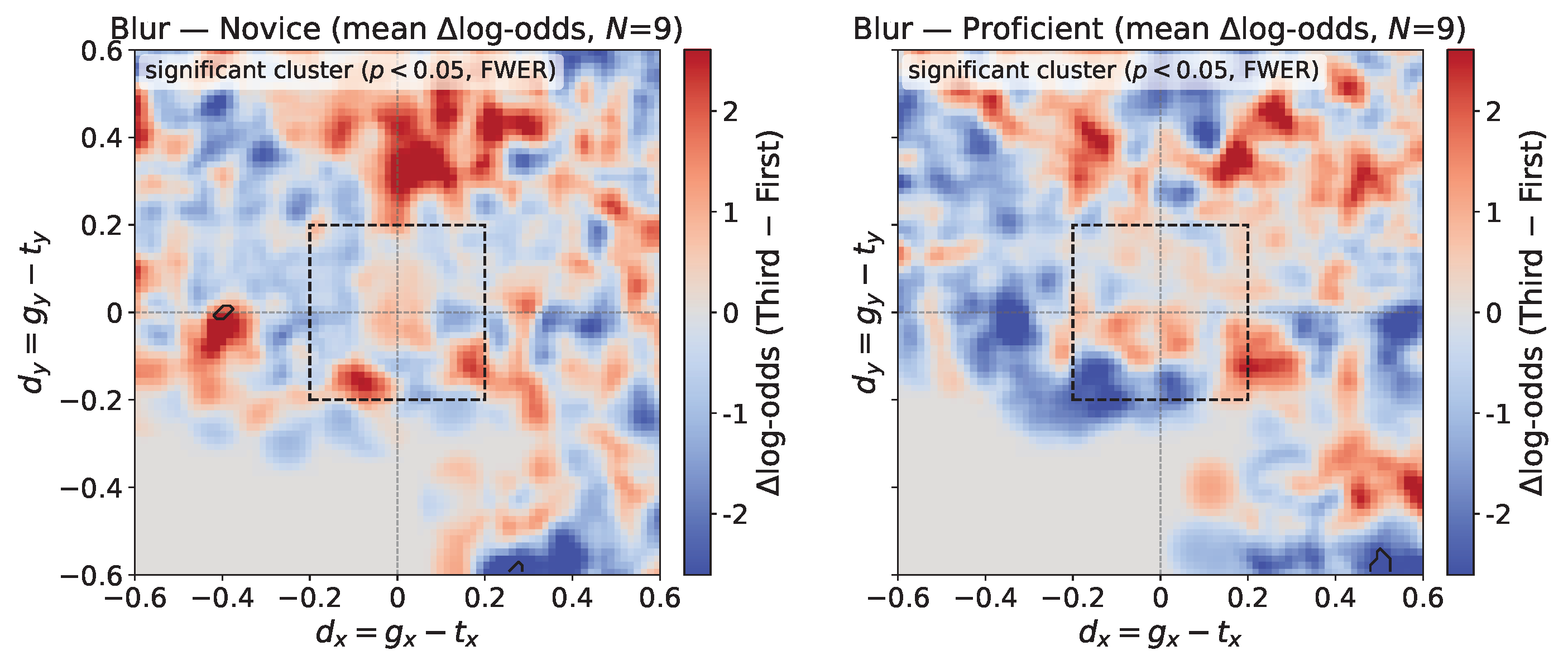
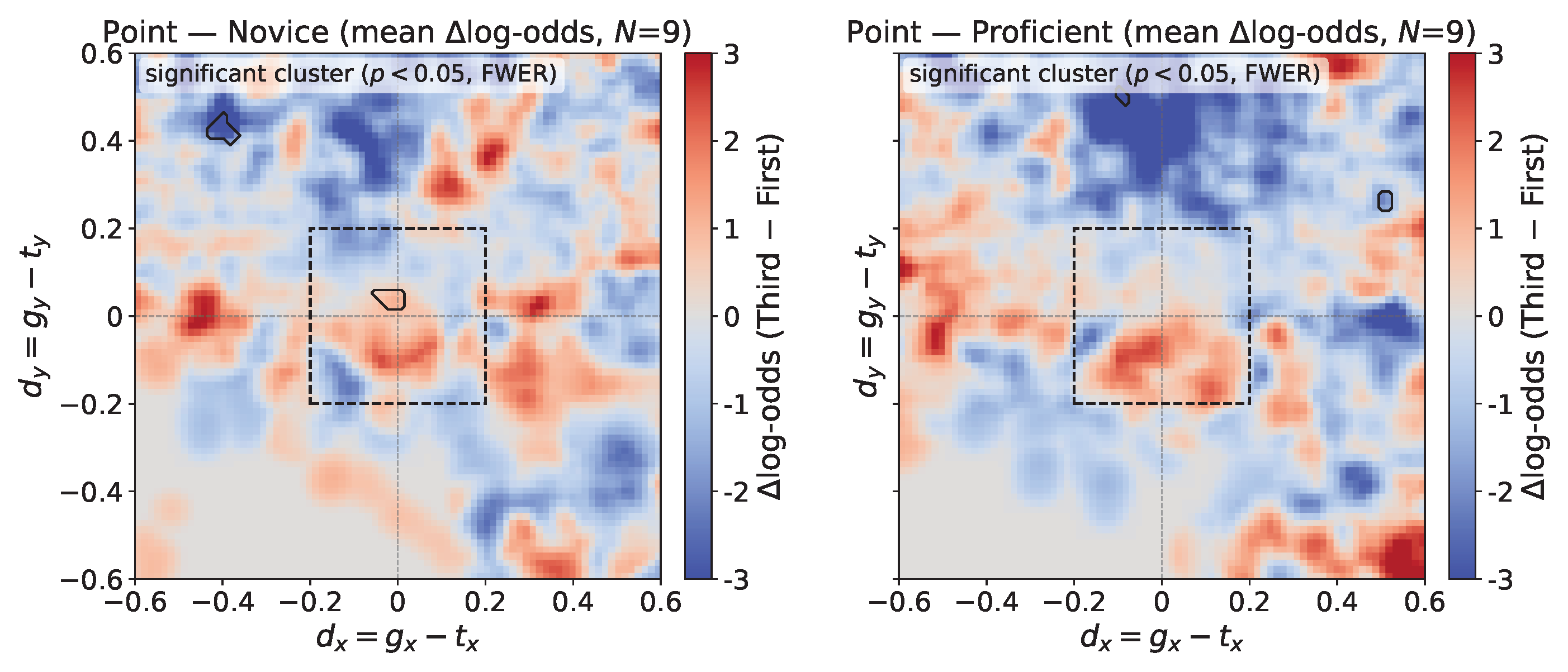
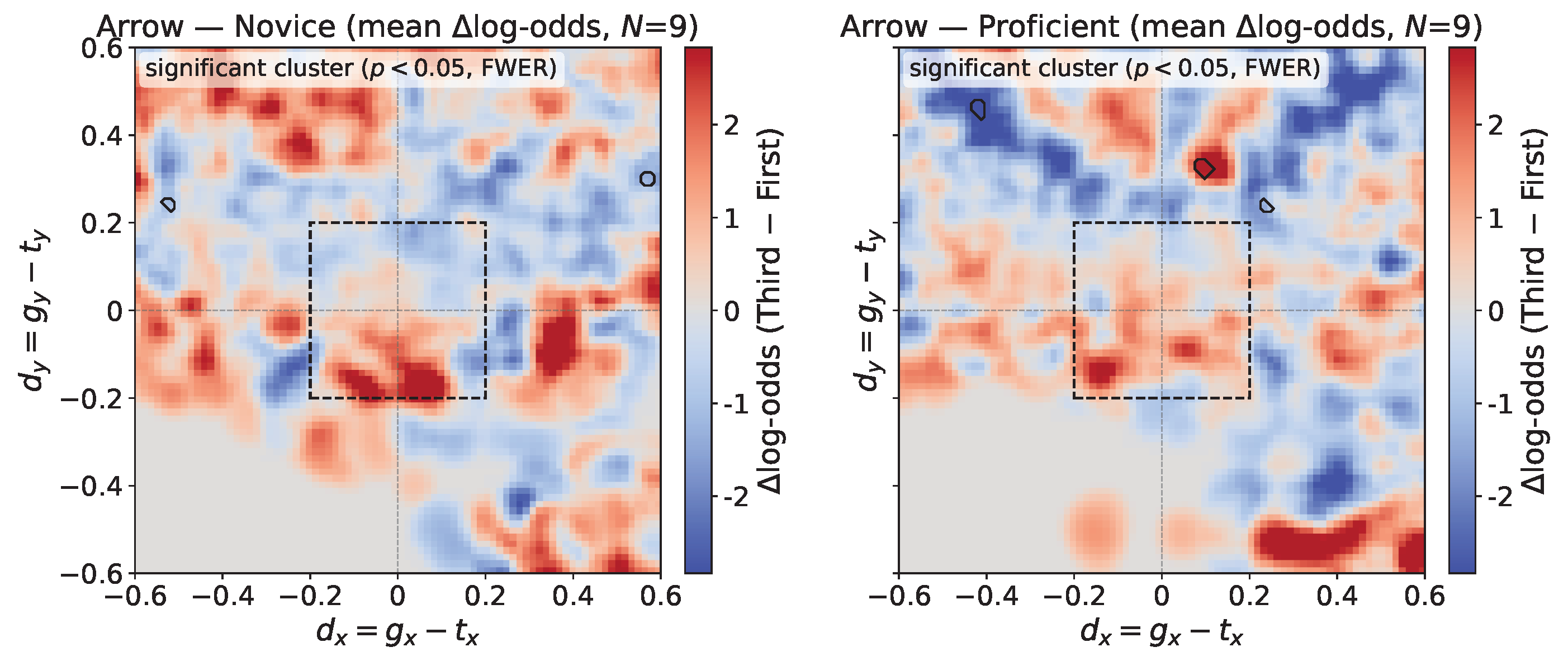
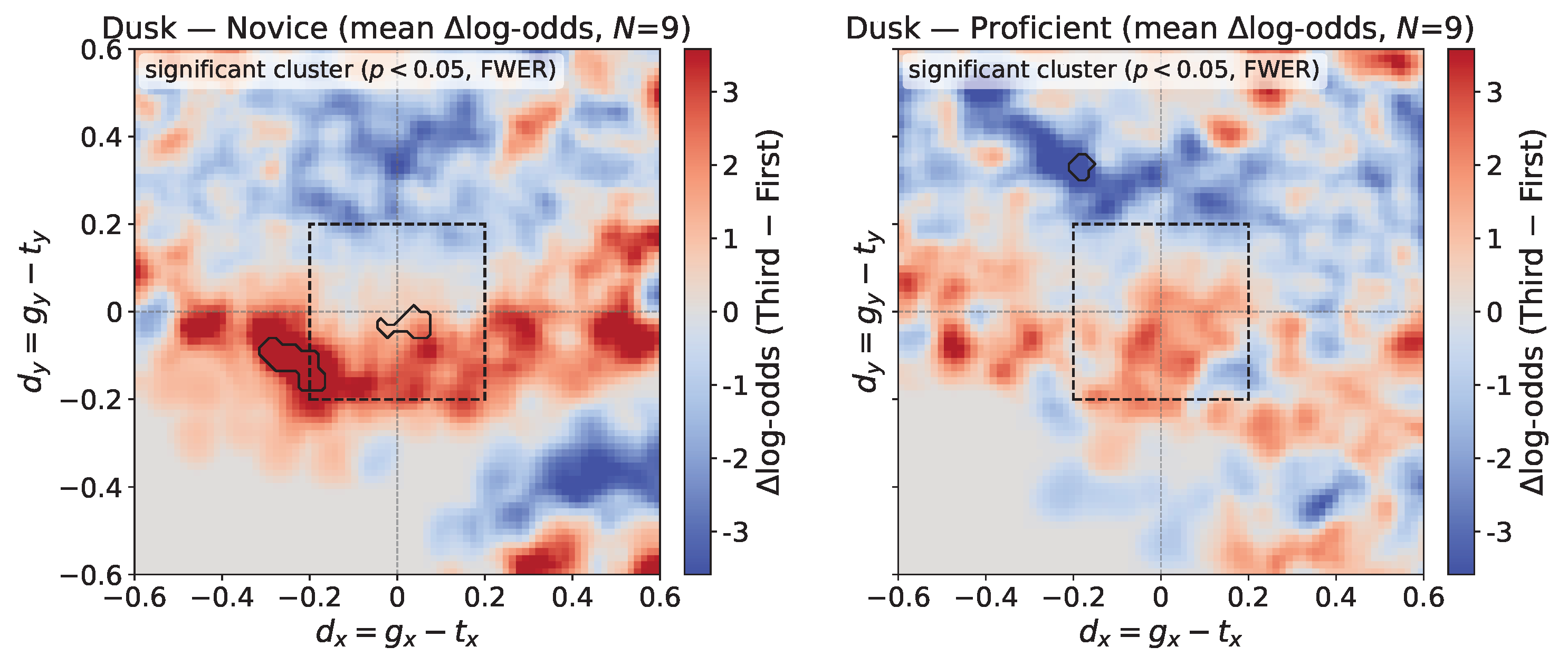
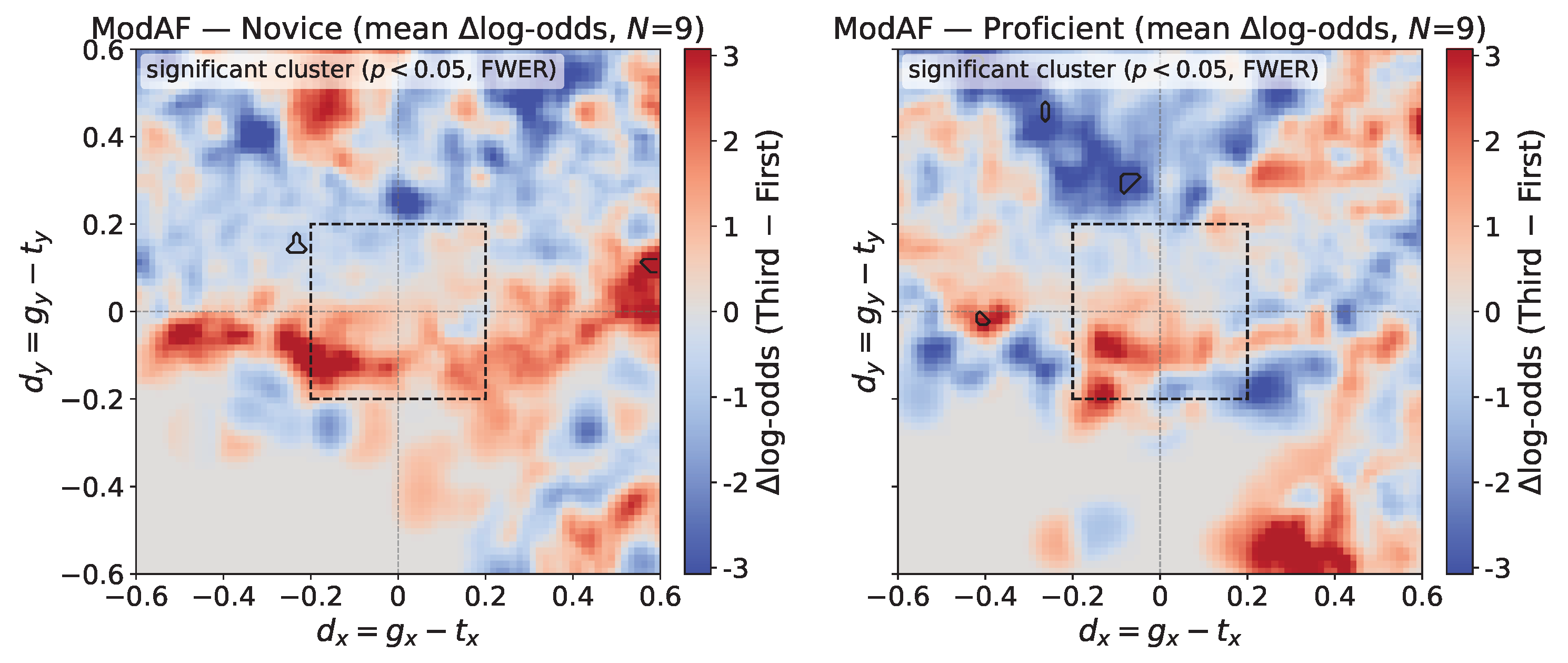
To demonstrate the effects of different visual attention prompt methods on changes in visual attention allocation during driving, Δ log-odds maps between the first and third laps were generated for novice and proficient drivers under each prompt method. In these maps, the coordinate origin ( 0 , 0 ) represented the position of the target traffic sign. The horizontal axis d x denoted the horizontal fixation offset relative to the target, and the vertical axis d y denoted the vertical fixation offset. The dashed square delineated the target region ( d x , d y [ 0.2 , 0.2 ] ), which corresponded to the central 1 5 portion of the display whose physical dimensions were 10.54 cm in width and 5.93 cm in height. It led to a visual angle of 9.3 degrees to the display at a distance of 65 cm from the driver. It effectively covered the visual angle of 1.1 degrees of the fovea image of the eye. This target region was highlighted to facilitate interpretation of changes in attention allocation. The analysis focused on the target region to directly reflect target-oriented attention allocation. Each coordinate was encoded in color, indicating the change in fixation probability in the third lap relative to the first one. Warm colors (red areas) denoted regions where fixation probability increased, while cold colors (blue areas) denoted regions where it decreased. Black contour lines indicated significant regions identified by cluster-based permutation tests (p < 0.05, FWER-corrected).
The maps shown in Figure 11 illustrate the changes in visual attention allocation between the first and third driving laps for novice and proficient drivers under the Point method. For novice drivers, a warm-colored area was observed within the target region, accompanied by a significant cluster, indicating that the fixation probability near the target traffic sign significantly increased in the third lap compared with the first one. This finding was further supported by the central AOI analysis, which showed a mean Δ log-odds of 0.81 (p < 0.05), with 77.8% of novice drivers exhibiting positive shifts toward the target center. In contrast, for proficient drivers, the target region also contained warm-colored areas, suggesting an increased fixation probability for the target traffic sign. However, no clear cluster-level significant contour was detected. This suggested that the Point method might have less impact on proficient drivers than novice drivers.
The maps shown in Figure 12 illustrate the changes in visual attention allocation between the first and third driving laps for novice and proficient drivers under the Arrow method. For novice drivers, it could be observed that a warm-colored area appeared below the origin in the target region, indicating their tendency to focus more on the target traffic sign in the third lap. In contrast, proficient drivers exhibited a small warm color area in the target region, indicating that their attention allocation remained relatively stable between the two laps. Compared with the previous Point method, the variation pattern of the Arrow method seemed to be more concentrated around the origin and showed more obvious diffusion along the horizontal axis. This might indicate that under the Arrow method, drivers often locate and confirm target traffic signs by adjusting their gaze and scanning in the left and right directions; that is, quickly guiding their gaze to the adjacent area of the target traffic sign.
The maps shown in Figure 13 illustrate the changes in visual attention allocation between the first and third driving laps for novice and proficient drivers under the Blur method. For novice drivers, only a weakly warm-colored area appeared near the origin in the target region. For proficient drivers, a weak warm-colored area appeared near the origin, similarly to the novice one. Overall, the Blur method was not likely to produce an attentional focusing effect for either group of drivers, as the color distribution around the target region remained relatively uniform. In contrast, outside the target region, warm-colored areas and cold-colored areas were more evenly scattered across the map for both novice and proficient drivers. This spatially dispersed distribution would suggest that the Blur method may have induced diffuse, non-target-specific changes in gaze points.
The maps shown in Figure 14 illustrate the changes in visual attention allocation between the first and third driving laps for novice and proficient drivers under the Dusk method. For novice drivers, the target region contained a large warm-colored area accompanied by significant clusters, indicating a significant increase in fixation probability near the target traffic sign in the third lap compared with the first. This finding was further supported by the central AOI analysis, which showed a mean Δ log-odds of 0.78 (p < 0.05), with all novice drivers exhibiting positive shifts toward the target center. In contrast, for proficient drivers, the target region showed only a limited warm-colored area. In addition, for novice drivers, the warm-colored area was widened horizontally, resembling the pattern found under the Arrow method. This pattern might be because the Dusk method would reduce the salience of areas outside of the target region in the top and bottom areas, thereby biasing gaze toward the target traffic sign and promoting horizontal adjustment for it.
The maps shown in Figure 15 illustrate the changes in visual attention allocation between the first and third driving laps for novice and proficient drivers under the ModAF method. For both novice and proficient drivers, the target region contained a warm-colored area, suggesting an increase in fixation probability near the target traffic sign in the third driving lap compared with the first one. In addition, novice drivers showed a wide, warm-colored area horizontally, the same as the Dusk method, whereas this was not observed for proficient drivers. These might suggest that the ModAF method would appear to provide novice drivers with a more structured attention allocation of fixations, supporting a gradual shift of fixation toward the target region. For proficient drivers, the change pattern remained largely confined to the target region, suggesting that the method mainly yielded a localized enhancement without substantially altering their overall spatial distribution.
Overall, the effectiveness of visual attention prompt methods varied between novice and proficient drivers. It also resulted in more noticeable changes for novice drivers, while the changes for proficient drivers were smaller, possibly because their attention allocation had already been stable.

6.3. Clustering Result of Driver Response Patterns to Attention Prompt Methods

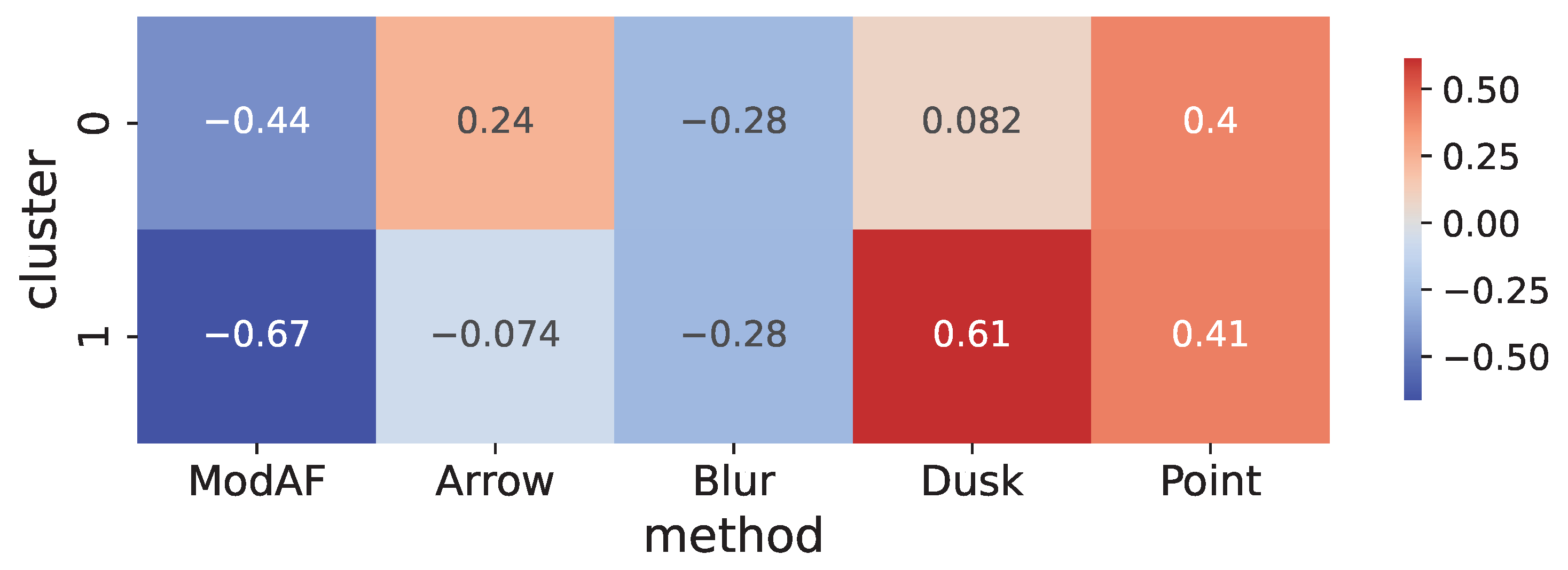
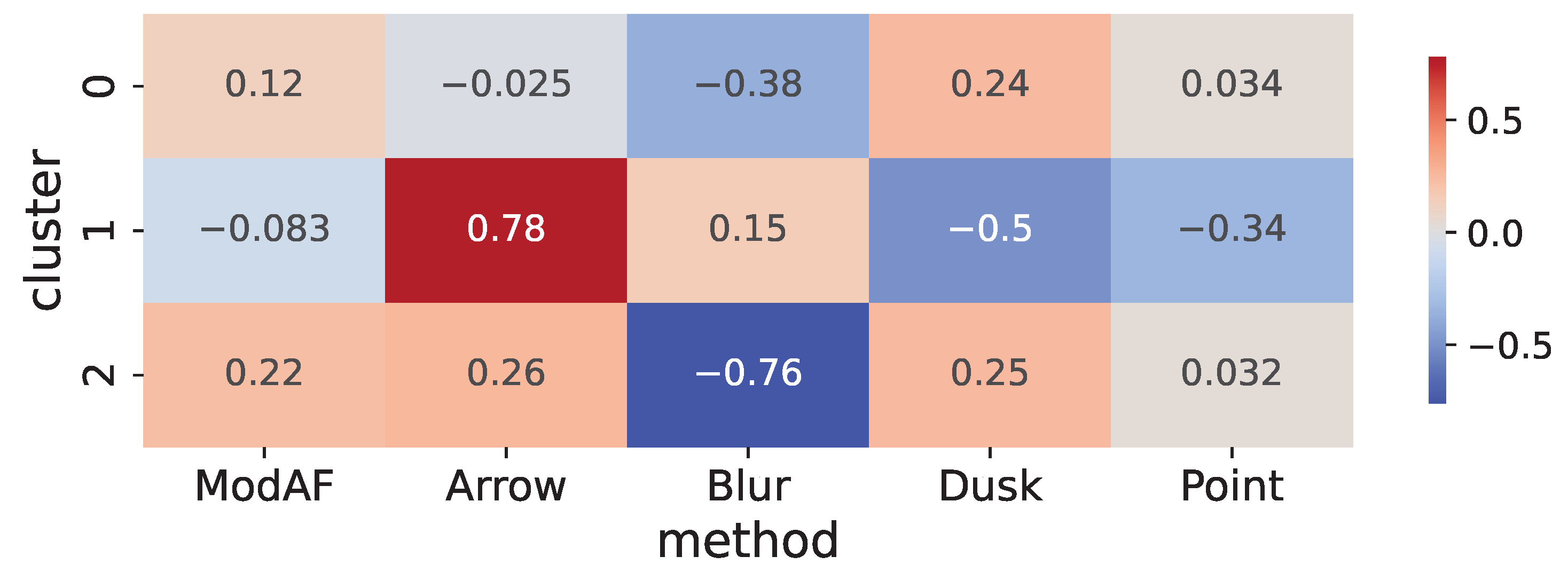
In order to explore differences in the response of drivers for different visual attention prompt methods, this study conducted a clustering analysis based on four indicators mentioned in Section 5.3. Figure 16 and Figure 17 showed the results of the clustering analysis for novice and proficient drivers. The horizontal axis in the figure represented five attention prompt methods, and the vertical axis represented the clusters. Novice drivers were categorized into two clusters, and proficient drivers were categorized into three clusters. The color of each cell represented the PCA-weighted score within the cluster under the corresponding visual attention prompt method, which was the comprehensive effect of different attention prompt methods on improving driving performance. Warm colors indicated a significant improvement in driving performance, while cold colors indicated little change.
As shown in Figure 16, drivers in cluster 0 exhibited higher scores for the Arrow (0.24) and Point (0.40) methods, while showing lower scores for the ModAF (−0.44) and Blur (−0.28) methods. For the Dusk method, there was only a small positive score (0.08). This type of driver in the cluster was more likely to benefit from visual attention prompt methods with clear directionality, which helped them focus their attention more efficiently on task-related targets. On the other hand, drivers in cluster 1 achieved higher scores for the Dusk (0.61) and Point (0.41) methods, whereas their performance was relatively low for the ModAF (−0.67), Arrow (−0.07), and Blur (−0.28) methods. This type of driver in the cluster was more likely to be responsive to luminance contrast–based attention prompt methods, which emphasized the target area rather than motion or directional information. Overall, the Point method showed consistently positive scores in both types of novice drivers, indicating that the visual attention prompt method that directly highlighted the target position could effectively promote drivers’ target detection and attention concentration. However, there was a subtle gap in the response between different types of drivers under even the same visual attention prompt method. To clarify the cause of the gap, Section 7.3 has a discussion about the meanings of the clusters (types of drivers).
As shown in Figure 17, drivers in cluster 0 showed slight positive improvements under the Dusk (0.24) and ModAF (0.12) methods and exhibited nearly neutral performance in the Arrow (−0.025) and Point (0.034) methods. This type of driver in the cluster was more likely to benefit from visual attention prompt methods that enhanced the target position through brightness modulation, such as Dusk. On the contrary, their adaptability to the Blur method was relatively low, possibly because peripheral blurring weakened the perception of environmental details for proficient drivers. Drivers in cluster 1 achieved the highest score under the Arrow method (0.78) and showed a slight improvement under the Blur method (0.15). This type of driver in the cluster was more likely to be sensitive to methods that provided a dynamically updated visual attention prompt method that guided gaze toward the target traffic sign, such as the Arrow method. Drivers in cluster 2 showed relatively balanced performance across visually different attention prompt methods. They exhibited slight enhancements under the ModAF (0.22), Arrow (0.26), and Dusk (0.25) methods. This type of driver in the cluster was likely to benefit more from visual attention prompt methods that narrowed the focus and structured the visual field around the target, such as Dusk and ModAF, as well as from visual attention prompt methods that were dynamically updated to guide gaze toward the target traffic sign, such as the Arrow method. Overall, the clustering analysis indicated that proficient drivers exhibited more pronounced differences and responses under different attention prompt methods. In general, the Blur method showed limited effectiveness among most proficient drivers, possibly because peripheral blurring interfered with their well-established visual scanning strategies. In contrast, visual attention prompt methods that highlighted targets while maintaining overall scene clarity were found to be more suitable for proficient drivers, such as the Arrow method and ModAF method.
Overall, the above clustering analysis and PCA would indicate that the PCA-weighted scores depended not only on the visual attention prompt methods but also on drivers’ proficiency and their types (clusters or subgroups). In other words, the same visual attention prompt method provided different levels of effectiveness of visual guidance between novice and proficient drivers and their subgroups. Section 7.3 looks into properties of the subgroups (clusters).

7. Discussion

This study aimed to address two main objectives: to evaluate the short-term transfer effect of different visual attention prompt methods in a driving simulator and to examine differences in drivers’ responses to these methods across different levels of driving proficiency. The following discussion interprets the experimental results with respect to these objectives in order to clarify the implications of the findings.

7.1. Short-Term Transfer Effect of Visual Attention Prompt Methods

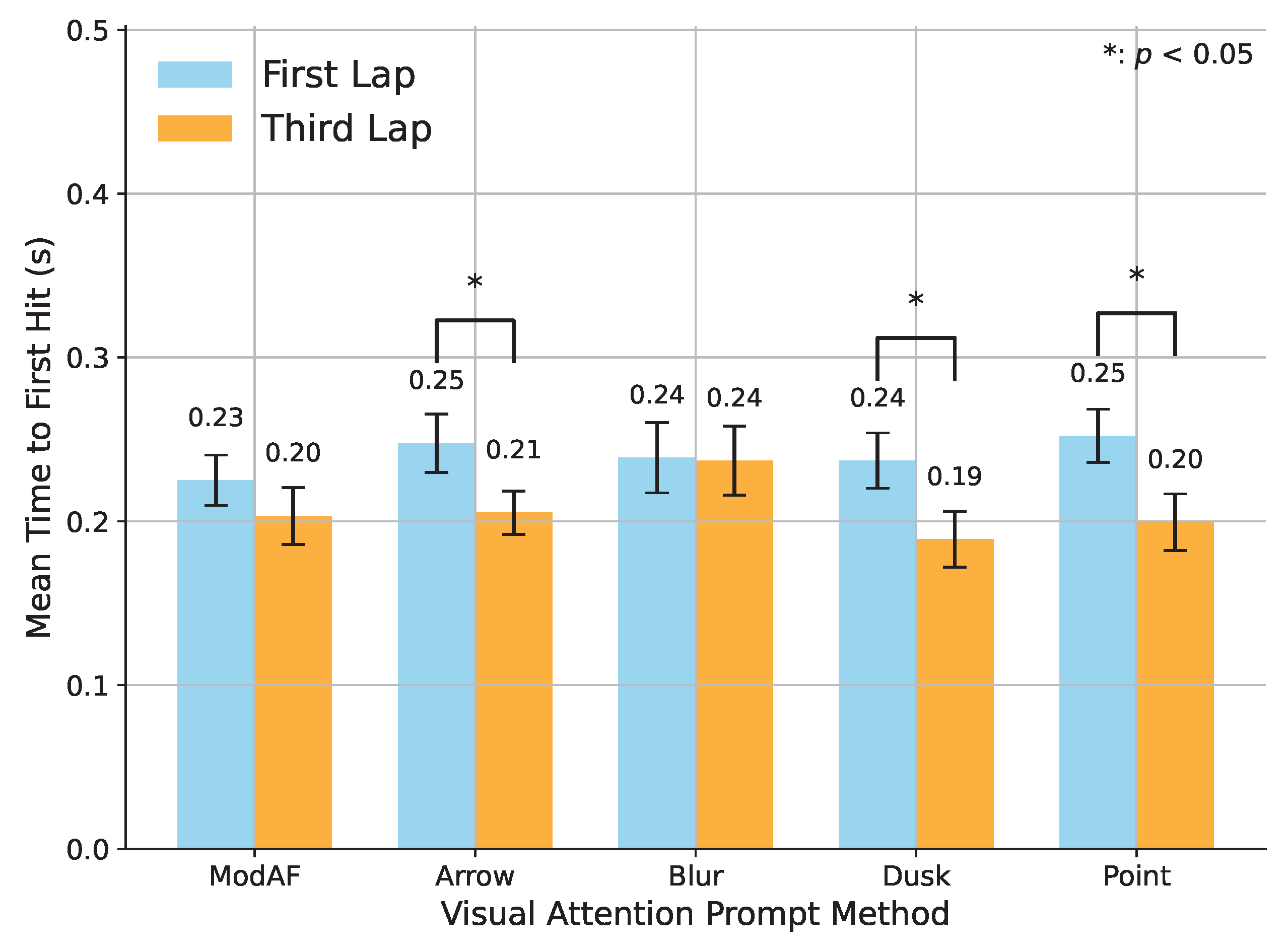
From the results of the survival curves in Figure 10, all the visual attention prompt methods tended to show a decline in survival probability during the third lap compared with the first one, suggesting that even after these methods were disabled, drivers were able to fixate on the target traffic sign somewhat earlier. This implied that visual attention prompt methods not only exerted an immediate influence during their presentation but also induced a short-term transfer effect. To verify the effect statistically, the study compared the mean of TTFHs under different visual attention prompt methods, as shown in Figure 18. The figure showed the mean of TTFHs across drivers and trials and the standard deviation at the first and third laps for each visual attention prompt method. The results indicated that in the first lap, the mean of TTFHs was relatively long, ranging approximately between 0.23 and 0.25 s. A paired t-test showed that the Arrow [t(17) = 2.23, p < 0.05], Dusk [t(17) = 2.63, p < 0.05], and Point [t(17) = 2.60, p < 0.05] methods demonstrated significant reductions in TTFH. In contrast, the ModAF and Blur methods did not show significant reductions. Overall, these results indicated that the Arrow, Dusk, and Point methods could be candidates for the short-term transfer effect.
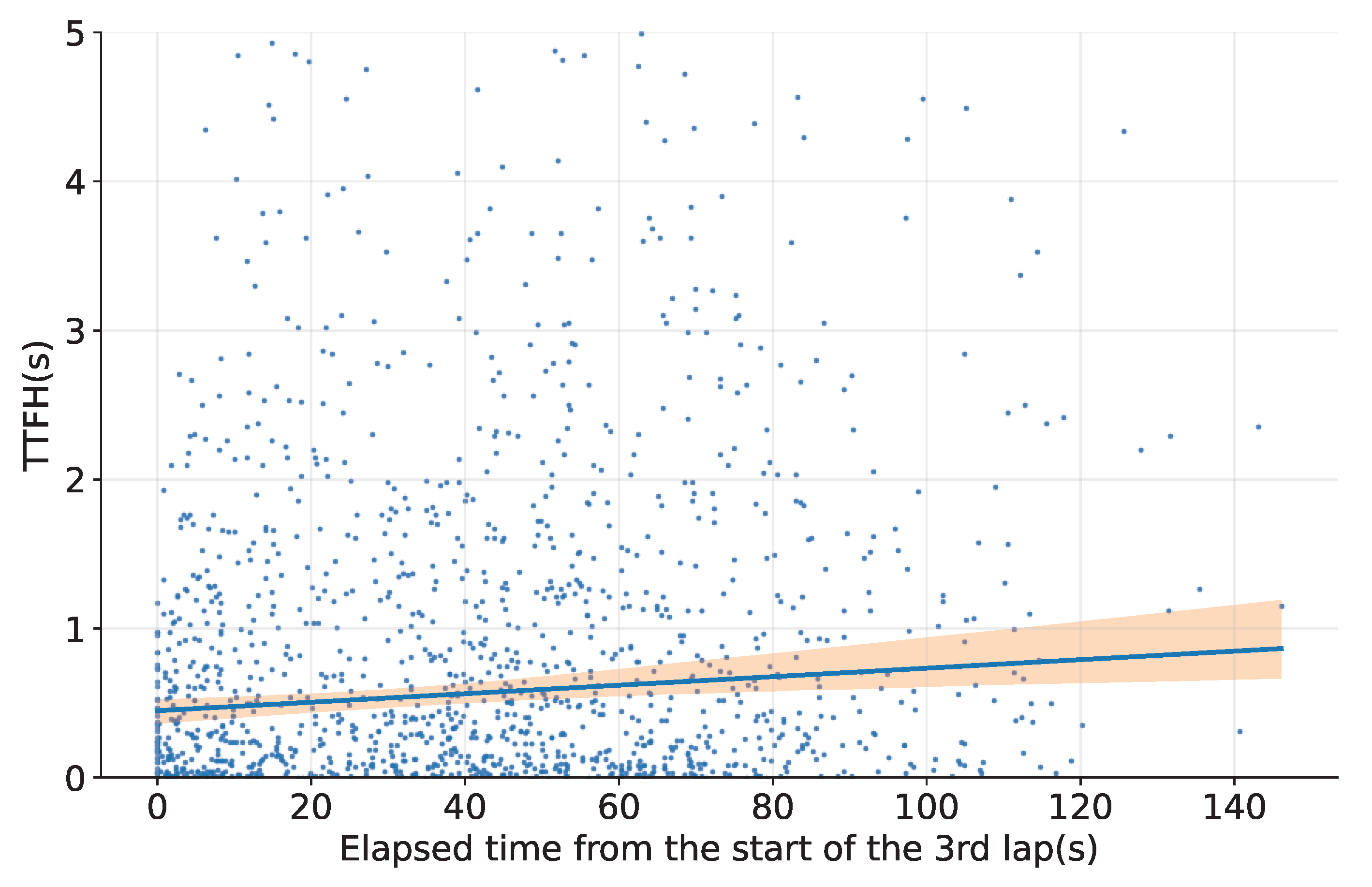
To see the duration when the effect would hold, Figure 19 showed the relationship between the elapsed time from the start of the third lap to the appearance of the target traffic sign and its TTFH. The horizontal axis represented the elapsed time, and the vertical one represented the TTFH. A scatter point in the figure corresponded to the observed value obtained from each participant at each appearance of the target traffic signs. The blue line represented a regression line of median values of TTFHs, and the yellow band indicated the 95% confidence range. As shown in Figure 19, the regression line exhibited a slight increase. A nonparametric bootstrap test of the slope of the median regression line against zero indicated a significantly positive trend (p = 0.004). As observed in the figure, the TTFH values are widely scattered and concentrated near lower values, while a smaller number of observations extend to higher values, resulting in mild skewness and non-constant variance. Under such conditions, bootstrap resampling was used to estimate the uncertainty of the regression slope without relying on strong distributional assumptions. The TTFH was expected to increase by approximately 0.17 s for every 60 s of elapsed time. As regards the short-term transfer effect, the regression line reached 0.707 s of the TTFH at the elapsed time of 84.35 s, which was the median value of the TTFHs at the 1st lap. It could be said that the short-term transfer effect would last for 84.35 s, and the induction of visual attention prompt methods was required to refresh the effect.
In summary, the Arrow, Dusk, and Point methods appeared to be effective methods, as drivers tended to fixate on the target traffic sign somewhat earlier in the third lap. The elapsed-time analysis suggested that this short-term transfer effect would hold for a limited period of about 84.35 s, which could serve as a practical reference for setting refresh intervals in future experiments. In addition, the prospective variance of the estimated duration, 84.35 s, at which the confidence interval of 95% of the regression curve reached, ranges from 55.91 to 146.09 s. This indicates considerable variability among participants. This range suggests that the duration of the transfer effect may differ across drivers, reflecting individual differences in visual attention allocation and perceptual processing during driving. It should also be noted that the present study examined the short-term transfer effect after a single exposure to the visual attention prompt methods in a controlled simulator environment. Therefore, the estimated duration of 84.35 s should be interpreted as a short-term reference under the current experimental conditions. In future research, we plan to investigate whether repeated training with visual attention prompt methods could reduce this variability across drivers and potentially extend the duration of the transfer effect.

7.2. Differential Effects of Visual Attention Prompt Methods Across Driver Proficiency

In Section 6.2, the Δ log-odds maps indicated that novice and proficient drivers exhibited spatial patterns of attentional change under different visual attention prompt methods. However, these maps mainly described where fixation probability increased or decreased around the target area, and they could not directly confirm whether drivers actually detected the target traffic signs. Therefore, the hit rate was compared between the first and third laps for novice and proficient drivers under each visual attention prompt method.
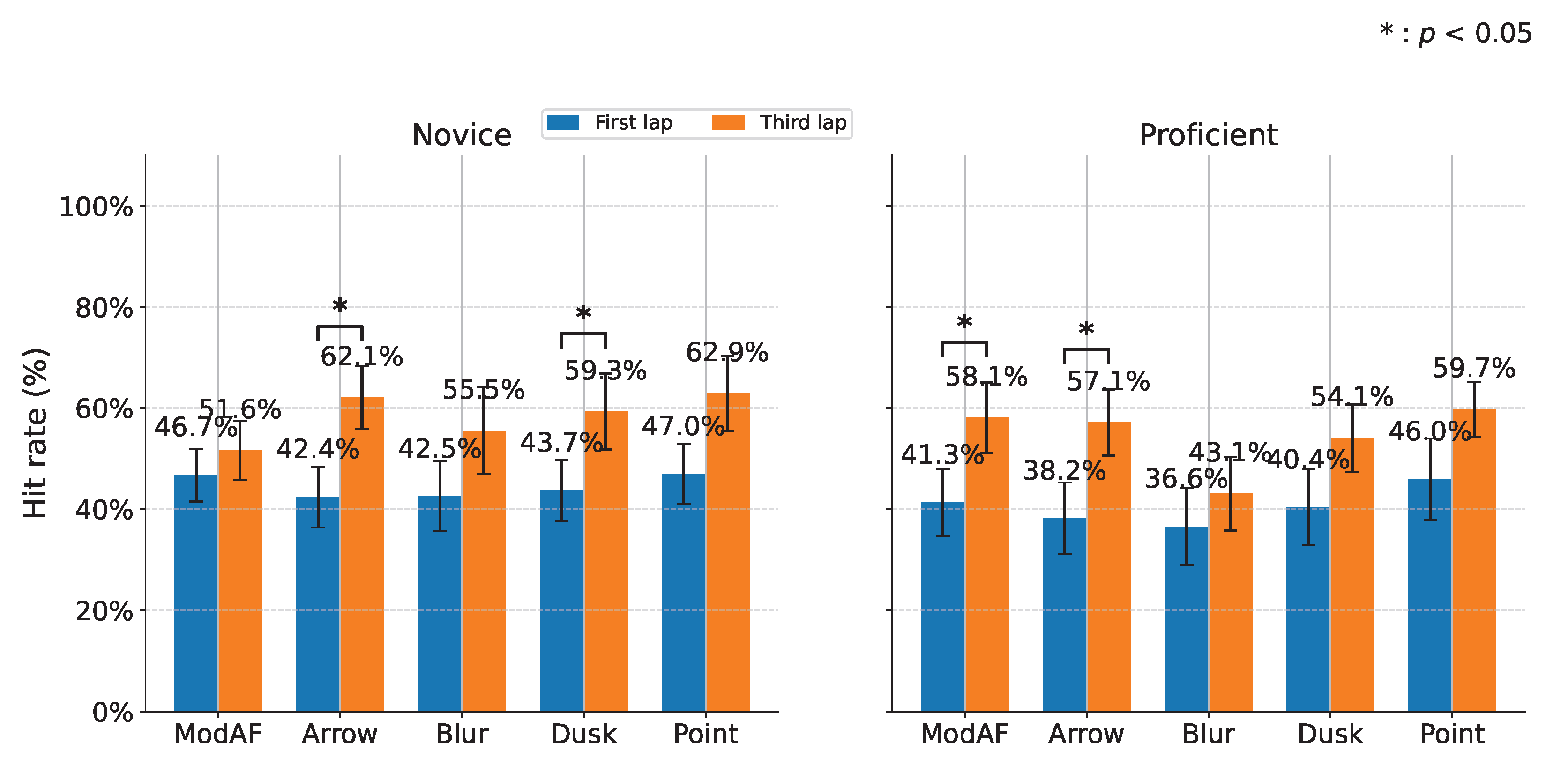
As shown in Figure 20, the hit rate was shown for novice and proficient drivers at the first and third laps under the five visual attention prompt methods. In this figure, the horizontal axis represented the five visual attention prompt methods, while the vertical axis represented the hit rate at the first lap and the third lap. The left and right bar graphs corresponded to novice and proficient drivers, respectively.
The Arrow method produced the largest increase in hit rate for both groups (Novice: +19.7, Proficient: +18.9), indicating that it consistently facilitated traffic sign detection from the first lap to the third lap. A paired t-test confirmed that this increase was significant for both novice drivers [t(8) = 2.47, p < 0.05] and proficient drivers [t(8) = 2.39, p < 0.05]. The Point and Dusk methods also showed improvements for novice drivers (Point: +15.9, Dusk: +15.6). However, only the Dusk method reached statistical significance in novices [t(8) = 2.41, p < 0.05]. For proficient drivers, the ModAF method exhibited a notably larger increase (Proficient: +16.8), implying that its benefit might become more apparent when drivers already maintain relatively stable attention allocation. This improvement was significant for proficient drivers [t(8) = 2.33, p < 0.05]. In contrast, the Blur method showed a moderate increase for novice drivers but only a small increase for proficient drivers (Novice: +13.0, Proficient: +6.5), suggesting that its contribution to hit performance was limited compared with other methods.
To hold the consistency with TTFHs, as shown in Figure 18, the Point method showed a significant reduction in TTFH, indicating that it could effectively accelerate target detection, but the hit rate was not significant for either novice or proficient drivers. One possible reason was that it improved how quickly drivers detected a traffic sign once it was noticed but did not reliably increase the number of signs detected. When drivers were engaged in the driving task, the Point method might have guided their attention locally without sufficiently encouraging them to scan broadly, and therefore, it was likely to leave traffic signs behind once it did not catch their attention. This interpretation was supported by the Point Δ log-odds maps in Figure 11, which showed warm-colored areas and a significant cluster around the target region, but the spatial extent of these warm-colored areas outside the target region appeared relatively limited compared with other methods. As regards the ModAF method, it did not show a significant reduction in TTHF, as shown in Figure 18, while it did show a significant improvement in hit rate for proficient drivers. This result implied that there would be a somewhat large gap in the improvement of TTFH between novice drivers and proficient ones. Actually, for novice drivers, it was a subtle drop of 0.003 s, and it was 0.050 s for proficient drivers. The gap was considerably small, but it was comparatively large for proficient ones. The proficient drivers had a tendency to detect the traffic signs more quickly, and there was a significantly higher number of them at the third lap. As shown in the Δ log-odds maps in Figure 15, the ModAF method induced band-like changes in fixation probability around the target area. For novice drivers, these changes were distributed on both sides of the target area, indicating remaining lateral fluctuations and limited stability. In contrast, for proficient drivers, the band-like changes were more concentrated around the target area, suggesting more stable coverage of the traffic sign. This discrepancy may be related to the visual characteristics of the ModAF method and the differences in drivers’ visual search strategies. This method modulated a relatively large area of the scene; it might obstruct surrounding visual information. For novice drivers, their visual search strategies are not yet well established; the presence of multiple visual cues may increase uncertainty about where to allocate gaze, which may weaken the benefit of the method in reducing TTFH and improving hit rate. In contrast, proficient drivers generally possess more stable visual search strategies and broader gaze distributions. The additional visual cues may help them maintain a more stable gaze around the target area. These underlying factors may explain the discrepancy. In addition, the potential influence of the presentation order of visual attention prompt methods should also be considered. As shown in Figure 9, the ModAF method appeared somewhat more frequently in later sessions, while the Point method occurred relatively more often in earlier sessions. Because drivers may gradually adapt to the driving task across sessions, such order variations could introduce a bias in performance measures. Therefore, part of the observed differences between these methods may also be partially influenced by this order imbalance.
The Dusk method significantly reduced the TTFH and also significantly increased the hit rate for novice drivers. This effect might be attributed to the ability of the Dusk method to suppress irrelevant peripheral visual information. In contrast, for proficient drivers, the Dusk method might have partially interfered with their already established scanning strategies, resulting in a more limited benefit. The Δ log-odds heatmaps in Figure 14 further supported this interpretation. Under the Dusk method, novice drivers exhibited band-like and concentrated warm-colored areas around the target one, accompanied by significant clusters, indicating a stable and sustained increase in fixation probability in the target area from the first to the third lap. In contrast, although some warm-colored areas were also observed for proficient drivers, no clear cluster was formed near the target area, suggesting that the Dusk method had a more limited effect on their attention allocation.
The Arrow method showed the strongest effect because it provided clear directional guidance toward the target, which helped drivers narrow the search area and locate the traffic sign more efficiently, leading to a larger increase in hit rate across driver proficiencies as well as a reduction of TTFHs. This interpretation was further supported by the Δ log-odds maps in Figure 12. Under the Arrow method, warm-colored areas were observed not only in the target area but also in its surrounding areas, forming a more continuous and connected spatial pattern for both the driver and proficiency. This suggested that the drivers’ gaze was surely guided toward the traffic sign rather than shifting abruptly.
Overall, the hit rate results showed that traffic sign detection improved from the first to the third lap in both novice and proficient drivers, while the magnitude of improvement depended strongly on the visual attention prompt method. Notably, the Arrow and ModAF methods tended to yield a more pronounced gain for proficient drivers, whereas novice drivers benefited more from the Arrow and Dusk methods. Therefore, future work should adjust visual attention prompt methods and their evaluation according to drivers’ proficiency.

7.3. Cluster Composition of Responder Types Across Driver Proficiency

Based on the PCA-weighted scores in Figure 16 and Figure 17, drivers’ response patterns to visual attention prompt methods differed across driver proficiency, yielding two clusters for novices and three for proficient drivers. To interpret the meaning of these clusters and examine their properties, we summarized the cluster composition within each driver proficiency.
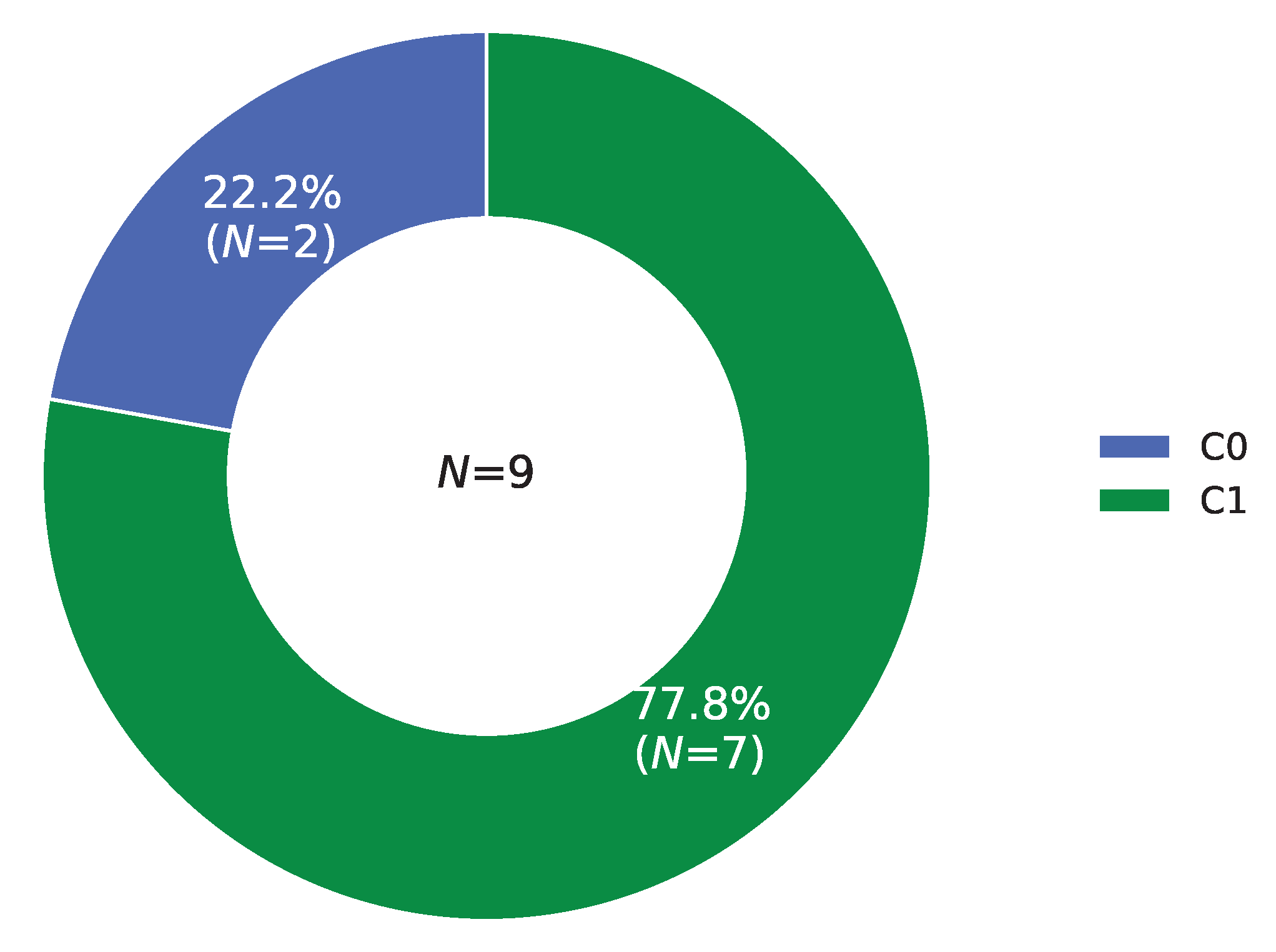
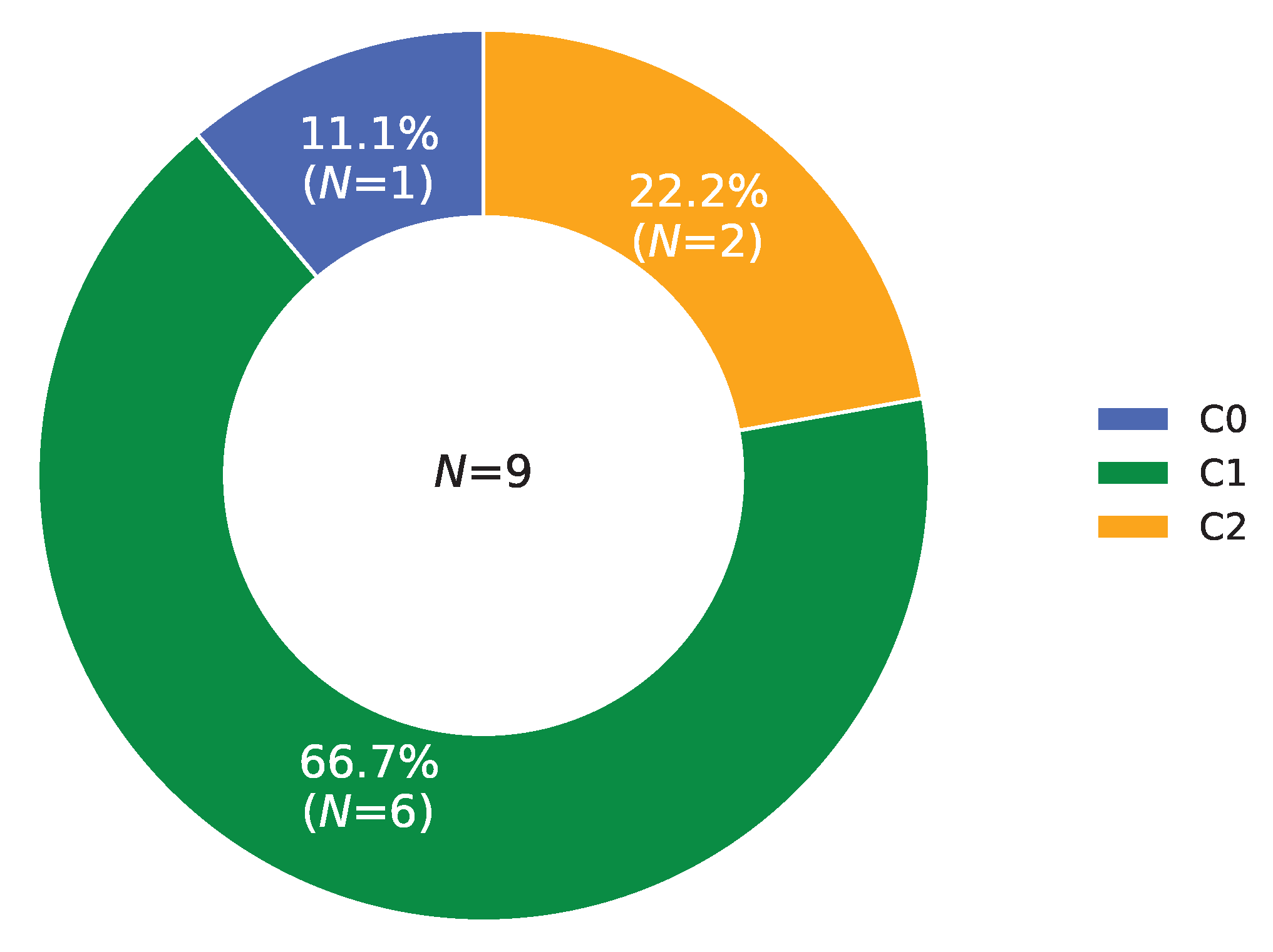
Figure 21 and Figure 22 showed the cluster composition for novice and proficient drivers. Novice drivers were formed into two clusters, dominated by C1 (77.8%, N = 7) over C0 (22.2%, N = 2), whereas proficient drivers were formed into three clusters with C1 (66.7%, N = 6), C2 (22.2%, N = 2), and C0 (11.1%, N = 1).
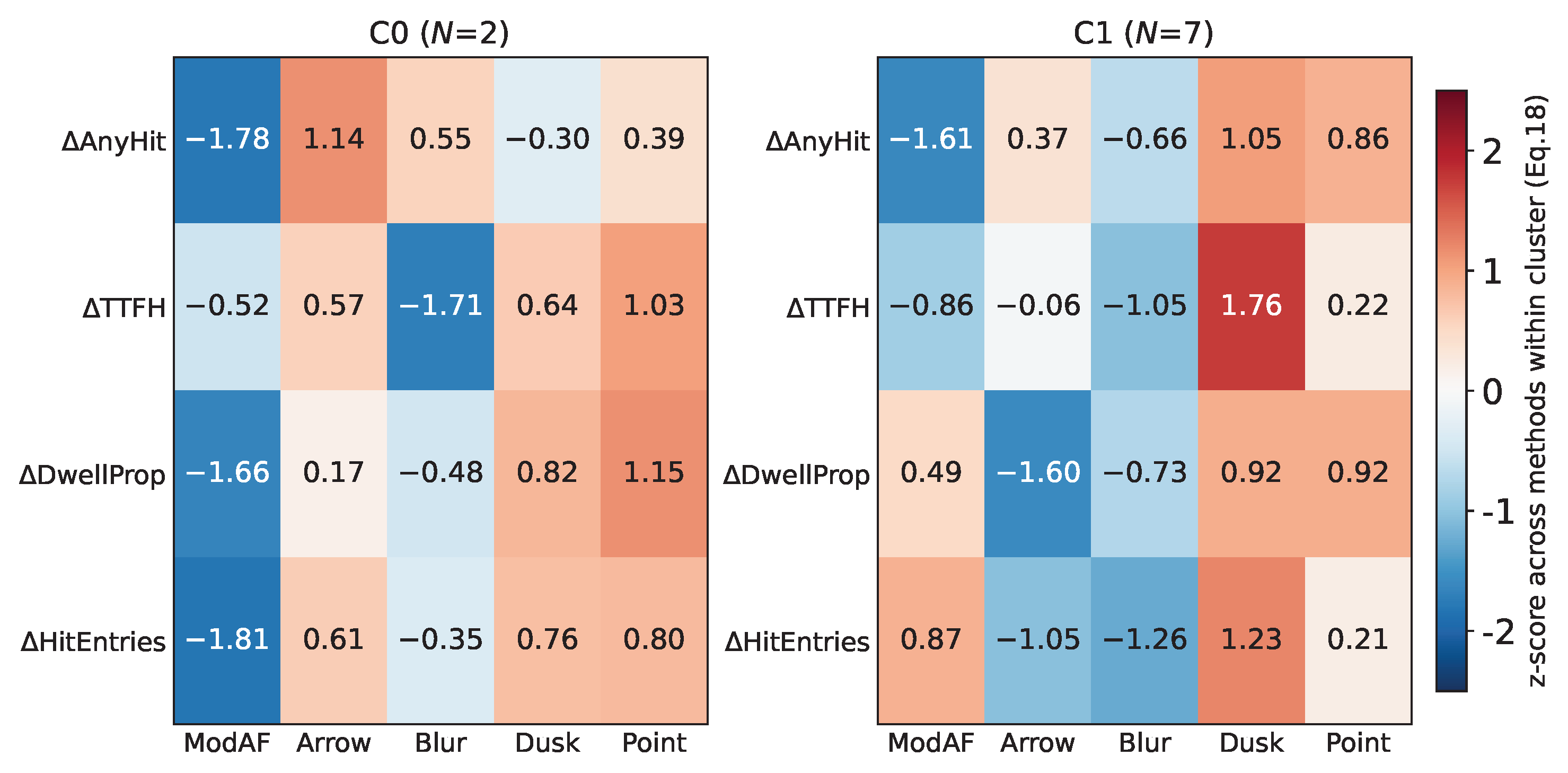
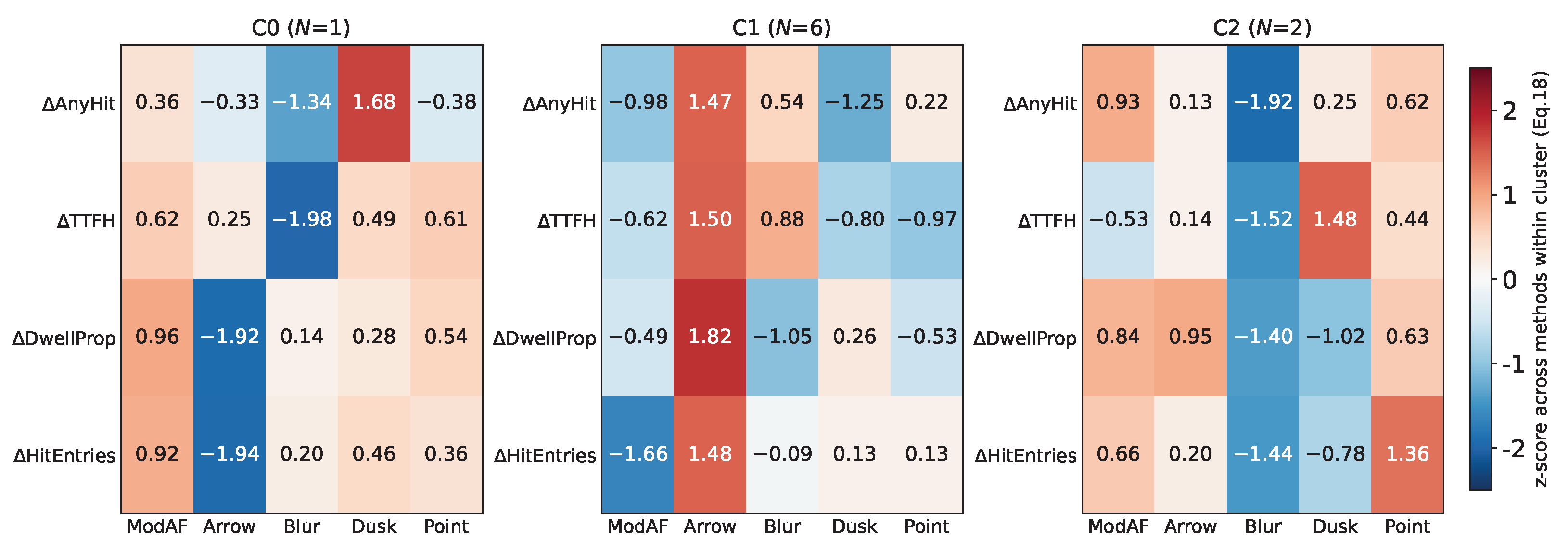
To interpret these cluster meanings in more detail, the within-cluster standardized patterns z m , C ( n ) in Equation (18) were visualized for the four Δ indices across the five visual attention prompt methods. As shown in Figure 23 and Figure 24, the horizontal axis lists the five visual attention prompt methods, and the vertical axis lists the four Δ indices. Each cell showed z m , C ( n ) . Warmer colors indicated higher standardized values, and cooler colors indicated lower ones. The higher values indicated relatively better outcomes for that index within the cluster compared with the other methods, while the lower values indicated relatively weaker outcomes.
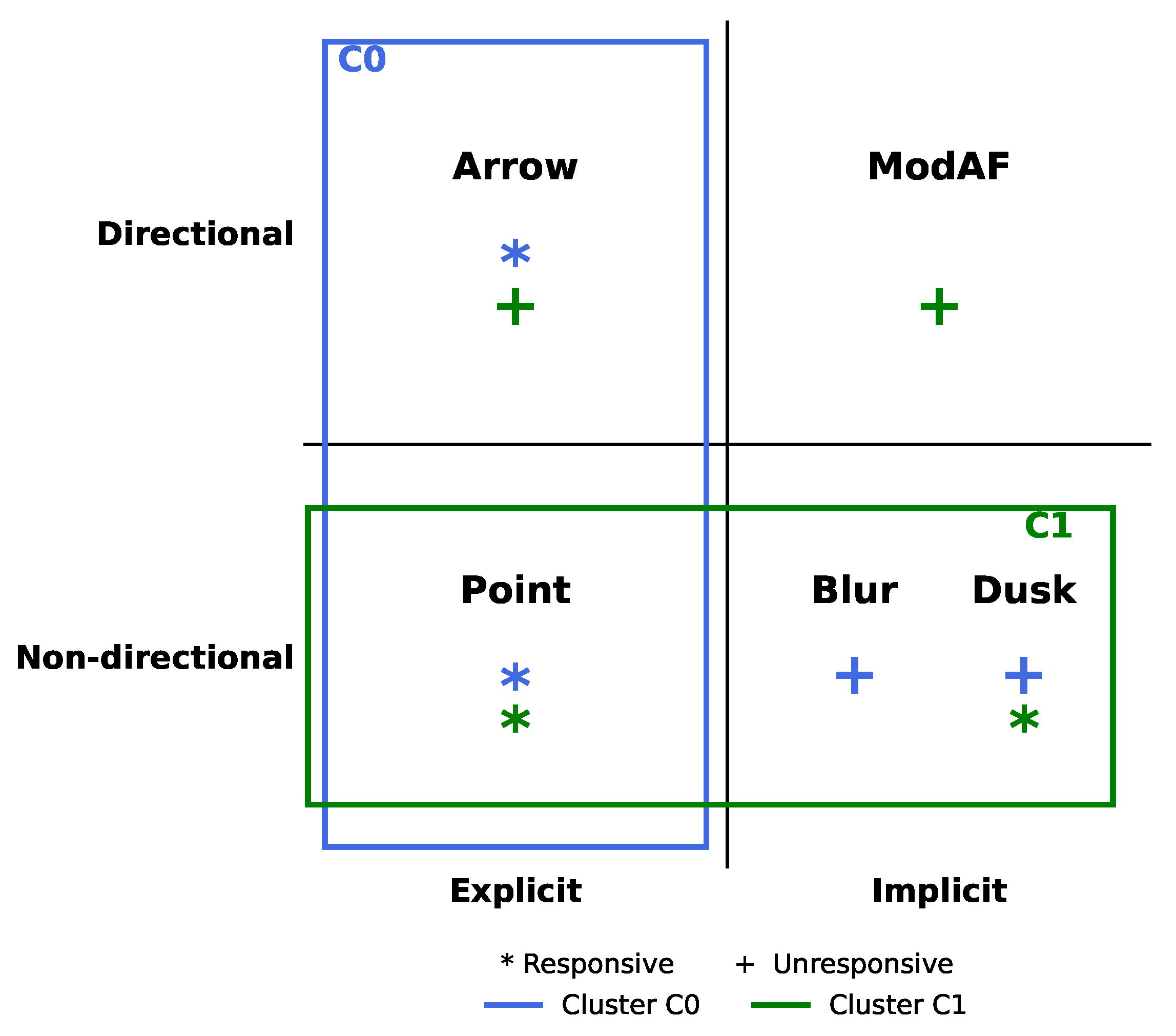
As shown in Figure 23, novice drivers exhibited different response patterns across the two clusters. For the dominant cluster C1, the Point and Dusk methods showed relatively higher values across the four indices. In contrast, the Blur method generally showed lower values within this cluster, whereas the Arrow and ModAF methods exhibited a more mixed response pattern. On the other hand, a similarity was observed between C0 and C1 in that the Point method remained relatively higher across the four indices. The Arrow method showed consistently higher values across all four indices in C0, whereas the ModAF method exhibited uniformly lower values across them. The main differences between the two clusters were mainly observed for the Arrow, ModAF, and Blur methods. These results indicated that novice drivers exhibited both certain commonalities and differences between the two clusters. To facilitate understanding of these differences, the schematic diagram in Figure 25 summarizes the visual attention prompt methods from the point of view of implicitness and directionality. The color of lines identifies the two clusters. The asterisk ‘*’ denoted positive values for all the four indices. The plus ‘+’ did positive values for at least one index. As shown in Figure 25, the cluster C0 mainly corresponded to drivers who benefited from explicit visual cues such as the Arrow and Point methods, indicating that this group was better at interpreting and translating them into more stable gaze control and vehicle operation. In contrast, the cluster C1 corresponded to drivers who benefited from non-directional visual cues such as the Point and Dusk methods, suggesting that this group relied more on target salience enhancement or suppression of peripheral information to accomplish target searches rather than directly following directional guidance.
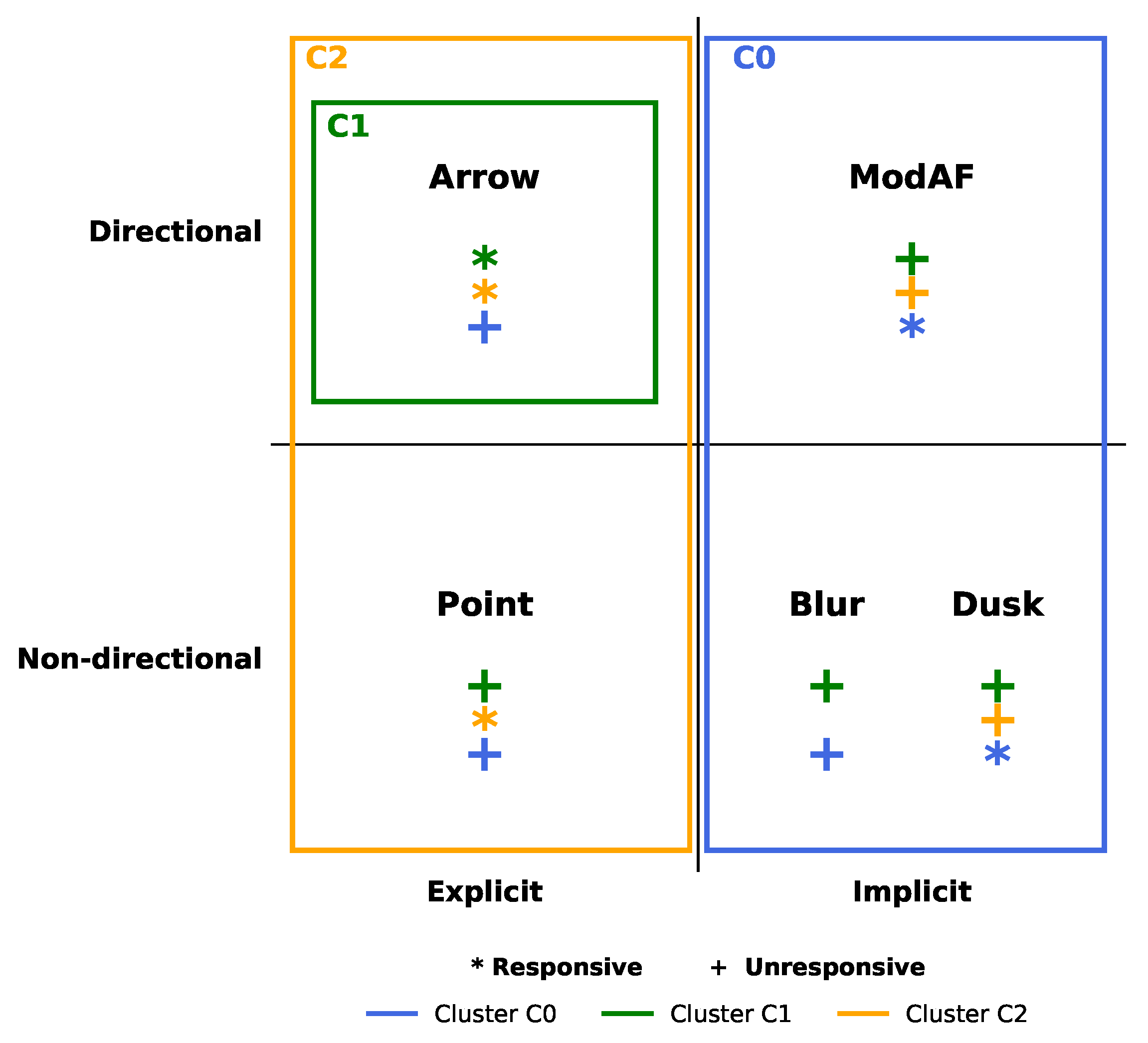
As shown in Figure 24, proficient drivers also exhibited distinct response patterns across the three clusters. For the dominant cluster C1, the Arrow method showed considerably high values across the four indices. For the cluster C2, the Point method remained at relatively high values across the four indices. The arrow method also showed positive effects in this cluster. Its overall impact was less pronounced than that observed in C1. In the cluster C0, a different response pattern was observed. The ModAF and Dusk methods showed relatively higher values across the four indices. To facilitate understanding of these differences, the schematic diagram in Figure 26 summarizes the visual attention prompt methods. As shown in Figure 26, the cluster C1 mainly corresponded to drivers who responded strongly to explicit directional visual cues, particularly the Arrow method. This suggested that drivers in this cluster were able to efficiently integrate those visual cues into their already established visual scanning strategies, refining gaze allocation and reducing unnecessary search without disrupting their driving performance. The cluster C2, in contrast, was more closely associated with explicit visual cues, such as the Point and Arrow methods. This indicated that drivers in this cluster tended to prefer methods that clearly highlighted traffic signs through direct visual cues, rather than relying on adaptive or ambient modulation. The cluster C0 exhibited a different response pattern, being more closely related to implicit visual cues, particularly the ModAF and Dusk methods. This suggested that drivers in this cluster benefited more from adaptive or ambient modulation that subtly supported attention without imposing explicit directional guidance. However, as this cluster contained only a single participant, the observed response pattern should have been interpreted cautiously and might have reflected individual driving strategies rather than a stable subgroup characteristic.
For dominant clusters of novice and proficient drivers, the primary difference between properties of their preferred methods is non-directional for novice drivers or directional for proficient ones. This may be related to changes in visual search behavior associated with driving proficiency. Robbins and Chapman [32] reported that novice drivers tend to exhibit a narrower visual search pattern and often concentrate their gaze near the central region of the scene. Under such conditions, non-directional cues, such as the Point method, may help novice drivers shift their attention from the central region toward the target location more efficiently within their limited search area. In contrast, proficient drivers generally demonstrate broader gaze distributions and more flexible visual search strategies. Directional cues such as the Arrow method may therefore assist them in confirming the target location quickly while maintaining their naturally distributed gaze across the driving environment.
Overall, the clustering results highlighted that the effectiveness of visual attention prompt methods could not be fully captured by a single average trend, because drivers adopted different response mechanisms even under the same proficiency level. This responder heterogeneity suggested that the design of visual attention prompt methods and their evaluation should explicitly account for subgroup-level differences, rather than assuming uniform benefits across individuals.

7.4. Study Limitations

Several limitations of the present study should be acknowledged. First, the sample size was relatively small, which may limit the generality of the findings. Second, all participants in this study were male, and therefore, potential gender differences in responses to visual attention prompt methods were not examined. Third, the age range of the participants was limited to young adults, and the effectiveness of these methods for elderly drivers remains to be verified in future studies. In addition, although the order of the visual attention prompt methods was randomly assigned, minor imbalances in the distribution of some methods across experimental sessions were observed. Such variations may introduce potential order effects or learning effects during repeated driving sessions. Our future studies with larger and more diverse participant groups and more balanced experimental designs are needed to further validate the findings.

8. Conclusions

This study evaluated the short-term performance of five visual attention prompt methods (Point, Arrow, Blur, Dusk, and ModAF) in a driving simulator and compared their performance between novice and proficient drivers. By combining a survival analysis, a visual attention distribution analysis, and a clustering analysis, this study examined whether the influence of these methods could be maintained after they were disabled and clarified drivers’ response patterns across methods in consideration with their driving proficiency.
The results indicated that visual attention prompt methods could induce a short-term transfer effect. After the methods were disabled, drivers still tended to fixate on traffic signs earlier, and this effect would last about 84.35 s on average, providing a reference for refresh intervals. Overall, the Point, Arrow, and Dusk methods showed significant effects with reductions in TTFH. In addition, the clustering analysis further showed that drivers’ response patterns to the five visual attention prompt methods were not uniform even for drivers with the same driving proficiency. Novice drivers were categorized into two clusters, while proficient drivers were categorized into three clusters. Within these clusters, the standardized patterns of the four Δ indices revealed that explicit non-directional visual cues that enhanced target salience, such as the Point method, were relatively beneficial for most novice drivers. For proficient drivers, explicit directional visual cues such as the Arrow method were relatively beneficial for most drivers in this group.
In future work, the author plans to develop an AI-based prediction framework to achieve adaptive visual attention prompt methods. The framework is expected to utilize multimodal driving behavior indicators, such as gaze allocation metrics and vehicle control features, to estimate drivers’ attentional states and dynamically adjust the type and timing of visual attention prompt methods. In addition, considering the short-term transfer duration observed in this study, visual attention prompt methods may be refreshed at appropriate intervals during training to reinforce attention allocation patterns, with the ultimate goal of improving overall driving safety.

Author Contributions

All authors contributed to the study design and research planning. J.L. collected, processed, and analyzed the data and drafted the manuscript under the guidance of M.I. All authors have read and agreed to the published version of the manuscript.

Funding

This research received no external funding.

Institutional Review Board Statement

Ethical approval for this study was granted by the Ethics Committee of Fukuoka Institute of Technology (approval number hm03-24) on 28 May 2024. All procedures adhered to relevant ethical guidelines to safeguard participants’ rights and welfare.

Informed Consent Statement

Informed consent was obtained from all participants involved in the study. No personally identifiable images or information are included in this article.

Data Availability Statement

The datasets obtained and/or analyzed during the current study, as well as the materials used, are available from the corresponding author upon reasonable request.

Acknowledgments

The authors thank the members of the Ishihara Laboratory at Fukuoka Institute of Technology for technical and administrative support and all study participants for their time and cooperation. We also appreciate the assistance of the Fukuoka Institute of Technology Ethics Committee office with approval procedures and colleagues who helped pilot-test the driving tasks and eye-tracking protocols. During manuscript preparation, the authors used ChatGPT (version 5.2) for grammar correction, language polishing, and minor LaTeX formatting adjustments. All AI-assisted text was reviewed and edited by the authors, who take full responsibility for the content of this publication.

Conflicts of Interest

The authors declare no conflicts of interest.

Abbreviations

The following abbreviations are used in this manuscript:
AFAttention Funnel
ModAFModified Attention Funnel
TTFTime to Fixate
TTFHTime to First Hit
PRTPerception Response Time
UFOVUseful Field of View
AOIArea of Interest
HUDHead-Up Display
PCAPrincipal Component Analysis
KMKaplan–Meier (survival estimator)
FWERFamily-Wise Error Rate
KPIKey Performance Indicator
DwellPropDwell Proportion
AnyHitAny-hit rate indicator
HitEntriesNumber of hit entries
Δ log-oddsLog-odds difference (gaze map)

References

  1. Lemonnier, S.; Brémond, R.; Baccino, T.; Désiré, L. Drivers’ Visual Attention: A Field Study at Intersections. Transp. Res. Part F Traffic Psychol. Behav. 2020, 69, 206–221. [Google Scholar] [CrossRef]
  2. Ball, K.; Owsley, C.; Sloane, M.E.; Roenker, D.L.; Bruni, J.R. Visual Attention Problems as a Predictor of Vehicle Crashes in Older Drivers. Investig. Ophthalmol. Vis. Sci. 1993, 34, 3110–3123. [Google Scholar]
  3. Seya, Y.; Nakayasu, H.; Yagi, T. Useful Field of View in Simulated Driving: Reaction Times and Eye Movements of Drivers. i-Perception 2013, 4, 285–298. [Google Scholar] [CrossRef] [PubMed]
  4. Yan, X.; Zhang, X.; Zhang, Y.; Li, X.; Yang, Z. Changes in Drivers’ Visual Performance during the Collision Avoidance Process as a Function of Different Field of Views at Intersections. PLoS ONE 2016, 11, e0164101. [Google Scholar] [CrossRef]
  5. Calvi, A.; D’Amico, F.; Vennarucci, A. Comparing Eye-tracking System Effectiveness in Field and Driving Simulator Studies. Open Transp. J. 2023, 17, e187444782301191. [Google Scholar] [CrossRef]
  6. Rusch, M.L.; Schall, M.C., Jr.; Gavin, P.; Lee, J.D.; Dawson, J.D.; Vecera, S.; Rizzo, M. Directing Driver Attention with Augmented Reality Cues. Transp. Res. Part F Traffic Psychol. Behav. 2013, 16, 127–137. [Google Scholar] [CrossRef]
  7. Li, Y.; You, Y.; Yu, B.; Lu, Y.; Zhou, H.; Tang, M.; Zuo, G.; Xu, J. The Impact of Cue and Preparation Prompts on Attention Guidance in Goal-Directed Tasks. Front. Hum. Neurosci. 2024, 18, 1397452. [Google Scholar] [CrossRef]
  8. Deng, M.; Wu, F.; Gu, X.; Xu, L. A comparison of visual ability and its importance awareness between novice and experienced drivers. Int. J. Ind. Ergon. 2021, 83, 103141. [Google Scholar] [CrossRef]
  9. Hurzlmeier, M.; Watzka, B.; Hoyer, C.; Girwidz, R.; Ertl, B. Visual Cues in a Video-Based Learning Environment: The Role of Prior Knowledge and its Effects on Eye Movement Measures. In Proceedings of the 15th International Conference of the Learning Sciences (ICLS 2021); International Society of the Learning Sciences: Bochum, Germany, 2021; pp. 3–10. Available online: https://repository.isls.org/handle/1/7481 (accessed on 2 October 2025).
  10. Liu, R.; Xu, X.; Yang, H.; Li, Z.; Huang, G. Impacts of Cues on Learning and Attention in Immersive 360-Degree Video: An Eye-Tracking Study. Front. Psychol. 2022, 12, 792069. [Google Scholar] [CrossRef]
  11. Pomarjanschi, L.; Dorr, M.; Barth, E. Gaze Guidance Reduces the Number of Collisions with Pedestrians in a Driving Simulator. ACM Trans. Interact. Intell. Syst. 2012, 2, 8. [Google Scholar] [CrossRef]
  12. Biocca, F.; Tang, A.; Owen, C.; Fan, X. The Omnidirectional Attention Funnel: A Dynamic 3D Cursor for Mobile Augmented Reality Systems. In Proceedings of the 39th Annual Hawaii International Conference on System Sciences (HICSS 2006), Kauai, HI, USA, 4–7 January 2006; pp. 1–10. [Google Scholar] [CrossRef]
  13. Grahn, H.; Kujala, T.; Taipalus, T.; Lee, J.; Lee, J.D. On the relationship between occlusion times and in-car glance durations in simulated driving. Accid. Anal. Prev. 2023, 182, 106955. [Google Scholar] [CrossRef]
  14. Miljković, N.; Sodnik, J. Effectiveness of a time to fixate for fitness to drive evaluation in neurological patients. Behav. Res. Methods 2024, 56, 4277–4292. [Google Scholar] [CrossRef]
  15. Vansteenkiste, P.; Cardon, G.; Philippaerts, R.; Lenoir, M. Measuring dwell time percentage from head-mounted eye-tracking data—comparison of a frame-by-frame and a fixation-by-fixation analysis. Ergonomics 2014, 57, 538–547. [Google Scholar] [CrossRef]
  16. Gerber, M.A.; Schroeter, R.; Johnson, D.; Janssen, C.P.; Rakotonirainy, A.; Kuo, J.; Lenné, M.G. An Eye Gaze Heatmap Analysis of Uncertainty Head-Up Display Designs for Conditional Automated Driving. In Proceedings of the CHI Conference on Human Factors in Computing Systems (CHI ’24), Honolulu, HI, USA, 11–16 May 2024; ACM: New York, NY, USA, 2024; pp. 1–16. [Google Scholar] [CrossRef]
  17. Farhani, G.; Rahman, T.; Charlebois, D. Weather-Dependent Variations in Driver Gaze Behavior: A Case Study in Rainy Conditions. arXiv 2025, arXiv:2509.01013. Available online: https://arxiv.org/abs/2509.01013v1 (accessed on 3 October 2025). [CrossRef]
  18. Eysenck, M.W.; Derakshan, N.; Santos, R.; Calvo, M.G. Anxiety and cognitive performance: Attentional control theory. Emotion 2007, 7, 336–353. [Google Scholar] [CrossRef] [PubMed]
  19. Zhang, M.; Lu, X.; Chen, Q.; Wang, L.; Luo, Y. Enhancing attentional control through training: Evidence from masked majority function tasks. Acta Psychol. 2024, 243, 104084. [Google Scholar] [CrossRef]
  20. Matsukura, M.; Luck, S.J.; Vecera, S.P. Attention effects during visual short-term memory maintenance: Protection or prioritization? Percept. Psychophys. 2007, 69, 1422–1434. [Google Scholar] [CrossRef]
  21. Unity Technologies. Wheel Collider. Unity Manual, Version 2017.3. Available online: https://docs.unity.cn/cn/current/Manual/class-WheelCollider.html (accessed on 7 October 2025).
  22. Japan Automobile Federation. What Is an Appropriate Following Distance While Driving? JAF Car Q&A. Available online: https://jaf.or.jp/common/kuruma-qa/category-drive/subcategory-technique/faq138 (accessed on 6 March 2026).
  23. Takahashi, H.; Itoh, M. A Driving Simulation Study on Visual Cue Presented in the Peripheral Visual Field for Prompting Driver’s Attention. J. Robot. Mechatron. 2019, 31, 274–288. [Google Scholar] [CrossRef]
  24. Utoyo, A.W.; Aprilia, H.D.; Kuntjoro-Jakti, R.A.D.R.I.; Kurniawan, A. Visual communication analysis: The effect of signs and colors on traffic safety in Jakarta. IOP Conf. Ser. Earth Environ. Sci. 2021, 729, 012087. [Google Scholar] [CrossRef]
  25. Ortega-Álvarez, G.; Matheus-Chacin, C.; García-Crespo, A.; Ruiz-Arroyo, A. Evaluation of user response by using visual cues designed to direct the viewer’s attention to the main scene in an immersive environment. Multimed. Tools Appl. 2023, 82, 573–599. [Google Scholar] [CrossRef]
  26. Hata, H.; Koike, H.; Sato, Y. Visual guidance with unnoticed blur effect. In Proceedings of the International Working Conference on Advanced Visual Interfaces (AVI ’16), Bari, Italy, 7–10 June 2016; ACM Press: New York, NY, USA, 2016. [Google Scholar] [CrossRef]
  27. Danieau, F.; Guillo, A.; Doré, R. Attention guidance for immersive video content in head-mounted displays. In Proceedings of the IEEE Virtual Reality (VR 2017), Los Angeles, CA, USA, 18–22 March 2017. [Google Scholar] [CrossRef]
  28. Lim, J.; Kwok, K. The Effects of Varying Break Length on Attention and Time on Task. Hum. Factors 2015, 57, 1320–1332. [Google Scholar] [CrossRef] [PubMed]
  29. Kaplan, E.L.; Meier, P. Nonparametric Estimation from Incomplete Observations. J. Am. Stat. Assoc. 1958, 53, 457–481. [Google Scholar] [CrossRef]
  30. Pohl, K.M.; Fisher, J.; Bouix, S.; Shenton, M.; McCarley, R.W.; Grimson, W.E.L.; Kikinis, R.; Wells, W.M. Using the Logarithm of Odds to Define a Vector Space on Probabilistic Atlases. Med. Image Anal. 2007, 11, 465–477. [Google Scholar] [CrossRef] [PubMed]
  31. Pearson, K. LIII. On Lines and Planes of Closest Fit to Systems of Points in Space. Lond. Edinb. Dublin Philos. Mag. J. Sci. 1901, 2, 559–572. [Google Scholar] [CrossRef]
  32. Robbins, C.; Chapman, P. How Does Drivers’ Visual Search Change as a Function of Experience? A Systematic Review and Meta-Analysis. Accid. Anal. Prev. 2019, 132, 105266. [Google Scholar] [CrossRef]
Figure 1. Overview of the driving simulator hardware components.
Mti 10 00028 g001
Figure 2. Overview of the route.
Mti 10 00028 g002
Figure 3. Overview of the city.
Mti 10 00028 g003
Figure 4. The Point method presents a small blue dot over the target traffic sign to draw the driver’s visual attention.
Mti 10 00028 g004
Figure 5. The Arrow method displays a dynamic blue arrow that gradually moves from the center of the screen toward the target traffic sign, drawing the driver’s visual attention.
Mti 10 00028 g005
Figure 6. The Blur method applies a blur effect to peripheral regions so that the target traffic sign remains clear to draw the driver’s visual attention.
Mti 10 00028 g006
Figure 7. The Dusk method applies peripheral shading regions so that the target traffic sign remains clear to draw the driver’s visual attention.
Mti 10 00028 g007
Figure 8. The ModAF method depicts five light-green squares that gradually decrease in size toward the target traffic sign to draw the driver’s visual attention.
Mti 10 00028 g008
Figure 9. Distribution of positions in presentation order of visual attention prompt methods. The numbers above the bars indicate the count of occurrences for each method at the corresponding position.
Mti 10 00028 g009
Figure 10. Kaplan–Meier survival curves of TTFH under different visual attention prompt methods: (a) Point method, (b) Arrow method, (c) Blur method, (d) Dusk method, and (e) ModAF method.
Mti 10 00028 g010
Figure 11. Δ log-odds maps of fixation probability distribution between novice and proficient drivers under the Point method. The dashed square delineated the target region ( d x , d y [ 0.2 , 0.2 ] ).
Mti 10 00028 g011
Figure 12. Δ log-odds maps of fixation probability between novice and proficient drivers under the Arrow method. The dashed square delineated the target region ( d x , d y [ 0.2 , 0.2 ] ).
Mti 10 00028 g012
Figure 13. Δ log-odds maps of fixation probability between novice and proficient drivers under the Blur method. The dashed square delineated the target region ( d x , d y [ 0.2 , 0.2 ] ).
Mti 10 00028 g013
Figure 14. Δ log-odds maps of fixation probability between novice and proficient drivers under the Dusk method. The dashed square delineated the target region ( d x , d y [ 0.2 , 0.2 ] ).
Mti 10 00028 g014
Figure 15. Δ log-odds maps of fixation probability between novice and proficient drivers under the ModAF method. The dashed square delineated the target region ( d x , d y [ 0.2 , 0.2 ] ).
Mti 10 00028 g015
Figure 16. Results of PCA-weighted scores for novice drivers based on clustering analysis.
Mti 10 00028 g016
Figure 17. Results of PCA-weighted scores for proficient drivers based on clustering analysis.
Mti 10 00028 g017
Figure 18. Mean TTFHs by visual attention prompt methods for the first lap and the third lap.
Mti 10 00028 g018
Figure 19. Estimation of duration of the short-term transfer effect. The blue line represented a regression line of median values of TTFHs, and the yellow band indicated the 95% confidence range.
Mti 10 00028 g019
Figure 20. Hit rate across visual attention prompt methods for novice and proficient drivers at the first and third laps.
Mti 10 00028 g020
Figure 21. Cluster composition of novice drivers.
Mti 10 00028 g021
Figure 22. Cluster composition of proficient drivers.
Mti 10 00028 g022
Figure 23. Heatmaps of z m , C ( n ) for the index n of the visual attention prompt method m in the cluster C for novice drivers.
Mti 10 00028 g023
Figure 24. Heatmaps of z m , C ( n ) for the index n of the visual attention prompt method m in the cluster C for proficient drivers.
Mti 10 00028 g024
Figure 25. Conceptual mapping of visual attention prompt methods and novice drivers’ responses at each cluster. The color of lines identifies the two clusters. The asterisk ‘*’ denoted positive values for all the four indices. The plus ‘+’ did positive values for at least one index.
Mti 10 00028 g025
Figure 26. Conceptual mapping of visual attention prompt methods and proficient drivers’ responses at each cluster. The color of lines identifies the three clusters. The asterisk ‘*’ denoted positive values for all the four indices. The plus ‘+’ did positive values for at least one index.
Mti 10 00028 g026
Table 1. Description of recorded data entries.
ItemsDescription
ParticipantIdentifier of the participant (1–18).
DeviceTimeStampTimestamp from the eye tracker’s internal clock (ms).
SystemTimeStampTimestamp from the simulator system for aligning with eye-tracking data (ms).
HitIndicator of whether the gaze point intersects with the target traffic sign (1 = hit, 0 = miss).
NumberIndex number of the target traffic sign.
Targetpos_x, Targetpos_yThe screen coordinates in pixels where the target traffic sign with the current Number is located. The coordinates are normalized between 0.0 and 1.0, and the origin is at the top-left corner of the screen.
L_gp_x, L_gp_y, R_gp_x, R_gp_yThe screen coordinates in pixels where the current participant’s gaze is located, representing the left and right eyes, respectively. The coordinates are normalized between 0.0 and 1.0, and the origin is at the top-left corner of the screen.
Disclaimer/Publisher’s Note: The statements, opinions and data contained in all publications are solely those of the individual author(s) and contributor(s) and not of MDPI and/or the editor(s). MDPI and/or the editor(s) disclaim responsibility for any injury to people or property resulting from any ideas, methods, instructions or products referred to in the content.