
From the Reality–Virtuality Continuum to the XR Ecosystem: A Systematic Literature Review of Definitions and Conceptual Models


Abstract
1. Introduction
- RQ1: How have the definitions of Mixed Reality (MR), Augmented Reality (AR), and Virtual Reality (VR) evolved since their inception?
- RQ2: What are the key theoretical frameworks and taxonomies that have been proposed to classify these realities?
- RQ3: What are the primary critiques and extensions of the foundational Reality-Virtuality (RV) Continuum model?
- RQ4: What are the key differences and similarities between the taxonomies used in academic research and the definitions employed by industry leaders?
2. Materials and Methods
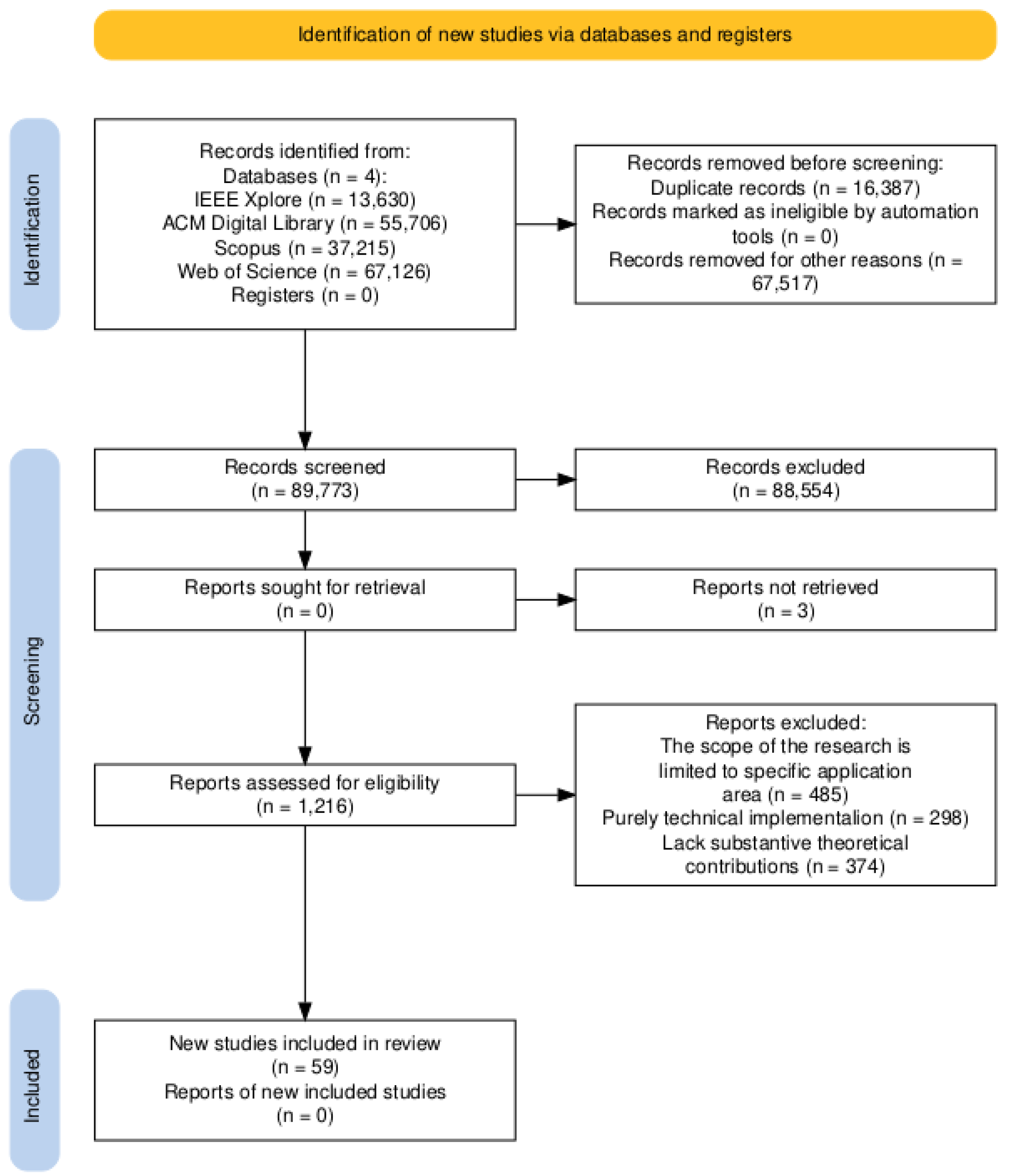
Literature Search and Selection
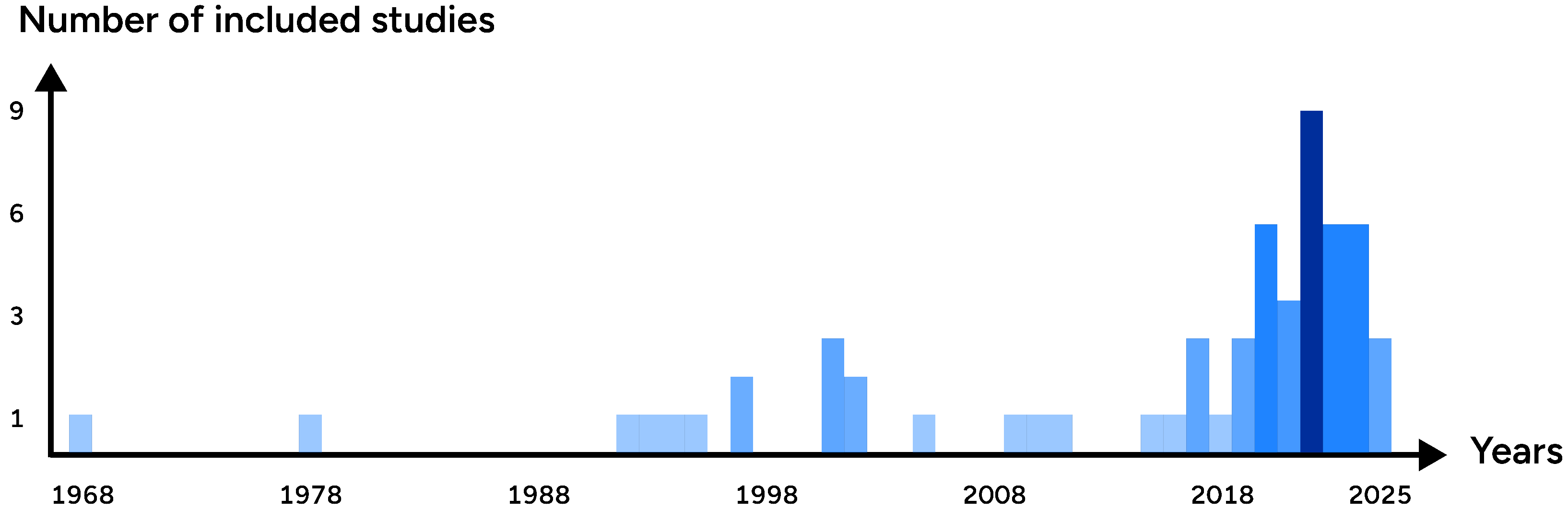
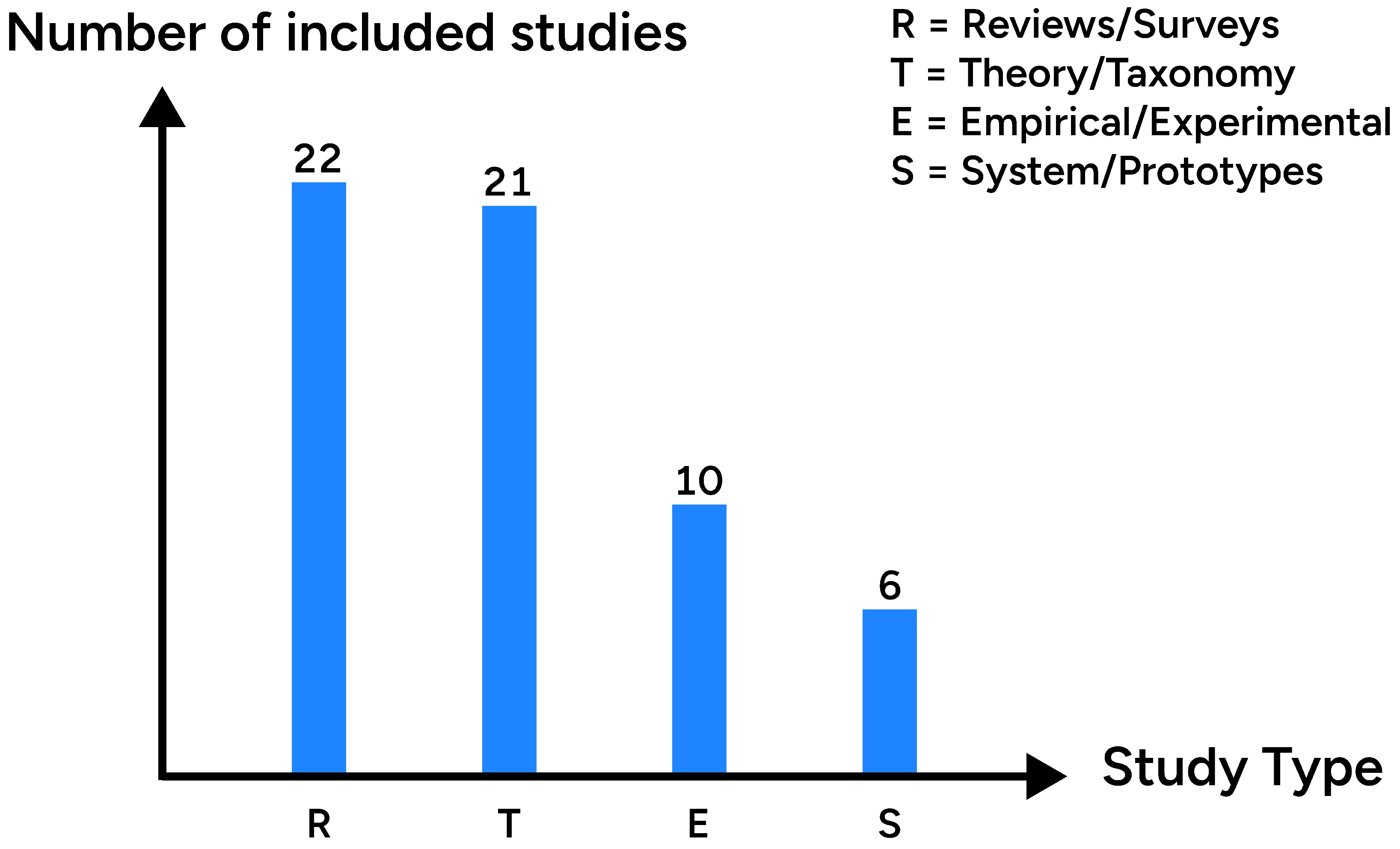
3. Descriptive Overview of the Included Corpus
4. Foundational Framework
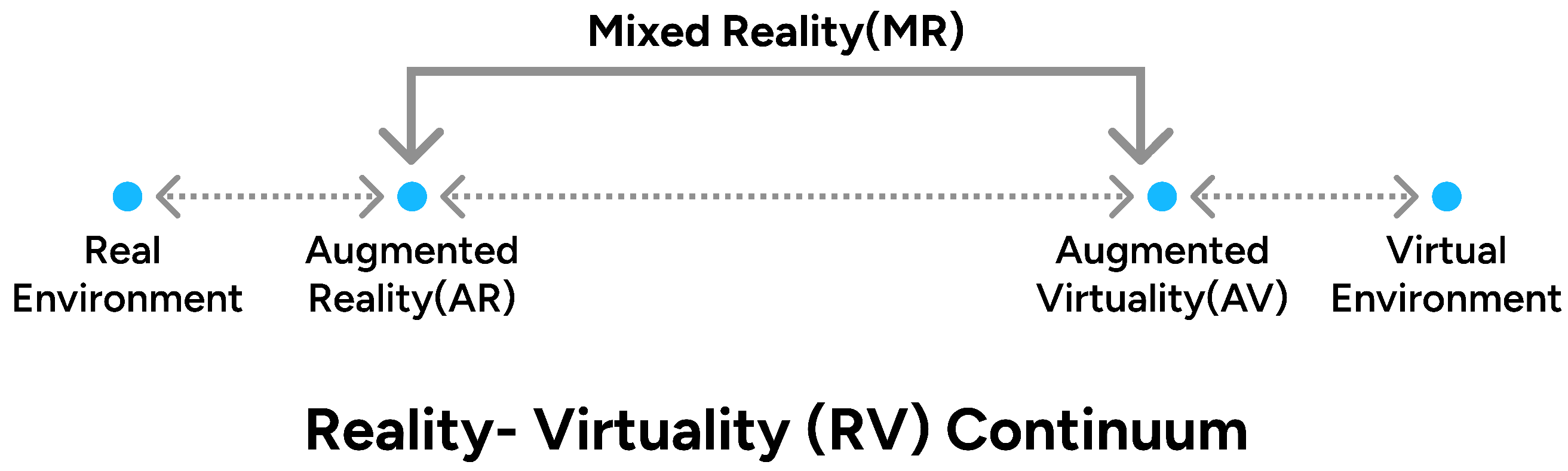
4.1. Historical Precursors and the Proposal of the Continuum
- Augmented Reality (AR): A MR environment is said to be Augmented Reality (AR) if it augments the real world with virtual content (computer graphics). This means the environment is primarily physical, with the addition of virtual elements.
- Augmented Virtuality (AV): if the majority of the content is virtual but contains some perception or incorporation of real-world objects, it is called Augmented Virtuality.The RV Continuum has been widely adopted for classifying and designing specific XR applications. For instance, in the domain of education, Panchenko et al. (2020) proposed a facet classification for augmented reality books, in which the first facet is the reality-virtuality continuum, categorising books as Virtual Book, Mixed Book, Augmented Book, and Reality Book [39]. This demonstrates how the continuum provides a foundational framework for structuring and understanding the design space of XR applications, bridging high-level theory with practical implementation.
4.2. Original Definition of Mixed Reality
- Real-world integration: Real-world content can also be integrated into the virtual world by embedding live video streams or integrating tracked haptic objects into the virtual experience [41]. This concept of mixing real and virtual worlds is widely used in industries such as broadcasting, entertainment, audio/video and computer graphics [12,41].
4.3. Historic Significance
- Monosensory: The initial version focused solely on visual displays, failing to adequately account for the user’s other senses.
- Lack of user experience: the influence of the observer’s or prior life experience on the experience is not explicitly considered.
- Insufficient consideration of consistency: The content is only relevant to realism and does not take into account the consistency of the overall experience.
5. Theoretical Evolution
5.1. Beyond a Single Visual Dimension
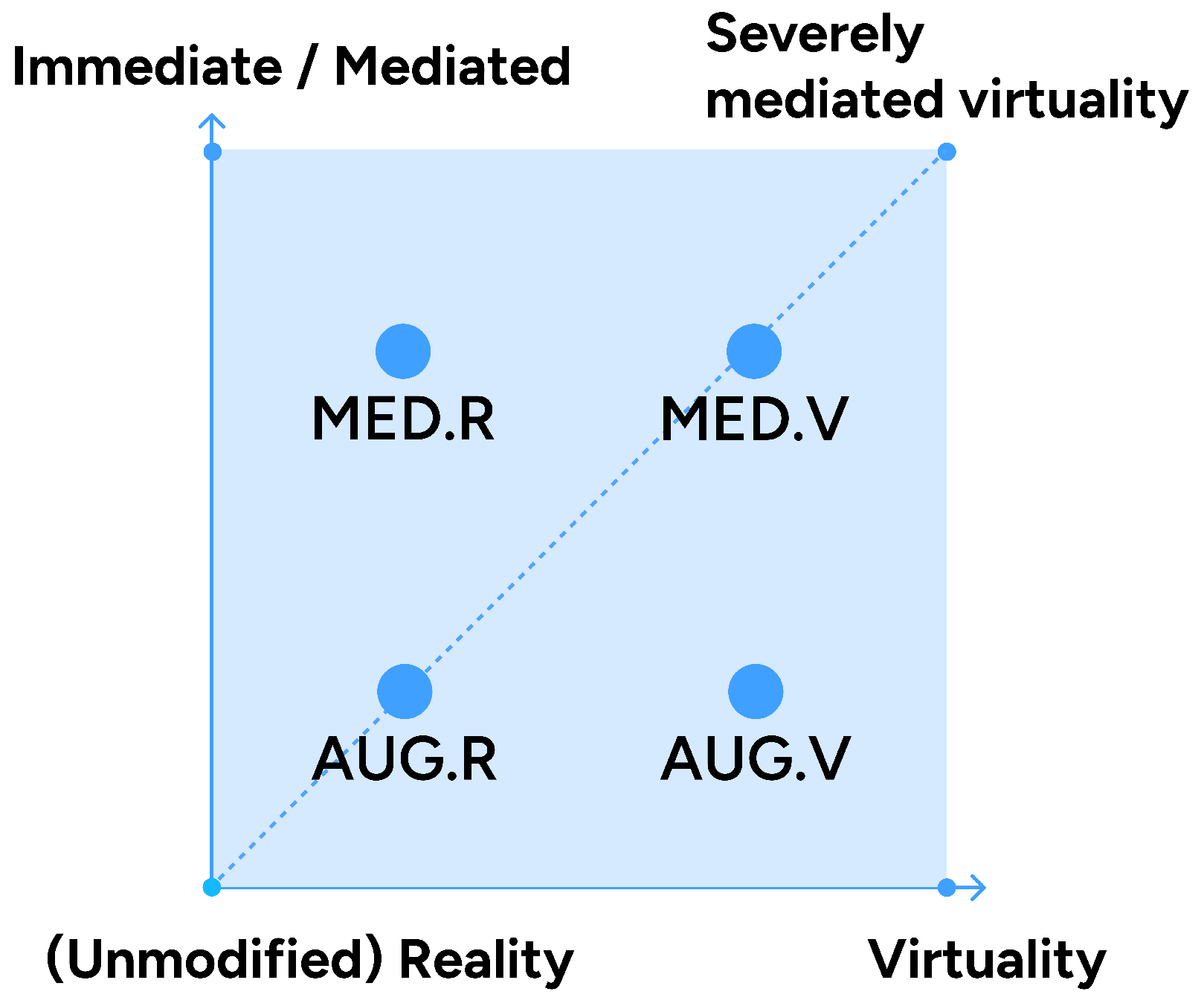
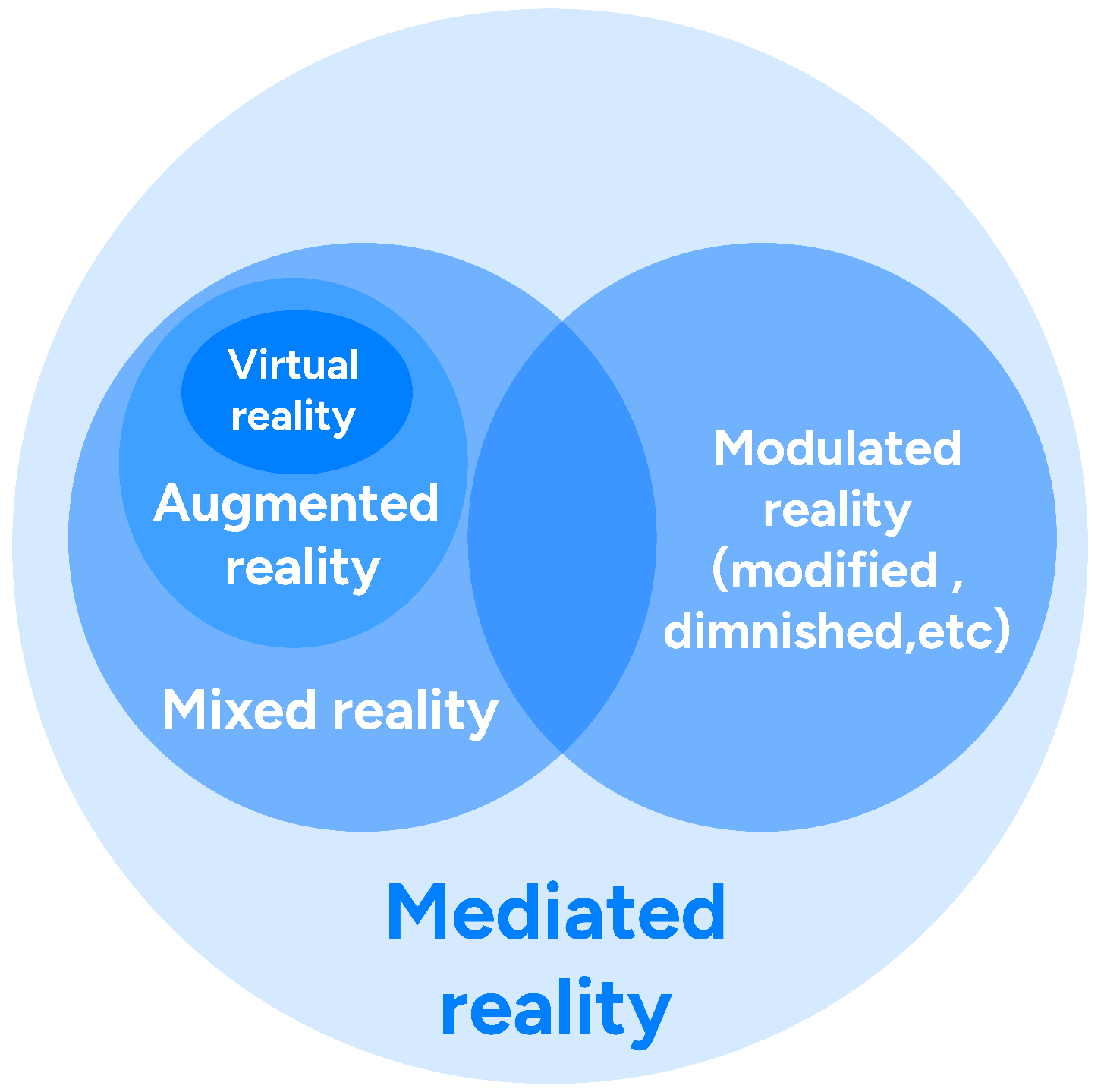
5.2. A Broader Framework—Mediated Reality
5.3. Solidifying a Key Point on the Continuum
- 1.
- Combination of Real and Virtual Worlds: AR can blend virtual objects (often computer-generated) with real environments.
- 2.
- Real-time Interaction: Users are able to interact with superimposed virtual information in real time. Although not directly listed in Azuma’s review, he discusses the construction of AR systems in his article, including the biggest challenges facing real-time systems, such as “registration and sensing.” Earlier studies he cites (e.g., [15]) also emphasise the system’s real-time and interactive nature.
- 3.
- 3D Registration: Virtual objects are precisely aligned with the real environment in three dimensions, making it appear as if they are coexisting in the same space, Azuma specifies that ideally, virtual and real objects would appear in the same space, for example, a virtual light fixture covering a real table, and a real table covering part of two virtual chairs, and lists “registration” as one of the biggest problems in building an AR system.
5.4. Mathematical Formalisation of Multiple Reality-Virtuality Continua
5.5. Cross-Reality as an Application Framework for the RV Continuum
6. Contemporary Academic Perspectives
6.1. Speicher’s Multi-Dimensional Descriptive Framework
- 1.
- Number of Environments: Refers to the number of physical and virtual environments required for a particular MR type. For example, if the AR user and the VR user are in the same room, the VR experience would be considered a separate environment.
- 2.
- Number of Users: Refers to the number of users required for a particular MR type. While more than one user is not strictly required in all cases, it is necessary for certain types of collaborative MRs.
- 3.
- Level of Immersion: Degree to which the system is immersive.
- 4.
- Level of Virtuality: Proportion or nature of virtual content in the environment.
- 5.
- Degree of Interaction: Degree of user interaction with virtual or real objects in the environment, ranging from completely passive (e.g., viewing 360-degree photos) to active manipulation (e.g., gesture control).
- 6.
- Input: The way the system receives user or environmental data.
- 7.
- Output: The way the system presents information to the user.
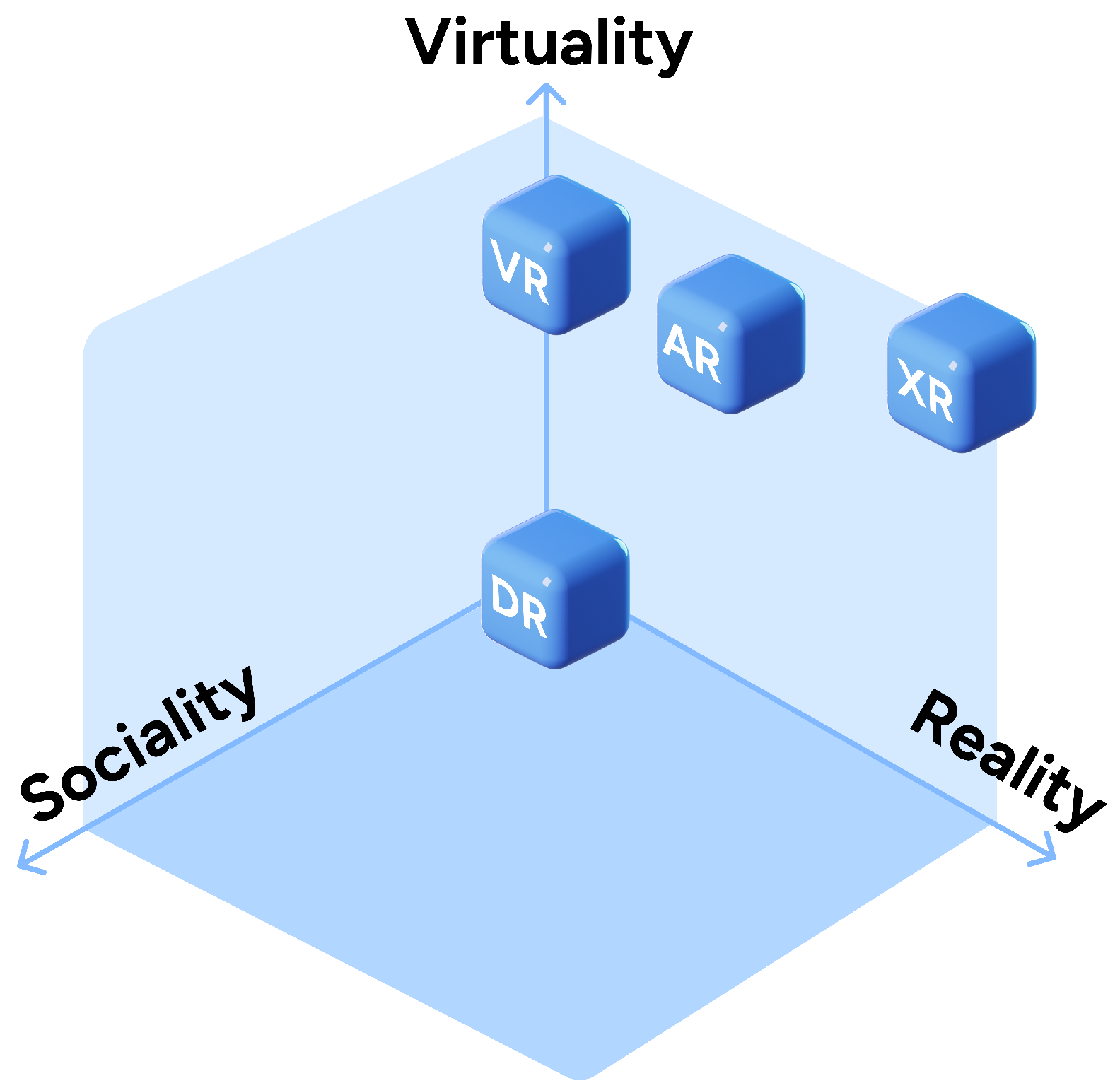
6.2. Gittens’ Ontological Perspective: A New Dimension of “Being”
6.3. The User-Centric Dimension: Presence, Plausibility, and Congruence
- Plausibility Illusion (Psi): [45] emphasises that Plausibility Illusion (Psi) becomes particularly important in MR experiences. Slater [23] defines Psi as “the illusion that what is apparently happening is really happening (even though you know for sure that it is not)”. Slater [23] further explains that plausibility refers to “overall credibility of the scenario being depicted in comparison with expectations” and is assessed on a cognitive level. Latoschik’s study [45] points out that inconsistencies in different information processing layers (e.g., sensory/perceptual and cognitive) can lead to a breakdown of plausibility. For example, virtual objects that exhibit irrational behaviour in a real environment (e.g., floating rather than landing on a surface) can undermine external rationality [41].
- Coherence: This notion of “coherence” used in the context of user perception echoes the system-capability dimension of “Coherence” (CO) proposed by Skarbez et al. [41]. Latoschik and Wienrich emphasise that perceived incoherence significantly reduces the perceived plausibility of an object [54]. Plausibility of the situation. It can be argued that “coherence”, as explored by Latoschik et al. at the level of the user’s psychological perception, and “coherence”, as proposed by Skarbez at the level of the system’s capabilities, constitute two sides of the same core idea: i.e., the virtual and real elements of the integration must follow a plausible set of internal logics [54].
- 1.
- Execution (43%): Focuses on application implementation and performance optimization [59]. This includes 360-degree content processing and analysis, object detection and tracking, and advanced scene recognition, all critical for maintaining low latency and system efficiency.
- 2.
- Interaction (33%): Enables natural and fluid user input. Applications range from Human-Computer Interaction (HCI) and gesture recognition to Foveated and Ocular Visualisation (e.g., eye tracking for rendering optimisation). These functions directly support the real-time engagement and sense of Congruence in XR.
- 3.
- Creation (24%): Involves the generation of content and visualisation elements. Key subcategories are 3D reconstruction and modelling, and point cloud processing. These technologies provide the necessary high-fidelity graphical assets to support external Rationality and Plausibility Illusion.
6.4. Merino et al.’s Systematic Framework for MR/AR Evaluation Methods [35]
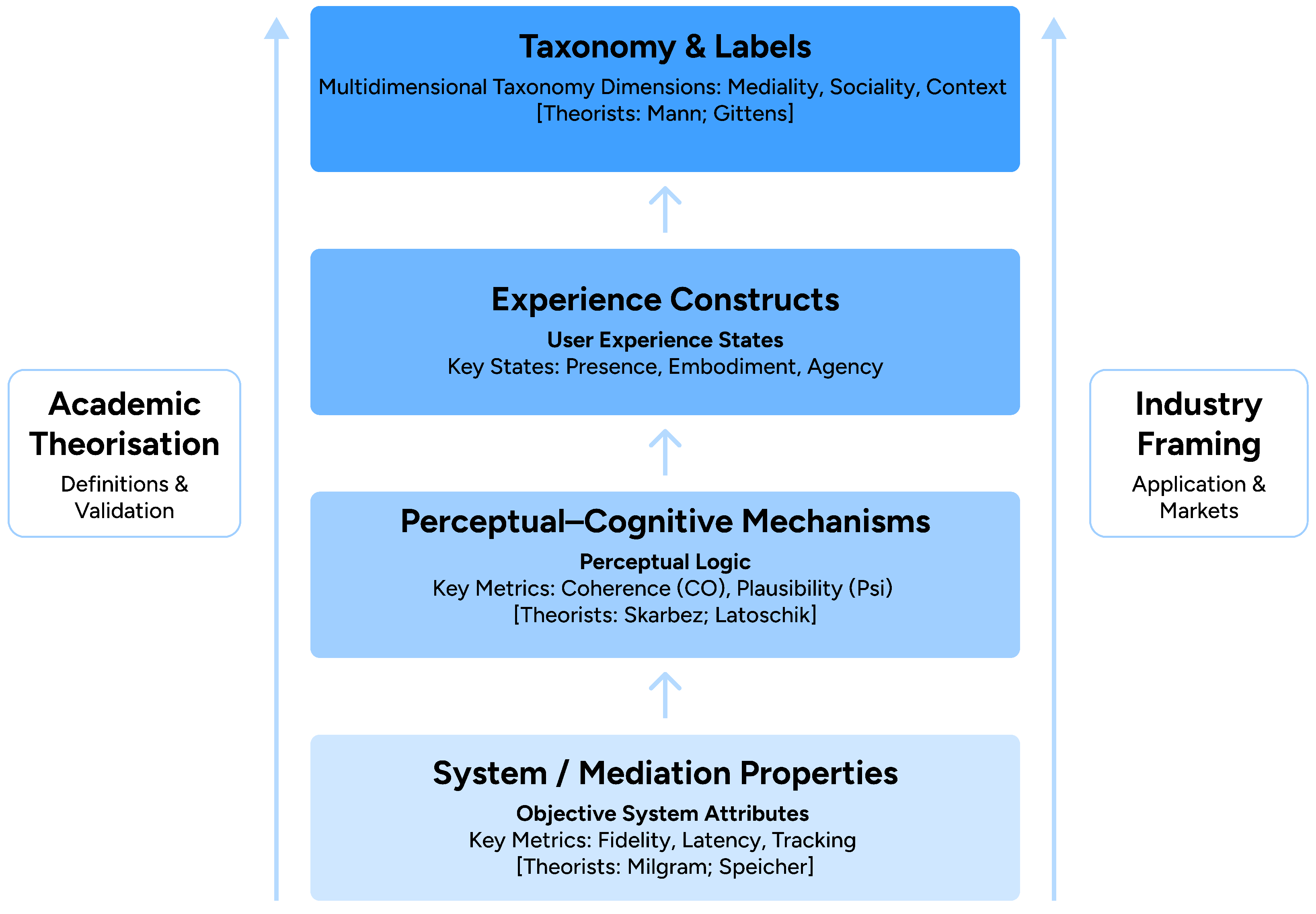
6.5. A Trend Toward Unified Classification Standards
7. Beyond Academia: Industry and Public Perceptions
- Meta represents the social ecosystem/mass market, whose definition and technology are primarily driven by the vision of an accessible, social Metaverse [44].
7.1. Meta (Industry Framing of MR)
7.2. Varjo (Industry Framing of MR)
7.3. Broader Industry Terminology Beyond the Two Case Examples
7.4. Public Perceptions of XR Terminology
7.5. Summary and Implications
8. Discussion
8.1. Answering RQ1 and RQ3: The Shift from Monosensory to Multi-Dimensional Extension
8.2. Answering RQ2: Systematisation Through Contemporary Multi-Dimensional Frameworks
8.3. Answering RQ4: The Technological Roots of Academic-Industry Divergence
8.4. Future Challenges and HCI Design Imperatives
8.5. Summary of Added Value Relative to Existing Surveys
9. Conclusions and Future Outlook
Author Contributions
Funding
Data Availability Statement
Conflicts of Interest
References
- Billinghurst, M.; Kato, H.; Poupyrev, I. The MagicBook: A transitional AR interface. Comput. Graph. 2001, 25, 745–753. [Google Scholar] [CrossRef]
- Meta. The Future of Mixed Reality: A Platform Ecosystem Vision. Available online: https://developers.meta.com/horizon/documentation/unity/mr-experience-and-use-cases/ (accessed on 20 January 2025).
- Varjo Technologies Oy. Mixed Reality. 2025. Available online: https://support.varjo.com/hc/en-us/mixed-reality (accessed on 23 June 2025).
- Dargan, S.; Bansal, S.; Kumar, M.; Sharma, M.; Garg, S.; Sehgal, H. Augmented Reality: A Comprehensive Review. Arch. Comput. Methods Eng. 2023, 30, 1057–1080. [Google Scholar] [CrossRef]
- Vatavu, R.-D. Sensorimotor Realities: Formalizing Ability-Mediating Design for Computer-Mediated Reality Environments. In 2022 IEEE International Symposium on Mixed and Augmented Reality (ISMAR); IEEE: New York, NY, USA, 2022; pp. 685–694. [Google Scholar] [CrossRef]
- Thompson, A.; Potter, L.E. Defining AR: Public Perceptions of an Evolving Landscape. In CHI’20 Extended Abstracts, Proceedings of the 2020 CHI Conference on Human Factors in Computing Systems Extended Abstracts, Honolulu, HI, USA, 25–30 April 2020; ACM: New York, NY, USA, 2020; pp. 1–7. [Google Scholar]
- Rauschnabel, P.A.; Felix, R.; Hinsch, C.; Shahab, H.; Alt, F. What is XR? Towards a Framework for Augmented and Virtual Reality. Comput. Human Behav. 2022, 133, 107289. [Google Scholar] [CrossRef]
- Milgram, P.; Kishino, F. A taxonomy of mixed reality visual displays. IEICE Trans. Inf. Syst. 1994, E77-D, 1321–1329. [Google Scholar]
- Kitchenham, B.A.; Charters, S. Guidelines for Performing Systematic Literature Reviews in Software Engineering; Keele University: Keele, UK, 2007. [Google Scholar]
- Koivisto, J.; Hamari, J. Gamification of physical activity: A systematic literature review of comparison studies. In International GamiFIN Conference; CEUR-WS: Aachen, Germany, 2019; pp. 106–117. [Google Scholar]
- Thomas, J.; Harden, A. Methods for the thematic synthesis of qualitative research in systematic reviews. BMC Med. Res. Methodol. 2008, 8, 45. [Google Scholar] [CrossRef]
- Mann, S. Mediated reality with implementations for everyday life. Presence Connect 2002, 1, 2002. [Google Scholar]
- Sutherland, I.E. A head-mounted three dimensional display. In Proceedings of the December 9–11, 1968, Fall Joint Computer Conference, Part I; Association for Computing Machinery: New York, NY, USA, 1968; pp. 757–764. [Google Scholar]
- Steuer, J. Defining virtual reality: Dimensions determining telepresence. J. Commun. 1992, 42, 73–93. [Google Scholar] [CrossRef]
- Feiner, S.; MacIntyre, B.; Seligmann, D. Knowledge-based augmented reality. Commun. ACM 1993, 36, 53–62. [Google Scholar] [CrossRef]
- Milgram, P.; Takemura, H.; Utsumi, A.; Kishino, F. Augmented reality: A class of displays on the reality-virtuality continuum. In Telemanipulator and Telepresence Technologies; SPIE: Bellingham, WA, USA, 1995; Volume 2351, pp. 282–292. [Google Scholar]
- Azuma, R.T. A survey of augmented reality. Presence Teleoperators Virtual Environ. 1997, 6, 355–385. [Google Scholar] [CrossRef]
- Mann, S. Wearable computing: A first step toward personal imaging. Computer 1997, 30, 25–32. [Google Scholar] [CrossRef]
- Lessiter, J.; Freeman, J.; Keogh, E.; Davidoff, J. A cross-media presence questionnaire: The ITC-Sense of Presence Inventory. Presence Teleoperators Virtual Environ. 2001, 10, 282–297. [Google Scholar] [CrossRef]
- Schuemie, M.J.; Van Der Straaten, P.; Krijn, M.; Van Der Mast, C.A.P.G. Research on presence in virtual reality: A survey. Cyberpsych. Behav. 2001, 4, 183–201. [Google Scholar] [CrossRef]
- Feiner, S.K. Augmented reality: A new way of seeing. Sci. Am. 2002, 286, 48–55. [Google Scholar] [CrossRef] [PubMed]
- Alexander, A.L.; Brunyé, T.; Sidman, J.; Weil, S.A. From gaming to training: A review of studies on fidelity, immersion, presence, and buy-in and their effects on transfer in PC-based simulations and games. DARWARS Train. Impact Group 2005, 5, 3. [Google Scholar]
- Slater, M. Place illusion and plausibility can lead to realistic behaviour in immersive virtual environments. Philos. Trans. R. Soc. B Biol. Sci. 2009, 364, 3549–3557. [Google Scholar] [CrossRef]
- Rodello, I.A.; Sanches, S.R.R.; Sementille, A.C.; Brega, J.R.F. Mixed Reality: Concepts, Tools and Applications. Rev. Bras. Comput. Apl. 2010, 2, 2–16. [Google Scholar] [CrossRef][Green Version]
- Dias, A.d.C.; García Ordaz, M.; López, J.F.M. From 2D to augmented reality. In Proceedings of the 6th Iberian Conference on Information Systems and Technologies (CISTI 2011), Chaves, Portugal, 15–18 June 2011; pp. 1–7. [Google Scholar]
- Zheng, R.; Zhang, D.; Yang, G. Seam the Real with the Virtual:a Review of Augmented Reality. In Proceedings of the 2015 Information Technology and Mechatronics Engineering Conference, Chongqing, China, 28–29 March 2015; pp. 77–80. [Google Scholar] [CrossRef][Green Version]
- Skarbez, R.T. Plausibility Illusion in Virtual Environments. Ph.D. Thesis, The University of North Carolina at Chapel Hill, Chapel Hill, NC, USA, 2016. [Google Scholar]
- Gilbert, S. Perceived realism of virtual environments depends on authenticity. Presence 2016, 25, 322–324. [Google Scholar] [CrossRef]
- Skarbez, R.; Brooks, F.P., Jr.; Whitton, M.C. A Survey of Presence and Related Concepts. ACM Comput. Surv. 2017, 50, 96. [Google Scholar] [CrossRef]
- Kim, S.; Kang, S.; Choi, Y.-J.; Choi, M.-H.; Hong, M. Augmented-Reality Survey: From Concept to Application. KSII Trans. Internet Inf. Syst. 2017, 11, 982–1004. [Google Scholar] [CrossRef]
- Nevelsteen, K.J.L. Virtual world, defined from a technological perspective and applied to video games, mixed reality, and the Metaverse. Comput. Animat. Virtual Worlds 2018, 29, e1752. [Google Scholar] [CrossRef]
- Bekele, M.K.; Champion, E.M. Redefining Mixed Reality: User-Reality-Virtuality and Virtual Heritage Perspectives. In Proceedings of the 24th International Conference of the Association for Computer-Aided Architectural Design Research in Asia (CAADRIA) 2019; CAADRIA: Hong Kong, China, 2019; Volume 2, pp. 675–684. [Google Scholar]
- Speicher, M.; Hall, B.D.; Nebeling, M. What is mixed reality? In Proceedings of the 2019 CHI Conference on Human Factors in Computing Systems; ACM: New York, NY, USA, 2019; pp. 1–15. [Google Scholar]
- Krzyzaniak, M.; Frohlich, D.; Jackson, P.J.B. Six types of audio that DEFY reality!: A taxonomy of audio augmented reality with examples. In Audio Mostly (AM’19); ACM: New York, NY, USA, 2019; pp. 1–8. [Google Scholar]
- Merino, L.; Schwarzl, M.; Kraus, M.; Sedlmair, M.; Schmalstieg, D.; Weiskopf, D. Evaluating Mixed and Augmented Reality: A Systematic Literature Review (2009–2019). In 2020 IEEE International Symposium on Mixed and Augmented Reality (ISMAR); IEEE: New York, NY, USA, 2020; pp. 438–451. [Google Scholar] [CrossRef]
- Hofer, M.; Hartmann, T.; Eden, A.; Ratan, R.; Hahn, L. The role of plausibility in the experience of spatial presence in virtual environments. Front. Virtual Real. 2020, 1, 2. [Google Scholar] [CrossRef]
- George, C.; Tien, A.N.; Hussmann, H. Seamless, bi-directional transitions along the reality-virtuality continuum: A conceptualization and prototype exploration. In 2020 IEEE International Symposium on Mixed and Augmented Reality (ISMAR); IEEE: New York, NY, USA, 2020; pp. 412–424. [Google Scholar]
- Zhang, C. The why, what, and how of immersive experience. IEEE Access 2020, 8, 90878–90888. [Google Scholar] [CrossRef]
- Panchenko, L.F.; Vakaliuk, T.A.; Vlasenko, K.V. Augmented reality books: Concepts, typology, tools. In Proceedings of the CEUR Workshop Proceedings, Vienna, Austria, 21–22 February 2020. [Google Scholar]
- Turchet, L.; Hamilton, R.; Çamci, A. Music in extended realities. IEEE Access 2021, 9, 15810–15832. [Google Scholar] [CrossRef]
- Skarbez, R.; Smith, M.C.; Whitton, M.C. Revisiting the reality-virtuality continuum: A new taxonomy for virtual and augmented reality. Presence Teleoperators Virtual Environ. 2021, 29, 247–274. [Google Scholar]
- Yin, K.; He, Z.; Xiong, J.; Zou, J.; Li, K.; Wu, S.-T. Virtual reality and augmented reality displays: Advances and future perspectives. J. Phys. Photonics 2021, 3, 022010. [Google Scholar] [CrossRef]
- Samini, A.; Palmerius, K.L.; Ljung, P. A Review of Current, Complete Augmented Reality Solutions. In 2021 International Conference on Cyberworlds (CW); IEEE: New York, NY, USA, 2021; pp. 49–56. [Google Scholar] [CrossRef]
- Park, S.-M.; Kim, Y.-G. A metaverse: Taxonomy, components, applications, and open challenges. IEEE Access 2022, 10, 4209–4251. [Google Scholar] [CrossRef]
- Latoschik, M.E.; Wienrich, C. Congruence and Plausibility, Not Presence: Pivotal Conditions for XR Experiences and Effects, a Novel Approach. Front. Virtual Real. 2022, 3, 883651. [Google Scholar] [CrossRef]
- Buchner, J.; Buntins, K.; Kerres, M. The impact of augmented reality on cognitive load and performance: A systematic review. J. Comput. Assist. Learn. 2022, 38, 285–303. [Google Scholar] [CrossRef]
- Brübach, L.; Westermeier, F.; Wienrich, C.; Latoschik, M.E. Breaking Plausibility Without Breaking Presence—Evidence for the Multi-Layer Nature Of Plausibility. IEEE Trans. Vis. Comput. Graph. 2022, 28, 2267–2276. [Google Scholar] [CrossRef]
- Pointecker, F.; Friedl, J.; Schwajda, D.; Jetter, H.-C.; Anthes, C. Bridging the gap across realities: Visual transitions between virtual and augmented reality. In 2022 IEEE International Symposium on Mixed and Augmented Reality (ISMAR); IEEE: New York, NY, USA, 2022; pp. 827–836. [Google Scholar]
- Nikolaidis, A. What Is Significant in Modern Augmented Reality: A Systematic Analysis of Existing Reviews. J. Imaging 2022, 8, 145. [Google Scholar] [CrossRef]
- Auda, J.; Gruenefeld, U.; Faltaous, S.; Mayer, S.; Schneegass, S. A Scoping Survey on Cross-reality Systems. ACM Comput. Surv. 2023, 56, 83. [Google Scholar] [CrossRef]
- Pamparau, C. A Review of Milgram and Kishino’s Reality-Virtuality Continuum and a Mathematical Formalization for Combining Multiple Reality-Virtuality Continua. Int. J. Adv. Comput. Sci. Appl. 2023, 14, 88. [Google Scholar] [CrossRef]
- Becker, A.; Dal Sasso Freitas, C.M. Evaluation of XR Applications: A Tertiary Review. ACM Comput. Surv. 2023, 56, 110. [Google Scholar] [CrossRef]
- Westermeier, F.; Brübach, L.; Latoschik, M.E.; Wienrich, C. Exploring plausibility and presence in mixed reality experiences. IEEE Trans. Vis. Comput. Graph. 2023, 29, 2680–2689. [Google Scholar] [CrossRef] [PubMed]
- Gall, A.; Heim, A.; Fröhler, B.; Heinzl, C. Uncertainty unveiled: Revealing the uncertainty of distribution visualization through cross reality. In 2023 IEEE International Symposium on Mixed and Augmented Reality Adjunct (ISMAR-Adjunct); IEEE: New York, NY, USA, 2023; pp. 20–24. [Google Scholar]
- Tahmid, I.A.; Rodrigues, F.; Giovannelli, A.; Lisle, L.; Thomas, J.; Bowman, D.A. CoLT: Enhancing collaborative literature review tasks with synchronous and asynchronous awareness across the reality-virtuality continuum. In 2023 IEEE International Symposium on Mixed and Augmented Reality Adjunct (ISMAR-Adjunct); IEEE: New York, NY, USA, 2023; pp. 831–836. [Google Scholar]
- Li, R.Z.; Cherival, T.; Cassandro, R.; Hou, Y. Eight questions on the evolution and impact of extended reality technologies in engineering systems performance evaluation. In 2024 IEEE International Conference on Prognostics and Health Management (ICPHM); IEEE: New York, NY, USA, 2024; pp. 217–222. [Google Scholar]
- Westermeier, F.; Brübach, L.; Wienrich, C.; Latoschik, M.E. Assessing depth perception in VR and video see-through AR: A comparison on distance judgment, performance, and preference. IEEE Trans. Vis. Comput. Graph. 2024, 30, 2140–2150. [Google Scholar] [CrossRef]
- Gittens, C.L. Dyadic-XV: A taxonomy of digital beings. IEEE Consum. Electron. Mag. 2024, 13, 36–45. [Google Scholar] [CrossRef]
- Cortes, D.; Bermejo, B.; Juiz, C. The use of CNNs in VR/AR/MR/XR: A systematic literature review. Virtual Real. 2024, 28, 154. [Google Scholar] [CrossRef]
- Ghourab, E.M.; Azab, M.; Gračanin, D.; Alhussein, O.; Al-Qutayri, M.; Muhaidat, S. Extended reality-aware wireless communication networks: A systematic literature review. IEEE Open J. Commun. Soc. 2025, 6, 7567–7588. [Google Scholar] [CrossRef]
- Mann, S.; Yuan, Y.; Lamberti, F.; Saddik, A.E.; Thawonmas, R.; Pratticò, F.G. eXtended meta-uni-omni-Verse (XV): Introduction, Taxonomy, and State-of-the-Art. IEEE Consum. Electron. Mag. 2024, 13, 27–35. [Google Scholar] [CrossRef]
- Lampropoulos, G. Intelligent Virtual Reality and Augmented Reality Technologies: An Overview. Future Internet 2025, 17, 58. [Google Scholar] [CrossRef]
- Cools, R.; Han, J.; Esteves, A.; Simeone, A.L. From display to interaction: Design patterns for cross-reality systems. IEEE Trans. Vis. Comput. Graph. 2025, 31, 3129–3139. [Google Scholar] [CrossRef]
- Moslavac, M.; Vlahović, S.; Skorin-Kapov, L. Towards a unified definition of social XR. In 2025 IEEE Conference on Virtual Reality and 3D User Interfaces Abstracts and Workshops (VRW); IEEE: New York, NY, USA, 2025; pp. 9–573. [Google Scholar]
- Sutherland, I.E. The ultimate display. Proc. IFIP Congr. 1965, 2, 506–508. [Google Scholar]
- Mann, S.; Fung, J. EyeTap devices for augmented, deliberately diminished, or otherwise altered visual perception of rigid planar patches of real-world scenes. Presence 2002, 11, 158–175. [Google Scholar] [CrossRef]
- Minsky, M. Telepresence. OMNI Magazine, June 1980; pp. 44–52. [Google Scholar]
- Heilig, M.L. Sensorama Simulator. US Patent 3,050,870, 28 August 1962. [Google Scholar]
- Varjo Technologies Oy. How Varjo Delivers Human-Eye Resolution in Virtual Reality. 2020. Available online: https://varjo.com/blog/introducing-bionic-display-how-varjo-delivers-human-eye-resolution/ (accessed on 23 June 2025).
- Varjo Technologies Oy. Varjo Insider Blog. 2025. Available online: https://varjo.com/blog/ (accessed on 23 June 2025).
- Microsoft. What Is Mixed Reality? Windows Mixed Reality Documentation. 2026. Available online: https://learn.microsoft.com/en-us/windows/mixed-reality/discover/mixed-reality (accessed on 3 January 2026).
- Apple. Introducing Apple Vision Pro: Apple’s First Spatial Computer. Apple Newsroom. 2023. Available online: https://www.apple.com/au/newsroom/2023/06/introducing-apple-vision-pro/ (accessed on 3 January 2026).
- Magic Leap. Magic Leap 2. 2026. Available online: https://www.magicleap.com/magic-leap-2 (accessed on 3 January 2026).



| Search terms | |
| (Framework OR Taxonomy OR Model OR Definition OR Survey OR Review) AND (“Mixed Reality” OR “Augmented Reality” OR “eXtended Reality” OR “Virtual Reality”) (Plausibility OR Presence OR Coherence OR Fidelity) AND (“Mixed Reality” OR “Augmented Reality”) “Reality-Virtuality Continuum” OR “Mediated Reality” | |
| Database | Number of records retrieved |
| IEEE Xplore | 13,630 |
| ACM Digital Library | 55,706 |
| Scopus | 37,215 |
| Web of Science | 67,126 |
| TOTAL | 173,677 |
| Dimensions | Core Standard | Key Elements (Must Include) |
|---|---|---|
| I. Concept Core and Description (RQ1) | Direct exploration of the definition, evolution, and classification of XR terminology. | Definition, Taxonomy, Framework, Survey, Review. |
| II. Theoretical Models and Frameworks (RQ2) | Propose cross-scenario, reusable XR conceptual models or system architectures. | Clear Model, Architecture, or Conceptual Framework. |
| III. User Perception Theory (RQ3) | Discuss how users’ subjective experiences influence the perception of reality. | Plausibility, Presence, Coherence, Fidelity. |
| IV. Macro Background and Critique (RQ4) | Provide critiques of Milgram’s Continuum, extensions, or discussions of XR from a macro perspective. | Direct critiques or extensions of the Reality-Virtuality Continuum. Discussion of Metaverse, IoT, or Social/Ethical Implications. |
| Criterion | Description |
|---|---|
| E1 | Did not contain an explicit definition, taxonomy, conceptual model, or framework related to XR/VR/AR/MR terminology (e.g., purely application reports without conceptual discussion). |
| E2 | Focused on technical implementation details (e.g., algorithms, rendering pipelines, networking, hardware performance) without proposing or interrogating a definitional or conceptual classification. |
| E3 | Addressed adjacent concepts (e.g., games, 3D graphics, teleoperation) and term misuse (e.g., MRI in the medical field). |
| E4 | Not a peer-reviewed scholarly source (e.g., patents, marketing materials), unless it was an industry definition explicitly analysed in Section 6. |
| E5 | Not accessible in full text or did not provide sufficient information to extract definitional/model content. |
| E6 | Not written in English. |
| No. | Title | Year | Type |
|---|---|---|---|
| p1 | A head-mounted three dimensional display [13]. | 1968 | S |
| p2 | Defining virtual reality: dimensions determining telepresence [14]. | 1992 | T |
| p3 | Knowledge-based augmented reality [15]. | 1993 | S |
| p4 | Taxonomy of mixed reality visual displays [8]. | 1994 | T |
| p5 | Augmented reality: a class of displays on the reality-virtuality continuum [16]. | 1995 | T |
| p6 | A survey of augmented reality [17]. | 1997 | R |
| p7 | Wearable computing: a first step toward personal imaging [18]. | 1997 | S |
| p8 | A cross-media presence questionnaire: the ITC-Sense of presence inventory [19]. | 2001 | R |
| p9 | The MagicBook: a transitional AR interface [1]. | 2001 | S |
| p10 | Research on presence in virtual reality: a survey [20]. | 2001 | R |
| p11 | Mediated reality with implementations for everyday life [12]. | 2002 | T |
| p12 | Augmented reality: a new way of seeing [21]. | 2002 | R |
| p13 | From gaming to training: a review of studies on fidelity, immersion, presence, and buy-in and their effects on transfer in PC-based simulations and games [22]. | 2005 | R |
| p14 | Place illusion and plausibility can lead to realistic behaviour in immersive virtual environments [23]. | 2009 | T |
| p15 | Mixed reality: concepts, tools and applications [24]. | 2010 | R |
| p16 | From 2D to augmented reality [25]. | 2011 | E |
| p17 | Seam the real with the virtual: a review of augmented reality [26]. | 2015 | R |
| p18 | Plausibility illusion in virtual environments [27]. | 2016 | E |
| p19 | Perceived realism of virtual environments depends on authenticity [28]. | 2017 | T |
| p20 | A survey of presence and related concepts [29]. | 2017 | R |
| p21 | Augmented-reality survey: from concept to application [30]. | 2017 | R |
| p22 | Virtual world, defined from a technological perspective and applied to video games, mixed reality, and the Metaverse [31]. | 2018 | T |
| p23 | Redefining mixed reality: user-reality-virtuality and virtual heritage perspectives [32]. | 2019 | T |
| p24 | What is mixed reality? [33] | 2019 | T |
| p25 | Six types of audio that DEFY reality!: A taxonomy of audio augmented reality with examples [34]. | 2019 | T |
| p26 | Evaluating mixed and augmented reality: a systematic literature review (2009-2019) [35]. | 2020 | R |
| p27 | The role of plausibility in the experience of spatial presence in virtual environments [36]. | 2020 | E |
| p28 | Seamless, bi-directional transitions along the reality-virtuality continuum: A conceptualization and prototype exploration [37]. | 2020 | E |
| p29 | The why, what, and how of immersive experience [38]. | 2020 | R |
| p30 | Augmented reality books: concepts, typology, tools [39]. | 2020 | T |
| p31 | Defining AR: Public perceptions of an evolving landscape [6]. | 2020 | E |
| p32 | Music in extended realities [40]. | 2021 | R |
| p33 | Revisiting Milgram and Kishino’s reality-virtuality continuum [41]. | 2021 | T |
| p34 | Virtual reality and augmented reality displays: Advances and future perspectives [42]. | 2021 | R |
| p35 | A Review of current, complete augmented reality solutions [43]. | 2021 | R |
| p36 | A metaverse: Taxonomy, components, applications, and open challenges [44]. | 2022 | R |
| p37 | Congruence and plausibility, not presence: pivotal conditions for XR experiences and effects, a novel approach [45]. | 2022 | T |
| p38 | The impact of augmented reality on cognitive load and performance: A systematic review [46]. | 2022 | R |
| p39 | Sensorimotor realities: Formalizing ability-mediating design for computer-mediated reality environments [5]. | 2022 | T |
| p40 | Augmented Reality: A comprehensive review [4]. | 2022 | R |
| p41 | What is XR? Towards a framework for augmented and virtual reality [7]. | 2022 | T |
| p42 | Breaking plausibility without breaking presence—evidence for the multi-layer nature of plausibility [47]. | 2022 | E |
| p43 | Bridging the gap across realities: visual transitions between virtual and augmented reality [48]. | 2022 | E |
| p44 | What is significant in modern augmented reality: A systematic analysis of existing reviews [49]. | 2022 | R |
| p45 | A scoping survey on cross-reality systems [50]. | 2023 | R |
| p46 | A Review of Milgram and Kishino’s reality-virtuality continuum and a mathematical formalization for combining multiple reality-virtuality [51]. | 2023 | T |
| p47 | Evaluation of XR applications: A tertiary review [52]. | 2023 | R |
| p48 | Exploring plausibility and presence in mixed reality experiences [53]. | 2023 | E |
| p49 | Uncertainty unveiled: Revealing the uncertainty of distribution visualization through cross reality [54]. | 2023 | S |
| p50 | CoLT: Enhancing collaborative literature review tasks with synchronous and asynchronous awareness across the reality-virtuality continuum [55]. | 2023 | S |
| p51 | Eight questions on the evolution and impact of extended reality technologies in engineering systems performance evaluation [56]. | 2024 | T |
| p52 | Assessing depth perception in VR and video see-through AR: A comparison on distance judgment, performance, and preference [57]. | 2024 | E |
| p53 | Dyadic-XV: A taxonomy of digital beings [58]. | 2024 | T |
| p54 | The use of CNNs in VR/AR/MR/XR: a systematic literature review [59]. | 2024 | R |
| p55 | Extended Reality-aware wireless communication networks: A systematic literature review [60]. | 2024 | R |
| p56 | eXtended meta-uni-omni-Verse (XV): Introduction, taxonomy, and state-of-the-art [61]. | 2024 | T |
| p57 | Intelligent virtual reality and augmented reality technologies: An overview [62]. | 2025 | R |
| p58 | From display to interaction: Design patterns for cross-reality systems [63]. | 2025 | T |
| p59 | Towards a unified definition of social XR [64]. | 2025 | T |
| Characteristics | Academic Theory (General) | Meta | Varjo |
|---|---|---|---|
| Definition of MR | An integration of real and virtual worlds along the RV continuum [8], defined as a “single perception” of real and virtual stimuli [41], with multiple working definitions in literature [33]. | A practical implementation that blends virtual content with the user’s physical environment via video passthrough. The focus is on social interaction and creating a platform ecosystem for apps and experiences within a real-world context. | The ultimate fusion of real and virtual, where virtual content is photorealistic and indistinguishable from reality. It is achieved via high-fidelity video passthrough, enabling professional use cases that demand extreme precision and realism. |
| Key Technology | Initially defined by display capabilities (EWK, RF, EPM) [8], later expanded to include user-centric dimensions like immersion and coherence [41]. | Driven by deep learning for content generation, mobile access, multimodal interaction, and a synergistic hardware/software ecosystem [44]. | “Human-eye resolution” display; low-latency video passthrough; gaze-driven XR autofocus system. |
| Primary Goal | To create a theoretical framework for classifying and understanding a wide range of experiences [8,41]. | To build a social, accessible, and commercially viable Metaverse ecosystem for the general consumer. | To provide a high-ROI tool for critical professional applications like training, simulation, and design. |
| Relationship to Milgram’s Continuum | Milgram and Kishino [8] originally proposed the Reality–Virtuality (RV) continuum. Skarbez et al. [41] argued that the continuum is fundamentally discontinuous at the “perfect VR” extreme and that all technologically mediated experiences fall within the broader scope of MR. | The Metaverse concept transcends the continuum by focusing more on social meaning and persistent content, accessible via both immersive (VR/AR) and non-immersive (2D screens) platforms. | Enables seamless, high-fidelity transitions between AR and VR, effectively operationalising the RV continuum [48,54]. |
| Typical Application | Tele-robotics, virtual environments, stereoscopic video/graphics. Early AR systems were used to enhance video scenes and for maintenance assistance [8]. | Social events, fashion, games, education, collaborative office work, psychotherapy, and marketing simulations [44]. | Training and Simulation (Flight, Crane), Design and Visualisation, Research, Sales and Marketing, Government and Defence, Healthcare, Automotive. |
Disclaimer/Publisher’s Note: The statements, opinions and data contained in all publications are solely those of the individual author(s) and contributor(s) and not of MDPI and/or the editor(s). MDPI and/or the editor(s) disclaim responsibility for any injury to people or property resulting from any ideas, methods, instructions or products referred to in the content. |
© 2026 by the authors. Licensee MDPI, Basel, Switzerland. This article is an open access article distributed under the terms and conditions of the Creative Commons Attribution (CC BY) license.
Share and Cite
Han, X.; Lehtonen, T.; Mäkilä, T. From the Reality–Virtuality Continuum to the XR Ecosystem: A Systematic Literature Review of Definitions and Conceptual Models. Multimodal Technol. Interact. 2026, 10, 24. https://doi.org/10.3390/mti10030024
Han X, Lehtonen T, Mäkilä T. From the Reality–Virtuality Continuum to the XR Ecosystem: A Systematic Literature Review of Definitions and Conceptual Models. Multimodal Technologies and Interaction. 2026; 10(3):24. https://doi.org/10.3390/mti10030024
Chicago/Turabian StyleHan, Xiaoran, Teijo Lehtonen, and Tuomas Mäkilä. 2026. "From the Reality–Virtuality Continuum to the XR Ecosystem: A Systematic Literature Review of Definitions and Conceptual Models" Multimodal Technologies and Interaction 10, no. 3: 24. https://doi.org/10.3390/mti10030024
APA StyleHan, X., Lehtonen, T., & Mäkilä, T. (2026). From the Reality–Virtuality Continuum to the XR Ecosystem: A Systematic Literature Review of Definitions and Conceptual Models. Multimodal Technologies and Interaction, 10(3), 24. https://doi.org/10.3390/mti10030024