Article

Design and Prototype of a Chatbot for Public Participation in Major Infrastructure Projects

by
Jonathan Matthei
1,*,
Johannes Maas
2,
Maurice Wischum
1,
Sven Mackenbach
1 and
Katharina Klemt-Albert
1
1
Chair and Institute of Construction Management, Digital Engineering and Robotics in Construction (ICoM), RWTH Aachen University; Templergraben 55, 52062 Aachen, Germany
2
Interactive Pioneers GmbH, Belvedereallee 5, 52070 Aachen, Germany
*
Author to whom correspondence should be addressed.
Multimodal Technol. Interact. 2026, 10(2), 12; https://doi.org/10.3390/mti10020012
Submission received: 10 November 2025 / Revised: 18 December 2025 / Accepted: 19 January 2026 / Published: 30 January 2026

Abstract

Public participation is a central element of democratic decision-making processes, but it often faces challenges within planning approval procedures due to problems of understanding and accessibility. This paper aims to counteract these challenges through the conceptual development, prototypical implementation and validation of a chatbot. The chatbot is designed to facilitate access to planning documents and improve the participation process as a whole. After presenting the theoretical foundations of chatbots and large language models (LLMs), three central use cases are described. The main tasks of the chatbot are to simplify the language of complex planning documents, find documents and information, and answer frequently asked questions. The underlying architecture of the prototype is based on the concept of retrieval augmented generation (RAG) and uses a vector database in which the information is embedded and stored as vectors. To evaluate the developed prototype, four focus workshops were conducted with professionals affiliated with road and rail infrastructure administrations at both state and federal levels in Germany. During these workshops, participants tested the core functionalities and assessed the system using both quantitative and qualitative criteria. The results indicate a strong potential for improving the handling of standard inquiries. By improving access to complex planning documents, the system may also contribute to a reduction in objections. At the same time, the evaluation emphasizes the importance of limiting hallucinations through appropriate technical safeguards and clearly indicating the use of AI to users. The insights gained from this study will be incorporated into the prototype developed within the BIM4People research project, funded by the German Federal Ministry of Transport. The aim therefore is to implement additional use cases and continuously optimize the functionality of the system through an iterative development process.

1. Introduction

1.1. Starting Point and Objective

Public participation is a key element of democratic decision-making processes [1]. It enables citizens to contribute their interests to political and administrative procedures. At the same time, it is an important tool for increasing transparency and acceptance. In the case of construction projects, it can make a significant contribution to the quality, cost and speed [2]. Protracted delays, for example, due to legal disputes, and the associated cost increases can be avoided through successful public participation [3].
However, participation is currently proving to be challenging for many citizens. Procedures are often complex, technical language is difficult to understand, and the provision of relevant information is confusing [4]. This can result in citizens only exercising their right to participate to a limited extent.
These difficulties are particularly evident in the planning approval process of major infrastructure projects. In this context, technical planning documents for infrastructure projects are made available to the public for a limited period of time during which they can raise objections. “According to Section 73(3), sentence 1 of the Administrative Procedure Act (VwVfG) in Germany, citizens have a period of four weeks during a so-called planning permission procedure (the German term: Planfeststellungsverfahren), an approval process for large infrastructure projects, to review the documents and determine whether they are affected.”
However, due to the large volume and complexity of the documents, reviewing them can be considered demanding in terms of both time and content [5]. This results in comprehension problems and difficulties in finding relevant documents [5].
The aim of this study is to conceptually develop, prototypically implement, and validate a chatbot to support citizens in the context of the planning approval process. The primary objective is to improve access to complex planning documents, enhance transparency and reduce barriers to understanding, thereby enabling citizens to more effectively exercise their participation rights. By supporting informed engagement and facilitating the identification of personally relevant information, the chatbot seeks to contribute to higher-quality participation.

1.2. Procedure and Structure

First, the theoretical foundations are presented, including the definition and classification of chatbots as well as an overview of existing applications in public participation (Section 2). In addition, this section discusses the theoretical foundations of Retrieval-Augmented Generation (RAG) and of keyword and semantic search approaches, which form the basis of the subsequent prototype implementation. Building on challenges identified in the literature regarding the review of planning documents, specific use cases for deploying a chatbot in the planning approval process are developed (Section 3). The presentation of these use cases is based on Cockburn (2001) [6], who recommends modeling the interactions between the stakeholders and the system. This is followed by the prototypical implementation based on planning documents from a planning approval procedure for the construction of a road tunnel located in southern Germany, which was submitted for public inspection in 2025 and comprised 84 documents (Section 4).
Subsequently, the prototype will be evaluated in four focus group workshops with a total of 25 participants (Section 5). For this purpose, the methodological approach will first be presented, followed by a presentation of the key findings. The experts hail from German road and rail construction authorities who are confronted with the display of plans for infrastructure projects as part of approval procedures that are based on mandatory public participation. The focus groups were designed based on Henseling (2006) [7]. Focus groups are an established qualitative method in which “discussion groups are assembled according to specific criteria (e.g., milieu- or actor-specific) and stimulated to discuss a specific topic through information input” [8]. According to Bär et al. (2020), they are particularly suitable for generating ideas and reviewing concepts and their acceptance [9]. Compared to individual interviews, focus groups enable a broader, more diverse, and in some cases, more creative discussion [7].
The conclusion consists of a summary of the key findings and an outlook on future research activities (Section 6).

2. Theoretical Foundation

2.1. Definition and Classification of Chatbots

A chatbot is a software-based dialogue system that communicates with human users using natural language [10,11,12]. The aim of a chatbot is to simulate human-like conversation and help solve tasks or answer specific questions [12,13,14,15]. The chatbot responds to inputs, processes the transmitted information and generates context-related responses [14]. Technologically, a chatbot is usually based on natural language processing (NLP) methods and either works on a rule-based basis with predefined responses or response patterns, or uses learning systems [13,16,17,18]. Chatbots are used in many different areas where automated and interactive communication is required [13,19].
Earlier versions of chatbots faced a number of challenges that limited their acceptance in widespread use. The primary challenges included, in particular, a limited understanding of contextual relationships and rigid, heavily scripted interactions with users [20,21]. With the introduction and use of large language models (LLMs), significant progress has been made in the further development of chatbots [22]. LLMs have now become a central component of modern chatbots, as they contribute significantly to the realization of human-like interactions between bots and users [20]. LLMs represent a class of artificial intelligence (AI) models that are trained on very large amounts of data to analyze language and generate natural, coherent responses to free-text inputs. In contrast to earlier rule-based or intent-based chatbots, which generate responses based on predefined rules or response templates, large language models produce responses dynamically by recognizing associations between tokens and estimating probability distributions over possible responses [23,24].

2.2. Added Value of Chatbots

Chatbots have a wide range of applications and offer diverse added value in various areas. Their basic function is to answer user queries, provide information and automate simple tasks [25]. In everyday contexts, chatbots are used, for example, to control smart home systems [12,15].
A key added value of chatbots lies in their ability to provide information in a structured manner while responding to individual enquiries [12,15,26]. This means they can be used in areas such as education, to answer frequently asked questions or as a tool for gathering information. Furthermore, the potential of chatbots is particularly evident in the public sector and, to some extent, already in the context of public participation [25,26]. In public institutions, they are used not only for general information dissemination but also for the provision of public services. These include appointment management and scheduling, responding to citizen enquiries, and the orderly provision of public administrative data [25,27].
The potential of chatbots to promote willingness to participate is particularly interesting for urban planning and public participation [25,26]. They can be used at different levels of participation. Chatbots can offer significant added value, particularly at the information and consultation levels [12]. For example, they can provide planning information in an understandable form or contribute specifically to shaping citizens’ opinions. In this context, chatbots act as intermediaries between specialist administrations and the population [26]. This makes planning processes more transparent and inclusive [26]. By providing relevant data in real time, on the basis of which objections can potentially be drafted, the quality of decisions in planning processes can be improved in the long term [26].
Another added value of chatbots lies in their constantly improving user-friendliness and continuous availability. Intuitive dialogues, easy accessibility and understandable response formats enable them to reach a wide audience [26]. At the same time, chatbots not only provide information to the public but also generate valuable data themselves. Their interactions can serve as a basis for analyzing citizens’ interests and patterns. These insights can be extremely relevant for both public administration and specialist planners [26].

2.3. Chatbots in Public Participation

The use of chatbots in public participation in the context of new planning projects is an innovative but as yet largely unexplored field [25,28]. While chatbots are increasingly finding their way into administrative contexts, their use in participatory planning processes, especially in the field of urban planning and the associated public participation, has hardly been tested to date [27,28]. There are only a few studies in the scientific literature that explicitly deal with the benefits or application of chatbots in the public sector, and even fewer in the context of active public participation [25]. The majority of systems or chatbots currently in use or being tested are limited to administrative services, such as answering frequently asked questions about administrative processes and are therefore not directly relevant to planning procedures [26,27].
However, some developments in Germany and internationally demonstrate the great potential of these chatbots. CityLAB Berlin, for example, has initiated several chatbot projects, including Parla and BärGPT [29]. On the one hand, these projects aim to make internal administrative processes more efficient through automated information processing and, on the other hand, they offer citizens the opportunity to ask questions that are answered on the basis of information and documents stored in the chatbot. This facilitates interaction with administrations, which could also be transferred to public participation in the context of planning processes in the future [30].
Initial attempts to integrate chatbots into participation processes have also been made in research. For example, Tavanapour et al. (2019) present a concept for a chatbot that can support citizens during such a process [28]. The chatbot is designed to answer simple questions about participation formalities either with the help of pre-formulated answers or, in the case of inappropriate enquiries, by forwarding them to a responsible contact person [28]. In practical application, however, this chatbot often had problems correctly interpreting users’ questions, which led to incorrect or inappropriate answers [28]. According to the authors, these results highlight the need to further develop such bots, as, despite the errors and existing technical challenges, they offer enormous potential as a supportive tool in planning processes and public participation [26,28,31,32].

2.4. Retrieval-Augmented Generation

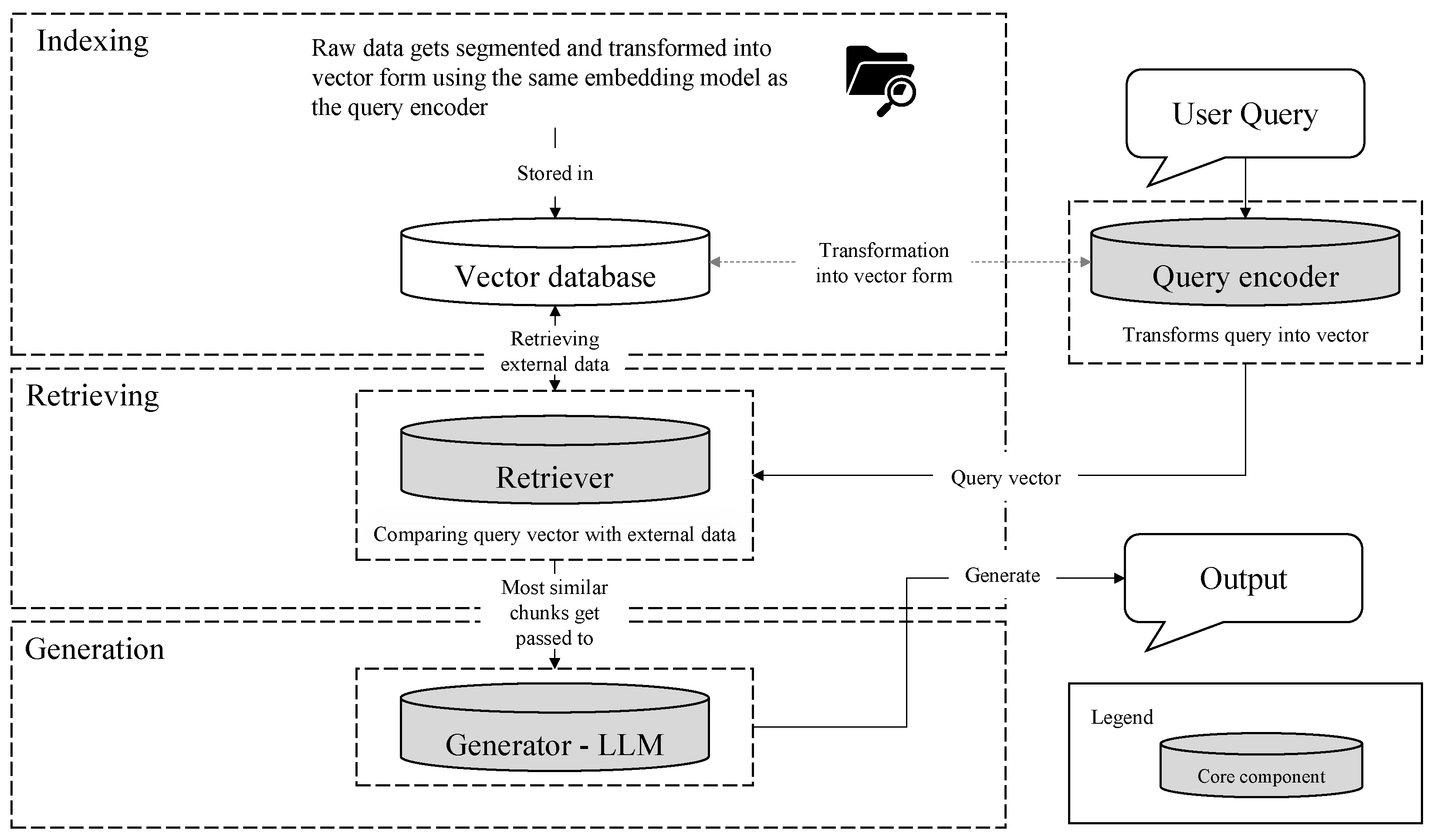
Retrieval-Augmented Generation (RAG) refers to a method for improving the response quality of LLMs by incorporating relevant information from external, trustworthy sources during generation [33,34,35]. The method aims in particular to reduce a weakness of LLMs known in the literature as hallucination [33,36,37]. Hallucinations refer to the tendency of language models to produce content that appears coherent and plausible but is in fact incorrect or completely fabricated [38,39,40]. This is often caused by outdated or incomplete training data, which limits the model’s knowledge spectrum [38,39]. By supplementing the model with up-to-date and reliable external knowledge, RAG helps to generate answers based on verifiable sources rather than on model-internal assumptions or inventions [33,34,37].
A RAG system can basically be divided into three functional components, two of which function as higher-level memory structures. A parametric and a non-parametric memory [35]. The parametric memory is represented by the generator, which also represents the underlying LLM. Its task is to formulate the final answer based on the user query and the retrieved external information [35,41]. Non-parametric memory is provided by the retriever. For each query, the retriever extracts the documents from the external knowledge base that are most relevant for subsequent response generation. This is based on the vector representation of the input, which was previously generated by the query encoder [35,37,41].
The query encoder is the third core component and is used to transform the user query into a semantic vector that can be processed within the vector database [33,35,37,41]. The retriever then uses this vector to identify the most similar documents in the external sources and pass them on to the LLM [37].
The typical process of an RAG system comprises three steps: indexing, retrieval and generation [35,37,42]. Indexing describes the preparation of the external knowledge base. Raw data is first converted into a uniform text form, then segmented into smaller units (chunks), and finally converted into vector form using an embedding model before being stored in a vector database [37,42]. The retrieval step involves retrieving this data. Here, the user query is vectorised using the same embedding model and compared with the stored text vectors using a similarity comparison, typically based on cosine similarity. The most similar chunks are passed to the LLM as context [37,42,43]. Finally, in the generation step, the context-relevant text passages are combined with the original user query to form a prompt and sent to the LLM, which generates the response based on its internal parametric knowledge and the external information [37,42,43]. The entire process, as well as the core components of RAG systems, is visualized in Figure 1.

2.5. Keyword and Semantic Search Approaches

Keyword-based search and semantic search represent two fundamental paradigms of information retrieval that differ primarily in how user queries are interpreted [44]. While both approaches aim to provide access to relevant information, they are based on distinct conceptual principles and exhibit specific advantages and limitations.
Keyword-based search retrieves information by matching explicit search terms with corresponding keywords in documents and therefore operates on a syntactic level [44,45]. A central limitation of this approach is that it does not account for the actual meaning of the terms used in a query or the semantic relationships between them [44,45,46]. As a result, keyword-based search can yield imprecise results or return a large number of documents that are formally similar but irrelevant to the user’s underlying search intent [44]. This limitation becomes particularly evident when queries are complex, ambiguous, or formulated using varied terminology.
In contrast, semantic search focuses on understanding the meaning, context, and intent of user queries rather than relying solely on exact keyword matches [44,45,46]. By capturing semantic relationships, this approach enables more accurate and context-aware retrieval of information [44,45]. Semantic search has been shown to be more effective and user-friendly than keyword-based search, particularly for complex queries, as it can resolve ambiguities and identify conceptually related content even when different wording is used [44,46]. Consequently, semantic search typically produces more relevant results and improves user efficiency by reducing the need to manually filter irrelevant documents [44].
Despite these advantages, semantic search also presents challenges, particularly with regard to explainability. While keyword-based search allows matched terms to be highlighted within documents, making it transparent why a specific text passage was retrieved, semantic search lacks a comparable level of interpretability. It is generally not immediately apparent why a document or text passage is classified as semantically similar to a query. This reduced transparency may lead users to perceive certain results as irrelevant or to question the completeness of the retrieved document set [47].
Overall, both search paradigms address different user needs. Keyword-based search offers transparency and traceability, whereas semantic search provides clear advantages in terms of relevance and usability, especially in complex and heterogeneous document collections such as planning and approval documents.

3. Use Cases for a Chatbot in the Planning Approval Process

Access to planning documents within public participation processes plays a central role in the context of planning approval procedures. However, numerous studies indicate that citizens face substantial barriers when engaging with planning approval documents, particularly in the context of large infrastructure projects. These barriers can be systematically grouped into three central user needs identified in the literature: (1) the need for understandable language, (2) the need for efficient access to relevant information and (3) the need for timely clarification of recurring questions.
First, planning documents are predominantly written in highly technical and legal language, which limits their comprehensibility for a non-expert audience [4,5,31]. This linguistic complexity makes it difficult for citizens to assess their own level of concern and to meaningfully participate in the process. The literature therefore highlights the need for tools that support the translation of technical content into more accessible language.
Second, planning documents of infrastructure projects are created on the basis of legal requirements and guidelines. However, these requirements contribute to the documents generally being extensive and complex, resulting in additional difficulties for citizens [4,48,49]. The complexity and scope of the documents make it difficult to find relevant documents or specific information within them [50,51]. This creates a clear user need for targeted guidance and information retrieval support.
Third, the complexity of the content of the planning documents and the technical language used in them can raise questions among citizens that need to be addressed to the relevant authorities or case workers [4,51,52,53]. In traditional participation formats, however, such inquiries often lead to long processing and waiting times, which can frustrate citizens and overburden administrative staff [54,55]. The literature therefore points to the need for more efficient mechanisms to address standard inquiries.
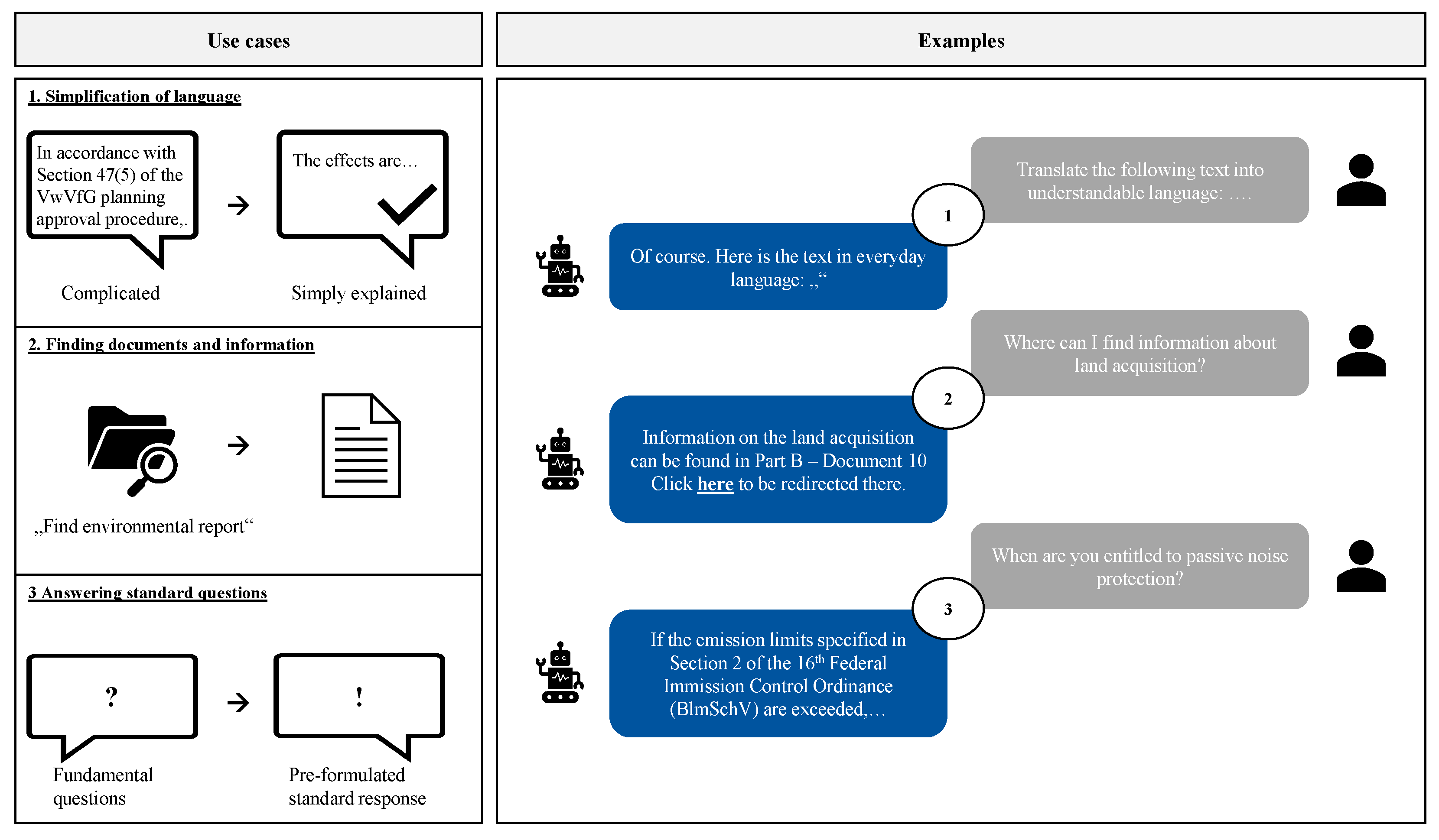
Based on these three user needs identified in the literature, Figure 2 illustrates three concrete chatbot use cases aimed at supporting citizen participation in planning approval procedures. The following sections provide a detailed description of each use case.

3.1. Simplification of the Language Used in Planning Documents

The first use case addresses the need for improved comprehensibility of planning documents. Its objective is to support citizens by presenting complex and technical content in simplified language. LLMs can be used to convert linguistically complex technical texts into a simplified form of expression. This makes it possible to provide key content in a more accessible way. In particular, it makes it easier for people without a technical background to access the relevant information. At the same time, it reduces misunderstandings that could otherwise lead to additional inquiries or objections.

3.2. Locating Documents and Information

The second use case relates to the targeted localization of documents and information. Citizens often face the challenge of locating relevant information within a large number of planning documents. A chatbot is well-suited to act as an intelligent search engine. It can answer queries such as ‘Where can I find information on noise pollution?’ and provide the relevant documents. This should facilitate access to documents in the planning approval process that are currently perceived as complex and improve information retrieval for private individuals.

3.3. Answering Standard Questions

The third use case focuses on addressing frequently asked or recurring questions. Automated responses to standard inquiries allow citizens to receive immediate feedback without having to wait for manual responses from authorities or project developers. This supports timely clarification of concerns and contributes to a more efficient participation process. While this use case may also reduce administrative workload, its primary benefit lies in improving responsiveness and accessibility for citizens.

4. Prototype Implementation

4.1. Architecture

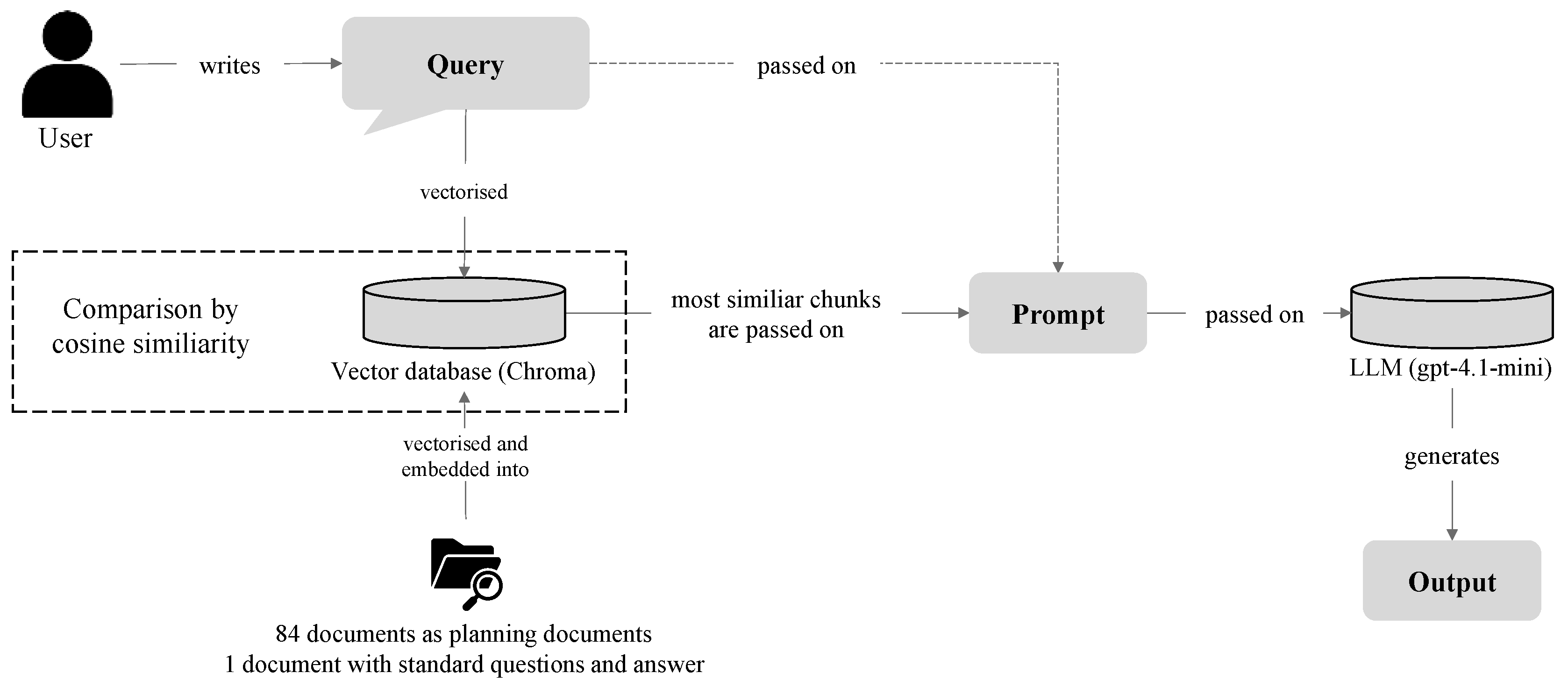
The underlying architecture is based on the described concept of RAG. The aim of this approach is to identify the most relevant information from a large amount of data that cannot be fully integrated into the context window of an LLM due to its size and to pass this information on to the model [37]. By grounding the model’s responses in retrieved source documents, as described in the theoretical foundations of this study, RAG reduces the likelihood of hallucinations by constraining the LLM to generate answers based on externally provided and verifiable information rather than solely on its internal representations.
The relevant information is selected using a vector database. LLMs encode information in vectors within multidimensional vector spaces. The similarity in content between two vectors is reflected in their angular relationship. The more similar the angular relationship between two vectors is, the closer the meanings tend to be. For example, the angular similarity between the two terms ‘fire’ and ‘hot’ is greater than between ’fire’ and ‘broccoli’ [56,57].
As part of the embedding process, the information is embedded in these vector spaces by assigning corresponding vectors to it. These vectors, including the embedded information, are stored in a database. To respond to a query, it is transformed into a vector space. Based on the comparison, the vectors most similar to the query can then be determined. The information stored with these vectors forms the result of the similarity search.
The information found by the similarity search and the original user query are then integrated into a prompt, i.e., an instruction or input directed at an AI model, and passed on to the LLM. The model then generates a response based solely on the information previously identified and provided. The overall architecture of the approach, as well as the underlying sequence, is presented in Figure 3. The detailed implementation is presented in the following subsection.

4.2. Detailed Implementation and Prototype

4.2.1. Used Data and Knowledge Base Construction

The prototype needs to be provided with specific external data in order to generate thematically appropriate answers. Accordingly, 84 documents and planning documents from a planning approval procedure in southern Germany, as well as a supplementary document containing standard questions and answers, were made accessible to the prototype. The standard questions and corresponding standard answers are based on a study by Matthei et al. (2025), which analyzed 828 objections from past planning approval processes between 2005 and 2019 [58]. The standard questions and answers were compiled in a separate text document and, like the planning documents, were accessible for the prototype.
Access to this externally stored data is made possible through the use of vector databases and knowledge collections. Open WebUI allows PDFs to be inserted into a vector database using knowledge collections [59]. To do this, the text content is first extracted from the PDF documents and divided into overlapping text blocks. Each of these blocks is then embedded in the vector database, including information such as the file name and page number.

4.2.2. Technological Setup and Process Sequence

Open-source components and selected models from OpenAI were specifically used for the technical implementation of the system. The technologies were selected based on their availability and the development team’s familiarity with the respective tools and frameworks. The central AI components of the presented approach consist of an LLM and an embedding model, which are used in combination to enable the generation of source-based responses.
The open-source web interface Open WebUI was used as the central interface between the user interface and the vector database, which uses the open-source vector database Chroma as standard. Within this architecture, the embedding model is responsible for vectorizing both the content of external documents and incoming user queries and storing these vector representations in the vector database. The text-embedding-3-small embedding model from OpenAI was used for the semantic representation of the content and its storage in the vector database [60]. This enables the conversion of textual content from PDFs into numerical vectors, which are necessary for efficient similarity searches. The large language model GPT-4.1-mini was used to respond to user queries and generate textual outputs [61]. Communication with the model took place via the Open WebUI API, which forwards queries to the OpenAI interface.
The prototype’s processing procedure begins with the input of a user query through the user interface. Once the query is submitted, Open WebUI initiates a semantic similarity search within the Chroma vector database. For this purpose, the user query is first transformed into a vector representation using the embedding model and then compared to the stored document vectors. The objective of this search is to identify the text blocks whose vector representations show the highest semantic similarity to the user query. In addition to free-text queries, the system supports the recognition of predefined standard queries. If a user query sufficiently matches a stored standard query, it is automatically identified through the similarity search and returned together with the corresponding predefined standard response. This serves to realize use case 3.
The text passages identified during the semantic search constitute the contextual basis for response generation by the large language model. Subsequently, a request is sent to the LLM via the Open WebUI API. The prompt explicitly includes both the original user query and the retrieved source documents. By embedding these elements directly into the prompt, the system ensures that the model has access to all relevant contextual information while preventing the use of external or unsupported knowledge.
Specific parameters were defined to control the language model. To ensure deterministic response generation and enable identical responses to identical questions, the temperature parameter was set to 0. The maximum number of tokens that can be generated (max_completion_tokens) was limited to 2048 to allow sufficient space for detailed responses and the inclusion of multiple quotations. The number of text blocks that serve as sources for response generation in the course of a query is limited to a maximum of five in order to ensure adequate search performance. These parameter choices support the implementation of use case 2 by enabling the retrieval of relevant documents and information.
The prompt sent to the LLM explicitly instructs the model to answer citizen queries based solely on the source documents retrieved beforehand. In addition, it is required to clearly indicate when requested information cannot be derived from the available documents in order to minimise the risk of hallucinations. The relevant sources are transferred to the model in a structured form using Extensible Markup Language (XML).
The LLM processes the prompt in accordance with these predefined instructions and generates a response using clear and understandable language. This aligns with use case 1, which focuses on simplifying the language of planning documents to improve accessibility and comprehension. The resulting output is returned in a structured JSON (The prototype uses the OpenAI function ‘Structured Output’ for this purpose. In addition, a JSON schema is specified, which the response should comply with) format. This output first contains a list of the citations used, including source identifiers and, where necessary, corrected references. The second part of the JSON structure contains the actual textual response generated by the model. In the user interface, the response is displayed in a structured manner, separating directly relevant text passages from the planning documents and a summarized explanation independently formulated by the LLM.

4.2.3. User Interface

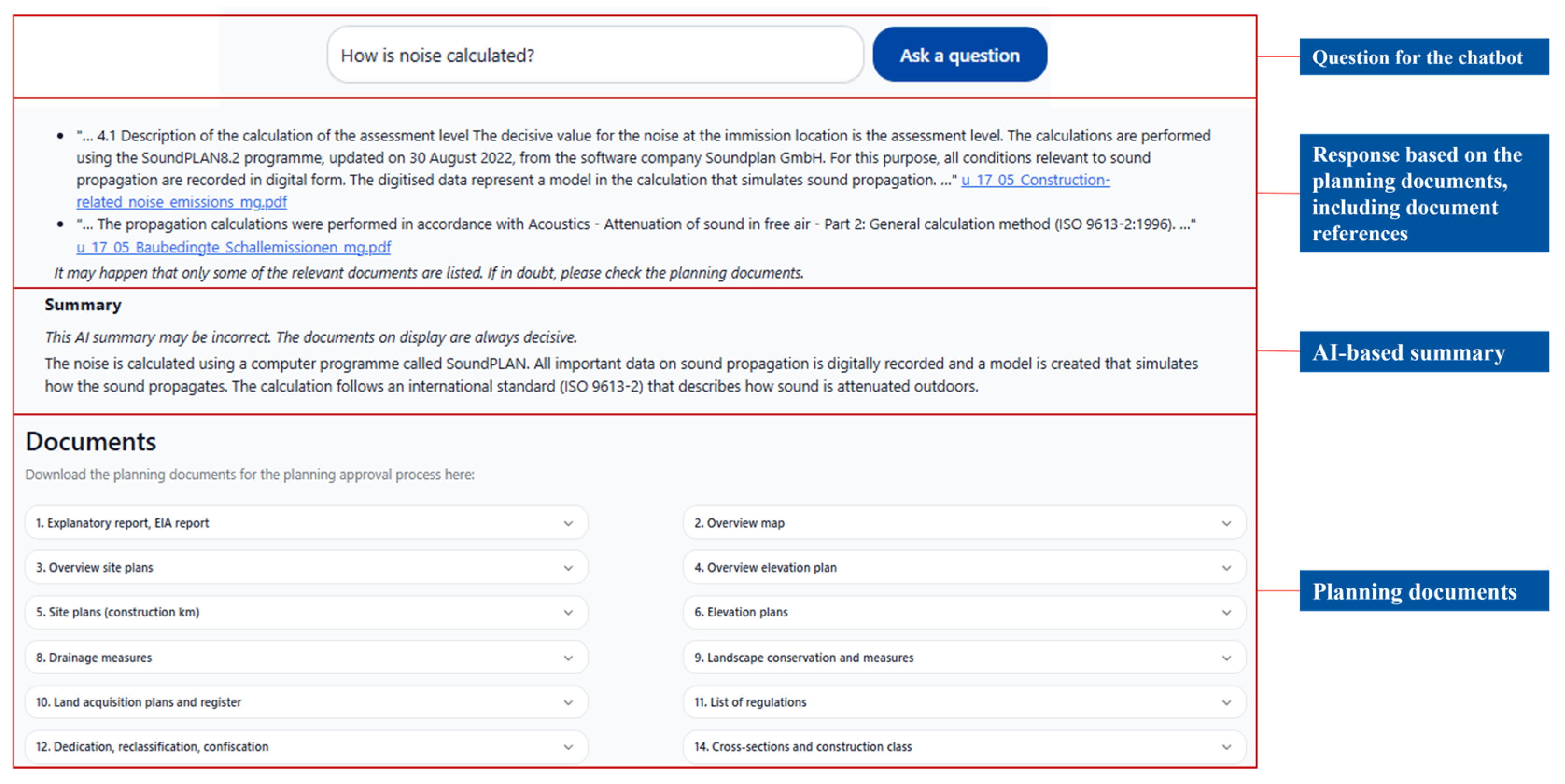
Figure 4 illustrates the user interface of the developed prototype. Users can enter their query to the chatbot in the upper section of the interface. Once the chatbot and the underlying technical infrastructure have generated a response, two text outputs appear below the input field. The first is a response quoted directly from the planning documents, with links to the relevant passages within these documents. Secondly, an AI-based summary is presented, which is also based on the previously stored planning documents, but is presented in a condensed and understandable form. The AI-based summary is preceded by a note pointing out that the summary may be incomplete or incorrect and that only the contents of the original documents are authoritative and binding. Below the answer areas, all planning documents relating to an infrastructure project are also listed. This gives users the opportunity to open these documents at any time and search for further information on their own.
It should be noted that the original project was conducted in German, and all prototype elements, including the user interface, were developed in the German language. For the purpose of this paper, the project has been translated and presented in English to ensure clarity and accessibility for an international audience.

5. Validation

5.1. Methodology

Following Hensling (2006), the procedure of focus groups can be divided into three stages [7]. The first stage involves defining the object of investigation, which includes selecting the participant group and developing the discussion guide. In this study, the focus groups were conducted online. This format was chosen because it reduces time and cost requirements and generally increases participant availability [62].
In total, 25 participants were recruited for the focus groups. Of these, 12 participants represented project developers acting as initiators of public participation processes and were therefore responsible for preparing planning documents. Eleven participants represented planning approval authorities responsible for conducting public disclosures within approval procedures. Two participants represented employees of the Information Technology Center Bund (ITZBund), which serves as the central IT service provider for the German federal administration. All participants were affiliated with road or rail infrastructure administrations at both the state and federal levels in Germany.
The core component of the focus group workshops is the demonstration of the chatbot, which participants can test via the developed user interface. To this end, participants are invited to formulate and submit questions to the chatbot. This is followed by an assessment of the presented use cases, consisting of a quantitative component in the form of a Likert scale and a qualitative component in the form of a group discussion.
The second step involves conducting the focus group workshops. The online collaboration platform Miro is used for implementation and documentation [63]. This enables collaborative work and individual coordination within the focus group workshops.
The third step involves evaluating the results. There is no standard method for evaluating focus groups [64]. Anything from simple transcripts to various scientific analyses is conceivable [9]. In this study, the evaluation is based on a summary of key discussion points in line with Ruddat (2012) [65]. Therefore, the key findings are summarized and supported by key quotes from the recording.

5.2. Validation Results

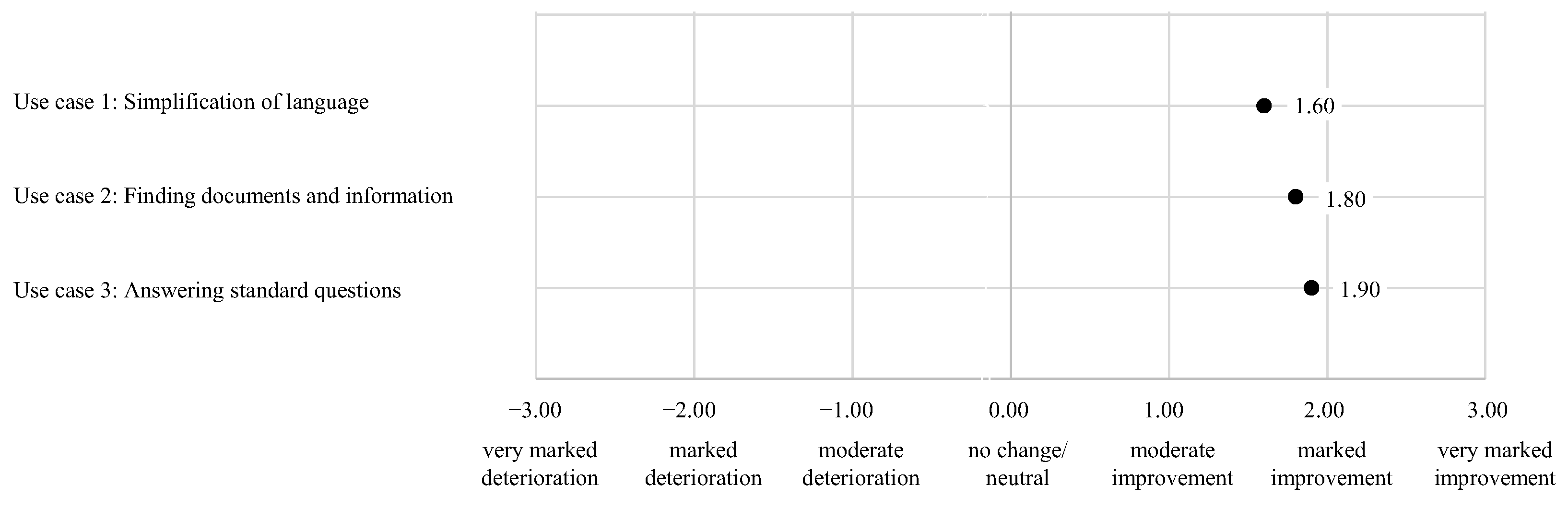
The quantitative survey in connection with the evaluation of the individual use cases for the chatbot in the presentation of planning documents shows that, according to the workshop participants, for use case 3: “Answering standard questions” is the use case that triggers the strongest improvement (Figure 5). The mean value of the scale survey is 1.9 and thus close to the scale value “marked improvement.”
The mean values for use cases 2 and 3 are also between the scale values “moderate improvement” and “marked improvement.” The mean value for use case 2: Finding documents and information is 1.8, and the mean value for use case 1: Simplification of language is 1.6.
In connection with use case 1: “Simplification of language,” one workshop participant notes that everything worked well for him and that “it is quickly and easily explained what it is all about.” Another participant in the same workshop also praised the prototype implementation, describing it as a “huge leap forward in terms of comprehensibility.” The presentation was also described as appealing, combining simplified text with quotes from the planning documents.
Another workshop participant pointed out that simplifying the documents is necessary and is already in demand. “So you have to make it understandable, and even when we get calls, we sometimes simplify our legal language in this regard […]”.
With regard to use case 2: “Finding documents and information,” one workshop participant mentioned that “so far, there has been no assistance whatsoever” for the “often very extensive documentation in the process.” Another participant in the same workshop noted that finding documents was quite easy. However, he noted that he had expected a different answer to his question. “I simply asked where I could find my property, and I received a general response.”
Another workshop participant was more critical, criticizing the restriction of results in the prototype implementation. The participant concluded that “only partial results are provided at this point.”
In connection with use case 3: “Answering standard questions,” one workshop participant emphasized that he had observed a “very significant improvement.” Another participant explained that “answering standard questions is definitely a very important point.” This was confirmed by another participant, who said that it reduced the number of “unnecessary objections.”
Overall, one workshop participant describes the chatbot as “very good.” He notes that he asked “control nonsense questions” and found that no incorrect answers were generated. He concludes: “I think it’s very good that such a filter works. That nothing is hallucinated or anything like that.” Another workshop participant concludes that the user interface is very clear and easy to understand.
An additional workshop participant notes that the generated summary was perceived as too short. This participant also notes that “a lot of AI training” is still necessary so that “the statements are, let’s say, more to the point.” As a possible extension, the workshop participant suggests that the assistance system could follow up after generating a response by asking whether the question was answered correctly or whether further information on the topic is desired.
In addition, the EU AI Act was mentioned in the discussion. One workshop participant asked whether legal requirements from this set of rules must be observed when applying the approach.

6. Summary, Discussion and Outlook

The aim of this study was to conceptually develop, prototypically implement and validate a chatbot to support public participation in planning approval processes for major infrastructure projects. The primary objective was to improve access to complex planning documents, enhance transparency and reduce barriers to understanding.
The study first discussed the theoretical foundations of chatbots and their application in public participation, then developed specific use cases in the context of planning approval processes, which were subsequently implemented as prototypes based on a specific German planning approval process. In the end, focus groups were conducted to validate the prototype and the developed use cases.
The presentation of the theoretical foundations has shown that chatbots offer various added values, such as the ability to provide information quickly and in a structured manner, or their continuous availability. Despite these added values, chatbots have hardly been used in public participation to date. However, the approach presented in this paper shows considerable potential for significantly improving the quality of public participation.
Traditional public participation in planning approval procedures presents numerous challenges, which are widely documented in the literature and significantly impede effective citizen participation. Three key use cases for the chatbot can be derived from these shortcomings. Automated linguistic simplification (use case 1), finding relevant information and documents (use case 2), and answering recurring standard questions (use case 3). These application scenarios for the chatbot show considerable potential for counteracting the existing problems in the participation process and optimizing it in the long term.
The architecture of the developed prototype follows the concept of retrieval-augmented generation (RAG). The Chroma vector database uses angle comparison to identify the most relevant information, which is then transferred to the model together with the user’s query in the form of a prompt. The model then generates a response based exclusively on the sources provided. The database consists of 84 planning documents for a German infrastructure project and an additional document containing frequently asked standard questions. All of the documents were stored in the vector database in advance.
The developed use cases were validated through focus group workshops involving a total of 25 participants using both quantitative and qualitative evaluation criteria. These workshops enabled professionals affiliated with road and rail infrastructure administrations at both state and federal levels in Germany to explore the chatbot prototype and to provide informed assessments of the underlying approach.
Overall, participants attributed a moderate to high potential for improving the participation process across all use cases. The results suggest that the system can significantly enhance the handling of standard inquiries. By improving access to complex planning documents, it may also contribute to a reduction in objections.
In addition to these opportunities, several key challenges must also be considered. The legal and regulatory framework, as highlighted in the focus groups, plays a crucial role in the deployment of chatbots and other AI-based applications. In particular, compliance with the General Data Protection Regulation (GDPR) (in German DSGVO) must be observed and ensured. Furthermore, the requirements of the EU AI Act are expected to become increasingly relevant for the future implementation of chatbot systems. The AI Act introduces a risk-based classification of AI applications that divides them into three categories. This classification distinguishes between prohibited systems, systems subject to strict regulatory requirements, and those permitted with minimal obligations [27,66]. However, as the EU AI Act has not yet been transposed into national law, there are currently no clear or binding legal guidelines that specifically regulate the use of chatbots in the context of public participation [66]. Consequently, no concrete or standardized system requirements can be derived at this stage. While future regulatory developments may introduce more detailed technical and organizational requirements for such systems, these remain largely speculative at present.
At the current stage of implementation, the system primarily relies on a warning within the user interface that alerts users to the possibility of incorrect or misleading content generated by the chatbot. This measure, however, cannot be considered a sufficient legal safeguard on its own. A more in-depth legal assessment will be required before drawing any definitive conclusions regarding compliance obligations or deriving concrete system requirements from existing or forthcoming legislation.
Another key challenge is ensuring the accuracy and reliability of AI-generated responses and summaries. Users may receive incomplete or incorrect information by using chatbots [31]. This can impact the effectiveness of the system. A related challenge is the social acceptance of AI applications, as studies indicate that parts of the population remain skeptical about their use [67,68,69]. Addressing public trust is therefore essential for the successful development of AI-based systems.
In the context of planning approval processes, specific legal requirements apply to planning documents [70]. To address these challenges, the prototype was designed to clearly distinguish between the original planning documents and AI-generated summaries. Each summary is accompanied by a note indicating that it may be inaccurate and that only the official planning documents are legally binding. Despite these precautions, further measures are needed to mitigate risks. A legal review is required to assess whether these safeguards adequately protect project developers and planning authorities from potential liability. Additionally, ongoing user education and transparency regarding the system’s limitations are crucial to enhance trust and social acceptance.
Another challenge is the potential for hallucinations in chatbots. Several measures have been implemented in the RAG-based chatbot to reduce this risk. For example, the model is restricted to perform only formatting corrections, and each text passage is linked to a unique ID. The prompt also instructs the model to explicitly state when no clear or sufficient information is available in the provided sources. The validation workshops indicate that these safeguards are largely effective. However, participants still expressed concerns that hallucinations could limit the chatbot’s usefulness in public participation processes. Overall, the risk persists, particularly when using semantic vector search instead of keyword-based search.
To further mitigate this risk, future work will focus on (i) introducing automated validation steps, such as similarity checks between original and cleaned text passages, and (ii) improving the underlying text extraction pipeline to reduce the need for LLM-based cleaning altogether.
In summary, the approach presented for using a chatbot demonstrates a way to increase the comprehensibility of planning documents for major infrastructure projects. In particular, the three use cases address key challenges that citizens often face in traditional participation formats. The validation indicates an improvement compared to the current situation from the perspective of initiators of public participation processes. However, further development and testing are needed to fully exploit this potential. The results of these evaluations should provide new insights into the chatbot’s performance and reliability, while also serving as a foundation for expanding it with additional functionalities. Furthermore, in this study, the chatbot’s functionality was examined exclusively in German, which opens up opportunities for future research to investigate its performance and applicability in other languages.

Author Contributions

Conceptualization, J.M. (Jonathan Matthei); methodology, J.M. (Jonathan Matthei); software, J.M. (Jonathan Matthei) and J.M. (Johannes Maas); validation, J.M. (Jonathan Matthei) and M.W.; formal analysis, J.M. (Jonathan Matthei); writing—original draft preparation, J.M. (Jonathan Matthei); writing—review and editing, J.M. (Johannes Maas), M.W., S.M., K.K.-A.; visualization, J.M. (Jonathan Matthei) and M.W.; supervision, J.M. (Jonathan Matthei); project administration, J.M. (Jonathan Matthei); funding acquisition, K.K.-A. All authors have read and agreed to the published version of the manuscript.

Funding

This article was written as part of the German BIM4People research project (funding code: 19FS2057A) funded by mFUND. The prototype implementation was realized using the participation platform provided by Interactive Pioneers GmbH.

Institutional Review Board Statement

Ethical review and approval were not required for this study, as it involved expert focus group workshops conducted in accordance with common research practice. All participants were informed about the purpose of the study and explicitly consented to participate as well as to the scientific use of their contributions. Only anonymized data were collected and analyzed, ensuring that no conclusions can be drawn about individual participants.

Informed Consent Statement

Informed consent was obtained from all subjects involved in the study.

Data Availability Statement

The original contributions presented in this study are included in the article. Further inquiries can be directed to the corresponding author.

Conflicts of Interest

Author Johannes Maas was employed by the company Interactive Pioneers GmbH. The remaining authors declare that the research was conducted in the absence of any commercial or financial relationships that could be construed as a potential conflict of interest.

References

  1. Arnstein, S.R. A Ladder of Citizen Participation. J. Am. Inst. Plan. 1969, 35, 216–224. [Google Scholar] [CrossRef]
  2. Joos, H.C.; Knyphausen-Aufseß, D.z.; Pidun, U. Project Stakeholder Management as the Integration of Stakeholder Salience, Public Participation, and Nonmarket Strategies. Schmalenbach Bus. Rev. 2020, 72, 447–477. [Google Scholar] [CrossRef]
  3. Ogryzek, M.; Krupowicz, W.; Sajnóg, N. Public Participation as a Tool for Solving Socio-Spatial Conflicts of Smart Cities and Smart Villages in the Sustainable Transport System. Remote Sens. 2021, 13, 4821. [Google Scholar] [CrossRef]
  4. Fink, S.; Ruffing, E.; Burst, T.; Chinnow, S.K. Less complex language, more participation: How consultation documents shape participatory patterns. Interest Groups Advocacy 2021, 10, 199–220. [Google Scholar] [CrossRef]
  5. Brettschneider, F.; Wenzel, G.; Spieker, A. Bauprojekte Visualisieren: Leitfaden für die Bürgerbeteiligung; Baden-Württemberg Stiftung: Stuttgart, Germany, 2017. [Google Scholar]
  6. Cockburn, A. Writing Effective Use Cases, 24th ed.; Addison-Wesley: Boston, MA, USA, 2012; ISBN 9780201702255. [Google Scholar]
  7. Henseling, C.; Hahn, T.; Nolting, K. Die Fokusgruppen-Methode als Instrument in der Umwelt- und Nachhaltigkeitsforschung; Institut für Zukunftsstudien und Technologiebewertung: Berlin, Germany, 2006; ISBN 978-3-929173-82-6. [Google Scholar]
  8. Eisend, M.; Kuß, A. Grundlagen Empirischer Forschung; Springer Fachmedien Wiesbaden: Wiesbaden, Germany, 2023. [Google Scholar] [CrossRef]
  9. Bär, G.; Kasberg, A.; Geers, S.; Clar, C. Fokusgruppen in der partizipativen Forschung. In Partizipative Forschung: Ein Forschungsansatz für Gesundheit und Seine Methoden; Hartung, S., Wihofszky, P., Wright, M.T., Eds.; Springer VS: Wiesbaden/Heidelberg, Germany, 2020; pp. 207–232. ISBN 978-3-658-30361-7. [Google Scholar]
  10. Collinsdictionary. Definition of ‘Chatbot’. Available online: https://www.collinsdictionary.com/dictionary/english/chatbot (accessed on 21 July 2025).
  11. Jia, J. The Study of the Application of a Keywords-based Chatbot System on the Teaching of Foreign Languages. arXiv 2003. [Google Scholar] [CrossRef]
  12. Ranoliya, B.R.; Raghuwanshi, N.; Singh, S. Chatbot for university related FAQs. In Proceedings of the 2017 International Conference on Advances in Computing, Communications and Informatics (ICACCI), Udupi, India, 13–16 September 2017; IEEE: New York, NY, USA, 2017; pp. 1525–1530. [Google Scholar]
  13. Adamopoulou, E.; Moussiades, L. An Overview of Chatbot Technology. In Artificial Intelligence Applications and Innovations, 16th ed., Proceedings of the Part II. IFIP International Conference on Artificial Intelligence Applications and Innovations, Neos Marmaras, Greece, 5–7 June 2020; Maglogiannis, I., Iliadis, L., Pimenidis, E., Eds.; Imprint Springer; Springer International Publishing: Cham, Switzerland, 2020; pp. 373–383. ISBN 978-3-030-49186-4. [Google Scholar]
  14. Colace, F.; de Santo, M.; Lombardi, M.; Pascale, F.; Pietrosanto, A.; Lemma, S. Chatbot for E-Learning: A Case of Study. Int. J. Mech. Eng. Robot. Res. 2018, 7, 528–533. [Google Scholar] [CrossRef]
  15. Abu Shawar, B.; Atwell, E. Chatbots: Are they Really Useful? J. Lang. Technol. Comput. Linguist. 2007, 22, 29–49. [Google Scholar] [CrossRef]
  16. Smestad, T.L. Personality Matters! Improving the User Experience of Chatbot Interfaces: Personality Provides a Stable Pattern to Guide the Design and Behaviour of Conversational Agents. Master’s Thesis, Noweigian University of Science and Technology, Trondheim, Norway, 2018. [Google Scholar]
  17. Cahn, J. CHATBOT: Architecture, Design, & Development; University of Pennsylvania School of Engineering and Applied Science: Philadelphia, PA, USA, 2017. [Google Scholar]
  18. Sansonnet, J.-P.; Leray, D.; Martin, J.-C. Architecture of a Framework for Generic Assisting Conversational Agents. In Intelligent Virtual Agents: 6th International Conference, IVA 2006, Marina Del Rey, CA, USA, August 21–23, 2006, Proceedings; Gratch, J., Ed.; Springer: Berlin/Heidelberg, Germany, 2006; pp. 145–156. ISBN 978-3-540-37593-7. [Google Scholar]
  19. Følstad, A.; Araujo, T.; Law, E.L.-C.; Brandtzaeg, P.B.; Papadopoulos, S.; Reis, L.; Baez, M.; Laban, G.; McAllister, P.; Ischen, C.; et al. Future directions for chatbot research: An interdisciplinary research agenda. Computing 2021, 103, 2915–2942. [Google Scholar] [CrossRef]
  20. Dam, S.K.; Hong, C.S.; Qiao, Y.; Zhang, C. A Complete Survey on LLM-based AI Chatbots. arXiv 2024. [Google Scholar] [CrossRef]
  21. Wollny, S.; Schneider, J.; Di Mitri, D.; Weidlich, J.; Rittberger, M.; Drachsler, H. Are We There Yet?—A Systematic Literature Review on Chatbots in Education. Front. Artif. Intell. 2021, 4, 654924. [Google Scholar] [CrossRef] [PubMed]
  22. Neumann, A.T.; Yin, Y.; Sowe, S.; Decker, S.; Jarke, M. An LLM-Driven Chatbot in Higher Education for Databases and Information Systems. IEEE Trans. Educ. 2025, 68, 103–116. [Google Scholar] [CrossRef]
  23. Bhayana, R. Chatbots and Large Language Models in Radiology: A Practical Primer for Clinical and Research Applications. Radiology 2024, 310, e232756. [Google Scholar] [CrossRef] [PubMed]
  24. Yigci, D.; Eryilmaz, M.; Yetisen, A.K.; Tasoglu, S.; Ozcan, A. Large Language Model-Based Chatbots in Higher Education. Adv. Intell. Syst. 2025, 7, 2400429. [Google Scholar] [CrossRef]
  25. Cortés-Cediel, M.E.; Segura-Tinoco, A.; Cantador, I.; Rodríguez Bolívar, M.P. Trends and challenges of e-government chatbots: Advances in exploring open government data and citizen participation content. Gov. Inf. Q. 2023, 40, 101877. [Google Scholar] [CrossRef]
  26. Hasan, F.; Jayasinghe, A.; Sathsarana, S. Specialized Urban Planning Chatbot: A Participatory Approach for Evaluating Efficiency. Bhumi Plan. Res. J. 2024, 10, 3–16. [Google Scholar] [CrossRef]
  27. Eichholz, L. Von Chatbots bis zur Stadtplanung: Generative KI in der Verwaltung. Available online: https://www.smart-city-dialog.de/wissen/blog/von-chatbots-bis-zur-stadtplanung-generative-ki-der-verwaltung (accessed on 23 July 2025).
  28. Tavanapour, N.; Poser, M.; Bittner, E. (Eds.) Supporting the Idea Generation Process in Citizien Participation—Toward an Interactive System with a Coversational Agent as Facilitator; European Conference on Information Systems: Stockholm-Uppsala, Sweden, 2019. [Google Scholar]
  29. CityLAB Berlin. Laufende Projekte. Available online: https://citylab-berlin.org/de/projects/ (accessed on 23 July 2025).
  30. CityLAB Berlin. Parla: Intelligentes Wissensmanagement für Verwaltungsdokumente. Available online: https://citylab-berlin.org/de/projects/parla/ (accessed on 23 July 2025).
  31. Netzwerk Bürgerbeteiligung. Anwendung von KI in der Bürgerbeteiligung: Ein Einführendes Gespräch mit Unserem Netzwerker Wolfgang König. 2025. Available online: https://www.netzwerk-demokratie-und-beteiligung.de/fileadmin/Inhalte/PDF-Dokumente/newsletter_beitraege/1_2025/nbb_beitrag_koenig_250305.pdf (accessed on 23 July 2025).
  32. Ramíres-Hernández, P.; Valle Cruz, D.; Mendoza Méndez, R.V. Revisión de los chatbots basados en inteligencia artificial en la administración pública: Hacia una arquitectura para el gobierno. Espac. Públicos 2023, 24, 29–49. [Google Scholar] [CrossRef]
  33. Cheng, Y.; Zhang, L.; Wang, J.; Yuan, M.; Yao, Y. RemoteRAG: A Privacy-Preserving LLM Cloud RAG Service. In Findings of the Association for Computational Linguistics: ACL 2025, Vienna, Austria; Che, W., Nabende, J., Shutova, E., Pilehvar, M.T., Eds.; Association for Computational Linguistics: Stroudsburg, PA, USA, 2025; pp. 3820–3837. [Google Scholar]
  34. Li, H.; Huang, J.; Ji, M.; Yang, Y.; An, R. Use of Retrieval-Augmented Large Language Model for COVID-19 Fact-Checking: Development and Usability Study. J. Med. Internet Res. 2025, 27, e66098. [Google Scholar] [CrossRef]
  35. Lewis, P.; Perez, E.; Piktus, A.; Petroni, F.; Karpukhin, V.; Goyal, N.; Küttler, H.; Lewis, M.; Yih, W.; Rocktäschel, T.; et al. Retrieval-Augmented Generation for Knowledge-Intensive NLP Tasks. In Advances in Neural Information Processing Systems; Larochelle, H., Ranzato, M., Hadsell, R., Balcan, M.F., Lin, H., Eds.; Curran Associates, Inc.: Red Hook, NY, USA, 2020; pp. 9459–9474. [Google Scholar]
  36. Barnett, S.; Kurniawan, S.; Thudumu, S.; Brannelly, Z.; Abdelrazek, M. Seven Failure Points When Engineering a Retrieval Augmented Generation System. In Proceedings of the CAIN 2024: IEEE/ACM 3rd International Conference on AI Engineering—Software Engineering for AI, Lisbon, Portugal, 14–15 April 2024; Bosch, J., Lewis, G., Cleland-Huang, J., Muccini, H., Eds.; ACM: New York, NY, USA, 2024; pp. 194–199. ISBN 9798400705915. [Google Scholar]
  37. Gao, Y.; Xiong, Y.; Gao, X.; Jia, K.; Pan, J.; Bi, Y.; Dai, Y.; Sun, J.; Wang, M.; Wang, H. Retrieval-Augmented Generation for Large Language Models: A Survey. arXiv 2023. [Google Scholar] [CrossRef]
  38. Hang, C.N.; Yu, P.-D.; Tan, C.W. TrumorGPT: Graph-Based Retrieval-Augmented Large Language Model for Fact-Checking. IEEE Trans. Artif. Intell. 2025, 6, 3148–3162. [Google Scholar] [CrossRef]
  39. Leiser, F.; Eckhardt, S.; Leuthe, V.; Knaeble, M.; Mädche, A.; Schwabe, G.; Sunyaev, A. HILL: A Hallucination Identifier for Large Language Models. In CHI ’24: Proceedings of the 2024 CHI Conference on Human Factors in Computing Systems; Mueller, F.F., Kyburz, P., Williamson, J.R., Sas, C., Wilson, M.L., Dugas, P.T., Shklovski, I., Eds.; ACM: New York, NY, USA, 2024; pp. 1–13. ISBN 9798400703300. [Google Scholar]
  40. Ji, Z.; Lee, N.; Frieske, R.; Yu, T.; Su, D.; Xu, Y.; Ishii, E.; Bang, Y.J.; Madotto, A.; Fung, P. Survey of Hallucination in Natural Language Generation. ACM Comput. Surv. 2023, 55, 248. [Google Scholar] [CrossRef]
  41. Sharma, C. Retrieval-Augmented Generation: A Comprehensive Survey of Architectures, Enhancements, and Robustness Frontiers. arXiv 2025. [Google Scholar] [CrossRef]
  42. Bianchini, F. Retrieval-Augmented Generation. In Engineering Information Systems with Large Language Models; de Luzi, F., Monti, F., Mecella, M., Eds.; Springer Nature: Cham, Switzerland, 2025; pp. 139–172. ISBN 978-3-031-92284-8. [Google Scholar]
  43. Cheng, M.; Luo, Y.; Ouyang, J.; Liu, Q.; Liu, H.; Li, L.; Yu, S.; Zhang, B.; Cao, J.; Ma, J.; et al. A Survey on Knowledge-Oriented Retrieval-Augmented Generation. arXiv 2025. [Google Scholar] [CrossRef]
  44. Hussan, B.K. Comparative Study of Semantic and Keyword Based Search Engines. Adv. Sci. Technol. Eng. Syst. J. 2020, 5, 106–111. [Google Scholar] [CrossRef]
  45. Bast, H.; Buchhold, B.; Haussmann, E. Semantic Search on Text and Knowledge Bases. Found. Trends® Inf. Retr. 2016, 10, 119–271. [Google Scholar] [CrossRef]
  46. Duhan, A.; Singhal, A.; Sharma, S.; Neeraj; MK, A. Semantic Search and Recommendation Algorithm. arXiv 2024. [Google Scholar] [CrossRef]
  47. Opitz, J.; Möller, L.; Michail, A.; Padó, S.; Clematide, S. Interpretable Text Embeddings and Text Similarity Explanation: A Survey. arXiv 2025. [Google Scholar] [CrossRef]
  48. Lamker, C. Unsicherheit und Komplexität in Planungsprozessen. Doctoral Dissertation, Technische Universität, Berlin, Germany, 2016. [Google Scholar]
  49. Bundesministerium für Verkehr und Digitale Infrastruktur. Reformkommission Bau von Großprojekten—Endbericht: Komplexität Beherrschen—Kostengerecht, Termintreu und Effizient. 2015. Available online: https://www.bmv.de/SharedDocs/DE/Publikationen/G/reformkommission-bau-grossprojekte-endbericht.pdf?__blob=publicationFile (accessed on 18 September 2025).
  50. Schütte, S.; Wolff, F.; von Vittorelli, L.; Schumacher, K.; Hünecke, K.; Zschiesche, M.; Stolpe, F.; Habigt, L.; Newig, J. Evaluation der Öffentlichkeitsbeteiligung: Bessere Planung und Zulassung Umweltrelevanter Vorhaben Durch die Beteiligung von Bürger*innen und Umweltvereinigungen; Umweltbundesamt: Dessau-Roßlau, Germany, 2023. [Google Scholar]
  51. Kubicek, H. Transparenz in und Über Bürgerbeteiligung: Online wie Offline Maßgebliches Qualitätsmerkmal. Online-Partizipation in der Stadtentwicklung. 2017, pp. 38–53. Available online: https://www.bbsr.bund.de/BBSR/DE/veroeffentlichungen/izr/2017/6/downloads/transparenz-buergerbeteiligung.pdf?__blob=publicationFile&v=2 (accessed on 18 September 2025).
  52. Staatsministerium Baden-Württemberg—Stabsstelle für Zivilgesellschaft und Bürgerbeteiligung. Leitfaden für eine Neue Planungskultur, Stuttgart. 2014. Available online: https://beteiligungsportal.baden-wuerttemberg.de/fileadmin/redaktion/beteiligungsportal/StM/140717_Planungsleitfaden.pdf (accessed on 18 September 2025).
  53. Verein Deutscher Ingenieure. Kommunikation und Öffentlichkeitsbeteiligung bei Bau- und Infrastrukturprojekten: Standards für die Leistungsphasen der Ingenieure, 2021 (VDI-MT 7001). Available online: https://www.vdi.de/mitgliedschaft/vdi-richtlinien/details/vdi-mt-7001-kommunikation-und-oeffentlichkeitsbeteiligung-bei-bau-und-infrastrukturprojekten-standards-fuer-die-leistungsphasen-der-ingenieure (accessed on 18 September 2025).
  54. Kümmel, M.; Lucka, M. KI in Infrastrukturprojekten: Beteiligung und Planung Verbessern. Faktenpapier—Aus der Serie: AI Science over Fiction, Berlin, Germany. 2020. Available online: https://www.bitkom.org/sites/main/files/2020-11/201112_sof10_ki-in-infrastrukturprojekten.pdf (accessed on 18 September 2025).
  55. Harding, J.; Alkhatib, W.; Fadl, B.; Peikert, S.; Ernst, T. Pilotstudie für ein KI-Gestütztes Einwendungsmanagement. 2022. Available online: https://www.dzsf.bund.de/SharedDocs/Downloads/DZSF/Veroeffentlichungen/Forschungsberichte/2022/ForBe_22_2022_KI_EinWend.pdf?__blob=publicationFile&v=5 (accessed on 18 September 2025).
  56. Mikolov, T.; Chen, K.; Corrado, G.; Dean, J. Efficient Estimation of Word Representations in Vector Space. arXiv 2013. [Google Scholar] [CrossRef]
  57. Mahajan, Y.; Freestone, M.; Aakur, S.; Karmaker, S. Revisiting Word Embeddings in the LLM Era. arXiv 2025. [Google Scholar] [CrossRef]
  58. Matthei, J.; Witte, A.; Mackenbach, S.; Klemt-Albert, K. Development of an Analytical System for Processing Citizien Objections. In Proceedings of the 14th Creative Construction Conference (CCC 2025), Zadar, Croatia, 14–17 June 2025; Hajdu, M., Skibniewski, M., Turk, Z., Eds.; International Association for Automation and Robotics in Construction (IAARC): Singapore, 2025. [Google Scholar] [CrossRef]
  59. Open WebUI. Document Extraction: Mistral OCR. Available online: https://docs.openwebui.com/features/rag/document-extraction/mistral-ocr/ (accessed on 18 September 2025).
  60. OpenAI. New Embedding Models and API Updates. Available online: https://openai.com/index/new-embedding-models-and-api-updates/ (accessed on 18 September 2025).
  61. OpenAI. Introducing GPT-4.1 in the API. Available online: https://openai.com/index/gpt-4-1/ (accessed on 18 September 2025).
  62. Bryman, A. Social Research Methods, 5th ed.; Oxford University Press: Oxford, UK, 2016; ISBN 9780199689453. [Google Scholar]
  63. Miro. Available online: https://miro.com/de/ (accessed on 9 December 2025).
  64. Anja, P.T.; Menold, N. Methodische Aspekte der Durchführung von Fokusgruppen in der Gesundheitsforschung: Welche Anforderungen Ergeben sich Aufgrund der Besonderen Zielgruppen und Fragestellungen? Leibniz-Institut für Sozialwissenschaften: Mannheim, Germany, 2015. [Google Scholar]
  65. Ruddat, M. Auswertung von Fokusgruppen mittels Zusammenfassung zentraler Diskussionsaspekte. In Fokusgruppen in der empirischen Sozialwissenschaft: Von der Konzeption bis zur Auswertung; Schulz, M., Mack, B., Renn, O., Eds.; Springer VS: Wiesbaden, Germany, 2012; pp. 195–206. ISBN 978-3-531-19397-7. [Google Scholar]
  66. EU Artificial Intelligence Act. High-Level summary of the AI Act. Available online: https://artificialintelligenceact.eu/high-level-summary/ (accessed on 22 September 2025).
  67. Kelly, S.; Kaye, S.-A.; Oviedo-Trespalacios, O. What factors contribute to the acceptance of artificial intelligence? A systematic review. Telemat. Inform. 2023, 77, 101925. [Google Scholar] [CrossRef]
  68. Gerlich, M. Perceptions and Acceptance of Artificial Intelligence: A Multi-Dimensional Study. Soc. Sci. 2023, 12, 502. [Google Scholar] [CrossRef]
  69. Koenig, P.D. Attitudes toward artificial intelligence: Combining three theoretical perspectives on technology acceptance. AI Soc. 2025, 40, 1333–1345. [Google Scholar] [CrossRef]
  70. Federal Ministry of Justice and Consumer Protection. Administrative Procedure Act (Verwaltungsverfahrensgesetz—VwVfG). 2023. Available online: https://www.gesetze-im-internet.de/vwvfg/ (accessed on 18 September 2025).
Figure 1. Components and process of RAG systems.
Mti 10 00012 g001
Figure 2. Use cases for a chatbot in the planning approval process.
Mti 10 00012 g002
Figure 3. Architecture and sequence of the approach.
Mti 10 00012 g003
Figure 4. A prototypical interface for the chatbot of the planning approval process.
Mti 10 00012 g004
Figure 5. Evaluation of the use cases for a chatbot in public participation.
Mti 10 00012 g005
Disclaimer/Publisher’s Note: The statements, opinions and data contained in all publications are solely those of the individual author(s) and contributor(s) and not of MDPI and/or the editor(s). MDPI and/or the editor(s) disclaim responsibility for any injury to people or property resulting from any ideas, methods, instructions or products referred to in the content.