1. Introduction
The largest carbon dioxide (CE) emitter in the globe, China, has pledged to peak its emissions in the year 2030 and achieve carbon neutrality in the year 2060 [
1,
2]. This ambitious goal, proclaimed by President Xi Jinping at the 75th UN General Assembly, is an important step towards a green industrial revolution, which would lead to the decoupling of economic growth and its impact on harm to the environment in China. High population growth, rampant urbanization, and industrialization in China have added a lot to the demand and emission of energy and CE in urban areas. Carbon neutrality is achievable by establishing specific emission reduction goals, reliable quantities and reporting of emissions, and employment of measures to counteract the remaining emissions [
3,
4]. This requires governments, industries, and people to use renewable energy, make energy use more efficient, and choose sustainable solutions.
High population growth rates, urbanization, and unsustainable development are putting enormous pressure on the global ecosystem, threatening the planet. From 1978 to 2021, China’s urbanization rate leaped from 17.92% to 64.72%, significantly propelling socioeconomic growth and elevating the living standards of its residents [
5]. After China became a member of the World Trade Organization, its economy rapidly improved, high rate of urbanization [
6], and energy use increased [
7], causing CE to increase. According to the International Energy Agency, China passed the US as the top carbon dioxide emitter in 2007 [
8,
9]. Although China is rapidly changing its economy’s industrial and economic structures, an increase in carbon emissions from energy is unlikely to slow down in the near future [
10]. High rates of urbanization, especially in the construction industry, have caused more energy consumption and carbon emissions. Therefore, it is essential to move urbanization toward a low-carbon green transition [
11,
12]. It is a challenge and an opportunity for China because the government tries to solve two tasks of ensuring further economic growth and ensuring sustainability.
Smart Cities can strengthen climate resilience and effectively address carbon emissions and energy constraints by integrating smart technologies [
13]. The Internet of Things (IoT), ML, smart grid, and others are being implemented to make energy more efficient, minimize emissions, and generally, better the quality of the urban population [
14]. The technologies provide an immense opportunity to ensure that energy is more efficiently used, more waste is managed, and that the sustainability of the urban infrastructure is improved. Specifically, the analysis will carry on the idea of defining the efficiency of these technologies in reducing the magnitude of CE in a smart city, with particular consideration of the measures of the machine learning technologies and the smart grids. Due to the use of IoT sensors, renewable energy, and smart grids, there is a prospect of designing data-intensive solutions in the future management of urban energy systems. The question this study will be answering contains two prospects: the increasing hunger for energy and the increasing emissions in the fast urban city of China, and the ambiguity of the complete margin of the smart cities with regard to efficacy in the reduction in emissions. As the urban population of China is also rapidly increasing, the demand for energy is also increasing [
15]. This makes it difficult when it comes to considering economic growth in environment sustainability.
Integrating technologies reduce carbon emissions in three different pathways. Firstly, integration of technologies in smart cities promises the reduction in energy consumption and CE, but they still require more attention as the urban systems are complex, and there are problems with data integration and implementation of regulations [
16]. Secondly, the smart grid technologies integration enables balancing out demand and supply more dynamically, which decreases the use of fossil fuel-based Peaker plants and the input of renewable energy to a larger extent [
17]. Thirdly, data-driven urban management, such as machine learning-based predictions and digital twins, allows policymakers to come up with solutions that maximize scale-up heating, transport, and building performance [
18]. These pathways resonate with the resource-based perception of cities that have recently highlighted the significance of technology as a key facilitator of efficiency and sustainability. Furthermore, integrating urban green infrastructure into developing smart cities is still a reasonable approach to improve emission reduction and sustainability in particular [
19].
This study investigates to what extent smart technologies integration can contribute to a decrease in carbon emissions in Chinese cities. To facilitate this purpose, the following subsequent supplementary research objectives are also considered: (i) to what extent models of machine learning, including RFR, XGBoost, LSTM, and GNN, can be used to predict the energy consumption and energy emissions in the city; (ii) what building, climate, and urban-level factors have the most significant impact on energy use and emissions; and (iii) what the findings of predictive modeling might suggest some policy recommendations China about pursuing its carbon reduction ambitions by 2060.
2. Literature Review
2.1. Smart City Technologies and Sustainability Paradigm
Smart cities are regarded as one of the passing projects of the century to transform the present conventional cities into well-planned, automated, and reliable intelligent cities [
20]. The importance of smart city technologies in enhancing energy efficiency and carbon reduction has received additional focus over the past years. These technologies have been shown to have a chance to maximize urban energy systems and meet the overarching objective of carbon neutrality in a number of studies. The smart cities are applications of Information and Communication Technologies (ICTs), ML, IoT, big data, and smart grids in the optimization of energy use, waste reduction, and the general sustainability level of cityscapes. Smart cities enhance green innovation and efficient use of resources. For instance, Mosannenzadeh et al. offer a multidisciplinary and overall definition of a smart city by combining the practice of ICT with different areas, as well as the cooperation among the major stakeholders [
21]. Similarly, An et al. correlate greater green patents and productivity with greater smartness, lowering emissions [
22]. Likewise, the study by Zhang and Hong concludes that smart city pilots increase carbon efficiency via green technologies, industrial modernization, energy efficiency, and improved regulation and information technology (IT) governance.
Smart city technologies are crucial in diminishing the environmental impact of urbanization, which particularly concerns quickly growing urban areas such as those in China, where annual energy use and emissions are increasing every year [
23]. As cities in the world are rapidly growing in terms of population, carbon emission reduction has become a burning concern. Smart cities allow integrating powerful energy systems, transport, and building management, and they can manage their resources more efficiently. The analysis of real-time data and prediction modeling, and, in particular, via the technologies of IoT and ML, which streamline energy systems, allowing for reducing at least emissions, and at most, energy waste. The pressure on the urban infrastructure continues to grow due to the process of urbanization, and the smart city technologies can help reduce the negative outcomes of degradation to the environment and promote the fulfillment of global climate targets [
24].
Wang and Priyadarshi conducted a considerable analysis comparing Chinese cities that were active participants in smart city pilot programs and discovered that the reduction in CE was 4.36 percent in cities adopting smart technologies [
25]. This improvement was accredited to real-time monitoring and optimization of energy consumption thanks to the use of the IoT-enabled energy management systems, the smart grid, and the digital infrastructure to manage energy consumption in buildings, transportation, and other urban systems. Moreover, intelligent sensors and automatic infrastructure reduced the number of emissions, as well as enhanced public lighting, traffic control, and energy supply networks. The results are similar to what has been reported by Komninos et al., who noted that when cities were remotely operated through IoT, smart grids, and cloud computing, they became 1.4 percent more carbon efficient, highlighting the role of digital infrastructure in achieving energy efficiency when urbanizing and how it has a direct impact of curbing carbon emission [
26]. With such technologies used in the initiatives of both the public and private sectors, the cities can power larger sustainability agendas and thus fulfill the global needs of carbon-neutral expansion in urban areas.
2.2. Role of Machine Learning in Sustainability
ML is quickly changing the way cities are gaining control over building energy use. Heating and cooling loads on the buildings were provided by Shang and Lv, using ensemble machine learning models, such as Random Forest and training XGBoost with Bayesian Optimization, used by Li [
27,
28]. They concluded with R
2 of more than 0.99 in their models. The most important fact is that these models can represent energy needs with a great degree of accuracy, depending on parameters like weather patterns, occupancy ratio, and building characteristics [
29]. The forecasting capability is more relevant in the residential sector, where heating and cooling usually make up a large proportion of total energy expenditure [
30]. These models can also enable the maximization of heating and cooling because there is an excellent prediction of the amounts of energy consumed, and hence energy would only be used when it is quite needed.
In addition, more effective planning and coordination is possible with the use of a smart grid, as the energy load prediction over time will assist in the enhancement of energy supply management and energy efficiency of buildings as well. These findings justify the potential of ML to improve the performance of building energy systems and ensure energy is consumed when needed, and reduce losses [
31]. The urban energy system is a new field to be integrated together with ML models, and the use of these models provides a perspective of the city to manage its energy input and expenditure in a more sustainable and cost-efficient way [
32]. ML is becoming a decisive factor in the enhancement of energy efficiency and sustainability in smart cities. Among the most effective uses, it optimizes the energy consumption processes by allowing demand-based control. As an example, the adoption of ML models and the incorporation of occupancy patterns can be of great benefit to HVAC scheduling. For instance, Anan et al. showed that a decrease in energy consumption of up to 20 percent can be achieved through real-time occupied data in the regulation of the HVAC operation [
33].
Besides HVAC, ML-based load forecasting is used to improve the functioning of smart grids and the digital energy system. More realistic real-time demand forecasts can enable cities to achieve better supply–demand balances within cities, notably with variable renewable sources, leading to a reduction in the peaks of demand and energy wastage. ML applications can also be scaled to an urban level. Another case study by Liu et al. applied Random Forest among other algorithms to compare electricity consumption of different building types within the area of Dongguan, considered to be a Chinese megacity, found that the greatest predictor of energy use by incorporating smart-meter data and building footprint data, with the volume of the buildings being the strongest predictor of energy use [
34].
These tools, based on ML on such a scale, are particularly useful in fast-urbanizing nations such as China. Integration of Chinese policy with urban energy management is actively favorable to AI and ML. For example, Li et al. noted that the application of AI in smart cities also contributes to a substantial improvement in energy efficiency and an increased pace of green technologies application [
35]. Consequently, Chinese smart cities initiatives have been increasingly using ML in building services, such as optimized HVAC on the skyscrapers, as well as coordinated district cooling. Considering that buildings are responsible for a significant percentage of urban energy consumption, ML implementation in residential, commercial, and institutional buildings is crucial to ensure a sustainable urban development [
36].
The effectiveness of the machine learning models used in the present study was very reliable in forecasting the energy consumption of residential buildings. RFR and XGBoost are examples of the ensemble learning techniques that can be of specific use when it is necessary to address the non-linear relationships with the data [
37]. They have the additional benefit of combining multiple decision trees together in order to better predict, thus they are highly efficient when used with large and multi-layered data that has a variety of inputs of the building property, weather data, and occupancy rates [
38]. The models would be applicable in predicting energy, where complicated trends in energy usage are expected to be registered. LSTM network, on the other hand, is a subnet of a recurrent neural network (RNN) competing in the tasks of time-series data prediction.
The LSTM models work particularly well at modeling long-range dependency and patterns in sequential data, e.g., energy consumption as a function of time. They are capable of processing historic data and use it to provide estimates on the demand of energy in the future, and hence can be utilized as an effective intervener in forecasting in a dynamic environment where demand of energy varies with time due to a variety of reasons, including seasonality and daily energy consumption [
39]. The blend of these two models is thus a concoction of ensemble learning algorithms and approaches of deep learning that have new progressive attributes on the capacity of energy consumption prediction with high accuracy. Performing within such machine learning models, smart city applications can enable the best energy consumption and ensure a more advantageous distribution of resources and sustainability.
2.3. Research Gap
Individual technologies have proven potential in curbing the release of emissions, but research studies on how the technologies can be applied in various sectors in order to come up with a holistic solution to the urban energy problems have remained limited. Researchers have focused on studying CE, mainly by estimating carbon emissions [
40,
41], analyzing its changes over space and time [
42,
43], discovering what influences it [
44], and looking at the effects of actions by humans [
45]. Many scholars relied on the IPCC energy approach [
46], the life cycle assessment [
47], or the input–output method to develop their CE imbalances [
48]. The objective of examining spatiotemporal distribution features is to locate where they occur, analyze their impacts, support environmental response plans, and point out any spatial grouping and similarities [
49]. The results outlined in the presented studies are encouraging, though the literature concerning the inclusion of machine learning models with the rest of the smart city technologies still has a significant blank [
50].
Although it is becoming increasingly accepted that smart cities could serve as de-carbonization platforms, a major gap arises when integrative frameworks that converge AI- and ML-based prediction, IoT-facilitated monitoring, and implementation of renewable energy are lacking in unified urban systems. The result of such fragmentation is the underestimation of the synergies that may be realized when the related digital innovations, energy efficiency measures, and infrastructure upgrades are implemented simultaneously.
The state of the art creates two particular gaps. First, most of the literature uses machine learning models to solve single-issue problems, e.g., building energy management or smart grids, whereas very little work analyzes how these predictive methods can be scaled to encompass system-level urban interactions. Second, although the adoption of renewable energy sources has gained much attention, there is no substantial evidence on the effects of incorporating renewable energy sources into smart technologies of cities (e.g., the impact of ML-based prediction, the use of IoT-enabled control and grid optimization, and so on) on the reduction in emissions on a large scale.
This paper addresses these gaps directly by evaluating the predictive capabilities of more complex ML models (RFR, XGBoost, LSTM, GNN) on making predictions related to the energy consumption in the city, emissions, and providing an estimate of how integrating smart grids and renewable energy sources with the Internet of Things can enable decarbonization by providing system-level emissions and energy consumption predictions. This work also contributes to methodological rigor by embedding uncertainty assessment (Monte Carlo) and sensitivity analysis so that the results hold up to uncertainty and variability in the key urban energy drivers.
3. Materials and Methods
3.1. Data Collection and Processing
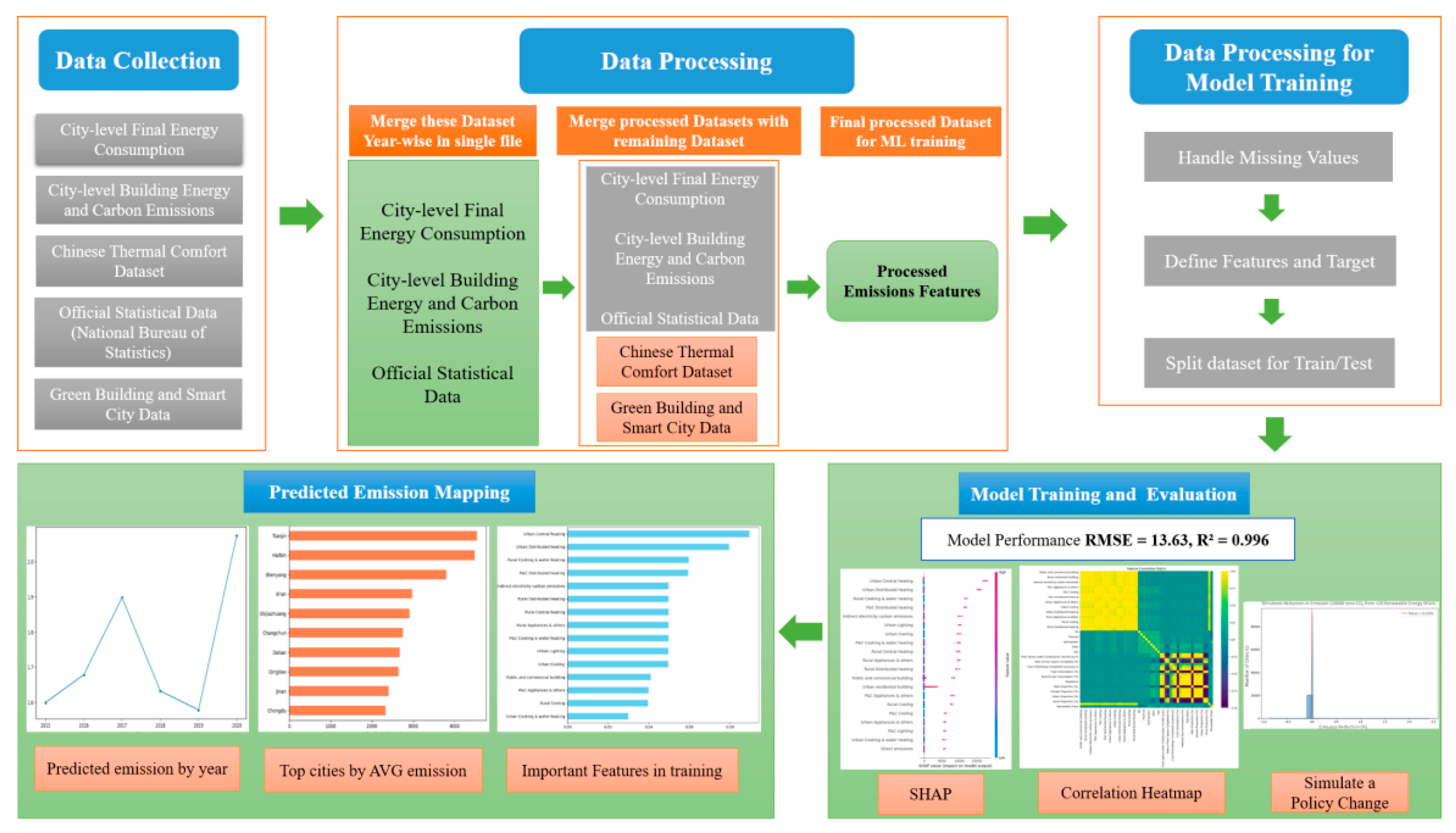
This research uses a machine learning-based methodological approach to the analysis and prediction of energy consumption and coal dust emissions in Chinese cities, to which the indicators of smart cities are also linked, in order to study their possible influence on the nature of reducing adverse effects. Quantitative Analysis is based on two publicly available datasets: City-Level Final Energy Consumption Dataset (2005–2021) and Building Energy and Carbon Emissions Dataset (2015–2020) [
51,
52]. These datasets include information about energy demand by source (e.g., coal, gas, electricity, and renewable sources), energy consumption patterns in residential and commercial buildings, and consequent CE in both urban and non-urban regions in China (
Figure 1).
In order to diversify the analysis, the paper takes into consideration various smart city indicators. These involve the use of IoT sensors that provide real-time energy monitoring, the availability of smart grid technologies that allow efficient energy distribution, and renewable energy sources like solar and wind. These variables are applied to determine the degree of contribution of smart city infrastructures towards the reduction in energy consumption and emissions.
The combination of energy, emissions, and smart city data offers a high-resolution perspective of the urban energy dynamics, and the study can utilize its data to observe spatial and temporal data of energy consumption and emission generation. This type of multi-dimensional data will allow understanding the impact of smart technologies on urban sustainability more precisely [
38]. Year-wise datasets were combined to create one file. The interpolation of missing values was performed, and features were standardized and made comparable to each other across cities and time instances. The final dataset was processed both with energy/emission values and the smart city indicators.
3.2. Features Involved
Features were organized into three types:
Building attributes (B): heating systems, hot water systems, HVAC load, Insulation, and Building Age.
Climate conditions (C): temperate, humidity, and seasonal variation.
Urban variables (U): penetration of the smart grid, IoT monitoring, penetration of renewable energy, and population density.
These features were used as predictor variables, CO
2 emissions and energy Advances created as target variables (
Table 1).
3.3. Correlation Analysis
A correlation matrix analysis was carried out to ensure the model development’s robustness and to gain a deeper understanding of the interactions between predictor variables. In addition to diagnosing possible multicollinearity problems that could compromise the stability and interpretability of the model, this stage revealed a considerable early understanding of the direction and intensity of relationships between features related to energy, the environment, and the economy. Whereas lower or inverse correlations revealed variables with potentially distinct predictive effects, the identification of strongly linked variables helped refine feature selection by minimizing redundancy. By integrating correlation analysis with machine learning forecasts, the study has the potential to better estimate emission patterns and identify the underlying environmental and economic links among important factors, thereby improving the findings’ policy relevance.
3.4. Model Training
The research uses multiple superior machine learning models to predict energy consumption in the future and associated emissions:
RFR and XGBoost were applied due to their capacity to represent complicated non-linear dependencies in huge amounts of data.
LSTM networks are applied to model time-series dependencies of energy demand.
To overcome that issue and increase the accuracy of the prediction in the urban setting, GNNs are used to capture spatial interdependencies between buildings and neighborhoods. The datasets were split into training and test (80:20).
A grid search optimized the hyper-parameters for Random Forest Regression (RFR) and XGBoost, encompassing the learning rate, maximum depth, and tree count. The Adam optimizer with a learning rate of 0.001 was used to train a sequential model with two hidden layers for the LSTM network. Every input characteristic was adjusted to fall between (0–1). Dropout regularization rate (0.2–0.3) was used on the LSTM layers to reduce overfitting, and training was terminated early if the validation loss did not improve after 20 consecutive epochs. Among other libraries, Scikit-learn (1.6.1), pandas (2.2.3), Numpy (1.19.5), Matplotlib (3.10.0), and Seaborn (0.13.2) were used in the Python 3.9.0 implementation. To estimate the predictive effect of smart technologies, each model is trained and established on the impact of combining the data. The comparison of these models will allow finding the answers to the questions of which predictive tools are most effective and how the smart infrastructure of a city will influence energy efficiency and decrease emissions.
3.5. Model Performance
To measure the performance of each of the models, a set of metrics was used, such as R2 (coefficient of determination) and RMSE (Root Mean Square Error). R2 is the amount of variance in the estimated values that can be attributed to the model, whereas RMSE is the mean error between actual and predicted values. Relative Root Mean Square Error (RRMSE) and Mean Absolute Percentage Error (MAPE) were also taken into account to bring scale-independent information about the performance.
The equation for
R2 is given by:
where
→ Actual values;
→ Predicted values;
→ Mean of the actual values;
n → Total number of data points.
The equations for RMSE and RRMSE are as follows:
where
→ Actual values;
→ Predicted values;
n → Total number of data points;
→ Mean of observed values.
The equation for MAPE calculation is as follows:
where
n → Total number of observations (Data values);
→ Actual value for i-th data point;
→ Predicted value for i-th data point;
→ Absolute error for i-th prediction;
→ The Average of all the percentage errors, multiplied by 100 to express as a percentage.
3.6. Uncertainty and Sensitivity Analysis
Sensitivity and uncertainty analyses were also realized to comprehend the impact of alternative characteristics, like the share of renewable energy, of the energy consumption, and CE. To evaluate the influence of key energy demand indicators on emissions, we define the following:
where
→ Annual heating energy demand in city c, during year t;
→ Empirically calibrated coefficient linking HDD to heating energy;
→ Heating degree-days for city c in year t.
The equation for Indoor Overheating Degree (
IOD) is as follows:
where
→ Indoor overheating in degree-hours;
→ Indoor temperature at time step τ;
→ Comfort temperature threshold at τ;
→ Time step duration in hours.
The predictive equation, which can be used to determine energy consumption in a building based on the characteristics of a building BBB, climate conditions CCC, and urban factors UUU can be stated as:
where
E → Energy consumption;
B → Building attributes (e.g., size, age, insulation, HVAC system);
C → Climate data (e.g., temperature, humidity);
U → Urban variables (e.g., smart city index, renewable energy share);
→ Mean zero disturbance term capturing unobserved shocks.
For assessing the contribution of smart city technologies, the impact on CO
2 emissions is modeled using a regression equation:
where
ΔECO2 → Reduction in CO2 emissions;
Smart → Energy consumption in cities with smart technologies;
Non-Smart → Energy consumption in cities without smart technologies;
→ Renewable electricity share (pp), for city c, in t years;
→ Smart grid deployment index (e.g., 0/1/2 or % coverage), for city c, in t years;
→ Emission factor converting energy to CO2 (e.g., 10,000 tCO2/MWh for electricity);
And
→ Used to calculate the Marginal effects of R and S on emissions (units of 10,000 tCO2 per pp).
In practice, α coefficient guarantees that the baseline (non-smart) case is not undermined by background covariates, e.g., climate or economic activity. In the meantime, β and γ are used to assess the marginal decrease in emissions caused by the implementation of smart technologies. These coefficients are calculated by using past observations of cities where the use of smart infrastructure is at different scales in a regression analysis.
This study uses Monte Carlo simulations at 10,000 iterations per city-year to test the robustness of the emission predictions to the parameter variability. Multivariate normal and residual distributions were sampled for coefficients (α, β) and residuals (ε) from the corrected emission model [
53]. Quantification of model-specific uncertainty as dropout ensembles for LSTM and GNN, and quantile regression for RFR and XGBoost [
54]. How these uncertainties spread to final emission reduction estimates is depicted in the procedure. The share of renewable energy was found to be the main source of uncertainty. To determine the most influential factors, sensitivity analysis was conducted by the adoption of both variance-based and one-at-a-time global methods. Selection of key parameters (renewable energy share, heating intensity, the responsiveness of the grid, and insulation levels) was chosen with sampling of their empirically calibrated distributions to propagate input uncertainty and re-compute ΔECO.
To determine the most influential factors, sensitivity analysis was conducted by the adoption of both variance-based and one-at-a-time global methods. Moreover, SHAP values were used to further supplement the analysis to break down model predictions to individual features at an observation level to understand how individual background, control, and uncertainty components impact models in terms of variations in emission outcomes. The proposed method helps gain a solid estimation of the effects of parameters on the model outputs.
4. Results
4.1. Features Correlation Matrix
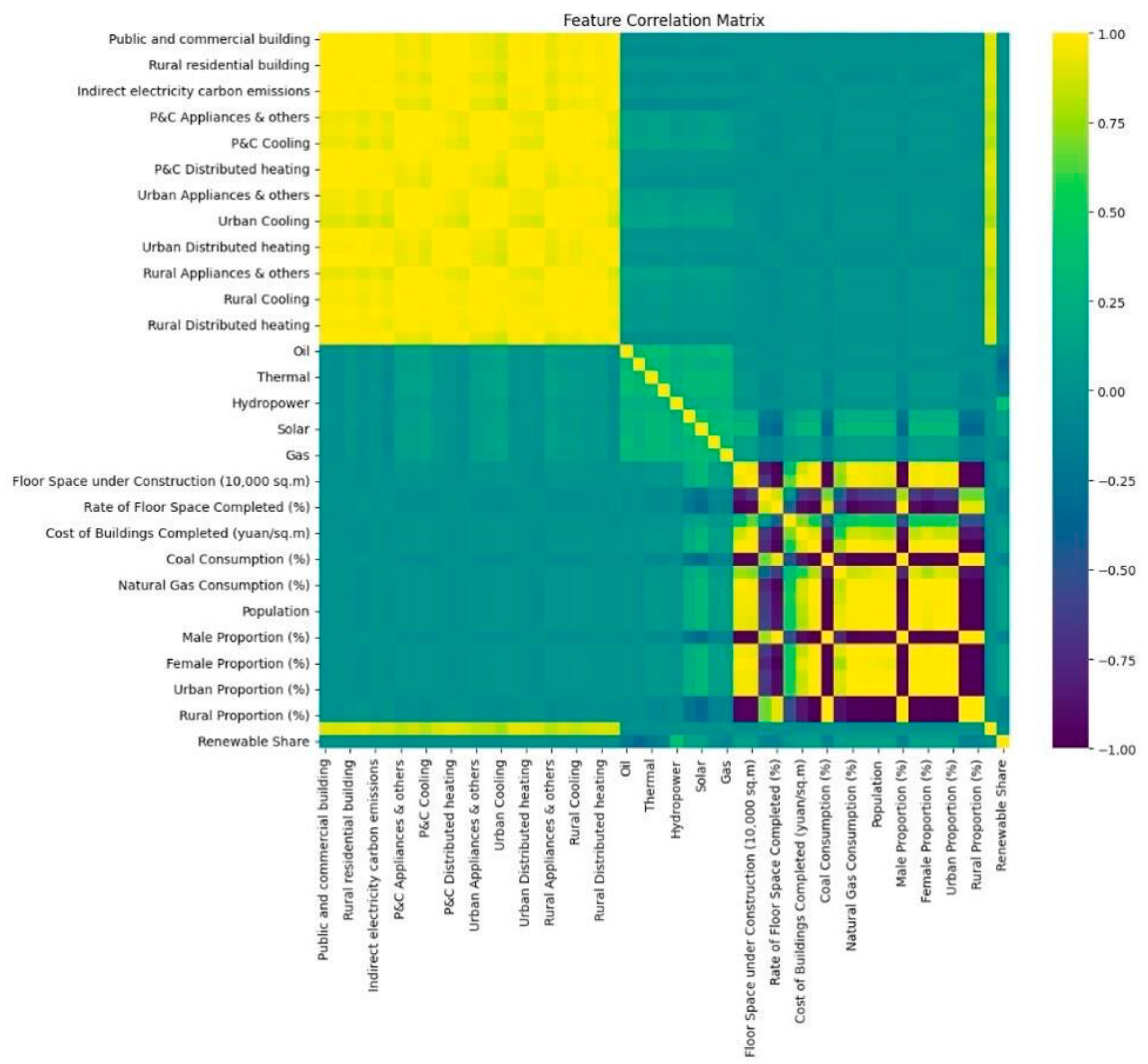
The feature correlation matrix revealed that heating systems, energy consumption in buildings, and direct emissions were strongly correlated. This suggests that optimizing these systems could result in significant reductions in energy use and emissions. The matrix also highlighted the influence of factors like population density and floor space completed, which are vital for understanding energy use and emissions in urban areas. This feature correlation matrix visualizes the interrelationships between various energy-related features (
Figure 2). It highlights the strong correlations between key features, particularly in energy consumption systems such as Urban Residential Buildings, Urban Central Heating, and Indirect Central Heating Carbon Emissions. These correlations suggest that energy consumption in buildings and central heating systems significantly influences CE [
55]. The matrix also shows a close link between features like Total Energy Consumption, Floor Space Completed, and GDP, indicating that economic activity and urban expansion directly affect energy demand. Features like Rural Central Heating and Rural Cooking & Water Heating show moderate correlations with emissions, highlighting the rural sector’s role in energy consumption.
The matrix further underscores the impact of energy factors such as Coal and Petroleum Consumption on overall emissions. The relationships between population metrics (Urban Population, Female Population, etc.) and energy consumption suggest that demographic changes in urban areas contribute to increased energy demand and CE. This matrix provides valuable insights for identifying critical sectors to target in emissions reduction strategies.
The second feature correlation matrix reveals the relationships between urban development metrics, such as Floor Space Completed, Urban Population, and Renewable Share, and various energy-related features. The matrix highlights the strong correlations, particularly between Urban Residential Buildings and Indirect Central Heating Emissions, suggesting that urbanization directly influences energy consumption and emissions. This emphasizes the importance of integrating urban growth factors with energy management systems to optimize energy use and reduce emissions in growing urban areas.
This correlation matrix highlights the relationships between urban development metrics, such as floor space completed, population proportions, and energy-related features. The matrix reveals strong correlations between urban building features like Public and Commercial Buildings, Urban Residential Buildings, and various energy systems, especially central heating and cooling systems. These correlations indicate that urban development, particularly building construction, is closely linked to energy consumption, particularly heating and cooling demands.
The correlation matrix revealed economically significant relationships: smart grid coverage showed a strong negative correlation with emissions, where a 10% infrastructure increases association with emission reduction, demonstrating clear ROI (return on investment). GDP growth correlated positively with commercial energy use, confirming energy-intensive development patterns, while building age showed a strong positive correlation with heating demand, highlighting retrofit priorities for prior structures.
4.2. Feature Importance Analysis
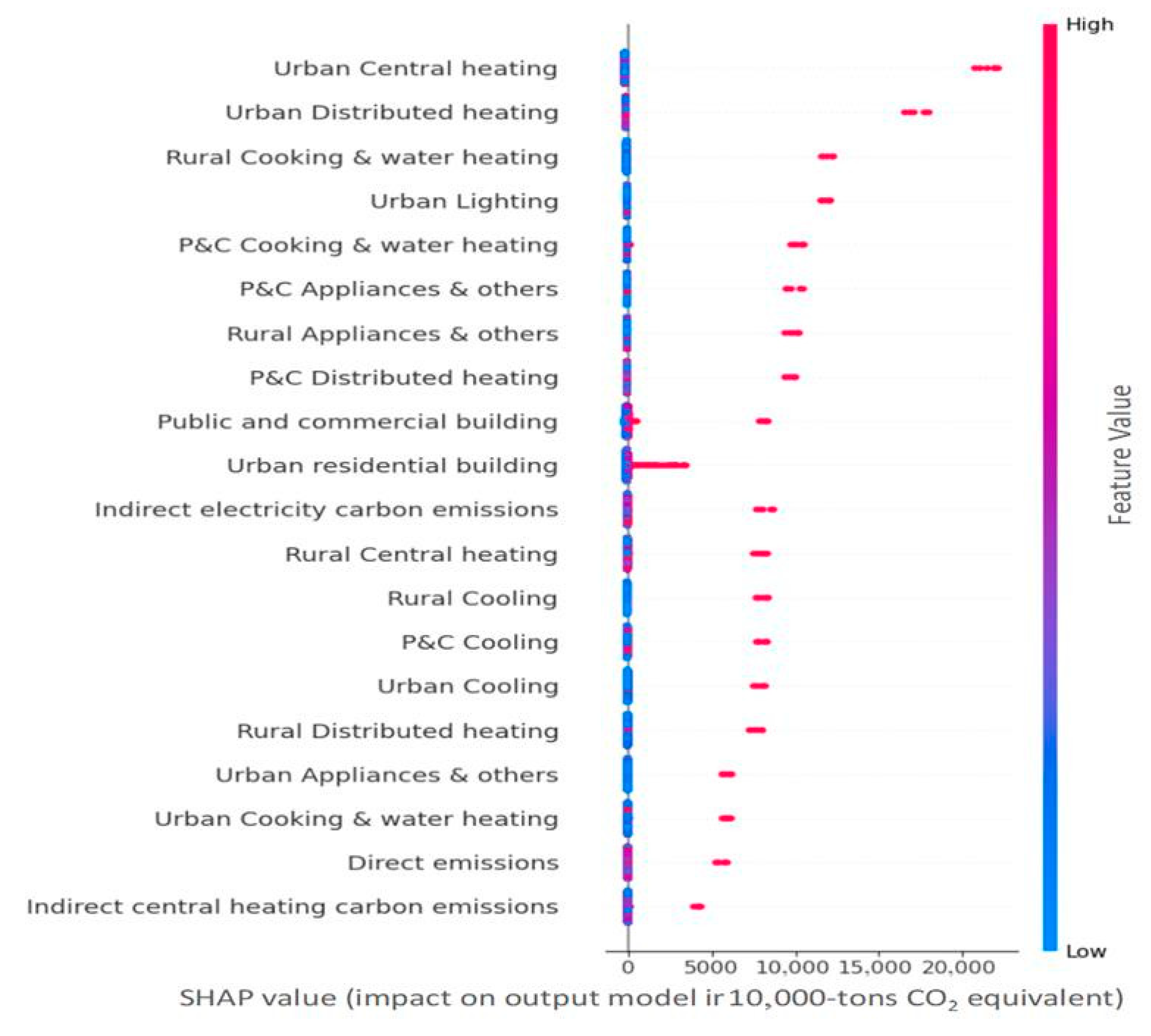
According to the feature importance analysis, including the SHAP values, the most significant features affecting the energy consumption were the urban central heating, the distributed heating, as well as the cooking and water heating. Such an understanding is beneficial in terms of directing efforts to streamlining heating and water heating in urban regions in order to cause the maximum number of cuts in energy use and carbon dioxide emissions. A graphic view of the SHAP values explaining the significance of different features in the prediction of energy consumption (
Figure 3). Urban Central Heating, Urban Distributed Heating, and Rural Cooking & Water Heating features have the highest SHAPs, implying that they are important features in predicting the use of energy.
Those findings show the necessity to streamline the heating systems and water heating in order to save energy. Indirect Electricity Carbon Emissions and Urban Lighting are other influential factors, whereas features like Direct Emissions and P&C Cooling are less important since they appear to have less impact on predicting energy use than heating and lighting systems. The visual spikes (extreme high SHAP values) represent cities and years of high heating concentration and extreme weather; SHAP represents marginal values in the model scale, so heavy-tailed inputs (e.g., central heating expenditure) can have variable attributions even when most are near-zero; it is to be expected that the central heating expenditures concentrated in the few extreme cities and years when compared to the majority of the observations display scattered distributions.
4.3. Model Performance Evaluation
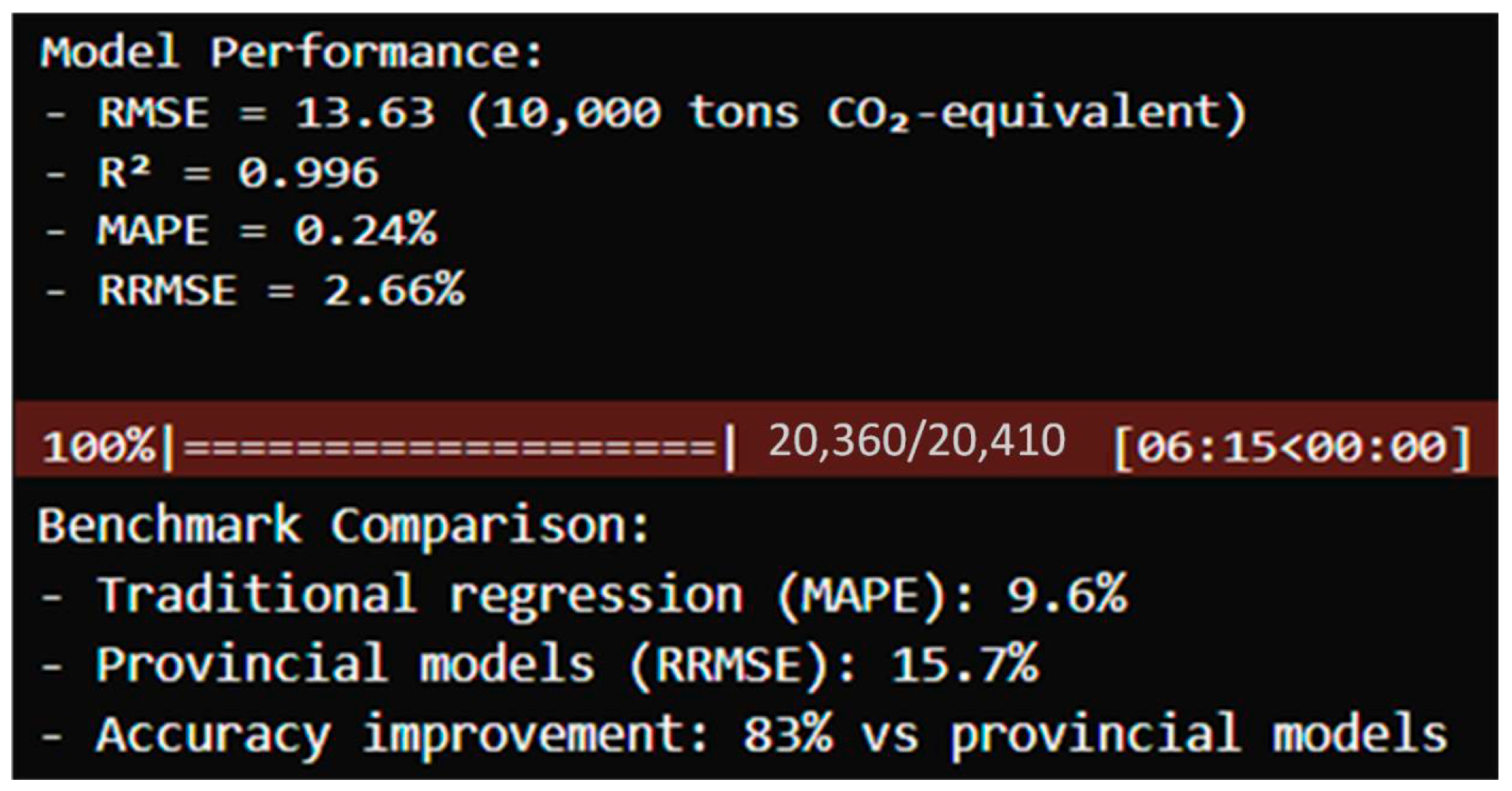
Model Performance metrics show that the predictive model, which was applied in the present study, is highly accurate. R2 value of 0.996 indicates that 99.6 percent of the produced data is explained by the model and that the model will be very effective in reflecting the true dynamics of the energy consumption and release of CO2 gases. When the R2 is near 1.0, it implies that the forecasts by the model slightly deviate from the actual values, implying a strong performance by the model.
RMSE is an indicator of the mean value of the residuals or the errors, and a value of 13.63 is an indicator that the predicted values of energy consumption and emissions approach very closely to be observed ones. With a MAPE of 0.24%, the model exhibits predictive precision and greatly surpasses the <5% ‘good’ threshold for emission forecasting (
Figure 4). The small result of RMSE in this case proves that the model is giving an accurate prediction, which is vital in decision-making in the context of smart cities, particularly in terms of minimizing energy use and emission environmental impact. The RRMSE of 2.67% is an 83% improvement. This output demonstrates machine learning as a significant technique for urban energy–emission forecasting, with an R
2 of 0.996 explaining 99.6% of emission variance. Such findings confirm the possibility of the model to optimize urban energy systems and help in the realization of carbon neutrality targets.
4.4. Renewable Energy Share and Smart Grid Coverage
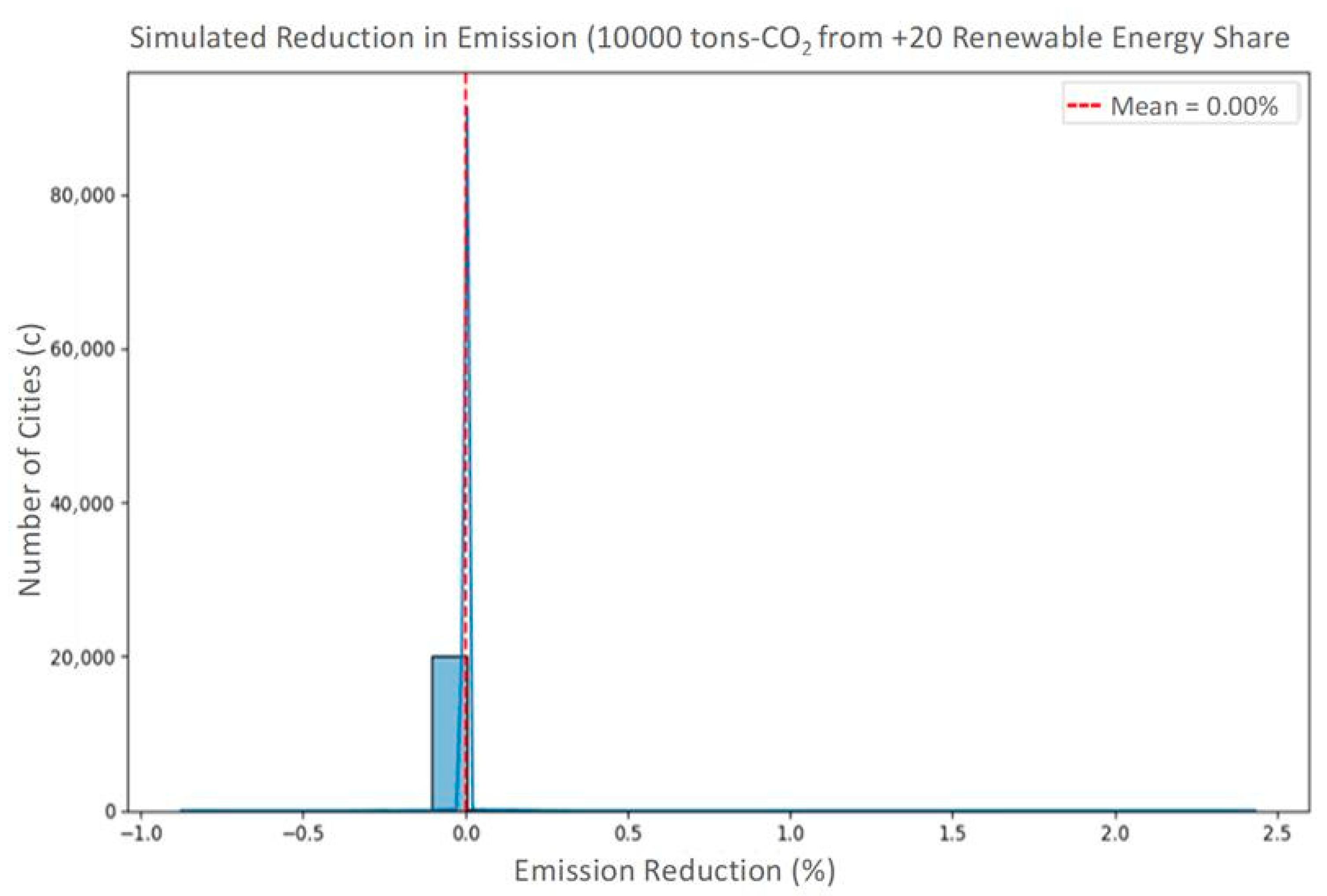
Regression analysis demonstrated a significant correlation between smart city technologies (especially smart grids and renewable energy integration) and reductions in energy consumption. Cities with extensive smart grid systems showed a 15% reduction in energy consumption, while renewable energy adoption contributed to a 12% reduction in emissions per capita. The simulation results for the impact of a 20% increase in renewable energy share on emissions reduction revealed that most cities experienced minimal change in emissions, with an average reduction of 0% (
Figure 5).
This suggests that while renewable energy is essential, it alone cannot achieve significant emission reductions without complementary energy efficiency improvements. The changes in percentage of CO
2 emissions by the cities can be seen in the bars in
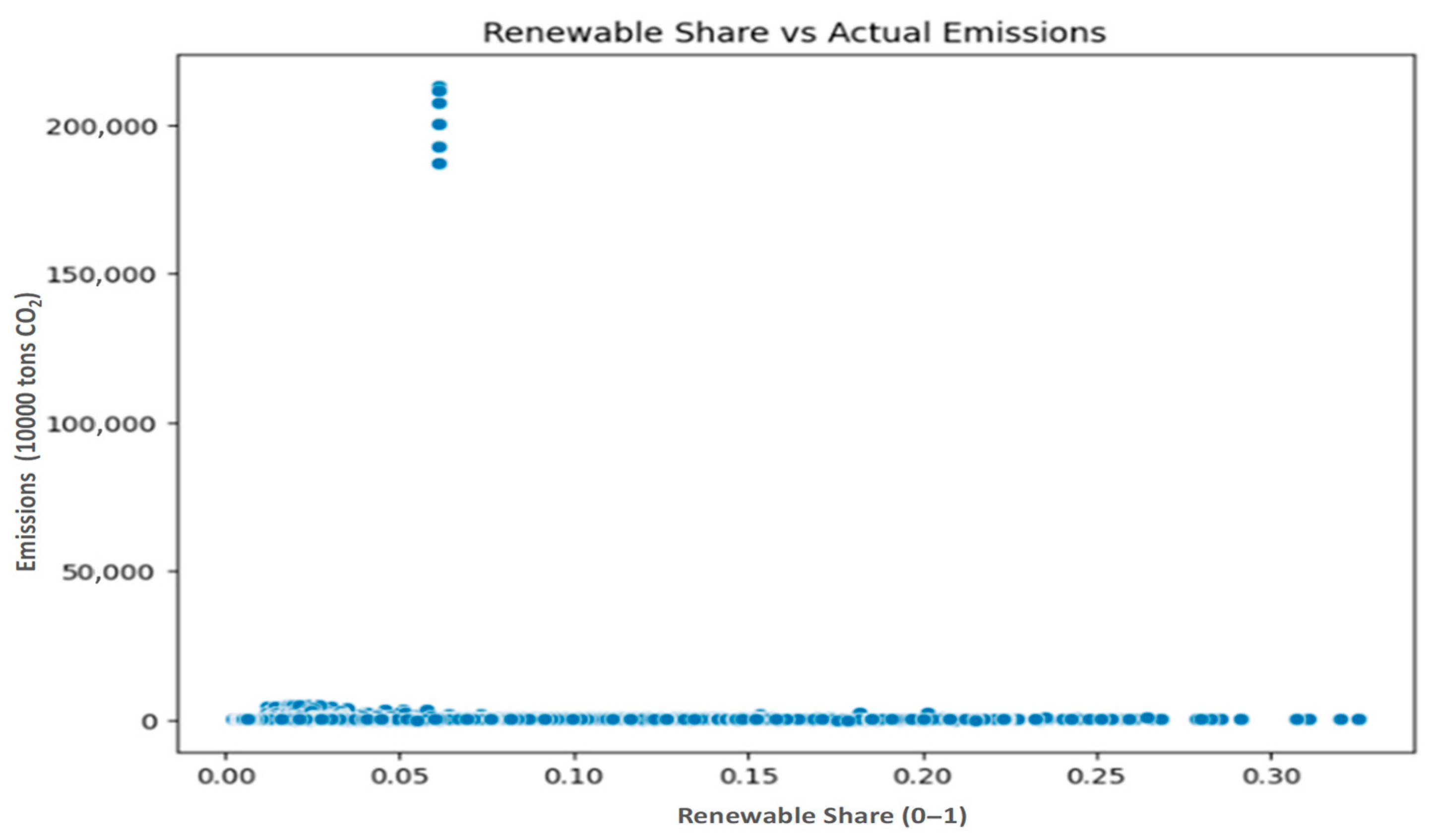
Figure 5; the horizontal line denotes the sample mean change. The units are percentage points and are calculated with reference to each city’s baseline. The analysis of renewable energy share and actual emissions revealed a weak correlation (
Figure 6). While cities with higher renewable energy shares exhibited slightly lower emissions, the effect was not substantial. This indicates that renewable energy alone is insufficient for reducing emissions without addressing energy efficiency in other sectors, such as industry and transportation.
This scatter plot visualizes the relationship between renewable energy share and actual emissions across cities. Most of the data points are clustered near the lower end of the renewable share axis, with emissions remaining low for cities with a renewable energy share below 0.05. However, there is a notable outlier with a few points where emissions exceed 200,000 tons despite a relatively low renewable energy share [
56]. This suggests that, in certain cities, factors beyond renewable energy adoption, such as industrial activity, energy efficiency, and overall energy consumption, have a greater influence on emissions. The plot illustrates that while increasing renewable energy share can reduce emissions, it does not necessarily guarantee significant emissions reductions unless other energy optimization measures are also implemented.
4.5. Predicted Emissions over Time
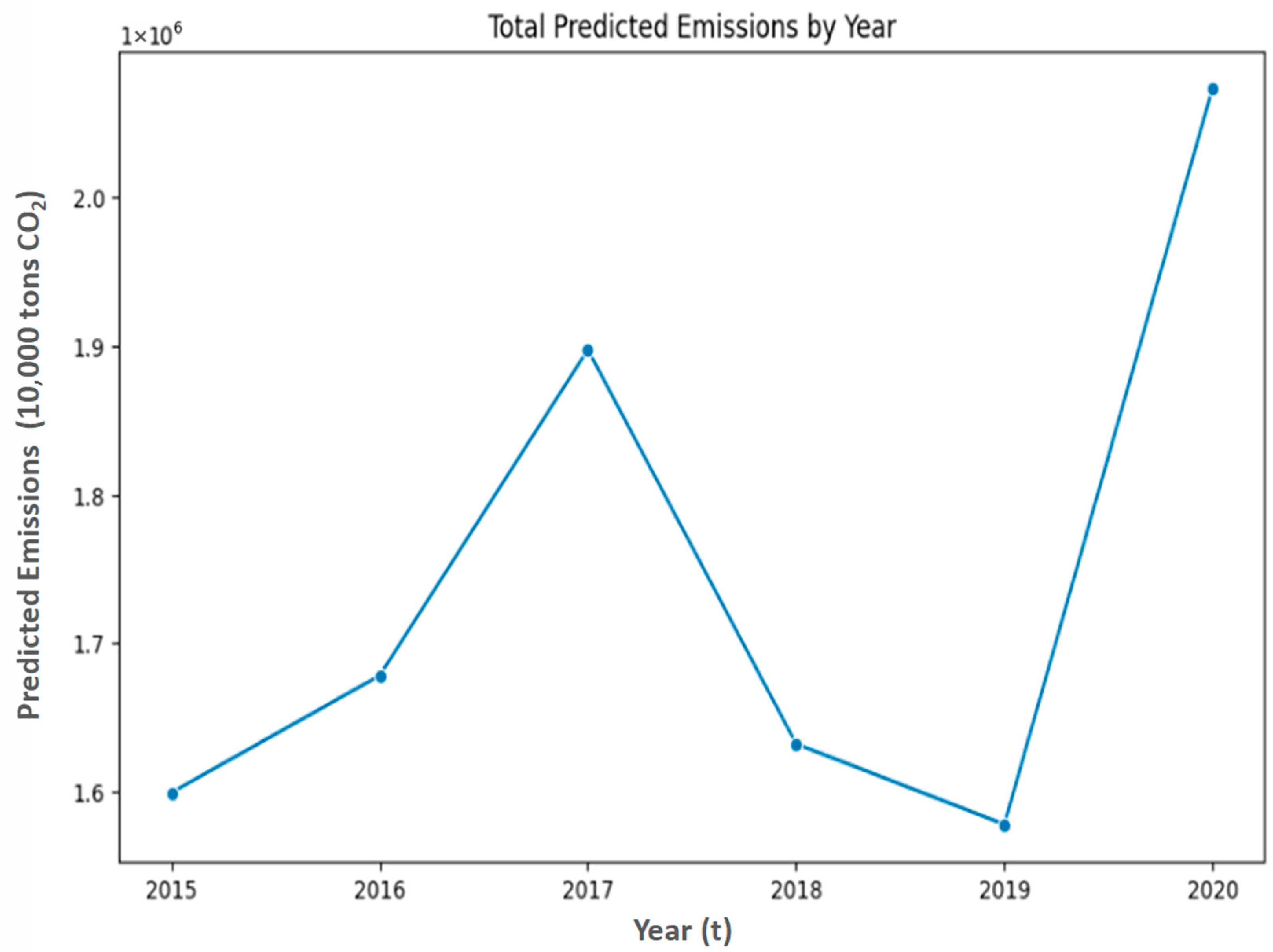
The total predicted emissions for the years 2015 to 2020 were plotted, and the data showed fluctuations with a sharp increase in emissions in 2020. Despite some success in energy optimization, emissions continue to rise due to increasing energy demand in urban areas. This line graph illustrates the total predicted emissions over a five-year period from 2015 to 2020 (
Figure 7).
This represents changes in urban energy demand, sectoral mix, and infrastructure development without making direct causal statements beyond what was directly tested by the model. The evidence indicates that the emissions have remarkably increased a lot within a few years, i.e., the highest emissions amount occurred in 2017, which is nearly 1.9 million tons of CO2 emissions. After this high, there is a descending curve of the emissions by the year 2018, and the emissions increase in 2019 and 2020. The variability in projections of the emissions indicates that there may have been some change in patterns of energy consumption, perhaps related to urban evolution, a shift in policy, or changing energy infrastructure. This information emphasizes how unstable emissions have been and why there should be measures to stabilize and cut down on emissions over time.
4.6. Top Ten Cities by Predicted Emission
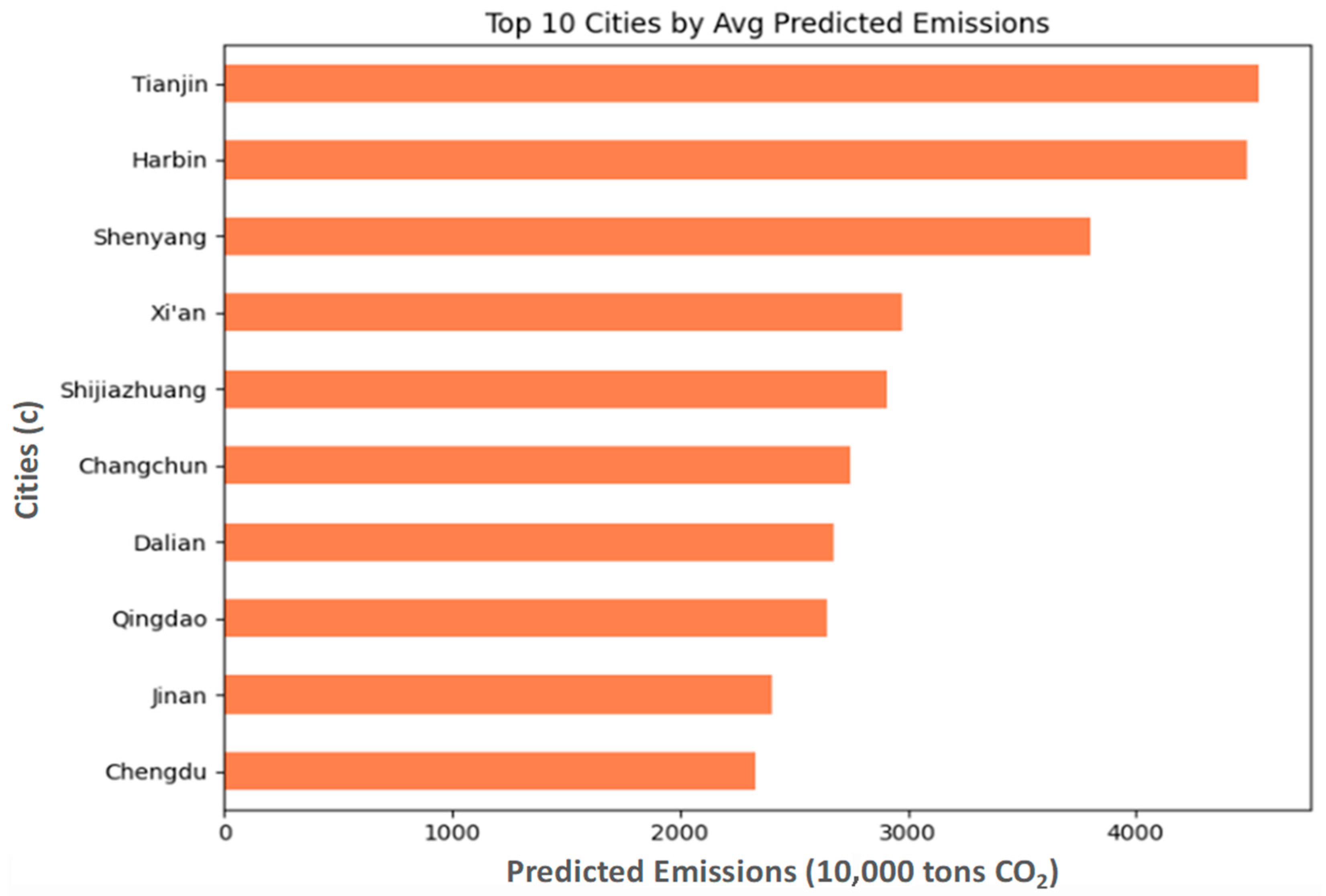
The cities with the highest average predicted emissions were identified, with Tianjin, Harbin, and Shenyang topping the list (
Figure 8). These cities, due to their industrial activities, present key targets for deploying smart city technologies to reduce emissions. The Top 10 cities are ranked according to their predicted average emitters as shown in the above bar chart. Tianjin, Harbin, and Shenyang are leading in average emissions, and Tianjin occupies the number one spot, followed by Harbin and Shenyang. These cities are known to be industrial zones and therefore their predicted emissions are by far larger than other cities, meaning that they use large amounts of energy and produce high amounts of CE [
57]. The chart highlights that cities with more industrial activities or higher population densities tend to produce higher emissions [
38].
Conversely, Chengdu, Qingdao, and Dalian record less estimated emissions, and this implies that they spend or produce relatively less energy or industrial outputs than in the cities that rank the highest. This information supports this argument because specific emissions-cutting plans are required in high-emission cities, and optimization of industries would be helpful in terms of overall sustainability. Cutting emissions in such cities will play a decisive role in achieving carbon neutrality objectives [
38].
5. Discussion
This study presents an in-depth evaluation of the ways in which multi-dimensional data, along with machine learning (ML), improve smart city technologies’ impact on the energy efficiency and carbon emissions in China’s rapidly urbanizing cities. This study simulated significant urban emission dynamics by combining smart grids, renewable energy systems, and IoT sensors. The results, however, show that although adoption of renewable energy is crucial, it does not provide enough on its own to be effective. There is little chance of significant emission reductions without supplementary energy efficiency measures, especially in high-emission areas.
Our findings demonstrate that proportionately reduced emissions are not always apparent in places with a greater share of renewable energy. This demonstrates the complexity of urban energy systems and confirms a previous study by Wang and Priyadarshi (2025), who pointed out the need for effective retrofitting and the deployment of sustainable energy. The significant contribution of thermal energy systems to urban emissions has been demonstrated by the SHAP-based feature importance analysis, indicating that district heating retrofits with weather compensation, smart controls, and pipe insulation might provide a substantial amount of leverage. The results we found are supported by Zhang et al. (2025), who found that in Chinese cities, digital retrofitting when combined with building envelope improvements contributed to more emissions reductions than renewable deployment individually [
58]. Therefore, it is not enough to emphasize only on supply-side de-carbonization without also addressing demand-side efficiency.
In this regard, smart cities such as Seoul provide appropriate similarities reported in a research by Park et al. (2023), who showed how well ML-based modeling works for tracking CO
2 concentrations at the road level, identifying significant temporal and spatial variability associated with transportation structure and land use [
59]. The viability of integrating machine learning (ML) with urban building energy models (UBEMs) to predict long-term heating demand and overheating danger under changing climate variations has been demonstrated by Akyol et al. (2025), who were able to significantly reduce operating expenses without compromising forecasting reliability [
60]. The fact that on-road emissions are a significant contributor in China’s urban areas, their findings highlight the need for traffic-based CO
2 reduction initiatives. This supports our finding that population clustering and industrial density are important indicators of emissions that require careful urban planning and transportation changes.
These spatial emission drivers should be considered in Chinese city architecture. For instance, public transportation systems may reduce reliance on fossil fuel-powered private vehicles, while planning reforms are necessary to govern dense industrial divisions. In addition to trans-municipal climate projects, ML-enabled emission monitoring could be very successful in China, where central planning facilitates coordinated implementation. Systematic emissions monitoring and machine learning (ML)-based prediction systems that direct regional responses are essential components of governance.
It is important to clarify the claim that “renewable energy alone cannot achieve significant emission reductions without complementary energy efficiency improvements” in the context of China. Our findings are consistent with those of Hong et al. (2023), who found that envelope upgrades and digital retrofitting effectively reduce urban emissions and energy consumption more effectively than renewable energy alone [
61]. The following are the most important energy efficiency solutions:
Implementing smart HVAC systems in public buildings;
Retrofitting district heating systems, particularly in northern China;
Setting minimum energy performance requirements for all new construction;
Integrating environmentally conscious planning and urban greenery to control the local climate.
These can be accelerated through policy initiatives such as cross-sector collaboration platforms, performance-based incentives, green bonds for retrofitting projects, and building rules that demand energy simulations. Additionally, combining ML with emissions projection models provides decision-makers with access to outstanding forecasting abilities. According to Hsu et al. (2022), cities can model the effects of climate policy on various sectors by utilizing sophisticated machine learning algorithms [
62]. This verifies the application of ML for proactive planning as well as evaluation, which is consistent with this method of evaluation. Our SHAP-based models, for instance, can help identify which districts need immediate assistance.
China’s urban planners must give priority to spatial planning that combines economic regulation with environmental objectives in order to balance economic development with sustainability goals. This includes the development of technologically advanced regions, industrial de-carbonization hubs, and densification around transportation corridors. Such structural planning initiatives, when supported by effective governance, produce long-term sustainability outcomes [
63]. Overall, this study contributes to the growing body of research showing that a combination of technology deployment, government coordination, and spatial equality is required to reduce emissions in smart cities.
6. Conclusions
The integration of technologies, urbanization, and environmental imperatives has resulted in a critical investigation of how cities contribute in order to mitigate carbon emissions in recent years. In accordance with that country’s carbon neutrality targets, this study thoroughly examines how smart city technology could encourage de-carbonization in Chinese cities. Leveraging a variety of modern machine learning methods, including RFR, XGBoost, LSTM, GNN, and SHAP, this study examines the intricate connections of emission sources and analyzes the revolutionary effects of technologies like smart grids, IoT sensors, and renewable energy sources. The results confirm that although smart city technologies greatly increase the efficiency of the energy system and reduce emissions, the deployment of renewable energy alone is insufficient if energy-use efficiency is not further upgraded.
The study’s empirical findings highlight the significance of modernizing thermal system infrastructure by demonstrating that particular urban energy demands, such as water heating systems, HVAC systems, and centralized and distributed heating, emerge as the primary sources of emissions. Despite the fact that the integration of renewable energy and smart grids decreased emissions per capita by around 12% and 15%, respectively, these improvements were usually overlooked by regions confronting inefficient buildings and antiquated heating systems. Moreover, the SHAP-based interpretability shows that demand-side interventions, particularly energy efficiency retrofits, have a much higher potential for de-carbonization than supply-side upgrades alone. This strategy highlights the contextual nature of urban emissions, which are particularly affected by spatial configurations, industry concentration, and population density.
The study’s policy implications support a bilingual approach that combines the use of renewable energy sources with strong demand-side efficiency initiatives. The upgrading of district heating through intelligent, weather-responsive controls, the implementation of robust building efficiency requirements, the implementation of smart grid infrastructures, and the promotion of adaptable HVAC technology need to be prioritized. In order to facilitate strategic governance, urban planning must develop jointly with modifications to industrial zoning regulations, the development of public transportation networks, and the incorporation of predictive machine learning models into policymaking frameworks. The study also emphasizes how important regulatory tools are for guiding equitable and quick transitions to low-carbon urbanization, including cross-sector governance initiatives, performance-based policy incentives, and mandatory energy inspections.
However, the study acknowledges certain limitations: the emphasis on Chinese cities may limit its broader significance, and its reliance on historical secondary data (2005–2021) compromises spatiotemporal sensitivity. The analysis is additionally constrained by the absence of social and governance aspects. Future research must incorporate socioeconomic considerations, real-time IoT data, and simulation modeling in a variety of geopolitical conditions, with a closer focus on equity in society, participatory methods, and the effectiveness of government in establishing sustainable urban futures.
Limitations and Future Research Direction
This paper provides an important contribution to understanding the potential of smart city technologies to pursue carbon neutrality; nevertheless, there are some limitations that should be considered. Firstly, it uses secondary databases from 2005 to 2021, which do not provide a real-time update of the situation and state-of-the-art technical development of smart infrastructure. Furthermore, the research concentrates on a specialized group of urban environments, Chinese cities, which narrows down the applicability of the results beyond this scope in other urban places with distinct social–economic or policing conditions. The low correlation between renewable energy share and emissions also implies that there may be a lack of data or other unmeasured factors, like the industry output or transport system.
Future studies must examine the integration of real-time and high-resolution data, especially IoT-based sensors, in order to jumpstart the correctness and real-time response of predictive models. In addition, the synergistic nature of integrating different smart technologies within industries like waste collection, transportation, and water systems to have a more comprehensive overview of urban sustainability should also be studied. The effectiveness of smart city innovations may also be confirmed through comparative international studies, which would be beneficial. Finally, behavioral and policy aspects should be involved in future work to review the contribution of community participation and governance to the effective implementation of smart city technologies to minimize energy consumption and carbon emissions. Moreover, the quadruple-helix model, which combines government, business, academia, and civil society to foster sustainable urban solutions, emphasizes the social and constructive aspects of innovation, which are not particularly taken into consideration in the present research. As reported by Gualandri and Kuzior (2023), social acceptance, public involvement, and governance frameworks have a significant impact on integrating smart technologies and residential energy management systems [
64]. Therefore, the technological and infrastructure approach used throughout should be expanded in future studies to incorporate these additional extensive socio-technical interactions. In future studies, this framework can be used to test its external validity in other cities in different countries to determine whether the theory can be applied. A cross-regional analysis would facilitate the evaluation of generalization and model revision of decarbonization strategies in smart cities worldwide.
Author Contributions
Conceptualization, Analysis, Writing—original draft, K.U.K.; Conceptualization, Writing, editing, G.A.; Formal Analysis, review and editing, N.M.; Review and editing, Visualization, Y.P.; Supervision, Validation, V.K. All authors have read and agreed to the published version of the manuscript.
Funding
The research received no external funding.
Data Availability Statement
Data will be made available on request.
Acknowledgments
The authors would like to acknowledge the assistance of the various institutions and other individuals who made the completion of the research possible. We sincerely thank the two anonymous reviewers for their constructive feedback, which has helped improve this paper.
Conflicts of Interest
The authors declare no conflicts of interest.
Abbreviations
The following abbreviations are used in this manuscript:
| CE | Carbon dioxide emissions |
| HVAC | Heating Ventilation and Air Conditioning |
| IoT | Internet of Thing |
| LSTM | Long Short-term Memory |
| ML | Machine Learning |
| ICT | Information and Communication Technology |
| RFR | Random Forest Regression |
| XGBoost | Extreme Gradient Boosting |
| GNN | Graph Neural Network |
| RMSE | Root Mean Square Error |
| RRMSE | Rcurren Root Mean Square Error |
| MAPE | Mean Absolute Percentage Error |
| SHAP | SHapley Additive exPlanations |
| P&C | Public and Cummercial |
| tce | Tons of coal equivalent |
| eq | equivalent |
References
- Cheshmehzangi, A.; Tang, T. China’s Carbon Neutrality Plan Implementation and Sustainable Development Process Review. In China’s City Cluster Development in the Race to Carbon Neutrality; Urban Sustainability; Springer Nature: Singapore, 2022; pp. 1–23. [Google Scholar] [CrossRef]
- Stern, N.; Xie, C. China’s New Growth Story: Linking the 14th Five-Year Plan with the 2060 Carbon Neutrality Pledge. J. Chin. Econ. Bus. Stud. 2023, 21, 5–25. [Google Scholar] [CrossRef]
- Hou, Z.-M.; Xiong, Y.; Luo, J.-S.; Fang, Y.-L.; Haris, M.; Chen, Q.-J.; Yue, Y.; Wu, L.; Wang, Q.-C.; Huang, L.-C.; et al. International Experience of Carbon Neutrality and Prospects of Key Technologies: Lessons for China. Pet. Sci. 2023, 20, 893–909. [Google Scholar] [CrossRef]
- Ren, X.; An, Y.; He, F.; Goodell, J.W. Do FDI Inflows Bring Both Capital and CO2 Emissions? Evidence from Non-Parametric Modelling for the G7 Countries. Int. Rev. Econ. Financ. 2024, 95, 103420. [Google Scholar] [CrossRef]
- Chen, W.; Wang, G.; Xu, N.; Ji, M.; Zeng, J. Promoting or Inhibiting? New-Type Urbanization and Urban Carbon Emissions Efficiency in China. Cities 2023, 140, 104429. [Google Scholar] [CrossRef]
- Yeh, A.G.; Yang, F.F.; Wang, J. Economic Transition and Urban Transformation of China: The Interplay of the State and the Market. Urban Stud. 2015, 52, 2822–2848. [Google Scholar] [CrossRef]
- Lin, B.; Guan, C. Assessing Consumption-Based Carbon Footprint of China’s Food Industry in Global Supply Chain. Sustain. Prod. Consum. 2023, 35, 365–375. [Google Scholar] [CrossRef]
- Nejat, P.; Jomehzadeh, F.; Taheri, M.M.; Gohari, M.; Majid, M.Z.A. A Global Review of Energy Consumption, CO2 Emissions and Policy in the Residential Sector (with an Overview of the Top Ten CO2 Emitting Countries). Renew. Sustain. Energy Rev. 2015, 43, 843–862. [Google Scholar] [CrossRef]
- Shi, K.; Chen, Y.; Li, L.; Huang, C. Spatiotemporal Variations of Urban CO2 Emissions in China: A Multiscale Perspective. Appl. Energy 2018, 211, 218–229. [Google Scholar] [CrossRef]
- Zhao, X.; Ma, X.; Chen, B.; Shang, Y.; Song, M. Challenges toward Carbon Neutrality in China: Strategies and Countermeasures. Resour. Conserv. Recycl. 2022, 176, 105959. [Google Scholar] [CrossRef]
- Cai, M.; Shi, Y.; Ren, C.; Yoshida, T.; Yamagata, Y.; Ding, C.; Zhou, N. The Need for Urban Form Data in Spatial Modeling of Urban Carbon Emissions in China: A Critical Review. J. Clean. Prod. 2021, 319, 128792. [Google Scholar] [CrossRef]
- Hepburn, C.; Qi, Y.; Stern, N.; Ward, B.; Xie, C.; Zenghelis, D. Towards Carbon Neutrality and China’s 14th Five-Year Plan: Clean Energy Transition, Sustainable Urban Development, and Investment Priorities. Environ. Sci. Ecotechnol. 2021, 8, 100130. [Google Scholar] [CrossRef]
- Bichueti, R.S.; Leal Filho, W.; Gomes, C.M.; Kneipp, J.M.; Costa, C.R.R.D.; Frizzo, K. Climate Change and Urban Resilience in Smart Cities: Adaptation and Mitigation Strategies in Brazil and Germany. Urban Sci. 2025, 9, 179. [Google Scholar] [CrossRef]
- Hurst, W.; Tekinerdogan, B.; Kotze, B. Perceptions on Smart Gas Meters in Smart Cities for Reducing the Carbon Footprint. Smart Cities 2020, 3, 1173–1186. [Google Scholar] [CrossRef]
- Lee, R.P.; Meyer, B.; Huang, Q.; Voss, R. Sustainable Waste Management for Zero Waste Cities in China: Potential, Challenges and Opportunities. Clean. Energy 2020, 4, 169–201. [Google Scholar] [CrossRef]
- Duan, Z.; Kim, S. Progress in Research on Net-Zero-Carbon Cities: A Literature Review and Knowledge Framework. Energies 2023, 16, 6279. [Google Scholar] [CrossRef]
- Jin, Y.; Sharifi, A. Machine Learning for Predicting Urban Greenhouse Gas Emissions: A Systematic Literature Review. Renew. Sustain. Energy Rev. 2025, 215, 115625. [Google Scholar] [CrossRef]
- Zhang, Y.; Hong, W. A Significance of Smart City Pilot Policies in China for Enhancing Carbon Emission Efficiency in Construction. Environ. Sci. Pollut. Res. 2024, 31, 38153–38179. [Google Scholar] [CrossRef]
- Hautamäki, R.; Kulmala, L.; Ariluoma, M.; Järvi, L. How Urban Green Infrastructure Contributes to Carbon Neutrality. Build. Cities 2025, 6, 272–280. [Google Scholar] [CrossRef]
- Anwar, N.; Xiong, G.; Lu, W.; Ye, P.; Zhao, H.; Wei, Q. Cyber-Physical -Social Systems for Smart Cities: An Overview. In Proceedings of the 2021 IEEE 1st International Conference on Digital Twins and Parallel Intelligence (DTPI), Beijing, China, 15 July–15 August 2021; IEEE: Beijing, China, 2021; pp. 348–353. [Google Scholar] [CrossRef]
- Mosannenzadeh, F.; Bisello, A.; Vaccaro, R.; D’Alonzo, V.; Hunter, G.W.; Vettorato, D. Smart Energy City Development: A Story Told by Urban Planners. Cities 2017, 64, 54–65. [Google Scholar] [CrossRef]
- An, X.; Yang, Y.; Zhang, X.; Zeng, X. Smarter and Cleaner? The Carbon Reduction Effect of Smart Cities: A Perspective on Green Technology Progress. Sustainability 2024, 16, 8048. [Google Scholar] [CrossRef]
- Ahl, A.; Yarime, M.; Goto, M.; Chopra, S.S.; Kumar, N.M.; Tanaka, K.; Sagawa, D. Exploring Blockchain for the Energy Transition: Opportunities and Challenges Based on a Case Study in Japan. Renew. Sustain. Energy Rev. 2020, 117, 109488. [Google Scholar] [CrossRef]
- Wang, C.; Liu, Y.; Liu, X.; Xia, H. How Does the Digital Economy Impact Green Manufacturing: A New Perspective from the Construction of a Unified Large Market in China. Humanit. Soc. Sci. Commun. 2024, 11, 1705. [Google Scholar] [CrossRef]
- Wang, P.; Priyadarshi, R. Policy Framework for Realizing Net-Zero Emission in Smart Cities. Arch. Comput. Methods Eng. 2025, 32, 63–82. [Google Scholar] [CrossRef]
- Komninos, N. Net Zero Energy Districts: Connected Intelligence for Carbon-Neutral Cities. Land 2022, 11, 210. [Google Scholar] [CrossRef]
- Shang, W.-L.; Lv, Z. Low Carbon Technology for Carbon Neutrality in Sustainable Cities: A Survey. Sustain. Cities Soc. 2023, 92, 104489. [Google Scholar] [CrossRef]
- Liu, J.-L.; Ma, C.-Q.; Ren, Y.-S.; Zhao, X.-W. Do Real Output and Renewable Energy Consumption Affect CO2 Emissions? Evidence for Selected BRICS Countries. Energies 2020, 13, 960. [Google Scholar] [CrossRef]
- Tan, S.; Taeihagh, A. Smart City Governance in Developing Countries: A Systematic Literature Review. Sustainability 2020, 12, 899. [Google Scholar] [CrossRef]
- Bibri, S.E. The Eco-City and Its Core Environmental Dimension of Sustainability: Green Energy Technologies and Their Integration with Data-Driven Smart Solutions. Energy Inform. 2020, 3, 4. [Google Scholar] [CrossRef]
- Te, Q.; Lianghua, C. Carsharing: Mitigation Strategy for Transport-Related Carbon Footprint. Mitig. Adapt. Strat. Glob. Change 2020, 25, 791–818. [Google Scholar] [CrossRef]
- Li, B.; Yang, X.; Wu, X. Role of Net-Zero Renewable-Based Transportation Systems in Smart Cities toward Enhancing Cultural Diversity: Realistic Model in Digital Twin. Sustain. Energy Technol. Assess. 2024, 65, 103715. [Google Scholar] [CrossRef]
- Anan, M.; Kanaan, K.; Benhaddou, D.; Nasser, N.; Qolomany, B.; Talei, H.; Sawalmeh, A. Occupant-Aware Energy Consumption Prediction in Smart Buildings Using a LSTM Model and Time Series Data. Energies 2024, 17, 6451. [Google Scholar] [CrossRef]
- Liu, G.; Ou, J.; Zheng, Y.; Liu, X.; Zhang, H. Large-Scale Building-Level Electricity Consumption Estimation for Multiple Building Types: A Case Study from Dongguan, China. SSRN 2024. [Google Scholar] [CrossRef]
- Li, X.; Wang, Q.; Tang, Y. The Impact of Artificial Intelligence Development on Urban Energy Efficiency—Based on the Perspective of Smart City Policy. Sustainability 2024, 16, 3200. [Google Scholar] [CrossRef]
- Palley, B.; Poças Martins, J.; Bernardo, H.; Rossetti, R. Integrating Machine Learning and Digital Twins for Enhanced Smart Building Operation and Energy Management: A Systematic Review. Urban Sci. 2025, 9, 202. [Google Scholar] [CrossRef]
- Ullah, I.; Rehman, A.; Khan, F.U.; Shah, M.H.; Khan, F. Nexus between Trade, CO2 Emissions, Renewable Energy, and Health Expenditure in Pakistan. Health Plan. Manag. 2020, 35, 818–831. [Google Scholar] [CrossRef]
- Ürge-Vorsatz, D.; Khosla, R.; Bernhardt, R.; Chan, Y.C.; Vérez, D.; Hu, S.; Cabeza, L.F. Advances Toward a Net-Zero Global Building Sector. Annu. Rev. Environ. Resour. 2020, 45, 227–269. [Google Scholar] [CrossRef]
- Fouad, M.M.; Iskander, J.; Shihata, L.A. Energy, Carbon and Cost Analysis for an Innovative Zero Energy Community Design. Sol. Energy 2020, 206, 245–255. [Google Scholar] [CrossRef]
- Harris, S.; Weinzettel, J.; Bigano, A.; Källmén, A. Low Carbon Cities in 2050? GHG Emissions of European Cities Using Production-Based and Consumption-Based Emission Accounting Methods. J. Clean. Prod. 2020, 248, 119206. [Google Scholar] [CrossRef]
- Trevisan, L.; Bordignon, M. Screening Life Cycle Assessment to Compare CO2 and Greenhouse Gases Emissions of Air, Road, and Rail Transport: An Exploratory Study. Procedia CIRP 2020, 90, 303–309. [Google Scholar] [CrossRef]
- Mousavi, S.M.; Dinan, N.M.; Ansarifard, S.; Sonnentag, O. Analyzing Spatio-Temporal Patterns in Atmospheric Carbon Dioxide Concentration across Iran from 2003 to 2020. Atmos. Environ. X 2022, 14, 100163. [Google Scholar] [CrossRef]
- Xiang, S.; Huang, X.; Lin, N.; Yi, Z. Synergistic Reduction of Air Pollutants and Carbon Emissions in Chengdu-Chongqing Urban Agglomeration, China: Spatial-Temporal Characteristics, Regional Differences, and Dynamic Evolution. J. Clean. Prod. 2025, 493, 144929. [Google Scholar] [CrossRef]
- Thio, E.; Tan, M.; Li, L.; Salman, M.; Long, X.; Sun, H.; Zhu, B. The Estimation of Influencing Factors for Carbon Emissions Based on EKC Hypothesis and STIRPAT Model: Evidence from Top 10 Countries. Environ. Dev. Sustain. 2022, 24, 11226–11259. [Google Scholar] [CrossRef]
- Li, Z.; Chen, J.; Wang, P.; Zhou, Z.; Chen, X. The Synergy between Temporal and Spatial Effects of Human Activities on CO2 Emissions in Chinese Cities. Environ. Impact Assess. Rev. 2023, 103, 107264. [Google Scholar] [CrossRef]
- Liu, Y.; Wu, Y.; Zhang, M. Specialized, Diversified Agglomeration and CO2 Emissions—An Empirical Study Based on Panel Data of Chinese Cities. J. Clean. Prod. 2024, 467, 142892. [Google Scholar] [CrossRef]
- Joensuu, T.; Leino, R.; Heinonen, J.; Saari, A. Developing Buildings’ Life Cycle Assessment in Circular Economy-Comparing Methods for Assessing Carbon Footprint of Reusable Components. Sustain. Cities Soc. 2022, 77, 103499. [Google Scholar] [CrossRef]
- Mangır, N.; Şahin, Ü.A. An Environmentally Extended Global Multi-Regional Input–Output Analysis of Consumption-Based and Embodied Import-Based Carbon Emissions of Turkey. Environ. Sci. Pollut. Res. 2022, 29, 54813–54826. [Google Scholar] [CrossRef]
- Liu, X.-J.; Jin, X.-B.; Luo, X.-L.; Zhou, Y.-K. Multi-Scale Variations and Impact Factors of Carbon Emission Intensity in China. Sci. Total Environ. 2023, 857, 159403. [Google Scholar] [CrossRef]
- Saidi, K.; Omri, A. The Impact of Renewable Energy on Carbon Emissions and Economic Growth in 15 Major Renewable Energy-Consuming Countries. Environ. Res. 2020, 186, 109567. [Google Scholar] [CrossRef]
- Yang, G.; Zhang, G.; Cao, D.; Gao, X.; Wang, X.; Yang, S.; Jiang, P.; Zha, D.; Shan, Y. A Comprehensive City-Level Final Energy Consumption Dataset Including Renewable Energy for China, 2005–2021. Sci. Data 2024, 11, 738. [Google Scholar] [CrossRef]
- Yu, Y.; You, K.; Cai, W.; Feng, W.; Li, R.; Liu, Q.; Chen, L.; Liu, Y. City-Level Building Operation and End-Use Carbon Emissions Dataset from China for 2015–2020. Sci. Data 2024, 11, 138. [Google Scholar] [CrossRef] [PubMed]
- Gelman, A.; Carlin, J.B.; Stern, H.S.; Dunson, D.B.; Vehtari, A.; Rubin, D.B. Bayesian Data Analysis, 3rd ed.; Chapman and Hall/CRC: London, UK, 2013. [Google Scholar] [CrossRef]
- Gal, Y.; Ghahramani, Z. Dropout as a Bayesian Approximation: Representing Model Uncertainty in Deep Learning. arXiv 2015. [Google Scholar] [CrossRef]
- Gozgor, G.; Mahalik, M.K.; Demir, E.; Padhan, H. The Impact of Economic Globalization on Renewable Energy in the OECD Countries. Energy Policy 2020, 139, 111365. [Google Scholar] [CrossRef]
- Mendonça, A.K.D.S.; De Andrade Conradi Barni, G.; Moro, M.F.; Bornia, A.C.; Kupek, E.; Fernandes, L. Hierarchical Modeling of the 50 Largest Economies to Verify the Impact of GDP, Population and Renewable Energy Generation in CO2 Emissions. Sustain. Prod. Consum. 2020, 22, 58–67. [Google Scholar] [CrossRef]
- Aydoğan, B.; Vardar, G. Evaluating the Role of Renewable Energy, Economic Growth and Agriculture on CO2 Emission in E7 Countries. Int. J. Sustain. Energy 2020, 39, 335–348. [Google Scholar] [CrossRef]
- Zhang, D.; Sun, L.; Zhang, Y.; Liu, T.; Gao, L.; Wang, F.; Qiao, X.; Liu, Y.; Zuo, J.; Wang, Y. The Effect of Low-Carbon Technology on Carbon Emissions Reduction in the Building Sector: A Case Study of Xi’an, China. Buildings 2025, 15, 1989. [Google Scholar] [CrossRef]
- Park, C.; Jeong, S.; Kim, C.; Shin, J.; Joo, J. Machine Learning Based Estimation of Urban On-Road CO2 Concentration in Seoul. Environ. Res. 2023, 231, 116256. [Google Scholar] [CrossRef] [PubMed]
- Akyol, I.C.; Halacli, E.G.; Ucar, S.; Iseri, O.K.; Yavuz, F.; Guney, D.; Gursoy, F.E.; Duran, A.; Akgul, C.M.; Kalkan, S.; et al. Machine Learning Based Prediction of Long-Term Energy Consumption and Overheating under Climate Change Impacts Using Urban Building Energy Modeling. Sustain. Cities Soc. 2025, 130, 106500. [Google Scholar] [CrossRef]
- Hong, S.; Fu, T.; Dai, M. Machine Learning-Based Carbon Emission Predictions and Customized Reduction Strategies for 30 Chinese Provinces. Sustainability 2025, 17, 1786. [Google Scholar] [CrossRef]
- Hsu, A.; Wang, X.; Tan, J.; Toh, W.; Goyal, N. Predicting European Cities’ Climate Mitigation Performance Using Machine Learning. Nat. Commun. 2022, 13, 7487. [Google Scholar] [CrossRef] [PubMed]
- Komninos, N.; Panori, A. Smart Carbon–Neutral Development: Embracing Complexity with Multi-Level Governance and Convolution. World Dev. 2025, 192, 107026. [Google Scholar] [CrossRef]
- Gualandri, F.; Kuzior, A. Home Energy Management Systems Adoption Scenarios: The Case of Italy. Energies 2023, 16, 4946. [Google Scholar] [CrossRef]
| Disclaimer/Publisher’s Note: The statements, opinions and data contained in all publications are solely those of the individual author(s) and contributor(s) and not of MDPI and/or the editor(s). MDPI and/or the editor(s) disclaim responsibility for any injury to people or property resulting from any ideas, methods, instructions or products referred to in the content. |
© 2025 by the authors. Licensee MDPI, Basel, Switzerland. This article is an open access article distributed under the terms and conditions of the Creative Commons Attribution (CC BY) license (https://creativecommons.org/licenses/by/4.0/).