
Barriers and Potentials for Circular Use of Waste Wood in Construction and Demolition Sector with Special Focus on Germany



Abstract
1. Introduction
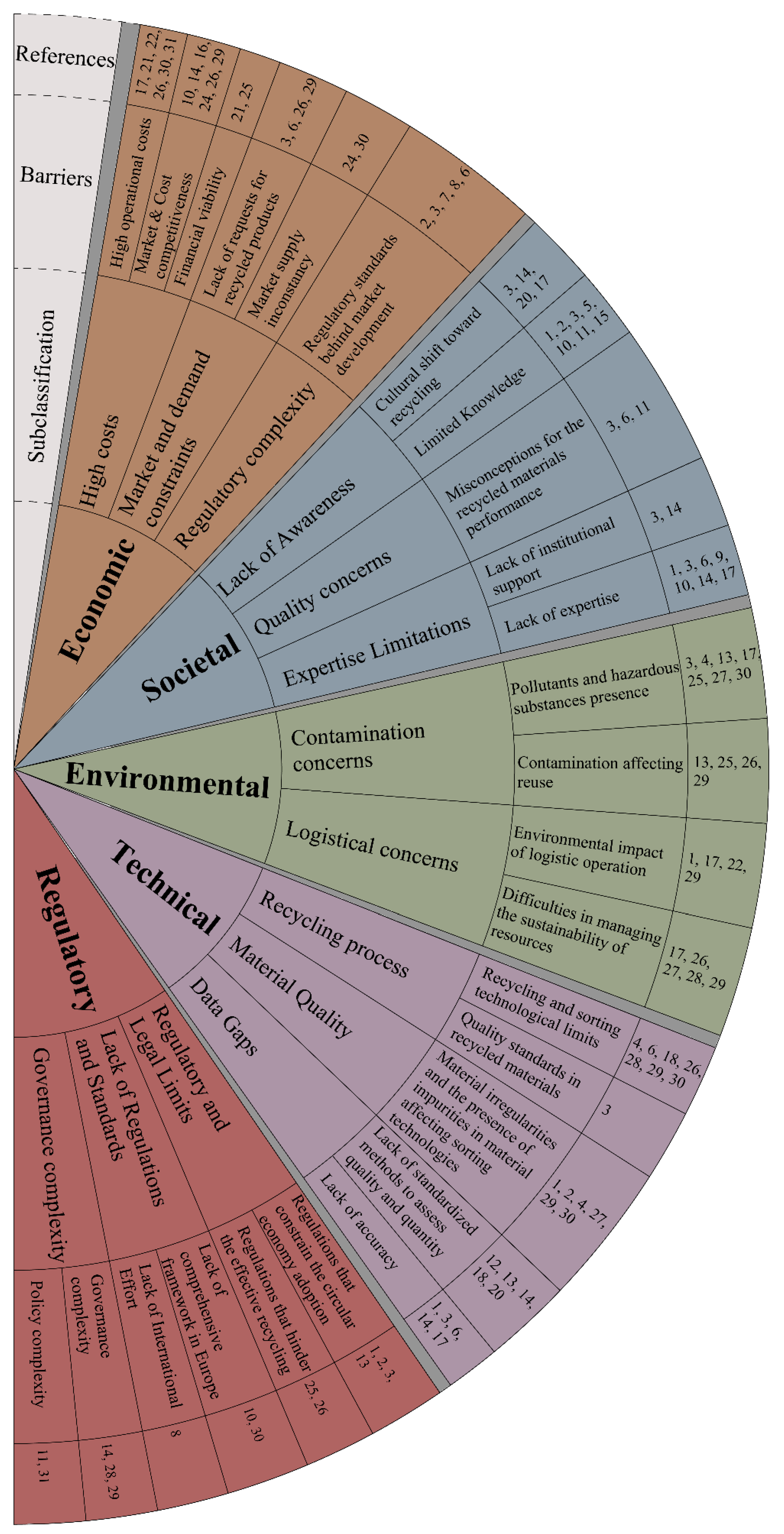
- What are the main barriers that hinder the application of wood waste in the construction and demolition sector?
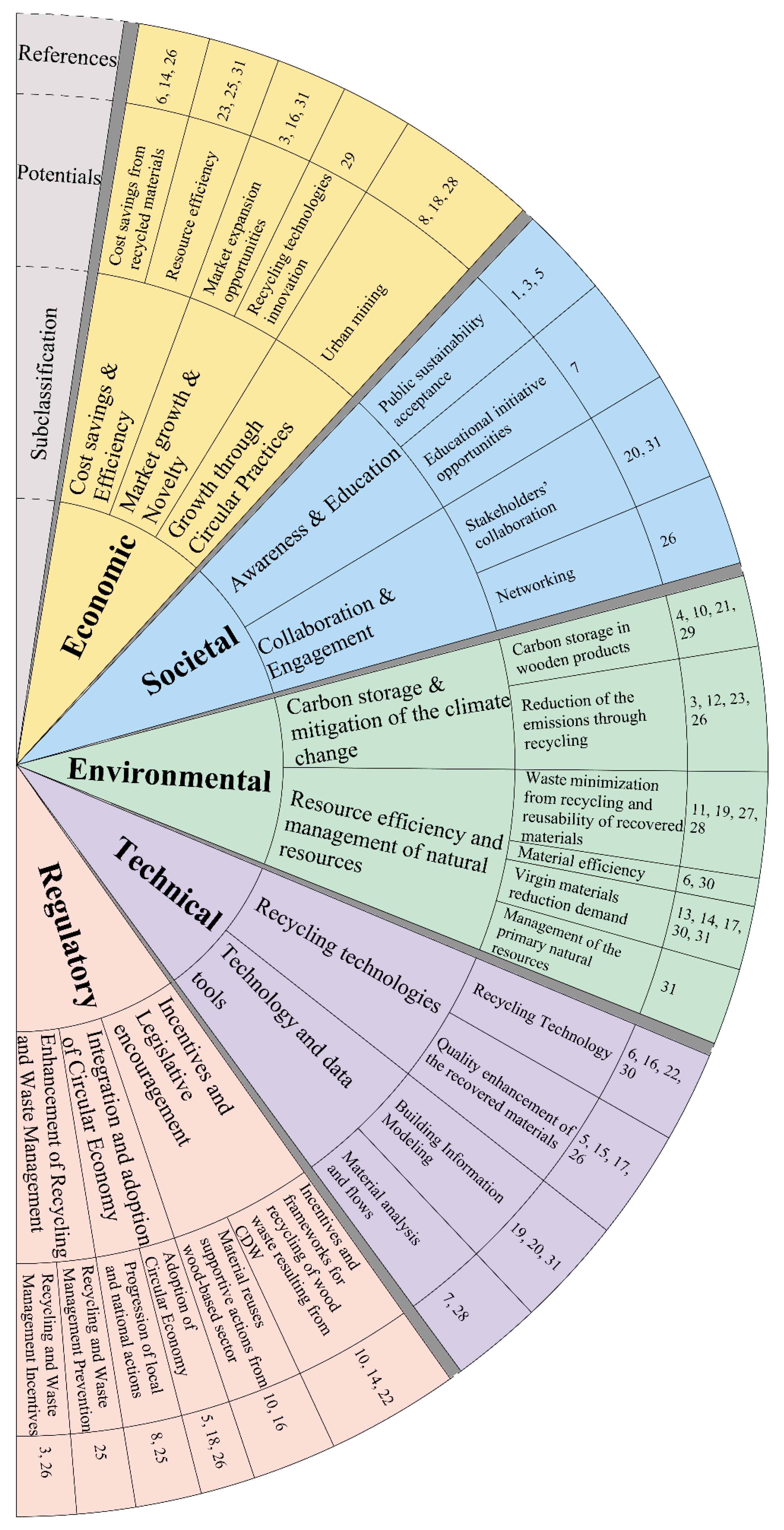
- What potentials characterize wood waste in the construction and demolition sector?
2. Materials and Methods
2.1. Data Collection and Filtration of the Literature
2.2. Selection of Papers from Germany, Denmark, Austria, and Belgium
3. Results and Discussion
3.1. Economic Barriers and Potentials
3.1.1. Economic Barriers
3.1.2. Economic Potentials
3.1.3. Integrating Potentials to Overcome Barriers
3.2. Societal Barriers and Potentials
3.2.1. Societal Barriers
3.2.2. Societal Potentials
3.2.3. Integrating Potentials to Overcome Barriers
3.3. Environmental Barriers and Potentials
3.3.1. Environmental Barriers
3.3.2. Environmental Potentials
3.3.3. Integrating Potentials to Overcome Barriers
3.4. Technical Barriers and Potentials
3.4.1. Technical Barriers
3.4.2. Technical Potentials
3.4.3. Integrating Potentials to Overcome Barriers
3.5. Regulatory Barriers and Potentials
3.5.1. Regulatory Barriers
3.5.2. Regulatory Potentials
3.5.3. Integrating Potentials to Overcome Barriers
4. Conclusions
Supplementary Materials
Author Contributions
Funding
Conflicts of Interest
Abbreviations
| C&D | Construction and Demolition |
| CDW | Construction Demolition Waste |
| BIM | Building Modeling Information |
| GHG | Greenhouse Gas |
| NIR | Near Infrared |
| RFID | Radio Frequency Identification |
References
- Ellen MacArthur Foundation. Growth Within: A Circular Economy Vision for a Competitive Europe; Ellen MacArthur Foundation: Isle of Wight, UK, 2015; Available online: https://www.ellenmacarthurfoundation.org/growth-within-a-circular-economy-vision-for-a-competitive-europe (accessed on 15 May 2024).
- Ellen MacArthur Foundation. What Is the Linear Economy? Ellen MacArthur Foundation: Isle of Wight, UK, 2023; Available online: https://www.ellenmacarthurfoundation.org/what-is-the-linear-economy (accessed on 10 May 2024).
- Geissdoerfer, M.; Savaget, P.; Bocken, N.M.P.; Hultink, E.J. The Circular Economy—A New Sustainability Paradigm? J. Clean. Prod. 2017, 143, 757–768. [Google Scholar] [CrossRef]
- United Nations. The Sustainable Development Goals Report 2023: Special Edition; United Nations: New York, NY, USA, 2023; Available online: https://unstats.un.org/sdgs/report/2023/ (accessed on 6 June 2024).
- Sitra. World Circular Economy Forum 2024: Summary Report; Sitra: Helsinki, Finland, 2024; Available online: https://www.sitra.fi/wp/wp-content/uploads/2024/05/wcef2024_summary-report.pdf (accessed on 10 October 2024).
- Ellen MacArthur Foundation. Towards the Circular Economy Vol. 1: An Economic and Business Rationale for an Accelerated Transition; Ellen MacArthur Foundation: Isle of Wight, UK, 2013; Available online: https://www.ellenmacarthurfoundation.org/towards-the-circular-economy-vol-1-an-economic-and-business-rationale-for-an (accessed on 20 May 2024).
- Järvinen, L.; Sinervo, R. How to Create a National Circular Economy Road Map: A Guide to Making the Change Happen; Sitra: Helsinki, Finland, 2020; Available online: https://www.sitra.fi/en/publications/how-to-create-a-national-circular-economy-road-map/ (accessed on 10 July 2024).
- European Commission. Commission Implementing Decision (EU) 2019/1004 of 7 June 2019: Laying Down Rules for the Calculation, Verification and Reporting of Data on Waste in Accordance with Directive 2008/98/EC of the European Parliament and of the Council and Repealing Commission Implementing Decision C(2012) 2384; European Commission: Brussels, Belgium, 2019. Available online: https://eur-lex.europa.eu/legal-content/EN/TXT/PDF/?uri=CELEX:32019D1004 (accessed on 5 October 2023).
- European Commission. Communication from the Commission to the European Parliament, the Council, the European Economic and Social Committee and the Committee of the Regions: A New Circular Economy Action Plan for a Cleaner and More Competitive Europe; European Commission: Brussels, Belgium, 2020. Available online: https://eur-lex.europa.eu/legal-content/EN/TXT/?qid=1583933814386&uri=COM:2020:98:FIN (accessed on 21 May 2024).
- Nguyen, P.H.; Le, T.N.; Pham, M.T.; Trinh, M.Q. Circular Economy, Economic Growth, and E-Waste Generation in EU27 Countries: Further Evidence from the Novel Circular Economy Index and Threshold Effect. Environ. Sci. Pollut. Res. 2024, 31, 55361–55387. [Google Scholar] [CrossRef]
- Sizirici, B.; Fseha, Y.; Cho, C.-S.; Yildiz, I.; Byon, Y.-J. A Review of Carbon Footprint Reduction in Construction Industry, from Design to Operation. Materials 2021, 14, 6094. [Google Scholar] [CrossRef]
- European Commission. Communication from the Commission to the European Parliament, the Council, the European Economic and Social Committee and the Committee of the Regions on Resource Efficiency Opportunities in the Building Sector; European Commission: Brussels, Belgium, 2014. Available online: https://eur-lex.europa.eu/legal-content/EN/TXT/?uri=celex:52014DC0445 (accessed on 30 June 2024).
- Eurostat. Waste Statistics; Eurostat: Luxembourg, 2023; Available online: https://ec.europa.eu/eurostat/statistics-explained/index.php?title=Municipal_waste_statistics (accessed on 27 April 2023).
- European Commission; Joint Assistance to Support Projects in European Regions (JASPERS). New European Bauhaus Investment Guide; European Commission: Brussels, Belgium, 2024. Available online: https://new-european-bauhaus.europa.eu/system/files/2024-07/NEB%20Investment%20Guidelines.pdf (accessed on 30 September 2024).
- Official Journal of the European Union. Council Conclusions on Culture, High-Quality Architecture and Built Environment as Key Elements of the New European Bauhaus Initiative; Official Journal of the European Union: Luxembourg, 2021; Available online: https://eur-lex.europa.eu/legal-content/EN/TXT/?uri=CELEX:52021XG1213(03) (accessed on 30 June 2024).
- European Environmental Bureau. Annual Report 2021; European Environmental Bureau: Brussels, Belgium, 2022; Available online: https://eeb.org/wp-content/uploads/2022/11/Annual-Report-EEB-2021-Website.pdf (accessed on 10 June 2024).
- Ghobadi, M.; Sepasgozar, S.M.E. Circular Economy Strategies in Modern Timber Construction as a Potential Response to Climate Change. J. Build. Eng. 2023, 77, 107229. [Google Scholar] [CrossRef]
- Directive (EU) 2018/2001 of the European Parliament and of the Council of 11 December 2018 on the Promotion of the Use of Energy from Renewable Sources (Recast). Publications Office of the European Union: Luxembourg, 2018. Available online: https://eur-lex.europa.eu/eli/dir/2018/2001/oj/eng (accessed on 5 May 2025).
- European Commission. Report from the Commission to the European Parliament, the Council, the European Economic and Social Committee and the Committee of the Regions: Identifying Member States at Risk of Not Meeting the 2025 Preparing for Re-Use and Recycling Target for Municipal Waste, the 2025 Packaging Recycling Target, and the 2035 Municipal Waste Landfilling Reduction Target; European Commission: Brussels, Belgium, 2023. Available online: https://eur-lex.europa.eu/legal-content/EN/TXT/PDF/?uri=CELEX:52023DC0304 (accessed on 10 July 2024).
- Munaro, M.R.; Tavares, S.F.; Bragança, L. Towards Circular and More Sustainable Buildings: A Systematic Literature Review on the Circular Economy in the Built Environment. J. Clean. Prod. 2020, 260, 121134. [Google Scholar] [CrossRef]
- Ghisellini, P.; Ripa, M.; Ulgiati, S. Exploring Environmental and Economic Costs and Benefits of a Circular Economy Approach to the Construction and Demolition Sector: A Literature Review. J. Clean. Prod. 2018, 178, 618–643. [Google Scholar] [CrossRef]
- Oluleye, B.I.; Chan, D.W.M.; Saka, A.B.; Olawumi, T.O. Circular Economy Research on Building Construction and Demolition Waste: A Review of Current Trends and Future Research Directions. J. Clean. Prod. 2022, 357, 131927. [Google Scholar] [CrossRef]
- AltholzV. Verordnung über Anforderungen an die Verwertung und Beseitigung von Altholz. Bundesgesetzblatt 2002, Teil I, 3302–3317. Available online: https://www.gesetze-im-internet.de/altholzv/ (accessed on 20 March 2023).
- Page, M.J.; Moher, D.; Bossuyt, P.M.; Boutron, I.; Hoffmann, T.C.; Mulrow, C.D.; Shamseer, L.; Tetzlaff, J.M.; Akl, E.A.; Brennan, S.E.; et al. PRISMA 2020 Explanation and Elaboration: Updated Guidance and Exemplars for Reporting Systematic Reviews. BMJ 2021, 372, n160. [Google Scholar] [CrossRef] [PubMed]
- Moher, D.; Liberati, A.; Tetzlaff, J.; Altman, D.G. Preferred Reporting Items for Systematic Reviews and Meta-Analyses: The PRISMA Statement. PLoS Med. 2009, 6, e1000097. [Google Scholar] [CrossRef] [PubMed]
- Economic Commission for Europe. Catalogue of Wood Waste Classifications in the UNECE Region; United Nations Research Institute for Social Development: Bloomfield, NJ, USA, 2023. Available online: https://unece.org/sites/default/files/2023-02/2228308_E_web_ECE_TIM_DP_91.pdf (accessed on 3 March 2024).
- Amarasinghe, I.T.; Qian, Y.; Gunawardena, T.; Mendis, P.; Belleville, B. Composite Panels from Wood Waste: A Detailed Review of Processes, Standards, and Applications. J. Compos. Sci. 2024, 8, 417. [Google Scholar] [CrossRef]
- Mancini, M.; Rinnan, Å. Classification of Waste Wood Categories According to the Best Reuse Using FT-NIR Spectroscopy and Chemometrics. Anal. Chim. Acta 2023, 1275, 341564. [Google Scholar] [CrossRef]
- Pazzaglia, A.; Castellani, B. Wood Waste Valorization in Europe: Policy Framework, Challenges, and Decisional Tools. Available online: https://procedia-esem.eu/pdf/issues/2023/no2/14_Pazzaglia_23.pdf (accessed on 10 June 2024).
- Schützenhofer, S.; Kovacic, I.; Rechberger, H.; Mack, S. Improvement of Environmental Sustainability and Circular Economy through Construction Waste Management for Material Reuse. Sustainability 2022, 14, 11087. [Google Scholar] [CrossRef]
- Christensen, T.B.; Johansen, M.R.; Buchard, M.V.; Glarborg, C.N. Closing the Material Loops for Construction and Demolition Waste: The Circular Economy on the Island Bornholm, Denmark. Resour. Conserv. Recycl. Adv. 2022, 15, 200104. [Google Scholar] [CrossRef]
- Di Maria, A.; Eyckmans, J.; Van Acker, K. Downcycling versus Recycling of Construction and Demolition Waste: Combining LCA and LCC to Support Sustainable Policy Making. Waste Manag. 2018, 75, 3–21. [Google Scholar] [CrossRef] [PubMed]
- Luciano, A.; Cutaia, L.; Cioffi, F.; Sinibaldi, C. Demolition and Construction Recycling Unified Management: The DECORUM Platform for Improvement of Resource Efficiency in the Construction Sector. Environ. Sci. Pollut. Res. 2021, 28, 24558–24569. [Google Scholar] [CrossRef] [PubMed]
- Honic, M.; Kovacic, I.; Rechberger, H. Improving the Recycling Potential of Buildings through Material Passports (MP): An Austrian Case Study. J. Clean. Prod. 2019, 217, 787–797. [Google Scholar] [CrossRef]
- Luciano, A.; Cutaia, L.; Altamura, P.; Penalvo, E. Critical Issues Hindering a Widespread Construction and Demolition Waste (CDW) Recycling Practice in EU Countries and Actions to Undertake: The Stakeholder’s Perspective. Sustain. Chem. Pharm. 2022, 29, 100745. [Google Scholar] [CrossRef]
- Kromoser, B.; Reichenbach, S.; Hellmayr, R.; Myna, R.; Wimmer, R. Circular Economy in Wood Construction—Additive Manufacturing of Fully Recyclable Walls Made from Renewables: Proof of Concept and Preliminary Data. Constr. Build. Mater. 2022, 344, 128219. [Google Scholar] [CrossRef]
- Buchard, M.V.; Christensen, T.B. Business Models for the Reuse of Construction and Demolition Waste. Waste Manag. Res. 2024, 42, 359–371. [Google Scholar] [CrossRef]
- Nußholz, J.L.K.; Rasmussen, F.N.; Milios, L. Circular Building Materials: Carbon Saving Potential and the Role of Business Model Innovation and Public Policy. Resour. Conserv. Recycl. 2019, 141, 308–316. [Google Scholar] [CrossRef]
- Sikkema, R.; Styles, D.; Jonsson, R.; Tobin, B.; Byrne, K.A. A Market Inventory of Construction Wood for Residential Building in Europe—In the Light of the Green Deal and New Circular Economy Ambitions. Sustain. Cities Soc. 2023, 90, 104370. [Google Scholar] [CrossRef]
- Christensen, T.B. Towards a Circular Economy in Cities: Exploring Local Modes of Governance in the Transition towards a Circular Economy in Construction and Textile Recycling. J. Clean. Prod. 2021, 305, 127058. [Google Scholar] [CrossRef]
- Höglmeier, K.; Weber-Blaschke, G.; Richter, K. Potentials for Cascading of Recovered Wood from Building Deconstruction—A Case Study for South-East Germany. Resour. Conserv. Recycl. 2013, 78, 81–91. [Google Scholar] [CrossRef]
- Risse, M.; Weber-Blaschke, G.; Richter, K. Eco-Efficiency Analysis of Recycling Recovered Solid Wood from Construction into Laminated Timber Products. Sci. Total Environ. 2019, 661, 107–119. [Google Scholar] [CrossRef]
- Mager, E.; Iurato, C.; Schanz, H. Depicting Wood-Based Sectors to Inform Policymaking: A Structural Modeling Approach Centering on Networks of Markets. For. Policy Econ. 2023, 157, 103078. [Google Scholar] [CrossRef]
- Schiller, G.; Müller, F.; Ortlepp, R. Mapping the Anthropogenic Stock in Germany: Metabolic Evidence for a Circular Economy. Resour. Conserv. Recycl. 2017, 123, 93–107. [Google Scholar] [CrossRef]
- Zeller, V.; Towa, E.; Degrez, M.; Achten, W.M.J. Urban Waste Flows and Their Potential for a Circular Economy Model at City-Region Level. Waste Manag. 2019, 83, 83–94. [Google Scholar] [CrossRef] [PubMed]
- Faraca, G.; Tonini, D.; Astrup, T.F. Dynamic Accounting of Greenhouse Gas Emissions from Cascading Utilisation of Wood Waste. Sci. Total Environ. 2019, 651, 2689–2700. [Google Scholar] [CrossRef]
- Jacobi, N.; Haas, W.; Wiedenhofer, D.; Mayer, A. Providing an Economy-Wide Monitoring Framework for the Circular Economy in Austria: Status Quo and Challenges. Resour. Conserv. Recycl. 2018, 137, 156–166. [Google Scholar] [CrossRef]
- Kühlen, A.; Thompson, N.; Schultmann, F. Barriers for Deconstruction and Reuse/Recycling of Construction Materials in Germany; Karlsruhe Institute of Technology (KIT): Karlsruhe, Germany, 2012; Available online: https://publikationen.bibliothek.kit.edu/1000052698 (accessed on 10 March 2025).
- Lesar, B.; Humar, M.; Hora, G. Quality assessment of recycled wood with and without non-wooden materials from selected recycling companies in Europe. Waste Manag. 2018, 79, 362–373. [Google Scholar] [CrossRef] [PubMed]
- Garcia, C.A.; Hora, G. State-of-the-art of waste wood supply chain in Germany and selected European countries. Waste Manag. 2017, 70, 189–197. [Google Scholar] [CrossRef] [PubMed]
- Federal Ministry for the Environment, Nature Conservation, Nuclear Safety and Consumer Protection (BMUV). The National Circular Economy Strategy—Summary; BMUV: Berlin, Germany, 2024; 19p, Available online: https://www.bundesumweltministerium.de/fileadmin/Daten_BMU/Download_PDF/Abfallwirtschaft/nkws_zusammenfassung_en_bf.pdf (accessed on 27 August 2025).
- Organisation for Economic Co-operation and Development (OECD). The Circular Economy in Berlin, Germany; OECD Regional Development Papers, No. 98; OECD Publishing: Paris, France, 2024; 50p. [Google Scholar] [CrossRef]
- Mayer, M. Material recovery certification for construction workers. Build. Cities 2020, 1, 550–564. [Google Scholar] [CrossRef]
- Ottenhaus, L.-M.; Yan, Z.; Brandner, R.; Leardini, P.; Fink, G.; Jockwer, R. Design for adaptability, disassembly and reuse—A review of reversible timber connection systems. Constr. Build. Mater. 2023, 400, 132823. [Google Scholar] [CrossRef]
- Rheude, F.; Bucher, A.; Röder, H. Residential Demolition and Waste Management—An Ecobalancing Case Study. Clean. Waste Syst. 2022, 3, 100056. [Google Scholar] [CrossRef]
- Szichta, P.; Risse, M.; Weber-Blaschke, G.; Richter, K. Potentials for Wood Cascading: A Model for the Prediction of the Recovery of Timber in Germany. Resour. Conserv. Recycl. 2022, 178, 106101. [Google Scholar] [CrossRef]
- De Lima, P.R.B.; Rodrigues, C.S.; Post, J.M. Integration of BIM and Design for Deconstruction to Improve Circular Economy of Buildings. J. Build. Eng. 2023, 80, 108015. [Google Scholar] [CrossRef]
- Caro, D.; Lodato, C.; Damgaard, A.; Cristóbal, J.; Foster, G.; Flachenecker, F.; Tonini, D. Environmental and Socio-Economic Effects of Construction and Demolition Waste Recycling in the European Union. Sci. Total Environ. 2024, 908, 168295. [Google Scholar] [CrossRef]
- Heisel, F.; Rau-Oberhuber, S. Calculation and Evaluation of Circularity Indicators for the Built Environment Using the Case Studies of UMAR and Madaster. J. Clean. Prod. 2020, 243, 118482. [Google Scholar] [CrossRef]
- Honic, M.; Kovacic, I.; Sibenik, G.; Rechberger, H. Data- and Stakeholder Management Framework for the Implementation of BIM-Based Material Passports. J. Build. Eng. 2019, 23, 341–350. [Google Scholar] [CrossRef]
- Krajewska, A.; Siewczyńska, M. Circular Economy in the Construction Sector in Materials, Processes, and Case Studies: Research Review. Sustainability 2025, 17, 7029. [Google Scholar] [CrossRef]
- Arm, M.; Wik, O.; Engelsen, C.J.; Erlandsson, M.; Hjelmar, O.; Wahlström, M. How Does the European Recovery Target for Construction & Demolition Waste Affect Resource Management? Waste Biomass Valorization 2017, 8, 1491–1504. [Google Scholar] [CrossRef]
- Asa, P.; El Feghali, C.; Steixner, C.; Tahouni, Y.; Wagner, H.J.; Knippers, J.; Menges, A. Embraced Wood: Circular Construction Method for Composite Long-Span Beams from Unprocessed Reclaimed Timber, Fibers and Clay. Constr. Build. Mater. 2024, 416, 135096. [Google Scholar] [CrossRef]
- Faraca, G.; Boldrin, A.; Astrup, T.F. Resource quality of wood waste: The importance of physical and chemical impurities in wood waste for recycling. Waste Manag. 2019, 87, 135–147. [Google Scholar] [CrossRef]
- Bais-Moleman, A.L.; Sikkema, R.; Vis, M.; Reumerman, P.; Theurl, M.C.; Erb, K.-H. Assessing Wood Use Efficiency and Greenhouse Gas Emissions of Wood Product Cascading in the European Union. J. Clean. Prod. 2018, 172, 3942–3954. [Google Scholar] [CrossRef]
- Fang, X.; Chang, R.; Zhang, Y.; Zuo, J.; Zou, Y.; Han, Y. Monitoring airborne particulate matter from building construction: A systematic review. J. Build. Eng. 2024, 86, 108708. [Google Scholar] [CrossRef]
- Forster, E.J.; Healey, J.R.; Newman, G.; Styles, D. Circular wood use can accelerate global decarbonisation but requires cross-sectoral coordination. Nat. Commun. 2023, 14, 6766. [Google Scholar] [CrossRef] [PubMed]
- Pinho, G.C.d.S.; Calmon, J.L. LCA of Wood Waste Management Systems: Guiding Proposal for the Standardization of Studies Based on a Critical Review. Sustainability 2023, 15, 1854. [Google Scholar] [CrossRef]
- Honic, M.; Kovacic, I.; Aschenbrenner, P.; Ragossnig, A. Material Passports for the End-of-Life Stage of Buildings: Challenges and Potentials. J. Clean. Prod. 2021, 319, 128702. [Google Scholar] [CrossRef]
- Jahan, I.; Zhang, G.; Bhuiyan, M.; Navaratnam, S. Circular Economy of Construction and Demolition Wood Waste—A Theoretical Framework Approach. Sustainability 2022, 14, 10478. [Google Scholar] [CrossRef]
- Yayla, A.; Mason, A.R.; Wang, J.; van Ewijk, S.; Myers, R.J. Global wood harvest is sufficient for climate-friendly transitions to timber cities. Nat. Sustain. 2025, 1–13. [Google Scholar] [CrossRef]
- Kiesnere, G.; Atstaja, D.; Cudecka-Purina, N.; Susniene, R. The Potential of Wood Construction Waste Circularity. Environments 2024, 11, 231. [Google Scholar] [CrossRef]
- Starzyk, A.; Marchwiński, J.; Milošević, V. Circular Wood Construction in a Sustainable Built Environment: A Thematic Review of Gaps and Emerging Topics. Sustainability 2025, 17, 7333. [Google Scholar] [CrossRef]
- Ikenze, N.; Rizos, V.; Nipius, L. Improving Waste Wood Circularity in the EU: Classification Frameworks and Policy Options. CEPS In-Depth Analysis 2024-14; Centre for European Policy Studies: Brussels, Belgium, 2024; 69p, Available online: https://cdn.ceps.eu/wp-content/uploads/2024/11/2024-14_ERCC_Wood2Wood.pdf (accessed on 5 May 2025).
- Jarre, M.; Petit-Boix, A.; Priefer, C.; Meyer, R.; Leipold, S. Transforming the bio-based sector towards a circular economy—What can we learn from wood cascading? For. Policy Econ. 2020, 110, 101872. [Google Scholar] [CrossRef]
- Iost, S.; Lüdtke, J. Transformation der Holzwirtschaft zu einer zirkulären Bioökonomie: Auswertung eines Workshops im Rahmen der Charta für Holz 2.0 im Dialog 2024 „Holz im Kreislauf—Treiber für Innovation!”. In Thünen Working Paper; Johann Heinrich von Thünen-Institut: Braunschweig, Germany, 2025. [Google Scholar] [CrossRef]


Disclaimer/Publisher’s Note: The statements, opinions and data contained in all publications are solely those of the individual author(s) and contributor(s) and not of MDPI and/or the editor(s). MDPI and/or the editor(s) disclaim responsibility for any injury to people or property resulting from any ideas, methods, instructions or products referred to in the content. |
© 2025 by the authors. Licensee MDPI, Basel, Switzerland. This article is an open access article distributed under the terms and conditions of the Creative Commons Attribution (CC BY) license (https://creativecommons.org/licenses/by/4.0/).
Share and Cite
Cakaj, A.; Hesse, L.; Krause, A.; Speth, H.; Lüdtke, J. Barriers and Potentials for Circular Use of Waste Wood in Construction and Demolition Sector with Special Focus on Germany. Urban Sci. 2025, 9, 367. https://doi.org/10.3390/urbansci9090367
Cakaj A, Hesse L, Krause A, Speth H, Lüdtke J. Barriers and Potentials for Circular Use of Waste Wood in Construction and Demolition Sector with Special Focus on Germany. Urban Science. 2025; 9(9):367. https://doi.org/10.3390/urbansci9090367
Chicago/Turabian StyleCakaj, Arbnore, Linnea Hesse, Andreas Krause, Hubert Speth, and Jan Lüdtke. 2025. "Barriers and Potentials for Circular Use of Waste Wood in Construction and Demolition Sector with Special Focus on Germany" Urban Science 9, no. 9: 367. https://doi.org/10.3390/urbansci9090367
APA StyleCakaj, A., Hesse, L., Krause, A., Speth, H., & Lüdtke, J. (2025). Barriers and Potentials for Circular Use of Waste Wood in Construction and Demolition Sector with Special Focus on Germany. Urban Science, 9(9), 367. https://doi.org/10.3390/urbansci9090367