
Potential Spatial Accessibility to Primary Percutaneous Coronary Intervention (pPCI) Facilities in the Republic of Serbia for the Year 2030

 ,
,  , ,
, ,  ,
, 
Abstract
1. Introduction
- It incorporates the collected weekly working hours of pPCI facilities to account for high peak and low peak periods.
- It uses gridded 2030 population projections to quantify the share of residents within each interval.
- It applies cluster analysis and a what-if scenario to identify underserved populations and evaluate the effect of adding a facility at the most suitable location. These steps extend earlier studies, which typically assumed static 24/7 operation or simple distance buffers [23]. In addition, new pPCI capacities were established after the Mickovski-Katalina [23] study was conducted. Thus, we believe our findings will be instrumental in assessing the extent to which accessibility has changed, identifying areas for improvement, and predicting future changes according to demographic processes, changes in traffic, and the construction of new roads.
2. Materials and Methods
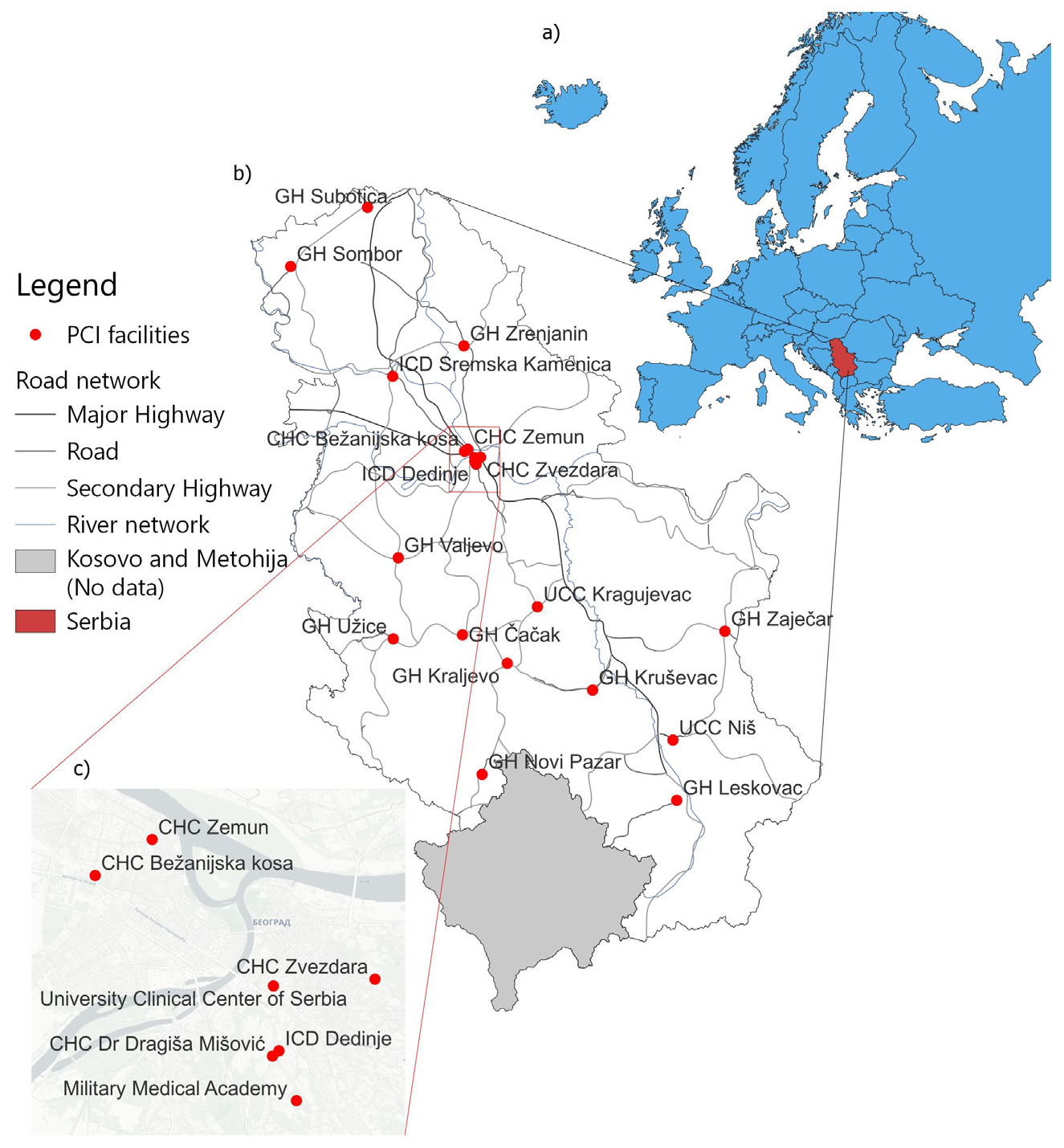
2.1. Geographical Setting of Serbia
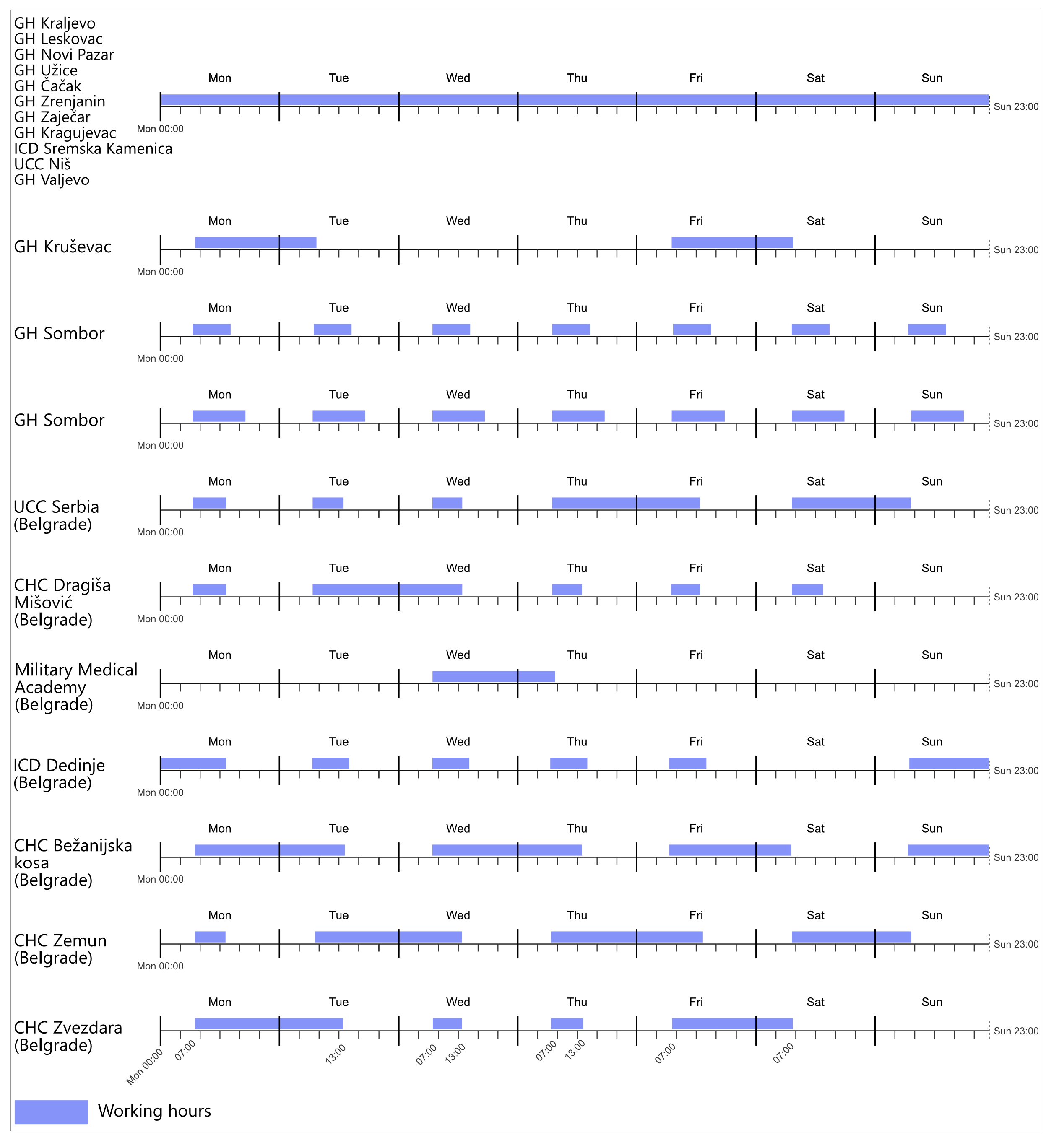
2.2. Research Workflow and Data
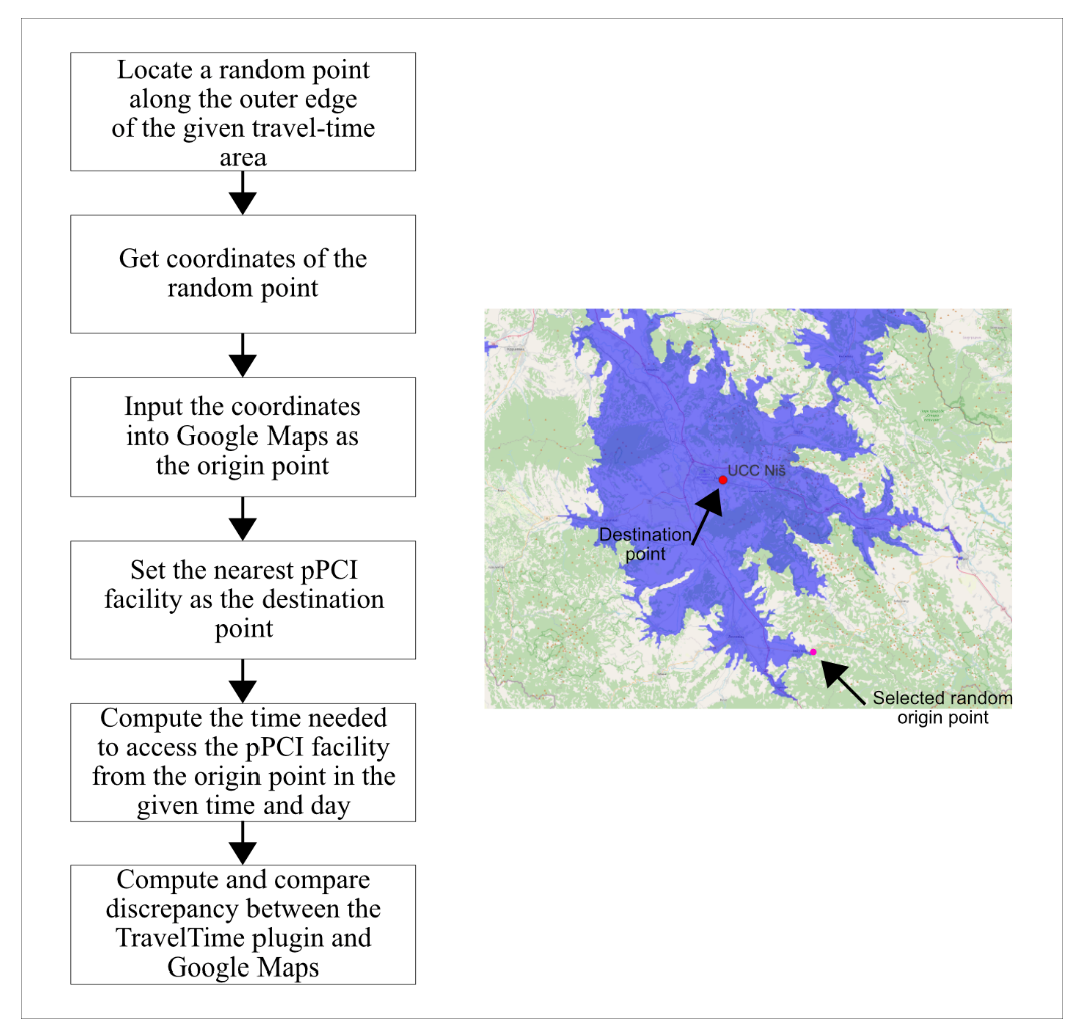
2.3. Results Validation Workflow Utilizing Google Maps
3. Results
3.1. GHSL Population Raster Verification for the Republic of Serbia
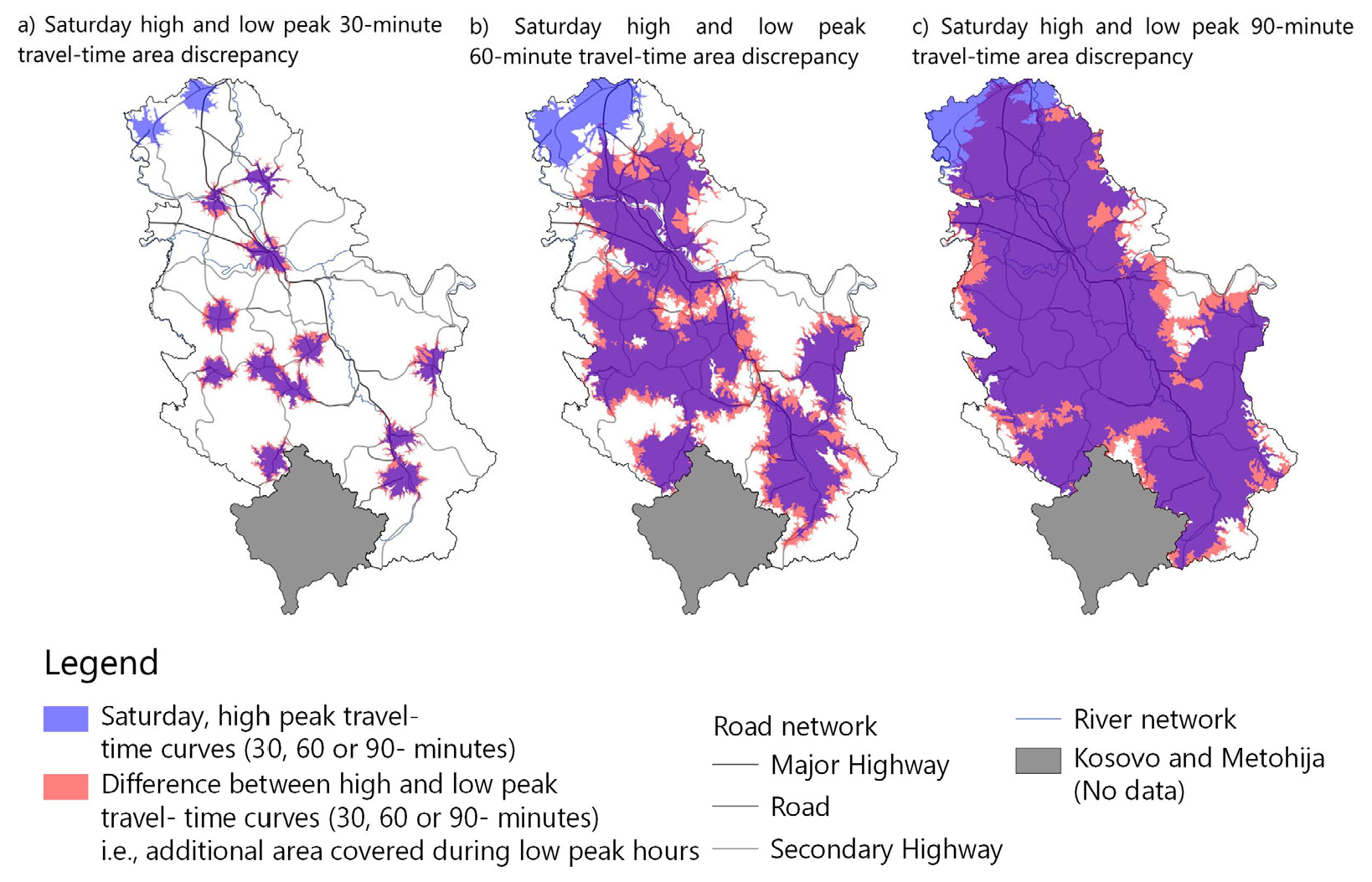
3.2. Spatiotemporal Analysis of pPCI Facilities for the Year 2030
- A total of 3.5 million people for the 30 min interval during the Monday morning shift;
- A total of 5.7 million people for the 60 min interval during the Sunday early morning shift;
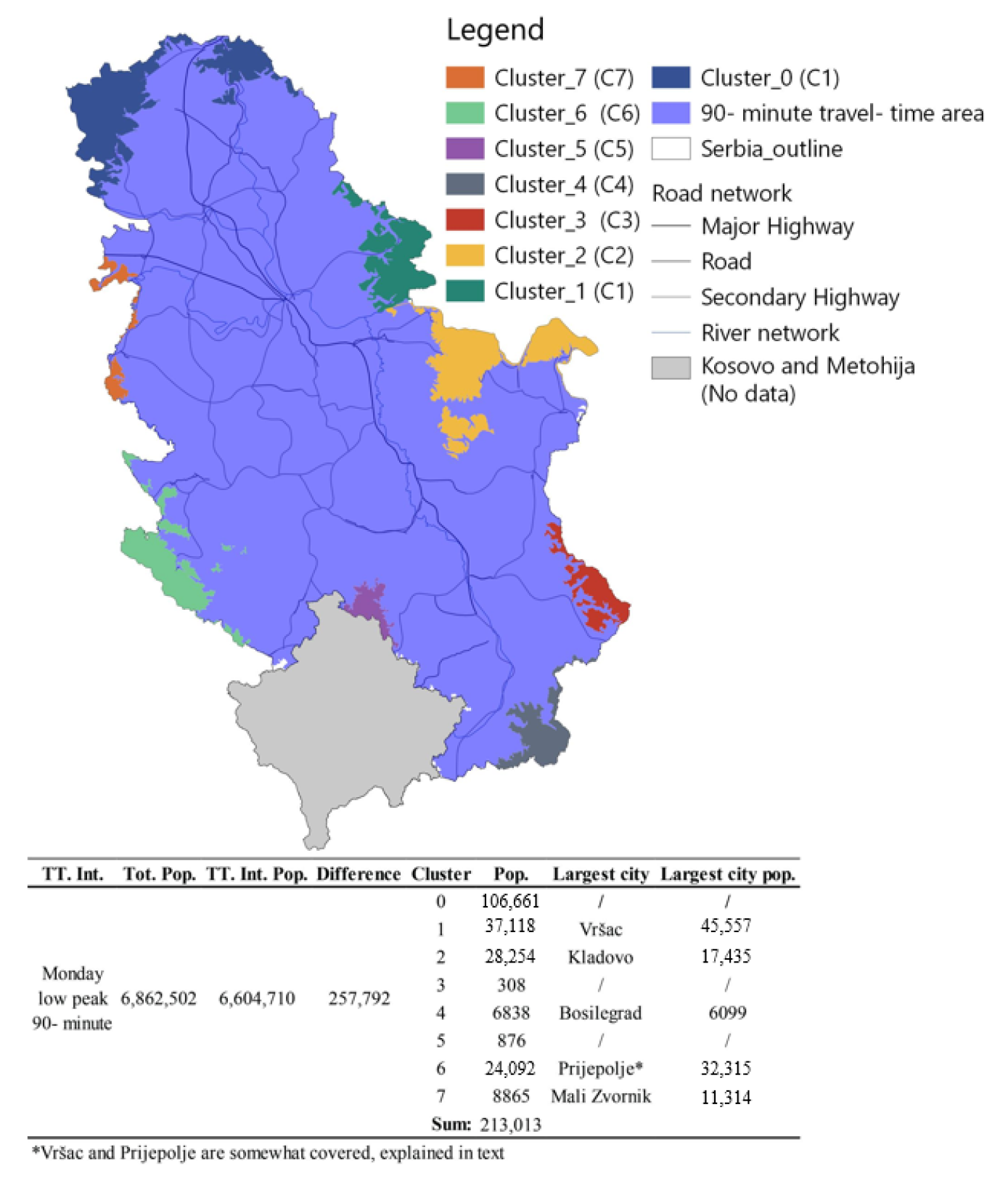
- A total of 6.6 million people for the 90 min interval during the Monday afternoon shift.
3.3. Addressing Underserved/Inaccessible Regions in the Republic of Serbia
- Adding or extending pPCI services;
- Lowering effective travel times via transport upgrades.
3.4. Results Validation Utilizing Google Maps
4. Discussion
4.1. General Discussion
- Accessibility is time-sensitive, meaning lower congestion at night extends reachable areas even when fewer facilities are open, while daytime congestion contracts them despite broader availability.
- Populations beyond the 90 min threshold are spatially clustered, with the largest concentrations around Vršac, Kladovo, and Prijepolje, and adjacent settlements are also outside of coverage.
- Targeted “what-if” analysis shows that incremental capacity and extended hours can materially reduce the non-covered population and bring national 90 min coverage near “total” coverage. These results are consistent with our focused external validation against Google Maps (small absolute errors, slightly larger at high peak times).
4.2. Policy and Implementation Measures
- One clear improvement would be to extend operating hours at Subotica and Sombor. This would eliminate the repeated low peak gaps we observed in northern Serbia.
- Pilot a shared on-call pPCI shift across neighboring facilities to smooth hour-by-hour availability without duplicating capacity.
- Introduce dynamic scheduling: align lab staffing with empirically busier daytime windows while preserving a minimal night schedule to capitalize on lower congestion.
- Preposition EMS units closer to the three major clusters (Vršac, Kladovo, Prijepolje) during high-risk periods; evaluate temporary satellite bases.
- Deploy real-time navigation and hospital load information to route patients to the fastest effective facility, not only the nearest by distance.
- Standardize prehospital triage and tele-ECG to shorten decision-to-balloon time.
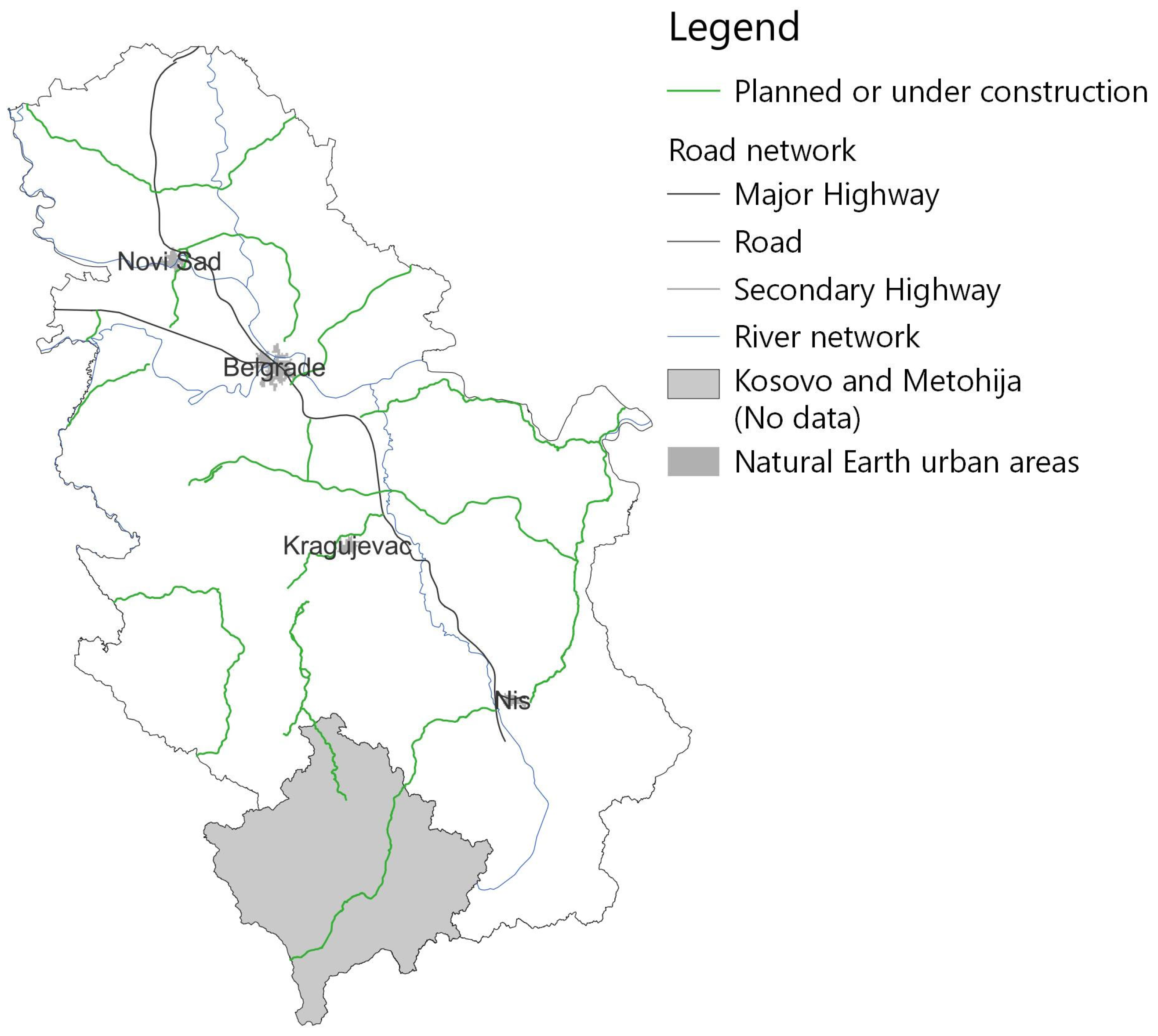
- Prioritize segments of the “smile of Vojvodina”, Danube Road (Požarevac–Golubac–Kladovo), Belgrade ring extension (Bubanj Potok–Vršac), and Kotroman–Požega–Ivanjica–Boljare, where they intersect with uncovered clusters; design EMS-focused access treatments (ramps, turning pockets, shoulder hardening).
- Incorporate accessibility key performance indicators (e.g., residents within 60/90 min) into corridor appraisal alongside traffic and economic metrics.
- Establish an annual accessibility dashboard tracking the share of the population within 30/60/90 min by period (low/high peak), district, and facility availability pattern.
- Use before/after evaluations when hours are extended or corridors open (e.g., Subotica/Sombor 24/7) to measure realized gains.
4.3. Limitations
5. Conclusions
Supplementary Materials
Author Contributions
Funding
Data Availability Statement
Acknowledgments
Conflicts of Interest
References
- Vaduganathan, M.; Mensah, G.A.; Turco, J.V.; Fuster, V.; Roth, G.A. The Global Burden of Cardiovascular Diseases and Risk: A Compass for Future Health. J. Am. Coll. Cardiol. 2022, 80, 2361–2371. [Google Scholar] [CrossRef] [PubMed]
- Luengo-Fernandez, R.; Walli-Attaei, M.; Gray, A.; Torbica, A.; Maggioni, A.P.; Huculeci, R.; Bairami, F.; Aboyans, V.; Timmis, A.D.; Vardas, P.; et al. Economic Burden of Cardiovascular Diseases in the European Union: A Population-Based Cost Study. Eur. Heart J. 2023, 44, 4752–4767. [Google Scholar] [CrossRef]
- World Heart Federation World Heart Vision 2030: Driving Policy Change. 2022. Available online: https://world-heart-federation.org/world-heart-vision-2030/#:~:text=The (accessed on 18 January 2025).
- Mocumbi, A.O. Cardiovascular Health Care in Low- and Middle-Income Countries. Circulation 2024, 149, 557–559. [Google Scholar] [CrossRef]
- Goldberg, R.J.; Kramer, D.G.; Yarzebski, J.; Lessard, D.; Gore, J.M. Prehospital Transport of Patients with Acute Myocardial Infarction: A Community-Wide Perspective. Heart Lung J. Acute Crit. Care 2008, 37, 266–274. [Google Scholar] [CrossRef][Green Version]
- Chowdhury, I.Z.; Amin, M.N.; Chowdhury, M.Z.; Rahman, S.M.; Ahmed, M.; Cader, F.A. Pre Hospital Delay and Its Associated Factors in Acute Myocardial Infarction in a Developing Country. PLoS ONE 2021, 16, e0259979. [Google Scholar] [CrossRef]
- Cenko, E.; Manfrini, O.; Fabin, N.; Dorobantu, M.; Kedev, S.; Milicic, D.; Vasiljevic, Z.; Bugiardini, R. Clinical Determinants of Ischemic Heart Disease in Eastern Europe. Lancet Reg. Health Eur. 2023, 33, 100698. [Google Scholar] [CrossRef]
- Vasić, A.; Vasiljević, Z.; Mickovski-Katalina, N.; Mandić-Rajčević, S.; Soldatović, I. Temporal Trends in Acute Coronary Syndrome Mortality in Serbia in 2005–2019: An Age–Period–Cohort Analysis Using Data from the Serbian Acute Coronary Syndrome Registry (RAACS). Int. J. Environ. Res. Public Health 2022, 19, 14457. [Google Scholar] [CrossRef] [PubMed]
- Institute of Public Health of Serbia. Incidence and Mortality from Acute Coronary Syndrome in Serbia in 2022; Institute of Public Health of Serbia: Beograd, Serbia, 2023. [Google Scholar]
- De Luca, G.; Suryapranata, H.; Ottervanger, J.P.; Antman, E.M. Time Delay to Treatment and Mortality in Primary Angioplasty for Acute Myocardial Infarction: Every Minute of Delay Counts. Circulation 2004, 109, 1223–1225. [Google Scholar] [CrossRef]
- Antman, E.M. Time Is Muscle. Translation Into Practice. J. Am. Coll. Cardiol. 2008, 52, 1216–1221. [Google Scholar] [CrossRef]
- Reimer, K.A.; Lowe, J.E.; Rasmussen, M.M.; Jennings, R.B. The Wavefront Phenomenon of Ischemic Cell Death. 1. Myocardial Infarct Size vs Duration of Coronary Occlusion in Dogs. Circulation 1977, 56, 786–794. [Google Scholar] [CrossRef] [PubMed]
- Ki, Y.J.; Kang, J.; Yang, H.M.; Woo Park, K.; Kang, H.J.; Koo, B.K.; Cho, M.C.; Kim, C.J.; Ahn, Y.; Jeong, M.H.; et al. Immediate Compared with Delayed Percutaneous Coronary Intervention for Patients with ST-Segment-Elevation Myocardial Infarction Presenting ≥12 Hours After Symptom Onset Is Not Associated with Improved Clinical Outcome. Circ. Cardiovasc. Interv. 2021, 14, E009863. [Google Scholar] [CrossRef]
- Silber, I.; Price, C. On the Use of VLF Narrowband Measurements to Study the Lower Ionosphere and the Mesosphere–Lower Thermosphere. Surv. Geophys. 2017, 38, 407–441. [Google Scholar] [CrossRef]
- Byrne, R.A.; Rossello, X.; Coughlan, J.J.; Barbato, E.; Berry, C.; Chieffo, A.; Claeys, M.J.; Dan, G.A.; Dweck, M.R.; Galbraith, M.; et al. 2023 ESC Guidelines for the Management of Acute Coronary Syndromes. Eur. Heart J. 2023, 44, 3720–3826. [Google Scholar] [CrossRef] [PubMed]
- Armstrong, P.W.; Gershlick, A.H.; Goldstein, P.; Wilcox, R.; Danays, T.; Lambert, Y.; Sulimov, V.; Rosell Ortiz, F.; Ostojic, M.; Welsh, R.C.; et al. Fibrinolysis or Primary PCI in ST-Segment Elevation Myocardial Infarction. N. Engl. J. Med. 2013, 368, 1379–1387. [Google Scholar] [CrossRef]
- Hewko, J.; Smoyer-Tomic, K.E.; Hodgson, M.J. Measuring Neighbourhood Spatial Accessibility to Urban Amenities: Does Aggregation Error Matter? Environ. Plan. A 2002, 34, 1185–1206. [Google Scholar] [CrossRef]
- Weiss, D.J.; Nelson, A.; Vargas-Ruiz, C.A.; Gligorić, K.; Bavadekar, S.; Gabrilovich, E.; Bertozzi-Villa, A.; Rozier, J.; Gibson, H.S.; Shekel, T.; et al. Global Maps of Travel Time to Healthcare Facilities. Nat. Med. 2020, 26, 1835–1838. [Google Scholar] [CrossRef]
- Gligorić, K.; Kamath, C.; Weiss, D.J.; Bavadekar, S.; Liu, Y.; Shekel, T.; Schulman, K.; Gabrilovich, E. Revealed versus Potential Spatial Accessibility of Healthcare and Changing Patterns during the COVID-19 Pandemic. Commun. Med. 2023, 3, 157. [Google Scholar] [CrossRef]
- Wang, F.; Luo, W. Assessing Spatial and Nonspatial Factors for Healthcare Access: Towards an Integrated Approach to Defining Health Professional Shortage Areas. Heal. Place 2005, 11, 131–146. [Google Scholar] [CrossRef]
- Khan, A.; Bhardwaj, S. Access to Health Care: A Conceptual Framework and Its Relevance to Health Care Planning. Eval. Health Prof. 1994, 17, 61–76. [Google Scholar] [CrossRef] [PubMed]
- Kelly, C.; Hulme, C.; Farragher, T.; Clarke, G. Are Differences in Travel Time or Distance to Healthcare for Adults in Global North Countries Associated with an Impact on Health Outcomes? A Systematic Review. BMJ Open 2016, 6, e013059. [Google Scholar] [CrossRef] [PubMed]
- Mickovski Katalina, N. Istraživanje Karakteristika Zdravstvenog Sistema i Blagovremenosti Terapije u Zbrin-Javanju Bolesnika sa Akutnim Koronarnim Sindromom u Srbiji. Doctoral Thesis, University of Belgrade, Belgrade, Serbia, 2016. [Google Scholar]
- Penchasky, R.; Thomas, J. The Concept of Access: Definition and Relationship to Consumer Satisfaction. Med. Care 1981, 19, 127–140. [Google Scholar] [CrossRef]
- Andersen, R.M. Revisiting the Behavioral Model and Access to Medical Care: Does It Matter? J. Health Soc. Behav. 1995, 36, 1–10. [Google Scholar] [CrossRef]
- Andersen, R.M. National Health Surveys and the Behavioral Model of Health Services Use. Med. Care 2008, 46, 647–653. [Google Scholar] [CrossRef]
- Institute of Public Health of Serbia “Dr Milan Jovanovic Batut”. Health Statistical Yearbook of the Republic of Serbia 2022; Institute of Public Health of Serbia “Dr Milan Jovanovic Batut”: Beograd, Serbia, 2023. [Google Scholar]
- Knoop, V. Introduction to Traffic Flow Theory; TU Delft: Delft, The Netherlands, 2017; ISBN 978-94-6366-062-4. [Google Scholar]
- Carioli, A.; Schiavina, M.; Freire, S.; MacManus, K. GHS-POP R2023A—GHS Population Grid Multitemporal (1975-2030). 2023. Available online: http://data.europa.eu/89h/2ff68a52-5b5b-4a22-8f40-c41da8332cfe (accessed on 1 September 2025).
- Freire, S.; Macmanus, K.; Pesaresi, M.; Doxsey-Whitfield, E.; Mills, J. Development of new open and free mul-ti-temporal global population grids at 250 m resolution. In Proceedings of the AGILE 2016, Atlanta, GA, USA, 25–29 July 2016. [Google Scholar]
- Melchiorri, M.; Pesaresi, M.; Florczyk, A.J.; Corbane, C.; Kemper, T. Principles and Applications of the Global Human Settlement Layer as Baseline for the Land Use Efficiency Indicator—SDG 11.3.1. ISPRS Int. J. Geo-Inf. 2019, 8, 19. [Google Scholar] [CrossRef]
- Nautiyal, G.; Maithani, S.; Sharma, A. Study of Urban Growth Dynamics Using Global Human Settlement Layer Data Set: Uttarakhand, India. J. Indian Soc. Remote Sens. 2020, 48, 817–827. [Google Scholar] [CrossRef]
- Santillan, J.R.; Heipke, C. Using Ghsl To Analyze Urbanization and Land-Use Efficiency in the Philippines From 1975-2020: Trends and Implications for Sustainable Development. ISPRS Ann. Photogramm. Remote Sens. Spat. Inf. Sci. 2023, 10, 413–422. [Google Scholar] [CrossRef]
- DIVA-GIS Free Spatial Data by Country. Available online: https://diva-gis.org/data.html (accessed on 5 January 2025).
- OpenStreetMap, Contributors Planet Data. Available online: https://www.openstreetmap.org/#map=14/44.78184/20.45654 (accessed on 17 July 2025).
- Cioclu, A.; Dumitrache, L.; Nae, M.; Mareci, A. Potential Spatial Accessibility to Cardiovascular Hospitals in Romania. Systems 2024, 12, 160. [Google Scholar] [CrossRef]
- Su, Y.; Wang, J.; Wang, J.; Wang, G. Measuring Spatial Accessibility to Hospitals of Acute Myocardial Infarction in Multi Period Scale: A Case Study in Shijingshan District, Beijing, China. ISPRS Int. J. Geo-Inf. 2022, 11, 21. [Google Scholar] [CrossRef]
- Mathew, A.; Abdullakutty, J.; Sebastian, P.; Viswanathan, S.; Mathew, C.; Nair, V.; Mohanan, P.P.; George Koshy, A. Population Access to Reperfusion Services for ST-Segment Elevation Myocardial Infarction in Kerala, India. Indian Heart J. 2017, 69, S51–S56. [Google Scholar] [CrossRef] [PubMed]
- Stassen, W.; Wallis, L.; Vincent-Lambert, C.; Castren, M.; Kurland, L. The Proportion of South Africans Living within 60 and 120 Minutes of a Percutaneous Coronary Intervention Facility. Cardiovasc. J. Afr. 2018, 29, 6–11. [Google Scholar] [CrossRef]
- Patel, A.B.; Waters, N.M.; Ghali, W.A. Determining Geographic Areas and Populations with Timely Access to Cardiac Catheterization Facilities for Acute Myocardial Infarction Care in Alberta, Canada. Int. J. Health Geogr. 2007, 6, 47. [Google Scholar] [CrossRef] [PubMed]
- Hsia, R.Y.; Shen, Y.C. Percutaneous Coronary Intervention in the United States: Risk Factors for Untimely Access. Health Serv. Res. 2016, 51, 592–609. [Google Scholar] [CrossRef] [PubMed]
- Clark, R.A.; Coffee, N.; Turner, D.; Eckert, K.A.; Van Gaans, D.; Wilkinson, D.; Stewart, S.; Tonkin, A.M. Application of Geographic Modeling Techniques to Quantify Spatial Access to Health Services before and after an Acute Cardiac Event: The Cardiac Accessibility and Remoteness Index for Australia (ARIA) Project. Circulation 2012, 125, 2006–2014. [Google Scholar] [CrossRef] [PubMed]
- Timonin, S.; Kontsevaya, A.; McKee, M.; Leon, D.A. Reducing Geographic Inequalities in Access Times for Acute Treatment of Myocardial Infarction in a Large Country: The Example of Russia. Int. J. Epidemiol. 2018, 47, 1594–1602. [Google Scholar] [CrossRef]
- Liebetrau, C.; Szardien, S.; Rixe, J.; Woelken, M.; Rolf, A.; Bauer, T.; Nef, H.; Möllmann, H.; Hamm, C.; Weber, M. Direct Admission versus Transfer of AMI Patients for Primary PCI. Clin. Res. Cardiol. 2011, 100, 217–225. [Google Scholar] [CrossRef]
- Langabeer, J.R.; Prasad, S.; Seo, M.; Smith, D.T.; Segrest, W.; Owan, T.; Gerard, D.; Eisenhauer, M.D. The Effect of Interhospital Transfers, Emergency Medical Services, and Distance on Ischemic Time in a Rural ST-Elevation Myocardial Infarction System of Care. Am. J. Emerg. Med. 2015, 33, 913–916. [Google Scholar] [CrossRef]
- Ibanez, B.; James, S.; Agewall, S.; Antunes, M.J.; Bucciarelli-Ducci, C.; Bueno, H.; Caforio, A.L.P.; Crea, F.; Goudevenos, J.A.; Halvorsen, S.; et al. 2017 ESC Guidelines for the Management of Acute Myocardial Infarction in Patients Presenting with ST-Segment Elevation. Eur. Heart J. 2018, 39, 119–177. [Google Scholar] [CrossRef]
- Denktas, A.E.; Anderson, H.V.; McCarthy, J.; Smalling, R.W. Total Ischemic Time: The Correct Focus of Attention for Optimal ST-Segment Elevation Myocardial Infarction Care. JACC Cardiovasc. Interv. 2011, 4, 599–604. [Google Scholar] [CrossRef]
- Candiello, A.; Alexander, T.; Delport, R.; Toth, G.G.; Ong, P.; Snyders, A.; Belardi, J.A.; Lee, M.K.Y.; Pereira, H.; Mohamed, A.; et al. How to Set up Regional STEMI Networks: A “Stent—Save a Life!” Initiative. EuroIntervention 2022, 17, 1313–1317. [Google Scholar] [CrossRef]
- Čolaković, G.; Anđelić, S.; Bogunović, S.; Čolaković, N. Do the Guidelines Guide the Belgrade Emergency Medical Service Physicians Through the Management of Acute St-Elevation Myocardial Infarction? Acta Clin. Croat. 2023, 62, 123–130. [Google Scholar] [CrossRef]
- Stojkovic, S.; Milasinovic, D.; Bozinovic, N.; Davidovic, A.; Debeljacki, D.; Djenic, N.; Hinic, S.; Jagic, N.; Micic, O.; Mitov, V.; et al. Serbia: Coronary and Structural Heart Interventions from 2010 to 2015. EuroIntervention 2017, 13, Z59–Z63. [Google Scholar] [CrossRef]
- Jolić, A.; Mitov, V.; Adamović, D.; Dimitrijević, M.; Nikolić, M.; Nedeljković, M.A. The Specifities of Eastern Serbia STEMI Network Organization during 2020 COVID Year 1. Srce I Krvni Sudov. 2022, 41, 57–60. [Google Scholar]
- Nedeljković, M.A.; Mitov, V.; Nikolić, M.; Jolić, A.; Adamović, D.; Dimitrijević, M.; Beleslin, B. Interventional Cardiology in Serbia during COVID-19 Pandemic for the Period of 2019-2022 Case Report UDRUŽENJE KARDIOLOGA SRBIJE CARDIOLOGY SOCIETY OF SERBIA. Srce I Krvni Sudov. 2022, 41, 52–55. [Google Scholar]
- Radke, P.W.; Halvorsen, S.; Jukema, J.W.; Kolh, P.; Annemans, L.; Postma, M.J.; Ardissino, D.; Kristensen, S.D.; Bassand, J.P.; Collet, J.P.; et al. Networks for Improving Care in Patients with Acute Coronary Syndrome: A Framework. Acute Card. Care 2014, 16, 41–48. [Google Scholar] [CrossRef]
- Kalla, K.; Christ, G.; Karnik, R.; Malzer, R.; Norman, G.; Prachar, H.; Schreiber, W.; Unger, G.; Glogar, H.D.; Kaff, A.; et al. Implementation of Guidelines Improves the Standard of Care: The Viennese Registry on Reperfusion Strategies in ST-Elevation Myocardial Infarction (Vienna STEMI Registry). Circulation 2006, 113, 2398–2405. [Google Scholar] [CrossRef]
- Jollis, J.G.; Al-Khalidi, H.R.; Monk, L.; Roettig, M.L.; Garvey, J.L.; Aluko, A.O.; Wilson, B.H.; Applegate, R.J.; Mears, G.; Corbett, C.C.; et al. Expansion of a Regional ST-Segment-Elevation Myocardial Infarction System to an Entire State. Circulation 2012, 126, 189–195. [Google Scholar] [CrossRef]
- Alexander, T.; Mullasari, A.S.; Narula, J. Developing a STEMI System of Care for Low- and Middle-Income Countries: The STEMI-India Model. Glob. Heart 2014, 9, 419–423. [Google Scholar] [CrossRef] [PubMed]
- Karamfiloff, K.; Jorgova, J. Decreasing STEMI Mortality by Implementing a PPCI Network in Bulgaria. EuroIntervention 2012, 8, P94–P98. [Google Scholar] [CrossRef]
- Official Gazette of Republic of Serbia. Law on Health Care; Official Gazette of Republic of Serbia: Belgrade, Republic of Serbia, 2019; p. 84. Available online: https://www.paragraf.rs/propisi/zakon_o_zdravstvenoj_zastiti.html (accessed on 24 July 2025).
- Bjegovic-Mikanovic, V.; Vasić, M.; Vuković, D.; Janković, J.; Jović-Vraneš, A.; Santrić-Milićević, M.; Terzić-Šupić, Z.; Hernandez-Quevedo, C. Serbia: Health System Review. Health Syst Transit. 2019, 21, 1–211. [Google Scholar] [PubMed]
- Official Gazette of the Republic of Serbia. Rulebook on Implants Provided from Compulsory Health Insurance Funds; Official Gazette of the Republic of Serbia: Belgrade, Republic of Serbia, 2021; p. 4. Available online: http://demo.paragraf.rs/demo/combined/Old/t/t2025_04/SG_031_2025_024.htm (accessed on 24 July 2025).
- Statistical Office of the Republic of Serbia Estimated Population. 2023. Available online: https://publikacije.stat.gov.rs/G2024/HtmlE/G20241179.html (accessed on 19 January 2025).
- Statistical Office of the Republic of Serbia Number of Residents in the Republic of Serbia. Available online: https://www.stat.gov.rs/en-us/ (accessed on 16 January 2025).



| Year | GHSL Population | Projected National Data Population | AE [/] | APE [%] |
|---|---|---|---|---|
| 2000 | 7,999,554 | 7,516,346 | 483,208 | 6.43 |
| 2005 | 7,892,178 | 7,440,769 | 451,409 | 6.07 |
| 2010 | 7,710,188 | 7,291,436 | 418,752 | 5.74 |
| 2015 | 7,571,148 | 7,095,383 | 475,765 | 6.71 |
| 2020 | 7,405,382 | 6,899,126 | 506,256 | 7.34 |
| MAE/MAPE: | 467,078 | 6.46 |
| Pop. Yr. Pop. Tot. | TT Int. | Mon | Tue | Wed | Thu | Fri | Sat | Sun | ||||||||||
|---|---|---|---|---|---|---|---|---|---|---|---|---|---|---|---|---|---|---|
| A | B | A | B | A | C | D | A | C | D | A | B | A | B | A | C | D | ||
| 2030 6,862,502 | 30 | 52 | 50 | 50 | 51 | 50 | 51 | 50 | 50 | 50 | 50 | 52 | 50 | 49 | 50 | 49 | 50 | 51 |
| 60 | 82 | 84 | 79 | 84 | 79 | 84 | 84 | 79 | 84 | 84 | 82 | 84 | 78 | 84 | 79 | 84 | 84 | |
| 90 | 96 | 97 | 96 | 97 | 96 | 97 | 96 | 96 | 97 | 96 | 96 | 97 | 96 | 97 | 96 | 97 | 96 | |
Disclaimer/Publisher’s Note: The statements, opinions and data contained in all publications are solely those of the individual author(s) and contributor(s) and not of MDPI and/or the editor(s). MDPI and/or the editor(s) disclaim responsibility for any injury to people or property resulting from any ideas, methods, instructions or products referred to in the content. |
© 2025 by the authors. Licensee MDPI, Basel, Switzerland. This article is an open access article distributed under the terms and conditions of the Creative Commons Attribution (CC BY) license (https://creativecommons.org/licenses/by/4.0/).
Share and Cite
Jevremović, S.; Arnaut, F.; Mickovski Katalina, N.; Kolarski, A.; Vasiljević, Z.; Medarević, A. Potential Spatial Accessibility to Primary Percutaneous Coronary Intervention (pPCI) Facilities in the Republic of Serbia for the Year 2030. Urban Sci. 2025, 9, 355. https://doi.org/10.3390/urbansci9090355
Jevremović S, Arnaut F, Mickovski Katalina N, Kolarski A, Vasiljević Z, Medarević A. Potential Spatial Accessibility to Primary Percutaneous Coronary Intervention (pPCI) Facilities in the Republic of Serbia for the Year 2030. Urban Science. 2025; 9(9):355. https://doi.org/10.3390/urbansci9090355
Chicago/Turabian StyleJevremović, Sreten, Filip Arnaut, Nataša Mickovski Katalina, Aleksandra Kolarski, Zorana Vasiljević, and Aleksandar Medarević. 2025. "Potential Spatial Accessibility to Primary Percutaneous Coronary Intervention (pPCI) Facilities in the Republic of Serbia for the Year 2030" Urban Science 9, no. 9: 355. https://doi.org/10.3390/urbansci9090355
APA StyleJevremović, S., Arnaut, F., Mickovski Katalina, N., Kolarski, A., Vasiljević, Z., & Medarević, A. (2025). Potential Spatial Accessibility to Primary Percutaneous Coronary Intervention (pPCI) Facilities in the Republic of Serbia for the Year 2030. Urban Science, 9(9), 355. https://doi.org/10.3390/urbansci9090355