1. Introduction
Cities are considered the prime economic engines of growth [
1]. With the rapid development of transportation infrastructure and information technology, inter-urban connections have become increasingly intensive and interdependent [
2]. Urban networks refer to topological structures formed by cities through both tangible and intangible connections [
3]. Tangible connections encompass hard infrastructure—such as railways, canals, aviation links, and telecommunications facilities—while intangible connections involve soft ties such as investment relationships, scientific collaboration, population mobility, and governmental cooperation [
4,
5,
6,
7,
8,
9]. Stemming from multifaceted cooperative relationships among individuals, enterprises, and institutions at the micro level [
10], such linkages interweave cities into a dynamic network that enables the circulation of resources and production factors, thereby reshaping physical urban spaces and exerting significant impacts on urban land use [
11].
The utilization of land resources lays the foundation for economic growth and the enhancement of urban residents’ living standards and well-being [
12]. Urban areas accommodate more than half of the world’s population and generate over 75% of the global GDP [
13]. As population growth accelerates and urbanization intensifies, efficient land utilization is essential for the sustainable development of urban areas [
14,
15]. Urban land use efficiency (ULUE), serving as a critical indicator of land use performance, is influenced by factors such as the rate of urbanization, economic growth patterns, and institutional capacity for policy implementation [
16]. As urban morphology evolves from monocentric structures to polycentric and networked configurations [
17], factors of production increasingly circulate and agglomerate through these urban networks, significantly impacting urban land productivity and sustainable urban development. Therefore, examining ULUE through the lens of urban networks offers a more nuanced understanding of the dynamics inherent in rapid urban development [
18] and can inform strategies for optimizing land resource allocation.
Previous studies have constructed urban networks using the data of enterprise investment and railway connectivity, validating the positive impact of urban networks on economic growth [
2,
19]. However, limited research has examined the influence of the industrial urban network on ULUE. Networks constructed using the multi-regional input–output (MRIO) table capture the characteristics of industrial division and cooperative relationships between cities by tracing interregional economic flows among sectors [
20]. From the industrial chain perspective, land resource allocation is shaped by urban networks through collaborative industrial development. In order to address the implications of China’s industrial networks for urban land use efficiency, this study investigates the question through the following three steps: First, it constructs an urban network using MRIO tables to reveal industrial linkages among cities. Second, it characterizes the spatial features of this network. Third, it investigates the relationship between the urban network and urban land use efficiency and identifies the underlying mechanisms.
The following sections are organized as follows: The second section reviews existing research on ULUE, urban networks, and MRIO tables. The third section analyzes the theoretical mechanisms of urban networks’ impact on ULUE. The fourth section outlines methods and data sources. The fifth section presents empirical results, including the characteristics and typical cities of the industrial urban network, the impact of the urban network on ULUE, heterogeneity analysis, and mechanism analysis. The last section consists of conclusions, discussions, and policy implications.
3. Theoretical Framework and Hypotheses
Industrial cooperation involves the complementary and collaborative use of resources, information, and technology among enterprises and industries across different geographical areas to achieve higher production efficiency [
49]. According to Marshall’s theory of external economies, the geographic proximity of enterprises generates positive externalities by forming specialized labor pools, fostering the development of intermediate goods and specialized services, all of which contribute to lowering production costs for individual firms [
50]. In the context of urban networks, the concept of spatial carriers extends from ‘industrial districts’ to ‘urban networks,’ emphasizing that urban network externalities are no longer constrained by geographical space [
39]. Therefore, economies of scale and economies of scope can be achieved through cooperative and complementary economic activities in urban networks [
51]. Specifically, economies of scale arise when similar firms share labor, infrastructures, or specialized production facilities to reduce average costs, while economies of scope emerge when different types of industries co-produce, providing complementary inputs and knowledge for multiple kinds of products. In addition, urban networks serve as pipelines for global and local knowledge exchange, thereby enhancing the knowledge accumulation within city nodes [
52]. With lower production costs and higher innovative capacity, the economic outputs and urban land use efficiency are enhanced [
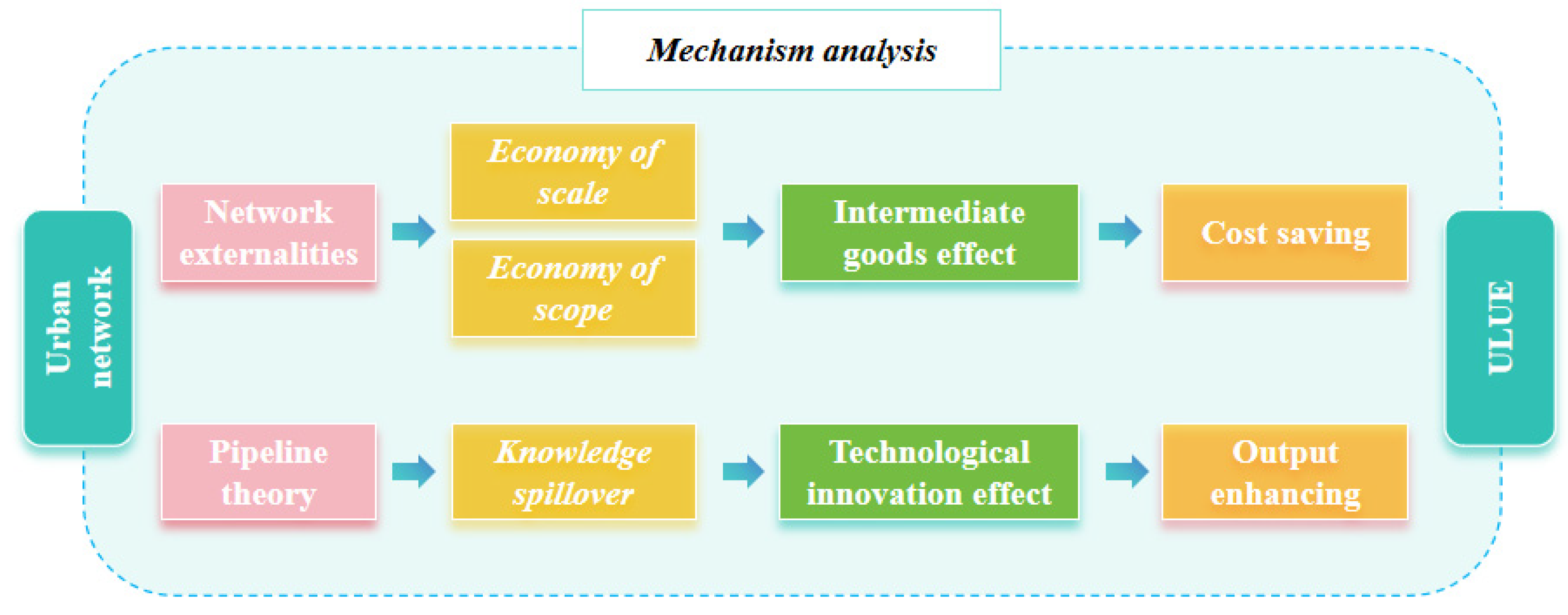
53], as shown in
Figure 1. Based on this, the following hypothesis is proposed.
H1: The higher the connectivity of nodes within an urban network, the higher the ULUE.
Urban networks can play a pivotal role in enhancing land use efficiency by the expansion of intermediate goods market. The ULUE is quantified as the ratio of input to output. Intermediate goods constitute an important component of production inputs. As urban networks facilitate a greater scale and diversity of intermediate goods, which is known as economies of scale and economies of scope [
54], the effective use of intermediate goods can bolster productivity in three main ways. Firstly, the expansion in the scale of intermediate goods contributes to reducing production costs per unit. The multiplier effect inherent in linkages formed via intermediate goods can lead to substantial productivity gains [
55]. Secondly, an expansion in the scale of the intermediate goods market facilitates a grater diversity of available products, which in turn enhances matching efficiency between suppliers and users [
56]. Thirdly, by incorporating intermediate goods, firms can access new technologies and innovative production methods effectively [
57]. Based on this, the following hypothesis is proposed.
H2: Industrial correlation promotes ULUE by the expansion of the intermediate goods market.
In the knowledge economy era, technological innovation has become the key driver of economic growth [
58]. Knowledge spillover is the process by which knowledge is unintentionally leaked and diffused [
59]. Urban networks, serving as pipelines of resource flows, enhance urban innovation capabilities by enabling knowledge spillovers [
60,
61]. Compared to single cities, urban networks feature higher levels of industrial diversification [
62], which promotes intercity technological cooperation and knowledge spillovers [
40] and accelerates technological progress. According to the endogenous growth theory, technological advancement could result in higher economic output and thereby improve ULUE [
18]. Technological innovation drives industrial upgrading and steers industrial development toward high-value-added, low-environmental-impact trajectories. It improves economic benefits, reduces negative environmental externalities, and thereby increases ULUE. Based on this, the following hypothesis is proposed.
H3: Industrial correlation promotes ULUE by promoting technological innovation.
5. Results
5.1. Characteristics of the Industrial Urban Network
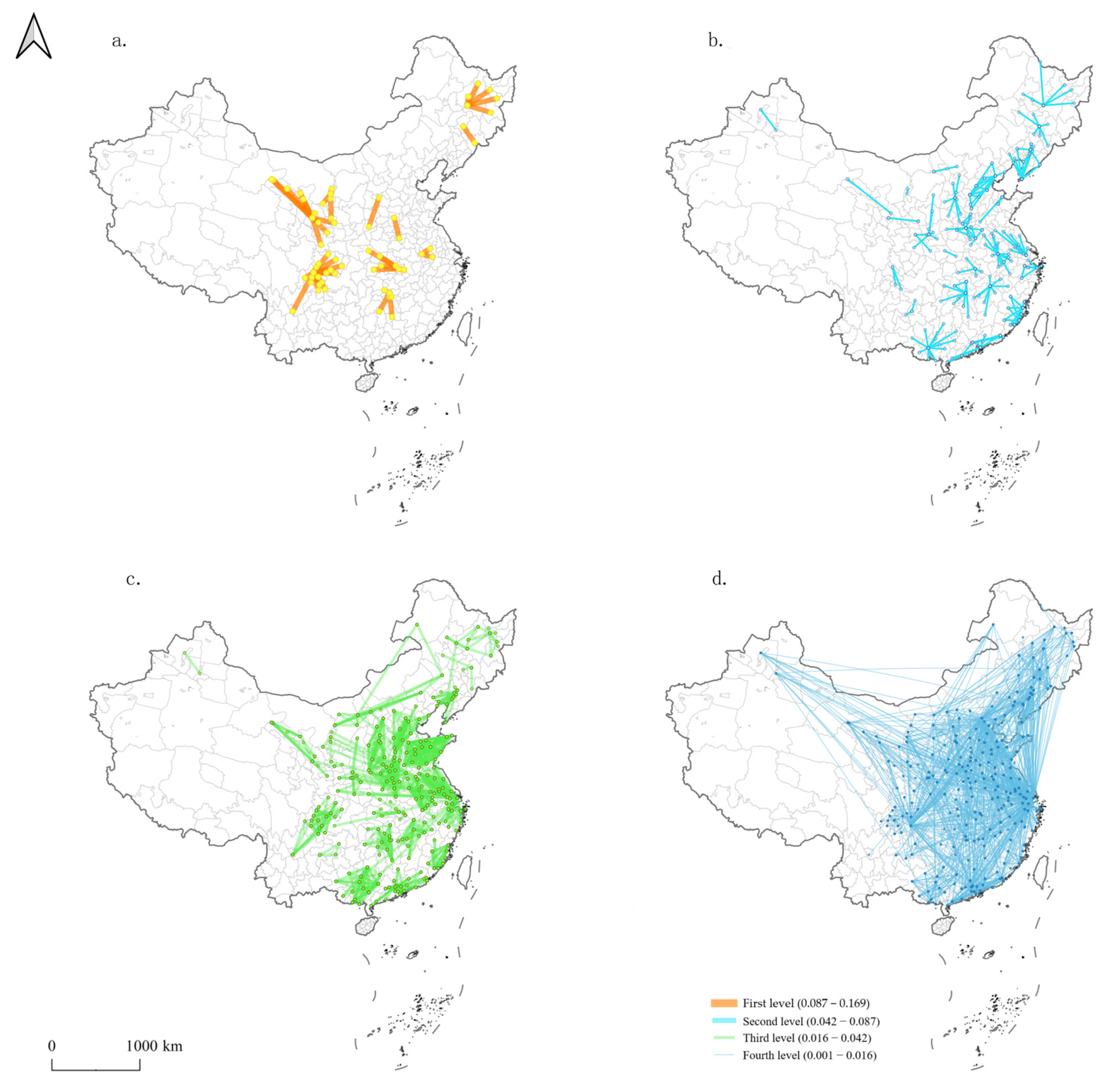
China’s provincial capitals play the role of “urban engines,” forging dense networks with their neighboring prefecture-level cities, as shown in
Figure 3. For example, Chengdu links arms with an impressive 17 other cities across Sichuan, effectively weaving the province into a tight-knit economic fabric. Similarly, Wuhan radiates its influence to 7 cities in Hubei, Lanzhou connects with 10 cities across the stretches of Gansu, while Harbin serves as an economic hub for 5 cities dotting the vast lands of Heilongjiang. In these local constellations, provincial capitals act as economic “output” cities, channeling industrial flows and transmitting resources from their regional peers—the “input” cities.
Zooming out to the national scale, Shanghai and Beijing emerge as real “national dispatchers” in the industrial network. Shanghai alone establishes connections with a staggering 190 cities, and Beijing with 120, crisscrossing the national landscape with their influence. Yet, interestingly, these links often fall into the third- and fourth-level tiers—signaling a broad but subtly layered, multi-level urban network where the giants frame the flow but local bridges do much of the day-to-day connecting.
5.2. Typical Cities in the Industrial Urban Network
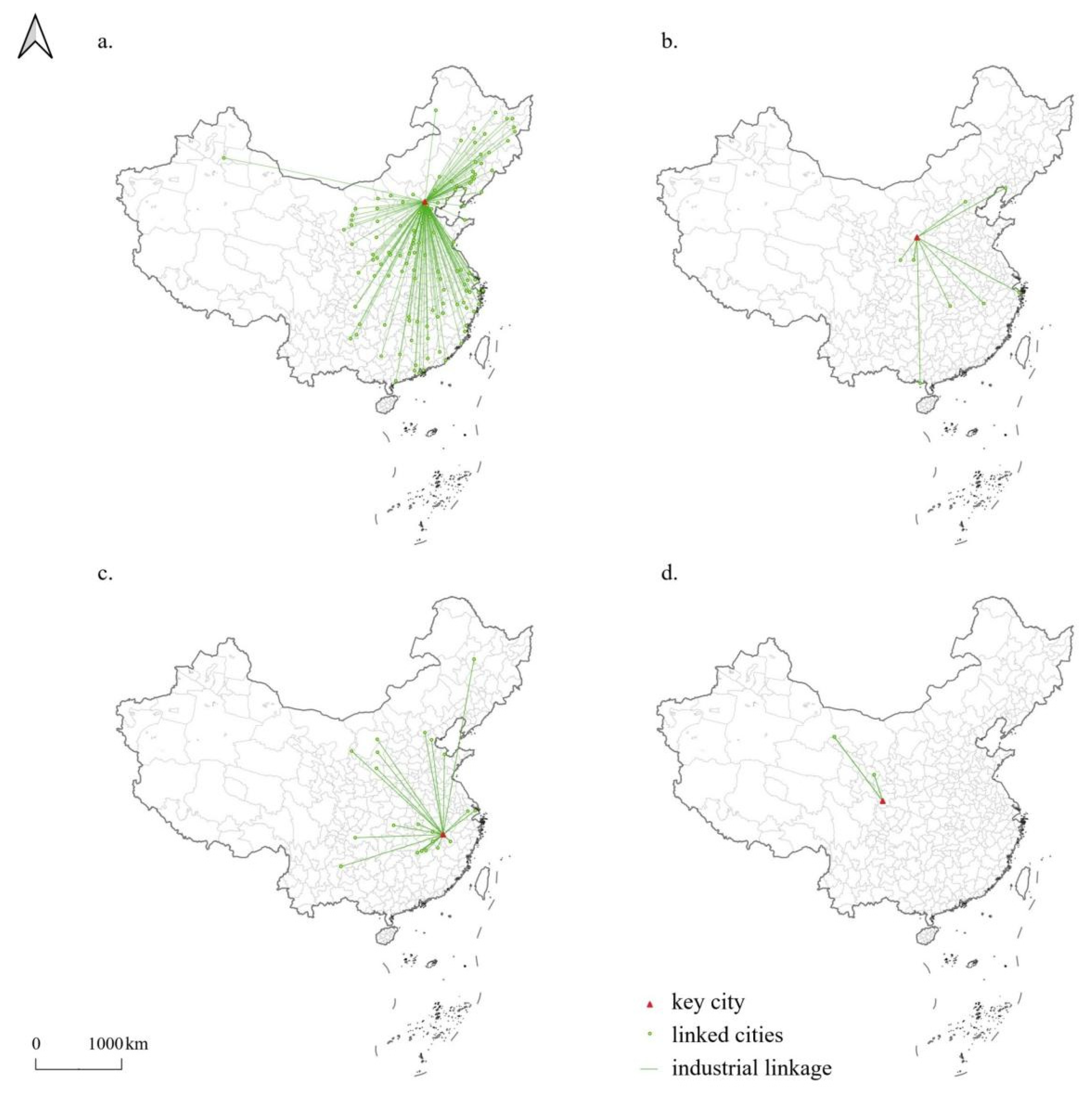
Based on the degree centrality and eigenvector centrality, cities can be classified into four roles, as shown in
Figure 4: core hub cities, connecting support cities, regional node cities, and peripheral cities. Core hub cities score high on both metrics, positioning them at the network center with extensive connections and significant driving and radiating effects. Connecting support cities have high eigenvector centrality but medium or low degree centrality, serving as important bridges between core cities and other network cities, functioning as conduits in resource flows. Regional node cities display high degree centrality but low eigenvector centrality, indicating active local or surrounding connections but limited overall influence, primarily serving their own regions. Peripheral cities score low on both metrics, demonstrating weak connections and influence, and typically occupy marginal positions in the network.
Beijing, as a core hub city, exhibits exceptionally high degree centrality and eigenvector centrality. As the capital and a leading center of politics, economy, and technology, its industrial linkages extend nationwide, forming input–output relationships with 124 cities—120 of which serve as input cities to Beijing. Yan’an, functioning as a connecting support city in the network, has relatively low degree centrality but high eigenvector centrality. It maintains input–output relationships with both core cities such as Beijing and Xi’an, and peripheral cities such as Baoji, facilitating the integration of industrial networks across different regions. Jingdezhen, as a representative regional node city, exhibits relatively high degree centrality but low eigenvector centrality. Renowned for its ceramic heritage, the city maintains strong industrial connections with neighboring cities in the provinces of Hunan and Jiangxi. This positions Jingdezhen as a vital local connector, fostering the exchange of goods and resources within the region. Longnan exemplifies a peripheral city, as it exhibits relatively low degree centrality and eigenvector centrality, occupying a marginal position in the industrial urban network. Its industrial connections are minimal, with ties to only two cities—Lanzhou and Jiayuguan—reflecting its limited ability to influence resource flows within the industrial network.
5.3. The Impact of Industrial Urban Network on ULUE
5.3.1. Baseline Regression
Columns (1)–(4) in
Table 4 measure the impact of degree centrality and eigenvector centrality of the industrial urban network on ULUE. Under ceteris paribus conditions, the impact coefficients of degree centrality and eigenvector centrality of the industrial urban network on ULUE are 0.533 and 0.429, respectively, both passing the significance test at the 1% level. This indicates that both the quantity and quality of external connections significantly and positively affect ULUE. This result supports Hypothesis 1. Ceteris paribus, a one-unit increase in degree centrality raises ULUE by 0.533, while a one-unit increase in eigenvector centrality raises ULUE by 0.429. In addition, the coefficient on BorSize is significantly positive, indicating that proximity to more populous national central cities helps improve ULUE. The coefficient on terrain ruggedness (TerRug) is significantly negative, suggesting that steeper terrain increases development costs and reduces land use efficiency.
5.3.2. Addressing Endogeneity Issues
- (1)
Lagged variable method
The urban network demonstrates a preferential selection mechanism in which cities with larger economic scales are more likely to occupy central positions [
81], thus introducing an endogeneity issue. To address the endogeneity issue arising from potential reverse causality, lagged first-order degree centrality and eigenvector centrality are used as explanatory variables in regression analysis, since past centrality measures cannot be affected by current economic efficiency. As shown in
Table 5, the impact coefficients of both centrality measures remain consistent with the baseline regression, demonstrating that the conclusions remain robust after mitigating the endogeneity issue caused by reverse causality. Relative to the baseline regression, the estimated coefficients for lagged first-order degree centrality and eigenvector centrality decrease. This evidence suggests that replacing contemporaneous with lagged variables can partially attenuate the upward bias induced by reverse causality.
- (2)
Instrumental Variable Method
Instrumental variables help address endogeneity from omitted variables [
82]. Network centrality and ULUE may be simultaneously influenced by unobserved variables such as regional policies and local industrial structures, leading to omitted variable bias. This study applies a two-step IV-Tobit model using the minimum distance to coastal ports as the instrument [
83]. This choice is justified because the geographical distance between cities and coastal ports is exogenous, unaffected by ULUE, yet it can influence a city’s network position through trade costs and economic activities. This method effectively isolates the causal relationship between network centrality and ULUE, thereby eliminating potential estimation bias arising from contemporaneous omitted variables.
Results show that in columns (1) and (3) of
Table 6, the regression coefficients for the instrumental variables are all significant, and both the AR and Wald statistics for the weak instrument test are significant at the 1% level, indicating that the instrument meets the relevance requirement. In columns (2) and (4), the fitted coefficients for degree centrality and eigenvector centrality are significantly positive at the 1% level, demonstrating that even after addressing potential endogeneity from reverse causality, the centrality of the industrial urban network still has a significant positive effect on ULUE. In the first stage, port distance exhibits a significant negative correlation with both degree centrality and eigenvector centrality, aligning with the theoretical expectation that cities closer to ports occupy more central positions in urban networks. In the second stage, the estimated coefficients of both degree centrality and eigenvector centrality on ULUE are notably higher than in the baseline regression, suggesting that the baseline regression may have underestimated their relationship due to the influence of omitted variables.
5.3.3. Robustness Test
In the robustness test, we exclude municipalities to avoid potential bias introduced by their unique administrative status in political standing, resource allocation, and administrative structure. The results show that the estimated coefficients of degree centrality and eigenvector centrality remain consistent with the baseline regression, confirming the robustness of the baseline regression results, as shown in
Table 7. Relative to the baseline regression, the estimated coefficient of degree centrality on ULUE exhibits an increase following the exclusion of municipalities. It means that ordinary cities rely more heavily on network connections for efficiency improvement, while municipalities benefit from their privileged administrative and economic status. Additionally, the exclusion of municipalities yields a reduction in the estimated coefficient of eigenvector centrality on ULUE. Since municipalities function as “critical nodes” in the network, their removal diminishes the quality of urban network connections, consequently attenuating the impact of network linkages on ULUE.
Key information in complex networks often lies in crucial relationships, and using top networks to simplify such networks is a common practice [
84]. This study used the top 40% of industrial ties to construct a top network for robustness testing. The results show that the direction and significance of the coefficients of the explanatory variables are largely consistent with those of the baseline regression results, verifying the robustness of the main conclusion, as shown in
Table 8. Relative to the baseline regression, the estimated coefficient of degree centrality on ULUE increases in top networks, indicating that direct intercity connections exert a stronger positive influence on land use efficiency. By contrast, the coefficient on eigenvector centrality is smaller and statistically insignificant at the 10% level, indicating that it has little impact on ULUE in top networks due to relatively homogeneous connection quality.
5.4. Heterogeneity Analysis
- (1)
Cities with different population scales
In accordance with the criteria of urban classification, the empirical results reveal distinctive patterns of network effects that vary by city size. As shown in
Table 9, both degree centrality and eigenvector centrality exert significant positive effects on ULUE in large cities, and their coefficients in large cities exceed those in the baseline regression. Large cities, with their moderate economic scale and diversified industrial structure, can fully leverage the industrial urban network to enhance ULUE. In contrast, neither centrality measure demonstrates significant impact in small and medium cities or mega cities. Small and medium cities are constrained by their homogeneous industrial composition, while mega cities suffer from industrial crowding-out effects due to excessively high land prices, both weakening the optimization benefits of the urban network.
- (2)
Growing cities and shrinking cities
Based on dynamic population trends, cities were classified into “growing cities” and “shrinking cities”. As shown in
Table 10, degree centrality significantly improves ULUE in growing cities, but has no significant effect in shrinking cities. Eigenvector centrality has a significant positive impact on ULUE in both growing and shrinking cities. Compared with baseline models, the effect of degree centrality on ULUE is stronger in growing cities, while eigenvector centrality demonstrates greater influence in shrinking cities. This suggests that growing cities can enhance land use efficiency by establishing more diversified industrial connections, effectively integrating various industrial resources. In contrast, shrinking cities rely more on high-quality connections with core cities, maintaining land use efficiency by embedding in high-value industrial networks. This reflects their adaptive strategies under limited resources. In summary, ULUE in growing cities is significantly affected by both the number and quality of industrial input–output connections, whereas in shrinking cities, it is primarily driven by the quality of these connections.
5.5. Mechanism Analysis
5.5.1. Intermediate Goods Effect
The market size of intermediate goods is measured based on the input value of intermediate goods. The results indicate that the centrality of cities within the urban network significantly enhances ULUE by expanding the market size of intermediate goods and promoting firms’ access to external economies. As presented in
Table 11, Models (1) and (3) demonstrate that degree centrality has a direct positive effect on ULUE with a coefficient of 0.533, which remains significant at 0.243 when controlling for the influence of the market size of intermediate goods. Model (2) shows that the degree centrality also has significantly positive effect on the market size of intermediate goods. The proportion of the mediating effect to the total effect is 0.385, indicating that the intermediate goods market size accounts for 38.5% of the impact of degree centrality on ULUE. The result supports Hypothesis 2, confirming the significant mediating role of intermediate goods market size in the relationship between urban network and ULUE.
5.5.2. Technological Innovation Effect
Using patent licensing as a measure of technological innovation effect, the results indicate that degree centrality in the urban network significantly improves ULUE by promoting technological innovation. As detailed in
Table 12, Models (1) and (3) demonstrate that the degree centrality has a direct positive effect on ULUE with a coefficient of 0.535, which remains statistically significant at 0.360 when controlling for the impact of patent licensing. Model (2) shows that the degree centrality also has significantly positive effect on technological innovation. The proportion of the mediating effect to the total effect is 0.180, indicating that technological innovation explains 18% of the total impact of urban centrality on ULUE. These results support Hypothesis 3, confirming the important mediating role of technological innovation in the centrality–efficiency relationship.
6. Conclusions, Discussions, and Policy Implications
6.1. Conclusions
This study utilizes MRIO tables to construct an industrial urban network for Chinese cities. The super-SBM model is employed to measure the ULUE. Furthermore, the Tobit model and mediation model are used to investigate the influence of the industrial urban network on ULUE. The key findings are as follows. First, both the quantity and quality of industrial linkages demonstrate significant positive effects on ULUE. The heterogeneity analysis indicates that the network position significantly enhances ULUE in large cities. Moreover, in growing cities, both the quantity and quality of industrial connections significantly affect ULUE, whereas in shrinking cities, it is mainly influenced by connection quality. Second, the market size of intermediate goods serves as a crucial mediation mechanism through which urban network centrality affects ULUE. Empirical analysis demonstrates that urban networks enhance ULUE by expanding the market size of intermediate goods, thereby promoting economies of scale and scope. Third, the technological innovation mechanism serves as another mediation mechanism. Cities occupying central positions in networks benefit from knowledge spillovers that stimulate technological advancement, which in turn drives industrial upgrading toward higher value-added activities.
6.2. Discussions
In terms of methods, this study examines the impact of urban networks on land use efficiency from perspectives both on the quantity and quality of network connections. In addition, we conduct a heterogeneity analysis for cities of different sizes and developmental stages, providing comparative insights into how network effects manifest differently among diverse urban typologies. Furthermore, this study examines network externality effects by analyzing mechanisms related to intermediate goods market size and knowledge spillovers.
Regarding the models, this study constructed a nationwide urban network based on MRIO tables and the modified Floyd algorithm. This approach extends land use research based on MRIO tables. While previous research explored land use issues from an embodied land perspective, this study investigates the problem through a complex network approach. Chen et al. (2019) discussed the interdependence of land use with the MRIO tables [
44]. Chuai et al. (2023) investigated embodied land use and industry efficiency [
64].
Regarding the results, this study reveals that both the quantity and quality of intercity industrial connections have significant positive impacts on ULUE, aligning with findings from previous research [
85,
86]. Ding et al. (2024) utilized corporate investment data to construct industrial urban networks and applied the MGWR model, demonstrating the critical role industrial urban networks play in fostering urban development [
85]. Shi et al. (2024) discovered that urban innovation network connections enhance the utilization rate and allocation efficiency of construction land [
86].
In addition, heterogeneity analysis indicates that network positions have varying effects on ULUE across various types of cities. In large cities, diversified industrial structures enable industrial urban network connections to effectively match economic supply and demand [
87], thereby enhancing resource utilization efficiency. In contrast, small and medium-sized cities face challenges such as population loss and sluggish economic development [
88], which weaken their network influence and make it difficult to fully utilize the external benefits of networks. Meanwhile, in mega-cities, characterized by excessive concentration of economic activities and nearly saturated land development [
89], improvements in ULUE driven by industrial connections are also limited.
Regarding urban population dynamics, the ULUE of growing cities is influenced by both the quantity and quality of their network connections, whereas in shrinking cities, efficiency depends more on qualitative connections. Growing cities typically serve as core hubs within the industrial urban network, exerting strong influence on resource aggregation and distribution [
88]. In contrast, shrinking cities, with diminished competitive advantages, have been increasingly marginalized within the urban network and have fewer network connections [
90]. For these cities, improvement in ULUE largely relies on the quality of their limited industrial connections.
In addition, several limitations should be noted. To begin with, the analysis of urban network structure is conducted from a general industrial perspective, without incorporating other data sources such as transportation infrastructure or population mobility. This might not fully capture the comprehensive intercity connections. Future research could leverage multiple data sources to analyze the multi-level network linkages and characteristics among cities. Additionally, this study focuses on the broader industrial linkage network. Subsequent studies may examine industrial networks within specific sectors. Furthermore, the analysis is primarily based on a “node-centric” perspective, without exploring deeper relationships such as network hierarchy and community structure. Future research could incorporate perspectives on network stratification and community structure to further enrich the understanding of the mechanisms linking urban networks and ULUE.
6.3. Policy Implications
In light of the above analysis, the policy implications are summarized as follows. First, strengthening intercity industrial linkages is essential for enhancing ULUE. Each category of city should clearly articulate its functional role and fully harness its comparative advantages to foster deeper industrial collaboration. Integration policies that support the flow of resources, information, and technology across cities should be targeted. In addition, the establishment of intercity coordination mechanisms is essential for facilitating collaborative governance across administrative boundaries.
Second, it is important to optimize the city scale. A moderate scale is found to be more conducive to leveraging the positive effects of these networks. For megacities, the redistribution of industries and urban functions can help alleviate the pressures of excessive population concentration. For small and medium-sized cities, cultivating specialized industrial clusters and improving infrastructure and public services can help integrate them effectively into the regional industrial urban network, thus contributing to improvements in ULUE.
Third, promoting collaborative synergies among cities and technological innovation is fundamental for sustainable regional development. Mechanism analysis reveals that intermediate product markets play a pivotal role in regional resource allocation. This entails optimizing circulation environments, enhancing infrastructure and public services to facilitate efficient flows of intermediate products. Furthermore, establishing resource-sharing platforms can effectively amplify regional technological spillover effects and accelerate overall technological innovation progress.