
Article

Accessibility and Spatial Conditions in Northern Italian Metropolitan Areas: Considerations for Governance After Ten Years of Metropolitan Cities

by
Valeria Vitulano
1,*,
Giulio Gabriele Pantaloni
1,
Antonio Bocca
2 and
Francesco Bruzzone
3
1
Interuniversity Department of Regional and Urban Studies and Planning, Politecnico di Torino, 10125 Torino, Italy
2
School of Architecture and Design “E. Vittoria”, University of Camerino, 63100 Ascoli Piceno, Italy
3
Department of Architecture and Arts, Università Iuav di Venezia, 30100 Venice, Italy
*
Author to whom correspondence should be addressed.
Urban Sci. 2025, 9(12), 526; https://doi.org/10.3390/urbansci9120526 (registering DOI)
Submission received: 25 October 2025 / Revised: 3 December 2025 / Accepted: 8 December 2025 / Published: 10 December 2025

Abstract

In a context of environmental and socio-economic challenges, metropolitan areas represent a fundamental territorial scale for addressing cohesion, competitiveness, and sustainability, key priorities in European territorial development. Accessibility to services is crucial, as it reflects the right to full citizenship, particularly in territories where attractive urban centres coexist with peripheral areas. Balancing these dynamics is a major challenge for metropolitan governance and planning, especially in Italy, where Metropolitan Cities (MCs) have been institutionalised for over a decade. This paper examines spatial structure, accessibility, and governance through a comparative analysis of three Italian MCs in the Po Valley macro-region, a polycentric system along the Mediterranean Corridor of the Trans-European Transport Network. Despite overall interconnections, the MCs display different settlement and accessibility patterns. The Metropolitan City of Turin is selected as a case study for its territorial diversity, metropolitan-mountainous character, misalignment between administrative and functional boundaries, and accessibility limitations. The research examines current planning instruments and governance-government arrangements of the case study in addressing these challenges. Findings, framed within the decadal review of Italian MCs, emphasise the need for greater coordination between plans, policies and programmes, combined with strengthened inter-municipal collaboration and territorial representation, to support a multi-level governance framework capable of coherent, effective, and balanced metropolitan development.

1. Introduction

Accessibility to services in metropolitan areas is widely recognised as one of the key criteria for measuring the degree of development, sustainability, and cohesion of a territory, where economies, interests and environmental values often overlap and intertwine. Nonetheless, a considerable number of metropolitan regions still rely on inadequate infrastructures, poor public transport, and fragmented governance arrangements [1].
Responses to this challenge vary across Europe and even at the local level. While Europe emphasises integrated multi-level governance, in Italy administrative fragmentation and territorial disparities hinder wide-scale strategies. The attempt at strategic planning initiated by Law 56/2014 (“Delrio Law”), which established the Metropolitan Cities (MCs) [2], has remained incomplete, while reducing the powers of the provinces [3].
In light of the administrative and conceptual innovation in metropolitan, multiscale governance, accessibility emerges as a pivotal metric for delineating territorial cohesion within Europe’s spatial development framework [4]. However, there is still limited attention to assessing accessibility and distribution of services, as well as to monitoring strategies and actions aimed at improving them [5]. This highlights a significant gap in the practical integration of accessibility considerations within spatial planning processes.
In this regard, the Italian case is significant for the study of polycentrism characterised by complex networks. This model does not translate into a simple distribution of centres, but rather into a complex network of settlement differences where the boundaries are uncertain [6]. Furthermore, not all sustainable mobility strategies consider the socio-spatial dimension of accessibility [7]. This polycentric structure and the resulting disparities require multi-level governance and inter-municipal functional districts to strengthen proximity and cohesion [8]. The governance of MCs must not be limited to improving connectivity but must also address accessibility as a matter of territorial equity, in relation to the quality of essential services and territorial needs. This provides a foundation for understanding the concept of “spatial structure” as an integrated system encompassing identity, urban environment, and processes of transformation. Accessibility is thus a key factor for inclusion and requires a comprehensive assessment of temporal and financial costs of accessing services. Considering these variables together directly involves the principle of spatial justice, allowing for a thorough assessment of the real socio-economic sustainability of providing essential services to people living in peripheral or inner areas.
Furthermore, the notion of proximity can drive systemic changes in the spatial allocation of services and in the use of public space. In this regard, accessibility can be interpreted through the lens of “cosmopolitan localism” [9], in which networks of short distances operate in synergy with long-distance connections to foster community, identity, and territorial belonging [10]. In this paper, a gravitational accessibility model is used to investigate the interplay between the local and metropolitan dimensions, disentangling functional links and exposing dependencies between poles (i.e., services) of different scales and the (potential) origins relying on them.
This perspective suggests that effective accessibility depends on: (i) enhancing public transport network performance (speed, frequency, capacity); (ii) improving urban form (size, shape, configuration); (iii) promoting synergies among social, economic, and environmental dimensions of development; and (iv) embedding policies within a robust governance framework [11].
This study compares Italian MCs in the Po Valley (Northern Italy) based on accessibility dynamics and morphological and settlement condition, exploring the implications for current metropolitan governance and government frameworks. The following research questions are addressed: (i) What morphological, settlement, and accessibility characteristics define the Italian MCs of the Po Valley macro-region? (ii) How are governance and government arrangements in Italian MCs structured to address accessibility challenges and territorial imbalances? Building on these questions, the article contributes to the debate on metropolitan governance by proposing an integrated framework that combines spatial and accessibility analysis—examined through the comparison of three MCs—and governance and institutional configurations, focusing on the case of Turin.
The paper is structured as follows: Section 1 provides a critical introduction to the topic. Section 2 contextualises the theoretical and policy framework of accessibility in metropolitan areas, with reference to European and Italian policies. Section 3 outlines the methodological framework and materials. Section 4 presents the results of the comparative analysis and the case study, while Section 5 offers the discussion and conclusions.

2. Theorical and Policy Framework

Building on the considerations outlined above, this section situates accessibility within the broader European and Italian policy framework, highlighting how it is interpreted and operationalised across different territorial scales.
Accessibility is indeed a fundamental component of metropolitan development, influenced by contextual, economic, socio-political, and regulatory factors [12]. At the European level, the 15-Minute City [13] concept and the focus on proximity have gained significant traction. However, while this model promotes sustainability, it risks prioritising urban cores over peripheral areas. To mitigate resulting inequalities, cities must complement local proximity with efficient regional transport, guaranteeing equitable access throughout the metropolitan territory [14].
The European approach to accessibility is embedded within the broader policy-framework of territorial cohesion and multi-level governance. Accessibility is understood as a function of both transport quality (travel times) and land-use systems [15,16]. The European Union, through various agendas, adopts an approach predominantly oriented towards cohesion and the reduction in social and economic disparities. The Territorial Agenda of the EU 2020, which aimed at polycentrism and accessibility, was updated in the Territorial Agenda of the EU 2030 to include the priorities of the green and digital transition [17]. In parallel, the Urban Agenda for the EU 2016, known as the Pact of Amsterdam [18] and subsequently reaffirmed by the Ljubljana Agreement [19], promotes multi-level governance based on regulation, funding, and knowledge.
Complementing these agendas, international case studies offer valuable insights. Switzerland adapts services based on community size [20], while Catalonia establishes minimum connection standards [21]. In France, the LOM law (Loi d’Orientation des Mobilités) delegates mobility planning to regional authorities (Autorités Organisatrices de la Mobilité, AOMs). This approach enables AOMs to draft plans and provide services based on the specific needs of their respective regions [11].
In Italy, accessibility is addressed through a dual-scale approach (Metropolitan and Inner Areas), with Homogeneous Zones that emphasise the relationship between services and places [22,23]. A key instrument is the PON Metro 2014–2020, which supports 14 MCs thought four thematic axes: digital, mobility, inclusion and infrastructures. This programme designates the urban authorities as intermediate bodies, responsible for multi-level governance and multi-scalar strategic planning, aligning urban and wide-area policies [24,25].
At the local scale, urban strategies have often failed to counterbalance urban sprawl and the “gravitational pull” of core cities [26], producing uneven accessibility patterns [27,28]. Inner areas, typically organised in a “tree-like” structure linking main centres to mountain zones via medium-sized towns, have experienced progressive marginalisation, limited innovation, and constrained regeneration [29]. The National Strategy for Inner Areas (SNAI) defines a multi-level governance framework addressing essential services, local development, and infrastructure. It uses distance and travel time as fundamental criteria to define the accessibility of minor centre relative to major hubs [30,31]. Yet, the strategy is limited by the structural weaknesses of inner regions, including population decline, the digital divide, and the fragmentation of skills [32]. Furthermore, the “place-based” approach fails to address territorial specificities, creating tensions between “strong centres” and “inner peripheries” [33,34]. The National Strategic Plan for Inner Areas 2021–2027 (PSNAI) reiterates the focus on accessibility through transport planning and infrastructural enhancement [31]. However, the absence of effective synergy between SNAI/PSNAI and the National Recovery and Resilience Plan (PNRR) has limited the development of an integrated, cohesive approach for these territories.
Ultimately, European and Italian policies can be seen as complementary: EU agendas provide the overarching framework, while Italian instruments adapt these principles to local contexts. Both pursue the integration of sectoral policies and multi-level governance. Yet, persistent difficulties remain in translating this interdisciplinary vision into operational and spatially coherent outcomes on the ground.

3. Materials and Methods

Building upon the conceptual and policy framework outlined above, the methodology operationalises the analysis of accessibility and metropolitan governance within the Italian context. It aims to examine the Metropolitan Cities of Northern Italy in order to characterise their morphological, settlement, and accessibility profiles. These are key factors that influence spatial organisation and governance. The methodology is structured into two main phases: (i) a comparative analysis based on two macro interpretative criteria designed to address the first research question; and (ii) an in-depth case study addressing the second. A preliminary phase is also included to define and select the territorial context of the research.
The research design is based on secondary data, with harmonised datasets and reproducible GIS models to ensure comparability, while qualitative evidence was indirectly acquired through triangulation of planning documents and grey literature used in the case study analysis. Metropolitan plans typically include co-planning processes, involving multiple stakeholders, becoming appropriate proxies for understanding territorial challenges. Spatial and accessibility analyses were also designed to be compared with these planning frameworks, verifying their consistency.

3.1. Selection of the Territorial Area of Investigation

The analysis focuses on European metropolitan governance through the lens of the Italian case. Specifically, it examines the system of metropolitan areas located in the Po Valley (Northern Italy), along the Mediterranean Corridor of the Trans-European Transport Network (TEN-T). The Po Valley constitutes a macro-region characterised by high accessibility and a polycentric settlement structure, shaped by uneven urban growth and strong functional connections between urban, rural, and mountain areas. This area thus represents a particularly relevant context for analysing spatial relationships, governance models, and accessibility dynamics.
The study considers three Metropolitan Cities, namely Turin (MCTo), Milan (MCMi), and Venice (MCVe), out of the 14 currently established in Italy. Pursuant to Article 114 of the Italian Constitution and Law 56/2014, MCs are constituent entities of the Italian Republic that replaced the former provincial administrations while retaining their previous administrative boundaries. Their designation reflects institutional reform rather than a direct functional correspondence with the “metropolitan” concept.

3.2. Comparative Analysis of Metropolitan Cities

The methodological approach combines quantitative and qualitative elements to construct a reasoned comparison among the MCs of Turin, Milan, and Venice. The analysis is based on two macro interpretative criteria: (i) morphological and settlement characteristics, and (ii) conditions of accessibility to service provision poles. The comparative phase is designed to identify both shared and distinctive traits among the selected MCs, providing a basis for selecting one case study for further investigation. The choice prioritises the context displaying the greatest heterogeneity in terms of morphological and settlement structure, population distribution, correspondence between administrative and functional boundaries, and accessibility conditions. This process enables the discussion of MCs as administrative, functional, and relational planning contexts, supporting policy implications and future research directions aimed at aligning northern Italian metropolitan systems with broader European concepts of metropolitan and inner areas.
The methodology is implemented in a GIS environment (QGIS v.3.34.15), supported by various plug-ins and geoprocessing tools. Accessibility analysis relies on the ORS Tools plug-in to determine travel times between origin–destination (OD) pairs within each MC. Additional non-spatial operations are performed using Microsoft Excel, as detailed below.

3.2.1. Morphological and Settlement Characteristics

The analysis is based on a set of indicators aimed at comparing the spatial, settlement, demographic and morphological characteristics of the three MCs. Indicators include:
  • Territorial extent;
  • Resident population and population density;
  • Demographic trends (2015–2025);
  • Number of municipalities;
  • Number of “small municipalities” (resident population of up to 5000 inhabitants, Art. 1, para. 2, Law 158/2017) [35];
  • Classification of municipalities by altitude zones;
  • Territorial extent of the core city and its share within the metropolitan context;
  • Population residing in the core city and its share within the metropolitan population.
The information was primarily gathered from the National Institute of Statistics (ISTAT), which provides multiple thematic databases, including periodically updated demographic data [36]. This data refers to the most recent update available (January 2025), as well as for the classification of municipalities by altitude zones [37].
The study also examines the correspondence between MC administrative boundaries, defined through a predominantly top-down process [1], and their corresponding Functional Urban Areas (FUAs). MCs’ perimeters often fail to reflect functional dynamics, as Law 56/2014 largely preserved previous provincial boundaries. By contrast, FUAs, as defined by the EU–OECD [38], consist of a core city and its commuting area, providing a more effective framework for comparing socio-economic and spatial dynamics than traditional administrative units. For each MC and its respective FUA, data on territorial extent, population, and number of municipalities were collected from OECD databases using the most recent available information [39,40,41].
Morphological and settlement analyses were complemented using Land Use–Land Cover (LULC) data from CLCplus Backbone 2023 (10 m raster, Europe, biennial), from the Copernicus Land Monitoring Service [42]. LULC categories distinguish urbanised, agricultural, natural and semi-natural areas, and water bodies, allowing for the assessment of spatial distribution patterns and their share within administrative territories. Obtained maps provide a comprehensive overview of the morphological configurations that shape the spatial and functional organisation of each metropolitan area.

3.2.2. Accessibility Analysis

The accessibility analysis adopts a gravity-based approach to quantify the accessibility of each municipality to its reference service pole, building on the classical formulation by Hansen [15]. Coherently, accessibility is interpreted as the potential of a population to reach relevant opportunities, decreasing with increasing travel time and increasing with the magnitude of the opportunities available at destinations. For each pole j , an attractiveness ratio R j was computed as the ratio between its supply, here proxied by the population of the pole ( S j ), and the effective demand of its hinterland, given by the population of all municipalities k assigned to that pole ( P k ) weighted by an exponential decay function of travel time: R j = S j / k P k e β t k j . The decay parameter β = ln   ( 2 ) / T 1 / 2 was defined assuming a half-life of 60 min, meaning that the contribution of a municipality to the demand of a pole halves at one hour of travel time. This value is consistent with metropolitan-scale accessibility studies [43,44]. Each municipality i was then assigned to its nearest pole j , following the criterion of minimum travel time as computed through QGIS plugin ORS Tools. Although the method allows for inclusion of any transport mode in the analysis, including multimodal trips, we propose a simplification focusing on travel time by private car only. This is due to several reasons: (i) it aligns with the criterion of minimum travel time; (ii) it avoids weighing travel and waiting time, particularly in dispersed, rural areas where public transport services are sparse and frequency can hardly be included in accessibility formulation. More details are given in the case study section.
For this purpose, centroids were created and snapped to the nearest point on the provincial road network using QGIS geoprocessing tools and the regional road network layers from the Open Data repositories of Northern Italian Regions. For each municipality, the accessibility value was calculated as A i = R j e β t i j , which increases with both the strength of the pole and its proximity to the municipality. Finally, accessibility and attractiveness values were normalised between 0 and 1 using the min–max transformation A i ( 0 1 ) = A i min A max A min A and R j ( 0 1 ) = R i min R max R min R . All non-spatial computations were carried out in Microsoft Excel using cross-referenced OD matrices derived from travel-time estimations (mode: car), with the exponential decay and aggregation functions implemented through standard formulas (SUMPRODUCT, AVERAGEIFS, LET, and VSTACK) to ensure transparency and replicability across the metropolitan datasets analysed.
In synthesis, high values of A i identify municipalities that are both close to and dependent on poles with a strong supply–demand ratio, reflecting better access to services. These areas typically correspond to relatively well-connected municipalities. Conversely, low A i values indicate spatial disadvantage or peripheral positioning, either because the assigned pole has limited supply capacity ( R j low), because travel times are long, or because of unfavourable combinations of both. The attractiveness ratio R j itself represents the relative service strength of each pole compared with the population it effectively serves: high R j values denote poles that are well endowed relative to their hinterland, while low R j values highlight poles where the available supply is insufficient to meet the potential demand. Together, the two indicators provide a complementary reading of the regional accessibility system, analytically supporting the more descriptive part of the method and the policy analysis.

3.3. Case Study

The comparative analysis provides a comprehensive overview of spatial and functional patterns within the reference metropolitan territories, considering population distribution, morphological and settlement structure, and the accessibility to services poles.
Based on the macro interpretative criteria and selected indicators described above, the analysis informed the selection of a case study aimed at a deeper discussion of the functioning of existing metropolitan governance and governance arrangements in Italy.
Although all three MCs display notable characteristics, one case was chosen as the focus, due to its heterogeneity and complexity. The selection priorities a metropolitan area where territorial disparities in accessibility are most evident, allowing for an in-depth investigation of this issue in relation to metropolitan planning and governance.

4. Results

4.1. Findings from the Comparative Analysis

The comparative analysis covered three MCs within the macro-regional context of the Po Valley in Northern Italy, also referred as the “Po Valley megalopolis”, described as a continuous urban belt stretching from Turin to the cities of Veneto and Friuli-Venezia Giulia [45]. This territorial system, one of Italy’s most significant centres of economic and productive activity, has been shaped over the decades by intense, predominantly dispersed urbanisation processes. These have had notable consequences, including the consumption of fertile soil and ecosystem degradation, and critical levels of air pollution [46].
The MCs of Turin, Milan and Venice, located in this macro-regional territory along the Mediterranean TEN-T Corridor, were selected for analysis, as they interact and share a specific location within the national and European context (Figure 1).
Comparative analysis of their morphological settlement characteristics and accessibility patterns reveals a complex and diverse framework.

4.1.1. Results: Morphological and Settlement Characteristics

The territories of the three MCs under analysis are characterised by different geomorphological conditions and spatial organisation, according to the set of indicators identified in the methodology (Table 1).
The Metropolitan City of Turin exhibits highly variable altitudes, with Sestriere as the highest municipality (2035 m above sea level) and Verolengo as the lowest at 169 m. According to the altitude zones classification from ISTAT, over 50% of MCTo’s total surface area falls within a mountainous context. In contrast, the MCs of Milan and Venice are entirely flat, with Venice and its lagoon overlooking the Upper Adriatic Sea.
The table shows that MCMi is the most populous of the three areas compared, resulting in high population density and confirming its strong role as a centre of attraction. MCTo, on the other hand, is the largest of the 14 Italian MCs [47], with a territorial extent far greater than that of the other two. Turin also includes the highest number of municipalities (312, compared to 133 in Milan and 44 in Venice), 79% of which fall into the “small municipalities” category and 35% have fewer than 1000 inhabitants [48]. This phenomenon of administrative fragmentation is significant when compared with MCMi and MCVe, where the presence of municipalities with up to 5000 inhabitants is limited. Furthermore, many MCTo municipalities are located in mountainous (105 municipalities) and hilly (83 municipalities) areas, whereas in the other MCs they are all situated in predominantly flat territories [44]. Notably, MCTo also includes an area classified as “Inner Area” (Valli di Lanzo) by the SNAI 2014–2020 [30].
Demographic analyses show that most Italian MCs are experiencing population decline, except for those more globalised and with capacity for internationalisation, such as Milan [49]. In MCTo and MCVe, ISTAT data indicate negative demographic trends over the period 2015–2025 (−3.26 and −2.54, respectively). Annual data confirms this trend, with MCTo showing a limited reversal towards a positive trend from 2023 onwards. MCMi, on the other hand, shows an overall positive demographic trend (+1.22), with annual data consistent with it, except for the two-year period 2020–2021 [36].
The population of the MCTo is concentrated in the plains, mainly within the municipalities of the two belts forming the Turin conurbation, while mountain areas have undergone depopulation processes over the years. In all three MCs, a significant share of the population resides in the core cities: 42% in Milan, 30% in Venice, and 39% in Turin.
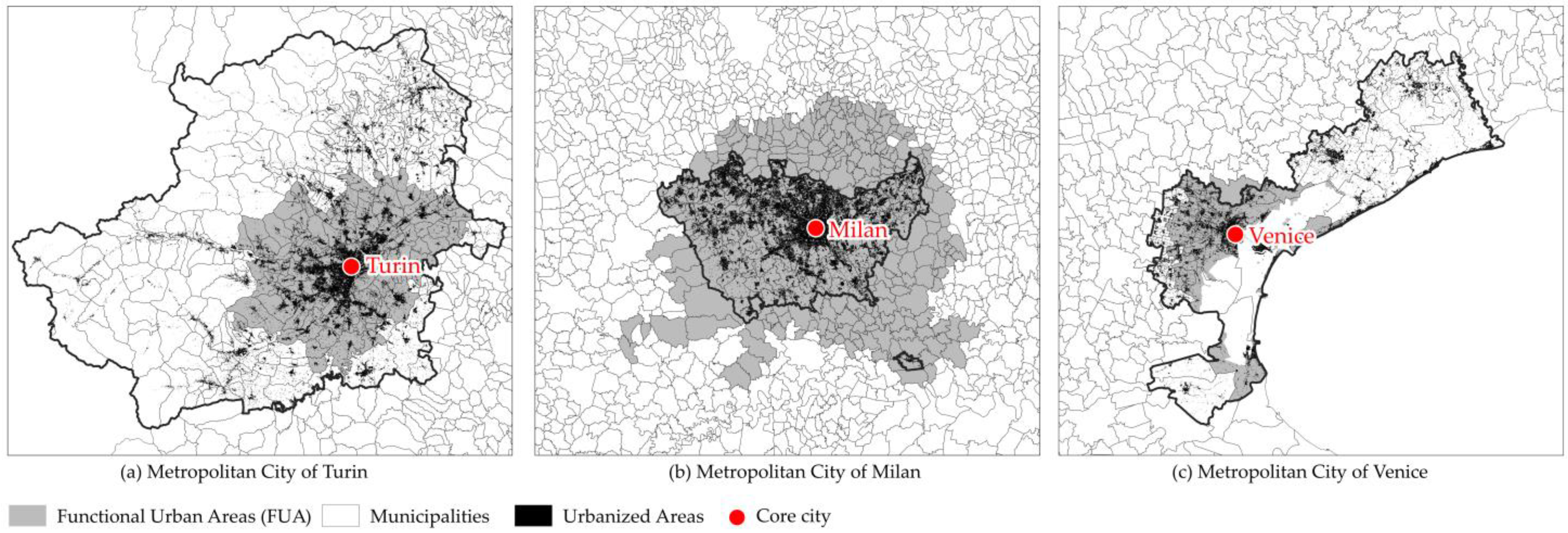
The comparison between the spatial dimensions of the three MCs and their respective FUAs, as defined by the EU-OECD, represents an important methodological step to verify the correspondence between administrative and functional areas and highlights distinctive features (Figure 2, Table 2). In the case of Turin, the FUA covers only a limited portion of the metropolitan administrative territory, concentrated in the flat area of the conurbation: 89 municipalities are included compared to 312 in the entire MC. In contrast, the Milan FUA encompasses a significantly larger area than MC itself, including 303 municipalities compared to 113 within the administrative area. This reflects more complex and less spatially confined commuting and functional relationships between the core city and its surrounding area, extending to the Province of Monza and Brianza and beyond.
In Venice, the FUA covers a smaller area, comprising 15 municipalities. This limited extent should be considered together with the immediately adjacent FUAs of Padua and Treviso, which together reflect a complex system of trans-metropolitan and inter-provincial relations. These dynamics have been de facto nullified by the legislator’s identification of the MC’s boundaries with those of the former province [50]. This misalignment is further evidenced by the so-called metropolitan “Civitas” [51], which encompasses 68 municipalities (including those located in neighbouring provinces).
Turin and Venice are classified as metropolitan FUAs (from 500,000 to 1.5 million inhabitants), while Milan is classified as large metropolitan (above 1.5 million inhabitants). Milan also represents the largest FUA in Italy in terms of both population and number of municipalities among all 83 FUAs, whereas Turin ranks fourth in population size.
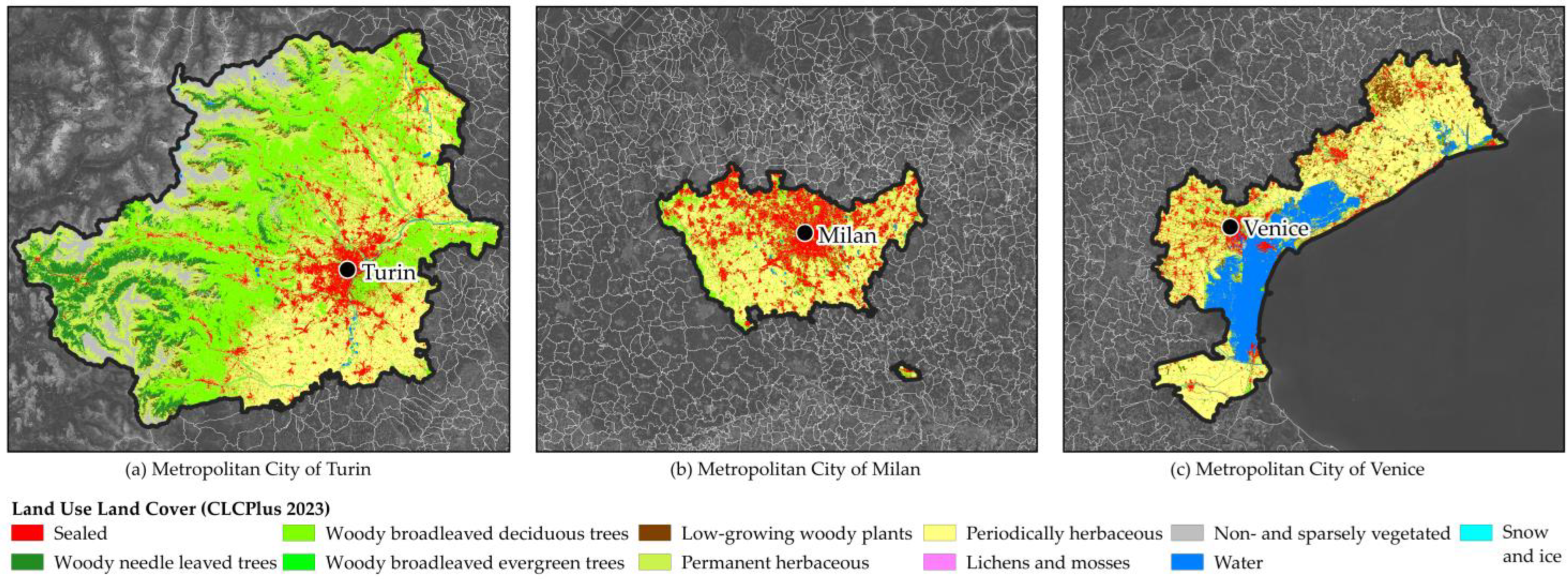
To complete the comparative study, the morphological and settlement structure of the three MCs were investigated to identify territorial invariants and geomorphological conditions that influence their spatial and functional structure. The analysis was based on LULC cartographic data from CLCplus Backbone 2023, which is the most up-to-date currently available dataset and suitable for comparative studies. Given the significant differences in the territorial extent among the three MCs, results are presented using percentage values, measuring the incidence of each LULC class relative to the total metropolitan area.
The data show that the MCMi is the most urbanised, with 31% of its administrative territory dedicated to urban land use. By contrast, MCTo and MCVe exhibit significantly lower but similar values, −7% and 10% respectively (Figure 3, Table 3). Results also indicate that MCTo stands out for its high incidence of natural and semi-natural soil, concentrated mainly in the higher altitudes, the Turin hills, and the network of parks and protected areas that extend from the Alpine valleys to the plains. While these land uses extend just 4% and 12% of MCVe and MCMi territories, MCTo exhibit significant values, with naturally vegetated areas covering 35% of the administrative territory and a further 8.9% covered with non-vegetated natural soils (mainly rocky areas at high altitude).
A common feature across all three metropolitan contexts is the substantial presence of land used for agricultural activities, confirming the marked productive vocation of the Po Valley macro-region. Finally, regarding the hydrographic component, the Venetian metropolitan area stands out: approximately 20% of its territory is occupied by basins and waterways, largely due to the presence of the Venetian Lagoon.

4.1.2. Results: Accessibility Analysis

The accessibility analysis is conducted according to the methodology presented in Section 3.2.2. As highlighted above, the choice was made to include trips by private car only. Such methodological simplification allows for comparable results, avoiding the need to weigh waiting and transfer time for multimodal or transit trips. In the specific contexts of the MCs under analysis, and particularly MCTo and, to a more limited extent, MCVe, comprising sparsely populated, rural areas either in mountainous areas or surrounded by water, public transport is often scarce, with extremely low frequencies (down to just one round trip a day in some cases), informal services operated by municipalities or small firms, and an overall lack of structure, on one side, and available data/information to conduct a correct analysis, on the other side [52]. Overall, then, the soundness of the accessibility analysis is much higher if considering private modes only, overcoming—in the authors’ opinion—the limitations due to the exclusion of other modes.
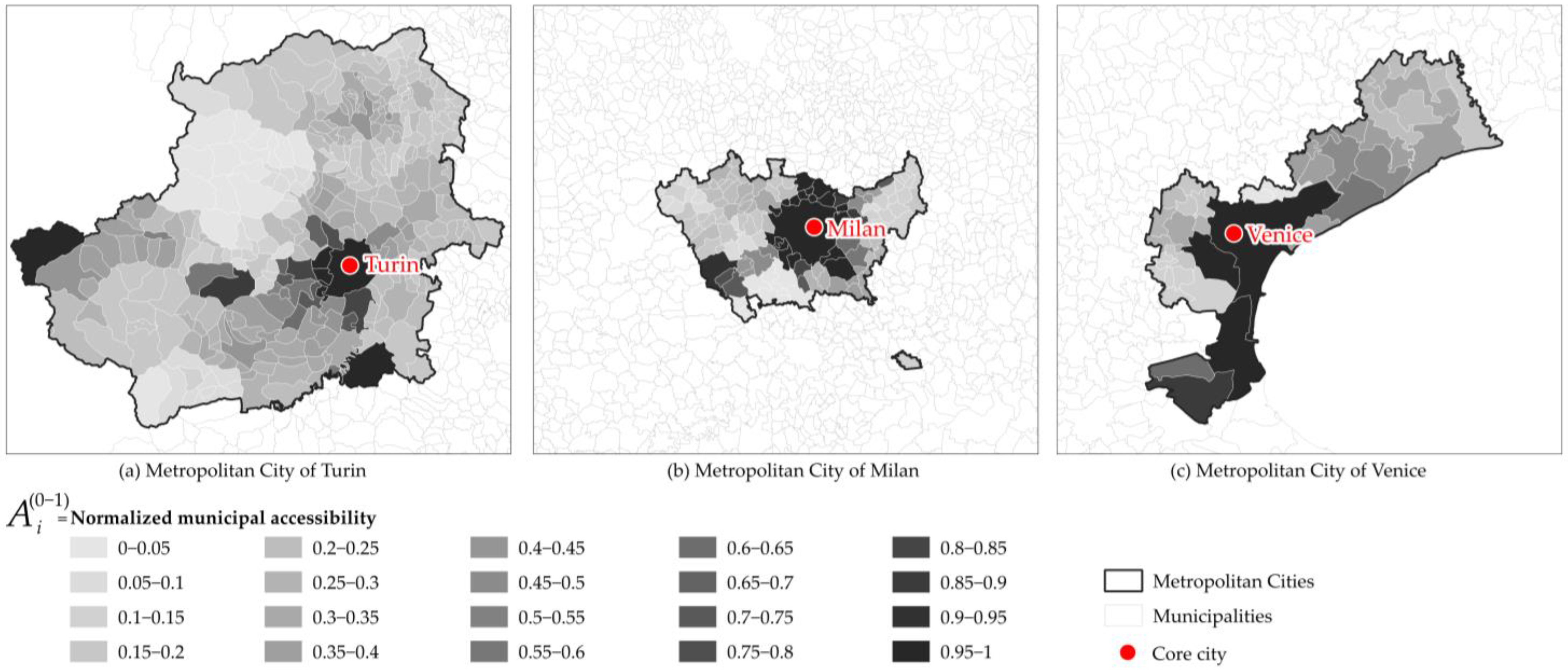
All premises made, the normalised accessibility index A i ( 0 1 ) highlights substantial differences among the three MCs (Figure 4). Milan has the highest mean accessibility (0.35) and the greatest variability (standard deviation of 0.32). This indicates a polarised spatial structure, where central municipalities, especially those along main transportation corridors, have high accessibility. Meanwhile, peripheral areas in the outer rings are comparatively disadvantaged. Venice has a similar mean value (0.34), but a more balanced distribution (standard deviation of 0.25). This reflects its hybrid geography where the concentration of opportunities in the mainland area coexists with a more diffuse settlement pattern across the lagoon and coastal municipalities. Turin displays the lowest average accessibility (0.26) and the least dispersion (standard deviation 0.17). This indicates a uniformly modest capacity to reach major service centres throughout the metropolitan area. This relative homogeneity does not imply equity, but rather a general flattening of accessibility levels, with few municipalities achieving high scores.
The spatial configuration of A i ( 0 1 ) values aligns—expectably—with each metropolitan morphology (Figure 4). In Milan, accessibility gradients radiate from the dense urban core and major radial axes, illustrating a monocentric and infrastructure-intensive model, nested around a belt of nodes around the metropolitan capital. In Venice, accessibility patterns are influenced by physical discontinuities, such as the lagoon, coastline, and inland plains, producing a fragmented yet regionally articulated accessibility structure, hinged on the three nodes part of the City of Venice: Venice itself (historic city and islands), Tessera, and Mestre. Turin’s morphology, shaped by the Po Valley and surrounding Alpine foothills, constrains spatial interactions. This reinforces the concentration of opportunities in the city centre and limits peripheral integration, a condition only partially alleviated by the multiplication of (minor) poles.
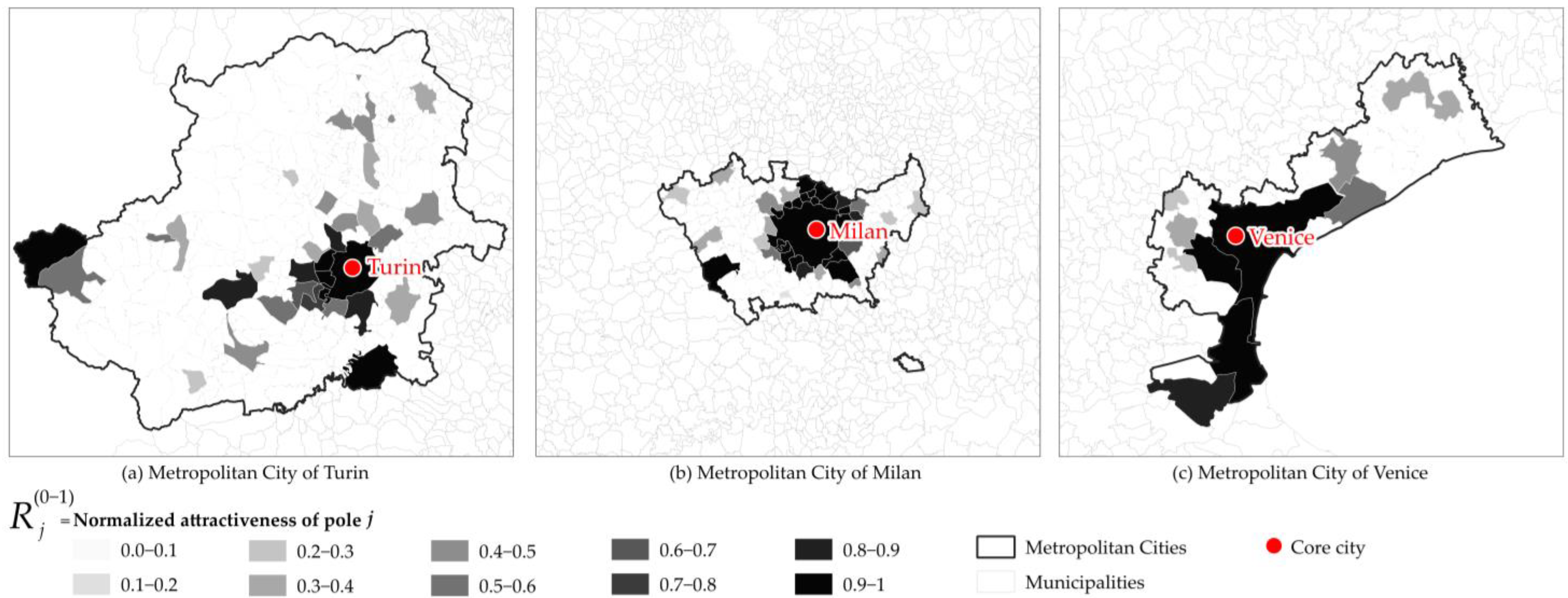
Turning to the attractiveness ratio R j ( 0 1 ) Milan’s poles exhibit the highest average value (0.72), confirming the dominance of a few large centres that command extensive hinterlands. Venice and Turin register similar mean values (0.60 and 0.59, respectively), but their internal variability differs. Venice shows the highest dispersion (standard deviation 0.36), consistent with a sharply hierarchical system dominated by a limited number of poles. Turin’s poles are more evenly distributed (standard deviation 0.26), but this uniformity stems from the higher number of poles and the relatively even population distribution among them, resulting in smaller contrasts in attractiveness (Figure 5).
Considering the dispersion of both indices in light of system composition, Milan and Venice appear less dispersed. This is not because accessibility or attractiveness are inherently balanced, but rather because each system relies on a few dominant poles that serve a generally low number of municipalities. Turin, by contrast, includes a greater number of municipalities and poles, which smooths statistical variability and compresses the range of possible accessibility outcomes.
Overall, the MC of Turin differs notably from the other two contexts. While Milan’s structure is highly centralised and efficient and Venice’s is spatially fragmented yet functionally integrated across multiple scales, Turin’s pattern reflects moderate centrality and widespread limitations in inter-municipal accessibility. Therefore, strengthening secondary poles and enhancing transversal connections could represent key levers for improving territorial cohesion and mitigating the structural imbalance between the core and the periphery within the Turin metropolitan system.

4.1.3. Influence of Land Use and Morphology on Accessibility Patterns

The integrated analysis of LULC patterns and spatial accessibility indicators shows that the physical structure of the territory and settlement distribution play a decisive role in shaping mobility networks, particularly in metro-mountain systems. The spatial configuration of urban, agricultural, and natural land, together with morphological constraints, influences the location and density of services and infrastructures and thus the capacity to ensure balanced levels of accessibility to metropolitan poles.
The LULC spatial distribution becomes critical where territories include extensive hilly and mountainous areas, where settlement discontinuity and physical-natural barriers tend to amplify functional disparities between the urban core and peripheral municipalities. The widespread presence of natural soils and forests in the Alpine areas and their surroundings, combined with the morphological complexity and the large territorial extent of the MCTo, has shaped an infrastructural system that is predominantly radial, structured along the main corridors that follow the valleys. This configuration, together with the greater physical distance separating many peripheral municipalities from the core city, results in marked accessibility gradients and in the presence of areas (such as the Lanzo Valleys) characterised by relatively low levels of connectivity towards the plains and the central conurbation. The discontinuous settlement pattern of rural and mountain municipalities and the weak integration of local service poles further reinforce car dependency and reduce the competitive capacity of these areas compared to the metropolitan core, where most activities are concentrated. Conversely, in the MCs of Milan and Venice, the flat morphology, more continuous urbanisation, and smaller territorial extent have supported the development of a denser and more articulated infrastructural network, preventing the emergence of large, consistently low-accessibility areas.
The relationship between LULC, morphology, and settlement structure helps explain how intra-metropolitan disparities in accessibility emerge from the interaction between physical constraints, the distribution of urbanised areas, continuity of the transport network, and the relationship between metropolitan extent and spatial organisation.

4.2. Focus on the Metropolitan City of Turin

The comparative analysis reveals distinctive features in the morphological characteristics of settlements and accessibility conditions within the MCTo, located at the western end of the Mediterranean TEN-T Corridor. This metropolitan area was selected as a case study due to its representativeness in terms of territorial diversity and imbalances. The exceptional metro-mountainous character of the MCTo within the national context has long been recognised by studies and planning tools [47,53,54,55]. Its vast territorial extension, bordering France for a significant section of its perimeter, its geographical heterogeneity given the significant prevalence of mountains and hills, and its pronounced administrative fragmentation pose challenges in terms of accessibility, making it a notable case for in-depth analysis of the implications for metropolitan governance. MCTo also includes Inner Areas (as defined by SNAI), which creates a sort of contradiction, as it brings together both urban centres and peripheral areas within the same metropolitan area [56]. While a few other Italian MCs (for example, Genoa or Messina) could also include large hilly, mountainous, or Inner Areas, Turin is particularly notable at the national scale for its specific combination of these features, making it a relevant case study.
The case of the MCTo also stands out, unlike others, because its FUA is much smaller than the administrative area, demonstrating that many municipalities included in the metropolitan area are in fact far removed from the socio-economic reality of the Turin capital. On the contrary, the FUAs of MCMi and CMVe require extending considerations to an area wider than the formally established administrative boundaries.
The case study on Turin therefore focuses on the functioning of the metropolitan government and governance arrangements, with particular attention to accessibility as a key factor to address in such a diverse and complex territory. As previously noted, in Italy the MC is a public territorial authority established by Law 56/2014 as an intermediate level between Regions and municipalities. It is a “second-tier elective body”, meaning that it is governed by the mayors and councillors of the constituent municipalities, who are indirectly elected. The governing organs are the metropolitan mayor (the same as the core city by law), the metropolitan council, and the metropolitan conference.
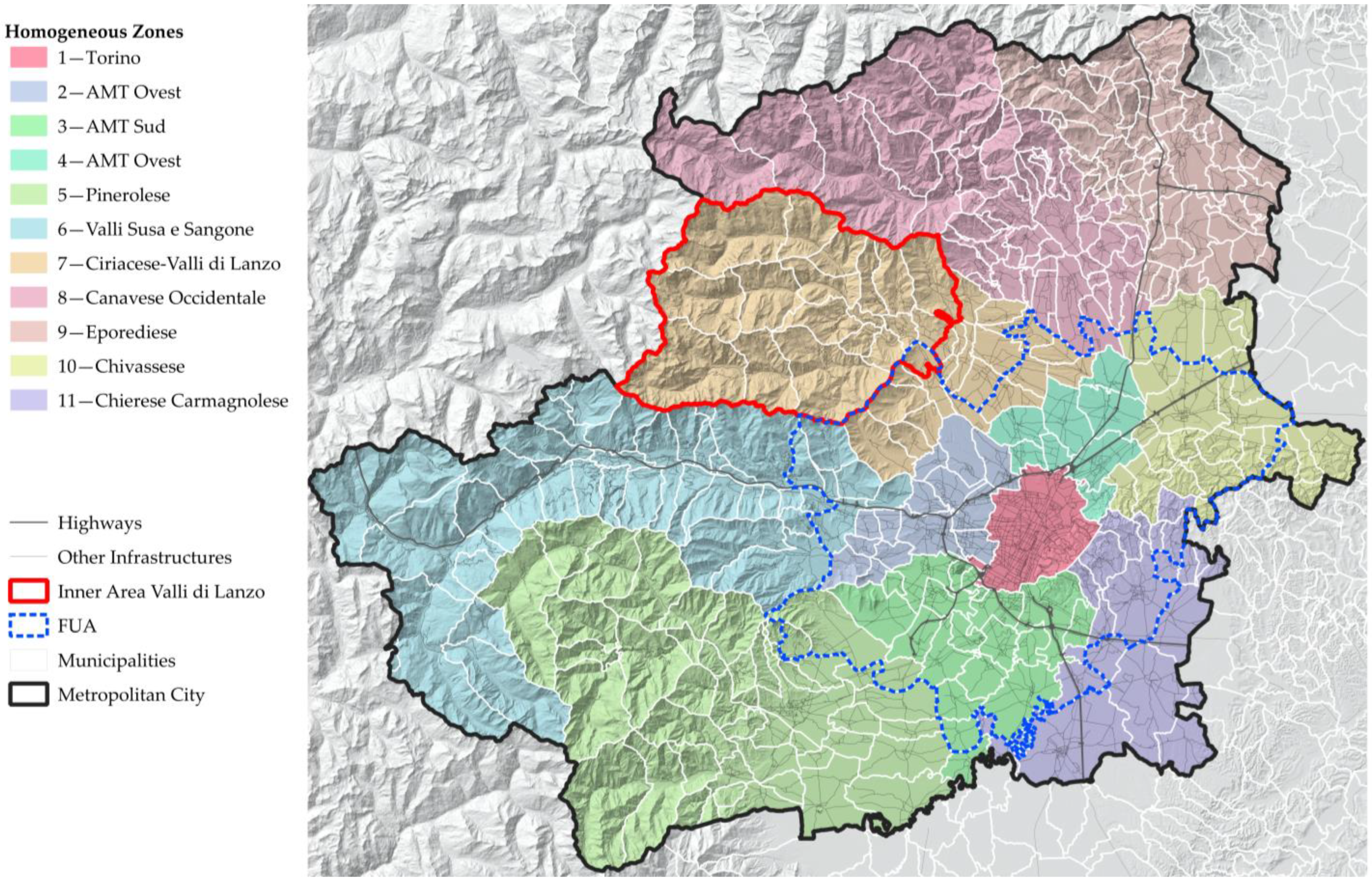
The metropolitan Statute, approved in 2015, which integrates the provisions of Law 56/2014, has strong regulatory value, also for correcting imbalances between municipalities and ensuring the participation and representation of different territories [47]. It recognises 11 Homogeneous Zones (HZs) (not mandatory by law), defined as a combination of historical, territorial and socio-economic factors, together with the organisation of public services. However, radial logics have been substantially maintained in their definition [57], with the capital city treated as a separate entity in the form of a single HZ [56]. Notably, the FUA of Turin does not align with this subdivision of HZs (Figure 6).
Three essential policy areas for metropolitan governance identified in the literature are regional development, spatial planning, and transport [58,59]. In Italian MCs, these functions are confirmed and expanded by Law 56/2014. The fundamental functions assigned (Art. 1, para. 44) include strategic planning (a new competence compared to provinces), general territorial planning, coordinated public service management systems and organisation of public services of general interest, mobility and the road networks, promotion and coordination of economic and social development, and promotion and coordination of digitization systems. In addition, MCs retain the fundamental functions of provinces (Art. 1, para. 85), such as transport and school network planning [2]. This division of functions led to greater responsibility for MC in several key sectors [60].
Regarding metropolitan territorial development, the challenge is to ensure coherence between planning and programming instruments. Italian MCs have generally been delayed in exercising planning function, focusing primarily on strategic plans, while territorial plans are often still pending approval [61]. The MCTo partially reflects this situation.
The MCTo must adopt and annually update a three-year strategic plan that guides the institution and the exercise of functions by municipalities and their unions. The third Metropolitan Strategic Plan (MSP) 2024–2026 is a policy and planning instrument for social, economic, and environmental development. It is structured around six Axes aligned with the PNRR missions, previous MSP outcomes, and the Metropolitan Sustainable Development Agenda. Developed through a co-planning and stakeholder engagement process [47], its vision promotes a new polycentric and metro-mountain model, where urban and mountain dimensions jointly enhance competitiveness and attractiveness of the entire territory. Multilevel governance is recognised as a guiding principle, fostering interdependence, coordination and inter-municipal cooperation, with the HZs playing as key interfaces between the MCTo and its municipalities [47].
As for general territorial planning, the MCTo adopted only the Preliminary Draft of the General Territorial Metropolitan Plan (GTMP) in 2022, while the Provincial Territorial Coordination Plan (PTC2) of 2011 remains the main reference. Under the Delrio Law, territorial planning must fulfil the strategic planning function; however, due to the limited duration of the MSP, it should relate to the long-term structural profile of the GTMP [62]. The absence of an approved GTMP results in a fragmented framework of instruments, often overlapping and producing inconsistent visions and objectives [63]. Within this context, the 2022 Sustainable Urban Mobility Plan (SUMP) should also be considered.
The MCTo has not yet implemented a “convergent planning” model (from HZs to the MC government) [64], and concrete bottom-up experiences are limited [55].
It is therefore important to examine the MCTo more closely, particularly its peripheral areas where accessibility issues are explicit, and to verify whether the current governance model and planning instruments are adequate to address these challenges. The peculiarity of the MCTo lies in its combination of metropolitan and marginal characteristics. Its geomorphological dualism has shaped settlement patterns with different levels of anthropisation, which is also reflected in demographic distribution: high concentration of activities in the plains and valleys, and sparse, depopulating settlements in the Alps [65]. This has created a bipolar relational structure between the metropolitan conurbation and the mountain, the latter being a natural, sociocultural, economic, and political entity [54].
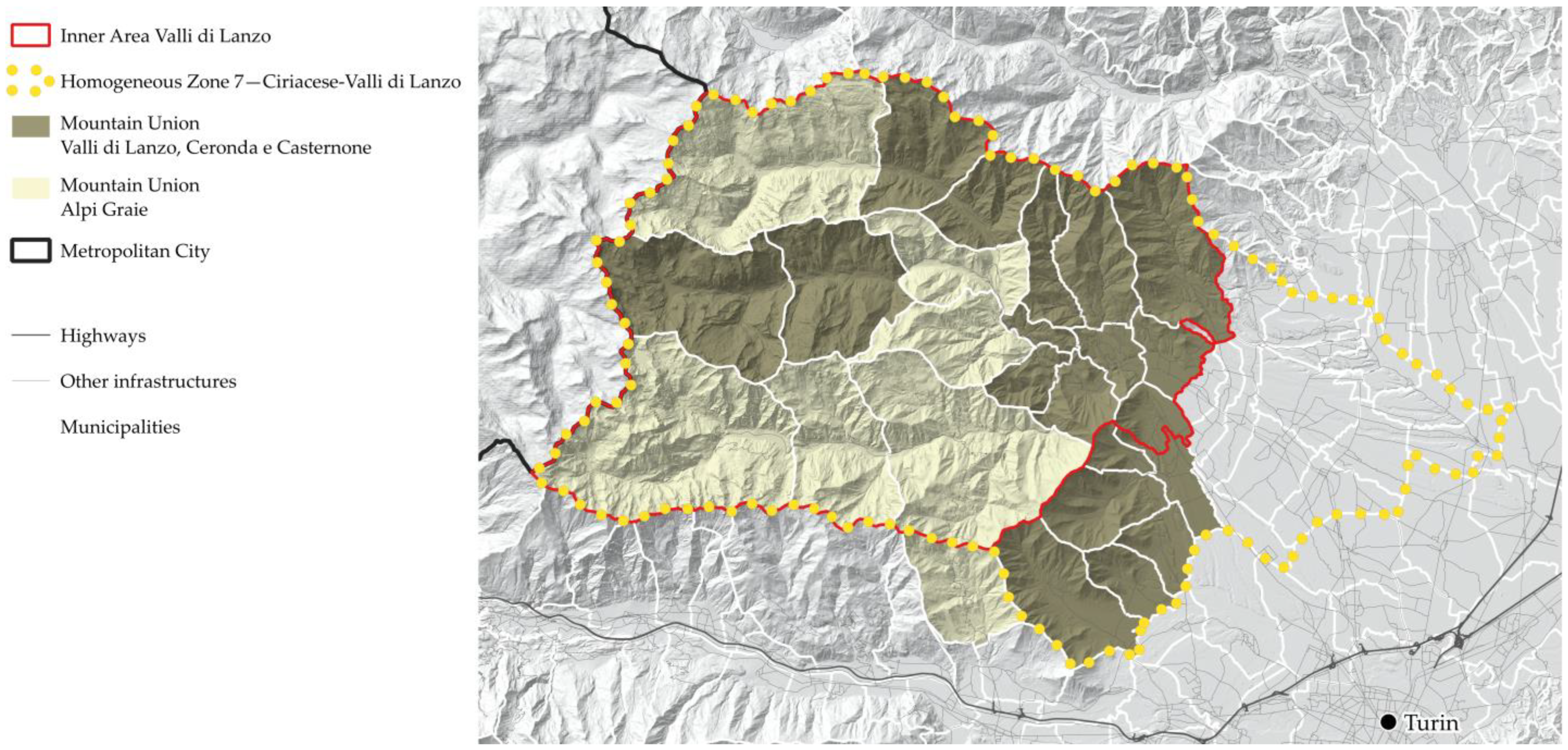
Within the MCTo the “Inner Areas”—i.e., the most marginal and peripheral territories—were formally recognised in 2015 by the Piedmont Region under the SNAI, leading to Framework Programme Agreements in 2021 that established objectives and funding commitments. The Lanzo Valleys were then identified, comprising 19 municipalities (695 km2, 23,273 inhabitants in 2023, ISTAT), nine of which are classified as “peripheral” [30]. It forms part of the Homogeneous Zone 7—Ciriacese-Valli di Lanzo, which includes 40 municipalities (973 km2, 99,831 inhabitants in 2023, ISTAT), and two Mountain Unions of Municipalities: Valli di Lanzo, Ceronda e Casternone, and Alpi Graie (Figure 7).
The Lanzo Valleys were not included in the 2021–2027 PSNAI [31], yet the territory remains isolated, with poor accessibility and essential services. The 2020 Strategy for the Lanzo Valleys identified critical issues, including progressive loss of territorial identity, persistent depopulation, demographic impoverishment, and migration toward the valley floor and the capital. Occupied dwellings and tourism have also declined, partly due to limited connections as the valley is not directly served by motorways [66].
Service accessibility differs within the area, with clear distinctions between the upper and lower valleys. Lanzo Torinese functions as a local centre within the inner area, while Cirié serves as a lower-middle centre outside the inner area but within the HZ 7 [57]. These bipolar interdependencies [57,67] reveal that only Ciriè provides complementary services to the capital and medium-sized centres. Lanzo Torinese provides basic services but lacks advanced hospital facilities, such as level I Emergency Department, and further service reductions have been reported, raising concerns among administrators and citizens [68].
In view of this situation, it is necessary to examine in detail the existing instruments to verify whether they consider these issues in their development forecasts and strategies. MSP 2024–2026 envisions a sustainable and cohesive metropolitan area, addressing inequalities and recognising the structural and functional relationship between cities and mountain/rural areas. Targeted actions for HZ 7 include promoting multimodal local public transport connectivity and developing a network of community centres, integrating school and health service locations, and strengthening inter-municipal connections [47].
The adopted GTMP includes strategies such as “Rebalancing of the plain-mountain relationship—Multipolar MC”, with operational actions to strengthen sub-metropolitan medium/intermediate centres, connections between municipalities (with sub-area/HZs synergies), accessibility to basic services. Completing the Pedemontana highway aims to overcome the radial, Turin-centric configuration of the MCTo road network [57].
Lanzo Valleys are explicitly mentioned only in safety and extraordinary road maintenance measures financed by the PNRR [57,59]. The metropolitan railway system (SFM) includes the SFM A line (Turin-Ceres), still under completion, and the Lanzo Valleys serve as a pilot area for the SUMP with new on-demand services for mountain areas [67].
Effective implementation requires inter-municipal collaboration, strengthening Mountain Unions of Municipalities (under Legislative Decree 267/2000) and their functions and services they perform in association, including mountain protection and promotion [67]. Existing unions in Lanzo Valleys build on former mountain community, reflecting a historical legacy of cooperation, and enhancing relation across HZ, aligned with Areas of Territorial Integration identified by the Regional Territorial Plan [69], would ensure consistency across territorial levels. Strategic associated organisation of services and delegated metropolitan functions (MCTo Statute, Art. 27) [70] could help rebalance exchanges between mountains and the city, particularly for ecosystem services [47]. The territorial capital of inner and mountain areas provides ecological regulation and biodiversity, yet these territories often face limited political influence and scarce resources, while urban areas concentrate demand, infrastructure and representation. HZs can facilitate targeted planning to balance ecological functions and administrative relevance [71].

5. Discussion and Conclusions

Over a decade has passed since the enactment of the Delrio Law, and the institutional experimentation of MCs allows reflections on the functioning of the Italian metropolitan governance model and its contribution to territorial development [72], particularly regarding accessibility, as a key lever for cohesion and full citizenship [31].
Italy is among the few European countries to have formalised metropolitan governance [1]. However, the reorganisation of local governments, including the Delrio Reform, remains incomplete. Studies show that metropolitan areas with governance bodies improve performance across multiple dimensions [58], enabling inter-municipal collaboration to enhance efficiency, service provision, and balanced territorial development [73]. Institutionalisation confers legitimacy but may introduce rigidity and allow hard forms of dialogue to prevail [59]. A top-down approach was seen in the reductive decision to model the new MCs’ boundaries on the former provinces. Misalignment between legal perimeters and the complex socio-economic and functional dynamics has been questioned [5,63,74]. Potential pathways include re-perimeterisation and approaches based on fluid, permeable, or variable-geometry boundaries [47,56,74,75]. Given the diversity of metropolitan contexts, there is a need to move towards flexible governance arrangements [60]. Examples of cooperative models with flexible boundaries exist (e.g., in Germany and the Netherlands), even if boundary optimisation poses challenges in balancing top-down and bottom-up approaches, implying the need for more context-specific solutions.
This study adds a tile to a complex panorama and provides valuable multidisciplinary insights into the debate on MC governance and multilayer complexity. Its contribution lies in the combined analysis of spatial accessibility and governance, applied at a metropolitan perspective and enriched by a case study illustrating the challenges of a metro-mountain context. Although rooted in Italy, this research offers transferable insights for European metropolitan areas seeking more cooperative and adaptive governance.
The study’s results align with previous literature, but several limitations remain. First, accessibility was computed for private cars only, a simplification designed to overcome practical and context-related difficulties: including multimodal trips and public transport accessibility could exacerbate the comparative (dis)advantage of peripheral areas, adding strength to the results and, possibly, giving better insights not only in spatial accessibility, but also in the socioeconomic geographies of the analysed areas [28]. Adding multimodal, multiscope accessibility analysis is an interesting future research direction, particularly for complex metropolitan areas such as that of Turin.
Second, the study relies on harmonised datasets, replicable spatial indicators, and documentary analysis. Future research could integrate primary or field-based data to explore further governance perceptions and policy implementation.
The spatial and accessibility findings align with the knowledge framework outlined in metropolitan plans (developed through co-planning and participatory processes) and other studies examined for the case of MCTo. Such triangulation allows the study to verify coherence between spatial patterns and governance interpretations, while also highlighting how planning instruments could more effectively promote accessibility improvements and reduce territorial disparities through stronger synergies among them and reinforcing the linkages between planning measures and funding mechanisms.
Policy recommendations can be articulated through multi-level operational measures with different degrees of feasibility. At the short-to-medium term, metropolitan governance could be strengthened through a revision of the metropolitan statute concerning the boundaries and functions of the HZs. Reconfiguring these perimeters—according to an evidence-based approach and a closer dialogue with the territories—could improve the alignment between institutional arrangements and actual territorial dynamics. For example, extending the Turin HZ to neighbouring municipalities could increase coordination capacity and reduce isolated actions by the core city, better capturing the inherently intermunicipal scale of policies and interventions. This could also be accompanied by procedures to reinforce the involvement of HZs in metropolitan decision-making processes.
At the medium-to-long term, more structural reforms may require amendments to the Law 56/2014. These could concern, for instance, the selection mechanism for the metropolitan mayor, considering that other European metropolitan authorities adopt different systems for the designation of their president (with rotation systems or greater responsibilities to councils and assemblies), to ensure forms of representation closer to diverse territories. While such reforms imply longer and more complex institutional procedures, they may enable more accountable and effective governance. While redefining MC boundaries may be desirable, the procedural complexity suggest favouring a renovated regulatory framework that allows soft, context-specific, and flexible governance solutions.
The case of Turin exemplifies the challenges of governing a large metropolitan area, with spatially and relationally dispersed municipalities, posing questions of representation. The automatic correspondence of the metropolitan mayor with the mayor of the capital city risks not responding to the needs of peripheral communities [72], potentially affecting the prioritisation of accessibility policies. Also, municipalities that do not perceive themselves as part of the metropolitan entity may resist cooperation, fearing loss of autonomy [74]. Building a strong sense of belonging with a participatory and convergent approach for the definition of metropolitan objectives, policies and projects is therefore crucial, as this underpins the very credibility of the public body [62].
Involvement of communities and territories through HZs and inter-municipal associations can ensure efficiency in managing functions, equity, and representativeness across territories. Such collaboration should be accompanied by cooperation across government levels, within a multi-level governance framework. Effective metropolitan action also requires coordination between planning and programming instruments, which is often lacking [76]. The new MCs have at times shown reluctance to introduce substantial innovations compared to the former provinces [61]. To avoid formalistic use of their functions, and to ensure operability and feasibility of declared actions and strategies, the introduction and approval of innovative GTMPs should be accelerated. These should serve as open-ended structural plans, providing the spatial reference framework for MSPs, which should take on a more programmatic, operational and project-oriented role [62].
Th MCTo demonstrates the necessity to integrate metropolitan policies with those for inner areas. Although MCs were designed as economic and productive engines for the country, they sometimes include marginal and peripheral areas, generating paradoxes in the metropolitan model. This model has historically been based on globalisation, innovation, and competitiveness, but recently the latter is increasingly giving way to collaboration [59]. A change in perspective is needed to consider and support marginal areas as spaces of regeneration, entrepreneurship, and welfare innovation [77].
Critical structural issues remain, including limited administrative capacity, financial obstacles, organisational fragility, and difficulty in coordinating urban policies for economic development [72]. Recurrent budget cuts have increased dependence on national resources, and this uncertain financial framework ultimately affects MCs’ ability to design and implement effective strategies [78]. Future research could explore these challenges in detail to better understand their deep-seated causes.

Author Contributions

Conceptualization, V.V.; methodology, F.B., G.G.P. and V.V.; formal analysis, F.B. and G.G.P.; writing—original draft preparation, A.B. and V.V.; writing—review and editing, A.B., F.B. and V.V.; visualisation, A.B. and G.G.P. All authors have read and agreed to the published version of the manuscript.

Funding

This research received no external funding.

Institutional Review Board Statement

Not applicable.

Informed Consent Statement

Not applicable.

Data Availability Statement

Data are available from the corresponding author upon reasonable request. The main sources and publicly archived datasets employed in the analysis are indicated within the References.

Conflicts of Interest

The authors declare no conflicts of interest.

Abbreviations

The following abbreviations are used in this manuscript:
FUAFunctional Urban Area
GTMPGeneral Territorial Metropolitan Plan
HZHomogeneous Zones
LULCLand Use-Land Cover
MCMetropolitan City
MCToMetropolitan City of Turin
MCMiMetropolitan City of Milan
MCVeMetropolitan City of Venice
MSPMetropolitan Strategic Plan
OECDOrganisation for Economic Co-operation and Development
PNRRPiano Nazionale di Ripresa e Resilienza (National Recovery and Resilience Plan, Italy)
SNAIStrategia Nazionale per le Aree Interne (National Strategy for Inner Areas, Italy)
SUMPSustainable Urban Mobility Plan

References

  1. Casavola, D.; Cotella, G.; Janin Rivolin, U.; Vitale Brovarone, E. Metropolitan governance in Europe: A classification of current national models. disP Plan. Rev. 2025, 61, 62–82. [Google Scholar] [CrossRef]
  2. Law No. 56 of 7 April 2014. Disposizioni Sulle Città Metropolitane, Sulle Province, Sulle Unioni e Fusioni di Comuni. Available online: https://www.bosettiegatti.eu/info/norme/statali/2014_0056.htm (accessed on 3 September 2025).
  3. Mascarucci, R. Città Medie e Metropoli Regionali; INU Edizioni: Roma, Italy, 2020. [Google Scholar]
  4. Cavallaro, F.; Bruzzone, F.; Nocera, S. Effects of high-speed rail on regional accessibility. Transportation 2023, 50, 1685–1721. [Google Scholar] [CrossRef]
  5. Sá Marques, T.; Saraiva, M.; Ribeiro, D.; Amante, A.; Silva, D.; Melo, P. Accessibility to services of general interest in polycentric urban system planning: The case of Portugal. Eur. Plan. Stud. 2019, 28, 1068–1094. [Google Scholar] [CrossRef]
  6. Brenner, N. Pensare lo Spazio Urbano Senza Più Esterno. IC Imprese Città 2015, 6, 23–34. [Google Scholar]
  7. Cáceres-Merino, J.; Coloma, J.F.; García, M.; Monzon, A. The Unsustainable Proximity Paradox in Medium-Sized Cities: A Qualitative Study on User Perceptions of Mobility Policies. Land 2025, 14, 944. [Google Scholar] [CrossRef]
  8. Bocca, A. City-Effect: New Centralities in Post-pandemic Regional Metropolis Pescara-Chieti. In Urban and Transit Planning, Advances in Science, Technology & Innovation, 3rd ed.; Alberti, F., Matamanda, A.R., He, B., Galderisi, A., Smol, M., Gallo, P., Eds.; Springer: Cham, Switzerland, 2023. [Google Scholar] [CrossRef]
  9. Beck, U. Der kosmopolitische Blick Oder: Krieg ist Frieden; Suhrkamp Verlag: Frankfurt am Main, Germany, 2004. [Google Scholar]
  10. Manzini, E. Abitare la Prossimità: Idee Per la Città Dei 15 Minuti; Egea: Milano, Italy, 2021. [Google Scholar]
  11. International Transport Forum (ITF). Sustainable Accessibility for All; ITF Research Reports; OECD Publishing: Paris, France, 2024. [Google Scholar] [CrossRef]
  12. Rokicki, B.; Rokicka, B.; Stępniak, M. Major transport Infrastructure Investment and Regional Economic Development–an Accessibility-based Approach. J. Transp. Geogr. 2018, 72, 193–202. [Google Scholar] [CrossRef]
  13. Moreno, C.; Allam, Z.; Chabaud, D.; Gall, C.; Pratlong, F. Introducing the “15-minute city”: Sustainability, Resilience and Place Identity in Future Post-Pandemic Cities. Smart Cities 2021, 4, 93–111. [Google Scholar] [CrossRef]
  14. International Transport Forum (ITF). Benchmarking Accessibility in Cities. Measuring the Impact of Proximity and Transport Performance; OECD Publishing: Paris, France, 2022; Available online: https://www.itf-oecd.org/sites/default/files/docs/accessibility-proximity-transport-performance_2.pdf (accessed on 20 September 2025).
  15. Hansen, W.G. How Accessibility Shapes Land Use. J. Am. Plan. Inst. 1959, 25, 73–76. [Google Scholar] [CrossRef]
  16. Straatemeier, T. How to Plan for Regional Accessibility? Transp. Policy 2008, 15, 127–137. [Google Scholar] [CrossRef]
  17. European Union. Territorial Agenda 2030–A Future for All Places, 2020. Available online: https://territorialagenda.eu/ (accessed on 2 September 2025).
  18. European Union, Urban Agenda for the EU ‘Pact of Amsterdam’ Agreed at the Informal Meeting of EU Ministers Responsible forUrban Matters on 30 May 2016 in Amsterdam, The Netherlands, 2016. Available online: https://ec.europa.eu/regional_policy/sources/policy/themes/urban-development/agenda/pact-of-amsterdam.pdf (accessed on 15 September 2025).
  19. Urban Agenda for EU. Ljubljana Agreement. Informal Meeting of Ministers Responsible for Urban Matters26 November 2021 Brdo pri Kranju, Slovenia, 2021. Available online: https://www.urbanagenda.urban-initiative.eu/sites/default/files/2022-10/ljubljana_agreement_2021_en.pdf (accessed on 20 September 2025).
  20. Hinchcliff, C.; Taylor, I. Every Village, Every Hour: A Comprehensive Bus Network for Rural England; CPRE: London, UK, 2021. Available online: https://www.cpre.org.uk/resources/every-village-every-hour-2021-buses-report-full-report/ (accessed on 1 September 2025).
  21. International Transport Forum (ITF). The Innovative Mobility Landscape: The Case of Mobility as a Service, International Transport Forum Policy Papers; OECD Publishing: Paris, France, 2021; Volume 92. [Google Scholar] [CrossRef]
  22. Ricciardi, G.C. Dalle Leggende Alle Città Metropolitane. Difficile Attuazione di Un’istituzione del Governo del Territorio tra Passato, Presente e Futuro. In La Riorganizzazione Territoriale e Funzionale Dell’area Vasta. Riflessioni Teoriche, Esperienze e Proposte Applicative a Partire Dal Caso Della Regione Lombardia; Ricciardi, G.C., Venturi, A., Eds.; G. Giappichelli Editore: Torino, Italy, 2018; pp. 29–86. Available online: https://osservatorioautonomie.unipv.it/wp-content/uploads/2021/04/5_Ricciardi_Venturi_Area-vasta-2018.pdf (accessed on 20 September 2025).
  23. Palermo, A.; Tucci, G.; Chieffallo, L. Definition of Spatio-Temporal Levels of Accessibility. Isochronous Analysis of Regional Transport Networks. TeMA J. Land Use Mobil. Environ. 2025, 18, 23–38. [Google Scholar] [CrossRef]
  24. Agenzia Per la Coesione Territoriale. PON Città Metropolitane. Available online: https://www.agenziacoesione.gov.it/pon/pon-metro/ (accessed on 22 October 2025).
  25. Dipartimento Per le Politiche di Coesione e il Sud. PON Città Metropolitane 2014–2020. Available online: https://www.pnmetroplus.it/ (accessed on 22 October 2025).
  26. Spinedi, M. Mobilità Nelle e Per le Città Metropolitane: Temi e Problemi. Working Papers. Rivista Online di Urban@it 2015, 1. Available online: https://www.urbanit.it/wp-content/uploads/2015/09/BP_A_Spinedi.pdf (accessed on 20 September 2025).
  27. Cascetta, E.; Cartenì, I.; Henke, E.; Pagliara, F. Economic growth, transport accessibility and regional equity impacts of high-speed railways in Italy: Ten years ex post evaluation and future perspectives. Transp. Res. Part A Policy Pract. 2020, 139, 412–428. [Google Scholar] [CrossRef] [PubMed]
  28. Wang, L. High-speed rail services development and regional accessibility restructuring in megaregions: A case of the Yangtze River Delta, China. Transp. Policy 2018, 72, 34–44. [Google Scholar] [CrossRef]
  29. Mascarucci, R. Sistema urbano intermedio e aree montane. In Urbano Montano. Verso Nuove Configurazioni e Progetti di Territorio; Corrado, F., Ed.; Franco Angeli: Milano, Italy, 2021; pp. 66–83. [Google Scholar]
  30. Barca, F.; Casavola, P.; Lucatelli, S. Strategia Nazionale Per le Aree Interne: Definizione, Obiettivi, Strumenti e Governance, Accordo di Partenariato 2014–2020; Ministero Dello Sviluppo Economico, Dipartimento Per lo Sviluppo e la Coesione Economica, Unità di Valutazione Degli Investimenti Pubblici: Rome, Italy, 2014. Available online: https://www.mim.gov.it/documents/20182/890263/strategia_nazionale_aree_interne.pdf/d10fc111-65c0-4acd-b253-63efae626b19 (accessed on 3 August 2025).
  31. Presidenza del Consiglio dei Ministri. Dipartimento Per le politiche di Coesione e Per il Sud. Piano Strategico Nazionale Delle Aree Interne. 2025. Available online: https://politichecoesione.governo.it/media/jhld12qn/psnai_finale_30072025_clean_ministro.pdf (accessed on 2 September 2025).
  32. De Rossi, A. Riabitare l’Italia. Le Aree Interne tra Abbandoni e Riconquiste; Donzelli: Rome, Italy, 2018. [Google Scholar]
  33. Servillo, L.; Russo, A.P.; Barbera, F.; Carrosio, G. Inner Peripheries: Towards an EU place-based agenda on territorial peripherality. IJPP Ital. J. Plan. Pract. 2016, 6, 42–75. Available online: https://arts.units.it/retrieve/e2913fdb-e4af-f688-e053-3705fe0a67e0/2016%20Servillo%20Russo%20Barbera%20Carrosio%20Journal%20Planning.pdf (accessed on 2 August 2025).
  34. Barbera, F.; De Rossi, A. Metromontagna. Un Progetto Per Riabitare l’Italia; Donzelli: Rome, Italy, 2021. [Google Scholar]
  35. Law No. 158 of 6 October 2017. Misure Per il Sostegno e la Valorizzazione Dei Piccoli Comuni, Nonchè Disposizioni Per la Riqualificazione e il Recupero Dei Centri Storici Dei Medesimi Comuni. Available online: https://www.normattiva.it/uri-res/N2Ls?urn:nir:stato:legge:2017-10-06;158~art1-com2 (accessed on 2 October 2025).
  36. Italian National Institute of Statistics (ISTAT). Demography in Figures. Available online: https://demo.istat.it/ (accessed on 10 October 2025).
  37. Italian National Institute of Statistics (ISTAT). Italian Statistical Yearbook 2024. 2024. Available online: https://www.istat.it/wp-content/uploads/2024/12/ASI_2024.pdf (accessed on 10 October 2025).
  38. Dijkstra, L.; Poelman, H.; Veneri, P. The EU-OECD Definition of a Functional Urban Area; OECD Regional Development Working Papers; OECD Publishing: Paris, France, 2019; Volume 11. [Google Scholar] [CrossRef]
  39. OECD. Boundaries of Functional Urban Areas (Spatial Data). Available online: https://www.oecd.org/en/data/datasets/oecd-definition-of-cities-and-functional-urban-areas.html (accessed on 5 September 2025).
  40. OECD. Population by Age and Sex—Cities and FUAs. 2024. Available online: https://data-explorer.oecd.org/vis?fs[0]=Topic%2C1%7CRegional%252C%20rural%20and%20urban%20development%23GEO%23%7CCities%20and%20functional%20urban%20areas%23GEO_URB%23&pg=0&fc=Topic&bp=true&snb=23&vw=ov&df[ds]=dsDisseminateFinalDMZ&df[id]=DSD_FUA_DEMO%40DF_AGE_SEX&df[ag]=OECD.CFE.EDS&df[vs]=1.1&dq=.A..._T._T..&to[TIME_PERIOD]=false&pd=2024%2C2024 (accessed on 20 September 2025).
  41. OECD. Local Administrative Units—Cities and FUAs. 2024. Available online: https://data-explorer.oecd.org/vis?fs[0]=Topic%2C1%7CRegional%252C%20rural%20and%20urban%20development%23GEO%23%7CCities%20and%20functional%20urban%20areas%23GEO_URB%23&pg=0&fc=Topic&bp=true&snb=28&df[ds]=dsDisseminateFinalDMZ&df[id]=DSD_FUA_TERR%40DF_LAU&df[ag]=OECD.CFE.EDS&df[vs]=1.1&dq=.A.LAU_C..&pd=2024%2C2024&to[TIME_PERIOD]=false (accessed on 5 September 2025).
  42. Copernicus Land Monitoring Service; European Environment Agency. Corine Land Cover (CLC) Backbone. 2023. Available online: https://land.copernicus.eu/en/products/clc-backbone (accessed on 10 September 2025).
  43. Geurs, K.T.; van Wee, B. Accessibility evaluation of land-use and transport strategies: Review and research directions. J. Transp. Geogr. 2004, 12, 127–140. [Google Scholar] [CrossRef]
  44. Rosik, P.; Stępniak, M.; Komornicki, T. The decade of the big push to roads in Poland: Impact on improvement in accessibility and territorial cohesion from a policy perspective. Transp. Policy 2015, 37, 134–146. [Google Scholar] [CrossRef]
  45. Turri, E. La Megalopoli Padana; Marsilio: Venice, Italy, 2000. [Google Scholar]
  46. Romano, B.; Zullo, F. Half a Century of Urbanization in Southern European Lowlands: A Study on the Po Valley (Northern Italy). Urban Res. Pract. 2015, 9, 109–130. [Google Scholar] [CrossRef]
  47. Metropolitan City of Turin. Metropolitan Strategic Plan 2024–2026. English Version 2024. Available online: https://www.cittametropolitana.torino.it/sites/default/files/pagina/qa7/PSM/piano_strategico_metropolitano_2024-2026_eng.pdf (accessed on 2 December 2025).
  48. Metropolitan City of Turin. StaTÒmetro—La Città Metropolitana di Torino in Numeri. 2024. Available online: https://app.powerbi.com/view?r=eyJrIjoiYzgzZjMyZTgtMjhhZC00ZDJhLWE0YWMtODIwZTY4ZDBlODQ2IiwidCI6IjA4M2IzZjU2LWVhYzQtNDM0Mi1hNDk5LWI5MDBkNTMxMDkyMyIsImMiOjh9 (accessed on 2 December 2025).
  49. Buonomo, A.; Benassi, F.; Gallo, G.; Salvati, L.; Strozza, S. In-between centers and suburbs? Increasing differentials in recent demographic dynamics of Italian metropolitan cities. Genus 2024, 80, 1–19. [Google Scholar] [CrossRef]
  50. Soriani, S.; Calzavara, A. Una valutazione critica sull’implementazione della legge 56 in Veneto: Il caso della Città metropolitana di Venezia. Geotema 2022, 70, 56–64. Available online: https://www.ageiweb.it/geotema/wp-content/uploads/2023/06/GEOTEMA-70.pdf (accessed on 20 September 2025).
  51. Fondazione di Venezia. Quattro Venezie Per un Nordest. Rapporto su Venezia Civitas Metropolitana; Marsilio: Venezia, Italy, 2019. [Google Scholar]
  52. Cristaldi, F. Commuting and gender in Italy: A methodological issue. Prof. Geogr. 2005, 57, 268–284. [Google Scholar] [CrossRef]
  53. Corrado, F.; Dematteis, G.; Durbiano, E.; Gioia, D. The Mountain–City Exchange: The Case of the Metropolitan City of Turin; FrancoAngeli: Milan, Italy, 2017. [Google Scholar]
  54. Dematteis, G. The Alpine Metropolitan–Mountain Faced with Global Challenges: Reflections on the Case of Turin. J. Alp. Res. Rev. De Géographie Alp. 2018, 106, 1–13. [Google Scholar] [CrossRef]
  55. Barbieri, C.A.; Giaimo, C. The Metropolitan City as a New Institution for Planning. In La Città Metropolitana di Torino e il Ruolo di Una Nuova Pianificazione; Barbieri, C.A., Giaimo, C., Voghera, A., Eds.; Urbanistica Dossier Online, INU Edizioni: Rome, Italy, 2022; Volume 28, pp. 11–12. [Google Scholar]
  56. Vetritto, G. L’Italia da rammendare. Legge Delrio e ridisegno del sistema delle autonomie. Riv. Giuridica Del Mezzog. 2016, 1, 153–172. [Google Scholar] [CrossRef]
  57. Metropolitan City of Turin. Piano Territoriale Generale Metropolitano—Progetto Preliminare/Metropolitan General Territorial Plan—Preliminary Draft. Relazione Illustrativa. 2022. Available online: https://www.cittametropolitana.torino.it/sites/default/files/pagina/allegati/Territorio/ptgm/ProgPrel/pdf/A_Relazione_illustrativa_PP.pdf (accessed on 2 December 2025).
  58. Ahrend, R.; Gamper, C.; Schumann, A. The OECD Metropolitan Governance Survey: A Quantitative Description of Governance Structures in Large Urban Agglomerations; OECD Regional Development Working Papers; OECD Publishing: Paris, France, 2014; Volume 4. [Google Scholar] [CrossRef]
  59. Bierwiaczonek, K. Metropolisation Through Institutional Action: An Analysis of Seven Metropolitan Areas in Central Europe. Stud. Socjol. 2025, 2, 145–168. [Google Scholar] [CrossRef]
  60. Vinci, I. Governing the Metropolitan Dimension: A Critical Perspective on Institutional Reshaping and Planning Innovation in Italy. Eur. J. Spat. Dev. 2019, 70, 1–21. [Google Scholar] [CrossRef]
  61. Mazzeo, G. Planning Assignments of the Italian Metropolitan Cities: Early Trends. TeMA J. Land Use Mobil. Environ. 2017, 10, 57–76. [Google Scholar] [CrossRef]
  62. Barbieri, C.A. Un nuovo modo di pianificare il territorio metropolitano. In La Città Metropolitana di Torino e il Ruolo di Una Nuova Pianificazione; Barbieri, C.A., Giaimo, C., Voghera, A., Eds.; Urbanistica Dossier Online, INU Edizioni: Rome, Italy, 2022; Volume 28, pp. 13–14. [Google Scholar]
  63. Mortari, I.; Boggio Merlo, P.; Fiora, G. Città metropolitana di Torino: Gli strumenti della pianificazione territoriale e strategica fra rigenerazione urbana e sviluppo territoriale. Urban. Inf. 2023, 317, 15–20. [Google Scholar] [CrossRef]
  64. Barbieri, C.A. Dall’istituzione all’azione della Città metropolitana di Torino: Il ruolo di una nuova pianificazione. Il Piemonte Delle Auton. 2015, 2, 8–14. [Google Scholar]
  65. Metropolitan City of Turin. Piano Territoriale di Coordinamento Provinciale 2/Provincial Territorial Coordination Plan 2. Relazione Illustrativa. 2011. Available online: https://www.cittametropolitana.torino.it/sites/default/files/pagina/allegati/Territorio/Pian_Area_Vasta/ptc2/PTC2_Rel_ill_dcr121_2011.pdf (accessed on 2 December 2025).
  66. Piedmont Region. Strategia Per le Valli di Lanzo: La Montagna si Avvicina. 2020. Available online: https://www.unionemontanavlcc.it/portals/1708/SiscomArchivio/8/Strategia_SNAI_Lanzo.pdf (accessed on 2 August 2025).
  67. Metropolitan City of Turin Piano Urbano Della Mobilità Sostenibile/Sustainable Urban Mobility Plan. Rapporto Finale 2022. Available online: https://www.cittametropolitana.torino.it/sites/default/files/pagina/allegati/trasporti/PUMS/RAPPORTO%20FINALE/PUMS_RapportoFinale.pdf (accessed on 2 December 2025).
  68. Giacomino, G. Lanzo Hospital in Chaos Between Resignations and Closures. La Stampa. 23 February 2025. Available online: https://www.lastampa.it/torino/2025/02/23/news/ospedale_lanzo_dimissioni_chiusure-15018325/ (accessed on 1 July 2025).
  69. Regione Piemonte. Piano Territoriale Regionale. Variante di Aggiornamento Adottata. Schede degli Ambiti di Integrazione Territoriale, 2024. Available online: https://www.regione.piemonte.it/web/sites/default/files/media/documenti/2024-06/3_schede_ait.pdf (accessed on 1 July 2025).
  70. Metropolitan City of Turin. Statuto Metropolitano. Approved by the Metropolitan Conference on 14 April 2015, Amended by Resolution No. 3/2023 of 14 February 2023. Available online: https://www.cittametropolitana.torino.it/sites/default/files/pagina/a02/consiglio/statuto/statuto_2023.pdf (accessed on 2 December 2025).
  71. Giaimo, C.; Pantaloni, G.G. Oltre i confini delle Zone omogenee: Vocazione ecosistemica e rigenerazione urbano-territoriale nella Città metropolitana di Torino. In La Città Metropolitana di Torino e il Ruolo di Una Nuova Pianificazione; Barbieri, C.A., Giaimo, C., Voghera, A., Eds.; Urbanistica Dossier Online, INU Edizioni: Rome, Italy, 2022; Volume 28, pp. 25–30. [Google Scholar]
  72. Giannino, C. Dieci anni dopo la nascita delle città metropolitane. Quale contributo offerto ai processi di sviluppo urbano? Urban. Inf. 2024, 317, 9–12. [Google Scholar] [CrossRef]
  73. Pearson, J. Metropolitan Governance: A Framework for Capacity Assessment; Deutsche Gesellschaft für Internationale Zusammenarbeit (GIZ) GmbH, United Nations Human Settlements Programme (UN-Habitat); GIZ: Bonn and Eschborn, Germany, 2018. Available online: https://unhabitat.org/sites/default/files/download-manager-files/giz2018-0191en-metropolitan-governance-framework-capacity-assessment.pdf (accessed on 10 October 2025).
  74. ESPON. METRO: The Role and Future Perspectives of Cohesion Policy in the Planning of Metropolitan Areas and Cities. Annex III—Metropolitan City of Turin Case Study; Cotella, G., Vitale Brovarone, E., Staricco, L., Casavola, D., Eds.; Politecnico di Torino: Turin, Italy, 2021. [Google Scholar]
  75. Tubertini, C. Nuove dinamiche territoriali e logiche metropolitane: Spunti per le città medie e le aree interne. Ist. Del Fed. 2016, 4, 857–865. [Google Scholar]
  76. Urbani, P. Città metropolitane: Un difficile bilancio positivo. Urban. Inf. 2024, 317, 13–14. [Google Scholar] [CrossRef]
  77. Venturi, P. Strategie Per le Aree Interne: Tra Retorica del Declino e Infrastrutturazione Comunitaria. DiTe. 15 July 2025. Available online: https://www.dite-aisre.it/strategie-per-le-aree-interne-tra-retorica-del-declino-e-infrastrutturazione-comunitaria/?utm_source=DiTe+newsletter&utm_campaign=7610721d3d-17_luglio_2025&utm_medium=email&utm_term=0_-c731c5715a-672480233 (accessed on 2 October 2025).
  78. Mobilio, G. Le Città metropolitane a dieci anni dalla loro istituzione. Spunti per un bilancio. Ital. Pap. Fed. 2024, 1, 23–45. [Google Scholar]
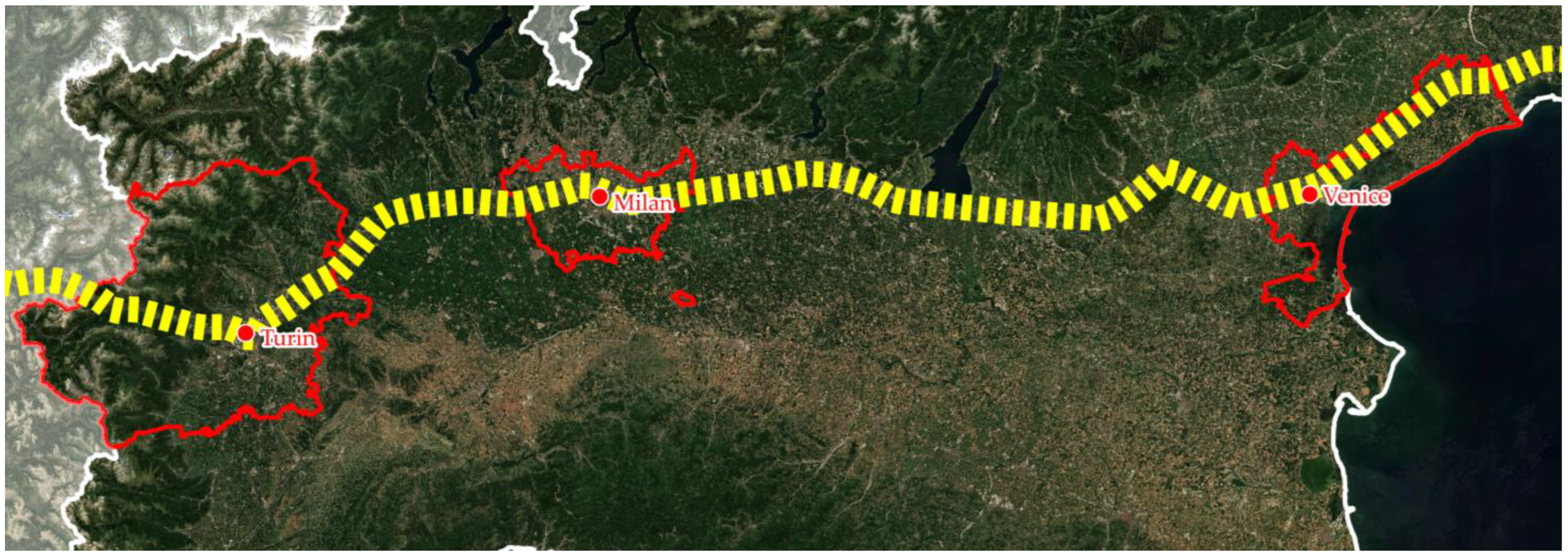
Figure 1. Overview of the territorial context of the Po Valley (Northern Italy), showing the Metropolitan Cities of Turin, Milan and Venice and the Mediterranean TEN-T Corridor.
Urbansci 09 00526 g001
Figure 2. Administrative boundaries and Functional Urban Areas (EU-OECD) of the Metropolitan Cities of Turin, Milan and Venice.
Urbansci 09 00526 g002
Figure 3. Spatial distribution of Land Use—Land Cover classes in the Metropolitan Cities of Turin, Milan and Venice based on CLCplus Backbone 2023 data.
Urbansci 09 00526 g003
Figure 4. Normalised municipal accessibility Ai(0–1).
Urbansci 09 00526 g004
Figure 5. Normalised attractiveness of pole j Rj(0–1).
Urbansci 09 00526 g005
Figure 6. The territory of the Metropolitan City of Turin, showing the boundaries of the Homogeneous Zones, the Functional Urban Area and the Inner Area of the Lanzo Valleys.
Urbansci 09 00526 g006
Figure 7. Detail of the Inner Area of the Lanzo Valleys within the Metropolitan City of Turin located in Homogeneous Zone 7 and including the territory of the two Mountain Unions of Municipalities.
Urbansci 09 00526 g007
Table 1. Results of comparative indicators of morphological and settlement characteristics in the Metropolitan Cities of Turin, Milan and Venice.
IndicatorMCToMCMiMCVe
Surface area (km2)682815742477
Population 2025 (inh.)2,207,8733,247,623833,934
Population density (inh./km2)3232063333
Population trend 2015–2025 (inh. & %)−74,324
(−3.26%)
+39,114
(+1.22%)
−21,762
(−2.54%)
Municipalities (n)31213344
Number of ‘small municipalities’ (n)105 mountainous
124 hilly
83 plains
All plainsAll plains
Surface area of the core city (km2)130182415.5
Population of the core city 2025 (inh.)856,7451,366,155249,466
Surface core city/MC (%)2%12%17%
Population core city/MC (%)39%42%30%
Table 2. Results of comparative indicators of the Turin, Milan and Venice Functional Urban Areas (EU-OECD).
IndicatorTurinMilanVenice
Surface area (km2)17023841670
Population 2024 (inh.)1,707,8754,981,421545,623
Municipalities (n)8930315
Table 3. Percentage distribution of Land Use—Land Cover classes in the Metropolitan Cities of Turin, Milan and Venice based on CLCplus Backbone 2023 data.
Land Use Land Cover ClassesMCTo
Surface Area (%)
MCMi
Surface Area (%)
MCVe
Surface Area (%)
1—Sealed7.4%30.8%10.3%
2—Woody needle leaved trees8.3%0.3%0.4%
3—Woody broadleaved deciduous trees28.0%11.4%3.3%
4—Woody broadleaved evergreen trees0.0%0.1%0.3%
5—Low-growing woody plants1.9%0.7%5.9%
6—Permanent herbaceous29.4%20.7%15.6%
7—Periodically herbaceous15.3%33.9%43.3%
8—Lichens and mosses0.0%0%0.0%
9—Non- and sparsely vegetated8.8%0.9%0.8%
10—Water0.8%1.2%20.1%
11—Snow and ice0.1%0.1%0.0%
Disclaimer/Publisher’s Note: The statements, opinions and data contained in all publications are solely those of the individual author(s) and contributor(s) and not of MDPI and/or the editor(s). MDPI and/or the editor(s) disclaim responsibility for any injury to people or property resulting from any ideas, methods, instructions or products referred to in the content.