
“Anti-Gravity Tourism Planning”: An Analytical Approach to Manage Tourism Congestion, Seasonality and Overtourism



Abstract
1. Introduction
2. Materials and Methods
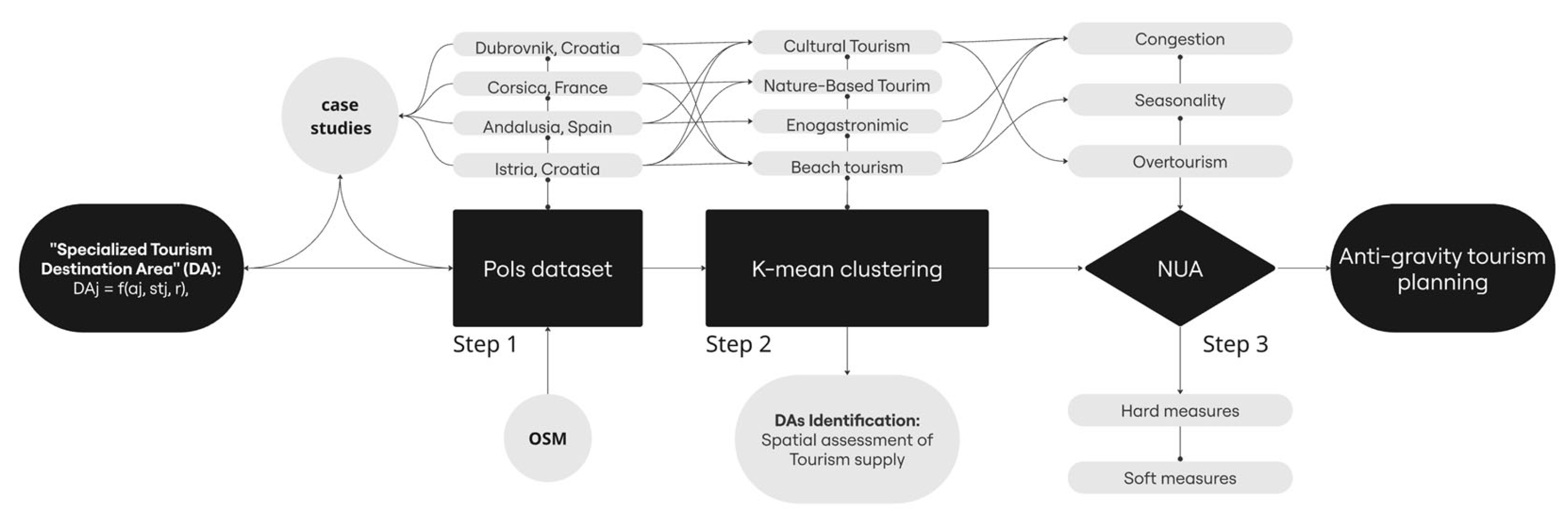
2.1. Step 1: PoIs Dataset and Case Studies
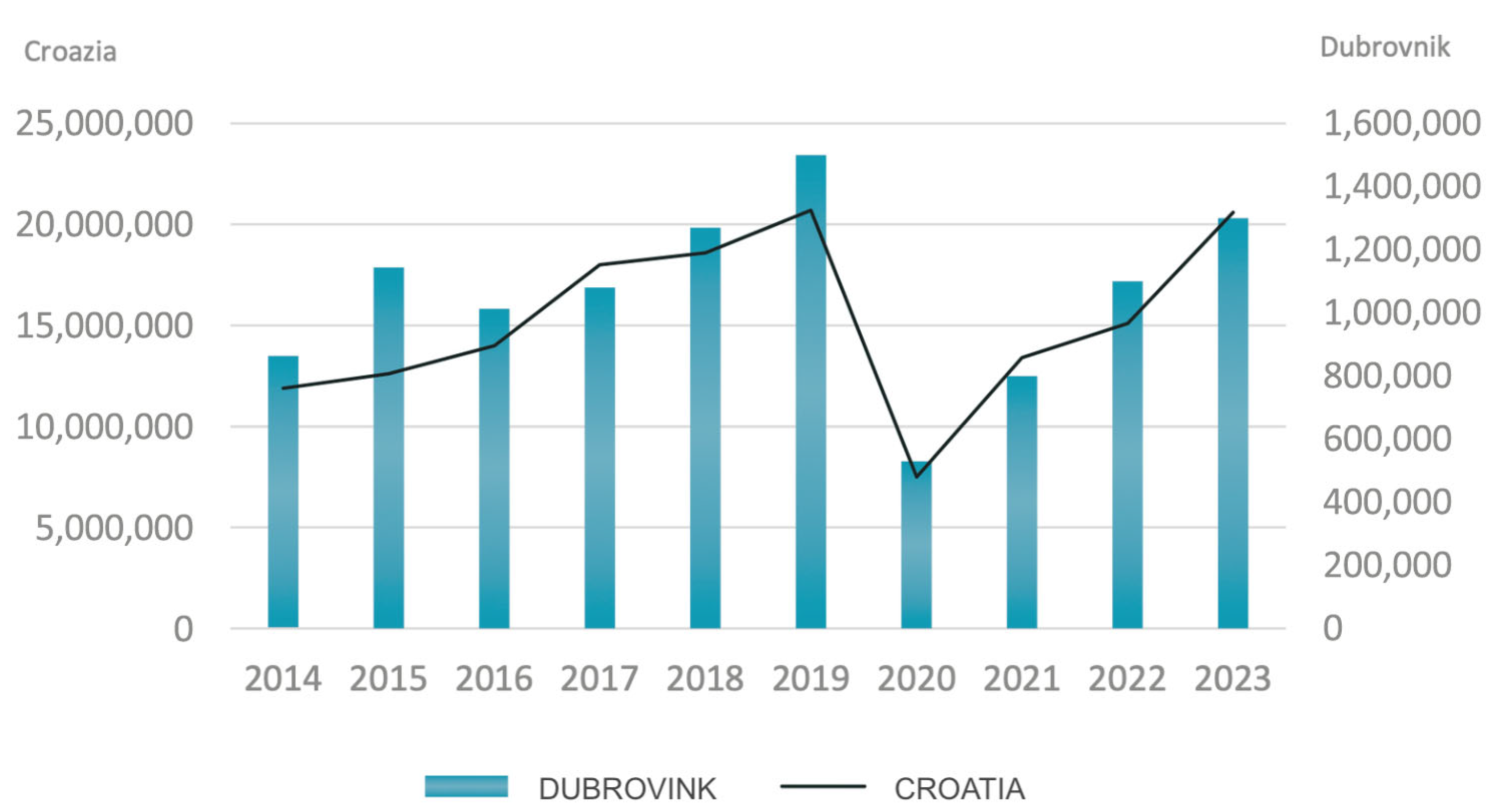
2.1.1. Dubrovnik, Croatia
2.1.2. Corsica, France
2.1.3. Andalusia, Spain
2.1.4. Istria, Croatia
2.2. Step 2: K-Mean Cluster Analysis
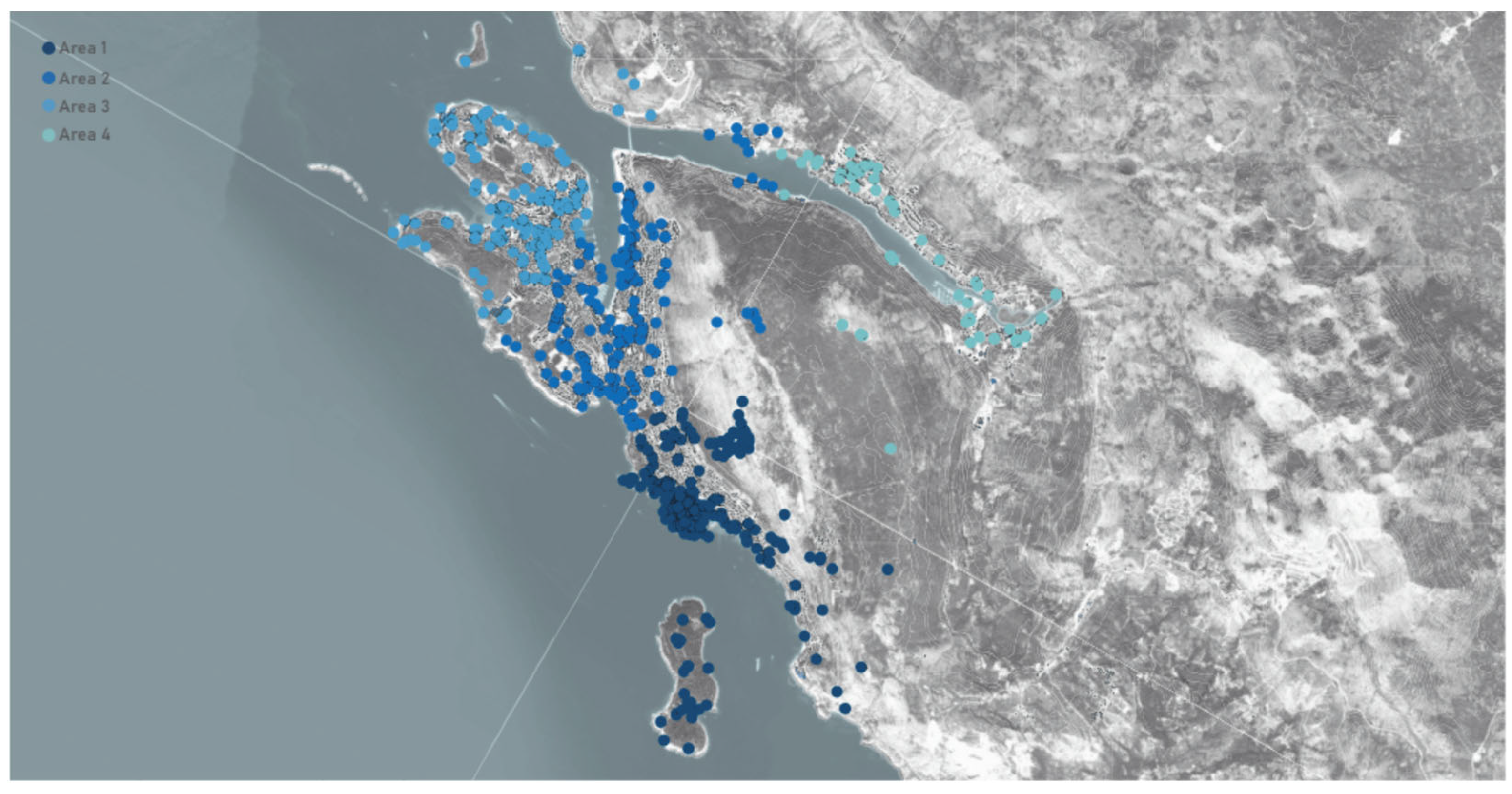
2.2.1. Dubrovnik, Croatia
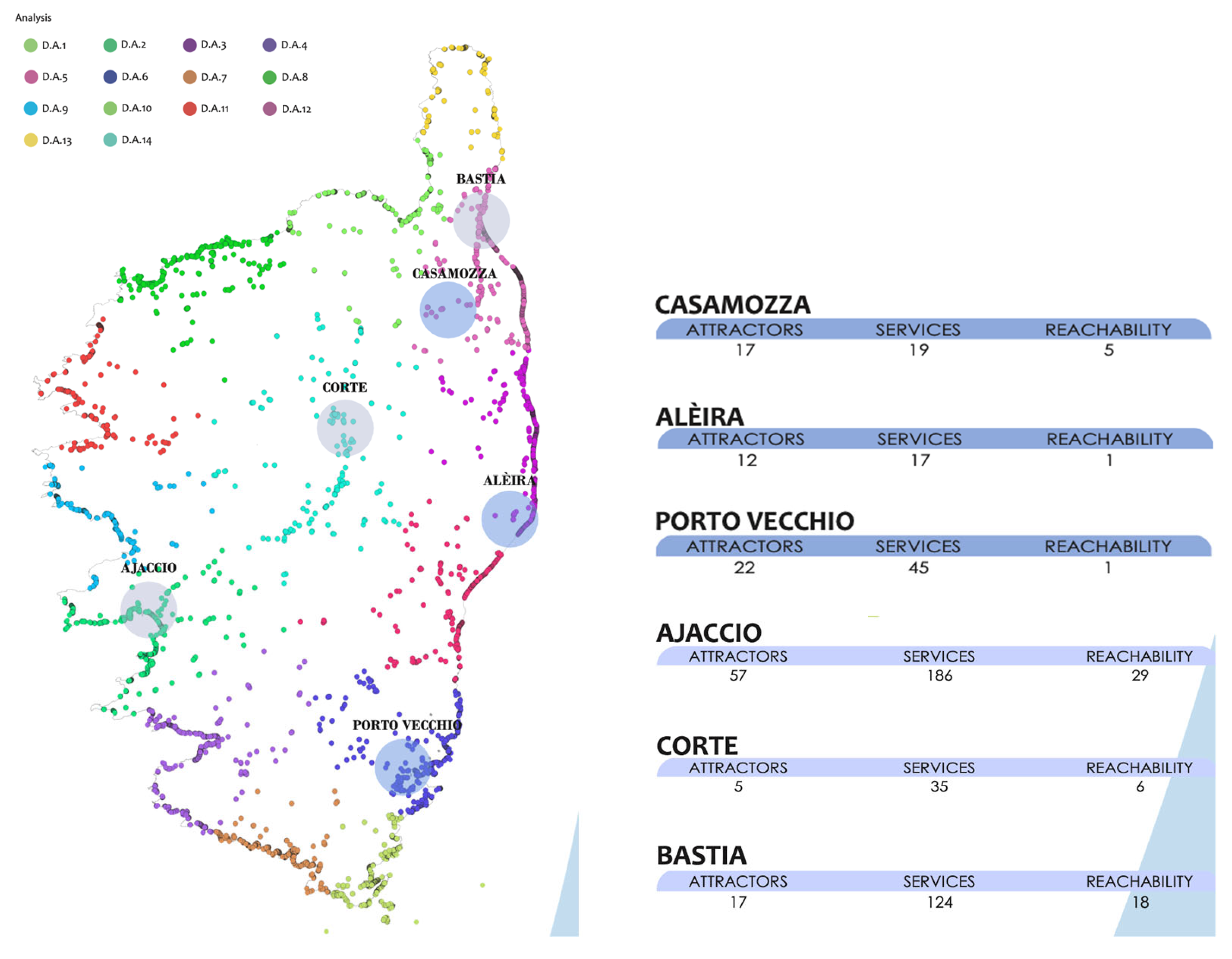
2.2.2. Corsica, France
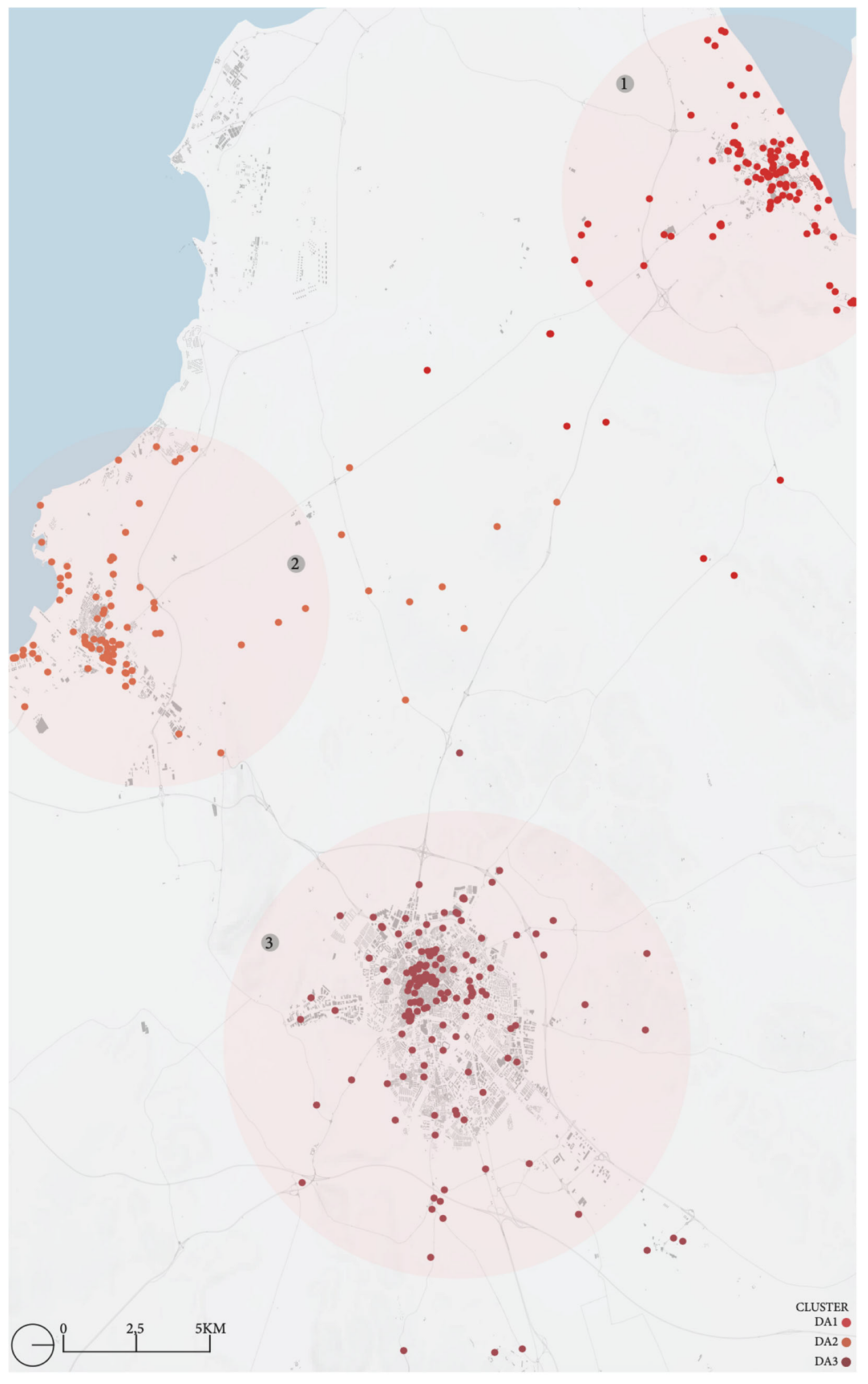
2.2.3. Andalusia, Spain
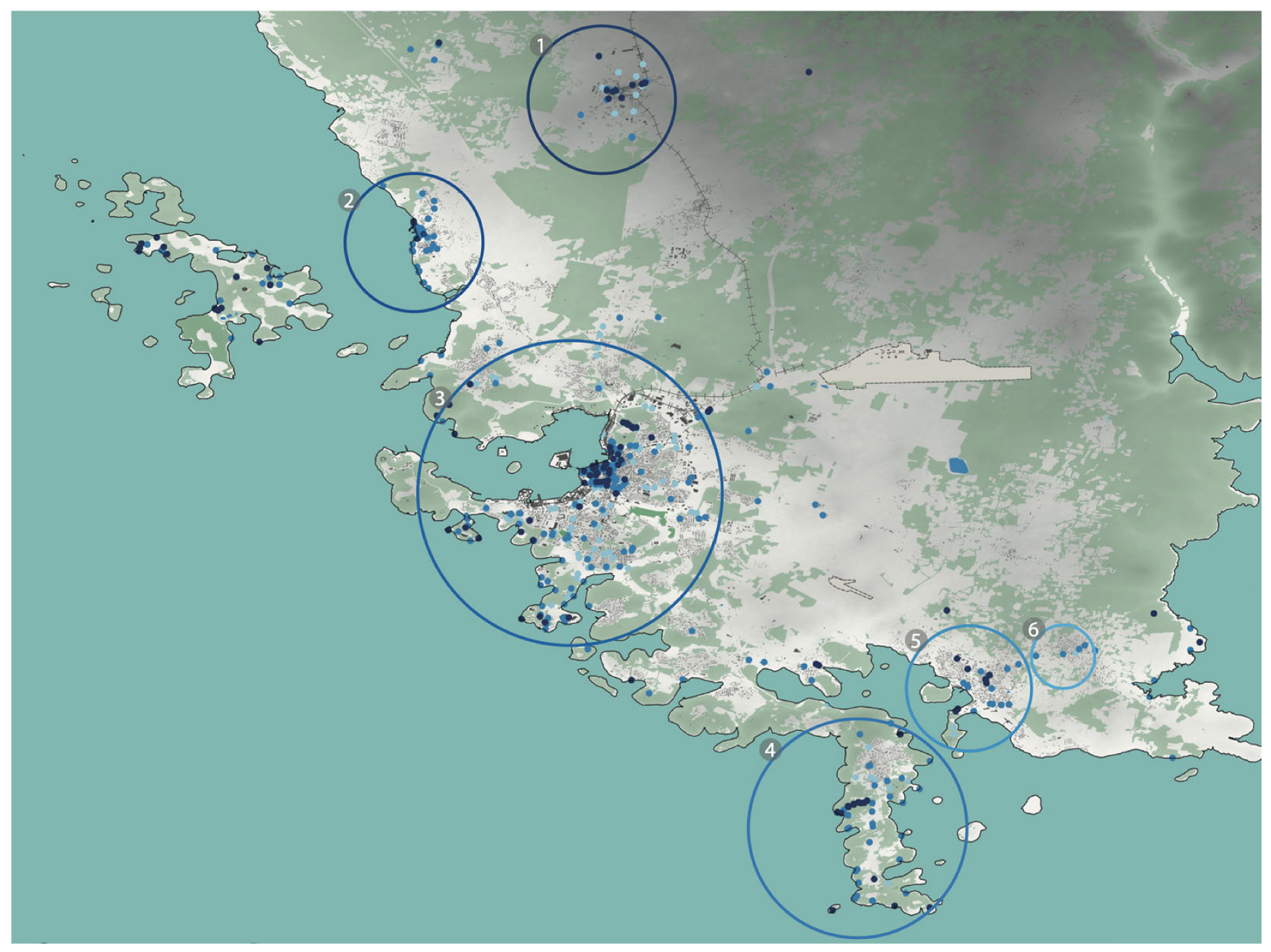
2.2.4. Istria, Croatia
2.3. Step 3: NUA Compliance
2.3.1. Dubrovnik, Croatia
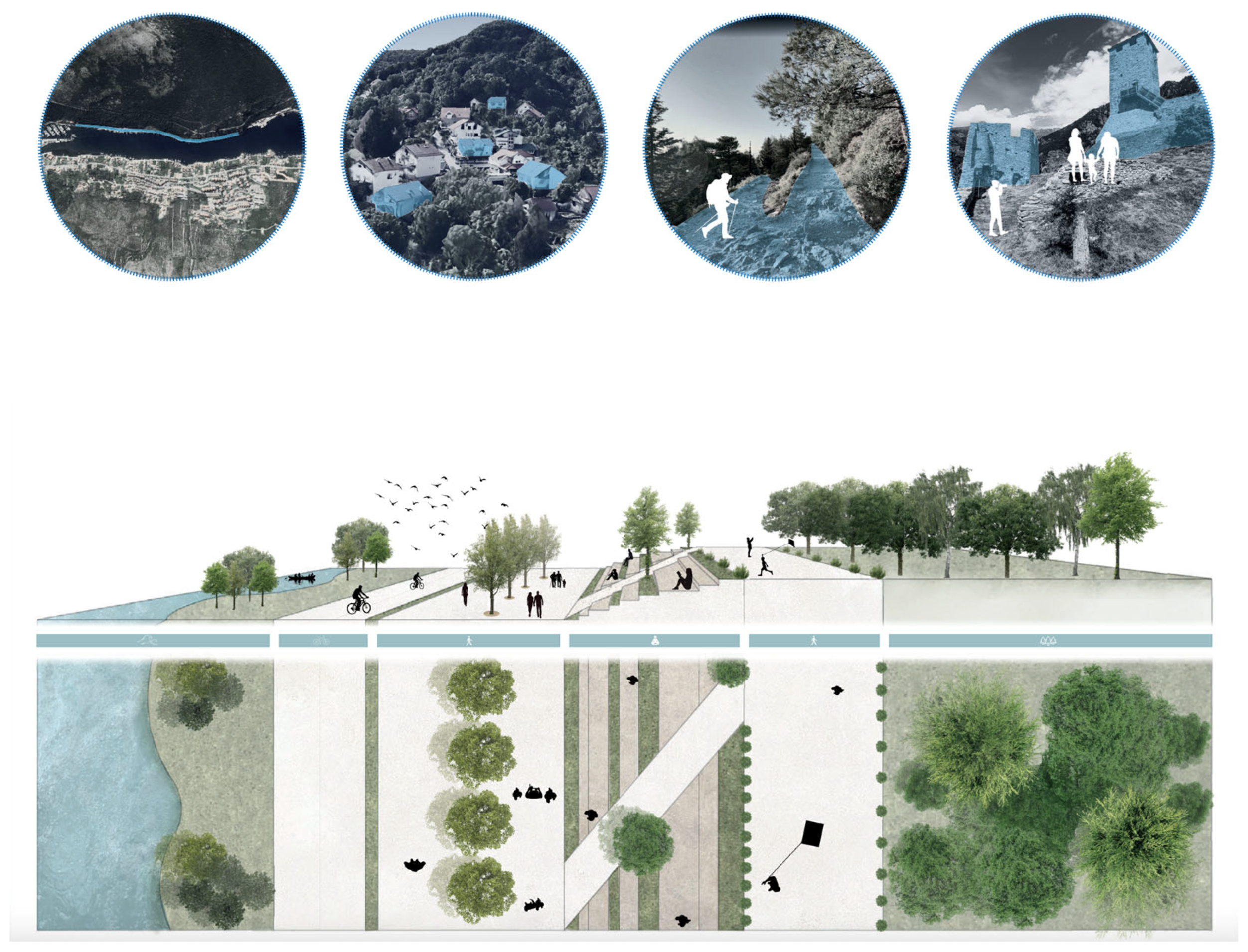
- Design of a continuous pedestrian and cycling route along the Ombla River to connect natural and urban environments, expanding leisure and recreation spaces.
- Conversion of vernacular houses and historic structures into eco-accommodations, supporting both heritage conservation and community-based tourism.
- Restoration of historic fortifications to host cultural programs, artisan residencies, and immersive events that interpret local identity.
- Improvement and safety upgrade of nature trails to encourage soft mobility and outdoor tourism experiences.
2.3.2. Corsica, France
2.3.3. Andalusia, Spain
2.3.4. Istria, Croatia
- -
- Reducing seasonality: broadening the temporal scope of tourism by promoting year-round cultural programming. Initiatives such as a Winter Festival (November–February), music performances, and artistic events are intended to redistribute visitor flows, activate local economies during the low season, and foster continuous community engagement.
- -
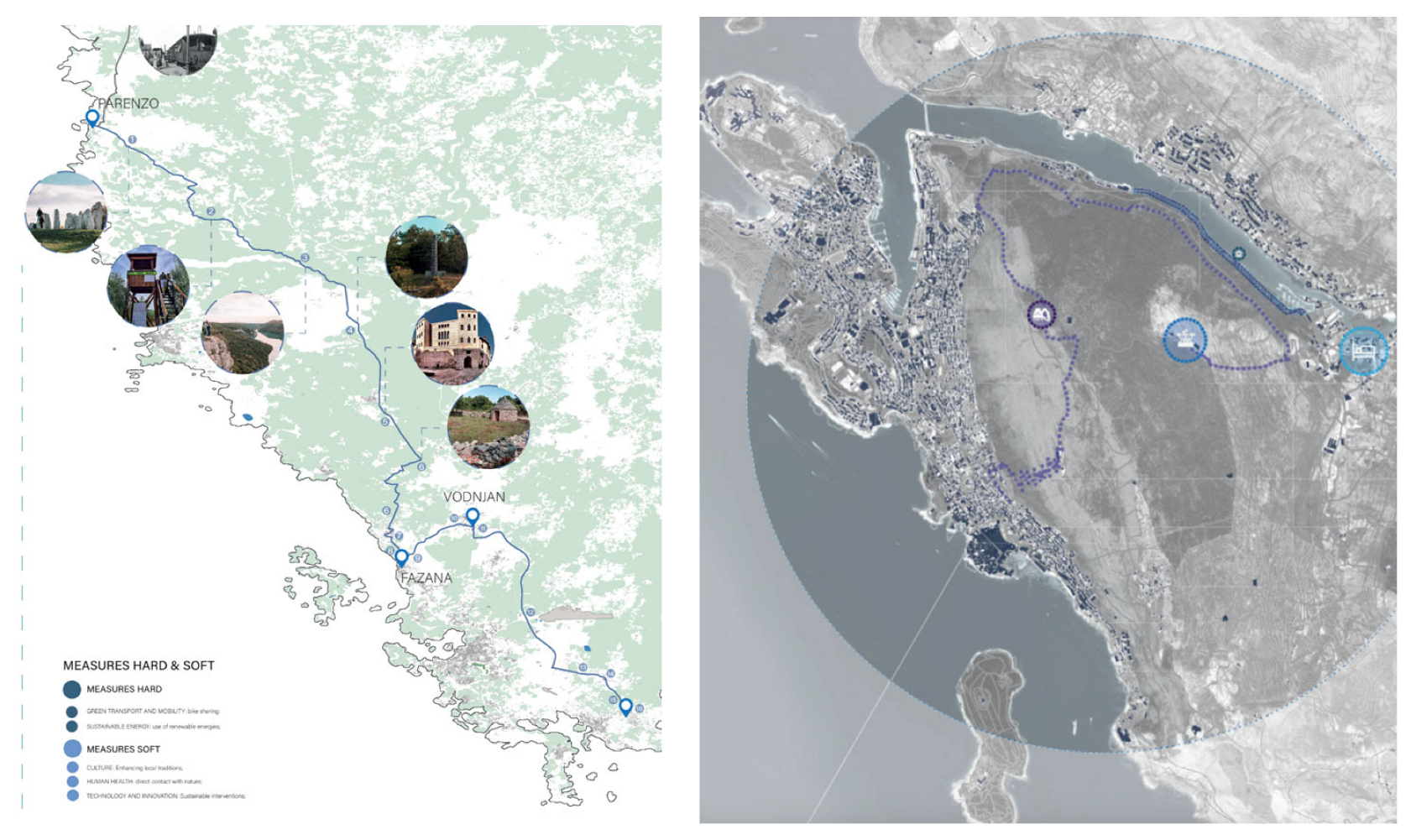
- Enhancing connectivity and regional cohesion: improving transport and mobility infrastructure through the revitalization of the historic Parenzana cycle route (123 km linking Trieste and Poreč). This intervention reinterprets the former railway as a slow-mobility corridor connecting coastal and inland areas, thereby integrating less-developed destinations into the broader tourism network.
- -
- Encouraging innovative and sustainable hospitality models: advancing forms of tourism rooted in soft mobility and immersive experiences. The inclusion of eco-glamping units within natural landscapes targets cycling and nature-oriented visitors, offering high-comfort, low-impact accommodation equipped with wellness facilities and bike-support services.
3. Discussions
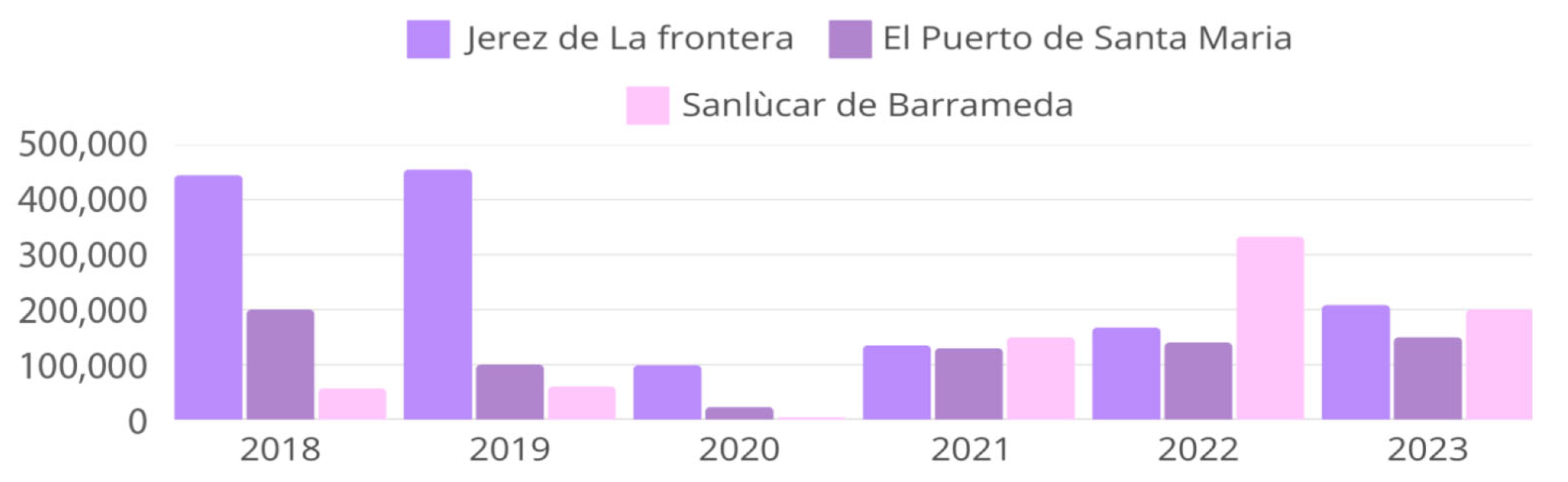
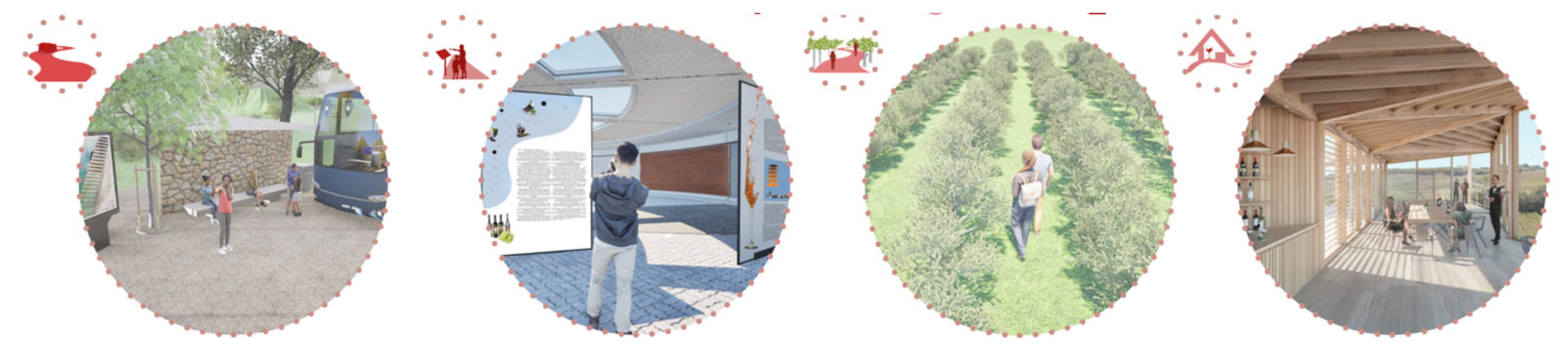
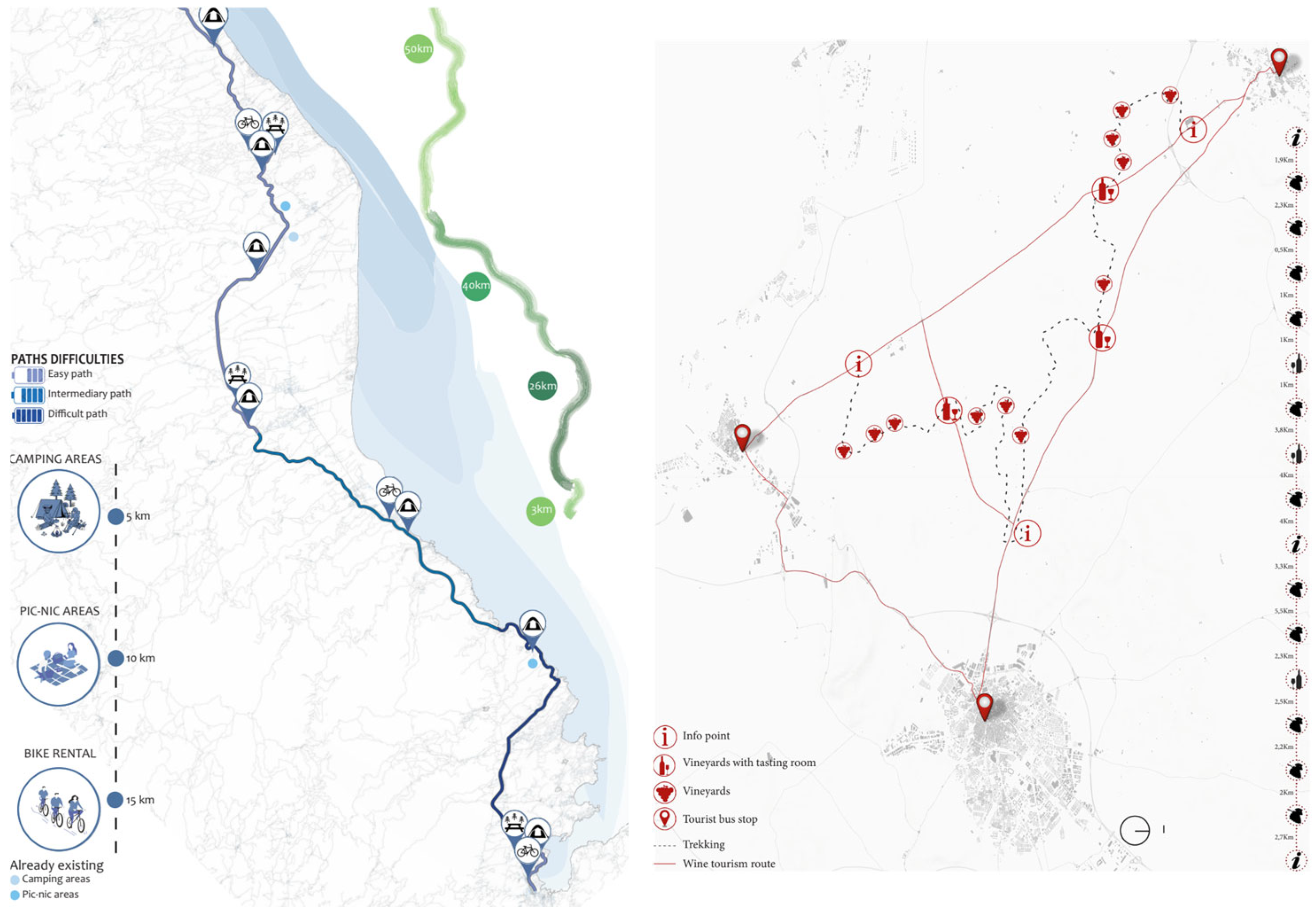
- The wine-tourism network in Andalusia (Spain) exemplifies this shift by strengthening transport connections between Jerez de la Frontera, El Puerto de Santa María, and Sanlúcar de Barrameda, while also enhancing slow mobility through vineyard routes and tasting facilities. This dual approach reduces territorial inequalities and reinforces the cultural value of the region’s landscape.
- In Dubrovnik (Croatia), the decentralization project in the DA of Canal D’Ombra addresses the problem of congestion in the Old Town by promoting eco-sustainable accommodation, reusing historic buildings, and creating thematic cultural itineraries. The aim is to redistribute visitor flows and integrate peripheral areas into the main tourism circuit.
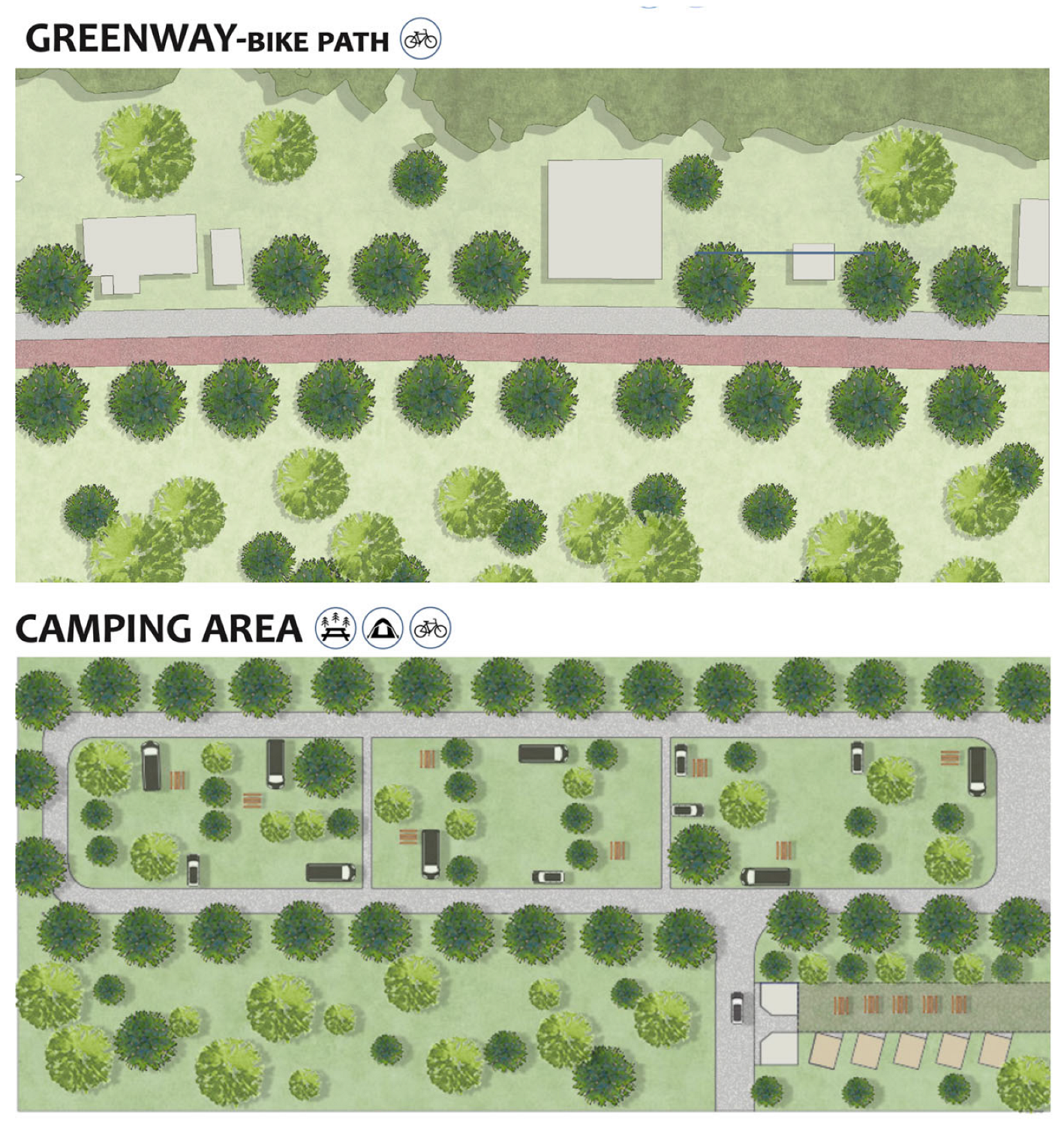
- The Corsican greenway project converts the disused Bastia–Porto Vecchio railway into a sustainable mobility corridor, introducing cycling and pedestrian paths with rest areas and e-bike rentals. By diversifying the tourism offer beyond the summer peak and beach monoculture, the project creates an all-season attraction that supports local economies while encouraging slow tourism.
- Finally, in Istria (Croatia), the upgrading of the Parenzana cycling route and the creation of innovative accommodation models such as glamping units contribute to de-seasonalization, promoting cultural events in the low season and offering high-quality services for cycling tourists. These actions strengthen regional connectivity and position Istria as a year-round tourism destination.
4. Conclusions
- It invites further testing across different geographical and governance contexts, to assess scalability and flexibility.
- It offers a lens for integrating tourism planning into broader regional development policies also assessing effects of post pandemic recovery.
- It encourages to deep tourism studies in a spatial planning perspective.
Author Contributions
Funding
Institutional Review Board Statement
Informed Consent Statement
Data Availability Statement
Conflicts of Interest
References
- World Travel&Tourism Council. Travel & Tourism Economic Impact Research: Global Trends 2025; World Travel & Tourism Council: London, UK, 2025. [Google Scholar]
- Seraj, M.; Ike, O.C.; Ozdeser, H. The Contribution of Tourism on GDP Growth and Sustainable Tourism Development in Africa. Future Bus. J. 2025, 11, 115. [Google Scholar] [CrossRef]
- Portella-Carbó, F.; Pérez-Montiel, J.; Ozcelebi, O. Tourism-Led Economic Growth across the Business Cycle: Evidence from Europe (1995–2021). Econ. Anal. Policy 2023, 78, 1241–1253. [Google Scholar] [CrossRef]
- Casado-Aranda, L.A.; Sánchez-Fernández, J.; Bastidas-Manzano, A.B. Tourism Research after the COVID-19 Outbreak: Insights for More Sustainable, Local and Smart Cities. Sustain. Cities Soc. 2021, 73, 103126. [Google Scholar] [CrossRef] [PubMed]
- Duro, J.A.; Perez-Laborda, A.; Turrion-Prats, J.; Fernández-Fernández, M. COVID-19 and Tourism Vulnerability. Tour. Manag. Perspect. 2021, 38, 100819. [Google Scholar] [CrossRef] [PubMed]
- Haywood, K.M. A Post COVID-19 Future-Tourism Re-Imagined and Re-Enabled. Tour. Geogr. 2020, 22, 599–609. [Google Scholar] [CrossRef]
- Trono, A.; Schmude, J.; Duda, T. Introduction: The Future of Tourism After COVID-19. In Tourism Recovery from COVID-19; Managing Cultural Tourism: A Sustainability Approach; World Scientific: Singapore, 2022; Volume 2, pp. 3–13. ISBN 978-981-12-6023-0. [Google Scholar]
- Metaxas, T.; Gavriilidis, G. Marketing Policies in Public Museums of Greece: Empirical Evidence and Implications for Policy. Urban Sci. 2025, 9, 351. [Google Scholar] [CrossRef]
- Kowalczyk-Anioł, J. Rethinking Tourism-Driven Urban Transformation and Social Tourism Impact: A Scenario from a CEE City. Cities 2023, 134, 104178. [Google Scholar] [CrossRef]
- Mason, P. Tourism Impacts, Planning and Management; Routledge: London, UK, 2020; ISBN 0429273541. [Google Scholar]
- Rossello-Geli, J. Tourism-Related Gentrification: The Case of Sóller (Mallorca). Urban Sci. 2025, 9, 246. [Google Scholar] [CrossRef]
- Dorta-Preen, J.M.; Santana-Talavera, A. Shaping Places Together: The Role of Social Media Influencers in the Digital Co-Creation of Destination Image. Urban Sci. 2025, 9, 262. [Google Scholar] [CrossRef]
- Buckley, R. Sustainable Tourism: Research and Reality. Ann. Tour. Res. 2012, 39, 528–546. [Google Scholar] [CrossRef]
- Smith, M.; Ram, Y. Tourism, Landscapes and Cultural Ecosystem Services: A New Research Tool. Tour. Recreat. Res. 2017, 42, 113–119. [Google Scholar] [CrossRef]
- Raevskikh, E. Anticipating the “Bilbao Effect”: Transformations of the City of Arles before the Opening of the Luma Foundation. Cities 2018, 83, 92–107. [Google Scholar] [CrossRef]
- Brandano, M.G.; Crociata, A. Cohesion Policy, Tourism and Culture in Italy: A Regional Policy Evaluation. Reg. Stud. 2023, 57, 763–779. [Google Scholar] [CrossRef]
- Rebollo, J.F.V.; Baidal, J.A.I. Measuring Sustainability in a Mass Tourist Destination: Pressures, Perceptions and Policy Responses in Torrevieja, Spain. J. Sustain. Tour. 2003, 11, 181–203. [Google Scholar] [CrossRef]
- Herman, G.V.; Bucur, L.; Filimon, C.A.; Herman, M.L.; Nistor, S.; Tofan, G.-B.; Stupariu, M.; Bacter, R.V.; Caciora, T. Exploring the Relationships Between Bicycle Paths and Urban Services in Oradea, Romania. Urban Sci. 2025, 9, 373. [Google Scholar] [CrossRef]
- Dodds, R.; Butler, R. The Phenomena of Overtourism: A Review. Int. J. Tour. Cities 2019, 5, 519–528. [Google Scholar] [CrossRef]
- Buitrago, E.M.; Yñiguez, R. Measuring Overtourism: A Necessary Tool for Landscape Planning. Land 2021, 10, 889. [Google Scholar] [CrossRef]
- Pasquinelli, C.; Trunfio, M. Reframing Urban Overtourism through the Smart-City Lens. Cities 2020, 102, 102729. [Google Scholar] [CrossRef]
- Alonso-Almeida, M.-M.; Borrajo-Millán, F.; Yi, L. Are Social Media Data Pushing Overtourism? The Case of Barcelona and Chinese Tourists. Sustainability 2019, 11, 3356. [Google Scholar] [CrossRef]
- Duro, J.A.; Turrión-Prats, J. Tourism Seasonality Worldwide. Tour. Manag. Perspect. 2019, 31, 38–53. [Google Scholar] [CrossRef]
- Cannas, R. An Overview of Tourism Seasonality: Key Concepts and Policies. Almatourism—J. Tour. Cult. Territ. Dev. 2012, 3, 40–58. [Google Scholar]
- Stojčić, N.; Mikulić, J.; Vizek, M. High Season, Low Growth: The Impact of Tourism Seasonality and Vulnerability to Tourism on the Emergence of High-Growth Firms. Tour Manag. 2022, 89, 104455. [Google Scholar] [CrossRef]
- Espinet-Rius, J.M.; García-Sánchez, A.; Gassiot-Melian, A. Seasonality in the Cruise Industry: Activity, Prices and Regionality. Eur. J. Tour. Res. 2024, 38, 3810. [Google Scholar] [CrossRef]
- Bei, G.; Celata, F. Challenges and Effects of Short-Term Rentals Regulation: A Counterfactual Assessment of European Cities. Ann. Tour. Res. 2023, 101, 103605. [Google Scholar] [CrossRef]
- Scherk, J. Antigravity: A crazy idea? Phys. Lett. B 1979, 88, 265–267. [Google Scholar] [CrossRef]
- Nieto, M.M.; Goldman, T. The Arguments against “Antigravity” and the Gravitational Acceleration of Antimatter. Phys. Rep. 1991, 205, 221–281. [Google Scholar] [CrossRef]
- Chen, Y.; Zhang, F.; Qian, Y.; Zeng, J.; Li, X. A New Car-Following Model Considering the Driver’s Dynamic Reaction Time and Driving Visual Angle on the Slope. Phys. A Stat. Mech. Its Appl. 2025, 663, 130408. [Google Scholar] [CrossRef]
- Bars, I.; James, A. Physical interpretation of antigravity. Phys. Rev. D 2016, 93, 044029. [Google Scholar] [CrossRef]
- UNhabitat. The New Urban Agenda; Unhabitat: Nairobi, Kenya, 2016; ISBN 9789211328691. [Google Scholar]
- Gatto, R.V.; Corrado, S.; Scorza, F. Towards a Definition of Tourism Ecosystem. In Proceedings of the 18th International Forum on Knowledge Asset Dynamics (IFKAD)-Managing Knowledge for Sustainability, Matera, Italy, 16 June 2023; 2023. [Google Scholar]
- Anselin, L.; Syabri, I.; Kho, Y. GeoDa: An Introduction to Spatial Data Analysis. Geogr. Anal. 2006, 38, 5–22. [Google Scholar] [CrossRef]
- Anselin, L.; Syabri, I.; GeoDa, K.Y. An Introduction to Spatial Data Analysis. In Handbook of Applied Spatial Analysis: Software Tools, Methods and Applications; Fischer Manfred, M., Getis, A., Eds.; Springer: Berlin/Heidelberg, Germany, 2010; pp. 73–89. ISBN 978-3-642-03647-7. [Google Scholar]
- Anselin, L.; Li, X.; Koschinsky, J. GeoDa, From the Desktop to an Ecosystem for Exploring Spatial Data. Geogr. Anal. 2022, 54, 439–466. [Google Scholar] [CrossRef]
- Alcántara-Rubio, L.; Valderrama-Hernández, R.; Solís-Espallargas, C.; Ruiz-Morales, J. The implementation of the SDGs in universities: A systematic review. Environ. Educ. Res. 2022, 28, 1585–1615. [Google Scholar] [CrossRef]
- Huda, S.S.M.S. Potential of Neighborhood Tourism in New Normal: A Research Agenda. Sustain. Communities 2024, 1, 2371578. [Google Scholar] [CrossRef]
- Scorza, F.; Casas, G.L.; Murgante, B.; Las Casas, G.B.; Scorza, F.; Murgante, B.; Las Casas, G.; Murgante, B. Overcoming Interoperability Weaknesses in E-Government Processes: Organizing and Sharing Knowledge in Regional Development Programs Using Ontologies. In Organizational, Business, and Technological Aspects of the Knowledge Society; Springer: Berlin/Heidelberg, Germany, 2010; Volume 112, pp. 243–253. ISBN 3642163238. [Google Scholar]
- Hall, P.; Pain, K. The Polycentric Metropolis; Routledge: London, UK, 2012; ISBN 9781136547690. [Google Scholar]
- Meijers, E. Measuring Polycentricity and Its Promises. Eur. Plan. Stud. 2008, 16, 1313–1323. [Google Scholar] [CrossRef]
- Scorza, F.; Gatto, R.V. Identifying Territorial Values for Tourism Development: The Case Study of Calabrian Greek Area. Sustainability 2023, 15, 5501. [Google Scholar] [CrossRef]


Disclaimer/Publisher’s Note: The statements, opinions and data contained in all publications are solely those of the individual author(s) and contributor(s) and not of MDPI and/or the editor(s). MDPI and/or the editor(s) disclaim responsibility for any injury to people or property resulting from any ideas, methods, instructions or products referred to in the content. |
© 2025 by the authors. Licensee MDPI, Basel, Switzerland. This article is an open access article distributed under the terms and conditions of the Creative Commons Attribution (CC BY) license (https://creativecommons.org/licenses/by/4.0/).
Share and Cite
Gatto, R.V.; Scorza, F. “Anti-Gravity Tourism Planning”: An Analytical Approach to Manage Tourism Congestion, Seasonality and Overtourism. Urban Sci. 2025, 9, 524. https://doi.org/10.3390/urbansci9120524
Gatto RV, Scorza F. “Anti-Gravity Tourism Planning”: An Analytical Approach to Manage Tourism Congestion, Seasonality and Overtourism. Urban Science. 2025; 9(12):524. https://doi.org/10.3390/urbansci9120524
Chicago/Turabian StyleGatto, Rachele Vanessa, and Francesco Scorza. 2025. "“Anti-Gravity Tourism Planning”: An Analytical Approach to Manage Tourism Congestion, Seasonality and Overtourism" Urban Science 9, no. 12: 524. https://doi.org/10.3390/urbansci9120524
APA StyleGatto, R. V., & Scorza, F. (2025). “Anti-Gravity Tourism Planning”: An Analytical Approach to Manage Tourism Congestion, Seasonality and Overtourism. Urban Science, 9(12), 524. https://doi.org/10.3390/urbansci9120524