Article

Quantifying Urban Ecosystem Services for Community-Level Planning: A Machine Learning Framework for Service Quality and Residents’ Perceptions in Wuhan, China


1
State Key Laboratory of Ocean Sensing & Ocean College, Zhejiang University, Zhoushan 316021, China
2
Suzhou Laboratory, Suzhou 215000, China
3
School of Statistics and Mathematics, Zhongnan University of Economics and Law, 182 Nanhu Avenue, Wuhan 430073, China
*
Author to whom correspondence should be addressed.
Urban Sci. 2025, 9(11), 449; https://doi.org/10.3390/urbansci9110449
Submission received: 6 August 2025 / Revised: 15 October 2025 / Accepted: 21 October 2025 / Published: 30 October 2025

Abstract

Urban ecosystem services (ESs) are increasingly recognized as critical determinants of residents’ quality of life and well-being. This study develops a data-driven demand–supply matching framework to integrate ES concepts into community-level planning and service performance evaluation. Based on 312 resident surveys across 10 communities in Wuhan, China, we identify the key environmental attributes shaping perceived service quality. A random forest (RF) algorithm is employed to assess the relative importance of environmental features, while a multinomial logit (Mlogit) model quantifies their specific effects. The results highlight that community autonomy, neighborhood relations, environmental awareness, and infrastructure—such as broadband networks and security systems—play pivotal roles in improving service quality. Although provisioning and regulating ESs, such as safety and infrastructure, are relatively well established, cultural services that promote social cohesion and civic participation remain under-supported. These findings uncover the heterogeneity of residents’ environmental expectations and provide actionable insights for incorporating ES-oriented thinking into community planning and fiscal decision-making. By bridging ecological theory with operational urban governance, this study contributes a replicable approach for advancing more inclusive and sustainable community development.

1. Introduction

1.1. Research Background

Community is the basic unit of social life, connecting different actors and involving the development of grassroots democratic politics and the supply of basic public services. It is an important aspect of community residents’ lives and a bridge for transmitting information about the needs of residents, directly affecting the satisfaction, happiness, and security of residents’ lives. In the report of the 19th National Congress, it was proposed to promote the focus of social governance down to the grassroots level, indicating the direction and focus of community governance in the new era. Community management and services, as an important part of community governance, should occupy a pivotal position in current community work. With the rapid development of China’s social economy and changes in the main social contradictions, people’s demand for a better life is growing day by day. Residents of communities pay more attention to their own living standards and quality and have higher expectations and demands for community management and service quality, which are reflected not only in the physical environment but also in management practices, interpersonal dynamics, and other spiritual needs to achieve higher life satisfaction and happiness. Currently, many problems persist in community management and services. For example, management entities such as neighborhood committees, property companies, and owners’ committees have unclear roles, overlapping rights, responsibilities, and interests due to differences in their positions, resources, and actions. The sense of belonging of community residents is weak, and their enthusiasm for participation is low, with community construction remaining primarily government-led.

1.2. Literature Review

1.2.1. Community Environment

The community environment is an important support and measurement index for the quality of life of community residents. The narrow sense of community environment refers only to the ecological green environment of the community, while the broad sense of community environment can be further understood by the research of relevant scholars. The academic community defines the community environment from different dimensions and indicators and focuses on the community environment as follows. First, it pays attention to land use, space form, road traffic, green space, open space, and other elements, which are the most direct factors that affect the community environment [1]. Secondly, scholars such as Panocchia et al. and Cheng et al. believe that attention should be paid to medical facilities in the community. When community residents are equipped with abundant medical resources, the evaluation of the community environment will be more meaningful [2,3]. Finally, research on the food environment near the community is also very important. Lin and Zhang et al. believe that wet markets and hypermarkets are healthy food stores because they can provide a variety of fresh food choices and improve residents’ eating habits [4]. Health issues should be paid more attention when studying the community environment [5].

1.2.2. Quality and Measurement of Community Management

Community management involves managing all the aspects of daily life of community residents in the community, and the standards of community management also involve all aspects of residents’ lives. Community management capabilities include community service provision, residents’ participation, community cultural leadership, community security and conflict adjustment, and community informatization capabilities [6]. Lian et al. believe that paying attention to community governance involves improving the level of community governance service, improving participation in community governance through diversity, paying full attention to the role of community education, and shaping new modes of community communication [7]. Hospers and Meijer proposed that the capacity for community governance should include the autonomy of the community, the engagement of residents, cultural leadership, the supervision of security conflicts, and the capacity for community informatization [8]. Veckalne et al. believe that community service provision should align resident motivations with the resulting outcomes; closing this motivation–outcome gap through integrated facilities and programming improves the quality of cultural and comprehensive services [9]. The frequency with which residents spontaneously visit public service facilities also impacts the quality of community services, providing a new facet to measure community management quality. Cherkesly et al., using the community health service system as a case, believe that the network architecture of community services should be optimized through an integrated framework of coverage–supervision and path [10]. The current multi-management path has been recognized, and good progress has been achieved in the process of actual implementation.

1.2.3. Community Service Quality and Measurement

The quality of community service is more reflected in the supply of community public services, and there is also some research on the service quality of community management departments. Today, remarkable achievements have occurred in the construction of community service quality, but there are still many problems, among which the imbalance of resource supply is an important phenomenon [11]. Sharma et al. proposed that innovations in transformative services (TSIs) foster social and economic sustainability among healthcare resources [12]. In terms of the construction of the related index evaluation system, Kuo et al. believe that the two key factors, the ability of the service team and the reliability of service performance, have been proved to be important for the evaluation of community service quality [13]. Among them, education, safety, and medical condition are also important indicators [14] to evaluate the quality of community service. At the same time, Goethem et al. believe that high-quality community service can significantly affect the physical and mental health of adolescents and improve the residential satisfaction of elderly residents [15]. Lee et al. focused on mobility as a service, incorporating trends in modal-share and ridership, congestion delays, and context variables such as compactness to measure the quality of community service [16].
In summary, research on the community environment and management is steadily increasing, which has enriched the literature and informs the research design of this article. The literature review reveals that the impact of community environment on community management and service quality has not reached a consensus, the empirical research is inusfficient, and the theoretical perspective needs to be continuously expanded. We advance a community-scale demand–supply matching framework that (i) pairs resident needs (safety, connectivity, belonging, co-production, etc.) with UES components (regulating, provisioning, and cultural) at the indicator level and (ii) produces a fit index and a misfit taxonomy and diagnoses demand–supply mismatches in light of person–environment fit. This goes beyond generic delivery–expectation gaps and generic P–E fit by specifying what is matched, how it is measured, and how it explains heterogeneous effects across community types. (iii) The framework operationalizes UESs on the community scale, tests the relative importance of physical versus socio-cultural services for perceived management and service quality, and translates the findings into investment priorities and governance actions to better meet residents’ aspirations for a good life.

2. Materials and Methods

2.1. Research Hypothesis

The person–environment fit theory can be traced back to the Parsons Environment Fit model on career decisions proposed by Parsons. The model holds that matching personal traits with demands of career positions can help individuals to make more correct career choices [17]. With the continuous development and improvement of the connotation of person–environment matching theory, Cable and Derue creatively subdivide complementary matching into demand–ability matching and demand–supply matching. Demand–ability matching refers to the degree to which an individual’s ability meets the environmental needs; demand–supply matching refers to the degree to which an individual’s needs are met in the environment. Different individuals have different needs, and whether environmental capacity and supply can meet the individual’s needs determines the individual’s participation in environmental activities [18]. Building on previous work, Ali examined the role of person–environment (P–E) fit theory in improving teaching satisfaction and subjective well-being, including matching between teachers’ teaching satisfaction and life satisfaction, person–organization, person–job, person–career, person–group, and person–person matching [19]. Padmasiri extended the P–E fit theory to the family domain, including person–job, person–organization, person–group, person–supervisor, and person–family matching [20]. Inoue et al. examined the impact of nurses’ learning and exchange of nursing practices within and outside the hospital on various dimensions of P–E fit (need–supply, demand–ability, person–organization, and person–group fit) [21].
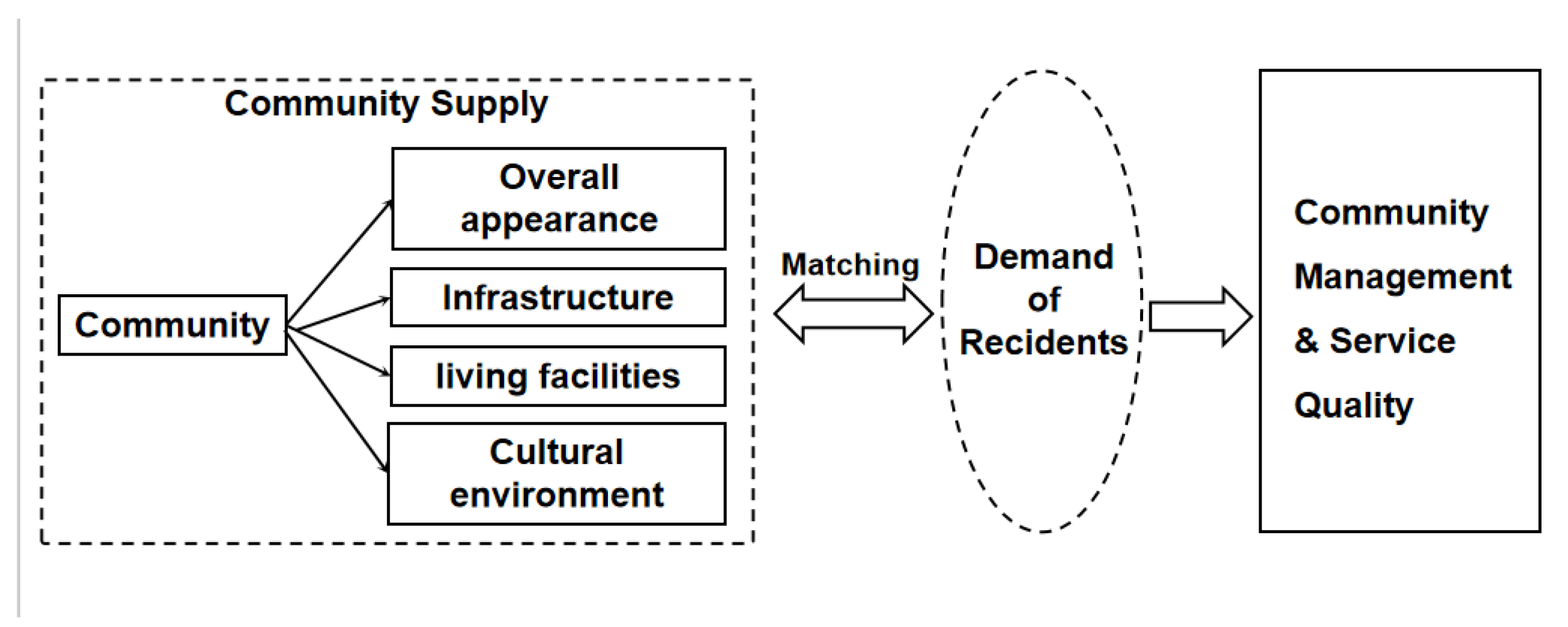
According to demand–supply matching theory, when the needs and preferences of community residents align with the supply of environmental resources, they are better satisfied, which in turn promotes their enthusiasm for participating in organizational activities and community construction. In community life, the construction of all aspects of the community environment constitutes a resource supply provided by the community itself, and residents also have strong material and socio-spiritual needs for high-quality community environmental construction so as to enjoy better community management and services and to improve the quality of life. When community actors meet residents’ needs through targeted measures, those needs more closely match the community’s supply capacity, thereby prompting residents to provide a higher evaluation of community governance and services. The specific theoretical analysis framework is shown in Figure 1. Based on this, the following research hypothesis is proposed:
Hypothesis 1 (H1).
Community environment can positively affect community management and service quality. The better the community’s environmental construction, the higher community residents’ evaluations of community management and service quality.
Hypothesis 2 (H2).
Community residents place greater emphasis on the construction of the community cultural environment, and the cultural environment has a greater impact on community management and service quality than the physical environment.

2.2. Data Sources

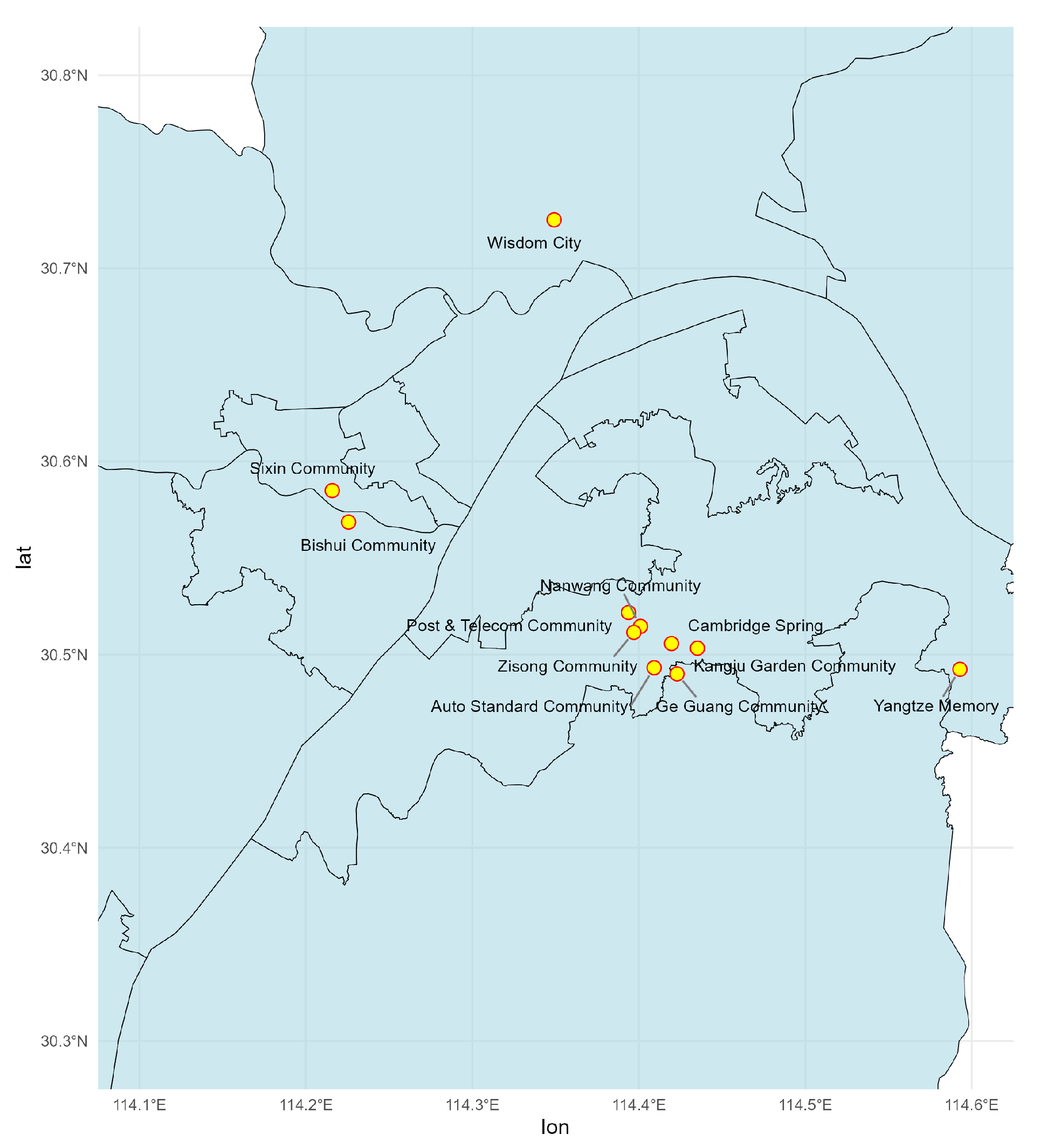
The research data comes from the questionnaire survey on “community environment and community governance and service” randomly conducted in 10 communities in Wuhan in 2020. The research sample is Wuhan community residents, and the data is mainly collected through a combination of online and offline questionnaires. Taking into account the representativeness of the samples and the differences in regions and community types, the survey areas include Hongshan District and Hanyang District (as shown in Figure 2), and the survey includes five major community types: commercial housing, unit housing, urban villages, urban-rural integration, and new countryside (Table A1).
A total of 400 questionnaires were sent out in this survey, and 371 were recovered, with a recovery rate of 92.75%. Following our pre-specified quality-control rules (for example, exclusion of questionnaires that selected the same option across all items or with excessive item non-response), a total of 312 valid questionnaires were obtained after the 59 questionnaires were excluded. Full questionnaire wording, coding, and quality-control rules are provided in Table A2 and Supplementary Materials.

2.3. Construction of Variables

Building upon the preceding analysis of the optimization path, this section further operationalizes the core constructs within the urban ecosystem services (UESs) framework to quantitatively examine how different community environmental attributes influence governance and service quality. The explained variable is community management and service quality, which comes from the question “community governance and service effect evaluation” in the questionnaire survey. The corresponding options include “no effect, not very good, average, relatively good, very good”, and the corresponding value ranges from 1 to 5. The higher the value, the higher the community residents think the quality of community governance and service. Within the UES framework, the explanatory variable is the community environment, which is divided into 4 levels: overall appearance, infrastructure, living facilities, and cultural environment, with 18 secondary indicators, and the corresponding question options are set as “very poor, poor, average, good, very good”, with the value ranging from 1 to 5. The overall appearance includes community planning (CP), community health (CH), community civilization and culture (CCC), and participatory management democracy (PGD); infrastructure includes fiber to the home (FTTH), parking conditions (PKC), property management (PRM), and security monitoring (CCTV); living facilities include kindergarten (KGN), nursing home (NHM), hypermarket (HMS), community medical station (CMedS), and community activity room (CARm); cultural environment includes neighborhood relationship (NR), residents’ social participation (SPR), community organization leadership (COL), residents’ self-government (SGP), and the relationship between residents and community (RCR). The specific variable construction methods and descriptive statistics are shown in Table 1.

2.4. Research Methods

2.4.1. Random Forest Model

Random forest (RF) is an ensemble learning algorithm proposed by Breiman (2001) [22]. It builds multiple decision trees on bootstrap samples and aggregates their predictions. Each tree is grown by recursive partitioning with random feature subsampling at each split, helping to reduce variance and correlation among trees.
The importance of the feature k can be measured by the average decrease in node impurity attributed to that feature across all trees. Here, we adopt the Gini index as the benchmark.
P k = i = 1 n j = 1 t i D k i j k = 1 18 i = 1 n j = 1 t i D k i j × 100 %
where P k ( k = 1 , 2 , , 18 ) denotes the relative importance of the feature k, n is the number of trees, t i is the number of nodes in the tree i, and D k i j is the decrease in impurity (reduction in the Gini index) contributed by the feature k at node j of tree i.

2.4.2. Ordered Logit Model

Given that residents’ evaluation of community management and service quality was measured using a five-point Likert scale (1 = “no effect”; 5 = “very good”), the dependent variable is ordinal in nature. To appropriately handle this ordered but discrete outcome, an ordered logit (Ologit) model was employed as the primary specification. This model avoids the bias that may arise from treating ordinal outcomes as continuous variables. Based on this, the ordered logit model is selected as the primary specification. The model is expressed as
CMSQ i = β 0 + β 1 CP i + β 2 CH i + β 3 CCC i + + β i X i + μ i
where C M S Q i is the evaluation of the respondent i on community management and service quality; β 0 is the intercept term; β i is the parameter vector to estimate; CP, CH, etc., are the acronyms of the names of the independent variables; X i is the characteristic variable of the respondent i, including sex, age, marital status, occupation, monthly income, household population, household income, household expenses, and living area; and μ i is the random error term.

2.4.3. Mlogit Model

Therefore, the multinomial logit (Mlogit) model was selected for analysis. The idea is that residents assign service-quality scores by comparing the utility of each environmental factor with others in the community. The model is specified as follows:
ln P i j P i 1 = α j + β 1 CP i j + β 2 j CH i j + β 3 j CCC i j + + β i j X i j + δ i j
where P i j is the probability that the respondent i selects category j ( j = 2 , , 5 ), with category 1 as the base; α j is the alternative-specific constant; β j k are coefficients for factor k in category j; CP, CH, etc., are the 16 community environmental indicators; and δ i j is the error term. Coefficients are typically interpreted in terms of odds ratios.

2.5. Comparative Model Strategy

For comprehensive interpretability, three model specifications—RF, Ologit, and Mlogit—were jointly applied in a triangulated analytical framework. The RF model identifies the most influential environmental variables in a data-driven non-parametric manner. The Ologit model captures the ordered structure of residents’ evaluations, providing interpretable odds ratios for key predictors. The Mlogit model further examines category-specific heterogeneity to validate the robustness of results and detect potential non-proportional effects. Additionally, an Ordinary Least Squares (OLS) model was estimated as a cardinal approximation, facilitating comparability of effect direction and relative magnitude across specifications. The triangulated approach ensures that the statistical findings are robust and interpretable, effectively linking environmental characteristics with residents’ subjective assessments of community service quality.

3. Results

3.1. Parameter Setting of Random Forest Model

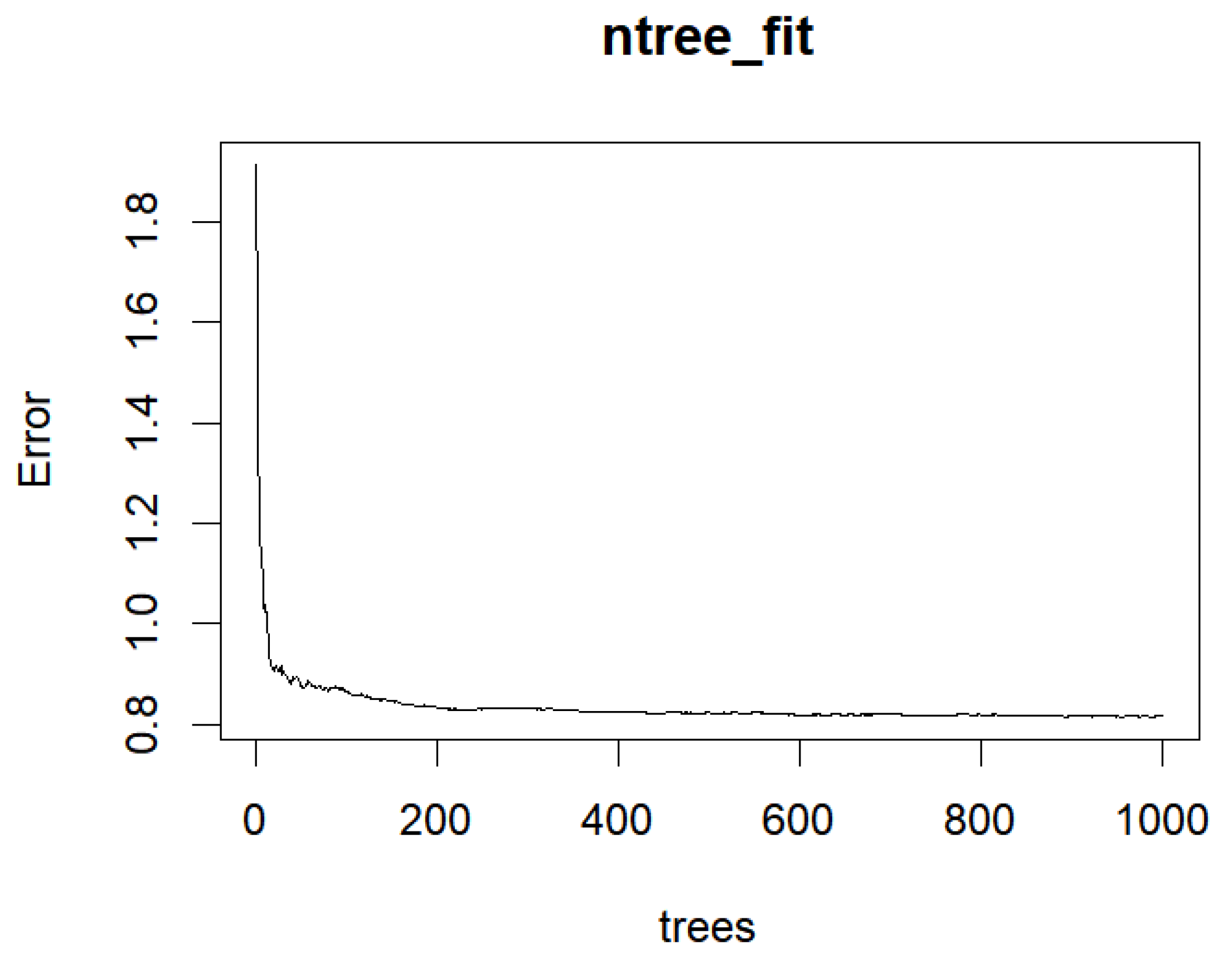
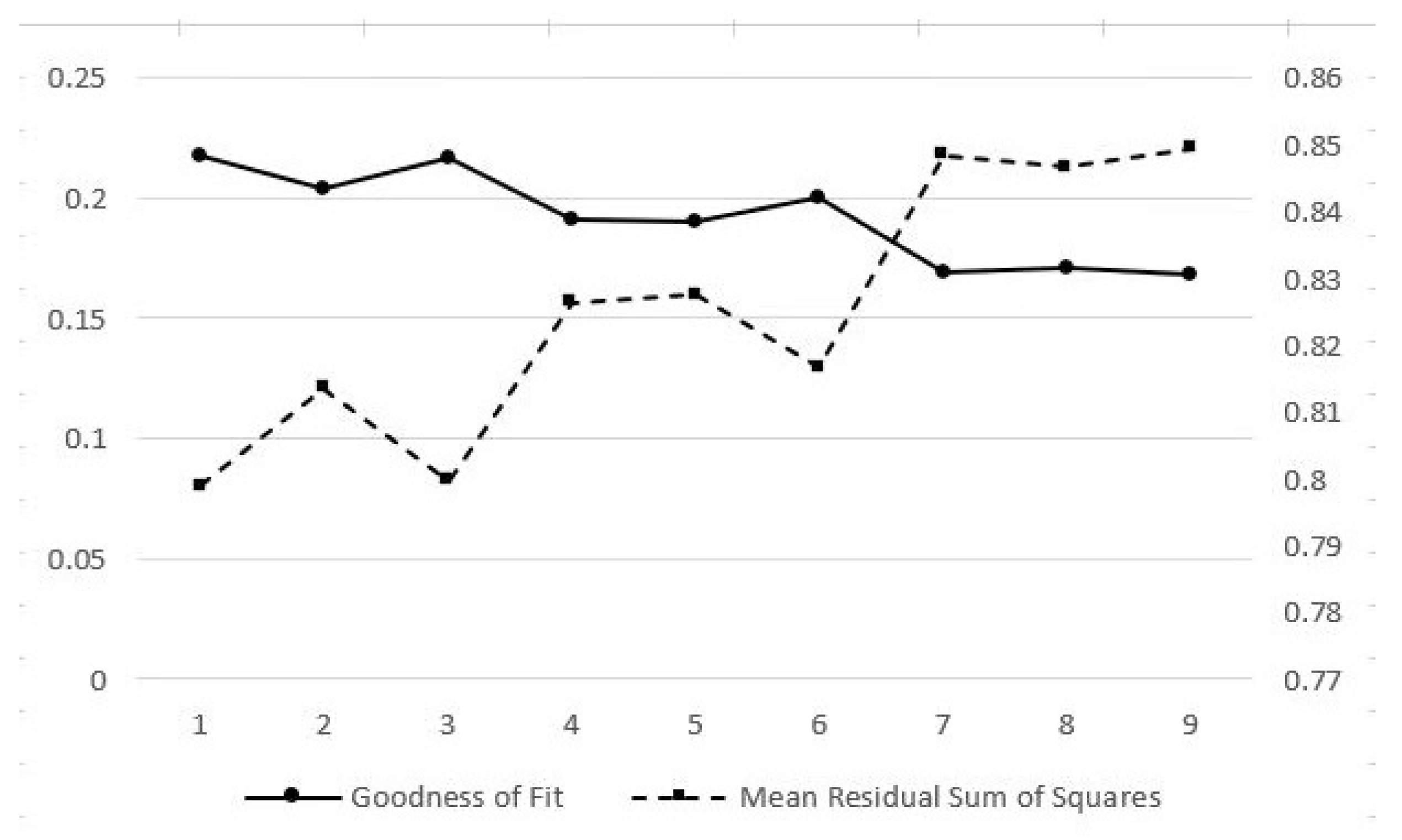
Based on Andy Liaw’s experience in determining the number of features sampled as split candidates at each node (mtry) when implementing the RF algorithm [23], the prediction performance of the RF algorithm is better when m t r y = p / 3 , where p is the number of variables introduced into the model; therefore, the initial value of m t r y was set to 6. We then plotted the change in out-of-bag (OOB) error as the number of trees increased to identify the optimal number of trees ( N t r e e ). It can be seen from Figure 3 that the OOB error curve stabilizes around 200. This paper further sets N t r e e at 200 and observes the changes in the goodness-of-fit and residual sum of squares as m t r y gradually increases from 1 to 9. It can be seen from Figure 4 that when m t r y = 1 , the model achieves the smallest mean squared error of OOB and the best predictive performance; therefore, m t r y = 1 was selected as the optimal value.

3.2. Importance Identification of Community Management and Service Quality

3.2.1. Benchmark Results

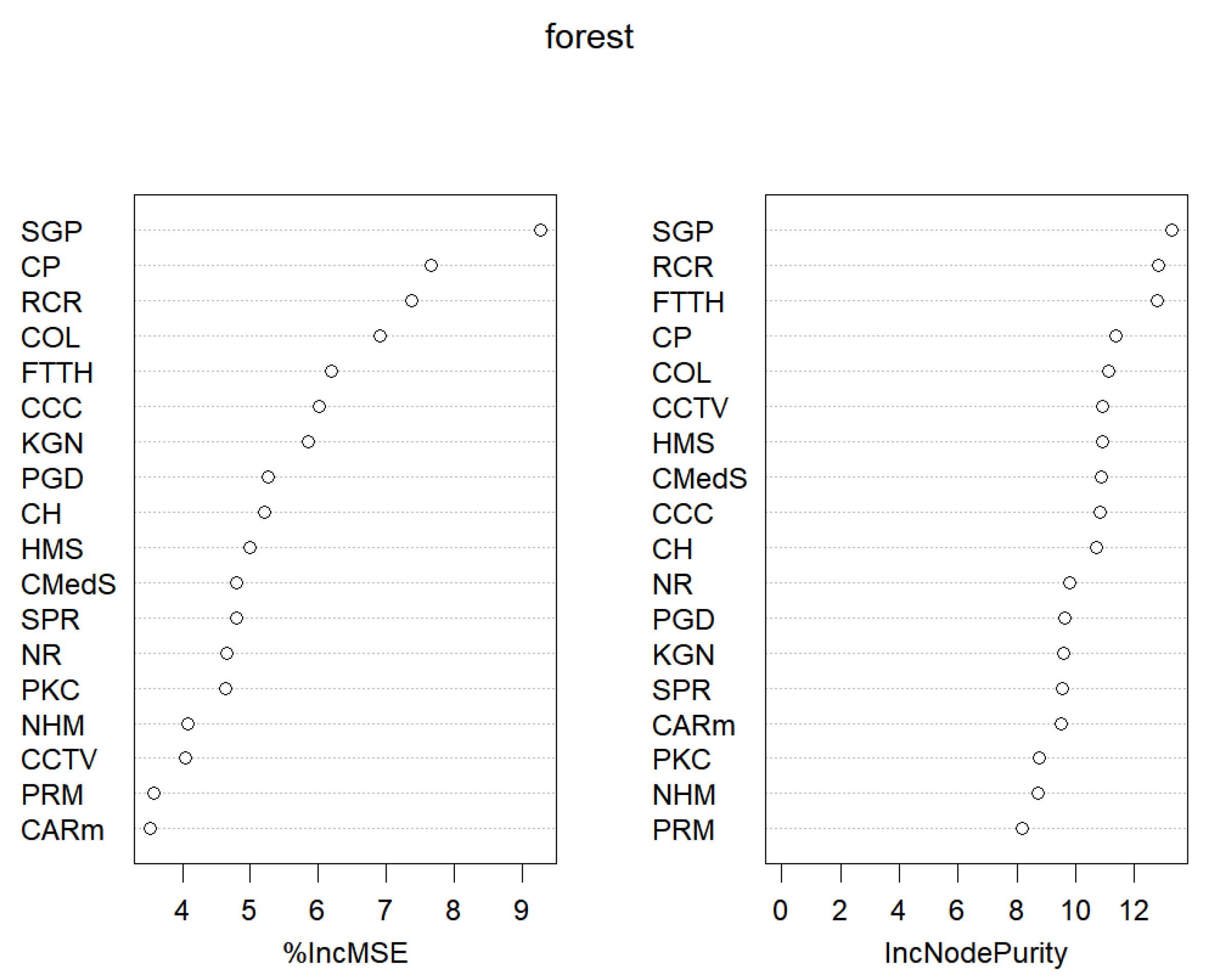
The top five elements of the community environment ranking are self-government of the population (SGP), resident–community relations (RCR), community civilization and culture (CCC), security monitoring (CCTV), and fiber to the home (FTTH). With the rapid development of the social economy and the increasing improvement in people’s living standards, both long-term urban residents and many migrants have put forward higher requirements and expectations for the construction of the community environment, which not only includes the physical environment, such as sports facilities and community health, but residents have also gradually begun to pay attention to the construction of the human environment in community governance. This is consistent with the results of the benchmark importance ranking.
The decision tree, as the base evaluator of RF, branches from top to bottom according to the degree of impurity reduction. The closer the explanatory variable is to the top of the decision tree, the more explanatory it is regarding the explained variable in the model. From this, the importance ranking of the features can be obtained, and the environmental elements of the community that have a greater impact on community management and service quality can be identified. Figure 5 and Table 2, respectively, show the importance ranking of the information features based on the full sample, in which the horizontal axis in Figure 5 represents the scores corresponding to the importance level, the vertical axis represents the Chinese acronym names of all the explanatory variables, and the specific numerical importance level in Table 2 corresponds to the horizontal axis in Figure 5. This helps readers to understand the importance ranking of 18 community environmental factors more precisely.
The top five elements of the community environment ranking are self-government of the population (SGP), resident and community relations (RCR), community civilization and culture (CCC), security monitoring (CCTV), and fiber to the home (FTTH). With the rapid development of the social economy and the increasing improvement in people’s living standards, both fixed city residents and a large number of resident migrants in the city have put forward higher requirements and expectations for the construction of the community environment, which not only includes the visual physical environment, such as sports facilities and community health, but residents have also gradually begun to pay attention to the construction of the human environment in community governance. This is consistent with the results of the benchmark importance ranking. Community residents have higher demand for the cultural environment regarding residents’ autonomy and residents’ relations with the community, while the demand regarding aspects related to infrastructure, such as security monitoring and fiber to the home, is relatively low.
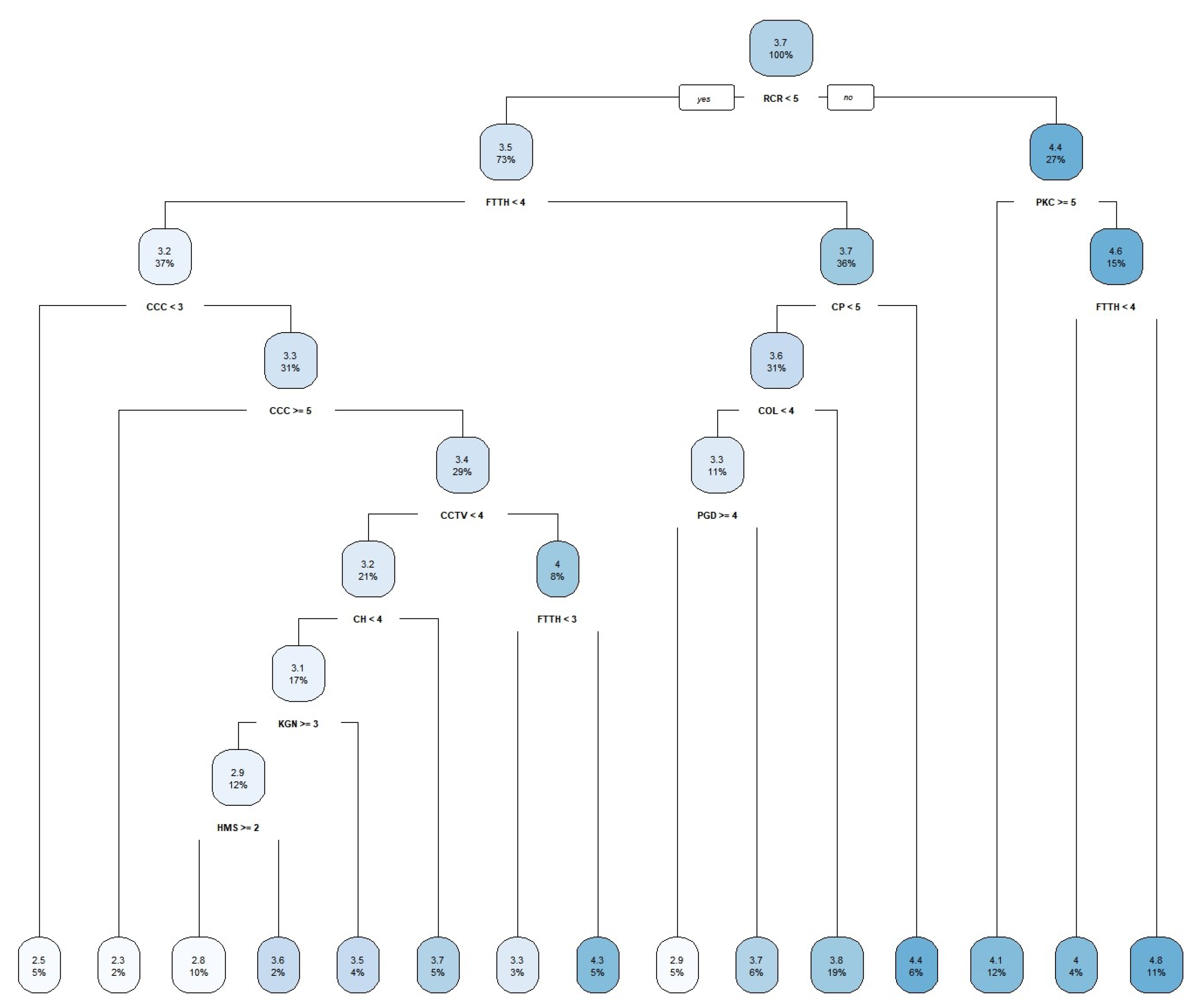
In order to better show the decision-making process of RF, the regression tree graph is illustrated in this paper, as shown in Figure 6. According to the principle of the RF model, the regression tree takes the features that provide the greatest degree of node impurity reduction after splitting as branch nodes and branches them from top to bottom. The features at the top of the tree provide the greatest degree of impurity reduction; that is, the features closer to the top of the tree have the greatest influence on community management and community service quality. Since the prediction results of the RF model are the average results of the predictions of multiple trees, a regression tree is randomly selected for visualization to facilitate presentation. The variables from the top of the tree to the bottom in Figure 6 can be found to be resident and community relations (RCR), fiber to the home (FTTH), community civilization and culture (CCC), community planning (CP), and organizational leadership (COL). This is basically consistent with the feature importance ranking based on the whole sample estimation, which enhances the credibility of the analysis results.
To further assess the explanatory power of RF, we employ multinomial logit (Mlogit) and ordered logit (Ologit) models to examine how community environmental factors influence residents’ evaluations of community management and service quality. The Mlogit model extends the standard logit framework to multiple discrete outcomes. In this specification, a base category must be chosen, and all coefficients are interpreted relative to this base as log-odds ratios, capturing the trade-offs among different satisfaction levels. As the outcome variable in this study consists of five ordered satisfaction categories (ranging from low to high), the Ologit model is particularly suitable for validating the determinants of residents’ perceived community management and service quality.
Before fitting these models, we apply Lasso regression for dimensionality reduction and variable selection. Lasso ( 1 regularization) is well suited to screening predictors: by imposing a penalty on the absolute size of coefficients, it shrinks some toward zero and sets others exactly to zero, thereby mitigating overfitting and handling both linear and certain nonlinear relations. The Lasso results in Table 3 indicate that three explanatory variables—community civilization and culture (CCC), participatory governance democracy (PGD), and community activity room (CARm)—have coefficients shrunk to zero and are therefore excluded from the subsequent Mlogit and Ologit analyses.
Variables whose coefficients are not 0 in the Lasso regression results are selected and included in the Mlogit model for further analysis so that the model can better explain the results. Table 4 reports the model estimation results of the impact of community environmental factors on community management and service quality, in which columns (1)–(4) represent the results of the Mlogit analysis and column (5) represents the results of OLS linear regression. In this paper, the analysis results in column (4) are selected as an illustrative example because the evaluation of community residents on community management and service quality is reflected primarily in the situation of relatively high scores, and the first five explanatory variables that show a positive correlation between the results are emphasized. In column (4), when other variables do not change, when residents score five points on the evaluation of community management and service quality compared to one point, the score coefficient of community health (CH) will increase by 1.824, the score coefficient of fiber to the home (FTTH) will increase by 1.194, and the score coefficient of security monitoring (CCTV) will increase by 1.264. The score coefficient of resident and community relations (RCR) will increase by 1.964, and the score coefficient of community organization leadership (COL) will increase by 1.434. In other words, residents pay more attention to these aspects of community environmental factors.
According to the coefficient size, the importance of community residents’ demand for community environmental factors can be deduced as follows: resident and community relations > community health > community organization leadership > security monitoring > fiber to the home. In the OLS regression results in column (5), it is evident that the top five elements of community environment are resident and community relations (RCR), fiber to the home (FTTH), community health (CH), security monitoring (CCTV), and community organization leadership (COL) according to the order of the coefficient of positive correlation regression results. Finally, the significance degree and value of these two regression coefficients were integrated, and the top five community environmental factors were resident and community relations (RCR), fiber to the home (FTTH), community health (CH), community organization leadership (COL), and security monitoring (CCTV).
Then, to further corroborate the above findings, we estimated an Ologit model that controls for individual- and community-level covariates to assess the effects of the remaining 15 community-environment variables on perceived community management and service quality. Specifically, we identified those community environmental factors with significant positive coefficients and ranked them by coefficient magnitude to obtain the order of factors that affect community management and service quality. In order, they are FTTH, CCTV, RCR, COL, and SGP. Detailed estimates are reported in Table 5.
The qualitative conclusions are consistent across Ologit, Mlogit, and OLS, with stable signs and a similar ranking of the core predictors. We therefore determine that the results are robust.
Table 6 shows the results of the analysis of community environmental importance characteristics based on the Mlogit model, Ologit model, and RF model. According to the ranking of important features of the results of the three models, it is found that resident and community relations (RCR) and fiber to the home (FTTH) are relatively high in the comprehensive importance rankings of the three models. At the same time, the ranking of these two elements in the RF model is also relatively high, which also shows the robustness of the conclusions of this paper. The RF model can effectively avoid the problems of freedom reduction and collinearity and obtain more accurate and reliable importance features.

3.2.2. Heterogeneity Analysis

The above feature importance ranking is based on the whole sample and reflects the overall pattern of the supply–demand matching framework constructed in this study. To further understand how the matching relationship between environmental supply and resident demand varies across community types, it is necessary to examine whether there are significant differences in the factors influencing residents’ evaluations of the community environment. The survey in this paper includes five major community types, namely commercial housing, unit housing, urban village, urban–rural integration, and new countryside. Since the survey samples of urban village, urban–rural integration, and new countryside account for only a small proportion of the total, to ensure the representativeness of the heterogeneity analysis, we ultimately select two community types with relatively large sample sizes (more than 100 samples), commercial housing and unit housing, for comparative analysis. We then separately examine the impact of community environmental factors on the management and service quality of these two types of communities within the same supply–demand framework.
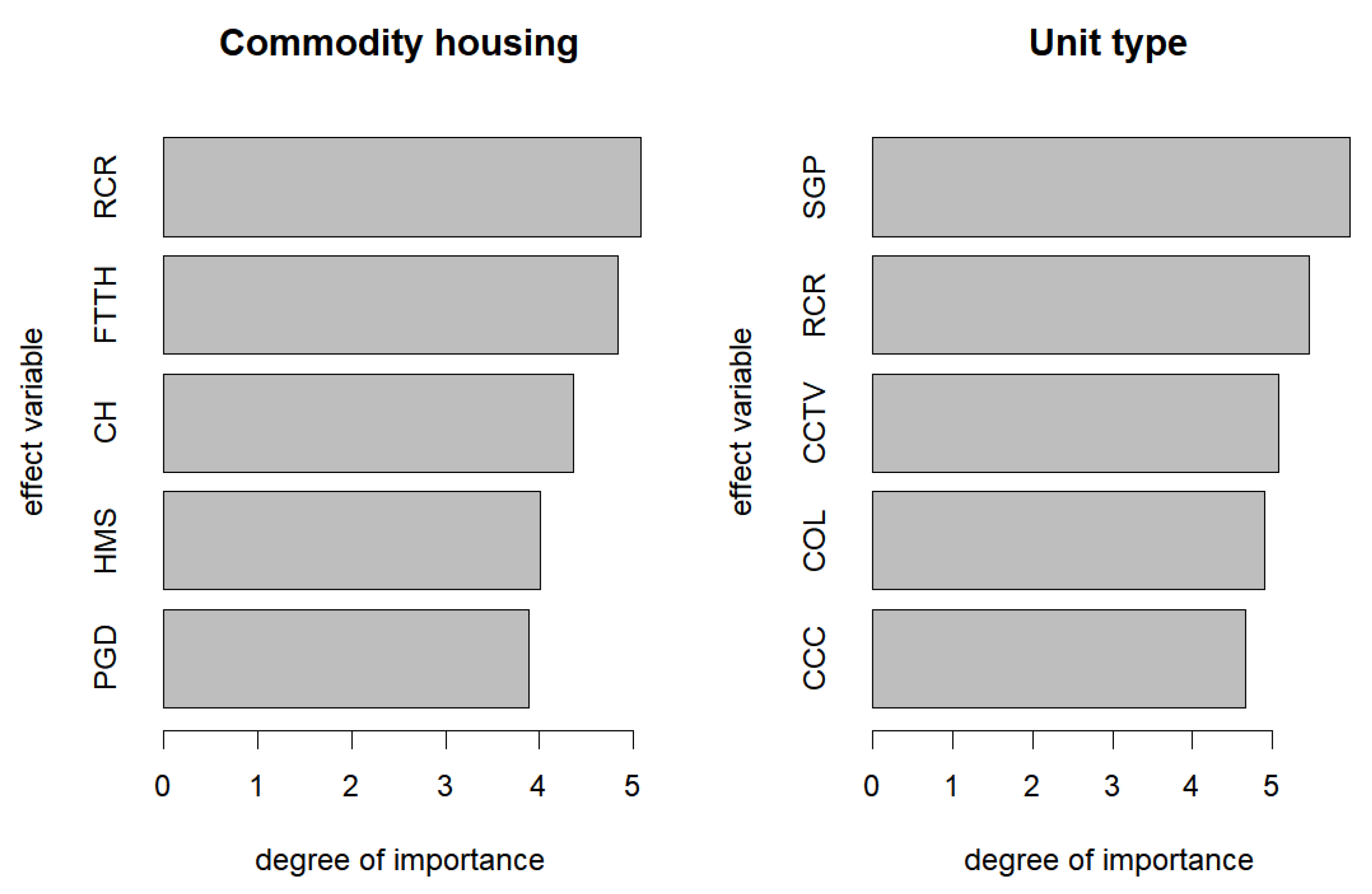
Based on the results of the feature importance estimation shown in Figure 7, it can be seen that, for residents of commercial housing communities, the top five community environmental factors in terms of importance are resident–community relations (RCR), fiber to the home (FTTH), community health (CH), hypermarket (HMS), and participatory governance democracy (PGD). For residents of unit housing communities, the top five factors are self-government of the population (SGP), resident–community relations (RCR), security monitoring (CCTV), community organization leadership (COL), and community civilization and culture (CCC). The above results indicate that residents of both community types attach great importance to resident–community relations, which is consistent with the overall sample estimates.
Relatively speaking, residents of commercial housing communities place greater emphasis on resident–community relations, possibly because these communities are composed of residents from diverse regions and professional backgrounds. This diversity tends to strengthen the demand for a more human-centered and inclusive community environment. This finding aligns with the view that participatory structures, such as homeowner associations, play a critical role in shaping residents’ evaluations of governance and service quality in commercial housing communities [24]. In contrast, residents of unit housing communities place less emphasis on resident–community relations but more on self-governance. This may be due to the fact that unit housing communities are typically formed through institutional welfare arrangements, where residents share similar occupational and social backgrounds. These communities tend to have higher educational attainment and more homogeneous management structures, resulting in greater reliance on internal self-organization and autonomous governance [25]. Moreover, differences in physical accessibility and infrastructure provision between community types can further influence how residents perceive and evaluate community management and services [26].

3.3. Path Analysis of Community Management and Service Quality Optimization

The above importance analysis of the ranking of environmental factors in communities provides direction and guidance to improve community management and service quality. However, the specific optimization path also needs to consider the economic conditions of different communities and the marginal income effect brought about by the corresponding investment in improving the community environment. Previous studies have shown that the perceived community environment and satisfaction with local governance significantly influence residents’ quality of life and service evaluations [27]. Similarly, empirical evidence from Shanghai indicates that the quality of basic public health services is closely related to the environmental conditions of the community and the socioeconomic context of the residents [28]. These findings suggest that the optimization of community management and service quality should be context-sensitive and supported by both environmental and social dimensions. In this regard, the supply–demand matching model provides a useful analytical framework to examine the balance between residents’ needs and the provision of community services, focusing on spatial and behavioral alignment between service supply and residents’ demand.
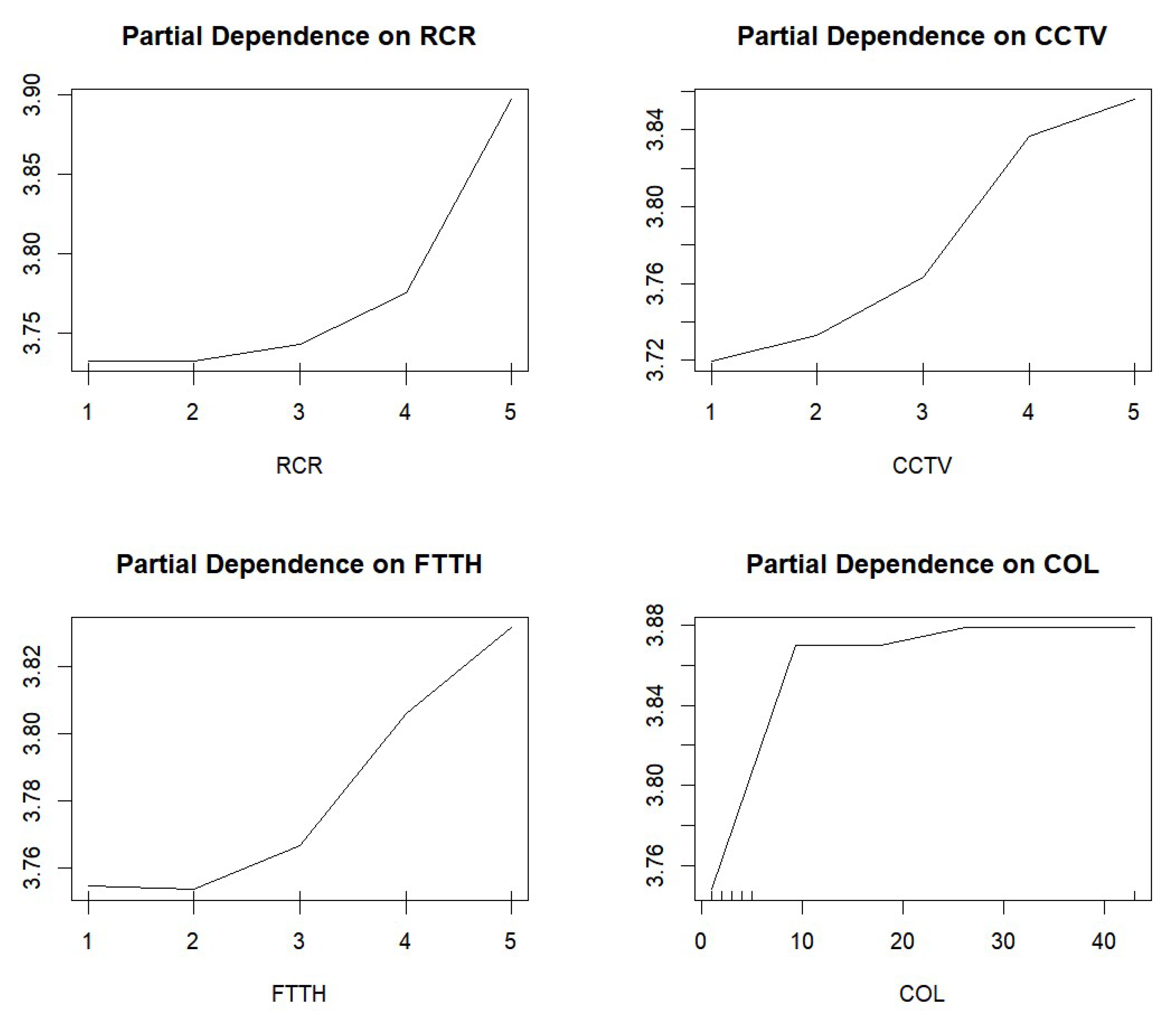
This paper uses the bias effect graph analysis tool to try to reveal the optimization path of community environment construction in Wuhan City to improve community management and service quality. The partial effect graph of a feature reflects the influence of the marginal change of the feature on the explained variable when the values of other features remain unchanged and can reveal the marginal effect size under different values of the feature.
Figure 8 shows the effect of the characteristics that affect community management and service quality. For the sake of analysis and presentation, only the top four community environmental factors that contribute to the improvement in community management and service quality based on the above analysis are reported: resident–community relations (RCR), security monitoring (CCTV), fiber to the home (FTTH), and community organizational leadership (COL). Among them, the community residents’ rating Y–axis is the community management and service quality, with options ranging from “no effect” to “very good” and corresponding scores ranging from 1 to 5; the higher the value, the better the community management and service quality. The X–axis represents the community residents’ evaluation of the community environment elements, with options from “very poor” to “very good” and corresponding values of 1 to 5; higher values indicate that the community residents perceive better community environment construction.
The partial effect curve reflects the marginal impact on community management and service quality after increasing investment in community environment construction under the condition that other conditions remain unchanged.
Observing the change trend of the curve in the bias–effect diagram, it can be found that the bias–effect diagram of each community environmental factor has two or three obvious turning points, which can divide the input of community environmental factors into different stages. The higher the slope, the greater the improvement in community management and service quality caused by the input of community environmental factors, and the stage with the highest slope is the optimal interval. The partial effect curve of resident–community relations (RCR) has the highest slope between 4 and 5, and the average input level of community environmental factors in the surveyed communities has not reached 4; therefore, communities need to pay more attention to the construction of resident–community relations in the future to improve community management and service quality. The bias effect curve of security monitoring (CCTV) has the largest slope between 3 and 4, and the input level of the sample community in this basic environment construction is higher than 3 and closer to 4, indicating that the sample community has been in a relatively optimal range in the construction of security monitoring. The bias effect curve of the fiber to the home (FTTH) has the largest slope between 3 and 4, and the sample community’s construction investment level is close to 4, indicating that the sample community is already within a relatively optimal range for security monitoring investment. The optimal range of community organization leadership (COL) is 4–5, but the current investment in COL is lower than 4, indicating that future community management and services should further strengthen the development of the human environment of community organization leadership.
In summary, the sample communities are already at a good level in the construction of basic environments, such as security monitoring and fiber to the home. In the future, under the condition of limited community construction funds, we should focus on the construction of a humanistic environment, such as the relationship between residents and communities and the leadership of community organizations. At the same time, we should also pay attention to the construction of the basic physical environments of communities to improve the quality of community management and services in a targeted manner.

4. Discussion

4.1. Synthesis of Findings and Theoretical Implications

This study combines a machine learning ranking of community features with discrete-choice estimation to explain residents’ perceived community service quality. Our estimates indicate that cultural-service proxies—especially resident–community relations and organizational leadership—exert effects comparable to, and in some contexts larger than, provisioning proxies such as optical-fiber coverage and security monitoring. Interpreted through a need–supply fit lens, communities that better match residents’ socio-cultural needs deliver higher perceived service quality even when physical stocks are adequate. This aligns with UES theory, in which cultural services, including identity, cohesion, and participation, mediate the experiential benefits of basic infrastructure. The negative sign on parking conditions is consistent with a congestion mechanism: more parking may crowd shared spaces or intensify traffic, eroding perceived quality. The weak or negative association for social participation suggests that participation may be reactive to local deficits rather than a pure amenity, underscoring the need to distinguish high-quality co-production from mobilization under stress.

4.2. Positioning in the Literature and Added Value

Our findings align with prior evidence linking service reliability and community engagement to satisfaction, but they extend the conversation in three ways. First, we integrate RF-derived importance scores with multinomial- and ordered-logit effects to triangulate both salience and direction, mitigating single-method bias and clarifying how predictive signals translate into interpretable marginal effects. Second, partial-effect curves convert statistical estimates into actionable investment intervals, making it possible to identify where additional inputs yield steep gains versus plateaus. Third, the results articulate a co-production mechanism: infrastructure provides the enabling conditions, yet social–organizational capacity determines whether residents perceive those conditions as high-quality services. This offers a bridge between ecosystem-services scholarship and neighborhood-governance studies by showing that cultural services, such as trust, participation, and leadership, mediate the conversion of physical assets into perceived benefits.

4.3. Limitations and Future Research

The joint use of RF and discrete-choice models provides methodological triangulation, mitigating concerns that the results depend on a specific functional form, while the replication of rankings across community types reinforces internal consistency. Nevertheless, several limitations qualify our inferences. First, the data are drawn from a single city at a single point in time, limiting the generalizability beyond this temporal and spatial context. Second, reliance on self-reported perceptions may introduce common-method variance and optimism bias. Third, endogeneity concerns may persist, for instance, when better governance simultaneously enhances both inputs and residents’ perceptions, and the absence of certain objective measures could influence the observed effects.
Future research should therefore (i) expand to multi-wave or multi-city samples so that temporal and institutional heterogeneity can be systematically evaluated; (ii) prioritize triangulation of subjective survey responses with objective administrative and sensor data. For example, activity participation can be verified with community sign-up records, facility utilization with access-control logs, and environmental quality with real-time monitoring devices. Linking such external benchmarks with survey responses would help to disentangle genuine service improvements from optimism or social-desirability bias, thereby mitigating common-method variance; (iii) apply streamlined causal-identification techniques—such as exploiting exogenous policy rollouts or instrumental variables—to alleviate the remaining concerns of reverse causality and omitted-variable bias. These extensions would consolidate the present study’s budgeting heuristics and improve their generalizability.

5. Conclusions and Suggestions

5.1. Research Conclusions

Based on survey data from 312 residents in 10 Wuhan communities, this study classifies the community environment into four macro-level dimensions: overall appearance, infrastructure, living facilities, and human environment. From a demand–supply matching perspective, we provide a new lens regarding how the community environment shapes perceived community management and service quality. Based on empirical analyses, we further identify the most influential environmental elements and propose targeted strategies to improve community environments. The main conclusions are as follows.
(1) Based on the RF and Mlogit models, we identify the community-environment features with the greatest influence on perceived community management and service quality. In the RF model, the top five factors are self-government of the population (SGP), resident–community relations (RCR), community civilization and culture (CCC), security monitoring (CCTV), and fiber to the home (FTTH). In the Mlogit model, the order is resident–community relations (RCR), fiber to the home (FTTH), community health (CH), community organizational leadership (COL), and security monitoring (CCTV). The empirical results indicate that the community environment positively affects residents’ evaluations of community management and service quality, and that the residents place greater weight on the human environment.
(2) There is heterogeneity in the importance of community-environment factors between community types. Regardless of the type—commercial or unit housing—residents attach great importance to resident–community relations. Relatively speaking, commercial-housing communities emphasize resident–community relations more, while unit-housing communities place greater emphasis on residents’ self-governance. This pattern likely reflects differences in community attributes and population composition: commercial housing is more market-oriented and socially diverse; unit housing is typically tied to institutional employers, with relatively stable populations and higher overall educational attainment. These findings provide a theoretical basis and practical guidance for targeted environmental construction in different communities.
(3) Using partial-effect graphs, we map the optimization path to improve community management and service quality through the construction of a community environment in Wuhan. The results indicate that the sample communities are already at relatively high levels in basic physical elements, such as security monitoring and fiber to the homes, but they need greater investment in resident–community relations and in the leadership of community organizations.

5.2. Research Suggestions

(1) The cultural environment through participatory mechanisms should be strengthened. Local governments should establish Community Development Funds dedicated to cultural and recreational activities. Implementation can follow a “Residents’ Assembly + third-party evaluation” model: residents propose and vote on projects via a digital participation platform, such as WeChat mini-programs and community apps, while third-party organizations monitor fund use and project outcomes. Key indicators, including participation rate, frequency of activities, and resident satisfaction, should be reported on a quarterly basis to both communities and supervising government agencies.
(2) For unit-housing communities, which often have stronger self-governance but aging infrastructure, municipal authorities should collaborate with property-management firms to create infrastructure renewal plans, including phased upgrades of digital networks, parking facilities, and green spaces. The funding sources may include municipal budget allocations combined with public–private partnerships (PPPs) to reduce fiscal pressure.
(3) Before allocating funds, neighborhood committees should conduct pre-investment diagnostics using resident surveys and spatial data to identify critical decision points that significantly impact resident satisfaction, such as outdated security systems or weak organizational leadership. Budgeting should adopt a marginal-utility principle, investing first in factors with the highest estimated partial effects. Annual audits and performance scorecards—covering cost efficiency, timeliness, and improvement in service quality—must be disclosed to residents to enhance transparency and trust.

Supplementary Materials

The following supporting information can be downloaded at: https://www.mdpi.com/article/10.3390/urbansci9110449/s1, Wuhan Community Governance & Services Survey.

Author Contributions

Conceptualization, F.Z.; methodology, Y.D.; validation, A.H.; formal analysis, Y.D.; investigation, Y.D.; data curation, A.H.; writing—original draft preparation, F.Z.; writing—review and editing, Q.Z. and Y.L.; visualization, A.H.; supervision, F.Z.; project administration, Q.Z.; funding acquisition, F.Z. All authors have read and agreed to the published version of the manuscript.

Funding

This research was supported by the Ministry of Science and Technology of the People’s Republic of China (Grant No. 2023ZD0120704 under Project No. 2023ZD0120700), the National Natural Science Foundation of China (Grant No. 62372409), the National Social Science Foundation of China (No. 24BTJ029), and Zhejiang University (Grant No. 226202200238).

Institutional Review Board Statement

Not applicable.

Informed Consent Statement

Not applicable.

Data Availability Statement

Data are available from the corresponding author upon reasonable request.

Conflicts of Interest

The authors declare no conflicts of interest. The funders had no role in the design of the study; in the collection, analysis, or interpretation of the data; in the writing of the manuscript; or in the decision to publish the results.

Appendix A

Table A1. Surveyed Community Information Form.
CommunityDistrictAverage
Age
Gender
Ratio
(M/F)
Location
(GCJ-02)
Housing
Price
(Median)
Sample
Size
Zisong
Community
Hongshan53.61.65(30.5139, 114.3905)20,00062
Nanwang
Community
Hongshan49.351.50(30.5125, 114.4018)18,00020
Cambridge
Community
Hongshan62.80.67(30.5083, 114.3905)17,00020
Wisdom
City
Hongshan62.790.27(30.5123, 114.3990)20,00028
Post Institute
Community
Hongshan58.210.32(30.4821, 114.4075)15,00033
Auto
Standard
Community
Hongshan59.510.84(30.6185, 114.2023)20,00057
Ge Guang
Community
Hongshan55.831.09(30.5750, 114.2500)20,00023
Kangju
Garden
Hongshan62.940.31(30.6500, 114.1500)18,00017
Bishui
Community
Hongshan66.090.38(30.5500, 114.3000)18,00011
Yangtze
Memory
Hongshan63.51.00(30.3750, 114.6050)17,00020
Sixin
Community
Hanyang42.380.81(30.5700, 114.2100)18,00049
Table A2. Variable Encoding Table.
DomainVariableVariable
Name
UES
Dimension
Question
ID
Internal
Coding
Basic
Information
sexsexA11 = male,
2 = female
ageageA2
marrymarryA5
OccupationoccA6
Monthly
post-tax income
inc_indA7
Household
Permanent Resi
-dent Population
hh_sizeA8
Monthly
household
income
inc_hhA9
Monthly
household
expenses
exp_hhA10
Living areaareaA11
Community
management and
service quality
Community
management and
service quality
CMSQD2_effect
_now
1 = very poor …
5 = very good
Overall
appearance
Community
planning
CPRegulating
/Supporting
B1_plan1 = very poor …
5 = very good
Community
health
CHRegulatingB1_hygiene1 = very poor …
5 = very good
Community
civilization
CCCCulturalB1_civility1 = very poor …
5 = very good
Participatory
Governance
democracy
PGDCulturalB1_democracy1 = very poor …
5 = very good
InfrastructureFiber to
the home
FTTHProvisioningB1_fiber1 = very poor …
5 = very good
Parking
conditions
PKCProvisioningB1_parking1 = very poor …
5 = very good
Property
management
PRMProvisioning
/Regulating
B1_property1 = very poor …
5 = very good
Living facilitiesSecurity
monitoring
CCTVRegulatingB1_cctv1 = very poor …
5 = very good
KindergartenKGNProvisioningB1_kinder1 = very poor …
5 = very good
Nursing homeNHMProvisioningB1_nursing1 = very poor …
5 = very good
Hypermarket/
Large supermarket
HMSProvisioningB1_market1 = very poor …
5 = very good
Community
medical station
CMedSProvisioningB1_clinic1 = very poor …
5 = very good
Cultural
environment
Community
activity room
CARmProvisioning
/Cultural
B1_activity1 = very poor …
5 = very good
Neighborhood
relations
NRCulturalB1_neighbor1 = very poor …
5 = very good
Social
participation
of residents
SPRCulturalB1_participation1 = very poor …
5 = very good
Community
organization
leadership
COLCulturalB1_org_lead1 = very poor …
5 = very good
Self-government
of the population
SGPCulturalB1_self_gov1 = very poor …
5 = very good
Resident–community
relations
RCRCulturalB1_res_comm1 = very poor …
5 = very good

References

  1. Frank, L.D.; Schmid, T.L.; Sallis, J.F.; Chapman, J.; Saelens, B.E. Linking objectively measured physical activity with objectively measured urban form: Findings from SMARTRAQ. Am. J. Prev. Med. 2005, 28, 117–125. [Google Scholar] [CrossRef]
  2. Panocchia, N.; D’Ambrosio, V.; Corti, S.; Lo Presti, E.; Bertelli, M.O.; Scattoni, M.L.; Ghelma, F. COVID-19 pandemic, the scarcity of medical resources, community-centred medicine and discrimination against persons with disabilities. J. Med. Ethics 2021, 47, 362–365. [Google Scholar] [CrossRef] [PubMed]
  3. Cheng, X.; Zhang, Z.; Chen, F.; Zhao, C.; Wang, T.; Sun, H.; Huang, C. Secure Identity Authentication of Community Medical Internet of Things. IEEE Access 2019, 7, 115966–115977. [Google Scholar] [CrossRef]
  4. Lin, X.B.; Yang, J.W. Built Environment And Public Health Review And Planning in North American Metropolitan Areas. Planners 2015, 31, 12–19. [Google Scholar]
  5. Liu, Q.; Yu, Y.; Wu, X.; Sun, Y.; Lyu, Y.; Cao, K.; Wang, Y.; Geng, L. Demand for Community Medical-Nursing Combined Services among the Empty-Nest Elderly in China: A Qualitative Study. Health and Social Care in the Community. Landsc. Archit. 2023, 27, 96–103. [Google Scholar] [CrossRef]
  6. Bray, D. Building ‘community’: New strategies of governance in urban China. Econ. Soc. 2006, 35, 530–549. [Google Scholar] [CrossRef]
  7. Lian, X.; Li, D.; Di, W.; Oubibi, M.; Zhang, X.; Zhang, S.; Xu, C.; Lu, H. Research on influential factors of satisfaction for residents in unit Communities—Taking Ningbo city as an example. Sustainability 2022, 14, 6687. [Google Scholar] [CrossRef]
  8. Ubels, H.; Bock, B.B.; Haartsen, T. The dynamics of self-governance capacity: The Dutch rural civic initiative “Project Ulrum 2034”. Sociol. Rural. 2022, 59, 763–788. [Google Scholar] [CrossRef]
  9. Veckalne, R.; Saidkhodjaev, A.; Tambovceva, T. Public Perceptions of Urban Green Spaces: Effects on Physical and Mental Health. Urban Sci. 2025, 9, 128. [Google Scholar] [CrossRef]
  10. Cherkesly, M.; Rancourt, M.E.; Smilowitz, K.R. Community Healthcare Network in Underserved Areas: Design, Mathematical Models, and Analysis. Prod. Oper. Manag. 2019, 28, 1716–1734. [Google Scholar] [CrossRef]
  11. Li, Y.; Ran, Q.; Yao, S.; Ding, L. Evaluation and Optimization of the Layout of Community Public Service Facilities for the Elderly: A Case Study of Hangzhou. Land 2023, 12, 629. [Google Scholar] [CrossRef]
  12. Sharma, A.; Borah, S.B.; Moses, A.C. Achieving social and economic sustainability through innovations in transformative services: A case of healthcare organizations in an emerging market. J. Acad. Mark. Sci. 2024, 52, 1366–1390. [Google Scholar] [CrossRef]
  13. Kuo, Y.C.; Chou, J.S.; Sun, K.S. Elucidating how service quality constructs influence resident satisfaction with condominium management. Expert Syst. Appl. 2011, 38, 5755–5763. [Google Scholar] [CrossRef]
  14. Christenson, J.A. Urbanism and Community Sentiment: Extending Wirth’s Model. Soc. Sci. Q. 1979, 60, 387–400. Available online: https://www.jstor.org/stable/42860593 (accessed on 15 October 2025).
  15. van Goethem, A.A.J.; van Hoof, A.; Orobio de Castro, B.; van Aken, M.A. Quality is Key—The Impact of Community Service, Community Service Quality, and Reflection on Adolescents’ Volunteering Intentions. Int. J. Dev. Sci. 2014, 8, 137–147. [Google Scholar] [CrossRef]
  16. Lee, K.; Jin, Q.; Animesh, R.; Ramaprasesad, J. Impact of Ride-Hailing Services on Transportation Mode Choices: Evidence from Traffic and Transit Ridership. MIS Q. 2022, 46, 1875–1900. [Google Scholar] [CrossRef]
  17. Parsons, F. Choosing a Vocation; Houghton Mifflin: Boston, MA, USA, 1909. [Google Scholar]
  18. Cable, D.M.; DeRue, D.S. The convergent and discriminant validity of subjective fit perceptions. J. Appl. Psychol. 2002, 87, 875–884. [Google Scholar] [CrossRef]
  19. Ali, I. Examining the role of person-environment fit in improving teaching satisfaction and subjective wellbeing. Int. J. Asian Bus. Inf. Manag. 2017, 8, 1–14. [Google Scholar] [CrossRef]
  20. Padmasiri, M.K.D.; Kailasapathy, P.; Jayawardana, A.K.L. Development of the person-family fit construct: An extension of person-environment fit into the family domain. South Asian J. Hum. Resour. Manag. 2019, 6, 156–176. [Google Scholar] [CrossRef]
  21. Inoue, M.; Kunie, K.; Takemura, Y.; Kida, R.; Ichikawa, N. The influence of learning circumstances and on-the-job opportunities for professional growth on perceived person-environment fit among hospital nurses: A longitudinal study. J. Nurs. Manag. 2021, 29, 776–784. [Google Scholar] [CrossRef]
  22. Breiman, L. Random forests. Mach. Learn. 2001, 45, 5–32. [Google Scholar] [CrossRef]
  23. Liaw, A.; Wiener, M. Classification and regression by randomForest. R News 2002, 2, 18–22. [Google Scholar]
  24. Guan, T.; Liu, T. Participatory Representation in a Non-Western Context: The Case of Homeowner Associations in Beijing. Urban Aff. Rev. 2021, 57, 984–1014. [Google Scholar] [CrossRef]
  25. Shan, Q.; Wang, Y.; Zhang, W. Exploring Factors Affecting Residential Satisfaction in Old Neighborhoods and Sustainable Design Strategies Based on Post-Occupancy Evaluation. Sustainability 2023, 15, 15213. [Google Scholar] [CrossRef]
  26. Wee, L.E.; Tsang, Y.Y.T.; Tay, S.M.; Cheah, A.; Puhaindran, M.; Yee, J.; Lee, S.; Oen, K.; Koh, C.H.G. Perceived Neighborhood Environment and Its Association with Health Screening and Exercise Participation among Low-Income Public Rental Flat Residents in Singapore. Int. J. Environ. Res. Public Health 2019, 16, 1384. [Google Scholar] [CrossRef]
  27. Lee, K.Y.; Park, K. Perception of Community Environment, Satisfaction with Local Government, and Quality of Life: The Case of Gyeonggi, Korea. Soc. Sci. 2022, 11, 394. [Google Scholar] [CrossRef]
  28. Guo, L.; Bao, Y.; Li, S.; Ma, J.; Sun, W. Quality analysis and policy recommendations on the utilization of community basic public health services in urban and suburban Shanghai from 2009 to 2014. Environ. Sci. Pollut. Res. 2018, 25, 18164–18173. [Google Scholar] [CrossRef] [PubMed]
Figure 1. Structural visualization of the theoretical analysis framework, demonstrating the pathways for enhancing community management and service quality by aligning community environmental resource provision with residents’ demand.
Urbansci 09 00449 g001
Figure 2. Geographic distribution visualization of the 10 representative communities in Wuhan, including 2 districts and 5 major community types.
Urbansci 09 00449 g002
Figure 3. Empirical analysis of model error convergence as a function of decision tree quantity, demonstrating the stabilization of prediction accuracy beyond 200 trees in random forest implementation for quantifying community management and services (N = 312).
Urbansci 09 00449 g003
Figure 4. Comparative analysis of model performance across different mtry values, illustrating the relationship between variable sampling rates and prediction accuracy in random forest implementation for quantifying community management and services (N = 312).
Urbansci 09 00449 g004
Figure 5. Hierarchical visualization of variable importance in community service quantifying, demonstrating the relative influence of physical and cultural environmental elements on community service quality (analysis based on 312 observations).
Urbansci 09 00449 g005
Figure 6. Hierarchical visualization of the regression tree structure in the evaluation of community service quality, demonstrating the sequential importance of various determinants and their interaction effects in the valuation process (decision nodes reflect optimal splitting criteria based on 312 observations).
Urbansci 09 00449 g006
Figure 7. Assessment of variable importance across community categories, demonstrating the relationship between community type and the relative influence of various elements of community environment on residents’ satisfaction (analysis of commodity-housing and unit-type communities, N = 312).
Urbansci 09 00449 g007
Figure 8. Multi-dimensional analysis of marginal effects demonstrating nonlinear relationships between key community service characteristics (resident–community relations, security monitors, fiber to the home, and community organization leadership) and residents’ satisfaction, revealing threshold effects and varying elasticities across different variable ranges (analysis based on 312 observations).
Urbansci 09 00449 g008
Table 1. Variable construction and descriptive statistics.
CategoryVariable NameVariable ValueMeanStandard Deviation
Community
Management and
Service quality
Community
management and
service quality
(CMSQ)
No effect, not very
good, fair, fairly
good, very good, on a
scale of 1 to 5
3.681.05
Overall
appearance
Community
planning (CP)
The value ranges
from 1 to 5: very poor,
poor, fair,
good, very good
3.810.99
Community
health (CH)
The value ranges from
1 to 5: very poor,
poor, fair, good, very good
3.701.03
Community
Civilization and
Culture (CCC)
Same as above3.880.94
Participatory
Governance
Democracy (PGD)
Same as above3.781.00
InfrastructureFiber to the Home (FTTH)Same as above3.621.22
Parking
Conditions (PKC)
Same as above3.311.15
Property
Management (PRM)
Same as above3.241.23
Security
Monitoring (CCTV)
Same as above3.521.12
Living
facilities
kindergarten (KGN)Same as above3.121.36
Nursing home (NHM)Same as above2.531.29
Hypermarkets (HMS)Same as above2.981.34
Community
Medical Station (CMedS)
Same as above3.471.15
Community
Activity Room (CARm)
Same as above3.561.10
Cultural
environment
Neighborhood
Relations (NR)
Same as above3.840.87
Social Participation
of Residents (SPR)
Same as above3.780.92
Community
Organization
Leadership (COL)
Same as above3.880.88
Self-government
of the
Population (SGP)
Same as above3.750.90
Resident–community
Relations (RCR)
Same as above3.681.05
Table 2. Feature importance estimates for the full sample.
Variable%IncMSEIncNodePurity
CP4.56711.460
CH5.0679.793
CCC7.30012.527
PGD5.20710.742
FTTH6.61012.298
PKC4.1368.644
PRM4.1229.448
CCTV6.76011.582
KGN3.2489.865
NHM2.7599.105
HMS4.0679.666
CMedS3.60010.101
CARm2.54210.122
NR3.3279.771
SPR6.0449.947
COL6.43113.410
SGP9.38214.148
RCR7.81914.446
Table 3. Lasso regression results.
VariableCoefficientIncNodePurity
CP−0.05811.460
CH0.1419.793
CCC012.527
PGD010.742
FTTH0.22512.298
PKC−0.1528.644
PRM−0.0259.448
CCTV0.09711.582
KGN−0.0329.865
NHM−0.0529.105
HMS−0.0419.666
CMedS0.09110.101
CARm010.122
NR0.0529.771
SPR−0.1089.947
COL0.03813.410
SGP0.08014.148
RCR0.29114.446
Table 4. Analysis results of Mlogit model.
(1)(2)(3)(4)(OLS)
1/52/53/54/5
CP−1.942 **−2.197 ***−1.833 **−1.932 **−0.053
(0.893)(0.820)(0.812)(0.846)(0.083)
CH0.6511.661 **1.479 **1.824 **0.164 **
(0.812)(0.747)(0.733)(0.767)(0.082)
FTTH−0.3990.3050.7051.194 **0.272 ***
(0.609)(0.551)(0.546)(0.578)(0.056)
PKC0.7140.016−0.199−0.474−0.180 ***
(0.865)(0.732)(0.717)(0.728)(0.065)
PRM−1.236−0.970−0.556−1.0090.014
(0.931)(0.849)(0.841)(0.858)(0.061)
CCTV0.5210.6250.5741.264 **0.115 *
(0.627)(0.576)(0.572)(0.607)(0.060)
KGN0.185−0.363−0.236−0.201−0.022
(0.470)(0.404)(0.397)(0.413)(0.046)
NHM0.5280.5020.3070.134−0.062
(0.543)(0.470)(0.460)(0.475)(0.048)
HMS−0.3470.099−0.0390.111−0.008
(0.495)(0.428)(0.425)(0.447)(0.050)
CMedS0.1260.2530.4880.2220.050
(0.583)(0.518)(0.511)(0.537)(0.059)
NR0.5140.5870.5610.2520.043
(0.997)(0.929)(0.921)(0.960)(0.089)
SPR−0.072−0.948−0.784−1.478 *−0.129
(0.784)(0.738)(0.728)(0.776)(0.088)
COL−0.2470.9261.3281.434 **0.043 *
(0.989)(0.932)(0.921)(0.934)(0.022)
SGP−0.603−1.074−1.151−0.3070.099
(1.043)(0.996)(0.986)(1.051)(0.110)
RCR0.2990.7740.9981.964 **0.283 ***
(0.861)(0.877)(0.869)(0.972)(0.0105)
Constant7.830 *5.476−0.329−8.095 *1.331 ***
(4.414)(3.975)(3.960)(4.277)(0.418)
N 312
R2 0.364
δ R 2 0.314
F 7.177 *** (df = 23; 288)
Note: * p < 0.1 , ** p < 0.05 , and *** p < 0.01 . Standard errors in parentheses.
Table 5. Regression results of Ologit model.
VariableCoefficientVariableCoefficient
CP0.035
(0.191)
HMS−0.081
(0.117)
CH0.257
(0.191)
CMedS0.182
(0.144)
FTTH0.662 ***
(0.132)
NR0.014
(0.212)
PKC−0.465 ***
(0.157)
SPR−0.403 *
(0.213)
PRM0.014
(0.149)
COL0.477 *
(0.262)
CCTV0.285 **
(0.140)
SGP0.409
(0.263)
KGN−0.102
(0.109)
RCR0.481 *
(0.249)
NHM−0.133
(0.111)
Note: * p < 0.1 , ** p < 0.05 , and *** p < 0.01 . Standard errors in parentheses.
Table 6. Estimation results of Mlogit, Ologit, and RF models.
Important Feature
Ranking
Mlogit ModelOlogit
Model
Random Forest
Model
1RCRFTTHSGP
2FTTHCCTVRCR
3CHRCRCCC
4COLCOLCCTV
5CCTVSGPFTTH
Disclaimer/Publisher’s Note: The statements, opinions and data contained in all publications are solely those of the individual author(s) and contributor(s) and not of MDPI and/or the editor(s). MDPI and/or the editor(s) disclaim responsibility for any injury to people or property resulting from any ideas, methods, instructions or products referred to in the content.