Article

Climate-Neutral Smart Cities and Their Energy Hinterland: Renewable Gas Integration Strategies for Romanian EU Mission Cities


by
Vlad Stoicescu
1,*,
Daniela Ioana Manea
2,
Vasile Alecsandru Strat
2,
Răzvan Popescu
3,
Alina-Cornelia Luchian (Chiriac)
3,
Radu Moldoveanu
4 and
Alexandra Stefan
3
1
Doctoral School of Business Administration I, Bucharest University of Economic Studies, Piața Romană 6, 010374 Bucharest, Romania
2
Department of Statistics and Econometrics, Bucharest University of Economic Studies, Piața Romană 6, 010374 Bucharest, Romania
3
Doctoral School of Economic Cybernetics and Statistics, Bucharest University of Economic Studies, Piața Romană 6, 010374 Bucharest, Romania
4
Doctoral School of Economics and International Business, Bucharest University of Economic Studies, Piața Romană 6, 010374 Bucharest, Romania
*
Author to whom correspondence should be addressed.
Urban Sci. 2026, 10(8), 437; https://doi.org/10.3390/urbansci10080437
Submission received: 2 June 2026 / Revised: 23 July 2026 / Accepted: 28 July 2026 / Published: 1 August 2026

Abstract

European smart cities face a distinct decarbonisation challenge in the gas component of urban energy consumption, which cannot be addressed through internal optimisation alone. The European Union (EU) Mission for Climate-Neutral and Smart Cities selected 112 cities for climate neutrality by 2030, including Bucharest Sector 2, Cluj-Napoca, and Suceava in Romania. The Mission timeline coincides with the Russian pipeline gas phase-out under Regulation (EU) 2026/261, the 5 August 2026 transposition deadline for the Hydrogen and Decarbonised Gas Market Package (also referred to as the Fourth Gas Package), and the post-Hormuz energy market environment of 2026. This paper develops a hinterland framework that links Romanian Mission cities to their rural renewable gas supply through biomethane and renewable hydrogen production, integrated with circular bioeconomy strategies and routed through the national transmission system operated by Transgaz. The empirical analysis combines documentary evidence from the May 2026 consultation on Government Emergency Ordinance 9/2026, institutional documentation of Transgaz and Romgaz, and the comparative European literature on smart city renewable energy integration. Findings show that Mission city decarbonisation pathways depend on rural-to-urban gas infrastructure calibration under the post-2024 regulatory cascade. The paper proposes specific deployment strategies for each Romanian Mission city.

1. Introduction

Smart cities have advanced as integrated platforms for urban service optimisation, with substantial scholarly attention to digital infrastructure, smart mobility, energy management at the building scale, grid modernisation, and citizen engagement [1,2]. The bibliometric review of 9320 papers on smart cities and urban energy planning published between 1992 and 2023 by Esfandi, Tayebi and Byrne [2] identified five principal dimensions of the smart city energy challenge: energy use at the building scale, urban design and planning integration, transportation and mobility, grid modernisation and smart grids, and policy and regulatory frameworks. The same review documented that the policy and regulatory dimension has received the least attention, a finding that is directly relevant to the renewable gas integration challenge addressed in the present paper.
The decarbonisation of urban gas consumption is one of the dimensions of the smart city energy challenge that cannot be addressed through internal optimisation alone. Gas is not produced inside the city. The renewable gas that the climate-neutral city of the future will consume is produced in the rural hinterland through anaerobic digestion of agricultural residues, livestock waste, and municipal biowaste, or through electrolytic hydrogen production at industrial scale. The infrastructure that connects rural production to urban consumption operates at the regional rather than at the municipal scale, with transmission system operators (TSOs) and distribution system operators (DSOs) as the principal infrastructure providers. The smart-city literature has paid limited attention to this rural–urban infrastructure dimension, partly because the conventional scope of smart city analysis stops at the municipal boundary.
The European Mission for Climate-Neutral and Smart Cities has selected 112 cities for climate neutrality by 2030, including 100 cities from EU Member States and 12 from Horizon Europe-associated countries [3]. Romania is represented by three Mission cities: Bucharest Sector 2, Cluj-Napoca, and Suceava [4,5]. The national mirror initiative M100, hosted by UEFISCDI as national hub secretariat under inter-ministerial coordination, supports an additional ten Romanian cities on parallel climate-neutrality pathways [5]. The Mission city timeline of 2030 coincides with three discrete European regulatory and geopolitical milestones. Regulation (EU) 2026/261 of 26 January 2026 establishes a phase-out trajectory for Russian pipeline gas, with long-term pipeline contracts terminated by 30 September 2027. The prohibition is deferred to 1 November 2027 in Member States for which the Commission, by 15 September 2027, adopts an implementing decision confirming risk of non-compliance with the 2027 underground storage filling target [6]. Directive (EU) 2024/1788 and Regulation (EU) 2024/1789, comprising the Gas Package, must be transposed by Member States by 5 August 2026 [7,8]. The Strait of Hormuz crisis that began on 28 February 2026 has elevated European fuel prices and reactivated the strategic importance of indigenous renewable gas production [9,10,11].
Romania occupies a distinctive position within this environment. The Neptun Deep deep-water gas field, scheduled to enter production in 2027 with a projected plateau production of approximately eight billion cubic metres per year [12], repositions the country from net importer to potential regional exporter. The Guidehouse 2022 study Gas for Climate estimates Romanian biomethane production potential at approximately two billion cubic metres annually by 2030 and approximately eight billion cubic metres by 2050, with anaerobic digestion as the dominant pathway and thermal gasification as a smaller complement [13]. Government Emergency Ordinance 9/2026 of 27 February 2026 introduced the first major reform of Romanian primary legislation on biomethane [14], and the National Energy Regulatory Authority opened a consultation on further amendments on 18 May 2026 [15].
The aim of this paper is to develop and apply a hinterland framework that explains and quantifies how the three Romanian EU Mission cities can decarbonise the gas component of their energy use through renewable gas supplied from their rural hinterlands. It addresses three questions: how much renewable gas the mandated network mix requires in each city, whether the rural hinterland can supply it, and which organisational and regulatory conditions govern the deployment. The method is a mixed documentary case study that combines EU Mission and institutional documentation, evidence from the stakeholder consultation on the Romanian biomethane reform, a first-order demand–supply quantification, and a comparative analysis of European regulatory practice. For readers outside the European Union, four instruments recur throughout. The EU Mission selects and supports one hundred cities from the Member States, with twelve more from associated countries, on the path to climate neutrality by 2030. The Climate City Contract is the decarbonisation plan that each Mission city signs with national and European authorities. The Gas Package and the Renewable Energy Directive set the European rules for renewable gas. The national energy and climate plan, known by its Romanian acronym PNIESC, sets the national targets. This paper extends the smart community framework developed in [16] to a hinterland framework that articulates the rural–urban renewable gas infrastructure on which Romanian Mission city decarbonisation pathways depend. Section 2 reviews the relevant literature across urban energy planning, energy communities, circular bioeconomy, and the EU regulatory environment. Section 3 develops the conceptual framework. Section 4 describes the materials and methods. Section 5 presents the results, organised around urban demand, rural supply, regulatory enablers, European comparative analysis, and the digital enablement of the hinterland. Section 6 discusses the city-specific implications for Bucharest Sector 2, Cluj-Napoca, and Suceava. Section 7 concludes.

2. Literature Review

This review is organised as a targeted rather than a systematic review. It is scoped to four bodies of work that bear directly on the rural–urban renewable gas interface: the smart-city and urban energy planning literature, the literature on the EU Mission and climate-neutral city pathways, the literature on renewable energy communities and the circular bioeconomy, and the literature on renewable gas infrastructure and the European regulatory environment. The review has a dual role in the paper. It provides the theoretical grounding for the conceptual framework in Section 3, and it supplies the comparative European evidence on which the analysis in Section 5 draws, which is why it precedes rather than follows the methods. Each subsection is read for what it contributes to the hinterland argument, and the contributions are drawn together at the end of the section.

2.1. Smart Cities, Urban Energy Planning, and the Rural–Urban Interface

The smart-city literature has matured into a substantive field with bibliometric depth. Esfandi, Tayebi and Byrne [2] established the five principal dimensions of the smart city energy challenge and identified the policy and regulatory dimension as the least adequately treated. Adel [1] examined the role of Industry 5.0 technologies in smart cities, with attention to cyber–physical systems, renewable energy integration, and the human–machine collaboration that enables intelligent urban services. Apanavičienė and Shahrabani [17] developed a framework for smart building integration into smart cities, identifying 26 factors influencing the integration across energy, mobility, water, security, and waste management domains. Trevisan, Ghiani and Pilo [18] developed a governance and realisation framework for renewable energy communities in positive energy districts under the Italian transposition of the European Directives, with explicit attention to the boundary between municipal and supra-municipal energy infrastructure.
The smart community framework developed in [16] articulated four strategy layers that align urban sustainability initiatives with the European regulatory architecture: hydrogen and renewable gas integration, ESG and sustainability reporting, biomass initiatives, and renewable energy. The hinterland framework developed in the present paper extends the smart community framework to the rural–urban infrastructure on which the renewable gas strategy layer depends. The extension responds to a gap in smart-city literature, which has concentrated on the optimisation of urban energy consumption while paying limited attention to the conditions of urban energy supply when that supply originates outside the urban boundary.

2.2. EU Mission Cities and the Climate-Neutral Pathway

The EU Mission for Climate-Neutral and Smart Cities was launched by the European Commission in 2021 as one of five missions under Horizon Europe, with the aim of supporting 100 European cities in their climate-neutrality transformation by 2030, plus an additional 12 cities from Horizon Europe-associated countries [3]. The Mission cities receive tailored advice and support through the NetZeroCities programme [4], the Mission Platform coordinated by EIT Climate-KIC, with each participating city required to develop a Climate City Contract that codifies the city decarbonisation pathway and the commitment of municipal and national authorities. The three Romanian Mission cities (Bucharest Sector 2, Cluj-Napoca, Suceava) have received the EU Mission Label in successive batches, recognising the substantive ambition of their respective Climate City Contracts [3,4]. The national mirror initiative M100, hosted by UEFISCDI as national hub secretariat under inter-ministerial coordination, supports an additional ten Romanian cities on parallel climate-neutrality pathways [5].
The Mission city decarbonisation pathway depends on the parallel transformation of multiple urban systems, including buildings, mobility, district energy, and waste management. The gas component of urban energy consumption is one of the elements that the city pathway must address. The literature on positive energy districts and on urban climate-neutrality pathways has paid extensive attention to the electrification of urban energy consumption, with limited attention to the residual gas consumption that cannot be electrified in the relevant planning horizon. The hinterland framework developed in the present paper addresses this gap by articulating the renewable gas supply pathway on which Mission city pathways depend.

2.3. Renewable Energy Communities, Circular Bioeconomy, and Rural Production

The literature on renewable energy communities under the Renewable Energy Directive II and III has developed rapidly. Trevisan, Ghiani and Pilo [18] developed the governance framework under Italian transposition. The Renewable Energy Directive provisions on energy communities, transposed across Member States with national variation, enable the legal recognition of community ownership of renewable production assets and the local sharing of the resulting energy. The literature on circular bioeconomy provides the complementary framework for the biological resource side of rural energy production. Meisterl, Sastre and Puig Ventosa [19] examined the Metropolitan Area of Barcelona biowaste management system, identifying the regulatory and non-regulatory drivers for the transition to biomethane production from anaerobic digestion. Feng, Aryal and Li [20] examined the development of centralised biogas circular bioeconomy systems using agricultural residues. Iragavarapu, Imam and Sarkar [21] reviewed bioprocessing of waste for renewable chemicals and fuels. Morone, D’Amato, Béfort and Yilan [22] provided a textbook treatment of the circular bioeconomy concept. Sulewski, Ignaciuk, Szymańska and Wąs [23] surveyed the development of the biomethane market across the European Union. Calero, Godoy, García-Heras, Lozano, Arjandas and Martín-Lara [24] traced the development of biogas and biomethane production in Spain.

2.4. Renewable Gas Infrastructure and the EU Regulatory Environment

Cavana and Leone [25] examined the linepack management techniques required for distribution networks to absorb biomethane injection at scale. Duma, Pollitt, Covatariu and Giulietti [26] developed an empirical definition and measurement framework for active distribution system operators in the electricity and natural gas sectors. The literature on hydrogen and biomethane convergence supports a coordinated rather than separated regulatory architecture for the two pathways [27,28,29,30]. The Gas Package, comprising Directive (EU) 2024/1788 and Regulation (EU) 2024/1789 [7,8], establishes the regulatory architecture for renewable gas integration with the EU Mission city horizon. The Net-Zero Industry Act (NZIA), Regulation (EU) 2024/1735 [31], introduces fast-track authorisation procedures for strategic net-zero projects. The European Commission proposal for the Industrial Accelerator Act, COM (2026) 100 of 4 March 2026, establishes a framework of measures for the acceleration of industrial capacity and decarbonisation in strategic sectors [32]. The NIS2 Directive (EU) 2022/2555 [33] and the Critical Entities Resilience (CER) Directive (Directive (EU) 2022/2557) [34] introduce an integrated cybersecurity and physical resilience perimeter for essential service operators. Mikac [35] examined the combined effect of the two instruments on European critical infrastructure protection. Chiara [36] developed the conceptual case for a right to cybersecurity in EU law. The literature on the post-2024 geopolitical environment provides the strategic context within which the regulatory cascade operates [37,38,39,40,41].
Read together, the four bodies of literature define the gap that this paper addresses. The smart-city literature in Section 2.1 establishes the dimensions of the urban energy challenge but stops at the municipal boundary, leaving the rural–urban supply interface unexamined. The Mission-city literature in Section 2.2 details the decarbonisation of urban systems but treats residual gas demand only lightly. The renewable energy community and circular bioeconomy literature in Section 2.3 shows that the rural resource, the biomethane potential, the digestate loop and the community ownership models are substantial and well theorised, but it is developed largely in isolation from the urban demand it could serve. The renewable gas infrastructure and regulatory literature in Section 2.4 supplies the technical and legal architecture, from reverse-flow management to the Gas Package and the cybersecurity perimeter, but it is not yet connected to a specific urban decarbonisation setting. The contribution of this paper is to join these four strands at the scale of the Mission city and its hinterland, which is the object of the framework developed next.

3. Conceptual Framework

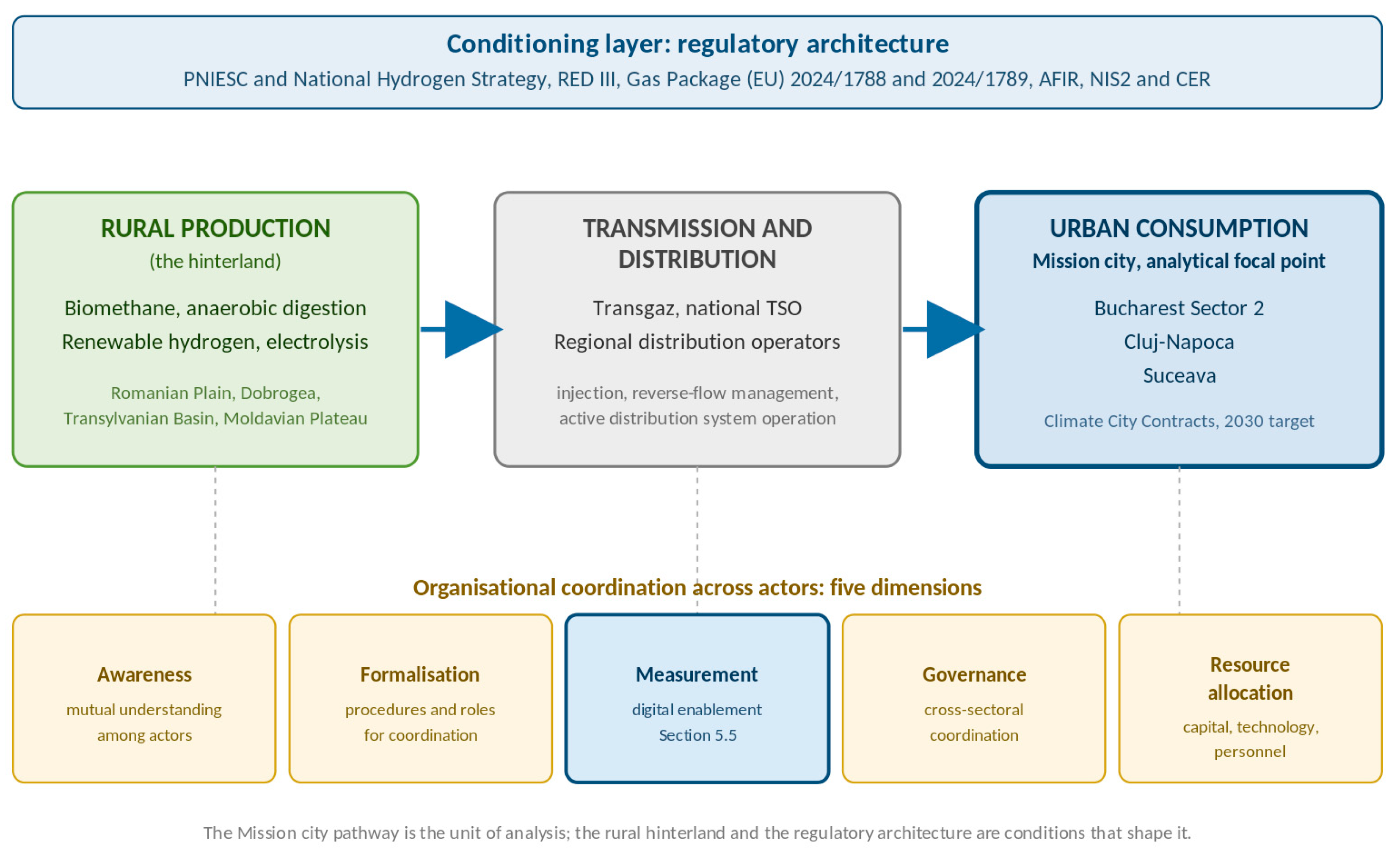
The hinterland framework developed in this paper is an empirical extension of the smart community framework articulated in [16], applied to the rural–urban renewable gas infrastructure on which Mission city decarbonisation pathways depend. Its scope is deliberately bounded to renewable gas, that is, to biomethane and renewable hydrogen routed through the gas transmission and distribution networks. Other renewable sources such as solar and wind enter the framework only as inputs to electrolytic hydrogen production, and demand-side electrification pathways lie outside its scope. Within this boundary, the framework articulates three physical layers, the rural production capacity, the transmission and distribution infrastructure, and the urban consumption capacity, that, together, constitute the operational scope of the renewable gas strategy layer identified in [16]. The Mission city is the analytical focal point, with the rural hinterland and the regulatory architecture treated as conditions that shape the operational viability of the city pathway. Figure 1 presents the framework.
To analyse how these physical layers are coordinated, the framework adds an organisational lens adapted from the tradition of organisational antecedents of sustainability transitions, of which the work of Jabbour and colleagues on stakeholders and business models for the circular economy [42] is representative. Five dimensions are operationalised for the rural–urban interface, applied at the regional rather than the firm scale and to the set of actors that must coordinate across that interface, namely municipal authorities, transmission and distribution system operators, renewable gas producers, and rural community stakeholders. Awareness is the mutual understanding among these actors. Formalisation is the documented procedures and roles for their coordination. Measurement is the data infrastructure for tracking production, transmission and consumption; it is operationalised as the digital enablement layer of Section 5.5 and is also what renders the rural–urban hinterland smart in the sense used across the smart-city literature [1,2]. Governance is the cross-sectoral coordination arrangement, and resource allocation is the dedicated capital, technology and personnel. Each dimension is carried into the empirical analysis, and their combined application across the three Mission cities is mapped in Section 6.
The framework is applied through the analytical sequence of urban demand, rural supply, regulatory enablers, European comparative analysis, and digital enablement, which provides the structure of Section 5. The unit of analysis is the Mission city pathway, with the rural hinterland, the transmission infrastructure, and the regulatory architecture as conditions that shape the city pathway. The framework is not offered as a new theoretical construct; it is an empirical extension of established frameworks applied to a new urban-centric setting, and its contribution lies in making the rural–urban renewable gas interface an explicit analytical category.
Figure 1. The hinterland framework. Three physical layers, from rural renewable gas production through transmission and distribution infrastructure to urban consumption in the Mission city, are coordinated across actors through five organisational dimensions and conditioned by the regulatory architecture. The grey dotted connectors indicate that each physical layer is coordinated through all five organisational dimensions. Green denotes the rural production layer, grey the transmission and distribution layer, blue the urban focal point together with the measurement dimension operationalised in Section 5.5, and amber the four remaining organisational dimensions. The instruments named in the conditioning layer are the Gas Package [7,8], the Network and Information Systems Security Directive (NIS2) [33], the Critical Entities Resilience (CER) Directive [34], the National Integrated Energy and Climate Plan [43] and the National Hydrogen Strategy [44]; the Renewable Energy Directive III (RED III) and the Alternative Fuels Infrastructure Regulation are named in the figure only to complete the regulatory perimeter and carry no numbered reference. Source: authors’ own elaboration.
Urbansci 10 00437 g001

4. Materials and Methods

The study adopts a mixed-methods case study design centred on the three Romanian EU Mission cities and their renewable gas supply hinterland. The case selection rationale combines theoretical and empirical considerations. Bucharest Sector 2, Cluj-Napoca, and Suceava are the three Romanian cities formally selected for the EU Mission for Climate-Neutral and Smart Cities, with EU Mission Label recognition and Climate City Contracts in place. The cities differ in size, regional location, and economic structure, providing variation across the case set within a common Mission framework. The Mission city timeline of 2030 coincides with the Gas Package transposition deadline of 5 August 2026 [7], the Russian pipeline gas phase-out trajectory under Regulation (EU) 2026/261 [6], and the post-Hormuz energy market environment of 2026.
The data sources combine four principal categories. The first category is the EU Mission documentation [3], including the Climate City Contracts of Bucharest Sector 2, Cluj-Napoca, and Suceava, the NetZeroCities programme documentation [4], and the M100 mirror initiative documentation, comprising the UEFISCDI-operated national hub and the Government of Romania framework memorandum [5]. The second category is the institutional documentation of the Romanian gas infrastructure, including the operational specifications and investment plan documents of Transgaz as the national transmission system operator and of Romgaz as the largest national producer. The third category is private stakeholder consultation evidence concerning Government Emergency Ordinance 9/2026, including unpublished discussion points and email correspondence exchanged on 18 May 2026 between the Romanian Association for Sustainable Fuels, the National Energy Regulatory Authority, and PATRES, together with the formal stakeholder response submitted by ACS on the same date [14,15]. This ordinance, adopted on 27 February 2026, introduced the first substantial reform of the Romanian primary legislation on biomethane. The consultation is the process through which the National Energy Regulatory Authority gathers positions from the main stakeholder groupings before finalising the secondary regulation, namely the renewable gas producers represented by ACS and PATRES, the transmission and distribution network operators, and the regulator. The divergent interests of these groupings are analysed in Section 5.3. These materials are used only as evidence of the stakeholder consultation process and of the issues raised during that process, not as publicly issued ANRE guidance. The fourth category is the comparative European literature reviewed in Section 2.
The analytical strategy proceeds through documentary analysis of the EU Mission and M100 documentation [3,4,5], the institutional documentation of Transgaz and Romgaz [45,46], the regulatory consultation documentation [14,15], and the comparative European literature, with triangulation across at least two of the four data source categories for each empirical claim. The author discloses participation in the Romanian energy policy stakeholder community as President of the Romanian Association for Sustainable Fuels, with the disclosure documented in the Conflicts of Interest declaration. The methodological mitigation rests on the explicit triangulation criteria rather than on disclosure alone. Empirical claims supported only by stakeholder consultation evidence are flagged in the analysis for interpretive caution.
To ensure that the demand–supply balance and the emissions estimates are reproducible, the quantitative analysis applies a fixed set of documented conversion and emission factors. Renewable gas volumes are converted to energy using a net calorific value of about 10.6 TWh per billion cubic metres, consistent with the Gas for Climate methodology [13]. Avoided combustion emissions are computed with the natural gas emission factor of 56.1 tonnes of carbon dioxide per terajoule, equivalently 0.202 tonnes per megawatt hour, set out in Regulation (EU) 2018/2066 [47] and derived from the 2006 IPCC Guidelines for National Greenhouse Gas Inventories [48]; biomethane that substitutes fossil gas is treated as carbon neutral at combustion under the same instruments. The 2030 renewable gas benchmark of about five per cent of the gas network follows the biomethane objective of the updated Romanian National Integrated Energy and Climate Plan [43]. City emission baselines and neutrality gaps are taken from the respective Climate City Contracts, so that every derived figure in the demand–supply balance and the emissions estimate can be reconstructed from these inputs.
Three limitations are acknowledged. The case selection is restricted to the three Romanian Mission cities, with the comparative European analysis providing partial mitigation. The cross-sectional design captures the situation as of mid-2026 and does not predict the trajectory through the 2030 Mission deadline. The reliance on documentary and institutional sources rather than on stakeholder interviews limits the depth of operational insight available, although the documentary and institutional sources used are extensive and substantive. The quantitative demand–supply balance in Section 5.4 is computed on an annual-average basis; the pronounced seasonal profile of urban gas demand, driven by winter district heating, is material for the sizing of injection, reverse-flow and storage capacity, but does not affect the annual balance on which the renewable gas substitution target is defined.

5. Results

5.1. Urban Demand: Renewable Gas Consumption in Romanian Mission Cities

The three Romanian Mission cities differ substantially in their urban gas consumption profiles. Bucharest Sector 2 is one administrative sector of the Bucharest metropolitan area, which is the country’s largest concentration of urban gas demand, so the sector’s own gas demand is only a fraction of the metropolitan total. The Climate City Contract of Bucharest Sector 2 includes the decarbonisation of district heating and residential gas consumption among the pathways toward the 2030 Mission target. Cluj-Napoca operates a different consumption profile, with proportionally lower district heating demand and a higher share of distributed residential and commercial gas use, reflecting the smaller urban scale and the polycentric morphology. Suceava is the smallest of the three cities and the most representative of medium-sized European cities, with a mixed industrial–residential consumption profile and substantial seasonal variation driven by district heating in the cold months. Together, the three cities illustrate the demand side of the renewable gas substitution challenge across different urban scales and hinterland types, from a large metropolitan sector to a small city whose centralised heating is supplied from biomass rather than gas.
The Climate City Contracts of the three Mission cities provide the planning framework within which renewable gas substitution can be specified as part of the broader pathway toward 2030 climate neutrality, alongside building energy retrofit, transport electrification, district heating decarbonisation, and waste management improvement. The implementation of renewable gas substitution depends on the availability of biomethane and renewable hydrogen at the city scale, which depends in turn on the rural production capacity and the transmission and distribution infrastructure that connects rural production to urban consumption.
The demand that this pathway must serve is a demand for energy, mandated to include a rising renewable share rather than expressed as a preference for a particular molecule, and its composition is expected to shift over the Mission horizon. In the near term, biomethane is the substitute that the existing gas network can absorb without modification, and it carries the mandated renewable gas share that the demand–supply balance later quantifies. Renewable hydrogen enters later and unevenly, pulled by industrial offtake rather than by household demand, which is why its deployment differs sharply across the three cities. Bucharest Sector 2 lies within the Bucharest and Ploiești hydrogen valley of the National Hydrogen Strategy [44], anchored by the refining offtake at Petrobrazi. Cluj-Napoca lies within the Cluj and Târgu Mureș valley, anchored by the fertiliser offtake at Azomureș and by the Iernut gas-fired capacity operated by Romgaz [49]. Suceava lies outside any designated hydrogen valley, so its pathway is biomethane-led, drawing on the agricultural and forestry resources of the Moldavian Plateau and Bucovina. The parallel entry of the Neptun Deep field, with an expected plateau of approximately eight billion cubic metres from 2027, repositions Romania as a potential regional exporter and relaxes the security constraint. It does not, however, alter the city decarbonisation logic. The mandated renewable share applies to consumption irrespective of the origin of the conventional gas, and electrification reduces the baseline gas demand only gradually.

5.2. Rural Supply: Biomethane and Renewable Hydrogen Production in the Hinterland

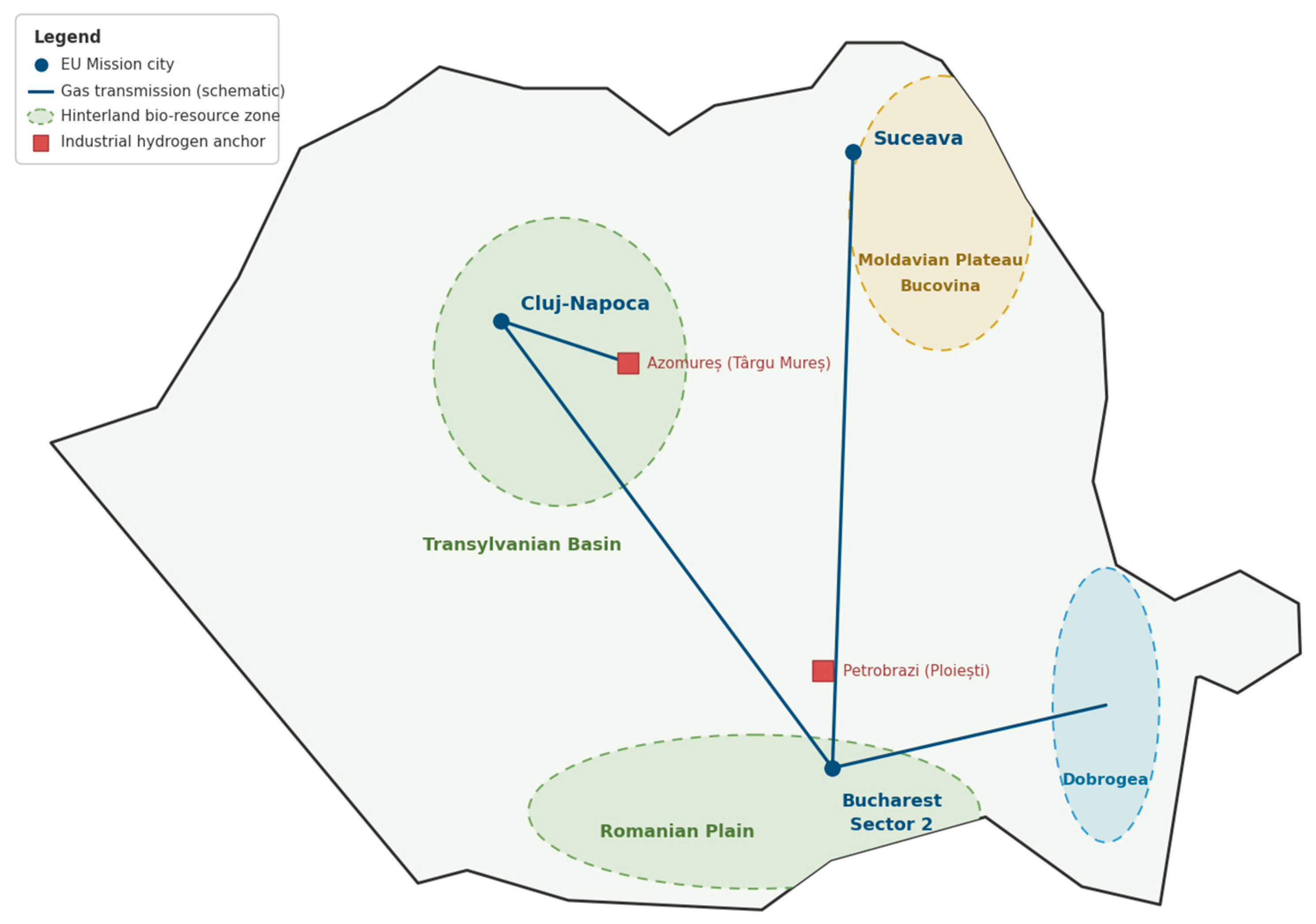
The Romanian biomethane production potential is concentrated in the rural hinterland of the urban consumption centres. The Guidehouse 2022 study Gas for Climate [13] estimates the total potential at approximately two billion cubic metres annually by 2030 and approximately eight billion cubic metres by 2050, including both anaerobic digestion and thermal gasification pathways. The geographic distribution of the potential matches the agricultural and forestry resource base of Romania, with the Transylvanian Basin, the Romanian Plain, the Moldavian Plateau, and the Dobrogea region as the principal production zones. The proximity of each Mission city to its rural production hinterland varies: Bucharest Sector 2 draws on the Romanian Plain and Dobrogea, Cluj-Napoca draws on the Transylvanian Basin, and Suceava draws on the Moldavian Plateau and the forested hinterland of Bucovina (Figure 2).
The renewable hydrogen production capacity in Romania is in the early stages of deployment, with the first commercial-scale electrolysis projects entering operation from 2024 onward. The industrial offtake of renewable hydrogen is concentrated in the petrochemical and fertiliser sectors. The Petrobrazi refinery operated by OMV Petrom is the principal confirmed candidate, with two green hydrogen electrolyser projects of 20 MW and 35 MW under construction, the first module of the 20 MW unit delivered in March 2026, and proposed European Investment Bank financing of about EUR 165 million under appraisal [50,51]. The Azomureș fertiliser plant in Târgu Mureș, currently Romania’s only operational fertiliser producer (running at partial capacity since its restart in July 2025) [52], represents a further potential offtake site. The hydrogen production pathway from biomethane reforming provides a regulatory connection between the biomethane production capacity and the hydrogen offtake demand. The Mission city pathways do not directly consume industrial hydrogen at scale, but the industrial hydrogen offtake competes for the same biomethane production capacity, and the integrated planning of biomethane allocation between urban gas consumption and industrial hydrogen production is one of the strategic questions that the hinterland framework articulates.
The circular bioeconomy dimension of the rural production capacity provides the linkage between biomethane production and the agricultural value chain. The digestate produced as a co-product of anaerobic digestion is a high-quality organic fertiliser that can be returned to the agricultural land that supplies the feedstock, closing the nutrient loop at the regional scale. The integration of biomethane production with the circular bioeconomy strategy of the agricultural value chain is one of the conditions that distinguishes the substantive deployment of renewable gas from the purely industrial deployment, with implications for rural development policy and the EU Mission city pathway design [19,20,21,22].

5.3. Regulatory Enablers and Frictions

Because the value of the consultation evidence lies in the conflicts of interest it reveals, the stakeholder landscape is set out first, in the spirit of the stakeholder-pressure analysis on which the framework draws [42]. Four groupings hold distinct and partly opposing interests. The renewable gas producers, represented in the consultation by ACS and PATRES, seek low and predictable connection costs and a clear legal status for biomethane, because these determine the bankability of their projects. The network operators, the national transmission operator and the regional distribution operators, seek full recovery of connection and reinforcement costs and the preservation of network integrity and security. The state, acting through the National Energy Regulatory Authority, must reconcile the 2030 renewable gas target with the protection of consumers from cost pass-through and with the security of the gas system. The industrial offtakers exposed to carbon pricing, the fertiliser, petrochemical, steel and aluminium producers identified in Section 5.1, seek access to certified low-carbon molecules at a competitive cost. The central friction, which of these parties bears the cost of connecting rural biomethane to the network, sets producers against operators, with the consumer carrying the residual through the tariff. Where the Romanian proposals diverge from the European mainstream, the divergence is best read not as a technical error but as an attempt either to accelerate deployment by relieving producers of the connection cost, or to shield operators and consumers from that cost. The analysis below assesses each proposal against the European experience on that basis. One of the authors participates in this process as President of ACS, a producer-side association, which is disclosed in the Conflicts of Interest statement, and the interpretive mitigation is the explicit triangulation of every claim against the independent European comparative literature.
The private stakeholder consultation materials exchanged on 18 May 2026 between ACS, ANRE, and PATRES concerning Government Emergency Ordinance 9/2026 [14,15] address eleven points of proposed amendments to the Romanian primary legislation on biomethane. The materials indicate a substantive coherence challenge between the proposed amendments and the dominant European regulatory architecture, in three principal areas. First, the proposed reanalysis or elimination of definitional anchoring of biomethane within the natural gas sector would, if implemented in the form proposed, produce a transitional gap in the cybersecurity perimeter of the National Information Security Directive transposition [33,34,53,54] and in the critical infrastructure protection framework [55]. The European comparative analysis confirms that no leading Member State maintains a separate conceptual regime for biomethane outside the natural gas sector [23,24,25].
Second, the proposed treatment of grid connection costs diverges from the European mainstream. The current Romanian regime imposes the full cost on the biomethane producer, which the consultation proposes to invert by transferring the full cost to the network operator. The European comparative analysis confirms that neither approach matches the European mainstream, which applies structured cost-sharing arrangements with the producer bearing a capped share [23,24,25,26]. On the basis of this comparison, the approach recommended by the present analysis is structured cost-sharing combined with tariff-based recovery and with state aid schemes under the Industrial Accelerator Act [32] and the Net-Zero Industry Act [31].
Third, and unlike the first two proposals, the proposal to regulate biomethane in the distribution network as a distinct regime is a useful step. Most European biomethane plants connect to the distribution network rather than to the high-pressure transmission network [23,25], so a regime designed for distribution matches where the gas actually enters the system. The proposal is useful, however, only if it also addresses reverse flow, that is, the need to push surplus biomethane from a low-demand distribution area back up into the transmission network. Cavana and Leone [25] show that reverse flow is the main technical limit once biomethane exceeds a certain share of local demand. Three conditions make the regime work. The same minimum technical standards must apply to every distribution operator. The distribution and transmission operators must coordinate, within the cybersecurity rules [33,34,35,36]. And the regulator must issue the detailed secondary rules quickly, within about twelve months of the primary law, so that producers are not left waiting.

5.4. European Comparative Analysis and Lessons for Romanian Mission Cities

The European comparative analysis identifies which design choices the European mainstream treats as settled, which remain contested, and which have produced suboptimal outcomes in early-adopter Member States. The unitary supply licensing approach with distinct accounting is comparatively mature across Germany, France, Denmark, the Netherlands, Italy, and Sweden, with no leading Member State operating separate biomethane licensing regimes [23]. Structured cost-sharing for grid connection has been institutionalised in different forms in Germany and France. Under the German Gas Network Access Ordinance (GasNZV), connection costs are shared 25 per cent by the connecting biomethane plant operator and 75 per cent by the network operator, with the plant operator share capped at EUR 250,000 for connecting lines up to one kilometre [56]. Under the French Code de l’Energie, Articles L. 452-1 and L. 452-1-1, a tariff-funded coverage meets 60 per cent of the biomethane connection cost up to EUR 600,000, with the producer bearing the remainder and the coverage recovered through the regulated network tariff [57]. The distribution-level injection is dominant in Italy and Denmark. In Italy, the regulation of reverse flow at the distribution level is currently piloted under ARERA Resolution 404/2022/R/gas rather than fully settled [58]. In Denmark, biomethane integration is supported through a competitive subsidy tender administered by the Danish Energy Agency, while grid operation is handled by Energinet as transmission system operator and Evida as the national distribution operator, and producers bear the cost of their upgrading unit and direct connection under nationally harmonised terms [59].
The Mission city implications of the comparative analysis are direct. Bucharest Sector 2 can draw on the German model of structured cost-sharing for the grid connection of biomethane production facilities in the Romanian Plain hinterland, with tariff-based recovery routed through the Transgaz transmission network. Cluj-Napoca can draw on the Italian model of distribution-level integration for the biomethane production facilities in the Transylvanian Basin hinterland, with explicit reverse-flow management at the distribution scale. Suceava can draw on the Danish model of operator coordination for the biomethane production facilities in the Moldavian Plateau and Bucovina forested hinterland, with the integration of small-scale community-owned production into the distribution network. The Climate City Contracts of the three Mission cities can incorporate these comparative lessons in the specification of the renewable gas substitution pathway toward 2030.
This comparative step does more than import three European models. It shows that a single national framework does not fit a country whose cities differ as much as these three. Each Romanian Mission city is matched to the European model whose scale and connection level suit its hinterland: transmission-scale cost-sharing on the German pattern for the large Bucharest metropolitan market, distribution-level integration on the Italian pattern for the polycentric Cluj market, and community-scale operator coordination on the Danish pattern for the dispersed Suceava market. This within-country tailoring is, to the authors’ knowledge, not yet applied in the European biomethane literature, which tends to treat national models as uniform, and it is the element of the analysis with the widest transferability, because any Member State with heterogeneous urban and rural structures can apply the same matching logic rather than adopt a single national template. Table 1 sets out the correspondence between each city, its hinterland and its supply and consumption profile, and its European reference model.
To move from the qualitative pathways to a measurable assessment, Table 2 sets out a demand–supply balance for the three Mission cities. City gas consumption is taken from the greenhouse gas inventories of the respective Climate City Contracts, which report the annual natural gas demand of each city, and is corroborated against the sustainable development and energy planning documents of the cities and their counties. On this basis, the annual city gas demand is about 0.18 billion cubic metres for Bucharest Sector 2, about 0.27 for Cluj-Napoca, and about 0.033 for Suceava, the last reflecting the city’s small scale and its biomass district heating, which burns no fossil gas, although about half of the city dwellings still use individual gas boilers. The mandated renewable gas volume is taken as about five per cent of city demand, consistent with the biomethane objective of the updated National Integrated Energy and Climate Plan [43], whose 2030 target of 4.27 TWh corresponds to about 0.40 billion cubic metres at the national level. The hinterland biomethane potential is allocated from the national potential of about two billion cubic metres estimated by the Guidehouse study [13] on the basis of the agricultural, livestock, and forestry resources of each development region, with energy crops excluded in line with the sustainability constraints applied in that study. The balance is conservative, yet its central result is robust. In every city, the regional hinterland resource is large relative to the city gas demand, from about 1.2 times at Cluj-Napoca, where the resource is of the same order as demand, to about 3.9 times at Bucharest Sector 2 and about 9 times at Suceava. For the three Mission cities and their hinterlands, the binding constraint on the renewable gas substitution pathway is therefore not the availability of the resource but the calibration of the infrastructure and the coordination of the actors, which is the central argument of this paper. At a national scale, biomethane remains a partial contributor, on the order of one-fifth of gas demand, so the abundance identified here is specific to these low-demand urban nodes set on large rural catchments, with renewable hydrogen complementing biomethane over the longer horizon. Table 3 then translates these volumes into avoided emissions and into a contribution to each city’s 2030 neutrality gap.
At full substitution, the avoided emissions correspond to about 41.6 per cent of the 2030 neutrality gap in Bucharest Sector 2, about 60.0 per cent in Cluj-Napoca, and about 30.1 per cent in Suceava. Under the near-term five per cent mandate, the contribution is much smaller, between about 1.5 and 3.0 per cent of each gap, which sets the policy floor. At this level, renewable gas is a structural component of the gas-related share of the 2030 target, not a marginal one, on condition that the rural–urban supply is mobilised beyond the regulatory minimum. The contribution is largest in Cluj-Napoca, whose baseline is the most gas-dependent, and smallest in Suceava, whose gas demand is the lowest of the three because its centralised heating is supplied from biomass rather than gas, a pattern that confirms the city-specific character of the pathways.

5.5. Digital Enablement of the Rural–Urban Hinterland

Of the five organisational dimensions through which the framework in Section 3 articulates the hinterland, the measurement dimension, defined as the data infrastructure required for tracking production, transmission, and consumption, is the one that the preceding analysis has invoked without specifying. Governance and formalisation are carried by the regulatory and coordination analysis of Section 5.3, and resource allocation by the cost-sharing analysis of Section 5.3 and Section 5.4, but the data layer on which several of those findings depend has so far remained implicit. This subsection operationalises the measurement dimension and, in doing so, renders the rural–urban interface genuinely smart. Three digital capabilities are central, and each is the precondition for an analytical move already made in the preceding subsections.
The first capability is the digital twin representation of the transmission and distribution interface. A digital twin is a virtual representation of a physical asset that is updated from real-time sensor data and supports simulation, anomaly detection, and predictive maintenance across the asset lifecycle [61]. Applied to the rural–urban gas hinterland, a digital twin covers the transmission network operated by Transgaz and the regional distribution networks. It turns the reverse-flow management that Cavana and Leone [25] identify as the principal technical limit on distribution-level injection into an operable control task rather than a static capacity rule. It is also the environment in which the transmission–distribution operator coordination required by the Danish model and the Suceava deployment profile can be simulated and rehearsed. The digital twin is therefore not an addition to the recommendations of Section 5.3 but the capability without which those recommendations cannot be implemented.
The second capability is the smart metering and Internet of Things monitoring of biomethane injection at the point of grid connection. The grid-modernisation and smart-grid dimension that Esfandi, Tayebi and Byrne [2] place among the five principal dimensions of the smart-city energy challenge extends, in the hinterland framework, beyond the municipal boundary to the rural injection points where biomethane enters the network. Advanced metering infrastructure at these points supplies the real-time quality, pressure, and flow data on which the active distribution system operation defined by Duma, Pollitt, Covatariu and Giulietti [26] depends, and on which the Climate City Contracts rely to track progress toward the 2030 target. This instrumentation is the concrete content of the measurement dimension and the substrate for the cyber–physical integration of renewable gas production that Adel [1] situates within the Industry 5.0 transformation of cities.
The third capability is the data platform that tracks and certifies the renewable attributes of the gas. The European market for renewable gas relies on Guarantees of Origin to prove the renewable character of a unit of gas and to allow that attribute to be transferred independently of the physical molecule, with the avoidance of double counting and double disclosure as the central integrity requirement. Distributed-ledger approaches to the issuance and transfer of Guarantees of Origin provide the tamper-evident traceability that this requirement demands, as demonstrated by the blockchain-based issuing platform developed under the TRINITY project [62]. For the Romanian Mission cities, a platform of this kind connects the rural biomethane and renewable hydrogen production to the urban consumption recorded in the Climate City Contracts, and it supplies the auditable evidence base on which the climate-neutrality claim of the Mission city pathway ultimately rests. Because this platform handles operational data for essential energy infrastructure, it is designed within the cybersecurity perimeter of the NIS2 and Critical Entities Resilience Directive transpositions [33,34,35,36], so that the measurement and resilience dimensions of the hinterland are built together rather than in sequence.
With the measurement dimension operationalised, the framework is complete across all five organisational dimensions, and the rural–urban hinterland is constituted as a smart, data-driven coordination system for the city, not merely as a piece of infrastructure attached to it. The digital enablement layer is also the point at which the renewable gas substitution pathway connects to the digital systems that the Climate City Contracts already deploy for the building, mobility, and grid dimensions of the Mission city, which indicates a concrete agenda for the integration of the hinterland into the wider smart-city architecture.

6. Discussion

The hinterland framework articulates the rural–urban renewable gas infrastructure on which Romanian Mission city decarbonisation pathways depend. The framework is an empirical extension of the smart community framework of [16], applied to a new urban-centric setting through the analysis of three Romanian EU Mission cities and their rural supply hinterland. The principal contribution of the framework is the articulation of the rural–urban interface as a substantive analytical category of the smart city energy challenge, complementing the building-scale, urban-design, transport, grid-modernisation, and policy dimensions identified by Esfandi, Tayebi and Byrne [2]. The contribution responds to the bibliometric finding that the smart-city literature has paid limited attention to the rural–urban infrastructure dimension, partly because the conventional scope of smart city analysis stops at the municipal boundary. A second element of the contribution is that the operationalisation of the measurement dimension in Section 5.5 completes the framework across all five organisational dimensions, and makes explicit the digital substrate on which the reverse-flow management, the active distribution system operation, and the Climate City Contract progress-tracking depend.
The five organisational dimensions of the framework are applied across the three Mission city pathways as follows. Awareness and formalisation are exercised in the stakeholder consultation on Government Emergency Ordinance 9/2026 analysed in Section 5.3, where the mutual understanding and the documented procedures among municipal authorities, the transmission and distribution operators, the producers and the rural stakeholders are still being negotiated. Governance is expressed in the operator-coordination arrangements that differ by city, that is, transmission-scale cost-sharing for Bucharest Sector 2, distribution-level integration for Cluj-Napoca, and small-scale community coordination for Suceava, as set out in Section 5.3 and Section 5.4. Resource allocation is captured in the cost-sharing and state-aid analysis of Section 5.2 and Section 5.3, which determines who bears the connection and production costs. Measurement is operationalised as the digital enablement layer of Section 5.5, and its salience differs by pathway, and is most demanding for the transmission-scale Bucharest deployment and the reverse-flow-intensive Cluj deployment, and lightest for the community-scale Suceava deployment. Taken together, the five dimensions show that the rural–urban interface is coordinated physically, through regulation, and organisationally, and that the coordination task is itself city-specific.
The Romanian application of the framework illustrates the city-specific deployment strategies that the rural–urban infrastructure can support. Bucharest Sector 2 is positioned to deploy a structured cost-sharing arrangement for the grid connection of large-scale biomethane production facilities in the Romanian Plain and Dobrogea hinterland, with the Transgaz transmission network as the principal infrastructure carrier. The metropolitan demand for renewable gas substitution in district heating and residential consumption provides the offtake that justifies the production-scale capital investment. The Climate City Contract of Bucharest Sector 2 can incorporate the structured cost-sharing arrangement as one of the specifications of the renewable gas substitution pathway.
Cluj-Napoca presents a distinct deployment profile that draws on the Italian model of distribution-level integration. The Transylvanian Basin hinterland of Cluj-Napoca contains substantial agricultural and livestock resources that support medium-scale biomethane production at the distribution level, with the regional distribution system operator as the principal interface infrastructure. The Cluj-Napoca Climate City Contract can incorporate the distribution-level integration model with explicit attention to the reverse-flow management that Cavana and Leone [25] identify as the principal technical constraint above certain penetration thresholds. The polycentric morphology of the city, with multiple residential and commercial demand centres, matches the distributed production profile of the rural hinterland.
Suceava represents the most challenging deployment profile, both because of the smaller urban scale and because of the more complex rural hinterland. The Moldavian Plateau and Bucovina forested hinterland support small-scale community-owned biomethane production, including production based on forestry residues and on the agricultural waste streams of the small-farm structure characteristic of the region. The Danish operator coordination model provides the regulatory and operational template for the integration of small-scale community-owned production into the distribution network. The Suceava Climate City Contract can incorporate the operator coordination model with explicit attention to the renewable energy community provisions of the EU Directives transposition. The renewable energy community framework, developed for the Italian context by Trevisan, Ghiani and Pilo [18], provides the governance reference for the community ownership of the production assets.
Beyond the city-specific deployment strategies, the analysis identifies several cross-cutting points that apply across the three Mission cities. The Climate City Contracts must address the regulatory uncertainty produced by the May 2026 consultation on Government Emergency Ordinance 9/2026, which the analysis in Section 5.3 identified as a substantive risk to the timely deployment of the renewable gas substitution pathway. The Climate City Contracts must also address the cybersecurity perimeter of the renewable gas infrastructure under the NIS2 [33] and CER [34] Directive transpositions. The Romanian transposition through Government Emergency Ordinance 155/2024, as modified by Law 124/2025 [53] and Law 294/2024 [54], establishes the legal foundation for the inclusion of biomethane operators in the cybersecurity perimeter. Climate City Contracts can incorporate the cybersecurity dimension as one of the cross-cutting specifications of the renewable gas substitution pathway, with explicit coordination between the municipal authorities and the national cybersecurity authority.
The post-2024 geopolitical environment shapes the urgency of the city deployment timeline. The Russian pipeline gas phase-out under Regulation (EU) 2026/261 [6] establishes the 30 September 2027 trajectory deadline that the indigenous renewable gas production must address. The Strait of Hormuz crisis that began on 28 February 2026 has elevated the strategic importance of indigenous renewable gas production [37,38,39,40,41]. The associated literature on firms as political actors in a multipolar world, developed by Mariotti [63], provides the conceptual framework within which network operators and biomethane producers must absorb the cumulative regulatory pressure of the post-2024 environment. The related legal literature on export controls and the green agenda also frames the tension between strategic autonomy and environmental policy coherence in EU regulation [64]. The EU Mission city timeline of 2030 sits beyond these immediate strategic horizons but operates under the same cumulative regulatory pressure. The Climate City Contracts can incorporate the geopolitical context as one of the considerations of the renewable gas substitution pathway, with explicit acknowledgement of the dual decarbonisation and sovereignty benefits of indigenous production.

7. Conclusions

Romanian Mission cities cannot decarbonise the gas component of urban energy consumption through internal optimisation alone. The rural hinterland production capacity, the transmission and distribution infrastructure, and the regulatory architecture together constitute the operational scope of the renewable gas substitution pathway. The hinterland framework developed in this paper articulates the rural–urban renewable gas infrastructure on which the city pathway depends, with empirical application to the three Romanian Mission cities (Bucharest Sector 2, Cluj-Napoca, Suceava) and their rural supply hinterland.
The Romanian application of the framework identifies city-specific deployment strategies that draw on different European reference models. Bucharest Sector 2 can deploy a structured cost-sharing arrangement consistent with the German GasNZV model. Cluj-Napoca can deploy a distribution-level integration model consistent with the Italian framework. Suceava can deploy a community-owned production integration model consistent with the Danish operator coordination framework. The three city deployments together can absorb a share of the Romanian biomethane production potential of approximately two billion cubic metres annually by 2030 estimated by the Guidehouse 2022 study [13]; at full substitution of their fossil gas demand, this share is about one quarter, while under the near-term five per cent mandate, it is on the order of one per cent, which delimits the contribution to the Mission 2030 climate-neutrality target.
The research agenda extends in several directions. Comparative analysis across EU Mission cities can be developed through systematic case study of the rural hinterland infrastructure of the participating cities. The empirical measurement of the cost-sharing arrangements for grid connection can be extended across the European Union through a coordinated survey of biomethane producer and network operator practices. The longitudinal analysis of the cybersecurity perimeter inclusion of biomethane operators under NIS2 and CER can be developed through panel data on operator compliance investments. The integration of the hinterland framework with the broader smart city research agenda can be developed through case study research on the renewable gas substitution pathway in additional Mission cities across the European Union, with implications for the Mission city deployment strategies and for the European Single Access Point design.

Author Contributions

Conceptualization, V.S.; validation, D.I.M.; formal analysis, V.S., V.A.S. and A.-C.L.; investigation, V.S. and R.P.; resources, R.P. and R.M.; data curation, A.S.; writing—original draft preparation, V.S. and A.-C.L.; writing—review and editing, V.A.S., R.P., A.-C.L. and R.M.; supervision, D.I.M. and V.A.S.; project administration, D.I.M. All authors have read and agreed to the published version of the manuscript.

Funding

This research received no external funding.

Institutional Review Board Statement

Not applicable.

Informed Consent Statement

Not applicable.

Data Availability Statement

The EU Mission for Climate-Neutral and Smart Cities documentation is publicly available at https://netzerocities.eu/mission-cities (accessed on 22 July 2026). The Climate City Contract of Bucharest Sector 2 is available at https://netzerocities.app/_content/files/knowledge/4438/district_2_ccc_bucharest_.pdf (accessed on 23 July 2026), with the Climate City Contracts of Cluj-Napoca and Suceava accessible through the corresponding city profiles on netzerocities.app (accessed on 22 July 2026). The Romanian regulatory documents analysed in this study are publicly available at the following permalinks, including Government Emergency Ordinance 9/2026 (Monitorul Oficial 157 of 27 February 2026, https://legislatie.just.ro/Public/DetaliiDocument/307948, accessed on 18 May 2026), Government Emergency Ordinance 155/2024 transposing NIS2 (https://legislatie.just.ro/Public/DetaliiDocument/293121, accessed on 18 May 2026), Law 124/2025 modifying the NIS2 transposition (https://legislatie.just.ro/Public/DetaliiDocument/299675, accessed on 18 May 2026), and Law 294/2024 transposing the Critical Entities Resilience Directive (https://legislatie.just.ro/Public/DetaliiDocument/291491, accessed on 18 May 2026), and Government Emergency Ordinance 98/2010 on critical infrastructures (https://legislatie.just.ro/Public/DetaliiDocument/123547, accessed on 18 May 2026). The stakeholder consultation materials of 18 May 2026 are not publicly available because they consist of private email correspondence and consultation documents exchanged between ACS, ANRE, and PATRES. These materials are retained by the author and may be made available to editors or reviewers upon reasonable request, subject to confidentiality constraints and third-party consent. The institutional documentation of Transgaz used in the operator analysis is publicly available at https://www.transgaz.ro (investor relations section, accessed on 30 June 2026), and the institutional documentation of Romgaz is publicly available at https://www.romgaz.ro (investor relations section, accessed on 30 June 2026). The EU primary and secondary legislation is publicly available through the EUR-Lex portal at https://eur-lex.europa.eu (accessed on 17 May 2026), with European Legislation Identifiers (ELIs) for each instrument referenced in the bibliography. No new primary survey data was generated for this study.

Acknowledgments

The authors thank the anonymous reviewers for their constructive and substantive comments, which materially strengthened the manuscript, and the Urban Science editorial office for guidance during the revision process. During the preparation of this manuscript, the authors used Claude (Anthropic), models Claude Opus 4.7 and, from 24 July 2026, Claude Opus 5, connected to the scite citation tool (scite.ai) through its Model Context Protocol server, between May 2026 and July 2026, for the purposes of literature search, identification of relevant sources, validation of the citation context of the sources analysed, and structured cross-checking of the consistency of the supporting documentary evidence. The scite service is a continuously updated web application that is not distributed under a numbered version; the releases current in that period were used. These tools were not used to generate text, data or graphics, nor for the study design, data collection, analysis or interpretation of data. All sources were independently retrieved, read and assessed by the authors, who verified every reference against the original publications. The authors have reviewed and edited the output and take full responsibility for the content of this publication.

Conflicts of Interest

Vlad Stoicescu is President of the Romanian Association for Sustainable Fuels (ACS), a non-governmental stakeholder organisation active in the Romanian energy policy consultation process. This author has participated in stakeholder consultations on Government Emergency Ordinance 9/2026 in his ACS capacity. This author declares no other conflicts of interest. The other authors declare no conflicts of interest. The methodological mitigation of the potential interpretive bias arising from this dual role is documented in Section 4, with explicit triangulation criteria applied across the four categories of data sources.

Abbreviations

The following abbreviations are used in this manuscript:
ACSAsociația pentru Combustibili Sustenabili (Romanian Association for Sustainable Fuels)
ANREAutoritatea Națională de Reglementare în domeniul Energiei (Romanian National Energy Regulatory Authority)
ARERAAutorità di Regolazione per Energia Reti e Ambiente (Italian Regulatory Authority for Energy, Networks and Environment)
bcmBillion Cubic Metres
CERCritical Entities Resilience Directive (Directive (EU) 2022/2557) [34]
DSODistribution System Operator
EUEuropean Union
GasNZVGasnetzzugangsverordnung (German Gas Network Access Ordinance)
M100Romanian Mirror Mission for 100 Climate-Neutral Cities
NIS2Network and Information Systems Security Directive (Directive (EU) 2022/2555) [33]
NZIANet-Zero Industry Act (Regulation (EU) 2024/1735) [31]
PATRESPatronatul Producătorilor de Energie din Surse Regenerabile (Romanian Patronage of Renewable Energy Producers)
PNIESCPlanul Național Integrat în domeniul Energiei și Schimbărilor Climatice (Romanian National Energy and Climate Plan)
RED IIIRenewable Energy Directive III (Directive (EU) 2023/2413)
TSOTransmission System Operator
UEFISCDIUnitatea Executivă pentru Finanțarea Învățământului Superior, a Cercetării, Dezvoltării și Inovării (Executive Unit for Financing Higher Education, Research, Development and Innovation)

References

  1. Adel, A. Unlocking the Future: Fostering Human-Machine Collaboration and Driving Intelligent Automation through Industry 5.0 in Smart Cities. Smart Cities 2023, 6, 2742–2782. [Google Scholar] [CrossRef]
  2. Esfandi, S.; Tayebi, S.; Byrne, J.; Taminiau, J.; Giyahchi, G.; Alavi, S.A. Smart Cities and Urban Energy Planning: An Advanced Review of Promises and Challenges. Smart Cities 2024, 7, 414–444. [Google Scholar] [CrossRef]
  3. European Commission. EU Mission: Climate-Neutral and Smart Cities. Brussels: European Commission Research and Innovation Directorate-General. Available online: https://research-and-innovation.ec.europa.eu/funding/funding-opportunities/funding-programmes-and-open-calls/horizon-europe/eu-missions-horizon-europe/climate-neutral-and-smart-cities_en (accessed on 16 May 2026).
  4. NetZeroCities. Mission Cities: The 112 Mission Cities Striving for Climate Neutrality by 2030; EU Cities Mission Platform, Coordinated by EIT Climate-KIC. Available online: https://netzerocities.eu/mission-cities/ (accessed on 22 July 2026).
  5. Government of Romania. Memorandum on the Establishment of the Coordination Committee of the M100 National Hub for the Implementation in Romania of the EU Mission 100 Climate-Neutral and Smart Cities by 2030; General Secretariat of the Government: Bucharest, Romania, 2023. Available online: https://sgg.gov.ro/1/wp-content/uploads/2023/10/MEMO-6.pdf (accessed on 22 July 2026).
  6. European Parliament and Council. Regulation (EU) 2026/261 of 26 January 2026 on the Phase-Out of Imports of Natural Gas from the Russian Federation. Official Journal of the European Union 2026, L 2026/261. Adopted 26 January 2026, Published 2 February 2026, Entry into Force 3 February 2026. Long-Term Pipeline Contracts Phase-Out by 30 September 2027 if Storage Targets are Met, by 1 November 2027 at the Latest. Available online: https://eur-lex.europa.eu/eli/reg/2026/261/oj (accessed on 17 May 2026).
  7. European Parliament and Council. Directive (EU) 2024/1788 of 13 June 2024 on common rules for the internal markets for renewable gas, natural gas and hydrogen. Transposition deadline 5 August 2026. Off. J. Eur. Union 2024, L 2024/1788. [Google Scholar]
  8. European Parliament and Council. Regulation (EU) 2024/1789 of 13 June 2024 on the internal markets for renewable gas, natural gas and hydrogen. Off. J. Eur. Union 2024, L 2024/1789. [Google Scholar]
  9. Euronews. War in Iran: Where in Europe have Petrol Prices Spiked? Euronews My Europe. 19 March 2026. Available online: https://www.euronews.com/my-europe/2026/03/19/war-in-iran-where-in-europe-have-petrol-prices-spiked (accessed on 17 May 2026).
  10. Chatham House. The Strait of Hormuz Energy Crisis Shows the EU’s Carbon Pricing is the Right Approach. Chatham House Expert Comment. 24 April 2026. Available online: https://www.chathamhouse.org/2026/04/strait-hormuz-energy-crisis-shows-eus-carbon-pricing-right-approach (accessed on 17 May 2026).
  11. Tagliapietra, S. How Will the Iran Conflict Hit European Energy Markets? Bruegel First Glance. 2 March 2026. Available online: https://www.bruegel.org/first-glance/how-will-iran-conflict-hit-european-energy-markets (accessed on 23 July 2026).
  12. OMV Petrom; Romgaz. OMV Petrom and Romgaz Announce the Decision to Develop Neptun Deep, the Largest Natural Gas Project in the Romanian Black Sea; Bucharest, Romania. 21 June 2023. Available online: https://www.omvpetrom.com/en/media/latest-news/2023/omv-petrom-and-romgaz-announce-the-decision-to-develop-neptun-deep (accessed on 23 July 2026).
  13. Alberici, S.; Grimme, W.; Toop, G. Biomethane Production Potentials in the EU: Feasibility of REPowerEU 2030 Targets, Production Potentials in the Member States and Outlook to 2050. A Gas for Climate Report; Guidehouse Netherlands B.V.: Utrecht, Netherlands, July 2022. Romanian Biomethane Potential Approximately 2 bcm by 2030 and Approximately 8 bcm by 2050. Available online: https://www.europeanbiogas.eu/wp-content/uploads/2022/07/GfC_national-biomethane-potentials_070722.pdf (accessed on 14 May 2026).
  14. Government of Romania. Government Emergency Ordinance 9/2026 of 27 February 2026 Amending and Complementing Certain Normative Acts in the Field of Biomethane. Monitorul Oficial al României, Part I, No. 157. 27 February 2026. (consolidated text). Available online: https://legislatie.just.ro/Public/DetaliiDocument/307948 (accessed on 18 May 2026).
  15. Romanian Association for Sustainable Fuels (ACS) (Bucharest, Romania). Stakeholder position submitted to the National Energy Regulatory Authority of Romania (ANRE) and consultation correspondence with ANRE and PATRES concerning Government Emergency Ordinance 9/2026 and the proposed biomethane regulatory amendments. Private communication, 18 May 2026. [Google Scholar] [CrossRef]
  16. Stoicescu, V.; Bițoiu, T.I.; Vrabie, C. The Smart Community: Strategy Layers for a New Sustainable Continental Framework. Smart Cities 2023, 6, 410–444. [Google Scholar] [CrossRef]
  17. Apanavičienė, R.; Shahrabani, M.M.N. Key Factors Affecting Smart Building Integration into Smart City: Technological Aspects. Smart Cities 2023, 6, 1832–1857. [Google Scholar] [CrossRef]
  18. Trevisan, R.; Ghiani, E.; Pilo, F. Renewable Energy Communities in Positive Energy Districts: A Governance and Realisation Framework in Compliance with the Italian Regulation. Smart Cities 2023, 6, 563–585. [Google Scholar] [CrossRef]
  19. Meisterl, K.; Sastre, S.; Puig-Ventosa, I.; Chifari, R.; Martínez Sánchez, L.; Chochois, L.; Fiorentino, G.; Zucaro, A. Circular Bioeconomy in the Metropolitan Area of Barcelona: Policy Recommendations to Optimize Biowaste Management. Sustainability 2024, 16, 1208. [Google Scholar] [CrossRef]
  20. Feng, L.; Aryal, N.; Li, Y.; Horn, S.J.; Ward, A.J. Developing a biogas centralised circular bioeconomy using agricultural residues: Challenges and opportunities. Sci. Total Environ. 2023, 868, 161656. [Google Scholar] [CrossRef] [PubMed]
  21. Iragavarapu, G.P.; Imam, S.S.; Sarkar, O.; Mohan, S.V.; Chang, Y.-C.; Reddy, M.V.; Kim, S.-H.; Amradi, N.K. Bioprocessing of Waste for Renewable Chemicals and Fuels to Promote Bioeconomy. Energies 2023, 16, 3873. [Google Scholar] [CrossRef]
  22. Morone, P.; D’Amato, D.; Béfort, N.; Yilan, G. The Circular Bioeconomy; Cambridge University Press: Cambridge, UK, 2023. [Google Scholar] [CrossRef]
  23. Sulewski, P.; Ignaciuk, W.; Szymańska, M.; Wąs, A. Development of the Biomethane Market in Europe. Energies 2023, 16, 2001. [Google Scholar] [CrossRef]
  24. Calero, M.; Godoy, V.; García-Heras, C.; Lozano, E.; Arjandas, S.; Martín-Lara, M.A. Current state of biogas and biomethane production and its implications for Spain. Sustain. Energy Fuels 2023, 7, 3584–3602. [Google Scholar] [CrossRef]
  25. Cavana, M.; Leone, P. Smart Gas Network with Linepack Managing to Increase Biomethane Injection at the Distribution Level. Energies 2022, 15, 8198. [Google Scholar] [CrossRef]
  26. Duma, D.; Pollitt, M.G.; Covatariu, A.; Giulietti, M. Defining and measuring active distribution system operators for the electricity and natural gas sectors. Util. Policy 2024, 87, 101708. [Google Scholar] [CrossRef]
  27. Langer, L.; Kountouris, I.; Bramstoft, R.; Münster, M.; Keles, D. Renewable fuel regulation: Implications for e-fuel production infrastructure in energy hubs. In Proceedings of the 19th International Conference on the European Energy Market (EEM 2023), Lappeenranta, Finland, 6–8 June 2023; IEEE: Piscataway, NJ, USA, 2023; pp. 1–16. [Google Scholar] [CrossRef]
  28. Dumančić, A.; Vlahinić, N.; Skok, M. Replacing Gray Hydrogen with Renewable Hydrogen at the Consumption Location Using the Example of the Existing Fertilizer Plant. Sustainability 2024, 16, 6437. [Google Scholar] [CrossRef]
  29. Thaler, B.; Pirker, G.; Wermuth, N. Hydrogen production with grid-connected electrolysis: Scenario-based analysis of the EU criteria for renewable fuels. Environ. Res. Lett. 2025, 20, 024017. [Google Scholar] [CrossRef]
  30. Migliavacca, G.; Carlini, C.; Domenighini, P.; Zagano, C. Hydrogen: Prospects and Criticalities for Future Development and Analysis of Present EU and National Regulation. Energies 2024, 17, 4827. [Google Scholar] [CrossRef]
  31. European Parliament and Council. Regulation (EU) 2024/1735 of 13 June 2024 establishing a framework of measures for strengthening Europe’s net-zero technology manufacturing ecosystem (Net-Zero Industry Act). Off. J. Eur. Union 2024, L 2024/1735. [Google Scholar]
  32. European Commission. Proposal for a Regulation Establishing a Framework of Measures for the Acceleration of Industrial Capacity and Decarbonisation in Strategic Sectors (Industrial Accelerator Act). COM(2026) 100 Final, Brussels. 4 March 2026. Available online: https://single-market-economy.ec.europa.eu/publications/industrial-accelerator-act_en (accessed on 15 May 2026).
  33. European Parliament and Council. Directive (EU) 2022/2555 of 14 December 2022 on measures for a high common level of cybersecurity across the Union (NIS2 Directive). Off. J. Eur. Union 2022, L 333, 80–152. [Google Scholar]
  34. European Parliament and Council. Directive (EU) 2022/2557 of 14 December 2022 on the resilience of critical entities (CER Directive). Off. J. Eur. Union 2022, L 333, 164–198. [Google Scholar]
  35. Mikac, R. Protection of the EU’s Critical Infrastructures: Results and Challenges. Appl. Cybersecur. Internet Gov. 2023, 2, 1–5. [Google Scholar] [CrossRef]
  36. Chiara, P.G. Towards a right to cybersecurity in EU law? The challenges ahead. Comput. Law Secur. Rev. 2024, 53, 105961. [Google Scholar] [CrossRef]
  37. Yang, Y.; Xia, S.; Qian, X. Geopolitics of the energy transition. J. Geogr. Sci. 2023, 33, 683–704. [Google Scholar] [CrossRef]
  38. Huang, D.; Wang, S.; Loughney, S.; Wang, J. Evolutionary Game Model of Strategic Maritime Transport Passages: A Case of the Strait of Hormuz. J. Mar. Sci. Eng. 2022, 10, 346. [Google Scholar] [CrossRef]
  39. Wang, X.; Du, D.; Peng, Y. Assessing the Importance of the Marine Chokepoint: Evidence from Tracking the Global Marine Traffic. Sustainability 2024, 16, 384. [Google Scholar] [CrossRef]
  40. de Jong, M. Wind of change: The impact of REPowerEU policy reforms on gas security. Policy Stud. 2024, 45, 614–632. [Google Scholar] [CrossRef]
  41. Bu, Q. Can de-risking avert supply chain precarity in the face of China-US geopolitical tensions? From sanctions to semiconductor resilience and national security. Int. Cybersecur. Law Rev. 2024, 5, 413–442. [Google Scholar] [CrossRef]
  42. Jabbour, C.J.C.; Seuring, S.; de Sousa Jabbour, A.B.L.; Jugend, D.; De Camargo Fiorini, P.; Latan, H.; Izeppi, W.C. Stakeholders, innovative business models for the circular economy and sustainable performance of firms in an emerging economy facing institutional voids. J. Environ. Manag. 2020, 264, 110416. [Google Scholar] [CrossRef] [PubMed]
  43. Government of Romania. Integrated National Energy and Climate Plan of Romania 2021–2030 (Final Updated Version); Submitted to the European Commission. 2024. Available online: https://commission.europa.eu/document/download/75df0ac2-ecf9-4212-89ac-2a603bd43e36_en (accessed on 23 July 2026).
  44. Government of Romania. Strategia Națională a Hidrogenului 2025–2030 cu Perspectiva Anului 2050 și Planul de Acțiune Pentru Implementarea Acesteia (National Hydrogen Strategy 2025–2030 with a Perspective to 2050 and its Implementation Action Plan); Approved by Government Decision No. 855 of 9 October 2025, Published in Monitorul Oficial al României, Part I, No. 970 of 21 October 2025, the Strategy Itself in No. 970 Bis of the Same Date. Available online: https://legislatie.just.ro/Public/DetaliiDocument/303696 (accessed on 23 July 2026).
  45. Transgaz. Annual Report 2024 and Ten-Year Development Plan of the National Gas Transmission System 2024–2033; Transgaz SA: Mediaș, Romania, 2025; Available online: https://www.transgaz.ro (accessed on 30 June 2026).
  46. Romgaz. Annual Report 2024; Romgaz SA: Mediaș, Romania, 2025; Available online: https://www.romgaz.ro (accessed on 30 June 2026).
  47. European Commission. Commission Implementing Regulation (EU) 2018/2066 of 19 December 2018 on the monitoring and reporting of greenhouse gas emissions pursuant to Directive 2003/87/EC. Off. J. Eur. Union 2018, L 334, 1–93. [Google Scholar]
  48. IPCC. 2006 IPCC Guidelines for National Greenhouse Gas Inventories, Volume 2: Energy; Institute for Global Environmental Strategies: Hayama, Japan, 2006; Available online: https://www.ipcc-nggip.iges.or.jp/public/2006gl/ (accessed on 23 July 2026).
  49. Romgaz. Electric Power Production and Supply; Romgaz SA: Mediaș, Romania. Available online: https://www.romgaz.ro/en/electric-power-production-and-supply-0 (accessed on 23 July 2026).
  50. OMV Petrom. First Module for the 20 MW Green Hydrogen Project at Petrobrazi Has Been Delivered; OMV Petrom: Bucharest, Romania, 2026; Available online: https://www.omvpetrom.com/en/media/latest-news/2026/first-module-for-the-20-mw-green-hydrogen-project-has-been-delivered (accessed on 23 July 2026).
  51. European Investment Bank. Petrobrazi Green Hydrogen Production; Project No. 20250483; European Investment Bank: Luxembourg, 2026; Available online: https://www.eib.org/en/projects/all/20250483 (accessed on 23 July 2026).
  52. Ernst, I. Romanian Fertilizers Maker Azomureș Resumes Operations After One-Year Outage. Romania Insider. 18 July 2025. Available online: https://www.romania-insider.com/azomures-restarts-operation-july-2025 (accessed on 23 July 2026).
  53. Government of Romania. Government Emergency Ordinance 155/2024 Transposing Directive (EU) 2022/2555 (NIS2), as Modified by Law 124/2025. Monitorul Oficial al României, Part I, No. 1332. 31 December 2024. (consolidated text). Available online: https://legislatie.just.ro/Public/DetaliiDocument/293121 (accessed on 18 May 2026).
  54. Government of Romania. Law 294/2024 transposing Directive (EU) 2022/2557 (CER Directive). Monitorul Oficial al României, Part I, No. 1189. 29 November 2024. Available online: https://legislatie.just.ro/Public/DetaliiDocument/291491 (accessed on 18 May 2026).
  55. Government of Romania. Government Emergency Ordinance 98/2010 on the identification, designation and protection of critical infrastructures, as approved by Law 18/2011. Monit. Of. Al României 2010, Nr. 757. (consolidated text). Available online: https://legislatie.just.ro/Public/DetaliiDocument/123547 (accessed on 18 May 2026).
  56. Bundesnetzagentur. Biogaseinspeisung ins Gasnetz; Bundesnetzagentur: Bonn, Germany, 2026. Available online: https://www.bundesnetzagentur.de/DE/Fachthemen/ElektrizitaetundGas/NetzzugangMesswesen/Biogas/start.html (accessed on 23 July 2026).
  57. Arrêté du 2 mars 2022 relatif au niveau de prise en charge des coûts de raccordement des installations de production de biogaz aux réseaux de gaz naturel, NOR TRER2202040A. 11 March 2022. Available online: https://www.legifrance.gouv.fr/jorf/id/JORFTEXT000045331779 (accessed on 23 July 2026).
  58. Autorità di Regolazione per Energia Reti e Ambiente (ARERA). Deliberazione 404/2022/R/gas of 2 August 2022, Progetti Pilota di Ottimizzazione della Gestione e Utilizzi delle Infrastrutture del Settore del Gas Naturale; ARERA: Milan, Italy, 2022; Available online: https://www.arera.it/atti-e-provvedimenti/dettaglio/22/404-22 (accessed on 23 July 2026).
  59. Danish Energy Agency. Biogas in Denmark; Danish Energy Agency: Copenhagen, Denmark, 2024. Available online: https://ens.dk/en/energy-sources/biogas-denmark (accessed on 23 July 2026).
  60. National Institute of Statistics (INS). Population and Housing Census 2021, Resident Population by County; National Institute of Statistics: Bucharest, Romania, 2023; Available online: https://www.insse.ro (accessed on 30 June 2026).
  61. Aghazadeh Ardebili, A.; Zappatore, M.; Ramadan, A.I.H.A.; Longo, A.; Ficarella, A. Digital Twins of smart energy systems: A systematic literature review on enablers, design, management and computational challenges. Energy Inform. 2024, 7, 94. [Google Scholar] [CrossRef]
  62. Nofuentes, A.; Hernandez, J.J.; Pons, L. Blockchain-based Guarantees of Origin issuing platform. In Proceedings of the 2022 18th International Conference on the European Energy Market (EEM), Ljubljana, Slovenia, 13–15 September 2022; IEEE: Piscataway, NJ, USA, 2022; pp. 1–4. [Google Scholar] [CrossRef]
  63. Mariotti, S. Firms as Political Forces for Good: Navigating Disorder and State Interventionism in a Multipolar World. Thunderbird Int. Bus. Rev. 2025, 67, 783–796. [Google Scholar] [CrossRef]
  64. Hrynkiv, O. Export Controls and the Green Agenda in the European Union. Int. Comp. Law Q. 2025, 74, 205–224. [Google Scholar] [CrossRef]
Figure 2. Schematic map of the three Romanian EU Mission cities, their rural bio-resource hinterlands, the principal industrial hydrogen anchors, and the gas transmission links between them. The map is schematic and not drawn to scale. Source: authors’ own elaboration.
Urbansci 10 00437 g002
Table 1. Mission city renewable gas pathway analysis.
Mission CityHinterland Production ZoneSupply ProfileConsumption ProfileEuropean Reference Model
Bucharest Sector 2Romanian Plain and DobrogeaLarge-scale crop residues; transmission-level injectionHigh district heating and residentialGerman GasNZV structured cost-sharing
Cluj-NapocaTransylvanian BasinMixed crop and livestock feedstock; distribution-level injectionPolycentric residential and commercialItalian distribution-level integration
SuceavaMoldavian Plateau and BucovinaSmall-farm and forestry residues; community-scale injectionMixed industrial–residential, seasonal peakDanish operator coordination with small-scale production
Source: Author compilation based on the Climate City Contracts of the three Romanian Mission cities (Bucharest Sector 2 contract accessible at https://netzerocities.app/_content/files/knowledge/4438/district_2_ccc_bucharest_.pdf (accessed on 23 July 2026), with the Cluj-Napoca and Suceava contracts accessible through the corresponding city profiles on netzerocities.app (accessed on 22 July 2026)), the comparative European regulatory literature [23,24,25,26], and the institutional documentation of Transgaz as the national transmission system operator available at https://www.transgaz.ro (accessed on 30 June 2026). In this table, GasNZV denotes the German Gas Network Access Ordinance (Gasnetzzugangsverordnung).
Table 2. Estimated demand–supply balance of renewable gas for the three Romanian Mission cities.
Mission City (Hinterland)City Gas Consumption (bcm per Year)Mandated Renewable Gas by 2030, About 5 per Cent (bcm per Year)Hinterland Biomethane Potential (bcm per Year)Potential Versus Demand
Bucharest Sector 2 (Romanian Plain, Dobrogea)0.180.0090.703.9
Cluj-Napoca (Transylvanian Basin)0.270.0140.321.2
Suceava (Moldavian Plateau, Bucovina)0.0330.0020.309.1
National (calibration)10.340.402.000.2
Source: authors’ estimates. City gas consumption from the greenhouse gas inventories of the Bucharest Sector 2, Cluj-Napoca, and Suceava Climate City Contracts, corroborated against the cities’ and counties’ sustainable development and energy planning documents; the national row from the Romgaz Annual Report 2024 [46], consistent with the published national gas balance. The Bucharest Sector 2 figure was cross-checked against a population-based apportionment of national consumption using the 2021 census [60], which converges to within about ten per cent; the Cluj-Napoca and Suceava figures rest on their Climate City Contract inventories, which reflect their non-standard heating mixes. The hinterland biomethane potential is a regional technical potential, allocated from the national potential in [13] on the development-region feedstock base rather than the city area, with energy crops excluded, so the potential-versus-demand ratio expresses the abundance of the regional resource relative to the Mission-city demand. For Suceava, the resource is weighted toward Bucovina forestry residues, and even its anaerobic-digestion component alone exceeds the city gas demand. The mandate column applies the five per cent network-share objective of the National Integrated Energy and Climate Plan [43] to each city demand; the national row is the plan’s absolute 2030 biomethane target of 4.27 TWh, about 0.40 billion cubic metres, equivalent to about 3.9 per cent of national consumption. Values are approximate and rounded.
Table 3. Avoided combustion emissions from hinterland renewable gas and their contribution to the 2030 neutrality gap of the three Romanian Mission cities.
Mission CityBaseline Emissions (tCO2e)2030 Neutrality Gap (tCO2e)Avoided Emissions, Full Gas Substitution (tCO2e per Year)Contribution to 2030 Gap at Full Substitution (per Cent)
Bucharest Sector 21,184,461940,719391,34741.6
Cluj-Napoca1,167,223949,757570,20360.0
Suceava289,055233,15270,28330.1
Source: authors’ calculations. Emission baselines and 2030 neutrality gaps from the greenhouse gas inventories and targets of the respective Climate City Contracts (Bucharest Sector 2 baseline for 2016; Cluj-Napoca and Suceava for 2021). Avoided emissions are the city gas demand from the Climate City Contract inventory, namely 1,937,363 megawatt hours for Bucharest Sector 2, 2,822,786 for Cluj-Napoca, and 347,936 for Suceava, multiplied by the natural gas emission factor of 0.202 tonnes of carbon dioxide per megawatt hour [47]; biomethane substituting fossil gas is treated as carbon neutral at combustion. The full substitution column replaces the city’s entire fossil gas demand, which the hinterland potential in Table 2 is sufficient to supply in every case, and reports a combustion-scope technical upper bound; on a lifecycle basis, the avoided emissions would be lower by roughly ten to twenty per cent.
Disclaimer/Publisher’s Note: The statements, opinions and data contained in all publications are solely those of the individual author(s) and contributor(s) and not of MDPI and/or the editor(s). MDPI and/or the editor(s) disclaim responsibility for any injury to people or property resulting from any ideas, methods, instructions or products referred to in the content.