1. Introduction
In recent decades, global climate change has emerged as one of the most pressing challenges for people all over the world. The European Union would like to be a global leader in environmental stewardship through its ambitious European Green Deal and would like to achieve climate neutrality by the year 2050. Meeting this long-term target requires a radical and accelerated decarbonization of national energy portfolios, which inherently demands a structural shift within urban environments. Reshaping municipal grid infrastructure is required, improving residential energy efficiency, and integrating decentralized renewable sources are essential for building resilient, smart cities. Consequently, understanding how different European regions approach this carbon-neutral trajectory is vital for informing Urban Science and transforming high-density areas into sustainable, low-emission ecosystems.
The adoption of renewable energy sources (RESs) is critical for mitigating environmental impact and reducing energy dependency. Since RES potential is dictated by specific geographical and climatic conditions, EU member states must strategically leverage their unique local resources to phase out fossil fuels.
1.1. Context and Problem Statement
Within this context, Portugal and Slovakia serve as compelling examples of divergent low-carbon trajectories, each utilizing unique regional strengths to restructure their energy sector. While Portugal has strategically leveraged its geographical position to maximize variable renewable energy sources, particularly through a rapid expansion of wind, solar, and historically robust hydropower capacities, Slovakia maintains an exceptionally high share of carbon-free electricity by relying on a stable nuclear baseload complemented by expanding decentralized renewable systems. Their energy sector must follow unique climatic, geological, and socio-political conditions of each country. Distinct geographical positioning (Southwestern versus Central Europe) results in divergent natural energy endowments for both countries. Furthermore, the demographic variance, with Slovakia possessing approximately half the population of Portugal, necessitates fundamentally different energy supply and consumption profiles. But both countries serve as examples of a low-carbon trajectory within the European Union:
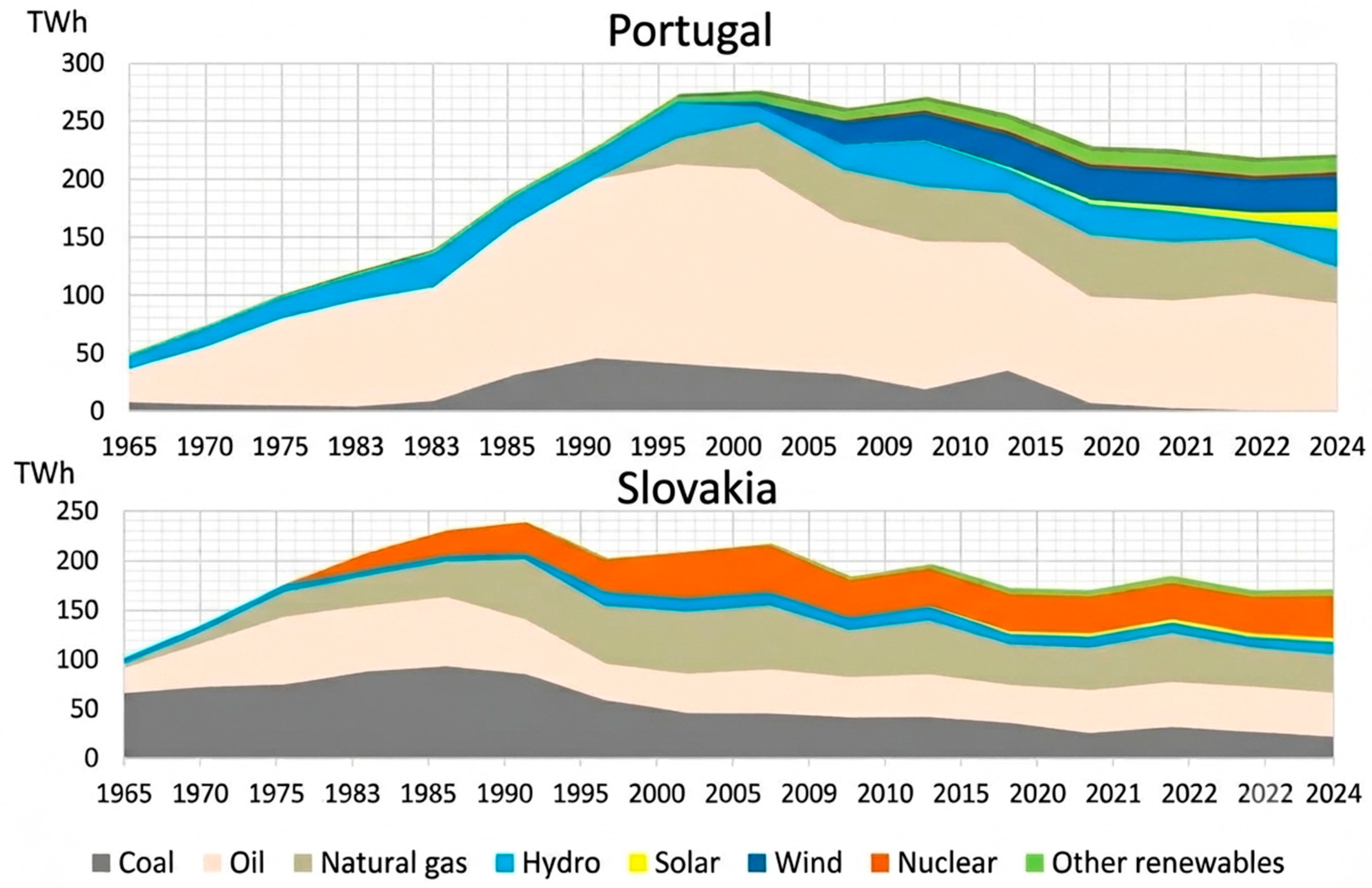
Portugal has strategically utilized its Atlantic coastline and high solar exposure, expanding its wind and solar capacities to position itself among the leaders in variable renewable integration. Portugal consistently achieves a significant share of renewable energy sources accounting for more than 60% of its annual electricity consumption. During specific periods—such as March 2024 or record-breaking days in 2023—renewables generated a surplus relative to national demand for several consecutive days. To mitigate the inherent variability of wind and solar power, Portugal utilizes its hydroelectric capacity, using pumped-storage power plants to ensure grid stabilization (see
Figure 1). Furthermore, the country extensively employs floating offshore wind technology. Given that its coastal waters are too deep for conventional fixed-bottom turbines, Portugal invested in the WindFloat Atlantic project, enabling the harvesting of high-velocity wind energy further offshore. Portugal has invested heavily in the digital transformation of its transmission grid, significantly enhancing weather-dependent production forecasting accuracy and enabling an instantaneous response to voltage fluctuations. Similarly, an efficient interconnection with Spain facilitates improved electricity exports. Following a trajectory comparable to Slovakia, Portugal has closed coal combustion; it was among the first EU nations to fully decommission its coal-fired power plants, with the final unit shuttered in 2021.
Slovakia maintains a robust low-carbon profile by utilizing a high share of nuclear energy (see
Figure 1) as a stable baseload, complemented by a strategic reduction in coal consumption. Slovakia has strategically used its historical industrial infrastructure and geographical conditions, positioning itself as a low-carbon electricity producer, primarily through the nuclear sector. The country consistently achieves a high share of carbon-free energy, with nuclear power accounting for approximately 60% of its annual electricity generation (e.g., in 2024 the share of nuclear in the electricity production represents 18,387 GWh, which accounts for a share of 60.6% of a total production of 30,319 GWh [
1]). The recent commissioning of the third unit at the Mochovce nuclear power plant has further solidified this position, allowing Slovakia to transition from a net importer to a significant exporter of clean energy in Central Europe. Hydropower remains the primary renewable energy source in the national mix; furthermore, Slovakia maintains four pumped-storage power plants to manage grid flexibility. In contrast to Portugal, solar and wind capacities are still developing. Biomass energy is also utilized in Slovakia; notably, prior to the decommissioning of coal-fired thermal power plants, biomass was also co-fired with coal. Excluding hydropower, the contribution of other renewable energy sources in 2024 amounted to only 2272 GWh, representing a modest 7.5% share. In contrast, hydropower generation reached 5372 GWh, accounting for nearly 18% of the total energy production [
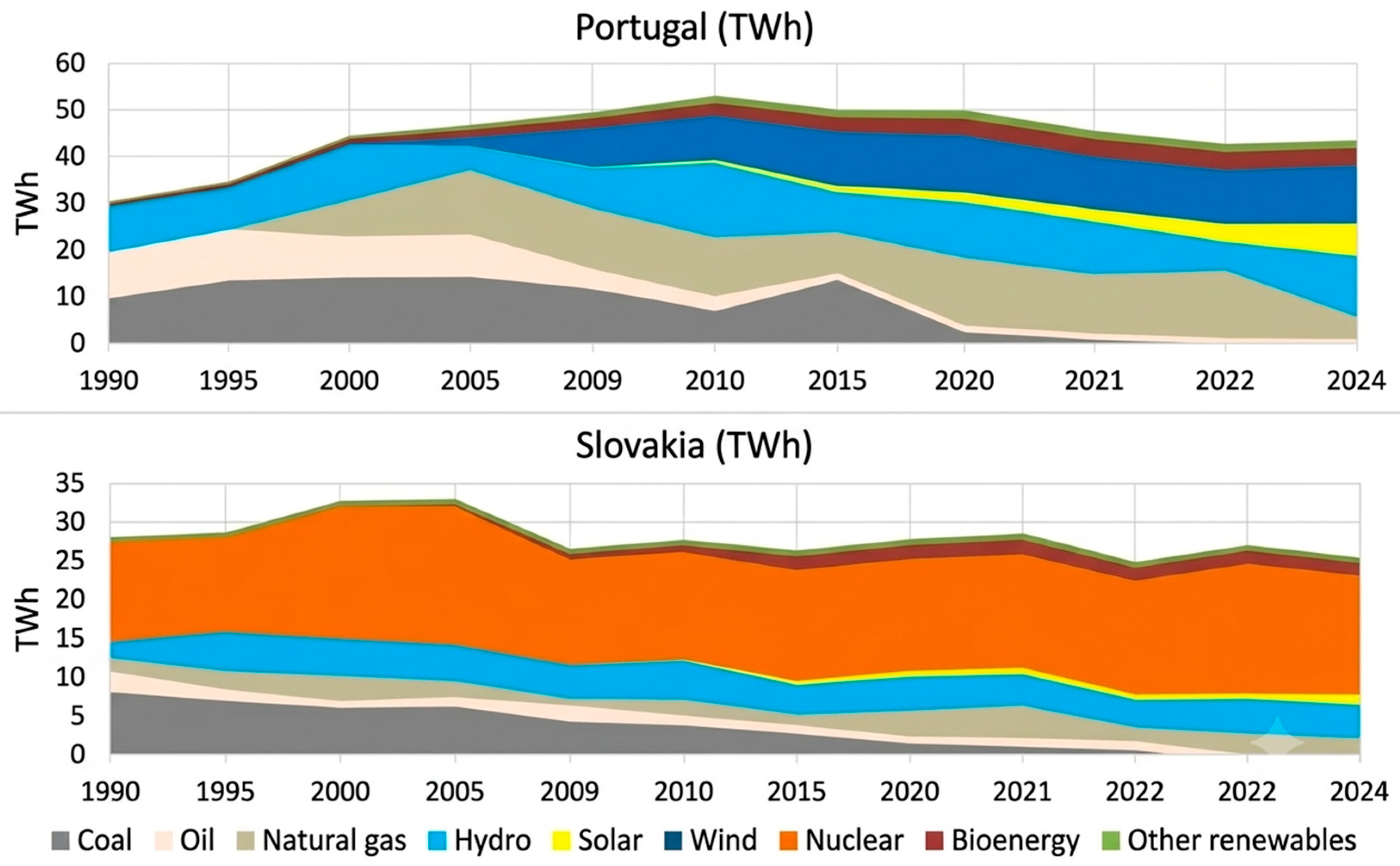
1]. Slovakia has also prioritized the modernization and digitalization of its transmission system to enhance regional grid stability and facilitate the integration of decentralized renewable sources. Its strategic location at the crossroads of Central European energy corridors ensures highly efficient interconnections with neighboring markets, particularly the Czech Republic, Hungary, and Poland. In a major environmental milestone, Slovakia successfully phased out electricity production from coal, with the decommissioning of coal-fired power plants in 2023 and 2024, marking a definitive shift toward a low-emission energy mix (see
Figure 2).
Figure 1.
Energy consumption by sources in Portugal and in Slovakia, 1965–2024 (data from [
2]).
Figure 1.
Energy consumption by sources in Portugal and in Slovakia, 1965–2024 (data from [
2]).
Figure 2.
Electricity production by source in Portugal and in Slovakia, 1990–2024 (data from [
2]).
Figure 2.
Electricity production by source in Portugal and in Slovakia, 1990–2024 (data from [
2]).
As a result of
Figure 1 and
Figure 2 the trajectories of Slovakia and Portugal between 1990 and 2024 to low carbon are visible. In Slovakia, the electricity mix is characterized by a dominant nuclear baseload; conversely, Portugal’s profile shows a rapid expansion of variable renewables, particularly wind and solar energy, alongside a significant historical reliance on hydropower. While Slovakia has maintained a relatively consistent production level, Portugal’s total electricity output has grown substantially over the decades to meet increasing demand. Both nations demonstrate a clear trend toward decarbonization, evidenced by the steady reduction in coal-fired generation in their respective energy portfolios.
Although numerous technical studies examine the energy mixes of both nations, there remains a critical gap in understanding how these divergent state strategies are perceived by the upcoming generation of engineers (STEM students), and how these macro-level disparities manifest in their actual household energy behavior.
The future development and strategic direction of the energy sector depend significantly on the expertise and commitment of today’s students. However, a declining interest in pursuing technical and engineering disciplines has been observed, which poses a substantial risk to the successful implementation of the energy transition. Recognizing this potential challenge, we conducted a comprehensive survey to analyze the attitudes and readiness of STEM students regarding the transformation of the energy sector. The research focuses specifically on students from Slovakia and Portugal to identify regional trends and barriers that will shape the next generation of energy experts. Analyzing their views on the feasibility of current energy policies provides critical data on whether the next generation perceives these strategic goals as attainable or technically challenging. Ultimately, our goal was to determine how these students navigate the complex balance between environmental sustainability, energy security, and economic viability in today’s volatile energy market. Due to the relatively small sample size, the findings of this study should be interpreted as indicative rather than statistically significant for the broader population. Therefore, these preliminary results should be viewed as a pilot assessment that establishes a foundation for more extensive future research involving a larger and more diverse demographic.
1.2. Literature Review: Public Perception of Renewable Energy Transitions
1.2.1. Public Acceptance of Renewable Energy in International and National Surveys
There are several studies regarding public opinion surveys in the field of renewable energy sources (RESs). One of the largest studies [
2] from 2017, involving 26,000 respondents from 13 different countries with diverse demographics, found that 82% of those surveyed supported the transition to renewable energy. A relatively recent survey [
3] from 2023, conducted across a sample of 19,000 respondents from 21 countries worldwide, compared public attitudes toward various energy sources, including renewables. Findings from this study [
3] indicate that public support for various energy technologies is significantly moderated by societal perceptions and literacy levels. While the NIMBY (Not In My Back Yard) effect continues to hinder certain projects, there is a distinct trend toward greater acceptance of less intrusive technologies, e.g., geothermal systems and heat pumps, which have a minimal impact on the landscape. It is also essential to highlight the numerous surveys commissioned and supported directly by the European Union (EU), which provide comprehensive data on public engagement with energy policies. The European Commission systematically monitors public sentiment across member states to assess the level of societal support for the transition to renewable energy. From some studies, e.g., [
4,
5], it is evident that public discourse varies significantly when comparing developing and developed nations. For instance, in [
6] detailed comparative analysis showed the disparities in RES adoption between developing and developed countries. These findings indicate that, although both types of countries employ different strategies for their implementation and support, renewables have a positive impact on their economy and also on the environment. Moreover, this indicates that industrialized nations already benefit from renewable energy usage.
Numerous EU-commissioned analyses specifically investigate public perceptions of renewable energy sources. For instance ref. [
7], an earlier study conducted by the European Commission, namely Special Eurobarometer 247—Attitudes towards Energy—revealed that EU citizens strongly favor non-conventional renewable energy forms for the coming decades, with 80% supporting solar energy, 71% wind energy, and 65% hydropower.
More recent findings are presented in [
8]—the European Commission study from September 2024, in which the Eurobarometer survey evaluated public sentiment regarding various European energy policy objectives across all Member States. The data indicates that a significant majority of respondents prioritized the stabilization of consumer energy prices as a critical strategic goal. The mentioned statistical analysis reveals that 40% of respondents identified the provision of affordable energy prices as a primary objective of EU energy policy, representing a significant increase of 13 percentage points (pp) since 2019. Furthermore, substantial support was recorded for technological innovation (33%, +9 pp) and the systematic reduction in aggregate energy consumption across Europe (30%, +2 pp).
Similarly, recent data [
9] from the summer of 2025 across six nations (Germany, Spain, France, Italy, Poland, and the UK) indicated that 77% of the respondents prefer investments in domestic renewable energy infrastructure over the continued reliance on imported fossil fuels.
1.2.2. Nuclear Versus Renewable Energy Pathways
Significant shifts have occurred within the energy sector since that period, most notably the recent discourse surrounding the role of nuclear energy. Consequently, it is pertinent to examine how these developments have influenced public opinion across individual Member States.
1.2.3. The Role of Students and Future Professionals
Our research focused on two European Union member states (Slovakia and Portugal) and it verified perspectives of individual students in STEM (Science, Technology, Engineering, and Mathematics) fields regarding RESs (renewable energy sources). As Member States of the European Union, both countries were included in the Eurobarometer studies. Moreover, some studies oriented to public opinion on RES were performed by institutions or the academic sector. A study from 2024 [
10] was conducted in Portugal, involving 3646 respondents to evaluate public perceptions of energy policies. This analysis was regarding four renewable technologies—hydro, wind, biomass and solar power. Hydropower was identified as the most well-known source, while biomass exhibited the lowest level of public awareness. Moreover, it showed public attitudes toward costs, environmental, and local development benefits with respect to RES.
Beyond general public surveys, several studies have specifically addressed the student population and the technical university environment. Sustainable energy behavior was analyzed among students of a technical university [
11], the willingness to pay a premium for green energy was assessed among European bachelor students [
12], and support for the renewable energy transition was examined within a university student population [
13]. These works confirm the relevance of the student perspective, but they remain confined to single institutions and individual national contexts. A cross-national comparison focused specifically on STEM students from Central and Southern Europe, such as the one presented in this study, has not yet been reported.
1.2.4. Public Opinion on Energy in the Slovak Context
Similarly, several public opinion surveys have been conducted in Slovakia, primarily commissioned by private agencies. For instance, a study by the FOCUS agency examined general attitudes toward the energy sector, revealing that while Slovaks support renewable energy sources (RESs), they maintain a stronger preference for nuclear energy or data [
9]. A 2021 study (
n = 1009) revealed that 72% of the Slovak population considers the development of renewable energy to be a key national energy priority. Additionally, organizations specializing in renewables, such as SAPI, conduct their own surveys, which tend to focus more specifically on local energy strategy.
2. Materials and Methods
The primary survey interface was developed using the Google Forms platform and remains publicly accessible at
https://forms.gle/7exajZw8WnsqFeZ19. The fully anonymized dataset and statistical outputs used in the paper are available from the corresponding author upon reasonable request.
In accordance with MDPI publisher guidelines regarding transparent research practices, the authors disclose that generative artificial intelligence (GenAI) was utilized during the development of this paper. Specifically, AI assistance was employed to optimize sentence structure, ensure precise technical phrasing, and perform language editing and grammatical verification during the preparation of the manuscript.
The GenAI tools were not utilized for study conceptualization, data collection, statistical data processing in JASP/PSPP, or the primary interpretation of the empirical results.
2.1. Structure of the Assessment Instrument
The primary objective of this research is to analyze the attitudes, preferences, and readiness of respondents regarding the transformation of the energy sector toward renewable energy sources, and to identify key factors influencing their energy-related behavior in households. The questionnaire represents a valid and systematic tool for investigating public opinions, positions and perceptions.
2.2. Research Design and Sample Strategy
The presented questionnaire was used for investigation or survey on energy use and the transition to renewable energy systems mainly among students in STEM fields. In addition to the primary objective, three specific objectives were defined as follows:
Specific Objective 1: To identify current energy consumption patterns and the extent of implementation of energy-saving measures in respondents’ households in relation to their demographic profile.
Specific Objective 2: To evaluate the environmental awareness of respondents and their subjective willingness to accept increased economic costs for the transition to clean energy.
To address this objective in greater depth, two specific hypotheses (H1, H2) were formulated and tested. The first hypothesis focuses on the direct financial implications of environmental values:
H1. There is a statistically significant positive relationship between respondents’ environmental concerns and their willingness to pay a premium for renewable electricity.
H2. There is a statistically significant relationship between respondents’ willingness to pay a higher price for renewable electricity and their perception of government/macro-level actors’ strategic responsibility.
Specific Objective 3: To examine respondents’ perspectives on the technological future of the energy sector, focusing on the potential of renewable energy sources, energy storage technologies, and the barriers hindering their development within the EU.
Importantly, while multiple potential research areas emerge from the defined specific objectives, this paper focuses in detail on testing the two primary hypotheses (H1, H2) derived from Specific Objective 2. These hypotheses were prioritized due to their critical relevance in understanding the behavioral drivers behind individual willingness to finance the energy transition. Nevertheless, the remaining specific objectives serve as a comprehensive baseline for a broader research framework, and hypotheses related to these objectives are anticipated to be fully formulated, tested, and evaluated in subsequent follow-up studies.
The questionnaire constructs and selected variables were primarily derived from the Value–Belief–Norm (VBN) theory and the Theory of Planned Behavior (TPB). These frameworks ground the hypothesized relationship between pro-environmental values, perceived strategic responsibility, and concrete financial behavior (willingness to pay). To ensure content validity and context appropriateness, the instrument was reviewed internally through consultations with departmental colleagues who are also engaged in teaching within relevant fields. A formal pilot testing phase with a small focus group of STEM students was not conducted, as this study is conceptually designed as a primary exploratory step. The empirical findings obtained from this pilot assessment are intended to serve as a foundational baseline to refine the questionnaire items and optimize the instrument design for a subsequent, larger-scale survey.
2.3. Questionnaire Development
In total, 15 items were included in the questionnaire (see
Appendix A). It was structured with predominantly closed-ended questions to enhance comparability and statistical analysis. Closed-ended questions and Likert-scale items were predominantly used to facilitate statistical analysis and reduce respondent ambiguity. The target respondents of the survey primarily consisted of young people, especially university students focused on technical fields. Young people are the primary stakeholders of future urban environments, so their perspectives are essential for designing sustainable and resilient cities. Moreover, involving further technical engineers in renewable energy discussions fosters their acceptance and accelerates the transition towards carbon-neutral technologies. We believe that collecting opinions from students provides innovative solutions for complex urban challenges like energy efficiency and green mobility.
The presented questionnaire consists of 15 questions (
Appendix A) categorized into several key thematic sections. Its scope covers the following areas:
Demographic Data (1–4): The introductory section collects baseline information about respondents, including country of origin, age, gender, and employment status.
Current Household Energy Behavior (5–6): This section focuses on the primary energy sources utilized in households and specific implemented energy-saving measures.
Environmental Attitudes and Perception of Responsibility (7–11): The questions examine the level of concern regarding the environmental impact of energy consumption, the willingness to pay a premium for green energy, and attitudes toward individual responsibility for climate change.
Expert Insight into Energy Mix and Technologies (12): The questionnaire evaluates respondents’ views on the potential of renewable energy sources to replace fossil fuels and identifies preferred energy storage technologies.
Strategic and Economic Barriers (13–14): Focused on identifying the main obstacles to energy development within the EU and the importance of government priorities, while weighing environmental aspects against cost-effectiveness and energy independence.
2.4. Data Collection Procedures and Instrument Validation
Data collection was conducted via an online questionnaire (available at:
https://forms.gle/7exajZw8WnsqFeZ19) developed using the Google Forms platform. The questionnaire was disseminated among students at the Slovak University of Technology in Bratislava (Slovakia) and the Instituto Superior de Engenharia do Porto (Portugal). A non-probability sampling strategy was applied. The instrument was distributed primarily to students enrolled in courses taught by the research team (convenience sampling) and was subsequently forwarded by these respondents to their peers (snowball sampling).
The research sample comprised participants, consisting of students from the Slovak University of Technology in Bratislava (Slovakia) and the Instituto Superior de Engenharia do Porto (Portugal). The data collection phase was executed over a six-month period, from October 2025 to March 2026. The study comprised a total of 133 respondents. Given the presence of international exchange programs at the selected universities, beyond Slovak and Portuguese there are also other nations included, accounting for approximately 19% of the total sample. This sampling approach supports the relevance of the findings for both technical practice and educational policy development.
If the required sample size were to be based on the total number of students, it would be prohibitively large for both countries. When determining demographic data from the 2024 Annual Report on the State of Education in Slovakia and in Portugal data from the Directorate-General for Education and Science Statistics, falls under the Portuguese Ministry of Science, Technology and Higher Education (MCTES), there are a total of 142,813 students in Slovak higher education institutions, with the majority being women, numbering 81,449 (57.03%) and in Portugal, a total of 456,032 students, also with majority of women 246,257 (54%). Therefore, the calculations were based on the number of students at specific institutions where the research was conducted: 11,041 students at STU in Slovakia [
14], women represent 3519 (31.87%) and 21,211 students at Polytechnic of Porto in Portugal [
15]. Given the size of the target group (exceeding 10,000 individuals), Cochran’s formula was used to calculate the minimum sample size:
where
n is number of respondents,
z is confidence level, for our purpose 95% (1.96),
p is maximum variability, we consider 0.5, and
e represents the acceptable margin of error. To achieve high precision (5% error margin), a sample size of 384 respondents would be required. Our actual research sample size is 133 respondents. With this number of respondents, the actual margin of error reaches approximately 8.3%. In the context of the exploratory nature of our research, we consider this margin of error to be acceptable. The obtained sample size is sufficient for exploratory pilot testing. As a result, this instrument is suitable for identifying trends in students’ perceptions of energy use, renewable energy, and sustainability-related policies.
A limitation of this study is the sample size (n = 133), resulting in an 8.3% margin of error. While this may increase the risk of Type II error in hypothesis testing, the sample represents a highly specialized technical population of STEM students, making a larger sample size difficult to achieve. Future studies will aim to expand the respondent base.
From a statistical methodology standpoint, the questionnaire items are constructed very differently (incorporating nominal data, multiple-choice questions, and ordinal scales). Therefore, it is mathematically impossible and methodologically unsound to validate the questionnaire as a single homogenous unit using Cronbach’s alpha or Exploratory Factor Analysis (EFA).
Another limitation is the reliance on a student sample—since these respondents generally do not pay for electricity directly at present (with costs often covered by parents or student housing), their responses represent a hypothetical willingness to pay. This reflects their environmental values and future consumer propensity rather than immediate, real-world financial behavior, which will fully realize only upon their financial independence.
Its thematic sections were logically ordered to minimize respondent burden and improve response accuracy. It was designed to assess public awareness, attitudes, and behaviors related to energy consumption and renewable energy sources. The content and face validity of the instrument were established through expert review: the items were developed by the authors, who are domain specialists in energy engineering and renewable energy, and were subsequently consulted with academic colleagues with relevant expertise, whose feedback was used to refine the wording, scope, and ordering of the questions prior to dissemination.
Upon completion of the data collection phase, the obtained primary data (
n = 133 respondents) were exported to the Microsoft Excel spreadsheet processor for initial sorting, the coding of reverse-scored items, and a data completeness check (questionnaire is available at:
https://forms.gle/7exajZw8WnsqFeZ19). Subsequently, the dataset was imported into the PSPP statistical software (version 1.4.1), where the final statistical processing was conducted. Statistical evaluation of specific survey parameters was performed using the JASP software (version 0.96).
3. Results
This report presents a selected subset of the preliminary findings. The results shared in this paper represent an initial phase of the research, focusing on specific key indicators relevant to the view on development of energy mix in both countries. A full evaluation of the dataset, including more detailed correlations, will be published in subsequent studies as the research evolves.
3.1. Descriptive Demographic and Socio-Economic Analysis
The questionnaire serves as a critical tool for mapping socio-demographic energy patterns with specific household energy behaviors. By analyzing implemented energy-saving measures, Urban Science can model the effectiveness of residential efficiency programs and identify gaps in the adoption of smart home technologies within high-density areas. The data regarding primary energy sources and storage preferences provides essential input for designing decentralized urban microgrids and optimizing the placement of local energy storage infrastructure. Assessing the public’s willingness to pay for green energy helps urban planners and policymakers quantify the social mandate for transitioning toward Carbon-Neutral Cities. Evaluating perceived barriers to renewable integration enables the determination of where infrastructural improvements are most needed to support a city’s strategic energy priorities.
To establish a clear baseline for the analysis, a comprehensive overview of the research sample is presented in
Table 1, where the details of the core demographic characteristics and academic profiles of the 133 participating students across both institutions. The final research sample, in terms of gender composition, the sample reflects a typical distribution in STEM fields, with male respondents constituting the majority at 79.7% (106), while female respondents accounted for 20.3%.
This pronounced male majority does not indicate sampling bias but reflects the gender composition of the technical engineering target population. At the Faculty of Electrical Engineering and Information Technology of STU, from which the Slovak respondents were primarily recruited, women represent only approximately 10% of enrolled students according to official institutional statistics. At the Instituto Superior de Engenharia do Porto, from which the Portuguese respondents were recruited, the student gender distribution is likewise male-dominated, at approximately 64% male and 37% female according to institutional figures. The Slovakia-wide (31.87%) and Portugal-wide (54%) gender ratios referenced in the sample-size estimation cover all fields of study, including non-technical disciplines with a considerably higher female share, and therefore do not constitute the relevant reference population for a survey targeting STEM students.
The majority of the surveyed STEM students fall within the 18 to 34 age range, over 92%. The presence of a small percentage of respondents under the age of 18 and over age of 34 is primarily due to the fact that students from Ukraine, who currently have a larger representation at STU, typically enter higher education at a younger age, while the segment over 34 years old reflects individuals pursuing or completing their university degrees later in life.
Subsequently, a selection of baseline findings is presented, utilizing an exclusively descriptive approach. To uncover deeper, non-trivial relationships within the dataset and rigorously validate our core research framework, the subsequent analysis employs advanced methods of inferential statistics. It should be emphasized that while the overall research design encompasses a broader set of objectives, this specific paper focuses exclusively on the presentation and evaluation of two primary hypotheses (H1, H2). It should be emphasized that this survey represents our initial, exploratory instrument in mapping student energy perspectives. Moving forward, we intend to conduct a deeper, multi-variable analysis of the current dataset to fully isolate key behavioral drivers. The empirical insights and lessons learned from this primary phase will serve as a foundational baseline to design a refined, follow-up questionnaire, allowing us to optimize the integration of socio-economic and regional factors in future research.
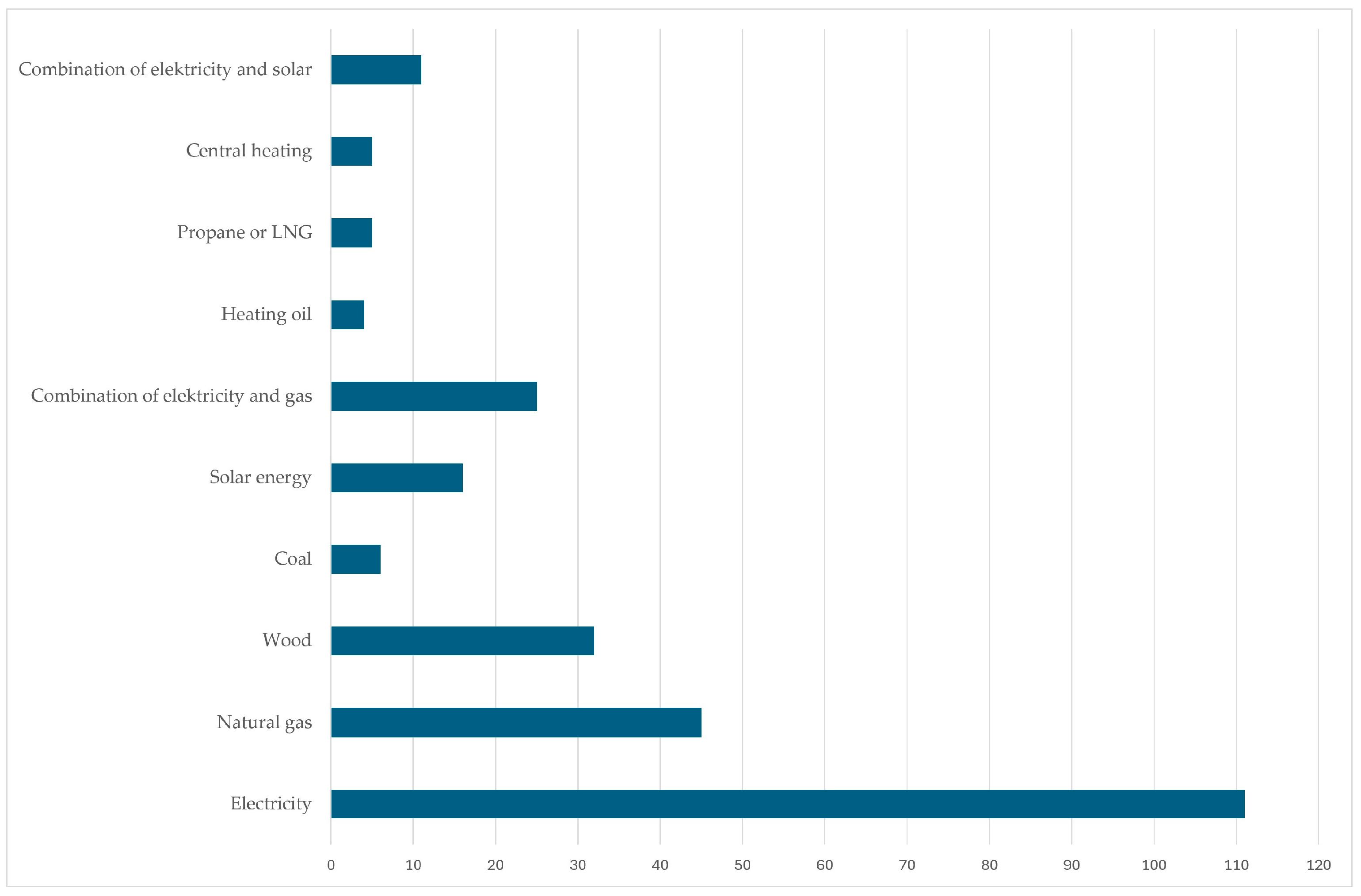
The following is a selected result obtained through the descriptive approach.
Figure 3 presents the results for the question regarding primary energy source use in households. Based on the responses regarding primary energy sources, it is possible to analyze the household electrification rate. Assessing the proportion of households exclusively dependent on electricity versus those utilizing gas or solid fuels is critical for urban distribution network capacity planning. A significant proportion of respondents utilize a combination of multiple energy sources.
More significant than the analysis of standalone sources is the comparative study of multi-source energy mixes and their prevalence in the respective regions. The findings revealed significant disparities in responses based on the country of origin. Specifically, only a single respondent from Portugal reported a combination of electricity and wood, whereas this energy mix was identified in 16 cases among Slovak households. This illustrates the disparities in regional energy mixes. While these results cannot be generalized due to the small sample size, the frequent reporting of solid fuel usage within this small Slovak cohort aligns with broader national challenges. According to official reports (e.g., Economic Policy Strategy of the Slovak Republic until 2030 [
16]), Slovakia consistently faces persistent air quality challenges in specific regions due to high PM10 and PM2.5 concentrations originating primarily from residential solid fuel heating. For Slovakia, it highlights a well-known fact frequently criticized by the EU: the high level of air pollution caused by particulate matter (PM), resulting from the continued use of solid fuels in households. Slovakia faces persistent air quality challenges due to high PM10 and PM2.5 concentrations from residential solid fuel heating. The use of inefficient boilers often creates “smog pockets,” exceeding EU standards and leading to legal pressure from the European Commission. These pollution levels pose a severe public health risk, significantly increasing respiratory diseases and premature mortality.
A total of 22 respondents reported using solar energy alone or in combination with other sources. Within this specific solar-user subgroup, Slovak respondents accounted for 14 cases (63.6%), outnumbering the 8 responses recorded in Portugal. However, when evaluated relative to each national sample, the internal adoption rate was higher among Portuguese respondents (26.7%, 8 out of 30) than among Slovak respondents (19.2%, 14 out of 73). The presence of a larger absolute number of solar energy users within the Slovak cohort may be primarily attributed to the following three factors: housing structure, energy crisis, and government support. Regarding housing structure, the key element is the difference in the proportion of single-family detached houses (which are better suited for solar panel installation) among the respondents from both countries. According to 2024 Eurostat statistics [
9] regarding the distribution of the population by dwelling type, there is no significant disparity between Slovakia and Portugal in terms of housing type as a percentage of the total population. Slovakia ranks 14th among EU countries with the highest proportion of single-family houses per capita (54.6%), while Portugal follows closely in 17th place (51.0%). A more decisive factor is likely the significant difference in property ownership rates. Slovakia ranks among the leaders with a 93% homeownership rate, whereas in Portugal, this figure stands at approximately 70% [
17,
18].
Property owners generally possess greater autonomy and decision-making freedom regarding the installation of renewable energy sources (RESs) compared to tenants, who are often restricted by lease agreements or collective building management decisions. In this regard, Slovakia holds the second-highest position among all EU member states, whereas Portugal ranks significantly lower, in 13th place [
18,
19].
The energy crisis represents another factor. Evidence suggests a higher motivation among Slovak households to achieve energy independence, primarily driven by the volatility and surge in natural gas prices. This economic pressure has accelerated the transition toward self-generation and decentralized energy solutions as a means of ensuring long-term cost stability. In Slovakia, natural gas represents the dominant fuel, accounting for approximately 43% of total household energy consumption [
17,
18]. The country possesses one of the most extensive gasification networks in Europe. Conversely, natural gas plays a significantly smaller role in Portuguese households, representing less than 10% of their energy use [
17,
18]. Instead, Portuguese consumers rely far more heavily on electricity and biomass for space heating and water heating purposes. The disparities in subsidy schemes between Slovakia and Portugal are fundamental and reflect divergent strategies within the field of Urban Science. While Slovakia focuses on direct financial contributions aimed at reducing the upfront investment costs, Portugal places greater emphasis on tax incentives and the development of energy communities.
3.2. Correlation Analysis of Environmental Awareness and Willingness to Pay (H1)
The following section provides a brief statistical analysis of the two hypotheses mentioned above. To analyze the relationship between respondents’ environmental concerns and their willingness to pay a higher price for electricity from renewable sources, Spearman’s rank correlation coefficient rs was applied. Spearman’s rank correlation was selected because Pearson’s correlation measures only linear relationships and requires interval data.
Our variables are ordinal in scale, and we sought a monotonic relationship—meaning whether the value of one question consistently increases (or decreases) with the increasing value of the second question, regardless of whether this increase is linear. The JASP software was used for calculation and correlation coefficient
rs was calculated as follows:
where
d is the difference between the ranks of the first and second question for each respondent, and
n represents the total number of respondents, which in our case is 133. The results of the analysis revealed a statistically significant, moderately positive correlation (
rs = 0.427,
p < 0.001). This result formally aligns with the initial assumption that higher environmental awareness among respondents is associated with a greater declared willingness to bear higher financial costs for green energy. However, it is critical to emphasize that correlation does not equal causation, and these findings must be interpreted with caution due to several methodological limitations. First, the sample exhibits a severe demographic and socioeconomic bias, as it consists exclusively of STEM students. Most of these young respondents do not currently bear direct responsibility for utility bills in their households (with expenses often covered by parents or student housing), rendering their expressed willingness to pay largely hypothetical. Second, because the study did not control for confounding variables such as socioeconomic status, family income, or regional economic disparities, it is impossible to rule out these factors as the actual underlying drivers of the observed financial commitment.
A closer look at the descriptive data (
Table 2) reinforces this statistical breakdown. While 42 respondents expressed low environmental concern, a significantly higher number (72 respondents) refused to pay a premium for green energy (answering ‘Rather no’ or ‘Definitely not’). The remaining gap represents environmentally conscious students who, despite their green values, are blocked from financial commitment. This may illustrate that environmental awareness is a necessary, but not always sufficient, condition for financial sacrifice, as economic barriers and living costs stifle active market participation. It should be noted that this specific analysis evaluated the dataset without differentiating between respondents from Slovakia and Portugal.
3.3. Analysis of Strategic Attitudes and Individual Financial Commitment (H2)
Another hypothesis tested in this study examined the relationship between the respondents’ financial commitment and their perception of individual responsibility. Specifically, this analysis was based on the cross-examination of the following questionnaire items: ‘Would you be willing to pay a higher price for electricity if it were generated exclusively from renewable sources?’ and ‘Do you agree that the development and integration of renewable energy should be a strategic priority for governments?’ Through this, we aimed to determine whether an individual’s strategic attitude correlates with their willingness to pay more for green energy. Given the nature of the data, Spearman’s rank correlation coefficient was again calculated.
Notably, the Spearman correlation analysis revealed a negligible and statistically non-significant relationship (rs = 0.04, p = 0.34) between respondents’ perception of renewable energy sources as a government priority and their willingness to pay a higher price for energy. Crucially, this lack of correlation should not be misinterpreted as a NIMBY effect, as our previous findings demonstrated that higher environmental awareness is associated with a greater hypothetical willingness to pay premium prices.
Given the lack of statistical significance, any definitive explanations regarding this discrepancy remain speculative and lack empirical support within this study. It can merely be hypothesized for future research that respondents may believe the transition to green energy should be financed macroeconomically (e.g., through government budgets or EU funds) rather than being shifted onto end consumers. Alternatively, the current socioeconomic reality in both Slovakia and Portugal, characterized by rising living costs and the threat of energy poverty, might mean that even environmentally conscious citizens simply cannot afford further financial strain, regardless of their positive attitudes toward sustainability. However, verifying these underlying mechanisms would require a larger, more socioeconomically diverse sample and multi-variable modeling to properly isolate these factors. Again, it should be noted that this specific analysis evaluated the dataset without differentiating between respondents from Slovakia and Portugal.
A primary limitation of this study lies in its relatively small sample size (n = 133) and its restriction to STEM students from two specific universities in Slovakia and Portugal. Consequently, caution must be exercised regarding the generalizability and external validity of the findings to the broader global context. However, this study is intended to serve as an initial exploratory framework. Moving forward, we hope to build upon these preliminary findings in a subsequent study. Rather than expanding the research across all socio-economic strata of the general population, our next phase is intended to remain strictly focused on STEM students as key future drivers of the engineering sector. To increase the statistical power and comparative depth, we would like to involve a substantially larger sample size of technical students and consider expanding the geographical scope by introducing another country—specifically North Macedonia—to offer a valuable comparative perspective from outside the European Union framework.
3.4. Comparative Context: Slovakia vs. Portugal
To directly compare the two focal national subsamples, the ordinal items were analyzed with the Mann–Whitney U test for independent groups (two-sided), with the rank-biserial correlation reported as the effect size and a 95% percentile bootstrap confidence interval (3000 resamples). The comparison was restricted to respondents from Slovakia and Portugal. The results are summarized in
Table 3.
Statistically significant differences were identified for the majority of the compared items. Portuguese respondents reported significantly higher environmental concern (p < 0.001, r = −0.47), higher willingness to pay more for renewable electricity (p = 0.019, r = −0.30), and stronger agreement that renewable energy development should be a strategic priority (p < 0.001, r = −0.57). Slovak respondents, in turn, expressed significantly stronger agreement with the more skeptical statements, namely that the change to renewable energy is not easy (p < 0.001, r = 0.45), that fossil fuels are not responsible for climate change (p = 0.003, r = 0.35), and concerning the attribution of responsibility for climate change (p = 0.003, r = 0.35). No significant difference was found for the perceived environmental friendliness of gas (p = 0.479) or for the view that renewable energy is not limited (p = 0.058). These effect sizes correspond to small-to-moderate and moderate-to-large differences, indicating that the two national subsamples differ in a systematic, and not merely incidental, manner.
4. Discussion
Despite an 8.3% margin of error resulting from the sample size of 133 respondents, the data provides adequate statistical power for the subsequent analysis, making this instrument perfectly suitable for mapping trends in student attitudes toward energy transition and sustainability.
The preliminary findings reveal a fascinating paradox between natural resource potential and actual household technology adoption. While Portugal possesses significantly higher solar exposure, the higher reported usage of residential solar solutions among Slovak STEM students suggests that socio-economic factors, such as property autonomy, often outweigh climatic advantages. We would like to re-emphasize the highly surprising conclusion that emerged from our data, that in Slovakia possess greater decision-making power regarding long-term infrastructural investments like photovoltaics. This counterintuitive finding can be explained by two primary factors that were not originally anticipated in our initial research design. First, as previously noted, the homeownership rate in Slovakia exceeds 93%, whereas in Portugal it revolves around 70%. Property ownership grants Slovak households substantially greater autonomy to implement photovoltaic solutions. Second, the recent energy crisis impacted Slovakia, which relies heavily on gas imports, much more acutely, thereby triggering strong economic pressure to seek alternative energy sources regardless of geographical limitations.
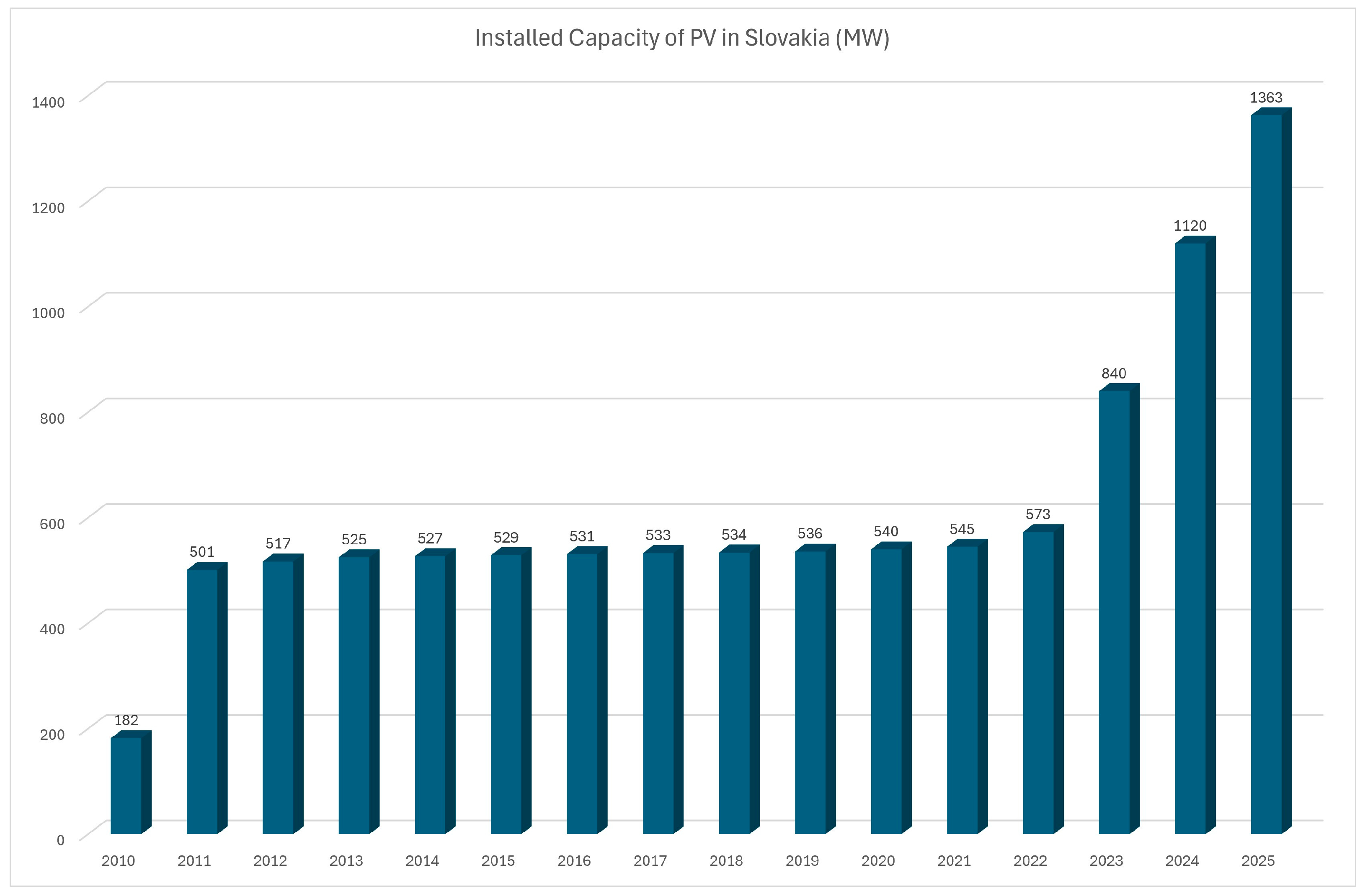
Subsequently, in Slovakia, the distribution system operators introduced the concepts of ‘small power source’ and ‘local source.’ These represent small-scale installations with a capacity of up to 10.8 kW that are eligible for connection to the distribution grid. Although the technical conditions and connection processes have been formally established, the actual capacity of the grid remains severely constrained, often forcing applicants to wait up to a year for final integration. Currently, a dramatic acceleration can be observed, following the compounding effects of the COVID-19 pandemic, the subsequent global energy crisis, and the geopolitical instability caused by the war in Ukraine; the pressure on energy self-sufficiency has intensified. Consequently, recent years witnessed a significant surge in total installed capacity (see
Figure 4).
The survey also reflects a global trend where young technical professionals are increasingly concerned with energy security and price stability. The high motivation for energy independence in Slovakia, driven by the recent volatility of natural gas prices, suggests that economic pragmatism is a primary catalyst for the decentralized energy transition. Future research should expand this sample to verify if these trends hold across broader demographics and to explore how specific subsidy schemes, direct grants in Slovakia versus tax incentives in Portugal, influence the speed of technology adoption in urban areas. The statistically significant differences identified between the two national subsamples (
Table 3) can be situated within the broader literature. The generally pro-renewable orientation of both groups is consistent with the strong public support for renewable energy reported in recent European surveys [
8,
9], and the present study extends that general-public evidence to the specific population of STEM students, complementing earlier single-institution studies of students and young professionals [
11,
12,
13]. At the same time, the more skeptical responses among the Slovak subsample indicate that support for the energy transition is not uniform across national contexts, a nuance that aggregate European surveys tend to obscure.
The combined testing results of our two hypotheses reveal a critical nuance in consumer behavior within Slovakia and Portugal. On one hand, the analysis confirmed a statistically significant relationship, demonstrating that respondents with higher environmental awareness are personally willing to pay a premium for green energy. Meanwhile, on the other hand, the results of H2 revealed no correlation between perceiving renewable energy as a government priority and the willingness to bear higher energy costs. This apparent paradox indicates that while environmentally motivated citizens do not reject personal financial commitment, they do not view general support for state energy strategies as a direct obligation for their own wallets. The data may highlight a gap between individual declarative activism and the shifting of macroeconomic responsibility for the green transition onto governments and corporations. Although the Spearman correlation analysis provided valuable initial insights into the relationship structures in H1 and H2, we intend to apply a chi-square test of independence in subsequent analyses to comprehensively validate these findings. This non-parametric approach will allow for a more detailed examination of response distributions within contingency tables, regardless of the differing number of response categories between the questions.
5. Conclusions
This report confirms that Portugal and Slovakia are successfully pursuing distinct yet valid low-carbon pathways. Portugal serves as a model for integrating high shares of variable renewables through digital grid transformation and offshore innovation, while Slovakia demonstrates the efficacy of nuclear energy as a stable, carbon-free baseload.
Crucially, the empirical results revealed a fascinating and counterintuitive paradox regarding the adoption of solar technologies, which was not originally anticipated in our initial research design. Despite Portugal’s significantly higher solar irradiance and climatic potential, the data showed a higher rate of solar solution implementation among Slovak respondents. We hypothesize that this unexpected divergence is primarily driven by socio-economic structures, specifically, the substantially higher homeownership rates in Slovakia (over 93% compared to approximately 70% in Portugal), which grant households greater autonomy to modify their energy systems, combined with the acute economic pressures of the recent energy crisis on Slovakia’s highly gas-dependent infrastructure. Because this finding came as a major surprise and challenges straightforward geographical assumptions, it will be the subject of a dedicated, in-depth follow-up study to thoroughly isolate and quantify these socio-economic and regional variables. It must be emphasized that the homeownership, energy crisis, and socio-economic factors referred to above were not directly measured or statistically tested within the present study. The proposed explanation is therefore offered as a tentative interpretation that requires verification in future dedicated research, rather than as an established causal relationship.
Our findings challenge the simplistic assumption that public support for renewable energy policies automatically translates into consumer willingness to absorb higher costs. The research successfully isolated a critical gap: environmental awareness drives financial commitment on an individual level, yet public consensus on government strategic priorities does not. Policy makers in Slovakia and Portugal must recognize that the green transition cannot rely solely on consumer-side financial sacrifices. Given the socio-economic constraints and risks of energy poverty, effective strategies must leverage state subsidies, EU funds, and corporate accountability to ensure that climate neutrality goals are achieved without disproportionately burdening end-users.
The pilot survey highlights that while the technical foundations for a carbon-neutral Europe are being laid, the success of the transition depends heavily on the next generation of STEM professionals. Addressing the observed declining interest in technical disciplines is essential to ensure a competent workforce capable of managing future smart grids and decentralized systems.
Ultimately, the transition to “Carbon-Neutral Cities” requires a multi-faceted approach that considers not only technological deployment but also regional housing structures, property ownership models, and the economic motivations of citizens. As Slovakia continues to tackle air quality issues and Portugal expands its energy communities, the exchange of regional best practices will be vital for achieving the EU’s collective 2050 climate goals.
Achieving this goal is crucial for students to express their attitudes, preferences, and readiness to participate in the transformation of the energy sector toward renewable energy sources, low-carbon and more sustainable energy systems.
This study contributes to the ongoing discourse on European energy transitions by offering a unique, comparative snapshot of how future technical professionals in two structurally distinct energy landscapes, Slovakia with its nuclear baseload and Portugal with its variable renewable focus, perceive climate neutrality. The novelty of this work rests in its examination of STEM students as pivotal future actors both in the energy market and as professionals who will actively work within the energy sector, revealing that while environmental awareness is high, immediate financial commitment is tightly constrained. Moving forward, these preliminary findings are intended to serve as a foundational baseline for a subsequent, larger-scale study. Rather than acting as a definitive conclusion, this work opens a path for expanded research where we hope to involve a significantly larger sample of technical students and consider broadening the geographical scope by potentially incorporating another country from outside the European Union framework to provide a wider comparative perspective.
Author Contributions
Conceptualization and research design, M.F.S. and F.F.M.; investigation and formal analysis, M.F.S. and D.K.; writing—original draft preparation, M.F.S. and D.K. All authors have read and agreed to the published version of the manuscript.
Funding
This work was funded by the EU NextGenerationEU through the Recovery and Resilience Plan for Slovakia under the project No. 09I04-03-V02-00033.
Institutional Review Board Statement
Ethics committee review was not required for this study under the national legislation of either participating country. In Slovakia, the competence of ethics committees is limited to biomedical research, defined in Section 2(12) of Act No. 576/2004 Coll. on Healthcare as the acquisition and verification of new biological, medical, nursing and midwifery knowledge on humans (reviewed under Sections 26 to 34 of the same Act); an anonymous opinion survey lies outside this scope. In Portugal, mandatory ethics committee approval applies to clinical research as defined by Law No. 21/2014, of 16 April (as amended by Law No. 9/2026, of 6 March), covering clinical trials and intervention studies involving human participants; a non-interventional attitudinal survey is not covered. The questionnaire recorded no special categories of personal data and no directly identifying information (no names and no e-mail addresses were collected), and responses were processed in anonymized form. The processing therefore remained outside the scope of Regulation (EU) 2016/679 (GDPR), consistent with Recital 26, as transposed by Act No. 18/2018 Coll. (Slovakia) and Law No. 58/2019, of 8 August (Portugal). What is at stake is a survey of students about energy perceptions and behaviors, not clinical research. The study collects responses on domestic energy consumption, environmental attitudes, and willingness to pay more for renewable electricity, without any reference to health issues, medical procedures, diagnostic or treatment assessments, and without processing personal data.
Informed Consent Statement
Participation was voluntary and anonymous. Respondents were informed of the purpose and scope of the survey at the start of the online questionnaire and provided consent by choosing to complete and submit it. No personal or identifying data were recorded. Because responses were fully anonymous and the survey posed no more than minimal risk, separate guardian consent was not required for the single respondent under 18 years of age, whose anonymity could not be distinguished from that of other participants.
Data Availability Statement
The forms generated during this study are available at:
https://forms.gle/7exajZw8WnsqFeZ19. The data generated during this study are available upon request from the corresponding author.
Conflicts of Interest
The authors declare no conflict of interest.
References
- Slovenská Elektrizačná Prenosová Sústava (SEPS). Ročenka SEPS 2024; SEPS: Bratislava, Slovakia, 2025; Available online: www.sepsas.sk/engine/wp-content/uploads/2025/07/Rocenka-SEPS_2024.pdf (accessed on 13 May 2026).
- Ørsted. New Survey Shows Strong Global Support for Green Energy. Ørsted Newsroom. 8 November 2017. Available online: https://orsted.co.uk/media/newsroom/news/2017/11/new-survey-shows-strong-global-support-for-green-energy (accessed on 7 April 2026).
- Groma, V.; Börcsök, E.; Terjék, A.; Bustreo, C. A European Comparative Study of Public Perception and Evidence-Based Information on Energy Production Alternatives. Sustainability 2025, 17, 10043. [Google Scholar] [CrossRef]
- Céspedes, J.E.S.; Bustos, E.H.; Reyes, J. Students’ Perceptions and Attitudes Towards Renewable Energy Sources. J. Namib. Stud. Hist. Politics Cult. 2022, 32, 226–238. [Google Scholar]
- Niels, T.A. A Model for Renewable Energy Education. In Intersol Eighty Five; Bilgen, E., Hollands, K.G.T., Eds.; Pergamon: Oxford, UK, 1986; pp. 2242–2246. [Google Scholar] [CrossRef]
- Karimi, K.; Karimi, A. The Economic Impacts of Renewable Energy Adoption: A Comparative Analysis of Developed and Developing Nations. Join J. Soc. Sci. 2024, 2, 32–47. [Google Scholar] [CrossRef]
- European Commission. Special Eurobarometer 247: Attitudes Towards Energy; European Commission: Brussels, Belgium, 2006.
- European Commission. Special Eurobarometer 555: Public Opinion on EU Energy Policy; European Union: Brussels, Belgium, 2024.
- Euronews. Europeans Want Homegrown Renewable Energy Over Fossil Fuels from Trump or Putin, Poll Confirms. Euronews. 6 May 2025. Available online: https://www.euronews.com/2025/05/06/europeans-want-homegrown-renewable-energy-over-fossil-fuels-from-trump-or-putin-poll-confi (accessed on 7 April 2026).
- Ribeiro, F.; Ferreira, P.; Araújo, M.; Braga, A.C. Public opinion on renewable energy technologies in Portugal. Energy 2014, 69, 39–50. [Google Scholar] [CrossRef]
- Janmaimool, P.; Chontanawat, J. Do University Students Base Decisions to Engage in Sustainable Energy Behaviors on Affective or Cognitive Attitudes? Sustainability 2021, 13, 10883. [Google Scholar] [CrossRef]
- Kurek, B.; Górowski, I. Willingness to Pay for Green Energy: Exploring Generation Z Perspectives. Sustainability 2025, 17, 7953. [Google Scholar] [CrossRef]
- Gaafar, A.M. The Role of Social Capital in Shaping Students’ Attitudes Toward the Renewable Energy Transition: An Explanatory Study of Sultan Qaboos University Students. Sustainability 2026, 18, 2531. [Google Scholar] [CrossRef]
- Počet Študentov STU v Akad. Roku 2025/2026 k 31.10.2025. Available online: https://www.stuba.sk/buxus/docs/stu/pracoviska/rektorat/odd_vzdelavania/student/statistika/studenti/Pocet_studentov_k_31_10_2025.pdf (accessed on 20 December 2025). (In Slovak)
- Arquivo de Notícias. Available online: www.isep.ipp.pt/New/ViewNew/3960 (accessed on 12 January 2026). (In Portugal)
- Ministry of Economy of the Slovak Republic. Economic Policy Strategy of the Slovak Republic Until 2030 (Stratégia Hospodárskej Politiky Slovenskej Republiky do roku 2030); Ministry of Economy of the Slovak Republic: Bratislava, Slovakia, 2018. Available online: www.economy.gov.sk/ministerstvo/centrum-pre-hospodarske-otazky/strategie-a-politiky?csrt=10995428995363610755 (accessed on 19 June 2026).
- Pravda. Survey: According to 72% of Slovaks, Renewable Energy Sources Should be One of the State’s Energy Priorities. Pravda.sk. 8 November 2021. Available online: https://spravy.pravda.sk/domace/clanok/606461-prieskum-obnovitelne-zdroje-by-podla-72-slovakov-mali-byt-jednou-z-energetickych-priorit-statu/ (accessed on 7 April 2026). (In Slovak)
- Eurostat. Housing in Europe: Type of Housing; European Commission: Brussels, Belgium, 2025. Available online: https://ec.europa.eu/eurostat/cache/interactive-publications/housing/2025/02/index.html (accessed on 23 May 2026).
- Our World in Data. 2024. Available online: https://ourworldindata.org/energy/country (accessed on 17 April 2026).
- SAPI. Správa o Stave Rozvoja OZE v Elektroenergetike za rok 2023 Upozorňuje na Nedostatočné Ambície Slovenska. Available online: https://www.sapi.sk/clanok/sprava-o-stave-rozvoja-oze-v-elektroenergetike-za-rok-2023 (accessed on 8 April 2024).
- Sečková, M. Cooperation of Photovoltaic System and Heat Pump in the Conditions of Slovak Republic. Master’s Thesis, Slovak University of Technology in Bratislava, Bratislava, Slovakia, 2025. [Google Scholar]
- SAPI. Slnko na Slovensku Zažilo ďalší Silný Rok, Pribudlo 243 MW Novej Fotovoltiky, Najviac ju ťahali Domácnosti. Sapi.sk. 30 January 2024. Available online: https://www.sapi.sk/clanok/slnko-na-slovensku-zazilo-dalsi-silny-rok-pribudlo-243-mw-novej-fotovoltiky-najviac-ju-tahali-domacnosti (accessed on 23 May 2026). (In Slovak)
| Disclaimer/Publisher’s Note: The statements, opinions and data contained in all publications are solely those of the individual author(s) and contributor(s) and not of MDPI and/or the editor(s). MDPI and/or the editor(s) disclaim responsibility for any injury to people or property resulting from any ideas, methods, instructions or products referred to in the content. |