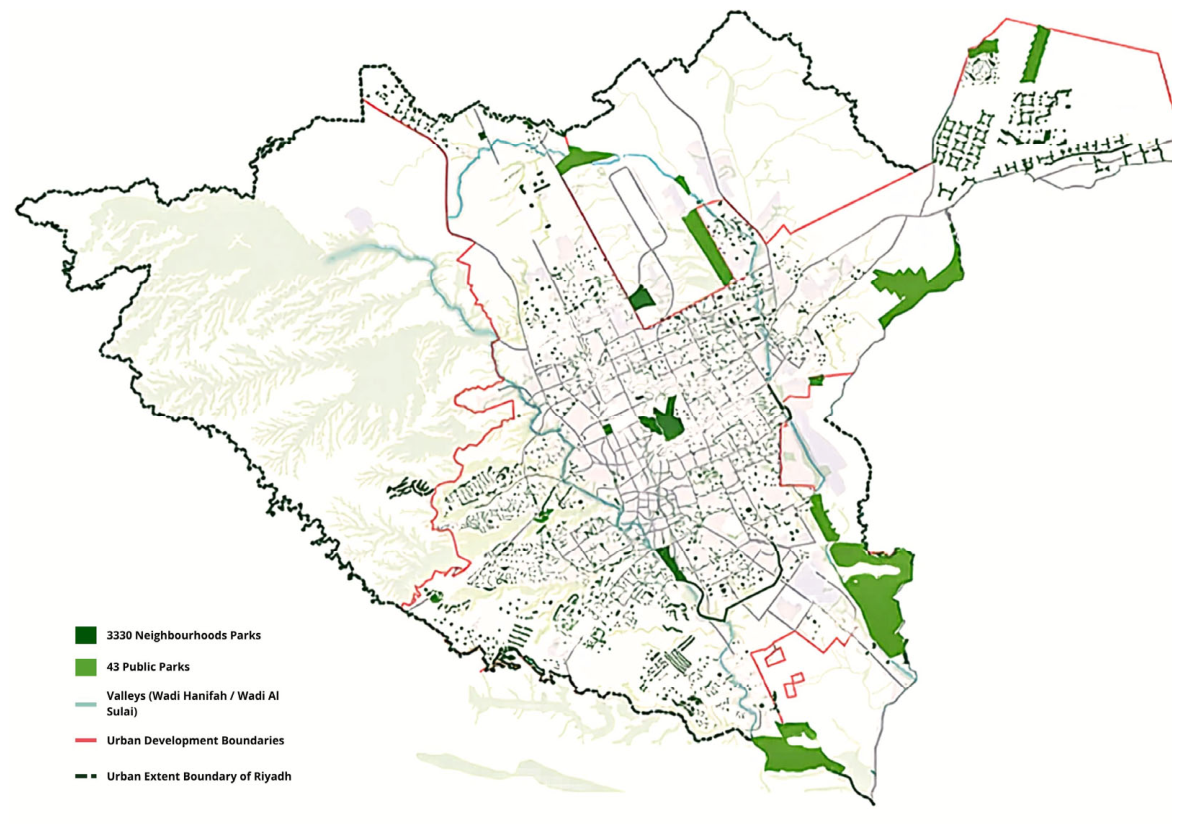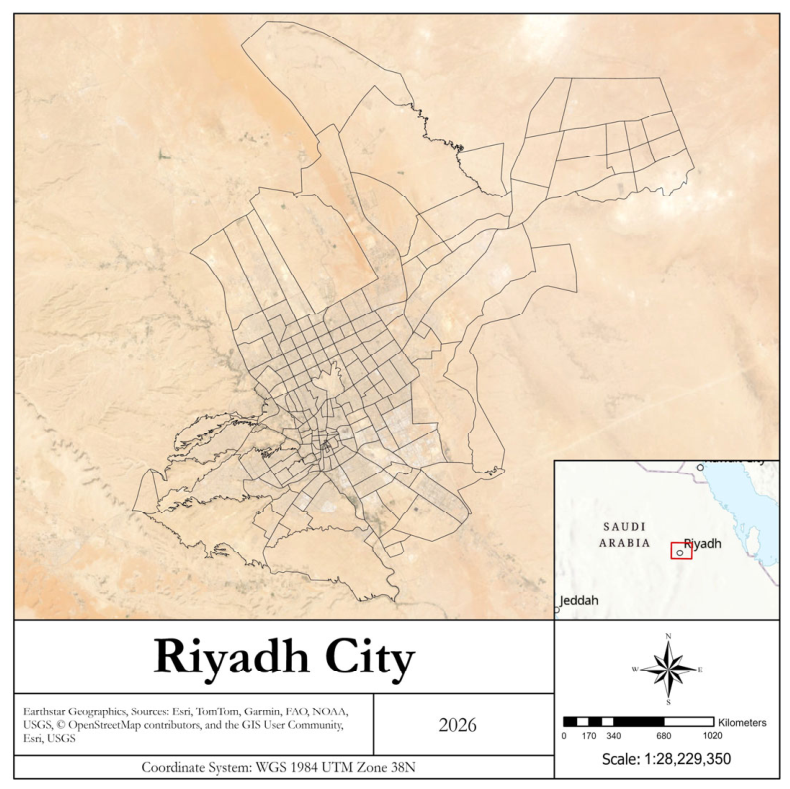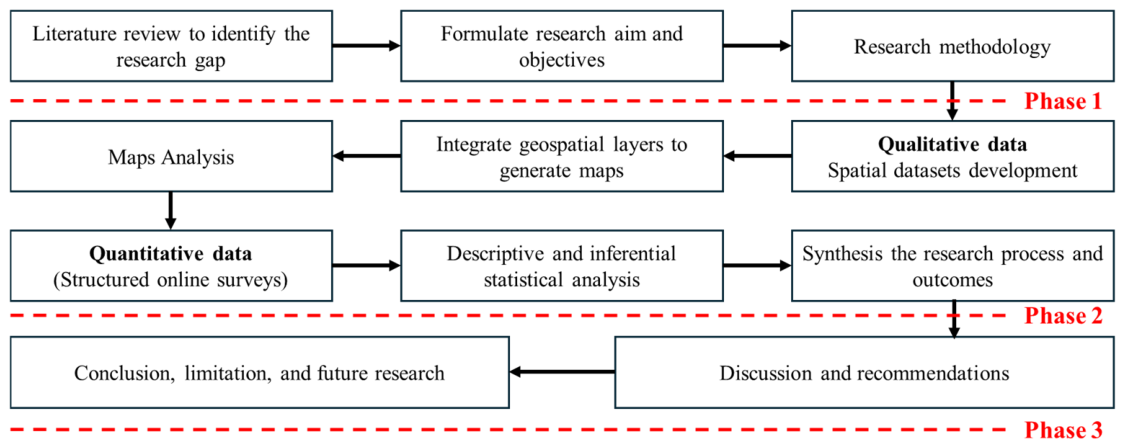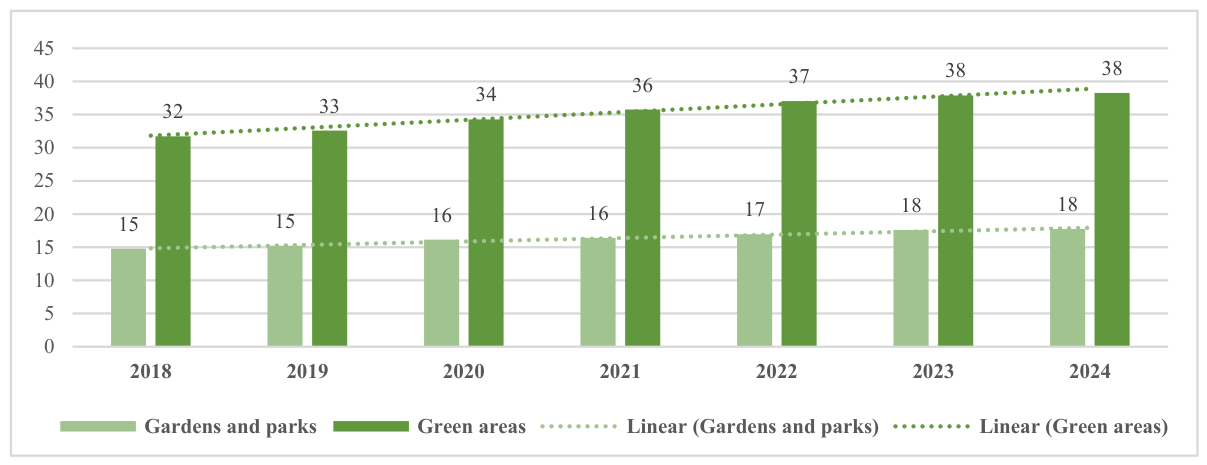
Assessing the Spatial Equity and Quality of Urban Green Spaces in Riyadh with International and National Benchmarks: A GIS-Based and User Perception Analysis

 , , ,
, , ,  and
and
Abstract
1. Introduction
- To evaluate the availability, distribution, and accessibility of urban green spaces in Riyadh using GIS-based indicators;
- To assess the spatial distribution and equity of UGS with international (WHO) and national (SGI) benchmarks in order to identify gaps and inform policy priorities.
- To analyse residents’ perceptions of green space quality and associated social and environmental benefits.
2. Literature Review
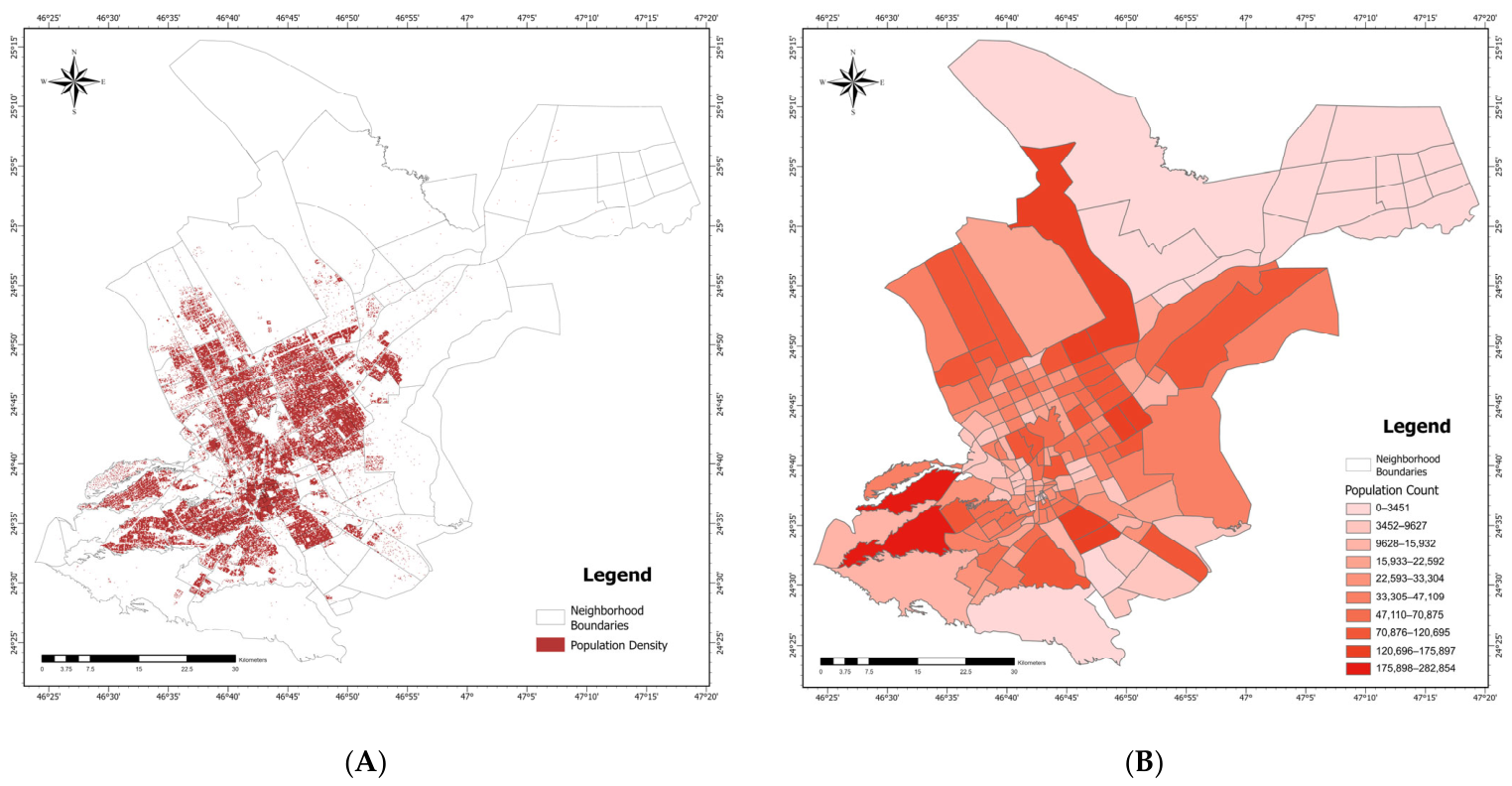
3. Dataset and Study Area
4. Materials and Methods
5. Results
5.1. Spatial Analysis
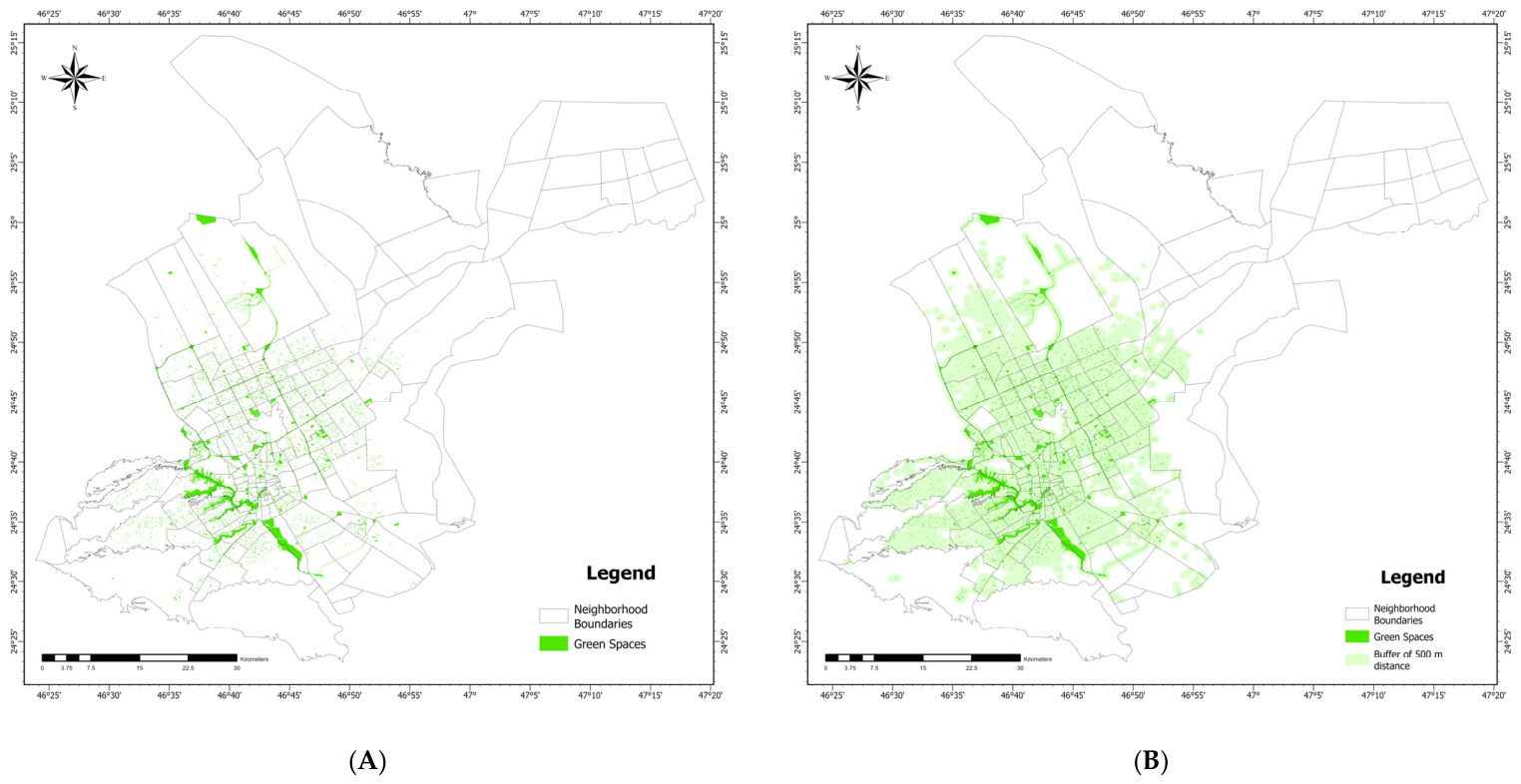
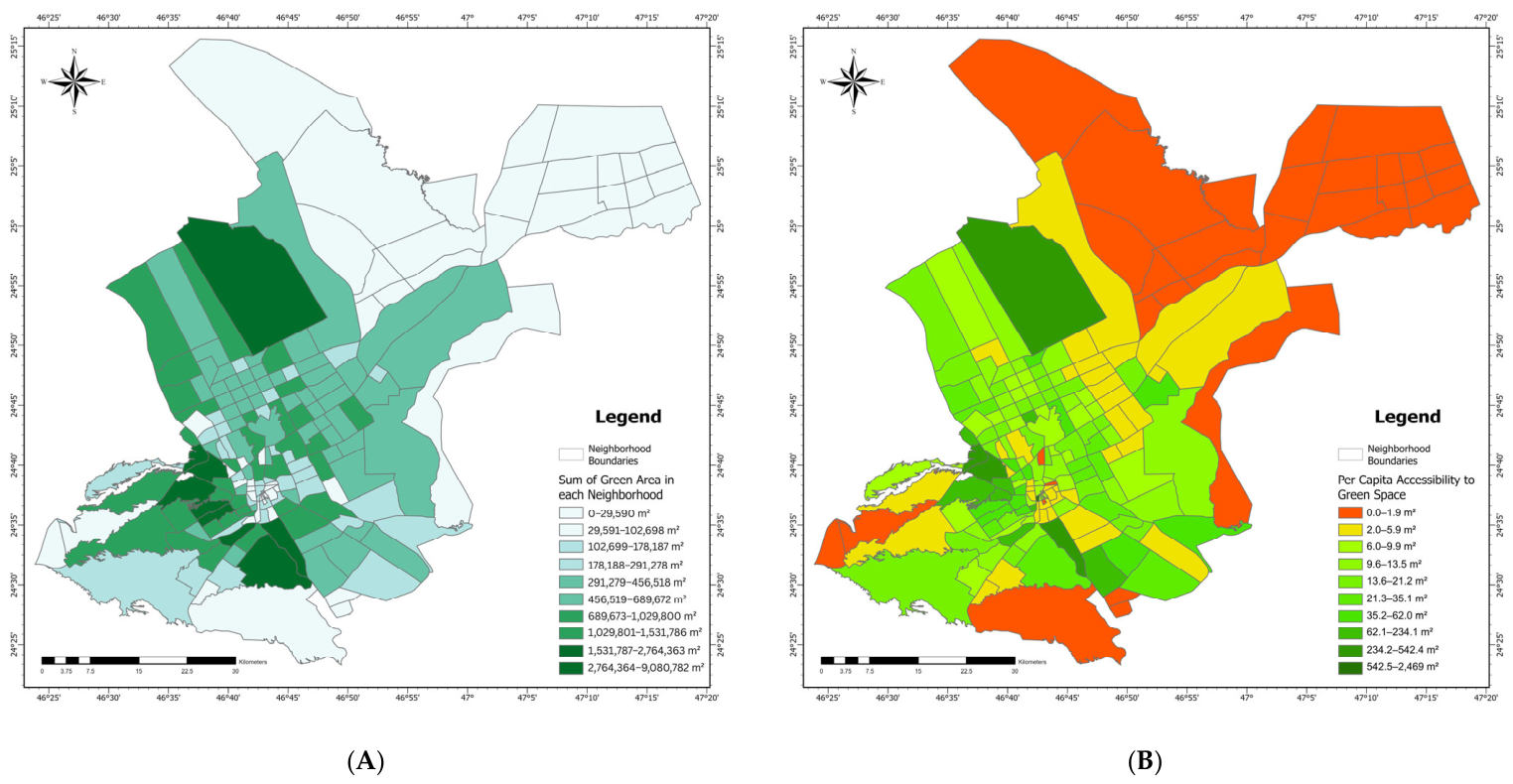
- Peripheral abundance vs. central deficit: Low-density or institutional areas exhibit surplus greenery, while established residential districts experience shortages.
- Population pressure as the primary driver of inequity: Per capita indicators decline sharply in high-density neighborhoods regardless of total green area.
- Mismatch between land allocation and social equity: High green area ratios do not guarantee equitable distribution.
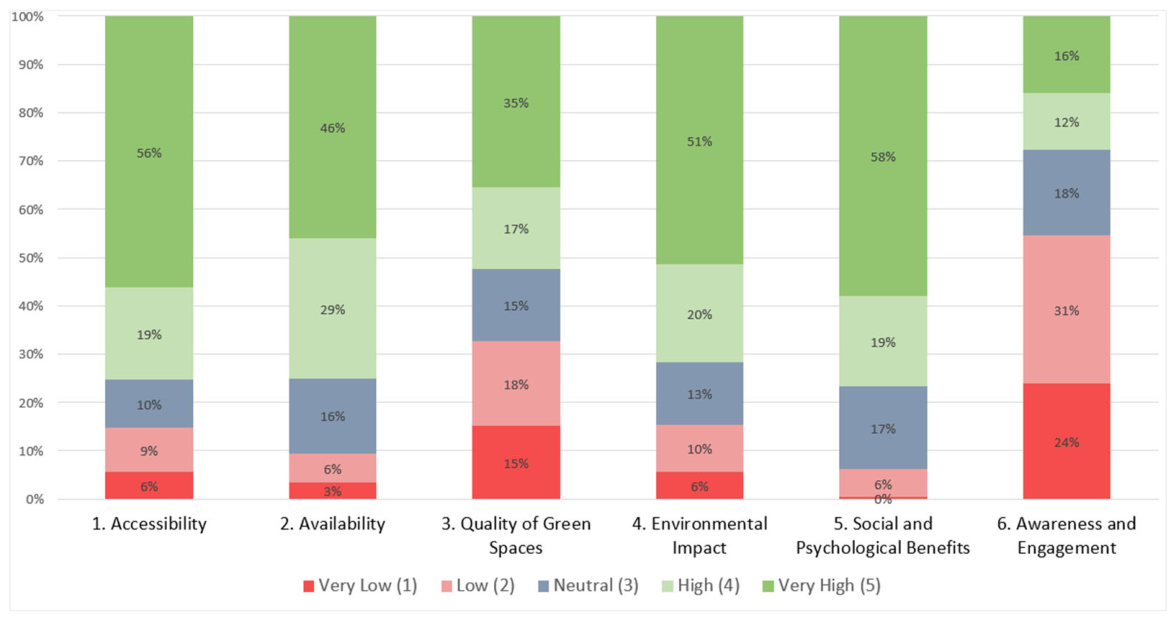
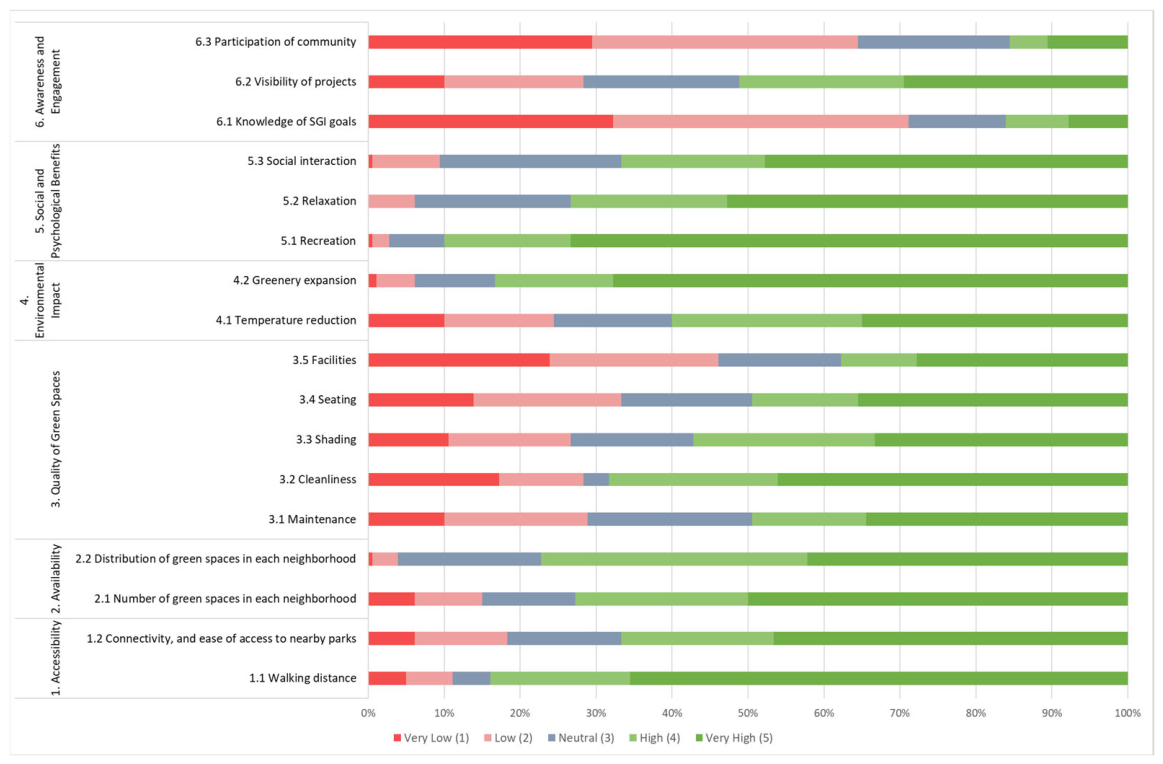
5.2. Resident Perceptions Analysis
6. Discussion and Policy Implications
- integrating small-scale parks and neighborhood green infrastructure within dense urban districts;
- converting vacant and underutilized land into accessible green infrastructure;
- strengthening green corridors and pedestrian connectivity to improve neighborhood accessibility;
- adopting population-weighted and equity-oriented planning metrics in green infrastructure allocation;
- improving maintenance standards, shading conditions, seating areas, and recreational facilities to enhance user comfort and functional quality;
- strengthening public communication and participatory planning approaches to increase residents’ awareness and engagement with SGI-related initiatives.
7. Study Limitations and Future Research Directions
8. Conclusions
- prioritize high-density and underserved residential districts in future greening interventions to reduce neighborhood-level spatial inequalities;
- improve neighborhood-scale accessibility through shaded pedestrian connections, walkable green corridors, and more evenly distributed public green infrastructure;
- strengthen the functional quality and usability of urban green spaces by improving maintenance, shading, seating, and recreational facilities;
- adopt population-sensitive and equity-oriented planning approaches rather than relying solely on aggregate green space expansion targets;
- strengthen public communication and participatory planning approaches to improve residents’ awareness and engagement with SGI-related initiatives;
- integrate GIS-based spatial assessment and resident perception analysis into long-term urban planning and monitoring frameworks to support evidence-based green infrastructure planning.
Author Contributions
Funding
Institutional Review Board Statement
Informed Consent Statement
Data Availability Statement
Acknowledgments
Conflicts of Interest
Appendix A

| NO | Neighborhood Name | Neighborhood Area | Population | Total Green Area (m2) | Green Area Ratio (%) | Green Space per Capita (m2) | WHO Achievement Level Toward (9 m2 per Capita) | SGI Achievement Level Toward (28 m2 per Capita) | How Much Green Space (m2) Should be to Achieve SGI Target | Required Green Space (m2) to Achieve SGI Target | Required Green Space (m2) per Capita to Achieve SGI Target | SGI Achievement (%) |
|---|---|---|---|---|---|---|---|---|---|---|---|---|
| 1 | AR-RAHMANIYAH | 3,743,823.435 | 14,600 | 214,114.72 | 5.72 | 14.67 | Adequate | Transitional | 408,800 | 194,685.28 | 13.33 | 52.4 |
| 2 | UTAYQAH | 1,895,925.056 | 28,975 | 99,937.05 | 5.27 | 3.45 | Inequitable | Deficit | 811,300 | 711,362.95 | 24.55 | 12.3 |
| 3 | AL-FUTAH | 1,114,624.199 | 15,526 | 129,518.00 | 11.62 | 8.34 | Inequitable | Deficit | 434,728 | 305,210.00 | 19.66 | 29.8 |
| 4 | AL-MUANISIYAH | 16,506,479.29 | 130,215 | 680,738.52 | 4.12 | 5.23 | Inequitable | Deficit | 3,646,020 | 2,965,281.48 | 22.77 | 18.7 |
| 5 | AL-KHUZAMA | 4,266,727.878 | 8936 | 1,029,799.93 | 24.14 | 115.24 | Adequate | Achieved | 250,208 | - | - | 411.6 |
| 6 | AD-DIRAH | 1,576,062.841 | 22,125 | 141,783.99 | 9.00 | 6.41 | Inequitable | Deficit | 619,500 | 477,716.01 | 21.59 | 22.9 |
| 7 | SALAM | 363,159.7795 | 102 | 251,837.33 | 69.35 | 2468.99 | Adequate | Achieved | 2856 | - | - | 8817.8 |
| 8 | Al Shohlah | 37,075,478.95 | 50< | 0.00 | 0.00 | 0.00 | Inequitable | Deficit | 1400 | 1400.00 | 28.00 | 0.0 |
| 9 | AL-MANAKH | 18,177,660.39 | 25,114 | 778,827.98 | 4.28 | 31.01 | Adequate | Achieved | 703,192 | - | - | 110.8 |
| 10 | AL-MARGAB | 894,762.7945 | 27,452 | 62,139.87 | 6.94 | 2.26 | Inequitable | Deficit | 768,656 | 706,516.13 | 25.74 | 8.1 |
| 11 | AL-MALAZ | 8,743,129.246 | 93,066 | 1,202,268.20 | 13.75 | 12.92 | Adequate | Transitional | 2,605,848 | 1,403,579.80 | 15.08 | 46.1 |
| 12 | AL-MASANI | 19,088,820.45 | 14,321 | 7,767,922.64 | 40.69 | 542.41 | Adequate | Achieved | 400,988 | - | - | 1937.2 |
| 13 | ORAID | 159,901,168.3 | 899 | 0.00 | 0.00 | 0.00 | Inequitable | Deficit | 25,172 | 25,172.00 | 28.00 | 0.0 |
| 14 | Al Rayah | 13,677,240.97 | 50< | 0.00 | 0.00 | 0.00 | Inequitable | Deficit | 1400 | 1400.00 | 28.00 | 0.0 |
| 15 | SHUBRA | 4,670,779.521 | 39,342 | 279,236.73 | 5.98 | 7.10 | Inequitable | Deficit | 1,101,576 | 822,339.27 | 20.90 | 25.3 |
| 16 | AS-SINAIYAH | 5,500,797.212 | 13,007 | 123,638.18 | 2.25 | 9.51 | Adequate | Transitional | 364,196 | 240,557.82 | 18.49 | 33.9 |
| 17 | AL-FAKHIRIYAH | 1,859,209.795 | 6897 | 61,604.12 | 3.31 | 8.93 | Inequitable | Deficit | 193,116 | 131,511.88 | 19.07 | 31.9 |
| 18 | AD-DIFAA | 6,988,705.605 | 11,288 | 199,662.23 | 2.86 | 17.69 | Adequate | Transitional | 316,064 | 116,401.77 | 10.31 | 63.2 |
| 19 | OHOD | 6,933,456.529 | 20,287 | 81,912.85 | 1.18 | 4.04 | Inequitable | Deficit | 568,036 | 486,123.15 | 23.96 | 14.4 |
| 20 | MANFUHA AL-JADEEDAH | 1,915,945.485 | 51,221 | 178,186.75 | 9.30 | 3.48 | Inequitable | Deficit | 1,434,188 | 1,256,001.25 | 24.52 | 12.4 |
| 21 | Al Ola | 49,963,381.41 | 50< | 0.00 | 0.00 | 0.00 | Inequitable | Deficit | 1400 | 1400.00 | 28.00 | 0.0 |
| 22 | AL-URAIJA | 4,417,605.215 | 9146 | 1,513,916.25 | 34.27 | 165.53 | Adequate | Achieved | 256,088 | - | - | 591.2 |
| 23 | EAST AN-NASEEM | 13,694,442.74 | 139,943 | 828,840.08 | 6.05 | 5.92 | Inequitable | Deficit | 3,918,404 | 3,089,563.92 | 22.08 | 21.2 |
| 24 | AL-KHALIDIAH | 3,843,365.126 | 58,269 | 313,057.01 | 8.15 | 5.37 | Inequitable | Deficit | 1,631,532 | 1,318,474.99 | 22.63 | 19.2 |
| 25 | EAST UMM AL-HAMAM | 3,125,609.602 | 34,372 | 126,031.67 | 4.03 | 3.67 | Inequitable | Deficit | 962,416 | 836,384.33 | 24.33 | 13.1 |
| 26 | AL-YAMAMAH | 2,691,568.481 | 38,382 | 132,996.76 | 4.94 | 3.47 | Inequitable | Deficit | 1,074,696 | 941,699.24 | 24.53 | 12.4 |
| 27 | AZ-ZAHRAA | 1,747,828.923 | 18,684 | 175,821.19 | 10.06 | 9.41 | Adequate | Transitional | 523,152 | 347,330.81 | 18.59 | 33.6 |
| 28 | AD-DOBBAT | 2,311,898.502 | 22,453 | 372,685.20 | 16.12 | 16.60 | Adequate | Transitional | 628,684 | 255,998.80 | 11.40 | 59.3 |
| 29 | SIYAH | 912,537.1255 | 2756 | 645,259.90 | 70.71 | 234.13 | Adequate | Achieved | 77,168 | - | - | 836.2 |
| 30 | AL-MUROOJ | 4,721,753.458 | 39,391 | 469,205.35 | 9.94 | 11.91 | Adequate | Transitional | 1,102,948 | 633,742.65 | 16.09 | 42.5 |
| 31 | AL-JANADRIYAH | 76,925,179.72 | 70,875 | 387,719.35 | 0.50 | 5.47 | Inequitable | Deficit | 1,984,500 | 1,596,780.65 | 22.53 | 19.5 |
| 32 | KHASHM AL ANN | 128,200,845.4 | 35,362 | 346,148.01 | 0.27 | 9.79 | Adequate | Transitional | 990,136 | 643,987.99 | 18.21 | 35.0 |
| 33 | AN-NAHDAH | 10,737,617.68 | 99,091 | 553,210.48 | 5.15 | 5.58 | Inequitable | Deficit | 2,774,548 | 2,221,337.52 | 22.42 | 19.9 |
| 34 | SULTANAH | 2,552,918.815 | 23,951 | 973,893.51 | 38.15 | 40.66 | Adequate | Achieved | 670,628 | - | - | 145.2 |
| 35 | AL-QURA | 44,162.08969 | 195 | 6852.82 | 15.52 | 35.14 | Adequate | Achieved | 5460 | - | - | 125.5 |
| 36 | KING SAUD UNIVERSITY | 9,835,435.119 | 15,164 | 97,592.45 | 0.99 | 6.44 | Inequitable | Deficit | 424,592 | 326,999.55 | 21.56 | 23.0 |
| 37 | AL-JARRADIYAH | 1,330,362.383 | 24,858 | 227,038.31 | 17.07 | 9.13 | Adequate | Transitional | 696,024 | 468,985.69 | 18.87 | 32.6 |
| 38 | AD-DAHOU | 81,498.28 | 494 | 2459.66 | 3.02 | 4.98 | Inequitable | Deficit | 13,832 | 11,372.34 | 23.02 | 17.8 |
| 39 | AL-WOROUD | 4,465,076.873 | 39,241 | 343,983.86 | 7.70 | 8.77 | Inequitable | Deficit | 1,098,748 | 754,764.14 | 19.23 | 31.3 |
| 40 | QURTUBAH | 14,057,613.62 | 87,548 | 938,541.70 | 6.68 | 10.72 | Adequate | Transitional | 2,451,344 | 1,512,802.30 | 17.28 | 38.3 |
| 41 | WEST AN-NASEEM | 12,656,423.84 | 159,949 | 579,538.40 | 4.58 | 3.62 | Inequitable | Deficit | 4,478,572 | 3,899,033.60 | 24.38 | 12.9 |
| 42 | AL-AZIZIYAH | 20,775,206.65 | 175,897 | 913,766.24 | 4.40 | 5.19 | Inequitable | Deficit | 4,925,116 | 4,011,349.76 | 22.81 | 18.6 |
| 43 | AS-SAFARAT | 7,669,846.019 | 5558 | 2,441,356.46 | 31.83 | 439.25 | Adequate | Achieved | 155,624 | - | 1568.8 | |
| 44 | AL-MASHAEL | 31,727,304.18 | 21,117 | 257,167.91 | 0.81 | 12.18 | Adequate | Transitional | 591,276 | 334,108.09 | 15.82 | 43.5 |
| 45 | AL- NADWAH | 4,093,886.784 | 43,383 | 199,997.61 | 4.89 | 4.61 | Inequitable | Deficit | 1,214,724 | 1,014,726.39 | 23.39 | 16.5 |
| 46 | AR-RABI | 5,657,812.253 | 35,054 | 370,160.67 | 6.54 | 10.56 | Adequate | Transitional | 981,512 | 611,351.33 | 17.44 | 37.7 |
| 47 | AL-AOUD | 2,116,208.624 | 25,580 | 94,053.32 | 4.44 | 3.68 | Inequitable | Deficit | 716,240 | 622,186.68 | 24.32 | 13.1 |
| 48 | KING FAHD | 4,820,309.272 | 34,511 | 342,107.80 | 7.10 | 9.91 | Adequate | Transitional | 966,308 | 624,200.20 | 18.09 | 35.4 |
| 49 | ASH-SHOHDA | 4,007,070.31 | 29,591 | 398,420.17 | 9.94 | 13.46 | Adequate | Transitional | 828,548 | 430,127.83 | 14.54 | 48.1 |
| 50 | OKAZ | 16,152,629.74 | 38,410 | 224,090.05 | 1.39 | 5.83 | Inequitable | Deficit | 1,075,480 | 851,389.95 | 22.17 | 20.8 |
| 51 | AN-NADHEEM | 150,564,903.5 | 120,695 | 480,310.23 | 0.32 | 3.98 | Inequitable | Deficit | 3,379,460 | 2,899,149.77 | 24.02 | 14.2 |
| 52 | AL-JAZEERAH | 8,822,331.615 | 39,842 | 1,208,257.30 | 13.70 | 30.33 | Adequate | Achieved | 1,115,576 | - | - | 108.3 |
| 53 | AD-DUBIYAH | 247,885.8052 | 3862 | 29,590.07 | 11.94 | 7.66 | Inequitable | Deficit | 108,136 | 78,545.93 | 20.34 | 27.4 |
| 54 | AL-GHADEER | 4,603,822.937 | 21,308 | 379,162.79 | 8.24 | 17.79 | Adequate | Transitional | 596,624 | 217,461.21 | 10.21 | 63.6 |
| 55 | AL-MASEEF | 4,020,747.622 | 42,594 | 367,621.40 | 9.14 | 8.63 | Inequitable | Deficit | 1,192,632 | 825,010.60 | 19.37 | 30.8 |
| 56 | AT-TAAWUN | 4,012,769.643 | 49,965 | 378,731.00 | 9.44 | 7.58 | Inequitable | Deficit | 1,399,020 | 1,020,289.00 | 20.42 | 27.1 |
| 57 | AS-SAFA | 5,357,535.188 | 6442 | 168,947.04 | 3.15 | 26.23 | Adequate | Transitional | 180,376 | 11,428.96 | 1.77 | 93.7 |
| 58 | AL-MANAR | 4,133,655.545 | 26,584 | 456,517.96 | 11.04 | 17.17 | Adequate | Transitional | 744,352 | 287,834.04 | 10.83 | 61.3 |
| 59 | AL-MATHAR | 3,190,762.239 | 16,529 | 863,619.84 | 27.07 | 52.25 | Adequate | Achieved | 462,812 | - | - | 186.6 |
| 60 | Al Tadamon | 44,569,192.02 | 50< | 0.00 | 0.00 | 0.00 | Inequitable | Deficit | 1400 | 1400.00 | 28.00 | 0.0 |
| 61 | AL-GHANAMIYAH | 8,451,101.12 | 4684 | 8750.88 | 0.10 | 1.87 | Inequitable | Deficit | 131,152 | 122,401.12 | 26.13 | 6.7 |
| 62 | AL-ANDALUS | 4,317,257.676 | 34,630 | 320,392.07 | 7.42 | 9.25 | Adequate | Transitional | 969,640 | 649,247.93 | 18.75 | 33.0 |
| 63 | AS-SULAI | 34,601,569.22 | 42,558 | 317,037.24 | 0.92 | 7.45 | Inequitable | Deficit | 1,191,624 | 874,586.76 | 20.55 | 26.6 |
| 64 | AL-MALQA | 21,849,351.43 | 87,931 | 1,323,379.48 | 6.06 | 15.05 | Adequate | Transitional | 2,462,068 | 1,138,688.52 | 12.95 | 53.8 |
| 65 | WADY LABAN | 42,990,046.44 | 11,867 | 7628.25 | 0.02 | 0.64 | Inequitable | Deficit | 332,276 | 324,647.75 | 27.36 | 2.3 |
| 66 | AL-BOTAIHA | 83,159.99377 | 3888 | 9087.88 | 10.93 | 2.34 | Inequitable | Deficit | 108,864 | 99,776.12 | 25.66 | 8.3 |
| 67 | AL-EZDIHAR | 4,006,177.639 | 35,507 | 603,613.13 | 15.07 | 17.00 | Adequate | Transitional | 994,196 | 390,582.87 | 11.00 | 60.7 |
| 68 | AS-SULAIMANYAH | 8,045,324.778 | 90,252 | 1,462,881.73 | 18.18 | 16.21 | Adequate | Transitional | 2,527,056 | 1,064,174.27 | 11.79 | 57.9 |
| 69 | AL-NUZHA | 4,099,697.964 | 27,415 | 497,221.68 | 12.13 | 18.14 | Adequate | Transitional | 767,620 | 270,398.32 | 9.86 | 64.8 |
| 70 | NORTH AL-MATHAR | 3,838,780.877 | 15,932 | 173,592.57 | 4.52 | 10.90 | Adequate | Transitional | 446,096 | 272,503.43 | 17.10 | 38.9 |
| 71 | NEW INDUSTRIAL CITY | 33,671,145.23 | 10,2196 | 328,746.46 | 0.98 | 3.22 | Inequitable | Deficit | 2,861,488 | 2,532,741.54 | 24.78 | 11.5 |
| 72 | AR-RAED | 4,997,094.913 | 9627 | 204,220.25 | 4.09 | 21.21 | Adequate | Transitional | 269,556 | 65,335.75 | 6.79 | 75.8 |
| 73 | ASH-SHARAFIYAH | 1,571,532.637 | 13,892 | 80,666.63 | 5.13 | 5.81 | Inequitable | Deficit | 388,976 | 308,309.37 | 22.19 | 20.7 |
| 74 | AL-MAHDIYAH | 23,667,148.38 | 37,067 | 287,965.25 | 1.22 | 7.77 | Inequitable | Deficit | 1,037,876 | 749,910.75 | 20.23 | 27.7 |
| 75 | AS-SUWAIDI AL-GHARBI | 5,450,392.701 | 42,356 | 417,391.59 | 7.66 | 9.85 | Adequate | Transitional | 1,185,968 | 768,576.41 | 18.15 | 35.2 |
| 76 | AS-SALAM | 5,619,762.168 | 50,079 | 520,579.93 | 9.26 | 10.40 | Adequate | Transitional | 1,402,212 | 881,632.07 | 17.60 | 37.1 |
| 77 | GHUBAIRA | 1,750,821.059 | 46,140 | 229,032.68 | 13.08 | 4.96 | Inequitable | Deficit | 1,291,920 | 1,062,887.32 | 23.04 | 17.7 |
| 78 | AL-WISHAM | 1,168,069.105 | 16,493 | 55,951.59 | 4.79 | 3.39 | Inequitable | Deficit | 461,804 | 405,852.41 | 24.61 | 12.1 |
| 79 | Al-Wahah | 3,321,937.556 | 17,254 | 143,744.82 | 4.33 | 8.33 | Inequitable | Deficit | 483,112 | 339,367.18 | 19.67 | 29.8 |
| 80 | SKIRINAH | 335,464.337 | 11,461 | 6522.10 | 1.94 | 0.57 | Inequitable | Deficit | 320,908 | 314,385.90 | 27.43 | 2.0 |
| 81 | AN-NADA | 4,003,110.232 | 19,017 | 202,522.75 | 5.06 | 10.65 | Adequate | Transitional | 532,476 | 329,953.25 | 17.35 | 38.0 |
| 82 | AL-WESITA | 139,955.7613 | 3451 | 11,720.04 | 8.37 | 3.40 | Inequitable | Deficit | 96,628 | 84,907.96 | 24.60 | 12.1 |
| 83 | AD-DURAIHEMIYAH | 1,686,070.603 | 12,087 | 79,297.52 | 4.70 | 6.56 | Inequitable | Deficit | 338,436 | 259,138.48 | 21.44 | 23.4 |
| 84 | MUGHARAZAT | 4,022,772.07 | 16,460 | 269,764.23 | 6.71 | 16.39 | Adequate | Transitional | 460,880 | 191,115.77 | 11.61 | 58.5 |
| 85 | AN-NARJIS | 48,826,651.89 | 82,800 | 804,505.41 | 1.65 | 9.72 | Adequate | Transitional | 2,318,400 | 1,513,894.59 | 18.28 | 34.7 |
| 86 | Al Danah | 1,2577,707.42 | 1404 | 0.00 | 0.00 | 0.00 | Inequitable | Deficit | 39,312 | 39,312.00 | 28.00 | 0.0 |
| 87 | AR-RAWDAH | 8,734,004.46 | 99,115 | 897,688.95 | 10.28 | 9.06 | Adequate | Transitional | 2,775,220 | 1,877,531.05 | 18.94 | 32.3 |
| 88 | AR-RAWABI | 7,180,102.694 | 57,209 | 1,460,774.07 | 20.34 | 25.53 | Adequate | Transitional | 1,601,852 | 141,077.93 | 2.47 | 91.2 |
| 89 | Al Risalah | 13,440,992.61 | 50< | 0.00 | 0.00 | 0.00 | Inequitable | Deficit | 1400 | 1400.00 | 28.00 | 0.0 |
| 90 | AL-WADI | 3,996,354.146 | 42,122 | 307,716.54 | 7.70 | 7.31 | Inequitable | Deficit | 1,179,416 | 871,699.46 | 20.69 | 26.1 |
| 91 | ASH-SHOMAISI | 1,473,443.557 | 32,090 | 92,626.98 | 6.29 | 2.89 | Inequitable | Deficit | 898,520 | 805,893.02 | 25.11 | 10.3 |
| 92 | AN-NAMUTHAJIYAH | 2,754,591.779 | 8127 | 444,395.98 | 16.13 | 54.68 | Adequate | Achieved | 227,556 | - | - | 195.3 |
| 93 | AL-MAIZALIYAH | 14,107,332.87 | 22,592 | 327,604.09 | 2.32 | 14.50 | Adequate | Transitional | 632,576 | 304,971.91 | 13.50 | 51.8 |
| 94 | Salah Al-Deen | 3,421,723.173 | 9082 | 1,182,403.18 | 34.56 | 130.19 | Adequate | Achieved | 254,296 | - | - | 465.0 |
| 95 | AL-MARWAH | 6,110,265.352 | 17,743 | 315,473.85 | 5.16 | 17.78 | Adequate | Transitional | 496,804 | 181,330.15 | 10.22 | 63.5 |
| 96 | AN-NOOR | 8,678,540.46 | 6279 | 67,878.77 | 0.78 | 10.81 | Adequate | Transitional | 175,812 | 107,933.23 | 17.19 | 38.6 |
| 97 | AL-ARID | 67,174,632.2 | 81,528 | 529,189.64 | 0.79 | 6.49 | Inequitable | Deficit | 22,82,784 | 1,753,594.36 | 21.51 | 23.2 |
| 98 | AD-DAR AL-BAIDA | 15,281,611.25 | 157,909 | 477,970.04 | 3.13 | 3.03 | Inequitable | Deficit | 4,421,452 | 3,943,481.96 | 24.97 | 10.8 |
| 99 | AL-MURABA | 4,866,316.871 | 58,068 | 771,060.98 | 15.84 | 13.28 | Adequate | Transitional | 1,625,904 | 854,843.02 | 14.72 | 47.4 |
| 100 | THULAIM | 829,632.6781 | 34,355 | 40,621.52 | 4.90 | 1.18 | Inequitable | Deficit | 961,940 | 921,318.48 | 26.82 | 4.2 |
| 101 | AL-KHALEEJ | 10,324,693.43 | 98,961 | 576,685.05 | 5.59 | 5.83 | Inequitable | Deficit | 2,770,908 | 2,194,222.95 | 22.17 | 20.8 |
| 102 | AL-HAMRA | 8,268,974.363 | 53,967 | 894,750.59 | 10.82 | 16.58 | Adequate | Transitional | 1,511,076 | 616,325.41 | 11.42 | 59.2 |
| 103 | AL-FALAH | 3,992,820.514 | 24,782 | 467,457.21 | 11.71 | 18.86 | Adequate | Transitional | 693,896 | 226,438.79 | 9.14 | 67.4 |
| 104 | AL-QADISIYAH | 11,781,759.18 | 58,777 | 271,563.83 | 2.30 | 4.62 | Inequitable | Deficit | 1,645,756 | 1,374,192.17 | 23.38 | 16.5 |
| 105 | AS-SAHAFA | 7,909,887.688 | 52,135 | 627,697.89 | 7.94 | 12.04 | Adequate | Transitional | 1,459,780 | 832,082.11 | 15.96 | 43.0 |
| 106 | ASH-SHIFA | 9,055,629.983 | 70,513 | 850,233.60 | 9.39 | 12.06 | Adequate | Transitional | 1,974,364 | 1,124,130.40 | 15.94 | 43.1 |
| 107 | AS-SALHIYAH | 671,845.9209 | 10,586 | 53,273.34 | 7.93 | 5.03 | Inequitable | Deficit | 296,408 | 243,134.66 | 22.97 | 18.0 |
| 108 | AL-MANSURAH (KHANSHALILAH) | 5,904,437.346 | 68,835 | 769,813.14 | 13.04 | 11.18 | Adequate | Transitional | 1,927,380 | 1,157,566.86 | 16.82 | 39.9 |
| 109 | Al Fursan | 30,369,788.06 | 138 | 0.00 | 0.00 | 0.00 | Inequitable | Deficit | 3864 | 3864.00 | 28.00 | 0.0 |
| 110 | AL-HADA | 13,761,911.33 | 6402 | 2,098,036.18 | 15.25 | 327.72 | Adequate | Achieved | 179,256 | - | - | 1170.4 |
| 111 | AL-NAKHEEL | 9,776,101.077 | 29,547 | 758,933.13 | 7.76 | 25.69 | Adequate | Transitional | 827,316 | 68,382.87 | 2.31 | 91.7 |
| 112 | AL-QUDS | 5,224,075.777 | 41,637 | 506,662.94 | 9.70 | 12.17 | Adequate | Transitional | 1,165,836 | 659,173.06 | 15.83 | 43.5 |
| 113 | TAYBAH | 25,485,989.84 | 7162 | 337,217.13 | 1.32 | 47.08 | Adequate | Achieved | 200,536 | - | - | 168.2 |
| 114 | AL-FARUQ | 5,655,324.544 | 6100 | 154,498.94 | 2.73 | 25.33 | Adequate | Transitional | 170,800 | 16,301.06 | 2.67 | 90.5 |
| 115 | AL-MISFAH | 47,223,047.23 | 6673 | 156,179.62 | 0.33 | 23.40 | Adequate | Transitional | 186,844 | 30,664.38 | 4.60 | 83.6 |
| 116 | KING ABDUL AZIZ | 16,768,939.16 | 55,187 | 431,627.83 | 2.57 | 7.82 | Inequitable | Deficit | 1,545,236 | 1,113,608.17 | 20.18 | 27.9 |
| 117 | AL-FAIHA | 54,06,752.048 | 58,107 | 305,976.01 | 5.66 | 5.27 | Inequitable | Deficit | 1,626,996 | 1,321,019.99 | 22.73 | 18.8 |
| 118 | AL-MUTAMARAT | 1,835,485.062 | 6160 | 57,754.46 | 3.15 | 9.38 | Adequate | Transitional | 172,480 | 114,725.54 | 18.62 | 33.5 |
| 119 | AR-RABWAH | 11,361,956.84 | 70,591 | 1,118,975.40 | 9.85 | 15.85 | Adequate | Transitional | 1,976,548 | 857,572.60 | 12.15 | 56.6 |
| 120 | DAHIAT NAMAR | 134,084,946.1 | 14,409 | 254,252.71 | 0.19 | 17.65 | Adequate | Transitional | 403,452 | 149,199.29 | 10.35 | 63.0 |
| 121 | WEST AL-ORAIJA | 16,146,306.48 | 104,688 | 852,132.77 | 5.28 | 8.14 | Inequitable | Deficit | 2,931,264 | 2,079,131.23 | 19.86 | 29.1 |
| 122 | KING ABDULLAH | 8,530,804.421 | 17,697 | 911,057.40 | 10.68 | 51.48 | Adequate | Achieved | 495,516 | - | - | 183.9 |
| 123 | AL-Awaly | 16,090,248.23 | 47,109 | 900,357.40 | 5.60 | 19.11 | Adequate | Transitional | 1,319,052 | 418,694.60 | 8.89 | 68.3 |
| 124 | AL-MUHAMMADIYAH | 4,253,384.29 | 21,720 | 146,509.13 | 3.44 | 6.75 | Inequitable | Deficit | 608,160 | 461,650.87 | 21.25 | 24.1 |
| 125 | HITTEEN | 18,184,546.47 | 35,795 | 797,514.69 | 4.39 | 22.28 | Adequate | Transitional | 1,002,260 | 204,745.31 | 5.72 | 79.6 |
| 126 | AL-YASMEEN | 12,718,878.73 | 107,229 | 557,647.41 | 4.38 | 5.20 | Inequitable | Deficit | 3,002,412 | 2,444,764.59 | 22.80 | 18.6 |
| 127 | Al Rihab | 20,273,627.96 | 3260 | 0.00 | 0.00 | 0.00 | Inequitable | Deficit | 91,280 | 91,280.00 | 28.00 | 0.0 |
| 128 | DAHRAT AL-BADEAH | 7,502,044.011 | 49,357 | 2,213,460.99 | 29.50 | 44.85 | Adequate | Achieved | 1,381,996 | - | - | 160.2 |
| 129 | AL-QAIRAWAN | 75,535,671.4 | 39,300 | 730,976.56 | 0.97 | 18.60 | Adequate | Transitional | 1,100,400 | 369,423.44 | 9.40 | 66.4 |
| 130 | AS-SUWAIDI | 6,250,181.728 | 58,475 | 1,090,124.42 | 17.44 | 18.64 | Adequate | Transitional | 1,637,300 | 547,175.58 | 9.36 | 66.6 |
| 131 | AL-AMAL | 1,259,524.701 | 20,513 | 127,357.77 | 10.11 | 6.21 | Inequitable | Deficit | 574,364 | 447,006.23 | 21.79 | 22.2 |
| 132 | AL-BADEAH | 4,068,930.249 | 30,180 | 1,294,968.39 | 31.83 | 42.91 | Adequate | Achieved | 845,040 | - | - | 153.2 |
| 133 | Al Nakhbah | 43,526,394.58 | 50< | 0.00 | 0.00 | 0.00 | Inequitable | Deficit | 1400 | 1400.00 | 28.00 | 0.0 |
| 134 | AL-MURSALAT | 4,093,835.393 | 20,338 | 326,267.61 | 7.97 | 16.04 | Adequate | Transitional | 569,464 | 243,196.39 | 11.96 | 57.3 |
| 135 | JAREER | 2,610,864.56 | 30,972 | 227,587.92 | 8.72 | 7.35 | Inequitable | Deficit | 867,216 | 639,628.08 | 20.65 | 26.2 |
| 136 | MEEKAL | 202,820.343 | 2717 | 55,197.31 | 27.21 | 20.32 | Adequate | Transitional | 76,076 | 20,878.69 | 7.68 | 72.6 |
| 137 | AL-FAISALIYAH | 9,600,520.203 | 18,806 | 291,277.56 | 3.03 | 15.49 | Adequate | Transitional | 526,568 | 235,290.44 | 12.51 | 55.3 |
| 138 | AL-AQEEK | 7,992,306.15 | 53,471 | 578,129.88 | 7.23 | 10.81 | Adequate | Transitional | 1,497,188 | 919,058.12 | 17.19 | 38.6 |
| 139 | AZ-ZAHRA | 4,928,672.16 | 45,834 | 1,095,013.65 | 22.22 | 23.89 | Adequate | Transitional | 1,283,352 | 188,338.35 | 4.11 | 85.3 |
| 140 | GHIRNATAH | 3,961,346.351 | 33,304 | 121,002.01 | 3.05 | 3.63 | Inequitable | Deficit | 932,512 | 811,509.99 | 24.37 | 13.0 |
| 141 | MANFUHA | 2,458,731.552 | 39,942 | 102,698.40 | 4.18 | 2.57 | Inequitable | Deficit | 1,118,376 | 1,015,677.60 | 25.43 | 9.2 |
| 142 | AR-RAYAN | 5,959,843.557 | 38,492 | 617,025.48 | 10.35 | 16.03 | Adequate | Transitional | 1,077,776 | 460,750.52 | 11.97 | 57.2 |
| 143 | AL-ISKAN | 6,797,588.276 | 32,566 | 689,672.14 | 10.15 | 21.18 | Adequate | Transitional | 911,848 | 222,175.86 | 6.82 | 75.6 |
| 144 | LABAN | 22,869,431.25 | 33,179 | 6,114,090.35 | 26.73 | 184.28 | Adequate | Achieved | 929,012 | - | - | 658.1 |
| 145 | KING FAISAL | 5,166,732.855 | 53,554 | 399,005.12 | 7.72 | 7.45 | Inequitable | Deficit | 1,499,512 | 1,100,506.88 | 20.55 | 26.6 |
| 146 | AL-YARMUK | 9,186,174.184 | 100,677 | 483,384.74 | 5.26 | 4.80 | Inequitable | Deficit | 2,818,956 | 2,335,571.26 | 23.20 | 17.1 |
| 147 | AN-NASIRIYAH | 2,289,027.428 | 6192 | 139,164.40 | 6.08 | 22.47 | Adequate | Transitional | 173,376 | 34,211.60 | 5.53 | 80.3 |
| 148 | Al Zaher | 52,410,295.29 | 344 | 0.00 | 0.00 | 0.00 | Inequitable | Deficit | 9632 | 9632.00 | 28.00 | 0.0 |
| 149 | AR-RIMAL | 166,520,134.6 | 141,144 | 376,140.21 | 0.23 | 2.66 | Inequitable | Deficit | 3,952,032 | 3,575,891.79 | 25.34 | 9.5 |
| 150 | AL-BARIYAH | 39,508,631.14 | 5418 | 213,147.61 | 0.54 | 39.34 | Adequate | Achieved | 151,704 | - | - | 140.5 |
| 151 | NAMAR | 7,737,875.751 | 17,510 | 2,764,363.20 | 35.73 | 157.87 | Adequate | Achieved | 490,280 | - | - | 563.8 |
| 152 | UMM-SALEEM | 915,867.987 | 23,867 | 59,120.00 | 6.46 | 2.48 | Inequitable | Deficit | 668,276 | 609,156.00 | 25.52 | 8.8 |
| 153 | AN-NAFEL | 3,990,876.484 | 49,438 | 398,843.94 | 9.99 | 8.07 | Inequitable | Deficit | 1,384,264 | 985,420.06 | 19.93 | 28.8 |
| 154 | AL-WIZARAT | 2,290,009.448 | 65,790 | 102,442.86 | 4.47 | 1.56 | Inequitable | Deficit | 1,842,120 | 1,739,677.14 | 26.44 | 5.6 |
| 155 | AL-MANSURIAH | 27,113,344.14 | 2617 | 543,118.06 | 2.00 | 207.53 | Adequate | Achieved | 73,276 | - | - | 741.2 |
| 156 | AL-HAZM | 10,696,505.73 | 58,442 | 739,180.73 | 6.91 | 12.65 | Adequate | Transitional | 1,636,376 | 897,195.27 | 15.35 | 45.2 |
| 157 | AL-OLAYA | 10,836,379.58 | 118,753 | 640,107.93 | 5.91 | 5.39 | Inequitable | Deficit | 3,325,084 | 2,684,976.07 | 22.61 | 19.3 |
| 158 | DIRAB | 14,366,247.55 | 26,948 | 215,030.56 | 1.50 | 7.98 | Inequitable | Deficit | 754,544 | 539,513.44 | 20.02 | 28.5 |
| 159 | BADER | 50,871,010.09 | 116,151 | 2,675,307.40 | 5.26 | 23.03 | Adequate | Transitional | 3,252,228 | 576,920.60 | 4.97 | 82.3 |
| 160 | JABRAH | 347,221.4759 | 8142 | 68,099.96 | 19.61 | 8.36 | Inequitable | Deficit | 227,976 | 159,876.04 | 19.64 | 29.9 |
| 161 | MIDDLE AL-URAIJA | 8,584,736.172 | 52,233 | 2,453,227.60 | 28.58 | 46.97 | Adequate | Achieved | 1,462,524 | - | - | 167.7 |
| 162 | DAHRAT LABAN | 37,384,574.94 | 237,856 | 863,513.63 | 2.31 | 3.63 | Inequitable | Deficit | 6,659,968 | 5,796,454.37 | 24.37 | 13.0 |
| 163 | TWAEEQ | 60,390,736.9 | 282,854 | 1,531,785.98 | 2.54 | 5.42 | Inequitable | Deficit | 7,919,912 | 6,388,126.02 | 22.58 | 19.3 |
| 164 | AR-RAFEAH | 5,515,257.575 | 11,518 | 1,294,977.23 | 23.48 | 112.43 | Adequate | Achieved | 322,504 | - | - | 401.5 |
| 165 | ISHBILIYAH | 9,382,042.142 | 96,370 | 519,959.85 | 5.54 | 5.40 | Inequitable | Deficit | 2,698,360 | 2,178,400.15 | 22.60 | 19.3 |
| 166 | AL-IMAM MOH-BIN-SAUD ISLAMIC UNIVERSITY | 4,602,246.512 | 6241 | 387,186.43 | 8.41 | 62.04 | Adequate | Achieved | 174,748 | - | - | 221.6 |
| 167 | AR-RIMAYAH | 21,496,911.99 | 13,426 | 538,846.60 | 2.51 | 40.13 | Adequate | Achieved | 375,928 | - | - | 143.3 |
| 168 | Al Mashriq | 32,287,719.92 | 351 | 0.00 | 0.00 | 0.00 | Inequitable | Deficit | 9828 | 9828.00 | 28.00 | 0.0 |
| 169 | Al Bayan | 16,140,088.47 | 12,302 | 19,999.03 | 0.12 | 1.63 | Inequitable | Deficit | 344,456 | 324,456.97 | 26.37 | 5.8 |
| 170 | Al Marjan | 22,413,789.89 | 1681 | 0.00 | 0.00 | 0.00 | Inequitable | Deficit | 47,068 | 47,068.00 | 28.00 | 0.0 |
| 171 | Al Sahab | 23,229,456.38 | 598 | 0.00 | 0.00 | 0.00 | Inequitable | Deficit | 16,744 | 16,744.00 | 28.00 | 0.0 |
| 172 | WEST UMM AL HAMAM | 3,948,193.296 | 37,663 | 685,638.03 | 17.37 | 18.20 | Adequate | Transitional | 1,054,564 | 368,925.97 | 9.80 | 65.0 |
| 173 | OLAISHAH | 2,225,181.051 | 8150 | 311,389.53 | 13.99 | 38.21 | Adequate | Achieved | 228,200 | - | - | 136.5 |
| 174 | Al Wasam | 13,023,009.45 | 1890 | 0.00 | 0.00 | 0.00 | Inequitable | Deficit | 52,920 | 52,920.00 | 28.00 | 0.0 |
| 175 | AS-SAADAH | 9,245,962.065 | 83,187 | 396,756.20 | 4.29 | 4.77 | Inequitable | Deficit | 2,329,236 | 1,932,479.80 | 23.23 | 17.0 |
| 176 | BINBAN | 125.4715762 | 10,000 | 0.00 | 0.00 | 0.00 | Inequitable | Deficit | 280,000 | 280,000.00 | 28.00 | 0.0 |
| 177 | AL-HAIER | 1,916,986.765 | 14,000 | 0.00 | 0.00 | 0.00 | Inequitable | Deficit | 392,000 | 392,000.00 | 28.00 | 0.0 |
| 178 | KING ABDULLAH CITY | 5,403,634.488 | 17,700 | 589.79 | 0.01 | 0.03 | Inequitable | Deficit | 495,600 | 495,010.21 | 27.97 | 0.1 |
| 179 | AL-RABIA | 121,536,155.5 | 35,100 | 0.00 | 0.00 | 0.00 | Inequitable | Deficit | 982,800 | 982,800.00 | 28.00 | 0.0 |
| 180 | HEET | 250,739,346.7 | 833 | 0.00 | 0.00 | 0.00 | Inequitable | Deficit | 23,324 | 23,324.00 | 28.00 | 0.0 |
References
- Endalew Terefe, A.; Hou, Y. Determinants Influencing the Accessibility and Use of Urban Green Spaces: A Review of Empirical Evidence. City Environ. Interact. 2024, 24, 100159. [Google Scholar]
- Selanon, P.; Chuangchai, W. The Importance of Urban Green Spaces in Enhancing Holistic Health and Sustainable Well-Being for People with Disabilities: A Narrative Review. Buildings 2023, 13, 2100. [Google Scholar] [CrossRef]
- Chen, K.; Zhang, T.; Liu, F.; Zhang, Y.; Song, Y. How Does Urban Green Space Impact Residents’ Mental Health: A Literature Review of Mediators. Int. J. Environ. Res. Public Health 2021, 18, 11746. [Google Scholar]
- Shi, L.; Halik, Ü.; Abliz, A.; Mamat, Z.; Welp, M. Urban Green Space Accessibility and Distribution Equity in an Arid Oasis City: Urumqi, China. Forests 2020, 11, 690. [Google Scholar] [CrossRef]
- Hashem, N. Assessing Spatial Equality of Urban Green Spaces Provision: A Case Study of Greater Doha in Qatar. Local Environ. 2015, 20, 386–399. [Google Scholar] [CrossRef]
- Bhor, N.; Mayavel, D. A Study on Analysing Sociospatial Distribution and Equity in Access to Urban Parks in Bengaluru, India. Lancet Planet. Health 2024, 8, S13. [Google Scholar] [CrossRef] [PubMed]
- Nesbitt, L.; Meitner, M.J.; Girling, C.; Sheppard, S.R.J.; Lu, Y. Who Has Access to Urban Vegetation? A Spatial Analysis of Distributional Green Equity in 10 US Cities. Landsc. Urban Plan. 2019, 181, 51–79. [Google Scholar] [CrossRef]
- Saudi Vision 2030 Quality of Life Program. Available online: https://www.vision2030.gov.sa/en/explore/programs/quality-of-life-program (accessed on 10 December 2025).
- Maleknia, R. How Perception of Environmental and Social Justice Drive Citizen’s Satisfaction and Intention to Engage with Urban Forests Management? Heliyon 2025, 11, e41274. [Google Scholar] [CrossRef]
- Mitinje, E.; Jabareen, Y. A New Conceptual Framework for Understanding the Contribution of Spatial Planning and Zoning Parameters to Social Justice. Land 2026, 15, 116. [Google Scholar] [CrossRef]
- Dong, Z.D.; Miller, E.J. Socio-Spatial Disparities in Urban Green Space Accessibility: The Existing Challenge for Toronto in Its Aspiration to be a Liveable City. Can. J. Reg. Sci. 2024, 47, 45–56. [Google Scholar] [CrossRef]
- Zhang, Y.; Zhao, J.; Mavoa, S.; Smith, M. Inequalities in Urban Green Space Distribution across Priority Population Groups: Evidence from Tāmaki Makaurau Auckland, Aotearoa New Zealand. Cities 2024, 149, 104972. [Google Scholar] [CrossRef]
- Chen, Y.; Yue, W.; La Rosa, D. Which Communities Have Better Accessibility to Green Space? An Investigation into Environmental Inequality Using Big Data. Landsc. Urban Plan. 2020, 204, 103919. [Google Scholar] [CrossRef]
- Qwaider, S.; Zami, M.S.; Bilal, M.; Ashmeel, R.; Hassanain, M.A. Spatial Analysis on Urban Justice Delivering the Community Parks: A Case of the Saudi Arabian City of Al-Khobar. Smart Cities 2025, 8, 205. [Google Scholar] [CrossRef]
- Batasuma, S.; Cao, W.; Atigah, N.A.; Garnet, E.A.; Bonzo, J.K.; Gyimah, J. Drivers in the Conservation of Urban Green Space Depletion: A Case Study of Wa Municipality, Ghana. City Environ. Interact. 2025, 25, 100186. [Google Scholar] [CrossRef]
- Addas, A. Evaluating the Impact of Urban Green Spaces on Public Well-Being and Environmental Sustainability in Saudi Arabian Megacities. Discov. Sustain. 2025, 6, 277. [Google Scholar] [CrossRef]
- Houlden, V.; Weich, S.; de Albuquerque, J.P.; Jarvis, S.; Rees, K. The Relationship between Greenspace and the Mental Wellbeing of Adults: A Systematic Review. PLoS ONE 2018, 13, e0203000. [Google Scholar] [CrossRef]
- Southon, G.E.; Jorgensen, A.; Dunnett, N.; Hoyle, H.; Evans, K.L. Perceived Species-Richness in Urban Green Spaces: Cues, Accuracy and Well-Being Impacts. Landsc. Urban Plan. 2018, 172, 1–10. [Google Scholar] [CrossRef]
- Afrad, A.; Kawazoe, Y. Can Interaction with Informal Urban Green Space Reduce Depression Levels? An Analysis of Potted Street Gardens in Tangier, Morocco. Public Health 2020, 186, 83–86. [Google Scholar] [CrossRef]
- Wu, P.; Xu, D.; Cui, N.; Li, X.; Liu, Y. Study on the Accessibility of Urban Parks Within the Framework of Kunming’s 15-Min Living Circle. Land 2025, 14, 933. [Google Scholar] [CrossRef]
- Jehle, U.; Coetzee, C.; Büttner, B.; Pajares, E.; Wulfhorst, G. Connecting People and Places: Analysis of Perceived Pedestrian Accessibility to Railway Stations by Bavarian Case Studies. J. Urban Mobil. 2022, 2, 100025. [Google Scholar] [CrossRef]
- UN-Habitat. Developing Public Space and Land Values in Cities and Neighbourhoods. Available online: https://unhabitat.org/sites/default/files/download-manager-files/Discussion%20Paper%20-%20Developing%20Public%20Space%20and%20Land%20Values%20in%20Cities%20and%20Neighbourhoods.pdf (accessed on 10 January 2026).
- Xu, Z.; Marini, S.; Mauro, M.; Maietta Latessa, P.; Grigoletto, A.; Toselli, S. Associations Between Urban Green Space Quality and Mental Wellbeing: Systematic Review. Land 2025, 14, 381. [Google Scholar] [CrossRef]
- Yoshida, A.; Hisabayashi, T.; Kashihara, K.; Kinoshita, S.; Hashida, S. Evaluation of Effect of Tree Canopy on Thermal Environment, Thermal Sensation, and Mental State. Urban Clim. 2015, 14, 240–250. [Google Scholar] [CrossRef]
- Islam, A.; Pattnaik, N.; Moula, M.M.; Rötzer, T.; Pauleit, S.; Rahman, M.A. Impact of Urban Green Spaces on Air Quality: A Study of PM10 Reduction across Diverse Climates. Sci. Total Environ. 2024, 955, 176770. [Google Scholar] [CrossRef]
- Brahimi, M.; Benabbas, M.; Altan, H.; Nocera, F.; Costanzo, V. Enhancing Urban Microclimates: Potential Benefits of Greenery Strategies in a Semi-Arid Environment. Sustainability 2023, 15, 16380. [Google Scholar] [CrossRef]
- Jennings, V.; Bamkole, O. The Relationship between Social Cohesion and Urban Green Space: An Avenue for Health Promotion. Int. J. Environ. Res. Public Health 2019, 16, 452. [Google Scholar] [CrossRef]
- Dmitrović, V.; Ignjatijević, S.; Vapa Tankosić, J.; Prodanović, R.; Lekić, N.; Pavlović, A.; Čavlin, M.; Gardašević, J.; Lekić, J. Sustainability of Urban Green Spaces: A Multidimensional Analysis. Sustainability 2025, 17, 4026. [Google Scholar] [CrossRef]
- Alajizah, S.M.; Altuwaijri, H.A. Assessing the Impact of Urban Expansion on the Urban Environment in Riyadh City (2000–2022) Using Geospatial Techniques. Sustainability 2024, 16, 4799. [Google Scholar] [CrossRef]
- Saudi & Middle East Green Initiatives Saudi Green Initiative Target. Available online: https://www.sgi.gov.sa/ (accessed on 20 February 2026).
- Saudi Vision 2030 Saudi Green Initiative. Available online: https://www.vision2030.gov.sa/en/explore/projects/saudi-green-initiative (accessed on 22 February 2026).
- Royal Commission for Riyadh Green Riyadh Project. Available online: https://www.rcrc.gov.sa/en/projects/green-riyadh-project. (accessed on 14 March 2024).
- Qwaider, S.; Al-Ramadan, B.; Shafiullah, M.; Islam, A.; Worku, M.Y. GIS-Based Progress Monitoring of SDGs towards Achieving Saudi Vision 2030. Remote Sens. 2023, 15, 5770. [Google Scholar] [CrossRef]
- King Salman Park Foundation “King Salman Park”. Available online: https://kingsalmanpark.sa/en (accessed on 20 February 2026).
- Qwaider, S.; Zami, M.S.; Al-Ramadan, B.M.; Hassanain, M.A.; Al-Kharoubi, A. A Framework for Designing and Assessing Sustainable Urban Public Open Spaces: Community Parks Enhancing Quality of Life in Saudi Arabia. Urban Sci. 2026, 10, 276. [Google Scholar] [CrossRef]
- Alamri, S. Spatial Analysis and GIS Mapping of Public Parks Adequacy: A Case Study from Riyadh, Saudi Arabia. Sustainability 2024, 16, 3305. [Google Scholar] [CrossRef]
- Meacham, M.; Norström, A.V.; Peterson, G.D.; Andersson, E.; Bennett, E.M.; Biggs, R.; Crouzat, E.; Cord, A.F.; Enfors, E.; Felipe-Lucia, M.R.; et al. Advancing Research on Ecosystem Service Bundles for Comparative Assessments and Synthesis. Ecosyst. People 2022, 18, 99–111. [Google Scholar] [CrossRef]
- Battiston, A.; Schifanella, R. On the Need for a Multi-Dimensional Framework to Measure Accessibility to Urban Green. npj Urban Sustain. 2024, 4, 10. [Google Scholar] [CrossRef]
- Jehle, U.; Baquero Larriva, M.T.; BaghaiePoor, M.; Büttner, B. How Does Pedestrian Accessibility Vary for Different People? Development of a Perceived User-Specific Accessibility Measure for Walking (PAW). Transp. Res. Part A Policy Pract. 2024, 189, 104203. [Google Scholar] [CrossRef]
- Abuwaer, N.; Ullah, S.; Vinodhkumar, B.; Al-Ghamdi, S.G. Walkability under the Influence of Extreme Temperatures: The Impact of Climate Change on Outdoor Thermal Discomfort in Saudi Arabia. City Environ. Interact. 2025, 28, 100241. [Google Scholar] [CrossRef]


| Dimension | Conceptual Definition | Key Indicators | Relevance to Spatial Equity and User Satisfaction | Supporting References |
|---|---|---|---|---|
| Accessibility | Refers to the ease with which residents can reach and utilize urban green spaces, emphasizing spatial proximity, connectivity, and walkability. Accessibility is influenced not only by distance, but also by pedestrian networks, physical barriers, and microclimatic comfort. | Walking distance, connectivity, pedestrian accessibility, service coverage | Accessibility is a critical determinant of urban livability and environmental justice because equitable green space provision depends on residents’ ability to physically access green infrastructure within reasonable walking distances. | [14,20,21,22,23] |
| Availability | Denotes the presence, adequacy, and spatial distribution of green spaces within the urban fabric. Availability reflects whether neighborhoods have equitable access to sufficient green infrastructure relative to population demand. | Green space per capita, spatial distribution, neighborhood provision | Availability is directly associated with environmental equity and spatial justice principles. WHO guidelines recommend a minimum of 9 m2 of green space per capita to support healthy urban environments. | [7,22] |
| Quality of Green Spaces | Encompasses the physical and functional characteristics of urban green spaces, including maintenance, cleanliness, shading, aesthetics, safety, and availability of amenities. | Maintenance, cleanliness, shading, seating, safety, facilities | Functional and aesthetic quality strongly influence user satisfaction, comfort, usability, and long-term utilization of urban green spaces, particularly in hot-climate urban environments. | [23,24] |
| Environmental Dimension | Captures residents’ perceptions of ecological and environmental benefits associated with urban greening initiatives. | Temperature reduction, greenery expansion, environmental comfort | In arid cities, vegetation contributes significantly to improving thermal comfort, environmental quality, and urban microclimatic conditions. | [25,26] |
| Social and Psychological Benefits | Refers to the recreational, psychological, and social benefits associated with access to urban green spaces. | Recreation, relaxation, social interaction, well-being | Interaction with nature contributes to stress reduction, improved mental health, social cohesion, and overall life satisfaction. Urban green spaces also function as important community-building environments. | [27,28] |
| Dataset Component | Description | Data Source | Purpose of Use |
|---|---|---|---|
| Administrative Boundaries | Shapefile of Riyadh’s city and district boundaries. | General Authority for Statistics (GASTAT) | To define spatial units and ensure data alignment. |
| Green Space Locations and Sizes | Shapefiles with Georeferenced data of public green areas. | Green Riyadh Project | To map spatial availability, distribution and accessibility of green spaces. |
| Population Count/Density | Population data of neighborhoods. | General Authority for Statistics (GASTAT) And Green Riyadh Project | To calculate green space per capita and assess spatial equity. |
| Satisfaction Dimension | Indicators | Data Type/Scale | Purpose of Measurement |
|---|---|---|---|
| Accessibility | Walking distance, connectivity, and ease of access to a nearby green area | Five-point Likert scale (1 = very low, 5 = very high level of satisfaction) | To assess the perceived spatial accessibility and inclusivity |
| Availability | Number and distribution of green spaces in each district | To measure perceived sufficiency of green spaces and urban equity | |
| Quality of Green Spaces | Maintenance, cleanliness, shading, seating, and facilities | To evaluate satisfaction with functional and aesthetic qualities | |
| Environmental Impact | Temperature reduction, and greenery expansion | To assess perceived environmental performance of the SGI | |
| Social and Psychological Benefits | Recreation, relaxation, social interaction, and well-being | To analyse the social value and well-being outcomes of SGI initiatives | |
| Awareness and Engagement | Knowledge of SGI goals, visibility of projects, and participation | To evaluate how well residents understand and support the SGI implementation |
| Indicator | Result | Percentage (%) | Interpretation |
|---|---|---|---|
| Neighborhoods meeting WHO’s benchmark (≥9 m2/person) | 89 | 49.4 | Adequate relative to WHO standard |
| Neighborhoods below WHO’s benchmark (<9 m2/person) | 91 | 50.6 | Deficit/inequitable provision |
| Neighborhoods between WHO and SGI targets (9–28 m2/person) | 62 | 34.4 | Transitional provision |
| Neighborhoods achieving SGI target (≥28 m2/person) | 27 | 15.0 | Target achieved |
| Mean green space per capita | 39.29 m2/person | — | Strongly influenced by high-value outliers |
| Median green space per capita | 8.85 m2/person | — | Typical neighborhood remains below WHO’s benchmark |
| Range of green space per capita | 0–2468.99 m2/person | — | Indicates substantial spatial inequality |
| Category | Neighborhood | Green Space per Capita (m2/Person) | WHO Status | SGI Status |
|---|---|---|---|---|
| Highest per capita values | SALAM | 2468.99 | Adequate | Achieved |
| AL-MASANI | 542.41 | Adequate | Achieved | |
| AS-SAFARAT | 439.25 | Adequate | Achieved | |
| Neighborhoods achieving SGI target (≥28 m2/person) | AL-JAZEERAH | 30.33 | Adequate | Achieved |
| SULTANAH | 40.66 | Adequate | Achieved | |
| TAYBAH | 47.08 | Adequate | Achieved | |
| Neighborhoods meeting WHO’s benchmark but below SGI target (9–28 m2/person) | AL-MALAZ | 12.92 | Adequate | Transitional |
| AL-MALQA | 15.05 | Adequate | Transitional | |
| AR-RABWAH | 15.85 | Adequate | Transitional | |
| Neighborhoods below WHO’s benchmark but above 5 m2/person | EAST AN-NASEEM | 5.92 | Inequitable | Deficit |
| AL-KHALEEJ | 5.83 | Inequitable | Deficit | |
| AL-OLAYA | 5.39 | Inequitable | Deficit | |
| Neighborhoods below 5 m2/person but above 1 m2/person | AL-MARGAB | 2.26 | Inequitable | Deficit |
| ASH-SHOMAISI | 2.89 | Inequitable | Deficit | |
| THULAIM | 1.18 | Inequitable | Deficit | |
| Neighborhoods with 0 m2/person | Al Shohlah | 0.00 | Inequitable | Deficit |
| Al Rayah | 0.00 | Inequitable | Deficit | |
| ORAID | 0.00 | Inequitable | Deficit |
| Variable | Options | N | % |
|---|---|---|---|
| Gender | Male | 97 | 57.8 |
| Female | 83 | 42.2 | |
| Total | 180 | 100 | |
| Age | 18–29 years | 67 | 37.2 |
| 30–44 years | 41 | 22.8 | |
| 45–60 years | 36 | 20.0 | |
| Over 60 years | 36 | 20.0 | |
| Total | 180 | 100 | |
| Frequency of Green Spaces Use | Rarely | 10 | 5.6 |
| Occasionally (occasions/holidays) | 28 | 15.6 | |
| Sometimes (once a month) | 60 | 33.3 | |
| Frequently (once every two weeks) | 32 | 17.8 | |
| Always (once a week) | 50 | 27.8 | |
| Total | 180 | 100 |
| Accessibility | Availability | Quality of Green Spaces | Environmental Impact | Social Benefits | Awareness Engagement | Overall Average | ||
|---|---|---|---|---|---|---|---|---|
| Accessibility | Pearson Correlation | 1 | 0.03 | 0.560 ** | 0.375 ** | 0.103 | −0.195 ** | 0.554 ** |
| Sig. (2-tailed) | 0.688 | 0 | 0 | 0.17 | 0.009 | 0 | ||
| Availability | Pearson Correlation | 0.03 | 1 | 0.190 * | 0.573 ** | 0.107 | 0.257 ** | 0.578 ** |
| Sig. (2-tailed) | 0.688 | 0.011 | 0 | 0.155 | 0.001 | 0 | ||
| Quality of Green Spaces | Pearson Correlation | 0.560 ** | 0.190 * | 1 | 0.443 ** | 0.164 * | 0.189 * | 0.715 ** |
| Sig. (2-tailed) | 0 | 0.011 | 0 | 0.028 | 0.011 | 0 | ||
| Environmental Impact | Pearson Correlation | 0.375 ** | 0.573 ** | 0.443 ** | 1 | 0.332 ** | 0.123 | 0.785 ** |
| Sig. (2-tailed) | 0 | 0 | 0 | 0 | 0.1 | 0 | ||
| Social Benefits | Pearson Correlation | 0.103 | 0.107 | 0.164 * | 0.332 ** | 1 | 0.059 | 0.483 ** |
| Sig. (2-tailed) | 0.17 | 0.155 | 0.028 | 0 | 0.434 | 0 | ||
| Awareness Engagement | Pearson Correlation | −0.195 ** | 0.257 ** | 0.189 * | 0.123 | 0.059 | 1 | 0.429 ** |
| Sig. (2-tailed) | 0.009 | 0.001 | 0.011 | 0.1 | 0.434 | 0 | ||
| Overall Average | Pearson Correlation | 0.554 ** | 0.578 ** | 0.715 ** | 0.785 ** | 0.483 ** | 0.429 ** | 1 |
| Sig. (2-tailed) | 0 | 0 | 0 | 0 | 0 | 0 |
| Domain | Design Criteria | Mean | Std. S | RII | Rank | Overall Domain Mean |
|---|---|---|---|---|---|---|
| 1. Accessibility | 1.1 Walking distance | 4.33 | 1.14 | 0.87 | 3 | 4.11 |
| 1.2 Connectivity and ease of access to nearby parks | 3.89 | 1.29 | 0.78 | 8 | ||
| 2. Availability | 2.1 Number of green spaces in each neighborhood | 4.02 | 1.24 | 0.80 | 7 | 4.08 |
| 2.2 Distribution of green spaces in each neighborhood | 4.15 | 0.88 | 0.83 | 5 | ||
| 3. Quality of Green Spaces | 3.1 Maintenance | 3.45 | 1.39 | 0.69 | 12 | 3.40 |
| 3.2 Cleanliness | 3.69 | 1.55 | 0.74 | 9 | ||
| 3.3 Shading | 3.53 | 1.37 | 0.71 | 11 | ||
| 3.4 Seating | 3.38 | 1.48 | 0.68 | 14 | ||
| 3.5 Facilities | 2.96 | 1.55 | 0.59 | 15 | ||
| 4. Environmental Impact | 4.1 Temperature reduction | 3.61 | 1.36 | 0.72 | 10 | 4.02 |
| 4.2 Greenery expansion | 4.44 | 0.95 | 0.89 | 2 | ||
| 5. Social and Psychological Benefits | 5.1 Recreation | 4.60 | 0.77 | 0.92 | 1 | 4.28 |
| 5.2 Relaxation | 4.20 | 0.97 | 0.84 | 4 | ||
| 5.3 Social interaction | 4.04 | 1.06 | 0.81 | 6 | ||
| 6. Awareness and Engagement | 6.1 Knowledge of SGI goals | 2.21 | 1.20 | 0.44 | 17 | 2.65 |
| 6.2 Visibility of projects | 3.42 | 1.35 | 0.68 | 13 | ||
| 6.3 Participation of community | 2.32 | 1.24 | 0.46 | 16 |
| Domain | Mean for Males (N = 97) | Mean for Females (N = 83) | Sig. (2-Tailed) |
|---|---|---|---|
| Domain 1: Accessibility | 4.026 | 4.211 | 0.028 * |
| Domain 2: Availability | 4.124 | 4.036 | 0.878 |
| Domain 3: Quality of Green Spaces | 3.353 | 3.458 | 0.130 |
| Domain 4: Environmental Impact | 4.010 | 4.036 | 0.297 |
| Domain 5: Social Benefits | 4.368 | 4.181 | 0.591 |
| Domain 6: Awareness & Engagement | 2.760 | 2.522 | 0.194 |
| Overall Mean | 3.773 | 3.741 | 0.289 |
| Source of Variation | Sum of Squares | df | Mean Square | F | Sig. |
|---|---|---|---|---|---|
| Between Groups | 1.250 | 3 | 0.417 | 1.674 | 0.170 |
| Within Groups | 43.736 | 176 | 0.249 | ||
| Total | 44.986 | 179 |
Disclaimer/Publisher’s Note: The statements, opinions and data contained in all publications are solely those of the individual author(s) and contributor(s) and not of MDPI and/or the editor(s). MDPI and/or the editor(s) disclaim responsibility for any injury to people or property resulting from any ideas, methods, instructions or products referred to in the content. |
© 2026 by the authors. Licensee MDPI, Basel, Switzerland. This article is an open access article distributed under the terms and conditions of the Creative Commons Attribution (CC BY) license.
Share and Cite
Qwaider, S.; Zami, M.S.; Abdelqader, A.; Alammar, M.H.; Ibrahim, T. Assessing the Spatial Equity and Quality of Urban Green Spaces in Riyadh with International and National Benchmarks: A GIS-Based and User Perception Analysis. Urban Sci. 2026, 10, 319. https://doi.org/10.3390/urbansci10060319
Qwaider S, Zami MS, Abdelqader A, Alammar MH, Ibrahim T. Assessing the Spatial Equity and Quality of Urban Green Spaces in Riyadh with International and National Benchmarks: A GIS-Based and User Perception Analysis. Urban Science. 2026; 10(6):319. https://doi.org/10.3390/urbansci10060319
Chicago/Turabian StyleQwaider, Sara, Mohammad Sharif Zami, Ahmed Abdelqader, Mashal Hamed Alammar, and Turki Ibrahim. 2026. "Assessing the Spatial Equity and Quality of Urban Green Spaces in Riyadh with International and National Benchmarks: A GIS-Based and User Perception Analysis" Urban Science 10, no. 6: 319. https://doi.org/10.3390/urbansci10060319
APA StyleQwaider, S., Zami, M. S., Abdelqader, A., Alammar, M. H., & Ibrahim, T. (2026). Assessing the Spatial Equity and Quality of Urban Green Spaces in Riyadh with International and National Benchmarks: A GIS-Based and User Perception Analysis. Urban Science, 10(6), 319. https://doi.org/10.3390/urbansci10060319