
Article

Structuring the Causal Hierarchy of Urban Sprawl in Iran: Governance, Market, and Infrastructure Drivers in Metropolitan Regions


1
School of Humanities, Arts and Social Sciences (HASS), University of New England, Parramatta, NSW 2150, Australia
2
Faculty of Art and Architecture, Shiraz University, Shiraz 71946-84471, Iran
3
School of Architecture and Built Environment, Adelaide University, North Terrace, Adelaide, SA 5005, Australia
*
Author to whom correspondence should be addressed.
Urban Sci. 2026, 10(6), 320; https://doi.org/10.3390/urbansci10060320
Submission received: 21 March 2026 / Revised: 9 May 2026 / Accepted: 27 May 2026 / Published: 8 June 2026
(This article belongs to the Special Issue The Experience of Urban Development in Global South Cities)

Abstract

Urban sprawl in Iran has previously been examined through spatial measurement, driver classification, and multi-criteria weighting approaches. However, less attention has been given to the hierarchical structure through which governance, market, infrastructure, demographic, and regulatory conditions reinforce one another over time. This study develops a structural interpretation of urban sprawl in Iran’s major metropolitan regions by integrating expert refinement of key drivers with Interpretive Structural Modeling and MICMAC analysis. Rather than ranking drivers by relative importance, the analysis identifies their causal positioning within the wider sprawl system. The findings show that institutional fragmentation, weak enforcement capacity, and limited metropolitan coordination occupy the deepest structural levels, shaping downstream outcomes such as speculative land development, infrastructure-led peripheral expansion, housing pressure, and the growth of outlying settlements. The study contributes to urban-sprawl scholarship by reframing Iranian metropolitan expansion as a governance-embedded spatial process and by identifying leverage points for coordinated intervention. Policy responses should therefore prioritize institutional alignment, enforceable growth-management mechanisms, and infrastructure investment that supports compact rather than dispersed metropolitan development.

1. Introduction

Urban sprawl has emerged as one of the most significant spatial challenges facing contemporary cities. Initially observed in North American and European metropolitan regions, the phenomenon has gradually spread to cities worldwide, transforming traditional urban development patterns and raising concerns about sustainability and spatial efficiency [1,2,3,4,5]. Characterized by low-density, dispersed, and automobile-dependent development, urban sprawl is widely associated with inefficient land use, environmental degradation, increased infrastructure costs, and socio-spatial inequality [6,7]. Understanding the dynamics and drivers of urban sprawl has therefore become a key priority for urban planners and policymakers seeking to promote more sustainable urban development.
In rapidly urbanizing economies, dispersed metropolitan growth is often produced through the combined pressure of demographic expansion, uneven infrastructure provision, land-market incentives, and limited institutional capacity [8,9]. In such contexts, expanding urban populations place considerable pressure on land resources, infrastructure systems, and planning institutions. Consequently, cities frequently expand outward into surrounding rural landscapes, producing fragmented settlement patterns and dispersed urban growth [10,11,12]. For this reason, sprawl is better interpreted as a relational process in which migration, housing demand, accessibility improvements, regulatory weakness, and land-market behavior interact across multiple scales of metropolitan development.
Scholarly research has examined urban sprawl from multiple perspectives. Early studies focused primarily on defining the concept and identifying its spatial characteristics, including low-density development, leapfrog growth, and spatial fragmentation [13,14,15,16]. Subsequent research introduced spatial metrics and geospatial techniques to measure and map urban expansion [2,17,18]. At the same time, a growing body of literature has investigated the environmental, economic, and social consequences of sprawl, highlighting its implications for sustainability, transportation systems, and land-use efficiency [15,19,20]. More recently, attention has shifted toward identifying the underlying drivers of urban sprawl to inform more effective urban planning and policy interventions [21,22].
In Iran, urban sprawl has become a prominent feature of metropolitan development since the 1970s. Rapid population growth, structural economic change, and rural–urban migration have significantly increased demand for housing and urban infrastructure [23,24,25,26,27,28]. These pressures have contributed to outward urban expansion and the transformation of traditionally compact settlements into more dispersed development patterns. However, demographic growth alone does not directly generate urban sprawl. Instead, migration pressures interact with land markets, transportation infrastructure, and governance systems to produce low-density development at the urban fringe [29]. In contexts where planning enforcement is weak and peripheral land remains relatively inexpensive, urban growth is often accommodated through outward expansion rather than through more compact development forms [30,31].
Institutional and planning challenges have further reinforced these trends. The Iranian planning system, established in the mid-twentieth century, has often struggled with fragmented governance structures, limited stakeholder participation, and weak coordination among planning authorities [32,33,34]. Delays in urban development plans, inconsistent implementation of planning policies, and limited integration across metropolitan jurisdictions have contributed to uneven spatial development and inadequate infrastructure provision [23,35]. The absence of an integrated urban governance framework has therefore played an important role in shaping contemporary patterns of urban sprawl in the country [36].
Existing research on urban sprawl in Iran has produced valuable evidence on land-use change, spatial expansion, environmental impacts, and informal settlement growth [18,37,38,39,40,41]. However, comparatively less attention has been given to the causal relationships through which governance, market, infrastructure, demographic, and regulatory factors interact to produce dispersed metropolitan growth. This gap is important because policy intervention requires not only identifying relevant drivers but also understanding their structural position within the wider sprawl system.
This study advances the literature by treating urban sprawl as a governance-embedded spatial process rather than a simple outcome of demographic or market pressure. By combining expert-based driver identification with ISM and MICMAC analysis, the paper reveals how institutional, economic, infrastructural, and social drivers are positioned within a structural ordering. This approach enables the identification of foundational leverage points for policy intervention in Iranian metropolitan regions. The study addresses the following research questions:
  • What are the key political, economic, social, technological, environmental, and legal drivers of urban sprawl in Iranian metropolitan regions?
  • How are these drivers structurally interconnected within the urban development system?
  • Which drivers exert the strongest influence on the emergence and persistence of urban sprawl in Iran?
The specific contribution of this paper is to move from driver classification and weighting toward causal structuring: it identifies which factors operate as deep institutional conditions, which act as intermediary transmission mechanisms, and which appear primarily as spatial outcomes of the wider sprawl system. By integrating the PESTEL (Political, Economic, Social, Technological, Legal and Environmental) framework with Delphi, Interpretive Structural Modeling (ISM), and MICMAC analysis, the research develops a systematic approach for identifying and prioritizing the most influential drivers of urban sprawl. This study differs from previous Delphi–DANP research on Iranian urban sprawl [42] in both purpose and analytical logic. Whereas earlier work quantified the relative importance of broad PESTEL-based drivers, the present study focuses on the structural ordering of a smaller set of systemically influential variables. The aim is not to re-rank previously identified factors, but to explain how selected governance, market, infrastructure, demographic, and regulatory drivers are causally positioned within a hierarchical sprawl system. In doing so, the paper provides a complementary but distinct contribution: it identifies root conditions, linkage mechanisms, and dependent outcomes that can inform the sequencing of urban policy interventions.

2. Literature Review

2.1. Urban Sprawl: Definitions and Conceptual Approaches

Urban sprawl has been widely discussed in the urban studies literature, yet it remains a concept with multiple interpretations and definitions. Early studies describe urban sprawl as a pattern of low-density, dispersed, and car-dependent urban expansion occurring at the urban fringe [5,6]. Economic and spatial analyses have further emphasized that sprawl emerges from a combination of market forces, household preferences, and institutional factors that influence urban land development [43,44]. Galster et al. [5] defined urban sprawl as a condition of urban development characterized by low density, discontinuous growth, and poor spatial coordination, while Ewing and Hamidi [6] identified key measurable characteristics such as leapfrog development, land-use segregation, and excessive land consumption. Similarly, Burchfield et al. [45], using satellite imagery, demonstrated that sprawling urban patterns are strongly associated with dispersed development and declining urban compactness.
Urban sprawl is therefore often conceptualized as a form of inefficient urban expansion that consumes large areas of land while providing relatively low levels of accessibility and infrastructure efficiency [6,7]. This type of development has been associated with a range of negative consequences, including increased infrastructure costs, environmental degradation, loss of agricultural land, traffic congestion, and socio-spatial inequality [15,19,20,46]. In addition, sprawling development patterns can exacerbate environmental challenges such as habitat fragmentation, increased energy consumption, and urban heat island effects [4,15,19,47].
In recent decades, scholars have also focused on measuring and modeling urban sprawl using spatial metrics, remote sensing techniques, and urban growth models [2,20,48]. These approaches have enabled researchers to quantify the extent of urban expansion and identify its spatial characteristics across different regions [12,17]. However, understanding the underlying drivers of urban sprawl remains equally important, as effective policy responses require identifying the mechanisms that generate dispersed urban growth [21,22].

2.2. Suburbanization Versus Urban Sprawl

Several studies have shown that suburban growth can occur in both compact and sprawling forms depending on planning policies and market conditions [43,44]. Urban sprawl is often closely associated with the process of suburbanization, although the two concepts are not identical [49]. Suburbanization generally refers to the outward movement of population, housing, and economic activities from central cities to surrounding suburban areas [39,40]. This process can occur because of demographic changes, rising incomes, housing preferences, or improved transportation networks [12,21].
Urban sprawl, by contrast, refers specifically to the spatial form of urban expansion characterized by low-density, fragmented, and uncoordinated development patterns. While suburbanization may occur in relatively compact and planned forms—such as the development of satellite towns or transit-oriented communities—urban sprawl typically involves dispersed settlement patterns and inefficient land use [13,21]. Studies have also noted that sprawling development often emerges when suburban growth is not adequately regulated through effective planning systems or growth management policies [7,50].
In many cities, suburbanization has historically been driven by the desire for larger housing units, improved environmental conditions, and lower land prices outside central urban areas [51]. However, when suburban growth occurs without effective planning or regulatory frameworks, it often produces sprawling development patterns characterized by leapfrog growth, scattered residential developments, and extensive dependence on private automobiles [5,6]. As a result, the distinction between suburbanization and urban sprawl lies primarily in the degree of planning, density, and spatial coordination within suburban development processes.
Understanding this distinction is important because suburbanization itself is not inherently problematic; rather, it becomes problematic when it leads to uncontrolled or poorly coordinated urban expansion [50,51]. Consequently, effective urban planning strategies aim to manage suburban growth while avoiding the inefficient spatial patterns associated with urban sprawl.

2.3. Drivers of Urban Sprawl in Developing Countries

Urban sprawl is particularly pronounced in developing countries undergoing rapid demographic and economic transformation [52,53]. In these contexts, rapid population growth, rural–urban migration, and structural economic changes create strong pressures for urban expansion [54,55,56]. As cities grow rapidly, housing demand increases, often exceeding the capacity of formal planning systems to accommodate new development [57,58].
The transition from agrarian to industrial and service-based economies also plays a key role in shaping urban spatial patterns. As employment opportunities concentrate in urban areas, large numbers of migrants relocate from rural regions to cities, contributing to increased housing demand and the expansion of urban settlements [57,58,59]. However, migration alone does not directly produce urban sprawl. Instead, demographic pressures interact with land markets, infrastructure development, and planning institutions to produce dispersed development patterns [21,22].
Economic incentives further reinforce peripheral expansion. Lower land prices at the urban fringe often make suburban locations more attractive for residential and commercial development [60]. Speculative land markets and real estate investment can accelerate this process by encouraging development beyond established urban boundaries [60,61]. Similarly, policies that promote industrial decentralization or infrastructure development in peripheral areas may contribute to the spatial dispersal of economic activities and residential growth [62]. Economic explanations of urban sprawl often emphasize the role of land markets, transportation costs, and household location preferences [63,64]. Classical urban economic models suggest that declining transportation costs and rising incomes encourage households to relocate to suburban areas where land is cheaper and housing units are larger [65,66]. Empirical studies have also shown that highway expansion and car dependence significantly contribute to spatial decentralization and suburban development [45].
These dynamics are especially evident in rapidly urbanizing regions of Asia, Africa, and Latin America, where weak planning institutions and rapidly growing urban populations combine to produce large-scale spatial expansion [67,68,69]. As a result, urban sprawl in developing countries often emerges as the outcome of multiple interacting demographic, economic, and infrastructural factors.

2.4. Governance and Institutional Drivers of Urban Sprawl

Among the various factors influencing urban sprawl, governance and institutional arrangements play a particularly important role. Numerous studies have emphasized that weak planning systems, fragmented governance structures, and ineffective regulatory frameworks are key contributors to uncontrolled urban expansion [70,71]. In many metropolitan regions, the absence of integrated urban management systems reduces the effectiveness of spatial planning and growth management policies.
Fragmented governance often results in overlapping responsibilities among different government agencies and levels of administration. In metropolitan regions where multiple municipalities operate independently, coordination failures can lead to inconsistent planning policies and weak enforcement of land-use regulations [71,72]. This institutional fragmentation can encourage dispersed development patterns, as developers exploit regulatory gaps between jurisdictions.
Ineffective planning frameworks can further exacerbate these challenges. Master plans that lack strong enforcement mechanisms or fail to adapt to changing urban conditions often struggle to guide urban growth effectively [32,33]. Similarly, weak zoning regulations and insufficient monitoring of land development can allow informal or unplanned settlements to expand beyond planned urban boundaries [71].
Legal and institutional weaknesses may also enable speculative land practices. In contexts where property rights are unclear or regulatory oversight is limited, land speculation can encourage developers to purchase inexpensive peripheral land in anticipation of future urban expansion [73,74]. This process can accelerate the conversion of agricultural land into urban uses, further contributing to urban sprawl [46].
In many developing countries, limited financial resources and institutional capacity also constrain the ability of governments to implement comprehensive urban planning policies [75,76,77]. As a result, urban development often proceeds in a fragmented and reactive manner rather than through coordinated metropolitan planning strategies.

2.5. Additional Factors Influencing Urban Sprawl

In addition to governance and economic drivers, several other factors contribute to the emergence of urban sprawl. Transportation infrastructure plays a significant role in shaping urban spatial patterns. The expansion of highway networks and increased reliance on private automobiles can significantly increase accessibility to peripheral areas, encouraging residential and commercial development at the urban fringe [4,41].
Environmental and geographic conditions may also influence urban expansion. Cities located in areas with flat terrain, favorable climate conditions, or abundant natural resources may experience faster outward expansion because these physical characteristics facilitate construction and infrastructure development [78]. However, such expansion often results in environmental consequences, including habitat fragmentation, farmland loss, and ecosystem degradation [79,80].
Social and cultural factors also contribute to urban sprawl. Preferences for larger housing units, detached homes, and suburban lifestyles often encourage households to relocate to lower-density suburban areas [21,51]. Rising household incomes and increasing car ownership can reinforce these preferences by making suburban living more accessible.
Technological changes can also influence urban spatial patterns. Improvements in transportation systems, construction technologies, and communication infrastructure may facilitate suburban development by reducing the cost and time associated with commuting or building in peripheral locations [41]. In combination with demographic and economic forces, these technological developments can significantly accelerate the spatial expansion of cities [81].
The literature indicates that urban sprawl cannot be adequately explained by a single driver category. Demographic expansion, land-price gradients, accessibility improvements, planning enforcement, legal ambiguity, and household preferences interact in ways that vary across institutional settings. However, much of the existing literature remains organized around lists of drivers or their relative importance. Such approaches are useful for classification, but they provide limited insight into causal depth: whether a factor operates as a root condition, an intermediary mechanism, or a dependent spatial outcome. This distinction is especially important in Iran, where metropolitan expansion is shaped by national planning rules, fragmented local implementation, infrastructure-led development, and uneven regulatory control. The present study therefore uses ISM and MICMAC to examine the structural position of key drivers within the sprawl system, rather than treating them as independent explanatory variables.

3. Methodology

Methodologically, this study extends previous driver-classification research [42] by using ISM and MICMAC to examine the structural position, driving power, and dependence relationships among selected urban sprawl drivers. Accordingly, the contribution of this paper lies in structural explanation and policy sequencing rather than driver identification or quantitative ranking.

3.1. Case Study

The empirical setting is Iran’s national metropolitan system, operationalized through seven major urban regions that together capture the country’s principal forms of large-scale peripheral expansion. These cases were selected because they represent different expressions of the same national planning problem: the outward redistribution of growth from consolidated urban cores toward increasingly accessible peripheral corridors and secondary settlement nodes [82,83,84]. For each region, the analytical boundary was defined to include the dominant metropolitan core and those adjacent settlements whose development is functionally tied to the core through transport accessibility, commuting relationships, and observable built-up continuity.
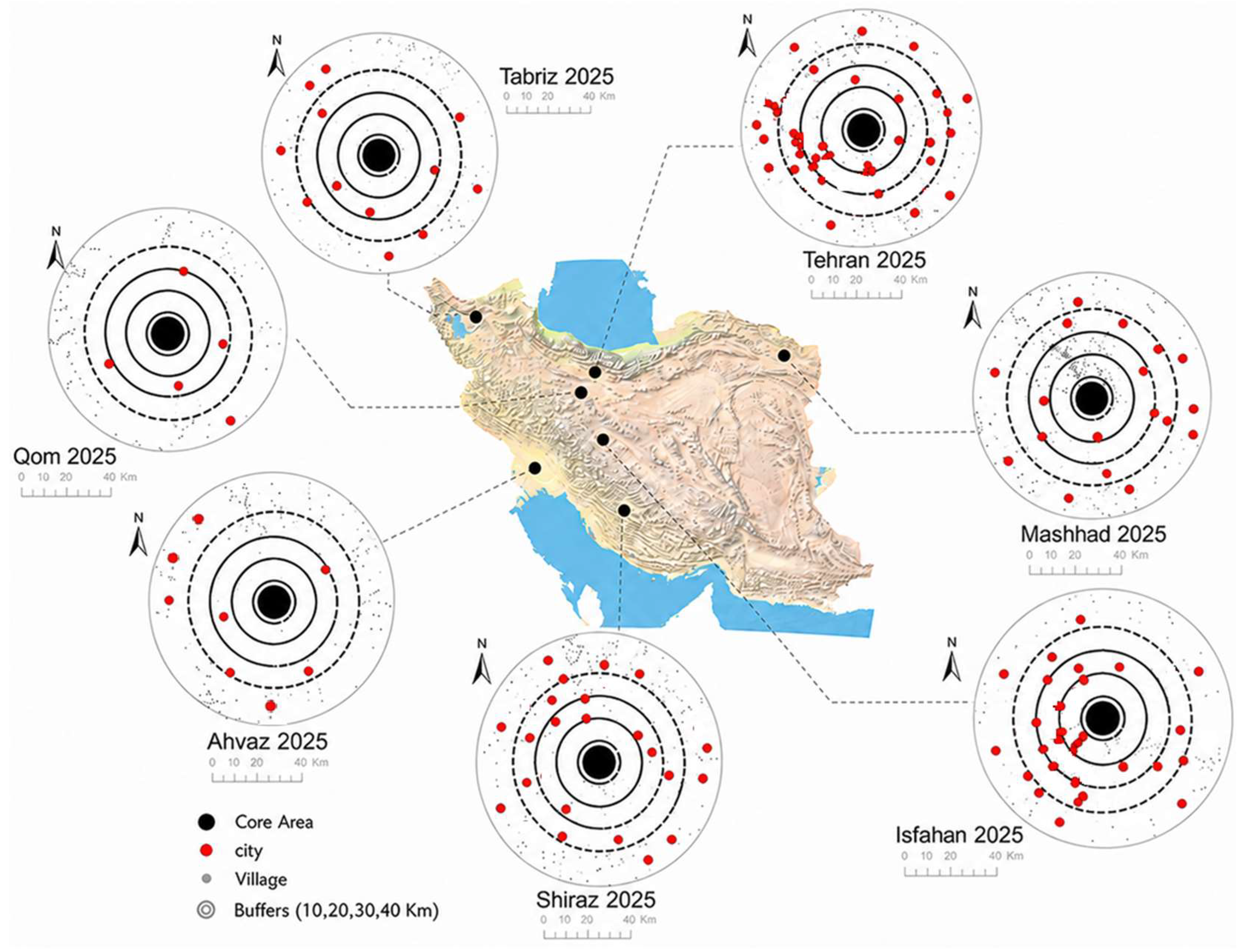
Because the spatial reach of metropolitan expansion differs across Iran, the definition of each study area was adjusted to reflect local settlement structure, road connectivity, and the scale of urbanized development. The Tehran–Karaj region required a wider spatial threshold because of its extensive metropolitan footprint, whereas smaller metropolitan regions were assessed using more compact catchment distances. This approach allowed the analysis to capture comparable peri-urban dynamics while recognizing variation in regional morphology and infrastructure distribution [20,51]. The 2025 data show considerable variation across the national metropolitan system, with Tehran–Karaj remaining the dominant region, while Mashhad, Isfahan, Tabriz, Shiraz, Ahvaz, and Qom each display distinct combinations of density, population scale, and peripheral settlement growth (Table 1).
The updated 1990–2025 settlement inventory shows that metropolitan growth has become increasingly decentralized, with peripheral settlements no longer functioning merely as isolated rural localities but as part of a wider, infrastructure-mediated urbanization process. Across the seven case-study regions, the number of outlying settlements increased from 60 to 321, signaling a shift from relatively compact metropolitan forms toward more dispersed and multi-nodal urbanization patterns. This change is important because peripheral settlement growth reflects not only population redistribution but also the cumulative effects of land-market incentives, infrastructure provision, weak development control, and fragmented metropolitan governance.
Figure 1 illustrates the 2025 distribution of peripheral settlements around the selected metropolitan regions. The pattern shows that outward growth has not occurred evenly around metropolitan cores; instead, new settlement concentrations tend to form along accessible corridors and around secondary nodes. Improved road and rail connectivity has reduced the friction of distance between metropolitan cores and peripheral land, allowing land-market pressures and housing demand to move outward. In the absence of coordinated land-use regulation, this improved accessibility has often produced fragmented expansion rather than planned compact growth.
Although the seven-region case-study framework is consistent with previous national-scale research on Iranian metropolitan sprawl [42], this study extends the empirical basis to 2025 and uses the case material for a different analytical purpose. The metropolitan data provide contextual grounding for the ISM–MICMAC model rather than serving as the primary basis for ranking driver importance.

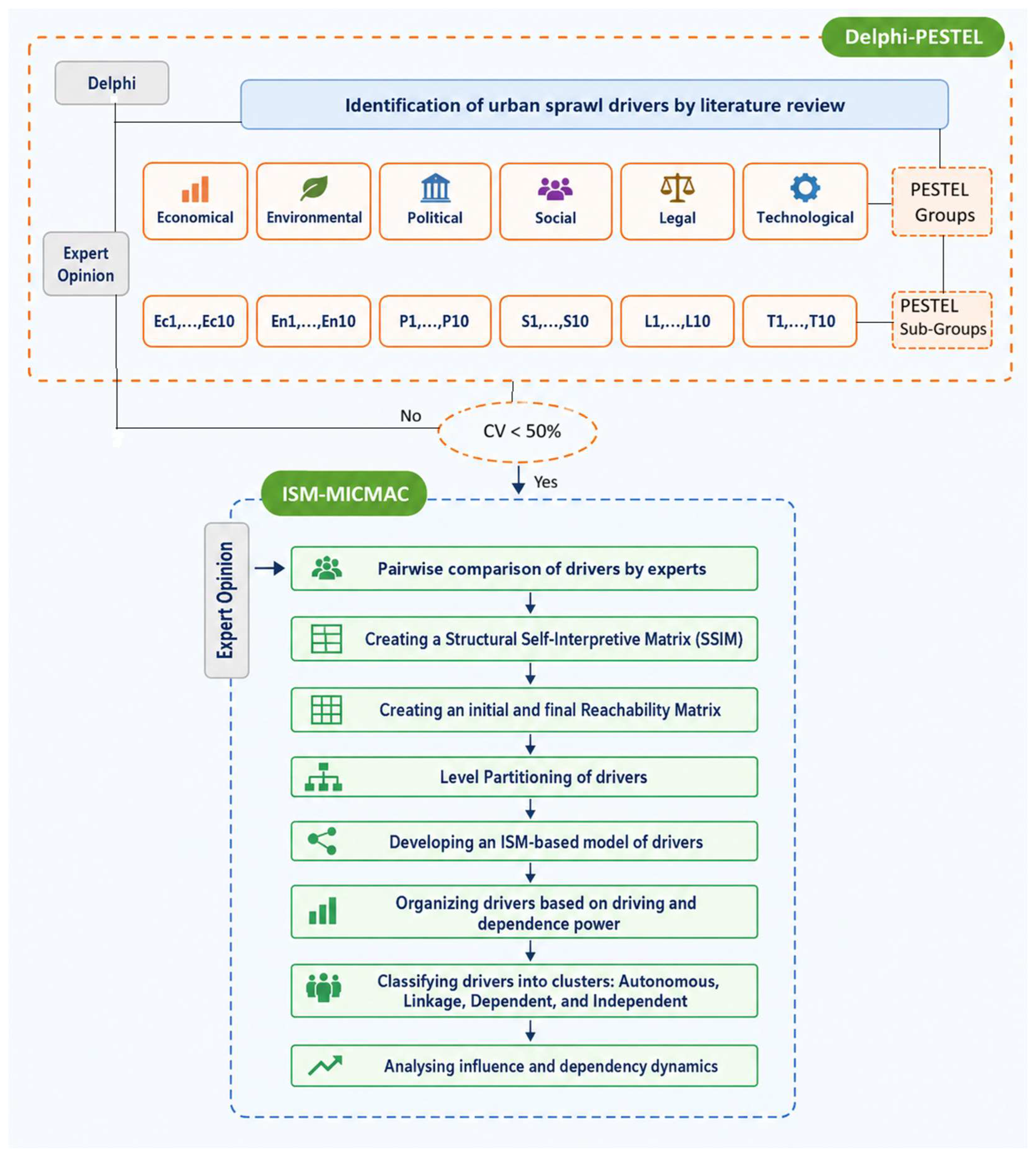
3.2. PESTEL Framework & DELPHI

The first methodological stage was designed to construct a broad but non-duplicative pool of potential sprawl drivers. Candidate variables were drawn from prior empirical and theoretical studies and then organized under the PESTEL domains to ensure coverage of institutional, economic, social, technological, environmental, and legal dimensions. At this stage, PESTEL was used only as an organizing framework; it did not imply that the domains were independent or equally influential.
The preliminary driver pool was then reviewed through a two-round Delphi process. Experts assessed the relevance of each variable for explaining outward metropolitan growth in Iran. After the first round, items with weak support were removed and conceptually overlapping variables were consolidated to avoid double counting. The revised list was returned to the panel for a second evaluation. Consensus was assessed using the coefficient of variation, with convergence interpreted as sufficient when dispersion in expert judgements fell below the accepted threshold. This process produced a refined set of 60 PESTEL-classified drivers.
Because ISM requires a manageable number of analytically meaningful variables, the study then applied an additional screening stage. Variables were retained for structural modeling only when they combined high expert-rated importance with evidence of systemic influence, meaning that experts regarded them as capable of shaping other drivers rather than merely reflecting downstream outcomes. This produced the final set of 16 drivers used in the ISM–MICMAC analysis.
The PESTEL framework is a strategic instrument employed for the examination of macro-environmental factors that exert influence on the performance of an organization [85]. The aforementioned factors encompass political, economic, social, technological, environmental, and legal dimensions. Although originally developed for strategic management analysis, the PESTEL framework has increasingly been applied in urban and regional planning studies to categorize complex external drivers influencing spatial development. The framework finds extensive application in the field of business and management literature, as scholars from diverse academic backgrounds, such as economics and business management [86], direct their attention towards examining the interconnection between economic development, entrepreneurial activity, and the conditions of the institutional framework [87].
In urban and regional planning, the PESTEL framework has been applied to structure the analysis of factors driving spatial challenges. For instance, Soltani et al. [42] employed the PESTEL framework as a structuring tool for categorizing urban sprawl drivers in Iranian metropolitan regions, demonstrating its applicability for examining complex multi-dimensional pressures on urban land use. Similarly, Feng and Gauthier [4] have used structured analytical frameworks akin to PESTEL to untangle the interplay of physical planning, transportation, and environmental drivers of urban sprawl across cities. The framework’s capacity to systematically organize diverse macro-environmental factors within a unified analytical structure makes it particularly well-suited for investigating the multi-causal dynamics of urban sprawl in developing-country contexts [88].
To capture the multi-dimensional nature of metropolitan expansion, the study first organized potential drivers using the PESTEL structure. This framework was used as a classificatory device to separate institutional, market-based, societal, technological, ecological, and regulatory influences before examining their interdependencies. Rather than treating these dimensions as independent categories, the study uses them as an entry point for identifying how macro-level conditions collectively shape peripheral urban growth.
After the preliminary list of drivers was developed, a two-stage expert consultation process was conducted to validate, refine, and prioritize the variables. The Delphi procedure was selected because it enables structured judgment from specialists familiar with the institutional and spatial conditions of Iranian metropolitan development [18]. Through iterative scoring and feedback, the initial list was screened to retain those drivers considered most relevant to the formation and persistence of urban sprawl. Consequently, 49 experts were identified and communicated for this study, of whom 28 actively participated in the survey (response rate = 57%). This response rate is considered acceptable for Delphi studies, where participation is voluntary and the emphasis is placed on expert knowledge rather than sample size.
According to the literature, Delphi studies commonly rely on relatively small panels of experts, typically ranging between 10 and 20 participants, as the objective is to obtain informed judgments rather than statistical representation [48]. The final panel size in this study therefore falls within the commonly recommended range for Delphi-based research [18].
The objective of this study is not to produce city-specific explanations but to identify systemic drivers operating across Iranian metropolitan regions. Although each metropolitan area has its own local characteristics, the governance structures, planning frameworks, and institutional arrangements influencing urban development are largely shaped by national policies and regulatory systems. Therefore, expert knowledge drawn from different metropolitan contexts can provide insights into common structural drivers of urban sprawl. This national-scale perspective allows the study to identify structural drivers embedded in institutional and governance systems that transcend individual city contexts.
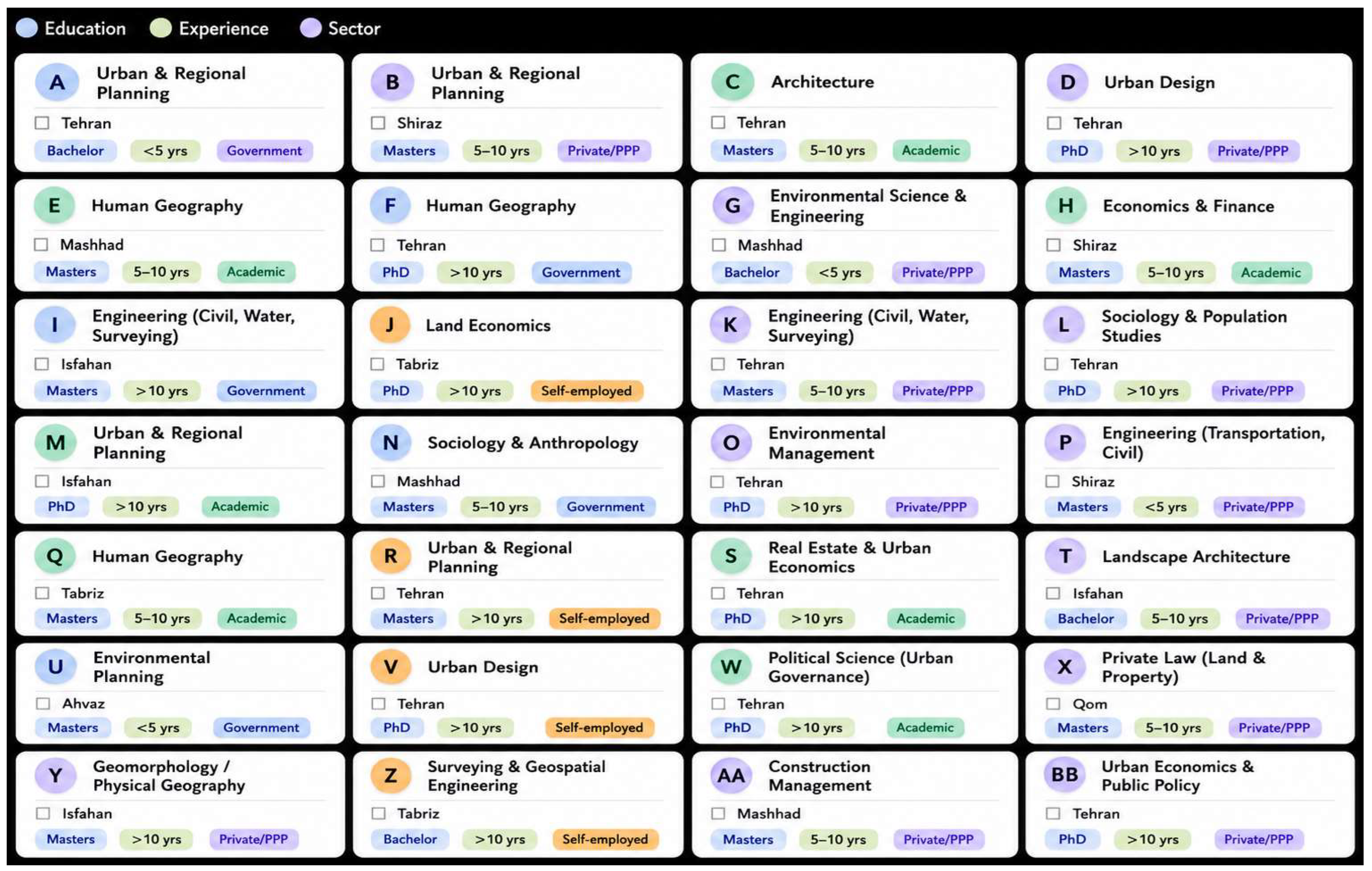
The panel was designed to capture multiple forms of professional knowledge relevant to metropolitan expansion. Participants included academic researchers, public-sector planners, legal and policy specialists, engineers, economists, and private-sector practitioners (see Figure 2). This composition was appropriate because sprawl in Iran is shaped not only by planning policy but also by land-market incentives, infrastructure decisions, regulatory enforcement, and political-administrative coordination. The purpose of the panel was therefore not statistical representation, but informed judgment across the principal institutional and professional domains involved in urban development.
Geographic distribution across Iran’s major metropolitan areas ensures that the findings are not skewed by the unique context of a single city like Tehran. By incorporating views from different regions, the study can more reliably identify the foundational, nationwide drivers of sprawl while implicitly accounting for regional variations, thus enhancing the generalizability of the conclusions for metropolitan regions.
While several participants were employed in public-sector institutions, their expertise in urban planning and governance was considered essential for understanding institutional drivers of urban sprawl. The panel was designed to capture disciplinary, professional, and geographic diversity. Participants were drawn from academic, public-sector, legal, engineering, economic, and private-sector backgrounds across Iran’s major metropolitan regions. This composition helped ensure that the Delphi process reflected the institutional, market, infrastructural, and regulatory dimensions of sprawl, while reducing the risk that the findings would be dominated by the experience of a single city.
Potential participants were approached directly through professional networks, institutional contacts, and targeted email correspondence. Reminder communications were used to maximize completion rates and to maintain consistency across the two Delphi rounds. Responses were gathered using a standardized survey instrument so that expert judgements could be compared systematically across all driver categories. The fieldwork was completed between October and December 2025 following ethics approval from the relevant authority.
The first methodological stage combined PESTEL classification with a two-round Delphi process. Candidate drivers were identified from prior empirical and theoretical studies and organized under six PESTEL domains: political, economic, social, technological, environmental, and legal. In this study, PESTEL was used as a classificatory framework rather than as an assumption that the domains operate independently (Table A1, Appendix A).
The preliminary driver list was reviewed by an expert panel through two Delphi rounds. In the first round, participants assessed each candidate driver using a five-point importance scale, where 1 indicated the lowest perceived relevance and 5 indicated the highest perceived relevance to metropolitan sprawl in Iran. This format was selected because it allowed participants to differentiate the perceived relevance of drivers while maintaining a simple and consistent scoring structure across the two Delphi rounds. After this round, variables with a mean score below 3 were removed, and conceptually overlapping items were consolidated to reduce duplication. The revised list was then returned to the panel for a second round of assessment. Consensus was evaluated using the coefficient of variation, with a CV below 50% interpreted as an acceptable level of convergence among expert judgements. This process produced 60 PESTEL-classified drivers.
Because ISM requires a manageable set of analytically meaningful variables, an additional screening stage was applied. Drivers were retained for structural modeling only when they met two criteria: a high final-round importance score and evidence of systemic influence, meaning that experts regarded them as capable of shaping other variables rather than merely reflecting downstream outcomes. This process produced the final set of 16 drivers used in the ISM–MICMAC analysis (Figure 3).

3.3. ISM and MICMAC

The MICMAC (Matrix of Cross Impact Multiplications Applied to a Classification) method developed by Michel Godet is a structural analysis tool designed to explore and understand the relationships between variables in complex systems [89]. It is particularly effective in identifying the most influential (driving) and most reactive (dependent) variables within a given context by examining both direct and indirect influences among them [90]. When combined with ISM, MICMAC analysis provides an additional layer of validation by classifying variables according to their driving and dependence power within the system. In urban studies, MICMAC is widely used alongside tools like Delphi and PESTEL to classify and prioritize the multidimensional factors—political, economic, social, technological, environmental, and legal—that drive urban challenges such as sprawl.
Building on this earlier driver-weighting work [42], the present study uses MICMAC for a different purpose. Rather than calculating relative priority weights, MICMAC is used here to interpret the dependence–driving profile of variables after their hierarchical relationships have been structured through ISM. The emphasis is therefore on causal positioning and policy sequencing, not on factor ranking.
MICMAC classifies variables into four groups: determinant variables, relay variables, dependent variables, and autonomous variables. This classification enables the analysis to distinguish root drivers from intermediate linkages and outcome variables, thereby clarifying where strategic interventions are likely to have the greatest systemic effect.

4. Findings

Table 2 presents a comprehensive list of 16 key drivers contributing to urban sprawl in Iranian metropolitan regions, each identified with a unique code (C1–C16). These drivers span a range of categories, including governance and institutional failures (e.g., C1, C2, C3, C4), economic and market pressures (e.g., C5, C6), infrastructure and pricing policies (e.g., C7, C10, C11), demographic and cultural trends (e.g., C8, C9), and environmental or quality-of-life factors (e.g., C12, C13, C14). The inclusion of zoning and permitting issues (C15, C16) highlights regulatory inconsistencies that further exacerbate urban expansion.

4.1. The Structural Self-Interaction Matrix (SSTM)

The Structural Self-Interaction Matrix (SSTM) (Table 3) presented here is a key step in the ISM process, capturing the contextual relationships among the 16 identified drivers of urban sprawl (C1–C16) in Iranian metropolitan regions. Each cell in the matrix indicates whether one driver influences another, is influenced by it, shares a mutual relationship, or has no connection; based on expert judgment and coded as V, A, X, or O (converted numerically here). This matrix represents the collective judgment of the expert panel regarding causal relationships among drivers and therefore serves as the starting point for constructing the structural model of urban sprawl dynamics. It is acknowledged that the reliance on expert perceptions to populate the SSTM introduces a degree of subjectivity. Ideally, GIS-based land use change metrics—such as impervious surface expansion rates, urban footprint growth trajectories, or remote sensing-derived land cover transitions—could serve as an additional layer of empirical validation for the directional relationships encoded in the matrix. However, such integration was not feasible within the scope and resources of the present study. The decision to rely exclusively on expert judgment is consistent with established ISM practice in urban and planning research, where the structural relationships among institutional, economic, and social variables are inherently difficult to operationalize through spatial data alone. The expert panel’s cross-disciplinary and multi-city composition, drawing on planners, economists, engineers, and governance specialists from across Iranian metropolitan regions, was designed to maximize the validity of these relational judgments. Future research should seek to cross-validate the causal structure identified here using quantitative spatial data, for instance by testing whether metropolitan regions with higher degrees of political fragmentation (C1) exhibit statistically greater rates of peripheral settlement expansion over time.
The values in the table reflect directional relationships: for instance, 1 in row C1 and column C2 means that C1 (Political fragmentation and weak coordination) influences C2 (Weak enforcement of urban growth boundaries). Diagonal values are all set to 1 by convention. At this stage, the analysis identifies whether a directional relationship exists between each pair of variables; the strength of influence is not yet assessed.

4.2. Initial Reachability Matrix

The Initial Reachability Matrix (IRM) converts the qualitative relationships captured in the SSTM into a binary format, enabling the systematic analysis of influence among variables. In this conversion, all positive directional relationships from the SSTM (coded as V, X, or 2) are represented as 1 (indicating influence exists), while non-relationships and negative values (coded as O, A, or −1) are represented as 0 (indicating no direct influence in that direction). This binary transformation is necessary because the SSTM captures nuanced directional relationships, whereas the ISM reachability matrix requires strictly binary input for mathematical computation of transitivity. This transformation allows the model to be analyzed mathematically and prepares the data for the application of transitivity, which is a key principle of ISM analysis (Table 4).

4.3. Final Reachability Matrix

The Final Reachability Matrix (FRM) (Table 5) summarizes the complete set of direct and indirect relationships among the 16 identified urban sprawl drivers (C1–C16), incorporating transitivity to reveal how influence propagates through the system. Each cell with a “1” indicates that the driver in the row influences the driver in the column, either directly or indirectly.
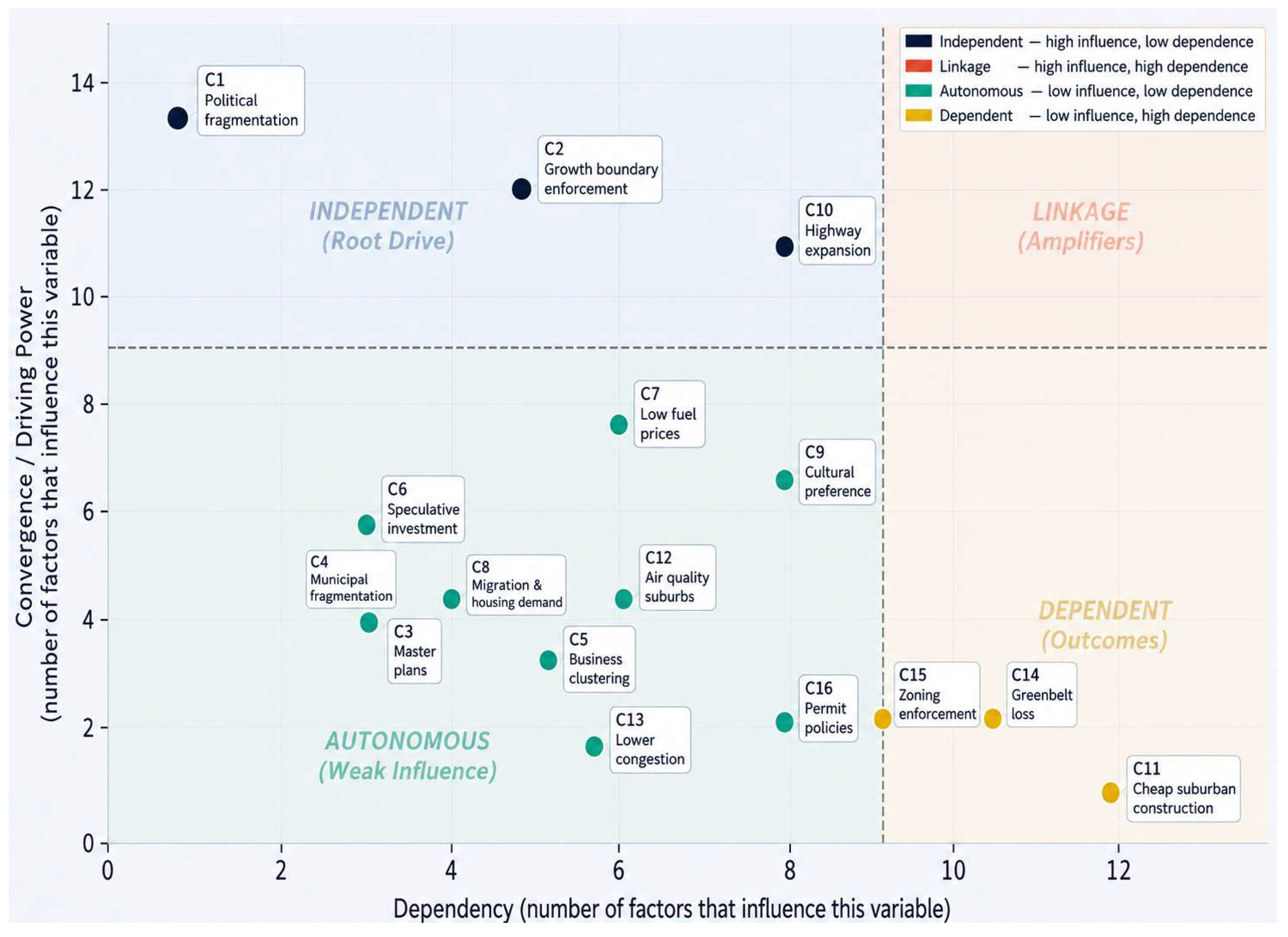
The “Convergence” column on the far right quantifies the driving power of each variable, i.e., how many other variables it influences; while the “Dependency” row at the bottom shows how many other drivers influence each variable. This step is critical because it allows the identification of root drivers and outcome variables within the system, thereby revealing the hierarchical structure of urban sprawl dynamics.
Variables such as C1 (Political fragmentation and weak coordination), C2 (Weak enforcement of urban growth boundaries), and C10 (Highway expansion enabling sprawl) show high convergence values (13, 12, and 11, respectively), identifying them as key independent drivers with strong influence across the system. Conversely, C11 (Faster, cheaper suburban construction methods) and C14–C16 (zoning and permitting issues) exhibit high dependency and low driving power, placing them at the bottom of the hierarchy as outcome-oriented or dependent variables. These findings indicate that governance-related drivers operate as foundational conditions that shape many other processes contributing to urban sprawl.
This matrix serves as the foundation for both hierarchical level partitioning in the ISM model and classification of variables into MICMAC quadrants, allowing researchers and policymakers to identify leverage points and target interventions effectively within the complex dynamics of urban sprawl.

4.3.1. Convergence

This column indicates the number of influence relationships that each criterion has over other criteria. For example, C1 has 13 influences, meaning this criterion affects 13 other criteria.

4.3.2. Dependency

This row indicates the number of criteria that influence each criterion. For example, C11 is influenced by 11 other criteria, which indicates a high level of dependency on this criterion on others.

4.4. Hierarchical Structure of Drivers

Table 6 presents a hierarchical structure of urban sprawl drivers in Iranian metropolitan regions, organized by levels of influence and based on three types of interdependencies: received collection, preliminary collection, and subscription collection. The hierarchical levels derived from the ISM analysis reveal how influence flows from foundational institutional drivers to more reactive outcome variables within the system.
Each level (ranging from Level 1 to Level 4) indicates the depth or hierarchy of the driver within the network, with Level 4 representing the most foundational or influential driver (in this case, C1). As we move down the levels, drivers become increasingly dependent on those above. For instance, Level 3 includes nodes such as C2, C7, C9, and C10, which are directly influenced by C1 and help transmit its effects further through the system. Levels 2 and 1 contain more peripheral or outcome-oriented drivers like C11, C12, C13, C14, C15, and C16, which are more reactive and less central to initiating system-wide change.
This hierarchical structure highlights that institutional and governance factors lie at the root of the urban sprawl system, while environmental and lifestyle factors tend to emerge as downstream consequences of earlier decisions related to planning, infrastructure, and regulation.
The three collection types; received, preliminary, and subscription; trace the flow of influence and interdependencies among drivers: “received collection” refers to the complete set of influencing factors, “preliminary collection” to the immediate upstream influencers, and “subscription collection” to confirmed or strongest connections. Table 6 helps identify key leverage points (e.g., C1 and C2 at higher levels) and clusters of mutually reinforcing drivers, providing a structured basis for prioritizing interventions in policy or planning aimed at mitigating urban sprawl.

4.5. Structural Model Interpretation

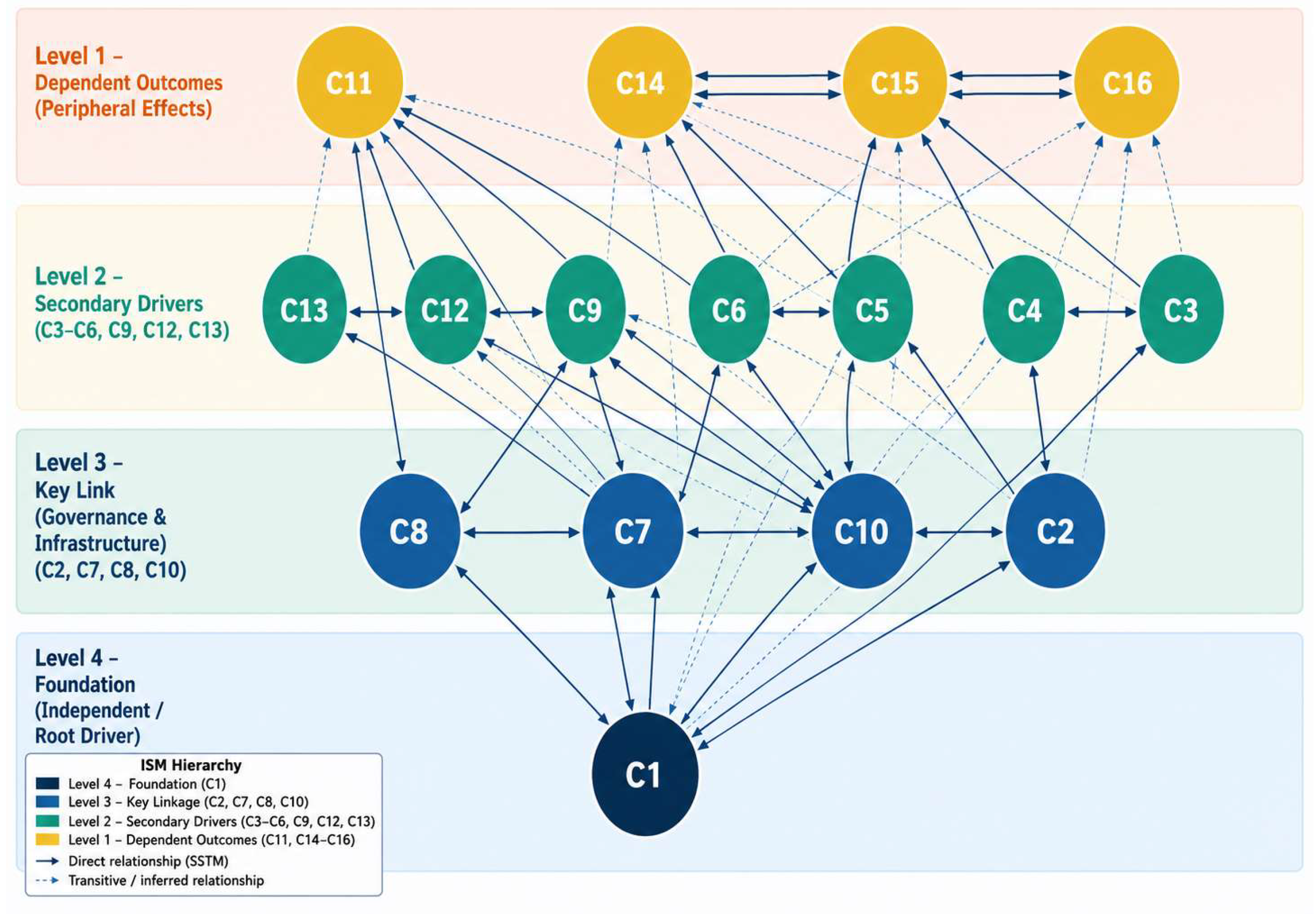
Figure 4 represents the complex and interdependent system of drivers contributing to urban sprawl in Iranian metropolitan regions. Each node in the diagram corresponds to one of the 16 identified factors (C1–C16), with the arrows indicating the direction of influence among them. It should be noted that the diagram includes both direct relationships (as elicited from the expert panel in the SSTM) and transitive or inferred relationships (derived through the reachability matrix computation). Arrows representing transitive connections reflect indirect influence pathways that emerge through the chain of direct relationships rather than from explicit expert judgment. The ISM model visually illustrates the cascading structure of urban sprawl drivers identified in the previous analytical steps.
At the core of the system are governance and regulatory failures, particularly political fragmentation and weak coordination (C1), municipal fragmentation and regulatory failure (C4), weak enforcement of urban growth boundaries (C2), ineffective master plans and development strategies (C3), weak enforcement of zoning regulations (C15), and inconsistent building permit policies (C16). These institutional shortcomings form the structural foundation of urban sprawl, influencing most of the downstream factors in the network.
The graph shows that these governance failures directly enable or amplify economic and market-driven forces, such as business clustering in outer suburbs (C5) and speculative real estate investments in peripheral areas (C6). In this way, institutional weaknesses indirectly shape urban spatial outcomes by altering market incentives and development patterns.
These pressures, in turn, are closely tied to infrastructure and pricing policies that make peripheral expansion more attractive, including highway expansion (C10), low fuel prices (C7), and faster, cheaper suburban construction methods (C11). The diagram also highlights how certain environmental and quality-of-life factors, such as better air quality in suburbs (C12) and lower congestion in outer areas (C13); further incentivize outward movement, especially in the absence of regulatory constraints. However, these same factors are undermined over time by the loss of greenbelts to development (C14), reinforcing a self-destructive loop. This dynamic feedback illustrates how sprawl can gradually erode the environmental and lifestyle advantages that initially attract residents to suburban locations.
Demographic and cultural factors, particularly rural-to-urban migration, increasing housing demand (C8) and a cultural preference for low-density living (C9), also contribute to the spread of sprawl. While these are positioned further downstream and are more difficult to influence directly, they interact with the broader system, especially in the context of weak urban containment policies and cheap peripheral housing. The structure of the diagram reflects a dynamic and cyclical system where poor governance fuels economic incentives and infrastructural patterns that promote sprawl, and those outcomes in turn weaken the very systems meant to control them. This systemic interpretation directly addresses the second research question by demonstrating how different categories of drivers interact within a hierarchical urban development system.
The node receiving the most downstream connections likely represents the outcome; urban sprawl itself; as the cumulative result of all other interacting drivers. Addressing this issue effectively requires targeting the most central and influential factors; particularly those related to institutional coordination, enforcement, and planning; while also considering the reinforcing effects of infrastructure policies, market behaviors, and cultural trends.
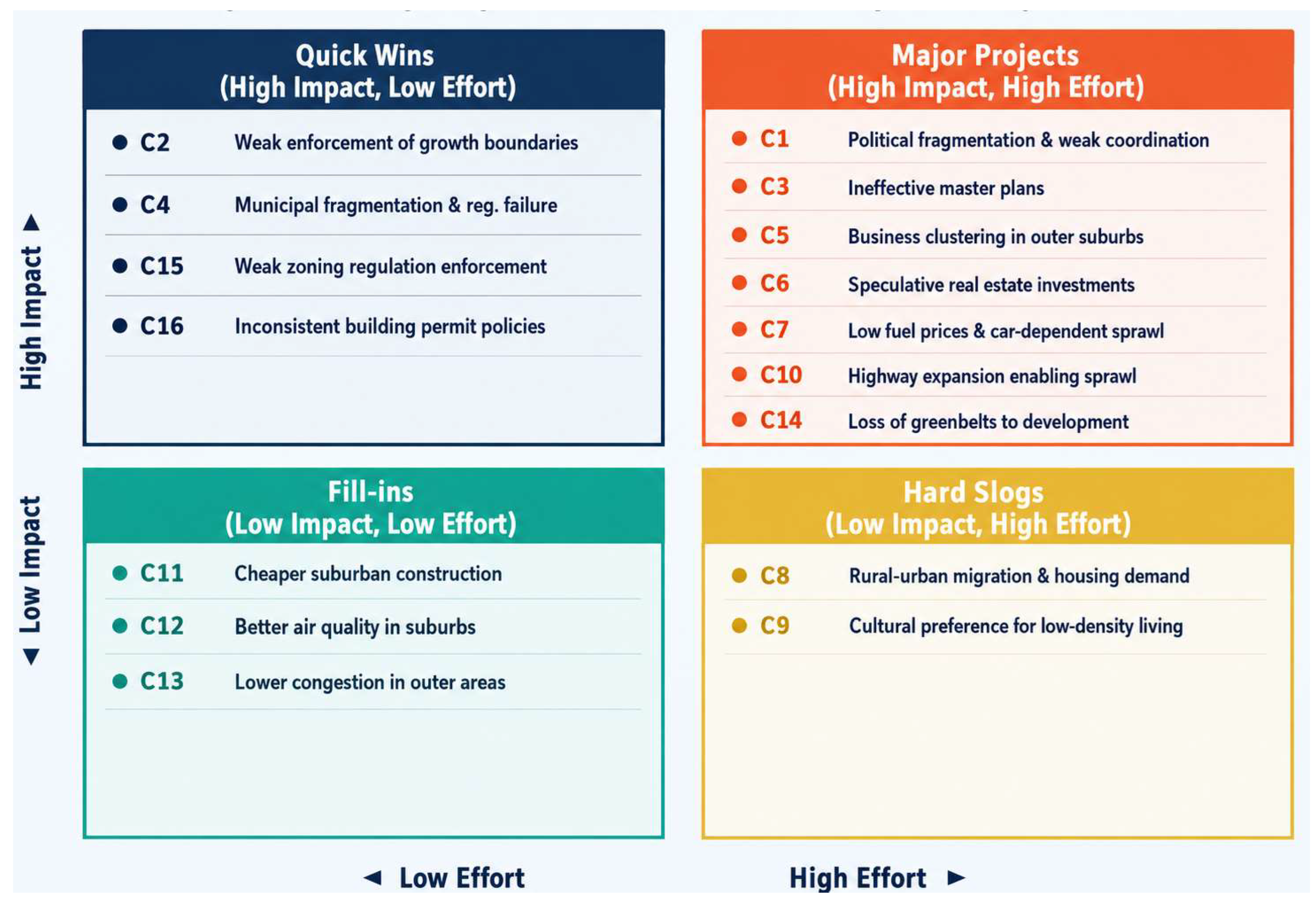
The impact-effort matrix allows for a strategic interpretation of urban sprawl drivers in Iranian metropolitan areas by categorizing each factor based on its potential impact and the effort required to address it. In the high impact–low effort (quick wins) quadrant, several governance-related issues stand out as immediate priorities. These include weak enforcement of urban growth boundaries (C2), weak enforcement of zoning regulations (C15), inconsistent building permit policies (C16), and municipal fragmentation and regulatory failure (C4). These are typically institutional or regulatory shortcomings that could be addressed through better coordination, monitoring, and administrative reforms without requiring large-scale investments.
In contrast, the high impact–high effort (major projects) quadrant includes more complex structural and economic drivers that demand significant coordination, planning, or financial resources. Political fragmentation and weak coordination across agencies (C1), along with ineffective master plans and development strategies (C3), represent major governance hurdles. Additionally, market-driven factors such as business clustering in outer suburbs (C5) and speculative real estate investments in peri-urban areas (C6) contribute strongly to sprawl and are challenging to regulate. Infrastructure-related drivers such as highway expansion enabling outward growth (C10), low fuel prices that encourage car-dependent development (C7), and the ongoing loss of greenbelts to development (C14) also fall into this quadrant, as they require multi-sector policy change and long-term commitment.
The low impact–low effort (fill-ins) quadrant captures secondary factors that are relatively easy to influence but offer limited standalone impact. These include better air quality in suburbs attracting residents (C12), lower congestion in peripheral areas (C13), and faster, cheaper suburban construction methods (C11). While these may shape residential preferences, they are more symptomatic of sprawl than root causes and addressing them alone is unlikely to reverse sprawling trends.
Finally, in the low impact–high effort (hard slogs) quadrant are deeper societal and demographic factors that are both difficult to change and yield limited direct impact on spatial growth. These include rural-to-urban migration, increasing housing demand (C8) and a cultural preference for low-density, detached housing (C9). Interventions targeting these trends would require profound shifts in economic policy, cultural norms, and public preferences; changes that are slow, resource-intensive, and uncertain in their effectiveness.

5. Discussion

This study set out to identify the drivers of urban sprawl in Iranian metropolitan regions and, more importantly, to model their complex interrelationships. These findings directly address the study’s research questions by identifying the most influential drivers of urban sprawl, revealing their structural interdependencies, and highlighting which factors exert the strongest systemic influence within Iranian metropolitan regions.
The hierarchical model developed through the ISM methodology provides a straightforward structural narrative. At the foundation of the problem (Level 4) lies C1: Political fragmentation and weak coordination. This single driver acts as the primary root cause, initiating a cascade of effects through the system. Its influence enables the critical linkage drivers at Level 3, such as C2: Weak enforcement of urban growth boundaries, C4: Municipal fragmentation and regulatory failure, and C10: Highway expansion enabling sprawl. These governance and infrastructure-related drivers, in turn, create a fertile ground for the economic and market-driven forces at Level 2, including C5: Business clustering in outer suburbs and C6: Speculative real estate investments. The ultimate, most visible outcomes of this entire process are the dependent variables at Level 1, such as C14: Loss of greenbelts to development and C11: Faster, cheaper suburban construction methods, which are symptoms rather than causes. This hierarchical structure highlights an important policy insight: interventions targeting downstream variables, such as environmental degradation or suburban construction practices, are unlikely to significantly reduce sprawl unless the upstream institutional drivers that enable these processes are simultaneously addressed (Figure 5).
It is important to note that C15 (Weak enforcement of zoning regulations) and C16 (Inconsistent building permit policies) appear at Level 1 of the ISM hierarchy, the most dependent, outcome-oriented tier, which may appear counterintuitive given that these are regulatory instruments that could, in principle, serve as causal mechanisms. This placement requires clarification. In the ISM framework, a variable’s level is determined by the matrix of reachability: a variable is assigned to Level 1 when it is heavily influenced by other variables but exerts little independent influence on variables not already above it in the hierarchy. In the context of this study, C15 and C16 reflect regulatory dysfunction rather than regulatory capacity. Their position at Level 1 captures the fact that, as modeled by the expert panel, these enforcement failures are themselves the product of deeper systemic drivers—specifically, the political fragmentation (C1), municipal regulatory breakdown (C4), and ineffective planning frameworks (C3) situated at higher levels. In other words, zoning enforcement weakness and inconsistent permitting are not autonomous institutional causes but are downstream manifestations of the governance failures operating at the root of the system. This distinction is consistent with the broader argument of the study: policy interventions at the level of C15 and C16 alone are unlikely to be effective unless the upstream institutional conditions enabling their failure are simultaneously addressed.
The impact–effort matrix translates the ISM–MICMAC findings into four policy-relevant intervention categories (Figure 6):
  • High-Impact, Low-Effort (Quick Wins): This quadrant is dominated by regulatory and institutional shortcomings. Factors like C2 (Weak enforcement of growth boundaries), C15 (Weak enforcement of zoning), and C16 (Inconsistent permit policies) represent immediate priorities. These do not necessarily require massive financial investment but rather strengthening of administrative will, monitoring capacity, and inter-agency coordination. They offer the most direct leverage for immediate impact.
  • High-Impact, High-Effort (Major Projects): This quadrant contains the most fundamental and challenging drivers. Addressing C1 (Political fragmentation), C10 (Highway expansion), and C7 (Low fuel prices) demands significant, long-term political commitment, multi-sectoral policy reform, and substantial financial resources. These are the core structural issues that require a paradigm shift in national and metropolitan governance.
  • Low-Impact, High-Effort (Hard Slogs): Deeper socio-cultural factors like C8 (Rural-to-urban migration) and C9 (Cultural preference for low-density living) fall into this category. These are difficult to influence directly through policy and are often symptomatic of broader economic and social trends. Our model suggests that rather than targeting these directly, a more effective strategy would be to address the primary leverage points that make sprawling lifestyles both possible and attractive.
  • Low-Impact, Low-Effort (Fill-ins): Factors such as C12 (Better air quality in suburbs) and C13 (Lower congestion) are secondary drivers. While they influence individual residential choices, they are essentially outcomes of the core sprawling process. Addressing them in isolation will have minimal effect on the overall trajectory of urban expansion.
Our findings align closely with those of Soltani et al. [42], who employed a Delphi–DANP framework to identify and quantify 40 urban sprawl drivers in Iran using the population and density data of 2020. Both studies highlight political fragmentation as the most influential driver, underscoring the centrality of governance failures in shaping sprawl dynamics. Similarly, weak legal regulations, rural-to-urban migration, and cultural preference for suburban living emerge as significant contributors in both analyses. However, methodological differences reveal nuanced contrasts. Whereas Soltani et al. [42] quantify the relative weights of drivers, our ISM–MICMAC approach maps the hierarchical structure and causal pathways among them, distinguishing between foundational governance failures, linkage variables such as infrastructure expansion, and downstream consequences like greenbelt loss. For example, while Soltani et al. [42] identify inadequate transportation infrastructure as a key factor, our model positions highway expansion (C10) as a high-impact, high-effort driver that both enables and reinforces market-driven pressures. Furthermore, their emphasis on technological advancements as a driver contrast with our findings, where technological change is embedded within broader economic and infrastructural linkages rather than acting as an independent high-leverage factor. Together, these complementary approaches suggest that both quantifying importance (as in Delphi–DANP) and mapping interdependencies (as in ISM–MICMAC) are critical for developing a full-spectrum understanding of urban sprawl drivers, thereby strengthening the evidence base for integrated policy interventions. More broadly, these findings are consistent with international research emphasizing the role of institutional fragmentation and governance capacity in shaping urban spatial development [91]. Studies in both developed and developing contexts have shown that weak coordination among planning authorities, inadequate regulatory enforcement, and fragmented metropolitan governance structures frequently act as structural causes of urban sprawl [30,31,53,91]. The present study contributes to this literature by demonstrating how these institutional factors operate within a hierarchical system of interdependent drivers in the Iranian context.
These findings should not be interpreted as another ranking of urban sprawl drivers. Rather, they show how drivers occupy different structural positions within the sprawl system. Political fragmentation and weak enforcement capacity operate as root conditions because they shape planning effectiveness, land-market behavior, and infrastructure coordination. Economic, demographic, and environmental pressures become spatially consequential when institutional systems fail to channel growth toward compact and serviced locations.

6. Conclusions

This study developed a structural interpretation of urban sprawl in Iranian metropolitan regions by examining how selected governance, market, infrastructure, demographic, environmental, and regulatory drivers interact within a hierarchical system. The ISM–MICMAC results show that political fragmentation, weak coordination, and limited enforcement capacity operate as foundational conditions that shape downstream land-market behavior, infrastructure-led expansion, and peripheral settlement growth.
The findings demonstrate that urban sprawl in Iranian metropolitan regions is not the result of isolated demographic or economic pressures but rather the outcome of a complex system of interdependent drivers. The ISM model highlights political fragmentation and weak coordination as the foundational driver initiating a cascade of secondary influences across the urban system. These institutional weaknesses contribute to ineffective urban growth management, including weak enforcement of growth boundaries, fragmented municipal governance, and inadequate planning strategies. These governance failures create the conditions that enable infrastructure expansion, speculative land markets, and suburban real estate development to flourish. In turn, these processes encourage the spatial dispersion of population and economic activity toward peripheral areas, resulting in low-density and fragmented development patterns characteristic of urban sprawl.
From a theoretical perspective, this study contributes to the urban sprawl literature by providing a systemic framework for understanding the hierarchical relationships among sprawl drivers in developing-country contexts. While previous research has often focused on identifying individual factors influencing urban expansion, this study advances the field by modeling the causal pathways linking these drivers through ISM and MICMAC analysis. The results highlight the importance of institutional and governance structures as foundational determinants that shape the behavior of economic, infrastructural, and social variables within the urban system. By demonstrating how governance failures propagate through multiple levels of influence, this study offers a more integrated conceptual understanding of urban sprawl dynamics in rapidly urbanizing regions.
The policy implications of the ISM–MICMAC results are sequential rather than sectoral. First, policy interventions should prioritize addressing institutional and governance shortcomings that serve as the root causes of urban sprawl. Reforms should address root-level institutional conditions, particularly fragmented metropolitan authority, weak enforcement capacity, and inconsistent implementation of land-use controls. Iran’s existing Supreme Council of Urban Planning and Architecture (Showray-e Ali Shahrsazi va Me’mari), which operates under the Ministry of Roads and Urban Development, provides a statutory basis for inter-agency coordination at the national level. Strengthening the operational authority and metropolitan-level extension of this body—for instance, by establishing metropolitan planning committees with mandatory participation from all municipalities within a defined urban region—could reduce the jurisdictional fragmentation that drives sprawl.
Second, infrastructure investment should be made conditional on compact-growth objectives, so that transport and service expansion do not unintentionally legitimize scattered fringe development. The enforcement of zoning regulations and urban growth boundaries should be tied to municipal budget allocations. Currently, Iranian municipalities are heavily dependent on construction permit revenues, which creates a structural incentive for approving peripheral development. Reforming the municipal financing system to reduce reliance on permit income—for example, through intergovernmental fiscal transfers tied to compact development performance metrics—would realign financial incentives with growth management objectives.
Third, land-market regulation should be coordinated with planning enforcement to reduce speculative conversion of peripheral land. The inconsistency of building permit policies (C16) across municipalities within the same metropolitan region can be addressed by requiring all municipalities to adopt harmonized permitting criteria derived from a mandatory metropolitan development strategy, approved under the Urban Region Act framework. This would reduce regulatory arbitrage between municipalities and constrain leapfrog development at metropolitan fringes.
Finally, housing and settlement policies should be integrated with metropolitan-scale growth management, ensuring that affordability objectives are not achieved through serviced outward expansion. To address speculative land development (C6) at urban peripheries, Iran’s existing land taxation framework should be reformed to impose progressive levies on undeveloped urban land held speculatively, as has been proposed in several national planning reform documents. Highway investment decisions (C10) should be subject to mandatory urban sprawl impact assessments, conducted prior to project approval, to evaluate whether proposed infrastructure will generate unintended peripheral development—a mechanism consistent with Iran’s environmental impact assessment legislation. Without such specific institutional reforms embedded in Iran’s existing legal and governance framework, recommendations for coordination and enforcement will remain aspirational rather than actionable.
While this study identifies a common hierarchical structure of urban sprawl drivers operating across Iranian metropolitan regions, it is important to acknowledge that the relative salience and ordering of individual drivers may vary depending on the geographic and biophysical characteristics of specific cities. The ISM model presented here captures systemic relationships that, according to the expert panel, operate broadly across the seven metropolitan regions studied; however, the hierarchy of drivers is not necessarily uniform across all urban contexts within Iran. For instance, in desert cities such as Qom, where water scarcity and arid land conditions represent structural constraints on urban development, environmental and infrastructural drivers—such as groundwater depletion, the absence of green infrastructure, and limited serviced land supply—may operate as more immediate triggers of compact development or, conversely, of leapfrog expansion toward water-accessible peripheral areas. In such contexts, the relative influence of environmental factors may be elevated in the hierarchy compared to what the aggregate model suggests. Conversely, in topographically constrained metropolitan regions such as Tehran, where mountain ranges restrict northward and westward expansion [92], the dynamics of sprawl are concentrated in specific directional corridors, amplifying the role of infrastructure investment decisions (C10) and land market speculation (C6) in shaping peripheral growth patterns. In comparatively land-abundant and lower-density regions such as Ahvaz or Shiraz, social and cultural preferences for low-density living (C9) and rural-to-urban migration pressures (C8) may play a proportionally stronger role in driving outward expansion [23]. These geographic considerations do not invalidate the aggregate model but highlight the need for context-sensitive policy calibration. Policymakers applying these findings should consider how the physical geography, resource availability, and settlement history of individual metropolitan regions may amplify or moderate the influence of drivers within the general hierarchy identified here. Future research should examine how the ISM hierarchy shifts when applied within geographically differentiated sub-samples of Iranian metropolitan regions, to develop more tailored governance and planning responses.
This study has several limitations that should be acknowledged. First, the structural model relies primarily on expert judgment obtained through the Delphi process. Although this approach is valuable for identifying complex systemic relationships and reducing individual bias through iterative consensus-building, it remains inherently interpretive and introduces a degree of subjectivity in the identification and prioritization of drivers [66,93,94]. Second, while the expert panel included participants from diverse disciplinary and professional backgrounds, their perspectives cannot capture all possible influences shaping urban sprawl across Iran. Third, the model provides a conceptual and hierarchical interpretation of causal relationships rather than an empirically quantified analysis of urban expansion patterns [95,96,97]. As a result, the findings offer a systemic explanation of the drivers of urban sprawl, but not precise measurements of their relative effects. Finally, the model represents a snapshot of Iranian metropolitan regions at a particular point in time and may not be fully generalizable to smaller cities or other national contexts.
Future research should therefore focus on empirically validating the relationships identified in this study and testing the strength of the causal pathways proposed in the ISM framework. Quantitative approaches such as econometric modeling, spatial regression, longitudinal urban growth modeling, and remote sensing-based land-use change analysis could help measure governance, infrastructure, market, and demographic factors influence urban expansion over time [48,92,95,98]. Such analyses are increasingly facilitated by machine learning and deep learning techniques, particularly where research seeks to examine the consequences of sprawl for urban heat [99,100], land market, housing affordability, traffic congestion or road accidents [101], and other spatially uneven environmental outcomes [102]. Comparative studies across different Iranian metropolitan areas, as well as across countries with similar institutional and governance conditions, would also help clarify how context shapes the operation of urban sprawl drivers [103]. Together, these approaches would strengthen the empirical basis of the present model and refine understanding of the mechanisms through which urban sprawl develops in rapidly urbanizing regions.
Ultimately, this study demonstrates that urban sprawl in Iran should not be understood merely as a spatial or demographic phenomenon but as the manifestation of deeper structural governance challenges. The hierarchical model developed through ISM and MICMAC analysis reveals that institutional fragmentation, weak regulatory enforcement, and misaligned infrastructure policies collectively create a system that unintentionally encourages dispersed urban expansion. Addressing urban sprawl therefore requires more than incremental planning reforms; it demands a systemic reorientation of metropolitan governance toward stronger coordination, integrated land-use and transport planning, and more effective regulatory oversight [93,94]. By identifying the most influential leverage points within the urban system, this study provides a strategic framework that can guide policymakers toward more targeted and effective interventions. If these structural drivers are addressed proactively, Iranian metropolitan regions could experience transition from uncontrolled expansion toward more compact, efficient, and sustainable urban development trajectories.

Author Contributions

Conceptualization, A.S. and A.A.; methodology, A.S. and H.N.K.; software, H.N.K.; validation, A.S. and A.A.; formal analysis, A.S. and H.N.K.; investigation, A.S.; resources, A.S. and A.A.; data curation, H.N.K.; writing—original draft preparation, A.S. and H.N.K.; writing—review and editing, A.S. and A.A.; visualization, A.S.; supervision, A.S. and A.A.; project administration, A.S. All authors have read and agreed to the published version of the manuscript.

Funding

This research received no external funding.

Institutional Review Board Statement

Not applicable.

Informed Consent Statement

Not applicable.

Data Availability Statement

A summary of the raw dataset is available from the first author on reasonable request.

Conflicts of Interest

The authors declare no conflicts of interest.

Appendix A

Table A1. PESTEL Drivers of urban sprawl, Expert Rating Instrument (Source: Authors, 2026). Please rate each driver on a scale of 1 (Not important) to 5 (Very important).
CodePESTELDriversNot ImportantRelatively UnimportantModerately ImportantImportantVery Important
Political Factors
P1Political FactorsNeo-liberal urban growth policies12345
P2Political FactorsPolitical fragmentation and weak coordination12345
P3Political FactorsPublic subsidies on fuel and utilities encouraging sprawl12345
P4Political FactorsLeapfrog development via satellite cities12345
P5Political FactorsWeak enforcement of urban growth boundaries12345
P6Political FactorsOver-reliance on property taxes and permit fees12345
P7Political FactorsIneffective master plans and development strategies12345
P8Political FactorsLack of expertise among planners and policymakers12345
P9Political FactorsMunicipal fragmentation and regulatory failure12345
P10Political FactorsPolicies prioritizing economic growth over sustainability12345
Economic Factors
Ec1Economic FactorsLow agricultural land rents driving conversion to urban use12345
Ec2Economic FactorsPreference for suburban industrial agglomerations12345
Ec3Economic FactorsGDP growth fueling urban expansion12345
Ec4Economic FactorsShift from agriculture to industrial economy12345
Ec5Economic FactorsRising purchasing power increasing suburban demand12345
Ec6Economic FactorsBusiness clustering in outer suburbs12345
Ec7Economic FactorsKnowledge-based economy driving sprawl in tech hubs12345
Ec8Economic FactorsSpeculative real estate investments in peripheries12345
Ec9Economic FactorsLow fuel prices encouraging car-dependent sprawl12345
Ec10Economic FactorsDecentralization of job centers to suburbs12345
Social Factors
S1Social FactorsRural-to-urban migration increasing housing demand12345
S2Social FactorsPopulation growth driving suburban expansion12345
S3Social FactorsCultural preference for low-density living12345
S4Social FactorsRising affluence, increasing demand for larger homes12345
S5Social FactorsHigh car ownership enabling suburban living12345
S6Social FactorsCrime and congestion pushing residents outward12345
S7Social FactorsAging population seeking quieter suburban areas12345
S8Social FactorsMinority groups concentrated in urban cores12345
S9Social FactorsCreative class clustering in sprawl-prone areas12345
S10Social FactorsLarger families preferring single-family homes12345
Technological Factors
T1Technological FactorsE-commerce reducing need for centralized retail12345
T2Technological FactorsTelecommuting enabling suburban living12345
T3Technological FactorsRide-hailing reducing reliance on public transit12345
T4Technological FactorsLack of smart growth technologies12345
T5Technological FactorsHighway expansion enabling sprawl12345
T6Technological FactorsInefficient suburban building energy use12345
T7Technological FactorsScience parks decentralizing employment12345
T8Technological FactorsFaster, cheaper suburban construction methods12345
T9Technological FactorsReduced need for physical proximity to services12345
T10Technological FactorsPoor public transit technology in suburbs12345
Environmental Factors
En1Environmental FactorsBetter air quality in suburbs attracting residents12345
En2Environmental FactorsLower congestion in outer areas12345
En3Environmental FactorsRoad networks enabling sprawl12345
En4Environmental FactorsAttractive natural amenities in suburbs12345
En5Environmental FactorsGroundwater depletion from urban expansion12345
En6Environmental FactorsUrban heat islands pushing growth outward12345
En7Environmental FactorsLoss of greenbelts to development12345
En8Environmental FactorsIndustrial pollution in cities driving migration12345
En9Environmental FactorsHabitat destruction from sprawl12345
En10Environmental FactorsUnregulated construction in flood-prone zones12345
Legal Factors
L1Legal FactorsWeak enforcement of zoning regulations12345
L2Legal FactorsAmbiguous land tenure enabling sprawl12345
L3Legal FactorsWeak EIA regulations for large projects12345
L4Legal FactorsInconsistent building permit policies12345
L5Legal FactorsLack of urban growth boundaries12345
L6Legal FactorsIllegal subdivisions due to lax laws12345
L7Legal FactorsFavoring suburban over urban investment12345
L8Legal FactorsPoor preservation leading to urban flight12345
L9Legal FactorsCar-centric policies over public transit12345
L10Legal FactorsConflicting local vs. national governance12345

References

  1. Shao, Z.; Sumari, N.S.; Portnov, A.; Ujoh, F.; Musakwa, W.; Mandela, P.J. Urban sprawl and its impact on sustainable urban development: A combination of remote sensing and social media data. Geo-Spat. Inf. Sci. 2021, 24, 241–255. [Google Scholar] [CrossRef]
  2. Silva, C.; Vergara-Perucich, F. Determinants of urban sprawl in Latin America: Evidence from Santiago de Chile. SN Soc. Sci. 2021, 1, 202. [Google Scholar] [CrossRef]
  3. Zhu, C.; Yang, L.; Xu, Q.; Fu, J.; Lin, Y.; Sun, L.; He, S.; Yuan, S. A Comparative Analysis of Farmland Occupation by Urban Sprawl and Rural Settlement Expansion in China. Land 2022, 11, 1738. [Google Scholar] [CrossRef]
  4. Feng, Q.; Gauthier, P. Untangling Urban Sprawl and Climate Change: A Review of the Literature on Physical Planning and Transportation Drivers. Atmosphere 2021, 12, 547. [Google Scholar] [CrossRef]
  5. Galster, G.; Hanson, R.; Ratcliffe, M.R.; Wolman, H.; Coleman, S.; Freihage, J. Wrestling sprawl to the ground: Defining and measuring an elusive concept. Hous. Policy Debate 2001, 12, 681–717. [Google Scholar] [CrossRef]
  6. Ewing, R.; Hamidi, S. Compactness versus Sprawl: A Review of Recent Evidence from the United States. J. Plan. Lit. 2015, 30, 413–432. [Google Scholar] [CrossRef]
  7. Fertner, C.; Jørgensen, G.; Sick Nielsen, T.A.; Bernhard Nilsson, K.S. Urban sprawl and growth management–drivers, impacts and responses in selected European and US cities. Future Cities Environ. 2016, 2, 9. [Google Scholar]
  8. Chauvin, J.P.; Glaeser, E.; Ma, Y.; Tobio, K. What is different about urbanization in rich and poor countries? Cities in Brazil, China, India and the United States. J. Urban Econ. 2017, 98, 17–49. [Google Scholar] [CrossRef]
  9. Chettry, V. Geospatial measurement of urban sprawl using multi-temporal datasets from 1991 to 2021: Case studies of four Indian medium-sized cities. Environ. Monit. Assess. 2022, 194, 860. [Google Scholar] [CrossRef]
  10. Abdullah, J. City Competitiveness and Urban Sprawl: Their Implications to Socio-Economic and Cultural Life in Malaysian Cities. Procedia-Soc. Behav. Sci. 2012, 50, 20–29. [Google Scholar] [CrossRef]
  11. Abudu, D.; Echima, R.A.; Andogah, G. Spatial assessment of urban sprawl in Arua Municipality, Uganda. Egypt. J. Remote Sens. Space Sci. 2019, 22, 315–322. [Google Scholar]
  12. Yue, W.; Liu, Y.; Fan, P. Measuring urban sprawl and its drivers in large Chinese cities: The case of Hangzhou. Land Use Policy 2013, 31, 358–370. [Google Scholar] [CrossRef]
  13. Dadashpoor, H.; Shahhossein, G. Defining urban sprawl: A systematic review of 130 definitions. Habitat Int. 2024, 146, 103039. [Google Scholar] [CrossRef]
  14. Moghadam, A.S.; Soltani, A.; Parolin, B. Transforming and changing urban centres: The experience of Sydney from 1981 to 2006. Lett. Spat. Resour. Sci. 2018, 11, 37–53. [Google Scholar]
  15. Manjunatha, C.; Chandrashekar, J.; Chandrashekhara, B. An overview of multidimensional drivers and adverse impacts of urban sprawl. Environ. We Int. J. Sci. Technol. 2019, 14, 77–87. [Google Scholar]
  16. Habibi, K.; Arefi, M.; Doostvandi, M.; Ashouri, K. Reproduction of urban informality in Iran: Its key factors, tools and challenges. J. Urban Manag. 2022, 11, 381–391. [Google Scholar] [CrossRef]
  17. Venkatesh, K.; Kamraju, M. Urban Sprawl and Sustainable Development in Hyderabad: A Geoinformatic Approach. Int. J. Creat. Res. Thoughts (IJCRT) 2018, 6, 1285–1294. [Google Scholar]
  18. Zali, N.; Amiri, S.; Yigitcanlar, T.; Soltani, A. Autonomous vehicle adoption in developing countries: Futurist insights. Energies 2022, 15, 8464. [Google Scholar] [CrossRef]
  19. Karwińska, A.; Böhm, A.; Kudłacz, M. The phenomenon of urban sprawl in modern Poland: Causes, effects and remedies. Zarządzanie Publiczne/Public Gov. 2018, 45, 26–43. [Google Scholar] [CrossRef]
  20. Dehghani, A.; Soltani, A.; Nateghi, K. Balancing urban growth and environmental change: Land use patterns in Tehran and Sydney. Environ. Sustain. Indic. 2025, 26, 100691. [Google Scholar] [CrossRef]
  21. Allan, A.; Soltani, A.; Abdi, M.H.; Zarei, M. Driving Forces behind Land Use and Land Cover Change: A Systematic and Bibliometric Review. Land 2022, 11, 1222. [Google Scholar] [CrossRef]
  22. Sinha, S.K. Causes of urban sprawl: A comparative study of developed and developing world cities. Res. Rev. Int. J. Multidiscip. 2018, 3, 1–5. [Google Scholar]
  23. Bagheri, B.; Soltani, A. The spatio-temporal dynamics of urban growth and population in metropolitan regions of Iran. Habitat Int. 2023, 136, 102797. [Google Scholar] [CrossRef]
  24. Fanni, Z. Cities and urbanization in Iran after the Islamic revolution. Cities 2006, 23, 407–411. [Google Scholar] [CrossRef]
  25. Hajilou, M.; Meshkini, A.; Mirehei, M.; Ghaedrahmati, S. Urban sprawl: Do its financial and economic benefits outweigh its costs for local governments? GeoJournal 2022, 88, 2325–2343. [Google Scholar] [CrossRef]
  26. Aghajanian, A. Post-revolutionary demographic trends in Iran. In Post-Revolutionary Iran; Routledge: Oxfordshire, UK, 2019; pp. 153–167. [Google Scholar]
  27. Asadzadeh, A.; Kötter, T.; Fekete, A.; Moghadas, M.; Alizadeh, M.; Zebardast, E.; Weiss, D.; Basirat, M.; Hutter, G. Urbanization, migration, and the challenges of resilience thinking in urban planning: Insights from two contrasting planning systems in Germany and Iran. Cities 2022, 125, 103642. [Google Scholar] [CrossRef]
  28. Mohammadi, J.; Zarabi, A.; Mobaraki, O. Urban Sprawl Pattern and Effective Factors on Them: The Case of Urmia City, Iran. J. Urban Reg. Anal. 2012, 4, 77–89. [Google Scholar] [CrossRef]
  29. Mwesigye, F.; Matsumoto, T.; Otsuka, K. Population pressure, rural-to-rural migration and evolution of land tenure institutions: The case of Uganda. Land Use Policy 2017, 65, 1–14. [Google Scholar] [CrossRef]
  30. Muolo, A.; Konaxis, I.; Salvati, L. Sustainable Economic Growth and ‘Sprawling’Cities. In Sustainable Urbanization and Local Development: Integrated Perspectives in Advanced Economies; Springer Nature: Singapore, 2026; pp. 73–115. [Google Scholar]
  31. Grover, H.; Anthony, J. Influence of State Planning Environments on Urban Sprawl. Urban Aff. Rev. 2026, 31, 10780874261436363. [Google Scholar] [CrossRef]
  32. Jafari, E.; Hein, C. Revisiting the transnational building of a modern planning regime in Iran: The first Tehran master plan and the interplay between local and foreign planners. Plan. Perspect. 2021, 36, 451–474. [Google Scholar] [CrossRef]
  33. Pilehvar, A.a. Spatial-geographical analysis of urbanization in Iran. Humanit. Soc. Sci. Commun. 2021, 8, 1–12. [Google Scholar] [CrossRef]
  34. Rasoolimanesh, M.; Jaafar, M.; Badarulzaman, N. Urban planning and management system in iran: A review and assessment. Middle-East J. Sci. Res. 2013, 18, 220–229. [Google Scholar]
  35. Zanganeh, S.; Sauri, D.; Serra, P.; Modugno, S.; Seifolddini, F.; Pourahmad, A. Urban sprawl pattern and land-use change detection in Yazd, Iran. Habitat Int. 2011, 35, 521–528. [Google Scholar] [CrossRef]
  36. Doshmangir, L.; Moshiri, E.; Farzadfar, F. Seven decades of primary healthcare during various development plans in Iran: A historical review. Arch. Iran. Med. 2020, 23, 338–352. [Google Scholar] [CrossRef] [PubMed]
  37. Talkhabi, H.; Ghalehteimouri, K.J.; Mehranjani, M.S.; Zanganeh, A.; Karami, T. Spatial and temporal population change in the Tehran Metropolitan Region and its consequences on urban decline and sprawl. Ecol. Inform. 2022, 70, 101731. [Google Scholar] [CrossRef]
  38. Hosseini, S.H.; Hosseini, M. Analysis of factors affecting sprawl in urban areas of Iran. J. Spat. Plan. 2016, 19, 33–66. [Google Scholar]
  39. Hosseini, S.H.; Hajilou, M. Drivers of urban sprawl in urban areas of Iran. Pap. Reg. Sci. 2019, 98, 1137–1158. [Google Scholar] [CrossRef]
  40. Hosseini, A.; Finn, B.M.; Momeni, A. The complexities of urban informality: A multidimensional analysis of residents’ perceptions of life, inequality, and access in an Iranian informal settlement. Cities 2023, 132, 104099. [Google Scholar] [CrossRef]
  41. Tian, L.; Li, Y.; Yan, Y.; Wang, B. Measuring urban sprawl and exploring the role planning plays: A shanghai case study. Land Use Policy 2017, 67, 426–435. [Google Scholar] [CrossRef]
  42. Soltani, A.; Azizi, P.; Javadpoor, M.; Allan, A.; Bagheri, B. Determining and Quantifying Urban Sprawl Drivers: A Delphi-DANP Approach. Land 2025, 14, 311. [Google Scholar] [CrossRef]
  43. Brueckner, J. Urban sprawl: Diagnosis and remedies. Int. Reg. Sci. Rev. 2000, 23, 160–171. [Google Scholar] [CrossRef]
  44. Nechyba, T.J.; Walsh, R.P. Urban sprawl. J. Econ. Perspect. 2002, 18, 177–200. [Google Scholar] [CrossRef]
  45. Burchfield, M.; Overman, H.G.; Puga, D.; Turner, M.A. Causes of sprawl: A portrait from space. Q. J. Econ. 2006, 121, 587–633. [Google Scholar] [CrossRef]
  46. Nakhili, B.; Chikhaoui, M.; Hmimsa, Y.; El Janati, M.; El Ouadi, I.; Medarhri, I.; Hakimi, F. Spatio-Temporal Analysis of Urban Expansion and Its Impact on Agricultural Land in the Casablanca Metropolitan Periphery. Urban Sci. 2026, 10, 207. [Google Scholar] [CrossRef]
  47. Li, Y.; You, J.; Chen, S.; Huang, Y. Is bigger better? A machine learning reassessment of urban sprawl and energy utilisation efficiency. Cities 2026, 169, 106534. [Google Scholar] [CrossRef]
  48. Azizi, P.; Soltani, A.; Bagheri, F.; Sharifi, S.; Mikaeili, M. An integrated modelling approach to urban growth and land use/cover change. Land 2022, 11, 1715. [Google Scholar] [CrossRef]
  49. Wu, Y.; Wei, Y.D.; Li, H. Firm suburbanization in the context of urban sprawl: Neighborhood effect and sectoral difference. Prof. Geogr. 2020, 72, 598–617. [Google Scholar] [CrossRef]
  50. Bharat, A.; Behnisch, M.; Krüger, T.; Jaeger, J.A.G. Rapid rise in urban sprawl: Global hotspots and trends since 1990. PLoS Sustain. Transform. 2022, 1, e0000034. [Google Scholar]
  51. Paulsen, K. Geography, policy or market? New evidence on the measurement and causes of sprawl (and infill) in US metropolitan regions. Urban Stud. 2014, 51, 2629–2645. [Google Scholar] [CrossRef]
  52. Liao, K.; Huang, W.; Wang, C.; Wu, R.; Hu, Y. Spatio-Temporal Evolution Features and Impact Factors of Urban Expansion in Underdeveloped Cities: A Case Study of Nanchang, China. Land 2022, 11, 1799. [Google Scholar] [CrossRef]
  53. Renu, S.K.T.; Hussain, T.P.R. Literature Review on Urban Sprawl in Developed and Developing. J. Adv. Res. Soc. Sci. Humanit. 2019, 5, 1–7. [Google Scholar]
  54. Andreasen, M.H.; Agergaard, J.; Møller-Jensen, L. Suburbanisation, homeownership aspirations and urban housing: Exploring urban expansion in Dar es Salaam. Urban Stud. 2017, 54, 2342–2359. [Google Scholar] [CrossRef]
  55. Azhdari, A.; Sasani, M.A.; Soltani, A. Exploring the relationship between spatial driving forces of urban expansion and socioeconomic segregation: The case of Shiraz. Habitat Int. 2018, 81, 33–44. [Google Scholar] [CrossRef]
  56. Zhao, P. Sustainable urban expansion and transportation in a growing megacity: Consequences of urban sprawl for mobility on the urban fringe of Beijing. Habitat Int. 2010, 34, 236–243. [Google Scholar] [CrossRef]
  57. Masoumi, H.E.; Hosseini, M.; Gouda, A.A. Drivers of urban sprawl in two large Middle-eastern countries: Literature on Iran and Egypt. Hum. Geogr. 2018, 12, 55–79. [Google Scholar] [CrossRef]
  58. Izquierdo, A.E.; Grau, H.R.; Aide, T.M. Implications of rural–urban migration for conservation of the Atlantic Forest and urban growth in Misiones, Argentina (1970–2030). Ambio 2011, 40, 298–309. [Google Scholar] [CrossRef]
  59. Yang, Y.; Liu, Y.; Li, Y.; Du, G. Quantifying spatio-temporal patterns of urban expansion in Beijing during 1985–2013 with rural-urban development transformation. Land Use Policy 2018, 74, 220–230. [Google Scholar] [CrossRef]
  60. Adaku, E. Urban Sprawl: A view from developing and developed Countries. Afr. J. Geogr. Reg. Plan. 2014, 1, 193–207. [Google Scholar]
  61. Lityński, P.; Hołuj, A. Macroeconomic perspective on urban sprawl: A multidimensional approach in Poland. Land 2021, 10, 116. [Google Scholar] [CrossRef]
  62. Fallah, B.N.; Partridge, M.D.; Olfert, M.R. Urban sprawl and productivity: Evidence from US metropolitan areas. Pap. Reg. Sci. 2011, 90, 451–473. [Google Scholar] [CrossRef]
  63. Kung, W. Using the PESTEL Analysis to Determine the Effectiveness of New Digital Media Strategies. Adv. Econ. Manag. Political Sci. 2023, 5, 19–25. [Google Scholar] [CrossRef]
  64. Shahid, D. Impact of COVID19 on the Education System in the United States through PESTLE Analysis: A Case Study. J. Bus. Manag. Stud. 2022, 4, 477–482. [Google Scholar] [CrossRef]
  65. Brueckner, J.K.; Fansler, D.A. The economics of urban sprawl: Theory and evidence on the spatial sizes of cities. Rev. Econ. Stat. 1983, 65, 479–482. [Google Scholar] [CrossRef]
  66. Glaeser, E.L.; Kahn, M.E. Sprawl and urban growth. In Handbook of Regional and Urban Economics; Elsevier: Amsterdam, The Netherlands, 2004; Volume 4, pp. 2481–2527. [Google Scholar]
  67. Hussnain, M.Q.U.; Waheed, A.; Wakil, K.; Pettit, C.J.; Hussain, E.; Naeem, M.A.; Anjum, G.A. Shaping up the Future Spatial Plans for Urban Areas in Pakistan. Sustainability 2020, 12, 4216. [Google Scholar] [CrossRef]
  68. Li, G.; Li, F. Urban sprawl in China: Differences and socioeconomic drivers. Sci. Total Environ. 2019, 673, 367–377. [Google Scholar] [CrossRef]
  69. Yiran, G.A.B.; Ablo, A.D.; Asem, F.E.; Owusu, G. Urban sprawl in sub-Saharan Africa: A review of the literature in selected countries. Ghana J. Geogr. 2020, 12, 1–28. [Google Scholar] [CrossRef]
  70. Poortaheri, N.; Alimohammadzadeh, K.; Hosseini, S.M.; Maher, A.; Bahadori, M. Analysis of Policies for Organizing and Managing Informal Settlements in Iran: A Content Analysis Method. Evid. Based Health Policy Manag. Econ. 2021, 5, 194–206. [Google Scholar] [CrossRef]
  71. Rakodi, C. Forget planning, put politics first? Priorities for urban management in developing countries. Int. J. Appl. Earth Obs. Geoinf. 2001, 3, 209–223. [Google Scholar] [CrossRef]
  72. Osman, T.; Divigalpitiya, P.; Arima, T. Driving factors of urban sprawl in Giza Governorate of Greater Cairo Metropolitan Region using AHP method. Land Use Policy 2016, 58, 21–31. [Google Scholar] [CrossRef]
  73. Adisa, W.B. Land use policy and urban sprawl in Nigeria: Land use and the emergence of urban sprawl. In Megacities and Rapid Urbanization: Breakthroughs in Research and Practice; IGI Global: Hershey, PA, USA, 2020; pp. 331–349. [Google Scholar]
  74. Singh, R.; Wang, X.; Mendoza, J.C.; Ackom, E.K. Electricity (in) accessibility to the urban poor in developing countries. Wiley Interdiscip. Rev. Energy Environ. 2015, 4, 339–353. [Google Scholar] [CrossRef]
  75. Chettry, V. A Critical Review of Urban Sprawl Studies. J. Geovisualization Spat. Anal. 2023, 7, 28. [Google Scholar] [CrossRef]
  76. Matji, M.; Ruiters, C. Funding and financing mechanisms for infrastructure delivery: Multi-sector analysis of benchmarking of South Africa against developed countries. In Proceedings of the AMPEAK Asset Management Conference, Sydney, Australia, 24–28 May 2015. [Google Scholar]
  77. Nuhu, S. Peri-urban land governance in developing countries: Understanding the role, interaction and power relation among actors in Tanzania. Urban Forum 2019, 30, 1–9. [Google Scholar] [CrossRef]
  78. Moghaddam, S.N.M.; Rafieian, M. Urban development as a marionette? Oil income and urban development in post-revolutionary Iran. Int. Dev. Plan. Rev. 2020, 42, 191–217. [Google Scholar] [CrossRef]
  79. Koprowska, K.; Łaszkiewicz, E.; Kronenberg, J. Is urban sprawl linked to green space availability? Ecol. Indic. 2020, 108, 105723. [Google Scholar] [CrossRef]
  80. Kebede, T.A.; Mengiste, B.M.; Alemu, W.T. Spatiotemporal dynamics of urban expansion driven agricultural land loss and its implications for sustainability. Discov. Sustain. 2026, 7, 407. [Google Scholar] [CrossRef]
  81. Blair, R.; Wellman, G. Smart growth principles and the management of urban sprawl. In Regional Equity; Routledge: Oxfordshire, UK, 2017; pp. 73–89. [Google Scholar]
  82. Zali, N.; Ghal’ejough, F.H.; Esmailzadeh, Y. Analyzing Urban Sprawl of Tehran Metropolis in Iran (During 1956–2011). Anuário Do Inst. De Geociências 2017, 39, 55–62. [Google Scholar] [CrossRef]
  83. Dadras, M.; Shafri, H.Z.; Ahmad, N.; Pradhan, B.; Safarpour, S. Land use/cover change detection and urban sprawl analysis in Bandar Abbas city, Iran. Sci. World J. 2014, 2014, 690872. [Google Scholar] [CrossRef]
  84. Dianati, V. The Anti-sprawl Policies in Tehran and the Creation of Spatial Injustice. disP-Plan. Rev. 2022, 57, 83–99. [Google Scholar] [CrossRef]
  85. Yüksel, I. Developing a multi-criteria decision making model for PESTEL analysis. Int. J. Bus. Manag. 2012, 7, 52. [Google Scholar] [CrossRef]
  86. Nicolae, P. Use of the PESTEL Model in the Management of the Tourism Branch of the Republic of Moldova. Ovidius Univ. Ann. Econ. Sci. Ser. 2018, 18, 370–375. [Google Scholar]
  87. Rashid, C.A. PESTEL Analysis and Porter’s Five Forces as marketing tools to evaluate Morrison’s performance and strategy. J. Glob. Soc. Sci. 2023, 4, 75–83. [Google Scholar] [CrossRef]
  88. Sukiennik, M.; Kowal, B. Analysis and Verification of Space for New Businesses in Raw Material Market—A Case Study of Poland. Energies 2022, 15, 3042. [Google Scholar] [CrossRef]
  89. Ammal, K.A.; Al Jassasi, A.R.N.; AlGhafri, S. Do PESTLE Factors Impact the Development of Non-oil Manufacturing Companies in Oman? Int. J. Energy Econ. Policy 2022, 12, 146–156. [Google Scholar] [CrossRef]
  90. Godet, M. The art of scenarios and strategic planning: Tools and pitfalls. Technol. Forecast. Soc. Change 2000, 65, 3–22. [Google Scholar] [CrossRef]
  91. Oyeleye, O.; Bigon, L. The evolution of sustainable urbanization and urban informality over the past 25 years: A bibliometric analysis. GeoJournal 2026, 91, 90. [Google Scholar] [CrossRef]
  92. Tayyebi, A.; Pijanowski, B.C.; Tayyebi, A.H. An urban growth boundary model using neural networks, GIS and radial parameterization: An application to Tehran, Iran. Landsc. Urban Plan. 2011, 100, 35–44. [Google Scholar] [CrossRef]
  93. Brenner, N. Metropolitan institutional reform and the rescaling of state space in contemporary Western Europe. Eur. Urban Reg. Stud. 2003, 10, 297–324. [Google Scholar] [CrossRef]
  94. Wesley Scott, J. Smart growth as urban reform: A pragmatic’ recoding’ of the new regionalism. Urban Stud. 2007, 44, 15–35. [Google Scholar] [CrossRef]
  95. Sing, D.; Das, M.; Das, S.; Mankar, A.K.; Koner, R. Urban Sprawl Dynamics in Bhubaneswar UA (1991–2024): Analyzing Land Use Changes through Remote Sensing Technique. Adv. Space Res. 2026, 77, 6760–6777. [Google Scholar] [CrossRef]
  96. Meral, A. Modeling Post-Disaster Urban Sprawl Trajectories through ANN-Based Land Use/Land Cover Change Analysis and Scenario Projection. Appl. Geomat. 2026, 18, 31. [Google Scholar] [CrossRef]
  97. Molaei Qelichi, M.; Molan, A.S.; Murgante, B. Investigating the drivers of Knowledge-Based growth management using fuzzy MICMAC: A case study in Iran. Sustainability 2023, 15, 3704. [Google Scholar] [CrossRef]
  98. Ansari, N. Sustainable Urban Expansion and Land Use Dynamics in North Bengal’s Urban and Peri-Urban Areas: A Trajectory-Based Forecasting Approach. J. Urban Manag. 2026, in press. [Google Scholar] [CrossRef]
  99. Tanoori, G.; Soltani, A.; Modiri, A. Machine Learning for Urban Heat Island (UHI) Analysis: Predicting Land Surface Temperature (LST) in Urban Environments. Urban Clim. 2024, 55, 101962. [Google Scholar] [CrossRef]
  100. Tanoori, G.; Soltani, A.; Modiri, A. Predicting Urban Land Use and Mitigating Land Surface Temperature: Exploring the Role of Urban Configuration with Convolutional Neural Networks. J. Urban Plan. Dev. 2024, 150, 04024029. [Google Scholar] [CrossRef]
  101. Bagheri, S.A.; Mojaradi, B.; Kamboozia, N.; Faizi, M. Analyzing the Effects of Streetscape and Land Use on Urban Accidents and Predicting Future Accidents by Using Machine Learning Algorithms: Case Study: Mashhad. Heliyon 2024, 10, e33492. [Google Scholar] [CrossRef] [PubMed]
  102. Sakti, A.D.; Deliar, A.; Hafidzah, D.R.; Chintia, A.V.; Anggraini, T.S.; Ihsan, K.T.; Virtriana, R.; Suwardhi, D.; Harto, A.B.; Nurmaulia, S.L.; et al. Machine Learning-Based Urban Sprawl Assessment Using Integrated Multi-Hazard and Environmental-Economic Impact. Sci. Rep. 2024, 14, 13385. [Google Scholar] [CrossRef]
  103. Madanian, S.; Costa, C.S. A model for evaluating a greenbelt planning in the city of Qazvin (Iran) using MICMAC method. Model. Earth Syst. Environ. 2017, 3, 1503–1513. [Google Scholar] [CrossRef]
Figure 1. The study area (Source: Authors, 2026).
Urbansci 10 00320 g001
Figure 2. The profile of participated experts, n = 28 (Source: Authors, 2026).
Urbansci 10 00320 g002
Figure 3. Research process (Source: Authors, 2026).
Urbansci 10 00320 g003
Figure 4. Network diagram of interdependent drivers (Source: Authors, 2026).
Urbansci 10 00320 g004
Figure 5. MICMAC diagram (Source: Authors, 2026).
Urbansci 10 00320 g005
Figure 6. Strategic Impact–Effort matrix (Source: Authors, 2026).
Urbansci 10 00320 g006
Table 1. Key characteristics of the study metropolitan areas in Iran (Source: Authors, 2026).
Metropolitan AreaPopulationDensity (Persons/ha)No. of Peripheral Settlements
Tehran-Karaj14,419,524206.9167
Mashhad3,245,70597.0546
Isfahan2,957,75385.7957
Tabriz1,842,638110.7053
Shiraz1,720,14949.1950
Ahvaz1,442,15884.4239
Qom1,181,126174.0619
Table 2. Selected drivers (Source: Authors, 2026).
DriverCode
Political fragmentation and weak coordinationC1
Weak enforcement of urban growth boundariesC2
Ineffective master plans and development strategiesC3
Municipal fragmentation and regulatory failureC4
Business clustering in outer suburbsC5
Speculative real estate investments in peripheriesC6
Low fuel prices encouraging car-dependent sprawlC7
Rural-to-urban migration increasing housing demandC8
Cultural preference for low-density livingC9
Highway expansion enabling sprawlC10
Faster, cheaper suburban construction methodsC11
Better air quality in suburbs attracting residentsC12
Lower congestion in outer areasC13
Loss of greenbelts to developmentC14
Weak enforcement of zoning regulationsC15
Inconsistent building permit policiesC16
Table 3. SSTM (Source: Authors, 2026).
C1C2C3C4C5C6C7C8C9C10C11C12C13C14C15C16
C11110000100000010
C2−1100100002000110
C3−1012000000000010
C40021000000000010
C50−100120000000000
C60000210000100100
C70000001212000000
C8−1000002110100000
C9000000−1−1121−1−1000
C100200002021111000
C1100000−10−1−1−1100000
C12000000001−1012000
C13000000001−1021000
C140−1000−10000000122
C15−1−1−1−1000000000212
C160000000000000221
Table 4. Initial reachability matrix (Source: Authors, 2026).
C1C2C3C4C5C6C7C8C9C10C11C12C13C14C15C16
C11110000100000010
C20100100001000110
C30011000000000010
C40011000000000010
C50000110000000000
C60000110000100100
C70000001111000000
C80000001110100000
C90000000011100000
C100100001011111000
C110000000000100000
C120000000010011000
C130000000010011000
C140000000000000111
C150000000000000111
C160000000000000111
Table 5. Final reachability matrix (Source: Authors, 2026).
C1C2C3C4C5C6C7C8C9C10C11C12C13C14C15C16Convergence
C111111 01 11 1 1 001 11 13
C2010011 1 01 11 1 1 111 12
C300110000000001 11 5
C400110000000001 11 5
C500001100001 001 004
C6000011000010011 1 6
C701 000011111 1 1 0008
C80000001111 1000005
C901 00001 01111 1 0007
C1001001 011 111111 1 011
C1100000000001000001
C120000000011 1 110005
C130000000011 1 110005
C1400000000000001113
C1500000000000001113
C1600000000000001113
Dependency153353648811661098
Table 6. Levels of variables based on MICMAC analysis (Source: Authors, 2026).
Subscription CollectionPreliminary CollectionReceived CollectionDriversLevel
C1C1C1-C2-C3-C4-C5-C7-C8-C9-C10-C11-C14-C15-C1614
C2-C7-C9-C10C1-C2-C7-C9-C10C2-C5-C6-C7-C9-C10-C11-C12-C13-C14-C15-C1623
C3-C4C1-C3-C4C3-C4-C14-C15-C1632
C3-C4C1-C3-C4C3-C4-C14-C15-C1642
C5-C6C1-C2-C5-C6-C10C5-C6-C11-C1452
C5-C6C2-C5-C6C5-C6-C11-C14-C15-C1662
C2-C7-C8-C9-C10C1-C2-C7-C8-C9-C10C2-C7-C8-C9-C10-C11-C12-C1373
C7-C8-C10C1-C7-C8-C10C7-C8-C9-C10-C1183
C2-C7-C9-C10-C12-C13C1-C2-C7-C8-C9-C10-C12-C13C2-C7-C9-C10-C11-C12-C1392
C2-C7-C8-C9-C10-C12-C13C1-C2-C7-C8-C9-C10-C12-C13C2-C5-C7-C8-C9-C10-C11-C12-C13-C14-C15103
C11C1-C2-C5-C6-C7-C8-C9-C10-C11-C12-C13C11111
C9-C10-C12-C13C2-C7-C9-C10-C12-C13C9-C10-C11-C12-C13122
C9-C10-C12-C13C2-C7-C9-C10-C12-C13C9-C10-C11-C12-C13132
C14-C15-C16C1-C2-C3-C4-C5-C6-C10-C14-C15-C16C14-C15-C16141
C14-C15-C16C1-C2-C3-C4-C6-C10-C14-C15-C16C14-C15-C16151
C14-C15-C16C1-C2-C3-C4-C6-C14-C15-C16C14-C15-C16161
Disclaimer/Publisher’s Note: The statements, opinions and data contained in all publications are solely those of the individual author(s) and contributor(s) and not of MDPI and/or the editor(s). MDPI and/or the editor(s) disclaim responsibility for any injury to people or property resulting from any ideas, methods, instructions or products referred to in the content.