Article

Aleppo After War: The Municipal Vision Before 2011 and Why Urban Recovery Should Not Start from Scratch

1
Department of Architectural Engineering, College of Engineering, University of Hail, Hail 2440, Saudi Arabia
2
Faculty of Architecture and Design, Bahçeşehir University, Istanbul 34353, Turkey
3
Department of Architecture, College of Architecture and Design, Prince Sultan University, Riyadh 11586, Saudi Arabia
*
Author to whom correspondence should be addressed.
Urban Sci. 2026, 10(6), 318; https://doi.org/10.3390/urbansci10060318
Submission received: 7 April 2026 / Revised: 21 May 2026 / Accepted: 27 May 2026 / Published: 5 June 2026

Abstract

Post-war Aleppo is often framed through destruction, legal constraints, and the technical demands of reconstruction. This article challenges that assumption by re-reading Aleppo’s pre-2011 municipal vision as an analytical resource for post-war recovery. The study adopts a qualitative interpretive methodology based on municipal archival material, including the City Council work programme, strategic planning presentations, project documents, and materials related to the City Development Strategy, Madinatuna initiative, the old city, Bab Antakiya, and major public-space and service initiatives. The analysis followed three steps: identifying repeated municipal priorities and planning concepts; organizing them into thematic axes; and interpreting flagship projects as spatial expressions of a broader municipal vision. To assess post-war relevance, the archive is also read against evidence of damage, displacement, urban functionality, and heritage loss. The results show that Aleppo’s pre-2011 municipal vision can be reconstructed through six interrelated axes: strategic urban development and managed growth; the old city as a living urban fabric; urban repair in the city centre; mobility and accessibility; culture and social development; and development partnerships and international cooperation. The findings reveal that these axes formed a partially integrated municipal urbanism rather than isolated projects, while flagship interventions such as Bab Antakiya, the Green Path, the river corridor, and the Citadel surroundings materialized this logic. The study also finds that this vision remained institutionally vulnerable because of political centralization and limited municipal autonomy. It concludes that post-war recovery should build on critical continuity rather than reconstruction from scratch.

1. Introduction

Post-war Aleppo is most often discussed in terms of destruction, emergency needs, reconstruction costs, legal constraints, and the technical requirements of rebuilding [1,2,3,4,5,6]. Within this dominant framing, recovery tends to appear as a process that begins only after rupture, as if the city were merely a damaged fabric awaiting repair, rehabilitation, and institutional stabilization. Yet this perspective leaves aside another question of equal importance: what forms of urban thinking had already emerged before the war, and how might they still matter for recovery today? This article argues that Aleppo before 2011 should not be understood only as a city managed through routine municipal services or isolated urban projects, but as a city in which the municipal council had begun to articulate a broader, if incomplete, urban vision concerned with strategic urban development, heritage rehabilitation, public-space improvement, mobility restructuring, social activation, and partnership-based urban capacity.
This question is especially important in cities with layered histories [7,8,9,10,11,12,13], where recovery cannot be reduced to the physical rebuilding of damaged sites. In such contexts, urban continuity depends not only on restoring structures, but also on reactivating the relationships between heritage, public life, accessibility, centrality, and municipal governance [13,14,15]. Aleppo provides a particularly significant case because its pre-2011 municipal material suggests that the city council was already moving beyond a narrowly service-based understanding of local government toward a broader municipal urbanism concerned with quality of life, strategic coordination, environmental improvement, public-space networks, and the management of urban change over time [16]. This broader orientation is visible not only in strategic tools such as the City Development Strategy and Madinatuna initiative, but also in the way major projects were framed as connected parts of a wider urban agenda rather than as isolated interventions.
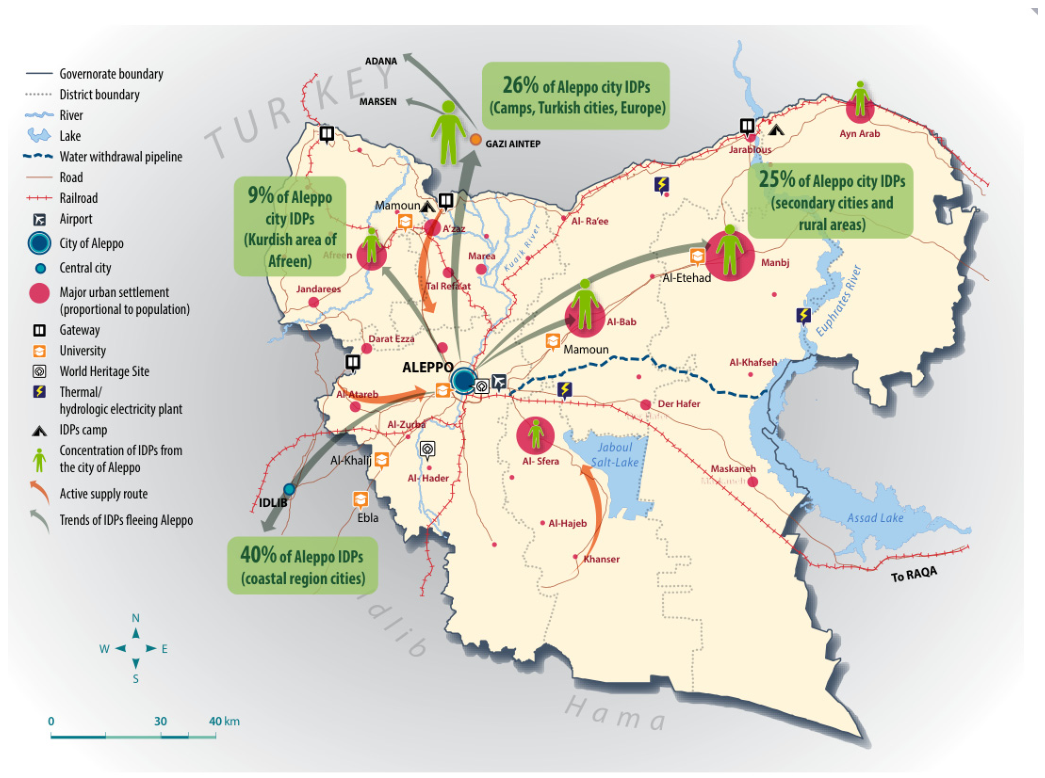
Aleppo is therefore framed not only as a historically layered city, but also as a crisis-affected urban system whose recovery must be read through the geography of damage, displacement, and service disruption. Before the crisis, Aleppo accommodated almost three million inhabitants and functioned as a major industrial, commercial, and cultural centre. A substantial share of the city’s population lived in informal areas, and the historic core remained closely connected to the wider metropolitan structure. The war profoundly altered this condition by producing large-scale displacement, deep service disruption, and extensive damage to housing, infrastructure, public facilities, and heritage sites. UN-Habitat’s City Profile estimated that more than 302,000 housing units were partially or fully damaged by the end of 2013, representing around 52% of the 2011 housing stock. This post-war context is used in the present article as an interpretive layer through which the pre-2011 municipal vision is critically re-evaluated.
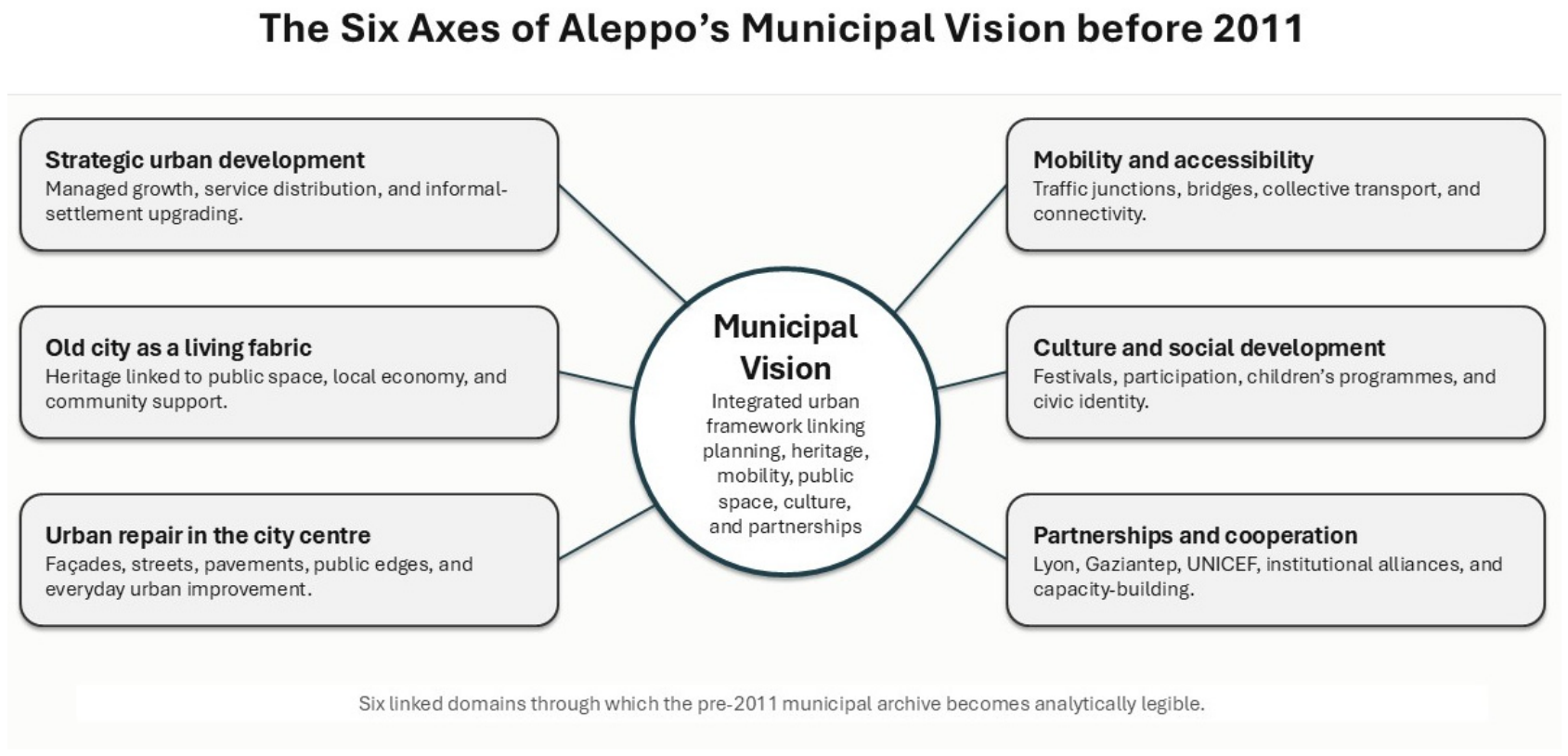
The article starts from the premise that pre-conflict municipal visions can constitute analytically recoverable resources for post-war urban recovery. In Aleppo, the available municipal documents do not simply record past activities; they also reveal how the city was being imagined, prioritised, and reorganised across multiple and interconnected fields of action. Read comparatively, these materials suggest that the municipal vision before 2011 can be reconstructed through six interrelated axes: strategic urban development, spatial planning, and managed urban growth; the old city as a living urban fabric; urban repair in the city centre; mobility and accessibility; culture and social development; and development partnerships and international cooperation. Taken together, these axes indicate that the municipality was beginning to frame Aleppo as a complex urban system requiring coordinated intervention across spatial, social, and institutional domains.
This repositioning matters at three levels. Nationally, it restores a locally generated urban memory that is often absent from Syrian reconstruction debates, which tend to privilege damage assessment, legal mechanisms, financial requirements, and externally driven recovery models. Internationally, it contributes to post-war urban scholarship by shifting attention from reconstruction after rupture to the recovery of interrupted local urban logics. Scientifically, it addresses a gap between heritage studies, urban governance research, and post-war reconstruction scholarship, fields that often remain insufficiently connected in the case of Aleppo. While existing research has generated important insights into destruction, conservation, legal frameworks, participation, and institutional challenges [17,18,19,20]. However, the pre-2011 municipal vision itself has rarely been examined as an object of inquiry and as a potential recovery framework in its own right.
The novelty of this article, therefore, lies not simply in revisiting municipal archives but in developing an analytical framework for reading pre-conflict municipal visions as latent recovery resources. Rather than treating the archive as a passive repository of past projects, the article treats it as evidence of an interrupted municipal urbanism: a partially integrated urban logic through which the city was being reimagined across strategy, sectoral intervention, and flagship spatial projects. In this sense, the study shifts the analytical focus from the archive as a record to the municipal vision as an urban framework. It also moves beyond reading highly visible projects in isolation by showing how they can be understood as spatial condensations of a wider municipal logic.
On this basis, the article addresses three questions: What were the principal components of Aleppo’s municipal vision before 2011? How was this vision translated into strategic priorities, sectoral interventions, and major urban projects? And in what ways can this interrupted vision be re-read today as a framework for post-war urban recovery? By addressing these questions, the article seeks to contribute not only to the historiography of Aleppo but also to a wider debate on how cities emerging from conflict can recover through critical continuity rather than by starting from scratch.
The article contributes to the literature in three ways. First, it conceptualises pre-conflict municipal visions as analytically recoverable resources for post-war recovery in historically layered cities. Second, it demonstrates, through the case of Aleppo, that municipal archives can reveal not merely isolated projects but a broader, partially integrated urban logic connecting planning, heritage, public space, accessibility, socio-cultural activation, and municipal capacity. Third, it proposes a shift in recovery thinking from reconstruction after rupture to recovery through critical continuity, showing that one of the most valuable foundations for rebuilding may lie in the locally produced urban intelligence that was interrupted by conflict.
The remainder of the article is organised as follows. The next section presents the materials and methods, including the documentary corpus, research design, and analytical procedure. Section 5 then reconstructs Aleppo’s municipal vision through the six axes identified in the source material and examines the flagship projects in their spatial materialisation. The Discussion interprets this vision as a form of interrupted municipal urbanism, examines why it remained incomplete, and considers its implications for post-war recovery. The article concludes by reflecting on the broader relevance of re-reading pre-conflict municipal visions as grounded recovery frameworks in historically layered cities.

2. Literature Review

2.1. Post-War Urban Recovery Beyond Physical Reconstruction

Scholarship on post-war cities has increasingly moved beyond narrow understandings of reconstruction as the technical repair of damaged buildings and infrastructure [21,22,23,24,25]. Earlier approaches often privileged physical rebuilding, legal regulation, financing mechanisms, and emergency stabilization, thereby treating the city primarily as a damaged material object requiring restoration [26,27,28,29]. More recent studies, however, emphasize that urban recovery is a broader process involving governance, institutional coordination, mobility, social reactivation, heritage, and the restoration of public life. In this perspective, recovery is not limited to rebuilding the urban fabric but also concerns the reconstitution of the relations, functions, and development trajectories through which the city operates as a coherent urban system.
This broader interpretation is especially important in historically layered cities, where the consequences of conflict cannot be reduced to physical destruction alone [30,31,32]. Urban continuity in such contexts depends not only on restoring structures but also on reactivating links among symbolic centers, lived heritage, public space, accessibility, and everyday social practices [3,13,33]. At the same time, much of the post-war literature still takes rupture itself as its main analytical starting point, focusing on damage, displacement, reconstruction policy, legal constraints, and post-conflict participation [34,35]. As a result, an important question remains insufficiently explored: whether cities had already developed local urban visions before the conflict that may still hold value for recovery afterward. This issue is especially relevant to Aleppo, where the historical core, the city center, and the wider municipal territory were deeply interconnected before the rupture of war.
The international literature also shows that post-war recovery follows different trajectories depending on the relationship between memory, governance, land policy, and reconstruction authority [36]. Warsaw is often discussed as a case where reconstruction mobilized historical memory and selective reconstruction to rebuild national and urban identity after large-scale destruction [37,38]. Beirut, by contrast, is frequently cited as a case where post-war reconstruction generated debates about privatization, social exclusion, and the partial erasure of everyday urban continuities [39,40]. These comparisons help situate Aleppo within a broader field of post-war urban recovery while clarifying the specificity of the present argument: the article does not propose nostalgic reconstruction or market-led redevelopment, but a critical re-reading of locally generated municipal intelligence.

2.2. Heritage-Led Recovery in Historically Layered Cities

A second major strand of scholarship concerns heritage-led recovery and the management of historic cities after conflict. This literature has made an important contribution by challenging monument-centered approaches and arguing that heritage areas should be understood not as static relics, but as socially inhabited, economically active, and spatially interconnected urban environments [41,42]. Approaches influenced by UNESCO’s Historic Urban Landscape framework, as well as studies on post-war Aleppo, increasingly stress that historic districts must be treated as living urban systems rather than isolated collections of monuments [43,44]. Consequently, greater attention has been paid to residential continuity, local livelihoods, material reuse, regulatory frameworks, community participation, and the integration of heritage into broader urban recovery strategies [6].
In the case of Aleppo, existing studies have addressed key issues such as residential heritage transformation, reconstruction policy, legal and regulatory challenges, participation, and the tension between preservation and modernization [2,5,43,45,46,47,48,49,50]. This work has been valuable in demonstrating the complexity of recovery in the old city and in critiquing top-down or overly technical approaches. Yet it remains focused primarily on the post-war moment itself: how heritage should be rebuilt, governed, protected, or socially reactivated after destruction. Less attention has been given to the possibility that Aleppo’s pre-war municipal vision may already have included principles relevant to heritage-led recovery. The municipal archive suggests that heritage was not treated merely as an object of conservation, but as part of a wider urban logic linking public space, movement, environmental upgrading, symbolic centrality, and civic activation. This broader dimension remains insufficiently theorized in the literature.

2.3. Municipal Governance and Urban Recovery

A third relevant strand of scholarship concerns municipal governance, local institutional capacity, and the role of local government in urban transformation. In both recovery studies and wider urban governance research, municipalities are increasingly understood as more than administrative service providers [51,52,53]. They are key actors in coordinating spatial interventions, managing infrastructure, organizing public space, prioritizing investment, and mediating between technical planning, political authority, and citizen needs. Many of the issues most central to urban recovery—land use, accessibility, environmental quality, mobility, public services, and neighborhood-level intervention—depend fundamentally on municipal capacity.
This governance perspective is crucial because recovery does not fail only through a lack of funding or technical expertise; it also fails when institutions are fragmented, coordination is weak, responsibilities are unclear, and interventions remain disconnected from a broader strategic vision [54,55]. Recent scholarship, therefore, treats governance not as a neutral background condition, but as a decisive arena through which urban recovery becomes possible, effective, or partial. Yet the role of the municipality before conflict—especially as a producer of urban vision rather than simply a manager of services—has received far less sustained attention. This is a major omission in the case of Aleppo. The municipal archive indicates that the city council had already expanded its scope beyond routine service provision to include strategic planning, environmental improvement, public-space enhancement, mobility restructuring, culture, social programming, and development partnerships. Aleppo thus appears not only as a site of post-war governance challenges but also as a place where a broader municipal urbanism had already been emerging before the war.

2.4. The Missing Link: Pre-Conflict Municipal Visions as Recovery Resources

Taken together, the three strands reviewed above—post-war urban recovery, heritage-led recovery, and municipal governance—provide a strong basis for understanding why Aleppo constitutes an important case. They also reveal a significant analytical gap [56]. Post-war recovery studies examine the challenges of rebuilding after rupture; heritage scholarship explains why historic cities must be approached as living urban environments rather than isolated monuments; and governance research underscores the importance of local institutional capacity, coordination, and implementation. What remains less fully explored is how these concerns intersect when a city’s own pre-conflict municipal vision is treated as a potential source of recovery knowledge.
This is the specific gap addressed by the present article. Existing research on Aleppo has produced valuable work on war damage, post-war heritage recovery, legal constraints, participation, and institutional challenges, yet the pre-2011 municipal vision itself has rarely been examined as an object of inquiry in its own right. Likewise, the most relevant fields often remain only partially connected: heritage is discussed separately from municipal governance, public space separately from social activation, and post-war reconstruction separately from pre-war planning intelligence. If pre-conflict municipal visions are ignored, recovery risks are framed either as technical rebuilding after rupture or as an externally prescribed agenda applied to a damaged city. By contrast, a critical re-examination of such visions may reveal locally grounded urban logics that still matter after conflict. For this reason, the present article treats the archive not as a passive repository of past interventions, but as evidence of an interrupted municipal urbanism whose relevance lies in its recovery potential; the next section, therefore, develops the conceptual framework needed to make this shift explicit.

3. Conceptual Framework

3.1. From Archive to Municipal Vision

The article begins with a distinction between the archive and the municipal vision. An archive, in the narrow sense, preserves traces of projects, policies, and administrative decisions. A municipal vision, by contrast, refers to the broader urban logic through which such traces can be interpreted as related components of an emerging framework. In Aleppo, the pre-2011 municipal documents do more than list interventions. Read comparatively, they reveal recurring priorities, repeated spatial logics, and cross-sectoral links that together point to a broader municipal way of imagining and reorganising the city.

3.2. Interrupted Municipal Urbanism

This broader logic is conceptualised here as interrupted municipal urbanism. The term refers to a partially formed yet analytically legible urban trajectory through which the municipality was beginning to connect strategic planning, heritage, mobility, public space, socio-cultural activation, and institutional modernisation before that trajectory was disrupted by war. The concept does not imply that Aleppo had reached a fully consolidated model of integrated urban governance. Rather, it captures an intermediate condition: more than fragmentation, but less than a stable and fully institutionalised urban order.
The concept is useful because it avoids two opposite errors. It avoids reducing the pre-2011 archive to scattered municipal initiatives with no deeper coherence. At the same time, it avoids overstating the pre-war moment as if Aleppo had already achieved a finished and exemplary planning model. What the archive reveals is a broader trajectory in formation, but one that remained incomplete, unevenly realized, and institutionally vulnerable.

3.3. Critical Continuity

If interrupted municipal urbanism describes the nature of the pre-war trajectory, critical continuity defines how that trajectory should be approached in relation to post-war recovery. Continuity here does not mean restoring the past unchanged, nor does it imply smooth transmission across rupture. It refers instead to the selective reactivation of meaningful urban relations, principles, and forms of municipal intelligence that remain relevant under post-war conditions.
The adjective critical is essential. The argument is not that Aleppo should revive the pre-2011 municipal agenda as a ready-made blueprint. The archive records both strengths and limitations. Yet it preserves forms of local urban reasoning that are too valuable to ignore. Critical continuity, therefore, offers an alternative both to nostalgic restoration and to reconstruction from zero.
To make the concept operational, critical continuity is treated here as a filtering procedure rather than as a general slogan. Pre-2011 municipal projects, principles, and spatial logics are re-read through the present condition of the city. This filter asks whether each archived element remains spatially present, socially needed, structurally recoverable, institutionally feasible, and compatible with contemporary recovery priorities. The result is not a simple acceptance or rejection of the archive, but a distinction between elements that can be recovered, elements that must be adapted, and elements that should be suspended or considered obsolete under current conditions. See Table 1.

3.4. Analytical Dimensions

To operationalise this framework, the study interprets the archive through six analytical dimensions: strategic urban development and managed growth; the old city as a living urban fabric; urban repair in the city centre; mobility and accessibility; culture and social development; and development partnerships and international cooperation. These dimensions bridge the gap between concept and documentary evidence. They are not arbitrary themes, but the recurring domains through which the broader municipal urbanism of pre-2011 Aleppo becomes legible.

4. Materials and Methods

4.1. Research Design

This study adopts a qualitative interpretive research design based on pre-2011 municipal documents produced by and for the Aleppo City Council. Its purpose is not to reconstruct an exhaustive administrative history of the municipality, nor to verify the implementation status of every project in a narrowly technical sense. Rather, it seeks to identify the broader urban vision embedded in the municipal material and to assess its relevance for post-war recovery. The documentary corpus is therefore treated not as a simple inventory of past interventions, but as evidence through which a municipal way of thinking about the city can be reconstructed analytically. More specifically, the study reads the archive as the trace of an interrupted municipal urbanism that linked strategic planning, sectoral action, and spatial projects before the rupture of war.

4.2. Source Material

The corpus includes three main categories of source material. The first consists of strategic and programmatic municipal documents, especially the City Council work programme, which sets out declared objectives, strategic axes, administrative restructuring efforts, decentralisation measures, environmental priorities, service-related concerns, and developmental ambitions. The second consists of planning-oriented presentations that position urban projects within broader frameworks such as the City Development Strategy, Madinatuna initiative, urban services, green networks, and the restructuring of central and historic urban areas. The third consists of detailed project material for specific interventions, most notably Bab Antakiya/the Western City Wall, where implementation phases, traffic reorganisation, land-use adjustments, public-space proposals, and heritage-related measures are articulated in greater operational and spatial detail. Taken together, these materials enable movement across scales, from strategic discourse to sectoral translation to project-level spatialisation.

4.3. Case Framing and Analytical Procedure

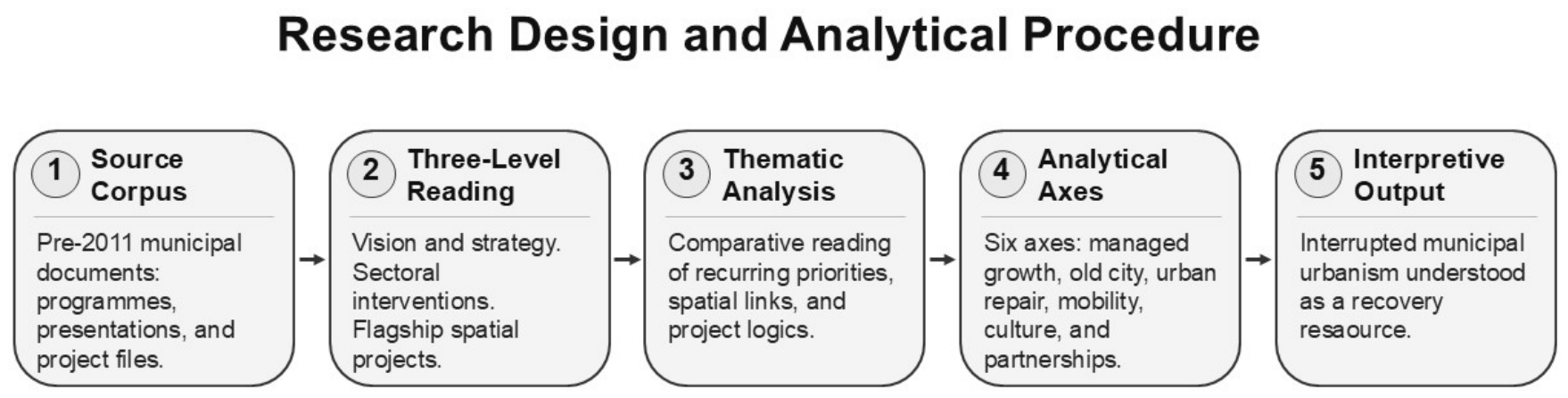
The analysis proceeded through a three-level reading. First, the documents were examined at the level of vision and strategy in order to identify how the municipality framed its role in relation to urban management, planning, decentralisation, environmental improvement, quality of life, and development. Second, they were read at the level of sectoral intervention in order to trace how this vision became visible across domains such as the old city, the city centre, transport, public space, cultural programming, social initiatives, and partnerships. Third, they were examined at the level of flagship projects, where the vision became materially legible in spatial interventions such as Bab Antakiya, the Green Path, the river corridor, and the Citadel surroundings. This three-level procedure was adopted to avoid reducing the municipal vision to either abstract planning rhetoric or a set of visually prominent projects alone.
Analytically, the study relied on comparative thematic reading. Recurring concepts, repeated project references, cross-sectoral linkages, converging spatial priorities, and repeated forms of municipal self-definition were identified across the corpus. The purpose was to make visible not only what projects existed, but also the urban logic that connected them. On that basis, the material was reorganised into six analytical axes that structure Section 5: (1) strategic urban development, spatial planning, and managed urban growth; (2) the old city as a living urban fabric; (3) urban repair in the city centre; (4) mobility and accessibility; (5) culture and social development; and (6) development partnerships and international cooperation. These axes were not imposed deductively in advance; they were derived from the repeated ways in which the municipality itself framed its priorities, projects, and urban interventions across documents and scales.
Aleppo was selected as a critical case for three reasons. First, it combines an exceptionally layered historic core with a large metropolitan territory, informal urban growth, industrial districts, and major public-space and mobility projects. Second, it preserves an unusually rich municipal archive from the pre-2011 period, allowing the reconstruction of an urban vision across documents, projects, and institutional practices. Third, it experienced severe post-war damage, displacement, and functional fragmentation, making it a relevant case for testing how pre-conflict municipal intelligence can be re-read for recovery rather than treated as a closed historical record. Chronologically, the analysis is organized around three moments: the formation of the municipal vision before 2011; the rupture produced by war, displacement, and large-scale urban damage; and the post-war recovery context in which the pre-2011 municipal vision is reassessed through the concept of critical continuity. This chronology is used as a textual analytical frame rather than as a separate graphical timeline; see Figure 1.
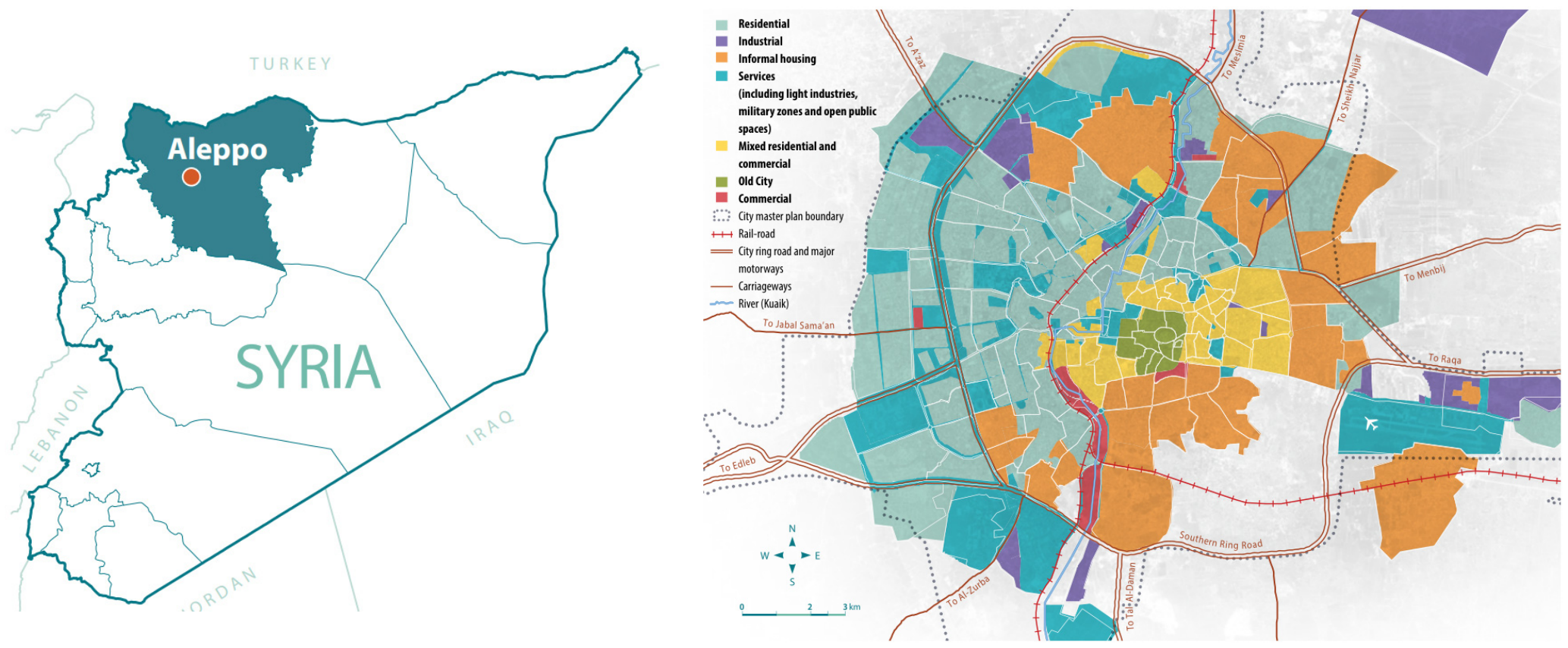
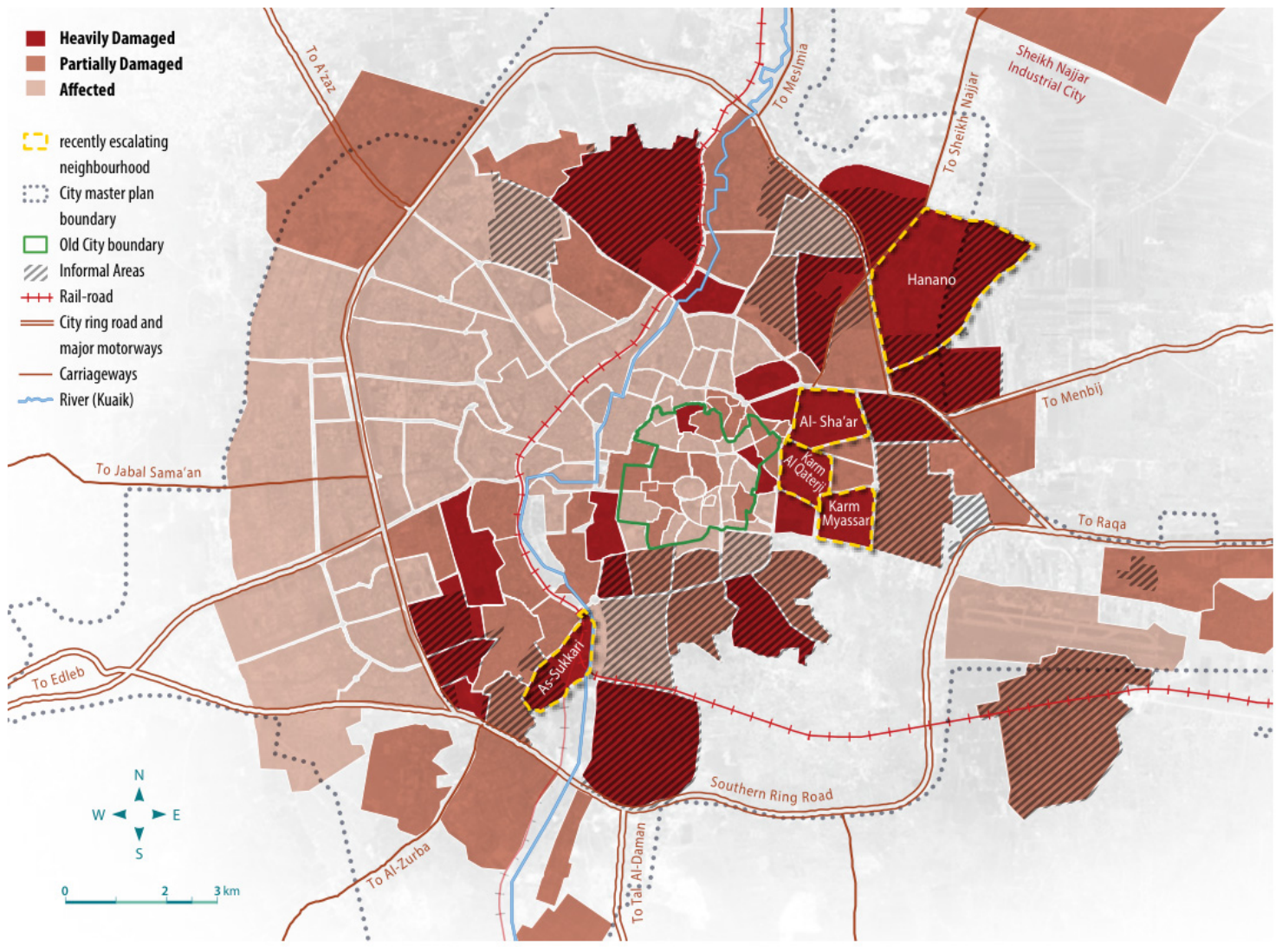
The manuscript also uses post-war maps and damage information as contextual evidence. These sources do not replace the municipal archive as the main corpus of the study; rather, they allow the pre-2011 vision to be interpreted against the present urban condition. In this sense, damage mapping and functionality mapping serve as a contemporary filter for the article’s core concept of critical continuity. To situate the analysis within Aleppo’s broader post-war urban condition, the manuscript includes two contextual elements. Figure 2 locates Aleppo within its governorate and regional setting, highlighting the city’s strategic position and wider territorial relationships. Table 2 complements this spatial framing by summarizing recent sectoral damage data for Aleppo Governorate, including damage to housing, schools, hospitals, health centres, mosques, and bakeries. Together, these materials clarify the scale and multi-sectoral nature of destruction and provide the necessary background for reading the pre-2011 municipal vision through the lens of post-war recovery.
These statistics show that the war produced a multi-sectoral pattern of damage across Aleppo Governorate, affecting not only housing but also essential public services, religious buildings, health facilities, schools, hospitals, and bakeries. Housing represents the largest absolute burden, with 179,133 damaged units, including 24,262 completely destroyed units, which indicates the scale of displacement, shelter insecurity, and the need for long-term residential reconstruction. The education sector was also heavily affected, with 1477 damaged schools, representing more than half of the estimated school stock, while 98 health centers and 9 hospitals were damaged, directly reducing the capacity of the city to provide basic healthcare. Damage to 91 bakeries is particularly significant because bakeries are part of the everyday food-supply infrastructure, while the damage to 1118 mosques reflects the impact of the conflict on both religious life and the social fabric of neighbourhoods. Taken together, these figures confirm that recovery in Aleppo cannot be limited to the physical reconstruction of buildings or monuments; it requires an integrated urban recovery strategy linking housing, infrastructure, public services, education, health, food supply, heritage, and local governance.

4.4. Reflexivity, Positionality, and Authorship Bias

Because the second author served as Mayor of Aleppo during the examined period (2003–2011), the study required explicit methodological reflexivity. This position provided privileged access to municipal archives, planning processes, and project documentation, but it also required measures to reduce authorship bias and maintain analytical distance. At the same time, the article acknowledges that several urban challenges exceeded the capacity of Aleppo Municipality during the pre-war period. These included long-standing issues of spatial injustice, informal housing, and rural-to-urban migration, which were not only municipal problems but also symptoms of broader weaknesses in state-level urban policy, territorial governance, and national planning frameworks.
First, the analysis relies primarily on documented material rather than personal recollection. It distinguishes between administrative participation and analytical interpretation by examining how a broader municipal urban vision becomes legible across documents, projects, and repeated institutional priorities. Second, the study adopts an objective thematic reading rather than a project-success narrative. This strategy privileges cross-document relationships and structural patterns over subjective administrative memory. Third, the co-authors critically reviewed the interpretation, questioned assumptions, reformulated claims, and reframed the archive through the concept of interrupted municipal urbanism. This concept was used precisely to avoid presenting the pre-2011 period as a complete or exemplary governance model.
The manuscript therefore acknowledges that the municipal path remained institutionally vulnerable because it depended on political will, leadership continuity, and Syria’s highly centralized administrative system. It also recognizes that the municipality operated within structural constraints that limited its ability to address deep-rooted problems such as uneven development, informal settlement expansion, and socio-spatial inequality. The methodological challenge is not to eliminate proximity to the archive, which is impossible in this case, but to transform insider access into critically examined and analytically transparent knowledge.

4.5. Scope and Limitations

This study is exploratory and interpretive in scope. It does not seek statistical generalisation, nor does it treat municipal presentations as transparent evidence of full implementation. Some projects are described in considerable detail, while others remain at the conceptual, strategic packaging, or projected intervention level. Repetition across documents may indicate both actual importance and the municipality’s desire to foreground specific initiatives as emblematic. For this reason, the article reads the corpus primarily as evidence of how the municipality understood the city, how it prioritised interventions, and how it attempted to connect sectors, spaces, and institutional tools within a broader urban framework. This is precisely what makes the archive valuable for the present study: it reveals a partially formed municipal urbanism whose interruption remains analytically significant for recovery thinking today; see Figure 3.

5. Results

5.1. Strategic and Institutional Orientation of the Municipal Vision

The municipal documents indicate that, before 2011, Aleppo’s city council was redefining its role beyond a narrowly technical or service-based mandate. The work programme explicitly shows that, from 2003 onward, the council’s objectives expanded to include the social, cultural, economic, touristic, and environmental dimensions of city-making, while the stated general objective emphasised improving urban management through efficient prioritisation, transparent procedures, and phased implementation. This shift suggests that the municipality was beginning to frame itself not only as a provider of basic services, but as a coordinating urban actor concerned with the broader direction of urban development.
This broader orientation is also visible in the strategic language of the City Development Strategy and Madinatuna initiative [59,60]. The municipal material linked urban development to structured domains such as the urban environment, urban development, service provision, local economic development, and administrative and financial modernisation. The same material also referred to coordination tools such as working groups, an urban observatory, communication platforms, and partnership networks. What emerges from this corpus is not yet a fully consolidated planning model, but a discernible strategic horizon in which governance, planning, and urban quality were increasingly connected; see Figure 4.
Across the documents, this municipal vision becomes analytically legible through six axes of intervention. These axes do not appear as a fixed list in one single document; rather, they emerge from repeated priorities, project types, and forms of municipal self-definition across the corpus. They are: strategic urban development, spatial planning, and managed urban growth; the old city as a living urban fabric; urban repair in the city centre; mobility and accessibility; culture and social development; and development partnerships and international cooperation. Together, these six axes reveal the sectoral breadth and internal coherence of the municipal vision before 2011.

5.2. The Six Axes of Aleppo’s Municipal Vision

5.2.1. Strategic Urban Development, Spatial Planning, and Managed Urban Growth

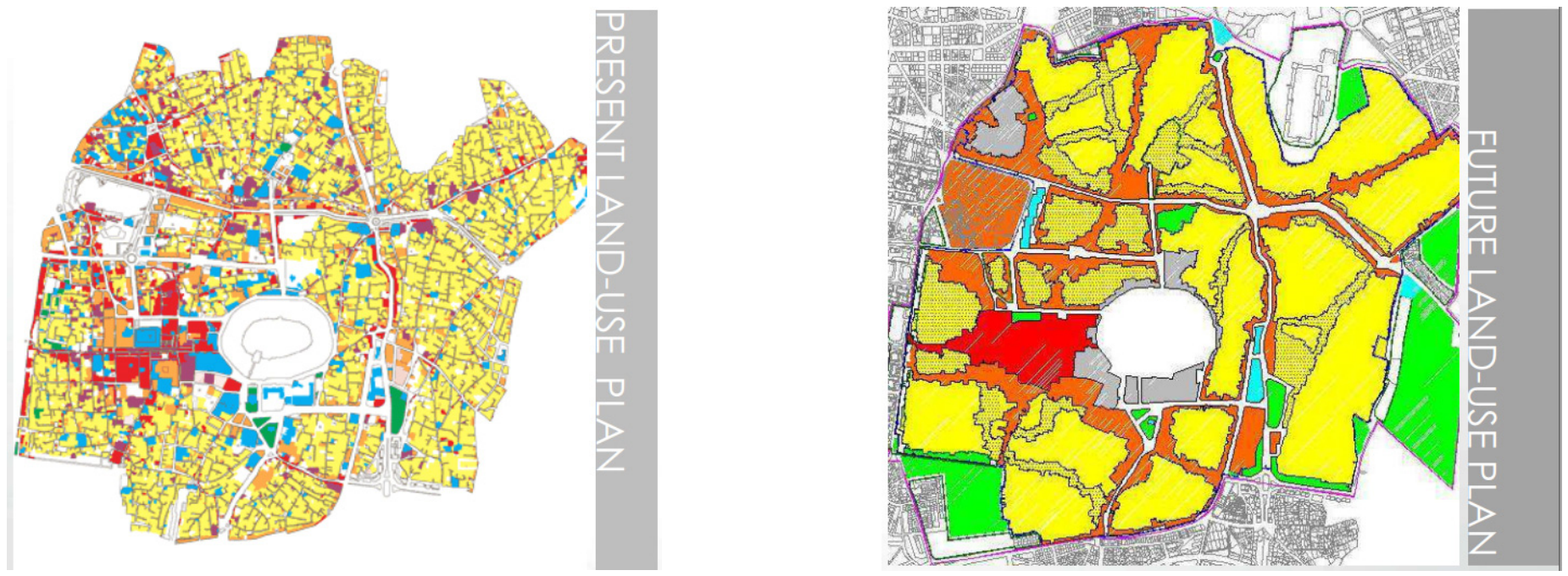
At the broadest scale, Aleppo’s municipal vision increasingly took the form of a citywide development agenda rather than a set of short-term sectoral responses. The strategic material associated with the CDS and Madinatuna initiative described Aleppo as a metropolis of about 2.5 million inhabitants, with an existing master-plan area of roughly 18,000 hectares, a future planning horizon of about 37,000 hectares, an annual population growth rate of 2.56%, and an informal-settlement population estimated at around 900,000. In this context, urban development could no longer be managed solely through piecemeal interventions. It required a more strategic approach able to anticipate expansion, structure future growth, redistribute services, and connect spatial planning to governance and quality-of-life objectives. The CDS material makes this shift explicit by linking urban development to the creation of sub-centres, the formation of micro-centres in informal areas, the control of urban expansion, the integration of road networks, and the diversification of neighbourhoods.
This strategic orientation was translated into concrete planning outputs. Before the municipality-university collaboration, the formal planning regime had produced only eight urban plans for city extension after the 1974 master plan, despite continuing urban growth. By contrast, the later collaborative framework redefined the master plan as a citywide strategic framework supported by growth scenarios, informal settlement modeling, infrastructure capacity forecasting, and phased development strategies. Most significantly, it generated 30 detailed urban plans, including 14 for informal settlement zones and 16 for new urban extension areas. The former focused on regularisation, infrastructure upgrading, street reorganisation, service redistribution, and public-facility location, while the latter addressed controlled urban growth, land subdivision, public-space networks, hierarchical road systems, and the allocation of schools and health centres according to spatial standards. The detailed extension studies also tested differentiated residential models and densities—around 300 p/h, 310 p/h, 320 p/h, and 98 p/h—showing that expansion was conceived not simply as peripheral land release, but as a question of neighbourhood structure, density calibration, service accessibility, and managed urban growth; see Figure 5.

5.2.2. The Old City as a Living Urban Fabric

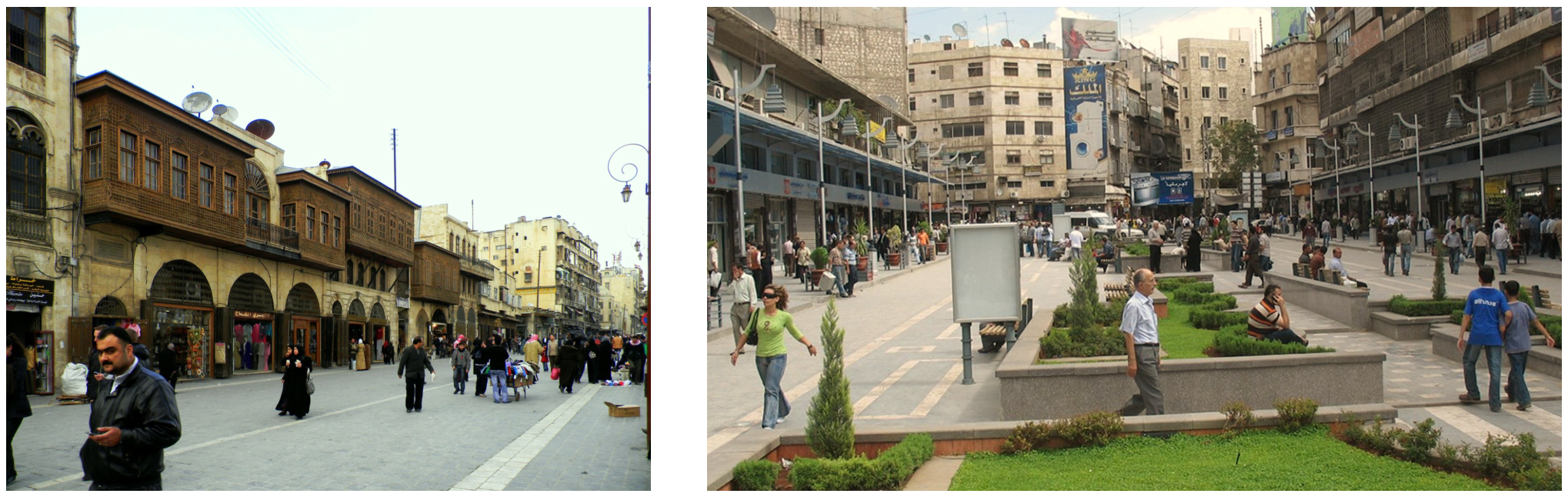
One of the clearest expressions of this urban vision lies in the municipality’s treatment of the old city. The historic core was not approached simply as a monumental or archaeological zone to be preserved in isolation. Instead, the planning material framed it as a living urban fabric whose continuity depended on functional mix, public-space quality, movement management, and support for local economic and social life. The old-city presentations explicitly linked conservation and development through the master plan, development plan, action areas, and action projects, all intended to stop deterioration, empower local communities, improve public space, and generate visible local change; see Figure 6.
This approach is reinforced by the range of interventions directed at the historic core. The restoration of Al-Hatab Square and Al-Almaji Square, the rehabilitation of old-city main streets, the Green Path project, and the rehabilitation of the traditional crafts building all demonstrate that the municipality’s concern with the old city extended beyond monument protection. It also encompassed public-space reactivation, support for local economic life, and targeted social programming, including initiatives for women and children in old-city neighbourhoods. In the documents, the old city thus appears not as a detached heritage enclave, but as an inhabited urban territory in which conservation, development, local economy, and collective life were closely connected.

5.2.3. Urban Repair in the City Centre

A second major field of intervention concerned the improvement of the city centre through incremental forms of urban repair. The municipal archive documents projects focused on façades, central streets, pavements, lighting, streetscapes, and public-space edges in areas such as Bab al-Faraj, Al-Khandaq, Al-Tellal, Al-Abbara, Al-Qutli, and the surroundings of the Umayyad Mosque. These interventions may appear more modest than the better-known flagship projects, yet the documents indicate that they formed an important part of the municipal vision. They show that the municipality was not concentrating only on emblematic sites, but also on the quality and continuity of the ordinary urban fabric; see Figure 7.
Read comparatively, these interventions reveal a distributed and cumulative mode of urban action. The city centre was being improved not only through major projects, but also through the upgrading of its everyday environment: façades, pavements, thresholds, streets, and public edges. This pattern indicates that the municipality attached importance to the legibility, coherence, and usability of central urban space. In the source material, city-centre improvement therefore appears as a sustained axis of urban intervention rather than as a secondary embellishment.

5.2.4. Mobility, Traffic Junctions, and Urban Accessibility

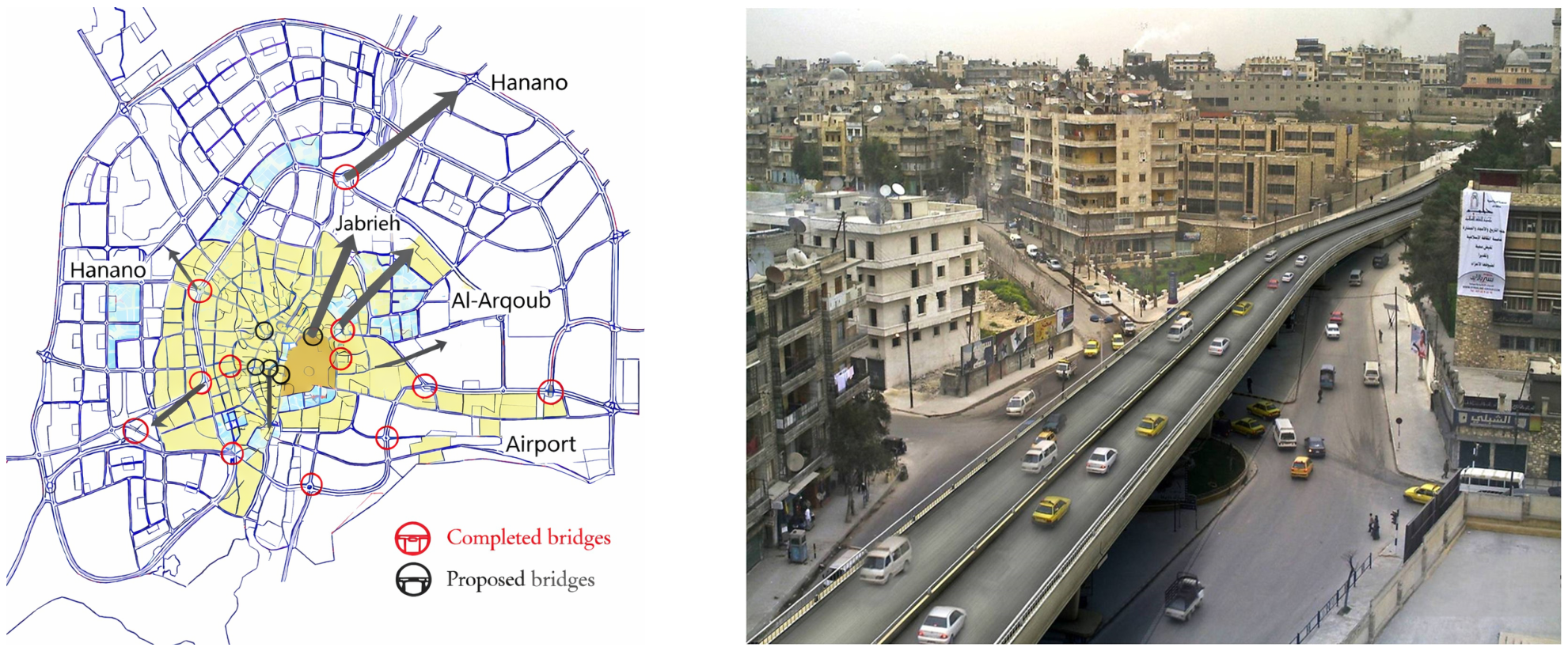
Mobility formed another key axis of the municipal vision. The city council work programme and project materials show that bridges, traffic junctions, and collective transport were not treated merely as technical engineering issues, but as structuring elements of urban organisation. Projects such as the Maisaloon junction, Jisr al-Hajj, and al-Ramousa were presented within broader traffic studies aimed at resolving bottlenecks, reorganising circulation, and improving the accessibility and internal coherence of the city. In this sense, the documents show that movement and accessibility were increasingly being understood as dimensions of urban quality and functionality; see Figure 8.
The same shift is visible in the municipal material related to public transport and cooperation with Lyon. The archive includes preliminary studies for tramway planning and the preparation of an urban transport plan for Aleppo. Whether or not these projects were fully realised, the documents clearly indicate a shift from isolated traffic solutions toward a more strategic mobility horizon. Aleppo was being increasingly imagined through organised accessibility, coordinated transport infrastructure, and stronger connectivity between major urban zones.

5.2.5. Culture and Social Development as Urban Components

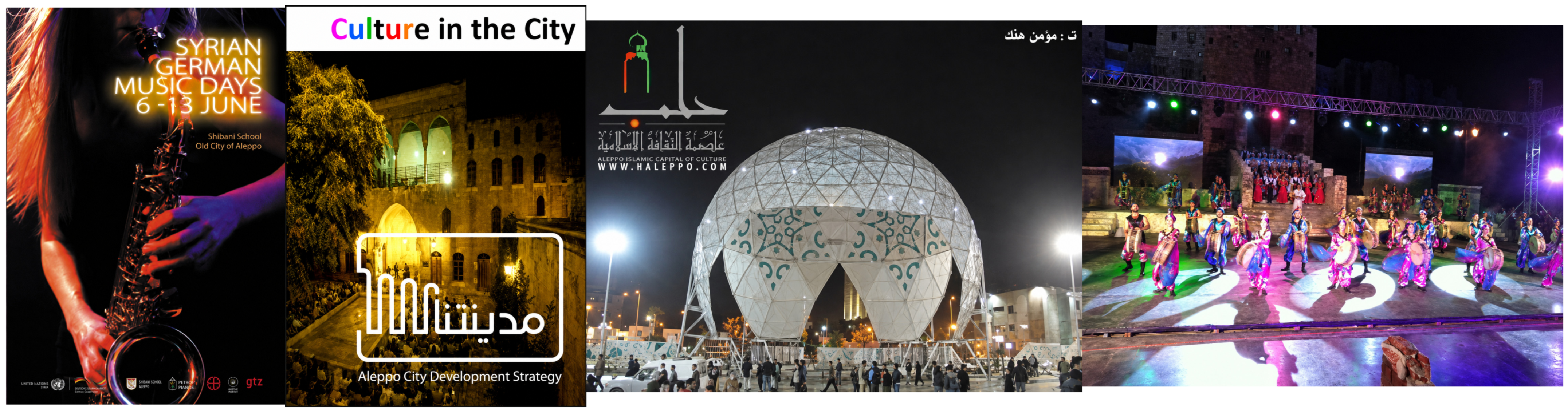
Another distinctive feature of the municipal vision is that it did not separate urban development from social and cultural activation. The municipal programme linked the role of the city council to cultural activities, participation, and public awareness, while the broader archive documents a dense calendar of events, exhibitions, children’s programmes, performances, festivals, and public celebrations across both the old city and the wider city. Titles such as Aleppo: City of Arts and Bridge of Cultures indicate that culture was being mobilised as a component of civic presence and urban identity rather than as a decorative supplement to urban policy; see Figure 9.
The same applies to social-development initiatives. The source material includes programmes for women and children, anti-poverty initiatives, child-friendly city programmes, neighbourhood-level activities, and partnerships with civic actors involved in local development. These interventions show that the municipal vision was not exclusively physicalist. It also recognised that urban improvement required social activation, public engagement, and support for vulnerable groups. In the archive, the social and cultural dimensions of the city are therefore treated as part of urban transformation rather than as separate welfare or cultural policy domains.

5.2.6. Development Partnerships and International Cooperation

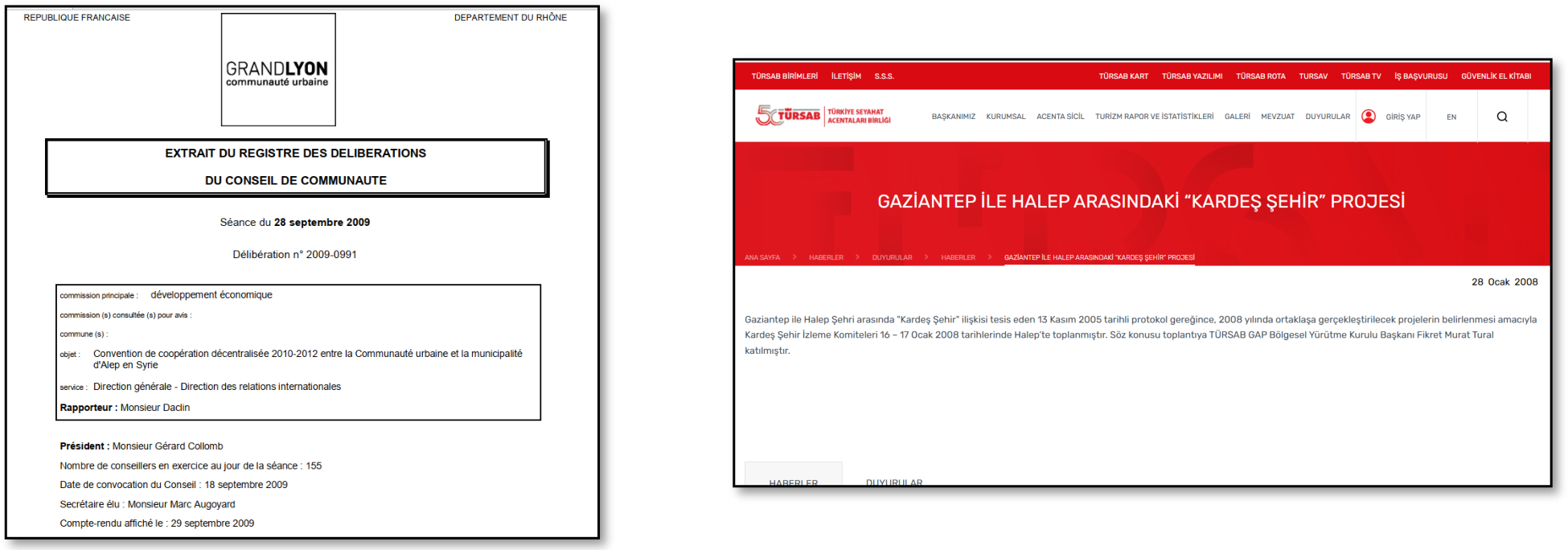
The breadth of Aleppo’s municipal vision is also evident in its reliance on development partnerships and cooperation frameworks. The source material documents collaboration with Lyon, Gaziantep, UNICEF, the Arab Urban Development Institute, Agha Khan-related programs, civil-society actors, and a range of local institutions and associations. These partnerships addressed traffic engineering, environmental management, waste management, urban strategy, technical training, cultural programming, and social development. In the documents, urban development is thus presented not as a closed administrative process, but as one supported by wider networks of exchange, learning, and cooperation; see Figure 10.
This partnership axis is significant not only because it demonstrates outward-looking municipal practice, but also because it reveals how the city council sought to expand its planning and implementation horizons through institutional alliances. The archive suggests that such cooperation contributed to strategic thinking, technical capacity, and developmental experimentation. The municipal vision before 2011, therefore, operated as a multi-scalar urban framework in which local intervention, strategic planning, and inter-institutional collaboration were increasingly intertwined.

5.3. Flagship Projects as the Spatial Materialisation of the Municipal Vision

5.3.1. Bab Antakiya/the Western City Wall

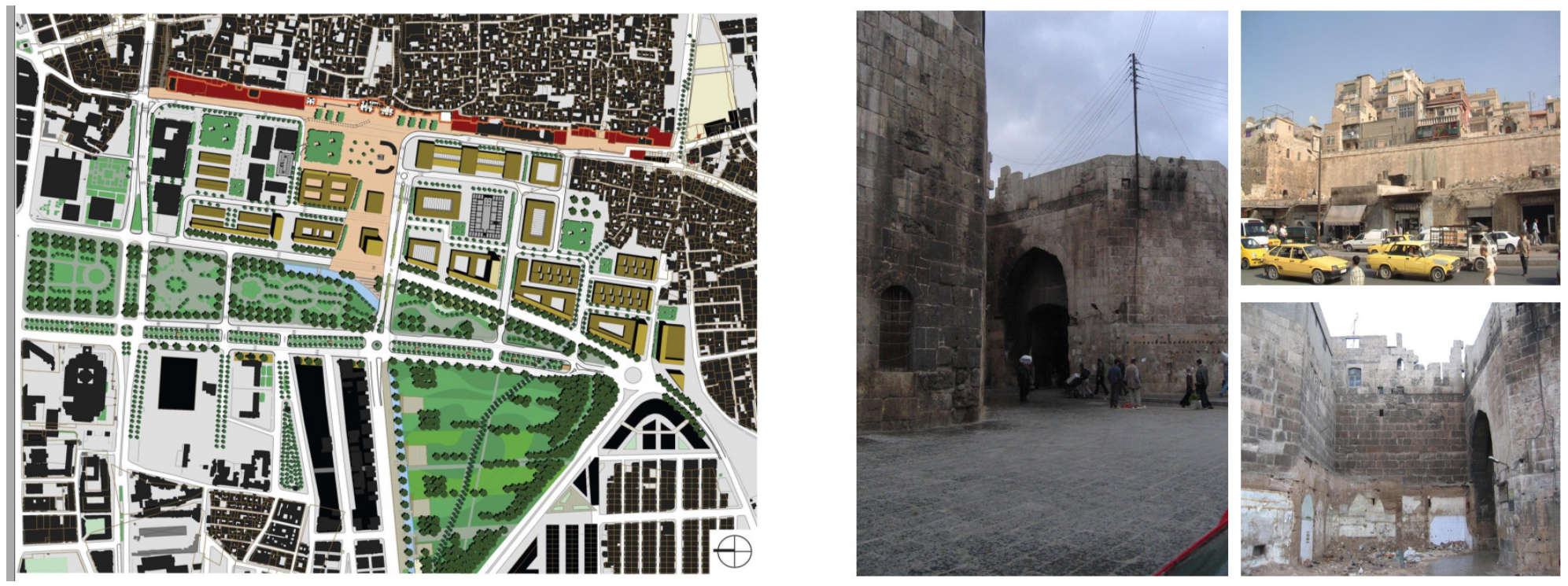
Among the documented projects, Bab Antakiya/the Western City Wall stands out as the most explicit example of a project in which heritage was treated as a structuring urban element rather than as an isolated object of conservation. The project was framed around improving the interaction between the old and new city, valorising the heritage site for development and tourism, organising traffic in harmony with the old city’s wider traffic concept, transforming older traffic connections into pedestrian routes, and preserving open space in order to establish a coherent recreational and public zone between the historic core and the modern city. From the outset, therefore, the project was conceived not as a restoration of a monument alone, but as a reorganisation of an urban threshold; see Figure 11.
This logic is reinforced in the detailed implementation material. The project combined the stabilisation and restoration of the gate, wall, and towers with the removal of illegal constructions, traffic-management measures, public-space creation, and the relocation or reorganisation of surrounding commercial and transport-related uses. The intervention therefore brought together several axes of the municipal vision at once: the old city as a living fabric, public-space repair, mobility restructuring, and partnership-supported urban reorganisation. Bab Antakiya appears in the archive as a project through which heritage, movement, public life, and spatial continuity could be reorganised together.

5.3.2. The Green Path

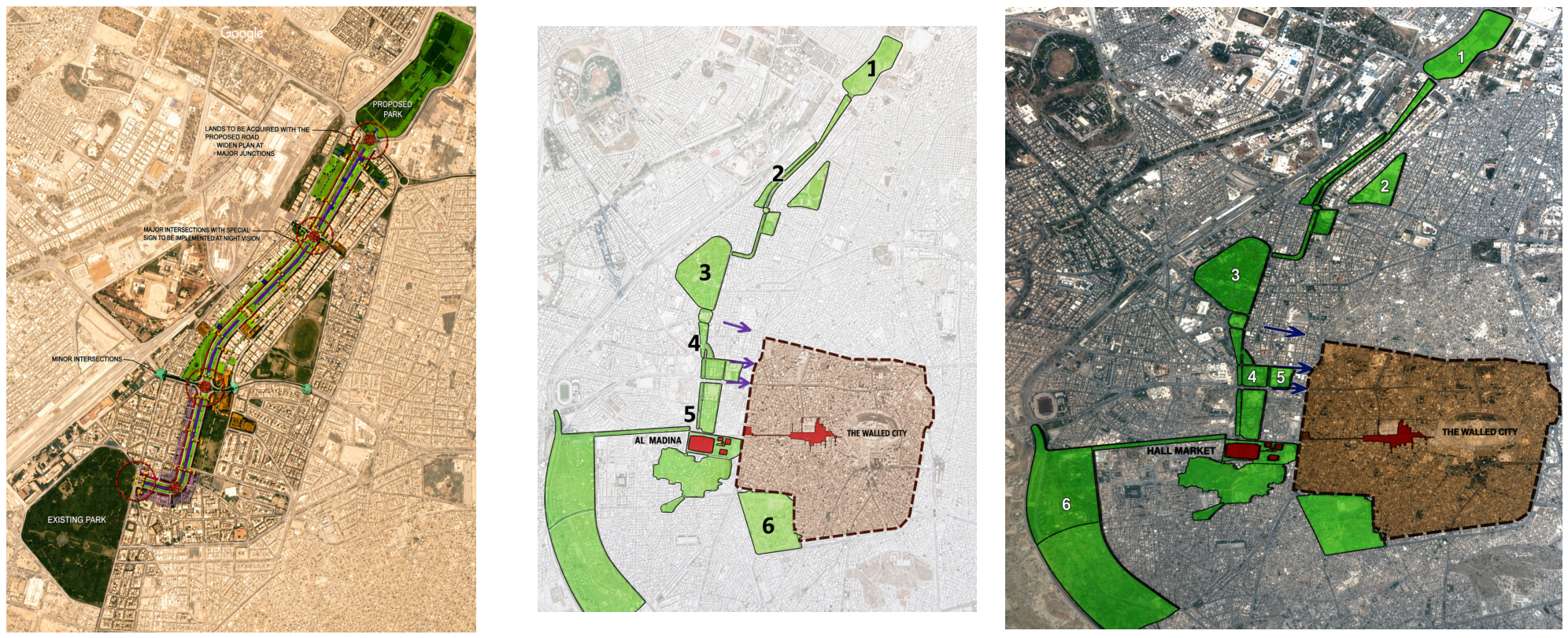
If Bab Antakiya represents the clearest threshold project, the Green Path represents the clearest networked expression of the municipal vision. The archive does not present it as a single park or beautification scheme, but as a structured urban sequence connecting major sites, including Sanobari Park, the river corridor, the public park, Sadallah Jabri Square, Bab Antakiya, and Bab Qinnasrine. In the Arabic material, the same logic appears in the form of an extended route linking the Citadel surroundings, Souq al-Zarb, the Western City Wall, Bab Qinnasrine, the central squares, the general park, and the Quweiq corridor. What the documents reveal here is a municipal concern with urban continuity and connected civic landscapes rather than stand-alone interventions; see Figure 12.
The Green Path therefore materialised several dimensions of the municipal vision simultaneously: historic-city integration, city-centre repair, ecological and public-space linkage, and civic activation. In spatial terms, it suggests that the municipality was beginning to imagine Aleppo through corridors, sequences, and connected nodes rather than through isolated project islands. Within the Results of this study, the Green Path stands out as the most explicit example of the municipal vision translated into a network-based urban logic.

5.3.3. The River Corridor: Ecology, Connectivity, and Urban Continuity

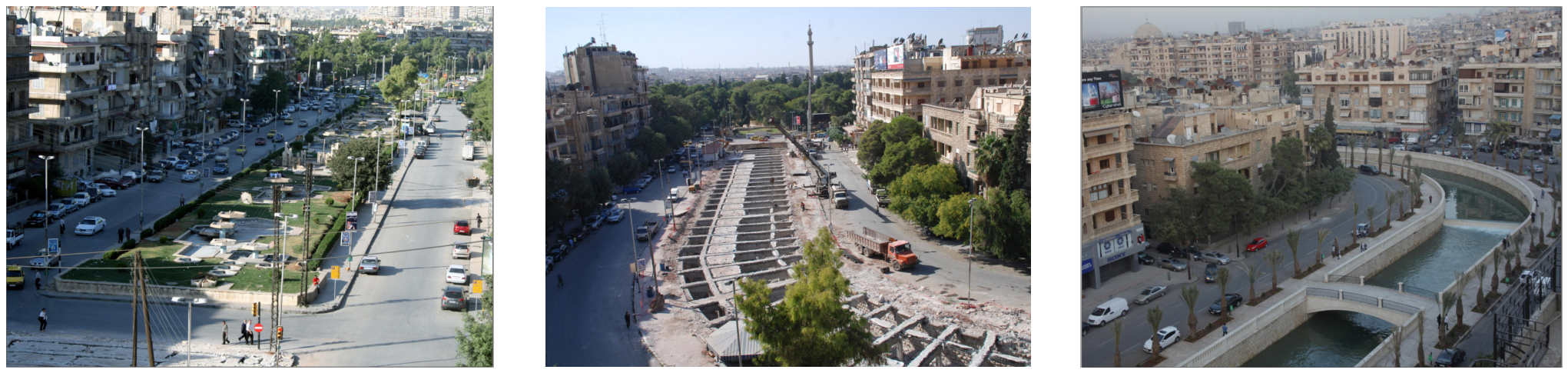
The river corridor project reveals how the municipal vision sought to reconnect environmental improvement with wider urban restructuring. In the municipal material, the project aimed to reopen and rehabilitate the river corridor, restore flow, improve its edges, and connect it to broader green and public-space networks. In the Alicante presentation, the river is similarly framed as part of the city’s green concept and as a link between parks. This suggests that the municipality was beginning to treat the river not merely as infrastructure or landscape, but as a civic and ecological armature capable of structuring urban continuity across different parts of the city; see Figure 13.
Read this way, the river corridor project is important because it translates several dimensions of the municipal vision into a single spatial intervention. It links ecological enhancement to public-space networks, mobility corridors, and urban legibility. Rather than functioning as a stand-alone landscape improvement scheme, the river was being reimagined as a connective urban element through which environmental repair and spatial integration could reinforce one another.

5.3.4. The Citadel Surroundings: Symbolic Centrality and the Reactivation of Public Life

The Citadel surroundings project makes a parallel but distinct move in relation to centrality and civic life. The material emphasizes not only site development, but also environmental benefits through reduced traffic and pollution, economic benefits through tertiary activities, and social benefits through public gathering and cultural events. The project was therefore framed as more than the enhancement of a symbolic heritage setting. It was conceived as a means of transforming the monumental centre into an active civic landscape.
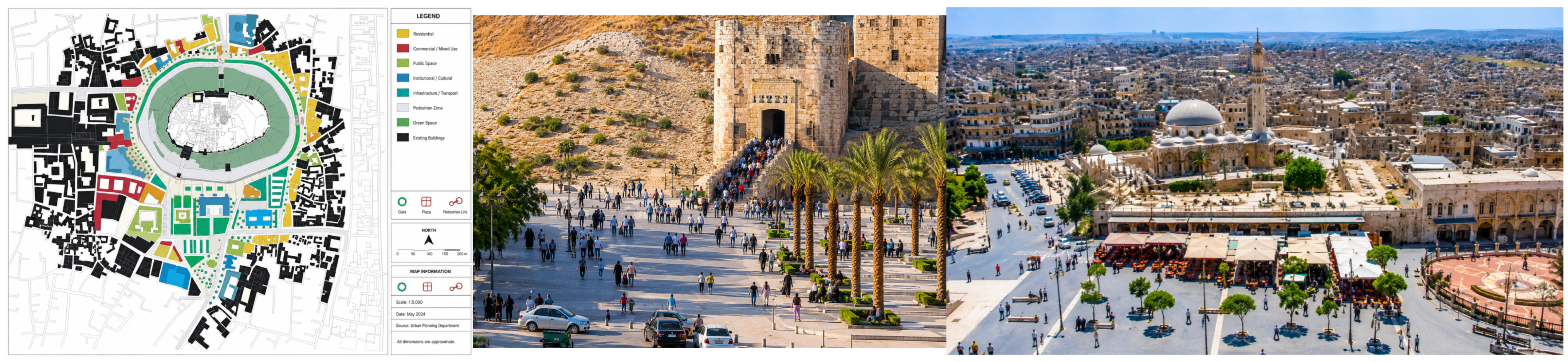
This is analytically important because it shows that the municipal vision did not treat the Citadel as a detached heritage object but as a focal point through which urban centrality itself could be reorganized. The project proposes an approach that brings together pedestrianization, public presence, environmental quality, and symbolic identity to reactivate one of Aleppo’s most important urban cores. In this sense, the Citadel surroundings project represents a clear attempt to reconnect monumental heritage with everyday public life; see Figure 14.
To clarify the spatial distribution of the main projects discussed in this section, the manuscript refers to the principal intervention areas through the text and contextual maps rather than adding a separate composite figure. This decision reflects the nature of the municipal vision itself: some components were spatial projects, while others were governance mechanisms, policy orientations, institutional processes, or citywide planning principles that cannot be accurately reduced to a single map. Nevertheless, the main intervention areas—the Old City, the Citadel surroundings, Bab Antakiya, the river corridor, central public spaces, and related mobility nodes—are identifiable through the contextual maps and available geographic references. These materials help readers unfamiliar with Aleppo understand the relationship between the principal project areas and support the interpretation of the municipal archive as a connected urban logic rather than a set of isolated projects.

5.4. Synthesis of the Results

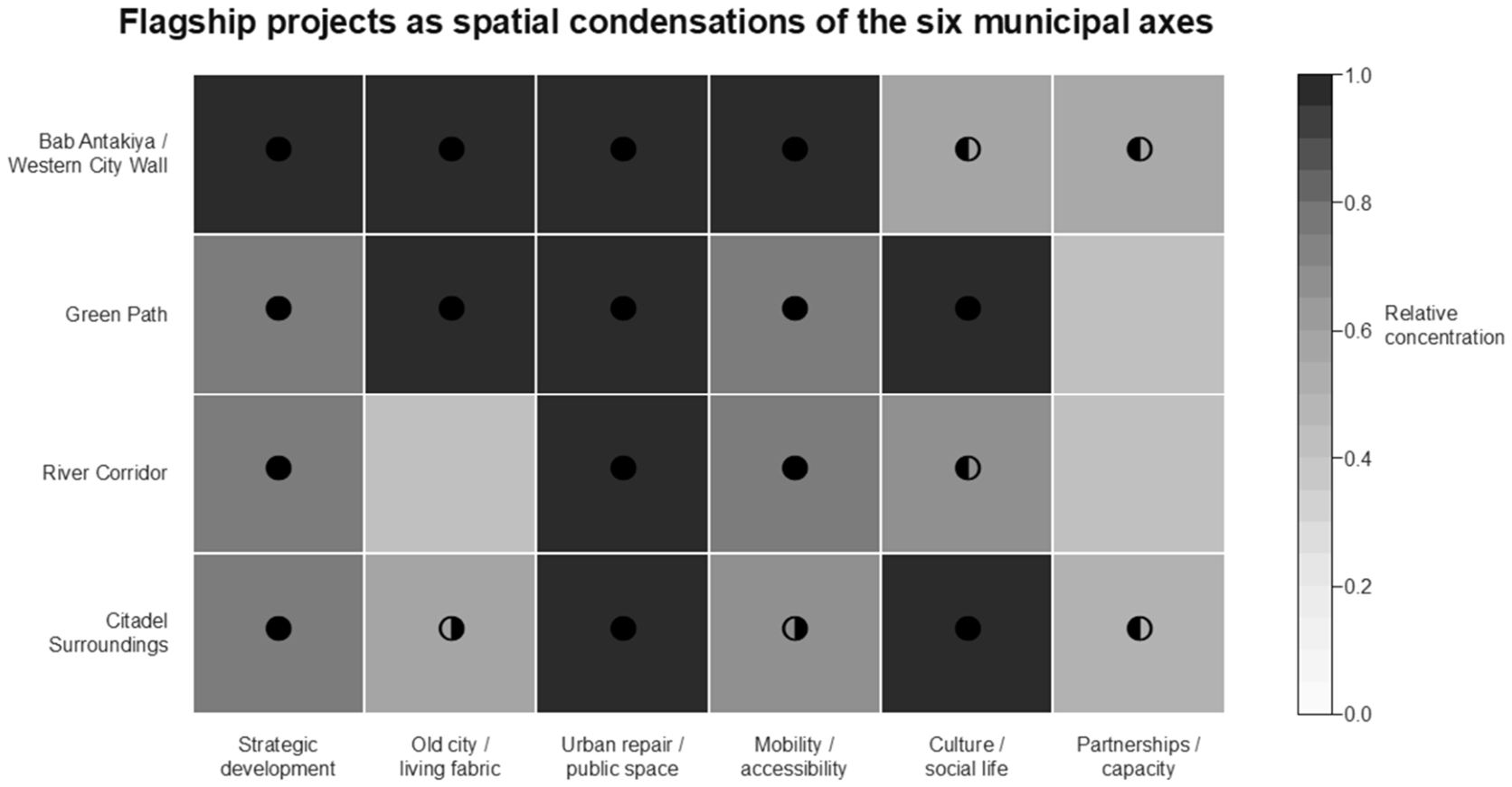
Taken together, the results show that Aleppo’s municipal vision before 2011 was broader than a simple list of projects and more coherent than a loose sectoral programme. Across the documents, the city appears as a complex urban system in which strategic planning, historic-core revitalisation, city-centre repair, mobility reorganisation, socio-cultural activation, and partnership-based capacity building were increasingly interconnected. The flagship projects did not stand apart from this wider agenda; rather, they materialised it spatially in particularly visible and concentrated forms; see Figure 15.
The results, therefore, support the view that the municipal archive preserves more than scattered evidence of past interventions. It preserves an interrupted municipal urbanism organised through six linked axes and expressed across multiple scales, from strategic documents to sectoral interventions to major urban projects. This is the principal empirical finding of the study and the basis for the interpretive discussion that follows.

6. Discussion

6.1. From Municipal Archive to Interrupted Municipal Urbanism

The Results show that Aleppo’s pre-2011 municipal material can be read as more than a fragmented archive of local initiatives. Across strategic programming, sectoral interventions, and flagship projects, the documents reveal a partially integrated municipal urbanism through which the city was being reimagined in relation to strategic development, historic fabric, city-centre repair, mobility, socio-cultural activation, and partnership-based capacity. This finding matters because it shifts the analytical focus away from the assumption that recovery begins only after destruction. In the case of Aleppo, recovery can also be thought through what had already been locally imagined before the rupture of war.
This is where the six-axis framework becomes especially useful. Taken together, the axes do not merely classify municipal activities; they reveal the internal structure of an urban logic already in formation. Strategic planning linked growth management to service provision and territorial differentiation. The old city was framed as a living urban fabric rather than a detached heritage enclave. Urban repair in the city centre pointed to a cumulative improvement in everyday public environments. Mobility initiatives treated accessibility as a structuring component of urban quality. Cultural and social programmes linked urban development to civic life and public activation. Development partnerships expanded municipal capacity through wider networks of exchange and cooperation. Read together, these six fields show that the municipality was beginning to think of Aleppo as a connected urban system rather than as a set of isolated sectors.

6.2. Why the Vision Remained Incomplete

At the same time, the article does not suggest that Aleppo’s pre-2011 municipal vision had consolidated into a fully stable or resilient model of urban governance. One of the central findings of this study is precisely that the vision remained incomplete, not because it lacked ambition, but because its strategic and spatial intelligence was developing within Syria’s highly centralized presidential administrative system. In that system, the Ministry of Local Administration and the central government maintained a dominant role over local authorities, limiting municipalities’ autonomy in planning, budgeting, institutional continuity, and long-term implementation. As a result, local urban initiatives could expand in scope and sophistication without being secured in a governance structure capable of protecting them from abrupt administrative or political reversal. The municipal reform moment in Aleppo, therefore, represented a meaningful advance in urban thinking, but not a fully empowered local governance transformation.
This structural limitation became especially visible in the relationship between municipal initiative and central authority. Even where the city council developed strategic planning tools, district-based service reorganization, urban observatory mechanisms, partnership-building, and a broader city-development agenda, these efforts remained vulnerable to central intervention. The mayor and council members could be dismissed by the central government, and shifts in local leadership could interrupt ongoing plans and redirect municipal priorities in accordance with the vision imposed from Damascus. In this sense, the incompleteness of the municipal vision was not merely technical or managerial; it was rooted in an administrative order that prevented local institutions across the country from developing into fully empowered and durable actors in urban governance. The case of Aleppo shows how a promising municipal trajectory could be weakened when local continuity depended less on institutional autonomy than on political tolerance from the centre.
This fragility can be read through the six axes themselves. The first axis, strategic urban development and managed growth, generated substantial planning outputs, including the reframing of the master plan and the production of thirty detailed urban plans, but these advances were not secured within a durable institutional order capable of guaranteeing continuity and local autonomy. The second and third axes, concerning the old city and city-centre repair, were more spatially visible and materially grounded, yet they progressed unevenly across sites and relied more on project momentum than on a routinized municipal delivery system. The fourth axis, mobility and accessibility, clearly expanded the municipality’s planning horizon, but some of its most ambitious dimensions remained at the level of studies, projected schemes, and future-oriented coordination rather than sustained implementation. The fifth axis, culture and social development, widened the meaning of urban policy considerably, yet much of its vitality depended on episodic activation and project-based participation rather than institutionalized civic structures. The sixth axis, development partnerships and international cooperation, enlarged the municipality’s technical and strategic horizon, but it also exposed parts of the urban agenda to dependence on cooperation environments that could not compensate for the absence of secure local institutional power. Seen from this perspective, the incompleteness of the vision lay not in the absence of urban intelligence, but in the gap between strategic imagination and durable local empowerment. This is why the vision should be treated neither as a nostalgic pre-war ideal nor as a ready-made reconstruction blueprint, but as a meaningful yet unfinished trajectory whose interruption reveals both the potential and the limits of municipal urbanism under a strongly centralized state structure.
For current recovery, this governance limitation means that the municipal vision cannot be implemented today as a single top-down master project. A more realistic approach would be to translate the six axes into micro-scale and phased governance mechanisms: neighbourhood recovery cells, municipal-university observatories, transparent damage-priority matrices, pilot public-space repairs, heritage-and-livelihood clusters in the Old City, and international technical partnerships focused on capacity building rather than externally imposed redevelopment. Such mechanisms would not remove the structural constraints of centralization, but they would create implementable channels through which critical continuity could operate under present institutional conditions.

6.3. Post-War Damage as a Filter for Critical Continuity

Post-war damage is used as a filter for critical continuity. The pre-2011 municipal vision is therefore not treated as a blueprint to be restored, but as a set of urban logics to be reassessed according to current destruction, displacement, functionality, and heritage loss. It is assessed against the current geography of destruction, displacement, urban functionality, and heritage loss. The UN-Habitat City Profile identifies a city divided by severe differences in damage, service provision, accessibility, and governance capacity. It reports heavily damaged neighbourhoods, partially damaged neighbourhoods, non-functional areas, and severe impacts on housing, infrastructure, education, health, and the Ancient City. Recent sectoral damage assessment for Aleppo Governorate further confirms that the recovery challenge includes not only monuments, but also housing, hospitals, health centres, schools, mosques, bakeries, and other everyday infrastructures; see Figure 16.
This evidence changes how the municipal archive should be read. Projects such as Bab Antakiya, the Citadel surroundings, the Green Path, and city-centre repair remain analytically valuable, but their present relevance depends on whether they can reconnect damaged urban fabrics, restore accessibility, support livelihoods, and reactivate public life under current conditions. Critical continuity therefore operates through comparison between the pre-war urban logic and the post-war damage map: where the two overlap, the archive can guide repair; where conditions have radically changed, the archive must be adapted or suspended.

6.4. Re-Reading the Vision for Post-War Recovery

The value of the municipal vision for the present lies in its capacity to be re-read as a framework for post-war urban recovery. This does not mean mechanically reviving the pre-war municipal agenda, nor does it assume that the conditions in Aleppo today are identical to those before 2011. Rather, it means recognizing that the six axes preserve a locally generated urban logic that can still orient recovery by showing what kinds of relations, priorities, and forms of coordination were already being imagined before the rupture of war. The pre-war vision matters, therefore, not because it was complete, but because it reveals a direction of urban thinking that remains usable.
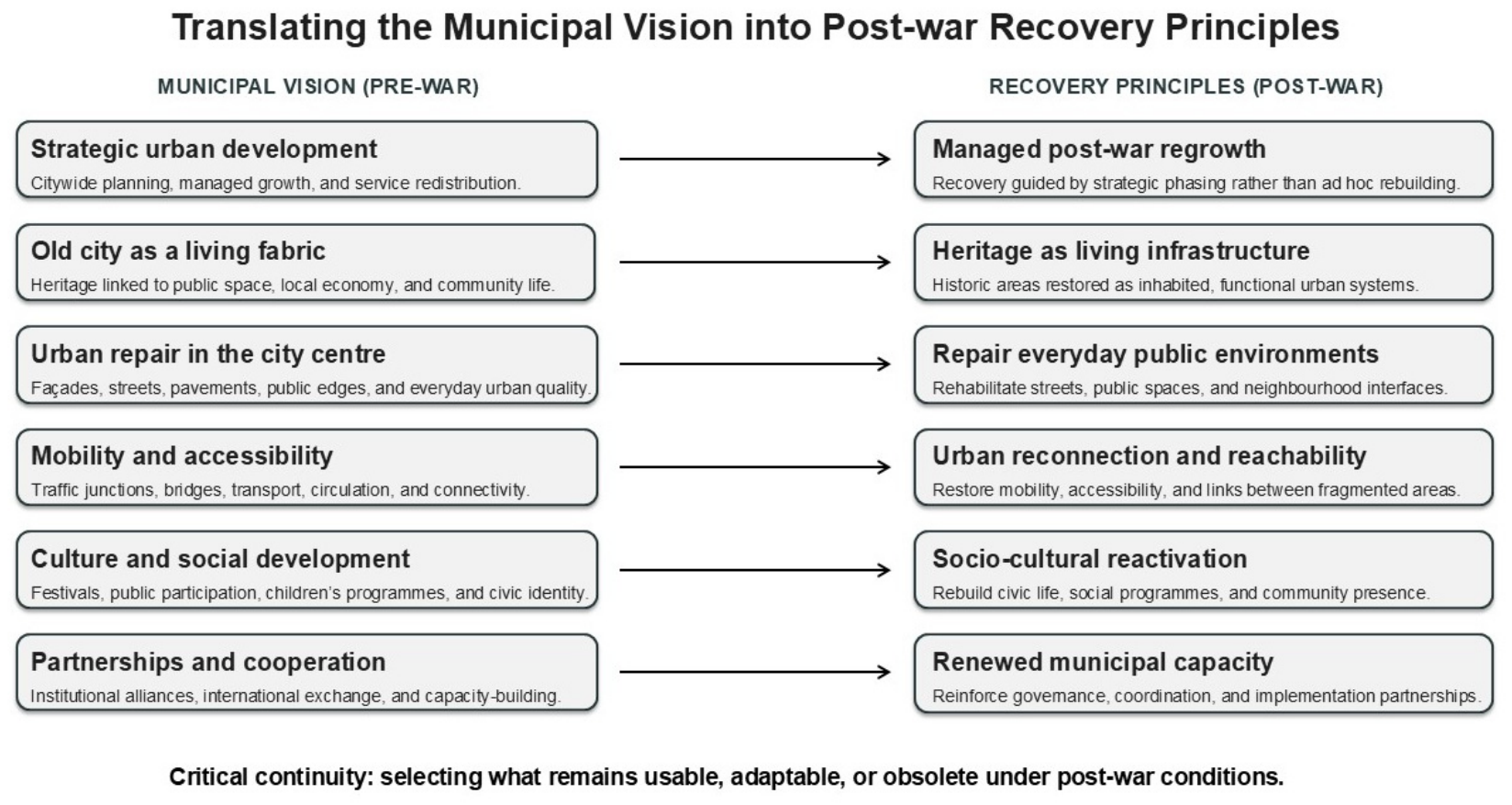
Each of the six axes suggests a corresponding recovery principle. The first axis points toward recovery through strategic planning and managed regrowth rather than ad hoc reconstruction. The second suggests that heritage should be treated as a living urban fabric rather than as a detached object of preservation. The third indicates that recovery must include the repair of everyday streets, façades, and public environments, not only emblematic monuments. The fourth highlights accessibility and urban reconnection as central recovery issues rather than secondary technical ones. The fifth shows that recovery must include socio-cultural reactivation, public life, and support for vulnerable groups. The sixth demonstrates that partnerships and renewed municipal capacity are essential to rebuilding durable urban coordination. In this sense, the six axes are not simply retrospective categories; they can be translated into a recovery grammar grounded in Aleppo’s own interrupted planning intelligence; see Figure 17.

6.5. Recovery Through Critical Continuity

This leads to the article’s main interpretive conclusion: Aleppo’s recovery is best approached through critical continuity rather than either nostalgic restoration or tabula rasa reconstruction [60,61]. Critical continuity means identifying which locally generated urban logics remain valuable [62], which institutional weaknesses need correction, and which planning principles can be reworked under present post-war conditions. It begins from the recognition that war interrupted a municipal urbanism already in formation, and that rebuilding from zero risks erases not only the damaged fabric but also the city’s own unfinished urban intelligence.
The comparison with other post-war cities reinforces this position. Warsaw illustrates how reconstruction can mobilize memory and urban identity, but also how recovery may become selective and politically framed. Beirut illustrates the risks of reconstruction led by capital-intensive redevelopment that can weaken social continuity and everyday urban life. Aleppo’s situation requires a different approach: neither literal reconstruction of the past nor tabula-rasa redevelopment, but a selective and evidence-based reactivation of locally generated planning intelligence.
Future technical work can strengthen this approach by combining the municipal archive with GIS, satellite-based damage assessment, and remote sensing methods such as Sentinel-1 InSAR. Such tools are particularly relevant in post-conflict settings where field access is uneven and where structural deformation, infrastructure vulnerability, and large-scale damage must be assessed before recovery interventions are prioritized. In the present article, these methods are identified as future extensions rather than as part of the empirical methodology, which remains qualitative and archive-based.
The broader significance of this argument extends beyond Aleppo. In historically layered cities affected by war, disaster, or political rupture, recovery debates often focus on damage, legal frameworks, or technical rebuilding after crisis, while overlooking the urban trajectories that had already been evolving before interruption. The Aleppo case suggests that these interrupted trajectories deserve closer attention because they may preserve locally grounded principles of continuity, heritage integration, public-space linkage, mobility, civic life, and municipal responsibility. The contribution of the present study, therefore, lies not only in reinterpreting Aleppo’s municipal archive but also in proposing that pre-conflict municipal visions can be studied as latent recovery frameworks in cities where continuity between past, present, and future remains central to urban recovery.

7. Conclusions

This article has argued that Aleppo’s municipal vision before 2011 should be understood not merely as a record of local projects, but as an interrupted municipal urbanism whose relevance extends into the post-war present. By reading municipal material across strategy, sectoral intervention, and flagship urban projects, the study has shown that the city council was beginning to articulate a broader and partially integrated urban logic linking strategic urban development, the living fabric of the old city, city-centre repair, mobility restructuring, socio-cultural activation, and partnership-based urban capacity.
The article contributes to the literature in three main ways. First, it repositions pre-conflict municipal visions as analytically valuable sources for post-war urban research. Second, it shows that Aleppo’s pre-2011 vision was not a fragmented set of isolated projects, but a broader municipal framework visible across multiple scales, from strategic planning and institutional reorientation to sectoral interventions and flagship urban projects. Third, it advances the idea of recovery through critical continuity, arguing that post-war recovery can benefit from identifying and reworking the locally produced planning intelligence that was interrupted by the conflict.
At the same time, the study has shown that the value of this vision lies not in its completeness. The pre-2011 municipal trajectory remained institutionally fragile. Although the municipality widened its urban scope and increasingly connected planning, heritage, public space, movement, civic life, and development, these efforts did not consolidate into a sufficiently durable governance structure. The significance of the case, therefore, lies in a double lesson: Aleppo’s municipal vision before 2011 preserves a locally grounded urban logic that remains relevant for recovery, but it also reveals the institutional conditions under which such a logic may remain vulnerable.
From the standpoint of post-war urban recovery, the article suggests that rebuilding Aleppo should not be framed only as the technical repair of damaged structures or the isolated restoration of monuments and sites. The six analytical dimensions identified in the municipal vision point toward a broader recovery agenda: reconnecting strategic planning to managed urban growth, treating the old city as a living urban fabric, repairing everyday public environments, restoring accessibility and urban reachability, reactivating socio-cultural life, and rebuilding municipal capacity through renewed institutional and partnership frameworks. This is why Aleppo should not start from scratch. One of the most valuable foundations for its future lies in the interrupted urban logic that the war did not erase entirely.
More broadly, the article suggests that historically layered cities affected by war, disaster, or political rupture may contain, within their pre-conflict archives, not only records of what existed, but also latent frameworks for thinking about what could still be recovered, translated, and reworked. Municipal archives are often used to document institutional history or illustrate past projects, but they can also serve as analytical sources for reconstructing interrupted urban trajectories. In settings where war or political rupture has broken continuity, such archives may provide one of the few grounded ways to reconnect recovery thinking with the city’s own prior planning intelligence. In this sense, Aleppo offers more than a historical case. It offers a grounded way to ask how a city might recover as a city, not merely as a collection of rebuilt sites.
Future research should develop this framework in three directions. First, municipal archives should be combined with GIS-based damage mapping and field verification to identify which pre-war projects, corridors, and public-space networks remain physically recoverable. Second, technical studies using remote sensing, structural assessment, and infrastructure monitoring should evaluate the safety and resilience of damaged assets before rehabilitation. Third, participatory research with residents, heritage actors, municipal professionals, and displaced communities should test whether the principles of critical continuity correspond to present social needs and local perceptions of recovery. These future studies would move the framework from interpretive analysis toward implementable recovery planning.


Author Contributions

Conceptualization, E.N. and M.C.; Methodology, E.N., M.C., L.H. and E.N.; Validation, E.N., M.C. and L.H.; Formal analysis, E.N. and L.H.; Investigation, E.N., M.C. and L.H.; Resources, M.C. and L.H.; Data curation, E.N. and M.C.; Writing—original draft preparation, E.N.; Writing—review and editing, E.N., M.C. and L.H.; Visualization, E.N. and L.H.; Supervision, E.N. and M.C.; Project administration, E.N. All authors approved the final version to be published and agree to be accountable for all aspects of the work, in accordance with ICMJE authorship criteria. All authors have read and agreed to the published version of the manuscript.

Funding

This research was supported by Prince Sultan University, and the Article Processing Charges (APC) were funded by Prince Sultan University.

Institutional Review Board Statement

Not applicable.

Informed Consent Statement

Not applicable.

Data Availability Statement

All data supporting the findings of this study are included within the manuscript. No additional datasets were generated or analyzed beyond the materials presented in the paper.

Acknowledgments

The authors would like to thank Prince Sultan University and Bahçeşehir University for its support.

Conflicts of Interest

The authors declare that they have no known financial or non-financial conflicts of interest that could have influenced the research, authorship, or publication of this manuscript.

References

  1. Dimelli, D.; Kotsoni, A. The reconstruction of post-war cities—Proposing integrated conservation plans for Aleppo’s reconstruction. Sustainability 2023, 15, 5472. [Google Scholar] [CrossRef] [Scilit]
  2. Thiel, F.; Orabi, R. Reviving Aleppo: Urban, Legal and Digital Approaches for Post-War Recovery; Springer Nature: Cham, Switzerland, 2024. [Google Scholar]
  3. Kar, S. Strategic Adaptation of Project Management Practices in Reconstruction Projects Within Post-Conflict Recovery Contexts; Vilniaus Universitetas: Vilnius, Lithuania, 2026. [Google Scholar]
  4. Alhusri, Y. Renew of Aleppo City: Urban Policies in the Renew of the City Center After War. Master’s Thesis, Faculdade de Arquitetura, Universidade de Lisboa, Lisbon, Portugal, 2022. Available online: https://repositorio.ulisboa.pt/entities/publication/c85dfe7c-488d-4fe8-9500-2bdb6151717c (accessed on 26 May 2026).
  5. Munawar, N.A.; Symonds, J. Post-conflict reconstruction, forced migration & community engagement: The case of Aleppo, Syria. Int. J. Herit. Stud. 2022, 28, 1017–1035. [Google Scholar]
  6. Noaime, E.; Alnaim, M.M. Heritage and Resilience: Sustainable Recovery of Historic Syrian Cities. Buildings 2025, 15, 2403. [Google Scholar] [CrossRef] [Scilit]
  7. Vale, L.J.; Campanella, T.J. The Resilient City: How Modern Cities Recover from Disaster; Oxford University Press: Oxford, UK, 2005. [Google Scholar]
  8. Orlando, L. Multidisciplinary approach to a recovery plan of historical buildings. Int. J. Geophys. 2011, 2011, 258043. [Google Scholar] [CrossRef] [Scilit]
  9. Moazzeni Khorasgani, A.; Asadi Eskandar, G. Sustainable regeneration principles in historic cities exploring landscape approach. Chin. J. Urban Environ. Stud. 2024, 12, 2450008. [Google Scholar] [CrossRef] [Scilit]
  10. Garcia, B.M. Integrating culture in post-crisis urban recovery: Reflections on the power of cultural heritage to deal with crisis. Int. J. Disaster Risk Reduct. 2021, 60, 102277. [Google Scholar] [CrossRef] [Scilit]
  11. Fouseki, K.; Guttormsen, T.; Swensen, G. Heritage and Sustainable Urban Transformations: Deep Cities; Routledge: London, UK, 2019. [Google Scholar]
  12. Noaime, E.; Alnaim, M.M. Attempting to grasp the architectural formation of the facades overlooking the courtyard: Al-Jadida neighborhood housing in Aleppo during the late Ottoman period (since the 18th century). Open House Int. 2024, 49, 468–488. [Google Scholar] [CrossRef] [Scilit]
  13. Noaime, E.; Alnaim, M.M. Examining the symbolic dimension of Aleppo’s historical landmarks. Alex. Eng. J. 2023, 78, 292–305. [Google Scholar] [CrossRef] [Scilit]
  14. Zhang, R. Spatial form, urban governance, and people’s experience: A study on the regeneration of historic environments in China from a public value perspective (2000–2020). Doctoral Dissertation, Universitat Politècnica de Catalunya, Barcelona, Spain, 2025. [Google Scholar]
  15. Rodrigues, R.; Heitor, J.C.; Pimentel, H.; Lopes, T. Relationship between preservation of built cultural heritage and economic development in Lisbon and Porto: Cultural legacy and urban revitalization as serial mediation mechanisms. Societies 2025, 15, 124. [Google Scholar] [CrossRef] [Scilit]
  16. Bhattarai, K.; Yousef, M. Urbanization and Sustainability in MENA: Challenges and Pathways to Smart Cities. In The Middle East: Past, Present, and Future; Springer Nature: Cham, Switzerland, 2025; pp. 167–216. [Google Scholar] [CrossRef] [Scilit]
  17. Klein, L.; Arts, K. Public participation in decision-making on conservation translocations: The importance and limitations of a legislative framework. Restor. Ecol. 2022, 30, e13505. [Google Scholar] [CrossRef] [Scilit]
  18. Khater, M.; Ibrahim, O.; Sayed, M.N.E.; Faik, M. Legal frameworks for sustainable tourism: Balancing environmental conservation and economic development. Curr. Issues Tour. 2025, 28, 3693–3714. [Google Scholar]
  19. Bakare, S. Evaluating environmental legislation on disaster resilience: Data insights from Nigeria and the USA. World J. Adv. Res. Rev. 2024, 21, 1900–1908. [Google Scholar] [CrossRef] [Scilit]
  20. Grangxabe, X.S.; Maphanga, T.; Madonsela, B.S. Public participation on waste management between nature reserves and surrounding informal settlement: A review. J. Air Waste Manag. Assoc. 2023, 73, 589–599. [Google Scholar] [CrossRef] [Scilit]
  21. Diefendorf, J.M. In the Wake of War: The Reconstruction of German Cities After World War II; Oxford University Press: Oxford, UK, 1993. [Google Scholar]
  22. Diefendorf, J.M. Urban reconstruction in Europe after world war II. Urban Stud. 1989, 26, 128–143. [Google Scholar] [CrossRef] [Scilit]
  23. Al-Mosawy, S.K.; Al-Jaberi, A.A.; Alrobaee, T.R.; Al-Khafaji, A.S. Urban planning and reconstruction of cities post-wars by the approach of events and response images. Civ. Eng. J. 2021, 7, 1836–1852. [Google Scholar] [CrossRef] [Scilit]
  24. Kawther, K.K.; Hassan, R.H. Sustainable urban space strategies in the reconstruction of destroyed cities after the wars. J. Eng. Sci. Technol. 2022, 17, 4163–4186. [Google Scholar]
  25. Haridasan, H.; Bansal, V.; Parmar, S.S.; Bansal, S.; Abid, N.; Resaal, M. War, Peace, and Reconstruction: Articulation and Synthesis of Lessons from International Experience in City Reconstruction. In City Reconstruction; Routledge: London, UK, 2025; pp. 68–82. [Google Scholar]
  26. Shvydkyi, D.; Shvets, V.; Sokolenko, K.; Rudniev, Y.; Sokolenko, V. Urban Planning Principles and Models of Reconstructive Restoration of Urbanized Territories of Luhansk Region Destroyed by Hostilities, Based on Innovative Development. In Data-Centric Business and Applications: Modern Trends in Financial and Innovation Data Processes 2025; Springer: Cham, Switzerland, 2026; Volume 2, pp. 33–57. [Google Scholar]
  27. Basher, Z. How to Recover a City After a Disaster–Mosul City. Master’s Thesis, University of Birmingham, Birmingham, UK, 2023. [Google Scholar]
  28. Tiutiunnyk, H. Conceptual Principles of Post-War Reconstruction of Coastal Cities of Ukraine. In Innovations for Achieving the Sustainable Development Goals: Science, Education and Economics; Aškerc Zadravec, K., Kvach, Y., Eds.; Ljubljana School of Business: Ljubljana, Slovenia, 2022; pp. 205–222. Available online: https://razumkov.org.ua/images/2022/06/29/mono_2022_-_slovenia_13.06_cover_added3_final_1.pdf (accessed on 26 May 2026).
  29. Bulthuis, J.; Durel, E.; Gosik, A.; Kulig, K.; Tudó Mitjavila, M. Post-War Smart Eco Cities According to Sustainable Development Proposed by the UN and EU Regulations. Bachelor’s Thesis, Lodz University of Technology, Lodz, Poland, 2024. [Google Scholar]
  30. Jiang, J. Reconstruction in post-war Rome: Transnational flows and national identity. Build. Cities 2026, 7, 215–231. [Google Scholar] [CrossRef] [Scilit]
  31. Shaev, B.; Hackett, S. Cities, migration and the historiography of post-war Europe. J. Migr. Hist. 2021, 7, 191–219. [Google Scholar] [CrossRef] [Scilit]
  32. Nasr, J.L. Reconstructing or Constructing Cities? Stability and Change in Urban Form in Post-World War II France and Germany. Ph.D. Thesis, University of Pennsylvania, Philadelphia, PA, USA, 1997. Available online: https://repository.upenn.edu/dissertations/AAI9727266 (accessed on 26 May 2026).
  33. Almukhtar, A. Place-identity in historic cities; The case of post-war urban reconstruction in Erbil, Iraq. In Urban Heritage Along the Silk Roads: A Contemporary Reading of Urban Transformation of Historic Cities in the Middle East and Beyond; Springer: Cham, Switzerland, 2019; pp. 121–136. [Google Scholar]
  34. Belal, A.; Shcherbina, E. Heritage in post-war period challenges and solutions. IFAC-PapersOnLine 2019, 52, 252–257. [Google Scholar] [CrossRef] [Scilit]
  35. Peter, O.A.; Osazuwa, C.M. A conceptual framework to analyse consequences of post-conflict reconstruction interventions. Am. J. Political Sci. Law Criminol. 2024, 6, 105–136. [Google Scholar]
  36. Del Castillo, G. Rebuilding War-Torn States: The Challenge of Post-Conflict Economic Reconstruction; OUP Oxford: Oxford, UK, 2008. [Google Scholar]
  37. Mallett, R.; Pain, A. Post-War Recovery and the Role of Markets: Policy Insights from Six Years of Research. Glob. Policy 2018, 9, 264–275. [Google Scholar] [CrossRef] [Scilit]
  38. López Jiménez, J.M.; Gómez Vargas, J.C.; Moreno Vargas, F. Postwar recomposition: Warsaw. In Heritage 2018: Proceedings of the 6th International Conference on Heritage and Sustainable Development, Granada, Spain, 12–15 June 2018; Amoêda, R., Lira, S., Pinheiro, C., Santiago Zaragoza, J.M., Calvo Serrano, J., García Carrillo, F., Eds.; Editorial Universidad de Granada, Universidad de Granada: Granada, Spain; Green Lines Institute: Barcelos, Portugal, 2018; Volume 2, pp. 1385–1394. Available online: https://dialnet.unirioja.es/servlet/articulo?codigo=10605273 (accessed on 26 May 2026).
  39. Jozefacka, A. Rebuilding Warsaw: Conflicting Visions of a Capital City, 1916–1956. Ph.D. Thesis, New York University, New York, NY, USA, 2011. [Google Scholar]
  40. H̲alaf, S.; Khoury, P.S. Recovering Beirut: Urban Design and Post-War Reconstruction; Brill: Berlin, Germany, 1993; Volume 47. [Google Scholar]
  41. Nasr, J.; Verdeil, E. The reconstructions of Beirut. In The City in the Islamic World (2 Vols.); Brill: Berlin, Germany, 2008; pp. 1121–1148. [Google Scholar]
  42. Makhzoumi, J.; Al-Harithy, H.; Bazzi, M. Contextualizing UNESCO’s Historic Urban Landscape Approach: A Framework for Identifying Modern Heritage in Post-Blast Beirut. Land 2024, 13, 2241. [Google Scholar] [CrossRef] [Scilit]
  43. Bouguebs, N.; Bouguebs, R.; Cemmaili, A. Urban Heritage at Risk: Sustainable Preservation Strategies for Constantine, Algeria. Int. J. Environ. Sci. 2025, 11, 2378–2388. Available online: https://theaspd.com/index.php/ijes/article/view/11921 (accessed on 26 May 2026).
  44. Abdulmawla, L. The Cultural Heritage in the Post-War Aleppo Transformations: Identity and Features. Ph.D. Thesis, Politecnico di Milano, Milan, Italy, 2024. Available online: https://hdl.handle.net/20.500.14242/206650 (accessed on 26 May 2026).
  45. Oseku, N.; Dimkovska, M.; Blazhevska, M. RE-Writing Aleppo. The Reconstruction of the City Centre. 2017. Available online: https://www.politesi.polimi.it/handle/10589/147012?mode=full (accessed on 26 May 2026).
  46. Kousa, C.; Lubelli, B.; Pottgiesser, U. Enhancing Community Participation for the Reconstruction of Residential Heritage in the Old City of Aleppo. Heritage 2025, 8, 319. [Google Scholar] [CrossRef] [Scilit]
  47. Kousa, C.; Pottgiesser, U.; Lubelli, B. Post-Syrian war residential heritage transformations in the old city of Aleppo: Socio-cultural sustainability aspects. Sustainability 2021, 13, 12213. [Google Scholar] [CrossRef] [Scilit]
  48. Kousa, C.; Lubelli, B.; Pottgiesser, U. Historic development of policies and regulations concerning residential heritage in the Old City of Aleppo. J. Cult. Herit. Manag. Sustain. Dev. 2026, 16, 1–19. [Google Scholar] [CrossRef] [Scilit]
  49. Chibli, M. Old Aleppo Between Reconstruction and Redevelopment Strategies: Balancing Preservation and Modernisation. In Reviving Aleppo: Urban, Legal and Digital Approaches for Post-War Recovery; Springer: Cham, Switzerland, 2024; pp. 153–173. [Google Scholar]
  50. Knox, R.L. Urban Recovery Framework for Aleppo City. In Reviving Aleppo: Urban, Legal and Digital Approaches for Post-War Recovery; Springer: Cham, Switzerland, 2024; pp. 25–51. [Google Scholar]
  51. Rifai, G.; Emekci, Ş. Experiences of war and peace in public spaces—Aleppo city case study. J. Infrastruct. Policy Dev. 2024, 8, 2789. [Google Scholar] [CrossRef] [Scilit]
  52. Beilin, R.; Wilkinson, C. Introduction: Governing for Urban Resilience; SAGE Publications: London, UK, 2015; pp. 1205–1217. [Google Scholar]
  53. Ziervogel, G.; Morgan, G. The adaptive governance capacities of the City of Cape Town built in response to extreme events. J. Extrem. Events 2022, 9, 2250005. [Google Scholar] [CrossRef] [Scilit]
  54. Healey, P.; Cars, G.; Madanipour, A.; De Magalhães, C. Urban governance capacity in complex societies: Challenges of institutional adaptation. In Urban Governance, Institutional Capacity and Social Milieux; Routledge: London, UK, 2017; pp. 204–225. [Google Scholar]
  55. Brinkerhoff, D.W.; Brinkerhoff, J.M. Governance reforms and failed states: Challenges and implications. Int. Rev. Adm. Sci. 2002, 68, 511–531. [Google Scholar] [CrossRef] [Scilit]
  56. Okunola, O.H. Exploring multi-level governance arrangements in disaster recovery: A study of Lagos, Nigeria. Int. J. Disaster Risk Reduct. 2025, 118, 105254. [Google Scholar] [CrossRef] [Scilit]
  57. Azzam, M.; Graw, V.; Rienow, A. Integrating Tenure Rights with a Balanced Socio-Spatial Approach Towards Sustainable Community in Aleppo. In Reviving Aleppo: Urban, Legal and Digital Approaches for Post-War Recovery; Thiel, F., Orabi, R., Eds.; Cities, Heritage and Transformation; Springer: Cham, Switzerland, 2024; pp. 99–123. [Google Scholar] [CrossRef] [Scilit]
  58. UN Habitat. City Profile Aleppo: Multi Sector Assessment; UN Habitat: Nairobi, Kenya, 2014; p. 28. [Google Scholar]
  59. The Syrian Ministry of Local Administration and Environment Issues the Results of the Damage and Needs assessment Study in Aleppo Governorate. Available online: https://molae.gov.sy/news/%D9%88%D8%B2%D8%A7%D8%B1%D8%A9-%D8%A7%D9%84%D8%A5%D8%AF%D8%A7%D8%B1%D8%A9-%D8%A7%D9%84%D9%85%D8%AD%D9%84%D9%8A%D8%A9-%D9%88%D8%A7%D9%84%D8%A8%D9%8A%D8%A6%D8%A9-%D8%AA%D8%B5%D8%AF%D8%B1-%D9%86%D8%AA/ (accessed on 26 May 2026).
  60. Ramadan, M. Madinatuna—A Programme for Aleppo City Development Strategy 2025: The Role of Civil Society in Local Urban Development. 2010. Available online: https://playmakers.be/uploads/1/2023-07/120626_aleppo_city_development_strategy_mahmoud_ramadan.pdf (accessed on 26 May 2026).
  61. Torrent, H. Tabula Rasa Meets Resilience: Urban Reconstruction and the Dilemmas of the Modern Planning in Chillán, Chile (1939). Int. Plan. Hist. Soc. Proc. 2016, 17, 367–379. [Google Scholar] [CrossRef] [Scilit]
  62. Wang, K.; Fouseki, K. Sustaining the fabric of time: Urban heritage, time rupture, and sustainable development. Land 2025, 14, 193. [Google Scholar] [CrossRef] [Scilit]
Figure 1. Aleppo governorate in Syria map, Urban composition of Aleppo, showing the relationship between residential areas, informal housing, industrial zones, mixed-use areas, and the Old City. Source: [57].
Urbansci 10 00318 g001
Figure 2. Aleppo within its governorate and regional context. Source: [57].
Urbansci 10 00318 g002
Figure 3. Research design, source corpus, and analytical procedure used to reconstruct the municipal urban vision of Aleppo before 2011.
Urbansci 10 00318 g003
Figure 4. Six analytical axes of Aleppo’s municipal vision before 2011. Source: Author’s synthesis based on the Aleppo municipal archive.
Urbansci 10 00318 g004
Figure 5. Multi-scalar planning in Aleppo. (Left) The citywide master plan of Aleppo. (Right) Detailed urban study of Zone W3 located in the western sector of the city. Source: Aleppo Municipality archive.
Urbansci 10 00318 g005
Figure 6. Land-use planning in the Old City of Aleppo. (Left) preservation land-use plan. (Right) future land-use plan of the Old City. Source: Aleppo Municipality archive.
Urbansci 10 00318 g006
Figure 7. Urban repair interventions in Aleppo’s city centre. (Left) Tellal Street. (Right) the Abbara zone in the city centre. Source: Aleppo Municipality archive.
Urbansci 10 00318 g007
Figure 8. Mobility restructuring in Aleppo. (Left) bridge projects within the city’s circulation network. (Right) the Maisaloon Bridge. Source: Aleppo Municipality archive.
Urbansci 10 00318 g008
Figure 9. Cultural programming in pre-2011 Aleppo. From left to right: Syrian–German Music Days poster; “Culture in the City” poster linked to Madinatuna initiative; stage installation for Memory of Nilae; and dance performance from the same festival at Aleppo Citadel Theatre in the old city. Held on 20–22 September 2010, the event formed part of the programme “Aleppo: City of Arts and Bridge of Cultures,” extending the city’s cultural profile after its designation as Capital of Islamic Culture in 2006.
Urbansci 10 00318 g009
Figure 10. Documents on Aleppo’s pre-2011 international municipal partnerships: (left) Grand Lyon’s 2009 deliberation approving the 2010–2012 cooperation agreement with Aleppo; (right) TÜRSAB’s 2008 announcement on the Gaziantep–Aleppo sister-city project under the 2005 protocol.
Urbansci 10 00318 g010
Figure 11. Urban design and existing conditions of the Bab Antakiya project area. (Left) proposed plan for the Bab Antakiya/Western City Wall intervention zone. (Right) views of the gate, wall, and adjacent urban context documenting site conditions prior to rehabilitation. Source: Aleppo Municipality archive.
Urbansci 10 00318 g011
Figure 12. The Green Path project in Aleppo is a connective urban sequence. (Left) project layout. (Center) and (right): diagrammatic and spatial overlays illustrating the corridor’s role in linking parks, the river corridor, central squares, Bab Antakiya, and the old city into a continuous public-space network. Source: Aleppo Municipality archive.
Urbansci 10 00318 g012
Figure 13. Transformation of Aleppo’s river corridor from traffic-dominated infrastructure to an integrated ecological and public urban space.
Urbansci 10 00318 g013
Figure 14. Symbolic centrality and public-space reactivation around the Aleppo Citadel. (Left) proposed layout for the Citadel surroundings project. (Center) and (right) site views illustrating the Citadel edge and its relationship to public life and the surrounding urban fabric. Source: Aleppo Municipality archive.
Urbansci 10 00318 g014
Figure 15. Flagship projects as spatial condensations of the six municipal axes. Source: Author’s synthesis based on the Aleppo municipal archive.
Urbansci 10 00318 g015
Figure 16. Damage analysis in Aleppo, showing heavily damaged, partially damaged, and affected areas. Source: [57].
Urbansci 10 00318 g016
Figure 17. Translating the municipal vision into post-war recovery principles. Source: Author’s synthesis based on the Aleppo municipal archive.
Urbansci 10 00318 g017
Table 1. Critical-continuity criteria for translating Aleppo’s pre-2011 municipal vision into feasible post-war recovery actions.
Critical-Continuity CriterionGuiding QuestionRecovery Implication
Spatial and damage conditionDoes the urban element still exist, and what is its damage or functionality status?Recover where viable; adapt where damaged; suspend where loss or risk is severe.
Social and functional relevanceDoes the element respond to present needs in housing, mobility, public space, services, or livelihoods?Prioritize elements that reconnect everyday urban life and basic services.
Heritage and identity valueDoes the element support collective memory, historic continuity, or living heritage?Reactivate heritage as urban fabric, not only as monument restoration.
Institutional feasibilityCan the municipality or partners implement the action under current governance constraints?Translate large visions into pilot actions, phased projects, and feasible governance mechanisms.
Partnership capacityCan local, academic, civic, or international actors support implementation?Use partnerships to compensate for limited municipal capacity while avoiding external tabula-rasa agendas.
Table 2. Recent sectoral damage assessment for Aleppo Governorate, including housing, schools, hospitals, health centres, mosques, and bakeries. Source: National rapid assessment platform/Ministry of Local Administration and Environment [58].
SectorSlight DamageModerate DamageSevere DamageCompletely DestroyedTotal DamagedEstimated Total Sector Stock
Bakeries26—8.7%22—7.4%22—7.4%21—7.0%91—30.5%About 300 bakeries
Hospitals4—7.8%2—3.9%1—2.0%2—3.9%9—17.6%About 51 hospitals
Housing units105,408—31.4%24,857—12.8%24,606—7.3%24,262—7.2%179,133—58.7%About 336,000 units
Schools555—19.1%480—16.5%215—7.4%227—7.8%1477—50.8%About 2900 schools
Health centers/dispensaries28—12.0%39—16.7%19—8.1%12—5.1%98—41.9%About 234 centers
Mosques358—9.5%273—7.3%229—6.1%258—6.9%1118—29.8%About 3750 mosques
Disclaimer/Publisher’s Note: The statements, opinions and data contained in all publications are solely those of the individual author(s) and contributor(s) and not of MDPI and/or the editor(s). MDPI and/or the editor(s) disclaim responsibility for any injury to people or property resulting from any ideas, methods, instructions or products referred to in the content.