Sustainable Management of National Forest Trails: Structural Relationships Among Volunteer Motivation, Satisfaction, Perceived Quality of Life, and Active Participation Intention


Abstract
1. Introduction
2. Materials and Methods
2.1. Participants and Data Collection
2.2. Measures
2.3. Analysis Procedure
2.4. Hypotheses
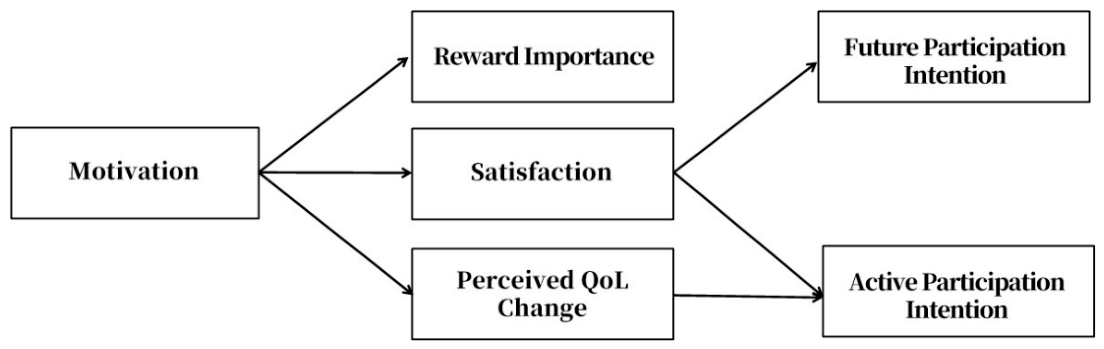
2.5. Research Model
3. Results
3.1. Demographic Characteristics of Respondents
3.2. Verification of Measurement Model
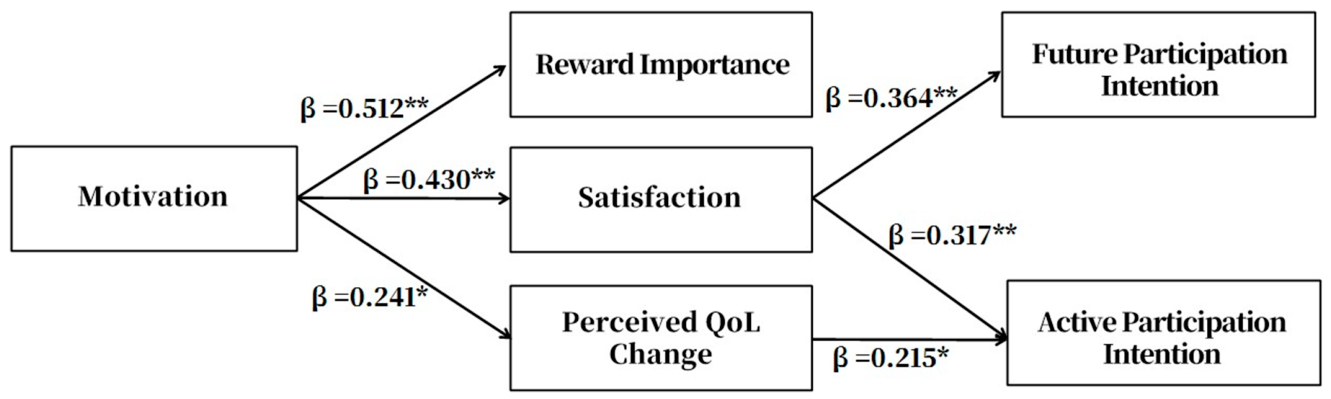
3.3. Structural Model Analysis and Hypothesis Verification
3.4. Verification of Mediation Effects
3.5. Hypothesis Testing
4. Discussion
4.1. Academic Implications and Comparative Analysis
4.2. Policy and Practical Implications
5. Conclusions
Limitations and Future Research
Author Contributions
Funding
Institutional Review Board Statement
Informed Consent Statement
Data Availability Statement
Conflicts of Interest
Abbreviations
| AVE | Average Variance Extracted |
| CFA | Confirmatory Factor Analysis |
| CFI | Comparative Fit Index |
| CR | Composite Reliability |
| EFA | Exploratory Factor Analysis |
| KFS | Korea Forest Service |
| NFTs | National Forest Trails |
| QoL | Quality of Life |
| PCT | Pacific Crest National Scenic Trail |
| RMSEA | Root Mean Square Error of Approximation |
| SDT | Self-Determination Theory |
| SEM | Structural Equation Modeling |
| TLI | Tucker–Lewis Index |
| VFI | Volunteer Functions Inventory |
| VSI | Volunteer Satisfaction Index |
Appendix A
| Pursuant to Article 33 of the Statistics Act (Protection of Secrets), your responses are protected from being used for any purpose other than statistical compilation. | ID |
| Greetings. Thank you for participating in the “Perception Survey of National Forest Trail Volunteers”. The Korea Forest Service is promoting a system to designate “National Forest Trails” to systematically manage forest trails with high forest ecological, historical, and cultural value at the national level and to induce sustainable use. Currently, 8 locations have been designated as National Forest Trails. In this regard, to expand opportunities for participation in National Forest Trails and to reach consensus, we intend to survey the experiences, motivations, satisfaction, and quality of life of those volunteering at National Forest Trails. We ask for your sincere responses until the end and request your cooperation so that the government can make better policy decisions. Your responses will be used solely as data for this research and will not be used for any other purpose. We would appreciate it if you could answer all questions without omission to ensure the smooth progress of this research. | |
| Inquiries | Organizer: National Institute of Forest Science (NIFoS) |
| Survey Agency: MegaR&C | |
| [Consent for Collection and Use of Personal Information] | |||
| For the perception survey of National Forest Trail volunteers, I hereby agree to the collection and use of the following information regarding myself, which is protected under the ‘Personal Information Protection Act’, pursuant to ‘Article 15 of the same Act’. Personal Information Provided: Name, Contact Information, etc. Purpose of Use: To be used for the verification of this survey. The collected personal information will not be provided to third parties or used for purposes other than this survey. Retention and Usage Period: Personal information will be discarded after the conclusion of this study. | |||
| yyyy. mm. dd. Consenting Person: Name: _________________ (Signature) | |||
| Respondent Name: | Respondent Contact (Mobile): | ||
| Visited Forest Trail: | Visited Center Name: | ||
| Name of Volunteer Program Participated in: | (Please write the specific program name) | ||
- A1.
- Did you know about this specific National Forest Trail before visiting for this volunteer activity?
- ① Yes ☞ Go to Question A1-1 ② No ☞ Go to Question A2
- A1-1.
- (Only for those who answered ① in A1) Through which channel did you acquire information about this National Forest Trail? Please select all that apply.
- ① TV, Radio ② Newspaper, Book, Pamphlet ③ Acquaintance ④ Internet (Website, Blog, etc.) ⑤ SNS (Facebook, Instagram, YouTube, etc.) ⑥ Other ( )
- A2.
- Do you have experience using this National Forest Trail? If yes, how often have you used it in the past year?
- ① Yes (Average usage based on: □Week/□Month/□Year: Average ______ times) ② No
- A3.
- What is your level of attachment (degree of liking and affection) to this National Forest Trail? Please select only one number. <Very High: A level where interest and affection for the trail are high, leading to actively seeking out and participating in related activities>
| Not at all | Average | Very High | ||||||||
| ⓪ | ① | ② | ③ | ④ | ⑤ | ⑥ | ⑦ | ⑧ | ⑨ | ⑩ |
- A4.
- Prior to participating in this survey, were you familiar with the term ‘National Forest Trail’?
- ① Yes ② No
- A5.
- Before participating in this survey, were you aware that this specific forest trail was designated as a ‘National Forest Trail’?
- ① Yes ② No
- B1.
- Have you participated in volunteer activities (including other types of volunteering) regularly within the past year?
- ① Yes (Approx. ______ times in 1 year) ② No
- B2.
- What is your level of expertise related to volunteer activities (including other types of volunteering)? Please select only one number.
| First Participation | Average | Expert Level | |||||
| ⓪ | ① | ② | ③ | ④ | ⑤ | ||
- C1.
- Did you participate in this (National Forest Trail) volunteer activity voluntarily?
- ① Yes ② No (Recommendation by company or acquaintances, for promotion, required for school, etc.)
- C2.
- How did you find out about this (National Forest Trail) volunteer activity? Please select all that apply.
- ① Print media (Magazines, Newspapers, etc.) ② Internet (Website, Blog, etc.) ③ SNS (Facebook, Instagram, YouTube, etc.) ④ Broadcast media (TV, Radio, etc.) ⑤ Recommendation from an affiliated group (Religious, Club, etc.) ⑥ Recommendation from family, friends, or people around you ⑦ Promotion by the institution or facility ⑧ Discovered the group or institution on my own ⑨ Other ( )
- C3.
- What mode of transportation did you use from your departure point to the forest trail to participate in this (National Forest Trail) volunteer activity? Please select all that apply.
- ① Private Car ② Bus ③ Taxi ④ Bicycle ⑤ Walking ⑥ Other ( )
- C3-1.
- What was the total travel time from your departure point to the forest trail?
- C4.
- With whom did you participate in this (National Forest Trail) volunteer activity? Please select all that apply.
- ① Alone ② Family ③ Friends/Colleagues ④ Group (Club, Religious organization, etc.) ⑤ Other ( )
- C5.
- What information do you think is necessary for conducting volunteer activities at this National Forest Trail? Please select all that apply.
- ① Participation routes/methods ② Participating institutions (Organizers/Hosts) ③ Types of volunteering ④ Volunteering methods (How to use equipment/tools) ⑤ Content of volunteering (Litter picking, Education, etc.) ⑥ Duration of volunteering ⑦ Volunteering benefits (Personal, Time recognition, etc.) ⑧ Effects of volunteering (Social, Environmental improvement, etc.) ⑨ Information on related education/training ⑩ Other ( )
- C6.
- What are the difficulties involved in conducting volunteer activities at this National Forest Trail? Please select all that apply.
- ① Lack of recognition/reward for volunteers ② Absence of awareness regarding volunteers ③ Lack of human resources (volunteers) ④ Lack of diverse programs ⑤ Lack of sustainability ⑥ Lack of related education/training ⑦ Other ( )
- C6-1.
- If you have any additional comments regarding the above (Question C6), please feel free to share them.
| Please feel free to share them. |
- C7.
- What do you think is needed to revitalize volunteer activities at this National Forest Trail? Please select all that apply.
- ① Service mindset and responsibility of volunteers ② Job assignment tailored to volunteers’ needs ③ Volunteer-related education/training ④ Discovery of volunteer programs representing the region ⑤ Active promotion by volunteer centers, etc. ⑥ Development of diverse volunteer activity programs ⑦ Government support policy for volunteering ⑧ Awards system for excellent volunteers ⑨ Continuous and systematic program implementation ⑩ Other ( )
- C7-1.
- If you have any additional comments regarding the above (Question C7), please feel free to share them.
| Please feel free to share them. |
- D1.
- What were your reasons (motivations) for participating in this (National Forest Trail) volunteer activity? Please check (✔) the corresponding number.
| Item | Not at All | Not Really | Neutral | Yes/Somewhat | Very Much So | Not Applicable | |
| 1 | For volunteer performance records (mileage accumulation) | ① | ② | ③ | ④ | ⑤ | ⓪ |
| 2 | Because of interest in (responsibility for) the environment | ① | ② | ③ | ④ | ⑤ | ⓪ |
| 3 | To help with self-development | ① | ② | ③ | ④ | ⑤ | ⓪ |
| 4 | To learn something new | ① | ② | ③ | ④ | ⑤ | ⓪ |
| 5 | To have diverse experiences | ① | ② | ③ | ④ | ⑤ | ⓪ |
| 6 | To do or learn work that I like | ① | ② | ③ | ④ | ⑤ | ⓪ |
| 7 | Because doing volunteer work is enjoyable | ① | ② | ③ | ④ | ⑤ | ⓪ |
| 8 | Because I feel a sense of reward when volunteering | ① | ② | ③ | ④ | ⑤ | ⓪ |
| 9 | Because I feel volunteering is valuable | ① | ② | ③ | ④ | ⑤ | ⓪ |
| 10 | Because I feel volunteering makes a better society | ① | ② | ③ | ④ | ⑤ | ⓪ |
| 11 | Because I can meet new people through volunteering | ① | ② | ③ | ④ | ⑤ | ⓪ |
| 12 | Because social recognition or treatment is good | ① | ② | ③ | ④ | ⑤ | ⓪ |
| 13 | To feel pride and a sense of achievement | ① | ② | ③ | ④ | ⑤ | ⓪ |
| 14 | To share my knowledge and experience | ① | ② | ③ | ④ | ⑤ | ⓪ |
| 15 | To feel needed | ① | ② | ③ | ④ | ⑤ | ⓪ |
- D1-1.
- What are your top 3 major motivations for participating in this volunteer activity from the above list? (1st: ______ 2nd: ______ 3rd: ______)
- D1-2.
- If you have any other motivations for participating in volunteering besides those listed above, please feel free to share them.
| Please feel free to share them. |
- D2.
- Are you satisfied with this (National Forest Trail) volunteer activity? Please check (✔) the corresponding number.
| Item | Not at All | Not Really | Neutral | Yes/Somewhat | Very Much So | Not Applicable | |
| 1 | It was an opportunity to have a new experience or learn something new | ① | ② | ③ | ④ | ⑤ | ⓪ |
| 2 | It was an opportunity for personal growth | ① | ② | ③ | ④ | ⑤ | ⓪ |
| 3 | I could feel a sense of personal reward and achievement | ① | ② | ③ | ④ | ⑤ | ⓪ |
| 4 | I am generally satisfied with the volunteer activity I performed | ① | ② | ③ | ④ | ⑤ | ⓪ |
- E1.
- Questions regarding your behavioral intentions for this (National Forest Trail) volunteer activity. Please check (✔) the corresponding number.
| Item | Not at All | Not Really | Neutral | Yes/Somewhat | Very Much So | Not Applicable | |
| 1 | I will continue to participate in volunteer activities | ① | ② | ③ | ④ | ⑤ | ⓪ |
| 2 | I will take an interest in information or materials helpful for volunteer activities | ① | ② | ③ | ④ | ⑤ | ⓪ |
| 3 | I will continue to participate in related education/training for volunteer activities | ① | ② | ③ | ④ | ⑤ | ⓪ |
| 4 | I will recommend participating in volunteer activities to people around me | ① | ② | ③ | ④ | ⑤ | ⓪ |
| 5 | I am willing to pay expenses (transportation costs, etc.) for volunteer activities | ① | ② | ③ | ④ | ⑤ | ⓪ |
| 6 | I am willing to devote my resources (time, ability, etc.) to volunteer activities | ① | ② | ③ | ④ | ⑤ | ⓪ |
- E2.
- Please respond regarding how much this (National Forest Trail) volunteer activity influences your quality of life.
| Item | Not at All | Not Really | Neutral | Yes/Somewhat | Very Much So | Not Applicable | |
| 1 | Do you think volunteer activity influences your quality of life? | ① | ② | ③ | ④ | ⑤ | ⓪ |
| 2 | Do you think volunteer activity has a positive influence on your quality of life? | ① | ② | ③ | ④ | ⑤ | ⓪ |
- E3.
- Please respond with the degree to which you agree regarding your satisfaction with this (National Forest Trail) volunteer activity.
| Item | Not at All | Not Really | Neutral | Yes/Somewhat | Very Much So | Not Applicable | |
| 1 | Through volunteering, I could feel that I am a necessary and valuable person | ① | ② | ③ | ④ | ⑤ | ⓪ |
| 2 | Through volunteering, I felt that I am gradually developing | ① | ② | ③ | ④ | ⑤ | ⓪ |
| 3 | Through volunteering, I learned how to be considerate of others | ① | ② | ③ | ④ | ⑤ | ⓪ |
| 4 | Through volunteering, I was able to acquire new information and knowledge | ① | ② | ③ | ④ | ⑤ | ⓪ |
| 5 | Through volunteering, it was helpful for relieving stress | ① | ② | ③ | ④ | ⑤ | ⓪ |
- E4.
- Please respond with the degree to which you agree regarding your life satisfaction.
| Item | Not at All | Not Really | Neutral | Yes/Somewhat | Very Much So | Not Applicable | |
| 1 | I am generally happy | ① | ② | ③ | ④ | ⑤ | ⓪ |
| 2 | I think I am living a valuable life | ① | ② | ③ | ④ | ⑤ | ⓪ |
| 3 | I am satisfied with the quality of life level of myself and my family | ① | ② | ③ | ④ | ⑤ | ⓪ |
| 4 | I am mentally healthy | ① | ② | ③ | ④ | ⑤ | ⓪ |
| 5 | I get along well with my neighbors | ① | ② | ③ | ④ | ⑤ | ⓪ |
- F1.
- Regarding recognition and rewards for this (National Forest Trail) volunteer activity, please check (✔) the number indicating the degree to which you think each item below is important, and the degree to which you would be satisfied if you received such recognition and rewards.
| F1-1. Important | Item | F1-2. Satisfaction | |||||||||
| Not Important at All | Not Important | Neutral | Important | Very Important | Not Satisfied at All | Not Satisfied | Neutral | Satisfied | Very Satisfied | ||
| ① | ② | ③ | ④ | ⑤ | 1 | Thank-you notes for volunteer activity (Text, Email, Card, etc.) | ① | ② | ③ | ④ | ⑤ |
| ① | ② | ③ | ④ | ⑤ | 2 | Words or expressions of praise and encouragement for volunteer activity | ① | ② | ③ | ④ | ⑤ |
| ① | ② | ③ | ④ | ⑤ | 3 | Media publicity about the (individual’s) activity in newsletters, etc. | ① | ② | ③ | ④ | ⑤ |
| ① | ② | ③ | ④ | ⑤ | 4 | Awarding of citations and certificates of appreciation for excellent volunteer activity | ① | ② | ③ | ④ | ⑤ |
| ① | ② | ③ | ④ | ⑤ | 5 | Provision of education, training, and seminar opportunities | ① | ② | ③ | ④ | ⑤ |
| ① | ② | ③ | ④ | ⑤ | 6 | Invitation to events such as volunteer conventions, expos, year-end parties, etc. | ① | ② | ③ | ④ | ⑤ |
| ① | ② | ③ | ④ | ⑤ | 7 | Volunteer hour accumulation management (Confirmation of volunteer activity) | ① | ② | ③ | ④ | ⑤ |
| ① | ② | ③ | ④ | ⑤ | 8 | Mentioning of name in publications or posts according to participation | ① | ② | ③ | ④ | ⑤ |
- F2-1.
- What are the top 3 recognition/rewards you consider most important from above? Please select in order of importance (1st: ______ 2nd: ______ 3rd: ______).
- F2-2.
- If there are other recognition/rewards you consider important besides those presented above, please feel free to share them.
| Please feel free to share them. |
| SQ1. What is your gender? | ① Male | ② Female | ||
| SQ2. What is your marital status? | ① Married (☞ Go to SQ2-1) | ② Single (☞ Go to SQ3) | ③ Other | |
| SQ2-1. If married, do you have children? | ① No children ② Preschool children (Age 0~5): ______ persons ③ School-age children (Age 6~18): ______ persons ④ Adult children (Age 19 or older): ______ persons | |||
| SQ3. In which year were you born? (e.g., 1988) | Born in ______ | |||
| SQ4. Where is your current residence? | ① Seoul ② Busan ③ Daegu ④ Incheon ⑤ Gwangju ⑥ Daejeon ⑦ Ulsan ⑧ Sejong ⑨ Gyeonggi-do ⑩ Gangwon-do ⑪ Chungcheongbuk-do ⑫ Chungcheongnam-do ⑬ Jeollabuk-do (Jeonbuk State) ⑭ Jeollanam-do ⑮ Gyeongsangbuk-do ⑯ Gyeongsangnam-do ⑰ Jeju | |||
| SQ4-1. Please write your detailed residence | City/County/District (Si/Gun/Gu): ______ Town/Township/Neighborhood (Eup/Myeon/Dong): ______ | |||
| SQ5. What is your education level? | ① High school graduate or below ② College student or graduate (2-year) ③ University student or graduate (4-year) ④ Graduate school or higher | |||
| SQ6. Do you currently have a job? | ① Yes (☞ Go to SQ6-1/Select current job) ② No (☞ Go to SQ6-1/Select past job) | ① Yes (☞ Go to SQ6-1/Select current job) ② No (☞ Go to SQ6-1/Select past job) | ||
| SQ6-1. What is your current (or past) occupation? | ① Professionals and related workers ② Managers ③ Clerks (Office workers) ④ Service workers ⑤ Sales workers ⑥ Skilled agricultural, forestry, and fishery workers ⑦ Craft and related trades workers ⑧ Elementary workers (Laborers) ⑨ Plant and machine operators and assemblers ⑩ Military personnel (Career soldier) ⑪ Student ⑫ Housewife ⑬ Unemployed ⑭ Other ( ) | |||
| SQ7. What is your average monthly household income? | ① Less than 1 million KRW ② 1 million~less than 2 million KRW ③ 2 million~less than 3 million KRW ④ 3 million~less than 4 million KRW ⑤ 4 million~less than 5 million KRW ⑥ 5 million~less than 6 million KRW ⑦ 6 million~less than 7 million KRW ⑧ 7 million~less than 8 million KRW ⑨ 8 million KRW or more | |||
| Verifier Name | Supervisor Confirmation | ||
| Verification Date | 2023. ______. ______. Time: ______ | ||
| Verification Result | |||
References
- Frumkin, H.; Bratman, G.N.; Breslow, S.J.; Cochran, B.; Kahn, P.H.; Lawler, J.J., Jr.; Levin, P.S.; Tandon, P.S.; Varanasi, U.; Wolf, K.L.; et al. Nature contact and human health: A research agenda. Environ. Health Perspect. 2017, 125, 075001. [Google Scholar] [CrossRef]
- World Health Organization. Nature, Biodiversity and Health: An Overview of Interconnections; WHO: Geneva, Switzerland, 2023. [Google Scholar]
- Peterfalvi, A.; Meggyes, M.; Makszin, L.; Farkas, N.; Miko, E.; Miseta, A.; Szereday, L. Forest bathing always makes sense: Blood pressure-lowering and immune system-balancing effects in late spring and winter in Central Europe. Int. J. Environ. Res. Public Health 2021, 18, 2067. [Google Scholar] [CrossRef]
- O’Brien, L.; Townsend, M.; Ebden, M. Doing Something Positive’: Volunteers’ Experiences of the Well-Being Benefits Derived from Practical Conservation Activities in Nature. Volunt. Int. J. Volunt. Nonprofit Organ. 2010, 21, 525–545. [Google Scholar] [CrossRef]
- Lovell, R.; Husk, K.; Cooper, C.; Stahl-Timmins, W.; Garside, R. Understanding How Environmental Enhancement and Conservation Activities May Benefit Health and Wellbeing: A Systematic Review. BMC Public Health 2015, 15, 864. [Google Scholar] [CrossRef]
- de Bell, S.; Alejandre, J.C.; Menzel, C.; Sousa-Silva, R.; Straka, T.M.; Berzborn, S.; Bürck-Gemassmer, M.; Dallimer, M.; Dayson, C.; Fisher, J.C.; et al. Nature-based social prescribing programmes: Opportunities, challenges, and facilitators for implementation. Environ. Int. 2024, 190, 108801. [Google Scholar] [CrossRef] [PubMed]
- Kim, J.-H.; Lee, S.-H. The effect of forest trail characteristics on visitor satisfaction. J. Korean Soc. For. Sci. 2019, 108, 425–434. [Google Scholar]
- Kwiatkowski, G.; Hjalager, A.-M.; Liburd, J.; Saabye Simonsen, P.S. Volunteering and collaborative governance innovation in the Wadden Sea National Park. Curr. Issues Tour. 2020, 23, 971–989. [Google Scholar] [CrossRef]
- Johansson, J. Collaborative governance for sustainable forestry in the emerging bio-based economy in Europe. Curr. Opin. Environ. Sustain. 2018, 32, 9–16. [Google Scholar] [CrossRef]
- Measham, T.G.; Barnett, G.B. Environmental volunteering: Motivations, modes and outcomes. Aust. Geogr. 2008, 39, 537–552. [Google Scholar] [CrossRef]
- Korea. Forestry Culture and Recreation Act (Act No. 20581); Korea Law Translation Center: Sejong, Republic of Korea, 2023. [Google Scholar]
- Wilkes-Allemann, J.; Hanewinkel, M.; Pütz, M. Forest recreation as a governance problem: Four case studies from Switzerland. Eur. J. For. Res. 2017, 136, 511–526. [Google Scholar] [CrossRef]
- Apollo, M.; Andreychouk, V.; Moolio, P.; Wengel, Y.; Myga-Piątek, U. Does the altitude of habitat influence residents’ attitudes to guests? A new dimension in the residents’ attitudes to tourism. J. Outdoor Recreat. Tour. 2020, 31, 100312. [Google Scholar] [CrossRef]
- Takase, Y.; Hadi, A.A.; Furuya, K. The Relationship Between Volunteer Motivations and Variation in Frequency of Participation in Conservation Activities. Environ. Manag. 2019, 63, 32–45. [Google Scholar] [CrossRef]
- Krasny, M.E.; Russ, A.; Tidball, K.G.; Elmqvist, T. Civic ecology practices: Participatory approaches to generating and measuring ecosystem services in cities. Ecosyst. Serv. 2014, 7, 177–186. [Google Scholar] [CrossRef]
- Clary, E.G.; Snyder, M.; Ridge, R.D.; Copeland, J.; Stukas, A.A.; Haugen, J.; Miene, P. Understanding and assessing the motivations of volunteers: A functional approach. J. Personal. Soc. Psychol. 1998, 74, 1516–1530. [Google Scholar] [CrossRef]
- Zhang, T.; Zhang, W.; Meng, H.; Zhang, Z. Analyzing Visitors’ Preferences and Evaluation of Satisfaction Based on Different Attributes, with Forest Trails in the Akasawa National Recreational Forest, Central Japan. Forests 2019, 10, 431. [Google Scholar] [CrossRef]
- Newsome, D.; Moore, S.A.; Dowling, R.K. Natural Area Tourism; Channel View Publications: Bristol, UK, 2013. [Google Scholar]
- Kotera, Y.; Richardson, M.; Sheffield, D. Effects of shinrin-yoku (forest bathing) and nature therapy on mental health: A systematic review and meta-analysis. Int. J. Ment. Health Addict. 2022, 20, 337–361. [Google Scholar] [CrossRef]
- Ryan, R.M.; Deci, E.L. Self-determination theory and the facilitation of intrinsic motivation, social development, and well-being. Am. Psychol. 2000, 55, 68–78. [Google Scholar] [CrossRef] [PubMed]
- Haivas, S.; Hofmans, J.; Pepermans, R. Volunteer engagement and intention to quit from a self-determination theory perspective. J. Appl. Soc. Psychol. 2013, 43, 1869–1880. [Google Scholar] [CrossRef]
- Bruyere, B.; Rappe, S. Identifying the motivations of environmental volunteers. J. Environ. Plan. Manag. 2007, 50, 503–516. [Google Scholar] [CrossRef]
- Molsher, R.; Townsend, M. Improving wellbeing and environmental stewardship through volunteering in nature. EcoHealth 2016, 13, 151–155. [Google Scholar] [CrossRef]
- Ryan, R.L.; Kaplan, R.; Grese, R.E. Predicting volunteer commitment in environmental stewardship programmes. J. Environ. Plan. Manag. 2001, 44, 629–648. [Google Scholar] [CrossRef]
- Beirne, C.; Lambin, X. Understanding the Determinants of Volunteer Retention Through Capture-Recapture Analysis: Answering Social Science Questions Using a Wildlife Ecology Toolkit. Conserv. Lett. 2013, 6, 391–401. [Google Scholar] [CrossRef]
- Nencini, A.; Romaioli, D.; Meneghini, A.M. Volunteer motivation and organizational climate: Factors that promote satisfaction and sustained volunteerism in NPOs. Voluntas 2016, 27, 618–639. [Google Scholar] [CrossRef]
- Wearing, S.; McGehee, N.G. Volunteer tourism: A review. Tour. Manag. 2013, 38, 120–130. [Google Scholar] [CrossRef]
- Sextus, C.P.; Hytten, K.F.; Perry, P. A systematic review of environmental volunteer motivations. Soc. Nat. Resour. 2024, 37, 11. [Google Scholar] [CrossRef]
- Korea Ministry of Health and Welfare. Enforcement Rule of the Bioethics and Safety Act. 2026. Available online: https://www.law.go.kr (accessed on 18 May 2026).
- MacCallum, R.C.; Browne, M.W.; Sugawara, H.M. Power analysis and determination of sample size for covariance structure modeling. Psychol. Methods 1996, 1, 130–149. [Google Scholar] [CrossRef]
- Lee, Y.; Brudney, J.L. Rational volunteering: A benefit-cost approach. Int. J. Sociol. Soc. Policy 2009, 29, 512–530. [Google Scholar] [CrossRef]
- Farrell, J.M.; Johnston, M.E.; Twynam, G.D. Volunteer motivation and satisfaction. J. Sport Manag. 1998, 12, 288–300. [Google Scholar] [CrossRef]
- Galindo-Kuhn, R.; Guzley, R.M. The volunteer satisfaction index. J. Soc. Serv. Res. 2001, 28, 45–68. [Google Scholar] [CrossRef]
- Bang, H.; Ross, S.D. Volunteer motivation and satisfaction. J. Venue Event Manag. 2009, 1, 61–77. [Google Scholar]
- Diener, E.; Emmons, R.A.; Larsen, R.J.; Griffin, S. The satisfaction with life scale. J. Personal. Assess. 1985, 49, 71–75. [Google Scholar] [CrossRef]
- Thoits, P.A.; Hewitt, L.N. Volunteer work and well-being. J. Health Soc. Behav. 2001, 42, 115–131. [Google Scholar] [CrossRef]
- Zeithaml, V.A.; Berry, L.L.; Parasuraman, A. The behavioral consequences of service quality. J. Mark. 1996, 60, 31–46. [Google Scholar] [CrossRef]
- Bussell, H.; Forbes, D. Understanding the volunteer market: The what, where, who and why of volunteering. Int. J. Nonprofit Volunt. Sect. Mark. 2002, 7, 244–257. [Google Scholar] [CrossRef]
- Penner, L.A. Dispositional and organizational influences on sustained volunteerism: An interactionist perspective. J. Soc. Issues 2002, 58, 447–467. [Google Scholar] [CrossRef]
- Anderson, J.C.; Gerbing, D.W. Structural equation modeling in practice: A review and recommended two-step approach. Psychol. Bull. 1988, 103, 411–423. [Google Scholar] [CrossRef]
- Hu, L.; Bentler, P.M. Cutoff criteria for fit indexes in covariance structure analysis: Conventional criteria versus new alternatives. Struct. Equ. Model. A Multidiscip. J. 1999, 6, 1–55. [Google Scholar] [CrossRef]
- Preacher, K.J.; Hayes, A.F. Asymptotic and resampling strategies for assessing and comparing indirect effects in multiple mediator models. Behav. Res. Methods 2008, 40, 879–891. [Google Scholar] [CrossRef]
- Zhou, S.; Muscente, K.K. Meta-analysis of volunteer motives using the Volunteer Functions Inventory to predict volunteer satisfaction, commitment, and behavior. Nonprofit Volunt. Sect. Q. 2022, 52, 864–887. [Google Scholar] [CrossRef]
- Fornell, C.; Larcker, D.F. Evaluating structural equation models with unobservable variables and measurement error. J. Mark. Res. 1981, 18, 39–50. [Google Scholar] [CrossRef]
- Podsakoff, P.M.; MacKenzie, S.B.; Lee, J.Y.; Podsakoff, N.P. Common method biases in behavioral research: A critical review of the literature and recommended remedies. J. Appl. Psychol. 2003, 88, 879–903. [Google Scholar] [CrossRef]
- Haski-Leventhal, D. Altruism and volunteerism: The perceptions of altruism in four disciplines and their impact on the study of volunteerism. J. Theory Soc. Behav. 2009, 39, 271–299. [Google Scholar] [CrossRef]
- Mayer, F.S.; Frantz, C.M. The connectedness to nature scale: A measure of individuals’ feeling in community with nature. J. Environ. Psychol. 2004, 24, 503–515. [Google Scholar] [CrossRef]
- Ulrich, R.S.; Simons, R.F.; Losito, B.D.; Fiorito, E.; Miles, M.A.; Zelson, M. Stress recovery during exposure to natural and urban environments. J. Environ. Psychol. 1991, 11, 201–230. [Google Scholar] [CrossRef]
- Kaplan, R.; Kaplan, S. The Experience of Nature: A Psychological Perspective; Cambridge University Press: Cambridge, UK, 1989. [Google Scholar]
- Peçanha Enqvist, J.; West, S.; Masterson, V.A.; Haider, L.J.; Svedin, U.; Tengö, M. Stewardship as a boundary object for sustainability research: Linking care, knowledge and agency. Landsc. Urban Plan. 2018, 179, 17–37. [Google Scholar] [CrossRef]
- Prahalad, C.K.; Ramaswamy, V. Co-creation experiences: The next practice in value creation. J. Interact. Mark. 2004, 18, 5–14. [Google Scholar] [CrossRef]
- Stebbins, R.A. Serious Leisure A Perspective for Our Time; Transaction Publishers: New Brunswick, NJ, USA, 2017. [Google Scholar]
- Lee, I.; Choi, H.; Bang, K.S.; Kim, S.; Song, M.; Lee, B. Effects of forest therapy on depressive symptoms among adults: A systematic review. Int. J. Environ. Res. Public Health 2017, 14, 321. [Google Scholar] [CrossRef]
- Haddad, M.A. Civic responsibility in Korea and Japan. J. Asian Stud. 2006, 65, 585–612. [Google Scholar]
- Chen, L.-J.; Chen, M.Y.-C. Leisure participation and quality of life. Soc. Indic. Res. 2012, 106, 393–404. [Google Scholar]
- Lee, M.K.; Lee, H.S.; Lee, H.I.; Lee, S.W.; Lee, Y.J.; Lee, C.B. Relative Importance of Landscape and Climate Factors to the Species Diversity of Plant Growth Forms along an East Asian Archipelago. Forests 2022, 13, 218. [Google Scholar] [CrossRef]
- Patrick, R.; Henderson-Wilson, C.; Ebden, M. Exploring the co-benefits of environmental volunteering for human and planetary health promotion. Health Promot. J. Aust. 2021, 32, 94–102. [Google Scholar] [CrossRef] [PubMed]
- NHS England. Green Social Prescribing. Available online: https://www.england.nhs.uk/personalisedcare/social-prescribing/green-social-prescribing/2023 (accessed on 18 May 2026).
- Jenhaug, L. Green social prescribing. Public Health 2022, 208, 37–44. [Google Scholar] [CrossRef]
- Son, Y.-H.; Ha, S.-Y. Hiking trail management in Korea. J. Korean Inst. For. Recreat. 2013, 17, 105–113. [Google Scholar]
- United States Congress. National Forest System Trails Stewardship Act; Public Law 114-245; U.S. Government Publishing Office: Washington, DC, USA, 2016.
- Orzechowska-Szajda, I.D.; Sobolewski, R.K.; Lewandowska, J.; Kowalska, P.; Kalbarczyk, R. Social Preferences of Young Adults Regarding Urban Forestry and Green Infrastructure. Forests 2020, 11, 1261. [Google Scholar] [CrossRef]



| Variable | Category | n | % |
|---|---|---|---|
| Gender | Male | 100 | 46.1 |
| Female | 117 | 53.9 | |
| Age | 10–19 | 3 | 1.4 |
| 20–29 | 7 | 3.2 | |
| 30–39 | 17 | 7.8 | |
| 40–49 | 32 | 14.8 | |
| 50–59 | 79 | 36.4 | |
| Over 60 | 79 | 36.4 | |
| Marital Status | Single (Never married) | 40 | 18.4 |
| Married | 171 | 78.8 | |
| Other | 6 | 2.8 | |
| Region | Capital Area (Seoul/Gyeonggi) | 45 | 20.7 |
| Gyeongsang Area | 44 | 20.3 | |
| Jeolla Area | 26 | 12 | |
| Chungcheong Area | 59 | 27.2 | |
| Gangwon/Jeju Area | 43 | 19.8 | |
| Education | High school or below | 42 | 19.4 |
| College (2-year) | 27 | 12.4 | |
| University (4-year) | 109 | 50.2 | |
| Graduate school or higher | 36 | 16.6 | |
| No response | 3 | 1.4 | |
| Job Status | Employed | 153 | 70.5 |
| Unemployed | 64 | 29.5 | |
| Monthly Income | <1 million KRW | 16 | 7.4 |
| 1~2 million KRW | 30 | 13.8 | |
| 2~3 million KRW | 47 | 21.7 | |
| 3~4 million KRW | 39 | 18 | |
| 4~5 million KRW | 28 | 12.9 | |
| 5~6 million KRW | 23 | 10.6 | |
| 6~7 million KRW | 14 | 6.5 | |
| 7~8 million KRW | 3 | 1.4 | |
| ≥8 million KRW | 17 | 7.8 |
| Index | Value | Criteria | Evaluation |
|---|---|---|---|
| χ2/df | 2.476 | <3.0 | Good |
| CFI | 0.945 | ≥0.90 | Good |
| TLI | 0.932 | ≥0.90 | Good |
| RMSEA | 0.053 | ≤0.08 | Good |
| SRMR | 0.039 | ≤0.08 | Good |
| Latent Variables | Std. Factor Loading Range | AVE | CR |
|---|---|---|---|
| Motivation | 0.659~0.808 | 0.531 | 0.891 |
| Reward Importance | 0.670~0.812 | 0.551 | 0.878 |
| Satisfaction | 0.713~0.860 | 0.604 | 0.88 |
| QoL Change | 0.719~0.816 | 0.602 | 0.864 |
| Future Participation Intention | 0.836~0.850 | 0.711 | 0.831 |
| Active Participation Intention | 0.818~0.841 | 0.689 | 0.815 |
| Variables | Items | Mean | SD | Skewness | Kurtosis | Cronbach’s α |
|---|---|---|---|---|---|---|
| Motivation | 14 | 3.87 | 0.62 | −0.45 | 0.11 | 0.872 |
| Reward Importance | 6 | 4.02 | 0.55 | −0.38 | −0.21 | 0.851 |
| Satisfaction | 5 | 4.15 | 0.49 | −0.53 | 0.35 | 0.879 |
| QoL Change | 4 | 3.91 | 0.57 | −0.41 | 0.18 | 0.843 |
| Future Participation Intention | 2 | 4.22 | 0.48 | −0.67 | 0.45 | 0.802 |
| Active Participation Intention | 2 | 4.11 | 0.51 | −0.59 | 0.26 | 0.817 |
| Index | Value | Criteria | Evaluation |
|---|---|---|---|
| χ2/df | 2.613 | <3.0 | Good |
| CFI | 0.934 | ≥0.90 | Good |
| TLI | 0.92 | ≥0.90 | Good |
| RMSEA | 0.057 | ≤0.08 | Good |
| SRMR | 0.045 | ≤0.08 | Good |
| Path | Std. Estimate (β) | SE | p-Value | Result |
|---|---|---|---|---|
| Motivation → Reward Importance | 0.512 | 0.047 | ** | Sig. |
| Motivation → Satisfaction | 0.43 | 0.044 | ** | Sig. |
| Motivation → QoL Change | 0.241 | 0.061 | * | Sig. |
| Satisfaction → Future Participation Intention | 0.364 | 0.059 | ** | Sig. |
| Satisfaction → Active Participation Intention | 0.317 | 0.062 | ** | Sig. |
| QoL Change → Active Participation Intention | 0.215 | 0.07 | * | Sig. |
| Mediation Path | Indirect Effect (β) | 95% CI | Sobel z |
|---|---|---|---|
| Motivation → Satisfaction → Active Participation Intention | 0.136 ** | [0.077, 0.209] | 3.982 ** |
| Motivation → QoL Change → Active Participation Intention | 0.052 * | [0.017, 0.103] | 2.540 * |
| Hypotheses | Description | Result |
|---|---|---|
| H1 | Motivation → Reward Importance, Satisfaction, QoL Change | Supported |
| H2a | Satisfaction → Future PI, Active PI | Supported |
| H2b | QoL Change → Active PI | Supported |
| H3 | Motivation → Satisfaction/QoL Change → Active PI | Supported |
Disclaimer/Publisher’s Note: The statements, opinions and data contained in all publications are solely those of the individual author(s) and contributor(s) and not of MDPI and/or the editor(s). MDPI and/or the editor(s) disclaim responsibility for any injury to people or property resulting from any ideas, methods, instructions or products referred to in the content. |
© 2026 by the authors. Licensee MDPI, Basel, Switzerland. This article is an open access article distributed under the terms and conditions of the Creative Commons Attribution (CC BY) license.
Share and Cite
Kim, S.; Lee, J.; Lee, S. Sustainable Management of National Forest Trails: Structural Relationships Among Volunteer Motivation, Satisfaction, Perceived Quality of Life, and Active Participation Intention. Urban Sci. 2026, 10, 317. https://doi.org/10.3390/urbansci10060317
Kim S, Lee J, Lee S. Sustainable Management of National Forest Trails: Structural Relationships Among Volunteer Motivation, Satisfaction, Perceived Quality of Life, and Active Participation Intention. Urban Science. 2026; 10(6):317. https://doi.org/10.3390/urbansci10060317
Chicago/Turabian StyleKim, Soojin, Jeonghee Lee, and Sugwang Lee. 2026. "Sustainable Management of National Forest Trails: Structural Relationships Among Volunteer Motivation, Satisfaction, Perceived Quality of Life, and Active Participation Intention" Urban Science 10, no. 6: 317. https://doi.org/10.3390/urbansci10060317
APA StyleKim, S., Lee, J., & Lee, S. (2026). Sustainable Management of National Forest Trails: Structural Relationships Among Volunteer Motivation, Satisfaction, Perceived Quality of Life, and Active Participation Intention. Urban Science, 10(6), 317. https://doi.org/10.3390/urbansci10060317