
Article

Spatial Optimization of Electric Vehicle Charging Infrastructure in Highly Heterogeneous Cities: A Monte Carlo Tree Search Approach Integrating Socioeconomic and Mobility Indicators

by
Diego Julian Rodriguez Patarroyo
,
Jaime Francisco Pantoja Benavides
and
Frank Nixon Giraldo Ramos
*
Facultad de Ingeniería, Universidad Distrital Francisco José de Caldas, Bogotá 110311, Colombia
*
Author to whom correspondence should be addressed.
Urban Sci. 2026, 10(6), 316; https://doi.org/10.3390/urbansci10060316
Submission received: 10 April 2026 / Revised: 24 May 2026 / Accepted: 26 May 2026 / Published: 4 June 2026

Abstract

This work proposes a spatial optimization framework based on Monte Carlo Tree Search (MCTS) to support infrastructure planning in complex urban environments. The challenge lies in integrating diverse geospatial and socioeconomic data to balance efficiency, defined as potential demand, with territorial equity, related to mobility needs. The approach formulates the problem as a sequential decision process, capturing the interdependence of location choices and enabling structured exploration of the solution space. Unlike traditional optimization methods that rely on local heuristics or require strong simplifications, this framework accommodates non-linear relationships and competing objectives without sacrificing system complexity. The use of MCTS effectively balances exploration and exploitation, making it well-suited for high-dimensional, non-convex spatial problems. This methodology offers a flexible and scalable tool for urban planning, adaptable to various contexts and constraints. It supports generating solutions that are both efficient and aligned with equity considerations, providing valuable guidance for decision-making in rapidly evolving urban systems.

1. Introduction

The transition to electric mobility systems is a key pillar of global urban decarbonization strategies. In rapidly growing cities with pronounced socio-spatial inequality, expanding electric vehicle (EV) charging infrastructure is not just a technical challenge but a structural one. It involves complex territorial dynamics, changing mobility patterns, and diverse income distributions [1]. Therefore, the optimal placement of charging stations is a strategic decision with long-term energy, environmental, and socioeconomic impacts [2,3].
In such complex urban environments, infrastructure cannot be distributed uniformly or determined solely by population density [4,5]. Potential demand for EVs is intrinsically linked to socioeconomic variables, while the territorial need for infrastructure depends on the structural quality of the existing urban mobility system [6]. While higher-income areas often exhibit a greater likelihood of early EV adoption, regions with limited structural connectivity may require higher charging-station density to compensate for accessibility deficits [7]. These dimensions are not necessarily aligned, often generating tensions between economic efficiency and territorial equity [8,9].
Mathematically, planning EV charging infrastructure involves a high-dimensional combinatorial problem [10]. Selecting multiple stations from a large set of candidates to maximize coverage and minimize redundancy results in a solution space that grows exponentially [11,12]. Traditional deterministic approaches or purely heuristic models often prove insufficient to capture the inherent spatial and structural complexity of this planning task [13,14].
Within this context, the problem is formulated as a multi-criteria spatial optimization task: how to distribute new infrastructure to maximize urban accessibility and capture socioeconomic demand while accounting for the existing mobility structure. Addressing this requires a computational framework capable of exploring large combinatorial spaces without exhaustive evaluation [5,15,16].
Methodological approaches to this problem have evolved through four main categories: classical location–allocation models, exact mathematical programming, metaheuristic algorithms, and stochastic search methods [13]. Early studies relied on classical models like the p-median problem or the Maximal Covering Location Problem (MCLP) [4]. While tractable for small instances, their complexity limits applicability in large urban systems without substantial spatial simplification [17]. To overcome this, subsequent research explored Mixed-Integer Linear Programming (MILP) to incorporate budget and electrical constraints [18,19]. However, realistic planning often leads to combinatorial explosion, prompting a shift toward metaheuristics like Genetic Algorithms and Particle Swarm Optimization (PSO) [20,21].
More recently, stochastic search methods such as Monte Carlo Tree Search (MCTS) have emerged as powerful alternatives for large-scale combinatorial optimization [12,16]. MCTS progressively constructs a search tree through randomized simulations, utilizing the Upper Confidence Bound for Trees (UCT) criterion to balance exploration and exploitation. Unlike deterministic frameworks, MCTS does not require linearity or convexity assumptions and can integrate heterogeneous spatial criteria within a flexible decision-making engine [5].
This study proposes a novel spatial optimization framework based on MCTS-UCT to determine the optimal deployment of EV infrastructure [10,22]. The primary contribution lies in the explicit integration of three territorial dimensions within a probabilistic engine: (i) accessibility improvements measured through a Manhattan ( L 1 ) metric to reflect real-world urban navigation; (ii) potential demand modeled via an empirical power-law relationship with socioeconomic strata; and (iii) structural mobility needs derived from a localized Mobility Index ( I M ) [11].
Using Bogotá, Colombia, as a case study—a city characterized by significant socio-spatial heterogeneity—this research demonstrates how stochastic tree-search methods effectively navigate high-dimensional spaces without exhaustive enumeration. Institutional frameworks describe mobility in Bogotá as a non-homogeneous phenomenon that requires balancing market dynamics with territorial equity. The resulting framework offers a scalable, adaptive decision-support tool for urban energy planning in complex metropolitan environments.
The paper is structured as follows: Section 2 outlines the materials and methods, presenting the empirical dataset, the spatial segmentation based on Voronoi diagrams, and the comprehensive mathematical formulation of the Monte Carlo Search Tree (MCTS) framework, including the multi-criteria reward function designed to balance accessibility and territorial equity. Section 3 presents the computational results and validates the proposed spatial optimization model through a case study in Bogotá. Section 4 discusses the implications of the findings for urban energy planning of charging stations and policy formulation. Finally, the study concludes by summarizing the main contributions, outlining the methodological limitations, and suggesting directions for future research.

2. Materials and Methods

2.1. Input Data and Preprocessing

An initial exploration of the data extracted from official sources was conducted, as presented in Table 1. The spatial segmentation adopted corresponds to the Zonal Planning Units (Unidades de Planeamiento Zonal, UPZ), which constitute the primary intermediate scale for urban planning in Bogotá. According to the District Planning Secretariat, UPZs are spatial units that allow for the integration of heterogeneous information—such as socioeconomic status, existing infrastructure, and mobility metrics—within a coherent analytical and planning framework.
The empirical foundation of this research is supported by prior studies that characterized the complex urban dynamics of Bogotá. Specifically, a spatial autocorrelation analysis demonstrated that mobility patterns and infrastructure quality are not randomly distributed but exhibit significant spatial clustering (Moran’s I = 0.656) [28]. This previous work identified that socioeconomic status (strata 4, 5, and 6) and household automobile ownership are the most influential variables in determining urban mobility quality. These findings are crucial for the current model, as they justify prioritizing socioeconomic demand as a primary signal within the MCTS reward function, moving beyond simple population density metrics to reflect the actual adoption potential of electric mobility in a segregated metropolitan context.
Furthermore, the territorial baseline for this optimization was established through the tessellation of the urban space into Voronoi regions, using the existing network of 37 charging stations as centroids [29]. This spatial partitioning allowed for the definition of functional areas of influence, where accessibility is dominated by specific operational nodes. By analyzing these Voronoi cells, it was found that the current infrastructure already follows identifiable spatial patterns that correlate with high-income corridors and strategic mobility nodes. This prior characterization of influence areas and the identification of territorial deficits provide the operational starting point for our MCTS-based framework, enabling a more precise exploration of the solution space by targeting zones where the existing Voronoi regions indicate significant coverage gaps or structural mobility needs.

2.2. Voronoi Spatial Partitioning and Urban Accessibility

Voronoi diagrams provide a robust mathematical framework for modeling spatial influence regions associated with discrete facilities, such as electric vehicle (EV) charging stations [30]. Given a set of existing charging stations E = { e 1 , e 2 , , e n } in a metric space, the Voronoi region V i represents the locus of points where the station e i is the most accessible. Formally, the Voronoi cell corresponding to e i is defined as:
V i = { x R 2 d L 1 ( x , e i ) d L 1 ( x , e j ) , j i }
where d L 1 ( · , · ) denotes the Manhattan or taxicab distance metric. Unlike the standard Euclidean distance, which is typically used in planar analyses, the L 1 metric is specifically selected in this study to more accurately reflect urban mobility in structured grid environments, such as Bogotá. In these contexts, vehicle displacements are constrained by orthogonal road networks, where actual trajectories approximate rectilinear paths along primary axes rather than direct linear paths.
The collection of all regions { V 1 , V 2 , , V n } forms a complete partition of the spatial domain, ensuring that each location within the study area is uniquely assigned to its nearest facility. In the context of EV infrastructure, this geometric partition allows for the estimation of the effective service territory and the functional influence area associated with each station.
Furthermore, the geometric attributes of these cells serve as proxy indicators for infrastructure density and territorial service gaps. Large Voronoi cells indicate regions with limited coverage and potential accessibility deficits, whereas smaller, compact cells correspond to areas with higher infrastructure saturation. In this work, Voronoi partitions are utilized as the spatial backbone to compute accessibility improvements ( Δ d ) and to derive territorial indicators—including average socioeconomic levels and mobility indices—that feed the multi-criteria reward function of the Monte Carlo Tree Search (MCTS) optimization framework.

2.3. Monte Carlo Tree Search Framework

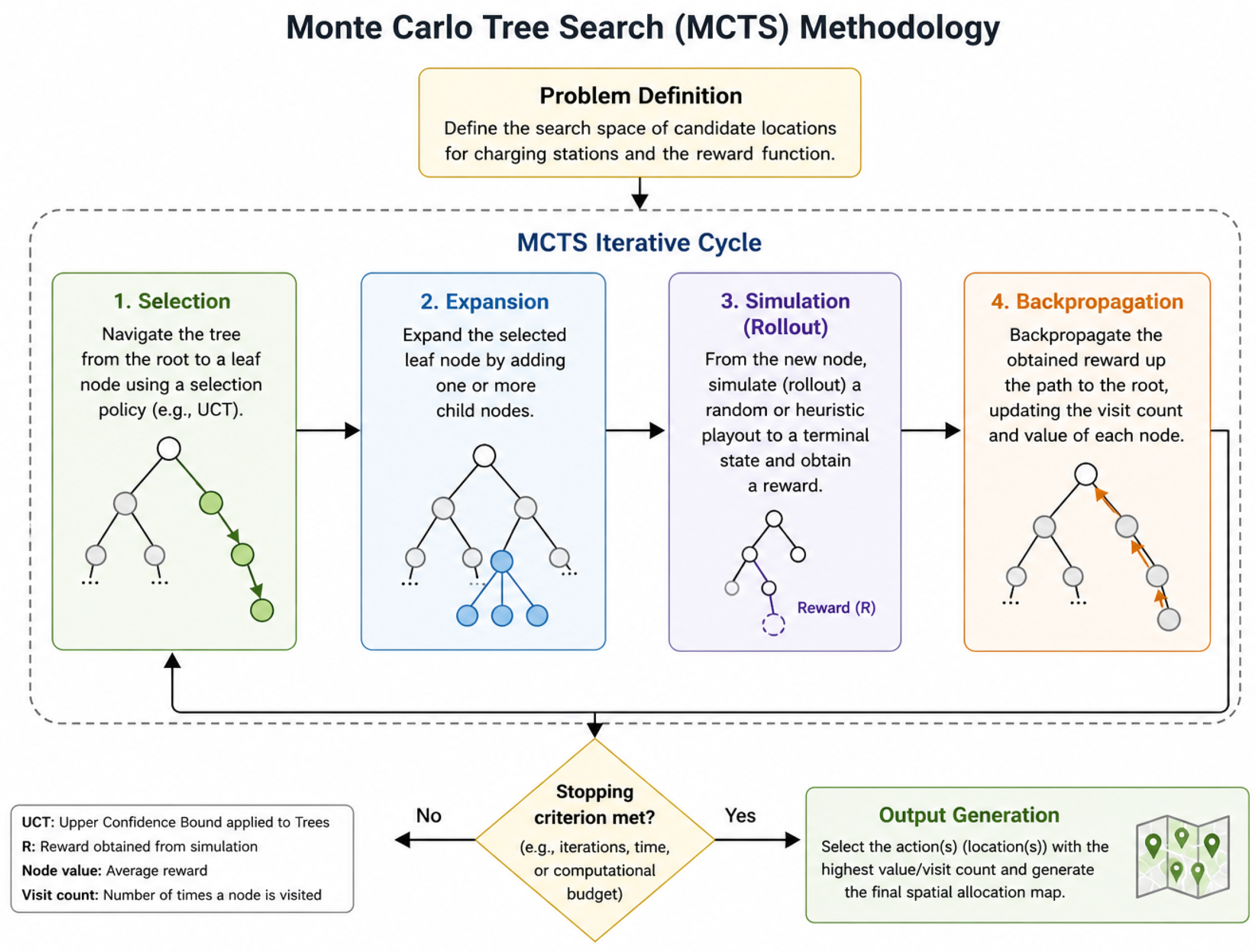
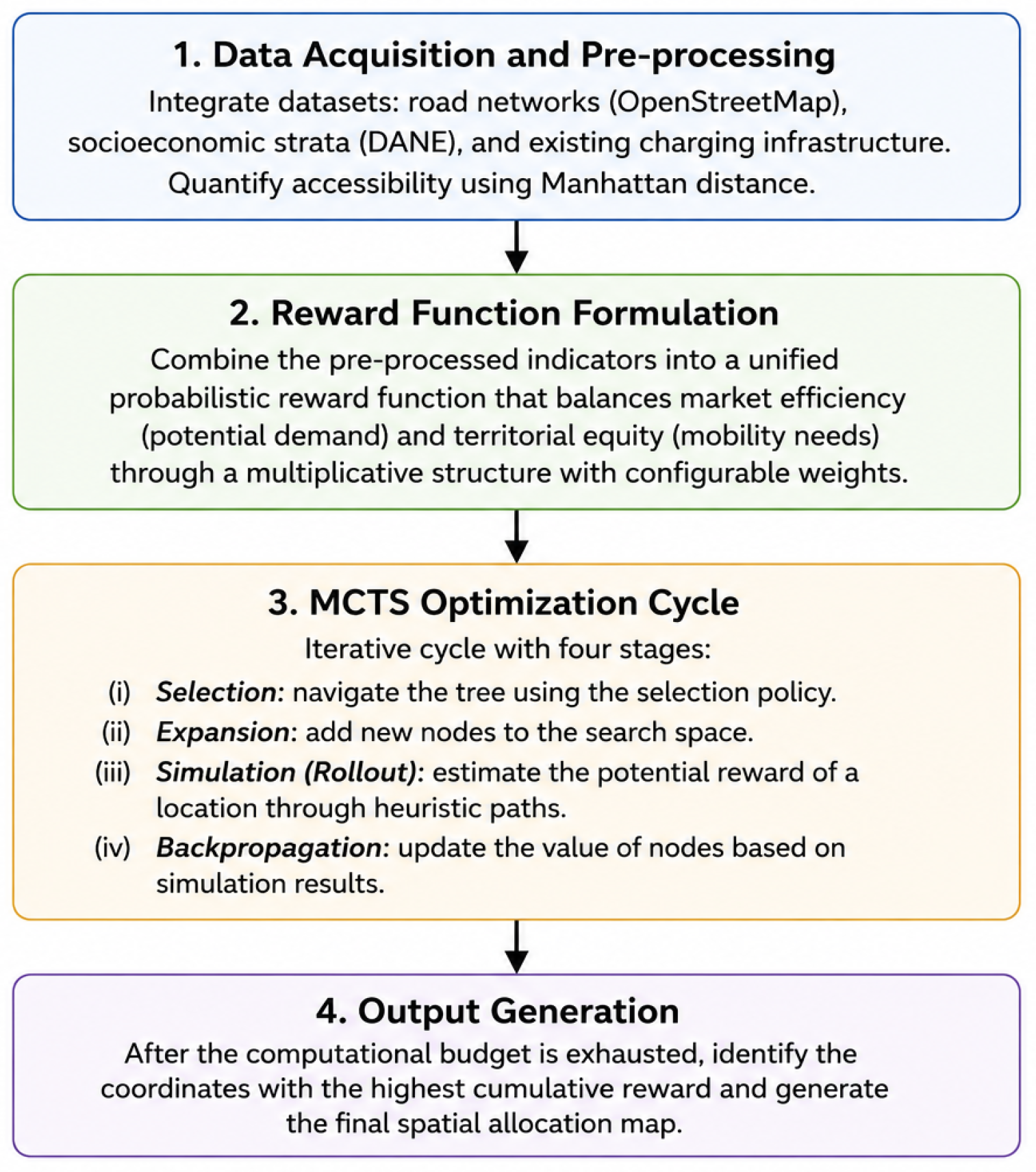
Monte Carlo Tree Search (MCTS) is a stochastic optimization method designed to efficiently explore large combinatorial decision spaces through an adaptive balance between exploration and exploitation [10]. In the context of electric vehicle (EV) infrastructure planning, the problem is formulated as a high-dimensional search task where each node in the search tree represents a partial configuration S t = { c i 1 , , c i t } of t charging stations. The algorithm incrementally constructs this tree through iterative cycles, as illustrated in the algorithmic diagram of Figure 1, which details the specific selection, expansion, simulation, and backpropagation loops. This core optimization engine is embedded as a centralized computational stage within the comprehensive multi-step geospatial pipeline, later detailed in Figure 2.
The MCTS engine executes four fundamental stages in each iteration to refine the spatial deployment strategy:
  • Selection: Starting from the root node (representing an empty configuration), the algorithm traverses the tree by selecting child nodes that maximize the Upper Confidence Bound for Trees (UCT) criterion:
    U C T = R ¯ i + c ln N n i
    where R ¯ i is the average reward observed from node i, N is the total number of visits to the parent node, n i denotes the visits to node i, and c is an exploration constant that balances the exploitation of high-reward regions against the sampling of less-visited branches [22].
  • Expansion: Upon reaching a leaf node that does not yet constitute a complete configuration ( t < K ), the tree is expanded by adding child nodes corresponding to new candidate locations from the feasible set C .
  • Simulation (Rollout): From the newly expanded node, a stochastic simulation is performed. To maintain computational efficiency, remaining charging stations are sampled using uniform or heuristic-guided playouts until a terminal state of size K is reached. The complex territorial interactions of Bogotá are then synthesized into a single reward value R.
  • Backpropagation: The terminal reward R ( S ) , calculated through the multi-criteria objective function, is propagated back through the visited path. This update refines the statistics ( R ¯ i and n i ) of all ancestral nodes, progressively guiding the search toward the most promising spatial deployments.
This MCTS engine iterative process, summarized in Figure 1, allows the algorithm to navigate the exponential growth of the solution space without requiring exhaustive enumeration. By treating territorial signals as modular components of the reward function, the MCTS provides a scalable alternative to traditional exact optimization methods in complex, heterogeneous urban environments [10,16].

2.4. Multi-Criteria Reward Function Design

The spatial optimization problem is formulated as the selection of a subset of candidate locations S C with fixed cardinality | S | = K , representing the deployment of K new electric vehicle charging stations. The objective is to identify the configuration that maximizes a territorial reward function R ( S ) , defined as
max S C , | S | = K R ( S )
where the reward function R ( S ) is expressed as:
R ( S ) = p P W ( p ) Δ d ( p , S ) λ 1 P n e w ( S ) λ 2 P e x i s t ( S )
In this formulation, P denotes the set of spatial evaluation points obtained from the discretization of the study area. The function Δ d ( p , S ) quantifies the improvement in accessibility at point p, measured as the reduction in the L 1 distance to the nearest charging station after the deployment of the set S. The composite weight W ( p ) integrates socioeconomic and functional dimensions:
W ( p ) = w d e m ( p ) α · w n e e d ( p ) β
The individual components of the weighting function are defined as follows:
  • Socioeconomic Demand ( w d e m ): A normalized proxy for potential EV adoption, defined as w d e m ( p ) = ( l e v e l ( p ) 1 ) / 5 , where l e v e l ( p ) { 1 , , 6 } . This linear mapping aligns with the observed power-law scaling between infrastructure coverage and socioeconomic levels.
  • Mobility Need ( w n e e d ): A proxy for structural accessibility gaps, calculated as w n e e d ( p ) = 1 I M n o r m ( p ) , where I M n o r m is the normalized Mobility Index.
The penalty terms P n e w ( S ) and P e x i s t ( S ) enforce spatial regularity by discouraging excessive clustering among newly selected stations and redundancy with existing infrastructure, respectively. This multi-signal design enables the MCTS algorithm to capture emergent spatial trade-offs between market-driven demand and territorial equity.
The reward function incorporates a multiplicative structure to weight socioeconomic demand and mobility needs. This design is intentional; it identifies locations where a ‘synergy’ of conditions exists. By multiplying these factors, the algorithm avoids selecting areas that excel in only one dimension (e.g., high demand but no transit flow) and instead prioritizes nodes that satisfy multiple urban criteria simultaneously. This ensures that the allocated stations serve as strategic hubs for both private users and systemic mobility needs.

2.4.1. Socioeconomic Demand as an MCTS Prior

In the Colombian urban planning context, Bogotá uses a socioeconomic stratification system officially regulated by the National Administrative Department of Statistics (DANE) and managed by the District Planning Secretariat [31,32]. This system classifies residential areas into six levels, with stratum 1 representing the lowest socioeconomic level and stratum 6 the highest. Originally designed as a technical tool for public policy to implement cross-subsidies in public services, the stratification has evolved into a key proxy for purchasing power and territorial development. Although this framework is specific to the Colombian administrative structure, its logic can be applied to other urban centers using similar metrics that capture income distribution and infrastructure quality. As a result, this system offers a standardized, high-granularity geospatial indicator to identify potential early adopters in technological transitions.
A linear mapping between socioeconomic strata and Electric Vehicle (EV) adoption potential is assumed. This premise is supported by the current local market structure in developing economies, where EV technology remains characterized by high upfront costs. Therefore, higher socioeconomic strata (5 and 6) represent the primary early adopters. This assumption serves as a strategic filter to prioritize locations with the highest immediate probability of use, ensuring the initial economic viability of the charging network.
To integrate socioeconomic information into the MCTS, the socioeconomic level is interpreted as a proxy for the potential demand for electric vehicles. For each spatial cell (candidate location) p, we define a normalized socioeconomic demand weight
w dem ( p ) = level ( p ) 1 5 , w dem ( p ) [ 0 , 1 ] ,
where level ( p ) { 1 , 2 , 3 , 4 , 5 , 6 } . This linear mapping yields a bounded, dimensionless feature that can be directly used within the Monte Carlo Tree Search (MCTS) reward model.
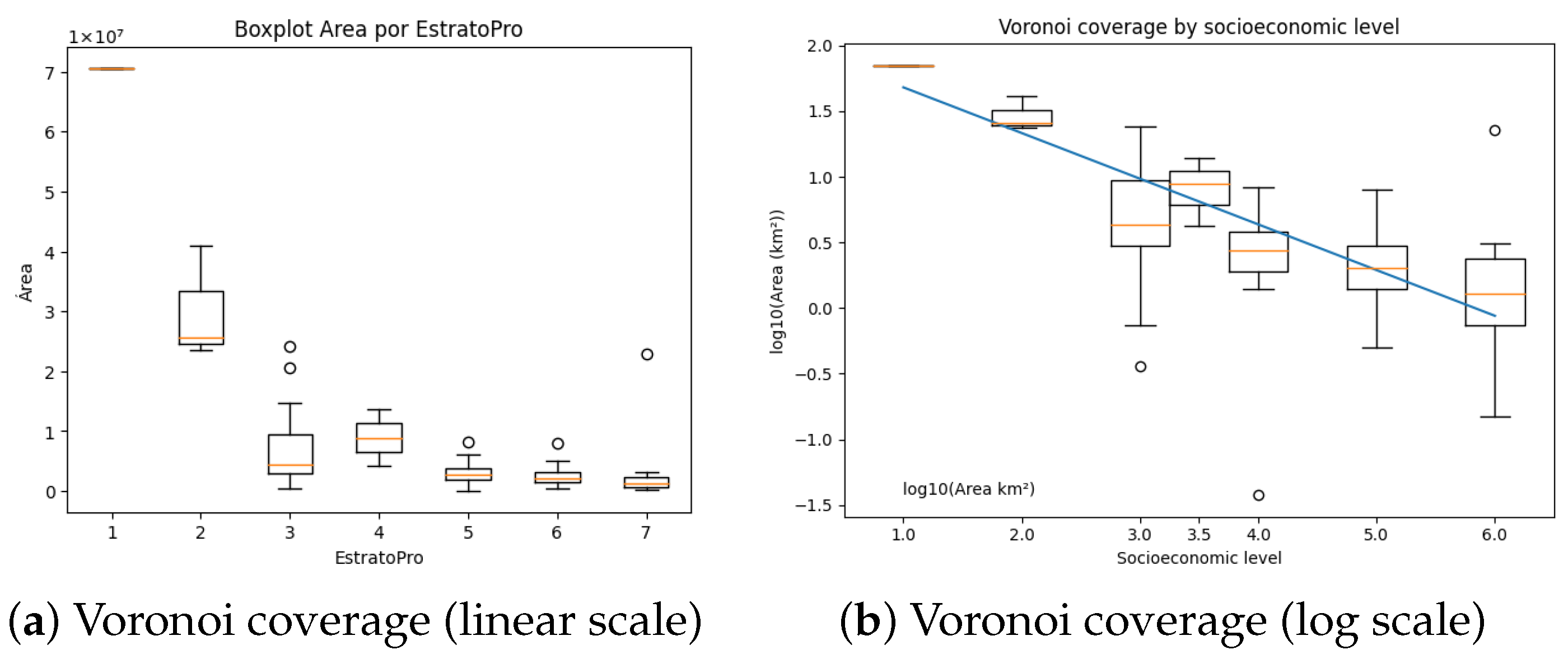
Empirically, the Voronoi coverage area associated with existing charging stations exhibits a scaling behavior with socioeconomic level, which becomes approximately linear on a logarithmic scale. This suggests a power-law relationship between coverage area and socioeconomic demand, which we express as
A ( p ) w dem ( p ) α ,
with α > 0 , where A ( p ) denotes the Voronoi coverage area. In the context of MCTS, Equation (7) motivates using w dem ( p ) as a structured prior: higher socioeconomic demand should, on average, correspond to smaller coverage areas (i.e., denser infrastructure), while lower demand is associated with larger coverage regions.
Accordingly, w dem ( p ) is incorporated into the node evaluation (reward) function as a demand-driven term that biases the search towards candidates with higher expected adoption potential, while preserving exploration through the standard MCTS selection rule (e.g., UCT). This design enables the algorithm to exploit observed scaling regularities (power-law behavior) as a heuristic signal, rather than assuming a purely planned or linear infrastructure deployment.

2.4.2. Mobility Need and Mobility Index

The Mobility Index ( M I ) is a composite geospatial metric designed to quantify the functional attractiveness and transit intensity of specific urban nodes within the Bogotá metropolitan area. Unlike static demand indicators, the M I acts as a proxy for territorial mobility conditions, capturing structural factors such as accessibility constraints, transport dependence, and spatial inequities. This index is based on the multidimensional framework established by the District Planning Secretariat [33], ensuring alignment with officially recognized planning instruments and enhancing the policy relevance of the approach. In this context, urban mobility is viewed as an inherently heterogeneous phenomenon, marked by significant spatial disparities across the city. By integrating dynamic variables—including proximity to the Integrated Public Transport System (SITP), TransMilenio trunk line density, and non-motorized transport flows—the M I identifies strategic “mobility hotspots” where the convergence of transport modes indicates both high accessibility and latent infrastructure demand.
For the specific context of Bogotá, the M I accounts for the city’s radial-concentric structure by integrating key territorial determinants through a principal component analysis (PCA) framework. This approach reduces dimensionality while preserving the dominant variance associated with mobility patterns, incorporating variables such as motorization rates, average travel times, and accessibility indicators for vulnerable or mobility-constrained populations. Additionally, the inclusion of the Manhattan distance to the nearest primary arterial road ensures consistency with the operational characteristics of Bogotá’s grid-constrained urban layout, reinforcing the spatial realism of the model.
To ensure comparability across spatial units, the index is normalized as
I M norm ( p ) = M I ( p ) M I min M I max M I min ,
yielding a bounded quantity in [ 0 ,   1 ] . Since higher values of the mobility index are associated with more favorable mobility conditions, the normalized index is inverted to explicitly represent territorial need:
w need ( p ) = 1 M I norm ( p ) .
Within the Monte Carlo Tree Search (MCTS) framework, w need ( p ) is incorporated as an independent signal that promotes the exploration of locations where infrastructure provision may alleviate structural mobility deficits. This formulation complements the socioeconomic demand prior by introducing a principled balance between expected adoption potential and territorial necessity. Accordingly, both weights, w dem ( p ) and w need ( p ) , are integrated into the node evaluation function, enabling the search process to simultaneously account for market-driven demand and equity-oriented accessibility considerations. This multi-signal design allows the MCTS algorithm to capture emergent spatial trade-offs without relying on purely proportional allocation rules or rigid centralized planning assumptions, thereby enhancing both the interpretability and practical relevance of the resulting infrastructure deployment strategies.

2.4.3. Optimization Using Monte Carlo Tree Search

The combinatorial nature of the charging station placement problem makes exhaustive search computationally intractable for realistic urban networks. To efficiently explore the space of candidate configurations, we employ a Monte Carlo Tree Search (MCTS) algorithm, which provides a balance between systematic exploration and stochastic sampling of the solution space.
In the proposed formulation, each node of the search tree represents a partial configuration of charging stations. At depth t, a node corresponds to a subset
S t = { c i 1 , , c i t } ,
where each element c i k denotes a selected candidate location from the feasible set C . The root node corresponds to the empty configuration, while deeper nodes represent progressively larger subsets of installed stations.
The selection of nodes during the tree traversal stage follows the Upper Confidence Bound applied to Trees (UCT) criterion:
U C T = R ¯ i + c ln N n i ,
where R ¯ i is the average reward obtained from simulations passing through node i; N denotes the number of visits to the parent node; n i is the number of visits to the child node; and c is a constant controlling the exploration–exploitation trade-off. Larger values of c encourage exploration of less-visited branches, while smaller values favor exploitation of promising configurations.
After node selection, the tree is expanded by adding a new candidate charging location to the current subset. When a node corresponding to a partial configuration S t is expanded, the rollout phase begins. During this phase, the remaining candidate locations are sampled uniformly without replacement until a complete configuration is obtained. The probability of selecting a candidate c at this stage is therefore
P ( c selected ) = 1 | remaining | ,
where remaining denotes the set of candidates not yet included in the current subset.
Importantly, territorial variables such as socioeconomic demand and mobility do not directly bias the sampling probability during rollout. Instead, these spatial attributes influence the evaluation stage through the reward function R ( S ) defined in the previous section. Once a full configuration S is generated, its reward is computed using the accessibility improvements and penalty terms described earlier.
The obtained reward is propagated back along the visited path in the search tree, updating the statistics of each node. This backpropagation step allows the algorithm to progressively refine its estimation of promising spatial configurations, guiding future exploration towards solutions that maximize accessibility improvements while balancing socioeconomic demand, mobility needs, and spatial coverage constraints.
A key strength of the proposed MCTS framework is the inclusion of configurable weights within the reward function, allowing the model to adapt to different urban planning objectives. While the base model identifies locations with high immediate demand potential, the weighting parameters ( ω i ) can be adjusted to prioritize territorial equity over market efficiency. By increasing the weight of the ‘Mobility Need’ or ‘Social Coverage’ indicators, the algorithm can be oriented toward egalitarian access policies. This flexibility ensures that infrastructure is not only deployed in high-income clusters but also in strategic nodes that provide essential charging services to underserved populations, thereby mitigating the risk of creating ‘charging deserts’ and supporting a just transition to electric mobility.

2.5. Computational Implementation and Geospatial Pipeline

The proposed methodology integrates geospatial preprocessing with stochastic optimization into a unified and reproducible computational pipeline. All spatial data operations were initially performed using QGIS 4.0 to ensure consistent territorial data across heterogeneous datasets, including socioeconomic strata, mobility indices, and urban points of interest. These datasets were transformed into a common coordinate reference system, specifically SIRGAS-Hormonal for the Bogotá case study, to preserve geometric accuracy during spatial analysis. A key step in this stage was generating L1-based Voronoi partitions to estimate the functional coverage areas of the existing charging infrastructure. Using spatial joins and zonal statistics, aggregated territorial variables were extracted for each Voronoi cell, forming the empirical basis for the multi-criteria weights applied in the optimization stage.
The optimization framework was subsequently implemented from scratch in Python 3.12.13, utilizing a scientific computing stack composed of NumPy 2.0.2 for numerical operations, Pandas 2.2.2 for data management, and Matplotlib 3.10.0 for visualizing results. The MCTS algorithm was designed using high-performance, vectorized data structures to ensure computational scalability, allowing the exploration of large candidate sets without the overhead typically associated with complex tree searches. By embedding the multi-criteria reward function directly into the backpropagation step, the algorithm iteratively refines the expected value of potential configurations based on the spatial signals of demand, necessity, and accessibility gain. This integrated approach, combining robust geospatial analysis with custom algorithmic execution, provides a flexible decision-support tool for large-scale urban energy planning.

2.6. Model Limitations and Scope

Despite the robustness of the MCTS framework in handling spatial complexity, certain limitations must be acknowledged to define the scope of this study. First, the proposed model is static; it provides an optimal ‘snapshot’ based on current geospatial and socioeconomic data but does not explicitly incorporate the temporal evolution of EV demand or dynamic urban growth. Future iterations could integrate multi-stage stochastic programming to address long-term uncertainty.
Second, as a heuristic search method, MCTS does not offer formal guarantees of mathematical optimality, unlike exact methods such as Mixed-Integer Linear Programming (MILP). However, this trade-off is justified by the algorithm’s superior scalability in handling the ‘spatial combinatorial explosion’ of dense urban grids, where exact solvers often become computationally infeasible. Finally, the model’s performance is inherently sensitive to the definition of the reward function and the quality of the input data, highlighting its role as a strategic decision-support tool rather than an absolute predictive system.

2.7. Methodological Pipeline

To ensure reproducibility and clarity, the proposed method is organized as a coherent overall methodological pipeline (see Figure 2). This workflow combines geospatial preprocessing with the iterative search logic of the Monte Carlo Tree Search (MCTS) algorithm, as described below:
  • Data Acquisition and Pre-processing: In this initial stage, heterogeneous datasets including road networks from OpenStreetMap, socioeconomic strata from DANE, and existing charging infrastructure are integrated. Accessibility is quantified using the Manhattan distance to reflect the city’s grid-based topology.
  • Reward Function Formulation: The pre-processed indicators are combined into a unified probabilistic reward function. This function balances market efficiency (potential demand) and territorial equity (mobility needs) through a multiplicative structure with configurable weights.
  • MCTS Optimization Cycle: The method consists of an iterative cycle of four stages:
    • Selection: Navigating the tree using the selection policy.
    • Expansion: Adding new nodes to the search space.
    • Simulation (Rollout): Estimating the potential reward of a location through heuristic paths.
    • Backpropagation: Updating the value of nodes based on simulation results.
  • Output Generation: Once the computational budget is exhausted, the algorithm identifies the coordinates with the highest cumulative reward, generating the final spatial allocation map.

3. Results and Discussion

3.1. Spatial Characterization and Empirical Scaling of Charging Infrastructure

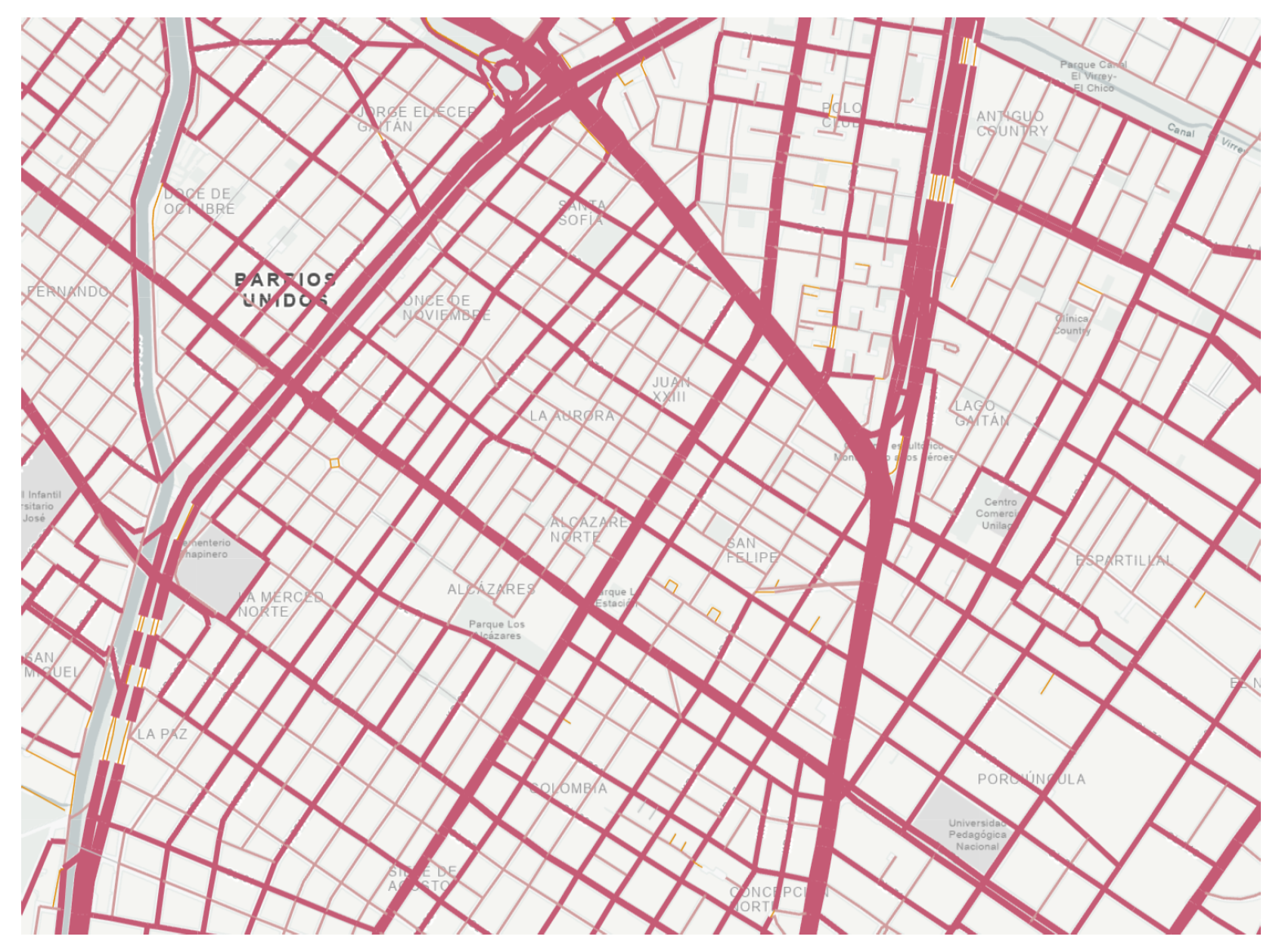
The territorial distribution of existing electric vehicle (EV) charging infrastructure in Bogotá was analyzed through Voronoi spatial tessellation to construct a proxy indicator for service demand intensity. Under the hypothesis that smaller influence areas reflect a higher concentration of potential users and infrastructure saturation, the geometric sizes of the Voronoi regions were utilized as a benchmark variable to explore correlations with other urban attributes. To ensure a realistic representation of urban accessibility, these regions were generated using an L 1 metric. This choice is specifically justified by the orthogonal structure of Bogotá’s road network, where actual vehicle displacements are better approximated by rectilinear paths along primary axes than by direct Euclidean distances (Figure 3).
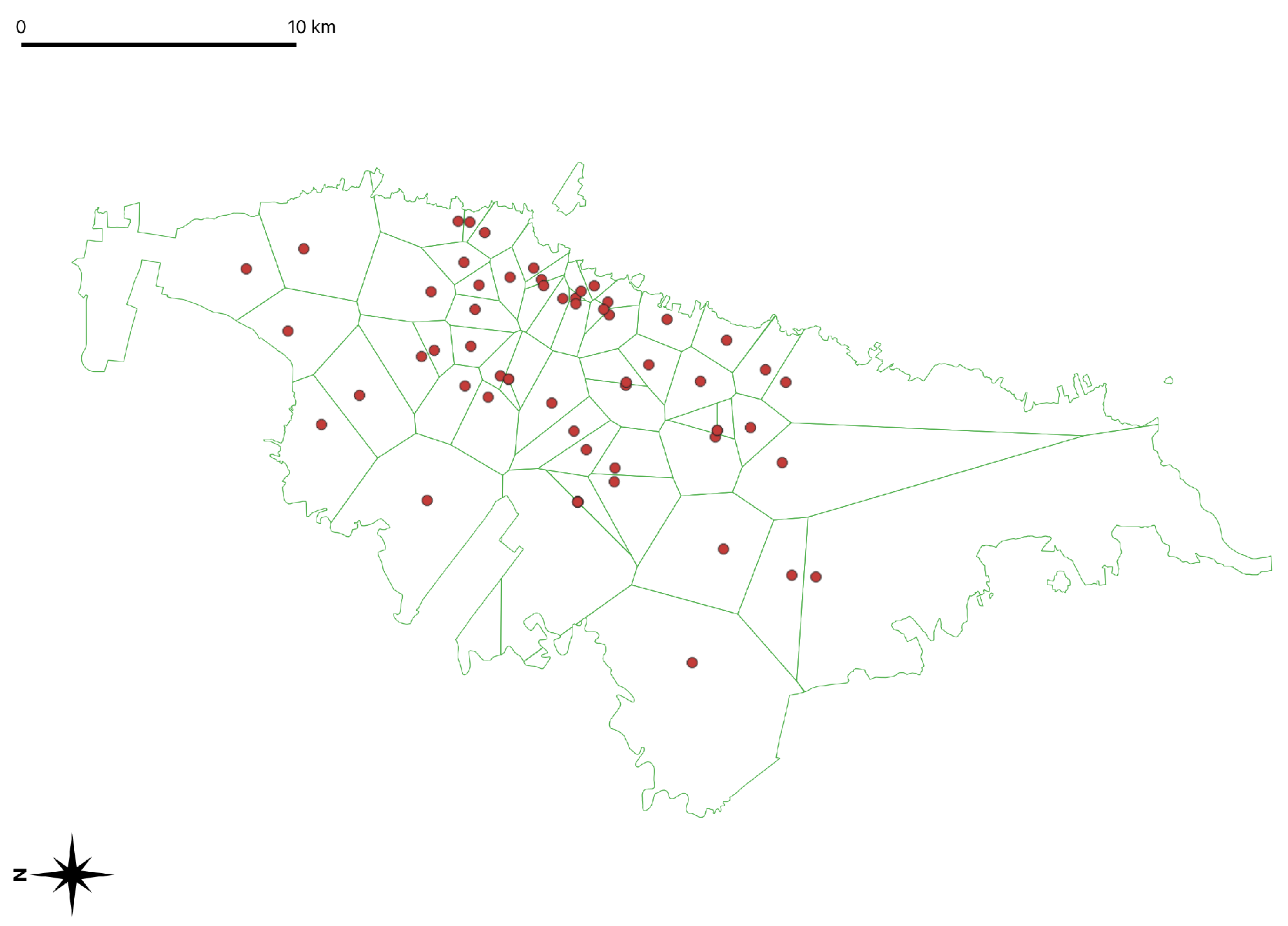
The spatial segmentation, illustrated in Figure 4, reveals significant territorial disparities. By integrating aggregate indicators for each Voronoi cell, a correlation analysis highlighted socioeconomic level, MI, and vehicle ownership as the most influential factors explaining spatial variability. Notably, the distribution of coverage areas across socioeconomic levels shows a systematic trend: while lower socioeconomic strata exhibit substantially larger and more dispersed coverage areas (indicating that individual stations must serve broader, underserved territories), higher socioeconomic strata are characterized by smaller, more compact regions, suggesting denser, more mature infrastructure deployment.
When examined on a logarithmic scale (Figure 5), the relationship between Voronoi coverage area and socioeconomic level follows an approximately linear trend, suggesting a power-law scaling behavior. Such scaling is characteristic of complex spatial systems where global patterns emerge from decentralized market dynamics rather than centralized planning [34,35]. This power-law behavior supports the interpretation that the current distribution reflects an adaptive spatial organization shaped by demand concentration and urban density. In the context of MCTS optimization, these empirical regularities serve as a structured prior; by embedding this scaling behavior into the reward function, the algorithm is guided towards configurations that respect the underlying urban structure while identifying underserved zones with high adoption potential.
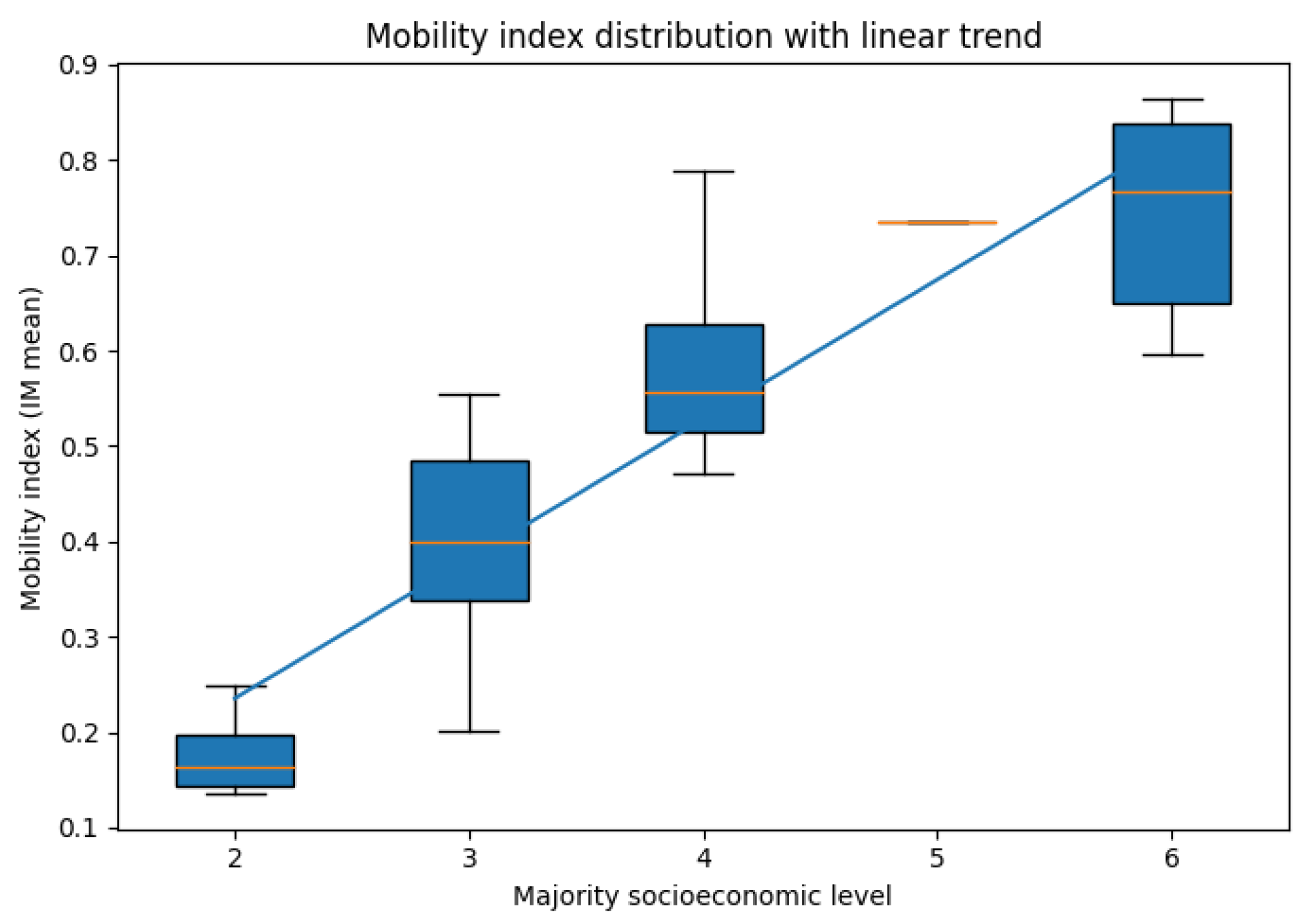
Furthermore, the relationship between the MI and the predominant socioeconomic level reveals a clear structural pattern. As shown in Figure 6, MI tends to increase with socioeconomic level, indicating that higher socioeconomic conditions generally correlate with better mobility indicators. The fitted linear trend, M I = 0.146 × 10 0.06 , captures this systematic association while allowing for local variability driven by urban morphology and territorial dynamics.
Regarding the results presented in Figure 5 and Figure 6, the presence of outliers was carefully examined. These extreme values do not represent measurement errors but correspond to specific “urban hotspots” characterized by atypical density and high-impact transit activity, such as the Avenida El Dorado corridor and the Calle 100 node. To ensure model reliability, a rigorous data-cleaning process filtered out technical artifacts while preserving these real-world anomalies, as they represent strategic locations for deployment. The dataset, validated against official records from the District Planning Secretariat and the Mobility Observatory, ensures that the MCTS search space remains grounded in Bogotá’s operational reality [36].

3.2. Candidate Selection and MCTS Optimization Results

The set of candidate locations for potential charging station deployment was derived from publicly accessible points of interest within the study area. These locations correspond to urban facilities that naturally provide parking availability or attract significant vehicle traffic, making them suitable sites for charging infrastructure. To identify these locations, data were obtained from OpenStreetMap (OSM) using the Overpass API to extract points associated with relevant tags such as amenity = parking, amenity = hospital, amenity = university, shop = mall, and related categories. These tags correspond to facilities where prolonged dwell times are common, making them appropriate candidates for the feasible set C .
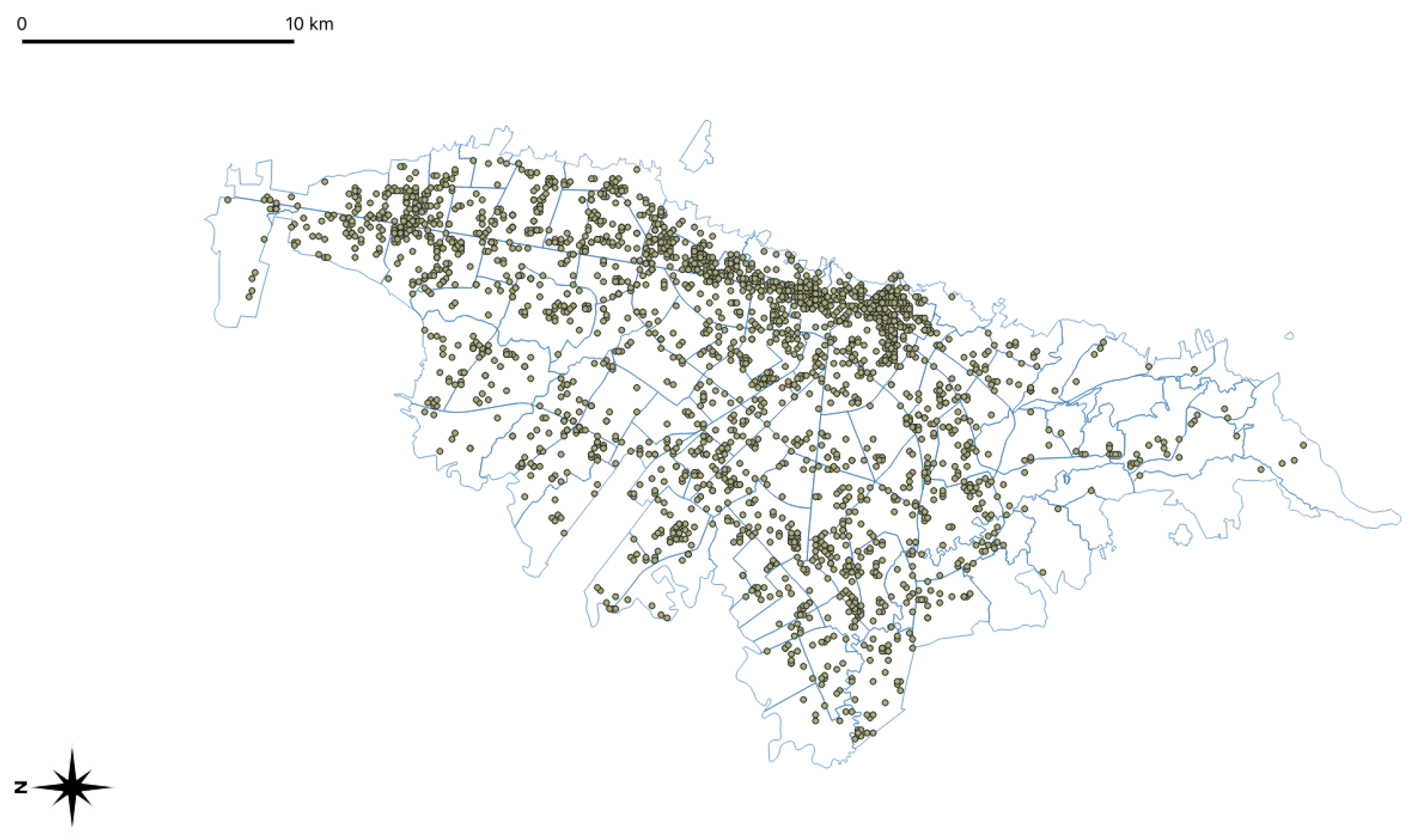
Figure 7 illustrates the spatial distribution of the resulting candidate locations. The dense concentration in central urban zones reflects higher facility availability, while peripheral regions present lower density. These points were spatially validated and harmonized within a GIS environment to ensure consistency with the territorial datasets.
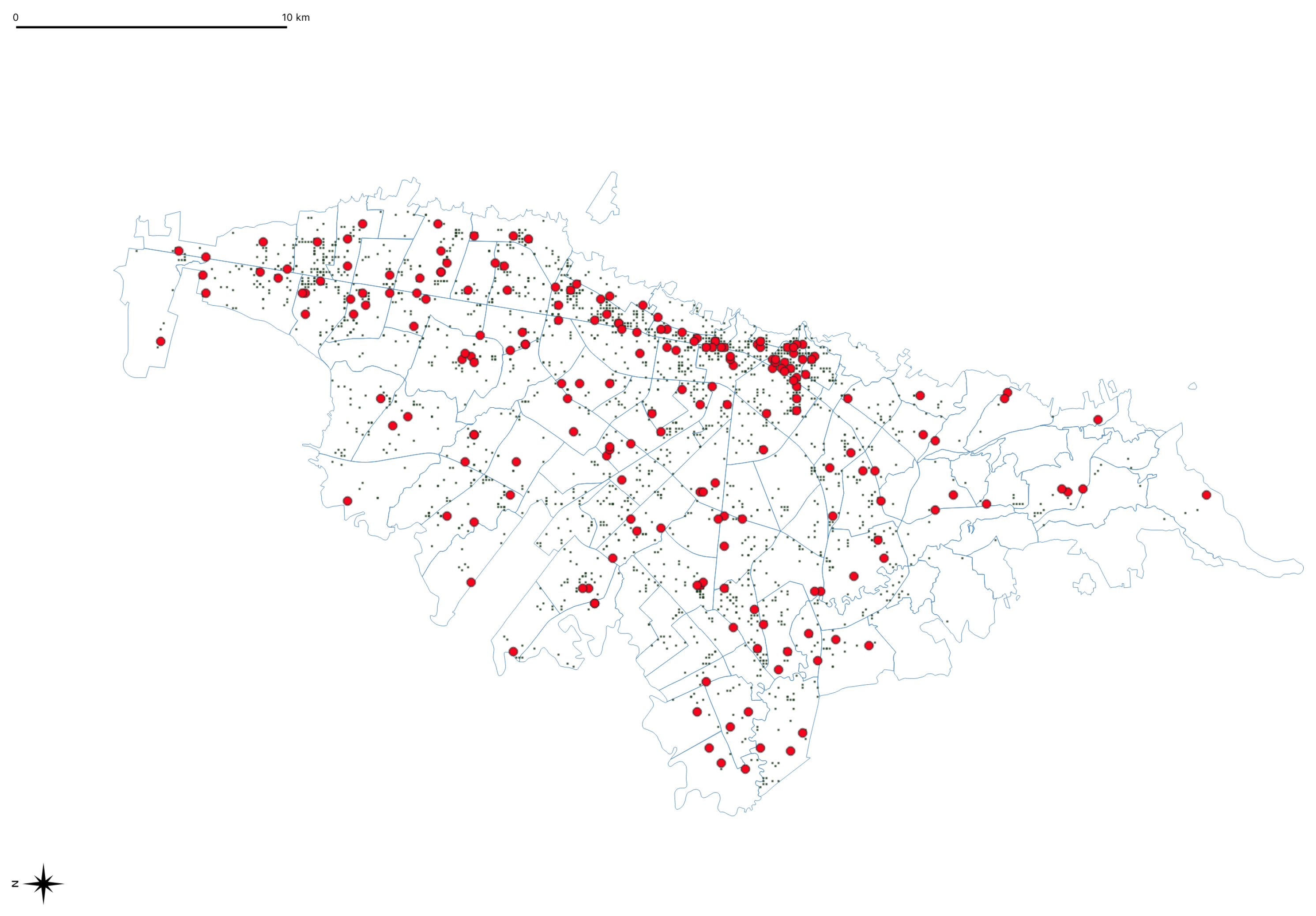
The spatial distribution of the 200 charging stations obtained through the MCTS optimization process is shown in Figure 8. The resulting pattern reflects the interaction between spatial accessibility and the territorial variables. A higher concentration is observed in the northeastern corridor and the extended city center, areas with higher socioeconomic levels and vehicle density, consistent with the identified adoption potential. Additionally, the algorithm allocates stations in peripheral regions with larger Voronoi polygons to minimize accessibility gaps, achieving a balance between territorial coverage and potential demand.
The scalability of this framework is supported by its probabilistic exploration-exploitation engine, which bypasses the computational bottlenecks of exhaustive enumeration. By utilizing MCTS, the model efficiently navigates high-dimensional combinatorial spaces without requiring restrictive linearity assumptions. The integration of modular components like the I M ensures adaptability to other heterogeneous urban environments [37].
While traditional facility location models, such as the p-median and MCLP, provide tractable solutions for small-scale instances [38], they often struggle with combinatorial explosion in finely discretized urban domains [12]. In contrast, our MCTS framework progressively refines spatial configurations through randomized simulations, offering greater scalability than exact MILP formulations [10]. Unlike purely metaheuristic approaches, the integration of the Upper Confidence Bound (UCT) ensures a robust balance between exploring underserved zones and exploiting high-demand areas. By explicitly embedding power-law scaling and structural mobility indices, this methodology addresses the socio-spatial tensions between economic efficiency and territorial equity often overlooked in the literature [22].
The results provide strong evidence supporting the suitability of Monte Carlo Tree Search (MCTS) for spatial optimization in complex urban systems. In contrast to greedy or clustering-based approaches, which typically rely on myopic decision rules and are prone to suboptimal local configurations, MCTS frames the problem as a sequential decision process. This formulation explicitly captures the interdependence among successive location choices, enabling the construction of solutions that are globally coherent rather than locally optimal.
Relative to evolutionary methods such as Genetic Algorithms (GA) and Particle Swarm Optimization (PSO), MCTS offers a more principled exploration of the solution space. While population-based methods depend on heuristic operators and sensitive parameter tuning, MCTS leverages a tree-based structure combined with statistically grounded policies, such as Upper Confidence Bounds for Trees (UCT), to balance exploration and exploitation. This results in a more efficient navigation of high-dimensional, non-convex landscapes, which are characteristic of urban environments where spatial, socioeconomic, and infrastructural factors interact in complex and non-linear ways.
A key advantage of the proposed framework lies in its ability to incorporate rich, non-linear reward formulations without requiring restrictive assumptions. The multiplicative structure adopted in this study enables the simultaneous representation of demand-driven efficiency and territorial equity, preserving their intrinsic trade-offs. Unlike additive or linearized formulations, this approach avoids compensatory effects that may otherwise mask critical spatial inequalities, thereby providing a more faithful representation of the underlying system dynamics.
The anytime property of MCTS constitutes a significant practical benefit, as it yields progressively improved solutions under increasing computational budgets. This feature enhances its applicability in real-world planning scenarios, where computational resources and decision timelines are often constrained. Overall, the findings position MCTS as a robust, flexible, and scalable framework for infrastructure planning in complex urban settings, particularly when addressing multi-objective problems under uncertainty and strong spatial interdependencies.

4. Conclusions

This study presents a spatial optimization framework for placing electric vehicle charging infrastructure that integrates accessibility, socioeconomic demand, and territorial mobility conditions within a unified computational model. The proposed approach combines geospatial analysis with Monte Carlo Tree Search (MCTS) optimization, enabling the exploration of large combinatorial configuration spaces without exhaustive enumeration. By incorporating accessibility improvements, socioeconomic demand proxies, and mobility-based territorial needs into the reward function, the model offers a flexible decision-support tool for the strategic expansion of charging infrastructure in complex urban environments.
The spatial analysis conducted for the case study of Bogotá revealed structural relationships between the distribution of existing charging infrastructure and key territorial variables. In particular, the analysis of Voronoi coverage areas showed that charging infrastructure density varies systematically with socioeconomic level. When represented on a logarithmic scale, the coverage areas exhibit an approximately linear trend, suggesting a power-law relationship between infrastructure coverage and socioeconomic demand. This scaling behavior indicates that the current spatial distribution of charging stations follows emergent patterns shaped by market dynamics, urban density, and mobility conditions rather than purely centralized planning.
These empirical observations were incorporated into the optimization framework through the definition of demand and mobility weights used in the MCTS reward function. The resulting optimization process, therefore, does not rely solely on geometric proximity but instead integrates territorial signals derived from socioeconomic structure and mobility conditions. The simulation results show that the proposed method produces spatial configurations that simultaneously reduce accessibility gaps, prioritize areas with higher EV adoption potential, and avoid excessive clustering through geometric penalty terms.
Overall, the proposed methodology demonstrates that stochastic tree-search algorithms such as MCTS can effectively address the complexity of large-scale infrastructure planning problems. By integrating geospatial analysis, territorial indicators, and probabilistic optimization into a single framework, the approach offers a scalable and adaptable tool for urban energy planning. Future research may extend this framework by incorporating dynamic demand projections, transportation network constraints, and electrical grid capacity considerations, further enhancing the applicability of the model for long-term sustainable mobility planning.

Author Contributions

Conceptualization, D.J.R.P.; methodology, D.J.R.P.; software, D.J.R.P.; validation, D.J.R.P. and J.F.P.B.; formal analysis, D.J.R.P. and J.F.P.B.; investigation, D.J.R.P. and J.F.P.B.; resources, J.F.P.B.; data curation, J.F.P.B.; writing—original draft, D.J.R.P.; writing—review and editing, D.J.R.P., J.F.P.B. and F.N.G.R.; supervision, D.J.R.P. All authors have read and agreed to the published version of the manuscript.

Funding

This research received no external funding.

Institutional Review Board Statement

Not applicable.

Informed Consent Statement

Not applicable.

Data Availability Statement

The data presented in this study are available on request from the corresponding author. Part of the spatial data was obtained from OpenStreetMap and DANE public repositories.

Acknowledgments

The author would like to express his gratitude to the Doctorate in Engineering (Doctorado en Ingeniería) at the Universidad Distrital Francisco José de Caldas for the institutional and academic support provided during this research. During the preparation of this manuscript, the author used Gemini (version 1.5 Pro/Flash) for the purposes of technical writing assistance, linguistic refinement, and LaTeX formatting. The author has reviewed and edited the output and takes full responsibility for the content of this publication.

Conflicts of Interest

The author declares no conflict of interest. The funders had no role in the design of the study; in the collection, analyses, or interpretation of data; in the writing of the manuscript; or in the decision to publish the results.

References

  1. Bukit, F.R.A.; Zulkarnain, H.; Kusuma, C.P. Optimizing electric vehicle charging station placement integrates distributed generations and network reconfiguration. Int. J. Electr. Comput. Eng. 2024, 14, 4929–4939. [Google Scholar] [CrossRef]
  2. Shukla, M.; Singh, D.K.; Yadav, A.; Singh, A.K.; Jumaa, N.A.; Mohammed, A. Optimizing Electric Vehicle Charging Station Placement in Urban Areas: A Data-Driven Approach. In 2023 3rd International Conference on Advance Computing and Innovative Technologies in Engineering (ICACITE); IEEE: Piscataway, NJ, USA, 2023; pp. 2835–2838. [Google Scholar] [CrossRef]
  3. Lamontagne, S.; Carvalho, M.; Frejinger, E.; Gendron, B.; Anjos, M.F.; Atallah, R. Optimising Electric Vehicle Charging Station Placement Using Advanced Discrete Choice Models. Inf. J. Comput. 2023, 35, 1195–1213. [Google Scholar] [CrossRef]
  4. Zafar, U.; Bayram, I.S.; Bayhan, S. A GIS-based Optimal Facility Location Framework for Fast Electric Vehicle Charging Stations. In 2021 IEEE 30th International Symposium on Industrial Electronics (ISIE); IEEE: Piscataway, NJ, USA, 2021; Volume 2021. [Google Scholar] [CrossRef]
  5. Huang, Y.; Ren, H.; Liu, Z.; Chen, D. A Hierarchical Spatio-Temporal Framework for Sustainable and Equitable EV Charging Station Location Optimization: A Case Study of Wuhan. Sustainability 2026, 18, 497. [Google Scholar] [CrossRef]
  6. Liu, Y.S.; Tayarani, M.; You, F.; Gao, H.O. Bayesian optimization for battery electric vehicle charging station placement by agent-based demand simulation. Appl. Energy 2024, 375, 123975. [Google Scholar] [CrossRef]
  7. Roy, A.; Law, M. Examining spatial disparities in electric vehicle charging station placements using machine learning. Sustain. Cities Soc. 2022, 83, 103978. [Google Scholar] [CrossRef]
  8. Yuan, S.; Fu, J.; Ma, X. Fairness-Oriented Charging Station Location Optimization Driven by Deep Reinforcement Learning. IEEE Access 2025, 13, 125217–125231. [Google Scholar] [CrossRef]
  9. Li, Q.; Zhao, N.; Carroll, P. Planning equitable on-street residential EV charging infrastructure: Evidence from Dublin City. J. Transp. Geogr. 2026, 130, 104473. [Google Scholar] [CrossRef]
  10. Kadri, A.A.; Perrouault, R.; Boujelben, M.K.; Gicquel, C. A multi-stage stochastic integer programming approach for locating electric vehicle charging stations. Comput. Oper. Res. 2020, 117, 104888. [Google Scholar] [CrossRef]
  11. Bae, S.; Jang, I.; Gros, S.; Kulcsar, B.; Hellgren, J. A Game Approach for Charging Station Placement Based on User Preferences and Crowdedness. IEEE Trans. Intell. Transp. Syst. 2022, 23, 3654–3669. [Google Scholar] [CrossRef]
  12. Lam, A.Y.S.; Leung, Y.W.; Chu, X. Electric vehicle charging station placement: Formulation, complexity, and solutions. IEEE Trans. Smart Grid 2014, 5, 2846–2856. [Google Scholar] [CrossRef]
  13. Shareef, H.; Islam, M.M.; Mohamed, A. A review of the stage-of-the-art charging technologies, placement methodologies, and impacts of electric vehicles. Renew. Sustain. Energy Rev. 2016, 64, 403–420. [Google Scholar] [CrossRef]
  14. Xiong, Y.; Gan, J.; An, B.; Miao, C.; Bazzan, A.L. Optimal electric vehicle fast charging station placement based on game theoretical framework. IEEE Trans. Intell. Transp. Syst. 2018, 19, 2493–2504. [Google Scholar] [CrossRef]
  15. Dinc Yalcin, G.; Ozsoy, C.Y.; Taskin, Y. A multi-objective mathematical model for the electric vehicle charging station placement problem in urban areas. Int. J. Sustain. Energy 2022, 41, 945–961. [Google Scholar] [CrossRef]
  16. Parent, P.L.; Carvalho, M.; Anjos, M.F.; Atallah, R. Maximum flow-based formulation for the optimal location of electric vehicle charging stations. Networks 2024, 84, 109–131. [Google Scholar] [CrossRef]
  17. Chen, F.; Peng, Y.; Han, B.; Lu, S.; Xue, F.; Li, G. Robust Planning of Electric Vehicle Charging Stations Considering Demand Uncertainty and Facility Failures. IEEE Trans. Transp. Electrif. 2024, 10, 7551–7564. [Google Scholar] [CrossRef]
  18. Soliman, I.A.; Tulsky, V.; Abd El-Ghany, H.A. Optimizing Electric Vehicle Charging Station Placement in Distribution Systems for Enhanced Power Grid Performance. In 2024 International Ural Conference on Electrical Power Engineering (UralCon); IEEE: Piscataway, NJ, USA, 2024; pp. 16–22. [Google Scholar] [CrossRef]
  19. Wu, K.; Li, W. Dynamic spatiotemporal electric vehicle charging station placement and pricing using mixed integer linear programming. J. Energy Storage 2026, 150, 120558. [Google Scholar] [CrossRef]
  20. Altundogan, T.G.; Yildiz, A.; Karakose, E. Genetic Algorithm Approach based on Graph Theory for Location Optimization of Electric Vehicle Charging Stations. In 2021 Innovations in Intelligent Systems and Applications Conference (ASYU); IEEE: Piscataway, NJ, USA, 2021. [Google Scholar] [CrossRef]
  21. Zhou, G.; Zhu, Z.; Luo, S. Location optimization of electric vehicle charging stations: Based on cost model and genetic algorithm. Energy 2022, 247, 123437. [Google Scholar] [CrossRef]
  22. Mrkos, J.; Basmadjian, R. Dynamic Pricing for Charging of EVs with Monte Carlo Tree Search. Smart Cities 2022, 5, 223–240. [Google Scholar] [CrossRef]
  23. Secretaría Distrital de Planeación de Bogotá. Mapas y Cartografía Oficial de Bogotá D.C. 2026. Available online: https://www.sdp.gov.co/node/36151 (accessed on 5 May 2026).
  24. Departamento Administrativo Nacional de Estadística (DANE). Archivo Nacional de Datos (ANDA): Repositorio Institucional de Microdatos. 2026. Available online: https://microdatos.dane.gov.co/index.php/catalog/central/about (accessed on 5 May 2026).
  25. Bogotá Cómo Vamos. Portal de Datos: Indicadores de Calidad de Vida y Movilidad en Bogotá. 2026. Available online: https://bogotacomovamos.org/datos/ (accessed on 5 May 2026).
  26. Observatorio de Movilidad de Bogotá. Mapas y Datos Abiertos de Movilidad y Seguridad Vial. 2026. Available online: https://observatorio.movilidadbogota.gov.co/ (accessed on 5 May 2026).
  27. OpenStreetMap Contributors. Planet OSM: Data Derived from OpenStreetMap. 2026. Available online: https://www.openstreetmap.org (accessed on 5 May 2026).
  28. Pantoja, J.; Melo, O.; Rodríguez, D.J. Characterization of urban mobility in Bogota: A spatial autocorrelation analysis. J. Appl. Res. Technol. 2024, 22, 886–896. [Google Scholar] [CrossRef]
  29. Pantoja Benavides, J.F.; Rodríguez Patarroyo, D.J.; Salamanca, J. Determinant Factors in Estimating Charging Stations for Electric Vehicles in Bogotá Using Voronoi Regionsá. Cienc. E Ing. Neogranadina 2025, 35, 141–160. [Google Scholar] [CrossRef]
  30. Figurska, M.; Dawidowicz, A.; Zysk, E. Voronoi Diagrams for Senior-Friendly Cities. Int. J. Environ. Res. Public Health 2022, 19, 7447. [Google Scholar] [CrossRef]
  31. Departamento Administrativo Nacional de Estadística (DANE). La Estratificación Socioeconómica en los Servicios Públicos Domiciliarios (SPD). 2024. Available online: https://www.dane.gov.co/files/geoestadistica/Estratificacion_en_SPD.pdf (accessed on 8 May 2026).
  32. Consejo Nacional de Política Económica y Social (CONPES). CONPES Social 160: Estrategia Para el Fortalecimiento del Sistema de Estratificación Socioeconómica. 2013. Available online: https://www.dane.gov.co/files/geoestadistica/ConpesSocial160_14-02-2013.pdf (accessed on 8 May 2026).
  33. Secretaría Distrital de Planeación. Índice de Movilidad en Bogotá, D.C. Carlos Alberto Velásquez Vega. Sub-secretaría de Información y Estudios Estratégicos. 2013. Available online: https://www.sdp.gov.co/sites/default/files/dice142-boletinindicemovilidad-04122013_0.pdf (accessed on 6 May 2026).
  34. Batty, M. The Size, Scale, and Shape of Cities. Science 2008, 319, 769–771. [Google Scholar] [CrossRef]
  35. Zhao, K.; Musolesi, M.; Hui, P.; Rao, W.; Tarkoma, S. Explaining the power-law distribution of human mobility through transportationmodality decomposition. Sci. Rep. 2015, 5, 9136. [Google Scholar] [CrossRef] [PubMed]
  36. Pierri-Daunt, A.B.; Siedentop, S. Unravelling urban typologies in Latin American cities: Integrating socioeconomic factors and urban configurations across scales. Appl. Geogr. 2025, 174, 103460. [Google Scholar] [CrossRef]
  37. Świechowski, M.; Godlewski, K.; Sawicki, B.; Mańdziuk, J. Monte Carlo Tree Search: A review of recent modifications and applications. Artif. Intell. Rev. 2023, 56, 2497–2562. [Google Scholar] [CrossRef]
  38. Janjić, A.; Velimirović, L.; Velimirović, J.; Vranić, P. Estimating the optimal number and locations of electric vehicle charging stations: The application of multi-criteria p-median methodology. Transp. Plan. Technol. 2021, 44, 827–842. [Google Scholar] [CrossRef]
Figure 1. Flowchart of the Monte Carlo Tree Search (MCTS) methodology. Colored circles represent distinct algorithm stages: green circles denote the Selection phase (node selection based on the Upper Confidence Bound for Trees criterion), blue circles represent the Expansion phase (addition of new candidate nodes to the search space), and orange arrows indicate the Simulation (stochastic rollout of configurations) and Backpropagation phases (reward propagation through the tree). The algorithm iteratively performs these four stages until a stopping criterion is met, after which the optimal charging-station allocation solution is generated.
Urbansci 10 00316 g001
Figure 2. Overall methodological pipeline workflow of the MCTS-based spatial optimization.
Urbansci 10 00316 g002
Figure 3. Detailed view of the Bogotá road map and network topology. The grid-constrained urban environment motivates the use of a rectilinear distance formulation to accurately represent travel paths between candidate charging-station locations and demand points within the MCTS framework.
Urbansci 10 00316 g003
Figure 4. Spatial segmentation using Voronoi diagrams constructed from existing charging stations (centroids) for Bogotá, Colombia. The red dots represent approximate influence areas based on a proximity criterion, and the boundary corresponds to the study area limit.
Urbansci 10 00316 g004
Figure 5. Spatial coverage area of electric vehicle charging infrastructure across socioeconomic levels in Bogotá. (a) Voronoi coverage (linear scale): Box plots display the distribution of Voronoi area per charging station across socioeconomic strata. The horizontal line within each box represents the median coverage area. (b) Voronoi coverage (log scale): The blue trend line represents the fitted linear regression that illustrates power-law scaling behavior on a logarithmic scale, capturing the systematic relationship between infrastructure coverage and socioeconomic stratification. Circles represent outliers in both panels.
Urbansci 10 00316 g005
Figure 6. Distribution of the mobility index (MI) across the majority of socioeconomic levels in Bogotá. Box plots display the distribution of MI values for each socioeconomic level. The orange horizontal line within each box represents the median MI value for that socioeconomic level. The blue trend line represents the fitted linear regression that captures the systematic association between MI and socioeconomic level while accounting for local variability driven by urban morphology and territorial dynamics. The plot demonstrates intra-level variability and a systematic increase of mobility conditions with socioeconomic level.
Urbansci 10 00316 g006
Figure 7. Spatial distribution area of candidate locations for potential electric vehicle charging stations derived from OpenStreetMap points of interest (shown as scattered dots across the map). The blue lines represent the boundaries of Voronoi regions corresponding to existing charging infrastructure, defined using the Manhattan distance metric. These Voronoi boundaries delineate the spatial influence areas of existing stations and provide essential context for understanding how the MCTS algorithm considers existing coverage when selecting new candidate locations. The dots show varying density patterns across the city, reflecting the interaction between spatial accessibility and territorial variables.
Urbansci 10 00316 g007
Figure 8. Spatial distribution dots of 200 charging stations obtained through the MCTS optimization model. Red points represent optimal locations, green points correspond to candidates, and blue lines represent the Voronoi regions of existing infrastructure.
Urbansci 10 00316 g008
Table 1. List of variables used in the study. DEM, MOV, and INFR indicate the type of variables: demographic, mobility, and infrastructure, respectively.
VariablesSymbolsTypeSourceReferences
Socioeconomic levelSSDEMDistrict Planning Secretariat[23]
HouseholdHNDEMDANE (National Administrative Department of Statistics)[24]
AutomobilesAutMOVBogotá Cómo Vamos[25]
Mobility indexIMMOVObservatorio de Movilidad de Bogotá[26]
Parking facilitiesParINFROpenStreetMap[27]
Health centersHCINFROpenStreetMap[27]
UniversitiesUniINFROpenStreetMap[27]
Fuel stationsFSINFROpenStreetMap[27]
Commercial centersCCINFROpenStreetMap, Open Data[27]
SupermarketsSupINFROpenStreetMap, Open Data[27]
ParksParkINFROpenStreetMap, Open Data[27]
Disclaimer/Publisher’s Note: The statements, opinions and data contained in all publications are solely those of the individual author(s) and contributor(s) and not of MDPI and/or the editor(s). MDPI and/or the editor(s) disclaim responsibility for any injury to people or property resulting from any ideas, methods, instructions or products referred to in the content.