1. Introduction
The rapid digital transformation of urban governance systems has fundamentally reshaped the way public services are designed, delivered, and evaluated in smart city environments. Advances in digital technologies, including artificial intelligence (AI), big data analytics, and integrated e-government platforms, have created new opportunities for enhancing efficiency, transparency, and accountability in public sector operations [
1,
2]. Within this evolving landscape, public procurement—representing a significant share of public expenditure—plays a critical role in shaping the effectiveness and sustainability of urban governance systems [
3].
Despite its strategic importance, public procurement remains one of the least digitally transformed domains in many transition economies, where institutional rigidities, fragmented information systems, and limited analytical capacities continue to constrain performance [
4,
5]. In particular, procurement processes are often characterized by procedural delays, insufficient transparency, and suboptimal decision-making, which undermine both economic efficiency and public trust [
6]. These challenges are especially pronounced at the municipal level, where resource constraints and governance complexities intersect with increasing demands for digitalization and service innovation [
7].
Recent literature has highlighted the growing potential of AI-driven systems to address these limitations by enabling predictive analytics, process automation, and real-time monitoring of procurement activities [
8,
9]. At the same time, the integration of digital procurement platforms within broader smart city ecosystems has been identified as a key enabler of data-driven governance and improved public service delivery [
10]. However, existing studies tend to focus either on technological aspects or on policy-level reforms, often lacking a comprehensive framework that systematically links digitalization, AI capabilities, and governance efficiency in procurement systems [
11].
This gap is particularly evident in the context of transition economies such as Armenia, where ongoing e-government reforms have not yet fully translated into optimized procurement performance at the urban level. The case of Yerevan provides a relevant and underexplored empirical setting for examining how digital and AI-enabled tools can enhance procurement efficiency and transparency within a smart city framework.
In response to these challenges, this study aims to develop a Governance Efficiency Framework that integrates digitalization, AI capabilities, and multi-criteria evaluation principles to assess and improve public procurement systems in urban environments. The main contributions of the paper are threefold. First, it advances the theoretical understanding of the intersection between public procurement, digital governance, and smart city development. Second, it proposes a structured and scalable framework for evaluating procurement performance. Third, it provides empirical insights from Yerevan, offering policy-relevant recommendations for improving governance efficiency in transition economy contexts.
To guide the empirical analysis, the study addresses the following research questions:
- (1)
How can digital and AI-enabled tools improve governance efficiency in public procurement systems?
- (2)
What is the current level of governance efficiency in the public procurement system of Yerevan across key dimensions?
- (3)
To what extent can AI-driven solutions enhance procurement performance under a scenario-based framework?
3. Methodology and Governance Efficiency Framework
This study adopts a mixed-method analytical approach combining conceptual modeling and empirical assessment to investigate the role of digital and AI-enabled public procurement systems in enhancing governance efficiency within smart city environments. The research is grounded in an interdisciplinary perspective, integrating insights from public procurement theory, digital governance, and artificial intelligence applications.
To guide the empirical analysis, the study addresses the following research questions:
- (1)
How can digital and AI-enabled tools improve governance efficiency in public procurement systems?
- (2)
What is the current level of governance efficiency in the public procurement system of Yerevan across key dimensions?
- (3)
To what extent can AI-driven solutions enhance procurement performance under a scenario-based framework?
The unit of analysis is the municipal public procurement system of Yerevan, examined as a representative case of a transition economy undergoing digital transformation. The empirical analysis covers the period 2019–2023, allowing for a longitudinal assessment of procurement performance and governance dynamics.
The methodological design is structured in two main stages. First, a conceptual Governance Efficiency Framework is developed based on a synthesis of existing literature on digital transformation, procurement systems, and AI-driven decision-making [
29,
30]. Second, the framework is empirically applied to the case of Yerevan to evaluate procurement performance and identify key determinants of governance efficiency in a transition economy context.
To ensure analytical rigor, the study incorporates multi-criteria evaluation principles, allowing for the systematic assessment of procurement processes across multiple dimensions. Multi-Criteria Decision-Making (MCDM) methods are widely recognized as effective tools for handling complex decision environments characterized by multiple, often conflicting criteria [
31]. Their application in public sector analysis enables the integration of qualitative and quantitative indicators into a unified evaluation model.
The empirical component relies on a structured combination of qualitative and quantitative data, supported by document analysis and indicator-based evaluation. Qualitative assessments are systematically translated into numerical scores using predefined evaluation criteria and a standardized five-point scale, ensuring consistency and comparability across governance dimensions.
3.1. Governance Efficiency Framework: Conceptual Structure
The proposed Governance Efficiency Framework is designed to provide a comprehensive and integrative analytical structure for evaluating public procurement systems within digitally evolving smart city environments. Unlike conventional approaches that treat technological and governance dimensions separately, this framework conceptualizes procurement as a dynamic system in which digital infrastructure, process optimization, and governance outcomes are interdependent and mutually reinforcing components.
At its core, the framework is grounded in a systems-oriented perspective, recognizing that the effectiveness of public procurement is not determined solely by procedural efficiency or technological sophistication, but by the alignment between digital capabilities and governance objectives. In this regard, the framework integrates digitalization and AI as enabling mechanisms that reshape procurement processes and ultimately influence governance performance.
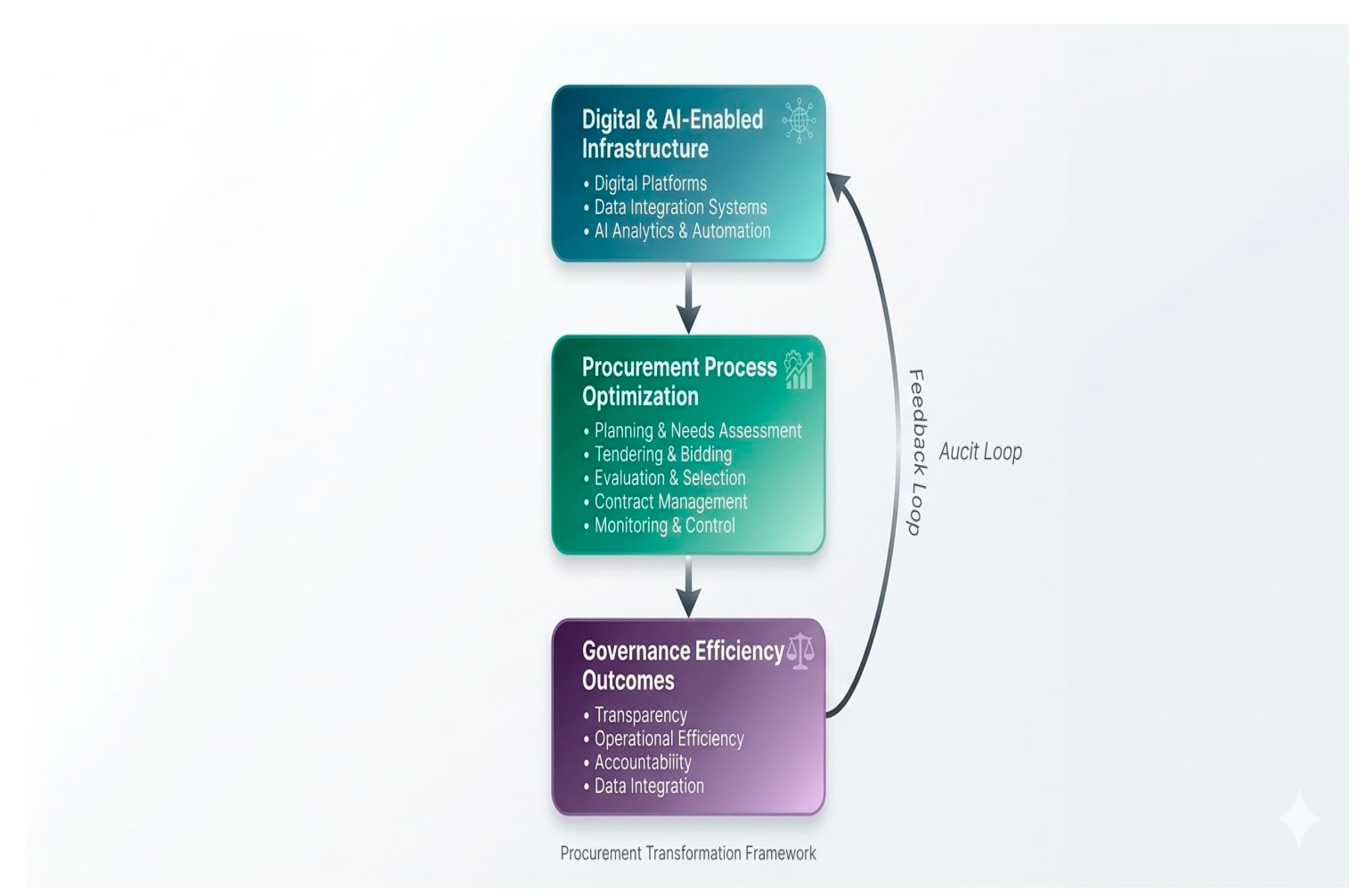
The framework is structured around three interrelated analytical layers, each capturing a distinct but interconnected dimension of procurement systems.
The first layer represents the technological foundation of procurement systems, encompassing digital platforms, data architectures, and AI-driven analytical tools. This layer reflects the degree to which procurement processes are supported by integrated information systems capable of real-time data processing, interoperability, and intelligent automation [
32].
Beyond basic digitalization, this layer emphasizes the role of AI in enhancing analytical capacity, enabling predictive insights, and supporting adaptive decision-making. The maturity of this layer determines the extent to which procurement systems can transition from reactive administrative procedures to proactive, data-driven governance mechanisms.
The second layer focuses on the operational dimension of procurement systems, capturing how digital and AI-enabled tools are embedded within the procurement lifecycle. This includes key stages such as planning, tendering, bid evaluation, contract management, and post-implementation monitoring.
The integration of digital technologies at this level aims to improve process efficiency, reduce transaction costs, minimize delays, and enhance the consistency and objectivity of decision-making [
33]. Importantly, this layer reflects the transformation of procurement from a fragmented and procedural activity into a streamlined and strategically managed process.
Furthermore, the interaction between the first and second layers highlights that technological capacity alone is insufficient unless it is effectively translated into process-level improvements.
The third layer captures the ultimate outcomes of procurement systems in terms of governance performance. It operationalizes governance efficiency through four key dimensions: transparency, operational efficiency, accountability, and data integration.
Transparency refers to the accessibility and openness of procurement information, enabling public oversight and reducing opportunities for corruption. Operational efficiency reflects the ability to deliver procurement outcomes in a timely and cost-effective manner. Accountability captures the extent to which procurement processes are subject to monitoring, control, and compliance mechanisms. Data integration represents the capacity to connect procurement systems with broader digital governance infrastructures, facilitating coordination and information exchange across institutional boundaries [
34].
This outcome-oriented layer is critical, as it links technological and procedural transformations to broader governance objectives, thereby providing a measurable basis for evaluating procurement performance.
The analytical strength of the proposed framework lies in the interaction between its three layers. Digital and AI-enabled infrastructure (Layer 1) serves as the enabling foundation, procurement process optimization (Layer 2) represents the operational transformation, and governance efficiency outcomes (Layer 3) capture the resulting performance improvements.
This layered structure allows for a systematic assessment of how technological advancements translate into tangible governance benefits. It also enables the identification of bottlenecks within the system, whether at the technological, procedural, or governance level.
By integrating these dimensions into a unified model, the framework addresses the fragmentation identified in the literature and provides a structured approach for analyzing and improving public procurement systems in smart city contexts.
The conceptual structure of the proposed Governance Efficiency Framework is illustrated in
Figure 1.
The framework illustrates the interaction between digital and AI-enabled infrastructure, procurement process optimization, and governance efficiency outcomes. It highlights how technological capabilities translate into improved procurement performance and governance results, while incorporating feedback mechanisms for continuous system improvement.
3.2. Operationalization of Variables and Indicators
To ensure the practical applicability of the proposed Governance Efficiency Framework, each governance dimension is operationalized through a structured set of measurable indicators capturing both quantitative and qualitative aspects of procurement performance. The operationalization process translates abstract governance concepts into empirically observable variables, enabling systematic assessment and comparative analysis.
Transparency is assessed through indicators related to the availability, accessibility, and completeness of procurement data. These include the extent to which tender announcements, bidding documents, contract awards, and execution reports are publicly disclosed on digital platforms, as well as the timeliness of information publication and the usability of procurement data for stakeholders. These indicators reflect the degree to which procurement systems support openness and reduce information asymmetry.
Operational efficiency is evaluated through a combination of process-oriented and outcome-based indicators, including procurement cycle duration, administrative processing time, cost-effectiveness of procurement decisions, and resource utilization. In addition, efficiency is assessed by examining the extent to which digital and AI-enabled tools reduce manual intervention, streamline workflows, and minimize transaction costs, thereby improving overall process performance.
Accountability is operationalized through indicators reflecting the strength and effectiveness of monitoring, control, and compliance mechanisms. These include the existence and functionality of audit systems, traceability of procurement decisions, enforcement of regulatory standards, and the frequency of irregularities or violations. Accountability is further linked to the presence of institutional oversight structures and feedback mechanisms, ensuring the responsibility and answerability of decision-makers.
Data integration reflects the extent to which procurement systems are embedded within broader digital governance ecosystems. This dimension is measured through indicators such as system interoperability, data-sharing capabilities across governmental units, and the integration of procurement platforms with financial management, budgeting, and planning systems. A higher level of data integration enables coordinated decision-making and supports the development of data-driven governance models [
35].
To enhance analytical rigor, the selected indicators are evaluated using a multi-criteria assessment approach, enabling the aggregation of diverse performance dimensions into a composite governance efficiency score. This approach facilitates both intra-system evaluation and cross-context comparison, particularly in the context of transition economies.
To ensure methodological transparency, the assignment of indicator scores follows a structured scoring protocol based on a standardized five-point scale (1–5). For each indicator, predefined evaluation criteria are applied: scores of 1–2 indicate low or insufficient performance (e.g., limited data availability, weak system integration, or significant procedural delays), scores around 3 reflect moderate or transitional performance, and scores of 4–5 indicate relatively high performance characterized by consistent implementation of digital tools, effective monitoring mechanisms, and higher levels of system integration.
The final scores are determined through the triangulation of multiple sources of empirical evidence, including statistical data, policy documents, and procurement records. In this study, expert-informed evaluation refers to the authors’ analytical interpretation of the empirical evidence based on professional expertise in public governance, procurement systems, and digital administration, rather than on a separate formal expert survey process. Qualitative assessments are systematically translated into numerical values through predefined performance thresholds and comparative evaluation across indicators, ensuring consistency in the application of the scoring scale while allowing sensitivity to context-specific characteristics.
To improve reproducibility, the scoring process follows a structured coding logic based on predefined evaluation criteria. For each indicator, empirical observations are compared against qualitative performance benchmarks derived from policy standards, digital governance practices, and procurement system characteristics.
To further enhance methodological transparency, each indicator is explicitly linked to its underlying evaluation criteria and the corresponding empirical evidence used for scoring. Specifically, indicators are assessed based on clearly defined performance attributes within each governance dimension. For instance, transparency indicators are evaluated in terms of data availability, accessibility, and completeness; efficiency indicators are assessed based on process duration and resource utilization; accountability indicators reflect monitoring and compliance mechanisms; and data integration indicators capture system interoperability and cross-platform data exchange. Each score is assigned through a structured comparison between observed empirical evidence and predefined performance benchmarks, ensuring consistent and non-arbitrary evaluation across indicators. Additional details and illustrative coding examples are provided in
Appendix A.
For example, higher scores (4–5) are assigned when procurement data are consistently available, accessible, and integrated across platforms; moderate scores (around 3) reflect partial availability or fragmented implementation; and lower scores (1–2) indicate limited transparency, weak integration, or significant procedural inefficiencies.
The evaluation is based on the systematic review of available procurement information, policy documents, and performance indicators, rather than on single observations. This approach ensures consistency in score assignment while allowing contextual interpretation of governance performance.
3.3. Empirical Application: Case of Yerevan
The empirical component of the study focuses on the city of Yerevan as a representative case of a transition economy currently undergoing digital transformation. The selection of Yerevan is analytically justified by its strategic position as the administrative and economic center of Armenia, as well as by its recent efforts to modernize public sector management and expand e-government infrastructures. In particular, the gradual introduction of digital procurement platforms and electronic public service systems provides a relevant context for examining the interaction between technological innovation and governance performance.
The empirical analysis is designed to apply the proposed Governance Efficiency Framework to assess the current state and performance of public procurement systems in Yerevan. This application enables a structured evaluation of how digital and AI-enabled tools influence procurement processes and governance outcomes across the defined dimensions.
The empirical analysis is based on a multi-source dataset combining administrative, statistical, and documentary evidence to ensure both reliability and comprehensiveness. Specifically, the study draws on: (i) official reports and statistical bulletins published by the RA Ministry of Finance and the Statistical Committee; (ii) municipal policy and regulatory documents related to public procurement and digital governance; (iii) publicly available procurement data, including indicators such as the number of bidders per tender, the share of single-bid contracts, and procurement cycle duration; and (iv) administrative and digital platform records, including e-procurement system data, service usage statistics, and digital infrastructure indicators.
The analysis covers the period 2019–2023, enabling a longitudinal assessment of procurement performance and digital governance development in Yerevan. The use of diverse data sources allows for triangulation, enhancing the robustness of the empirical findings and reducing potential biases associated with single-source analysis.
The implementation of the framework involves mapping the selected indicators to the empirical data and evaluating procurement performance across the four key governance dimensions: transparency, operational efficiency, accountability, and data integration. Indicators are assessed using a standardized qualitative–quantitative scoring scale (1–5), based on the triangulation of multiple data sources and expert-informed evaluation. This approach enables consistent comparison across dimensions while maintaining methodological transparency.
This analytical approach enables the identification of both strengths and systemic weaknesses within the existing procurement system. In particular, the analysis focuses on detecting inefficiencies in procedural timelines, gaps in information disclosure, limitations in monitoring mechanisms, and the degree of integration between procurement platforms and broader digital governance systems.
Furthermore, the empirical application provides a basis for assessing the potential impact of AI-driven solutions on procurement performance. By analyzing current system limitations, the study identifies areas where AI technologies—such as predictive analytics, automated evaluation, and real-time monitoring—can contribute to improving efficiency, reducing risks, and enhancing transparency.
The case of Yerevan also offers valuable context-specific insights into the institutional, technological, and regulatory factors that shape procurement system performance in transition economies, including constraints related to administrative capacity, digital infrastructure maturity, and policy coordination across governmental units. Understanding these contextual factors is essential for designing effective and sustainable procurement reforms.
Overall, the empirical analysis not only validates the applicability of the proposed framework but also demonstrates its utility as a diagnostic and decision-support tool for policymakers. By linking conceptual dimensions with real-world data, the framework provides actionable insights for improving governance efficiency in digitally evolving urban environments [
36].
Data were systematically collected and extracted from publicly available sources, including official reports, procurement databases, and policy documents, using a structured document analysis approach.
The procurement data used in the analysis are derived from publicly accessible national e-procurement platforms and related official databases, covering tender announcements, contract awards, and procurement process indicators.
3.4. Model Implications and Analytical Contribution
The proposed methodology makes a substantive contribution to the literature by advancing an integrative and multi-dimensional approach to the analysis of public procurement systems within smart city environments. Unlike existing studies that tend to examine digital transformation, artificial intelligence, or procurement reforms in isolation, this research develops a unified analytical framework that systematically links technological capabilities with governance efficiency outcomes.
From a theoretical perspective, the study contributes to the emerging discourse at the intersection of public procurement, digital governance, and smart city research. It conceptualizes procurement not merely as an administrative function but as a strategic governance instrument shaped by digital infrastructures and AI-driven decision-making processes. By embedding procurement within a broader governance efficiency paradigm, the study extends existing models of public sector digitalization and offers a more holistic understanding of how technological innovation translates into institutional performance.
Methodologically, the research introduces a structured Governance Efficiency Framework that integrates multi-layered analysis and multi-criteria evaluation. The combination of digital and AI-enabled infrastructure, process-level optimization, and outcome-based governance dimensions provides a novel approach for assessing procurement performance. This layered structure allows for the identification of analytical relationships and interpretive linkages between technological inputs, process transformations, and governance outcomes, thereby enhancing analytical precision and explanatory power.
In addition, the operationalization of governance dimensions into measurable indicators strengthens the empirical applicability of the framework. By incorporating multi-criteria evaluation principles, the model enables the aggregation of diverse performance indicators into a coherent assessment tool, facilitating both intra-system diagnostics and cross-context comparisons. This methodological contribution is particularly relevant for analyzing complex public sector systems characterized by multiple and interdependent performance dimensions.
From a practical and policy-oriented perspective, the framework offers a decision-support tool for policymakers, urban administrators, and public procurement practitioners. It enables evidence-based evaluation of procurement systems, identification of structural inefficiencies, and prioritization of reform interventions. Importantly, the integration of AI capabilities within the framework provides a forward-looking perspective on how emerging technologies can be leveraged to enhance transparency, efficiency, and accountability in public procurement.
Finally, the flexibility and scalability of the proposed model allow for its adaptation to different urban and institutional contexts. This is particularly significant for transition economies, where digital transformation processes are often uneven and constrained by institutional limitations. The framework can thus serve as a guiding instrument for designing and implementing context-sensitive procurement reforms aligned with broader smart city strategies.
The framework is intended to support interpretive and exploratory analysis rather than to establish causal relationships.
4. Results and Discussion
4.1. Overview of the Public Procurement System in Yerevan
The public procurement system in Yerevan reflects a hybrid structure characterized by elements of centralization at the municipal level combined with fragmented operational implementation across administrative units, consistent with the institutional organization of public procurement in Armenia, where regulatory functions are centralized while implementation is decentralized [
37,
38,
39]. Procurement functions are primarily coordinated through municipal authorities; however, execution involves multiple departments with differing levels of institutional capacity and digital readiness.
In recent years, Armenia has made notable progress in the digitalization of public procurement through the introduction of e-procurement platforms and broader electronic governance tools. In particular, the development and use of national e-procurement systems and digital public administration platforms have contributed to improving the formal accessibility of procurement processes and to enhancing procedural standardization. However, available procurement data from the national e-procurement platform, official reports of the RA Ministry of Finance, and broader digital governance assessments suggest that the overall level of digital maturity remains moderate, particularly because the integration of procurement systems with wider digital governance infrastructures is still limited [
40,
41]. These assessments are grounded in the review of Armenian procurement data, institutional reports, and digital governance documents rather than relying solely on cross-country comparisons.
From a transparency perspective, procurement-related information—such as tender announcements and contract awards—is generally available through the national e-procurement platform [
41] and official procurement portals in Armenia. At the same time, the practical usability of this information appears more limited. In particular, restricted access to detailed evaluation criteria, contract execution data, and performance-monitoring information constrains effective public oversight and reduces the practical impact of transparency mechanisms [
42,
43,
44]. This indicates that while formal transparency has improved, functional transparency remains only partially developed within the Armenian procurement system.
Operational efficiency also presents notable challenges. Available procurement indicators derived from publicly accessible procurement data and official reports suggest that procurement cycles in Yerevan are often characterized by extended time-to-award periods and administrative delays. These inefficiencies may be associated with procedural rigidity, partial reliance on manual verification processes, and limited interdepartmental coordination. As a result, the expected efficiency gains from digital transformation do not yet appear to have been fully realized [
45,
46].
Another important limitation concerns the use of advanced analytical tools, including artificial intelligence. Available administrative and procurement system evidence in Armenia indicates that procurement systems continue to rely predominantly on rule-based and administrative processes, while the use of data analytics for forecasting, risk detection, and decision support remains limited. This constrains the evolution of the system toward a more strategic and data-driven procurement model [
47,
48].
Overall, the assessment suggests that while the foundational elements of digital procurement are in place, significant gaps persist in terms of system integration, analytical capacity, and governance alignment. These structural limitations underscore the need for a more comprehensive and technologically advanced approach to procurement reform.
The overview presented in
Table 1 summarizes the main characteristics of the public procurement system in Yerevan based on the authors’ synthesis of publicly available Armenian procurement data, official reports of the RA Ministry of Finance, municipal and national policy documents, and prior studies on public procurement systems in transition economies [
49].
4.2. Indicator-Based Assessment of Governance Efficiency
To provide a structured and comparable assessment of procurement performance, the selected governance indicators are quantified using a standardized scoring scale. The results of this indicator-based evaluation for Yerevan are presented in
Table 2.
The scoring is based on a qualitative–quantitative assessment using a five-point scale (1 = very low performance; 5 = high performance), allowing for systematic comparison across governance dimensions. The assigned values are derived from the triangulation of multiple sources of empirical evidence, including official statistics, publicly available procurement data, and policy documents, complemented by expert-informed evaluation. This approach supports consistency across indicators while enhancing transparency and methodological robustness [
31,
41].
To improve methodological transparency and reproducibility, the scoring process follows a structured evaluation logic. For each indicator, empirical observations are assessed against predefined performance benchmarks. Scores in the range of 1–2 indicate low or insufficient performance, typically associated with limited data availability, weak system integration, or significant procedural inefficiencies. A score of around 3 reflects moderate or transitional performance, where partial implementation or mixed results are observed. Scores of 4–5 indicate relatively high performance, characterized by consistent digital integration, effective monitoring mechanisms, and well-functioning governance processes.
The assigned scores reflect the relative performance of each dimension based on available empirical evidence rather than precise quantitative measurement, which is consistent with multi-criteria evaluation approaches in public sector analysis.
The indicator-based assessment of governance efficiency in Yerevan reveals a structurally imbalanced performance profile, characterized by moderate progress in transparency and accountability, but significant weaknesses in efficiency and data integration.
From a transparency perspective, the relatively higher score for data availability (3.5) reflects improvements associated with the adoption of digital procurement platforms. However, the lower score for usability (2.5) indicates that the accessibility and practical interpretability of procurement information remain limited. This suggests that while formal transparency has improved, functional transparency remains underdeveloped [
41]. For example, while tender announcements and contract awards are publicly accessible through the national e-procurement platform, detailed information on contract execution and evaluation criteria is often not fully disclosed or presented in a user-friendly format, limiting effective external monitoring.
Operational efficiency appears to be one of the more constrained dimensions of the procurement system. The low score for process duration (2.0) reflects observed delays in procurement cycles. While cost-effectiveness is assessed at a moderate level (3.0), this appears to be driven primarily by price-based competition rather than strategic procurement optimization, suggesting limited efficiency gains from digitalization [
42]. In practice, procurement procedures frequently involve multiple administrative stages and verification processes, which may contribute to extended time-to-award periods compared to more fully automated procurement systems.
In terms of accountability, the presence of audit mechanisms and regulatory oversight contributes to a moderate score (3.0). However, the lower score for compliance (2.5) indicates that enforcement may be inconsistent, pointing to a gap between formal regulatory frameworks and their practical implementation [
43]. Although formal audit mechanisms are in place, the consistency of enforcement may vary across institutions, reflecting differences in administrative capacity and oversight effectiveness.
The most significant weaknesses are observed in the dimension of data integration. The low scores for system interoperability (2.0) and cross-platform data sharing (1.5) suggest a fragmented digital environment, limiting coordinated decision-making and reducing the potential for data-driven governance [
44]. For instance, procurement systems are not fully integrated with financial management and planning platforms, which restricts real-time data exchange and coordinated decision-making across public sector institutions.
Overall, the results suggest that the procurement system in Yerevan remains in a transitional stage, where digital tools have been introduced but are not yet fully leveraged to achieve comprehensive governance efficiency.
4.3. Composite Governance Efficiency Index (Weighted Aggregation Approach)
To provide an aggregated and analytically coherent assessment of procurement performance, this study constructs a Composite Governance Efficiency Index based on a structured multi-criteria evaluation approach. The index integrates the individual performance scores across four key governance dimensions—transparency, operational efficiency, accountability, and data integration—into a single evaluative metric using a transparent weighted aggregation.
The weighting of each dimension is theoretically informed and reflects its functional importance within the procurement governance system. Operational efficiency is assigned the highest weight (0.30) due to its direct impact on procurement outcomes, including timeliness, cost-effectiveness, and process performance. Transparency (0.25) and data integration (0.25) are assigned equal weights, as they play a critical role in enabling openness, public oversight, and data-driven decision-making. Accountability (0.20) is also incorporated as a key institutional dimension, reflecting the strength of monitoring and compliance mechanisms, although its influence is considered more indirect compared to operational performance [
45].
The weighting scheme is not derived from a formal pairwise comparison or analytic hierarchy procedure, but represents a transparent and policy-oriented evaluation framework grounded in multi-criteria assessment principles. Accordingly, the composite index is calculated as the weighted sum of the average scores across governance dimensions, ensuring interpretability and analytical clarity [
31,
45].
Table 3 presents the weighted scores across governance dimensions and the calculated Composite Governance Efficiency Index for the Yerevan procurement system.
The composite index is calculated as the weighted sum of the average scores across governance dimensions. The underlying scores reflect observable system characteristics, such as partial accessibility of procurement data, extended procurement cycle durations, and limited interoperability between procurement and other public sector information systems.
Total Governance Efficiency Index = 2.49/5. This composite result reflects the combined effect of moderate transparency improvements and persistent structural limitations in efficiency and data integration observed in the Yerevan procurement system.
To assess the robustness of the results, a simple sensitivity consideration was conducted. Moderate variations in weights (e.g., reducing the weight of data integration from 0.25 to 0.20 or increasing accountability from 0.20 to 0.25) do not materially change the overall conclusions, as the relative performance gaps across governance dimensions remain consistent.
To further illustrate the robustness of the results,
Table 4 presents alternative weighting scenarios and the corresponding recalculated index values.
The recalculated results confirm that moderate variations in weights do not materially affect the overall index value, indicating the robustness of the composite measure.
The composite index score of 2.49 indicates that the public procurement system in Yerevan operates at a moderate-to-low level of governance efficiency, reflecting partial progress in digital transformation but significant structural and institutional constraints. These constraints are reflected in observable system characteristics, including fragmented digital infrastructures, limited interoperability between procurement and other public sector platforms, and continued reliance on administrative procedures.
A closer examination of the weighted results reveals important asymmetries across governance dimensions. While transparency and efficiency contribute equally to the overall score (0.75 each), their underlying dynamics differ substantially. Transparency improvements are primarily driven by the availability of digital procurement data, whereas efficiency remains constrained by procedural delays and limited process optimization. For instance, while procurement data are formally available through digital platforms, procurement procedures still involve multiple administrative steps that contribute to delays and reduce overall process efficiency.
Accountability demonstrates a relatively stable but not fully effective performance (0.55), suggesting that formal monitoring and regulatory mechanisms are in place but lack consistent enforcement and institutional strength. This highlights a gap between regulatory design and implementation effectiveness. This is evident in variations in the practical application of oversight mechanisms across institutions, which may limit the consistency of regulatory enforcement.
The most critical weakness is observed in the data integration dimension, which records the lowest weighted contribution (0.44). This confirms that the procurement system lacks interoperability and cross-platform connectivity, limiting its ability to function as part of a broader digital governance ecosystem. As a result, decision-making remains fragmented and insufficiently data-driven. In particular, the absence of fully integrated data systems linking procurement, financial management, and planning functions constrains real-time information exchange and coordinated decision-making.
From a practical perspective, the index results clearly indicate that incremental digitalization alone is insufficient to achieve high governance efficiency. Instead, the findings emphasize the need for integrated reforms that simultaneously enhance technological infrastructure, streamline procurement processes, strengthen accountability mechanisms, and enable system-wide data integration. Addressing these challenges requires not only technological upgrades, but also institutional coordination and process re-engineering within the Armenian public procurement system.
4.4. Impact of AI-Enabled Public Procurement: Scenario-Based Analysis
To evaluate the potential impact of artificial intelligence (AI) in public procurement systems, this study develops a forward-looking scenario-based analysis comparing the current performance of the procurement system in Yerevan with a projected AI-enabled model. The objective is to explore how the integration of AI-driven tools could enhance governance efficiency across the four key dimensions.
The scenario assumes the implementation of selected AI functionalities, including predictive analytics for demand forecasting, automated bid evaluation systems, anomaly detection mechanisms for risk and fraud identification, and real-time monitoring tools for contract execution. These functionalities are conceptualized as potential enablers of improved process performance, reduced manual intervention, and enhanced transparency, as suggested by existing studies on AI-driven public sector transformation [
46].
Based on these assumptions, a scenario-based evaluation is conducted to estimate the potential impact of AI integration on governance performance. It is important to emphasize that the projected values do not represent observed outcomes, but rather analytical estimates under a set of favorable implementation conditions. The projected scores across the four dimensions are presented in
Table 5, allowing for a comparative analysis between the current system and the AI-enabled scenario.
As shown in
Table 4, the integration of AI technologies is projected to result in improvements across governance dimensions, with particularly significant gains observed in data integration and operational efficiency. These technologies are expected to reduce manual intervention, improve decision accuracy, and enhance system transparency, as supported by existing studies on AI-driven public sector transformation [
44,
46].
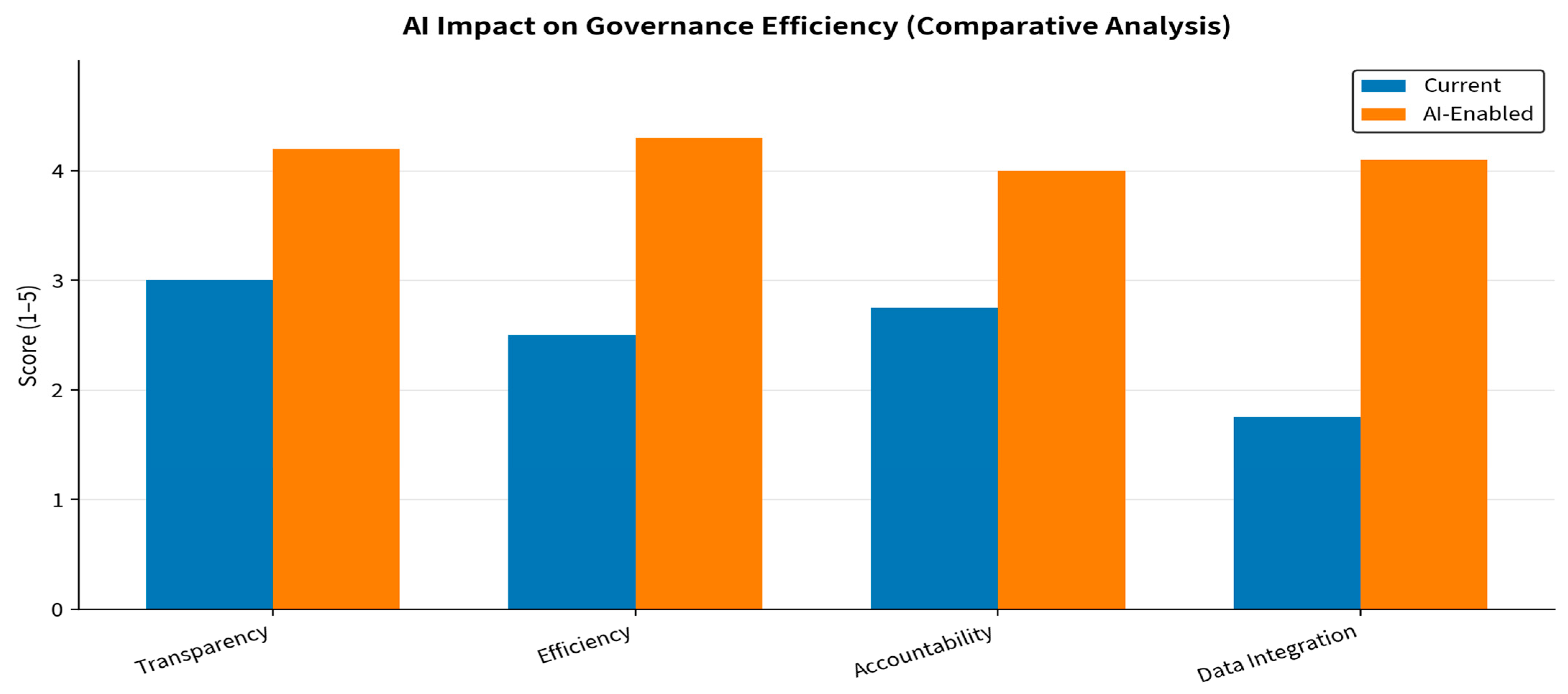
To further illustrate the comparative differences between the current procurement system and the AI-enabled scenario, the results are visualized in
Figure 2.
As illustrated in
Figure 2, the AI-enabled scenario suggests a consistent upward shift across all governance dimensions under the assumed implementation conditions. The visual comparison highlights the most pronounced improvement in data integration, followed by significant gains in operational efficiency. Transparency and accountability also exhibit notable increases, suggesting the potential of AI-driven systems to contribute to improvements in both procedural performance and governance outcomes.
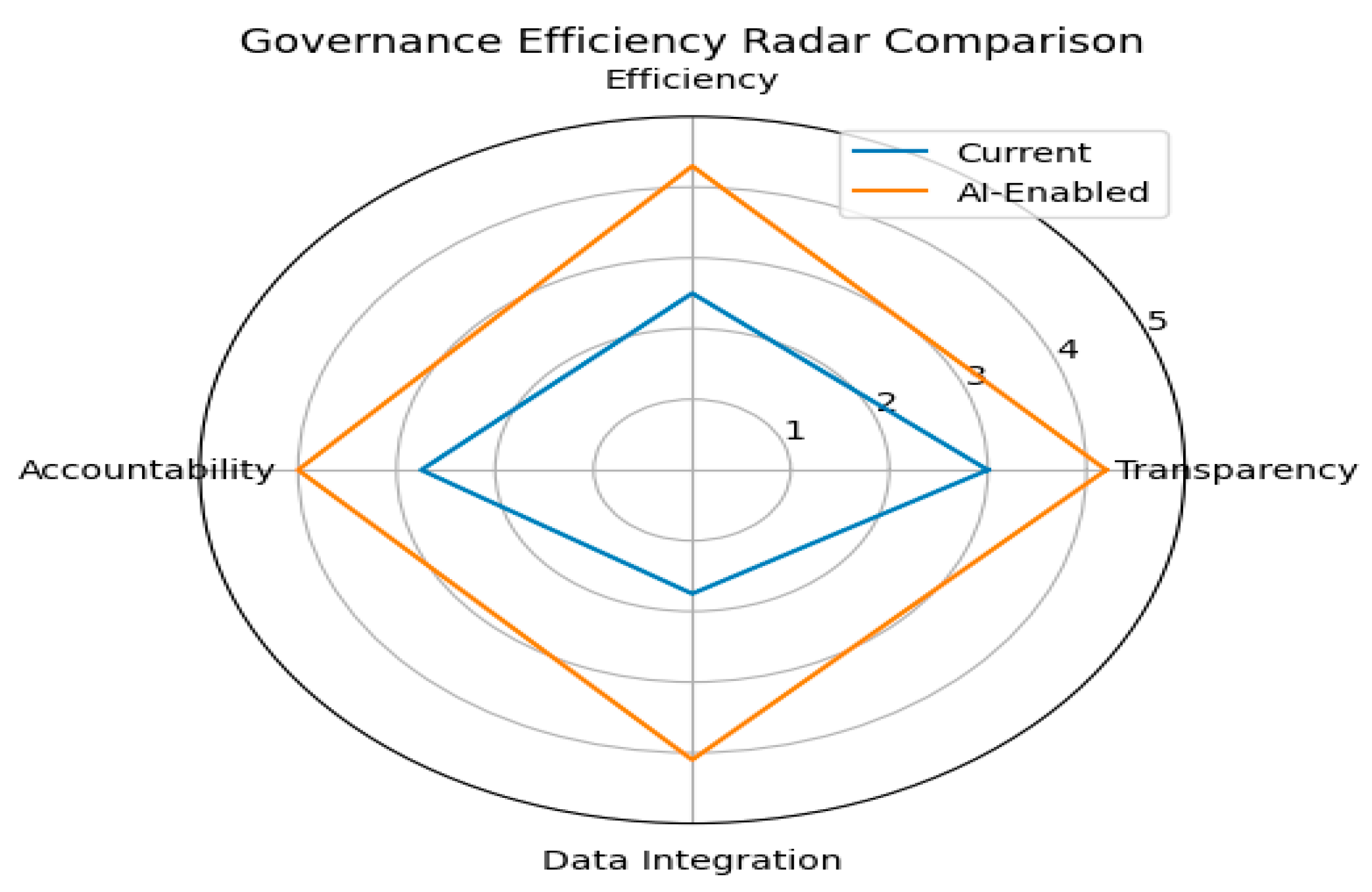
To provide a multidimensional visualization of governance performance,
Figure 3 presents a radar chart comparing the current and AI-enabled procurement scenarios across key dimensions.
As illustrated in
Figure 3, the AI-enabled scenario suggests a potential expansion of the performance frontier across all governance dimensions. The most pronounced improvements are observed in data integration and operational efficiency, while transparency and accountability also show upward trends. These patterns reflect the potential impact of AI-enabled systems under the assumed implementation conditions.
The scenario-based analysis suggests that the integration of AI technologies has the potential to significantly enhance governance efficiency across all evaluated dimensions. The most substantial improvement is projected in the dimension of data integration (+134%), reflecting the capacity of AI systems to enable interoperability, automate data exchange, and support real-time coordination across institutional platforms.
Operational efficiency is projected to show a substantial increase (+72%), primarily due to the automation of procurement processes, reduction in administrative delays, and optimization of decision-making workflows. AI-driven bid evaluation and contract management systems can substantially reduce time-to-award and improve resource allocation efficiency.
Transparency and accountability are projected to exhibit considerable improvements, driven by enhanced data accessibility, real-time monitoring, and the ability to detect irregularities through anomaly detection algorithms. These capabilities could strengthen public oversight and reduce opportunities for corruption, thereby contributing to higher levels of institutional trust.
Importantly, the analysis highlights that AI serves not merely as a technological upgrade, but as a structural enabler of governance transformation. By integrating AI into procurement systems, public administrations could potentially transition from reactive and procedure-driven models toward more proactive, predictive, and data-driven governance systems.
From a policy perspective, the findings suggest that the adoption of AI in public procurement should be approached as a strategic reform priority rather than a purely technical enhancement. The successful implementation of AI-enabled procurement systems requires:
Institutional readiness and capacity building.
Regulatory adaptation to ensure transparency and accountability.
Investment in digital infrastructure and data standardization.
Development of human capital and analytical competencies.
Without these complementary conditions, the potential benefits of AI may not be fully realized, particularly in transition economy contexts such as Armenia.
4.5. Key Findings and Discussion
The empirical and scenario-based analyses provide a comprehensive understanding of the current state and potential future development of public procurement systems in Yerevan. The findings suggest a structurally imbalanced governance performance, where partial digitalization has contributed to improvements in transparency, but has not yet translated into comparable gains in operational efficiency or system integration. This pattern is reflected in the practical functioning of the procurement system, where digital platforms ensure formal data availability, but do not fully eliminate procedural bottlenecks or administrative fragmentation.
A key finding of the study is the presence of a digitalization–performance gap, whereby the introduction of e-procurement platforms does not appear to be associated with proportional improvements in efficiency or overall governance effectiveness. The empirical results suggest that this gap may be linked to institutional constraints, including limited administrative capacity, procedural rigidity, and insufficient coordination across governmental units. As a result, digital tools tend to function primarily as supportive instruments rather than as fully transformative mechanisms within the procurement system [
47]. For example, while procurement procedures are formally conducted through digital platforms, they often continue to involve multiple administrative validation steps, which limits the extent to which digitalization translates into measurable efficiency gains.
Another important bottleneck identified in the analysis is the relatively low level of data integration, which constrains the development of a data-driven governance model. The limited interoperability between procurement platforms and other public sector systems—such as financial management and planning tools—appears to contribute to fragmented decision-making and reduce the capacity of public authorities to effectively utilize data for strategic purposes. This observation is consistent with broader patterns identified in transition economies, where digital systems often evolve in parallel rather than within integrated governance frameworks [
48]. In practice, procurement systems are not fully connected with financial management and planning platforms, which restricts real-time data exchange and coordinated policy implementation.
The findings also suggest that operational inefficiencies—particularly extended procurement cycles and administrative delays—remain persistent despite the presence of digital platforms. This indicates that technological adoption alone may be insufficient in the absence of corresponding process re-engineering and institutional reform. In this context, procurement systems continue to operate within established administrative practices, which may limit the overall impact of digital transformation initiatives. This is particularly evident in procurement cycle durations, where delays persist despite the availability of digital submission and evaluation tools.
Importantly, the scenario-based analysis indicates that the integration of AI technologies has the potential to alter this trajectory. Under appropriate implementation conditions, AI-enabled procurement systems may address several of the identified bottlenecks by enhancing predictive capacity, supporting automated decision processes, and enabling more effective real-time monitoring. In this sense, AI can be interpreted not only as a technological enhancement, but also as a potential enabler of broader governance transformation. However, these effects remain conditional on the existence of sufficient data quality, system integration, and institutional readiness.
From a policy perspective, the findings suggest that effective procurement reform requires a holistic and integrated approach. Digitalization, AI adoption, institutional capacity building, and regulatory coherence need to be pursued in a coordinated manner to achieve meaningful improvements in governance efficiency. Fragmented or isolated reform efforts are unlikely to produce sustainable outcomes.
Furthermore, the case of Yerevan highlights the importance of context-sensitive policy design in transition economies. The findings suggest that reform strategies need to account for existing institutional constraints, levels of digital maturity, and administrative capacities. In this regard, the proposed Governance Efficiency Framework can serve as a practical and adaptable tool for diagnosing system weaknesses and supporting evidence-based policy interventions.
Overall, the study contributes to the literature by suggesting that the transformation of public procurement systems requires more than technological investment. It involves a coordinated alignment between digital innovation, institutional structures, and governance objectives. By integrating empirical analysis with a forward-looking AI-based scenario, the research provides both analytical insight and practical relevance for advancing procurement reform in smart city contexts. The empirical insights derived from the Yerevan case illustrate how these challenges manifest in practice, highlighting the need for coordinated and context-specific reform strategies.
To synthesize the empirical findings and link them to broader analytical and policy implications,
Table 6 presents a structured summary across key governance dimensions.
As summarized in
Table 5, the findings indicate that the primary limitations of the current procurement system are not purely technological but structural and institutional in nature. While digital tools have improved certain aspects of transparency, their impact remains constrained by weak data integration, limited process optimization, and insufficient institutional capacity.
5. Conclusions
This study examined the efficiency of public procurement systems in a smart city context, with a particular focus on Yerevan as a representative case of a transition economy undergoing digital transformation. By developing and applying a Governance Efficiency Framework, the research provides a structured and evidence-based assessment of procurement performance across four key dimensions: transparency, operational efficiency, accountability, and data integration.
The findings suggest that, despite measurable progress in the digitalization of procurement processes, significant structural inefficiencies remain. In particular, limited data integration, fragmented institutional coordination, and procedural rigidity continue to constrain overall system effectiveness. These results indicate that digital transformation alone may be insufficient to achieve meaningful improvements in governance performance without complementary institutional and organizational reforms.
A key contribution of the study lies in highlighting the potential role of AI-enabled procurement systems. The scenario-based analysis suggests that the integration of AI technologies—such as predictive analytics, automated evaluation mechanisms, and real-time monitoring—may enhance governance efficiency under appropriate implementation conditions. The most notable projected improvements are observed in data integration and operational efficiency, pointing to the potential of AI as a facilitator of more integrated and performance-oriented procurement systems.
At the same time, the findings emphasize that the successful implementation of AI-driven procurement depends on a broader set of enabling conditions. Institutional capacity, regulatory coherence, and human capital development emerge as critical factors shaping whether digital innovations can translate into tangible governance outcomes. This underscores the importance of adopting a holistic reform approach that aligns technological advancement with institutional and policy development.
From a theoretical perspective, the study contributes to the literature on digital governance and smart cities by incorporating public procurement into the broader analytical framework of governance efficiency. By linking technological and institutional dimensions, the research offers a more comprehensive understanding of how digital transformation may influence public sector performance in transition economies.
From a practical standpoint, the proposed framework provides a structured and adaptable tool for policymakers and urban administrators. It facilitates the identification of system weaknesses, supports the prioritization of reform interventions, and informs the design of AI-enabled solutions aimed at improving transparency, efficiency, and accountability. These insights may be particularly relevant for Armenia and other transition contexts seeking to advance sustainable and performance-oriented public sector reforms.
Finally, several limitations should be acknowledged. The empirical analysis is based on a single-case study, which may limit the generalizability of the findings. In addition, the AI-enabled component is based on a scenario-based projection rather than observed implementation and should therefore be interpreted as indicative rather than conclusive. Future research could extend this work through comparative cross-country studies, longitudinal data analysis, and empirical evaluation of implemented AI-based procurement systems.
The findings presented in this study should be interpreted with consideration of the analytical design. While the empirical assessment provides indicative insights into procurement performance, the scoring framework represents an exploratory evaluation tool rather than a causal measurement model. Accordingly, the results are best understood as analytical interpretations supported by available evidence, rather than definitive causal conclusions.