1. Introduction
Cities play a key role in the fight against climate change, as they account for approximately two-thirds of the global energy consumption and produce more than 70% of carbon dioxide emissions [
1,
2,
3].
In accordance with legally binding European climate legislation, Europe is working toward achieving climate neutrality by 2050 through a parallel digital and green transition [
4]. The concept of Smart Cities has evolved from a purely technological focus to a comprehensive model in which the integration of ICT with physical, social, and business structures serves to optimize urban intelligence [
5]. Urban areas are emerging as key drivers of climate action, with a significant number of them setting targets to achieve climate neutrality by deadlines that are ahead of national commitments [
1,
6]. In the light of contemporary academic discourse, Smart Cities are characterized by the integration of digital tools aimed at fostering environmental sustainability and improving societal well-being. This multifaceted domain is perpetually evolving, driven by breakthroughs in urban planning and various eco-innovations [
2]. Sustainability-oriented Smart City services focus on innovations that create economic, environmental and social value through intentional changes in the values of organizations [
6].
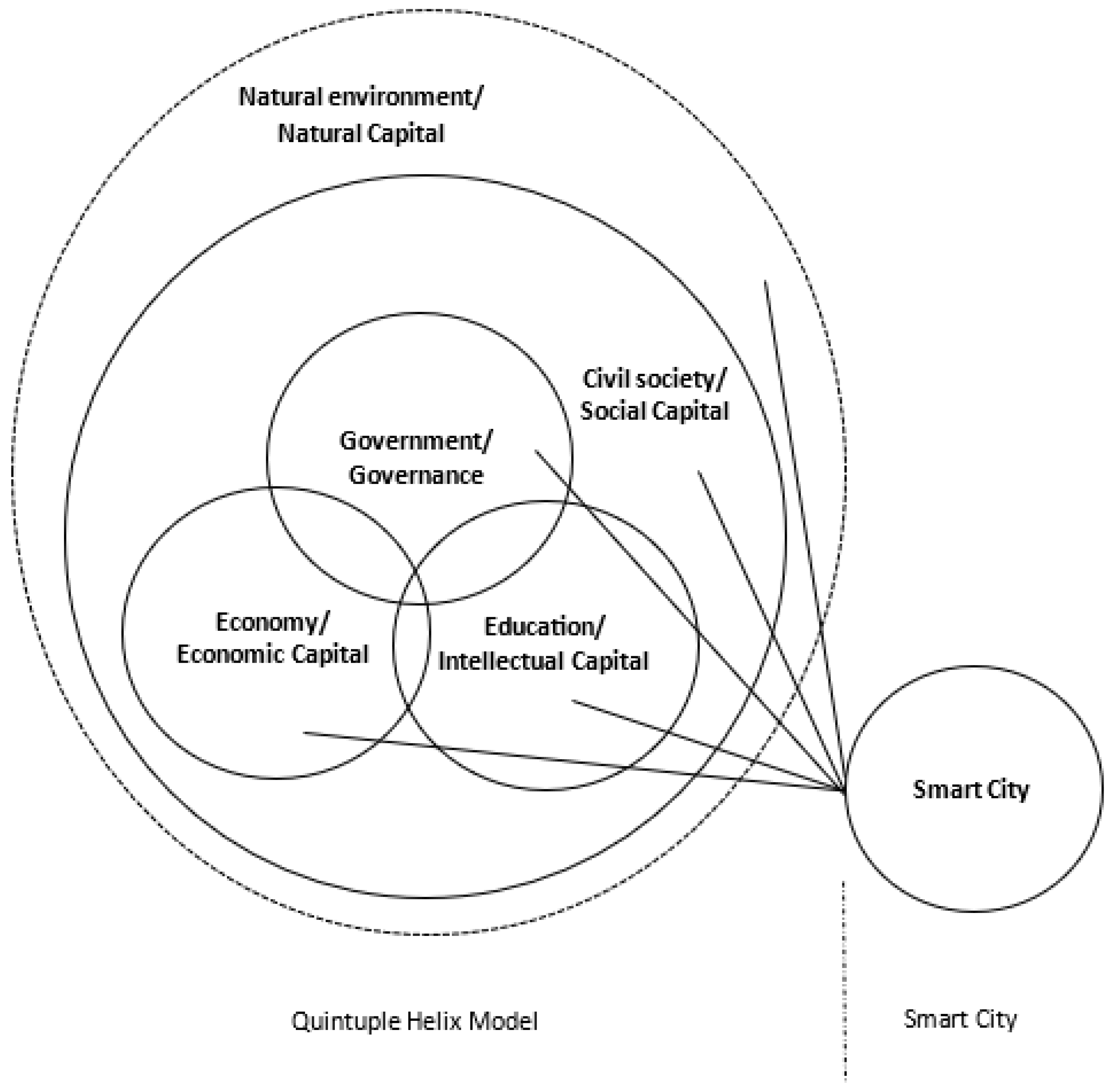
To evaluate innovation ecosystems within smart urban environments, this study employs an evolutionary perspective on Helix frameworks. The primary Helix model emphasizes reciprocal relationships between universities, industry and government as the basis for knowledge creation and innovation—called the Triple Helix model. This primary model was subsequently expanded into the Quadruple Helix model. This model adds a fourth element—Civil Society, media and culture, thus acknowledging the influence of community context and values on innovation processes. The most advanced stage of the Helix framework is the Quintuple Helix model, which incorporates the natural environment as a fifth dimension and emphasizes that innovation processes must address global challenges such as global warming and environmental sustainability. The architecture of the Quintuple Helix operates on the principle of nested systems: the core Triple Helix (academia, industry, and government) is enclosed within the fourth helix of Civil Society and culture (Quadruple Helix), which are collectively situated within the overarching fifth environment of the natural environment. This hierarchical structure ensures that all innovation processes are ultimately integrated into the ecological context of sustainable development [
7,
8].
Within this framework, the ecological dimension is viewed as a primary driver for generating new insights and innovative practices [
2]. The current literature [
9,
10,
11,
12] highlights that the creation of sustainable urban solutions is fundamentally dependent on the active participation of various interest groups. Furthermore, the authors argue that a unified strategic design cannot be realized through isolated, sporadic actions, but instead demands continuous and integrated cooperation. Collaboration in developing innovations within the framework of building Smart Cities accelerates the adoption of sustainable solutions and the improvement of approaches that enhance human well-being. Innovative Smart City solutions include different strategies [
13]. Since each city and the country in which it is located is different, the implementation of smart solutions is diverse and requires different innovations, contextualization and adaptation of technologies, business models, governance structures, user motivation for social acceptance, capacities, intellectual capital, financing, etc. [
14,
15]. Digital solutions are usually easier to implement. On the contrary, innovations and new solutions that lack market demand and require a change in thinking (paradigm innovation) are more challenging.
Cooperation and synergies between stakeholders remain the primary challenges for the success of Smart Cities. Nevertheless, achieving high performance levels is contingent upon the seamless alignment of technological, administrative, and institutional frameworks [
16,
17] of all regional aspects for sustainable development without neglecting the importance of any component and participatory processes, involving citizens—the Social Capital of the region, in the smart transformation and implementation of digital solutions within the framework of strategic urban development [
18]. Therefore, the Smart City development ecosystem itself has a wide range of interpretations, from technical to social approaches towards digital urban transformation [
19] aimed at improving the quality of life, sustainability and smart development of the city [
20]. The trend is shifting toward increased collaboration among multiple stakeholders, leading to complex value networks that these actors must operate within [
21]. Consequently, the implementation of a comprehensive governance framework based on Helix models is essential. Such an approach facilitates the development of sustainable Smart Cities by integrating inclusive management solutions. These solutions ensure that no stakeholder group or urban subsystem is overlooked, while simultaneously prioritizing environmental integrity for the benefit of future generations [
22]. In this context, the Quintuple Helix functions as a circular innovation mechanism where the natural environment acts as a primary stimulus. It forces the academic, political, and economic subsystems to move beyond traditional digitalization and co-produce specific eco-innovations as a necessary response to environmental constraints. This transformation ensures that Smart City development is not just technological, but fundamentally sustainable [
23].
The different levels of the Helix model serve primarily as a theoretical basis for understanding the relationships between actors whose common goal is to stimulate the innovation capacity of the region or economy [
24,
25]. This capacity defines the potential of entities to effectively create and implement new knowledge or technologies into practice [
26]. Within the European context, this approach serves as a fundamental driver for achieving long-term strategic objectives, including the 2030 Agenda and earlier initiatives like the Lisbon Strategy. As digital transformation evolves, traditional innovative potential is being redefined as a digital innovation capacity, where technological maturity and ICT proficiency act as catalysts for regional smart growth. Ultimately, enhancing this capacity across the EU depends on harmonizing all five dimensions of the Quintuple Helix model [
27,
28].
The Quintuple Helix model finds practical application in Smart Cities through specific governance mechanisms. The EU mission “100 climate-neutral and Smart Cities by 2030” represents an ambitious plan for the systemic transformation of cities into innovation hubs. Robust monitoring systems are essential to assess the impact of innovation frameworks [
3]. The profound connection between Smart City initiatives and regional advancement is currently a focal point for both strategic planning and practical execution. This trend creates a favorable environment for adopting European policy frameworks that champion innovation systems grounded in Helix models and Urban Helix perspectives [
29].
Urbanized areas, regardless of their scale, face urgent challenges in the areas of mobility, urban planning or parking management and environmental sustainability. An effective response to these problems presupposes the implementation of proactive strategies based on empirical research with a direct impact on urban practice. The development of sustainable innovations is conditioned by cross-sectoral cooperation that facilitates the transfer of knowledge and the search for synergistic solutions, with the Smart City concept playing a key role in this process [
30]. Despite the progress of research in this area, several barriers to the effective functioning of the Quintuple Helix within regional and Smart City development are identified. Coordination between different levels of government (governance) is often lacking. The participation of companies and investors is still perceived as a limiting factor that requires new investment models and the removal of regulatory barriers [
31,
32,
33].
The integration of the Quintuple Helix model into the Smart City strategy allows cities to move from isolated technological projects to interconnected ecosystems. However, the success of this transformation depends on effective multi-level governance, the mobilization of private capital and the active participation of citizens as co-creators of innovation. Therefore, the aim of this study is to investigate the impact of the national framework of the Quintuple Helix model of EU countries on the performance of their capital cities and eco-innovation. While previous research has primarily focused on technological indicators or effective growth of this capacity, this study addresses a critical research gap by examining the holistic synergy of the Quintuple Helix Model at the EU country level and its linkages to capital’s Smart City and eco-innovation performance.
The contribution of the presented study to the existing knowledge lies in three levels. From a theoretical perspective, it extends the application of the Quintuple Helix model by linking it to Smart City readiness and eco-innovation performance, thus going beyond the traditional focus of the Triple Helix model, which is mainly oriented towards collaboration between industry and academia. From a methodological perspective, the study presents results that are the output of a multidimensional quantitative approach, which in our case combines K-means cluster analysis and Pearson correlation to categorize EU capitals according to their complex capital profiles, including natural, social, intellectual, economic and institutional capital. Empirically, the study offers a new comparative analysis of 26 EU capitals, identifying governance as a key factor in digital transformation and eco-innovation. It also points out that natural capital often develops relatively independently of the level of digitalization in less developed regions. Unlike previous research that focused largely on individual technological indicators, this work offers a holistic view of how synergies between different forms of capital affect the position of cities in global rankings.
2. Materials and Methods
To address the core issues identified through our research objectives, we have defined the following investigative questions.
Research question 1: What is the degree of heterogeneity of EU capitals from the viewpoint of Smart Cities, individual dimensions of the Quintuple Helix model and eco-innovations as the results of cooperation of all interested actors.
Research question 2: How does the structure of cooperation between individual dimensions of the Quintuple Helix model and eco-innovations affect the Smart City of EU capitals?
This study examines the digital transformation of Smart Cities in the capitals of individual EU member states—26 countries. Malta was not included in the research because Smart City Index data [
34] is not available for this country. In general, capital cities function as specific administrative and economic hubs. However, it is evident that their performance does not necessarily reflect the socio-economic conditions of all cities across the country. Consequently, focusing exclusively on capital cities is a recognized limitation of this study, as the Smart City Index used does not cover the entire urban landscape of the examined states. This research aims to identify the structure of the Quintuple Helix model perspectives and the levels of Smart Cities in the capitals of individual EU member states in the context of sustainability by implementing eco-innovations of digitalization for mutual differentiation of EU countries.
To determine the mutual differentiation of EU countries from the perspective of the researched issue, a quantitative approach combining cluster analysis and correlation analysis was chosen. These methods enabled the identification of similarities and differences between EU countries and subsequently allowed the examination of the actual relationships among the analyzed variables.
The analysis was carried out using selected indices. The Smart City Index was used as the main indicator, providing a balanced emphasis on both the economic and technological dimensions of Smart Cities, as well as their human aspects, including quality of life, the environment, and social inclusion. The Smart City Index evaluates countries based on their urban performance; because it uses an inverse scale, a lower numerical value represents a superior position. The Smart Cities Index assesses residents’ perceptions of the structures and technological applications available to them in their city. The final index score is calculated based on the perceptions of approximately 120 residents in each city over the past years. This may be a limitation of this study, but the perceptions of the times are balanced by economic and technological aspects in the assessment. This index is world-renowned and is the first global index to assess the Smart level of cities [
34]. Therefore, the eco-innovation index [
35], which is a key element of the EU’s green innovation transformation, was included as another index of rankings to examine mutual relationships. Eco-innovation is a tool for developing eco-friendly activities with a positive association with the economy and society. This index shows how innovative a country is in the development of green technologies and solutions based on 12 indicators included in the measurement framework. Performance in each of these indicators is measured using relevant data published by Eurostat, the European Environment Agency and the Organisation for Economic Co-operation and Development (OECD). A higher value is better because it reflects greater progress in eco-innovation. To evaluate individual indicators, the Quintuple Helix model was applied to individual EU countries within the Global Sustainable Competitiveness Index (GSCI) 2024 5. This index presents the most comprehensive measurement of a country’s competitiveness and sustainability, based on 239 quantitative indicators from international organizations [
36]. In this framework, the five theoretical pillars of the Helix model are represented by specific capital indices: Natural capital (environmental subsystem), Social Capital (social subsystem), Intellectual capital (educational subsystem/academia), Economic capital (economic subsystem/industry), and Governance (political subsystem). The analysis is based on established and recognized indices. These indices may not fully correspond to the pillars of the Quintuple Helix model, but they are the most suitable ones that we have identified for this study. The summary of the indicators used is shown in
Table 1.
Table 1 also shows which GSCI indicators represent the individual parts of the Quintuple Helix model.
Table 1 also shows which GSCI indicators represent the individual parts of the Quintuple Helix model. Within the methodology of this research, the individual pillars of the GSCI represent the parts of the Quintuple Helix model, such as Natural capital—Natural environment, Social Capital—Civil Society, Intellectual capital—Education, Economic capital—Economy and Governance—Government. The use of country-level indicators from the GSCI as proxies for capital cities is justified by the fact that EU capital cities often serve as the primary economic, educational, and institutional hubs of their respective nations. In these centralized systems, national policies and capital structures are most intensely manifested within the capital’s urban ecosystem. Nevertheless, this approach is acknowledged as a limitation in capturing city-specific nuances.
Utilizing cluster analysis offers an effective means of categorizing nations by identifying similarities in their performance across various multidimensional indicators. Existing research [
24,
37,
38,
39] demonstrates that clustering methodologies are effective for identifying structural patterns among EU countries, highlighting regional disparities and assessing progress across various digital and innovation metrics. In this study, the methodology is designed to assess the links between the Quintuple Helix (QTH) model, the Smart City Index and eco-innovation performance. To ensure a critical perspective and eliminate scale bias, data normalization was performed using Z-score standardization before statistical analysis. Subsequently, cluster analysis was employed to categorize EU countries/capitals into homogeneous groups based on shared structural attributes within the QTH framework and urban smartness indicators. K-means was chosen as the basic partitioning method. To identify the ideal cluster count, a hierarchical clustering procedure employing Ward’s method was conducted. To confirm that the selected variables (QTH dimensions, Smart City indicators and eco-innovation scores) significantly differentiate the final clusters, an ANOVA was performed with statistical significance set at the
p < 0.05 level. In addition, a Pearson correlation analysis was performed to quantify the strength and direction of the relationships between the QTH components, the Smart City index and eco-innovations. GDP per capita (GDPpc) was used as a control variable for the correlation analysis [
40]. The correlation coefficient (r) ranges from \−1; +1\, where values approaching the extremes indicate strong linear associations. The relationships between the individual variables examined for research question 2 will be plotted in a hypothetical model of cooperation between the dimensions of the Quintuple Helix model and Smart Cities, see
Figure 1. This model is based on the Quintuple Helix model theory and the indices used according to the methodology. This model is based on the theory of the Quintuple Helix model and the indices used according to the methodology. It is based on the architecture of the Five-fold Helix, according to Carayannis, Campbell [
7], where the Triple Helix (academia, industry and government) is formed by the core. The core is enclosed and nested in the Fourth Helix of Civil Society and culture (Quadruple Helix), which are jointly located in the overarching Fifth Environment of the Natural Environment (Quintuple Helix). This hierarchical structure is individually complemented by the part Smart City and the hypothetical model, presenting its relationship to all the structures of the Quintuple Helix model.
Regression analysis will be used as a statistical method to test the relationship between the variables under investigation in the hypothetical model. Regression analysis will examine the statistical relationship between one dependent variable (Smart City index) and multiple independent variables (other variables under investigation).
IBM SPSS Statistics 20 (IBM, Armonk, NY, USA), MS Office 365 (Microsoft, Redmond, WA, USA), Google functionalities (Google LLC, Mountain View, CA, USA), Gemini 3 (Google LLC, Mountain View, CA, USA), ChatGPT-5 (OpenAI, San Francisco, CA, USA), QuillBot 4 (QuillBot, Chicago, IL, USA) and Colab (Google LLC, Mountain View, CA, USA) were used to conduct the research.
3. Results and Discussion
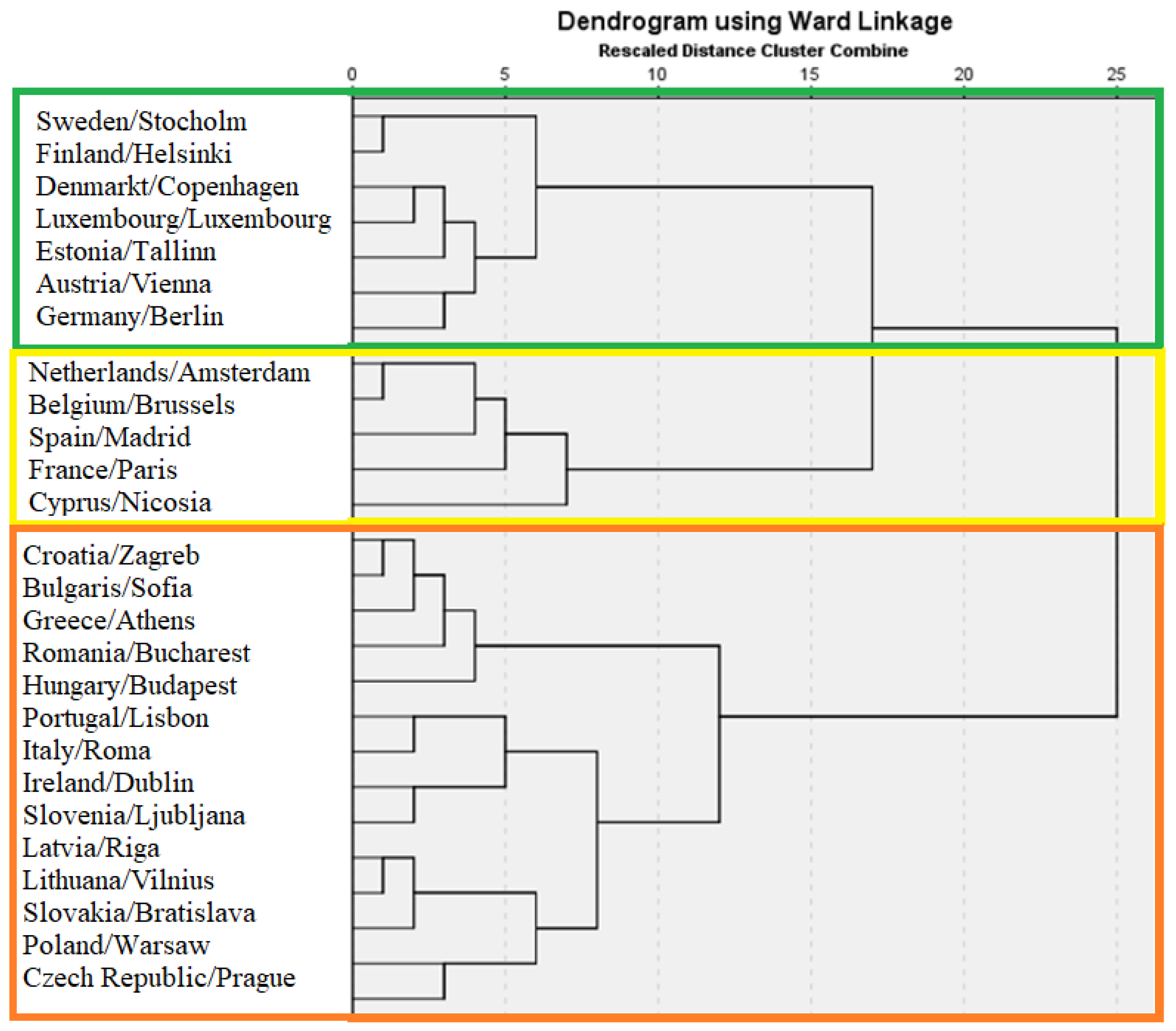
This research explores how prepared EU capitals are for Smart City transitions by applying the lens of the Quintuple Helix model and ecological innovation. Through the use of cluster analysis, the study distinguishes between various EU member states, uncovering inherent groupings within the data based on their unique capital profiles and environmental progress. This methodological choice facilitates the identification of natural patterns that define the current landscape of urban smartness across Europe. These clusters present groups of studied elements that show a high degree of similarity and at the same time identify differences between groups that are significant. It is an important statistical method in the context of evaluating the subsystems of the Quintuple Helix model and Smart City readiness of EU capitals in the context of eco-innovations. This method helps to classify countries from the perspective of their individual parameters within the individual components of the Quintuple Helix model, i.e., environmental, social, economic, political and educational factors, Smart City and eco-innovations. The hierarchical relationships identified through this analysis are visually represented in a dendrogram (see
Figure 2).
Based on the dendrogram obtained from cluster analysis using Euclidean distance, three main clusters were identified. To validate the identified number of clusters, we used the Silhouette Score (
Table 2). Using the Average Silhouette Score, we also identified the number of clusters as three. The Average Silhouette Coefficient measures the compactness and separation of clusters, where higher is better. The analysis showed that the three-cluster model achieved the highest value of the average silhouette coefficient (0.5115), see
Table 2.
The first cluster (marked in green): It includes countries such as Sweden, Finland, Denmark, Luxembourg, Estonia, Austria and Germany. These countries show the highest level of synergy within the subsystems of the Quintuple Helix model. They can be defined as “Smart City leaders of capitals” where the interaction between the education system, the economy, the political system, Civil Society and the natural environment and eco-innovation achieves the highest efficiency.
The second cluster (marked in yellow): It consists of countries/capitals such as the Netherlands, Belgium, Spain, France and Cyprus. This group represents countries/capitals with slightly above-average to stable performance within the parameters examined. Although they exhibit strong elements of an innovation ecosystem, compared to the first cluster, there are certain reserves in some dimensions of the Quintuple Helix (e.g., in the environmental or social areas) that prevent them from being ranked among the absolute top.
The third cluster (marked in orange): It is the most numerous and consists of countries and their capital cities mainly from Central, Eastern and Southern Europe (Slovakia, Czech Republic, Poland, Hungary, Bulgaria, Greece, Italy and others). These countries/capitals are similar to each other in a lower degree of Quintuple Helix interactions in relation to Smart Cities and eco-innovations. The results indicate that the transformation towards Smart Cities of capital cities in these countries/capitals is taking place more slowly and faces similar structural challenges, which naturally separates them from the innovation leaders in the first cluster. The individual data of the investigated elements are summarized in
Table 3.
Based on the dendrogram of the cluster analysis, the EU countries/cities (capitals) were divided into three main clusters in terms of the Smart City readiness of their capitals.
Table 2 summarizes the values and specific scores for the individual dimensions of the Quintuple Helix, the Smart City index and the level of eco-innovation in the fast countries.
Cluster 1 presents the leaders in the field of Smart Cities of the EU countries/capitals and is the best performing group in all the examined parameters, except for Civil Society/Social Capital. This cluster achieves the highest rate of the examined parameters of the Quintuple Helix model and innovations. In this cluster, the Smart City Index reaches its lowest values, representing a superior performance; this is due to the index’s inverse scaling, where a lower numerical value indicates a higher position in the urban ranking. This indicates a strong connection between the academic sector, high quality of governance and smart technologies and environmental technologies. Cluster 2 presents metropolises (capitals) with a focus on Civil Society/Social Capital. This cluster dominates in the area of Civil Society/Social Capital (average 59.68), which indicates a high level of social cohesion and civic participation. This cluster has lower values of other parameters compared to Cluster 1, but higher values in all examined parameters than Cluster 3. This cluster has the lowest average in the area of Natural environment/Natural Capital (36.84) compared to Cluster 3, which reflects the challenges associated with high urbanization and environmental burden of large metropolitan areas.
Cluster 3 presents developing regions and where the digital transformation of capital cities is underway, which also presents a lower level of innovation. The most striking feature of this cluster is Natural environment/Natural Capital (46.98) compared to Cluster 2. However, compared to Cluster 1, it lags significantly in Education/Intellectual Capital (55.39) and especially in innovation, which indicates that the technological development of Smart Cities in these cities has not yet fully converted into systemic environmental innovations.
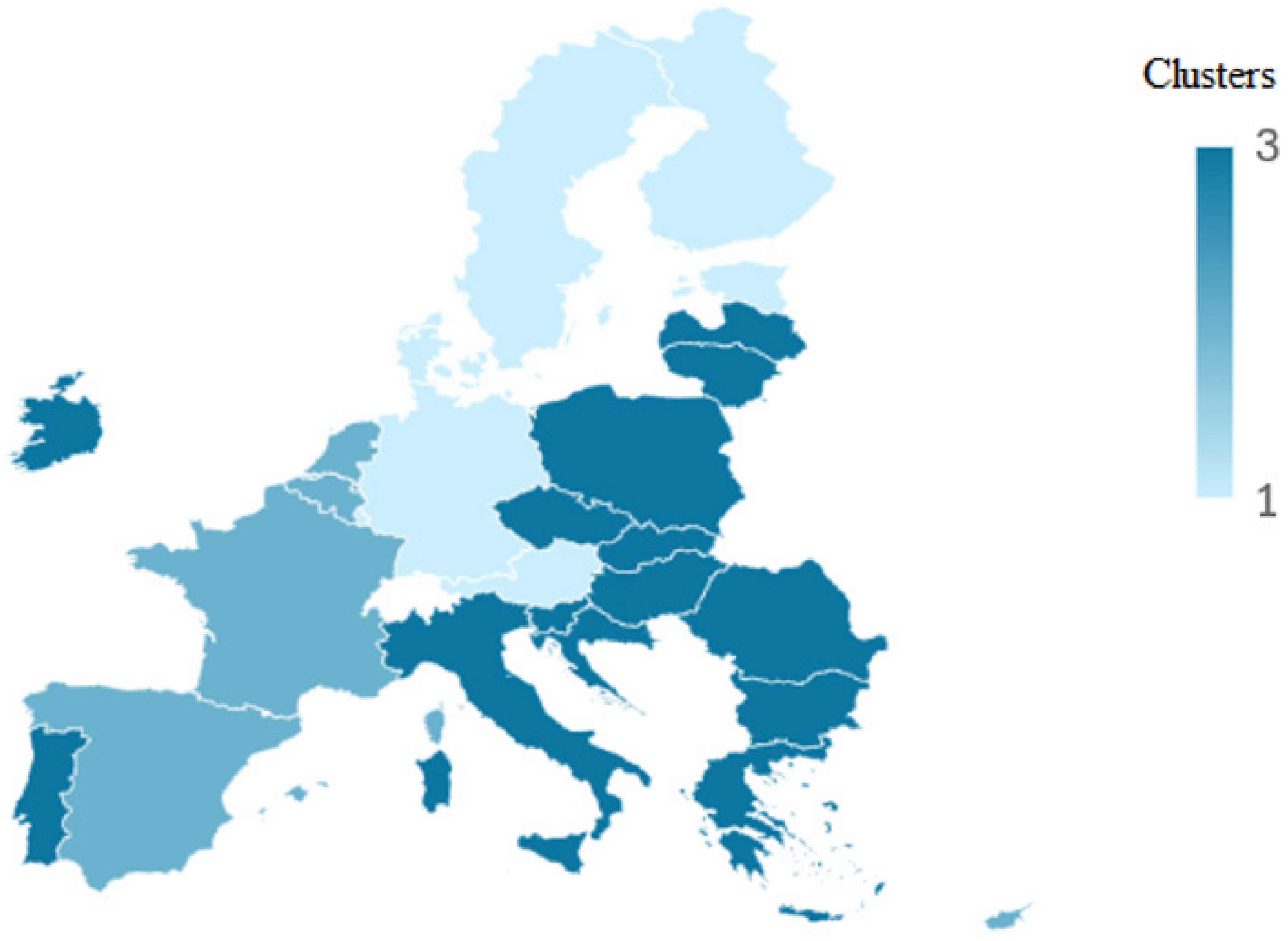
A graphical representation of the cluster analysis results from a geographical perspective is shown in
Figure 3.
The identified segmentation of EU countries/cities within the framework of the examined parameters of the Helix model, eco-innovations and Smart Cities of their EU capitals into three clusters reflects the historical and political division. Cluster 1 presents leaders within the EU and benefits from the economy and synergy between the Quintuple Helix model and innovation systems. Cluster 2 presents countries whose capitals are large metropolises. These use strong Social Capital to compensate for the environmental burden associated with high urbanization, while Cluster 3 is a post-socialist region where capitals show technological catching up, which, however, runs into limits associated with the historical and political system [
41,
42].
Based on the hierarchical cluster analysis, a K-means cluster analysis was subsequently performed for three clusters (see
Table 4). This analysis allowed us to identify the association of the individual parameters under study with the formation of clusters.
The results of K-means analysis with ANOVA testing confirmed that the clustering process was statistically highly significant for six of the seven monitored parameters. Government/Governance emerged as the most significant variable associated with cluster differentiation (F = 17.295; p < 0.001). This fact suggests that the institutional setting is the key associate in the innovation ecosystem of EU capitals for the digital transformation of capitals. Education/Intellectual capital (F = 15.906; p < 0.001) and Civil Society/Social Capital (F = 14.319; p < 0.001) also showed a high level of significance in the formation of clusters. These findings confirm the important role of human potential and Civil Society. Soft skills play a crucial role in the transformation of cities. The environmental dimension, represented by natural capital and the eco-innovation index, also showed statistical significance in clustering, confirming the heterogeneity of European metropolises in their ecological orientation and the need to develop environmental innovation solutions for the development of sustainability. However, Economic Sustainability, or Economy/Economic Capital (F = 0.233; p = 0.794), turned out to be a statistically insignificant variable.
Correlation analysis was performed to confirm or refute the interrelationships between the individual parameters examined.
Table 5 describes, based on the statistical testing, the relationships between the individual dimensions of the Smart City innovation ecosystem of EU capitals and the Quintuple Helix model. The strongest positive correlations were identified between Education/Intellectual Capital and Civil Society/Social Capital (r = 0.687;
p < 0.01) and a moderately strong link with Government/Governance (r = 0.579;
p < 0.01). These findings indicate that cities with a high level of education and innovation potential also tend to have a strong Civil Society and effective institutional mechanisms, which are basic prerequisites for successful knowledge transfer and, therefore, the building of Smart Cities. Despite the fact that the Smart City index shows a negative correlation with other dimensions of the Quintuple Helix model, this is positive, since increasing the values of the dimensions (parameters) of the Quintuple Helix model will decrease the Smart City index, which is positive with regard to the orientation of the parameters examined. In the methodology, we state that a low value of the Smart City index is better; the higher the other parameters are, the better. The Smart City index has the opposite direction of evaluation to the parameters of the Quintuple Helix model. The Smart City Index is negatively correlated mainly with Education/Intellectual Capital, Civil Society/Social Capital and Government/Governance. The results show that natural capital does not show any significant correlation with other variables. This indicates that the natural environment and ecological parameters of cities in the monitored sample develop relatively autonomously and are not directly conditioned by the degree of digitalization or Civil Society/Social Capital. Similarly, Economy/Economic Capital does not show statistically significant relationships to the dimensions of the Quintuple Helix model, which corresponds to the previous ANOVA results and confirms that the economic level of cities is not a direct determinant of their innovation structure within the Quintuple Helix model. Correlation analysis shows a significant relationship between all examined variables of the Helix model and GDP pc.
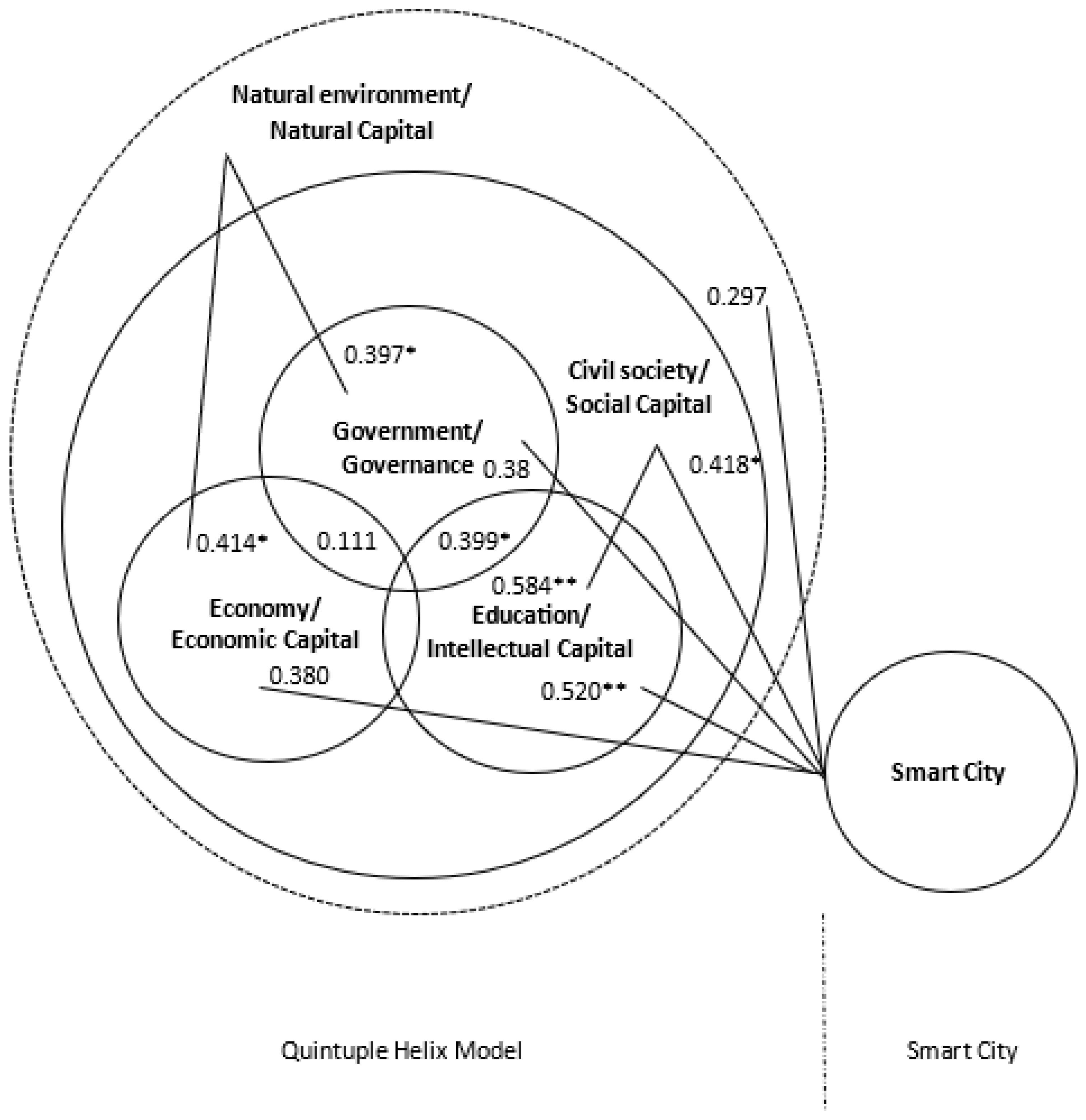
The control part of the table provides a fundamental insight, where the value of GDP_pc was introduced as a control variable. After this adjustment, the strength of the relationship decreases for most pairs, demonstrating that the originally observed correlation was partly associated with the country’s economic strength. In terms of the strength and direction of the relationships, the table is dominated by a moderately strong positive correlation between intellectual and Social Capital (r = 0.584), indicating that the development of the knowledge base and social networks proceeds in mutual synergy independently of the country’s wealth. Natural environment/Natural capital also shows significant positive links, namely in relation to economic capital (r = 0.414) and to Government/Governance (Government/Governance = 0.397), indicating a connection between environmental resources, institutional quality and economic structure. Government/Governance is further linked to intellectual capital and ecological innovation, underlining the importance of institutions for modern development. The Smart City Index relationship itself shows statistically significant relationships mainly with Education/Intellectual Capital and Civil Society/Social Capital. The negative correlation is associated with the methodology, where the direction of the Smart City Index is opposite to the other indices used; therefore, the resulting relationship does not represent a negative relationship in reality. The Smart City index is therefore supported by Education/Intellectuals and Civil Society/Social Capital.
Regression analysis will be used as a statistical method to control the relationship between the variables under study in the hypothetical model,
Table 5. As part of the investigation of factors affecting Smart City (Smart City Index), regression analysis was applied, as shown in
Table 6. The main goal was to verify the association with of the Helix model (its individual variables), GDP_pc and eco-innovations on Smart City. The first model, which included all five key determinants of the Quintuple Helix model: Economy/Economic Capital, natural environment/Natural Capital, Civil Society/Social Capital and Education/Intellectual Capital together with the quality of Government/Governance (Governance). This model achieved a total rate of explained variability of 52.9% and appears to be statistically the most optimal and statistically significant (
p = 0.033). The second model expanded the analysis to include the eco-innovation variable. However, the results showed that after accounting for the previous forms of capital, eco-innovations no longer bring any additional explanatory value (
p = 0.964).
The third model, including only the control variable GDP_pc, explains only 14.5% of the variance of the dependent variable. The regression analysis points to the synergistic effect of the determinants of the Quintuple Helix model on Smart city.
The identified and statistically significant relationships between the investigated variables within the hypothetical model are illustrated in
Figure 4.
The results of the analysis confirm that the successful transformation of EU capitals (excluding Malta) into Smart Cities is not only a question of technological innovation, but requires a comprehensive approach within the Quintuple Helix model. While the original model focused primarily on the cooperation of universities, industry and government (Triple Helix) [
2,
3,
4,
5,
6], the results of our research point to the importance of Civil Society/Social Capital and Education/Intellectual Capital. However, the most important factor for the success of Smart Cities in the EU is still governance. This finding corresponds to the claim that the success of the transformation depends on the governmental and institutional integration of all regional aspects. The state and local government is key mediator of innovation processes in the Quintuple Helix model [
29]. The absent coordination between levels of governance is identified in the literature as a key barrier. This finding aligns with Tura and Ojanen [
6], who emphasize that sustainability-oriented innovations in Smart Cities are fundamentally contingent on institutional integration rather than technological availability alone. The strong correlation between education/intellectual and Civil Society/Social Capital confirms that the education system and the active participation of citizens are essential prerequisites for the transfer of knowledge and the adoption of sustainable innovations. Analysis of the impact of the Quintuple Helix model shows that developed intellectual and social capital at the national level is a key correlate of the success of capital cities. Those metropolises whose countries dominate these dimensions are identified as leaders in the implementation of smart solutions [
5]. The success of Smart Cities does not depend on the technologies themselves, but on the ability of government structures to coordinate complex ecosystems of actors [
43]. A remarkable finding is the statistically insignificant relationship between Economic Capital/Economy and the Smart City Index, which means that economic maturity countries alone is an not automatic prerequisite for high performance of Smart Cities. This finding supports the theory that the critical factor is not economic capital, but rather the ability to cognitively evaluate the available resources (Education/Intellectual Capital) rather than their nominal amount [
44]. Cities often lack the technical, organizational and human capacity to implement smart strategies. Their capacity is limited [
15]. This confirms the claim that while one of the most fundamental challenges for cities is access to finance and financial means to implement green and smart strategies (EU programs financing, etc.), cities do not have the capacity to develop bankable projects to implement the necessary measures. Therefore, the main challenge is to bridge the gap between ambitious goals and feasible investment plans [
15,
45]. Economic capital is not a statistically significant factor for the Smart City index, contrasting with traditional techno-economic approaches, but confirming the findings of Huovila and Hukkalainen [
15]. They suggest that the success of climate-neutrality goals by 2030 is not determined by the availability of financial resources, but by the ability of cities to build innovative capacities and strategic partnerships, which in our model represent intellectual and social capital.
Although European cities are striving for digital transformation in line with the goals of climate neutrality by 2050, the results show that natural capital in many cases develops autonomously and is not directly conditioned by the level of digitalization. This suggests that the technological development of Smart Cities in less developed regions has not yet fully translated into systemic environmental innovations. The identification of three clusters confirms that the adoption of smart solutions across the EU is diverse and requires contextual adaptation of technologies and management models. These results confirm the fact that innovative urban solutions often involve many parties with different intentions [
13,
46]. New innovations, contextualized and adapted to each country and its specific cities, are needed in terms of technologies, business models, governance structures, social acceptance, user motivation, capacities, knowledge, etc. [
14,
47]. The differences between leaders and transition countries in Smart City development (especially in Central and Eastern Europe) stem primarily from the different levels of institutional mechanisms and innovation capacity. For leaders countries, participation in the EU mission: 100 climate-neutral and Smart Cities by 2030 should be a priority for their Smart City development [
48]. Countries represented by cities with strong Civil Society/Social Capital could benefit from the targeted Digital Europe programme, which focuses on building digital skills and modernizing public administration. Digital solutions are usually easier to implement because they do not require a change in mindset or lack market demand. The strategic goal should be to implement good practices from leaders in the first cluster. Implementing previous experiences and solutions represents a good business model with replication by expanding the service offer of companies [
15]. For countries in transition in the context of Smart City development, investments from the European Structural and Investment Funds, or European Urban Initiative [
49], should be developed with a priority focus on basic digital connectivity and inclusion. However, it is essential that these investments do not end with the purchase of hardware, but are linked to reforms in education and building social capital, which have proven to be key factors associated with long-term success in our model, in line with the Recovery and Resilience Facility [
50]. These assumptions align with the objectives of the “Climate Neutral and Smart Cities” [
51] to engage local authorities, citizens, businesses and investors, as well as regional and national authorities, in building climate-neutral and Smart Cities and to ensure that these cities function as innovation hubs, thus setting an example for all other European cities. These findings support the need to adopt a holistic Smart City governance model that does not isolate technology projects but builds interconnected ecosystems with the involvement of all stakeholders [
16,
17,
18,
19,
20,
21,
22,
52,
53].