Article

The Portability Paradox: How Best-Practice Reporting Filters Implementation Knowledge Across 250 UN-Habitat Cases

1
School of Architecture, Louisiana State University, Baton Rouge, LA 70803, USA
2
Urban Studies, Department of Social Sciences, Faculty of Humanities and Social Sciences, University of Basel, 4051 Basel, Switzerland
3
Facultad de Ingeniería, Universidad de Montevideo, Montevideo 11600, Uruguay
*
Author to whom correspondence should be addressed.
Urban Sci. 2026, 10(5), 277; https://doi.org/10.3390/urbansci10050277
Submission received: 10 April 2026 / Revised: 11 May 2026 / Accepted: 12 May 2026 / Published: 15 May 2026

Abstract

Implementation remains a central challenge in urban policy, yet the knowledge formats designed to bridge the gap between policy goals and on-the-ground delivery remain under-examined. This study treats 250 UN-Habitat Best Practice reports not as proof of effectiveness but as a standardized genre through which local interventions are narrated, compressed, and made portable for replication. We extract three focal sections, namely Results, Lessons Learned, and Transferability, apply systematic thematic coding with 906 open codes consolidated into axial categories, and compute co-occurrence networks using Jaccard similarity and Lift to detect thematic bundles, holes, and silos within and across sections. Three findings emerge. First, the reporting repertoire narrows progressively, as mean thematic richness declines by 28.2% from Results to Transfers while concentration increases 4.2 times, with substantive dimensions such as governance, equity, sustainability, and evidence losing prevalence to circulation-oriented themes. Second, formal bundle detection yields zero qualifying pairs across all six matrices, indicating a loosely coupled reporting grammar anchored by generic silos rather than integrated implementation packages. Third, structural holes concentrate at the pipeline’s end, where infrastructure transfer and sustainability as transferable value are the most systematically disconnected themes. These patterns reveal a portability paradox in which the reporting format achieves institutional legibility, making practices comparable within a shared vocabulary, but progressively filters out the physical, evidentiary, and context-sensitive content that operational reproduction would require.

1. Introduction

Cities have become central spaces for improving living conditions and economic development, yet rapid urbanization has also exposed deep disparities in access to essential resources, environmental quality, and social well-being [1]. As population, infrastructure, services, and economic activity increasingly concentrate in urban areas, cities have emerged as key sites where environmental, social, and health-related challenges unfold [2,3]. At the same time, the spatial organization of cities plays a critical role in determining access to the benefits of urban life, including opportunities, services, and well-being [4]. Current sustainable urban development guidance increasingly emphasizes innovation, inclusiveness, and adaptability, but this raises questions about how such principles are operationalized in local contexts [5].
In this context, international organizations increasingly promote the identification and documentation of “best practices” (BPs) as a way to catalog lessons learned and support learning across countries in the implementation of sustainable urban development agendas [6]. BPs are commonly understood as initiatives that demonstrate effective responses to urban challenges and whose experiences may inform policy development and offer transferable knowledge for other contexts [7]. In the literature, however, the significance of BPs lies not only in the replication of specific interventions, but also in the circulation of broader forms of policy knowledge, including ideas, principles, governance arrangements, and institutional designs [8,9]. From this perspective, BPs are closely related to processes of policy transfer and policy mobility, through which urban policy knowledge travels across places and is reinterpreted according to local needs, resources, and institutional contexts [10,11]. Within this literature, Dolowitz and Marsh [12] distinguish degrees of transfer along a spectrum that runs from direct copying through emulation, hybridization, and broad inspiration. The typology is more than descriptive. Each transfer mode places different demands on the knowledge format that supports it. Copying requires highly codified procedural and material specification, emulation depends on transferable institutional logics, hybridization presupposes context-sensitive adaptation, and inspiration tolerates the greatest level of abstraction. A reporting format therefore does not merely document what was done. It conditions which transfer modes a given practice can plausibly support elsewhere. Therefore, their value does not lie in providing ready-made solutions, but in offering documented experiences that can support policy learning, inform decision-making, and encourage the diffusion of potentially effective strategies in urban development [1,13,14]. Nevertheless, the diffusion of BPs depends on active processes of promotion, framing, and legitimization carried out by networks of actors and institutions, including international organizations, consultants, and professional communities [15].
Recognizing BPs as a standardized reporting genre rather than as a neutral collection of cases opens a complementary analytical line. In genre theory, recurrent textual forms are not simply templates but socially situated actions that stabilize how communities recognize, classify, and circulate knowledge [16,17,18]. A reporting genre licenses certain claims, authorizes certain content, and filters what counts as a legitimate account of practice. The UN-Habitat BP report is therefore not only a record of an intervention but a vehicle that translates heterogeneous local experiences into an institutionally legible form, with standardized headings (Results, Lessons Learned, Transferability) that operate as interpretive scaffolding shaping what authors include, omit, and emphasize when narrating implementation.
This genre logic acquires sharper definition when analyzed in relation to Polanyi’s [19] distinction between explicit knowledge, which can be codified and transmitted in propositional form, and tacit knowledge, which resides in skilled practice, situated judgment, and embodied familiarity with local conditions. A standardized reporting genre is structurally suited to carry the explicit pole because codified knowledge maps directly onto categorical headings and indicator-style claims. The tacit pole resists such codification, since the situated judgment that allowed a project to navigate a specific institutional environment, the material know-how embedded in physical design choices, and the experiential calibration through which community engagement becomes effective in a particular setting are exactly the kinds of content that a standardized format struggles to preserve. Genre theory and the tacit-explicit distinction together predict that a curated reporting format will systematically privilege procedural and codifiable content over situated and embodied content. The empirical question this raises, and the question this study addresses, is which thematic families the BP genre carries forward and which it filters out across the Results, Lessons Learned, and Transferability sequence.
These framings sit within a broader epistemological literature on how institutions render heterogeneous local experiences comparable for action at a distance. The sociology of quantification has documented how commensuration, the transformation of qualitative differences into a shared metric of comparison, makes diverse cases legible, comparable, and aggregable while compressing the contextual texture that distinguishes them [20,21]. Adjacent work on knowledge translation in international development and public policy shows that policy ideas do not move in unmediated form. They are translated, in the strong sense of being reconstituted as they cross institutional, linguistic, and contextual borders, and translation is necessarily selective [22,23]. Read together, these studies clarify why the relationship between implementation gap research and policy mobilities scholarship is not coincidental but structural. Implementation gap research foregrounds the situated, technical, and relational specificity that interventions require to succeed in place. Policy mobilities scholarship foregrounds the institutional and discursive infrastructures that select and reformat such specificity for circulation across places. The empirical question of what survives the reformatting, and what is filtered out, is exactly the question that a curated reporting genre such as UN-Habitat’s BP database stages.
This study takes that question as its analytical pivot through the working distinction between institutional legibility and operational specificity. Institutional legibility refers to the capacity of a reporting format to render local interventions classifiable, comparable, and searchable within a shared administrative vocabulary, in line with what Scott [24] theorized as the precondition for governance at a distance. Operational specificity refers, by contrast, to the capacity of the same format to carry forward the situated technical, evidentiary, financial, and relational content that a practitioner would need to reproduce or adapt the intervention elsewhere. The two are not opposed, but they are not equivalent. A reporting genre that succeeds at the first does not automatically succeed at the second. This distinction yields a working proposition that this study tests empirically. The standardizing logic of a curated genre will tend to preserve content amenable to commensuration and procedural codification more reliably than content that is tacit, materially specific, or contextually embedded. The portability paradox advanced in this paper is the empirical pattern that emerges when a reporting format optimized for legibility encounters implementation knowledge that is not uniformly codifiable.
These dynamics situate BPs within the broader challenge of implementation in urban sustainability and planning, where the translation of policy goals into action on the ground is far from automatic [7]. The persistent disconnection between policy ambitions and their effective realization is widely framed as an implementation gap [25].
Research on this gap has advanced along two fronts. The first identifies the conditions under which implementation succeeds or fails, including institutional, financial, and contextual barriers that reduce the likelihood that plans are carried out and sustained over time [25,26,27]. The second concerns the instruments designed to support implementation, including the growing infrastructure of indicators, rankings, observatories, and diagnostic tools that exist to assess and compare urban interventions, although these often remain fragmented, methodologically inconsistent, and difficult to translate into concrete action [28,29,30,31]. Taken together, these two bodies of work clarify why implementation is difficult and how its quality can be measured, but they share a common boundary. They say relatively little about how implementation knowledge is generated, formatted, and made transferable across contexts [28,32].
What remains largely unexamined is the reporting layer that sits between a successful local intervention and its uptake elsewhere. Prior scholarship on best practices has examined how individual BPs are constructed and politically mobilized [8,13,14], but it has done so primarily through interpretive case studies of selected practices, leaving the systemic properties of the BP genre as a whole largely uncharacterized. This study makes three departures from that prior work. First, it scales the analysis to 250 reports drawn from a region-balanced sample of the world’s most globally visible BP repository, allowing genre-level patterns to be characterized rather than inferred from individual cases. Second, it treats the report itself, rather than the underlying intervention, as the analytical object, asking which thematic content survives the transition from situated practice to portable example and which is filtered out. Third, it operationalizes that question through systematic thematic coding and co-occurrence networks, making it possible to identify, at the level of the corpus, where in the reporting sequence translation loss concentrates and around which themes.
Four research questions guide the analysis, organized as a nested progression from description to synthesis. RQ1 to RQ3 are descriptive and structural, examining theme prevalence, within-domain association, and cross-domain linkage in turn. RQ4 is integrative and synthesizes the three preceding patterns into a single claim about how the reporting genre mediates between institutional legibility and operational specificity. First, (RQ1) what recurrent axial thematic categories and prevalence patterns structure how UN-Habitat Best Practices report Results, Lessons Learned, and Transferability across the full corpus? This question establishes the baseline vocabulary of the reporting grammar and documents whether and how the thematic repertoire narrows across the three domains. Second, (RQ2) what within-domain bundles and selective thematic pairings recur within the Results, Lessons Learned, and Transferability sections, and what do these associations reveal about the reporting logic of implementation? This question moves from individual theme prevalence to pairwise association, testing whether the corpus produces tightly coupled implementation packages or a more loosely organized co-occurrence structure. Third, (RQ3) what cross-domain linkages and disconnections emerge across the Results-Lessons-Transferability sequence, and what do they reveal about how reported outcomes are translated into portable implementation knowledge? This question traces the epistemic pipeline across its full length, identifying where selective translation occurs and where thematic content is lost between sections. Fourth, (RQ4) what do the prevalence, association, and disconnection patterns collectively reveal about how the BP reporting format mediates between the implementation gap and the portability of implementation knowledge? This integrative question synthesizes the preceding findings to characterize the relationship between institutional legibility and operational specificity in the genre as a whole.
The remainder of the paper proceeds as follows. Section 2 describes the methods, including the construction of a region-balanced corpus of 250 BP reports, the two-level thematic coding strategy that translates narrative accounts into binary presence/absence indicators, and the quantitative framework of prevalence profiles, Jaccard similarity, and Lift used to estimate thematic co-occurrence, bundling, and disconnection. Section 3 reports the results in two stages, first documenting within-domain prevalence and association patterns for Results, Lessons, and Transferability separately, and then tracing cross-domain linkages and disconnections across the full reporting sequence. Section 4 discusses the implications of these patterns for how the BP format mediates implementation learning, identifies the thematic families most vulnerable to translation loss, and considers what the findings mean for the design of practice-sharing repositories that aim to support not only the visibility of successful interventions but also their reproducibility in new contexts. Section 5 states the conclusions and outlines the scope of a subsequent regional analysis that will exploit the stratified design of the corpus.

2. Materials and Methods

This study draws on the UN-Habitat Best Practices Database, described by UN-Habitat as a free public access repository with approximately 4000 proven solutions to common social, economic, and environmental problems. From this database, we constructed a corpus of 250 BPs reports using a region-balanced sampling strategy based on the database’s standardized world regions: North America (NA), Europe (EU), Asia and Pacific (AP), Africa and Arab States (AA), and Latin America and the Caribbean (LC) (Table S1). Reports were eligible for inclusion only if they were classified under the database’s highest recognition tiers, “Award Winner” or “Best Practice.” Other tiers were excluded to focus the analysis on the reporting conventions the platform most explicitly promotes as exemplary. To ensure comparable region sizes, two Europe-related categories were merged into a single EU stratum. This consolidation was necessary because one of the two categories, “European Union,” contained only five reports total classified as “Award Winner” or “Best Practice.”
Within each region, we selected the 50 most recent eligible reports according to the date displayed in the database (5 regions × 50 cases = 250 reports). The database does not explicitly define this date field; however, we considered it as a chronological reference. All reports in the final corpus were available in English and used a standardized format with clearly labeled headings for “Results,” “Lessons Learned,” and “Transferability,” enabling consistent section-based extraction and coding.
Epistemologically, we do not evaluate empirical effectiveness, validate the database’s “proven” designation, or attempt causal inference about urban change. Instead, BP reports were analyzed as a standardized mode of implementation reporting.
To translate narrative implementation accounts into analyzable data, we used a two-level thematic coding hierarchy that moves from inductive description to standardized comparison. Open coding was conducted inductively by two coders, who read the reports and tagged distinct themes, claims, and implementation-relevant elements as they appeared in the text. Coders worked from a shared codebook that was iteratively refined. We assessed inter-coder agreement on a stratified subset of reports and resolved disagreements through consensus.
The consolidation of Open Codes into Axial Codes followed a negotiated consensus process. Both coders independently proposed candidate axial groupings based on shared semantic and functional properties among Open Codes. The two proposals were then compared: convergent groupings were retained, while divergent ones were discussed and reconciled over multiple iterative rounds. The resulting Axial Codes were reviewed against the coded extracts to verify internal semantic consistency, and domain-specific definitions were formulated so that each thematic family could be expressed in terms appropriate to the narrative function of Results, Lessons, and Transferability. The final axial framework (Table S2) is therefore a product of structured deliberation between coders rather than a predefined schema imposed on the data.
To illustrate how axial codes are anchored in the underlying narrative, three brief exemplars from the corpus are indicative. In a Results section from the Africa and Arab States, the SEPP Program report states that the project established a “solid waste center that serves 56 villages (approximately 300,000 people) with a capacity to process 150 tons per day,” which the open code “Waste Management” captured and consolidated under the axial code ESRO (Environmental Sustainability and Resilience Outcomes). In a Lessons section from the Asia and Pacific, the Making land-use climate-sensitive report observes that “coordination among local governments is essential in harmonizing land-use and development planning,” which the open code “Land Use Planning” captured and consolidated under SPMX (Strategic Planning and Management). In a Transferability section from the Latin America and Caribbean stratum, the Monitoring urban prosperity and sustainability in 153 municipalities in Mexico report notes that “the success of this project is verified in first instance by the replicability of the operation in a second phase that includes a number of 152 municipalities,” which the open code “Local Replication” captured and consolidated under RSPX (Replication and Scaling Pathways). The full mapping of axial codes to their constituent open codes (frequency at least 20) is reported in Table S2.
This approach is grounded in established qualitative methodological literature on codebook development for team-based analysis. When categories emerge inductively from the data rather than being imposed a priori, formal reliability statistics partly measure shared codebook conventions rather than independent recognition of pre-given categories, and consensus-based deliberation has been argued to be epistemologically more appropriate for interpretive coding work [33,34,35,36]. We did not compute a formal reliability statistic such as Cohen’s kappa or Krippendorff’s alpha for the application of the final axial framework, and we acknowledge this as a methodological limitation (Section 4.5). Three design features of the analytical pipeline mitigate the sensitivity of downstream results to individual coding decisions. First, binary presence/absence coding at the BP-by-domain level reduces interpretive ambiguity relative to intensity or scaled coding by removing judgments about narrative emphasis. Second, the frequency threshold of at least 20 occurrences buffers against marginal coding decisions, since codes whose retention depends on a small number of borderline calls do not enter the analysis. Third, the structural findings of interest rest on aggregate patterns across 250 cases and 861 code pairs, not on the specific coding of any individual report. These features do not substitute for a reliability statistic but they constrain the influence of any single coding decision on the patterns this study reports.
This two-stage process (inductive open coding followed by negotiated axial consolidation) produced a high-granularity vocabulary of 906 Open Codes. While this breadth captured the diversity of reporting language, it also complicated deliberation around consolidating themes into Axial Codes in a way that would remain stable and interpretable across cases. For this reason, Open Codes were first mapped to a standardized set of Axial Codes (a controlled analytic vocabulary), and then frequency-thresholded at ≥20 occurrences, reducing the Open Code set from 906 to 313. This “map first, cut later” approach preserves the conceptual structure generated by inductive coding while explicitly controlling analytic complexity. No additional selection was applied to the Axial Codes themselves. The different domain sizes follow entirely from the frequency distribution of their constituent Open Codes.
Analysis is organized around the reports’ Results, Lessons, and Transferability narrative structure, treated as three analytically distinct domains. All Axial Codes were recorded as binary indicators (presence/absence) at the level of BP-by-domain. For each BP and each domain, an Axial Code was coded as present (1) if at least one of its mapped (and retained) Open Codes appeared in that domain’s text, and absent (0) otherwise. This presence/absence design is intentional: it reduces sensitivity to report length and repetition, and aligns the dataset with association measures that estimate thematic coupling based on shared occurrence rather than narrative intensity.
Co-occurrence matrices were constructed directly from the binary BP-by-domain coding tables. For each domain, a BP contributes 1 to a code pair (i, j) if both Axial Codes i and j are present in that BP’s domain text; otherwise, it contributes 0. Summing across BPs yields a symmetric code-by-code co-occurrence matrix for each domain, which then serves as the basis for estimating thematic clustering and disconnection patterns within Results, Lessons, and Transfers.

2.1. Quantitative and Network Metrics

Quantitative analysis proceeded in three steps. First, we computed BP-level prevalence statistics to describe domain-specific emphasis. Second, we estimated baseline thematic overlap using the Jaccard Index to identify dominant core bundles of reporting. Third, we estimated statistical dependence using Lift to distinguish genuine thematic attraction or repulsion from co-occurrence driven by base-rate frequency.
For each narrative domain (Results, Lessons, Transfers), we computed BP-level prevalence for each Axial Code as
p r e v i , d = f i , d N
where fi,d is the number of BPs in which code i is present in domain d , and N = 250 . Prevalence profiles support cross-sectional comparisons of which themes are most widely mobilized in each domain. To operationalize translation loss as measurable narrowing from Results to Transfers, we used three complementary indicators: (1) domain breadth, defined as the number of distinct Axial Codes appearing at least once in a domain; (2) per-BP thematic richness, defined as the mean number of Axial Codes present per BP within each domain; and (3) thematic concentration, defined using normalized HHI, which represents whether a domain’s prevalence mass becomes dominated by fewer codes.
To compute concentration, we first converted prevalences into a distribution across codes by normalizing them:
p i , d = p r e v i , d k p r e v k , d = f i , d k f k , d
We then computed the Herfindahl-Hirschman Index (HHI) for each domain as H H I d = i p i , d 2 . Because the number of Axial Codes differs by domain, we used normalized HHI to enable direct comparison:
H H I n o r m , d = H H I d 1 K d 1 1 K d ,
where K d is the number of Axial Codes in domain d . Higher H H I n o r m indicates greater thematic concentration and therefore stronger narrowing of the reporting repertoire, consistent with translation loss.
To examine how themes are bundled rather than merely how often they appear, we computed within-domain pairwise overlap using the Jaccard Index. For Axial Codes i and j ,
J d ( i , j ) = n 11 n 11 + n 10 + n 01 ,
where n 11 is the number of BPs in which both codes are present in domain d , and n 10 and n 01 are the numbers of BPs in which only one code is present. Jaccard measures baseline similarity in binary presence.
Because overlap can be inflated by highly prevalent codes, we additionally estimated thematic dependence using Lift, which compares observed co-occurrence to the level expected under independence. For codes i and j in domain d ,
L i f t d ( i , j ) = P d ( i j ) P d ( i )   P d ( j ) ,
where P d ( i ) and P d ( j ) are marginal probabilities of code presence and P d ( i j ) is the joint probability that both codes are present, all computed over BPs within the domain. Lift values greater than 1 indicate thematic attraction beyond base rates, while values less than 1 indicate under-co-occurrence relative to independence.
For cross-domain matrices (Results × Lessons, Results × Transfers, Lessons × Transfers), the same formulas apply with a modified co-occurrence logic. A BP contributes 1 to a cross-domain code pair (i, j) if Axial Code i is present in the BP’s domain d1 text and Axial Code j is present in the BP’s domain d2 text. Marginal probabilities are computed from each code’s own domain: P(i) is the prevalence of code i in d1 and P(j) is the prevalence of code j in d2, both over N = 250. The joint probability P(ij) is the proportion of BPs in which both codes are simultaneously present in their respective domains. Jaccard is computed analogously, with n11 counting BPs where both codes are present in their respective domains, and n10 and n01 counting BPs where only one code is present in its domain. This cross-domain extension preserves the BP as the unit of observation and treats the three narrative sections as analytically distinct but structurally linked layers of the same report.

2.2. Inferential Scope and Operational Definitions

Before the operational definitions, two methodological framings constrain what the downstream classifications can support. First, all Axial Codes are recorded as binary presence/absence indicators at the BP-by-domain level. This design supports inference about aggregate co-occurrence patterns, relative prevalence across domains, and structural disconnection between thematic families. It does not support claims about narrative emphasis, intensity of treatment, or the causal mechanisms by which themes co-occur. The findings that follow are accordingly structural and descriptive rather than weighted or causal. Second, Axial Codes derived inductively from densely coded implementation narratives share substantial topical context, and pairwise Lift values in this corpus consequently fall within a compressed range, with most values between 0.85 and 1.25. This compression is a structural feature of inductively coded thematic data rather than a sampling or coding artifact. To prevent the compressed magnitude from rendering classification arbitrary, we use matrix-specific percentile thresholds applied to the within-distribution of Jaccard and Lift values rather than fixed numeric cutoffs, identifying relative positions within a tightly distributed system rather than departures from independence in absolute terms. Even modest distributional Lift variation, when it concentrates around recurring themes across multiple matrices, carries diagnostic value for identifying systemic features of the reporting genre. All percentiles are computed separately within each co-occurrence matrix from the distributions of Jaccard similarities and Lift values across all unique Axial Code pairs.
The operational definitions that follow apply dual thresholds combining prevalence- or visibility-based criteria with statistical-attraction criteria. This is intentionally conservative. A pair classified as a bundle, for example, must be both highly co-present (high Jaccard) and selectively attracted (high Lift) within its matrix, rather than satisfying only one criterion. The corresponding implication, anticipated here so that it can be read prospectively in Section 3, is that the absence of pairs simultaneously crossing both thresholds indicates that the genre lacks tightly coupled implementation packages within its own distribution, rather than indicating that no thematic associations exist. A more permissive single-threshold scheme would surface candidate pairs that are visible without being attracted, or attracted without being visible, but neither pattern would correspond to the conventional understanding of an integrated bundle.
Bundles. We define bundles as pairs or clusters of Axial Codes that are simultaneously highly visible in co-reporting and selectively associated beyond base rates. Operationally, a code pair is classified as a bundle when it satisfies both criteria:
  • J d ( i , j ) is in the upper decile (≥90th percentile) of the domain’s Jaccard distribution.
  • L i f t d ( i , j ) is in the upper decile (≥90th percentile) of the domain’s Lift distribution.
Holes. We define holes as systematic thematic disconnections evidenced by under-co-occurrence relative to independence. Operationally, a code pair constitutes a hole when:
  • L i f t d ( i , j ) falls in the lower decile (≤10th percentile) of the domain’s Lift distribution.
  • L i f t d ( i , j ) < 1 , ensuring the relationship reflects under-co-occurrence rather than low-magnitude variation around independence.
Silos. We define silos as themes that are highly prevalent yet weakly integrated with other themes. To avoid over-labeling mid-prevalence themes as silos, we use a conservative node-level rule (reducing false positives). Operationally, a code i is classified as silo when it meets both:
  • High prevalence: p r e v i , d is at or above the domain’s 75th percentile prevalence.
  • Low integration: the code’s median Lift across all its pairwise relations in domain, m e d i a n j { L i f t d ( i , j ) } , falls in the lowest quartile (≤25th percentile) of the distribution of codes’ median Lift values within that domain.
When applied to cross-domain matrices (Results × Lessons, Results × Transfers, Lessons × Transfers), percentile thresholds are computed from each matrix’s own distribution of Jaccard and Lift values, following the same within-distribution logic used for the three within-domain tables.

3. Results

Tables S3–S8 report the full pairwise co-occurrence statistics. The narrative below highlights the patterns most relevant to the paper’s research questions.

3.1. Prevalence, Richness, and Concentration

Table 1 and Table 2 show a progressive narrowing of the reporting repertoire across the Results, Lessons, and Transfers sequence. Results and Lessons each contain 15 axial codes, whereas Transfers contains 12. Mean per-BP thematic richness declines from 8.696 codes in Results to 7.960 in Lessons and 6.248 in Transfers, a reduction of about 8.5% at the first interface and a further 21.5% at the second, for a total decline of approximately 28.2% across the full sequence. Normalized HHI rises from 0.00419 in Results to 0.00613 in Lessons and 0.01743 in Transfers, making Transfers approximately 4.2 times more concentrated than Results. The top three codes account for about 26.8% of prevalence mass in Results, 27.9% in Lessons, and 39.5% in Transfers.
The distribution of prevalence differs in shape across domains. In Results, five codes cluster above 0.69 without a clear single leader: ESRO (0.816), GPIO (0.764), ICMP (0.752), EPCC (0.692), and SIAO (0.688). In Lessons, a single code separates from the rest: SPMX (0.808) stands 0.10 prevalence points above its nearest neighbors, CBLX and PMCX (both 0.708). In Transfers, this separation widens further: RSPX (0.924) exceeds KTCB (0.816) by more than 0.10 points and exceeds the remaining codes by wider margins still.
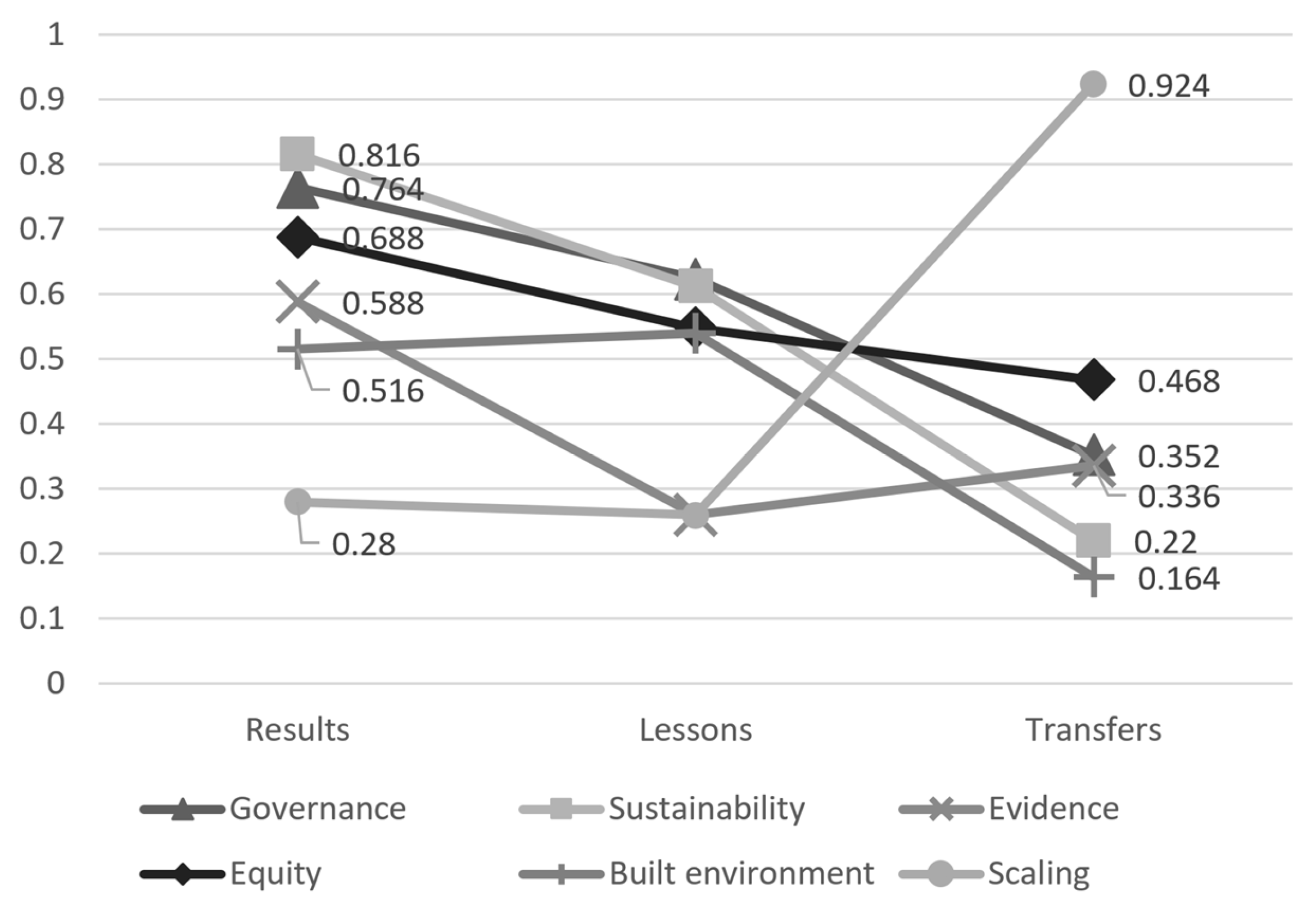
Across comparable thematic families, prevalence trajectories diverge (Figure 1). Governance-related prevalence declines from GPIO (0.764) to GPIA (0.624) to GIPA (0.352). Sustainability-related prevalence shows the steepest decline, from ESRO (0.816) to SRPX (0.612) to SRTV (0.220). Evidence-related coding is moderate in Results (MEEI at 0.588) but lower in both Lessons (MEEU at 0.260) and Transfers (EMPT at 0.336). Built environment and design-related coding declines from IHBE (0.516) and TIIA (0.540) to IDPT (0.164), the lowest-prevalence code in the Transfers domain. Equity-related prevalence declines from SIAO (0.688) to EIEP (0.548) to EICR (0.468). The reverse trajectory belongs to scaling: SRDO (0.280) and SRTM (0.260) sit near the bottom of their respective domains, but RSPX reaches 0.924 in Transfers, the highest single-code prevalence in the entire corpus. Figure 1 summarizes these patterns by showing the progressive narrowing of the reporting repertoire across the three domains.

3.2. Results vs. Results

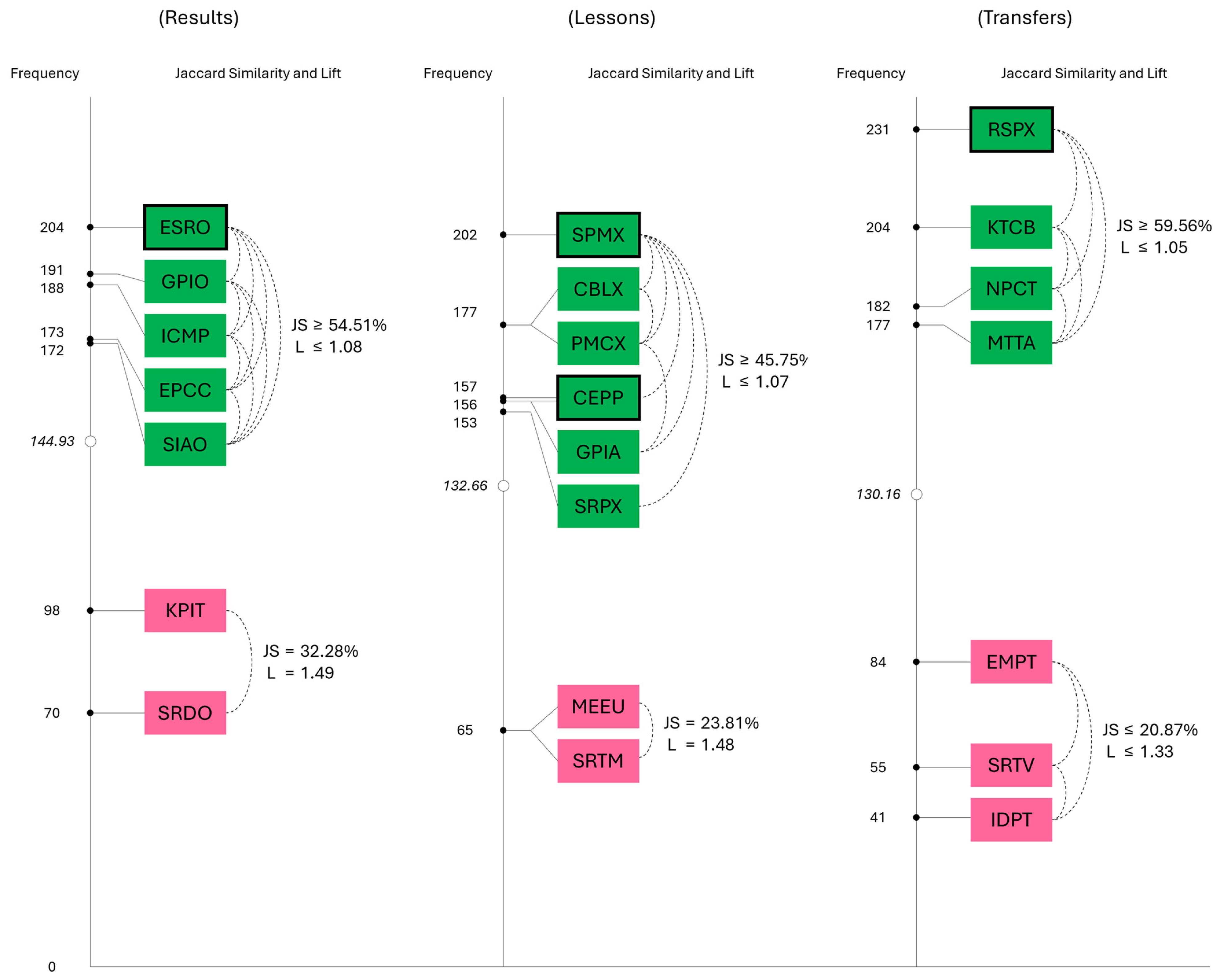
The Results-by-Results matrix (Table S3) has a more evenly distributed overlap profile than either of the other two within-domain tables. Five codes (ESRO, GPIO, ICMP, EPCC, SIAO) form a high-overlap cluster in which no single code commands the network. The largest Jaccard values, ESRO-ICMP (69.70%), ESRO-GPIO (65.97%), GPIO-ICMP (64.78%), and GPIO-SIAO (60.62%), are all concentrated within this group, and no code outside it exceeds 50% overlap with more than two partners. Lift values within the cluster remain close to 1.0, indicating that these pairings reflect shared high prevalence rather than selective co-occurrence.
KPIT and SRDO, the two lowest-prevalence codes in the domain, record the highest Lift value in the entire table (KPIT-SRDO, 32.28%, Lift 1.49). Their Jaccard values with most other Results codes remain below 30%. These cases are examined further in Section 3.8 alongside the formal hole classification.

3.3. Lessons vs. Lessons

The Lessons-by-Lessons matrix (Table S4) differs from the Results matrix in its overlap structure. SPMX is the single most connected code in any within-domain matrix, with Jaccard above 50% in six of its fourteen pairings: SPMX-PMCX (67.70%), SPMX-CBLX (59.92%), SPMX-GPIA (59.11%), SPMX-CEPP (56.77%), SPMX-SRPX (55.70%), and SPMX-TIIA (51.12%). Where the Results matrix distributes overlap across a five-code plateau, the Lessons matrix concentrates it around a single code from which other high-overlap ties extend. CBLX, PMCX, and GPIA function as secondary connectors within this group, but none approaches SPMX’s breadth. Lift values within this core cluster near 1.0.
MEEU and SRTM, the two lowest-prevalence codes in the domain (both at 0.260), show Jaccard values generally below 30% across the matrix but account for the strongest Lift values in the table. MEEU-SRTM records the highest Lift (23.81%, Lift 1.48), followed by OWSQ-SRTM (24.19%, Lift 1.30) and TIIA-MEEU (27.39%, Lift 1.23). These three codes form an internally selective grouping that is weakly connected to the core in overlap terms. MEEU also records some of the lowest Lift values in the matrix, notably with EIEP (0.93) and FVED (0.93). The clearest below-independence pairing involving SRTM is CEPP-SRTM (18.72%, Lift 0.86).

3.4. Transfers vs. Transfers

The Transfers-by-Transfers matrix (Table S5) completes a structural progression visible across the three within-domain tables. Where Results distributes overlap across a five-code plateau and Lessons organizes it around a single hub, Transfers produces the most polarized architecture in the corpus: a tight four-code core separated from a sparse periphery by a wider gap than in either preceding domain.
RSPX anchors this core with the strongest hub profile of any code in any within-domain matrix. Its Jaccard values with KTCB (78.28%), NPCT (69.96%), and MTTA (67.90%) are the highest within-domain overlaps in the study, and it maintains Jaccard above 47% with every code except SRTV and IDPT. KTCB and NPCT further reinforce the core through their mutual overlap (67.83%). Lift values within this group remain near 1.0, consistent with the pattern observed in Results and Lessons.
The periphery is sparser and more internally selective than in either previous domain. EMPT, SRTV, and IDPT form a loose triangle that accounts for the strongest Lift values in the matrix: SRTV-IDPT (14.29%, Lift 1.33), EMPT-IDPT (16.82%, Lift 1.31), and EMPT-SRTV (20.87%, Lift 1.30). All three codes sit below 0.340 prevalence, and all show stronger affinity with each other than with the four-code core. IDPT has the weakest Jaccard profile of any code in the matrix, but its Lift values with SRTV, EMPT, and EICR (1.15) indicate selective co-occurrence with other low-prevalence transfer themes rather than isolation.
At the core-periphery boundary, several pairings fall below independence. DCVX-IDPT (11.76%, Lift 0.82) and KTCB-IDPT (13.95%, Lift 0.90) record under-co-occurrence between the highest-prevalence transfer codes and the lowest-prevalence one. Another notable below-independence pairing is EICR-CALX (25.41%, Lift 0.89), where equity safeguards and context adaptation under-co-occur despite their apparent conceptual proximity. These polarization patterns are examined through the formal hole and silo classification in Section 3.8.
Figure 2 summarizes the structural progression across the three within-domain matrices. Results distributes overlap across a five-code plateau, Lessons concentrates it around a single strategic-planning hub, and Transfers produces the most polarized core-periphery architecture in the corpus.

3.5. Results vs. Lessons

The Results-by-Lessons matrix (Table S6) is the first of three cross-domain tables. Its defining feature is breadth: many themes co-occur across the two domains, but few do so with elevated Lift. The large majority of Lift values fall between 0.90 and 1.15, producing a flatter profile than in either within-domain matrix.
SPMX is the clearest Lessons-side connector, with Jaccard values of 68.46% (ESRO), 67.38% (ICMP), and 65.82% (GPIO), confirming that the hub identified in the within-Lessons matrix (Section 3.3) also functions as the primary receiving code for Results-domain content. PMCX and CBLX serve as secondary connectors, with Jaccard above 60% in their pairings with the top Results codes.
A small number of pairings show above-baseline selectivity along thematic-family lines. SIAO-CEPP (56.67%, Lift 1.10) links equity outcomes to community engagement lessons. IHBE-TIIA (40.43%, Lift 1.09) links built-environment outcomes to technical design lessons. These are the only pairings where a Results code co-occurs preferentially with its thematic counterpart on the Lessons side, and even here, the Lift magnitudes remain modest.
The most distinctive pattern in this matrix involves wellbeing outcomes. HWQO records the lowest Lift values of any Results code at this interface: HWQO-SRTM (15.48%, Lift 0.81) and HWQO-MEEU (16.23%, Lift 0.84). No other Results code shows comparably low Lift values with either SRTM or MEEU. Combined with the scarcity of high-overlap, high-Lift pairings anywhere in the matrix, these patterns are carried forward into the cross-domain analysis in Section 3.6 and Section 3.7.

3.6. Results vs. Transfers

The Results-by-Transfers matrix (Table S7) has the flattest Lift profile of any of the six co-occurrence tables. The contrast between the strongest and weakest Lift values is smaller here than in any other matrix, and the large majority of pairings fall within a narrow band around 1.0.
RSPX is the clearest Transfers-side connector, with Jaccard values of 76.83% (ESRO), 72.43% (ICMP), and 72.24% (GPIO). KTCB, NPCT, and MTTA also maintain Jaccard above 55% in their pairings with the top Results codes, all with Lift near 1.0. This broad connectivity parallels the pattern observed in the Results-to-Lessons matrix (Section 3.5), but with even less variation in Lift.
A small number of pairings show above-baseline selectivity. The highest Lift value in the matrix is IHBE-IDPT (22.30%, Lift 1.47), linking built-environment outcomes to infrastructure and design package transfer. Governance themes record elevated Lift through GPIO-GIPA (39.50%, Lift 1.18) and SIAO-GIPA (37.57%, Lift 1.17). Evidence outcomes connect to evidence for transfer through MEEI-EMPT (33.53%, Lift 1.17). These selective pairings are notable for their scarcity: no pair in this matrix reaches the P80/P80 joint threshold tested in Section 3.8, making it the only matrix where that is the case.
Below-independence pairings concentrate around three codes on the Transfers side. SRDO-IDPT records the lowest Lift value in the entire corpus (7.77%, Lift 0.70). HWQO shows a consistent below-independence pattern with multiple Transfers codes, including HWQO-GIPA (Lift 0.87) and HWQO-IMRX (Lift 0.92). No other Results code records as many below-independence Lift values at this interface.

3.7. Lessons vs. Transfers

The Lessons-by-Transfers matrix (Table S8) has the widest Lift range of the three cross-domain tables, distinguishing it from the Results-to-Lessons matrix (broad but flat) and the Results-to-Transfers matrix (broad and flatter still).
Outside the core, LTLC stands out as the Lessons-side code with the most differentiated Lift profile. It records elevated Lift with GIPA (31.97%, Lift 1.26), EMPT (29.25%, Lift 1.21), and SRTV (21.05%, Lift 1.20), while simultaneously recording among the lowest Lift values in the table with IDPT (9.70%, Lift 0.75). Other above-baseline pairings include SPMX-IMRX (52.34%, Lift 1.12) and EIEP-EICR (41.90%, Lift 1.17).
SRTV and IDPT again concentrate the extreme Lift values at this interface, as they do in the within-Transfers matrix (Section 3.4). The highest-Lift edges are CSAP-IDPT (20.95%, Lift 1.37) and CAVX-IDPT (19.70%, Lift 1.36). The lowest-Lift edges are LTLC-IDPT (9.70%, Lift 0.75) and MEEU-IDPT (8.16%, Lift 0.75). On the SRTV side, below-independence pairings include OWSQ-SRTV (11.63%, Lift 0.77).

3.8. Bundles, Holes, and Silos

This section applies the formal detection rules defined in Section 2.2 across all six matrices.
Applying the bundle rule (Jaccard ≥ P90 and Lift ≥ P90) to all six matrices yields zero qualifying pairs. Pairs in the top Jaccard decile cluster near the Lift median, while pairs in the top Lift decile fall well below the Jaccard median. This distributional separation between overlap and selectivity holds in every matrix. The zero-bundle finding is robust to threshold relaxation. Even at P80/P80, only 12 of 861 code pairs (1.4%) meet the joint threshold (Table 3). The Results-to-Transfers matrix produces zero qualifying pairs at this level, making it the only matrix with no pair simultaneously in the top quintile on both measures. The pairs that do emerge at P80/P80 cluster around social infrastructure themes in the within-Results matrix (SIAO-EPCC, CBEO-PMCO, SIAO-CBEO, EPCC-CBEO) and around operational or institutional pairings in the cross-domain matrices: SIAO-CEPP (Lift 1.10), MEEI-SRPX (Lift 1.11), MEEI-GPIA (Lift 1.09), and SIAO-CSAP (Lift 1.08) in Results-to-Lessons, and SPMX-IMRX (Lift 1.12) and GPIA-DCVX (Lift 1.10) in Lessons-to-Transfers.
Holes (Lift ≤ P10 and Lift < 1) are identified in every matrix, totaling 89 holes across the six co-occurrence tables. Table 4 aggregates these at the node level. IDPT is the most recurrent hole node in the corpus (11 holes across 3 matrices), followed by SRTV (9 holes, 2 matrices). Both sit exclusively on the Transfers side. The next tier includes HWQO (8 holes, 3 matrices), MEEU (8 holes, 3 matrices), and SRDO (8 holes, 2 matrices). HWQO and MEEU appear in both within-domain and cross-domain matrices, while SRDO and SRTV appear only in cross-domain matrices. The five most recurrent hole nodes group into four thematic areas: built environment and design (IDPT), sustainability framing (SRTV), wellbeing and evidence (HWQO, MEEU), and scaling outcomes (SRDO). Additional hole nodes are reported in Table 4.
Silo detection (prevalence ≥ P75 and median Lift ≤ Q25) identifies four codes across the three within-domain matrices (Table 5). In each domain, the single most prevalent code also qualifies as a silo: ESRO (prevalence 0.816, median Lift 1.011) in Results, SPMX (0.808, 1.020) in Lessons, and RSPX (0.924, 1.012) in Transfers. A fourth silo, CEPP (0.628, 1.022), enters in Lessons at the fourth prevalence rank, just clearing the 75th percentile threshold. All four codes show Lift profiles that are flat near 1.0 across their pairwise relations, co-occurring with nearly everything in their domain without elevated selectivity toward any particular partner.

4. Discussion

The Discussion addresses the research questions by interpreting the empirical patterns reported in Section 3 as properties of the BP reporting grammar rather than as direct descriptions of implementation practice.

4.1. From Multidimensional Outcomes to Concentrated Transfer Packages (RQ1)

The findings show that the recurrent thematic repertoire of the UN-Habitat Best Practices corpus is not simply reproduced across Results, Lessons Learned, and Transferability, but progressively redistributed across them. Mean per-BP thematic richness declines by approximately 28% from Results to Transfers, while normalized HHI increases more than four times. What begins as a relatively broad and multidimensional reporting of outcomes is gradually reformulated into a more selective package of portable claims, dominated by a smaller set of transfer-oriented codes: RSPX alone appears in 92.4% of Transfers sections, and the top three codes account for nearly 40% of that domain’s prevalence mass, compared to 27% in Results. This progressive compression is consistent with what the policy mobilities literature theorizes as the mutation of knowledge during transfer: policy models do not move intact but are systematically simplified and reformatted as they are mobilized for wider circulation [37]. The BP reporting sequence makes the dynamics of this mutation empirically visible.
This redistribution is uneven across thematic families (Table 1). Families that describe the substantive content of implementation, what was governed, who was included, what environmental goals were pursued, and what evidence was generated, lose relative salience as the narrative moves toward transferability. Governance-related prevalence dropped by more than half. Sustainability-related prevalence shows the steepest decline, losing nearly three-quarters of its prevalence share. This decline is consistent with the broader challenge of mainstreaming urban nature-based solutions with operational specificity where sustainability is broadly invoked as an outcome but rarely carried forward as a transferable value proposition with operational specificity [38]. Built-environment and design-related, as well as Evidence-related coding also declined considerably. The filtering out of financial, evidentiary, and built-environment content across the sequence mirrors, at the reporting level, the planning-to-implementation detail loss that Olazabal and Ruiz De Gopegui [25] document in climate adaptation plans, where ambitious goals are set without the budgetary and operational specificity needed to execute them.
By contrast, the circulation-oriented codes (RSPX, KTCB, NPCT, MTTA) collectively dominate the Transfers domain. Scaling-related coding illustrates the reversal most clearly: it is among the least prevalent families in Results (SRDO at 0.280) and Lessons (SRTM at 0.260) but becomes the single most prevalent code in Transfers (RSPX at 0.924). As sustainability concepts are routinely reduced to manageable proxy sets that simplify comparison but lose operational depth [28,39], the BP reporting grammar compresses multidimensional implementation narratives into a narrower vocabulary optimized for portability. Similarly, the infrastructure captures thematic presence but not the operational knowledge that would connect monitoring to implementation [31].
Blanc et al. [40] argue that international agencies shape what transfers by selecting, simplifying, and packaging policy models for recirculation. The prevalence redistribution documented here instantiates this dynamic at the corpus level. The BP template carries forward the procedural machinery of circulation more reliably than the substantive content of what was achieved, for whom, and under what conditions. Similarly, Sievers et al. [41] show that place-based knowledge undergoes simplification at each step of transfer from local to global scales, with tacit and context-specific elements being the hardest to carry forward.
Read in light of the paper’s epistemological stance, this pattern should not be interpreted as evidence that urban interventions themselves become simpler, narrower, or less multidimensional over time. The narrowing is a property of the reporting grammar, not of the practices it describes. What it indicates is that implementation knowledge is selectively compressed as it is reformulated for broader circulation. The BP format works as a mechanism of thematic filtration: it carries forward how to circulate a practice (through training, networks, toolkits, and replication pathways) more reliably than it carries forward what was done, for whom, under what institutional conditions, and with what evidence of impact.

4.2. A Loosely Coupled Reporting Grammar: The Absence of Bundles and the Presence of Silos (RQ2)

The findings show that the thematic associations within each domain are organized around broad, prevalence-driven cores rather than around tightly coupled implementation packages. High-overlap associations owe their cohesion to marginal prevalence, while high-Lift associations occur among lower-prevalence codes whose joint visibility is too limited to anchor the reporting core. In the vocabulary of policy assemblage theory, what the BP corpus produces is not a set of integrated policy packages but a loosely coupled assemblage of co-traveling themes [42]. This finding runs counter to the expectation that a curated best-practice repository would reveal coherent implementation “bundles.” In areas such as social housing, successful implementation requires synergy between community participation, institutional commitment, and sustainability principles [43]. The zero-bundle result indicates that the BP reporting grammar does not produce evidence of such synergy at the corpus level.
What the corpus produces instead of bundles is a layered architecture with consistent features across domains. Each domain contains a dense, high-overlap core (documented in Section 3.2, Section 3.3 and Section 3.4). Outside each core sits a thinner periphery of selective associations among lower-prevalence codes, where Lift values are higher but joint visibility is lower. Consistent with that, transdisciplinary collaborations can produce richer integration, but it is difficult to formalize and transfer through standardized formats [44], the selective peripheries in this research are where the corpus’s most distinctive thematic signals reside, but they are also where its least visible reporting occurs.
The silo finding adds a node-level dimension to this picture. In each domain, the single most prevalent code also qualifies as the least selectively integrated (Table 5). These codes co-occur with nearly everything in their domain but are not preferentially attracted to anything. Dickey et al. [45] describe urban knowledge as fragmented across institutions, with “silo-ed thinking” leading to inefficient duplication and failure to translate research into actionable policy. The silo structure identified here exhibits the same pattern. ESRO, SPMX, and RSPX function as institutionally expected narrative elements that co-occur with everything but integrate with nothing. Although silo detection was operationally applied only to within-domain matrices, the Discussion-level observation that the same three codes (ESRO, SPMX, RSPX) anchor their respective domains while showing flat Lift profiles suggests that the silo pattern functions as a cross-domain property of the genre’s defaults. This is a recurrent structural role rather than a domain-specific anomaly. This inference is interpretive rather than formally detected, since the operational silo definition relies on within-domain prevalence and Lift distributions that are not directly comparable across matrices.
The silo structure also reveals which knowledge becomes “obligatory framing” in the BP repertoire. Croese and Duminy [32] argue that urban expertise is not a neutral technical tool but a social product shaped by history and politics, where whose knowledge counts determines what becomes actionable. The three domain-level silos can be read through this lens: environmental sustainability, strategic planning, and replication pathways are the themes that the global reporting template has elevated into obligatory narrative elements, the genre’s version of what Appelhans et al. [46] describe as globally legible norms that circulate widely but are not substantively integrated with the situated, everyday knowledge generated at the local level.
The fourth silo, CEPP (community engagement and participation practices, prevalence 0.628 in Lessons), adds a more pointed observation. Unlike the other three silos, CEPP does not occupy the top prevalence rank in its domain. Community engagement is thus widely invoked as a lesson of implementation but narratively disconnected from scaling logic. This pattern is consistent with a reporting grammar in which participation functions as a procedural legitimacy signal, rather than as an operationally integrated component of how practices are made scalable or financially sustainable. Research on participatory governance supports this interpretation from two directions. On the one hand, Islam [47] shows that participatory budgeting functions simultaneously as a governance mechanism and a legitimacy device, and that its effectiveness depends on institutional embedding rather than procedural adoption alone. On the other hand, Taktak [48] found that community engagement is critical for project success but that its implementation depends heavily on local political culture and varies across countries. Participation is reported as a lesson but not connected to the operational mechanisms (scaling, finance) that would make it context sensitive.

4.3. Translation Loss as Structural Disconnection: What Falls out of the Epistemic Pipeline (RQ3)

The findings show that the movement from Results to Lessons to Transfers is not only a quantitative narrowing, but also a qualitative disconnection. The three cross-domain matrices reproduce the same broad core structure, but they also reveal where in the epistemic pipeline the most consequential content is lost, and the answer is consistent: the Results-to-Transfers interface is the weakest translation pathway in the corpus. This finding is consistent with Dolowitz and Marsh [12], who distinguished among degrees of transfer. From direct copying through emulation, hybridization, and inspiration, noting that the further a policy moves from its original context, the more selective and incomplete the transfer becomes.
The evidence for this claim is cumulative. The Results-to-Transfers matrix has the flattest Lift profile of any cross-domain table, meaning that the contrast between the strongest and weakest associations is smallest. It produces zero qualifying pairs even at the P80/P80 relaxed threshold, making it the only matrix in the study where no code pair simultaneously reaches the top quintile on both Jaccard and Lift. It also contains the lowest Lift value in the entire corpus.
The hole analysis from Section 3.8 identifies where these disconnections concentrate at the node level. The pattern is not random. The five most recurrent hole nodes in the corpus cluster around four thematic families that together define the substantive underside of the reporting grammar: tangible implementation, evaluative infrastructure, value-laden framing, and human impact. If international agencies shape what transfers by selecting, simplifying, and recirculating policy models [40], the hole distribution is consistent with this selective bias because the four families that accumulate the most holes are precisely those that carry the most situated, context-dependent content.
Two patterns within this disconnection structure are especially revealing. The first is that infrastructure and design package transfer (IDPT), the most tangible dimension of what was built, is also the most disconnected code in the entire corpus (11 hole edges across 3 matrices). In Polanyi’s [19] terms, physical design and infrastructure represent the knowledge dimension most resistant to formalization. Similarly, Sievers et al. [41] show that place-based knowledge undergoes simplification at each step of transfer from local to global scales, with tacit and context-specific elements being the hardest to carry forward. The IDPT pattern is the corpus-level expression of this dynamic.
However, the disconnection is not uniform across all Lessons content. In the Lessons-to-Transfers matrix, CSAP-IDPT (Lift 1.37) and CAVX-IDPT (Lift 1.36) are the highest-Lift edges, indicating that context adaptation and communication lessons are selectively drawn toward design transfer even as institutional and evaluative lessons are not. This suggests that when design transfer does occur in the reporting, it is framed through the language of adaptation and visibility rather than through governance, leadership, or evidence. This observation resonates with evidence that physical design resists standardization. For example, affordable housing in Africa depends on context-sensitive strategies and faces material, regulatory, social, and implementation constraints [49]; active mobility infrastructure varies enormously across cities and resists template-based transfer [50]; and waste management systems require significant technical redesign when moving between income contexts [51]. In each case, the dimension of implementation that is most tangible and most context-dependent is also the hardest to carry through a standardized reporting format. The narrative tells the reader to replicate, but not what to build.
The second revealing pattern concerns how far selective translations carry across the full sequence. Built-environment outcomes illustrate this clearly: physical infrastructure outcomes translate modestly into technical design lessons at the first interface (Tables S3 and S6), but this selective link attenuates significantly at the second interface. The design content present in Lessons fails to reach the transfer narrative. The content is not absent from the start; it is lost at the second interface. By contrast, governance themes maintain selective affinity directly across the Results-to-Transfers interface despite the steep prevalence decline documented in Section 4.1. This asymmetry is consistent with what Macrorie et al. [52] observe in EU urban transformation: digital and environmental technologies require strong legal and institutional frameworks to function effectively, and it is those frameworks, rather than the technologies themselves, that prove most portable across settings. A similar attenuation pattern shapes equity translation, but with an important distinction. Equity does reach Transfers, but through a different channel (EIEP-EICR). Showing that equity as a lesson, rather than equity as a reported outcome, is the code that selectively connects to equity safeguards for transfer. The translation is not absent but rerouted.
Evidence outcomes show a parallel direct link to governance: MEEI-EMPT (Lift 1.17 in Results-to-Transfers) connects evidence of impact to evidence for transfer with modest selectivity. These direct selective translations do not require the mediating step of Lessons, making governance and evidence the thematic families with the clearest unmediated pathway from outcomes to transfer claims. The evidence channel, however, is narrow. Gavaldà et al. [28] document a structural disconnect between indicator frameworks and actual sustainability goal achievement, and the MEEI-EMPT link suggests that a version of the same disconnect operates within the BP corpus: evidence translates through direct citation of proven impact rather than through operationalized lessons about how to use monitoring for adaptive implementation. Boeing et al. [53] make a complementary observation about open-data spatial indicators, showing that measurable urban design features require local calibration and context-specific interpretation to become actionable. The MEEU disconnection (8 holes across 3 matrices) confirms that evidence is present in the corpus but not integrated with the substantive themes, equity, finance, wellbeing, that it would need to support for transfer to carry operational specificity.
The pipeline, in other words, does not treat all thematic families equally. HWQO appears in 45.6% of Results sections but is among the most poorly translated themes across the pipeline. Pappu and Lazar [30] note that liveability is measured at the index level through divergent methods but rarely operationalized for context-specific intervention, and Stiuso [54] argues that urban safety for women requires not just technical tools but social inclusion and lived experience. The HWQO disconnection is the reporting-grammar counterpart of both observations: human-impact knowledge is present as a reported achievement but is not carried forward into the design of transfer with the same reliability as institutional or procedural content.
Following this interpretation, the cross-domain and hole findings indicate that translation loss in the BP corpus is not simply a matter of reduced thematic breadth, as documented by the prevalence and concentration analysis in Section 4.1, but a matter of selective disconnection. The themes that lose the most connectivity across the pipeline are precisely those that would be needed to move from recognizing a practice as successful to understanding how to reproduce its substantive content in a new setting.

4.4. Best Practices and the Implementation Gap (RQ4)

The introduction framed this study around the premise that implementation knowledge is not simply missing but actively constructed, formatted, and circulated through institutional reporting genres, and that the UN-Habitat Best Practices database represents one of the most globally visible attempts to make local implementation legible and portable at scale. In the language of the policy transfer literature, UN-Habitat functions as what Stone [55] calls a transfer agent: an international organization that does not merely collect practices but actively shapes what becomes portable by determining the format through which local experience is narrated, compressed, and made comparable. The preceding sections have documented what seems to be a progressively narrower thematic repertoire (Section 4.1), a loosely coupled reporting grammar organized around obligatory framings rather than integrated packages (Section 4.2), and a set of systematic cross-domain disconnections that concentrate around the physical, evidentiary, value-laden, and human-impact dimensions of implementation (Section 4.3). The question that remains is what these patterns, taken together, mean for the implementation gap that motivated the study.
The findings suggest that the BP reporting grammar accomplishes a specific and non-trivial form of bridging. Across 250 cases drawn from five world regions, covering diverse sectors, scales, and institutional contexts, the corpus produces a shared thematic vocabulary that makes heterogeneous interventions minimally comparable. The recurrence of a recognizable reporting core in every domain indicates that the template succeeds in standardizing what implementation looks like when it is reported for external audiences. The corpus also consistently mobilizes the machinery of circulation: 92.4% of Transfers sections invoke replication pathways, 81.6% invoke knowledge transfer, 72.8% invoke partnerships for transfer, and 70.8% invoke methodology and toolkits. The BP format thus generates, at scale, what Scott [24] theorized as legibility: a condition in which diverse, situated practices are rendered recognizable, classifiable, and comparable within a shared administrative vocabulary. Scott argued that legibility is the precondition for governance at a distance, enabling central institutions to see and coordinate activities they cannot directly observe. This is a real contribution to bridging the implementation gap, and it should not be dismissed. Dickey et al. [45] note that knowledge exchange institutions are typically analyzed as knowledge brokers rather than as shapers of knowledge content. The present analysis makes the complementary move: it shows that the BP system generates a navigable, searchable infrastructure of cases (the broker function) while simultaneously shaping the content of those cases through the thematic filtration documented in Section 4.1, Section 4.2 and Section 4.3.
However, the same findings also reveal that institutional legibility is not the same as operational specificity, and the gap between the two is where the reporting grammar falls short. The implementation gap, as defined in the Introduction, is not primarily a gap in recognition or classification. It is a gap in the capacity to reproduce, adapt, and deliver interventions under real institutional, financial, social, and environmental constraints [56,57]. The OECD’s Global State of National Urban Policy report documents a persistent disconnect between national urban policy frameworks and local implementation, finding that many countries have policies but lack the execution mechanisms to deliver them. Our findings show that this disconnect is reproduced inside the BP reporting format itself. The corpus generates policy-level legibility but not so much the execution-level specificity that would close the gap. A reporting format that supported the closure of that gap would carry forward not only the recognition that a practice was successful but also the substantive content of what was physically built, what evidence demonstrated impact, how sustainability was operationalized as more than a framing, and whose wellbeing concretely improved. These are precisely the dimensions that the hole analysis identifies as the most systematically disconnected from the portable transfer narrative.
The specifics of this disconnection, and the channels through which some content does survive, can now be read together across the four thematic families identified in Section 4.3. Infrastructure and design package transfer (IDPT), the most disconnected code in the corpus (11 hole edges across 3 matrices), represents the tangible, material dimension of implementation. Anand [26] documents the tendency of smart city projects in the Global South to prioritize infrastructure investment over social equity, deploying technology without addressing basic needs. The IDPT disconnection suggests that the BP reporting grammar mirrors this pattern at the level of knowledge packaging. The format describes that a practice is replicable and through what mechanisms, but the design content that operational reproduction would require is among the least preserved in the corpus. Even in sectors where technical knowledge is highly codifiable, such as IoT-based urban planning systems, successful implementation requires substantial context-specific calibration that resists template-based transfer [58]. The instruction manual specifies the training, the partnerships, and the replication pathway, but the blueprint, when it appears, is not something technically specified.
Evidence and monitoring (MEEU at 8 hole edges across 3 matrices, EMPT at 6 hole edges across 2 matrices) represent the evaluative infrastructure of implementation. The MEEU and EMPT disconnections show that the evaluative gap documented by indicator-framework reviews [28,31] is reproduced inside the BP reporting grammar. Evidence of impact is reported in 58.8% of Results sections (MEEI), but evidence use as a lesson drops to 26.0% (MEEU), and evidence as a basis for transfer only partially recovers to 33.6% (EMPT). Within Lessons, evidence use is decoupled from equity practices and financial viability (EIEP-MEEU Lift 0.93, FVED-MEEU Lift 0.93), indicating that even where evidence is invoked, it is not integrated with the substantive themes it would need to support. The evidence channel is not entirely closed, as documented in Section 4.3: evidence translates through direct citation of proven impact rather than through operationalized lessons about how to use monitoring for adaptive implementation.
Sustainability as a transferable value (SRTV, 9 hole edges across 2 matrices) represents the normative dimension of implementation. The prevalence decline from ESRO (0.816 in Results) to SRTV (0.220 in Transfers) is the steepest in the corpus, and the hole analysis shows that this is not merely a matter of reduced frequency. SRTV is systematically decoupled from equity, financial, wellbeing, and context-adaptation themes across multiple matrices. Sustainability is present in the corpus as an outcome but largely absent from the transfer narrative as an integrated, operationally grounded value. Bani Khalifi et al. [59] show that integrating life cycle assessment into green infrastructure requires site-specific environmental data and locally calibrated impact models. The SRTV disconnection is consistent with this finding. Sustainable operationalization requires precisely the kind of situated, evidence-intensive specification that the reporting grammar progressively filters out.
Wellbeing and quality-of-life outcomes (HWQO, 8 hole edges across 3 matrices) represent the human-impact dimension of implementation. As documented in Section 4.3, HWQO is among the most poorly translated themes across the pipeline, decoupled from scaling, evidence, and governance at multiple interfaces. The disconnection, however, is specific to the cross-domain interface. Within the Lessons domain, the wellbeing code (OWSQ) selectively associates with scaling mindset (OWSQ-SRTM Lift 1.30), meaning that when wellbeing appears as a lesson rather than as a reported achievement, it does connect to replication thinking. The disconnect is not between the concepts themselves but between the reporting positions they occupy: the pipeline translates wellbeing-as-lesson into scaling logic but fails to translate wellbeing-as-outcome into that same logic. Jato-Espino et al. [60] document a parallel gap in green space planning, where citizen perceptions of availability and quality diverge from objective GIS data, indicating that effective implementation requires integrating subjective, community-level knowledge with measurable indicators. The HWQO disconnection suggests that the BP format carries what is objectively reportable (outcomes, prevalence, pathways) but not the subjective, experiential knowledge of how wellbeing was concretely improved and for whom.
The community engagement silo (CEPP in Lessons, decoupled from scaling logic with CEPP-SRTM Lift 0.86) adds a procedural dimension to this picture, as discussed in Section 4.2. The within-Transfers domain reveals a parallel disconnection. Equity safeguards and context adaptation are decoupled (EICR-CALX Lift 0.89), indicating that even within the transfer narrative, the equity considerations that would make adaptation context-sensitive are not integrated with the adaptation mechanisms themselves. Participation and equity are reported as something that happened and that should happen, but not as something that shapes how transfer is designed or how adaptation is made locally relevant.
These individual disconnections compose a coherent overall pattern. The BP format bridges the implementation gap at the level of institutional legibility, but it does not bridge the gap at the level of operational specificity. What emerges is a portability paradox: the more implementation knowledge is reformulated for broad circulation through the standardized reporting template, the more it sheds the situated, technical, and evaluative content that a practitioner in a new context would need to actually reproduce the practice. The genre succeeds at making implementation legible but not at making it reproducible. It solves the visibility problem (how to find and compare practices) more reliably than it solves the translation problem (how to adapt and deliver them elsewhere). This paradox is the empirical form of what the policy mobilities literature theorizes as mutation. Policy models do not move intact but are systematically reformatted as they travel, and the reformatting is not random but follows the logic of the institutional formats through which circulation occurs [37]. If international agencies shape what transfers by selecting, simplifying, and recirculating policy models, a process that creates institutional legibility at the cost of local specificity [40], the portability paradox is the empirical measurement of this cost. The corpus achieves legibility (RSPX at 92.4%) while shedding the situated content (IDPT at 16.4%, SRTV at 22.0%) that would make transfer substantive. Sievers et al. [41] make a complementary argument from the knowledge-transfer literature, showing that effective place-based transfer depends on maintaining relational, tacit, and context-sensitive dimensions across each transfer step. The reporting grammar carries the procedural machinery of transfer (training, networks, toolkits, replication pathways) but not the relational and tacit content that Sievers et al. identify as essential for reproduction.
The differentiated translation patterns documented in Section 4.3 add precision to this paradox. The portability gap is not a uniform wall. In the framework of Dolowitz and Marsh [12], these thematic families operate closer to the “emulation” end of the transfer spectrum, where institutional structures and evaluative logics are reproduced with some adaptation. Equity is rerouted through Lessons-side codes rather than lost entirely, representing what Dolowitz and Marsh would characterize as a form of “hybridization,” where the translated content differs in form from the original reported outcome.
The paradox also has a knowledge-politics dimension that connects to broader critiques of global urban norms. Croese and Duminy [32] argue that urban expertise in the Global South is shaped by history and politics, and that whose knowledge becomes actionable determines whose problems get solved. The reporting grammar’s selective filtration is not knowledge-neutral; it favors institutional and procedural knowledge, which is globally legible and readily standardized, over situated, community-produced knowledge, which is locally essential but harder to formalize. Appelhans et al. [46] extend this critique, arguing that international agendas are often “blind” to everyday urban realities and treat local practices as problems to be solved rather than as sources of innovation. The portability paradox is structurally aligned with their argument. The BP format makes practices legible to global audiences by reformulating them into a standardized vocabulary, but in doing so it strips the everyday, situated content that is most valuable for locally responsive implementation.
The content that survives the pipeline (replication pathways, knowledge transfer, partnerships) is the content that is most amenable to the template’s standardizing logic. The content that is lost (physical design, sustainability as a lived value, well-being as experienced impact) is the content that is most resistant to that logic and most dependent on the local conditions it describes.

4.5. Limitations

Several limitations shape what the findings can and cannot claim. The most fundamental concerns what the corpus represents. Inclusion in the database as Award Winner or Best Practice is treated as institutional recognition, not as independent verification of effectiveness. The database likely over-represents cases with higher documentation capacity and narratives aligned with UN policy vocabularies, and its exclusive use of English may further amplify this selection dynamic.
The coding pipeline introduces two further constraints. First, as discussed in Section 2, formal inter-coder reliability statistics were not computed for the application of the final axial framework. While the consensus-based codebook construction is supported by qualitative methodological literature, the absence of a kappa or alpha statistic limits independent verification of coding application. Second, the frequency threshold (≥20 occurrences) biases the network toward recurrent themes, improving analytic tractability but meaning that the reported patterns describe the visible reporting grammar rather than an exhaustive map of what is present in the texts. A code’s appearance in a section also does not guarantee that the underlying text provides actionable detail, only that the theme is narratively mobilized.
Finally, the data also cannot disentangle three mechanisms contributing to the observed grammar, namely the template’s design, authors’ choices about what to include, and the curation process that determines what the database recognizes. The holes identified in Section 3.8 could arise from any combination of these.

5. Conclusions

This study analyzed 250 UN-Habitat Best Practice reports as a standardized genre of implementation reporting, revealing a portability paradox. The BP format bridges the implementation gap at the level of institutional legibility, making practices recognizable and comparable within a shared vocabulary, but not at the level of operational specificity. The physical, evidentiary, and context-sensitive content that operational reproduction would require is progressively filtered out across the reporting sequence. Four thematic families, namely infrastructure and design, evidence and monitoring, sustainability as a transferable value, and wellbeing as experienced impact, proved the most systematically disconnected from the portable transfer narrative, while the procedural machinery of circulation (replication pathways, knowledge transfer, partnerships, toolkits) survived with minimal attenuation. The portability paradox is not a critique of the database nor a claim that the UN-Habitat template is deficient; it is a property of the genre itself, in which the reformatting of local experience for broader circulation follows the standardizing logic of the institutional format [37].
Three implications follow. First, the analytical framework developed here (prevalence profiles, Jaccard/Lift co-occurrence networks, bundle/hole/silo detection) provides a replicable audit methodology applicable to other curated reporting systems, from SDG Voluntary National Reviews to ICLEI, C40, and OECD urban policy compendia, to test whether analogous filtration patterns appear across reporting genres. More broadly urban and policy studies could engage with text-as-data and network-based methodologies capable of surfacing the systematic biases and silences that conventional case-based evaluation leaves unexamined. Second, the findings surface a design tension that merits empirical investigation: whether reporting templates can retain more situated, evidentiary, and material content without sacrificing the cross-context comparability that makes them institutionally useful. The legibility the current format achieves is a nontrivial accomplishment; whether structured prompts for design specifications, evidence chains, or operationalized sustainability could preserve more content without overloading the format is an open question beyond the scope of genre analysis. Future template design could incorporate structured fields that preserve local material and contextual specificity alongside the standardized categories that enable cross-case legibility. Third, the progressive shedding of content most resistant to formalization suggests that the implementation gap is not only a gap between policy and practice but also a gap between what is known locally and what survives the reporting formats through which that knowledge circulates.
Finally, because sustainability priorities and implementation conditions vary across regions [61], the global patterns documented here may compress meaningful regional variation. Whether the portability paradox operates uniformly or is itself regionally differentiated is the focus of a subsequent study exploiting the stratified design of this corpus.


Supplementary Materials

The following supporting information can be downloaded at: https://www.mdpi.com/article/10.3390/urbansci10050277/s1, Table S1: 250 Best Practices selected for this research separated by region; Table S2: Axial code framework for Results, Lessons, and Transferability, including definitions and retained open codes (frequency ≥ 20); Table S3: Within-Results thematic co-occurrence matrix for axial codes, showing Jaccard similarity and Lift; Table S4: Within-Lessons thematic co-occurrence matrix for axial codes, showing Jaccard similarity and Lift; Table S5: Within-Transferability thematic co-occurrence matrix for axial codes, showing Jaccard similarity and Lift; Table S6: Cross-section thematic co-occurrence matrix between Results and Lessons axial codes, showing Jaccard similarity and Lift; Table S7: Cross-section thematic co-occurrence matrix between Results and Transferability axial codes, showing Jaccard similarity and Lift; Table S8: Cross-section thematic co-occurrence matrix between Lessons and Transferability axial codes, showing Jaccard similarity and Lift.

Author Contributions

Conceptualization, F.C.-R., F.V. and D.B.; methodology, F.C.-R.; software, F.C.-R. and J.P.; validation, F.C.-R., J.P. and D.B.; formal analysis, F.C.-R., F.V. and D.B.; investigation, F.C.-R., J.P., F.V. and D.B.; data curation, F.C.-R. and J.P.; writing—original draft preparation, F.C.-R.; writing—review and editing J.P., F.V. and D.B.; visualization, F.C.-R. and D.B.; supervision, F.C.-R.; project administration, F.C.-R.; funding acquisition, F.C.-R. All authors have read and agreed to the published version of the manuscript.

Funding

This research was supported by the National Academies of Sciences, Engineering, and Medicine’s Gulf Research Program (GRP) through the Gulf Futures Design Studio Program (GR-00016186/SCON-10001235) and an Early-Career Research Fellowship awarded to Fabio Capra-Ribeiro (GR-00017768/SCON-10001539).

Institutional Review Board Statement

Not applicable.

Informed Consent Statement

Not applicable.

Data Availability Statement

The original contributions presented in this study are included in the article/Supplementary Materials. Further inquiries can be directed to the corresponding author.

Conflicts of Interest

The authors declare no conflicts of interest.

References

  1. United Nations Human Settlements Programme. UN-Habitat World Cities Report 2022: Envisaging the Future of Cities; United Nations Human Settlements Programme: Nairobi, Kenya, 2022. [Google Scholar]
  2. Bai, X.; McPhearson, T.; Cleugh, H.; Nagendra, H.; Tong, X.; Zhu, T.; Zhu, Y.-G. Linking Urbanization and the Environment: Conceptual and Empirical Advances. Annu. Rev. Environ. Resour. 2017, 42, 215–240. [Google Scholar] [CrossRef]
  3. Lowe, M.; Adlakha, D.; Sallis, J.F.; Salvo, D.; Cerin, E.; Moudon, A.V.; Higgs, C.; Hinckson, E.; Arundel, J.; Boeing, G.; et al. City Planning Policies to Support Health and Sustainability: An International Comparison of Policy Indicators for 25 Cities. Lancet Glob. Health 2022, 10, e882–e894. [Google Scholar] [CrossRef] [PubMed]
  4. Sarkar, S.; Cottineau-Mugadza, C.; Wolf, L.J. Spatial Inequalities and Cities: A Review. Environ. Plan. B Urban Anal. City Sci. 2024, 51, 1391–1407. [Google Scholar] [CrossRef]
  5. UN-Habitat. Shanghai Manual: A Guide for Sustainable Urban Development in the 21st Century; 2025 Annual Report; UN-Habitat: Nairobi, Kenya, 2025. [Google Scholar]
  6. UN-Habitat. Guidelines for Reporting on the Implementation of the New Urban Agenda; UN-Habitat: Nairobi, Kenya, 2024. [Google Scholar]
  7. Capra-Ribeiro, F. Prevailing Issues and Actions in Urban Best Practices Across Latin America and the Caribbean. Urban Plan. 2024, 9, 8130. [Google Scholar] [CrossRef]
  8. Blake, O.; Glaser, M.; Bertolini, L.; te Brömmelstroet, M. How Policies Become Best Practices: A Case Study of Best Practice Making in an EU Knowledge Sharing Project. Eur. Plan. Stud. 2021, 29, 1251–1271. [Google Scholar] [CrossRef]
  9. de Oliveira, O.P. A Prelude to Policy Transfer Research. In Handbook of Policy Transfer, Diffusion and Circulation; Edward Elgar Publishing: Cheltenham, UK, 2021; pp. 1–24. ISBN 978-1-78990-560-1. [Google Scholar]
  10. Cochrane, A.; Ward, K. Researching the Geographies of Policy Mobility: Confronting the Methodological Challenges. Environ. Plan. A 2012, 44, 5–12. [Google Scholar] [CrossRef]
  11. Temenos, C.; Baker, T.; Cook, I.R. Inside Mobile Urbanism: Cities and Policy Mobilities. In Handbook of Urban Geography; Edward Elgar Publishing: Cheltenham, UK, 2019; pp. 103–118. ISBN 978-1-78536-460-0. [Google Scholar]
  12. Dolowitz, D.P.; Marsh, D. Learning from Abroad: The Role of Policy Transfer in Contemporary Policy-Making. Governance 2000, 13, 5–23. [Google Scholar] [CrossRef]
  13. Macmillen, J.; Stead, D. Learning heuristic or political rhetoric? Sustainable mobility and the functions of ‘best practice’. Transp. Policy 2014, 35, 79–87. [Google Scholar] [CrossRef]
  14. Nagorny-Koring, N.C. Leading the Way with Examples and Ideas? Governing Climate Change in German Municipalities through Best Practices. J. Environ. Policy Plan. 2019, 21, 46–60. [Google Scholar] [CrossRef]
  15. McCann, E. Urban Policy Mobilities and Global Circuits of Knowledge: Toward a Research Agenda. Ann. Assoc. Am. Geogr. 2011, 101, 107–130. [Google Scholar] [CrossRef]
  16. Swales, J.M. Genre Analysis: English in Academic and Research Settings; Cambridge University Press: Cambridge, UK, 1990; ISBN 978-0-521-32869-2. [Google Scholar]
  17. Bazerman, C. Shaping Written Knowledge: The Genre and Activity of the Experimental Article in Science; University of Wisconsin Press: Madison, WI, USA, 1988. [Google Scholar]
  18. Miller, C.R. Genre as Social Action. Q. J. Speech 1984, 70, 151–167. [Google Scholar] [CrossRef]
  19. Polanyi, M. The Tacit Dimension; University of Chicago Press: Chicago, IL, USA, 1966; ISBN 978-0-226-67298-4. [Google Scholar]
  20. Porter, T.M. Trust in Numbers: The Pursuit of Objectivity in Science and Public Life; Princeton University Press: Princeton, NJ, USA, 1995; ISBN 978-0-691-02908-5. [Google Scholar]
  21. Espeland, W.N.; Stevens, M.L. Commensuration as a Social Process. Annu. Rev. Sociol. 1998, 24, 313–343. [Google Scholar] [CrossRef]
  22. Mosse, D. Cultivating Development: An Ethnography of Aid Policy and Practice; Pluto Press: London, UK, 2005; ISBN 978-1-78371-364-6. [Google Scholar]
  23. Freeman, R. What Is ‘Translation’? Evid. Policy 2009, 5, 429–447. [Google Scholar] [CrossRef]
  24. Scott, J.C. Seeing Like a State: How Certain Schemes to Improve the Human Condition Have Failed; Yale University Press: New Haven, CT, USA, 1998; ISBN 978-0-300-24675-9. [Google Scholar]
  25. Olazabal, M.; Ruiz De Gopegui, M. Adaptation Planning in Large Cities Is Unlikely to Be Effective. Landsc. Urban Plan. 2021, 206, 103974. [Google Scholar] [CrossRef]
  26. Anand, P.B. Assessing Smart City Projects and Their Implications for Public Policy in the Global South. Contemp. Soc. Sci. 2021, 16, 199–212. [Google Scholar] [CrossRef]
  27. Gupta, A.; Yadav, M.; Nayak, B.K. A Systematic Literature Review on Inclusive Public Open Spaces: Accessibility Standards and Universal Design Principles. Urban Sci. 2025, 9, 181. [Google Scholar] [CrossRef]
  28. Gavaldà, O.; Gibbs, C.; Eicker, U. A Review of Current Evaluation Urban Sustainability Indicator Frameworks and a Proposal for Improvement. Sustainability 2023, 15, 15425. [Google Scholar] [CrossRef]
  29. Mohamed, S.T.; Mandour, A.; Baker, H. A Critical Review of Quality Assessment Tools for Public Spaces. Eng. Res. J. 2023, 177, 255–274. [Google Scholar] [CrossRef]
  30. Pappu, M.; Lazar, N. Comparative Review of Liveability Indices: Trends and Insights. Bud. Archit. 2025, 24, 25011. [Google Scholar] [CrossRef]
  31. Rusli, N.; Ludin, A.N.M.; Umjang, E.; Sahana, M. A Review on Worldwide Urban Observatory Systems’ Data Analytics Themes: Lessons Learned for Malaysia Urban Observatory (MUO). J. Urban Manag. 2023, 12, 231–254. [Google Scholar] [CrossRef]
  32. Croese, S.; Duminy, J. Co-Producing Urban Expertise for SDG Localization: The History and Practices of Urban Knowledge Production in South Africa. Urban Geogr. 2023, 44, 538–557. [Google Scholar] [CrossRef]
  33. MacQueen, K.M.; McLellan, E.; Kay, K.; Milstein, B. Codebook Development for Team-Based Qualitative Analysis. CAM J. 1998, 10, 31–36. [Google Scholar] [CrossRef]
  34. Saldana, J. The Coding Manual for Qualitative Researchers; SAGE Publications: Thousand Oaks, CA, USA, 2021; ISBN 978-1-5297-5599-2. [Google Scholar]
  35. Hill, C.E.; Knox, S.; Thompson, B.J.; Williams, E.N.; Hess, S.A.; Ladany, N. Consensual Qualitative Research: An Update. J. Couns. Psychol. 2005, 52, 196–205. [Google Scholar] [CrossRef]
  36. Campbell, J.L.; Quincy, C.; Osserman, J.; Pedersen, O.K. Coding In-Depth Semistructured Interviews: Problems of Unitization and Intercoder Reliability and Agreement. Sociol. Methods Res. 2013, 42, 294–320. [Google Scholar] [CrossRef]
  37. Peck, J.; Theodore, N. Mobilizing Policy: Models, Methods, and Mutations. Geoforum 2010, 41, 169–174. [Google Scholar] [CrossRef]
  38. McPhearson, T.; Frantzeskaki, N.; Ossola, A.; Diep, L.; Anderson, P.M.L.; Blatch, T.; Collier, M.J.; Cook, E.M.; Culwick Fatti, C.; Grabowski, Z.J.; et al. Global Synthesis and Regional Insights for Mainstreaming Urban Nature-Based Solutions. Proc. Natl. Acad. Sci. USA 2025, 122, e2315910121. [Google Scholar] [CrossRef]
  39. Michalina, D.; Mederly, P.; Diefenbacher, H.; Held, B. Sustainable Urban Development: A Review of Urban Sustainability Indicator Frameworks. Sustainability 2021, 13, 9348. [Google Scholar] [CrossRef]
  40. Blanc, F.; Cotella, G.; Dąbrowski, M. Spatial Governance and Planning Policy Transfer in the Global South. The Role of International Agency and the Recirculation of Policies. Plan. Pract. Res. 2023, 38, 749–762. [Google Scholar] [CrossRef]
  41. Sievers, E.; Spierenburg, M.; Jhagroe, S.S.; van Oudenhoven, A.P.E. Place-Based Knowledge Transfer in a Local-to-Global and Knowledge-to-Action Context: Key Steps and Facilitative Factors. Ecol. Soc. 2024, 29, 8. [Google Scholar] [CrossRef]
  42. McCann, E.; Ward, K. Policy Assemblages, Mobilities and Mutations: Toward a Multidisciplinary Conversation. Political Stud. Rev. 2012, 10, 325–332. [Google Scholar] [CrossRef]
  43. Gomide, F.P.d.B.; Bragança, L.; Junior, E.F.C. The Synergy of Community, Government, and Circular Economy in Shaping Social Housing Policies. Buildings 2024, 14, 1897. [Google Scholar] [CrossRef]
  44. Patel, Z.; Schneider, F.; Paulavets, K. Linking Local Projects with Global Processes: Learning From Transdisciplinary Collaborations in African Cities. Front. Sustain. Cities 2022, 4, 806053. [Google Scholar] [CrossRef]
  45. Dickey, A.; Kosovac, A.; Fastenrath, S.; Acuto, M.; Gleeson, B. Fragmentation and Urban Knowledge: An Analysis of Urban Knowledge Exchange Institutions. Cities 2022, 131, 103917. [Google Scholar] [CrossRef]
  46. Appelhans, N.; Rawhani, C.; Huchzermeyer, M.; Oyalowo, B.; Sihlongonyane, M.F. Everyday Urban Practices in Africa: Disrupting Global Norms; Taylor & Francis: Abingdon, UK, 2024; ISBN 978-1-040-11230-4. [Google Scholar]
  47. Islam, S. Public Finance and Policy Effectiveness: A Review of Participatory Budgeting In Local Governance Systems. J. Sustain. Dev. Policy 2025, 1, 115–143. [Google Scholar] [CrossRef]
  48. Taktak, F. Global Perspectives on Urban Transformation: A Comparative Analysis of Approaches and Outcomes in Different Countries. J. Urban Plan. Dev. 2025, 151, 04025056. [Google Scholar] [CrossRef]
  49. Bhanye, J.; Lehobo, M.T.; Mocwagae, K.; Shayamunda, R. Strategies for Sustainable Innovative Affordable Housing (SIAH) for Low Income Families in Africa: A Rapid Review Study. Discov. Sustain. 2024, 5, 157. [Google Scholar] [CrossRef]
  50. D’Amico, A. Strategies and Instruments for Active Mobility: Comparison of International Experiences. TeMA J. Land. Use Mobil. Environ. 2024, 17, 155–167. [Google Scholar] [CrossRef]
  51. Awino, F.B.; Apitz, S.E. Solid Waste Management in the Context of the Waste Hierarchy and Circular Economy Frameworks: An International Critical Review. Integr. Environ. Assess. Manag. 2024, 20, 9–35. [Google Scholar] [CrossRef]
  52. Macrorie, R.; Marvin, S.; Smith, A.; While, A. A Common Management Framework for European Smart Cities? The Case of the European Innovation Partnership for Smart Cities and Communities Six Nations Forum. J. Urban Technol. 2023, 30, 63–80. [Google Scholar] [CrossRef]
  53. Boeing, G.; Higgs, C.; Liu, S.; Giles-Corti, B.; Sallis, J.F.; Cerin, E.; Lowe, M.; Adlakha, D.; Hinckson, E.; Moudon, A.V.; et al. Using Open Data and Open-Source Software to Develop Spatial Indicators of Urban Design and Transport Features for Achieving Healthy and Sustainable Cities. Lancet Glob. Health 2022, 10, e907–e918. [Google Scholar] [CrossRef]
  54. Stiuso, T. Exploring Approaches and Solutions for Urban Safety: A Focus on Women. TeMA J. Land Use Mobil. Environ. 2024, 17, 179–186. [Google Scholar] [CrossRef]
  55. Stone, D. Transfer Agents and Global Networks in the ‘Transnationalization’ of Policy. J. Eur. Public Policy 2004, 11, 545–566. [Google Scholar] [CrossRef]
  56. OECD; United Nations Human Settlements Programme (UN-Habitat). Global State of National Urban Policy 2021: Achieving Sustainable Development Goals and Delivering Climate Action; OECD Publishing: Paris, France; UN-Habitat: Nairobi, Kenya, 2021. [Google Scholar]
  57. Pressman, J.L.; Wildavsky, A. Implementation: How Great Expectations in Washington Are Dashed in Oakland; Or, Why It’s Amazing That Federal Programs Work at All, This Being a Saga of the Economic Development Administration as Told by Two Sympathetic Observers Who Seek to Build Morals on a Foundation; University of California Press: Oakland, CA, USA, 1984; ISBN 978-0-520-05331-1. [Google Scholar]
  58. Zakaria, A.A.; Amr, T.; Ragheb, A.A. IoT in Smart Urban Planning: A Comprehensive Review of Applications, Developments, and Engineering Perspectives. IEEE Access 2025, 13, 135316–135335. [Google Scholar] [CrossRef]
  59. Bani Khalifi, N.; Avgoustaki, D.D.; Bartzanas, T. Integrating Life Cycle Assessment into Green Infrastructure: A Systematic Review and Meta-Analysis of Urban Sustainability Strategies. Front. Sustain. Cities 2025, 7, 1601091. [Google Scholar] [CrossRef]
  60. Jato-Espino, D.; Capra-Ribeiro, F.; Moscardó, V.; Gallardo, L.O. Citizen Perceptions on the Use, Management and Availability of Green Spaces in a Mediterranean Region. City Environ. Interact. 2025, 27, 100210. [Google Scholar] [CrossRef]
  61. Moradi, Z.; Moradi, M.A.; Ziari, K. Comparative Analysis of Sustainable Urban Development Unraveling Challenges and Dimensions in Different Continents and Utilizing AI with BERT Model for Articles Classification. Int. Rev. Spat. Plan. Sustain. Dev. 2025, 13, 230–256. [Google Scholar] [CrossRef]
Figure 1. Compression of the reporting repertoire across Results, Lessons Learned, and Transferability. Prevalence trajectories for six thematic families. Substantive implementation dimensions (governance, sustainability, evidence, equity, built environment) lose prevalence across the pipeline while scaling reverses from the lowest-prevalence family in Results to the highest-prevalence code in Transfers (RSPX, 0.924).
Urbansci 10 00277 g001
Figure 2. Structural progression of the within-domain reporting grammar. Results shows a distributed high-overlap plateau among five codes (ESRO, GPIO, ICMP, EPCC, SIAO; JS ≥ 54.51%, L ≤ 1.08) with no dominant hub, and a selective peripheral pair (KPIT-SRDO; JS = 32.28%, L = 1.49). Lessons concentrates overlap around a single strategic-planning hub (SPMX; JS ≥ 45.75%, L ≤ 1.07), with a low-prevalence selective dyad (MEEU-SRTM; JS = 23.81%, L = 1.48) weakly connected to the core. Transfers exhibits core-periphery polarization, with a tight four-code circulation core (RSPX, KTCB, NPCT, MTTA; JS ≥ 59.56%, L ≤ 1.05) separated from a sparse peripheral triangle of evidence, sustainability, and design transfer codes (EMPT, SRTV, IDPT; JS ≤ 20.87%, L ≤ 1.33). Green nodes indicate the set with highest frequency and interrelation within each group; red nodes indicate lower frequency and interrelation; thick-bordered nodes combine high prevalence with low integration (silo classification); dashed lines map pairwise relationships between nodes; edge thickness reflects Jaccard similarity; dashed edges indicate selective affinity; and the open circle on the frequency axis marks the group frequency average. Full pairwise matrices are reported in Tables S3–S5.
Urbansci 10 00277 g002
Table 1. Prevalence, per-BP thematic richness, and thematic concentration across Results, Lessons, and Transferability domains.
Thematic Concentration
( H H I n o r m )
Frequency (f) Thematic Share (p) Prevalence/Mean Richness
RESULTS0.004192501.000008.69600
1ESROEnvironmental sustainability & resilience outcomes 2040.093840.81600
2GPIOGovernance, policy & institutional outcomes 1910.087860.76400
3ICMPImplementation, coordination & management performance 1880.086480.75200
4EPCCEmpowerment, participation & community cohesion outcomes 1730.079580.69200
5SIAOSocial equity, inclusion & access outcomes 1720.079120.68800
6AABCAwareness, advocacy & behavior change outcomes 1470.067620.58800
7MEEIMonitoring, evaluation & evidence of impact 1470.067620.58800
8EDLOEconomic development & livelihoods outcomes 1400.064400.56000
9FSRMFinancial sustainability & resource mobilization outcomes 1400.064400.56000
10CBEOCapacity building & education outcomes 1330.061180.53200
11IHBEInfrastructure, housing & built environment outcomes 1290.059340.51600
12PMCOPartnerships & multi-stakeholder collaboration outcomes 1280.058880.51200
13HWQOHealth, wellbeing & quality-of-life outcomes 1140.052440.45600
14KPITKnowledge products, innovation & tools outcomes 980.045080.39200
15SRDOScaling, replication & diffusion outcomes 700.032200.28000
LESSONS0.006132501.000007.96000
1SPMXStrategic planning & management 2020.101510.80800
2CBLXCapacity building & learning 1770.088940.70800
3PMCXPartnerships & multi-stakeholder coordination 1770.088940.70800
4CEPPCommunity engagement & participation practices 1570.078890.62800
5GPIAGovernance, policy & institutional arrangements 1560.078390.62400
6SRPXSustainability & resilience principles 1530.076880.61200
7CSAPContext specificity, adaptation & problem solving 1380.069350.55200
8EIEPEquity, inclusion & empowerment practices 1370.068840.54800
9TIIATechnical/design innovation & implementation approach 1350.067840.54000
10CAVXCommunication, advocacy & visibility 1170.058790.46800
11FVEDFinancial viability, economic development & resource mobilization 1160.058290.46400
12LTLCLeadership, trust & long-term commitment 1060.053270.42400
13OWSQOutcome focus: wellbeing, services & quality of life 890.044720.35600
14MEEUMonitoring, evaluation & evidence use 650.032660.26000
15SRTMScaling, replication & transfer mindset 650.032660.26000
TRANSFERS0.017432501.000006.24800
1RSPXReplication & scaling pathways 2310.147890.92400
2KTCBKnowledge transfer & capacity building 2040.130600.81600
3NPCTNetworks, partnerships & collaboration for transfer 1820.116520.72800
4MTTAMethodology, toolkits & technical assistance 1770.113320.70800
5DCVXDissemination, communication & visibility 1490.095390.59600
6IMRXImplementation & management requirements 1240.079390.49600
7EICREquity, inclusion & community relevance safeguards 1170.074900.46800
8CALXContext adaptation & localization 1100.070420.44000
9GIPAGovernance, institutionalization & policy alignment 880.056340.35200
10EMPTEvidence, monitoring & proof for transfer 840.053780.33600
11SRTVSustainability & resilience as transferable value 550.035210.22000
12IDPTInfrastructure & design package transfer 410.026250.16400
Table 2. Compression of the reporting repertoire across Results, Lessons Learned, and Transferability. Summary metrics showing declining thematic richness and increasing concentration across the reporting sequence. Percentages indicate per-BP richness change between adjacent domains.
MetricResultsLessonsTransfers
Axial codes151512
Mean richness8.6967.966.248
HHI (normalized)0.004190.006130.01743
Top-3 share (%)26.827.939.5
Richness change −8.50%−21.50%
Table 3. Bundle Robustness Check: Qualifying Pairs at Relaxed Thresholds. Even at P80/P80, only 1.4% of pairs qualify (12 of 861).
MatrixPairs (n)P90/P90P85/P85P80/P80P75/P75
Res × Res1050047
Les × Les1050011
Trf × Trf660013
Res × Les2250147
Res × Trf1800004
Les × Trf1800126
TOTAL861021228
Table 4. Most Frequent Hole Nodes Across All Six Matrices.
CodeTotal Hole EdgesMatrices InvolvedThematic Family
IDPT113Built environment & design
SRTV92Sustainability
HWQO83Wellbeing & evidence
MEEU83Wellbeing & evidence
SRDO82Scaling
IHBE73Built environment & design
FSRM63Financial
SIAO63Equity & governance
KPIT62Knowledge & communication
CAVX63Knowledge & communication
SRTM62Scaling
GPIA62Equity & governance
SRPX63Sustainability
EIEP63Equity & governance
EMPT62Wellbeing & evidence
Table 5. Silos: Prevalence ≥ P75 and Median Lift ≤ Q25 (within-domain only).
DomainCodeFull NamePrevalencePrev. P75Median LiftMed. Lift Q25
ResultsESROEnvironmental sustainability & resilience outcomes0.8160.6901.01141.0176
LessonsSPMXStrategic planning & management0.8080.6261.01971.0228
LessonsCEPPCommunity engagement & participation practices0.6280.6261.02241.0228
TransfersRSPXReplication & scaling pathways0.9240.7131.01241.0205
Disclaimer/Publisher’s Note: The statements, opinions and data contained in all publications are solely those of the individual author(s) and contributor(s) and not of MDPI and/or the editor(s). MDPI and/or the editor(s) disclaim responsibility for any injury to people or property resulting from any ideas, methods, instructions or products referred to in the content.