Article

A Framework for Designing and Assessing Sustainable Urban Public Open Spaces: Community Parks Enhancing Quality of Life in Saudi Arabia


by
Sara Qwaider
1,*,
Mohammad Sharif Zami
1,2,3,*,
Baqer M. Al-Ramadan
1,2,
Mohammad A. Hassanain
2,4 and
Amer Al-Kharoubi
2,5
1
Architecture and City Design Department, College of Design and Built Environment, King Fahd University of Petroleum and Minerals, Dhahran 31261, Saudi Arabia
2
Interdisciplinary Research Center for Smart Mobility and Logistics, King Fahd University of Petroleum and Minerals, Dhahran 31261, Saudi Arabia
3
Interdisciplinary Research Center for Construction and Building Materials, King Fahd University of Petroleum and Minerals, Dhahran 31261, Saudi Arabia
4
Architectural Engineering and Construction Management Department, King Fahd University of Petroleum and Minerals, Dhahran 31261, Saudi Arabia
5
Department of Integrated Design, College of Design and Built Environment, King Fahd University of Petroleum and Minerals, Dhahran 31261, Saudi Arabia
*
Authors to whom correspondence should be addressed.
Urban Sci. 2026, 10(5), 276; https://doi.org/10.3390/urbansci10050276
Submission received: 11 March 2026 / Revised: 8 May 2026 / Accepted: 12 May 2026 / Published: 14 May 2026

Abstract

Urban community parks are important public open spaces (POSs) that support residents’ quality of life (QoL) by aiding recreation, social interaction, and physical activity. However, evidence on how to design and assess sustainable POS in Saudi Arabia remains limited, particularly in relation to the country’s hot–arid climate, socio-cultural context, and emerging urban development priorities. This study aims to develop a context-sensitive framework for the design and assessment of sustainable POSs (a scope of urban community parks) in Saudi Arabia using a mixed-methods approach. The study combined: (i) a structured review of the literature on POSs’ sustainability and QoL/subjective well-being (SWB); (ii) naturalistic field observations in two community parks in Al-Khobar (Shells Park and Prince Ibn-Jalawy Park); (iii) an on-site questionnaire survey of park users assessing satisfaction and self-reported well-being (n = 89); and (iv) structured expert interviews to refine and prioritize the framework elements (n = 15). The quantitative analysis included descriptive statistics, Pearson correlation analysis, and reliability testing using Cronbach’s alpha, the Mann–Whitney U test, and the Kruskal–Wallis test to explore the associations between perceived park attributes, user satisfaction, and self-reported well-being. The framework was iteratively refined through triangulation via the literature, field evidence, user feedback, and expert judgement, while expert responses were synthesized using weighted mean scores, simple ranking system, and the Relative Importance Index (RII). The findings indicate that shading and thermal comfort, safety, accessibility, maintenance, and cultural alignment are the most important design priorities in the Saudi Arabian context. The empirical assessment also highlights recurrent shortcomings in the selected parks, particularly inadequate heat mitigation measures, inconsistent maintenance, limited recreational infrastructure, and the weak integration of smart support features. Based on this triangulated evidence, the study proposes a framework comprising nine categories, 43 sub-categories, with 137 indicators organized across environmental, socio-cultural, economic, and smart-enabler considerations. The framework provides a practical and context-sensitive tool for evaluating existing parks, prioritizing interventions, and guiding future community park development in support the Quality-of-Life Programme of Saudi Vision 2030.

1. Introduction

Urban public open spaces (UPOS) have become integral components of the urban fabric, functioning as multifunctional public areas that accommodate diverse users and activities. They provide social, economic, and environmental benefits while enhancing sustainability. Importantly, the quality of these spaces is essential for promoting smart habitats and improving both the physical and mental dimensions of QoL [1,2]. Additionally, urban community parks are recognized as an integral component of UPOS [3]. The United Nations’ 2030 Agenda for Sustainable Development emphasizes improving QoL, particularly through Sustainable Development Goal (SDG) 11.7, which calls for universal access to safe, inclusive, and accessible green public spaces for all groups [4].
Designing UPOS must account for local environmental conditions, which are particularly challenging in arid regions [5]. Eastern Saudi Arabia is characterized by an arid climate, with temperatures increasing from approximately 15 °C in winter to around 52 °C in summer, and annual rainfall ranging from about 100 mm in the north and northeast to less than 10 mm in the Rub’ al Khali. These climatic conditions make context-sensitive design a critical requirement for functional and sustainable urban POS [6].
With the rapid expansion of metropolitan areas, Saudi Arabia requires more systematic planning and management of POS to support leisure, recreation, and social interaction. The emerging landscape architecture profession, influenced by international practices, is contributing to this paradigm shift [7,8,9]. Concurrently, the design of public spaces must align with the nation’s broader transformation under Saudi Vision 2030, which prioritizes enhanced liveability and the development of sustainable urban environments to fulfil its strategic objectives [9]. Although existing studies have examined important dimensions of public space performance, including accessibility, user satisfaction, spatial justice, and design quality, these issues have generally been addressed in isolation. Consequently, the current body of research does not yet offer an integrated framework capable of linking environmental responsiveness, socio-cultural appropriateness, economic and managerial sustainability, and smart-enabler potential within a unified structure for both assessment and design. This limitation is especially significant in the Saudi context, where extreme climatic conditions, evolving patterns of public space use, and national policy priorities under Saudi Vision 2030 require more contextually grounded and operationally relevant approaches. Recent research has therefore highlighted the urgent need for a context-sensitive framework for designing and evaluating POSs across Saudi Arabia [10,11,12,13].
Despite the significant role of urban community parks in promoting sustainability, social inclusion, and community well-being, Saudi Arabia still lacks clear design guidelines and institutional frameworks to support their development. To date, no study has holistically integrated environmental, socio-cultural, economic, and smart-enabler considerations into a single framework for the design and assessment of community parks in Saudi cities. This gap constrains the creation of effective and context-responsive public spaces. Furthermore, limited community participation in planning and management further increases the risk of designing parks that do not adequately respond to users’ needs and preferences. In response to this gap, the present study aims to develop a context-specific framework for designing sustainable urban community parks in Saudi Arabia. To achieve this aim, the study pursues two objectives:
  • To examine how urban community parks influence users’ behaviour and self-reported well-being through field observations, and the assessment of sustainable landscape elements and design conditions.
  • To identify the essential design categories, sub-categories, and indicators for sustainable POS (a case of community parks) and to propose an integrated framework for their design and evaluation in the Saudi context.

2. Literature Review

POSs play a crucial role in the liveability and sustainability of cities, particularly in hot and arid environments [14]. As urban populations continue to grow, the need for well-designed and sustainable open spaces becomes increasingly important. Urban planners must prioritize the creation of accessible green areas that promote community engagement and provide environmental benefits such as improved air quality, biodiversity preservation, and temperature regulation [15]. The importance of POSs in influencing QoL is well-documented in the literature, which highlights their role in supporting physical and psychological health, fostering social interaction, reducing crime rates, and increasing property values [16]. POSs enhance individual well-being, strengthen community life, and promote sustainable development, thereby reinforcing their significance as critical components of liveable cities [17]. When designing sustainable urban public open spaces (SUPOSs), certain design elements contribute to their success. These design elements help create spaces that are appealing, functional, and well-utilized by the community [18].

2.1. Theoretical Background

This study is grounded in established theories from environment–behaviour research and public space scholarship that explain how physical settings influence human experience, behaviour, and well-being in outdoor environments. Ulrich’s psycho-evolutionary perspective and Kaplan’s Attention Restoration Theory provide an important foundation by showing that natural environments can reduce stress, support psychological restoration, and enhance well-being [19,20]. These perspectives are particularly relevant to community parks because they explain why natural features such as trees, vegetation, shaded areas, and restorative landscapes are not merely esthetic additions, but core elements shaping comfort, emotional response, and overall user experience. Similarly, Gibson’s Affordance Theory explains how the physical properties of an environment enable or constrain particular behaviours, suggesting that elements such as seating, shading, pathways, accessibility, and visibility directly influence patterns of use, social interaction, and duration of stay [21].
The study also draws on the observational tradition established by Whyte, whose work highlighted the importance of directly examining how people use, appropriate, and respond to public environments in everyday life. This perspective remains highly relevant for understanding how spatial settings influence human activity, patterns of use, social interaction, and overall user experience. Similarly, Gehl’s human-centred approach to urban space, together with Gehl and Svarre’s systematic methods for observing behaviour in public settings, provides both a conceptual and methodological foundation for examining the relationship between park design, user behaviour, and lived experience. These contributions support the use of structured observation as a key component in evaluating the performance and liveability of community parks [22,23,24]. Related work on behavioural mapping and post-occupancy evaluation has likewise shown that direct observation provides valuable evidence on user–environment relationships and the actual performance of outdoor spaces [25,26].
In addition, social participation perspectives emphasize that shared outdoor environments can foster inclusivity, informal interaction, and social belonging when they are designed in ways that respond to users’ everyday needs and cultural practices [27]. This dimension is particularly important in the Saudi context, where climatic and socio-cultural conditions strongly shape outdoor behaviour. Natural components are therefore essential elements of POSs because they enhance comfort, provide pleasant and restorative experiences, facilitate relaxation, and mitigate adverse weather conditions through elements such as trees, shaded pathways, and vegetated rest areas [28,29,30]. Taken together, these theoretical perspectives provide the basis for understanding community parks not only as physical landscapes, but as lived socio-environmental settings in which design conditions, user behaviour, contextual realities, and perceived QoL are closely interconnected.

2.2. Design Principles for Sustainable Public Open Spaces

Effective community parks should provide ample space, essential amenities, privacy, security, and facilities catering to different age groups to encourage social interaction and ensure safety [31]. Research indicates that user satisfaction is strongly influenced by the availability of recreational facilities, cleanliness, and the natural environment, all of which significantly impact user satisfaction. While well-designed amenities and ease of use positively impact satisfaction, the presence of incivilities or poorly maintained areas can reduce it [32,33]. Additionally, specific landscape features, such as flower clusters and waterscapes contribute to users’ mental and physical well-being [33]. Furthermore, the management of parks, including maintenance and accessibility, plays a crucial role in shaping user experiences [34]. Overall, these characteristics collectively determine the level of satisfaction users derive from community parks. However, it is important to note that while these factors generally enhance satisfaction, individual preferences, contextual elements, such as cultural background and socioeconomic status, can also significantly influence user experiences in community parks [32].
Community parks should enhance leisure and entertainment functions, promote physical and mental health, and meet residents’ needs through improved service levels and optimized features [35]. Key design elements for community parks include plant configuration, road walking comfort, site area, and site safety, all of which significantly influence user satisfaction and health restoration effects [36]. To enhance user experience and promote social interaction, the design elements of neighbourhood parks must include smooth accessibility, multifunctional spaces, seating, toilets, ecological value, safety, and well-connected pathways [37].
In 2011, Malek assessed that natural settings, safety, esthetic appeal, convenience, psychological comfort, symbolic ownership, policy on use, cost, and interaction with the natural environment are key design elements for neighbourhood parks [38]. Currie developed a framework of small parks comprising design factors include “Accessibility, Specificity, Authenticity, Adaptability and Functionality” [39]. According to Dempsey, the effective neighbourhood park design includes clean, well-maintained green spaces, accessible seating, playground facilities, litter bins, and regular maintenance to enhance user experience and safety [37]. Inclusive design elements should prioritize social gathering spaces and safety, while considering cultural significance and users’ reliance on existing park features to enhance environmental justice [40]. Additionally, parks should include nature trails, bike paths, playgrounds, athletic fields, and accessible green spaces to promote physical activity and mental health benefits for adolescents [41]. Design elements that enhance neighbourhood parks include flower clusters, waterscapes, fitness trails, benches with backrests, pavilions, and green corridors, which promote relaxation and alleviate stress [33]. When parks are designed to cater to the varied needs of individuals from all age groups and backgrounds, both user satisfaction and park usage significantly rise [42,43].
A study was conducted on the key principles involved in designing smart and sustainable urban public open spaces (Smart-SUPOSs), and the results provided an integrated design guideline for creating smart and sustainable urban open spaces by combining sustainability principles, landscape design elements, design conditions, and smart technology integration. It emphasized environmental responsiveness, cultural relevance, community engagement, the use of IoT, AI, and renewable energy to enhance liveability, inclusivity, and urban resilience [44]. Recent regional research has also reinforced the importance of context-sensitive sustainability frameworks in Middle Eastern urban environments. A recent study on the challenges of establishing sustainable logistics urban parks in Middle Eastern countries found that successful park development depends not only on environmental design measures, but also on governance coherence, climate-adaptive planning, and community engagement [45].

2.3. Design Considerations of Urban Public Open Spaces in the Saudi Arabian Context

Parks in Saudi Arabia extend beyond recreation, functioning as cultural spaces that reflect societal norms, family-oriented activities, gender separation, and privacy [46]. Urban planning has long been undervalued, resulting in a lack of clear standards for spatial health and social infrastructure, and contributing to poorly serviced residential areas that lack basic amenities such as transportation, schools, and green spaces [12]. Addas highlights key factors for effective POS design (accessibility, activities and programming, esthetic quality, amenity, maintenance, safety, and user diversity) and indicates a major knowledge gap in planning and management practices, which limits the development of accessible and user-friendly spaces in Saudi cities [9].
Maniruzzaman et al. examined residents’ satisfaction with urban park features based on a set of attributes (amenities, esthetic, convenience and safety) and revealed that residents’ satisfaction with Dammam’s urban parks varied by feature, with maintenance and safety identified as key areas for improvement, emphasizing the need to integrate user feedback into park planning and management [47]. It is important to highlight that cultural shifts in Hail city are reshaping user expectations, increasing the demand for inclusive parks that promote social interaction, highlighting the need for public space design to align with evolving cultural norms to enhance satisfaction and engagement [48].
Alamasi et al. assessed user satisfaction at Wadi Hanifa Park across seven domains (accessibility and linkage, safety and security, preserving environmental elements, recreational amenities and services, social benefits and interaction, visual attractiveness, urban furniture, and shading) through surveys [11]. The study emphasizes the need for national design guidelines and an evaluation framework tailored to Saudi Arabia’s environmental and social contexts. Additionally, the study recommends further field research to identify design priorities for upgrading existing parks nationwide.
Asfour and Hossain evaluated the design quality of AlRabie Park in Al-Khobar city, and its influence on user satisfaction through surveys. The research identifies design attributes (accessibility, safety and security, environmental quality, amenities and services, and user’s comfort) to assess user satisfaction in relation to the park. The study recommends developing a national evaluation index for POSs to create inclusive, safe, and vibrant environments that reflect Saudi Arabia’s urban and socio-cultural context [10].
A study on the spatial analysis of urban justice in delivering community parks in Al-Khobar, Saudi Arabia, highlights inequities in park access, distribution, and usability, emphasizing that many neighbourhoods are underserved [13]. In that study, future research is recommended to develop a national framework for culturally and climatically appropriate park design, integrate full seasonal data to capture year-round usage, and apply weighted spatial indicators reflecting user priorities. Additionally, incorporating detailed land use analysis and advanced Geographical Information System (GIS) tools, including connectivity and multi-criteria decision metrics could identify feasible locations for new parks and support evidence-based planning. These directions aim to promote equitable, accessible, and sustainable urban green spaces aligned with Saudi Vision 2030 and the Quality-of-Life Programme [13].
Saudi Vision 2030, launched in 2016, aspires to enhance citizens’ QoL while ensuring the preservation of the environment and natural resources. A central initiative within this framework, the Quality-of-Life Programme, aims to promote healthy living and vibrant urban environments by expanding POSs, a persistent challenge for the Ministry of Municipalities and Housing (Momah) due to existing planning and management constraints. Complementing this effort, the National Transformation Programme aims to advance Saudi cities toward smart city status by improving service quality, infrastructure, green spaces, and pedestrian networks, while simultaneously enhancing safety, reducing pollution, and applying smart technologies to strengthen urban management and QoL. Saudi smart city standards, harmonized with global frameworks such as those established by the European Parliament and the Smart Cities Council, are structured around seven dimensions: regional and global competitiveness, QoL, citizen participation, human and social capital, natural resources, transportation and mobility, and smart enablers (ICT). Within this strategic framework, the Smart Parks initiative (central to this study) embodies an integrative approach to embedding smart living principles within urban public spaces [49,50,51,52,53,54].

2.4. Multidimensional Framework Development of Sustainable Public Open Spaces

The United Nations (SDG) underscores the significance of sustainable open space in its eleventh target, Goal 7, which states the following: “by 2030, providing universal access to safe, inclusive, and accessible green and public spaces, particularly for women and children, older people, and people with disabilities” [4]. POSs play a crucial role in enhancing the QoL in cities, serving as essential spaces for recreation, social interaction, and ecological balance. As urban areas grow, the need for sustainable design principles becomes even more critical [55]. Transforming contaminated post-industrial landscapes into healthy, sustainable public parks can help reduce urban heat intensification and improve human health and well-being [56], while sustainable and resilient design approach is essential to cope with the effects of climate change [57]. It is important to ensure that public spaces reflect the social and environmental complexity of a community by implementing regulations that guarantee ecosystem services to offset any losses for the community [58].
Table 1 presents the key environmental considerations for creating sustainable urban open spaces. The framework elements were unified and categorized based on three criteria: their conceptual relationship, their level of specificity, and their contextual relevance. Variables identified from the literature were first grouped according to shared thematic meaning, so that related aspects of park performance were brought together under common sustainability domains. They were then organized hierarchically according to analytical scale, with broader domains classified as considerations, principal assessment areas as categories, more focused dimensions as sub-categories, and concrete measurable items as indicators. This classification was further refined through contextual filtering, whereby the retained variables were assessed against the specific climatic, socio-cultural, and operational conditions of community parks in Saudi Arabia. In this way, the framework structure reflects not only recurrence in prior studies but also conceptual coherence and contextual applicability.
Sustainable POS can drive economic growth and enhance the vitality of cities by improving QoL, esthetic appeal, and walkability [68]. Designing public urban parks with low initial and maintenance costs is essential for ensuring their long-term sustainability [56]. Table 2 presents the key economic considerations for creating sustainable urban open spaces.
POS should be designed to stimulate all age groups, encouraging their participation in activities, events, and gatherings while promoting social sustainability [79]. Creating comfortable spaces is essential where people of diverse backgrounds, genders, and ethnicities can benefit from numerous opportunities for social interaction [80]. Engaging and empowering the community through collaboration between the public sector, private sector, and local residents is essential for the sustainable management of POSs [81]. Design elements that promote inclusiveness, desirable activities, comfort, safety, and pleasure contribute to the quality of social interactions in multifunctional public spaces [82]. POSs can serve as platforms for promoting social coexistence, multiculturalism, tolerance, and exchange [83]. Mashary Alnaim and Noaime examined how parks in Hail are influenced by cultural shifts and user perceptions. The assessment attributes of the parks include “amenity, accessibility, linkage, safety, attractiveness, appeal, activity, uses and comfort of outdoor space,” highlighting how they cater to the evolving needs of the community. The study reveals that as cultural norms change, users’ expectations for public spaces also shift, leading to increased demand for areas that promote social interaction and inclusivity. The effective public space design must consider these cultural dynamics to enhance user satisfaction and engagement [48]. Table 3 presents the key socio-cultural considerations for creating sustainable urban open spaces.
In recent years, sustainability has become a central concern in urban planning and design, leading to increased attention to sustainable POSs’ development [94]. Smart sustainable POSs are increasingly recognized as important urban assets because they can support human well-being, stimulate economic activity, transform underused spaces into productive public environments, improve public services, reduce crime, and minimize environmental impacts [44]. In such spaces, users should be able to access information related to spatial layout and navigation, environmental conditions, barrier-free accessibility, safety, essential amenities, including drinking water, restrooms, seating, and shaded green areas. Moreover, modern technologies can facilitate the continuous monitoring and adaptive management of these services, thereby strengthening environmental sustainability, water efficiency, renewable energy integration, lighting quality, and biodiversity conservation. These efforts aim to improve the QoL while delivering economic and environmental benefits [44]. Table 4 presents the smart enablers for creating sustainable urban open spaces.
Previous studies on POSs in Saudi Arabia have produced useful but fragmented evidence. For example, some have evaluated park quality and user satisfaction, with an emphasis on accessibility, safety, shading, amenities, and visual quality [9,10,11,12,54,90,97,98], whereas others have examined city-scale issues such as spatial justice, provision standards, and the distribution of parks across neighbourhoods [13]. These studies collectively point to the need for a coherent framework that integrates the main dimensions of sustainable park performance. Important inconsistencies therefore remain in the literature, particularly between design-focused assessments, user-based evaluations, and broader planning analyses. Furthermore, existing research has rarely brought together environmental responsiveness, socio-cultural appropriateness, economic, managerial sustainability, and smart-enabler potential within a single design assessment structure, nor has it sufficiently examined how these factors relate to residents’ well-being in the Saudi context. This gap is particularly important in hot–arid cities, where climatic stress, cultural expectations, and national urban transformation priorities require more context-sensitive and operationally useful guidance. In response to this fragmentation, this study organized the most recurrent and context-relevant variables identified in the literature into a hierarchical framework composed of considerations, categories, sub-categories, and indicators. In this way, the framework structure was developed not as a simple compilation of elements, but as an analytical response to the limitations of previous studies, which have often treated key dimensions of park performance in isolation. The principles presented in Table 1, Table 2, Table 3 and Table 4 therefore provided the preliminary conceptual structure of this study and informed the initial set of framework components used in the subsequent empirical phases. The literature-derived elements were then examined, assessed, and refined through field observations, user surveys, and expert interviews. This rigorous refinement process enabled the framework to evolve from a literature-based structure into a context-sensitive design and assessment tool grounded in conceptual, empirical, and practitioner-based evidence.

3. Materials and Methods

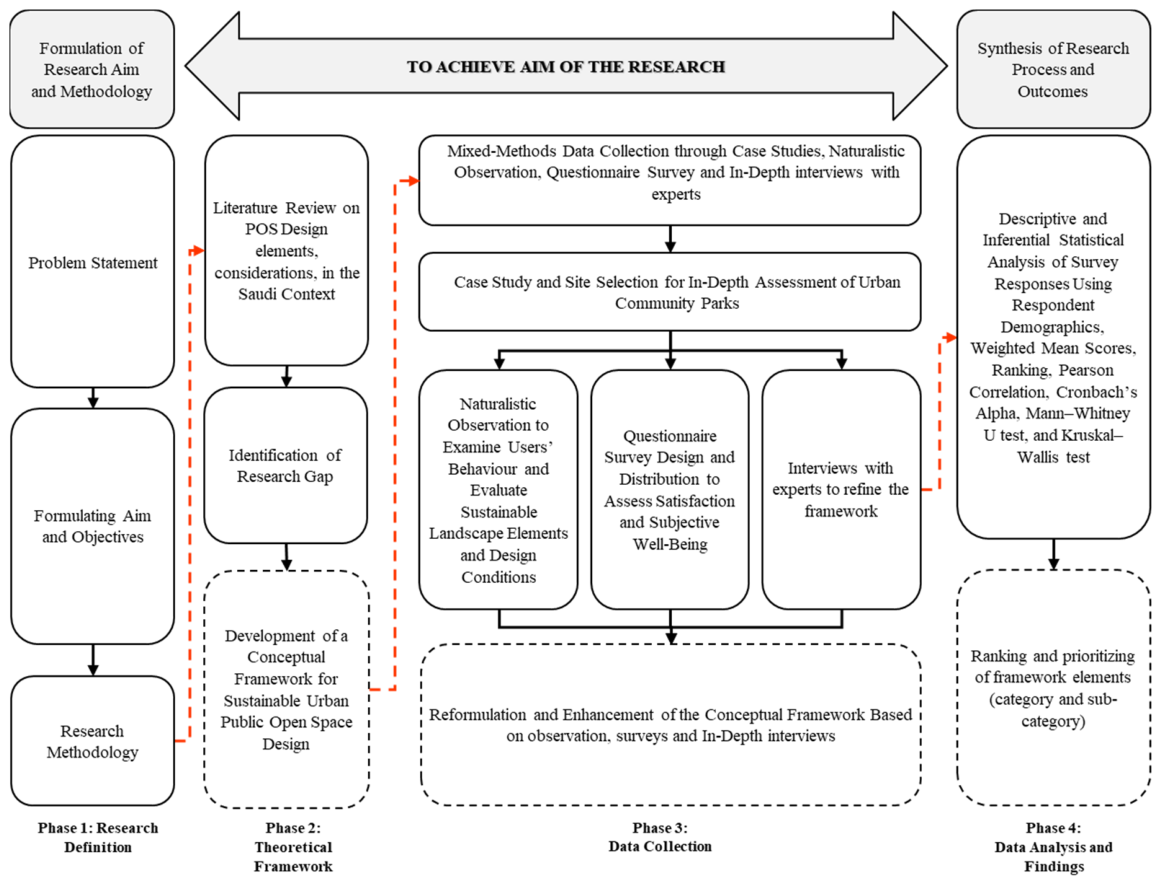
This study employs a mixed-methods research design that integrates qualitative and quantitative approaches to develop and prioritize a multidimensional framework for sustainable urban community park design in the Saudi Arabian context. This approach allows for the triangulation of results, improving the reliability of findings by combining observation, survey, and interview data. Figure 1 shows that the methodological process is structured into four interrelated phases, each contributing to the systematic development, refinement, and prioritization of the proposed framework.
The first and second phases involved an extensive review of peer-reviewed research articles, official governmental reports, and strategic policy documents. These phases established the study’s conceptual foundation by identifying research gaps, establishing the theoretical foundation, and synthesizing the key design principles related to sustainable urban public open spaces, smart technologies, and their implications for human well-being. The literature review also examined Saudi Arabia’s progress in developing sustainable public spaces in alignment with Vision 2030. A structured search strategy was applied using Scopus and Google Scholar as the primary search platforms, while ResearchGate was used as a supplementary source to retrieve relevant publications that were already identified or closely related to the review topic. The search combined keywords related to public open spaces, community parks, sustainability, quality of life, subjective well-being, Smart Parks, Saudi Arabia, and hot–arid urban environments. In addition to the academic literature, relevant governmental reports and policy documents were reviewed to identify the planning frameworks, strategic priorities, and institutional directions adopted by national authorities, particularly the Ministry of Municipalities and Housing (Momah). Over 90 sources were selected according to their relevance to the study objectives, publication quality, contextual applicability to public space design and assessment. Publications produced between 2016 and 2025 were prioritized because this period reflects the post-Vision 2030 phase, during which public space policy, quality-of-life initiatives, and sustainability agendas became increasingly central to urban development in the Kingdom. This time frame was also intended to capture the most current and policy-relevant body of evidence available during the research process. The selected sources were then screened and synthesized to identify recurring design principles, assessment categories, and strategic policy directions that informed the conceptual basis of the proposed framework. In particular, this process supported the preliminary organization of the framework into hierarchical levels (considerations, categories, sub-categories, and indicators) which were subsequently assessed, refined through field observations, user surveys, and expert interviews.
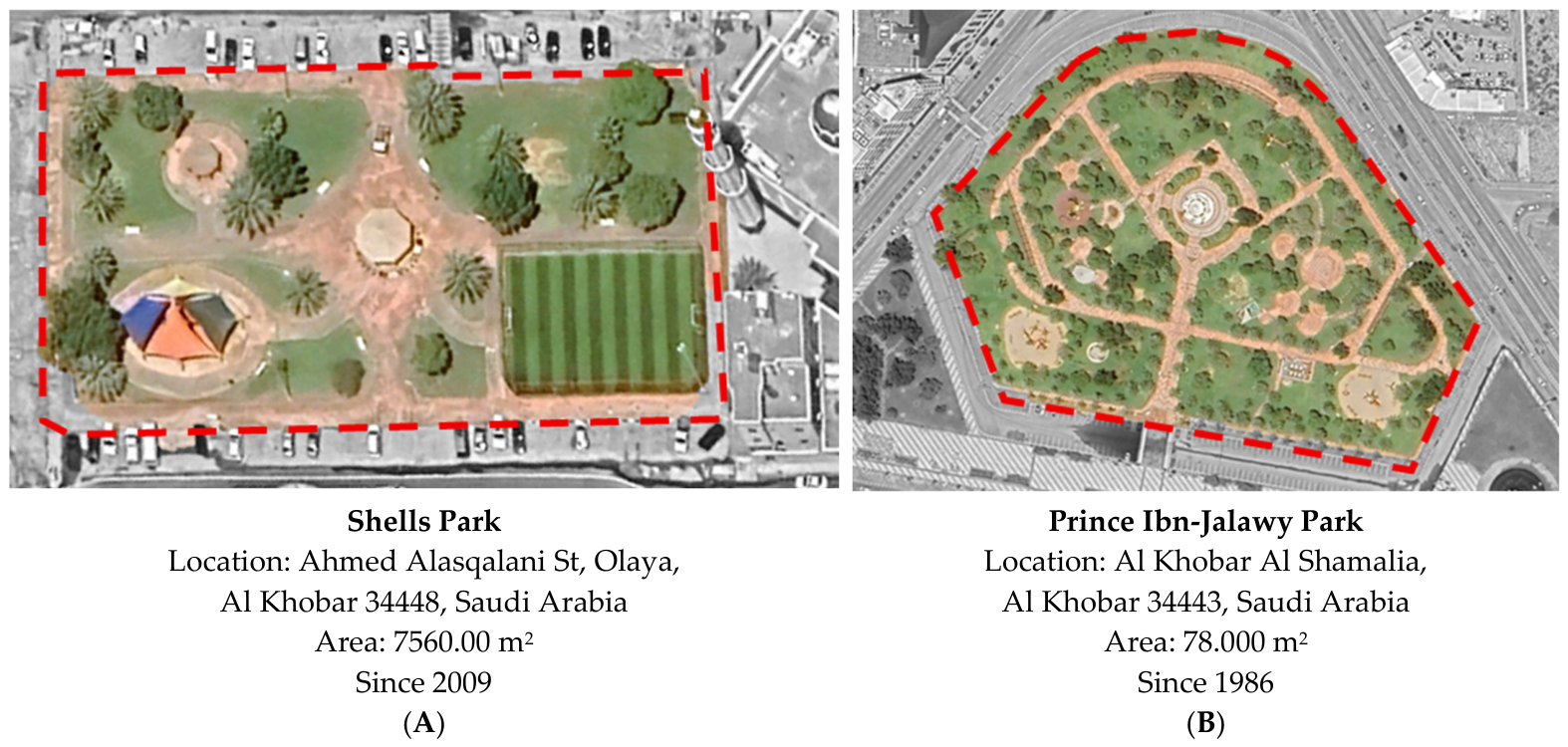
The objective of the third phase was to reformulate and empirically ground the conceptual framework through field-based evidence. Two neighbourhood-level community parks in Al-Khobar (Shells Park and Prince Ibn-Jalawy Park) were purposefully selected as case studies to support analytical comparison within a shared urban and climatic context. The case selection was based on four considerations. First, both parks operate as community-level public open spaces with recreational, social, and family-oriented functions. Second, both are situated in populated residential areas of Al-Khobar, making them relevant to neighbourhood-scale public space planning in the Saudi context. Third, they differ in relation to several key characteristics, including their size, period of establishment, spatial organization, and provision of facilities, thereby allowing the study to compare contrasting park conditions while holding the broader city context constant. Fourth, both parks attract regular and socially diverse users, making them appropriate sites for behavioural observation, user-based assessment, and framework refinement. Accordingly, the two cases were selected not for statistical representativeness, but for their value as contextually comparable and analytically informative examples through which the proposed framework could be empirically examined and refined.
Observational data were collected to document patterns of human activity, including the duration and frequency of visits, social interaction types, and the use of design features. These observations were systematically recorded, captured, and analyzed through thematic and content analysis to identify recurrent behavioural trends, spatial preferences, and design gaps relative to the conceptual framework extracted from Table 1, Table 2, Table 3 and Table 4. The observational component was also conceptually informed by the public-life research tradition advanced by Gehl and later elaborated by Gehl and Svarre, which treats direct and systematic observation as a key method for understanding how spatial settings shape patterns of movement, staying, interaction, and use in public spaces [28,99].
Both parks operate 24 h a day, and observations were conducted over a four-week period (15 September–15 October 2024) during the afternoon and evening hours when activities peaked and visitor numbers were the highest. A structured time-sampling procedure was used to document park use and user behaviour. Observations were conducted over four consecutive weeks during afternoon and evening periods to capture peak use and avoid the extreme midday heat. Each observation visit comprised repeated scan sampling rounds at fixed intervals (e.g., every 15 min). During each scan, observers recorded (i) the activity type (e.g., walking, sitting/relaxing, children’s play, sports, and socializing), (ii) the group composition and approximate group size (individual/pair/family/group), (iii) the user location within predefined park zones (e.g., walking paths, playground, seating areas, and sports facilities), and (iv) contextual conditions relevant to comfort and usability (e.g., shaded vs. unshaded areas, lighting conditions, perceived crowding, and maintenance issues).
To complement the observations, the survey was administered digitally using a Google Form accessible through QR codes displayed within the parks. The survey was conducted anonymously and participation was voluntary. Participants were informed about the purpose of the research and that the collected data would be used only for academic purposes. Personal identifications of the participants were not recorded.
The questionnaire targeted park users from different age groups and genders. Using an estimated population size of 102 park users, the minimum sample size was determined to be approximately 81 respondents at a 95% confidence level and a 10% margin of error [100]. Accordingly, 89 valid responses were obtained through convenience sampling during regular park visitation hours between September and October 2024.
The survey gathered data on respondents’ demographic characteristics, park visitation frequency and purpose, subjective well-being (SWB), and satisfaction with park features. SWB reflects individuals’ evaluations of their life experiences, combining cognitive dimensions (life satisfaction) and affective dimensions (emotional balance), which is widely used as a QoL indicator [101,102]. The questionnaire comprised three sections: (1) demographic characteristics and park use patterns; (2) subjective well-being assessment; and (3) user satisfaction with park quality. Subjective well-being was measured through self-reported items covering overall happiness, positive and negative emotional experience, connection with nature, perceived support for physical activity, and intentions to revisit or recommend the park, using a five-point Likert scale (where one indicated the lowest level of agreement and five indicated the highest level of agreement). User satisfaction was measured using five-point Likert-scale evaluations of park-related framework elements derived from the literature-based framework (Table 1, Table 2, Table 3 and Table 4), including environmental, socio-cultural, economic, and smart-enabler considerations. For these items, one indicated the lowest level of satisfaction and five indicated the highest level of satisfaction, while “Not Available” indicated that the relevant element or amenity was absent from the park and therefore fell outside direct user evaluation.
Quantitative data were analyzed using descriptive statistics, Pearson correlation analysis, reliability testing (Cronbach’s alpha), the Mann–Whitney U test, and Kruskal–Wallis tests. These procedures were selected because the quantitative component of the study served an exploratory role within a broader mixed-methods design aimed at framework development and refinement. Accordingly, the statistical analysis was intended to identify indicative associations, within-sample group differences, patterns in user satisfaction and self-reported well-being, rather than to support causal or population-level inference. Given the relatively small convenience sample and the case-based design of the study, the results were interpreted cautiously, and their inferential and generalizability limits are acknowledged explicitly in the manuscript. Ethical considerations were addressed by ensuring voluntary participation and maintaining respondent anonymity.
In Phase four, the emerging framework was refined and prioritized through expert interviews. A total of 15 experts, including urban designers, architects, landscape architects, governmental representatives, and academics were purposefully selected based on two criteria: (1) professional or academic expertise in urban design, landscape architecture, or public space planning, and (2) direct experience with public space development, assessment, policy, or research in Saudi Arabia. Semi-structured interviews were conducted to triangulate findings from the literature review, field observations, and user survey. The interviews followed a mixed-format guide consisting of (i) prompts asking experts to identify missing sub-categories or indicators and suggest refinements, and (ii) a quantitative rating exercise in which experts evaluated the importance of framework elements using a five-point Likert scale, where one indicated “extremely unimportant” and five indicated “extremely important.” The quantitative component of the expert interview phase was analyzed through the simple ranking system, weighted mean scores, and the Relative Importance Index (RII) to establish the relative priority of framework’s sub-categories. The qualitative component was analyzed thematically to identify recurring concerns, suggested refinements, and missing context-specific elements. Together, these analyses informed the prioritization and comparative evaluation of sub-categories across the environmental, socio-cultural, economic, and smart-enabler considerations. The mixed analytical approach enhanced the contextual relevance, practical applicability, and methodological robustness of the proposed framework. All interviews were conducted with informed consent, and participant identities were kept confidential to ensure ethical compliance.
The final phase synthesized findings from the literature, field observations, surveys, and expert interviews to refine and prioritize the proposed design framework for sustainable urban community park. Each methodological phase was designed to contribute to framework development, refinement, or prioritization, thereby ensuring alignment between the identified research gap and the study’s analytical procedure. This integrative synthesis ensured the framework’s contextual suitability for Saudi Arabia’s hot and arid climate while aligning with user needs, expert recommendations, and national sustainability objectives. The refined framework serves as a strategic tool for policymakers, designers, and planners to design, assess, and manage sustainable urban public spaces.

4. Results

This section presents the empirical findings from the two selected community parks in Al-Khobar and shows how these findings informed the refinement of the preliminary literature-based framework. Field observations were used to document user behaviour, activity patterns, and park conditions. The survey was used to examine user satisfaction and self-reported subjective well-being. The expert interview phase was used to refine, expand, and prioritize the framework’s considerations, categories, sub-categories, and indicators. In this way, this section demonstrates how multiple forms of empirical evidence were integrated to assess the contextual relevance and practical applicability of the proposed framework.

4.1. Naturalistic Observation

As shown in Figure 2, the two parks (Shells Park in Al-Olaya, identified as Site 1, and Prince Ibn-Jalawy Park in Al-Khobar Al-Shamaliah, identified as Site 2) were deliberately selected as case studies due to their contrasting establishment periods, spatial distribution, and urban significance. Shells Park, a more recently developed park, reflects contemporary approaches to urban community park design. In contrast, Prince Ibn-Jalawy Park, as an older and well-established park, provides insights into earlier design practices. Both parks are situated in densely populated districts of diverse socio-economic groups. They ensure observations of a wide range of user behaviours, activities, and perspectives.

4.1.1. Real-Time Crowdsourcing

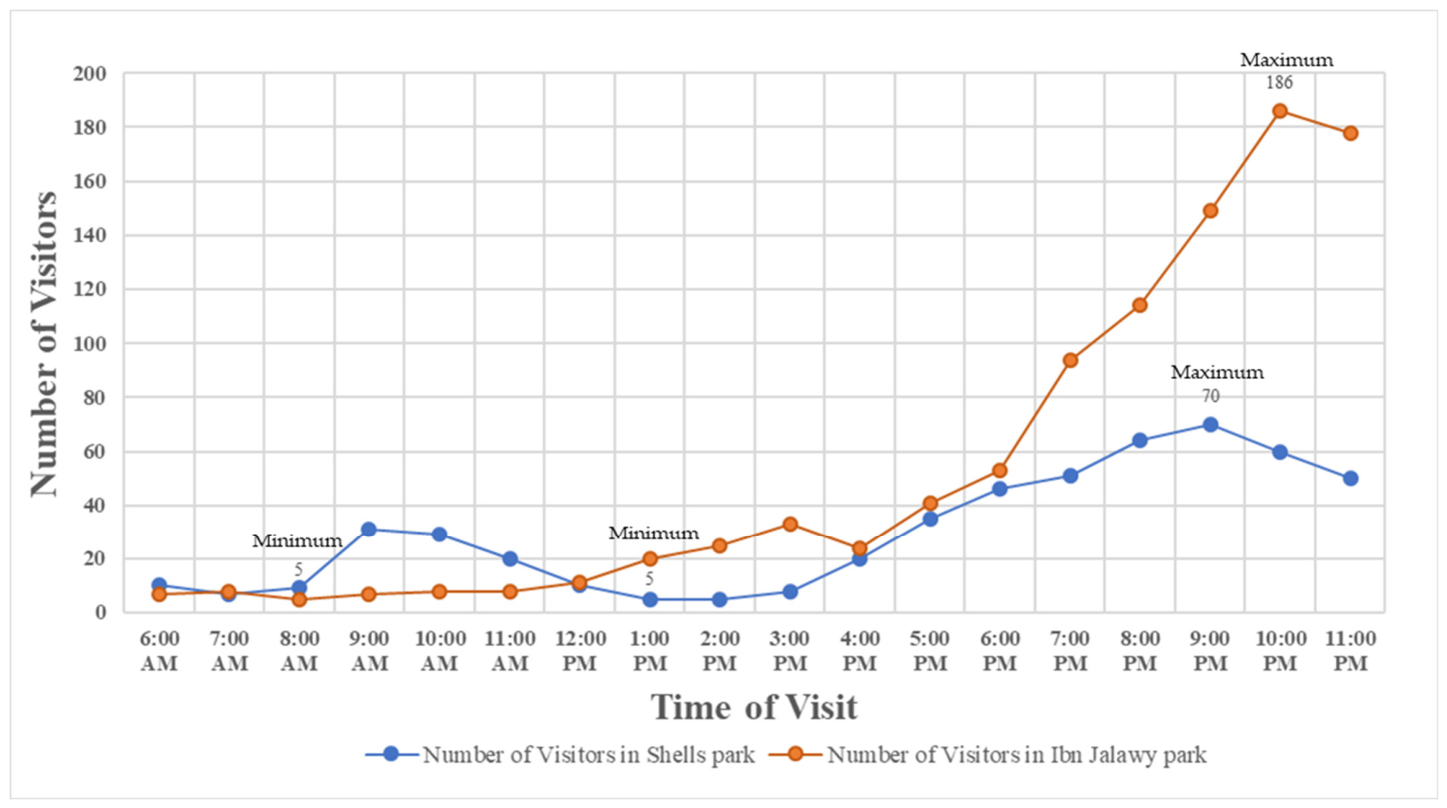
Figure 3 demonstrates contrasting usage patterns. Both parks exhibit low daytime activity, suggesting that visitors tend to avoid these spaces during typical daytime hours. The reasons could either environmental factors such as avoiding the high daytime temperatures or social habit preference for evening visits. In Shells Park, the number of visitors reached 70 at 11:00 PM, indicating that the park becomes livelier during late night. In Prince Ibn-Jalawy Park, the number of visitors reached 186 by 10:00 PM, which is both earlier in the evening and more than twice the peak seen at Shells Park.

4.1.2. Human Behaviour and Activities and Sustainable Consideration

In order to understand the patterns of recreational behaviour and park use, a comparative analysis of observed activities was conducted in Shells Park and Prince Ibn-Jalawy Park. The observations highlighted variations in user engagement, the timing of visits, adherence to park regulations, emerging challenges linked to overcrowding and inadequate facilities. While both parks accommodate a wide range of social and physical activities, they differ in terms of intensity, timing, and the extent to which design features support or constrain user needs. Table 5 summarizes the key findings related to human behaviour and activities across the two parks, highlighting the similarities, differences, and opportunities for improvement.
The assessment of sustainable considerations in urban parks provides critical insights into how design, management, and infrastructure influence environmental performance, social engagement, and visitor experience. Table 6 synthesizes the key findings from the observations, highlighting the strengths, weaknesses, and opportunities for improvement in each park.

4.2. Questionnaire Survey

An online survey of 89 park users conducted to gain insights into how community parks affect individual well-being and assess users’ satisfaction with the quality of parks design categories, sub-categories, and indicators.

4.2.1. Subjective Well-Being (SWB) Assessment Analysis

Table 7 presents the demographic characteristics and park use patterns of the 89 respondents. In terms of gender, the sample comprised 61 males (68.54%) and 28 females (31.46%). Regarding age distribution, the largest group was 26–35 years (n = 33, 37.08%), followed by 36–45 years (n = 29, 32.58%), 18–25 years (n = 16, 17.98%), 46–55 years (n = 8, 8.99%), and 56 years and above (n = 3, 3.37%). With respect to visitation frequency, the highest proportion of respondents reported visiting the park once a week (n = 19, 21.35%), followed by several times a week (n = 18, 20.22%) and occasionally—that is, less than once a month (n = 18, 20.22%). First-time visitors accounted for 16.85% (n = 15), while 13.48% (n = 12) visited every other week and 7.87% (n = 7) visited daily. In relation to visit duration, more than half of the respondents stayed for 1–2 h (n = 48, 53.93%), followed by 3–4 h (n = 22, 24.72%), 5–6 h (n = 10, 11.24%), and less than one hour (n = 9, 10.11%). The longer durations reported by some respondents, particularly 5–6 h, likely reflect family outings, picnics, or social gatherings rather than continuous active use of the park. Concerning the purpose of visiting, children’s activities constituted the most common reason (n = 39, 43.82%), followed by spending time with family and friends (n = 19, 21.35%), walking to a destination (n = 13, 14.61%), relaxation and enjoying nature and green space (n = 11, 12.36%), and exercise and physical activities (n = 7, 7.87%).
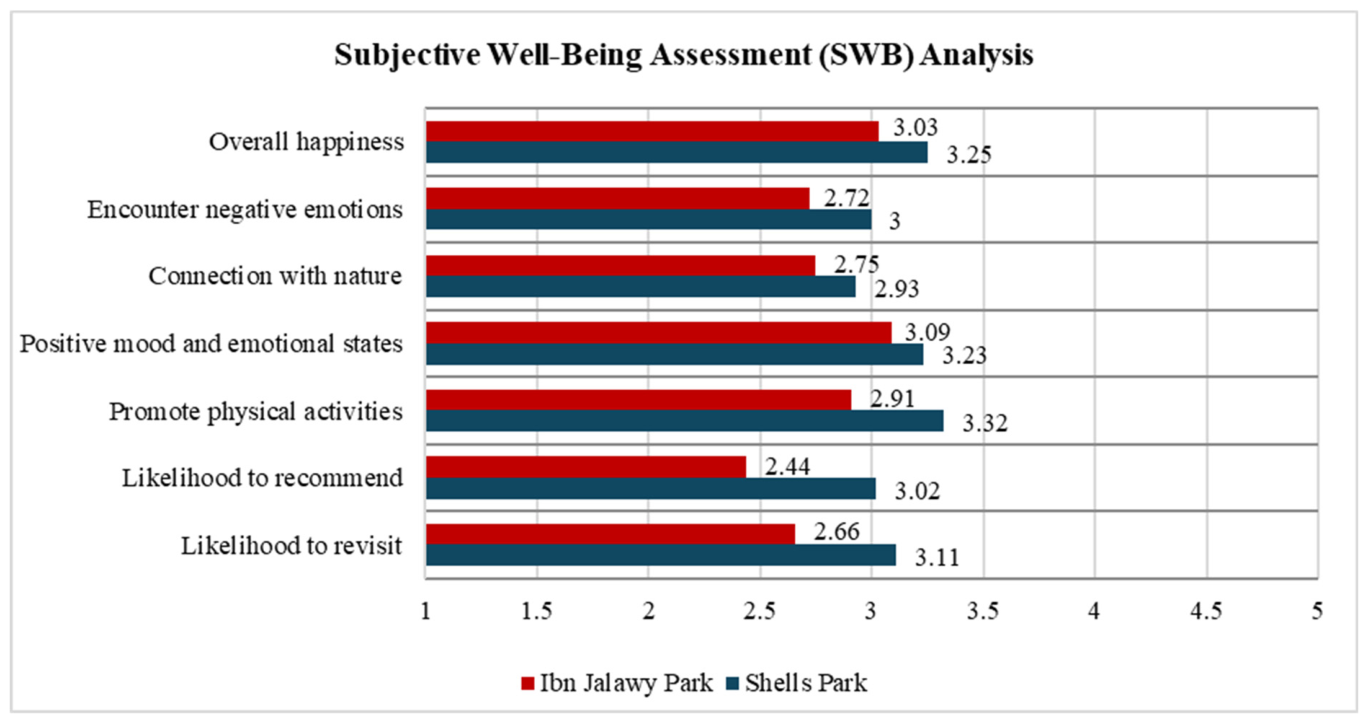
Figure 4 shows Shells Park SWB scores of moderate satisfaction, with overall happiness at 3.25, likelihood to revisit 3.11, and connection with nature 2.93. At Ibn-Jalawy Park, SWB outcomes were lower, with overall happiness at 3.03, likelihood to revisit 2.66, and likelihood to recommend 2.14, indicating moderate satisfaction and weak engagement with nature. Both parks demonstrate clear opportunities to improve safety, maintenance, amenities, and recreational offerings to enhance visitor well-being and overall experience.
Open-ended survey feedback from Shells Park and Ibn-Jalawy Park identified key factors influencing visitation and users’ experience. At Shells Park, common concerns included extreme heat, child safety near traffic, a lack of privacy for women, insufficient adult amenities, and maintenance issues such as noise, poor pathways, and cleanliness. Respondents recommended enhanced cleaning, improved lighting, fencing, safer and expanded children’s play areas, additional facilities (restrooms, seating, sports equipment, and tennis courts), better landscaping, and educational and physical activities. Overall, the community expressed a desire for a safer, more functional, and family-friendly park. At Ibn-Jalawy Park, visitors emphasized exercise and family time but noted the poor maintenance, cleanliness, and facility conditions along with safety concerns related to being near busy roads, crowded play areas, and inadequate nighttime lighting. The suggested improvements included additional amenities, food kiosks, more garbage bins, and enhanced safety measures. Addressing these issues could enhance usability, increase visitor numbers, and create a safer, more engaging environment.

4.2.2. Users Satisfaction Analysis

Table 8 summarizes user satisfaction for Shells Park and Prince Ibn-Jalawy Park, where 1 = the lowest level of satisfaction, 5 = highest level of satisfaction, and “Not Available” refers to features that were absent in the relevant park and therefore fell outside direct user evaluation. The scores were low-to-moderate with overall means of 2.33 and 2.11 respectively. Shells Park slightly outperforms Prince Ibn-Jalawy Park overall, though each park has distinct strengths and weaknesses. Environmentally, Prince Ibn-Jalawy Park ranks higher in shading (3.5 vs. 2.5) and biodiversity (2.9 vs. 2.8), while Shells Park excels in lawn quality (4.1 vs. 3) and tree density/coloration; both parks lack water features and exhibit low heat mitigation. Economically, Shells Park scores better in functional open spaces (4.2 vs. 2.6), landscaping (3.2 vs. 2.5), and maintenance (3.4 vs. 2.8), though both sites underperform in relation to sustainable materials and flexible design, with no smart technologies implemented. Socio-culturally, Shells Park leads in terms of its accessibility/universal design (4.8 vs. 2.1), human interaction (4.5 vs. 3.9), circulation (4.7 vs. 2.8), and esthetics (4.1 vs. 3.2), whereas Prince Ibn-Jalawy Park is stronger in its provision of comfort, amenities (3.5 vs. 2.3), and recreational facilities (3.7 vs. 2.1). Both parks show low scores in relation to sculptures, safety, and urban furniture, and lack community engagement or wayfinding systems. Overall, Shells Park excels in esthetics, accessibility, and social interaction, while Prince Ibn-Jalawy Park favours comfort and recreational offerings. Both require major improvements in terms of sustainability, safety, maintenance, and adaptable design to enhance user satisfaction.
Table 9 shows the park-specific correlation analysis whereby the relationships among subjective well-being variables were positive in both Shells Park and Prince Ibn-Jalawy Park; however, these relationships were generally stronger in Prince Ibn-Jalawy Park. In Shells Park, overall happiness was moderately associated with connection with nature (r = 0.57), positive mood and emotional state (r = 0.52), the promotion of physical activities (r = 0.62), likelihood to recommend (r = 0.57), and likelihood to revisit (r = 0.69). In Prince Ibn-Jalawy Park, the corresponding correlations were higher, at r = 0.75, r = 0.69, r = 0.76, r = 0.78, and r = 0.80, respectively. Likewise, the association between likelihood to recommend and likelihood to revisit remained extraordinarily strong in both parks, although it was slightly stronger in Shells Park (r = 0.82) than in Prince Ibn-Jalawy Park (r = 0.79). Negative emotions were weakly related to the other well-being indicators in both parks, but the inverse relationships were more pronounced in Prince Ibn-Jalawy Park. Overall, these results indicate positive associations between reported park experiences and self-reported well-being outcomes in both parks, with stronger and more consistent associations observed in Prince Ibn-Jalawy Park.
The survey showed high reliability, with a Cronbach’s alpha of 0.85, indicating strong internal consistency among the items. Table 10 presents the results of the Mann–Whitney U test comparing overall happiness between male and female park users. The analysis showed no statistically significant difference in overall happiness between the two groups (U = 851.5, p = 0.985). This suggests that reported happiness levels were broadly similar across gender within the study sample.
Table 11 shows the results of the Kruskal–Wallis test comparing overall happiness across multiple respondent groups. No statistically significant differences were found across the examined categories, as all p-values exceeded the 0.05 threshold. Specifically, no significant variation in overall happiness was observed across age groups (H = 6.129, p = 0.190), frequency of park visits (H = 8.635, p = 0.125), visit duration (H = 1.019, p = 0.797), or purpose of visiting (H = 2.690, p = 0.611). Although some group means varied descriptively, these differences were not statistically significant, indicating that overall happiness was relatively consistent across the examined respondent categories within the study sample.

4.3. Framework Refinement and Prioritization Through In-Depth Interviews

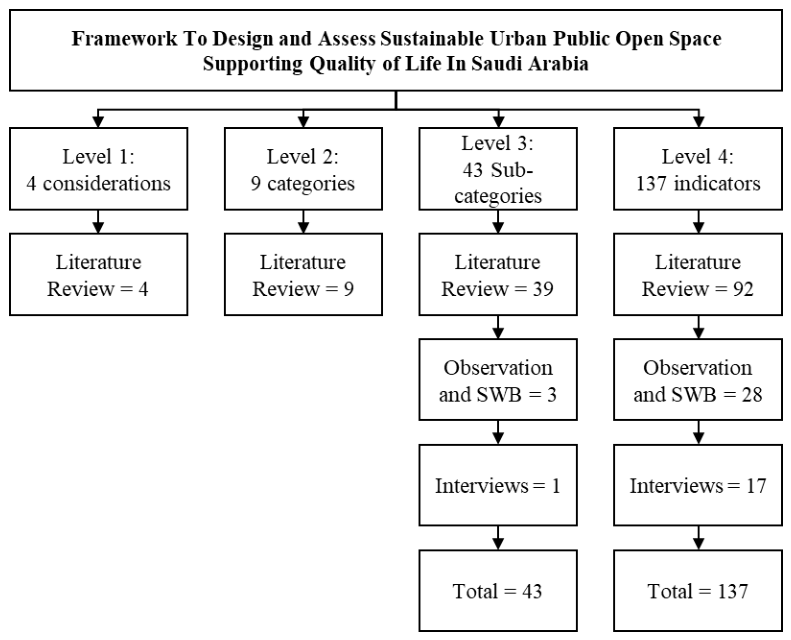
The proposed framework (Figure 5, Figure 6, Figure 7, Figure 8 and Figure 9) is organized in a hierarchical design-and-assessment system comprising four levels: considerations, categories, sub-categories, and indicators. At the broadest level, the framework is structured around four overarching considerations (environmental, socio-cultural, economic, and smart enabler) which represent the principal domains influencing the sustainability and performance of POS in the Saudi context. Within each consideration, categories identify the major areas of evaluation, while sub-categories translate these into more specific dimensions of design, management, and user experience. At the most detailed level, indicators provide the concrete and observable elements through which each sub-category can be assessed. This hierarchical structure strengthens the analytical value of the framework by connecting broad sustainability goals with operational assessment elements, thereby supporting both the evaluation of existing parks and decision-making for future design interventions. It also demonstrates that park performance is shaped by the combined contribution of multiple levels, where higher-order considerations provide conceptual guidance and lower-order indicators provide measurable evidence for refinement and prioritization.
Experts elaborated on the sustainable environmental considerations of the framework highlighting key enhancements to improve parks’ comfort, esthetics, and ecological performance. Expanding tree canopy size provides shade, moderates urban temperatures, and creates visually appealing, comfortable spaces. As shown in Figure 5, the inclusion of non-electrical fans supports natural airflow and reduces heat and humidity. Improving vegetation quality and density, particularly with plants adapted to arid climates, enhances shade, air quality, soil health, and climate resilience. Finally, experts believed in incorporating a pet-friendly environment promotes inclusivity and community engagement while managing food waste to minimize health risks and support local wildlife.
In relation to the sustainable economic considerations of the framework (Figure 6), key indicators were identified to enhance the effectiveness and sustainability of urban community parks. Experts claim the benefit of including “Adequate Funding and Resources,” with indicators that include long-term financial planning, governmental grants and funds, and proposal development, ensuring that parks are adequately funded for both development and ongoing maintenance. Long-term financial planning enables realistic budgeting and anticipates future needs, while grants foster innovative and sustainable practices. Proposal development aligns funding with specific environmental and community objectives. Furthermore, the indicator of balanced landscape within the sub-category-appropriate landscaping emphasizes the integration of fine, medium, and coarse landscape elements to enhance visual quality, create sensory diversity, and improve the overall visitor experience. In the landscape elements of the economic considerations, several indicators were introduced to strengthen the sustainability, functionality, and management of community parks. Under the “balance smart technology integration”, the addition of air quality sensors and interactive learning/entertainment stations enhance both environmental monitoring and educational engagement. Air quality sensors provide real-time data on pollutants, supporting timely interventions and evaluating the effectiveness of green infrastructure. Interactive stations, meanwhile, make environmental education engaging and accessible to all age groups, creating a balance between technology and nature. Further indicators derived from expert interviews include maintenance plans, regular monitoring and adaptation, a ticketing system to safeguard communal spaces, and a clear vision and goals. Altogether, these ensure efficient resource allocation, the early detection of issues, adherence to community guidelines, and the alignment of maintenance efforts to the park’s long-term sustainability objectives.
The additional indicators were introduced in the socio-cultural considerations layer of the framework (Figure 7) during the expert interview phase whereby the specialists refined the preliminary framework and identified missing context-specific considerations. These additions strengthen the framework’s relevance and applicability to Saudi Arabia by better reflecting practical design priorities like socio-cultural expectations, inclusivity requirements, and operational concerns observed in real park settings. Under the “prioritize people’s needs and behaviour” sub-category, indicators such as behavioural observation, community input, age-appropriate facilities, and facilities reflecting community interests emphasize user-centered design and promote inclusivity across different age groups. Within the “sustainability awareness” sub-category, the addition of indicators such as educational signage, recycling, and waste management stations fosters environmental learning and encourages responsible behaviour among visitors. Similarly, the “easy accessibility and universal design” sub-category included safe surfacing, universal restrooms, and wide pathways ensuring equitable access for all, including children, elderly people, and individuals with disabilities. Cultural and social preferences were also incorporated into the framework through privacy considerations, which are particularly important in the Saudi context. These privacy measures should be designed in a balanced manner so that they provide visual and acoustic comfort for families and individuals without creating hidden, isolated, or poorly surveyed areas that may compromise safety. Additionally, amenities such as inclusive playgrounds and car parking spaces reflect local preferences, supporting both social cohesion and practical accessibility. Overall, these enhancements strengthen the socio-cultural dimension of park design, ensuring inclusivity, sustainability, and community engagement.
Several enhancements were introduced in the landscape elements dimension under the socio-cultural considerations of the framework (Figure 8) to improve functionality, inclusivity, and user satisfaction. The “wayfinding system” was strengthened by adding indicators like focal areas, map kiosks, universal symbols, Braille and tactile maps, which collectively improve orientation, accessibility, and inclusivity for diverse users, including those with visual impairments. The “urban furniture” sub-category incorporates indicators such as flexible use, strategic placement, ergonomic design, weather-resistant materials, sufficient seating, regular upkeep, ensuring comfort, durability, and functionality. Proper waste management facilities were also emphasized to maintain cleanliness and sustainability. New indicators are added under “comfort and amenities,” like food and beverage facilities, and sports fields designed through community input. This reflects both users’ needs and local preferences, thereby enhancing satisfaction and promoting active lifestyles.
With regard to park boundaries, usage pattern analysis addressed concerns regarding children’s safety and crowd management and added these in the sub-category “safety and security”. Similarly, the “sculpture and landform” sub-category was enriched with interactive installations, cultural representation, and functional landforms, blending esthetics with practicality and cultural identity. Finally, under “circulation path and connectivity to surrounding,” three indicators were added: public transit accessibility, multiple entrances, and safe crossings. These additions ensure seamless integration with the urban fabric, enhance pedestrian, cyclist access, and improve overall safety. Collectively, these refinements highlight the framework’s emphasis on inclusivity, cultural responsiveness, and community-driven design in shaping sustainable and liveable urban parks. By emphasizing sustainability, community engagement, and environmental resilience, the framework guides creating parks that enhance the QoL for residents while fostering ecological balance and social cohesion, which aligns closely with Saudi Vision 2030. Establishing sustainable urban community parks contributes to the development of more liveable, resilient urban environments, supporting Vision’s objectives of creating vibrant, thriving communities and a sustainable future.
The expert interviews indicate that the smart-enabler layer should be understood as an auxiliary rather than primary component of the framework. Although smart features can support park management, communication, monitoring, and user services, they were consistently regarded as less critical than the core sustainable layers. Experts emphasized that, in the Saudi context, the effectiveness of community parks depends primarily on environmental responsiveness, socio-cultural appropriateness, economic and operational sustainability. Features such as shading, heat mitigation, safety, accessibility, maintenance, and culturally aligned amenities were therefore prioritized over digital and technological additions. Importantly, (in Figure 9) the expert interview phase did not generate any additional sub-category or indicators within the smart-enabler layer, and this indicating that this dimension was retained as originally structured in the preliminary framework. The smart layer is thus positioned as a supplementary component that may enhance park performance, but only after securing essential sustainability requirements.
The framework (Figure 10) was developed through an iterative triangulation process rather than through the direct aggregation of indicators. The literature review initially identified recurring dimensions and attributes associated with sustainable public open spaces, quality of life, and context-responsive park design. These preliminary components were then examined empirically through field observations and user surveys to assess how they appeared in practice, and how they related to user satisfaction and subjective well-being in the selected case studies. In addition, user feedback helped identifying context-relevant aspects that warranted inclusion in the framework. The expert interview phase was then used to refine, expand, and prioritize the sub-categories and indicators. Accordingly, the final framework reflects the convergence of conceptual, empirical, and user- and practitioner-based evidence.
The final framework is therefore neither a purely literature-derived structure nor merely an outcome of the selected case studies. Rather, it emerged through an iterative process in which the conceptual categories identified from the literature were confronted with empirical evidence from observed park conditions and behaviours, then further refined through user feedback and experts’ judgement. In this way, the framework was advanced through the integration of four complementary forms of evidence: theoretical grounding, field-based observation, user-based assessments of satisfaction, well-being, professional evaluation of relevance and priority. The resulting framework comprises four considerations, nine categories, 43 sub-categories, including 17 design conditions, 13 landscape elements, and 13 smart enablers, together with 137 indicators for the design and assessment of sustainable POS (community parks). As such, it serves as a practical and context-sensitive guideline that integrates multidisciplinary insights and best practices to address the specific challenges of hot–arid urban environments.
Table 12 presents the considerations, categories, sub-categories, and indicators of the proposed framework together with the weighted mean, simple ranking, and Relative Importance Index (RII) derived from the expert- prioritization phase. These values were calculated from the ratings provided by 15 experts, who evaluated each sub-category on a five-point Likert scale ranging from one (extremely unimportant) to five (extremely important). The weighted mean was used to determine the average importance assigned to each sub-category, while the rank order and RII were used to compare and prioritize sub-categories within and across the framework considerations. Accordingly, the expert interview phase should be understood as a contextual prioritization exercise rather than a confirmatory validation procedure.
The results indicate that the priorities for designing sustainable urban community parks are centred on environmental performance, socio-cultural inclusivity, economic viability, and, to a lesser extent, smart technology integration. From an environmental perspective, incorporating shading achieved the highest priority, with a weighted mean of 4.9 and an RII of 0.98, underscoring its critical importance for thermal comfort in the Saudi context. On the other hand, biodiversity (mean = 3.6) and pet-friendly environments (mean = 3.1; RII = 0.62) received lower ratings, indicating that they were considered less urgent than shading, safety, and heat mitigation measures. Within the socio-cultural considerations, alignment with community traditions and values was among the highest-rated sub-category (mean = 4.8; RII = 0.96), highlighting the importance of cultural relevance in strengthening belonging and inclusivity, while accessibility features also received high importance (mean = 4.5). In the economic consideration, regular maintenance and cleanliness ranked highest (mean = 4.6), followed by adequate funding and resources (mean = 4.1), emphasizing the importance of long-term operational sustainability. In contrast, balanced smart technology integration received a lower score (mean = 3.5; RII = 0.70). Regarding smart enablers, ubiquitous Wi-Fi ranked highest (mean = 4.1; RII = 0.82), whereas smart municipal furniture (mean = 3.9; RII = 0.78) and digital signage (mean = 3.6; RII = 0.72) were assigned moderate importance. Overall, these rankings show that experts prioritized core climatic, cultural, accessibility, and maintenance-related needs over advanced technological features.

5. Discussion and Recommendations

This study contributes to fill up several key gaps identified in the existing literature on public open spaces design in Saudi Arabia. Previous study has highlighted issues of the uneven distribution of community parks, limited accessibility, and inadequate design quality [13]. However, most of the studies primarily focused on spatial analysis or user satisfaction without developing multidimensional design frameworks that integrate environmental, socio-cultural, economic, and technological considerations within the Saudi context [9,10,11,47]. The findings of this research respond directly to this gap by proposing a multidimensional framework for designing and evaluating sustainable urban POS, the scope of community parks in Saudi Arabia’s socio-climatic context. Unlike previous research that focused on isolated aspects of park design, the proposed frameworks integrate categories, sub-categories, and indicators across environmental, socio-cultural, economic, and smart technology considerations. This integrated approach enables a more comprehensive evaluation of community parks and provides practical guidance for planners and designers working in comparable POS contexts. Additionally, the existing research on POS in Saudi Arabia rarely considers the influence of climatic conditions on park usability. The present study extends the existing research in the Saudi context by integrating these established design concerns into a single framework that also incorporates socio-cultural alignment and smart-enabler considerations. Previous studies on Saudi context have often examined POSs through narrower lenses, such as user satisfaction, accessibility, or spatial distribution [10,11,13,47,54,97]. By contrast, the current study brings these strands together and shows that environmental and socio-cultural priorities particularly shading, cultural appropriateness, accessibility, and safety are perceived as more fundamental than smart features. This finding is important because it suggests that, in the Saudi context, technological enhancement should complement rather than substitute for basic design quality, thermal comfort, and social inclusivity. The present findings are also consistent with recent regional research showing that sustainable park development in the Middle East depends on more than physical design quality alone. A recent study found that operational sustainability, governance coherence, climate-adaptive strategies, and community engagement are central to successful park development in the region [45]. This aligns with the current study’s finding that environmental responsiveness, socio-cultural appropriateness, maintenance, and long-term operational considerations are prioritized over purely technological additions. Taken together, these studies suggest that, in hot–arid Middle Eastern contexts, the effectiveness of urban parks is shaped by the interaction of climatic, managerial, and user-related factors rather than by isolated design features.
The discussion of findings should be understood in direct relation to the study’s central objective: to develop a context-sensitive framework for designing and assessing sustainable POS (in specific community parks) in Saudi Arabia. In this regard, the empirical results do not function as stand-alone observations, but as complementary sources of evidence that informed the refinement of the proposed framework. The literature review established the initial conceptual structure of the framework, while field observations revealed recurring design and management deficiencies in the selected parks, particularly in relation to shading, maintenance, safety, recreational provision, and usability. The user survey added a perceptual layer by identifying patterns of satisfaction and self-reported well-being associated with park conditions, and the expert interviews further refined, expanded, and prioritized the framework’s considerations, categories, sub-categories, and indicators. Taken together, these stages show how the framework was iteratively advanced through triangulation between conceptual and empirical evidence.
The findings of this study can be interpreted through several complementary theoretical perspectives from environment–behaviour research and public space studies. First, the high priority assigned to shading, thermal comfort, vegetation, and restorative landscape elements is consistent with restoration-oriented theories, particularly the work of Ulrich and Kaplan, which suggest that natural environments can reduce stress, support psychological restoration, and enhance perceived well-being. In the context of Saudi community parks, these findings indicate that environmental qualities are not peripheral design features but fundamental conditions affecting comfort, usability, and the overall capacity of parks to support positive user experience. The observed importance of natural shade, vegetation quality, and climate-responsive features therefore reinforces the argument that park design in hot–arid settings must respond not only to ecological concerns but also to psychological and behavioural needs.
Second, the findings also align with Gibson’s Affordance Theory, which emphasizes that the physical properties of an environment enable or constrain particular forms of action and interaction. From this perspective, features such as seating, pathways, shaded areas, accessibility provisions, playgrounds, and amenities can be understood as affordances that shape how users occupy and engage with park space. The empirical results of this study suggest that when these affordances are limited, poorly maintained, or misaligned with user needs, patterns of use and satisfaction are similarly constrained. Conversely, the prioritization of accessibility, safety, comfort, and culturally appropriate amenities indicates that the usefulness of community parks depends on how effectively their physical setting supports everyday practices, social interaction, and diverse user groups.
Third, the observational findings and the framework’s emphasis on actual patterns of use are strongly supported by Whyte’s observational tradition and by Gehl’s human-centred approach to public life. These perspectives argue that the quality of public environments should be assessed not only through formal design intentions but through how people actually move, stay, interact, and appropriate space in daily life. In this study, the use of observation, user feedback, and expert judgement reflects that tradition by treating park performance as something lived and experienced rather than merely planned. The results show that the success of community parks depends on the relationship between physical design and lived practice, particularly in contexts where climatic stress, social customs, and family-oriented patterns of use strongly influence outdoor behaviour.
Finally, the findings also contribute to broader theoretical discussions on the contextual nature of sustainable public space design. The lower priority assigned to smart technologies relative to socio-cultural, environmental, and economic considerations suggests that technological enhancement alone does not define park quality. Rather, the results indicate that, in the Saudi context, the foundations of successful park design remain related to thermal comfort, inclusivity, accessibility, maintenance, and cultural appropriateness. This supports a more context-sensitive understanding of sustainability, in which digital or smart features are supplementary rather than primary unless essential environmental and social needs are secured first. In this sense, the proposed framework contributes theoretically by linking established environment–behaviour concepts with a context-specific model of sustainable park assessment and design in hot–arid urban environments.
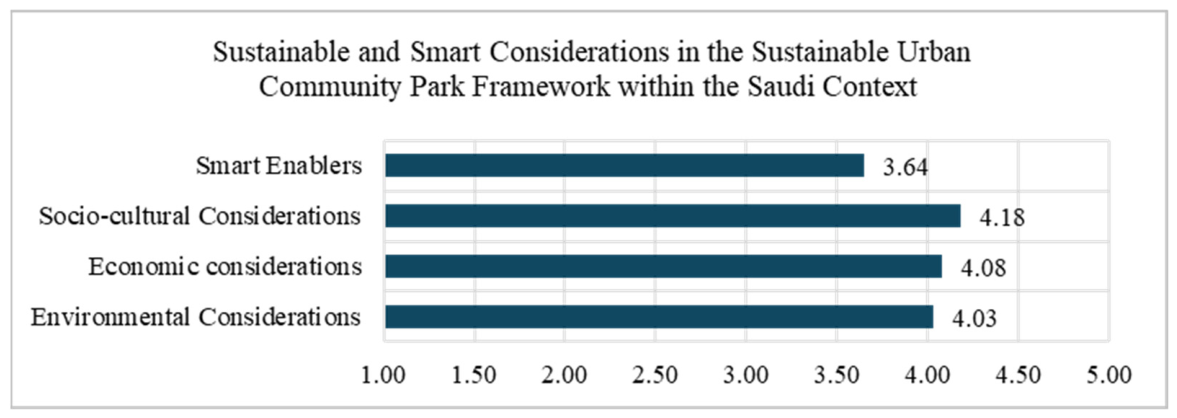
The lower ranking of smart technologies suggests that users and experts prioritize fundamental spatial and environmental qualities over digital enhancement, indicating that smart features are perceived as supportive rather than essential in the absence of adequate shading, amenities, maintenance, and cultural responsiveness. Incorporating these technologies within the proposed framework supports the broader transition toward smart and sustainable cities envisioned under Saudi Vision 2030. As illustrated in Figure 11, the results indicate that sustainable park design in the Saudi context prioritizes cultural relevance, social inclusivity, alongside substantial attention to environmental and economic sustainability. In contrast, technological integration was viewed as a complementary rather than primary priority.
Taken together, these theoretical perspectives help explain not only the observed priorities within the case studies, but also the logic of the proposed framework, in which environmental comfort, socio-cultural appropriateness, functional affordances, and lived patterns of use are treated as interrelated dimensions of park performance. These theoretical interpretations should be understood in relation to the exploratory and case-based nature of the study, as they are derived from two parks in Al-Khobar and a non-probability user sample rather than from broadly representative empirical testing.
In Saudi cities, everyday leisure activity often takes place in indoor environments, particularly in hot climatic conditions, which may reduce the frequency and duration of park visitations [103]. In addition, the field observations and user feedback in this study suggest that limited shading, inadequate playground capacity, weak heat mitigation measures, and insufficient supporting amenities may further constrain park use. However, these explanations should be understood as contextually informed interpretations rather than directly tested causal conclusions.
Based on the findings of this study, several recommendations can be proposed to improve the design, management, and sustainability of urban POS in Saudi Arabia. These recommendations aim to enhance park usability, increase user satisfaction, and support broader national objectives related to urban sustainability and QoL. Given the extreme climatic conditions in Saudi Arabia, climate-responsive design should be prioritized in the planning and development of urban parks. Therefore, municipalities and designers should focus on increasing tree canopy coverage, incorporating shaded seating areas, and integrating passive cooling strategies such as pergolas, misting systems, and natural ventilation. The use of drought-resistant and native plant species can also improve environmental sustainability while reducing water consumption and maintenance costs.
Maintenance was identified as a key concern affecting user satisfaction in the examined parks. Municipal authorities should prioritize regular maintenance, improved lighting systems, and safer park layouts to enhance the overall visitor experience. Installing adequate lighting, maintaining clean pathways, and ensuring well-maintained recreational facilities can increase public confidence and encourage greater park usage, particularly during evening hours when visitation is highest. One of the key contributions of this study is the proposed framework for sustainable POS design. Government agencies and planning authorities may use and further test this framework as a basis for developing context-sensitive guidance for public open space planning. The establishment of a standardized evaluation structure would help ensuring future POS which meet environmental, social, and economic sustainability objectives while responsive to the distinctive climatic and cultural conditions of Saudi Arabia.

6. Conclusions

Urban public open spaces are essential components of neighbourhood life because they provide opportunities for recreation and social interaction, as well as environmental and health benefits. In Saudi Arabia, however, POSs’ development has often been constrained by weak institutional frameworks, limited community engagement, and the absence of systematic design and assessment guidance. As a result, many existing parks continue to suffer from inadequate shading, poor heat mitigation measures, insufficient facilities, weak maintenance, safety concerns, and limited inclusivity, all of which reduce user satisfaction and overall park performance. To address these issues, this study developed a context-sensitive framework for the design and assessment of sustainable urban community parks in hot–arid environments. The framework was initially established through the literature review and was subsequently refined through field observations, user surveys, and expert interviews. The final frameworks were organized around four overarching considerations (environmental, socio-cultural, economic, and smart enablers) and comprises nine categories, 43 sub-categories, and 137 indicators. Across these levels, it incorporates 17 design conditions, 13 landscape elements, and 13 smart-enabler components, providing a hierarchical and operational basis for assessing and guiding sustainable park design. The findings indicate that socio-cultural and environmental considerations are the most critical priorities in the Saudi context. In particular, shading, cultural alignment, accessibility, safety, and heat mitigation were ranked as the most essential elements, while smart technologies and pet-friendly features were assigned lower priorities. These results suggest that sustainable POS (a case of community parks) design in Saudi Arabia depends primarily on thermal comfort, inclusivity, usability, long-term maintenance, and responsiveness to local cultural expectations. Smart enablers were recognized as potentially valuable for management and service support but were considered secondary to more fundamental sustainability needs.
The study contributes an initial and context-sensitive design-and-assessment framework that can support the evaluation of existing community parks and inform future planning and design decisions in Saudi Arabia. Its value lies in structuring and prioritizing park-related considerations in a way that is grounded in the literature, empirical observation, user feedback, and expert judgement, while remaining responsive to the climatic and socio-cultural realities of the Saudi Arabia.
The conclusions of this study should be interpreted in light of its empirical scope. The frameworks were informed by only two case study parks in Al-Khobar, and the survey relied on a convenience sample, while the quantitative analysis remained primarily descriptive and correlational. In addition, the framework refinement process relied substantially on expert judgement and triangulated case-based evidence rather than on large-scale confirmatory testing, which limits the strength of claims regarding broader validity and transferability. Accordingly, the findings should be understood as exploratory rather than causal, and the frameworks viewed as an initial and context-sensitive tool whose broader applicability requires further testing.
Future research should therefore apply and refine the framework across a larger number of parks, cities, user groups in Saudi Arabia and comparable hot–arid contexts. It would also be valuable to examine its applicability to other types of POSs and to employ more robust analytical designs capable of testing how specific attributes influence user satisfaction, behaviour, and well-being. Through such future work, the framework can be further strengthened as a practical basis for more responsive, inclusive, and sustainable POS planning.

Author Contributions

Conceptualization, S.Q. and M.S.Z.; methodology, S.Q. and M.S.Z.; software, S.Q.; validation, S.Q. and M.S.Z.; formal analysis, S.Q. and M.S.Z.; investigation, S.Q.; resources, S.Q.; data curation, S.Q.; writing—original draft preparation, S.Q. and M.S.Z.; writing—review and editing, M.A.H., B.M.A.-R. and A.A.-K.; visualization, S.Q. and M.S.Z.; supervision, M.S.Z.; project administration, M.S.Z., B.M.A.-R. and M.A.H.; and funding acquisition, A.A.-K. All authors have read and agreed to the published version of the manuscript.

Funding

This research received no external funding.

Institutional Review Board Statement

Ethical review and approval were waived for this study by the Institution Committee because this study involved anonymous, voluntary surveys without collecting any personal identifiers or sensitive information. It falls under the category of ethically exempted from IRB certification according to the Implementing Regulations of the Law of Ethics of Research on Living Creatures issued by the National Committee of Bioethics (NCBE, Saudi Arabia) (Article 10.33, Version 3-2025, Page 40).

Informed Consent Statement

Informed consent was obtained from all subjects involved in the study.

Data Availability Statement

The authors confirm that the data supporting the findings of this study are available within the article.

Acknowledgments

The authors acknowledge the APC (Article Processing Charge) support from the Deanship of Research of King Fahd University of Petroleum and Minerals (KFUPM), Dhahran, Eastern Province, Saudi Arabia.

Conflicts of Interest

The authors declare no conflicts of interest.

References

  1. Ibrahim, M.; El-Zaart, A.; Adams, C. Smart Sustainable Cities Roadmap: Readiness for Transformation Towards Urban Sustainability. Sustain. Cities Soc. 2018, 37, 530–540. [Google Scholar] [CrossRef]
  2. Das, I.; Praharaj, S. Public Spaces Under the Smart Cities Paradigm in India. ISPRS Ann. Photogramm. Remote Sens. Spat. Inf. Sci. 2022, X-4/W3-2022, 33–40. [Google Scholar] [CrossRef]
  3. Yang, C.; Shi, S.; Runeson, G. Towards Sustainable Urban Communities: Investigating the Associations between Community Parks and Place Attachment in Master-Planned Estates in Sydney. Sustain. Cities Soc. 2023, 96, 104659. [Google Scholar] [CrossRef]
  4. The United Nations the Global Goals. Goal 11: Sustainable Cities and Communities. Available online: https://globalgoals.org/goals/11-sustainable-cities-and-communities/ (accessed on 10 April 2025).
  5. Graça, M.; Cruz, S.; Monteiro, A.; Neset, T.-S. Designing Urban Green Spaces for Climate Adaptation: A Critical Review of Research Outputs. Urban Clim. 2022, 42, 101126. [Google Scholar] [CrossRef]
  6. Herbarium, J.T. Eastern Saudi Arabia. Available online: https://plantdiversityofsaudiarabia.info/eastern-region/ (accessed on 10 April 2025).
  7. Addas, A. Motivation and Attachment in the Use of Public Open Spaces in Jeddah, Saudi Arabia. Ph.D. Thesis, The University of Sheffield, Sheffield, UK, 2015. [Google Scholar]
  8. Addas, A.; Rishbeth, C. The Transnational Gulf City: Saudi and Migrant Values of Public Open Spaces in Jeddah. Landsc. Res. 2018, 43, 939–951. [Google Scholar] [CrossRef]
  9. Addas, A. Enhanced Public Open Spaces Planning in Saudi Arabia to Meet National Transformation Program Goals. Curr. Urban Stud. 2020, 8, 184–204. [Google Scholar] [CrossRef]
  10. Asfour, O.S.; Hossain, S.T. Assessing the Impact of Design Quality Attributes of Public Open Spaces on Users’ Satisfaction: Insights from a Case Study in Saudi Arabia. Architecture 2025, 5, 55. [Google Scholar] [CrossRef]
  11. Alamasi, R.; Asfour, O.S.; Al-Mahdy, O.E. Users’ Satisfaction with the Urban Design of Nature-Based Parks: A Case Study from Saudi Arabia. Urban Sci. 2024, 8, 219. [Google Scholar] [CrossRef]
  12. Addas, A. Role of Urban Planning Standards in Improving Lifestyle in a Sustainable System. Sustainability 2023, 15, 9171. [Google Scholar] [CrossRef]
  13. Qwaider, S.; Zami, M.S.; Bilal, M.; Ashmeel, R.; Hassanain, M.A. Spatial Analysis on Urban Justice Delivering the Community Parks: A Case of the Saudi Arabian City of Al-Khobar. Smart Cities 2025, 8, 205. [Google Scholar] [CrossRef]
  14. Farjami, G.; Taefnia, M. Impact of Urban Open Spaces on City Spatial Structure (In Case of Isfahan). In Sustainable Development Dimensions and Urban Agglomeration; IntechOpen: Rijeka, Croatia, 2022. [Google Scholar]
  15. Maes, J.; Zulian, G.; Günther, S.; Thijssen, M.; Raynal, J. Enhancing Resilience of Urban Ecosystems Through Green Infrastructure (EnRoute); Publications Office of the European Union: Luxembourg, 2019. Available online: https://www.researchgate.net/publication/330875190_Enhancing_Resilience_Of_Urban_Ecosystems_through_Green_Infrastructure_EnRoute_Final_Report (accessed on 10 March 2026).
  16. Li, C.L. Quality of Life: The Perspective of Urban Park Recreation in Three Asian Cities. J. Outdoor Recreat. Tour. 2020, 29, 100260. [Google Scholar] [CrossRef]
  17. Scheiber, S. Urban Open Spaces and Their Potential as Green Infrastructure. Ph.D. Thesis, L-Università ta’ Malta, Msida, Malta, 2021. [Google Scholar]
  18. Carmona, M. Principles for Public Space Design, Planning to Do Better. Urban Des. Int. 2019, 24, 47–59. [Google Scholar] [CrossRef]
  19. Ulrich, R.S. Aesthetic and Affective Response to Natural Environment. In Behavior and the Natural Environment; Springer: Boston, MA, USA, 1983. [Google Scholar]
  20. Kaplan, S. The Restorative Benefits of Nature: Toward an Integrative Framework. J. Environ. Psychol. 1995, 15, 169–182. [Google Scholar] [CrossRef]
  21. Gibson, J.J. The Theory of Affordances” The Ecological Approach to Visual Perception. In The Ecological Approach to Visual Perception; Psychology Press: Hove, UK, 1979. [Google Scholar]
  22. Gehl, J. Life Between the Buildings: Using Public Space; Van Nostrand Reinhold: New York, NY, USA, 1987. [Google Scholar]
  23. Whyte, W.H. The Social Life of Small Urban Spaces; Project for Public Spaces: New York, NY, USA, 1980; ISBN 097063241X. [Google Scholar]
  24. Gehl, J.; Svarre, B. How to Study Public Life; Island Press/Center for Resource Economics: Washington, DC, USA, 2013; ISBN 978-1-59726-445-7. [Google Scholar]
  25. Marcus, C.C.; Francis, C. People Places: Design Guidelines for Urban Open Space; John Wiley & Sons: Hoboken, NJ, USA, 1998. [Google Scholar]
  26. Morrison, C.; Lee, J.P.; Gruenewald, P.J.; Mair, C. The Reliability of Naturalistic Observations of Social, Physical and Economic Environments of Bars. Addict. Res. Theory 2016, 24, 330–340. [Google Scholar] [CrossRef]
  27. Gehl, J. Life Between Buildings: Using Public Space; Island Press: Washington, DC, USA, 2011; ISBN 978-1-59726-827-1. [Google Scholar]
  28. Gehl, J. Public Space and Public Life City of Adelaide; Planning SA: Adelaide, Australia, 2002.
  29. Carr, S.; Francis, M.; Rivlin, L.G.; Stone, A.M. Needs in Public Space. In Public Space Book; Cambridge University Press: Cambridge, UK, 1992. [Google Scholar]
  30. Kaplan, S.; Kaplan, R. Humanscape: Environments for People; Ulrich’s Books: Ann Arbor, MI, USA, 1982; ISBN 1607854260. [Google Scholar]
  31. Adedayo, O.F.; Akingbohungbe, D.O.; Ale, A.T.; Abdullahi, A.P.; Adegoke, M.A. Assessment of Community Park as Social Interaction Place for Rural Communities: A Case Study of Peyi Community Bwari Abuja. City Territ. Archit. 2023, 10, 24. [Google Scholar] [CrossRef]
  32. Roberts, H.; Kellar, I.; Conner, M.; Gidlow, C.; Kelly, B.; Nieuwenhuijsen, M.; McEachan, R. Associations between Park Features, Park Satisfaction and Park Use in a Multi-Ethnic Deprived Urban Area. Urban For. Urban Green. 2019, 46, 126485. [Google Scholar] [CrossRef]
  33. Zhang, L.; Liu, S.; Liu, S. Mechanisms Underlying the Effects of Landscape Features of Urban Community Parks on Health-Related Feelings of Users. Int. J. Environ. Res. Public Health 2021, 18, 7888. [Google Scholar] [CrossRef] [PubMed]
  34. Yu, B.; Che, S.; Xie, C.; Tian, S. Understanding Shanghai Residents’ Perception of Leisure Impact and Experience Satisfaction of Urban Community Parks: An Integrated and IPA Method. Sustainability 2018, 10, 1067. [Google Scholar] [CrossRef]
  35. Xuan, D.; Kim, S.; Shi, J.; Xiong, M. Research on Community Park Optimization Strategy from the Perspective of Healthy City. Int. J. New Dev. Eng. Soc. 2024, 8, 6–11. [Google Scholar] [CrossRef]
  36. Wan, J.; Wu, H.; Collins, R.; Deng, K.; Zhu, W.; Xiao, H.; Tang, X.; Tian, C.; Zhang, C.; Zhang, L. Integrative Analysis of Health Restoration in Urban Blue-Green Spaces: A Multiscale Approach to Community Park. J. Clean. Prod. 2024, 435, 140178. [Google Scholar] [CrossRef]
  37. Dempsey, N. Neighbourhood Design: Green Space and Parks. In International Encyclopedia of Housing and Home; Elsevier: Amsterdam, The Netherlands, 2012; pp. 12–20. [Google Scholar]
  38. Malek, N.A.; Mariapan, M.; Mohd Shariff, M.K.; Aziz, A. Assessing the Needs for Quality Neighbourhood Parks. Aust. J. Basic Appl. Sci. 2011, 5, 743–753. [Google Scholar]
  39. Currie, M.A. A Design Framework for Small Parks in Ultra-Urban, Metropolitan, Suburban and Small Town Settings. J. Urban Des. 2017, 22, 76–95. [Google Scholar] [CrossRef]
  40. Carnahan, A.H.; Groshong, L.; Stanis, S.A.W.; Balasubramanyam, V.; Kutty, A. Place-Making Practices for Park Improvements to Support Environmental Justice in a Low-Income African American Neighborhood. J. Park Recreat. Admi. 2020, 38, 93–111. [Google Scholar] [CrossRef]
  41. Feda, D.M.; Seelbinder, A.; Baek, S.; Raja, S.; Yin, L.; Roemmich, J.N. Neighbourhood Parks and Reduction in Stress among Adolescents: Results from Buffalo, New York. Indoor Built Environ. 2015, 24, 631–639. [Google Scholar] [CrossRef]
  42. Bambó Naya, R.; de la Cal Nicolás, P.; Díez Medina, C.; Ezquerra, I.; García-Pérez, S.; Monclús, J. Quality of Public Space and Sustainable Development Goals: Analysis of Nine Urban Projects in Spanish Cities. Front. Archit. Res. 2023, 12, 477–495. [Google Scholar] [CrossRef]
  43. Malek, N.A.; Nashar, A. Measuring Successfulness of Malaysian Green Open Spaces: An Assessment Tool. Theor. Empir. Res. Urban Manag. 2018, 13, 21–37. [Google Scholar]
  44. Zami, M.S.; Qwaider, S.; Al-Ramadan, B.M.; Hassanain, M.A. A Framework to Understand the Design Guidelines of Smart and Sustainable Urban Open Space. ESTOA 2026, 15, 202–216. [Google Scholar] [CrossRef]
  45. Zami, M.S.; Qwaider, S.; Azhar, J.; Hassanain, M.A.; Delledonne, N. Challenges of Establishing Sustainable Logistics Urban Park in the Middle Eastern Countries. Urban Sci. 2025, 9, 510. [Google Scholar] [CrossRef]
  46. Imam, A.; Helmi, M.; Alkadi, A.; Hegazy, I. Exploring the Quality of Open Public Spaces in Historic Jeddah. Archit. City Environ. 2023, 18, 12123. [Google Scholar] [CrossRef]
  47. Maniruzzaman, K.M.; Alqahtany, A.; Abou-Korin, A.; Al-Shihri, F.S. An Analysis of Residents’ Satisfaction with Attributes of Urban Parks in Dammam City, Saudi Arabia. Ain Shams Eng. J. 2021, 12, 3365–3374. [Google Scholar] [CrossRef]
  48. Mashary Alnaim, M.; Noaime, E. Evaluating Public Spaces in Hail, Saudi Arabia: A Reflection on Cultural Changes and User Perceptions. Alex. Eng. J. 2023, 71, 51–72. [Google Scholar] [CrossRef]
  49. Saudi’s Vision 2030 Saudi Arabia’s Vision 2030 Program. Available online: https://www.vision2030.gov.sa/en (accessed on 20 December 2025).
  50. Saudi Vision 2030 Quality of Life Program. Available online: https://www.vision2030.gov.sa/en/explore/programs/quality-of-life-program (accessed on 10 December 2025).
  51. NTP National Transformation Program Delivery Plan 2018–2020. Available online: https://www.vision2030.gov.sa/media/nhyo0lix/ntp_eng_opt.pdf (accessed on 10 February 2026).
  52. Saudi Momah, Smart Cities Blueprint Master Document. Available online: https://www.scribd.com/document/663425597/%D8%A7%D9%84%D8%A7%D8%B3%D8%AA%D8%B1%D8%A7%D8%AA%D9%8A%D8%AC%D9%8A%D8%A9-%D8%A7%D9%84%D9%88%D8%B7%D9%86%D9%8A%D8%A9-%D8%A7%D9%84%D8%B9%D8%A7%D9%85%D8%A9-%D9%84%D9%84%D9%85%D8%AF%D9%86-%D8%A7%D9%84%D8%B0%D9%83%D9%8A%D8%A9 (accessed on 9 March 2024).
  53. Saudi Momah Smart Cities—The Next Stage of Urbanization in KSA. Available online: https://www.aecl.com/media/2371/urbane.pdf (accessed on 10 January 2026).
  54. Addas, A.; Alserayhi, G. Quantitative Evaluation of Public Open Space per Inhabitant in the Kingdom of Saudi Arabia: A Case Study of the City of Jeddah. Sage Open 2020, 10, 2158244020920608. [Google Scholar] [CrossRef]
  55. Beck, H. Linking the Quality of Public Spaces to Quality of Life. J. Place Manag. Dev. 2009, 2, 240–248. [Google Scholar] [CrossRef]
  56. Dupper, I. Re-Think the Ex-ILVA Landscape. Bagnoli’s Public Park, Naples 2021. Ri-Vista 2021, 19, 222–237. [Google Scholar] [CrossRef]
  57. Mussinelli, E.; Tartaglia, A.; Fanzini, D.; Riva, R.; Cerati, D.; Castaldo, G. New Paradigms for the Urban Regeneration Project Between Green Economy and Resilience. In Research for Development; Springer International Publishing: Cham, Switzerland, 2020; pp. 59–67. [Google Scholar]
  58. Valente, R. Semi-Public Urban Spaces: Evolution and Appropriate Design Process Criteria. TECHNE—J. Technol. Archit. Environ. 2020, 19, 86–95. [Google Scholar] [CrossRef]
  59. Turner, V.K.; Middel, A.; Vanos, J.K. Shade Is an Essential Solution for Hotter Cities. Nature 2023, 619, 694–697. [Google Scholar] [CrossRef]
  60. Langie, K.; Rybak-Niedziółka, K.; Hubačíková, V. Principles of Designing Water Elements in Urban Public Spaces. Sustainability 2022, 14, 6877. [Google Scholar] [CrossRef]
  61. Jacobs, C.; Klok, L.; Bruse, M.; Cortesão, J.; Lenzholzer, S.; Kluck, J. Are Urban Water Bodies Really Cooling? Urban Clim. 2020, 32, 100607. [Google Scholar] [CrossRef]
  62. Aram, F.; Higueras García, E.; Solgi, E.; Mansournia, S. Urban Green Space Cooling Effect in Cities. Heliyon 2019, 5, e01339. [Google Scholar] [CrossRef]
  63. Threlfall, C.G.; Mata, L.; Mackie, J.A.; Hahs, A.K.; Stork, N.E.; Williams, N.S.G.; Livesley, S.J. Increasing Biodiversity in Urban Green Spaces through Simple Vegetation Interventions. J. Appl. Ecol. 2017, 54, 1874–1883. [Google Scholar] [CrossRef]
  64. López-Martínez, F. Visual Landscape Preferences in Mediterranean Areas and Their Socio-Demographic Influences. Ecol. Eng. 2017, 104, 205–215. [Google Scholar] [CrossRef]
  65. Salama, S.W. Towards Developing Sustainable Design Standards for Waterfront Open Spaces. City Territ. Archit. 2022, 9, 26. [Google Scholar] [CrossRef]
  66. Ward Thompson, C.; Roe, J.; Aspinall, P.; Mitchell, R.; Clow, A.; Miller, D. More Green Space Is Linked to Less Stress in Deprived Communities: Evidence from Salivary Cortisol Patterns. Landsc. Urban Plan. 2012, 105, 221–229. [Google Scholar] [CrossRef]
  67. Balasubramanian, S.; Irulappan, C.; Kitchley, J.L. Aesthetics of Urban Commercial Streets from the Perspective of Cognitive Memory and User Behavior in Urban Environments. Front. Archit. Res. 2022, 11, 949–962. [Google Scholar] [CrossRef]
  68. Jayakody, R.R.J.C.; Amarathunga, D.; Haigh, R. Integration of Disaster Management Strategies with Planning and Designing Public Open Spaces. Procedia Eng. 2018, 212, 954–961. [Google Scholar] [CrossRef]
  69. Esmaeilian, B.; Wang, B.; Lewis, K.; Duarte, F.; Ratti, C.; Behdad, S. The Future of Waste Management in Smart and Sustainable Cities: A Review and Concept Paper. Waste Manag. 2018, 81, 177–195. [Google Scholar] [CrossRef]
  70. Bhavsar, D.; Limbasia, B.; Mori, Y.; Imtiyazali Aglodiya, M.; Shah, M. A Comprehensive and Systematic Study in Smart Drip and Sprinkler Irrigation Systems. Smart Agric. Technol. 2023, 5, 100303. [Google Scholar] [CrossRef]
  71. Ozgun, K.; Weir, I.; Cushing, D. Optimal Electricity Distribution Framework for Public Space: Assessing Renewable Energy Proposals for Freshkills Park, New York City. Sustainability 2015, 7, 3753–3773. [Google Scholar] [CrossRef]
  72. Cheela, V.; John, M.; Biswas, W.; Sarker, P. Combating Urban Heat Island Effect—A Review of Reflective Pavements and Tree Shading Strategies. Buildings 2021, 11, 93. [Google Scholar] [CrossRef]
  73. Yi, Q.L.; Xu, K.; Zhai, J. Application of Environmentally Friendly Materials in Landscape Infrastructure. Key Eng. Mater. 2016, 723, 830–835. [Google Scholar] [CrossRef]
  74. Lengen, C. The Effects of Colours, Shapes and Boundaries of Landscapes on Perception, Emotion and Mentalising Processes Promoting Health and Well-Being. Health Place 2015, 35, 166–177. [Google Scholar] [CrossRef]
  75. Lin, X.; Yusoff, W.F.M.; Sulaiman, M.K.A.M. Assessment of Xiamen Community Parks to Promote Physical Activity for Older Adults. J. Archit. Urban Des. 2024, 1, 1–13. [Google Scholar] [CrossRef]
  76. Han, S.; Song, D.; Xu, L.; Ye, Y.; Yan, S.; Shi, F.; Zhang, Y.; Liu, X.; Du, H. Behaviour in Public Open Spaces: A Systematic Review of Studies with Quantitative Research Methods. Build. Environ. 2022, 223, 109444. [Google Scholar] [CrossRef]
  77. Zivkovic, J.; Lalovic, K.; Milojevic, M.; Nikezic, A. Multifunctional Public Open Spaces for Sustainable Cities: Concept and Application. Facta Univ.—Ser. Archit. Civ. Eng. 2019, 17, 205–219. [Google Scholar] [CrossRef]
  78. Soori, M.; Arezoo, B.; Dastres, R. Internet of Things for Smart Factories in Industry 4.0, a Review. Internet Things Cyber-Phys. Syst. 2023, 3, 192–204. [Google Scholar] [CrossRef]
  79. Jagtap, R.D.; Singh, D.P. P06 2A Planning Aspect of Balancing Sustainability and Green Form for 21st Centuries Mega Cities. Int. J. Innov. Technol. Explor. Eng. 2019, 8, 72–77. [Google Scholar] [CrossRef]
  80. Askari, A.H.; Soltani, S. Determinants of a Successful Public Open Space: The Case of Dataran Merdeka in the City Centre of Kuala Lumpur, Malaysia. Landsc. Res. 2019, 44, 162–173. [Google Scholar] [CrossRef]
  81. Sujatini, S. The Framework of Sustainable Temporary Public Open Space Concept (Case Study: Paseban Kampung, Jakarta, Indonesia). In Sustainable Future for Human Security; Springer: Singapore, 2018; pp. 133–146. [Google Scholar]
  82. Salim Ferwati, M.; Keyvanfar, A.; Shafaghat, A.; Ferwati, O. A Quality Assessment Directory for Evaluating Multi-Functional Public Spaces. Archit. Urban Plan. 2021, 17, 136–151. [Google Scholar] [CrossRef]
  83. Barau, A.S.; Abubakar, I.R.; Kafi, K.M.; Olugbodi, K.H.; Abubakar, J.I. Dynamics of Negotiated Use of Public Open Spaces between Children and Adults in an African City. Land Use Policy 2023, 131, 106705. [Google Scholar] [CrossRef]
  84. Hashemi, N.; Emami, F.; Abdshahzadeh, P.; Niaei, A.A. The Impact of Physical Components of the Environment on the Sociability of Cultural-Recreational Spaces Case Study: Rasht Cultural Complex. HBRC J. 2022, 18, 1–30. [Google Scholar] [CrossRef]
  85. Esfandfard, E.; Wahab, M.H.; Amat, R.C. Universal Design in Urban Public Spaces for People with Disability. Case Study of Tehran, Iran. Plan. Malays. 2018, 16. [Google Scholar] [CrossRef]
  86. Francis, J.; Giles-Corti, B.; Wood, L.; Knuiman, M. Creating Sense of Community: The Role of Public Space. J. Environ. Psychol. 2012, 32, 401–409. [Google Scholar] [CrossRef]
  87. Kong, D.; Chen, Z. Research on the Planning and Design of Theme-Based Urban Community Park. In Advances in Energy Materials and Environment Engineering; CRC Press: London, UK, 2022; pp. 806–813. [Google Scholar]
  88. Lau, S.S.Y.; Gou, Z.; Liu, Y. Healthy Campus by Open Space Design: Approaches and Guidelines. Front. Archit. Res. 2014, 3, 452–467. [Google Scholar] [CrossRef]
  89. Zami, M.S. Influence of Landscape Design on the Function of University Campus: A Case Study of Zimbabwe; Lambert Academic Publishing: Saarbrücken, Germany, 2010; ISBN 978-3-8433-5326-7. [Google Scholar]
  90. Addas, A.; Maghrabi, A.; Goldblatt, R. Public Open Spaces Evaluation Using Importance-Performance Analysis (IPA) in Saudi Universities: The Case of King Abdulaziz University, Jeddah. Sustainability 2021, 13, 915. [Google Scholar] [CrossRef]
  91. Montgomery County Planning Board. Designing Public Spaces—Energized Public Spaces (EPS) Design Guidelines: Working Draft; Montgomery County Planning Department: Silver Spring, MD, USA, 2019. Available online: https://montgomeryplanningboard.org/wp-content/uploads/2019/01/Attachment_A_EPS_Design_Guidelines_Working_Draft.pdf (accessed on 10 December 2025).
  92. US Environmental Protection Agency Meeting Community Needs, Protecting Human Health and the Environment: Active and Passive Recreational Opportunities at Abandoned Mine Lands. Available online: https://semspub.epa.gov/work/HQ/174083.pdf (accessed on 10 December 2025).
  93. Guida, F.E. Co-Designed Signals. Designing an Open Wayfinding System. In Proceedings of the 1st International Conference on Environmental Design; MDA Mediterranean Design Association: Puglia, Italy, 2015. [Google Scholar]
  94. Shebek, N.; Timokhin, V.; Tretiak, Y.; Kolmakov, I.; Olkhovets, O. Sustainable Development and Tolerance in the Socializing and Resocializing of the Architectural Environment of Cities. E3S Web Conf. 2021, 280, 04009. [Google Scholar] [CrossRef]
  95. Smart Cities Council Smart Cities Readiness Guide. Available online: https://kenosha.extension.wisc.edu/files/2013/11/SmartCitiesCouncil-READINESSGUIDEV1.5-7.17.14.pdf (accessed on 10 March 2025).
  96. Shahrour, I.; Xie, X. Role of Internet of Things (IoT) and Crowdsourcing in Smart City Projects. Smart Cities 2021, 4, 1276–1292. [Google Scholar] [CrossRef]
  97. Addas, A. Evaluating the Impact of Urban Green Spaces on Public Well-Being and Environmental Sustainability in Saudi Arabian Megacities. Discov. Sustain. 2025, 6, 277. [Google Scholar] [CrossRef]
  98. Addas, A.; Maghrabi, A. A Proposed Planning Concept for Public Open Space Provision in Saudi Arabia: A Study of Three Saudi Cities. Int. J. Environ. Res. Public Health 2020, 17, 5970. [Google Scholar] [CrossRef]
  99. Gehl, J. Cities for People; Island Press: Washington, DC, USA, 2010. [Google Scholar]
  100. Australian Bureau of Statistics Sample Size. Available online: https://www.abs.gov.au/websitedbs/d3310114.nsf/home/sample+size+calculator (accessed on 10 December 2025).
  101. Das, K.V.; Jones-Harrell, C.; Fan, Y.; Ramaswami, A.; Orlove, B.; Botchwey, N. Understanding Subjective Well-Being: Perspectives from Psychology and Public Health. Public Health Rev. 2020, 41, 25. [Google Scholar] [CrossRef]
  102. Sadeghi, A.R.; Ebadi, M.; Shams, F.; Jangjoo, S. Human-Built Environment Interactions: The Relationship between Subjective Well-Being and Perceived Neighborhood Environment Characteristics. Sci. Rep. 2022, 12, 21844. [Google Scholar] [CrossRef]
  103. Al-Khawaja, S.; Asfour, O.S. The Impact of COVID-19 on the Importance and Use of Public Parks in Saudi Arabia. Ain Shams Eng. J. 2024, 15, 102286. [Google Scholar] [CrossRef]
Figure 1. Methodological framework. (Arrows indicate the sequential flow of the research phases).
Urbansci 10 00276 g001
Figure 2. (A) Site 1—Shells Park top-view map. (B) Site 2—Prince Ibn-Jalawy Park top-view map. Source: Google Earth. (The red dashed boundaries indicate the park study area).
Urbansci 10 00276 g002
Figure 3. Real-time crowdsourcing of Shells and Prince Ibn-Jalawy parks. Source: Crowd Alerts.
Urbansci 10 00276 g003
Figure 4. SWB assessment of the parks.
Urbansci 10 00276 g004
Figure 5. Environmental considerations under the framework of designing and assessing sustainable urban public open space, the scope of community parks in the context of Saudi Arabia.
Urbansci 10 00276 g005
Figure 6. Economic considerations Under the framework of designing and assessing sustainable urban public open space, the scope of community parks in the context of Saudi Arabia.
Urbansci 10 00276 g006
Figure 7. Socio-cultural considerations (design conditions) under the framework of designing and assessing sustainable urban public open space, the scope of community parks in the context of Saudi Arabia.
Urbansci 10 00276 g007
Figure 8. Socio-cultural considerations (landscape elements) under the framework of designing and assessing sustainable urban public open space, the scope of community parks in the context of Saudi Arabia.
Urbansci 10 00276 g008
Figure 9. Smart enablers layer under the framework of designing and assessing sustainable urban public open space, the scope of community parks in the context of Saudi Arabia.
Urbansci 10 00276 g009
Figure 10. Hierarchical structure of the proposed framework.
Urbansci 10 00276 g010
Figure 11. Weighted mean of sustainable and smart considerations in the developed framework.
Urbansci 10 00276 g011
Table 1. Principal environmental considerations to design of sustainable urban open spaces.
CategorySub-CategoryIndicatorsReferences
Design conditionsIncorporating ShadingNatural shade elements[44,59]
Manufactured shade elements
Heat Mitigation StrategiesGreen areas[60,61,62]
Shadings
Water features like fountains, ponds, or misting systems
BiodiversityNative plant species[44,63]
Creating wildlife habitats
Preserving existing natural features
Landscape design elementsWaterscapeArtificial (fountain)[64,65]
Natural (pond/lake)
Green LawnWell-cleaned green spaces[36,66]
Trees, Colourful and Dense PlantationFlowers cluster[33,67]
Table 2. Principal economic considerations to design of sustainable urban open spaces.
CategorySub-CategoryIndicatorsReferences
Design conditionsEfficient Use of
Resources
Utilizing renewable energy sources[69,70,71]
Smart Waste Management
Water management
Sustainable
Construction Materials and Surface
Environmentally friendly and locally soured materials[72,73]
Maintenance
Light-coloured paving materials
Materials and surfaces that minimize heat absorption and retain less heat
Appropriate
Landscaping
Choice of heat tolerant and drought-resistant plant species [44,74]
Vegetation quality
Native plant species
Adding FunctionSpace for mobility [39,75,76]
Communal space
Space for recreation
Space for relaxation
Landscape design elementsRegular Maintenance and cleanlinessSoftscape[9,11]
Hardscape
Lighting
Policy on use
Site furniture
Flexibility and
Adaptability
Movable furniture [77]
Multi-purpose/functional spaces
Modular structures
Smart Technology IntegrationThe use of sensors and IoT devices[78]
Crowdsourcing
Table 3. Principal of socio-cultural considerations to design of sustainable urban open spaces.
CategorySub-CategoryIndicatorsReferences
Design conditionsPrivacy-[46]
Designing for InteractionsPromote human interactions[11,44,48,84]
Promote human with environment interactions
Social events
Consider different ages and genders
Easy Accessibility and
Universal Design
Easily accessible to all members of the communities[9,10,11,48,85]
Inclusive design elements
Site area
Linked pathways, and entrances
Parking
Community EngagementSurveys and feedback[10,11,67,86]
Public meetings
User diversity of different cultural backgrounds
Various activities
EstheticsWell-designed walkways[9,48,67,75]
Attractive landscaping
Thoughtful use of colours and materials
Site image
Public art
Cleanliness and maintenance
Reflect community culture and regional characteristicAlignments with the country’s traditions, norms and values[40,42,43,46,87]
Consider cultural background and socioeconomical status
Symbolic ownership
Landscape design elementsCirculation pathPedestrian continuity[44,88]
Walking comfort
Barrier-free
Sculptures and landform-[89]
Safety and SecurityAdequate lighting, clear sightlines[9,10,11,47,54,90]
Proper maintenance
Pedestrian-privileged arrangement
Not isolated from surroundings
Surveillance measures
Comfort and AmenitiesSeating arrangement[9,10,11,37,41,44,91]
Shaded spots
Drinking fountains
Walking/jogging track
Public restrooms
Bike path
Bicycle parking
Play area
Health and well-beingActive recreations: walking paths, sport fields, and sports facilities[10,43,47,92]
Passive recreations: contemplative spaces
Psychological comfort
Urban furnitureSufficient shaded spots[11,89]
Dustbins
Adequacy and quality of furniture
Wayfinding systemClear directions[93]
Signage
Table 4. Principal of smart-enabler considerations to design of sustainable urban open spaces.
CategorySub-CategoryIndicatorsReferences
Areas of
Focus
Smart Municipal FurnitureEnhances sensing and provides inputs to smart services[52,95]
Digital SignageTwo-way communication between government
Smart Parks and Recreation FacilitiesProvide relaxation and education opportunities enhanced by ICT
InitiativesPublic Interactive Information Signage-
Smart Kiosks and Benches-
Smart Street Signs-
Mobile Community and Tourist Information-
Interactive Mobile Applications for Residents, Tourists and MICE-
Ubiquitous Wi-Fi-
RFID Ticketing-
LayersData Collection LayerData transparency [44,96]
Smart sensors
Crowdsourcing
Communication LayerWired and wireless protocols
AI urban management
ServerData storage, processing and analysis
Smart ServicesSafety
Information
Navigation
Table 5. Summary of human behaviour and activities in the two parks.
AspectShells ParkPrince Ibn-Jalawy Park
Main Activities
-
Children playing football on walkways (against rules)
-
Playground use (crowded in evenings)
-
Walking, especially among women
-
Mothers picnicking and socializing
-
Walking, jogging, and cycling (daytime)
-
Families picnicking in shaded areas (afternoon/evening)
-
Children playing in playgrounds (mainly evenings)
-
Informal climbing on sculptures
-
Kids’ use of digital devices during play
Time Pattern
-
Activity increases after 3 PM, peaking in evening
-
Overcrowding in playgrounds at night
-
Low use in daytime due to hot weather
-
High evening activity, becoming a social hub
-
Visitor numbers exceed 100 at night
Rule Violations
-
Cycling on pedestrian paths
-
Football played in restricted areas
-
Littering
-
Cycling and football despite prohibitions
-
Climbing on sculptures
-
People throwing food on the ground to feed cats
-
Littering
Weaknesses
-
Lack of adequate playground equipment
-
No designated sports or cycling areas
-
Poor enforcement of rules
-
Cats using playground sand for littering
-
Safety concerns from overcrowding
-
Lack of designated sports/cycling zones
-
Risks from climbing sculptures
-
The arrangement of seating areas in the park emphasizes interaction between people and the natural environment, rather than human-to-human interaction.
Opportunities
-
Add more play equipment
-
Provide designated sports and cycling areas
-
Improve waste management
-
Improve lighting
-
Use of tactile paving in walkways to help in guiding people through the walkways, adding an accessibility feature, and minimize using the walkways for cycling and playing football
-
Create safe climbing or adventure play zones
-
Expand shaded seating
-
Improving the cooling system by adding a misting system and more trees to increase the utilization of the park during the daytime
-
Align regulations with user needs
-
Improve lighting
-
Use of defensive design elements to minimize the unsafe use of sculptures and other parks elements
PhotographsUrbansci 10 00276 i001
Kids waiting to Play in the Playground
Urbansci 10 00276 i002
Thrown Trash on Landscape
Urbansci 10 00276 i003 Urbansci 10 00276 i004
Kids Breaking the Park Rules by Cycling on the Pathways (No Cycling Infrastructure)
Urbansci 10 00276 i005 Urbansci 10 00276 i006
Kids Breaking the Rules by Playing Football
Urbansci 10 00276 i007
People Climbing the Sculpture
Urbansci 10 00276 i008
Anti-Pet-Friendly Environment
Table 6. Summary of sustainable consideration in the two parks.
Sustainable Consideration
Observed
Shells Park ObservationsPrince Ibn-Jalawy Park Observations
Shading and Heat Mitigation
-
Insufficient natural shade in playground
-
Inadequate tree canopy
-
No water features
-
Poor heat mitigation
-
Some natural and manufactured shading (trees, pergolas) in playgrounds and prayer areas largely unshaded
-
No water features
-
Limited heat mitigation
Flexibility and Adaptability
-
Lack of movable furniture and modular structures
-
Park design does not support dynamic activities
-
Multipurpose spaces exist but lack movable or modular elements
-
Limited adaptability for various activities
Social Interaction and
Community
-
Fosters social interaction, especially for children
-
No visible community engagement mechanisms, such as user feedback surveys or consultation activities
-
Limited communal/social activity areas
-
No community engagement initiatives observed
Biodiversity and Vegetation
-
Limited species (2–3 dominant trees)
-
low visual appeal and ecological value
-
Poor lawn condition; insufficient maintenance
-
Moderate native plant diversity (6–7 species)
-
Lawn shows dryness and brown patches
-
Some trees stressed or have dead branches
-
Requires maintenance
Landscape Design and
Esthetics
-
Poor lawn and plantation condition
-
Limited colour and planting variety
-
Lack of artistic elements (sculptures, landforms)
-
Balanced softscape and hardscape
-
Mostly green hues, limited colour variation
-
Single sculpture present; well-defined pathways
Sustainable Materials &
Infrastructure
-
Absence of eco-friendly surfaces and light-reflective materials
-
Positive: availability of permeable paving
-
Lack of maintenance
-
Locally sourced urban furniture
-
Availability of permeable paving
-
Some areas need maintenance
-
Sustainable materials partially adopted
Smart Technology
-
No smart lighting, sensors, Wi-Fi, interactive displays, or smart irrigation
-
No smart systems for irrigation, sensors, lighting, or visitor engagement
Accessibility and Universal
Design
-
Ramp angles are not up to standards
-
Some mobility challenges
-
Seamless neighbourhood integration but no defined entrance
-
Some accessibility efforts (parking)
-
Many elevated pathways with stairs
-
Absence of ramps in key areas, resulting in limited implementation of universal design.
Safety and Security
-
Inadequate nighttime lighting
-
Exposed to street traffic
-
Previous gating removed
-
Potential hazards for children
-
No security cameras
-
Some areas are poorly lit
-
Playgrounds are close to the street
-
Inconsistent pathway maintenance
-
Safety concerns for children
-
No security cameras
Comfort and Amenities
-
Limited seating, mostly unshaded;
-
No drinking fountains or restrooms
-
Lack of pet-friendly facilities
-
Drinking fountains are non-operational
-
Restrooms are poorly maintained and not accessible
-
Absence of designated bicycle lanes
-
Anti-pet-friendly
-
Limited shaded seating
Recreational Opportunities
-
Supports social play and physical activity
-
Lack of sports-specific infrastructure
-
Supports recreation and relaxation
-
Lack of designated sports areas
-
Bicycle lanes, or modular activity spaces
Wayfinding and Signage
-
No clear signage or wayfinding system
-
Navigation could be improved
-
Pathways are well-connected
-
Signage and wayfinding systems are insufficient
Table 7. Demographic and park usage analysis.
VariableOptionsN%
GenderFemale2831.46%
Male6168.54%
Age Group18–251617.98%
26–353337.08%
36–452932.58%
46–5588.99%
56 and above33.37%
Frequency of park visitDaily77.87%
Several times a week1820.22%
Once a week1921.35%
Every other week1213.48%
Occasionally (less than once a month)1820.22%
This is my first time1516.85%
Visit DurationLess than an hour910.11%
1–2 h4853.93%
3–4 h2224.72%
5–6 h1011.24%
Purpose of VisitingWalk to a destination1314.61%
Children activities3943.82%
Relaxation and enjoying the nature and green space1112.36%
Spend time with family and friends1921.35%
Exercise and physical activities77.87%
Table 8. Users’ satisfaction with the quality of the park’s sustainable landscape elements and design conditions based on survey.
ConsiderationsCategoriesSub-Categories and IndicatorsMean
Shells Park
Mean
Prince Ibn-Jalawy Park
Environmental
Considerations
Design
conditions
Incorporating Shading (natural or manufactured shade elements)2.53.5
Heat Mitigation Strategies (green areas, shadings, water features like fountains, ponds, or misting systems)22.4
Biodiversity (native plant species, creating wildlife habitats, preserving existing natural features)2.82.9
Landscape
elements
Green Lawn (well-cleaned green spaces)4.13
Trees, Colourful and Dense Plantation2.42.2
Water Elements/Blue SpaceNot Available Not Available
Economic
Considerations
Design conditionsEfficient Use of Resources:
Water Management (smart irrigation techniques, incorporate moisture sensors, weather-based controllers)
Smart Waste Management (recycling facilities, smart bins, waste reduction initiatives)
Efficient Use of Energy (utilizing renewable energy sources)
Not Available Not Available
Sustainable Construction Materials and Surface (environmentally friendly and locally sourced materials, maintenance, light-coloured paving materials, choice of materials and surfaces that minimize heat absorption and retain less heat)1.51.9
Appropriate Landscaping (vegetation quality, choice of heat-tolerant and drought-resistant plant species, native plant species)3.22.5
Adding Function (open space for mobility, open space for commerce, open space for recreation)4.22.6
Landscape
elements
Flexibility and Adaptability (movable furniture, multipurpose spaces, modular structures)2.72.3
Smart Technology Integration (the use of sensors and IoT devices)Not Available Not Available
Regular Maintenance and Cleanliness (softscape, hardscape, urban furniture, and lighting)3.42.8
Socio-cultural ConsiderationsDesign conditionsDesigning for Interactions (promote human interactions, promote human with environment interactions, social events and consider different ages and genders)4.53.9
Easy Accessibility and Universal Design (easily accessible to all members of the community, linked pathways, and entrances, parking)4.82.1
Community Engagement and Sense of Belonging (workshops, surveys, public meetings, user diversity of different cultural backgrounds, various activities)Not Available Not Available
Esthetics (well-designed walkways, attractive landscaping, thoughtful use of colours and materials, site image, public art, cleanliness, and maintenance)4.13.2
Landscape elementsCirculation Path (pedestrian continuity, barrier free)4.72.8
Sculptures and landform1.11.5
Safety and Security (adequate lighting, clear sightlines, proper maintenance, pedestrian-privileged arrangement, not isolated from surroundings, surveillance measures)2.11.6
Comfort and Amenities (seating arrangement, shaded spots, drinking fountains, public restrooms, bicycle parking, walking/jogging track, dustbins, play area)2.33.5
Health and Well-Being: Active and Passive Recreation (sports facilities, play areas, walking paths, contemplative spaces)2.13.7
Urban Furniture (adequacy and quality of furniture, sufficient shaded spots)1.52.2
Wayfinding system (clear directions, signage)Not Available Not Available
Smart EnablersEnablersSmart Municipal Furniture (enhance sensing and provide inputs to smart services)Not Available Not Available
Digital Signage (two-way communication between government and community)Not Available Not Available
Smart Parks and Recreation Facilities (relaxation and education opportunities enhanced by ICT)Not Available Not Available
Public Interactive Information SignageNot Available Not Available
BenchmarkSmart Kiosks, BenchesNot Available Not Available
Mobile Community and Tourist InformationNot Available Not Available
Ubiquitous Wi-FiNot Available Not Available
Child ID and TaggingNot Available Not Available
Augmented Reality Applications to Increase Resident/Visitor InformationNot Available Not Available
LayersData Collection layer (data transparency, smart sensors, crowdsourcing)Not Available Not Available
Communication Layer (wired and wireless protocols, AI for urban management)Not Available Not Available
Server (data storage, processing and analysis)Not Available Not Available
Smart Services Layer (safety, information, navigation)Not Available Not Available
Overall Mean2.332.11
Note: The green-to-red background colors indicates that (green, high level of satisfaction, whereas red indicates low level of satisfaction).
Table 9. Correlation analysis of relationships between distinct aspects of park users’ well-being for Shells Park and Prince Ibn-Jalawy Park.
Aspects of Park Users’
Well-Being
Overall HappinessEncounter
Negative Emotions
Connection with NaturePositive Mood and Emotional StatePromote Physical ActivitiesLikelihood to RecommendLikelihood to Revisit
Shells Park
Overall happiness1.00
Encounter negative emotions−0.031.00
Connection with nature0.570.121.00
Positive mood and emotional state0.520.020.541.00
Promote physical activities0.620.090.510.671.00
Likelihood to recommend0.57−0.070.650.620.651.00
Likelihood to revisit0.69−0.030.610.680.750.821.00
Prince Ibn-Jalawy Park
Overall happiness1.00
Encounter negative emotions−0.261.00
Connection with nature0.750.151.00
Positive mood and emotional state0.69−0.380.521.00
Promote physical activities0.76−0.070.620.521.00
Likelihood to recommend0.78−0.030.620.430.721.00
Likelihood to revisit0.80−0.270.610.600.710.791.00
Table 10. Mann–Whitney U test results comparing overall happiness between male and female park users.
VariableGroupnMann–Whitney Up-ValueResult
Overall happinessFemale28851.50.985Not significant
Male61
Table 11. Kruskal–Wallis test results comparing overall happiness across respondent groups.
VariableGroups ComparedKruskal–Wallis Hp-ValueResult
Age group18–25, 26–35, 36–45, 46–55, 56 and above6.1290.190Not significant
Frequency of park visitsDaily, Several times a week, Once a week, Every other week, Occasionally, First time8.6350.125Not significant
Visit durationLess than an hour, 1–2 h, 3–4 h, 5–6 h1.0190.797Not significant
Purpose of visitingWalk to a destination, Children activities, Relaxation, Family/friends, Exercise2.6900.611Not significant
Table 12. Ranking the framework based on importance according to expert insights.
ConsiderationsCategoriesSub-CategoriesIndicatorsWeighted
Mean
Rank Among All Sub-CategoriesRank Among
Sustainable/Smart
Considerations
RII
Environmental ConsiderationsDesign conditionsIncorporating ShadingTree canopy size4.9110.98
Manufactured shading element
Vegetation cover
Heat Mitigation StrategiesGreenery4.4720.88
Shading solutions
Water features like pound/fountain
Misting system
Native plant species
Non-electrical fans
BiodiversityCreating wildlife habitats3.62860.72
Preserving existing natural features
Native plant landscaping
Pet-Friendly EnvironmentSpecific zone for wild cat’s food/water stations and waste management3.13970.62
Landscape
elements
Trees, Colourful and Dense PlantationFlower clusters4.4720.88
Vegetation quality and quantity
WaterscapeArtificial fountain42040.8
Natural water feature like pond/lake
Green lawnWell-cleaned and maintained green spaces3.82550.76
Economic
considerations
Design conditionsEfficient Use of ResourcesWater management3.82570.76
Smart waste management
Renewable energy sources
Sustainable Construction Materials and SurfaceLocally sourced materials4.4720.88
Environmentally friendly and recycled materials
Light-coloured paving
Adequate Funding and ResourcesLong-term financial planning4.11640.82
Government grants and funding
Proposal development
Appropriate LandscapingChoice of heat-tolerant and drought-resistant plant species4.31030.86
Native plant species
Balanced landscape (fine, coarse, medium)
Adding
Function
Space for mobility42050.8
Communal space
Space for recreation
Space for relaxation
Landscape elementsFlexibility and
Adaptability
Movable furniture3.92360.78
Multipurpose spaces
Modular structures
Balanced Smart
Technology
Integration
Crowdsourcing3.53480.7
Interactive learning/entertainment Stations
Air Quality Sensors
Regular Maintenance and CleanlinessSoftscape4.6410.93
Hardscape
Lighting
Site furniture
Socio-cultural ConsiderationsDesign conditionsDesigning for InteractionsPromote human interactions (group seating arrangements)4.21480.84
Promote human with environment interactions
Social events
Consider different ages and genders
Easy
Accessibility and
Universal
Design
Easily accessible to all members of the community4.5640.9
Linked pathways, and entrances
Parking slots
Safe surfacing
Universal restrooms
Wide pathways
Inclusive activities
Community Engagement and Sense of belongingSurveys and feedback4.21480.84
Workshops
User diversity of different cultural backgrounds
Diverse amenities
Seasonal festivals
EstheticsWell-designed walkways420120.8
Attractive landscaping
Thoughtful use of colours and materials
Site image
Public art
Cleanliness and maintenance
Sustainability AwarenessEducational signage3.727130.74
Recycling and waste management
PrivacyDesignated family areas3.436140.68
Placement of quiet zones away from playgrounds or sports fields, and use of natural sound barriers
Visual privacy
Prioritize
People’s Needs and
Behaviours
Behavioural observations4.31050.86
Community input
Age-appropriate facilities
Reflect Community Culture and Regional CharacteristicsAlignments with the country’s traditions, norms, and values4.8210.96
Consider cultural background and socioeconomical status
Symbolic ownership
Landscape elementsCirculation Path and Connectivity to SurroundingsClear pathways4.31050.86
Pedestrian continuity
Barrier free
Bicycle and walking trails
Public transit accessibility
Multiple entrances
Safe crossings
Walking comfort
Sculptures and LandformInteractive installations3.434140.68
Functional landforms
Cultural representation
Safety and
Security
Adequate lighting, clear sightlines4.8210.96
Proper maintenance
Pedestrian privilege arrangement
Surveillance and monitoring
Not isolated from surroundings
Park boundaries
Analysis of usage patterns
Comfort and AmenitiesSeating arrangement4.6430.92
Shaded spots
Drinking fountains
Public restrooms
Sufficient play areas
Bicycle parking
Picnic spots
Food and beverage stations
Privacy
Sport field based on community outputs
Health and Well-BeingExercise equipment4.31050.86
Play areas
Walking and jogging trails
Contemplative spaces
Nature observation areas
Urban
Furniture
Quality of furniture4.116100.82
Shade Structures
Recycling and dustbins
Flexible use
Wise position
Weather-resistant materials
Ergonomic design
Sufficient benches and seating
Regular upkeep
Wayfinding SystemClear directions4.116100.82
Signage, and information
Focal areas
Map kiosks
Universal symbols
Braille and tactile maps
Smart EnablersEnablersSmart Municipal FurnitureEnhance sensing and provide inputs to smart services3.92320.78
Digital SignageTwo-way communication between government and community3.62830.72
Smart Parks and Recreation FacilitiesRelaxation and education opportunities enhanced by ICT3.62830.72
BenchmarkPublic Interactive Information Signage-3.62830.72
Smart Kiosks, Benches-3.62830.72
Mobile Community and Tourist Information-3.33890.66
Ubiquitous
Wi-Fi
-4.11610.82
Child ID and Tagging-3.62830.72
Augmented Reality Applications to Increase Resident/Visitor Information-3.53480.7
LayersData Collection LayerData transparency4.31050.86
Smart sensors
Crowdsourcing
Communication LayerWired and wireless protocols3.92360.78
AI for urban management
ServerData storage, processing and analysis3.13970.62
Smart Services LayerSafety3.434140.68
Information
Navigation
Disclaimer/Publisher’s Note: The statements, opinions and data contained in all publications are solely those of the individual author(s) and contributor(s) and not of MDPI and/or the editor(s). MDPI and/or the editor(s) disclaim responsibility for any injury to people or property resulting from any ideas, methods, instructions or products referred to in the content.