Review

Twenty-Five Years of Sentiment Analysis in Urban Environments: Thematic Trends and Future Perspectives


Centre for Geographical Studies, Associate Laboratory TERRA, Institute of Geography and Spatial Planning, University of Lisbon, 1600-276 Lisbon, Portugal
*
Authors to whom correspondence should be addressed.
Urban Sci. 2026, 10(5), 265; https://doi.org/10.3390/urbansci10050265
Submission received: 31 December 2025 / Revised: 18 April 2026 / Accepted: 29 April 2026 / Published: 12 May 2026

Abstract

This paper offers a comprehensive overview of academic research on sentiment analysis in urban built environments from 2000 to 2025. Based on data from the scientific database Scopus and drawing on bibliometric tools like Bibliometrix (R) and VOSviewer for performance analysis and scientific mapping, it identifies publication trends, key influential works, leading authors and institutions, funding sources, and thematic clusters. The final dataset comprises 1315 English-language documents authored by 3855 researchers across 160 sources, with a total of 14,058 citations worldwide. The academic production increased after 2009, peaking in 2025. Keyword and network analyses highlight central themes (and methodological approaches) to the study of sentiment analysis in urban built environments. These include social media platforms like Twitter/X, machine learning, smart cities, artificial intelligence, mental health, and urban planning. China, the USA, and India lead in publication output. Over the last twenty-five years, key publication outlets included Sustainability (Switzerland), Cities, and the International Journal of Environmental Research and Public Health, while the National Natural Science Foundation of China has been the main funder. The paper discusses how sentiment analysis can support urban planning and public health by linking environmental features to well-being and explores emerging methodological trends like deep learning, multimodal approaches, and context-aware models. Overall, it maps the field’s intellectual landscape and argues in future directions for human-centered, data-driven urban decision-making.

1. Introduction

Urban environments have long been recognized as key determinants of human health and well-being. While early research primarily highlighted issues such as pollution, disease, and overpopulation, there is now increasing evidence of both positive and negative effects stemming from diverse aspects of the urban environment [1]. Urban planners and public health professionals have raised concerns about how urban features, such as the uneven presence of, and access to, blue spaces, green spaces, and other urban amenities, as well as air quality, impact residents’ physical, social, and mental well-being [2].
Although the overall quality of life has improved worldwide, mental health issues have escalated, often attributed to the stressors of urban lifestyles. Several common mental disorders seem to be triggered by the high stress levels linked to urban living and rhythms [3]. Rapid urbanization has significantly affected mental health globally, with city residents facing higher risks of depression, generalized anxiety disorders, addiction, mood disorders, and psychoses [4,5]. Notably, one study found that urban residents have a 38% higher risk of developing mental disorders compared to rural populations, including 39% higher for mood disorders and 21% higher for anxiety disorders [5].
Social stressors such as social isolation and social density are independent health factors that happen more often in cities—a concept often called the “social stress hypothesis”. When compounded by individual risk factors, such as genetic predisposition, personality-related, and sociodemographic characteristics, including age, poverty, and migration status, these urban stressors can significantly impact health. The risk to mental health is further worsened by major socioeconomic gaps within small spaces, poor housing, and exposure to violence [3].
There is broad agreement in the literature that psychotic disorders are more prevalent in urban areas than in non-urban areas [6]. This trend is partly due to reduced access to nature and increasingly sedentary lifestyles [7]. Strong evidence indicates that urban design and landscape architecture can significantly improve human health and well-being [3]. For instance, urban studies have explored the regenerative and restorative effects of human–nature connection, such as community gardens, urban parks, and water bodies within urban built environments [8,9]. Living in urban areas with natural features such as parks, gardens, water, trees, and birdlife is linked to better mental health and lower rates of chronic mental illness [10,11,12,13].
The dynamic nature of cities, viewed as complex systems with many interacting factors, presents significant challenges for urban analysis to support planning. With the growth of large-scale, user-generated datasets, social media platforms (e.g., Twitter/X) now offer the potential for detailed spatial and temporal analysis, especially concerning people’s emotions and sentiments [14,15]. The simultaneous transformation of urban spaces and society’s digitization has enhanced our understanding of how individual well-being is produced and mediated by surrounding urban built environments [16,17]. Digital technologies have enabled new ways of exercising freedoms of association, assembly, and expression while also creating new methods to restrict them [18,19,20,21,22]. This duality makes well-being an ideal case for sentiment analysis. Sentiment analysis, sometimes mistakenly called opinion mining, aims to automatically classify the sentiment expressed in text [23]. While opinion mining focuses on extracting and analyzing opinions about entities, sentiment analysis seeks to identify sentiments, determine their polarity, and categorize them [24].
Although studying human sentiments and emotions has been ongoing for decades, the term “sentiment analysis” and its computational application gained prominence in the early 2000s with the rise of automated emotion assessment methods like opinion mining, subjectivity detection, and emotion analysis [24,25]. Early sentiment analysis relied heavily on sentiment lexicons, manually created lists of words labeled with positive or negative polarity [26], but has since shifted toward machine learning and hybrid approaches [27]. The rapid growth of sentiment analysis coincides with the rise of Web 2.0 and the increasing availability of online, user-generated content [23]. As digitally-mediated interactions on social media platforms show no signs of abating, sentiment analysis has opened new ways to understand the production and mediation of urban spatialities in the twenty-first-century city [28]. By evaluating the emotional impact of urban environmental features, sentiment analysis offers valuable insights into the connection between city life and well-being, which is increasingly important for urban planners and public health officials.
Against this background, the present study aims to provide a comprehensive bibliometric and thematic assessment of scholarly research on sentiment analysis applied to urban built environments from 2000 to 2025. Specifically, it seeks to systematically map the field’s intellectual structure and evolution by identifying publication trends, highly influential articles, leading authors and research institutions, major funding bodies, and the geographical distribution of scientific output. In addition, the study explores the main and emerging thematic areas, methodological trajectories, and interdisciplinary linkages that have shaped research in this domain, with the objective of identifying knowledge gaps and outlining promising directions for future research on sentiment-driven analyses of urban environments.

2. Materials and Methods

Bibliometric analysis techniques are generally divided into two categories: (1) performance analysis and (2) scientific mapping. Performance analysis assesses the contributions of research components (e.g., data and methods) to a specific field. Common indicators include the number of publications and citations per year or per research component. While publication counts reflect productivity, citation counts reflect scholarly impact and influence [29,30]. Additional composite measures, such as citations per publication, h-index, and g-index, combine citation data and productivity to evaluate research performance more comprehensively. For example, an h-index of 5 means that the author has published at least 5 articles, each cited at least 5 times. The g-index is based on the distribution of citations across publications; a g-index of 5 means that the author has published at least five articles collectively cited at least 25 times (g2). While primarily descriptive, performance analysis unpacks the relative significance of different components within a research field.
Scientific mapping, on the other hand, explores the intellectual structure of a research field by examining relationships among its elements [31,32,33]. This includes citation analysis, co-citation analysis, bibliographic coupling, co-word analysis, and co-authorship analysis. When paired with network analysis, these techniques effectively reveal the bibliometric and intellectual structure of a research area [30,34,35].
For instance, a bibliometric study by Niu and Silva in 2020 [28] analyzed the use of crowdsourced data in urban activities, focusing on themes, publication sources, most cited references, authors, and keywords. They organized their findings into three sections, one of which involves sentiment analysis. Bibliometric methods have become widely used to analyze scientific output across various research disciplines [36].

2.1. Data Source

This paper is based on the Scopus electronic database (https://www.scopus.com/) (powered by Elsevier, Amsterdam, The Netherlands), as accessed on 11 March 2026. The dataset includes records published up to December 2025. Scopus was selected due to its broad coverage of peer-reviewed literature and its structured indexing system, which facilitates bibliometric analysis. The analytical methodological approaches were adopted from previous studies conducted by [30,36].

2.2. Research Strategy

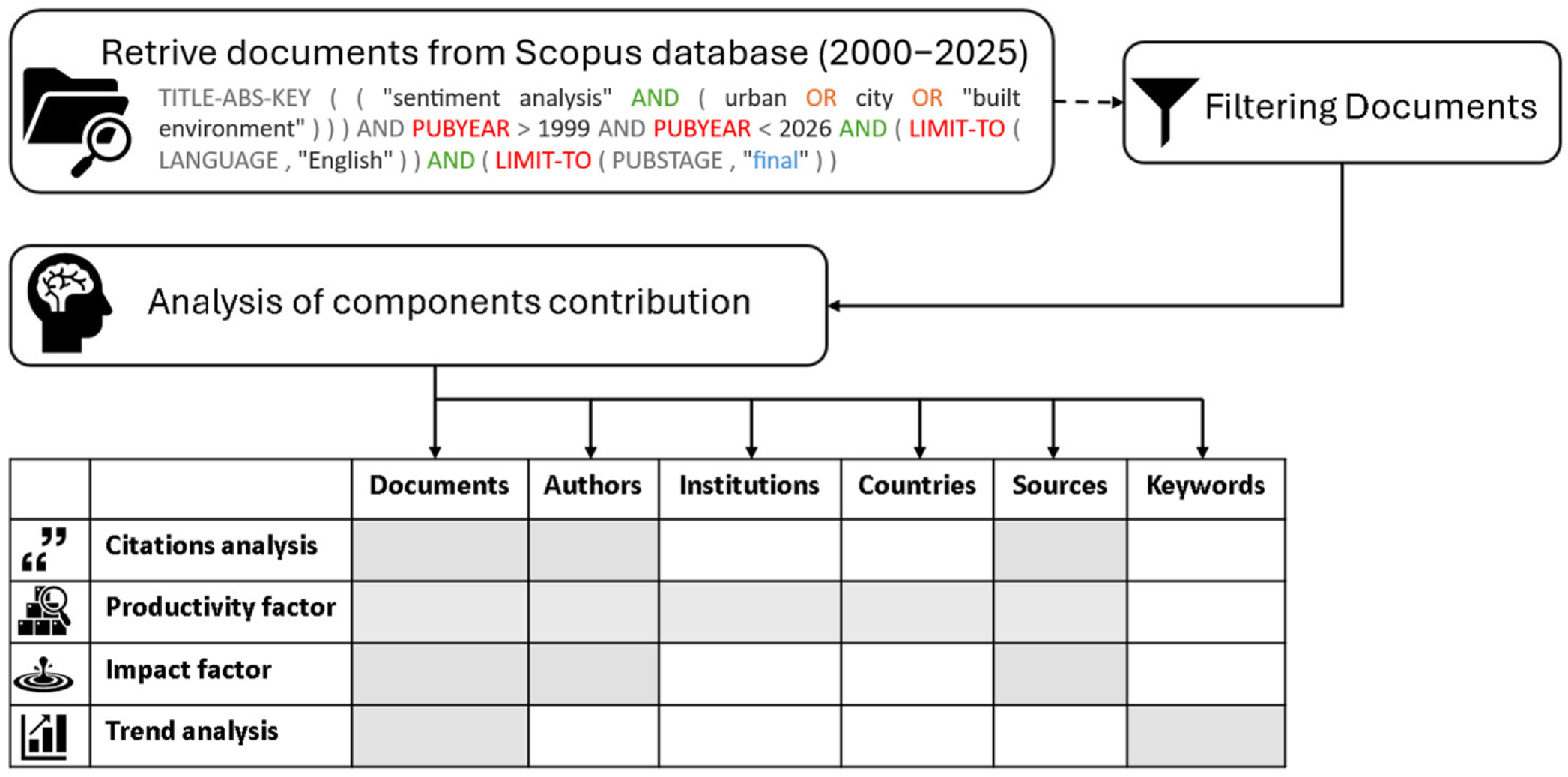
The Scopus database was used to gather the desired publications by applying a query with the following keywords: “sentiment analysis” AND (urban OR city OR “built environment”). The Boolean operator ‘AND’ was employed to retrieve research documents that connect sentiment analysis to urban, city, or built environments. The Scopus search was open to all scientific disciplines. Figure 1 shows the flowchart outlining the document extraction process. This search yielded a database of 1385 documents, which was then limited to those published in English with final publication. Consequently, 1315 documents were retained. The decision to use Scopus was based on its broad coverage of peer-reviewed literature and its widespread use in bibliometric and review studies. The Elsevier–Scopus database is also regarded as more comprehensive in representing research within the social sciences [37,38]. Furthermore, there has been an increasing overlap between Scopus and Thomson Reuters Web of Science [39].

2.3. Statistical Analysis

The Bibliometrix library (https://CRAN.R-project.org/package=bibliometrix) (accessed on 11 March 2026) in R software version 4.2.2, developed by Aria and Cuccurullo (2017), was used to analyze the data, as it enables performance analyses of groups of components such as documents, keywords, authors, journals, and countries/territories, and to assess their impact within the research domain [39].
VOSviewer, the other software used, combines high-quality graphics with simplicity, flexibility, and responsiveness to user needs. However, it has limited capabilities for integrating data from multiple sources, often requiring prior data preprocessing and separate analyses. Bibliometrix is more robust and versatile, allowing for greater customization by users and performing analyses on files from multiple databases. It offers more advanced analysis options, although it has a steeper learning curve that includes programming [40].
Descriptive statistics were employed to determine frequency, percentage, sum, mean, h-index, and g-index. The former is generally less sensitive to extremely highly cited works than the latter. This indicates that the h-index may not be as influenced by a single highly cited publication as the g-index. Therefore, the h-index is often regarded as a more conservative indicator of academic impact, while the g-index may better represent the distribution of impact across a researcher’s publications. For scientific mapping, VOSviewer version 1.6.19 was also utilized, enabling social network analysis. It examines co-authorship, co-occurrence, citations, bibliographic coupling, and co-citation links.

3. Results

3.1. Document Characteristics, Trends, and Citations

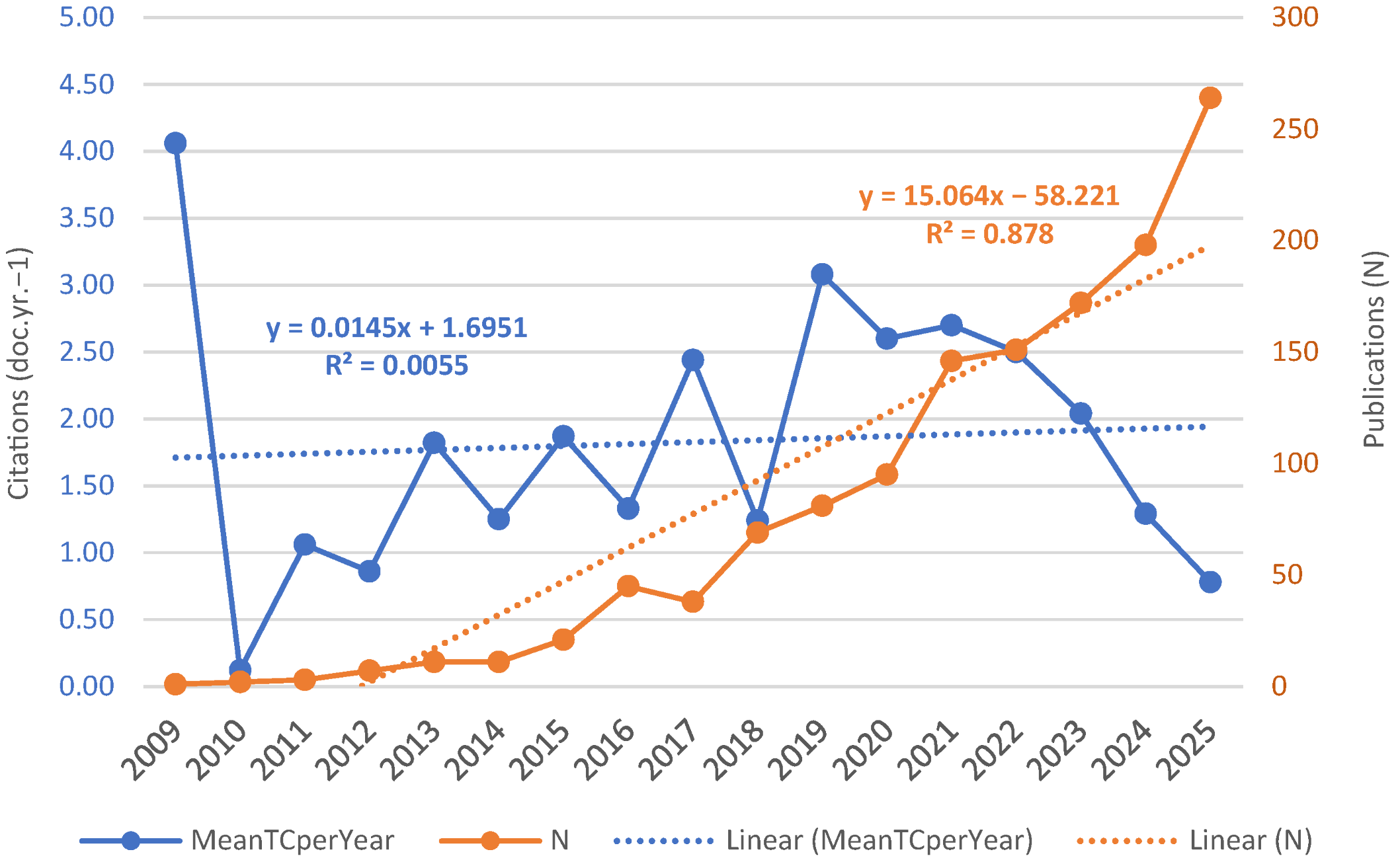
From the Scopus electronic database, 1315 documents published between 2000 and 2025 related to sentiment analysis and the urban, city, or built environments were identified (Figure 2). These included 609 (46%) journal articles, 444 (34%) conference papers, and 46 (3%) book chapters as of 31 December 2025. These documents were authored by 3855 authors and published in 160 sources (such as journals and books). The documents received 14,058 global citations, with an average of 11 citations per document. The dataset included 3855 authors, with an average of 2.93 co-authors per document and a collaboration index of 3.4, as calculated using the Bibliometrix package.
The earliest published document on sentiment related to the urban, city, or built environments was: Little Islands of Erin: Irish Settlement and Identity in Mid-Nineteenth-Century Manchester, published in 1999 by Busteed. The author analyzed sentiment during Irish colonization in British cities in the 19th century, focusing on popular Irish opinions expressed through ballads (songs) that circulated widely in cities [41]. However, there was a nearly ten-year gap, and the first work on sentiment analysis and its relation to the environment after 2000 appeared in 2009 (Figure 2). Afterwards, interest in the topic grew over the years, as shown by a linear regression model fitted to the annual publication data (slope of 15.0; Figure 2), with a steady rise in publications (R2 = 0.878), except in 2017, when there was a decline. From 2009 to 2025, the average annual publication rate was 82 documents. In 2020, 95 documents were published, followed by 146 in 2021 (+53.7% compared to 2020), then 151 in 2022, 172 in 2023, 198 in 2024, and 264 in 2025. Based on this recent growth pattern, it is likely that this trend will continue over the next decade. The average number of citations per year showed a very slight increasing trend overall (slope ≈ 0.014), although the change is minimal. However, a decline could be observed in the most recent years, particularly after 2021.

3.1.1. Most Influential Publications on Sentiment Analysis in Urban Built Environment

Of the 1315 documents in the database on sentiment analysis related to urban built environments, the ten most globally cited articles per year (TC year−1) are listed in Table 1. The total number of local and global citations differs because local citations are counted within the dataset of eligible documents, while global citations include all documents indexed in the Scopus electronic database. The total normalized citations (Normalized TC) of a document are calculated by dividing its actual citation count by the expected citation rate for documents published in the same year.
The total global citations per year (TC year−1) in the Top 10 ranged from 40.75 to 22.50. The highest-ranked article was “Artificial Intelligence as a Disruptive Technology—A Systematic Literature Review” by Păvăloaia Vasile-Daniel and Necula Sabina-Cristiana (2023) [42], with 163 citations (see Table 1). From a temporal perspective, more recent articles tend to have a higher average number of citations per year, which could make them more prominent in the future. In this context, two recent articles stand out: “How do different types and landscape attributes of urban parks affect visitors’ positive emotions?” and “Which environmental features contribute to positive and negative perceptions of urban parks? A cross-cultural comparison using online reviews and natural language processing methods”, both from 2022, with 39.00 (195 total) and 28.00 (140 total) citations per year, respectively.
Table 2 lists the ten references most frequently cited within the analyzed dataset. The 1315 documents included in this study cited a total of 43,633 references, generating 46,518 local citations. Among the Top 10 references, the number of citations within the dataset (LC) ranged from 4 to 20. The highest-ranked article was ‘BERT: Pre-training of deep bidirectional transformers for language understanding’ by Devlin et al., (2018) [52], with 20 citations.

3.1.2. Author Analysis

Table 3 lists the ten most relevant authors based on their local impact. Authors were ranked based on their g-index, while additional indicators such as h-index, total citations (TC), number of publications (NP), and the year they started activity (PY_start) are provided for reference. According to these ranking, Manar Alkhatib appeared as the leading author, with a total of 7 publications and a local g-index of 7 (meaning that he published at least 7 articles that received at least 49 citations collectively). He was followed by May El Barachi, with a g-index of 6 and 6 publications.
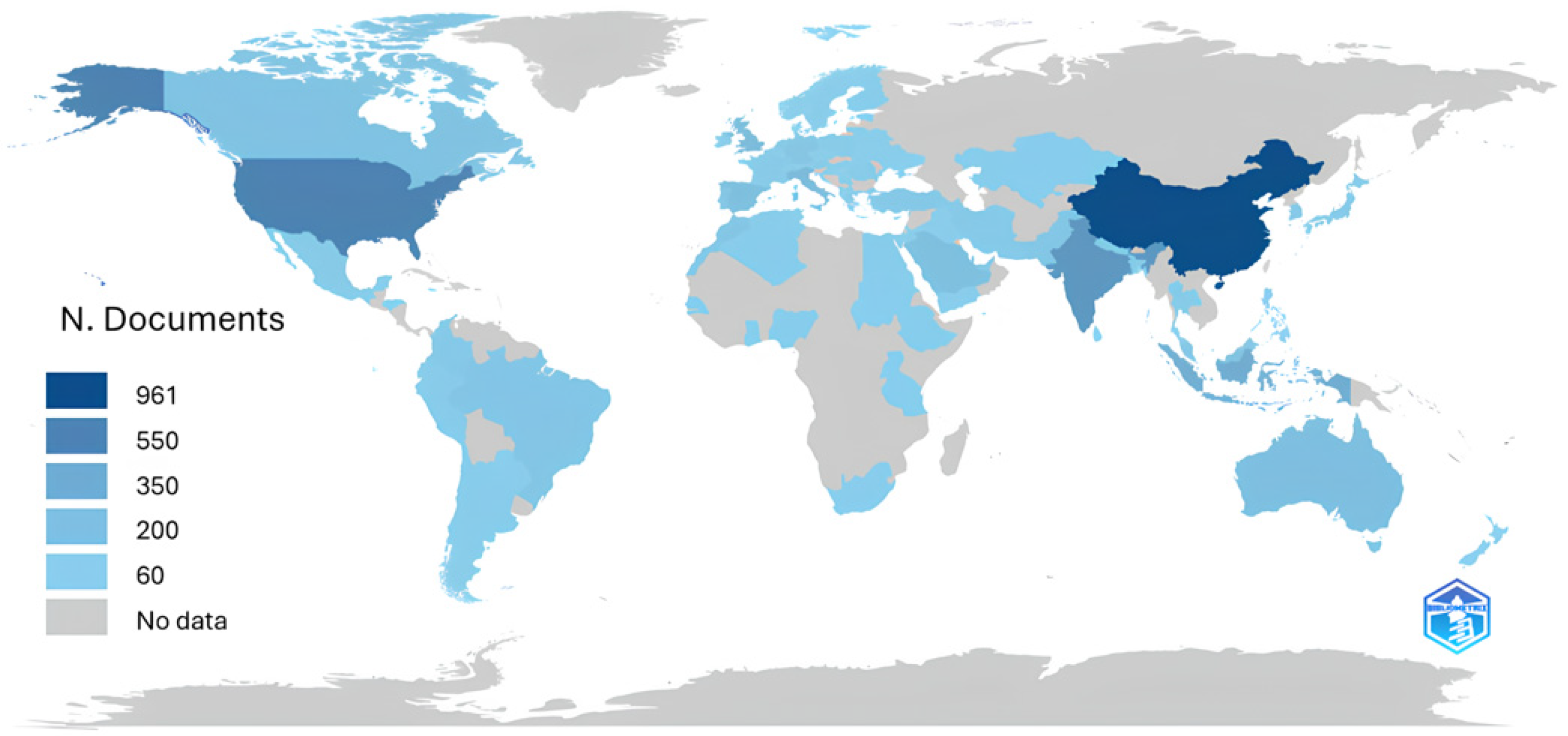
Based on the institutional affiliations of authors and co-authors, Bibliometrix identified 83 contributing countries. The results showed that China was the most productive country in sentiment analysis related to the urban, city, or built environments, with 961 publications, followed by the USA with 550, India with 394, and Indonesia with 247, among others (Figure 3). This could be correlated with the country’s relatively open data policies and extensive use of social media platforms [60,61].
Additionally, 74 countries with the most productive and cited authors were recognized (Table 4). The data indicate that China led in productivity, with 212 articles (27%), followed by the USA with 94 (12%), India with 63 (8%), and Indonesia with 36 (5%). Moreover, the countries with the highest number of publications involving authors from different countries (MCP = multi-country publication) were China (n = 54), the USA (n = 21), and the United Kingdom (n = 11), as shown in Table 4.

3.1.3. Influential Sources Publishing on Sentiment Analysis

The documents on sentiment analysis related to the urban, city, or built environments were published across 160 different sources (Table 5). Among these, the ten most prominent sources published 169 publications, representing 13% of the total sampled (169 out of 1315). The source with the greatest local impact was Sustainability (Switzerland), which published 28 documents, with a g-index of 16 and a total of 284 citations (Table 6). This was followed by Cities (15), the International Journal of Environmental Research and Public Health (15), Lecture Notes in Computer Science (14), and the ISPRS International Journal of Geo-Information (10), ordered by citation counts according to the g-index.
The sources with the highest number of publications were Lecture Notes in Computer Science (51), Communications in Computer and Information Science (44), Lecture Notes in Networks and Systems (41), ACM International Conference Proceeding Series (29), and Sustainability (Switzerland) (28). While the journals with the highest number of publications mainly belonged to the field of computer science, they were not necessarily the most highly cited. In fact, the fields of environmental health, public health, planning, and urban policy had the greatest influence on this topic.

3.1.4. Funding and Authorship Affiliation Funds

A total of 160 funders and 160 institutions were identified from 2009 to 2025. The National Natural Science Foundation of China was the leading funder with 92 documents (Table 6).
Among the top institutions, the Chinese Academy of Sciences in China had 19 publications (1.44%), followed by Tongji University with 14 publications (1.06%) (Table 7).

3.2. Network Analysis

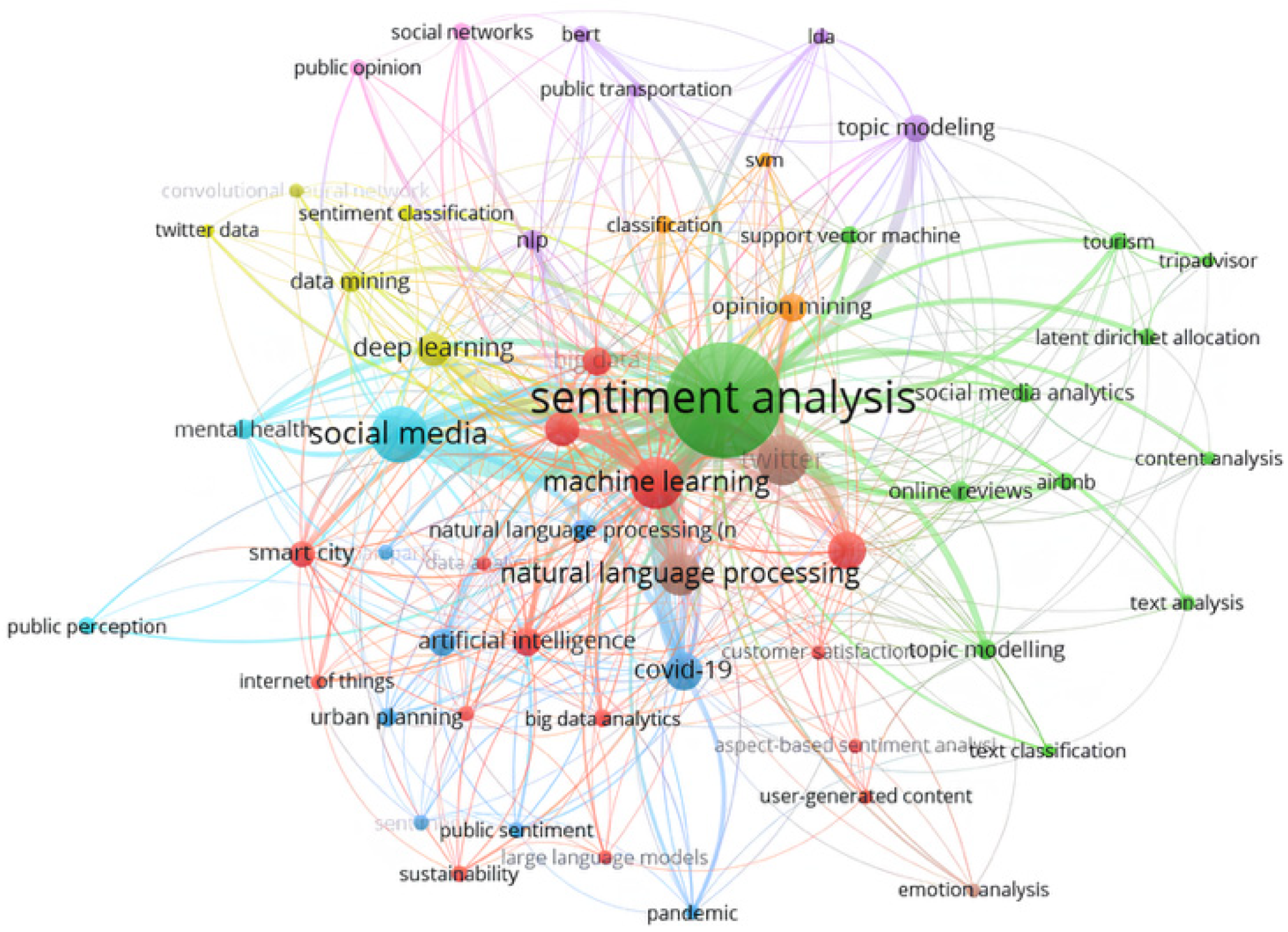
In co-authorship networks, the links attribute indicates the number of collaborative connections between a specific component and others, while the total link strength attribute shows the overall strength of these co-authorship connections [62]. For co-occurrence networks (co-words analysis), each line represents the relationship between two keywords—when they appear together in the same document. The size of the nodes reflects the frequency of the keywords—higher frequency results in larger nodes. Clusters, identified by colors, are automatically generated by the VOSViewer software and distinguish different networks from one another [63]. The 1315 documents analyzed included 3040 different keywords selected by the authors. Figure 4 displays the keyword co-occurrence network. A minimum occurrence threshold of eight was applied, resulting in 56 keywords included in the analysis. The closer the keywords appear, the stronger their co-occurrence relationship. Overall, nine clusters were identified, with 459 links (L) and a total link strength (TLS) of 1727.
The main keywords in each cluster were sentiment analysis (tourism—green cluster), social media (mental health—light blue cluster), machine learning (smart city—red cluster), twitter (emotion analysis—brown cluster), COVID-19 (health—blue cluster), deep learning (yellow cluster), opinion mining (orange cluster), topic modeling (purple cluster), and social networks (public opinion—pink cluster). The keyword sentiment analysis appeared 624 times, followed by social media with 144 mentions and machine learning with 117.
The red cluster shows connections between machine learning, artificial intelligence, smart cities, and big data. This cluster highlights the frequent use of big data and machine learning techniques in smart city research. These studies are essential for making better decisions and developing more efficient solutions to urban challenges. The blue cluster displays links between terms such as urban planning, social media data, and the COVID-19 pandemic. The COVID-19 pandemic influenced society, as seen in user interactions on social media, emphasizing the importance of sentiment analysis to understand people’s public sentiment in urban contexts during this time. The green cluster demonstrates links between sentiment analysis, topic modeling, social media analysis, TripAdvisor, and tourism. TripAdvisor has become more popular in sentiment analysis because of the increasing amount of data it provides, like user reviews and opinions. These data are semi-structured, making it easier to extract relevant information for the tourism industry, such as market opportunities. Additionally, there are clear connections in the yellow cluster between deep learning, data mining, and sentiment classification. These links show the recent use of deep learning techniques in sentiment analysis, thanks to their effectiveness in solving complex problems in natural language processing.
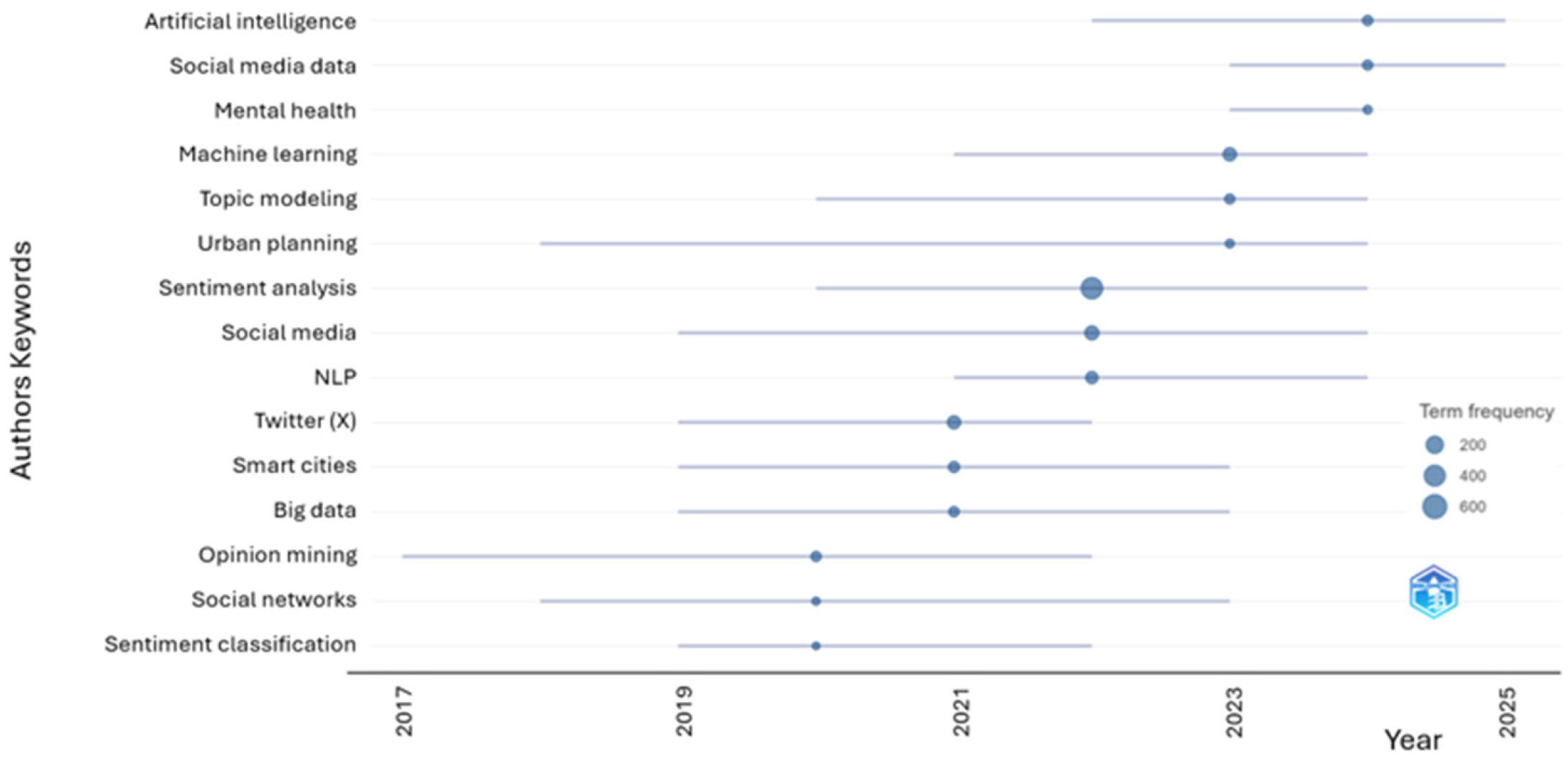
Figure 5 shows the trends in research topics over time. It emphasizes the important role of artificial intelligence and social media in sentiment analysis in recent years, with Twitter being especially prominent, used in studies related to urban planning (2018 to 2024) and smart cities (2019 to 2023). More recently, the keyword mental health appears predominantly in the latest years of the dataset, suggesting a growing research interest in applying sentiment analysis to mental health-related topics. This trend may reflect the increasing recognition that different aspects of the urban environment can influence mental health and well-being [64]. Urban environments significantly impact mental health through factors such as green spaces, air quality, noise, and social cohesion. For instance, access to green spaces and walkable areas is associated with reduced stress, anxiety, and depression, while poor air quality and overcrowding negatively affect mental well-being [65,66,67].
Several developments have taken place over the last years (2017–2025), coinciding with the increasing use of big data and social media data. Keywords such as opinion mining, twitter, and smart cities appear earlier in the period, while machine learning, sentiment analysis, and natural language processing become more prominent around 2021–2022. More recently, keywords such as artificial intelligence and mental health emerged in the most recent years of the dataset, indicating a shift toward more advanced analytical techniques and growing interest in mental health within sentiment analysis research.
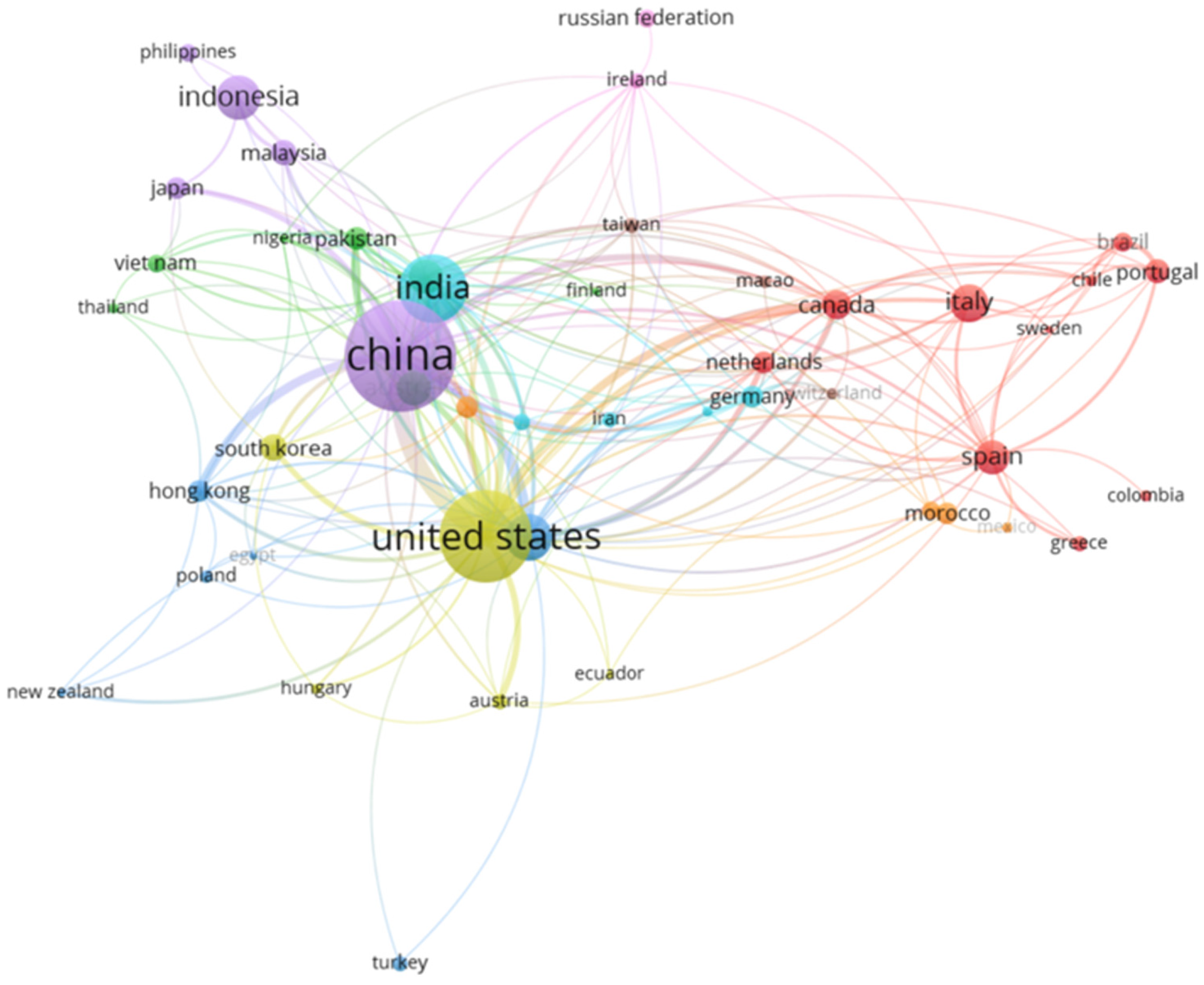
Based on Scopus data analyzed using VOSviewer, the publications included in this study involved authors affiliated with institutions from 103 different countries. Figure 6 presents the collaboration network for the 47 countries with at least 5publications. The size of each node represents the number of publications, while links between nodes indicate co-authorship collaborations. The closer the countries appear and the thicker the links, the stronger the collaboration. Overall, 9 clusters were identified, with 214 links (L) and a total link strength (TLS) of 448. The countries with the highest number of publications included the United States, China, India, Italy, and the United Kingdom. Several clusters of international collaboration were observed, reflecting regional and cross-continental research partnerships.

4. Discussion

This study provides a bibliometric analysis of documents on sentiment analysis related to the urban, city, or built environments indexed in the Scopus electronic database over the past 25 years. Two complementary bibliometric methods were used—performance analysis and scientific mapping—to identify the most impactful authors and the most productive countries, sources, institutions, and funding agencies. The results show consistent growth in urban sentiment analysis research over the past decade, with academic production expected to continue increasing.
Annual citations increased after 2010, reaching higher levels around 2019–2021, before declining in the most recent years. This decline may be explained by the citation time-lag effect, as recently published articles have had less time to accumulate citations. In addition, the rapid increase in the number of publications over recent years may dilute the average citation rate. The most prolific author on this topic is currently Manar Alkhatib, an Assistant Professor of artificial intelligence at The British University in Dubai (BUiD), while a few years ago, the leading author was Cambria Erik from Nanyang Technological University, Singapore [36]. Major publication sources include Sustainability (Switzerland), Cities, International Journal of Environmental Research and Public Health, and Lecture Notes in Computer Science (LNCS), which features subseries like Lecture Notes in Artificial Intelligence (LNAI) and Lecture Notes in Bioinformatics (LNBI). China, the USA, and India produced the largest number of papers and citations, dominating both single-country publications and multi-country collaborations; authorship patterns similarly showed those affiliated to China as leading contributors, followed by the U.S. and India, aligning with [36,68]. This dominance may be explained by the presence of large research communities and substantial investments in artificial intelligence, machine learning, and smart city initiatives in these countries [69,70], areas that are closely linked to the development of data-driven approaches such as sentiment analysis for understanding urban environments.
The thematic structure identified through KeyWords Plus (the 50 most frequent terms) focuses on sentiment analysis, social media, online social networking, data mining, and smart cities. It offers a concise overview of the field’s most prominent topics over the past 15 years and highlights the benefit of KeyWords Plus in broadening the keyword set [71]. Author keywords (the 50 most frequent out of 3040) emphasize sentiment analysis, social media, machine learning, twitter, and natural language processing—patterns that may reflect author preferences, particular interests, or publishing strategies. These findings are consistent with previous bibliometric studies of opinion mining and sentiment analysis [36,68], which similarly mapped influential authors and institutions, highly cited papers, and keyword trends. Machine learning remains the predominant method for sentiment classification, and Twitter/X) continues to be the most used social platform, although TripAdvisor has gained importance, partly due to recent access restrictions enforced by X (and the growth of tourism-related platforms such as Airbnb, TripAdvisor, Booking, etc.). TripAdvisor data have been included in tourism-related research because user reviews provide detailed and subjective insights about locations [65]. Indeed, with the increase in reviews on online travel platforms and their impact on consumers, many researchers have examined the connection between online travel reviews and consumer behavior, as well as how these reviews influence consumer decisions and choices toward particular places [66].
This discussion focuses on the empirical relevance and practical implications of the results. From this perspective, the literature indicates a higher prevalence of psychotic disorders in urban areas compared to non-urban areas [6], a pattern linked to increasing disconnection from nature and more sedentary urban lifestyles [7]. Urban design and landscape architecture serve as crucial tools for enhancing health and the human condition [3]. Exposure to natural elements and systems within cities, such as parks, gardens, water bodies, trees, and birds, has been connected to improved mental well-being and a lower occurrence of chronic mental illnesses [8,9,10,11,12]. Cities are seen as complex systems with many interacting factors, making them challenging to analyze for planning purposes. However, the availability of large datasets and the digitalization of urban life now allow for highly detailed spatiotemporal assessments of sentiments and emotions through social networks (e.g., Twitter/X) [15,16]. Digital transformation reshapes the spaces where people connect, express themselves, and gather, offering both opportunities and constraints for civic life. In this context, social media data are an important trigger to use sentiment analysis as a compelling case for well-being [23].
Conceptually, sentiment analysis, sometimes mistakenly conflated with opinion mining, aims to automatically identify opinions, detect the sentiments expressed, and classify their polarity (positive, negative, neutral, or more detailed schemes like OpeNER 2014 and EmoLex) [24,72,73]. While early work relied on lexicon-based methods with manually labeled polarity lists [26], the field has shifted toward machine learning, hybrid approaches [27], and landmark contributions that established modern pipelines (e.g., [74]). The rise of Web 2.0 and the surge of user-generated content have accelerated both the breadth and depth of sentiment analysis [23,75], opening new avenues for understanding human geography in urban environments [28]. Taking on a bibliometric approach, this paper focused on trends and publications, leading authors, institutions, funding sources, countries, thematic areas, and potential future hotspots in the field.
Against this background, social media platforms like Weibo, Twitter/X, and others are becoming key sources for sentiment analysis, providing real-time data on public perceptions and emotions related to urban environments [76,77,78]. Using large datasets from social media enables a more comprehensive and dynamic analysis of sentiments across different urban areas and time periods [79,80,81]. Advances in deep learning and natural language processing (NLP), including object detection, image segmentation, and machine learning algorithms, are enhancing the accuracy and detail of sentiment classification and visualization [76,78,79,80,81]. Additionally, new methods such as dual-polarity metrics better capture distinctions between positive and negative sentiments [82]. However, most studies still rely predominantly on textual data, while the integration of multimodal data sources, such as images, videos, and geospatial information, remains limited. This suggests that multimodal AI approaches represent a promising direction for future research, enabling a more comprehensive understanding of urban sentiments.
There is a growing awareness of how the built environment influences public sentiment and mental health, with increasing focus on factors like green spaces, building density, and urban infrastructure. As a result, sentiment analysis is intertwined with the development of urban planning and public policies aimed at improving well-being and reducing negative emotions, with growing attention to elements such as green spaces, building density, and urban infrastructure [76,80,83,84]. However, vulnerable groups, such as elderly individuals and low-income populations, may experience higher levels of anxiety, depression, and frustration during technological transformations and smart city transitions [85]. If these groups are underrepresented in sentiment analysis data, their emotional distress may be underestimated, potentially limiting the development of inclusive urban policies.
Methodologically, this paper combines performance analysis and scientific mapping following established practices for summarizing large bibliometric corpora to reveal structural patterns and emerging trends [86]. Performance indicators such as publications, citations, citations per publication, and composite metrics like the h-index and g-index help assess productivity and impact [30], while scientific mapping—using citation/co-citation analysis, bibliographic coupling, co-word analysis, and co-authorship analyses—illuminates the intellectual and structural relationships within the field [31,32,33,34,35]. Complementary evidence from related bibliometric surveys, such as Niu and Silva (2020) mapping of crowdsourced data in urban activities, where sentiment analysis is paired with machine learning methods (e.g., maximum entropy classifier, multinomial Naïve Bayes) and lexical tools (e.g., AFINN), reinforces the present study’s depiction of methodological convergence [28,36].
Finally, researchers are increasingly examining the spatial distributions and temporal variations of sentiments to understand how different urban areas and time periods influence public emotions during specific events, seasons, or under changing environmental conditions [77,79,80,81,82]. Geotagged data enable detailed mapping of the emotional landscape within cities [80,81,82]. External shocks such as the COVID-19 pandemic have significantly affected public sentiment, highlighting the importance of including contextual variables; studies document shifts related to lockdowns, environmental changes, and urban renewal projects [77,79,81], which inform strategies for urban resilience and crisis management [77]. In practice, sentiment analysis guides urban development projects to ensure that new initiatives align with public preferences and enhance quality of life [76,83,84]. It also supports strategies for managing green spaces, air quality, and other environmental factors that impact public sentiment [80,81,87]. Integrating these insights into smart city frameworks helps create more responsive, human-centered urban environments. Meanwhile, trend analysis indicates a relative increase in work specifically labeled as “urban planning” in sentiment analysis, this enables planners to incorporate underrepresented voices into decision-making processes [88,89]. Although results derived from online media data may overrepresent the young population and underrepresent children and elderly people (as indicated in social media demographic reports), the information obtained remains valuable [89].

5. Conclusions

The present paper offers a bibliometric overview of research findings on sentiment analysis in urban built environments. The results show a significant increase in scientific production over the last decade, with countries such as the United States, China, and India emerging as the most productive contributors. Keyword and thematic analyses highlight the central role of machine learning, natural language processing, and social media platforms such as Twitter/X. Recently, there has been increased use of sentiment analysis in topics like artificial intelligence, mental health, and urban planning.
Since sentiment analysis plays a crucial role in understanding how environmental characteristics affect individual well-being, it makes sense to develop future studies focused on this area, incorporating newer methods like deep learning, which recognize complex text patterns and process data in ways inspired by the human brain. In fact, deep neural network architectures, such as convolutional neural networks (CNNs) and recurrent neural networks (RNNs), have shown promising results in sentiment analysis from text. More advanced models, like Google’s Transformer neural network, have also been explored because of their ability to capture complex semantic relationships.
Transfer learning, which fine-tunes models pre-trained on large datasets for sentiment analysis on social media, further enhances model performance, especially when training data are scarce. However, obtaining large, annotated datasets for training sentiment analysis models remains challenging. In such cases, semi-supervised learning, which combines labeled and unlabeled data, can improve performance by allowing models to learn from unclassified examples during training. However, the results of this study suggest that most existing research relies predominantly on textual data, highlighting a gap in the integration of more diverse data sources. Future methodologies to explore include multimodal models capable of analyzing multiple data types simultaneously, that is, social data not only consist of text but also includes images, videos, and audio, which are becoming increasingly important for capturing subtle nuances in sentiment expression. This naturally leads to research into the realm of urban environments and context analysis.
Considering the contextual, positional, and situational specificity in which messages are posted can significantly enhance the accuracy of sentiment analysis. Methods that account for social, temporal, and situational context can help interpret expressed sentiment more precisely. Such analyses offer future researchers guidance and insights into potential challenges and limitations within the field, complementing the bibliometric findings related to authors, countries, sources, and institutions, thereby supporting the development of more comprehensive academic production on sentiment analysis related to urban built environments. Of course, the bibliometric analysis drawn in this paper has some limitations, especially since it relies on data from only one indexer, Scopus. Future research could incorporate additional databases beyond electronic sources, such as Google Scholar, Web of Science, PubMed, Embase, as well as physical libraries and repositories, print publications, and others.
Overall, sentiment analysis supported by social media data is a powerful tool for understanding public emotions, perceptions, and thus well-being, which is essential for effective urban planning, health services, and policymaking. By leveraging near real-time data, policymakers and researchers can make informed decisions that better reflect the needs and sentiments of the general population.

Author Contributions

Conceptualization, I.B., J.R. and C.M.V.; methodology, I.B., J.R. and C.M.V.; validation, I.B., C.M.V. E.G. and J.R.; formal analysis, I.B., C.M.V., E.G. and J.R.; investigation, I.B., C.M.V. and J.R.; resources, I.B., J.R. and C.M.V.; data curation, I.B., J.R. and C.M.V.; writing—original draft preparation, I.B., J.R. and C.M.V.; writing—review and editing, J.R., E.G., D.G.S. and C.M.V.; supervision, J.R. and C.M.V.; project administration, J.R. and D.G.S.; funding acquisition, J.R. and D.G.S. All authors have read and agreed to the published version of the manuscript.

Funding

This research was funded by the Portuguese Foundation for Science and Technology (FCT), grant number 2022.11665.BD, awarded to Iuria Betco, and the APC was funded by The Center for Geographical Studies at the University of Lisbon and the FCT, grant number UID/00295/2025 (https://doi.org/10.54499/UID/00295/2025).

Institutional Review Board Statement

Not applicable.

Informed Consent Statement

Not applicable.

Data Availability Statement

No new data were created or analyzed in this study.

Acknowledgments

We thank GEOMODLAB—Remote Sensing, Geographical Analysis, and Modeling Laboratory—of the Center for Geographical Studies (CEG) and the Institute of Geography and Spatial Planning (IGOT) for providing the necessary equipment and software. During the preparation of this manuscript/study, the authors used grammarly v1.2.258.1885 for final text and grammer chek. The authors have reviewed and edited the output and take full responsibility for the content of this publication.

Conflicts of Interest

The authors declare no conflicts of interest.

References

  1. Pineo, H.; Rydin, Y. Cities, Health and Well-Being. In Royal Institution of Chartered Surveyors; Royal Institution of Chartered Surveyors: London, UK, 2018; pp. 1–40. [Google Scholar]
  2. Hidaka, B.H. Depression as a Disease of Modernity: Explanations for Increasing Prevalence. J. Affect. Disord. 2012, 140, 205–214. [Google Scholar] [CrossRef]
  3. Adli, M.; Berger, M.; Brakemeier, E.L.; Engel, L.; Fingerhut, J.; Gomez-Carrillo, A.; Hehl, R.; Heinz, A.; Mayer, J.; Mehran, N.; et al. Neurourbanism: Towards a New Discipline. Lancet Psychiatry 2017, 4, 183–185. [Google Scholar] [CrossRef]
  4. Lederbogen, F.; Kirsch, P.; Haddad, L.; Streit, F.; Tost, H.; Schuch, P.; Wüst, S.; Pruessner, J.C.; Rietschel, M.; Deuschle, M.; et al. City Living and Urban Upbringing Affect Neural Social Stress Processing in Humans. Nature 2011, 474, 498–501. [Google Scholar] [CrossRef]
  5. Peen, J.; Schoevers, R.A.; Beekman, A.T.; Dekker, J. The Current Status of Urban-Rural Differences in Psychiatric Disorders. Acta Psychiatr. Scand. 2010, 121, 84–93. [Google Scholar] [CrossRef]
  6. Galea, S. The Urban Brain: New Directions in Research Exploring the Relation between Cities and Mood–Anxiety Disorders. Depress. Anxiety 2011, 28, 857–862. [Google Scholar] [CrossRef] [PubMed]
  7. Miller, J.R. Biodiversity Conservation and the Extinction of Experience. Trends Ecol. Evol. 2005, 20, 430–434. [Google Scholar] [CrossRef]
  8. Hartig, T. Nature Experience in Transactional Perspective. Landsc. Urban Plan. 1993, 25, 17–36. [Google Scholar] [CrossRef]
  9. Kaplan, S. The Restorative Benefits of Nature: Toward an Integrative Framework. J. Environ. Psychol. 1995, 15, 169–182. [Google Scholar] [CrossRef]
  10. Bakolis, I.; Hammoud, R.; Smythe, M.; Gibbons, J.; Davidson, N.; Tognin, S.; Mechelli, A. Urban Mind: Using Smartphone Technologies to Investigate the Impact of Nature on Mental Well-Being in Real Time. Bioscience 2018, 68, 134–145. [Google Scholar] [CrossRef]
  11. Cox, D.T.C.; Shanahan, D.F.; Hudson, H.L.; Plummer, K.E.; Siriwardena, G.M.; Fuller, R.A.; Anderson, K.; Hancock, S.; Gaston, K.J. Doses of Neighborhood Nature: The Benefits for Mental Health of Living with Nature. Bioscience 2017, 67, 147–155. [Google Scholar] [CrossRef]
  12. Hammoud, R.; Tognin, S.; Burgess, L.; Bergou, N.; Smythe, M.; Gibbons, J.; Davidson, N.; Afifi, A.; Bakolis, I.; Mechelli, A. Smartphone-Based Ecological Momentary Assessment Reveals Mental Health Benefits of Birdlife. Sci. Rep. 2022, 12, 6–15. [Google Scholar] [CrossRef] [PubMed]
  13. Sá, R.; Roquette, R.; Rebecchi, A.; Matias, J.; Rocha, J.; Buffoli, M.; Capolongo, S.; Ribeiro, A.I.; Nunes, B.; Dias, C.; et al. Association between Area-Level Walkability and Glycated Haemoglobin: A Portuguese Population-Based Study. BMC Public Health 2024, 24, 1116. [Google Scholar] [CrossRef] [PubMed]
  14. Kovacs-Györi, A.; Ristea, A.; Kolcsar, R.; Resch, B.; Crivellari, A.; Blaschke, T. Beyond Spatial Proximity-Classifying Parks and Their Visitors in London Based on Spatiotemporal and Sentiment Analysis of Twitter Data. ISPRS Int. J. Geo-Inf. 2018, 7, 378. [Google Scholar] [CrossRef]
  15. Kovács-Győri, A.; Ristea, A.; Havas, C.; Resch, B.; Cabrera-Barona, P. #London2012: Towards Citizen-Contributed Urban Planning through Sentiment Analysis of Twitter Data. Urban Plan. 2018, 3, 75–99. [Google Scholar] [CrossRef]
  16. Romice, O.; Thwaites, K.; Porta, S.; Greaves, M.; Barbour, G.; Pasino, P. City Form and Wellbeing. In The Handbook of Environmental Psychology and Quality of Life Research; Fleury-Bahi, G., Pol, E., Navarro, O., Eds.; Springer: Berlin/Heidelberg, Germany, 2016; pp. 241–273. [Google Scholar]
  17. Ash, J.; Kitchin, R.; Leszczynski, A. Digital Turn, Digital Geographies? Prog. Hum. Geogr. 2016, 42, 25–43. [Google Scholar] [CrossRef]
  18. Alsharif, M.; Hnit, H. Digital Human Rights: Legal Debates and Emerging Foundations under the International Bill of Human Rights. Soc. Sci. Humanit. Open 2025, 12, 102160. [Google Scholar] [CrossRef]
  19. Jørgensen, R.F. Social Media, Human Rights and Society. In Routledge Handbook of Social: Media, Law and Society; Routledge: Abingdon-on-Thames, UK, 2025; pp. 7–9. [Google Scholar]
  20. Charoenloasiri, N.; Yimsook, N.; Walsh, C. Understand and Find a Mechanism to Enhance the Power of App-Based Food Delivery Riders in Thailand. J. Arts Thai Stud. 2025, 47, E3142. [Google Scholar] [CrossRef]
  21. Arginbekova, G.; Amitov, S.; Kyndybayeva, R.; Bakbergen, K. Human Values in the Age of Digitalization. Sci. Her. Uzhhorod Univ. Phys. 2024, 2024, 2275–2284. [Google Scholar] [CrossRef]
  22. Lynch, N. Facial Recognition Technology in Policing and Security—Case Studies in Regulation. Laws 2024, 13, 35. [Google Scholar] [CrossRef]
  23. Zunic, A.; Corcoran, P.; Spasic, I. Sentiment Analysis in Health and Well-Being: Systematic Review. JMIR Med. Inform. 2020, 8, 22. [Google Scholar] [CrossRef] [PubMed]
  24. Medhat, W.; Hassan, A.; Korashy, H. Sentiment Analysis Algorithms and Applications: A Survey. Ain Shams Eng. J. 2014, 5, 1093–1113. [Google Scholar] [CrossRef]
  25. Balahur, A.; Mihalcea, R.; Montoyo, A. Preface: Computational Approaches to Subjectivity and Sentiment Analysis: Present and Envisaged Methods and Applications. Comput. Speech Lang. 2014, 28, 1–6. [Google Scholar] [CrossRef]
  26. Shayaa, S.; Jaafar, N.I.; Bahri, S.; Sulaiman, A.; Wai, P.S.; Chung, Y.W.; Piprani, A.Z.; Al-Garadi, M.A. Sentiment Analysis of Big Data Methods, Applications, and Open Challenges. IEEE Access 2018, 6, 37807–37827. [Google Scholar] [CrossRef]
  27. Maynard, D.; Funk, A. Automatic Detection of Political Opinions in Tweets. In The Semantic Web: ESWC 2011 Workshops. ESWC 2011; Lecture Notes in Computer Science; García-Castro, R., Fensel, D., Antoniou, G., Eds.; Springer: Berlin/Heidelberg, Germany, 2012; pp. 88–99. [Google Scholar]
  28. Niu, H.; Silva, E.A. Crowdsourced Data Mining for Urban Activity: Review of Data Sources, Applications, and Methods. J. Urban Plan. Dev. 2020, 146, 04020007. [Google Scholar] [CrossRef]
  29. Zupic, I.; Čater, T. Bibliometric Methods in Management and Organization. Organ. Res. Methods 2014, 18, 429–472. [Google Scholar] [CrossRef]
  30. Donthu, N.; Kumar, S.; Mukherjee, D.; Pandey, N.; Lim, W.M. How to Conduct a Bibliometric Analysis: An Overview and Guidelines. J. Bus. Res. 2021, 133, 285–296. [Google Scholar] [CrossRef]
  31. Baker, H.K.; Kumar, S.; Pandey, N. Forty Years of the Journal of Futures Markets: A Bibliometric Overview. J. Futur. Mark. 2021, 41, 1027–1054. [Google Scholar] [CrossRef]
  32. Cobo, M.J.; López-Herrera, A.G.; Herrera-Viedma, E.; Herrera, F. An Approach for Detecting, Quantifying, and Visualizing the Evolution of a Research Field: A Practical Application to the Fuzzy Sets Theory Field. J. Informetr. 2011, 5, 146–166. [Google Scholar] [CrossRef]
  33. Ramos-Rodrígue, A.-R.; Ruíz-Navarro, J. Changes in the Intellectual Structure of Strategic Management Research: A Bibliometric Study of the Strategic Management Journal, 1980–2000. Strateg. Manag. J. 2004, 25, 981–1004. [Google Scholar] [CrossRef]
  34. Baker, H.K.; Pandey, N.; Kumar, S.; Haldar, A. A Bibliometric Analysis of Board Diversity: Current Status, Development, and Future Research Directions. J. Bus. Res. 2020, 108, 232–246. [Google Scholar] [CrossRef]
  35. Tunger, D.; Eulerich, M. Bibliometric Analysis of Corporate Governance Research in German-Speaking Countries: Applying Bibliometrics to Business Research Using a Custom-Made Database. Scientometrics 2018, 117, 2041–2059. [Google Scholar] [CrossRef]
  36. Musa, I.H.; Zamit, I.; Xu, K.; Boutouhami, K.; Qi, G. A Comprehensive Bibliometric Analysis on Opinion Mining and Sentiment Analysis Global Research Output. J. Inf. Sci. 2021, 49, 1506–1516. [Google Scholar] [CrossRef]
  37. Bakkalbasi, N.; Bauer, K.; Glover, J.; Wang, L. Three Options for Citation Tracking: Google Scholar, Scopus and Web of Science. Biomed. Digit. Libr. 2006, 3, 7. [Google Scholar] [CrossRef]
  38. Burnham, J.F. Scopus Database: A Review. Biomed. Digit. Libr. 2006, 3, 1. [Google Scholar] [CrossRef] [PubMed]
  39. Aria, M.; Cuccurullo, C. Bibliometrix: An R-Tool for Comprehensive Science Mapping Analysis. J. Informetr. 2017, 11, 959–975. [Google Scholar] [CrossRef]
  40. Arruda, H.; Silva, E.R.; Lessa, M.; Proença, D.J.; Bartholo, R. VOSviewer and Bibliometrix. J. Med. Libr. Assoc. 2022, 110, 392–395. [Google Scholar] [CrossRef] [PubMed]
  41. Busteed, M. Little Islands of Erin: Irish Settlement and Identity in Mid-Nineteenth-Century Manchester. Immigr. Minor. 1999, 18, 94–127. [Google Scholar] [CrossRef]
  42. Păvăloaia, V.-D.; Necula, S.-C. Artificial Intelligence as a Disruptive Technology—A Systematic Literature Review. Electronics 2023, 12, 1102. [Google Scholar] [CrossRef]
  43. Kong, L.; Liu, Z.; Pan, X.; Wang, Y.; Guo, X.; Wu, J. How Do Different Types and Landscape Attributes of Urban Parks Affect Visitors’ Positive Emotions? Landsc. Urban Plan. 2022, 226, 104482. [Google Scholar] [CrossRef]
  44. Barbado, R.; Araque, O.; Iglesias, C.A. A Framework for Fake Review Detection in Online Consumer Electronics Retailers. Inf. Process. Manag. 2019, 56, 1234–1244. [Google Scholar] [CrossRef]
  45. Valdez, D.; ten Thij, M.; Bathina, K.; Rutter, L.A.; Bollen, J. Social Media Insights into US Mental Health during the COVID-19 Pandemic: Longitudinal Analysis of Twitter Data. J. Med. Internet Res. 2020, 22, e21418. [Google Scholar] [CrossRef]
  46. Shuja, J.; Alanazi, E.; Alasmary, W.; Alashaikh, A. COVID-19 Open Source Data Sets: A Comprehensive Survey. Appl. Intell. 2021, 51, 1296–1325. [Google Scholar] [CrossRef]
  47. Wang, T.; Lu, K.; Chow, K.P.; Zhu, Q. COVID-19 Sensing: Negative Sentiment Analysis on Social Media in China via BERT Model. IEEE Access 2020, 8, 138162–138169. [Google Scholar] [CrossRef]
  48. Huai, S.; Van de Voorde, T. Which Environmental Features Contribute to Positive and Negative Perceptions of Urban Parks? A Cross-Cultural Comparison Using Online Reviews and Natural Language Processing Methods. Landsc. Urban Plan. 2022, 218, 104307. [Google Scholar] [CrossRef]
  49. Huang, J.; Obracht-Prondzynska, H.; Kamrowska-Zaluska, D.; Sun, Y.; Li, L. The Image of the City on Social Media: A Comparative Study Using “Big Data” and “Small Data” Methods in the Tri-City Region in Poland. Landsc. Urban Plan. 2021, 206, 103977. [Google Scholar] [CrossRef]
  50. Lee, M.; Jeong, M.; Lee, J. Roles of Negative Emotions in Customers’ Perceived Helpfulness of Hotel Reviews on a User-Generated Review Website: A Text Mining Approach. Int. J. Contemp. Hosp. Manag. 2017, 29, 762–783. [Google Scholar] [CrossRef]
  51. Wu, Z.; Zhang, Y.; Chen, Q.; Wang, H. Attitude of Chinese Public towards Municipal Solid Waste Sorting Policy: A Text Mining Study. Sci. Total Environ. 2021, 756, 142674. [Google Scholar] [CrossRef] [PubMed]
  52. Devlin, J.; Chang, M.-W.; Lee, K.; Toutanova, K. BERT: Pre-Training of Deep Bidirectional Transformers for Language Understanding. In Proceedings of the 2019 Conference of the North American Chapter of the Association for Computational Linguistics: Human Language Technologies; Volume 1 (Long and Short Papers); Burstein, J., Doran, C., Solorio, T., Eds.; Association for Computational Linguistics: Minneapolis, MN, USA, 2019; pp. 4171–4186. [Google Scholar]
  53. Ghahramani, M.; Galle, N.J.; Ratti, C.; Pilla, F. Tales of a City: Sentiment Analysis of Urban Green Space in Dublin. Cities 2021, 119, 103395. [Google Scholar] [CrossRef]
  54. Grootendorst, M.R. BERTopic: Neural Topic Modeling with a Class-Based TF-IDF Procedure. arXiv 2022, arXiv:2203.05794. [Google Scholar]
  55. Li, J.; Gao, J.; Zhang, Z.; Fu, J.; Shao, G.; Zhao, Z.; Yang, P. Insights into Citizens’ Experiences of Cultural Ecosystem Services in Urban Green Spaces Based on Social Media Analytics. Landsc. Urban Plan. 2024, 244, 104999. [Google Scholar] [CrossRef]
  56. Xiang, Z.; Du, Q.; Ma, Y.; Fan, W. A Comparative Analysis of Major Online Review Platforms: Implications for Social Media Analytics in Hospitality and Tourism. Tour. Manag. 2017, 58, 51–65. [Google Scholar] [CrossRef]
  57. Pang, B.; Lee, L. Opinion Mining and Sentiment Analysis. Found. Trends Inf. Retr. 2008, 2, 1–135. [Google Scholar] [CrossRef]
  58. Plunz, R.A.; Zhou, Y.; Carrasco Vintimilla, M.I.; Mckeown, K.; Yu, T.; Uguccioni, L.; Sutto, M.P. Twitter Sentiment in New York City Parks as Measure of Well-Being. Landsc. Urban Plan. 2019, 189, 235–246. [Google Scholar] [CrossRef]
  59. Sun, P.; Lu, W.; Jin, L. How the Natural Environment in Downtown Neighborhood Affects Physical Activity and Sentiment: Using Social Media Data and Machine Learning. Health Place 2023, 79, 102968. [Google Scholar] [CrossRef] [PubMed]
  60. Nugroho, R.P.; Zuiderwijk, A.; Janssen, M.; de Jong, M. A Comparison of National Open Data Policies: Lessons Learned. Transform. Gov. People Process Policy 2015, 9, 286–308. [Google Scholar] [CrossRef]
  61. Ahmad, I.; Khan, I.A.; Verma, A.; Sharma, S. Recent Trends in Sentiment Analysis Tools. In AIP Conference Proceedings; American Institute of Physics (AIP): New York, NY, USA, 2023; Volume 2771. [Google Scholar]
  62. Van Eck, N.J.; Waltman, L. {VOSviewer} Manual; Univeristeit Leiden: Leiden, The Netherlands, 2023. [Google Scholar]
  63. Knani, M.; Echchakoui, S.; Ladhari, R. Artificial Intelligence in Tourism and Hospitality: Bibliometric Analysis and Research Agenda. Int. J. Hosp. Manag. 2022, 107, 103317. [Google Scholar] [CrossRef]
  64. Betco, I.; Rocha, J. The Relation between Urban Environment and Well-Being: Analysis in Lisbon, Portugal, Using Social Networks. Rev. Cartogr. 2024, 2024, 7–28. [Google Scholar] [CrossRef]
  65. Guite, H.F.; Clark, C.; Ackrill, G. The Impact of the Physical and Urban Environment on Mental Well-Being. Public Health 2006, 120, 1117–1126. [Google Scholar] [CrossRef]
  66. Salsabila, S.; Navitas, P. Built Environment Design Features, Mental Health, and Well-Being for Inclusive Urban Design: An Extensive Literature Review. In Proceedings of the IOP Conference Series: Earth and Environmental Science; IOP Publishing: Bristol, UK, 2024; Volume 1394. [Google Scholar]
  67. Ochnik, D.; Buława, B.; Nagel, P.; Gachowski, M.; Budziński, M. Urbanization, Loneliness and Mental Health Model—A Cross-Sectional Network Analysis with a Representative Sample. Sci. Rep. 2024, 14, 24974. [Google Scholar] [CrossRef]
  68. Keramatfar, A.; Amirkhani, H. Bibliometrics of Sentiment Analysis Literature. J. Inf. Sci. 2018, 45, 3–15. [Google Scholar] [CrossRef]
  69. Yutong, C.; Jin, H. A Bibliometric and Visualization Analysis of Artificial Intelligence and Machine Learning. In Proceedings of the 2024 IEEE 4th International Conference on Electronic Communications, Internet of Things and Big Data, ICEIB 2024, Taiwan, China, 19–21 April 2024; pp. 219–222. [Google Scholar]
  70. Hu, Q.; Zheng, Y. Smart City Initiatives: A Comparative Study of American and Chinese Cities. J. Urban Aff. 2021, 43, 504–525. [Google Scholar] [CrossRef]
  71. Zhang, Z.; Wu, G.; Lan, M. ECNU: Multi-Level Sentiment Analysis on Twitter Using Traditional Linguistic Features and Word Embedding Features. In Proceedings of the SemEval 2015—9th International Workshop on Semantic Evaluation; co-located with the 2015 Conference of the North American Chapter of the Association for Computational Linguistics: Human Language Technologies, NAACL-HLT 2015—Proceedings; Nakov, P., Zesch, T., Cer, D., Jurgens, D., Eds.; Association for Computational Linguistics (ACL): Stroudsburg, PA, USA, 2015; pp. 561–567. [Google Scholar]
  72. Mohammad, S.; Turney, P. NRC Word-Emotion Association Lexicon (Aka EmoLex). Available online: https://saifmohammad.com/WebPages/NRC-Emotion-Lexicon.htm (accessed on 23 January 2022).
  73. Bollen, J.; Mao, H.; Zeng, X. Twitter Mood Predicts the Stock Market. J. Comput. Sci. 2011, 2, 1–8. [Google Scholar] [CrossRef]
  74. Pang, B.; Lee, L. A Sentimental Education: Sentiment Analysis Using Subjectivity Summarization Based on Minimum Cuts. In Proceedings of the 42nd Annual Meeting of the Association for Computational Linguistics, Barcelona, Spain, 21–26 July 2004; pp. 271–278. [Google Scholar]
  75. Afriliana, N.; Iswari, N.M.S. Suryasari Sentiment Analysis of User-Generated Content: A Bibliometric Analysis. J. Syst. Manag. Sci. 2022, 12, 583–598. [Google Scholar] [CrossRef]
  76. Duan, S.; Shen, Z.; Luo, X. Exploring the Relationship between Urban Youth Sentiment and the Built Environment Using Machine Learning and Weibo Comments. Int. J. Environ. Res. Public Health 2022, 19, 4794. [Google Scholar] [CrossRef] [PubMed]
  77. He, Y.; Zhao, Q.; Sun, S.; Li, W.; Qiu, W. Measuring the Spatial-Temporal Heterogeneity of Helplessness Sentiment and Its Built Environment Determinants during the COVID-19 Quarantines: A Case Study in Shanghai. ISPRS Int. J. Geo-Inf. 2024, 13, 112. [Google Scholar] [CrossRef]
  78. Ashayeri, M.; Abbasabadi, N. Unraveling Energy Justice in NYC Urban Buildings through Social Media Sentiment Analysis and Transformer Deep Learning. Energy Build. 2024, 306, 113914. [Google Scholar] [CrossRef]
  79. Huang, J.; Tu, H. Inconsistent Affective Reaction: Sentiment of Perception and Opinion in Urban Environments. In Proceedings of the International Conference on Computer-Aided Architectural Design Research in Asia, Singapore, 20–26 April 2024; Volume 2, pp. 395–404. [Google Scholar]
  80. He, H.; Sun, R. Sentiment Variations Affected by Urban Temperature and Landscape across China. Cities 2024, 149, 104933. [Google Scholar] [CrossRef]
  81. He, H.; Sun, R.; Li, J.; Li, W. Urban Landscape and Climate Affect Residents’ Sentiments Based on Big Data. Appl. Geogr. 2023, 152, 102902. [Google Scholar] [CrossRef]
  82. Gao, Y.; Chen, Y.; Mu, L.; Gong, S.; Zhang, P.; Liu, Y. Measuring Urban Sentiments from Social Media Data: A Dual-Polarity Metric Approach. J. Geogr. Syst. 2022, 24, 199–221. [Google Scholar] [CrossRef]
  83. Fan, C.; Gai, Z.; Li, S.; Cao, Y.; Gu, Y.; Jin, C.; Zhang, Y.; Ge, Y.; Zhou, L. Does the Built Environment of Settlements Affect Our Sentiments? A Multi-Level and Non-Linear Analysis of Xiamen, China, Using Social Media Data. Front. Public Health 2023, 10, 1094036. [Google Scholar] [CrossRef]
  84. He, P.; Yu, B.; Ma, J.; Luo, K.; Chen, S.; Shen, Z. Exploring the Non-Linear Relationship and Synergistic Effect between Urban Built Environment and Public Sentiment Integrating Macro- and Micro-Level Perspective: A Case Study in San Francisco. Front. Psychol. 2024, 15, 1276923. [Google Scholar] [CrossRef]
  85. Shayan, S.; Kim, K.P. Social Responses and Change Management Strategies in Smart City Transitions: A Socio-Demographic Perspective. Smart Cities 2025, 8, 188. [Google Scholar] [CrossRef]
  86. Verma, S.; Gustafsson, A. Investigating the Emerging COVID-19 Research Trends in the Field of Business and Management: A Bibliometric Analysis Approach. J. Bus. Res. 2020, 118, 253–261. [Google Scholar] [CrossRef]
  87. Betco, I.; Ribeiro, A.I.; Vale, D.S.; Encalada-Abarca, L.; Viana, C.M.; Rocha, J. Sentiment Analysis Using a Lexicon-Based Approach in Lisbon, Portugal. Geospat. Health 2025, 20, 1344. [Google Scholar] [CrossRef] [PubMed]
  88. Shehu, D.; Luarasi, T.; Kyratsis, P. Designing a Natural Language Processing-Driven Communication System for Urban Planning: A Case Study. J. Chin. Arch. Urban. 2025, 7, 8417. [Google Scholar] [CrossRef]
  89. Chen, Y.; Silva, E.A.; Reis, J.P. Measuring Policy Debate in a Regrowing City by Sentiment Analysis Using Online Media Data: A Case Study of Leipzig 2030. Reg. Sci. Policy Pract. 2021, 13, 675–692. [Google Scholar] [CrossRef]
Figure 1. Flowchart of the documentation extraction process, showing the sequential workflow from Scopus document retrieval and filtering to the analysis of bibliometric components.
Urbansci 10 00265 g001
Figure 2. Annual trends and total average citations per year of publications on sentiment analysis related to the urban, city, or built environments.
Urbansci 10 00265 g002
Figure 3. Countries’ scientific production. TOP 10, China (961), USA (550), India (394), Indonesia (247), United Kingdom (155), Italy (147), Spain (109), Australia (106), Saudi Arabia (95), and Canada (78).
Urbansci 10 00265 g003
Figure 4. Keyword co-occurrence analysis generated using VOSviewer. Colors represent automatically identified keyword clusters based on co-occurrence patterns.
Urbansci 10 00265 g004
Figure 5. Trending topics based on the frequency of the authors’ keywords over time.
Urbansci 10 00265 g005
Figure 6. Co-authorship analysis by country generated using VOSviewer. Colors represent clusters of countries automatically identified based on co-authorship patterns.
Urbansci 10 00265 g006
Table 1. Top 10 documents ranked by citations per year (global citations) (TC: total citations; TC year−1: total citations per year).
RankAuthorsPaperYearTCTC Year−1Normalized TC Source
1Păvăloaia Vasile-Daniel,
Necula Sabina-Cristiana
Artificial intelligence as a disruptive technology—A systematic literature review202316340.7519.95Electronics
[42]
2Lingqiang Kong, Zhifeng Liu,
Xinhao Pan,
Yihang Wang,
Xuan Guo,
Jianguo Wu
How do different types and landscape attributes of urban parks affect visitors’ positive emotions?202219539.0015.60Landscape and Urban Planning [43]
3Rodrigo Barbado,
Oscar Araque, Carlos A. Iglesias
A framework for fake review detection in online consumer electronics retailers201925531.8810.35Information Processing & Management
[44]
4Danny Valdez, Marijn Ten Thij,
Krishna Bathina,
Lauren A Rutter,
Johan Bollen
Social media insights into U.S. mental health during the COVID-19 pandemic: longitudinal analysis of twitter data202021230.2911.64Journal of Medical Internet Research
[45]
5Junaid Shuja,
Eisa Alanazi,
Waleed Alasmary,
Abdulaziz Alashaikh
COVID-19 open source data sets: A comprehensive survey202118130.1711.18Applied Intelligence [46]
6Tianyi Wang,
Ke Lu,
Kam Pui Chow,
Qing Zhu
COVID-19 sensing: Negative sentiment analysis on social media in China via BERT model202020329.0011.15IEEE Access
[47]
7Songyao Huai,
Tim Van de Voorde
Which environmental features contribute to positive and negative perceptions of urban parks? A cross-cultural comparison using online reviews and natural language processing methods202214028.0011.20Landscape and Urban Planning [48]
8Jianxiang Huang,
Hanna Obracht-Prondzynska,
Dorota Kamrowska-Zaluska,
Yiming Sun,
Lishuai Li
The image of the city on social media: A comparative study using “Big Data” and “Small Data” methods in the Tri-City Region in Poland202114223.678.77Landscape and Urban Planning [49]
9Minwoo Lee,
Miyoung Jeong,
Jongseo Lee
Roles of negative emotions in customers’ perceived helpfulness of hotel reviews on a user-generated review website: A text mining approach201722822.809.36International Journal of Contemporary Hospitality Management
[50]
10Zezhou Wu, Yan Zhang, Qiaohui Chen, Hao WangAttitude of Chinese public toward municipal solid waste sorting policy: A text mining study202113522.508.34Science of the Total Environment [51]
Table 2. Top locally cited references ranked by citations per year (LC: local citations; LC year−1: local citations per year).
RankAuthorsCited ReferenceYearLCLC Year−1Source
1Jacob Devlin, Ming-Wei Chang, Kenton Lee, Kristina ToutanovaBERT: Pre-training of deep bidirectional transformers for language understanding2018202.22Human Language Technologies
[52]
2Mohammadhossein Ghahramani, Nadina J. Galle, Carlo Ratti,
Francesco Pilla
Tales of a city: Sentiment analysis of urban green space in Dublin2021132.17Cities
[53]
3Maarten GrootendorstBERTopic: Neural topic modeling with a class-based TF-IDF procedure202291.80ArXiv
[54]
4Songyao Huai, Tim Van de VoordeWhich environmental features contribute to positive and negative perceptions of urban parks? A cross-cultural comparison using online reviews and natural language processing methods202271.40Landscape and Urban Planning [48]
5Walaa Medhat, Ahmed Hassan, Hoda KorashySentiment analysis algorithms and applications: A survey2014181.38Ain Shams Engineering Journal
[24]
6Jie Li, Jun Gao,
Zhonghao Zhang, Jing Fu, Guofan Shao, Zhenyu Zhao, Panpan Yang
Insights into citizens’ experiences of cultural ecosystem services in urban green spaces based on social media analytics202441.33Landscape and Urban Planning [55]
7Zheng Xiang, Qianzhou Du, Yufeng Ma, Weiguo FanA comparative analysis of major online review platforms: Implications for social media analytics in hospitality and tourism2017131.30Tourism Management
[56]
8Bo Pang, Lillian LeeOpinion mining and sentiment analysis2008241.26Foundations and Trends in Information Retrieval
[57]
9Plunz, Richard A., Yijia Zhou, Maria Isabel Carrasco Vintimilla, Kathleen Mckeown, Tao Yu, Laura Uguccioni, Maria Paola SuttoTwitter sentiment in New York City parks as a measure of well-being2019101.25Landscape and Urban Planning [58]
10Peijin Sun, Wei Lu, Lan JinHow the natural environment in downtown neighborhood affects physical activity and sentiment: Using social media data and machine learning202351.25Health & place [59]
Table 3. Top 10 authors ranked by local g-index (TC: total citations; NP: number of publications; PY_start: start publication year).
RankAuthorg-Indexh-IndexTCNPPY_Start
1Manar Alkhatib7411972019
2May El Barachi6411562019
3Yan Wang5521552019
4Justin B. Hollander522552017
5Marek Nowacki445042020
6Bernd Resch4418842018
7Kwan Hui Lim434742018
8Sujith Samuel Mathew439242020
9Farhad Oroumchian4310842019
10Aparna S. Varde435542018
Table 4. Top 10 corresponding authors’ countries (NA: number of articles; SCP: single-country publication; MCP: multiple-country publication; MCP_Ratio: proportion of multiple-country publications; TC: total citations; AAC: average citations per article).
RankCountry (n = 58) NASCPMCPFrequenceMCP RatioTCAAC
1China212158540.1610.25519269.10
2USA9473210.0710.223216623.00
3India635670.0480.1113034.80
4Indonesia363150.0270.1391283.60
5Spain231580.0170.34880935.20
6Saudi Arabia221570.0170.31844520.20
7United Kingdom2211110.0170.542619.40
8Italy202000.015020610.30
9South Korea191180.0140.42139220.60
10Australia181350.0140.27828215.70
Table 5. Top 10 sources’ local impact (TC: total citations; NP: number of publications; PY_start: year of first publication).
RankSourceg-Indexh-IndexTCNPPY_Start
1Sustainability (Switzerland)169284282019
2Cities1512451152017
3International Journal of Environmental Research and Public Health159345152018
4Lecture Notes in Computer Science (including subseries Lecture Notes in Artificial Intelligence and Lecture Notes in Bioinformatics)147218512012
5ISPRS International Journal of Geo-Information105134102018
6IEEE Access9635792017
7Journal of Medical Internet Research9635192019
8PLOS One9515192017
9Applied Sciences (Switzerland)8680132018
10Land8680102022
Table 6. Top 10 funding sponsors (NP: number of publications).
RankFunding Sponsor (n = 160)NP(%)
1National Natural Science Foundation of China927.00
2Fundamental Research Funds for the Central Universities201.52
3National Science Foundation181.37
4Horizon 2020 Framework Program171.29
5Fundação para a Ciência e a Tecnologia130.99
6National Key Research and Development Program of China120.91
7UK Research and Innovation120.91
8European Commission110.84
9Ministry of Education of the People’s Republic of China90.68
10National Office for Philosophy and Social Sciences70.53
Table 7. Top 10 affiliations (NP: number of publications).
RankInstitution (n = 160)CountryNP(%)
1Chinese Academy of SciencesChina191.44
2Tongji UniversityChina141.06
3University of Chinese Academy of SciencesChina120.91
4Wuhan UniversityChina110.84
5Ministry of Education of the People’s Republic of ChinaChina90.68
6The University of Hong KongChina90.68
7University of MelbourneAustralia90.68
8King Abdulaziz UniversitySaudi Arabia80.61
9University College DublinIreland80.61
10Umm Al-Qura UniversitySaudi Arabia80.61
Disclaimer/Publisher’s Note: The statements, opinions and data contained in all publications are solely those of the individual author(s) and contributor(s) and not of MDPI and/or the editor(s). MDPI and/or the editor(s) disclaim responsibility for any injury to people or property resulting from any ideas, methods, instructions or products referred to in the content.