
Review

Removal of Fluoride Anions and Chromium (VI) from Water and Urban Wastewater by Coagulation: Emphasis on Public Health


by
Sanjay Kay Sagar
1,
Sabrina Sorlini
1,
Satesh Kumar Devrajani
1 and
Athanasia K. Tolkou
2,*
1
Department of Civil, Environmental, Architectural Engineering and Mathematics, University of Brescia, Via Branze 43, 25123 Brescia, Italy
2
Hephaestus Laboratory, School of Chemistry, Faculty of Sciences, Democritus University of Thrace, GR-65404 Kavala, Greece
*
Author to whom correspondence should be addressed.
Urban Sci. 2026, 10(5), 262; https://doi.org/10.3390/urbansci10050262
Submission received: 12 March 2026 / Revised: 23 April 2026 / Accepted: 5 May 2026 / Published: 11 May 2026

Abstract

Coagulation-based technologies are increasingly recognized as key for controlling fluoride and hexavalent chromium in urban water and wastewater. Combined geogenic and industrial sources often drive chronic exposure and create an underrecognized public health burden. This review synthesizes current knowledge on the occurrence, speciation, and toxicology of F and Cr(VI) in urban systems, links regulatory targets to health outcomes, and critically examines conventional, advanced, and electrochemical coagulation processes for their removal under realistic water-quality conditions. Mechanistic sections describe how aluminum-, iron-, magnesium- and zirconium-based coagulants, including pre-polymerized and composite formulations (e.g., IPC-type coagulants, PSiFAC-Mg, ZrCl4), remove fluoride via Al–F complexation, Al–F–OH co-precipitation, ion exchange, and sweep flocculation, while Cr(VI) control relies on Fe(II)-mediated reduction to Cr(III), followed by adsorption and co-precipitation with metal hydroxides. The review assesses how water chemistry and operating conditions affect single- and multi-contaminant removal, highlighting competition among fluoride, Cr(VI), nutrients, and other oxyanions. Performance data from bench-, pilot-, and selected full-scale studies show that optimized coagulation and electrocoagulation can substantially reduce fluoride and Cr(VI) (to drinking-water-relevant levels) in diverse urban waters, but also reveal persistent issues of sludge generation and stability, residual metals, process robustness, and cost. The review identifies priorities, including long-term urban-scale assessments, low-toxicity green coagulants, life-cycle and health impact assessments, and real-time coagulation control for fluoride and Cr(VI).

1. Introduction

1.1. Background and Significance for Public Health

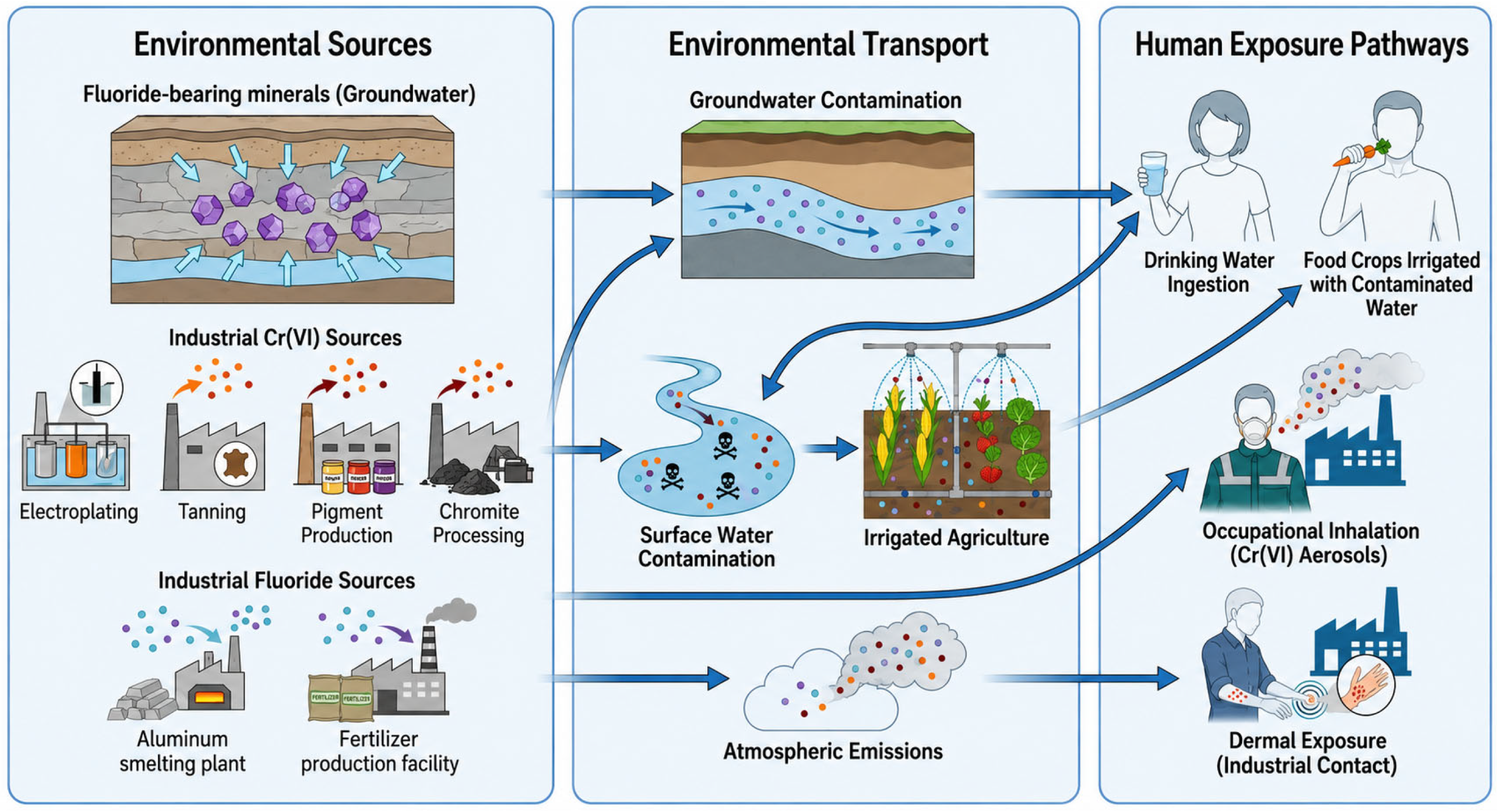
Rapid industrialization, urbanization, and intensive agriculture have degraded surface and groundwater quality in many cities, increasing exposure to inorganic contaminants such as fluoride and redox-active metals [1,2]. Urban groundwater is especially vulnerable due to reliance on stressed aquifers impacted by industrial effluents, landfill leachates, fertilizer runoff, and atmospheric deposition, while treatment systems are often designed mainly for microbial and turbidity control rather than for specific inorganic toxins. In low- and middle-income regions, intermittent supply, aging infrastructure, and informal wells further allow contaminated water to bypass treatment, making water pollution a systemic public health issue rather than a set of isolated failures [3]. Human exposure to fluoride occurs primarily through the ingestion of drinking water, with smaller contributions from food grown in fluoride-rich soils and from the ingestion of dental products, particularly among children. Exposure to Cr(VI) may occur through contaminated drinking water, inhalation of industrial aerosols, and dermal contact in occupational settings (Figure 1).
Urban water contamination has major implications for population health because exposure is typically continuous, affects large cohorts, and interacts with other vulnerabilities such as poor nutrition and limited access to healthcare [4]. Excess fluoride intake from drinking water is strongly associated with dental and skeletal fluorosis, but also with neurological, endocrine, and reproductive disorders, so that urban communities reliant on high-fluoride groundwater may experience a broad, under-recognized burden of chronic disease [5]. Chromium is a potent carcinogen and mutagen associated with dermal lesions, kidney and liver damage, and elevated cancer risk [6]; its occurrence is tightly linked to industrial activities that are often concentrated in or near urban areas, such as leather tanning, electroplating, pigment production, and stainless-steel manufacturing [7]. The World Health Organization recommends a guideline value of 50 µg/L for total chromium, while the U.S. Environmental Protection Agency (EPA) has established a maximum contaminant level of 100 µg/L. Despite these limits, typical Cr(VI) concentrations in North American drinking water are generally reported to range between 0.2 and 2 µg/L [8]. More recently, the European Union adopted a more precautionary standard under the revised Drinking Water Directive, lowering the permissible concentration for total chromium to 25 µg/L, with full compliance required by 2036 [9].
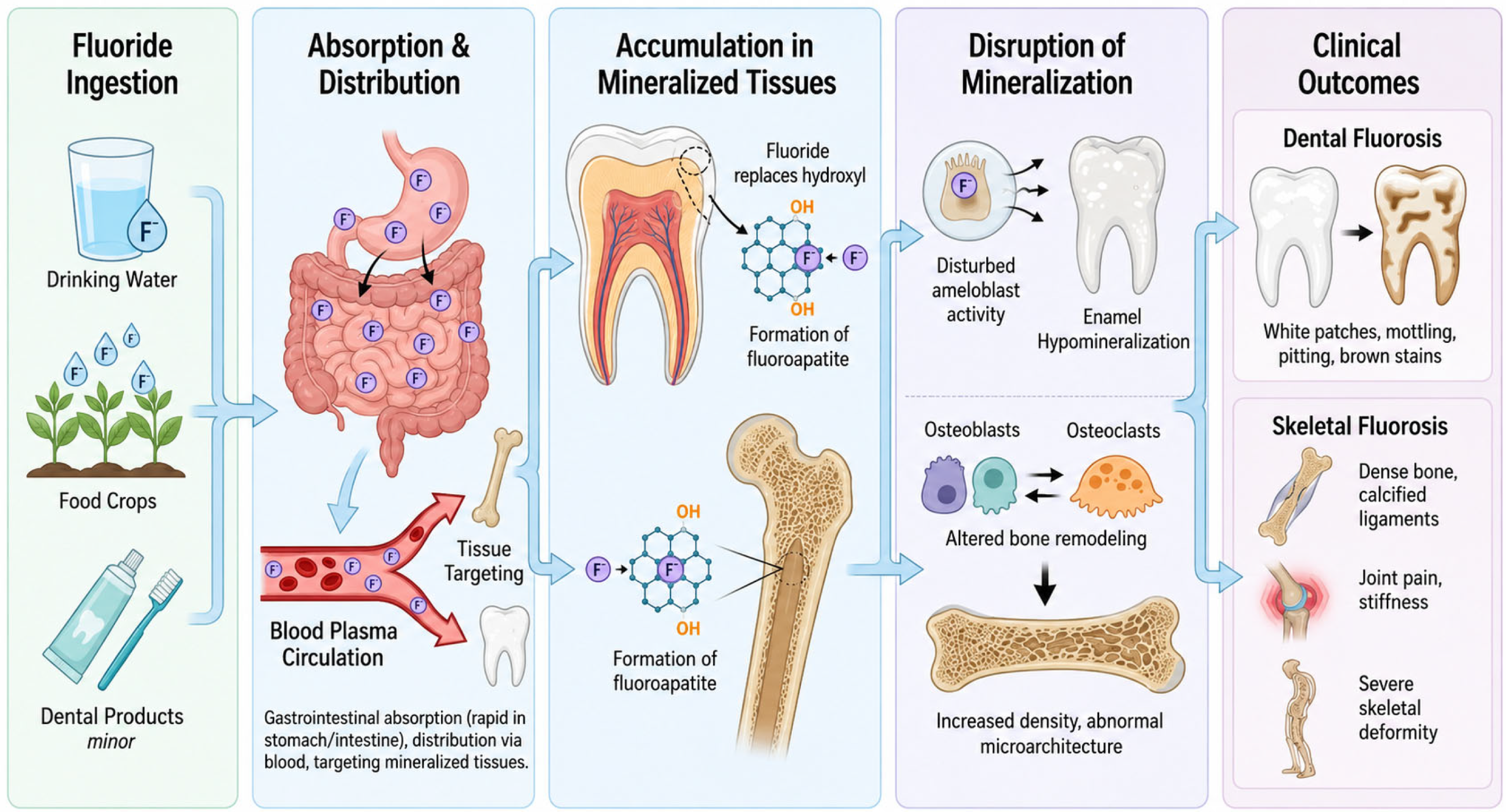
Fluoride is a naturally occurring anion that is widely distributed in the environment and can enter water bodies through both geogenic and anthropogenic pathways [10]. In drinking water, it occurs predominantly through the geogenic dissolution of fluoride-bearing minerals such as fluorite, cryolite, and fluorapatite in aquifers [11]. This natural signal is increasingly superimposed by industrial inputs from aluminum smelting, phosphate fertilizer and glass production, semiconductor manufacturing, and other high-temperature processes that discharge concentrated fluoride-rich effluents into sewers and receiving waters [12]. Global surveys indicate that groundwater fluoride can exceed 10–20 times the World Health Organization (WHO) guideline value (i.e., 1.5 mg/L) in several regions, with high-fluoride occurrences reported, among others, in parts of India, Pakistan, Mexico, East Africa, and China, and many of these hotspots coincide with rapidly urbanizing areas [3,13,14]. At low concentrations around 0.5–1.0 mg/L, fluoride is beneficial for the prevention of dental caries, but the margin between beneficial and harmful intake is narrow; concentrations above 1.5 mg/L are associated with dental fluorosis, and prolonged exposure above roughly 4–10 mg/L can lead to skeletal fluorosis and crippling deformities [3,5] (Figure 2). In urban populations, especially in hot climates, the risk is amplified because higher temperatures increase water consumption, raising daily fluoride intake for the same water concentration, and because industrial wastewater often contains fluoride at levels far above recommended limits and therefore requires effective treatment prior to discharge or reuse [15,16].
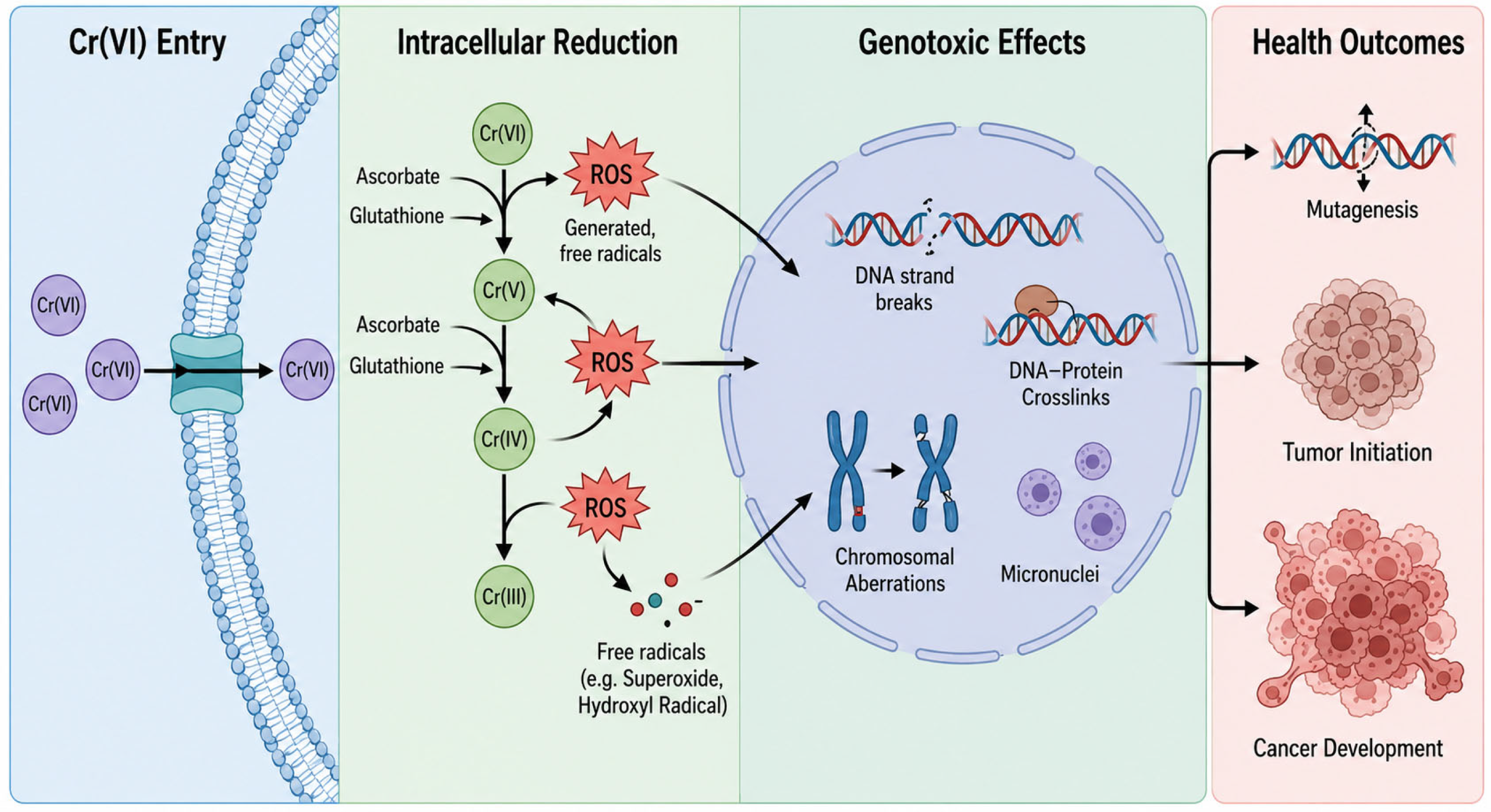
Cr(VI) in urban water and wastewater is largely of industrial origin, with tanneries, metal finishing, and dye and pigment manufacturing representing dominant sources where treatment is inadequate (Figure 1) [17]. In aquatic and sewer systems, Cr(VI) and Cr(III) undergo redox cycling, but Cr(VI) can remain stable and mobile as chromate and dichromate under oxidizing, alkaline conditions typical of some effluents [18]. Chronic exposure to Cr(VI) in drinking water is associated with gastrointestinal, renal, hepatic, and dermal toxicity, as well as increased risks of lung and stomach cancers, with children and pregnant women especially vulnerable [19,20] (Figure 3). Once internalized, Cr(VI) undergoes sequential intracellular reduction to Cr(V), Cr(IV), and ultimately Cr(III), generating reactive intermediates that induce oxidative stress and extensive genetic damage. These reactions can produce DNA strand breaks, DNA–protein crosslinks, chromosomal aberrations, and mutagenic lesions that contribute to carcinogenesis (Figure 3). Based on substantial epidemiological evidence from occupational cohorts and supporting experimental studies, the International Agency for Research on Cancer (IARC) and the EU classify Cr(VI) compounds as Group 1 carcinogens (carcinogenic to humans) [19,21,22]. The strongest evidence concerns lung cancer and cancers of the paranasal sinuses associated with inhalation exposure among workers involved in chromium processing and related industrial activities.
Their co-occurrence with fluoride in industrial downstream waters creates complex multi-contaminant mixtures that complicate risk assessment, treatment design, and regulatory control [7,23].
Urban wastewater discharge standards are typically less stringent than potable water standards but still increasingly restrict total chromium and, in some jurisdictions, Cr(VI) specifically, because of downstream reuse of treated effluent for irrigation or indirect potable reuse and the risk of contaminant recycling into urban water supplies [24]. However, in practice, monitoring often focuses on total chromium and may not routinely speciate Cr(VI). Institutional capacity to enforce limits on both fluoride and Cr(VI) in densely urban regions remains highly variable, particularly where rapid industrial expansion has outpaced regulatory oversight and analytical capacity. These regulatory limits are based on toxicological and epidemiological evidence linking increased F exposure to dental and skeletal fluorosis and Cr(VI) exposure to carcinogenic and systemic health effects.
F and Cr(VI) are frequently reported as co-contaminants in groundwater, particularly in regions influenced by industrial discharge and mining activities [25]. Both species exist predominantly in anionic forms under environmentally relevant pH conditions and therefore compete for adsorption sites during treatment processes [26]. Moreover, the removal of these contaminants often relies on similar classes of adsorbents, including metal oxides, layered double hydroxides, and functionalized carbon-based materials [27,28,29,30,31,32]. Considering their co-occurrence, comparable removal challenges, and shared health risks, a joint review provides an integrated perspective that supports the development of multifunctional treatment strategies.

1.2. Rationale for Focusing on Coagulation

A variety of physicochemical methods have been explored for defluoridation, including adsorption, ion exchange, membrane processes, precipitation, and coagulation–flocculation, each with distinct advantages and limitations [5,33]. Among these, coagulation–flocculation has gained renewed attention as a simple, scalable, and cost-effective approach for the simultaneous or sequential removal of fluoride and other oxyanions, including Cr(VI), from urban water and wastewater [34].
On the other hand, the disadvantages of using coagulation for water and wastewater purification mainly affect the environment in terms of high and toxic sludge production and consumer health due to the prolonged consumption of water containing possible chemical residues that can potentially cause neurodegenerative diseases [35]. For this reason, research should focus on more natural coagulants and the use of lower coagulant dosages.
Conventional aluminum sulfate coagulation can reduce fluoride concentrations but often requires high alum doses for waters containing 2–10 mg/L fluoride, leading to residual aluminum, sulfate accumulation, and increased sludge production, with only partial compliance with guideline values (1.5 mg/L) [36,37,38,39]. Fluoride removal occurs mainly through positively charged hydrolyzed aluminum species that promote surface complexation and co-precipitation, processes strongly influenced by pH, dose, and competing anions. Pre-polymerized coagulants, such as polyaluminum chloride and Al–Fe–Mg composites, have been developed to improve speciation, enhance flocculation, widen the effective pH range, and reduce residual aluminum, thereby improving performance in complex urban water matrices [33,39,40].
Electrocoagulation has emerged as a promising alternative or complement to conventional coagulation for fluoride removal from water and wastewater [41]. In this process, sacrificial aluminum or iron electrodes dissolve under direct current, generating multivalent cations that hydrolyze into hydroxide species acting as in situ coagulants [42,43]. These destabilize fluoride through charge neutralization, adsorption, and sweep flocculation, while hydrogen evolution aids the flotation of the formed flocs [42]. Removal efficiencies often exceed 90% across various water matrices, although performance depends on operating parameters such as current density, electrode spacing, material, initial concentration, and electrolyte [44,45]. Compared with chemical coagulation, electrocoagulation reduces chemical dosing and enables automation but introduces additional considerations, including energy consumption and electrode passivation for large-scale applications.
Beyond fluoride and chromium, industrial wastewater typically contains complex mixtures of organic matter, nutrients, dyes, oils, and other metals. Conventional chemical coagulation–flocculation using inorganic salts and synthetic polymers, while effective, raises concerns regarding sludge toxicity, residual metal content, and non-biodegradable polymer residues [46]. These concerns have stimulated additional research into alternative coagulant classes, including biocoagulants and bioflocculants derived from plants, microbes, and agro-industrial wastes, which could, in principle, generate more benign sludges that are better suited for agricultural reuse or resource recovery [47]. However, such bio-based systems are still at an early stage of development, with most evidence coming from bench-scale studies on specific wastewater. Their role in fluoride and Cr(VI) removal in complex urban matrices remains largely unexplored compared with that of metal-based and electrochemical approaches.
Despite technological advances, challenges remain for reliable coagulation-based removal of fluoride and Cr(VI) in urban water systems [18,48]. Variable water quality (pH, alkalinity, natural organic matter, suspended solids, and competing oxyanions) can affect coagulant speciation, floc formation, and overall performance. Residual metals from coagulants, including aluminum, iron, and emerging materials, also raise regulatory concerns [40,49]. In addition, limited data exist on long-term operational impacts and the translation of treatment efficiency into measurable public health benefits, highlighting the need for integrated performance and risk assessments.

1.3. Objectives and Scope of the Review

The present review therefore aims to critically synthesize the current knowledge on the removal of fluoride and Cr(VI) from water and wastewater by coagulation, with particular emphasis on public health protection in urban water systems. The review summarizes the occurrence, environmental sources, and toxicological significance of fluoride and Cr(VI) in urban waters, highlighting their co-occurrence and potential exposure pathways. It examines the physicochemical speciation and aqueous behavior of these contaminants to clarify how their chemical properties influence treatment targets and removal during coagulation processes. The mechanisms, performance, and limitations of conventional and advanced coagulation systems are critically analyzed, including aluminum- and iron-based salts, pre-polymerized coagulants, and multi-metal composite coagulants, with attention to hydrolysis chemistry, redox reactions, competing ions, and operational parameters affecting removal efficiency in realistic water matrices. The studies included in this review were selected based on their relevance to F and Cr(VI) removal, their application to urban water systems, and the availability of performance and operational data. Several review articles have summarized the removal of F or Cr(VI) separately, with reviews focusing on F mainly emphasizing adsorption materials, while reviews focusing on Cr(VI) have largely discussed reduction-adsorption mechanisms and photocatalytic removal. However, these studies generally examine the contaminants independently and do not address their frequent coexistence or competitive removal behavior in water systems. Furthermore, coagulation, which is the main treatment technique discussed in this review, has not been specifically highlighted in the literature summarized in Table 1. The novelty of this review lies in providing a comprehensive, coagulation-focused evaluation of the removal of both F and Cr(VI) within a unified mechanistic framework. In contrast to many previous reviews that either address these contaminants separately or broadly cover multiple treatment technologies, this work integrates both F and Cr(VI) into a synergistic control strategy, highlighting their simultaneous management in water treatment processes. This review further introduces an urban public health perspective, discussing the combined exposure risks, regulatory challenges, and treatment strategies appropriate for urban water systems. Therefore, this review provides a comprehensive and previously underexplored perspective on the synergistic management of F and Cr(VI), bridging environmental chemical technology with urban public health issues. By linking contaminant chemistry, treatment performance in real water and wastewater systems, and operational challenges such as residual metals and sludge management, this review offers a more unified perspective for designing effective coagulation strategies and identifies key research priorities for improving multi-contaminant control in urban water treatment.
This review includes both basic studies on conventional coagulants and recent literature on emerging materials and hybrid processes, in order to provide a comprehensive and up-to-date assessment.

2. Physicochemical Properties and Sources of Fluoride and Chromium

2.1. Chemical Speciation and Behavior in Water Systems

In most natural and engineered waters, fluoride occurs predominantly as the free ion F at circumneutral pH, but its speciation is strongly controlled by complexation with multivalent cations (Al3+, Fe3+, Zr4+, Mg2+, Ca2+) and by pH-dependent competition with hydroxide [40,42]. In low-alkalinity systems with elevated aluminum, Al–F complexes (AlF2+, AlF2+, AlF3, AlF4 and hydroxo-fluoro species such as AlF(OH)2+ and AlF2(OH) can dominate dissolved speciation at pH 4–6. At higher pH values (approximately 7–7.5), free F becomes the predominant species as fluoride complexes dissociate due to competition with OH ions [42].
During alum coagulation, measurements of fluoride have shown that aluminum–fluoride complexes are abundant at low pH and high initial F concentrations. However, their formation does not correlate monotonically with fluoride removal efficiency, as a significant fraction of these complexes remains soluble. At pH 7, total fluoride concentration reaches a minimum, indicating that fluoride uptake is primarily governed by freshly formed Al(OH)3(s) and Al–F–OH solids phases, rather than by complexation in the dissolved phase. Similarly, at a fixed Al dose, increasing initial fluoride increases the fraction of F bound in Al–F complexes at pH 6–7 but can reduce removal when complexation drives aluminum into soluble forms rather than into amorphous hydroxide floc [30].
Fluoride also forms sparingly soluble salts such as CaF2, MgF2 and cryolite (Na3AlF6), but under typical drinking water hardness and pH conditions precipitation is limited; in engineered coagulation systems, intentional elevation of Ca2+ or Mg2+ can shift speciation toward mixed solid phases and contribute to removal [42]. In Zr-based coagulation, Visual MINTEQ simulations and XPS/FTIR analyses indicate formation of Zr–F surface complexes (e.g., ZrO–HF, ZrFX species) on hydrolyzed Zr(OH)4-like flocs, with weak influence of fluoride on Zr hydrolysis compared with the strong suppression observed for Al3+ [39]. Overall, fluoride’s behavior in aqueous systems is thus governed by a delicate balance between complexation, ion exchange with surface –OH, coprecipitation into mixed metal–F–OH phases, and, at high hardness, lattice incorporation into Ca/Mg minerals [49].
Chromium in aquatic environments exists mainly as trivalent Cr(III) and hexavalent Cr(VI), with redox transformations controlled by pH, redox potential, presence of reductants (Fe2+, organic matter, sulfides) and oxidants (O2, Mn oxides), and by catalysis on mineral or floc surfaces [18,20]. At circumneutral to alkaline pH and under oxidizing conditions typical of many urban groundwaters and surface waters, Cr(VI) is predominantly present as chromate (CrO42−) and, at higher ionic strength or lower pH, as hydrogen chromate (HCrO4), both highly soluble and weakly sorbing oxyanions [18,62].
Under reducing conditions (e.g., anoxic sediments, Fe2+-rich zones) Cr(VI) can be reduced to Cr(III), which forms cationic or neutral hydroxo species (Cr3+, Cr(OH)2+, Cr(OH)2+, Cr(OH)3) that strongly adsorb to mineral surfaces or precipitate as amorphous Cr(OH)3(s) [18,63]. In engineered coagulation and electrocoagulation, this redox chemistry is deliberately exploited: Fe2+ generated from iron anodes or dosed as FeSO4 reduces Cr(VI) to Cr(III), and the resulting Cr(III) is captured by coprecipitation with Fe(OH)3(s) or Al(OH)3(s) [43,64]. The reduction is rapid and can be dominated by heterogeneous pathways involving Fe(II) adsorbed on freshly formed iron hydroxides, which can even catalyze further Cr(VI) reduction in drinking water-relevant EC systems [20,43].
In multi-contaminant waters, redox speciation is further affected by competing oxidants and reductants (e.g., NOM, nitrite, sulfide), by complexation of Cr(III) with ligands (e.g., organic acids), and by changes in pH during coagulation. Consequently, real systems are considerably more complex than those predicted by idealized CrO42−/Cr(OH)3 equilibrium models [43].

2.2. Natural and Anthropogenic Sources in Urban Watersheds

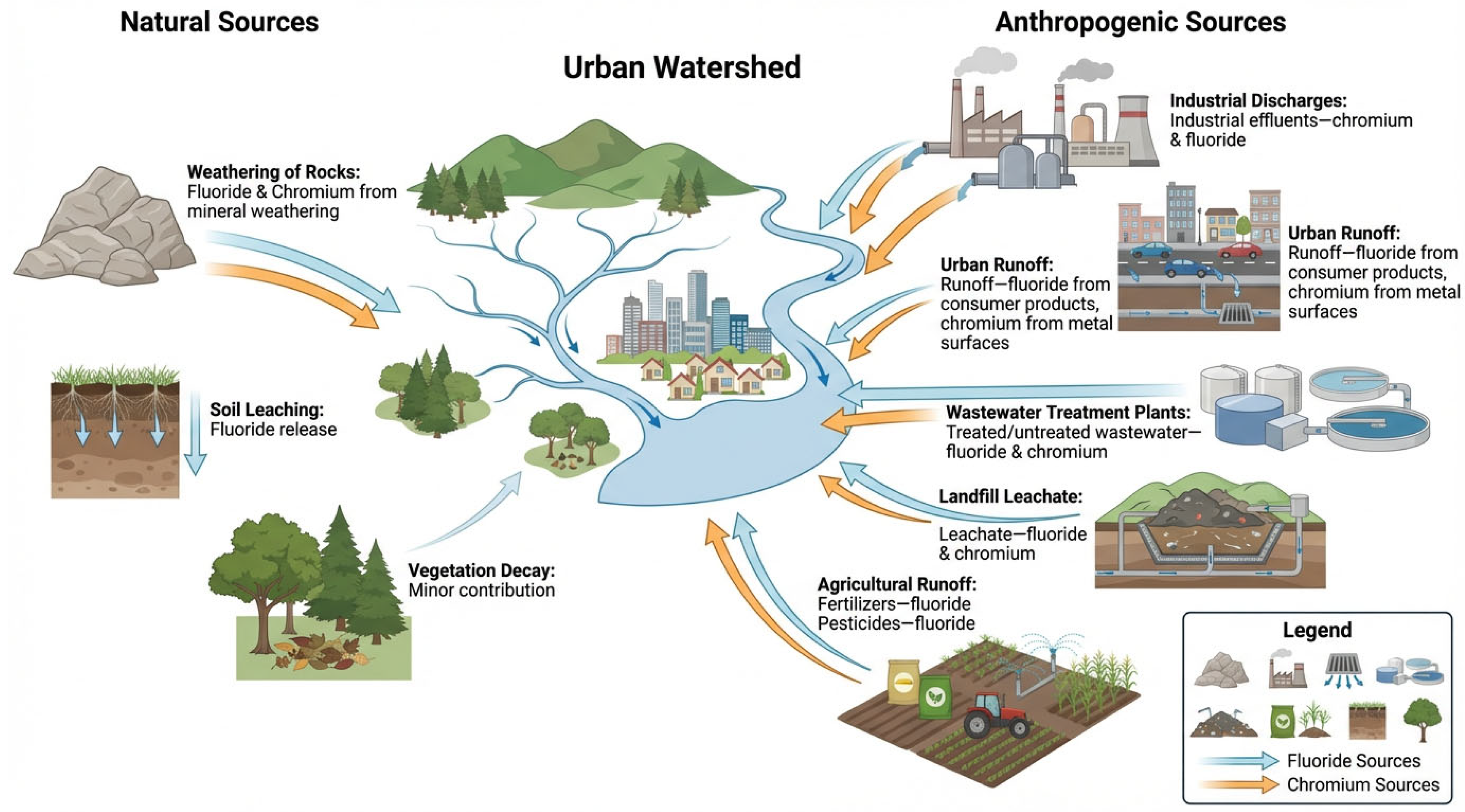
Naturally, fluoride originates from the weathering of fluoride-bearing minerals such as fluorite, fluorapatite, and cryolite in various geological formations, with elevated groundwater levels (>30 mg/L) often observed in arid and semi-arid regions [3,40,65,66]. In urban watersheds, these geogenic sources are compounded by industrial and municipal inputs from aluminum smelting, fertilizer and glass production, ceramics, and other high-temperature industries, as well as wastewater and urban runoff. The combined natural and anthropogenic pathways contributing to fluoride loading in water systems are summarized in Figure 4.
Cr(VI) in urban waters mainly derives from industrial activities such as electroplating, tanning, pigment and stainless-steel production, while additional diffuse sources include corrosion, treated wood leaching, and traffic-related wear. Industrial and municipal discharges, along with landfill leachates, further increase chromium levels, and due to the persistence and mobility of Cr(VI), these inputs can affect downstream water supplies when specific treatment is lacking (Figure 4) [18,20].

3. Fluoride and Chromium (VI) Removal by Coagulation

3.1. Mechanistic Understanding of F and Cr(VI) Uptake During Coagulation

The removal of F and Cr(VI) during chemical coagulation is governed by a combination of physicochemical mechanisms that arise from the hydrolysis and precipitation of multivalent metal coagulants. When aluminum or iron salts are added to water, rapid hydrolysis produces amorphous metal hydroxide precipitates such as Al(OH)3(s) and Fe(OH)3(s), which possess high surface area and abundant surface hydroxyl groups capable of binding dissolved contaminants through adsorption, surface complexation, ion exchange, and coprecipitation processes [39,42]. These freshly formed hydroxide flocs also promote sweep flocculation, whereby dissolved or colloidal species become entrapped within the growing precipitate matrix. However, the dominant mechanisms differ substantially between F and Cr(VI) because of their contrasting aqueous speciation and redox behavior.
For fluoride, the dominant pathways are surface complexation and incorporation into newly formed solids. In aluminum systems, rapid formation of dissolved Al–F complexes occurs immediately after dosing, but efficient removal is obtained only when hydrolysis proceeds far enough to generate amorphous Al–F–OH precipitates or fluoride-bearing aluminum hydroxide flocs [39,42]. This is why fluoride removal by alum or PAC/PACl is usually best in the mildly acidic-to-neutral region rather than under strongly acidic conditions, where soluble Al–F complexes are stabilized. More recent evidence from industrial wastewater and phosphogypsum leachate confirms that aluminum-based coagulation is not merely “adsorption onto Al(OH)3” but a coupled process involving Al–F complexation, formation of mixed precipitates such as AlFx(OH)3−x, and enhancement of CaF2 aggregation where calcium is present; PAC often outperforms aluminum sulfate because its pre-hydrolyzed structure promotes faster floc formation and more effective fluoride-bearing precipitate growth [39,40,67,68]. Spectroscopic studies using FTIR and XPS have shown shifts in Al–O vibrational bands and distinct F 1s binding energies compared with pure Al(OH)3, supporting the formation of new aluminum–fluoride hydroxide phases rather than surface adsorption alone [42,69]. This structural incorporation of fluoride explains why coagulation generally achieves faster and more complete fluoride removal compared with adsorption onto preformed hydroxide solids.
For fluoride, removal during coagulation is primarily controlled by adsorption and coprecipitation processes involving metal hydroxide surfaces. Fluoride ions exhibit strong affinity toward hard Lewis acid centers such as Al3+ and Zr4+, enabling the formation of inner-sphere complexes with surface hydroxyl groups of metal hydroxides [39,42]. Several mechanisms may occur simultaneously, including (i) electrostatic attraction between negatively charged fluoride ions and positively charged hydroxide surfaces, (ii) ligand exchange between fluoride ions and surface hydroxyl groups (F/OH exchange), (iii) adsorption onto polymeric aluminum species, and (iv) incorporation of fluoride into newly formed amorphous metal hydroxide phases through coprecipitation [49].
In addition to aluminum systems, other multivalent metal coagulants exhibit different fluoride removal pathways depending on their hydrolysis chemistry. Zirconium-based coagulants, for example, hydrolyze to produce Zr(OH)4-like species with high positive surface charge and strong affinity for fluoride. In such systems, fluoride removal is dominated by surface adsorption and ion exchange mechanisms involving substitution of hydroxyl groups by fluoride ions (F/OH exchange) on zirconium hydroxide surfaces [49,70].
Cr(VI) removal during coagulation is mainly driven by reduction–precipitation rather than simple adsorption. In iron-based systems, Fe2+ reduces Cr(VI) to Cr(III), which then precipitates as Cr(OH)3 or is incorporated into iron hydroxide flocs via coprecipitation and adsorption [71]. Fresh Fe(OH)3 flocs also provide strong sorption sites for Cr(III), often leading to stable mixed Fe–Cr hydroxide phases [18,64].

3.2. Influence of Coagulant Type and Hydrolysis Chemistry

The removal of F and Cr(VI) by chemical coagulation depends strongly on coagulant type and hydrolysis chemistry. Conventional coagulants such as alum, ferric chloride, ferric sulfate, and ferrous sulfate are widely used due to low cost and established performance. Alum is most commonly applied for defluoridation, with reported effective doses of 150–1000 mg/L for waters containing 2–10 mg/L F, often reducing concentrations to near the WHO guideline of 1.5 mg/L, but producing high sludge volumes and elevated sulfate residuals [39,42]. Ferric salts form Fe(OH)3 flocs that remove fluoride mainly via adsorption and sweep flocculation but typically show lower capacity than Al hydroxides at neutral pH and greater sensitivity to competing anions. In contrast, iron-based coagulants are more effective for Cr(VI) removal: Fe2+ can reduce Cr(VI) to Cr(III), which is then removed via precipitation and incorporation into Fe(OH)3 flocs, with removal efficiencies often exceeding 90–99% under optimized conditions [44,71,72].
Enhanced coagulants such as pre-polymerized PACl and inorganic polymeric coagulants achieve higher fluoride removal at lower doses than alum; for example, IPC-17 can reduce 2–6 mg/L F to around 1.0–1.2 mg/L at pH near 6.5 with reduced aluminum residuals [33,39]. Composite Al–Fe–Mg coagulants and zirconium-based systems can further improve fluoride removal efficiency, in some cases achieving >95% removal at lower doses, although their application remains limited by cost, sludge handling, and scale-up considerations [40,49,73]. Table 2 presents a comparison of commonly used coagulant types for the removal of F and Cr(VI).

3.3. Effect of Solution Characteristics and Operational Parameters

The removal of F and Cr(VI) during chemical coagulation is governed by a combination of physicochemical mechanisms arising from the hydrolysis and precipitation of multivalent metal coagulants. The performance of coagulation processes for F and Cr(VI) removal is strongly influenced by water chemistry and operational conditions. Key parameters include pH, alkalinity, coagulant dosage, mixing conditions, the presence of competing ions, natural organic matter (NOM), and temperature. These variations in water chemistry partly explain the wide range of removal efficiencies reported in the literature and highlight the need for optimization.
Among operational factors, pH is the most critical because it governs both metal hydrolysis and contaminant speciation. For aluminum-based coagulation, fluoride removal is highest at pH 6–7, where Al(OH)3 formation is maximized and F is effectively incorporated into flocs. At lower pH, strong Al–F complexation suppresses hydrolysis, while at higher pH (>7.5–8), aluminum exists mainly as soluble Al(OH)4, leading to reduced removal [33,42]; in alum systems, optimal total F removal typically occurs near pH 7 [72,73,82]. Modified coagulants such as PSiFAC–Mg extend the effective range to ~7.5–7.8 due to Mg-assisted mechanisms [40].
For Cr(VI), iron-based coagulation performs best at pH 5–7, where Fe2+ efficiently reduces Cr(VI) to Cr(III), followed by precipitation as Cr(OH)3 or incorporation into Fe(OH)3 flocs. At very low pH, hydroxide formation is limited, while at higher pH, Cr(III) forms soluble complexes that reduce removal efficiency [43,86,87].
Alkalinity further influences performance by buffering pH and forming metal–carbonate complexes, often increasing coagulant demand. While conventional alum requires higher doses, advanced coagulants such as IPC-17 and PSiFAC–Mg can achieve comparable or higher fluoride removal at significantly lower Al doses, reducing sludge and residual metal impacts [33,40].
Increased coagulant doses also lead to greater sludge production, which may contain concentrated fluoride or chromium species. This raises challenges related to handling, dewatering and disposal, especially where hazardous waste management infrastructure is limited [88]. On the other hand, excessive coagulant dosage or failure to control pH can also increase residual aluminum or iron concentrations in the treated water, requiring careful optimization and adequate clarification/filtration to meet drinking water standards [89,90].
Mixing conditions (rapid mixing typically for 1–2 min at 200–250 rpm, followed by slow mixing for 10–20 min at 40–50 rpm) affect collision efficiency, floc size, and structure. Mechanistic studies with alum, IPC, and ZrCl4 adopt similar regimes and show that insufficient rapid mixing leads to poor dispersion and micro-floc formation, while excessive shear breaks flocs and can reduce removal efficiency [33,42]. These operating ranges are broadly compatible with conventional full-scale coagulation practice, although site-specific optimization is required during scale-up.
Competing anions can significantly modulate performance. For PSiFAC-Mg and ZrCl4, Cl and NO3 up to 10 mM have negligible effects on F removal; sulfate and silicate at ≤1 mM have minor influence, but at 10 mM, sulfate exerts modest competition. Phosphate and arsenate at low levels (≤1 mg/L as P or As) are co-removed efficiently with F, but at 10 mg/L, they compete strongly for adsorption sites, reducing F uptake and their own removal [40,49,70]. For Cr(VI), sulfate and phosphate compete with chromate/dichromate for adsorption sites on Fe and Al hydroxides, lowering removal, while NOM can both reduce Cr(VI) and complex Cr(III), simultaneously aiding and complicating treatment [18,43,46,82].
NOM adsorption on floc surfaces alters surface charge and aggregation, often requiring higher coagulant doses to achieve the same F or Cr(VI) removal and increasing sludge organic content. PSiFAC-Mg and ZrCl4 have shown relatively robust performance in the presence of moderate NOM levels, although high NOM still reduces capacity. Temperature influences reaction kinetics and solubility but has been less systematically studied. Most mechanistic work has been conducted at 20–25 °C, so extrapolation to colder or hotter urban systems introduces additional uncertainty [40,46,49].

3.4. Hybrid Coagulation Technologies

Although conventional coagulation–flocculation–sedimentation remains the core clarification process in most drinking water and wastewater treatment plants, this configuration was historically designed primarily for turbidity and natural organic matter removal rather than for the targeted elimination of dissolved contaminants such as F and Cr(VI). Consequently, advanced treatment strategies increasingly integrate coagulation with complementary processes to enhance contaminant removal efficiency and treatment reliability. These advanced and hybrid coagulation technologies include the use of engineered coagulants, as well as treatment configurations combining coagulation with adsorption, membrane filtration, reduction processes, or electrochemical techniques.
In F control, hybrid coagulation–adsorption schemes couple alum, IPC, or composite coagulants with downstream F-selective media such as activated alumina, Fe–Al mixed oxides, layered double hydroxides, or even properly conditioned coagulation sludge, enabling polishing to <1 mg/L with lower incremental chemical use [46,91]. Coagulation–membrane hybrids (coagulation–microfiltration or coagulation–ultrafiltration) allow higher coagulant doses without risking particle breakthrough, and studies with PSiFAC-based systems indicate reduced membrane fouling alongside effective F and NOM removal [92]. Coagulation–softening processes, in which lime and sometimes Mg salts are added to promote CaCO3 and CaF2 precipitation, can be advantageous in hard urban groundwaters but require careful control to prevent scaling.
In these configurations, coagulation serves as a pretreatment step that removes suspended solids and a significant fraction of dissolved contaminants, while adsorption media provide a polishing stage capable of achieving low residual concentrations. For example, coagulation followed by activated alumina filtration has been reported to reduce F concentrations from 5 to 10 mg/L to below 1 mg/L, corresponding to overall removal efficiencies of 80–95%. Other adsorbents such as iron–aluminum layered double hydroxides (LDHs), granular activated carbon (GAC) and modified metal oxides have also been used as polishing media following coagulation treatment [90]. In chromium-contaminated waters, adsorption media can similarly capture residual chromium species remaining after reduction–coagulation treatment. Hybrid systems combining iron-based coagulation with adsorption materials have been reported to reduce total chromium concentrations to below 50 µg/L, meeting typical regulatory discharge standards.
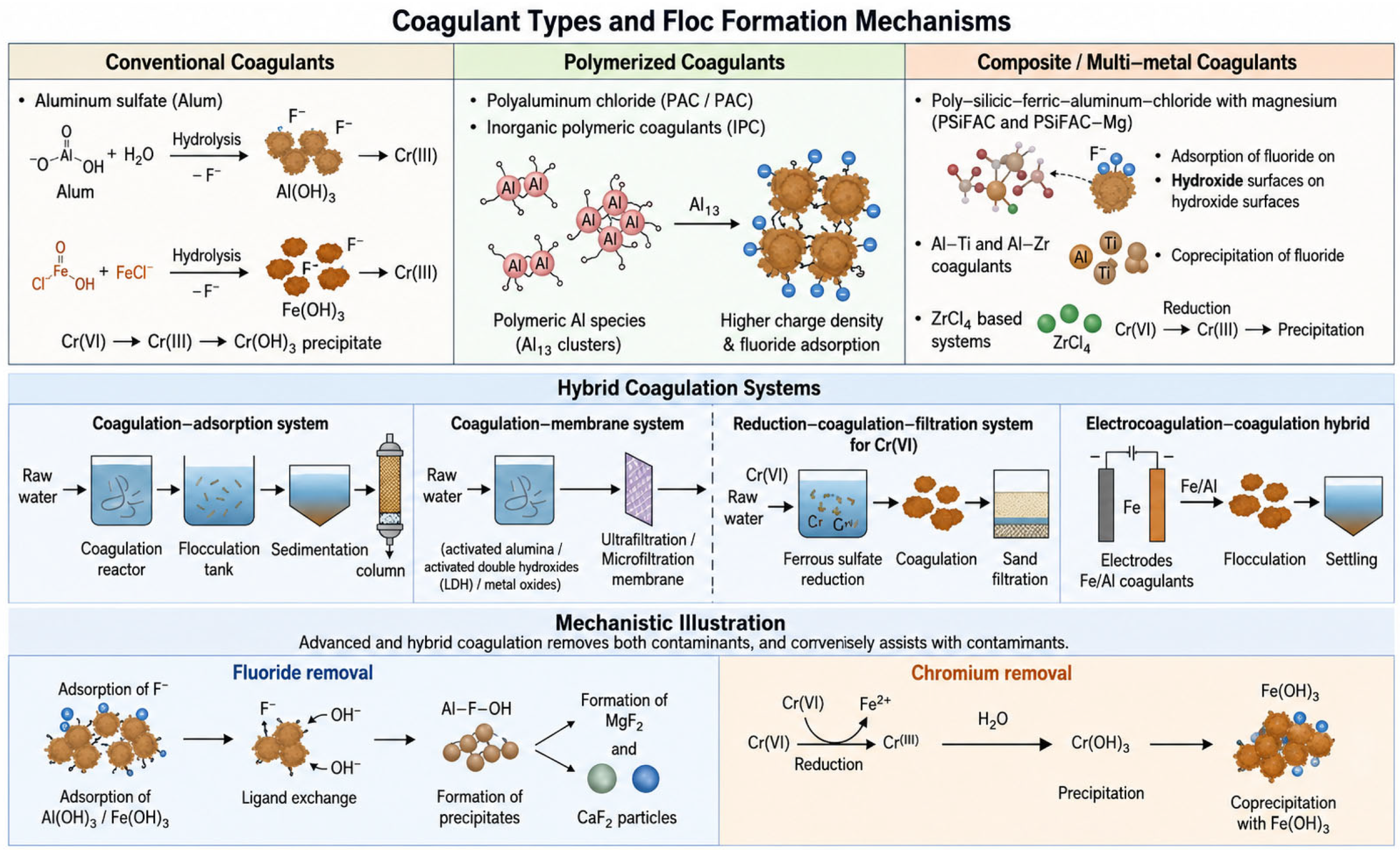
To provide a conceptual overview of these developments, Figure 5 illustrates the evolution of advanced coagulation technologies and representative hybrid treatment configurations used for F and Cr(VI) removal. As shown in Figure 5, conventional coagulants such as alum and ferric salts remove contaminants mainly through hydrolysis and the formation of amorphous metal hydroxide flocs, whereas polymerized coagulants (e.g., PACl/PAC and inorganic polymeric coagulants) contain pre-formed polymeric species that provide higher charge density and enhanced adsorption capacity. The figure also highlights the emergence of composite and multi-metal coagulants, including PSiFAC, PSiFAC-Mg, Al–Ti, Al–Zr, and ZrCl4-based systems, which introduce additional adsorption sites and promote synergistic removal mechanisms. Furthermore, hybrid treatment schemes such as coagulation–adsorption, coagulation–membrane filtration, reduction–coagulation–filtration for Cr(VI), and electrocoagulation–coagulation processes are illustrated to demonstrate how coagulation can be integrated with complementary technologies to improve treatment efficiency. The mechanistic pathways summarized in the figure show that F removal occurs primarily through adsorption, ligand exchange, and precipitation reactions, while chromium removal involves reduction of Cr(VI) to Cr(III), followed by precipitation and coprecipitation with iron hydroxide flocs. This schematic therefore provides an integrated representation of how advanced coagulant materials and hybrid treatment strategies enhance contaminant removal in complex water matrices.
Another important configuration is coagulation–membrane filtration, particularly coagulation–microfiltration (MF) and coagulation–ultrafiltration (UF) systems. In these hybrid processes, coagulants such as PACl or ferric chloride are dosed upstream of membrane filtration. Coagulation destabilizes colloids and promotes adsorption of dissolved contaminants onto metal hydroxide flocs, while the membrane retains the resulting aggregates. Experimental studies demonstrate that PACl–microfiltration systems can reduce F concentrations from 5 to 8 mg/L to below approximately 1.5 mg/L, while simultaneously improving membrane performance by reducing fouling and particulate loading [93,94]. Membrane-assisted coagulation is also advantageous for chromium treatment because membranes effectively retain the metal hydroxide precipitates formed during reduction–coagulation processes.
For chromium-contaminated waters, particularly industrial effluents, coagulation is often integrated with reduction–coagulation–filtration treatment trains. Because Cr(VI) is highly soluble and mobile, its removal typically requires reduction to Cr(III) prior to precipitation and separation. In these systems, ferrous salts such as FeSO4 are used as reducing agents, followed by coagulation and filtration to remove the resulting Cr(III) hydroxide precipitates. Pilot-scale studies have reported that reduction with ferrous sulfate followed by coagulation and sand filtration can reduce Cr(VI) concentrations from approximately 50–200 µg/L to below 1–5 µg/L, corresponding to removal efficiencies exceeding 95% [95].
Electrocoagulation (EC) uses sacrificial Al or Fe electrodes to generate in situ hydroxide flocs with high adsorption capacity for contaminants. Al-EC can achieve fluoride removal efficiencies of 85–98%, comparable to optimized alum coagulation, with generally lower residual Al, although energy demand and electrode passivation limit large-scale use. Iron EC is highly effective for Cr(VI), as electro-generated Fe2+ reduces Cr(VI) to Cr(III), enabling reductions below 10 µg/L under typical operating conditions. Hybrid EC–coagulation systems combining EC with small doses of PAC or IPC further reduce chemical consumption and improve floc properties, offering flexible decentralized treatment options [53,64,96].
Another emerging strategy in advanced coagulation systems is the reuse of coagulation sludge as an adsorbent material. Sludge produced during aluminum or iron coagulation contains amorphous metal hydroxides with significant adsorption capacity for anionic contaminants [97]. Instead of disposal, this sludge can be conditioned and reused as a secondary adsorbent in hybrid treatment systems. Studies have shown that alum sludge reused as an adsorbent can remove F from water with efficiencies ranging from 60 to 85%, depending on the sludge conditioning method and initial F concentration [98,99]. Similarly, iron-based coagulation sludge has demonstrated adsorption capacity for chromium species, particularly Cr(III), allowing additional polishing of treated water following primary coagulation [100,101].
Overall, these advanced treatment configurations demonstrate that coagulation is increasingly implemented within integrated multi-stage treatment systems rather than as a stand-alone clarification process. Technologies such as pre-polymerized composite coagulants (PACl, PSiFAC, PSiFAC-Mg), coagulation–adsorption systems, coagulation–membrane filtration, reduction–coagulation–filtration, electrocoagulation, sludge-reuse adsorption, and coagulation–GAC filtration significantly enhance the capability of coagulation processes to remove both F and Cr(VI). Such integrated approaches are particularly important for modern water treatment systems, where complex contaminant mixtures and increasingly stringent regulatory standards require flexible and robust treatment strategies.

3.5. Performance in Real Water and Wastewater Applications

Although mechanistic and laboratory investigations provide essential insight into coagulation processes, the performance of F and Cr(VI) removal in real drinking water and wastewater systems is strongly influenced by water matrix composition, variable contaminant loads, and operational conditions. As a result, treatment efficiencies reported under controlled laboratory conditions often differ from those achieved in practical treatment systems.
In groundwater sources affected by naturally occurring F, coagulation has been widely investigated as a relatively simple and scalable treatment approach. Field- and pilot-scale studies indicate that aluminum-based coagulants such as alum or polyaluminum chloride (PAC/PACl) can reduce F concentrations in waters containing approximately 3–10 mg/L F, typically achieving 60–90% removal under optimized conditions [39,42]. However, real-water performance is highly dependent on background chemistry. High alkalinity, elevated bicarbonate concentrations, and competing anions such as phosphate and silicate reduce adsorption capacity on metal hydroxide flocs and may require higher coagulant doses than predicted from laboratory experiments.
To address these limitations, polymerized and engineered coagulants have received increasing attention. Bench- and pilot-scale studies of inorganic polymeric coagulants such as IPC-17 show improved F removal compared with alum systems. Optimized IPCs have been reported to reduce F from approximately 3–9 mg/L to ≤1.2 mg/L at pH around 6.5 while producing lower sludge volumes and smaller increases in total dissolved solids (TDS) than alum-based coagulation, indicating their potential suitability for upgrading centralized treatment plants [33,69,102].
Recent work on industrial and mixed wastewater matrices further supports the advantages of engineered coagulants. In metallurgical or smelting wastewater, polymerized aluminum coagulants such as PAC often outperform aluminum sulfate because of their higher charge density and more stable hydrolysis behavior. Multi-metal formulations such as Al–Ti and Al–Zr coagulants have demonstrated deeper F removal and more robust floc formation than conventional PACl/PAC systems under optimized conditions [67,84,85]. Zirconium-based materials have also shown strong affinity for F; for example, Zr xerogel coagulants exhibit higher F uptake than PAC or polyferric sulfate in optimized systems, although most evidence currently derives from laboratory or hybrid treatment studies rather than from full municipal implementation [76].
In mixed industrial–urban wastewater, such as semiconductor effluents blended with municipal sewage, ZrCl4 coagulation has achieved residual F concentrations below approximately 1.5 mg/L at moderate Zr doses and pH 4–6, while simultaneously removing phosphate, arsenate, and turbidity. Importantly, negligible residual zirconium concentrations have been reported under environmentally relevant F levels, suggesting potential applicability for complex wastewater treatment scenarios [40,49,103].
The treatment context for chromium differs substantially because most contamination originates from anthropogenic industrial activities, including electroplating, leather tanning, pigment production, and metal finishing. In untreated industrial wastewater, chromium concentrations may range from several milligrams per liter to more than 100 mg/L.
Pilot- and continuous-flow studies further demonstrate the robustness of ferrous-based reduction–coagulation systems in drinking water treatment. For example, continuous experiments show that influent concentrations of 50–100 µg/L Cr(VI) can be reduced by more than 90% using only 1–2 mg/L Fe2+ at approximately neutral pH (7.3), while treated-water iron concentrations remain below about 200 µg/L [78,86]. At even lower concentrations, pilot-scale studies report that Fe(II)-based reduction followed by coagulation and filtration can reduce Cr(VI) in the range of 1–10 µg/L to below analytical detection limits, although this typically requires ferrous doses exceeding stoichiometric demand because dissolved oxygen competes strongly for Fe2+ [104].
In conventional municipal wastewater treatment plants, iron or aluminum coagulants are usually applied primarily for solids and phosphorus removal rather than for chromium control. Because influent Cr(VI) concentrations are generally low and dedicated reduction steps are absent, coagulation alone has limited impact on chromium speciation. In contrast, industrial treatment plants serving electroplating facilities, tanneries, and metal-finishing industries typically apply ferrous sulfate or mixed Fe/Al coagulation with pH adjustment to reduce and precipitate chromium. These systems often achieve effluent total chromium concentrations below approximately 0.5–2 mg/L, although monitoring sometimes focuses on total chromium rather than verifying the complete elimination of Cr(VI) [16,105,106,107].
Recent studies integrating coagulation–flocculation with adsorption or iron-based electrocoagulation in tannery wastewater have demonstrated substantial reductions in turbidity, chemical oxygen demand (COD), and total chromium. However, the optimal operating conditions remain site-specific because treatment design must balance chromium removal efficiency, sludge production, and the potential re-oxidation of Cr(III) during downstream processing or sludge handling [16,105,106,107].
Sludge management also represents an important practical consideration in real treatment systems. Coagulation processes targeting F or chromium removal generally require higher metal doses than conventional clarification, resulting in increased production of metal hydroxide sludge. F treatment residues may contain aluminum–F complexes or CaF2 precipitates, whereas chromium treatment sludges often consist of mixed Fe–Cr hydroxides requiring stabilization prior to disposal. Improper sludge handling may lead to secondary contamination, and recent research therefore explores sludge reuse or resource recovery strategies within integrated treatment systems [46].
Overall, comparison of real-world studies reveals a clear difference between F and chromium coagulation research. F removal studies involve a wider diversity of coagulant materials, particularly polymerized and multi-metal systems, yet many investigations remain dominated by synthetic or controlled matrices. In contrast, although fewer in number, chromium coagulation studies increasingly emphasize pilot-scale and real-water applications at environmentally relevant concentrations. Consequently, Fe(II)-based reduction–coagulation processes for Cr(VI) removal appear operationally more mature than many emerging F coagulation technologies. Recognizing this difference is essential for guiding future research and for designing integrated treatment strategies capable of addressing multiple contaminants in complex water systems.

3.6. Operational Challenges

Operational challenges for coagulation-based removal of F and Cr(VI) in urban systems include:
  • Sludge generation and management: Nalgonda and other high-dose alum schemes produce large volumes of Al-rich, F-bearing sludge that are rarely managed as hazardous waste. Improper drying and disposal can lead to leaching of F and metals, undermining treatment gains. Cr-bearing sludges from Fe-based coagulation or EC similarly risk re-release of Cr(VI) under aerobic, alkaline conditions [20,33,43].
  • Residual metals: Many alum-based defluoridation systems leave residual Al above 0.2 mg/L, especially when pH and dose are not tightly controlled; Fe-based systems can leave elevated iron and color. Moreover, advanced coagulants often incorporate Zr or other metals whose long-term fate in distribution and sludge is not fully characterized [5,39].
  • Chemical and energy costs: Conventional alum defluoridation is chemically intensive where F is high; IPCs and PSiFAC-Mg reduce Al consumption while Zr-based coagulants are significantly costlier and less available. EC and hybrid systems add electrical energy costs and electrode replacement to the resource burden [33,40,49].
  • Robustness to variability: maintaining consistent F and Cr(VI) removal under diurnal and seasonal fluctuations in contaminant loads, alkalinity, NOM, and temperature requires reliable monitoring and control (e.g., online pH, turbidity, residual F/Cr sensors, and streaming-current control) that many urban utilities currently lack [42,64,105,106].

4. Cost, Energy Demand, and Operational Complexity in Urban Utilities

At the scale of urban utilities, coagulation is typically among the lowest-cost technologies per unit volume treated because coagulants (alum, ferric salts) are ubiquitous, inexpensive, and already used for turbidity and NOM control; incremental costs of optimizing for F and Cr(VI) mainly involve adjustments in coagulant dosage, pH control, and occasional deployment of more advanced coagulants (e.g., IPC-type andcomposite Al-Fe-Mg formulations). Energy requirements for chemical coagulation are modest and largely associated with mixing and pumping. In contrast, adsorption units for F or Cr(VI) have moderate capital costs and simple hydraulics but incur ongoing expenses for media replacement or regeneration, chemicals for regeneration, and management of spent media, which may be hazardous; these factors can be especially challenging for small or under-resourced utilities [34,86,107,108,109].
Membrane systems (RO, NF) entail high capital and energy costs, as they require high-pressure pumps, specialized materials, and regular membrane cleaning and replacement; they also demand skilled operation and robust pretreatment to manage fouling and scaling. Consequently, membrane-based solutions in urban settings are often reserved for small-scale, high-risk scenarios such as highly contaminated wells or as polishing steps in advanced treatment plants, rather than as stand-alone city-wide treatments. Dialysis and electrodialysis occupy an intermediate space, with lower hydraulic pressures but still significant electrical energy and maintenance demands. Electrocoagulation adds electrical energy costs and electrode consumption/maintenance to the classical coagulation cost structure; however, it can reduce reliance on commercial coagulant supply chains and is amenable to modular deployment. Optimization studies on Cr(VI) EC and related electrochemical processes indicate that appropriate selection of current density, electrode arrangement, and, where used, natural coagulant aids can decrease specific energy consumption while maintaining high removal efficiencies. Biological treatments for Cr(VI) (and potential co-removal of F where co-precipitation with biogenic minerals occurs) are attractive in principle for low-energy operation, but they require careful control of electron donors, redox conditions, and toxicity, making them difficult to manage in most conventional urban utilities [43].
While the discussion here provides a qualitative overview of costs, energy demand, and operational complexity, future work should include quantitative comparative analyses of coagulant consumption, energy use, and sludge production per unit volume treated, as well as life-cycle assessments, to enhance the techno-economic evaluation of different treatment options.

5. Suitability for Centralized vs. Decentralized Urban Water and Wastewater Systems

Centralized coagulation-based treatment is best suited to large municipal water and wastewater systems with relatively stable influent quality, where economies of scale, professional operation, and existing infrastructure allow reliable control of F and chromium at low marginal cost. In such systems, optimization of coagulant type (e.g., transitioning from alum to pre-polymerized or composite coagulants), dosage, and pH, along with targeted addition of reduction steps for Cr(VI), can significantly improve contaminant control without major process overhauls. Centralized plants are also well placed to integrate hybrid trains—coagulation followed by filtration, adsorption or membranes—where risk assessments justify the additional investment.
In peri-urban areas and informal settlements that depend on small piped schemes, community supplies, or individual wells, decentralized solutions are often more feasible than large centralized plants. Here, small-scale coagulation–filtration units, electrocoagulation reactors, and point-of-use or point-of-entry devices based on adsorption (e.g., household filters) or compact membranes (NF/RO) can provide incremental protection against F and Cr(VI). For such systems, coagulant selection and process design must prioritize safety, ease of handling, and minimal residual toxicity. Polymeric aluminum coagulants with low residual Al, Mg-containing composites that can operate at native pH, and natural coagulant aids may have pragmatic advantages over high-dose alum. For Cr(VI), low-cost Fe(II)-based reduction using ferrous salts, zero-valent iron, or iron-based EC followed by simple sedimentation and filtration or small adsorption cartridges may be more realistic than replicating full-scale coagulation plants in every high-risk neighborhood [3].
In summary, coagulation offers a robust, low-cost backbone for urban water and wastewater treatment, while adsorption, ion exchange, membranes, electrochemical, and biological processes provide complementary strengths for polishing or handling extreme contamination. The optimal configuration depends on scale, source water quality, regulatory targets, and institutional capacity. It should be noted that the available data on F and Cr(VI) concentrations and their spatial distribution are limited and mostly regional. Comprehensive global surveys are still lacking and future work incorporating broader datasets would improve the representativeness of treatment suitability assessments.

6. Research Gaps and Future Directions

To improve clarity and relevance, the research directions below are organized according to their feasibility and direct linkage to the key technical gaps identified in Section 3, distinguishing between near-term actionable priorities and longer-term aspirational developments.

6.1. Need for Pilot- and Full-Scale Studies in Diverse Urban Contexts

Despite extensive bench-scale work on F and Cr(VI) removal by coagulation, there is a marked scarcity of rigorously documented pilot- and full-scale demonstrations in real urban systems. Most F studies use synthetic or relatively simple tap-water matrices, and only a few (e.g., Nalgonda and IPC/PSiFAC work) provide partial field-scale evidence. For Cr(VI), high-quality field data are largely confined to electrocoagulation and a limited number of industrial case studies. Future research should prioritize near-term pilot and demonstration studies focusing on optimized coagulation trains in utilities serving high-F and Cr-impacted cities, explicitly tracking influent variability, co-contaminants, residual metals, speciation changes, sludge production, and operating costs [33,34,95,110]. However, treatment performance may vary depending on local water chemistry, contaminant concentrations and operational constraints. Therefore, the results should be interpreted as general guidance, with site-specific optimization suggested for application in different contexts.
Particular emphasis is needed on three fronts: (i) upgrading existing alum-based plants in high-F cities by substituting or supplementing alum with pre-polymerized and composite coagulants (IPC-type, PSiFAC-Mg, ZrCl4) to quantify real gains in F removal, residual Al, and sludge characteristics; (ii) integrating Fe-based reduction–coagulation for Cr(VI) in municipal and industrial flows, including iron-salt pretreatment and iron electrocoagulation, with careful monitoring of chromium speciation and re-oxidation risks; and (iii) testing compact electrocoagulation–coagulation units in peri-urban and decentralized settings, where industrial discharges and high-F boreholes intersect with limited infrastructure and operator capacity. Robust, comparable pilot-scale datasets are highly important for moving beyond lab-scale proof-of-concept and informing technology selection and design standards [33,40,64,95,105].

6.2. Development of Low-Toxicity, Green Coagulants and Process Intensification

This subsection combines both near-term material optimization strategies and longer-term sustainable development considerations for next-generation coagulants and process intensification. The next generation of coagulants for F and Cr(VI) control should combine high removal performance with low intrinsic toxicity, minimal environmental persistence, and reduced embodied energy. Multi-metal systems such as Fe–Al–Si–Mg composites (e.g., PSiFAC-Mg) and Mg-modified Al coagulants already demonstrate enhanced anion uptake per unit Al and improved performance at near-neutral pH, yet their formulations, raw-material sourcing, and synthesis routes remain optimized largely for performance rather than for life-cycle sustainability. Likewise, Zr-based coagulants show excellent F removal with low residual metal concentrations and broad pH applicability, but the implications of large-scale zirconium use for resource depletion, sludge toxicity, and downstream ecosystems are not well characterized.
Process intensification offers complementary opportunities to make coagulation more compact, energy-efficient, and controllable in dense urban plants. High-shear micro-mixers and short-contact flocculation reactors could improve coagulant dispersion and reduce reactor volumes. Integrated coagulation–membrane modules could exploit in situ floc formation to protect nanofiltration or RO units while sharing infrastructure. In parallel, exploration of bio-based coagulant aids such as modified chitosan, tannin-based polymers, or biosourced polysaccharides could help reduce required metal doses and attenuate sludge toxicity, particularly in low-resource settings where sludge disposal options are limited and “green” process credentials matter for community acceptance [111,112]. Systematic toxicity testing (acute and chronic), biodegradability studies, and standardized performance-toxicity trade-off analyses are needed to guide the development and regulatory approval of such green coagulants.

6.3. Life-Cycle, Cost–Benefit, and Health Impact Assessments of Coagulation-Based Schemes

These assessments directly address the key uncertainty identified in Section 3 regarding the lack of integration between treatment performance, operational cost, and long-term health impacts. Most F and Cr(VI) coagulation studies focus on removal efficiency and residual metals, with limited attention to upstream and downstream impacts. Comprehensive life-cycle assessments (LCAs) and cost–benefit analyses are needed to compare coagulation-based schemes with alternative technologies (adsorption, ion exchange, membranes, biological reduction) under realistic urban deployment scenarios. LCAs should include coagulant production (including mining and refinement of Al, Fe, Mg and Zr), energy use for mixing and pumping, sludge handling and disposal or reuse, and potential environmental releases from sludge mismanagement or process upsets [34,113,114].
Critically, these techno-economic and environmental assessments are recommended linked to quantitative health-impact models. Reductions in F and Cr(VI) exposure achieved by optimized coagulation should be translated into metrics such as disability-adjusted life years (DALYs) averted from dental and skeletal fluorosis, Cr-related cancers, and organ toxicity, using exposure–response relationships derived from epidemiological studies. Very few existing works connect plant-level performance data (e.g., residual F distributions, Cr speciation under real operating conditions) with population-level health outcomes. Bridging this gap would enable rational resource allocation, help justify targeted upgrades in high-burden neighborhoods, and support inclusion of F and Cr(VI) control in urban health planning and SDG monitoring frameworks.

6.4. Priorities for Interdisciplinary Research Bridging Engineering and Urban Health

This subsection highlights longer-term, interdisciplinary research needs that extend beyond immediate process optimization and are highly important for translating coagulation performance into public health outcomes. Finally, realizing the public-health potential of optimized coagulation for F and Cr(VI) removal requires a more deliberate integration of engineering, environmental chemistry, toxicology, epidemiology, social science, and urban planning. Longitudinal cohort studies in high-F and Cr(VI)-exposed cities that combine detailed water-quality and treatment-performance data with health outcomes are highly important for refining exposure–response relationships, identifying particularly vulnerable groups (e.g., children, pregnant women, patients with kidney disease), and evaluating the real-world impact of treatment upgrades.
Social and behavioral research is needed to understand how communities perceive coagulation-based interventions—from household Nalgonda buckets and community EC units to centralized plant upgrades, including trade-offs in taste, trust, sludge handling, and willingness to pay. Governance and finance studies should explore models that enable utilities to adopt advanced coagulants and digital control systems while protecting low-income users, for example through targeted subsidies, performance-based grants, or cross-subsidization schemes. Cross-disciplinary collaborations can ensure that advances in coagulant chemistry, reactor design, and control theory are translated into interventions that are technically sound, socially acceptable, and equitably distributed, thereby maximizing the public health benefits of coagulation-based F and Cr(VI) control in real urban environments.

7. Conclusions

F and Cr(VI) contamination in water and wastewater remains a significant environmental and public health concern, particularly in urban regions where geogenic groundwater contamination overlaps with industrial activities. Chronic exposure to elevated F concentrations is associated with dental and skeletal fluorosis and other systemic health effects, while Cr(VI) is a highly toxic and carcinogenic metal capable of causing oxidative stress, genetic damage, and organ toxicity. Coagulation remains one of the most practical and widely applied treatment strategies for controlling these contaminants because of its operational simplicity, scalability, and compatibility with existing drinking water and wastewater treatment infrastructure. The mechanisms governing contaminant removal differ substantially: F removal occurs mainly through adsorption, ligand exchange, and coprecipitation within metal hydroxide flocs, whereas effective Cr(VI) removal generally requires reduction to Cr(III), followed by precipitation and coprecipitation with iron hydroxides.
Conventional coagulants such as alum and ferric salts continue to dominate practical applications, although relatively high chemical dosages may be required for effective F removal and may increase sludge production and residual metal concentrations. Recent advances in pre-polymerized aluminum coagulants, inorganic polymeric coagulants, and multi-metal composite systems have demonstrated improved removal efficiency, broader operational pH ranges, and enhanced floc formation compared with conventional salts. In addition, hybrid treatment approaches integrating coagulation with adsorption, membrane filtration, or reduction–coagulation processes have shown potential for improving treatment performance in complex water matrices where competing ions and natural organic matter influence removal efficiency.
Overall, the evidence reviewed indicates that coagulation provides a robust and adaptable framework for controlling F and Cr(VI) contamination in water and wastewater systems. However, further research is needed to validate promising coagulants under real-water conditions, optimize operational parameters, manage sludge safely, and assess long-term sustainability and health implications of residual metals. Integrating advances in coagulant chemistry with pilot-scale implementation and public health-oriented assessment will be essential for developing effective and scalable treatment strategies capable of protecting urban populations from chronic exposure to these contaminants.

Author Contributions

Conceptualization, S.K.S. and A.K.T.; methodology, S.K.S., S.S., S.K.D. and A.K.T.; software, S.S. and A.K.T.; validation, S.S. and A.K.T.; formal analysis, S.K.S., S.S., S.K.D. and A.K.T.; investigation, S.K.S., S.S., S.K.D. and A.K.T.; resources, S.S. and A.K.T.; data curation, S.K.S., S.S., S.K.D. and A.K.T.; writing—original draft preparation, S.K.S., S.S., S.K.D. and A.K.T.; writing—review and editing, S.K.S., S.S., S.K.D. and A.K.T.; visualization, S.S. and A.K.T.; supervision, S.S. and A.K.T. All authors have read and agreed to the published version of the manuscript.

Funding

This research received no external funding.

Institutional Review Board Statement

Not applicable.

Informed Consent Statement

Not applicable.

Data Availability Statement

The original contributions presented in this study are included in the article. Further inquiries can be directed to the corresponding author.

Conflicts of Interest

The authors declare no conflicts of interest.

References

  1. Devrajani, S.K.; Ahmed, Z.; Qambrani, N.A.; Kanwal, S.; Sundaram, U.M.; Mubarak, N.M. Mechanism of Arsenic Removal Using Brown Seaweed Derived Impregnated with Iron Oxide Biochar for Batch and Column Studies. Sci. Rep. 2024, 14, 18102. [Google Scholar] [CrossRef] [PubMed]
  2. Saxena, V. Water Quality, Air Pollution, and Climate Change: Investigating the Environmental Impacts of Industrialization and Urbanization. Water Air Soil Pollut. 2025, 236, 73. [Google Scholar] [CrossRef]
  3. Shaji, E.; Sarath, K.V.; Santosh, M.; Krishnaprasad, P.K.; Arya, B.K.; Babu, M.S. Fluoride Contamination in Groundwater: A Global Review of the Status, Processes, Challenges, and Remedial Measures. Geosci. Front. 2024, 15, 101734. [Google Scholar] [CrossRef]
  4. Rahaman, M.A.; Kalam, A.; Al-Mamun, M. Unplanned Urbanization and Health Risks of Dhaka City in Bangladesh: Uncovering the Associations between Urban Environment and Public Health. Front. Public Health 2023, 11, 1269362. [Google Scholar] [CrossRef]
  5. Ahmad, S.; Singh, R.; Arfin, T.; Neeti, K. Fluoride Contamination, Consequences and Removal Techniques in Water: A Review. Environ. Sci. Adv. 2022, 1, 620–661. [Google Scholar] [CrossRef]
  6. Hossini, H.; Shafie, B.; Niri, A.D.; Nazari, M.; Esfahlan, A.J.; Ahmadpour, M.; Nazmara, Z.; Ahmadimanesh, M.; Makhdoumi, P.; Mirzaei, N.; et al. A Comprehensive Review on Human Health Effects of Chromium: Insights on Induced Toxicity. Environ. Sci. Pollut. Res. 2022, 29, 70686–70705. [Google Scholar] [CrossRef]
  7. Ling, Y.; Podgorski, J.; Sadiq, M.; Rasheed, H.; Eqani, S.A.M.A.S.; Berg, M. Monitoring and Prediction of High Fluoride Concentrations in Groundwater in Pakistan. Sci. Total Environ. 2022, 839, 156058. [Google Scholar] [CrossRef]
  8. Shoushtarian, F.; Negahban-Azar, M. Worldwide Regulations and Guidelines for Agricultural Water Reuse: A Critical Review. Water 2020, 12, 971. [Google Scholar] [CrossRef]
  9. Herschy, R.W. Water Quality for Drinking: WHO Guidelines. In Encyclopedia of Lakes and Reservoirs; Springer: Dordrecht, The Netherlands, 2012; pp. 876–883. [Google Scholar] [CrossRef]
  10. Mousazadeh, M.; Alizadeh, S.; Frontistis, Z.; Kabdaşlı, I.; Karamati Niaragh, E.; Al Qodah, Z.; Naghdali, Z.; Mahmoud, A.; Sandoval, M.; Butler, E.; et al. Electrocoagulation as a Promising Defluoridation Technology from Water: A Review of State of the Art of Removal Mechanisms and Performance Trends. Water 2021, 13, 656. [Google Scholar] [CrossRef]
  11. Rashid, T.; Sabarathinam, C.; Bhandary, H.; Al-Jumaa, M.; Shishter, A.; Al-Salman, B. Hydrogeochemical Changes in Arid Groundwater Systems: Inferences from Well-Field Long-Term Data. Environ. Earth Sci. 2025, 84, 674. [Google Scholar] [CrossRef]
  12. Ya, V.; Le, A.H.; Nguyen, L.S.P. Recovery of Fluoride from Fluorine Industrial Wastewater: Recent Technologies, Challenges and Perspectives. In Fluoride and Fluorocarbon Toxicity; Kumar, N., Ed.; Environmental Science and Engineering; Springer Nature: Singapore, 2024; pp. 255–274. [Google Scholar]
  13. Rafique, T.; Naseem, S.; Usmani, T.H.; Bashir, E.; Khan, F.A.; Bhanger, M.I. Geochemical Factors Controlling the Occurrence of High Fluoride Groundwater in the Nagar Parkar Area, Sindh, Pakistan. J. Hazard. Mater. 2009, 171, 424–430. [Google Scholar] [CrossRef]
  14. Ayoob, S.; Gupta, A.K. Fluoride in Drinking Water: A Review on the Status and Stress Effects. Crit. Rev. Environ. Sci. Technol. 2006, 36, 433–487. [Google Scholar] [CrossRef]
  15. Kanwal, S.; Devrajani, S.K.; Hashmani, S.A.K. Removal of Fluoride from Aqueous Solution Using Biochar Derived from Brown Macroalgae (Sargassum polycystum) Impregnated with Fe3O4 Nanoparticles. Phycology 2025, 5, 37. [Google Scholar] [CrossRef]
  16. Rajan, M.; Karunanidhi, D.; Subramani, T.; Preethi, B. Evaluation of Fluoride Contamination in Groundwater and Its Non-Carcinogenic Health Hazards in a Drought-Prone River Basin of South India. Phys. Chem. Earth Parts ABC 2024, 136, 103714. [Google Scholar] [CrossRef]
  17. Kamruzzaman, M.; Hredoy, R.H.; Shimo, F.J.; Khan, M.S.U.; Amin, M.S.; Ritu, S.A.; Uddin, S. Chromium Toxicity: Source, Distribution, Challenges, and Remediation. In Chromium Toxicity; Kumar, N., Ed.; Springer Nature: Cham, Switzerland, 2026; pp. 1–48. [Google Scholar]
  18. Pakade, V.E.; Tavengwa, N.T.; Madikizela, L.M. Recent Advances in Hexavalent Chromium Removal from Aqueous Solutions by Adsorptive Methods. RSC Adv. 2019, 9, 26142–26164. [Google Scholar] [CrossRef] [PubMed]
  19. Sharma, P.; Singh, S.P.; Parakh, S.K.; Tong, Y.W. Health Hazards of Hexavalent Chromium (Cr (VI)) and Its Microbial Reduction. Bioengineered 2022, 13, 4923–4938. [Google Scholar] [CrossRef] [PubMed]
  20. Zhitkovich, A. Chromium in Drinking Water: Sources, Metabolism, and Cancer Risks. Chem. Res. Toxicol. 2011, 24, 1617–1629. [Google Scholar] [CrossRef]
  21. Junaid, M.; Hashmi, M.Z.; Malik, R.N.; Pei, D.-S. Toxicity and Oxidative Stress Induced by Chromium in Workers Exposed from Different Occupational Settings around the Globe: A Review. Environ. Sci. Pollut. Res. 2016, 23, 20151–20167. [Google Scholar] [CrossRef]
  22. Seidler, A.; Jähnichen, S.; Hegewald, J.; Fishta, A.; Krug, O.; Rüter, L.; Strik, C.; Hallier, E.; Straube, S. Systematic Review and Quantification of Respiratory Cancer Risk for Occupational Exposure to Hexavalent Chromium. Int. Arch. Occup. Environ. Health 2013, 86, 943–955. [Google Scholar] [CrossRef]
  23. Das, R.K.; Marma, M.; Mizan, A.; Chen, G.; Alam, M.S. Heavy Metals and Microplastics as Emerging Contaminants in Bangladesh’s River Systems: Evidence from Urban–Industrial Corridors. Toxics 2025, 13, 803. [Google Scholar] [CrossRef]
  24. Vasudevan, S.; Lakshmi, J.; Vanathi, R. Electrochemical Coagulation for Chromium Removal: Process Optimization, Kinetics, Isotherms and Sludge Characterization. CLEAN—Soil Air Water 2010, 38, 9–16. [Google Scholar] [CrossRef]
  25. Kanagaraj, G.; Elango, L. Chromium and Fluoride Contamination in Groundwater around Leather Tanning Industries in Southern India: Implications from Stable Isotopic Ratio δ53Cr/δ52Cr, Geochemical and Geostatistical Modelling. Chemosphere 2019, 220, 943–953. [Google Scholar] [CrossRef]
  26. Melak, F.; Asere, T.G. Comparative Removal of Cr(VI) and F− Ions from Water by Freezing Technology. J. Chem. 2022, 2022, 9143182. [Google Scholar] [CrossRef]
  27. Ergović Ravančić, M.; Habuda-Stanić, M. Fluoride Adsorption from Water Using Activated Carbon Modified with Nitric Acid and Hydrogen Peroxide. Water 2024, 16, 3439. [Google Scholar] [CrossRef]
  28. Fezraoui, A.; Cornu, D.; Hébrant, M. Fast and Efficient Chromium(VI) Extraction by Colloidal Mg/Al Layered Double Hydroxide Nanoparticles. Appl. Clay Sci. 2024, 260, 107536. [Google Scholar] [CrossRef]
  29. Perluxo, J.D.; Alves, F.C.; Maia, L.S.; Faria, M.I.S.T.; De Oliveira, D.M.; Botelho, E.C.; Rosa, D.S.; Mulinari, D.R. Sustainable Solutions for Cr6+ Removal Using Carbon-Based Adsorbents. Colloids Surf. Physicochem. Eng. Asp. 2025, 726, 137881. [Google Scholar] [CrossRef]
  30. Priyadharshini, R.; Elanchezhiyan, S.S.; Prabhu, S.M.; Meenakshi, S. Bimetallic Oxide Integrated Chitosan Matrix for Adsorption Coupled Reduction of Cr(VI) from Aqueous Solution. Sep. Purif. Technol. 2025, 370, 133158. [Google Scholar] [CrossRef]
  31. Wei, L.; Zietzschmann, F.; Rietveld, L.C.; Van Halem, D. Fluoride Removal from Water by Ca-Al-CO3 Layered Double Hydroxides and Simultaneous Acidification. J. Water Process Eng. 2021, 40, 101957. [Google Scholar] [CrossRef]
  32. Xiao, F.; Jiang, G.; Bu, D.; Fu, J.; Cui, X.; Zhang, Q. Rapid and Synergistic Adsorption of Arsenic and Fluoride by Bifunctional Al/Ce Oxides in Complex Geothermal Matrices. Ecotoxicol. Environ. Saf. 2025, 306, 119362. [Google Scholar] [CrossRef] [PubMed]
  33. Solanki, Y.S.; Agarwal, M.; Maheshwari, K.; Gupta, S.; Shukla, P.; Gupta, A.B. Removal of Fluoride from Water by Using a Coagulant (Inorganic Polymeric Coagulant). Environ. Sci. Pollut. Res. 2021, 28, 3897–3905. [Google Scholar] [CrossRef] [PubMed]
  34. Aoudj, S.; Khelifa, A.; Drouiche, N.; Belkada, R.; Miroud, D. Simultaneous Removal of Chromium(VI) and Fluoride by Electrocoagulation–Electroflotation: Application of a Hybrid Fe-Al Anode. Chem. Eng. J. 2015, 267, 153–162. [Google Scholar] [CrossRef]
  35. Bahrodin, M.B.; Zaidi, N.S.; Hussein, N.; Sillanpää, M.; Prasetyo, D.D.; Syafiuddin, A. Recent Advances on Coagulation-Based Treatment of Wastewater: Transition from Chemical to Natural Coagulant. Curr. Pollut. Rep. 2021, 7, 379–391. [Google Scholar] [CrossRef]
  36. He, Z.; Lan, H.; Gong, W.; Liu, R.; Gao, Y.; Liu, H.; Qu, J. Coagulation Behaviors of Aluminum Salts towards Fluoride: Significance of Aluminum Speciation and Transformation. Sep. Purif. Technol. 2016, 165, 137–144. [Google Scholar] [CrossRef]
  37. Jagtap, S.; Yenkie, M.K.; Labhsetwar, N.; Rayalu, S. Fluoride in Drinking Water and Defluoridation of Water. Chem. Rev. 2012, 112, 2454–2466. [Google Scholar] [CrossRef] [PubMed]
  38. Mondal, P.; George, S. A Review on Adsorbents Used for Defluoridation of Drinking Water. Rev. Environ. Sci. Biotechnol. 2015, 14, 195–210. [Google Scholar] [CrossRef]
  39. Dubey, S.; Agarwal, M.; Gupta, A.B. Experimental Investigation of Al-F Species Formation and Transformation during Coagulation for Fluoride Removal Using Alum and PACl. J. Mol. Liq. 2018, 266, 349–360. [Google Scholar] [CrossRef]
  40. Tolkou, A.K.; Mitrakas, M.; Katsoyiannis, I.A.; Ernst, M.; Zouboulis, A.I. Fluoride Removal from Water by Composite Al/Fe/Si/Mg Pre-Polymerized Coagulants: Characterization and Application. Chemosphere 2019, 231, 528–537. [Google Scholar] [CrossRef] [PubMed]
  41. Sinharoy, A.; Chung, C.M. Fluoride Removal from Wastewater and Potential for Resource Recovery: Comparative Studies between Different Treatment Technologies. Environ. Eng. Res. 2024, 29, 240179. [Google Scholar] [CrossRef]
  42. Gong, W.-X.; Qu, J.-H.; Liu, R.-P.; Lan, H.-C. Effect of Aluminum Fluoride Complexation on Fluoride Removal by Coagulation. Colloids Surf. Physicochem. Eng. Asp. 2012, 395, 88–93. [Google Scholar] [CrossRef]
  43. Pan, C.; Troyer, L.D.; Catalano, J.G.; Giammar, D.E. Dynamics of Chromium(VI) Removal from Drinking Water by Iron Electrocoagulation. Environ. Sci. Technol. 2016, 50, 13502–13510. [Google Scholar] [CrossRef]
  44. Meng, X.; Zeng, P.; Lin, S.; Wu, M.; Yang, L.; Bao, H.; Kang, J.; Han, H.; Zhang, C.; Sun, W. Deep Removal of Fluoride from Tungsten Smelting Wastewater by Combined Chemical Coagulation-Electrocoagulation Treatment: From Laboratory Test to Pilot Test. J. Clean. Prod. 2023, 416, 137914. [Google Scholar] [CrossRef]
  45. Khatibikamal, V.; Torabian, A.; Janpoor, F.; Hoshyaripour, G. Fluoride Removal from Industrial Wastewater Using Electrocoagulation and Its Adsorption Kinetics. J. Hazard. Mater. 2010, 179, 276–280. [Google Scholar] [CrossRef]
  46. El Mouhri, G.; Elmansouri, I.; Amakdouf, H.; Belhassan, H.; Kachkoul, R.; El Oumari, F.E.; Merzouki, M.; Lahrichi, A. Evaluating the Effectiveness of Coagulation–Flocculation Treatment on a Wastewater from the Moroccan Leather Tanning Industry: An Ecological Approach. Heliyon 2024, 10, e27056. [Google Scholar] [CrossRef]
  47. Kurniawan, S.; Abdullah, S.; Imron, M.; Said, N.; Ismail, N.; Hasan, H.; Othman, A.; Purwanti, I. Challenges and Opportunities of Biocoagulant/Bioflocculant Application for Drinking Water and Wastewater Treatment and Its Potential for Sludge Recovery. Int. J. Environ. Res. Public. Health 2020, 17, 9312. [Google Scholar] [CrossRef]
  48. Teh, C.Y.; Budiman, P.M.; Shak, K.P.Y.; Wu, T.Y. Recent Advancement of Coagulation–Flocculation and Its Application in Wastewater Treatment. Ind. Eng. Chem. Res. 2016, 55, 4363–4389. [Google Scholar] [CrossRef]
  49. Gan, Y.; Wang, X.; Zhang, L.; Wu, B.; Zhang, G.; Zhang, S. Coagulation Removal of Fluoride by Zirconium Tetrachloride: Performance Evaluation and Mechanism Analysis. Chemosphere 2019, 218, 860–868. [Google Scholar] [CrossRef] [PubMed]
  50. Mohapatra, M.; Anand, S.; Mishra, B.K.; Giles, D.E.; Singh, P. Review of Fluoride Removal from Drinking Water. J. Environ. Manag. 2009, 91, 67–77. [Google Scholar] [CrossRef] [PubMed]
  51. He, J.; Yang, Y.; Wu, Z.; Xie, C.; Zhang, K.; Kong, L.; Liu, J. Review of Fluoride Removal from Water Environment by Adsorption. J. Environ. Chem. Eng. 2020, 8, 104516. [Google Scholar] [CrossRef]
  52. Gai, W.-Z.; Deng, Z.-Y. A Comprehensive Review of Adsorbents for Fluoride Removal from Water: Performance, Water Quality Assessment and Mechanism. Environ. Sci. Water Res. Technol. 2021, 7, 1362–1386. [Google Scholar] [CrossRef]
  53. Das, D.; Nandi, B.K. A Comprehensive Approach towards Efficient Removal of Fluoride along with Co-Existing Pollutants from Real Groundwater Using Electrocoagulation Process. J. Appl. Electrochem. 2025, 55, 2573–2586. [Google Scholar] [CrossRef]
  54. Sun, Y.; Zhang, C.; Ma, J.; Sun, W.; Shah, K.J. Review of Fluoride Removal Technology from Wastewater Environment. Desalination Water Treat. 2023, 299, 90–101. [Google Scholar] [CrossRef]
  55. Wan, K.; Huang, L.; Yan, J.; Ma, B.; Huang, X.; Luo, Z.; Zhang, H.; Xiao, T. Removal of Fluoride from Industrial Wastewater by Using Different Adsorbents: A Review. Sci. Total Environ. 2021, 773, 145535. [Google Scholar] [CrossRef]
  56. Sun, X.; Ke, C.; Lu, Q.; Wang, Q.; Zhou, S.; Liang, L.; Xie, G. Recent Advances in Adsorption Techniques for the Removal of Fluoride Ions from Wastewater: A Review. Ind. Eng. Chem. Res. 2024, 63, 19936–19954. [Google Scholar] [CrossRef]
  57. Ramli, N.N.; Kurniawan, S.B.; Ighalo, J.O.; Mohd Said, N.S.; Marsidi, N.; Buhari, J.; Ramli Shah, R.A.; Zulkifli, M.; Alias, J.; Daud, N.M.; et al. A Review of the Treatment Technologies for Hexavalent Chromium Contaminated Water. BioMetals 2023, 36, 1189–1219. [Google Scholar] [CrossRef]
  58. Irshad, M.A.; Sattar, S.; Nawaz, R.; Al-Hussain, S.A.; Rizwan, M.; Bukhari, A.; Waseem, M.; Irfan, A.; Inam, A.; Zaki, M.E.A. Enhancing Chromium Removal and Recovery from Industrial Wastewater Using Sustainable and Efficient Nanomaterial: A Review. Ecotoxicol. Environ. Saf. 2023, 263, 115231. [Google Scholar] [CrossRef] [PubMed]
  59. Mallik, A.K.; Moktadir, M.A.; Rahman, M.A.; Shahruzzaman, M.; Rahman, M.M. Progress in Surface-Modified Silicas for Cr(VI) Adsorption: A Review. J. Hazard. Mater. 2022, 423, 127041. [Google Scholar] [CrossRef] [PubMed]
  60. Zeng, W.; Luo, Y.; Wang, C.; Liu, Z.; Xue, M.; Xie, X. A Review on Recent Advances of Adsorption and Photoreduction of Cr(VI). Environ. Pollut. Bioavailab. 2025, 37, 2493057. [Google Scholar] [CrossRef]
  61. Zhigalenok, Y.; Tazhibayeva, A.; Kokhmetova, S.; Starodubtseva, A.; Kan, T.; Isbergenova, D.; Malchik, F. Hexavalent Chromium at the Crossroads of Science, Environment and Public Health. RSC Adv. 2025, 15, 21439–21464. [Google Scholar] [CrossRef]
  62. Hamdan, S.S.; El-Naas, M.H. Characterization of the Removal of Chromium(VI) from Groundwater by Electrocoagulation. J. Ind. Eng. Chem. 2014, 20, 2775–2781. [Google Scholar] [CrossRef]
  63. Nasseh, N.; Taghavi, L.; Barikbin, B.; Harifi-Mood, A.R. The Removal of Cr(VI) from Aqueous Solution by Almond Green Hull Waste Material: Kinetic and Equilibrium Studies. J. Water Reuse Desalination 2017, 7, 449–460. [Google Scholar] [CrossRef]
  64. Bidiraa, F.; Bekele, E.A.; Muleta, W.S. Optimizing Chromium Removal from Synthetic Wastewater via Electrocoagulation Process with a Natural Coagulant (Blended of Eggshell Powder and Lime) Using Response Surface Methodology. Heliyon 2024, 10, e39234. [Google Scholar] [CrossRef]
  65. Nungula, E.Z.; Ngaiza, V.V.; Chappa, L.R.; Mwadalu, R.; Nyambele, K.A.; Uddin, S.; Ranjan, S.; Sow, S.; Heydarzadeh, S.; Gitari, H.I. Fluoride in Groundwater: Causes, Implications and Mitigation Measures. In Fluorides in Drinking Water; Sharma, K., Ed.; Environmental Science and Engineering; Springer Nature: Cham, Switzerland, 2025; pp. 283–303. [Google Scholar]
  66. Schlesinger, W.H.; Klein, E.M.; Vengosh, A. Global Biogeochemical Cycle of Fluorine. Glob. Biogeochem. Cycles 2020, 34, e2020GB006722. [Google Scholar] [CrossRef]
  67. Meng, X.; Luo, Z.; Wu, M.; Sun, W. Comparative Analysis of Aluminum Sulfate and Polyaluminum Chloride for Fluoride Removal from Smelting Wastewater. J. Water Process Eng. 2025, 79, 108917. [Google Scholar] [CrossRef]
  68. Li, C.; Chen, H.; Zhang, Y.; Fang, W.; Zou, L.; Chi, R. Investigation of the Mechanism of Soluble Fluoride Removal from Phosphogypsum Leachate Using Polyaluminium Chloride Flocculation: A Molecular Dynamics Approach. Colloids Surf. Physicochem. Eng. Asp. 2025, 718, 136822. [Google Scholar] [CrossRef]
  69. Zhang, Y.-X.; Jia, Y. Fluoride adsorption onto amorphous aluminum hydroxide: Roles of the surface acetate anions. J. Colloid Interface Sci. 2016, 483, 295–306. [Google Scholar] [CrossRef]
  70. Dou, X.; Mohan, D.; Pittman, C.U.; Yang, S. Remediating Fluoride from Water Using Hydrous Zirconium Oxide. Chem. Eng. J. 2012, 198–199, 236–245. [Google Scholar] [CrossRef]
  71. Pei, K.; Liu, T. Enhanced Cr (VI) Removal with Pb (II) Presence by Fe2+ -Activated Persulfate and Zero-Valent Iron System. Environ. Technol. 2023, 44, 2215–2229. [Google Scholar] [CrossRef] [PubMed]
  72. Zewge, F. Combined Aluminium Sulfate/Hydroxide Process for Fluoride Removal from Drinking Water. Bull. Chem. Soc. Ethiop. 2017, 30, 391–401. [Google Scholar] [CrossRef]
  73. Du, H.; Fang, L.; Shi, X.; Li, T.; Sui, Z.; Zhong, J.; Li, K. Efficient Defluoridation of High-Fluoride Water Using Rare Earth-Based Adsorbents: Adsorption Performance, Mechanism, and Kinetics. Sci. Rep. 2025, 15, 42709. [Google Scholar] [CrossRef] [PubMed]
  74. Ozairi, N.; Mousavi, S.A.; Samadi, M.T.; Seidmohammadi, A.; Nayeri, D. Removal of Fluoride from Water Using Coagulation–Flocculation Process: A Comparative Study. Desalination Water Treat. 2020, 180, 265–270. [Google Scholar] [CrossRef]
  75. Li, S.; Liu, M.; Meng, F.; Hu, X.; Yu, W. Removal of F and Organic Matter from Coking Wastewater by Coupling Dosing FeCl3 and AlCl3. J. Environ. Sci. 2021, 110, 2–11. [Google Scholar] [CrossRef]
  76. Qu, L.; Gan, Y.; Xu, B.; Wu, B.; Wu, W.; Huang, T.; Kong, M.; Chao, J.; Ding, C.; Cui, Y. Application of a Novel Zirconium Coagulant in the Coagulation-Ultrafiltration Process: Fluoride Removal and Membrane Fouling Alleviation. Chem. Eng. J. 2023, 478, 147324. [Google Scholar] [CrossRef]
  77. Kachoue Sefiddashti, M.H.; Farhikhte, M.; Khorashadi Zadeh, F.; Berahmand, M. Integrated Evaluation of Five Coagulants and Precipitants for Fluoride and Turbidity Removal from Steel Industry Wastewater: Removal Performance, Sedimentation, and Life Cycle Assessment. Sustainability 2026, 7, 100270. [Google Scholar] [CrossRef]
  78. Katsoyiannis, I.A.; Xanthopoulou, M.; Zouboulis, A.I. Cr(VI) Femoval from Ground Waters by Ferrous Iron Redox-Assisted Coagulation in a Continuous Treatment Unit Comprising a Plug Flow Pipe Reactor and Downflow Sand Filtration. Appl. Sci. 2020, 10, 802. [Google Scholar] [CrossRef]
  79. Pangeran, A.B.; Afandy, M.A.; Sawali, F.D.I. Efficiency of FeSO4.7H2O as a Coagulant on Chromium Hexavalent Removal Using Coagulation-Flocculation Process: Optimization Using Response Surface Methodology. J. Tek. Kim. Dan Lingkung. 2023, 7, 123–133. [Google Scholar] [CrossRef]
  80. Dermentzis, K.; Karakosta, K.; Chatzichristou, C.; Spanos, T. Comparing Chemical Coagulation and Electrocoagulation on Removal Efficiency of Chromium (VI) from Galvanic Effluents. J. Eng. Sci. Technol. Rev. 2021, 14, 54–58. [Google Scholar] [CrossRef]
  81. Stylianou, S.; Simeonidis, K.; Mitrakas, M.; Zouboulis, A.; Ernst, M.; Katsoyiannis, I.A. Reductive Precipitation and Removal of Cr(VI) from Groundwaters by Pipe Flocculation-Microfiltration. Environ. Sci. Pollut. Res. 2018, 25, 12256–12262. [Google Scholar] [CrossRef]
  82. El Gaayda, J.; Rachid, Y.; Titchou, F.E.; Barra, I.; Hsini, A.; Yap, P.-S.; Oh, W.-D.; Swanson, C.; Hamdani, M.; Akbour, R.A. Optimizing Removal of Chromium (VI) Ions from Water by Coagulation Process Using Central Composite Design: Effectiveness of Grape Seed as a Green Coagulant. Sep. Purif. Technol. 2023, 307, 122805. [Google Scholar] [CrossRef]
  83. Muleta, W.S.; Abdi, F.B.; Bekele, E.A. Removal of Chromium from Synthetic Wastewater by Electrocoagulation and Using Natural Coagulant (Blend of Hen Eggshell Powder with Lime): Optimization of Response Surface Methodology. Appl. Water Sci. 2025, 15, 48. [Google Scholar] [CrossRef]
  84. Sun, Y.; Hu, Z.; Wang, Z.; Zhang, C.; Sun, W. Efficient Removal of Fluoride From Water by Polymeric Aluminum Zirconium Chloride: Performance and Mechanism From Flocculation Aspects. Water. Air. Soil Pollut. 2025, 236, 674. [Google Scholar] [CrossRef]
  85. Zhang, N.; Yang, Y.; Fan, L.; Zheng, X.; Wang, J.; Jiang, C.; Xu, S.; Xu, H.; Wang, D. Coagulation Effect of Polyaluminum-Titanium Chloride Coagulant and the Effect of Floc Aging in Fluoride Removal: A Mechanism Analysis. Sep. Purif. Technol. 2023, 325, 124674. [Google Scholar] [CrossRef]
  86. Akhtar, N.A.; Kobya, M.; Khataee, A. Removal of Cr(VI) by Continuous Flow Electrocoagulation Reactor at Controlled and Uncontrolled Initial pH Conditions. Chem. Eng. Res. Des. 2025, 214, 403–414. [Google Scholar] [CrossRef]
  87. Bhatti, I.A.; Ahmad, N.; Iqbal, N.; Zahid, M.; Iqbal, M. Chromium Adsorption Using Waste Tire and Conditions Optimization by Response Surface Methodology. J. Environ. Chem. Eng. 2017, 5, 2740–2751. [Google Scholar] [CrossRef]
  88. Frumento, D.; Ţălu, Ş. Recent Advances in the Application of Natural Coagulants for Sustainable Water Purification. Eng 2026, 7, 38, Correction in Eng 2026, 7, 114. https://doi.org/10.3390/eng7030114. [Google Scholar] [CrossRef]
  89. Tahraoui, H.; Toumi, S.; Boudoukhani, M.; Touzout, N.; Sid, A.N.E.H.; Amrane, A.; Belhadj, A.-E.; Hadjadj, M.; Laichi, Y.; Aboumustapha, M.; et al. Evaluating the Effectiveness of Coagulation–Flocculation Treatment Using Aluminum Sulfate on a Polluted Surface Water Source: A Year-Long Study. Water 2024, 16, 400. [Google Scholar] [CrossRef]
  90. Katsoyiannis, I.; Tzollas, N.; Tolkou, A.; Mitrakas, M.; Ernst, M.; Zouboulis, A. Use of Novel Composite Coagulants for Arsenic Removal from Waters—Experimental Insight for the Application of Polyferric Sulfate (PFS). Sustainability 2017, 9, 590. [Google Scholar] [CrossRef]
  91. Abujazar, M.S.S.; Karaağaç, S.U.; Abu Amr, S.S.; Alazaiza, M.Y.D.; Bashir, M.J. Recent Advancement in the Application of Hybrid Coagulants in Coagulation-Flocculation of Wastewater: A Review. J. Clean. Prod. 2022, 345, 131133. [Google Scholar] [CrossRef]
  92. Agarwal, M.; Dubey, S.; Gupta, A.B. Coagulation Process for Fluoride Removal by Comparative Evaluation of Alum and PACl Coagulants with Subsequent Membrane Micro-Filtration. Int. J. Environ. Technol. Manag. 2017, 20, 200–224. [Google Scholar] [CrossRef]
  93. Li, Y.; Wang, Y.; Liao, M.; Su, F.; Zhang, Y.; Peng, L. Effects of Electroflocculation/Oxidation Pretreatment on the Fouling Characteristics of Ultrafiltration Membranes. Water Sci. Technol. 2022, 85, 1079–1089. [Google Scholar] [CrossRef]
  94. Arab, N.; Derakhshani, R.; Sayadi, M.H. Approaches for the Efficient Removal of Fluoride from Groundwater: A Comprehensive Review. Toxics 2024, 12, 306. [Google Scholar] [CrossRef]
  95. Qin, G.; McGuire, M.J.; Blute, N.K.; Seidel, C.; Fong, L. Hexavalent Chromium Removal by Reduction with Ferrous Sulfate, Coagulation, and Filtration: A Pilot-Scale Study. Environ. Sci. Technol. 2005, 39, 6321–6327. [Google Scholar] [CrossRef]
  96. Vishwakarma, V.; Srivastava, J.K. Removal of Fluoride from Ground Water by Electrocoagulation Method: Investigation of Process Parameters, Kinetic Analysis, and Operating Cost. J. Dispers. Sci. Technol. 2024, 45, 2344–2354. [Google Scholar] [CrossRef]
  97. Pająk, M. Alum Sludge as an Adsorbent for Inorganic and Organic Pollutants Removal from Aqueous Solutions: A Review. Int. J. Environ. Sci. Technol. 2023, 20, 10953–10972. [Google Scholar] [CrossRef]
  98. Aghapour, A.A.; Khorsandi, H.; Dehghani, A.; Karimzade, S. Preparation and Characterization and Application of Activated Alumina (AA) from Alum Sludge for the Adsorption of Fluoride from Aqueous Solutions: New Approach to Alum Sludge Recycling. Water Supply 2018, 18, 1825–1831. [Google Scholar] [CrossRef]
  99. Dassanayake, K.B.; Jayasinghe, G.Y.; Surapaneni, A.; Hetherington, C. A Review on Alum Sludge Reuse with Special Reference to Agricultural Applications and Future Challenges. Waste Manag. 2015, 38, 321–335. [Google Scholar] [CrossRef] [PubMed]
  100. Genawi, N.M.; Ibrahim, M.H.; El-Naas, M.H.; Alshaik, A.E. Chromium Removal from Tannery Wastewater by Electrocoagulation: Optimization and Sludge Characterization. Water 2020, 12, 1374. [Google Scholar] [CrossRef]
  101. Tang, W.; Zhang, H.; Huang, S. Removal Cr(VI) from Tunneling Wastewater by Fe-Containing Sludge Biochar: The Role of Endogenous Iron. Desalination Water Treat. 2024, 318, 100306. [Google Scholar] [CrossRef]
  102. Teshome, L.Y.; Jim, F.C.; Feleke, Z.B.; David, A.S. Performance Enhancement of Nalgonda Technique and Pilot Testing Electrolytic Defluoridation System for Removing Fluoride from Drinking Water in East Africa. Afr. J. Environ. Sci. Technol. 2018, 12, 357–369. [Google Scholar] [CrossRef]
  103. Hao, W.; Gao, T.; Shi, W.; Zhao, M.; Huang, Z.; Ren, H.; Ruan, W. Coagulation Removal of Dissolved Organic Matter (DOM) in Nanofiltration Concentrate of Biologically Treated Landfill Leachate by ZrCl4: Performance, Mechanism and Coagulant Recycling. Chemosphere 2022, 301, 134768. [Google Scholar] [CrossRef] [PubMed]
  104. Konradt, N.; Dillmann, S.; Becker, J.; Schroden, D.; Rohns, H.-P.; Wagner, C.; Müller, U.; Konradt, D.; Janknecht, P.; Hobby, R.; et al. Removal of Chromium Species from Low-Contaminated Raw Water by Different Drinking Water Treatment Processes. Water 2023, 15, 516. [Google Scholar] [CrossRef]
  105. Sinha, R.; Kumar, R.; Sharma, P.; Kant, N.; Shang, J.; Aminabhavi, T.M. Removal of Hexavalent Chromium via Biochar-Based Adsorbents: State-of-the-Art, Challenges, and Future Perspectives. J. Environ. Manag. 2022, 317, 115356. [Google Scholar] [CrossRef]
  106. Mthombeni, N.H.; Onyango, M.S.; Aoyi, O. Adsorption of Hexavalent Chromium onto Magnetic Natural Zeolite-Polymer Composite. J. Taiwan Inst. Chem. Eng. 2015, 50, 242–251. [Google Scholar] [CrossRef]
  107. He, C.; Sun, Y.; Gu, Y.; Ji, H. Enhanced Fluoride Removal Using Mg-Zr Binary Metal Oxide Nanoparticles Confined in a Strong-Base Anion Exchanger. Chemosphere 2024, 358, 141980. [Google Scholar] [CrossRef] [PubMed]
  108. El-Gawad, H.A.; Hassan, G.K.; Aboelghait, K.M.; Mahmoud, W.H.; Mohamed, R.M.; Afify, A.A. Removal of Chromium from Tannery Industry Wastewater Using Iron-Based Electrocoagulation Process: Experimental; Kinetics; Isotherm and Economical Studies. Sci. Rep. 2023, 13, 19597. [Google Scholar] [CrossRef] [PubMed]
  109. Ono, R.; Shimoda, S.; Fukuoka, A.; Takada, T. Fluoride Removal from Water Using Zr-Modified Meso- and Macroporous Carbons: Effect of Pore Structure and Adsorption Conditions. Chem. Eng. J. Adv. 2023, 15, 100512. [Google Scholar] [CrossRef]
  110. El Mahjoub, A.A.; Najid, N.; Falil, F.Z.; Audonnet, F.; Vial, C.; Rashwan, H.A.; Stiriba, Y.; Necibi, M.C.; Gourich, B. Pilot-Scale Demonstration for Simultaneous Removal of Fluoride, Silica and Hardness from Real Brackish Groundwater Using Electrocoagulation Process: Performance Evaluation and Machine Learning Prediction. Desalination 2026, 619, 119510. [Google Scholar] [CrossRef]
  111. Ibrahim, A.; Yaser, A.Z.; Lamaming, J. Synthesising Tannin-Based Coagulants for Water and Wastewater Application: A Review. J. Environ. Chem. Eng. 2021, 9, 105007. [Google Scholar] [CrossRef]
  112. Salehizadeh, H.; Yan, N.; Farnood, R. Recent Advances in Polysaccharide Bio-Based Flocculants. Biotechnol. Adv. 2018, 36, 92–119. [Google Scholar] [CrossRef]
  113. Goyal, H.; Mondal, P. Life Cycle Assessment (LCA) of the Arsenic and Fluoride Removal from Groundwater through Adsorption and Electrocoagulation: A Comparative Study. Chemosphere 2022, 304, 135243. [Google Scholar] [CrossRef]
  114. Choudhary, V.; Goyal, H.; Varma, A.K.; Shankar, R.; Chakma, S.; Malviya, P.; Thakur, L.S. Life Cycle Assessment (LCA) of the Lead, Chromium, and Cadmium Removal from Water through Electrocoagulation. Mater. Today Proc. 2024, 111, 8–14. [Google Scholar] [CrossRef]
Figure 1. Human exposure pathways and effects of fluoride and chromium (made by the authors).
Urbansci 10 00262 g001
Figure 2. Mechanistic pathways linking chronic fluoride ingestion to dental and skeletal fluorosis through disruption of enamel mineralization and bone remodeling processes (made by the authors).
Urbansci 10 00262 g002
Figure 3. Intracellular reduction of chromium leading to oxidative stress, DNA damage, and carcinogenesis (made by the authors).
Urbansci 10 00262 g003
Figure 4. Sources of chromium and fluoride contamination in watersheds (made by the authors).
Urbansci 10 00262 g004
Figure 5. Schematic illustration of advanced and hybrid coagulation technologies for F and Cr(VI) removal (made by the authors).
Urbansci 10 00262 g005
Table 1. Existing reviews versus the integrated F and Cr(VI) approach of this review.
ReviewPollutant FocusTreatment MethodsMultiple Pollutant DiscussionPublic Health PerspectiveRef.
Review AFMembrane and adsorptionNoNo[50]
Review BFAdsorptionNoNo[51]
Review CFAdsorptionNoNo[52]
Review DFElectrocoagulationYes No [53]
Review EFVariousNoNo[54]
Review FFAdsorptionNoNo[55]
Review GFAdsorptionNoNo[56]
Review HCr(VI)VariousNoNo[57]
Review ICr(VI)VariousNoLimited[58]
Review GCr(VI)AdsorptionNoNo[59]
Review KCr(VI)Adsorption and photocatalytic reductionNoNo[60]
Review LCr(VI)VariousNoYes[61]
Review MF and Cr(VI)Coagulation/ElectrocoagulationYesYesThis Review
Table 2. Comparison of commonly used coagulant types for the removal of F and Cr(VI).
CoagulantTypePollutantpHCoagulant Dose (mg/L)C0 (mg/L)Removal (%)Ref.
Aluminum-based
Alum sulfate (Al2(SO4)3·14H2O)Alum saltF430283.0[74]
AlCl3Conventional aluminum saltF6.5266792.094.4[75]
PACPre-polymerized Al coagulantF6205424.7[76]
PAClpoly aluminum chlorideF72001690.0[77]
Iron-based
FeCl3Conventional Fe saltF42501618.8[77]
FeCl3Conventional iron saltF6.5266792.025.4[75]
FeSO4/Fe (II)Ferrous ironCr(VI)7.310.05>90.0[78]
FeSO4.7H2OConventional reducing iron saltCr(VI)8150-99.9[79]
FeCl3·6H2OConventional ferric coagulantCr(VI)1150030099.9[80]
Fe(II)Redox-assisted coagulation in pipe flocculation reactorsCr(VI)~7.010.599.0[81]
Other Metal-based
ZXC (zirconium xerogel coagulant)Polymeric Zr-based coagulantF5205481.0[76]
Natural coagulant
Grape seed powder (GSP)Plant-based green coagulantCr(VI)4.535005.12-[82]
Blend of hen eggshell powder + lime with Al electrodesNatural coagulant-assisted electrocoagulationCr(VI)7-33899.8[64]
Blend of hen eggshell powder with lime + Al electrodesNatural coagulant-assisted electrocoagulationCr(VI)5.45-45699.0[83]
Composite coagulants
PSiFAC-MgMg-modified Al–Fe–Si composite coagulantF7.030576.0[40]
PAZCPolymeric aluminum zirconium chlorideF750592.0[84]
PATCPolyaluminum–titanium chlorideF-26->20.2[85]
Disclaimer/Publisher’s Note: The statements, opinions and data contained in all publications are solely those of the individual author(s) and contributor(s) and not of MDPI and/or the editor(s). MDPI and/or the editor(s) disclaim responsibility for any injury to people or property resulting from any ideas, methods, instructions or products referred to in the content.