
A Mathematical Model for Continuous Expression of Urban Underground Space Resource Multi-Object Evaluation



Abstract
1. Introduction
2. Methods
2.1. Linear Weighted Summation Model
2.2. Fuzzy Synthesis Theory
2.3. Interval Continuous Mathematical Model
- (1)
- Determination of the benchmark intervals of indicators
- (2)
- Calculation of the relative quantized value () of indicators
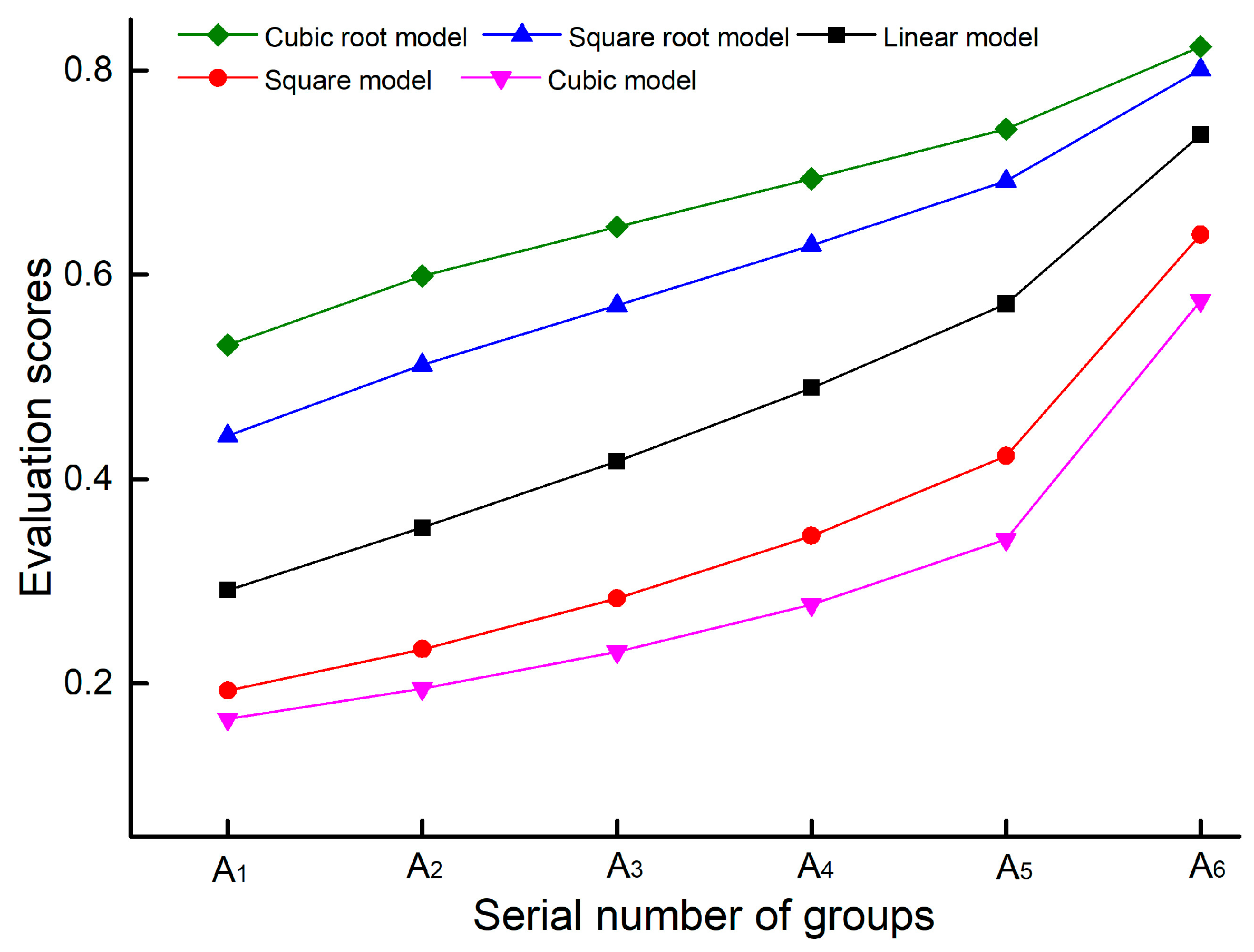
- Linear model, which can be obtained as:
- b.
- Square model, which is described as:
- c.
- Square root model, which can be expressed as:
- d.
- Cubic model, which is described as:
- e.
- Cubic root model, which can be calculated as:
- (3)
- Combination with a linear weighted function
3. Results
3.1. Evaluation Indicators
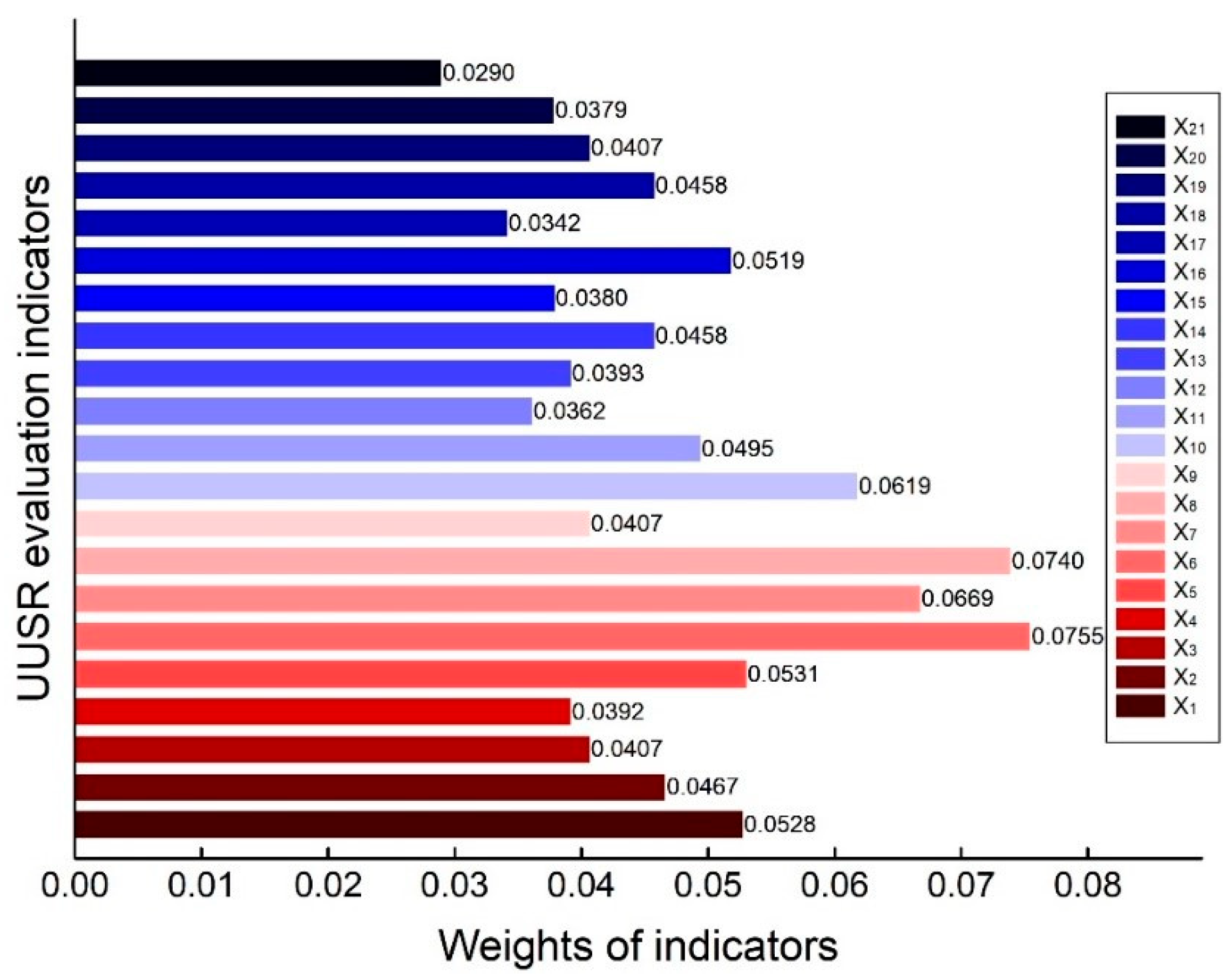
3.2. Evaluation Weights
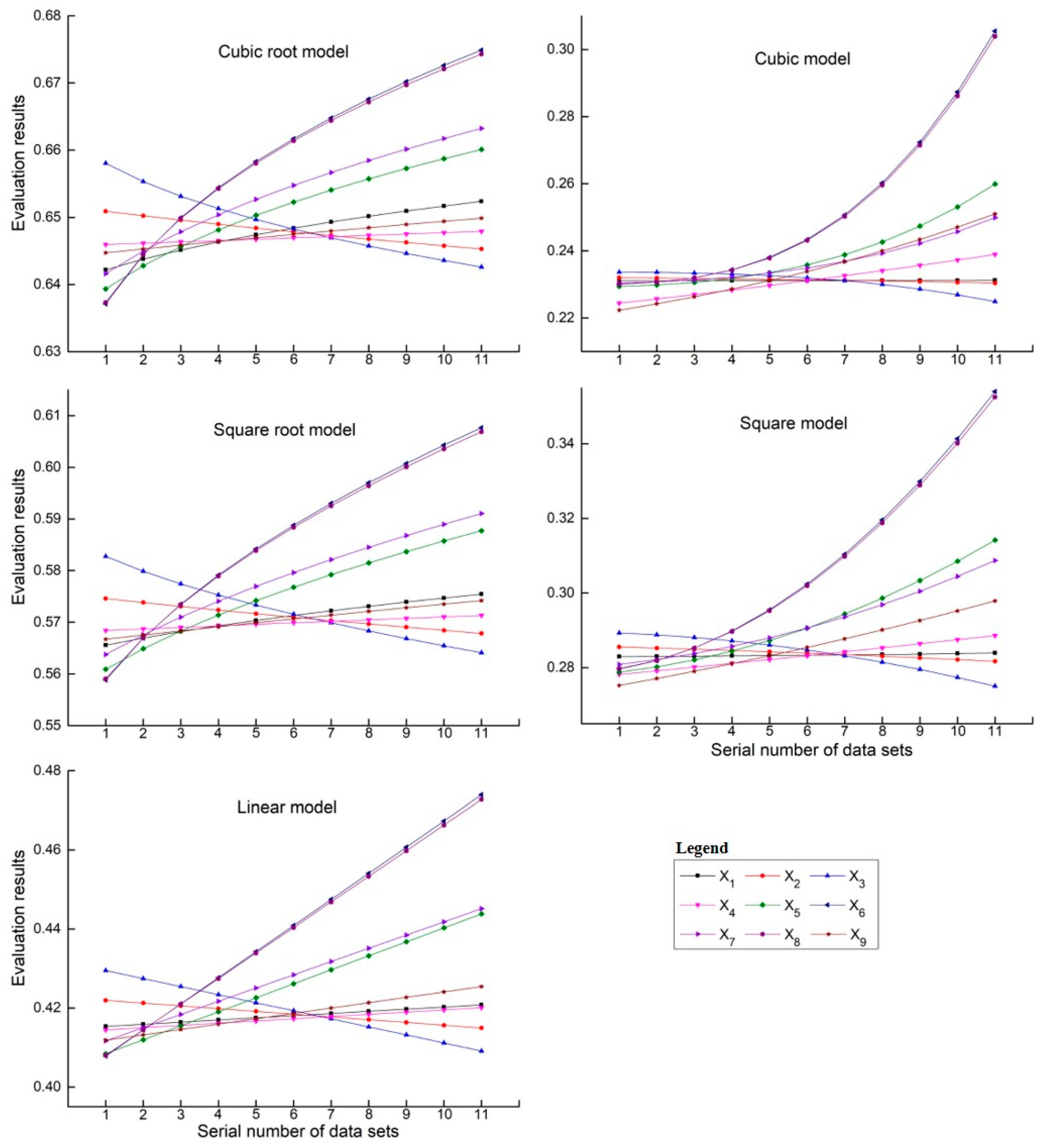
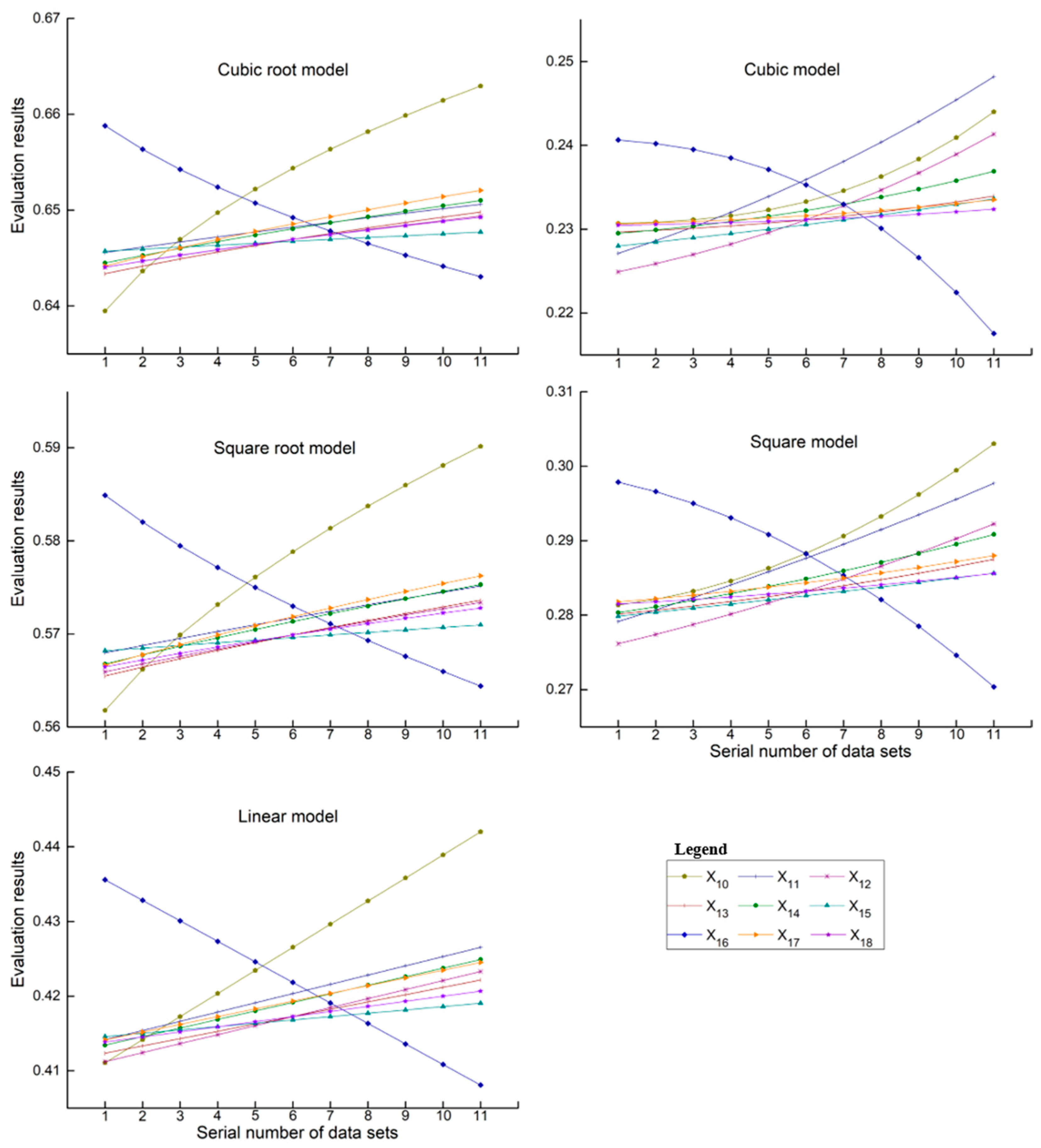
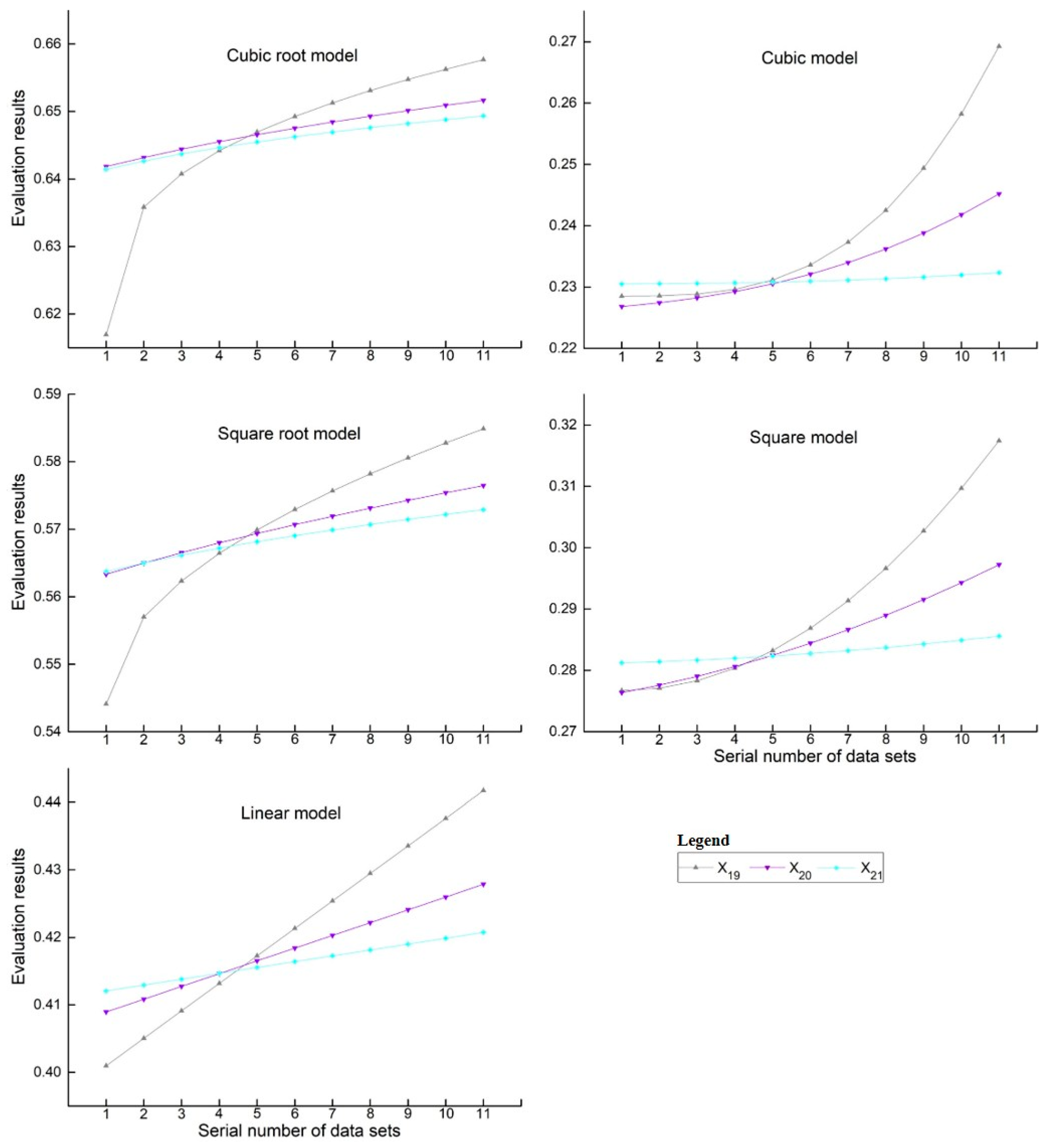
3.3. Correlation Analysis
- (1)
- Analysis of hard factors
- (2)
- Analysis of soft factors
- (3)
- Analysis of control factors
4. Discussion
5. Conclusions
Author Contributions
Funding
Institutional Review Board Statement
Informed Consent Statement
Data Availability Statement
Acknowledgments
Conflicts of Interest
Abbreviations
| UUSR | Urban underground space resource |
| ICMM | Interval continuous mathematical model |
References
- Chen, Z.L.; Chen, J.Y.; Liu, H.; Zhang, Z.F. Present status and development trends of underground space in Chinese cities: Evaluation and analysis. Tunn. Undergr. Space Technol. 2018, 71, 253–270. [Google Scholar] [CrossRef]
- Peng, F.L.; Qiao, Y.K.; Zhao, J.W.; Liu, K.; Li, J.C. Planning and implementation of underground space in Chinese central business district (CBD): A case of Shanghai Hongqiao CBD. Tunn. Undergr. Space Technol. 2020, 95, 103176. [Google Scholar] [CrossRef]
- Xie, H.P.; Zhang, Y.H.; Chen, Y.Y.; Peng, Q.; Liao, Z.Y.; Zhu, J.B. A case study of development and utilization of urban underground space in Shenzhen and the Guangdong-Hong Kong-Macao Greater Bay Area. Tunn. Undergr. Space Technol. 2021, 107, 103651. [Google Scholar] [CrossRef]
- Kho, J.C.; Loke, W.S.; Wong, Z.Z.; Raghunandan, M.E. Impact of rising temperatures on urban underground infrastructure: A state-of-the-art review. Tunn. Undergr. Space Technol. 2025, 164, 106835. [Google Scholar] [CrossRef]
- Wu, Y.T.; Wen, H.Y.; Fu, M.C. A review of research on the value evaluation of urban underground space. Land 2024, 13, 474. [Google Scholar] [CrossRef]
- Wallace, M.I.; Ng, K.C. Development and application of underground space use in Hong Kong. Tunn. Undergr. Space Technol. 2016, 55, 257–279. [Google Scholar] [CrossRef]
- Zerhouny, M.; Fadil, A.; Hakdaoui, M. Underground space utilization in the urban land-use planning of Casablanca (Morocco). Land 2018, 7, 143. [Google Scholar] [CrossRef]
- Zhang, X.Y.; Ruan, Y.C.; Xuan, W.H.; Bao, H.J.; Du, Z.H. Risk assessment and spatial regulation on urban ground collapse based on geo-detector; a case study of Hangzhou urban area. Nat. Hazards 2023, 118, 525–543. [Google Scholar] [CrossRef]
- Kuchler, M.; Craig-Thompson, A.; Alofe, E.; Tryggvason, A. SubCity: Planning for a sustainable subsurface in Stockholm. Tunn. Undergr. Space Technol. 2024, 144, 105545. [Google Scholar] [CrossRef]
- Loretta Von Der, T.; Sterling, R.; Zhou, Y.X.; Metje, N. Systems approaches to urban underground space planning and management—A review. Undergr. Space 2020, 5, 144–166. [Google Scholar] [CrossRef]
- Yu, P.; Liu, H.H.; Wang, Z.S.; Fu, J.N.; Zhang, H.; Wang, J.; Yang, Q. Development of Urban Underground Space in Coastal Cities in China: A Review. Deep Undergr. Sci. Eng. 2023, 2, 148–172. [Google Scholar] [CrossRef]
- Yang, J.P.; Liu, Q.; Shi, A.; Xu, N. Assessment of Carbon Emission Reduction Benefits of Infrastructure Systems in Urban Underground Space Development. Appl. Sci. 2026, 16, 1845. [Google Scholar] [CrossRef]
- Bobylev, N. Geosystem and ecosystem services—Exploring opportunities for inclusion in Urban underground space planning. In Proceedings of the 16th World Conference of the Associated Research Centers for the Urban Underground Space: Integrated Underground Solutions for Compact Metropolitan Cities, Hong Kong, China, 5–7 November 2018; pp. 238–248. [Google Scholar]
- Broere, W.; Mitew-Czajewska, M. Urban underground space for resilient cities. Tunn. Undergr. Space Technol. 2026, 170, 107412. [Google Scholar] [CrossRef]
- Qiao, Y.K.; Peng, F.L.; Dong, Y.H.; Lu, C.F. Planning an adaptive reuse development of underutilized urban underground infrastructures: A case study of Qingdao, China. Undergr. Space 2024, 14, 18–33. [Google Scholar] [CrossRef]
- Fayaz, M.; Ullah, I.; Park, D.; Kim, K.; Kim, D. An integrated risk index model based on hierarchical fuzzy logic for underground risk assessment. Appl. Sci. 2017, 7, 1037. [Google Scholar] [CrossRef]
- Tengborg, P.; Sturk, R. Development of the use of underground space in Sweden. Tunn. Undergr. Space Technol. 2016, 55, 339–341. [Google Scholar] [CrossRef]
- Liu, X.Y.; Liu, H.J.; Dong, J.; Yu, P.; Liu, H.H.; Cheng, G.H. Land-sea integrated suitability evaluation of underground space based on Pythagorean fuzzy Bayesian network. Undergr. Space 2025, 24, 197–215. [Google Scholar] [CrossRef]
- Bobylev, N. Underground space as an urban indicator: Measuring use of subsurface. Tunn. Undergr. Space Technol. 2016, 55, 40–51. [Google Scholar] [CrossRef]
- González, R.C.L.; Ulloa, B.M.; Otón, M.P. The underground of European cities in planning documents: The case of A Coruña (Spain). Procedia Eng. 2017, 209, 42–48. [Google Scholar] [CrossRef]
- Peng, F.L.; Wang, W.X.; Qiao, Y.K.; Ma, C.X.; Dong, Y.H. Review on data-informed planning for underground space. Undergr. Space 2026, 26, 257–281. [Google Scholar] [CrossRef]
- Bricker, S.; Jelenek, J.; van der Keur, P.; La Vigna, F.; O’Connor, S.; Ryzynski, G.; Smith, M.; Schokker, J.; Venvik, G. Geoscience for cities: Delivering Europe’s sustainable urban future. Sustainability 2024, 16, 2559. [Google Scholar] [CrossRef]
- Agarwal, V.; Kumar, A.; Qin, Z.Y.; Gomes, R.L.; Marsh, S. Lessons for Sustainable Urban Development: Interplay of Construction, Groundwater Withdrawal, and Land Subsidence at Battersea, London. Remote Sens. 2023, 15, 3798. [Google Scholar] [CrossRef]
- Peng, J.; Peng, F.L. A GIS-based evaluation method of underground space resources for urban spatial planning: Part 1 methodology. Tunn. Undergr. Space Technol. 2018, 74, 82–95. [Google Scholar] [CrossRef]
- Xi, Y.; Li, X.J.; Zhu, H.H.; Zhang, W.B.; Zhao, S.C.; Xu, W.Y. Three-dimensional high-precision assessment of mountainous urban underground space resources: A case study in Chongqing, China. Tunn. Undergr. Space Technol. 2022, 123, 104439. [Google Scholar] [CrossRef]
- Yang, Y.; Wang, R.; Liu, D.X.; Wu, L.X.; Su, J.W. Three-Dimensional quality assessment of urban underground space resource based on multiple geological environmental factors. Appl. Sci. 2024, 14, 4046. [Google Scholar] [CrossRef]
- He, L.; Song, Y.; Dai, S.Z.; Durbak, K. Quantitative research on the capacity of urban underground space—The case of Shanghai, China. Tunn. Undergr. Space Technol. 2012, 32, 168–179. [Google Scholar] [CrossRef]
- Zhu, H.H.; Huang, X.B.; Li, X.J.; Zhang, L.Y.; Liu, X.Z. Evaluation of urban underground space resources using digitalization technologies. Undergr. Space 2016, 1, 124–136. [Google Scholar] [CrossRef]
- Lu, Z.L.; Wu, L.; Zhuang, X.Y.; Rabczuk, T. Quantitative assessment of engineering geological suitability for multilayer urban underground space. Tunn. Undergr. Space Technol. 2016, 59, 65–76. [Google Scholar] [CrossRef]
- Deng, F.; Pu, J.; Huang, Y.; Han, Q.D. 3D geological suitability evaluation for underground space based on the AHP-cloud model. Undergr. Space 2023, 8, 109–122. [Google Scholar] [CrossRef]
- Song, H.; Lee, S.H.; Heo, H.M. Indicators of urban underground space development for implementing sustainability. In Proceedings of the PICMET’13: Technology Management for Emerging Technologies, San Jose, CA, USA, 28 July–1 August 2013. [Google Scholar]
- Zargarian, R.; Hunt, D.; Braithwaite, P.; Bobylev, N.; Rogers, C. A new sustainability framework for urban underground space. Proc. Inst. Civ. Eng.-Eng. Sustain. 2018, 171, 238–253. [Google Scholar] [CrossRef]
- Doyle, M.R. From hydro/geology to the streetscape: Evaluating urban underground resource potential. Tunn. Undergr. Space Technol. 2016, 55, 83–95. [Google Scholar] [CrossRef]
- Mavrikos, A.; Kaliampakos, D. An integrated methodology for estimating the value of underground space. Tunn. Undergr. Space Technol. 2021, 109, 103770. [Google Scholar] [CrossRef]
- Doyle, M.R. Mapping urban underground potential in Dakar, Senegal: From the analytic hierarchy process to self-organizing maps. Undergr. Space 2020, 5, 267–280. [Google Scholar] [CrossRef]
- Lu, S.; Hitoshi, N.; Shu, Y. The establishment and application of underground space safety evaluation system in Shanghai. Procedia Eng. 2016, 165, 433–447. [Google Scholar] [CrossRef]
- Guo, J.H.; Liu, K.; Ma, Y. A methodology for comprehensive quality evaluation of underground space. Acta Geol. Sin.-Engl. 2024, 98, 1637–1648. [Google Scholar] [CrossRef]
- Zhou, D.K.; Li, X.Z.; Wang, Q.; Wang, R.; Wang, T.D.; Gu, Q.; Xin, Y.X. GIS-based urban underground space resources evaluation toward three-dimensional land planning: A case study in Nantong, China. Tunn. Undergr. Space Technol. 2019, 84, 1–10. [Google Scholar] [CrossRef]
- Dou, F.F.; Li, X.H.; Xing, H.X.; Yuan, F.; Ge, W.Y. 3D geological suitability evaluation for urban underground space development—A case study of Qianjiang Newtown in Hangzhou, Eastern China. Tunn. Undergr. Space Technol. 2021, 115, 104052. [Google Scholar] [CrossRef]
- Wang, M.L.; Wang, H.X.; Feng, Y.; He, Y.Z.; Han, Z.; Zhang, B. Investigating urban underground space suitability evaluation using fuzzy c-mean clustering algorithm—A case study of Huancui District, Weihai City. Appl. Sci. 2022, 12, 12113. [Google Scholar] [CrossRef]
- Tong, D.F.; Tan, F.; Ma, B.C.; Jiao, Y.Y.; Wang, J. A suitability evaluation method of urban underground space based on rough set theory and conditional entropy: A case study in Wuhan Changjiang New Town. Appl. Sci. 2022, 12, 1347. [Google Scholar] [CrossRef]
- Hou, W.S.; Yang, L.; Deng, D.C.; Ye, J.; Clarke, K.; Yang, Z.J.; Zhuang, W.M.; Liu, J.X.; Huang, J.C. Assessing quality of urban underground spaces by coupling 3D geological models: The case study of Foshan city, South China. Comput. Geosci. 2016, 89, 1–11. [Google Scholar] [CrossRef]
- Wu, L.X.; Liu, D.X.; Cao, P. A new method for evaluating rock mass quality of slopes based on interval continuous mathematical models. Bull. Eng. Geol. Environ. 2020, 79, 1357–1364. [Google Scholar] [CrossRef]
- Zhang, X.B.; Wang, C.S.; Fan, J.; Wang, H.J.; Li, H.L. Optimizing the analytic hierarchy process through a suitability evaluation of underground space development in Tonghu District, Huizhou City. Energies 2020, 13, 742. [Google Scholar] [CrossRef]
- Martin-Fernandez, S.; Gomez-Serrano, A.; Martinez-Falero, E.; Pascual, C. Comparison of AHP and a utility-based theory method for selected vertical and horizontal forest structure indicators in the sustainability assessment of forest management in the Sierra De Guadarrama National Park, Madrid Region. Sustainability 2018, 10, 4101. [Google Scholar] [CrossRef]
- Martín, C.J.; Carnero, M.C. Evaluation of sustainable development in European Union countries. Appl. Sci. 2019, 9, 4880. [Google Scholar] [CrossRef]
- Guo, Y.N.; Chen, G.Q.; Mo, R.G.; Wang, M.; Bao, Y.Y. Benefit evaluation of water and soil conservation measures in Shendong based on particle swarm optimization and the analytic hierarchy process. Water 2020, 12, 1955. [Google Scholar] [CrossRef]
- Shannon, C.E. A mathematical theory of communication. Bell Syst. Tech. J. 1948, 27, 623–656. [Google Scholar] [CrossRef]



| Subject Layer | Indicators | Characteristics |
|---|---|---|
| Geological medium | Ground surface slope X1 | Quantitative |
| Soft soil thickness X2 | Quantitative | |
| Liquefaction index of sandy soil X3 | Quantitative | |
| Corrosiveness of groundwater X4 | Quantitative | |
| Phreatic water depth X5 | Quantitative | |
| Rock and soil condition | Cohesion stress X6 | Quantitative |
| Internal friction angle X7 | Quantitative | |
| Bearing capacity X8 | Quantitative | |
| Permeability coefficient X9 | Quantitative | |
| Economic condition | GDP per capita X10 | Quantitative |
| Income per capita X11 | Quantitative | |
| Expenditure per capita X12 | Quantitative | |
| Social condition | Population density X13 | Quantitative |
| Benchmark land price X14 | Quantitative | |
| Urbanization rate X15 | Quantitative | |
| Construction condition | Ground facility types X16 | Qualitative |
| Underground facility types X17 | Qualitative | |
| Geographic location condition | Distance from downtown X18 | Quantitative |
| Policy condition | National policy X19 | Qualitative |
| Geological defect | Fault X20 | Qualitative |
| Karst X21 | Qualitative |
| Data | X1 | X2 | X3 | X4 | X5 | X6 | X7 | X8 | X9 | X10 | X11 |
| A1 | 1 | 3.5 | 6 | 6 | 10 | 100 | 10 | 100 | 1 | 10,000 | 5000 |
| A2 | 1.2 | 3.3 | 5 | 6.2 | 15 | 150 | 11 | 150 | 1.1 | 15,000 | 5300 |
| A3 | 2.1 | 3 | 4 | 6.5 | 20 | 200 | 15 | 200 | 1.2 | 20,000 | 5500 |
| A4 | 2.9 | 2.5 | 3 | 6.7 | 25 | 250 | 25 | 250 | 1.3 | 25,000 | 6000 |
| A5 | 3.6 | 2.3 | 2 | 6.9 | 30 | 350 | 30 | 400 | 1.4 | 30,000 | 6500 |
| A6 | 4.1 | 2 | 1 | 7 | 50 | 800 | 40 | 800 | 1.5 | 60,000 | 7000 |
| Data | X12 | X13 | X14 | X15 | X16 | X17 | X18 | X19 | X20 | X21 | |
| A1 | 3000 | 1000 | 4000 | 50 | 1 | 1 | 4000 | 0 | 1.5 | 0.5 | |
| A2 | 3500 | 1200 | 4500 | 52 | 1.1 | 1.3 | 3500 | 1 | 2.1 | 1.2 | |
| A3 | 4000 | 1500 | 5000 | 56 | 1.3 | 1.5 | 3000 | 2 | 2.6 | 1.4 | |
| A4 | 4200 | 1800 | 5500 | 58 | 1.6 | 1.7 | 2500 | 3 | 3.2 | 1.5 | |
| A5 | 4500 | 1900 | 6500 | 59 | 1.9 | 1.8 | 1500 | 4 | 3.6 | 1.7 | |
| A6 | 5000 | 2000 | 7000 | 60 | 2 | 2 | 1000 | 5 | 4 | 2 |
Disclaimer/Publisher’s Note: The statements, opinions and data contained in all publications are solely those of the individual author(s) and contributor(s) and not of MDPI and/or the editor(s). MDPI and/or the editor(s) disclaim responsibility for any injury to people or property resulting from any ideas, methods, instructions or products referred to in the content. |
© 2026 by the authors. Licensee MDPI, Basel, Switzerland. This article is an open access article distributed under the terms and conditions of the Creative Commons Attribution (CC BY) license.
Share and Cite
Liu, D.; Wang, Z.; Yang, Y.; Zhao, C.; Zhang, W.; Dong, J. A Mathematical Model for Continuous Expression of Urban Underground Space Resource Multi-Object Evaluation. Urban Sci. 2026, 10, 260. https://doi.org/10.3390/urbansci10050260
Liu D, Wang Z, Yang Y, Zhao C, Zhang W, Dong J. A Mathematical Model for Continuous Expression of Urban Underground Space Resource Multi-Object Evaluation. Urban Science. 2026; 10(5):260. https://doi.org/10.3390/urbansci10050260
Chicago/Turabian StyleLiu, Dixu, Zhongsheng Wang, Yang Yang, Chuanjie Zhao, Wei Zhang, and Jie Dong. 2026. "A Mathematical Model for Continuous Expression of Urban Underground Space Resource Multi-Object Evaluation" Urban Science 10, no. 5: 260. https://doi.org/10.3390/urbansci10050260
APA StyleLiu, D., Wang, Z., Yang, Y., Zhao, C., Zhang, W., & Dong, J. (2026). A Mathematical Model for Continuous Expression of Urban Underground Space Resource Multi-Object Evaluation. Urban Science, 10(5), 260. https://doi.org/10.3390/urbansci10050260