Article

Towards Sustainable Urban Tourism: Carbon Accounting of Allegorical Float Construction in Major Cultural Festivals

by
Angélica Tirado-Lozada
1,2 and
Diego Venegas-Vásconez
1,*
1
Escuela de Hábitat, Infraestructura y Creatividad, Pontificia Universidad Católica del Ecuador Sede Ambato, Ambato 180207, Ecuador
2
Facultad de Diseño y Comunicación, Universidad de Palermo, Buenos Aires C1175ABT, Argentina
*
Author to whom correspondence should be addressed.
Urban Sci. 2026, 10(5), 252; https://doi.org/10.3390/urbansci10050252
Submission received: 1 April 2026 / Revised: 22 April 2026 / Accepted: 29 April 2026 / Published: 5 May 2026
(This article belongs to the Special Issue Innovation and Sustainability in Urban Tourism)

Abstract

Assessing carbon footprints has become increasingly important globally as a key tool for quantifying environmental impacts and supporting sustainable decision-making. However, although allegorical floats—central elements of large-scale parades in internationally recognized cultural festivals such as the Rose Parade in Pasadena, USA (RPP), the Rio de Janeiro Carnival, Brazil (RJC), the Black and White Carnival in San Juan de Pasto, Colombia (BWC), and the Fruit and Flower Festival in Ambato, Ecuador (FFF)—represent significant expressions of cultural heritage and artistic creativity, their environmental impact has received limited attention in sustainability research. The primary objective was to quantify the carbon emissions associated with constructing these temporary structures. The methodology integrated geometric surface estimation with carbon accounting principles commonly applied in life-cycle assessment. Emissions were calculated based on the material composition of the structural, covering, and finishing stages, and normalized using two indicators: kilograms of CO2 equivalent (kg CO2e) per square meter of float surface area and kg CO2e per float. Results indicate that emission intensity varies substantially across festivals, with RJC exhibiting the highest value (approximately 9 kg CO2e/m2) due to extensive use of synthetic materials, while BWC demonstrates the lowest intensity (approximately 4.3 kg CO2e/m2) as a result of greater reliance on wood- and paper-based components. When assessed per float, the large scale of RJC structures leads to emissions exceeding 30,000 kg CO2e per float, whereas FFF floats generate less than 1000 kg CO2e due to their smaller dimensions and use of natural materials. This research constitutes the first comparative carbon assessment of allegorical float construction and advances the emerging intersection of cultural heritage studies and environmental sustainability.

1. Introduction

Global energy consumption continues to rise due to population growth, urbanization, and industrial development [1,2]. Projections suggest that, if current production and consumption patterns persist, global energy demand and associated CO2 emissions will increase significantly by 2030 [3]. As concerns regarding climate change intensify, sectors previously considered environmentally neutral, such as cultural and artistic activities, are now subject to sustainability and carbon footprint assessments [4,5]. The Intergovernmental Panel on Climate Change (IPCC) identifies anthropogenic greenhouse gas (GHG) emissions as the primary driver of global warming, with industrial processes, material production, and transportation making substantial contributions to global emissions (IPCC, 2023) [6]. Environmental impact assessments commonly employ methodologies such as carbon footprint accounting and life cycle assessment (LCA) to quantify emissions from material extraction, processing, transportation, and manufacturing (ISO 14040; ISO 14044) [7]. Although these approaches are frequently applied in industrial systems, their use in cultural production, particularly in the construction of parade floats, remains limited [8,9].
Carbon footprint assessment has recently been widely applied to buildings, infrastructure, and industrial products, utilizing standardized life-cycle assessment (LCA) methodologies. However, the application of these methods to ephemeral cultural structures remains limited, primarily due to insufficient material inventories, significant variability in construction practices, and the predominance of artisanal processes. Previous research has identified the necessity of adapting sustainability assessment tools for non-conventional systems, especially for temporary structures and culturally embedded production models, such as those found in cultural heritage contexts and event-based infrastructures [10]. Recent studies underscore the value of integrating simplified inventory methods, geometric approximations, and context-specific indicators to assess environmental impacts in scenarios with limited data availability [11].
Popular celebrations play a fundamental role in shaping cultural identities, with festivals serving as key venues for symbolic and artistic expression. These events also drive economic, tourism, and socio-environmental development [12,13]. Parades featuring elaborate floats represent a significant aspect of the intangible cultural heritage in many societies worldwide [14]. Notable examples include RPP, RJC, BWC, and FFF, all of which have achieved international recognition and attract global audiences annually. These celebrations are distinguished by large floats that combine craftsmanship, engineering, sculpture, and temporary architectural structures to form mobile installations integral to the festivities [15]. In addition to their aesthetic and symbolic significance, these artifacts demand complex design, logistical coordination, and construction processes, utilizing diverse materials such as wood, metals, polymers, textiles, and decorative organic elements [16]. In this context, parade floats are complex, temporary engineering structures that involve multiple production stages, including conceptual design, structural assembly, sculptural modeling, cladding, decoration, and transportation [17]. Each stage requires materials and energy, resulting in greenhouse gas emissions. Despite their cultural significance and the annual production of numerous floats for festivals, their environmental impact has received limited scientific attention.
Previous research has examined cultural–creative tourism, urban branding, youth engagement, and sustainability largely in isolation. This limits integrated approaches to sustainable urban development. To address this gap, recent work proposes the Hierarchical–Relational Urban Sustainability (HRUS) framework. This framework was developed through bibliometric and content analysis. HRUS establishes both sequential and direct relationships among these dimensions. It positions cultural–creative tourism as a foundational driver of urban branding. In turn, urban branding fosters youth engagement and contributes to sustainability outcomes. By systematically integrating these four domains, the HRUS framework provides a comprehensive and actionable model to support cross-sectoral collaboration in sustainable urban planning and development [18]. The Bio-Circular-Green (BCG) model enhances sustainability in food festivals by improving resource efficiency, reducing waste, and promoting local sourcing. Based on survey data and structural modeling, results highlight its effectiveness, with sustainability factors outweighing traditional community identity in influencing tourist preferences [19]. Wan et al. [20] examine the carbon footprint of rural tourism within the context of China’s “dual carbon” goals by applying a life-cycle assessment (LCA) to a case study in Guangdong Province. The findings demonstrate that transportation constitutes the primary source of emissions, representing over 85% of the total, with catering and accommodation as subsequent contributors. The study underscores the importance of sector-specific analysis in tourism-related emissions and calls for targeted mitigation strategies, particularly in transportation and energy efficiency. While this research affirms the value of LCA in tourism systems, it primarily addresses structured and permanent tourism activities, thereby overlooking the assessment of temporary, culturally driven infrastructures such as festival-based constructions.
Aligned with the United Nations Sustainable Development Goals (SDGs) [21], specifically SDG 11 (Sustainable Cities and Communities), SDG 12 (Responsible Consumption and Production), and SDG 13 (Climate Action), the evaluation of environmental impacts associated with cultural events and temporary infrastructure has gained increasing importance. To address methodological limitations in applying life-cycle assessment (LCA) to data-scarce, artisanal, and ephemeral systems, this study presents a context-adapted carbon footprint evaluation framework for allegorical float construction. The framework integrates geometric surface estimation, stage-based material classification, and dual normalization indicators. When applied to four internationally recognized festivals—RPP, RJC, BWC, and FFF—the framework enables robust and comparable carbon accounting across diverse scales and material compositions, overcoming the absence of standardized inventories typical of such structures. This study is the first to propose and implement a structured carbon footprint assessment framework specifically tailored to ephemeral cultural infrastructures, thereby extending the applicability of LCA to intangible cultural heritage and temporary artistic production. By systematically combining engineering-based quantification with environmental accounting in a non-conventional context, this approach establishes a transferable methodological foundation for assessing and mitigating the environmental impact of cultural production systems.

2. Materials and Methods

2.1. Materials

2.1.1. Construction Materials of Allegorical Floats

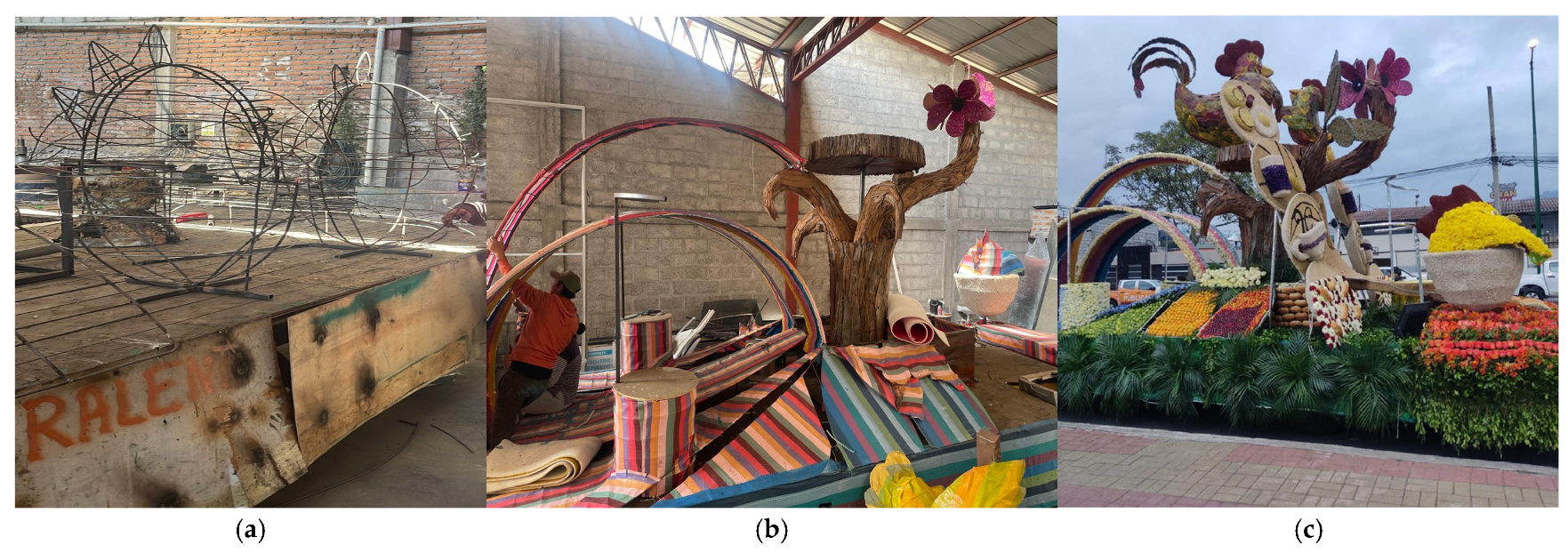
This study adopts a comparative carbon footprint assessment approach to quantify the carbon dioxide (CO2) emissions associated with the construction of allegorical floats used in major international cultural festivals. The construction of allegorical floats demonstrates considerable variation among the analyzed festivals, especially regarding material selection and finishing techniques. In RPP, floats are constructed on steel chassis equipped with adjustable structural systems and motorized platforms. A defining feature of this event is the mandate that all visible surfaces must be covered exclusively with natural plant-based materials, such as flowers, seeds, bark, fruits, and leaves. This requirement leads to a labor-intensive process that engages thousands of volunteers [22]. In RJC, floats are large engineered structures that combine steel frames with lightweight materials such as polyurethane, polystyrene, and fiberglass, as well as decorative coatings. This combination enables the display of monumental artistic elements while maintaining structural stability throughout the parade [15]. In BWC, artisans and local communities construct floats using wooden frameworks combined with sculptural materials such as polyurethane, polystyrene, paper elements, and painted surfaces. This method integrates traditional craftsmanship with the use of lightweight synthetic materials [23]. Finally, in FFF, float construction is primarily handcrafted, with frameworks designed to support substantial quantities of organic decorations. Natural materials such as flowers, fruits, bread, and dried grains constitute the majority of the finishing layer, imparting a distinctive appearance to the floats [24]. Figure 1 illustrates the main constituent elements of allegorical floats from the FFF: structure (Figure 1a), covering (Figure 1b), and finishing (Figure 1c).

2.1.2. Surface Area Calculation of Allegorical Floats

Since allegorical floats present complex and irregular geometries due to sculptural and decorative elements, their external surface area can be estimated using a geometric approximation model based on decomposition into regular solids. In this approach, the float is approximated as a rectangular prism representing the main structural platform, while an additional correction factor accounts for the irregular decorative elements [25]. The total external surface area of the float (Atotal) can be estimated as:
A t o t a l = 2 ( L W + L H + W H ) + k ( L H )
where:
L = length of the float (m), W = width of the float (m), H = maximum height of the structure (m), and k = correction factor accounting for sculptural and irregular decorative elements (typically 0.15 ≤ k ≤ 0.35).
The first term represents the surface area of the rectangular base structure, while the second term approximates the additional area contributed by sculptures, ornaments, and decorative volumes typically present in allegorical floats. This simplified geometric approach is widely used when the exact surface geometry is difficult to measure directly but dimensional data are available.

2.2. Methodology

The methodological framework is based on carbon accounting principles commonly applied in environmental impact assessment and life cycle analysis (LCA), focusing specifically on the manufacturing phase of float construction. Four internationally recognized festivals were selected as case studies: RPP, RJC, BWC and FFF. These festivals were selected due to their international visibility, large-scale float production, and diversity in design traditions and construction techniques. The analysis focuses on the material production, fabrication processes, and structural assembly stages, allowing for the estimation and comparison of CO2 emissions generated during float manufacturing.
To enable comparison across festivals, emissions are normalized using two indicators: kg CO2 per square meter of float structure and kg CO2 per float. This allows comparison despite differences in float size and design complexity.
To calculate the estimated CO2 equivalent emissions (CO2e) in a life cycle assessment (LCA), the following formula is used [26]:
C O 2 e   e m i s s i o n = i = 1 n ( A i F E i )
where:
Ai = area (in m2) or mass (in kg) of the material used; FEi = emission factor of material i, expressed in kg of CO2e per m2 (if it is a coating) or kg CO2e/kg (if it is a structural or heavy material); and n = total number of materials involved (structure, coating, adhesives, finishes).

3. Results

3.1. Material Distribution

Table 1 presents the relative percentage distribution of the materials used in the construction of the analyzed allegorical floats. The materials are categorized according to their functional role within the structure: structural components (S), covering elements (C), and finishing elements (F).
The structural stage constitutes a significant proportion of the total material composition in all analyzed cases, ranging from 50% in RPP, BWC, and FFF to 76% in RJC. Steel serves as the primary structural material in most cases, particularly in RPP, RJC, and FFF, where it comprises approximately 90% of the structural framework, while wood functions as a secondary component (around 10%). In contrast, floats from the BWC festival display a distinct structural composition, with wood representing 60% of the structural materials and steel 40%. This distribution reflects a greater reliance on artisanal construction techniques and the use of locally sourced materials.
The covering stage, representing 18% to 25% of the total material composition, is characterized by the use of lightweight sculptural materials that facilitate the formation of intricate artistic shapes. Polyurethane (PU) is the predominant material in this stage, comprising 70% of the covering materials in RPP and BWC, and 50% in RJC. Other materials, including adhesives, paint, and decorative coatings, supplement the covering layer. In the BWC case, glass fiber (GF) is also utilized, enhancing the structural reinforcement of sculptural elements.
The finishing stage exhibits the greatest variability among the analyzed festivals and reflects the distinct cultural identities of each event. In RPP floats, the finishing layer consists exclusively of natural decorative elements, including flowers (60%), fruits (20%), and dried granules (20%), in compliance with regulations mandating the use of plant-based materials. Conversely, floats from RJC predominantly utilize synthetic paint (90%) and decorative glitter (10%), producing pronounced visual effects under parade lighting. BWC floats employ a singular approach in the finishing stage, with synthetic paint comprising 100% of the finishing materials, underscoring the significance of vibrant artistic expression characteristic of this carnival tradition. In contrast, FFF floats display the most diverse array of finishing materials, including canvas (55%), floral foam (14%), rubber adhesives (10%), flowers (60%), fruits (15%), dried grains (15%), and bread (10%). This diversity highlights the festival’s strong association with agricultural and natural symbolic elements.
Overall, the findings demonstrate that structural materials remain relatively consistent across festivals, with steel frameworks or wood-based structures prevailing. In contrast, the most significant differences are observed in the covering and finishing stages, where cultural traditions and artistic requirements exert a strong influence on material selection. These distinctions are especially pertinent for the subsequent carbon footprint analysis, since polymer-based sculptural materials and synthetic coatings typically exhibit higher emission factors compared to natural decorative materials.

3.2. Surface Area Estimation of Allegorical Floats

The calculation of the total surface area based on these parameters is presented in Table 2. The construction characteristics and dimensions of allegorical floats vary significantly among the analyzed festivals, reflecting differences in engineering practices, artistic traditions, and logistical constraints. Floats from RPP are typically developed by specialized companies in technical design and structural engineering. These floats generally measure 16–24 m in length, 5.5 m in width, and 5.5–8 m in height, with an approximate weight of 10 tons [22]. In RJC, standard dimensions range from 18 to 60 m in length and 8–8.5 m in width, while their height can reach 20–23 m during the parade, although exceptional cases have exceeded these dimensions [15]. For BWC, floats are primarily built by master artisans supported by local families and communities. These structures generally measure 15–20 m in length and 10–15 m in height, with estimated widths between 6 and 8 m [23]. Finally, floats constructed for FFF are considerably smaller, with standardized platform dimensions of approximately 7 m in length, 2.8 m in width, and 4.2 m in height [24]. The calculation of the total surface area based on these parameters is presented in Table 2.

3.3. Carbon Emission Factors of Materials Used for the Float Construction Analysis

Table 3 presents the emission factors for the primary materials utilized in the construction of the allegorical floats analyzed in this study. The values, expressed in kg CO2e/m2, were sourced from previously published studies and environmental databases. These emission factors serve as the foundation for estimating the carbon footprint generated during the structural, covering, and finishing stages of float construction in the selected festivals.

3.4. Carbon Emission Analysis

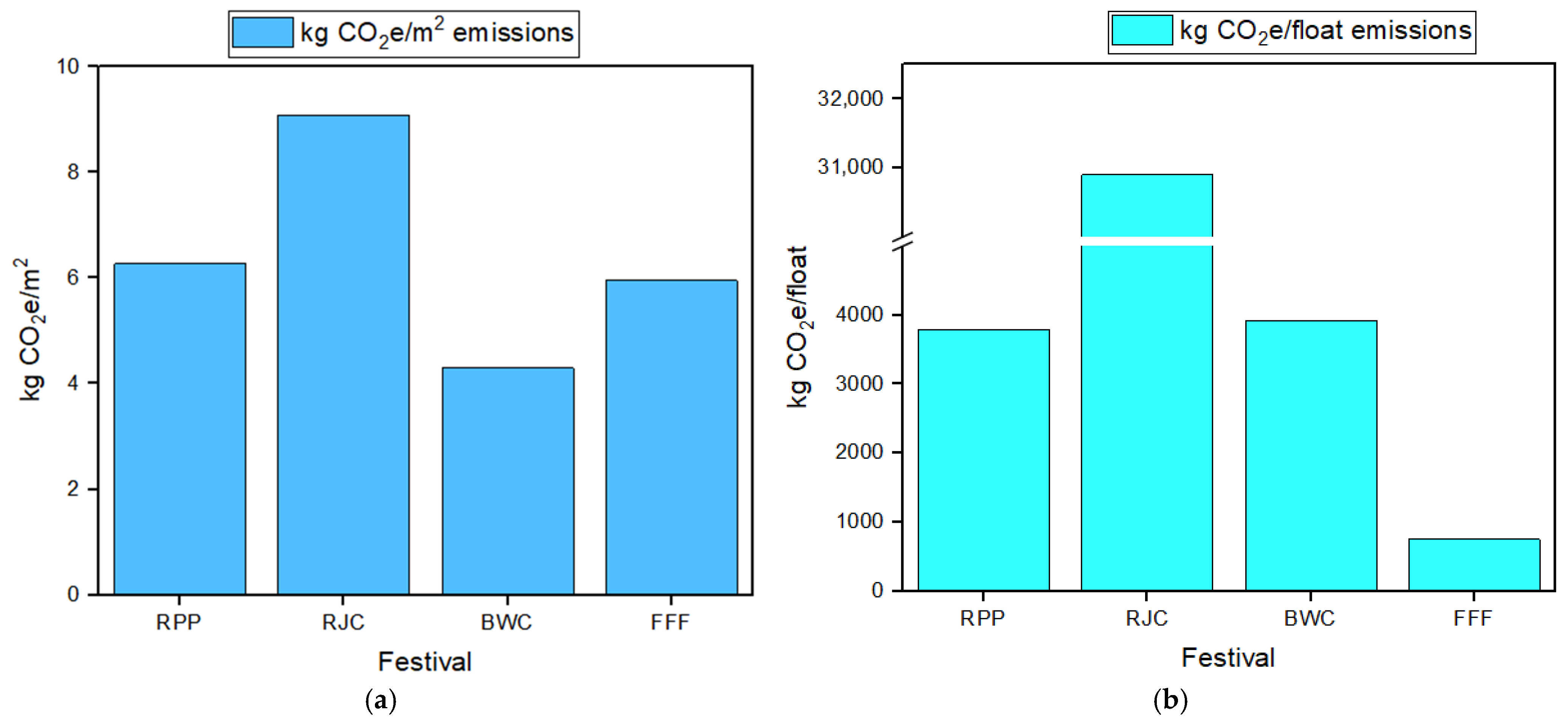
Figure 2 presents a comparison of greenhouse gas emissions resulting from the construction of allegorical floats at four analyzed festivals, expressed as kilograms of CO2 equivalent (kg CO2e) per square meter of float surface area (Figure 2a) and per float (Figure 2b). These metrics offer complementary perspectives on environmental impact by differentiating between material intensity per unit area and the total carbon footprint associated with the overall scale of each structure.
When emissions are normalized by surface area (kg CO2e/m2), RJC demonstrates the highest emission intensity at approximately 9 kg CO2e/m2. This value reflects a greater reliance on carbon-intensive materials, including polyurethane, polystyrene, synthetic paints, and structural composites [40,41]. The construction techniques employed at this festival, therefore, involve a higher proportion of synthetic or processed materials with elevated embodied emissions [42]. In contrast, BWC records the lowest emission intensity, around 4.3 kg CO2e/m2, due to a material composition dominated by lower-impact resources such as wood- and paper-based elements. RPP and FFF exhibit intermediate values of approximately 6.2 kg CO2e/m2 and 5.9 kg CO2e/m2, respectively, indicating a mixed material composition that combines both natural and synthetic materials [28,43].
A different pattern emerges when emissions are evaluated per float (kg CO2e/float). In this case, the absolute scale of the structures becomes the dominant factor influencing total emissions. RJC clearly dominates the emissions profile, with values exceeding 30,000 kg CO2e per float, primarily due to the extremely large dimensions and complex multi-level architectures characteristic of samba parade floats. Similarly, BWC and RPP show emissions in the range of 3500–4000 kg CO2e per float, despite their different material compositions, indicating that the total surface area and structural volume significantly amplify the cumulative environmental burden. In contrast, FFF demonstrates significantly lower emissions per float, remaining below 1000 kg CO2e. This result is attributable to both the smaller geometric dimensions of the floats and the predominant use of natural decorative materials, including fruits, flowers, and biodegradable organic components, which typically have lower embodied carbon values than petrochemical-based materials.
The observed divergence between emission intensity (kg CO2e/m2) and total emissions per float (kg CO2e/float) reveals two fundamentally different dimensions of environmental impact. While emission intensity reflects material efficiency and design choices, total emissions are primarily driven by scale and volumetric expansion. For instance, festivals with low emission intensity may still generate high total emissions due to large floats, whereas smaller floats with moderate intensity can result in comparatively low overall emissions. This distinction is critical, as it shows that optimizing material selection alone is insufficient to reduce the environmental burden if scale effects are not addressed simultaneously. Therefore, the combined interpretation of both indicators provides a more comprehensive assessment, enabling the identification of differentiated mitigation strategies—targeting material efficiency in high-intensity cases and structural downsizing or design optimization in high-emission scenarios. This finding reinforces the importance of adopting multi-metric frameworks when evaluating heterogeneous and scale-sensitive systems such as allegorical float construction. In summary, the comparison of these two indicators reveals that material composition is the primary factor influencing emission intensity (kg CO2e/m2), while structural scale determines total emissions per float (kg CO2e/float). This dual perspective emphasizes the need to consider both material selection and dimensional design when assessing the environmental footprint of large decorative structures in cultural events.

3.5. Lifecycle, Reuse, and End-of-Life Management of Float Materials

The lifecycle of allegorical floats is inherently short, as these structures are primarily designed for single-event use during festival parades. Consequently, post-event material management practices play a critical role in determining their environmental impact. In the case of the Fruit and Flower Festival (FFF), which serves as a detailed case study, organic materials such as fruits and flowers are discarded after the event without creating long-term environmental burdens because they are biodegradable. By contrast, polymer-based materials are typically separated and disposed of in accordance with municipal regulations established in Ambato city. Meanwhile, metallic structural components are commonly recovered and reused in subsequent float constructions, reducing the need for new raw material inputs. Although detailed data are not available for all festivals analyzed, it is reasonable to assume that similar practices—particularly regarding structural reuse and partial material recovery—are implemented in events such as RPP, RJC, and BWC, given the logistical and economic advantages of material reutilization. These lifecycle considerations are thus relevant to interpreting carbon footprint results, as they highlight opportunities to reduce environmental impacts through improved material recovery and circular practices.

4. Future Research Directions

While this study offers an initial quantitative assessment of the carbon footprint associated with the construction of allegorical floats at international festivals, several avenues for further research remain open.
Future studies should build on this initial assessment by incorporating a full life cycle assessment (LCA) of allegorical floats. This expanded approach would extend system boundaries beyond material production to include transportation, assembly processes, energy consumption during construction, and end-of-life management of materials. Such comprehensive analysis would provide a more complete understanding of the environmental impacts associated with these cultural events.
The development of more detailed geometric modeling techniques could improve the accuracy of surface-area estimates used to normalize emissions. Advanced methods, including 3D scanning, photogrammetry, and digital reconstruction models, may yield more precise measurements of the complex geometries characteristic of allegorical structures.
Evaluating alternative materials with lower embodied carbon represents another important research direction. Replacing petrochemical-based materials, such as polyurethane, polystyrene, and synthetic coatings, with bio-based or biodegradable alternatives could substantially reduce the environmental footprint of float construction while maintaining the artistic and cultural value of these structures.
Future research could also focus on optimizing float design through eco-design strategies by integrating environmental criteria into the early stages of conceptual development. Computational tools and parametric modeling can support the creation of lighter structures that minimize material consumption while ensuring structural stability and meeting aesthetic requirements.
Expanding the comparative framework to include additional cultural festivals and geographic regions would facilitate the identification of broader patterns in material use, construction practices, and environmental impacts. These comparative analyses could inform the development of sustainability guidelines for large-scale decorative structures used in public cultural events.

5. Conclusions

This study provides the first comparative analysis of carbon footprints resulting from the construction of allegorical floats at four prominent international cultural festivals. By quantifying the environmental impacts of these temporary cultural structures, the research contributes to the advancement of sustainability assessment within cultural production. The findings also reinforce the global agenda outlined by the United Nations’ Sustainable Development Goals (SDGs), specifically SDG 11 (Sustainable Cities and Communities), SDG 12 (Responsible Consumption and Production), and SDG 13 (Climate Action), by emphasizing the importance of incorporating environmental considerations into the design and construction of cultural infrastructures.
This study not only quantifies the carbon footprint associated with allegorical float construction across four internationally recognized festivals but also introduces a transferable evaluation framework tailored to ephemeral cultural systems. By integrating geometric-based material estimation, stage-specific emission classification, and dual normalization indicators, the proposed approach overcomes key limitations of conventional LCA methodologies when applied to data-scarce, artisanal, and temporary structures.
The framework provides a robust basis for cross-cultural and cross-scale comparisons, enabling more informed decision-making toward sustainable material selection and design practices in festival contexts. Furthermore, it contributes to bridging the gap between cultural heritage preservation and environmental sustainability, opening new avenues for research on low-impact artistic production and circular strategies in temporary constructions.
The results indicate that both material composition and structural scale are critical determinants of the carbon footprint of allegorical floats. When emissions are normalized by surface area, substantial differences are observed among construction materials. Floats from the Rio de Janeiro Carnival display the highest emission intensity, primarily due to the extensive use of synthetic materials including polyurethane, polystyrene, fiberglass, and synthetic coatings. Conversely, floats from the Black and White Carnival exhibit lower emission intensity, attributable to a greater reliance on wood- and paper-based elements.
Analysis of emissions per float reveals that the geometric scale of the structures is the primary driver of total emissions. The exceptionally large dimensions of floats in the Rio de Janeiro Carnival result in carbon emissions exceeding 30,000 kg CO2e per structure. In contrast, floats from the Fruit and Flower Festival generate significantly lower emissions, remaining below 1000 kg CO2e per float. This reduction is mainly due to their smaller dimensions and the extensive use of natural decorative materials such as flowers, fruits, and agricultural products.
Finally, the proposed framework demonstrates that robust carbon footprint estimates can be generated in contexts characterized by limited data availability, high material variability, and artisanal construction processes. While not intended as a universal methodology, its adaptable structure makes it particularly suitable for assessing ephemeral cultural infrastructures and other non-conventional systems where traditional life cycle assessment approaches face significant constraints. By extending carbon accounting principles to these underexplored domains, this study not only fills a critical gap in the literature but also provides a transferable methodological foundation for future applications in diverse cultural and event-based contexts. Ultimately, this work contributes to advancing sustainability assessment beyond conventional boundaries, supporting more informed decision-making in the design and management of environmentally responsible cultural production systems.

Author Contributions

Conceptualization, A.T.-L.; methodology, A.T.-L. and D.V.-V.; software, D.V.-V.; validation, A.T.-L. and D.V.-V.; formal analysis, A.T.-L. and D.V.-V.; investigation, A.T.-L. and D.V.-V.; resources, A.T.-L.; data curation, A.T.-L. and D.V.-V.; writing—original draft preparation, A.T.-L. and D.V.-V.; writing—review and editing, A.T.-L. and D.V.-V.; visualization, A.T.-L. and D.V.-V.; supervision, A.T.-L. and D.V.-V.; project administration, A.T.-L. and D.V.-V.; funding acquisition, A.T.-L. All authors have read and agreed to the published version of the manuscript.

Funding

This research received no external funding.

Institutional Review Board Statement

Not applicable.

Informed Consent Statement

Not applicable.

Data Availability Statement

The original contributions presented in this study are included in the article. Further inquiries can be directed to the corresponding author.

Acknowledgments

The authors give special thanks to the “Escuela de Hábitat, Infraestructura y Creatividad” and the “Dirección de Investigación” of “Pontificia Universidad Católica del Ecuador, Sede Ambato” for their support of this research.

Conflicts of Interest

The authors declare no conflicts of interest.

Abbreviations

The following abbreviations are used in this manuscript:
RPPRose Parade in Pasadena USA
RJCRio de Janeiro Carnival Brazil
BWCBlack and White Carnival in San Juan de Pasto Colombia
FFFFruit and Flower Festival in Ambato Ecuador

References

  1. Venegas-Vásconez, D.; Arteaga-Pérez, L.E.; Aguayo, M.G.; Romero-Carrillo, R.; Guerrero, V.H.; Tipanluisa-Sarchi, L.; Alejandro-Martín, S. Analytical Pyrolysis of Pinus radiata and Eucalyptus globulus: Effects of Microwave Pretreatment on Pyrolytic Vapours Composition. Polymers 2023, 15, 3790. [Google Scholar] [CrossRef] [PubMed]
  2. Venegas-Vásconez, D.; Orejuela-Escobar, L.; Valarezo-Garcés, A.; Guerrero, V.H.; Tipanluisa-Sarchi, L.; Alejandro-Martín, S. Biomass Valorization through Catalytic Pyrolysis Using Metal-Impregnated Natural Zeolites: From Waste to Resources. Polymers 2024, 16, 1912. [Google Scholar] [CrossRef] [PubMed]
  3. Venegas-Vásconez, D. Pirólisis de biomasa: Un proceso de transformación termoquímica sustentable. In Generación del Conocimiento para un Mundo Sostenible. Transformaciones Sociales, Educativas y Ambientales; Editorial Universidad Tecnológica Indoamérica: Quito, Ecuador, 2025; Volume 2, ISBN 978-9942-693-13-6. [Google Scholar]
  4. Naranjo, C. Tendencias y Preferencias en Consumo Sostenible y Cultura Responsable: Un Análisis Generacional en Colombia, Universidad Politecnica de Valencia: Valencia. 2025. Available online: https://riunet.upv.es/server/api/core/bitstreams/997160b5-a3f7-4641-ad53-ebbaafc227f8/content (accessed on 25 March 2026).
  5. Palazón Botella, M.D. La historia del arte frente al cambio climático: Formar para actuar sobre el patrimonio cultural. Erph. Rev. Electrón. Patrim. Histórico 2022, 31, 113–142. [Google Scholar] [CrossRef]
  6. Masson-Delmotte, V.; Pörtner, H.-O.; Skea, J.; Slade, R.; Ferrat, M.; Neogi, S.; Portugal Pereira, J.; Kissick, K.; Calvo Buendía, E.; Connors, S.; et al. El Cambio Climático y la Tierra: Informe Especial del IPCC Sobre el Cambio Climático, la Desertificación, la Degradación de las Tierras, la Gestión Sostenible de las Tierras, la Seguridad Alimentaria y los Flujos de Gases de Efecto Invernadero en los Ecosistemas Terrestres: Resumen para Responsables de Políticas; IPCC: Geneva, Switzerland, 2020; ISBN 978-92-9169-354-2. Available online: https://bibliotecasemiaridos.ufv.br/jspui/handle/123456789/337 (accessed on 26 March 2026).
  7. Finkbeiner, M.; Inaba, A.; Tan, R.; Christiansen, K.; Klüppel, H.-J. The New International Standards for Life Cycle Assessment: ISO 14040 and ISO 14044. Int. J. Life Cycle Assess. 2006, 11, 80–85. [Google Scholar] [CrossRef]
  8. Cavallin Toscani, A.; Macchion, L.; Stoppato, A.; Vinelli, A. How to assess events’ environmental impacts: A uniform life cycle approach. J. Sustain. Tour. 2022, 30, 240–257. [Google Scholar] [CrossRef]
  9. Atescan-Yuksek, Y.; Paddea, S.; Jackson, S.; Jolly, M.; Salonitis, K. Quantifying the Carbon Footprint of Events: A Life Cycle Assessment-Based Framework for Evaluating Impact of Location and Timing. In Proceedings of the Sustainable Manufacturing as a Driver for Growth; Kohl, H., Seliger, G., Dietrich, F., Mur, S., Eds.; Springer: Cham, Switzerland, 2025; pp. 277–285. [Google Scholar]
  10. Barbhuiya, S.; Das, B.B. Life Cycle Assessment of construction materials: Methodologies, applications and future directions for sustainable decision-making. Case Stud. Constr. Mater. 2023, 19, e02326. [Google Scholar] [CrossRef]
  11. Oregi, X.; Hernandez, P.; Gazulla, C.; Isasa, M. Integrating Simplified and Full Life Cycle Approaches in Decision Making for Building Energy Refurbishment: Benefits and Barriers. Buildings 2015, 5, 354–380. [Google Scholar] [CrossRef]
  12. García Canclini, N. Culturas Híbridas: Estrategias para Entrar y Salir de la Modernidad; de Grigalbo, S.A.C.V.: México City, México, 1989; ISBN 970-05-0562-6. [Google Scholar]
  13. Quintero, M.A.S. Turismo Rural, Gentrificación y Resiliencia Ecosocial en Pahuatlán: Un Análisis desde la Economía Ecológica y la Ecología Política. Cienc. E Innovación Rev. Interdiscip. De Investig. 2025, 3, 69–86. [Google Scholar] [CrossRef]
  14. Tirado, D.; Viteri, J. Carros Alegóricos: Un legado cultural desde el renacimiento hasta la modernidad. Dilemas Contemp. Educ. Política Y Valores 2024, 1, 1–21. [Google Scholar] [CrossRef]
  15. Fernandes, J.L.d.S.; dos Passos, J.C.; de Gonçalves, R.C.P. Barracão de Alegorias e Etnomatemática: Práticas e reflexões pedagógicas no Carnaval de Florianópolis. Práxis Educ. 2022, 17, 1–23. [Google Scholar] [CrossRef]
  16. Flores-Carrillo, D.G. Criterios morfológico-estéticos: Diseño de los carros alegóricos en la Fiesta de la Frutas y de las Flores en Ecuador. Ágora De Heterodoxias 2019, 5, 48–66. [Google Scholar]
  17. Venegas-Vásconez, D.; Tirado-Lozada, A. Análisis de ciclo de vida en el diseño de productos de ingeniería: Una revisión sistemática. Arksis-J. 2026, 1, 33–49. [Google Scholar] [CrossRef]
  18. Kasemsarn, K.; Sawadsri, A.; Kritsanaphan, A.; Nickpour, F. Urban Branding Through Cultural–Creative Tourism: A Review of Youth Engagement for Sustainable Development. Urban Sci. 2025, 9, 204. [Google Scholar] [CrossRef]
  19. Suvittawat, A.; Janchai, N.; Seepho, S.; Nonthachai, J.; Nonthachai, I. Sustainable Food Festival Tourism: Integrating the Bio-Circular-Green (BCG) Model for Cultural and Environmental Resilience in Thailand. Sustainability 2025, 17, 1969. [Google Scholar] [CrossRef]
  20. Wan, J.; Wang, P.; Wang, M.; Huang, Y.; Luo, J. Research on the Carbon Footprint of Rural Tourism Based on Life Cycle Assessment: A Case Study of a Village in Guangdong, China. Sustainability 2025, 17, 6495. [Google Scholar] [CrossRef]
  21. Venegas-Vásconez, D.; Erazo-Puentes, O.; Farías-Fuentes, Ó.; Ayabaca-Sarria, C.; Medina, A. Fires in World Heritage Buildings. In Artificial Intelligence, Computer and Software Engineering Advances; Advances in Intelligent Systems and Computing; Springer International Publishing: Cham, Switzerland, 2021; Volume 1326, pp. 433–447. ISBN 978-3-030-68079-4. [Google Scholar]
  22. Pasadena Tournament of Roses America’s New Year Celebration. Available online: https://tournamentofroses.com/ (accessed on 29 July 2025).
  23. Lasso-Guerrero, J.G.; Arturo-Insuasty, G.A.; Castellanos-Navarrete, J.A. Reflexiones sobre la participación de los maestros artesanos en el escenario creativo del Carnaval de Negros y Blancos de San Juan de Pasto, Colombia. Prospectiva 2023, 35, 1–21. Available online: https://www.redalyc.org/journal/5742/574275313011/?utm_source=chatgpt.com (accessed on 26 March 2026). [CrossRef]
  24. Infobae P.N. El Desfile de Imponentes Carrozas Cierra el Carnaval de Negros y Blancos de Colombia. Infobae. Available online: https://www.infobae.com/america/agencias/2025/01/06/el-desfile-de-imponentes-carrozas-cierra-el-carnaval-de-negros-y-blancos-de-colombia/ (accessed on 26 March 2026).
  25. Guinée, J. Handbook on Life Cycle Assessment; Kluwer Academic Publisher: Norwell, MA, USA; Springer: Berlin/Heidelberg, Germany, 2002. [Google Scholar] [CrossRef]
  26. Ku, R.; Baba, A.; Iwafune, Y.; Ogimoto, K.; Watanabe, K. How much can CO2 emissions be reduced? Impact of flexible household demand control linked to hourly CO2 emission factors. Energy Convers. Manag. X 2026, 30, 101695. [Google Scholar] [CrossRef]
  27. Ecoinvent—Data with Purpose. Ecoinvent. Available online: https://ecoinvent.org/ (accessed on 26 March 2026).
  28. Silva, R.; Barros-Timmons, A.; Quinteiro, P. Life cycle assessment of fossil- and bio-based polyurethane foams: A review. J. Clean. Prod. 2023, 430, 139697. [Google Scholar] [CrossRef]
  29. Füchsl, S.; Rheude, F.; Röder, H. Life cycle assessment (LCA) of thermal insulation materials: A critical review. Clean. Mater. 2022, 5, 100119. [Google Scholar] [CrossRef]
  30. Sun, M.; Wang, Y.; Shi, L.; Klemeš, J.J. Uncovering energy use, carbon emissions and environmental burdens of pulp and paper industry: A systematic review and meta-analysis. Renew. Sustain. Energy Rev. 2018, 92, 823–833. [Google Scholar] [CrossRef]
  31. Climatiq Emission Factor: Paints/Varnishes and Similar Coatings/Printing Ink and Mastics. Carbon Intelligence for Products, Supply Chains, and Real Impact. Available online: https://www.climatiq.io/data/emission-factor/bf702c5c-fc10-475d-8117-0f494c950b73 (accessed on 26 March 2026).
  32. Eisen, A.; Bussa, M.; Röder, H. A review of environmental assessments of biobased against petrochemical adhesives. J. Clean. Prod. 2020, 277, 124277. [Google Scholar] [CrossRef]
  33. European Commission. Joint Research Centre. Institute for Environment and Sustainability. International Reference Life Cycle Data System (ILCD) Handbook: General Guide for Life Cycle Assessment: Detailed Guidance; Publications Office: Luxembourg, 2010; Available online: https://data.europa.eu/doi/10.2788/38479 (accessed on 26 March 2026).
  34. Salehpour, T.; Khanali, M.; Rajabipour, A. Environmental impact assessment for ornamental plant greenhouse: Life cycle assessment approach for primrose production. Environ. Pollut. 2020, 266, 115258. [Google Scholar] [CrossRef] [PubMed]
  35. Poore, J.; Nemecek, T. Reducing food’s environmental impacts through producers and consumers. Science 2018, 360, 987–992. [Google Scholar] [CrossRef]
  36. Nemecek, T.; Kägi, T.; Blaser, S. Life Cycle Inventories of Agricultural Production Systems; Final Report Ecoinvent; Agroscope Reckenholz-Tänikon ART: Zürich, Switzerland, 2007. [Google Scholar]
  37. Ungureanu-Comanita, E.-D.; Olteanu, S.; Cosbuc, E.L.; Smaranda, C.; Gavrilescu, M. Environmental Pressures Generated by Bakery Waste for Sustainable Management. In Proceedings of the 2021 International Conference on e-Health and Bioengineering (EHB), Iasi, Romania, 18–19 November 2021; pp. 1–4. [Google Scholar] [CrossRef]
  38. Dormer, A.; Finn, D.P.; Ward, P.; Cullen, J. Carbon footprint analysis in plastics manufacturing. J. Clean. Prod. 2013, 51, 133–141. [Google Scholar] [CrossRef]
  39. Liu, Y.; Lask, J.; Kupfer, R.; Gude, M.; Feldner, A. A Comparative Life Cycle Assessment of a New Cellulose-Based Composite and Glass Fibre Reinforced Composites. J. Polym. Environ. 2024, 32, 2207–2220. [Google Scholar] [CrossRef]
  40. American Institute of Steel Construction Data for aisc.org/epd. Google Docs. Available online: https://docs.google.com/spreadsheets/d/1siNb_X0RLcBFubOwLF8QDEUILNw_LePPotAoEAdGWfM/pubhtml?gid=913945573&single=true&widget=false&chrome=false&headers=false&range=B2:E39&usp=embed_facebook (accessed on 26 March 2026).
  41. Dunlap, J. Life Cycle Assessments & The Impact of Architectural Metals. 2023. Available online: https://www.azahner.com/blog/the-life-cycle-assessment-of-metal/ (accessed on 26 March 2026).
  42. Kylili, A.; Seduikyte, L.; Fokaides, P.A. 9—Life Cycle Analysis of Polyurethane Foam Wastes. In Recycling of Polyurethane Foams; Thomas, S., Rane, A.V., Kanny, K.V.k.A., Thomas, M.G., Eds.; Plastics Design Library; William Andrew Publishing: Norwich, NY, USA, 2018; pp. 97–113. ISBN 978-0-323-51133-9. [Google Scholar]
  43. Muñoz-López, N.; Biedermann, A.; Santolaya-Sáenz, J.L.; Valero-Martín, J.I.; Serrano-Tierz, A. Sustainability in the Design of an Itinerant Cultural Exhibition. Study of Two Alternatives. Appl. Sci. 2021, 11, 9863. [Google Scholar] [CrossRef]
Figure 1. Elements of allegorical floats from the FFF: (a) structure, (b) covering, and (c) finishing.
Urbansci 10 00252 g001
Figure 2. Comparison of CO2e emissions from allegorical floats across the analyzed festivals: (a) emissions per unit surface area (kg CO2e/m2) and (b) total emissions per float (kg CO2e/float).
Urbansci 10 00252 g002
Table 1. Percentage distribution of materials used in the structural, covering, and finishing stages of allegorical float construction.
(A) Structural Materials
MaterialRPP (%)RJC (%)BWC (%)FFF (%)
Steel90904090
Wood10106010
Total100100100100
(B) Covering Materials
MaterialRPP (%)RJC (%)BWC (%)FFF (%)
PU7050705
PS255
Paper201
Paint155
VA7555
RA81010
Total100100100100
(C) Finishing Materials
MaterialRPP (%)RJC (%)BWC (%)FFF (%)
Flowers6060
Fruits2015
DG2015
Canva55
FF14
Bread10
SP90100
Glitter10
GF15
Total100100100100
Note: Structure (E), Covert (C), Finish (F), Polyurethane (PU), Polystyrene (PS), Vegetable adhesive (VA), Rubber adhesive (RA), Floral foam (FF), Dried granules (DG), Synthetic paint (SP), Glass fiber (GF).
Table 2. Estimated surface area of each festival float.
FestivalL (m)W (m)H (m)k (Sculpture)Atotal (m2)
RPP20.05.57.00.20605.0
RJC45.08.022.00.353398.5
BWC17.57.012.50.25912.2
FFF7.02.84.20.15125.9
Table 3. Emission factors of materials used for the carbon footprint estimation of allegorical floats.
MaterialEmission (kgCO2e/m2)Reference
Steel11.00[27]
Wood0.75[27]
PU6.00[28]
PS5.20[29]
Paper1.26[30]
Paint1.80[31]
VA0.20[31]
RA0.25[32]
Canva2.80[33]
FF6.80[28]
Flowers0.80[34]
Fruits0.10[35]
DG0.60[36]
Bread1.00[37]
SP2.00[31]
Glitter0.18[38]
GF30.00[39]
Disclaimer/Publisher’s Note: The statements, opinions and data contained in all publications are solely those of the individual author(s) and contributor(s) and not of MDPI and/or the editor(s). MDPI and/or the editor(s) disclaim responsibility for any injury to people or property resulting from any ideas, methods, instructions or products referred to in the content.