Article

Long-Term Assessment of Surface Urban Heat Islands Using Open Access Remote Sensing Data (1984–2024) in the Moroccan Atlantic Coast


by
Sana Ajjoul
1,
Adil Zabadi
1,
Ayyoub Sbihi
2,*,
Hind Lamrani
2,
Danielle Nel-Sanders
3,
Brahim Benzougagh
2,4 and
Maryam Mazouz
5
1
National Institute of Planning and Urbanism (INAU), Avenue Allal El Fassi, P.O. Box 6215—Rabat-Institutes, Rabat 10100, Morocco
2
Department of Geomorphology and Geomatics (D2G), Scientific Institute, Mohammed V University in Rabat, Avenue Ibn Batouta, Agdal, P.O. Box 703, Rabat 10106, Morocco
3
School of Public Management, Governance and Public Policy, College of Business & Economics, Auckland Park Kingsway Campus, University of Johannesburg, Johannesburg 2001, South Africa
4
Laboratory of Geoengineering and Environment, Cartography and Tectonophysics Team (CaTec), Department of Geology, Faculty of Sciences, Moulay Ismail University, Meknes 50000, Morocco
5
Urban Innovation and Heritage Laboratory, Higher School of Architecture of Rabat, International University of Rabat, Technopolis Rabat-Shore, Rabat-Sale Rocade, Rabat 10000, Morocco
*
Author to whom correspondence should be addressed.
Urban Sci. 2026, 10(5), 237; https://doi.org/10.3390/urbansci10050237
Submission received: 29 January 2026 / Revised: 5 March 2026 / Accepted: 11 March 2026 / Published: 30 April 2026

Abstract

Rapid urbanization combined with global climate change is intensifying the Surface Urban Heat Island (SUHI) effect worldwide, posing significant risks to human health, thermal comfort, and quality of life in cities. Characterized by notably higher temperatures in urban areas compared to their rural surroundings, the SUHI phenomenon is driven by factors such as increased built-up density and reduced vegetation cover. In this context, open-source remote sensing data, particularly from the Landsat satellite series, play a crucial role in studying surface urban heat islands. Available freely, Landsat’s multispectral and thermal imagery provides extensive spatial coverage and consistent temporal frequency, enabling long-term diachronic analyses. This study leverages a 40-year time series (1984–2024) of Landsat thermal data to map surface temperature variations in urban environments between Kenitra and Rabat cities, facilitating the identification of heat-excess zones linked to anthropogenic factors. Based on the results obtained, the LU/LC maps show that the study area is characterized by the notable growth of urbanization over the period 1984–2024, particularly in the dynamic poles of the region such as the city centers of Kénitra, Rabat, and Sale. This dynamic is highlighted by an increase from 1.8% to 3% in the total area of the region, accompanied by a remarkable decrease in agricultural land and bare soils. The evaluation of the Random Forest (RF) model’s performance also indicates that it successfully classified the data and predicted the LU/LC classes effectively, as confirmed by metric indices such as the Receiver Operating Characteristic curve and the Kappa index, which present very high average values exceeding 90%. Furthermore, the exploitation of the thermal bands of Landsat images provided relevant information on surface temperature variation. The SUHI maps show that the Rabat-Sale-Kenitra (RSK) region experienced a progressive increase in temperature over the study period, rising from 27 °C in 1984 to 44 °C in 2024. This value could increase further due to the continuous dynamics of urbanization. Together, these tools provide a robust framework for understanding the spatiotemporal dynamics of surface urban heat islands and support sustainable urban planning.

1. Introduction

Climate change is today recognized as one of the major challenges of the 21st century, with profound impacts on natural and human systems on a global scale. The latest report from the Intergovernmental Panel on Climate Change [1] emphasizes the need for rapid and collective action to curb the effects of global warming, which affects average temperatures, the frequency of extreme events, and hydrological cycles. Similarly, global changes, including rampant urbanization, deforestation, and land-use changes, intensify pressures on ecosystems and societies. These transformations exacerbate vulnerability to natural hazards, such as floods, droughts, wildfires, and heatwaves, and have major impacts on public health, notably through the increase in heat-related illnesses and air quality degradation [2].
In this context, urban environments contain a growing share of the global population, with more than 55% of inhabitants living in cities in 2018 and a projection of nearly 68% by 2050 [3]. This rapid urbanization, mostly unplanned, profoundly affects the local and regional environment. It is often accompanied by the emergence of several phenomena including the “Surface Urban Heat Island (SUHI),” characterized by a significant rise in temperatures in built-up areas compared to surrounding rural areas. This phenomenon amplifies the effects of climate change in urban settings, accentuating the likelihood of other health risks, notably during heatwaves, which are now the leading cause of weather-related mortality in several regions [4]. The SUHI is thus at the crossroads of climate, environmental, and social issues, requiring in-depth research to better understand its mechanisms and identify appropriate solutions.
The Moroccan urban population has experienced a sharp increase driven by strong demographic dynamics, rural exodus, the expansion of urban perimeters, and the promotion of rural centers to urban status. This trend is also reflected in the sustained demographic growth observed over the past decade, with the population increasing from 2,598,312 inhabitants in 2014 to 2,860,430 in 2024, according to the national census statistics [5,6]. Urban spaces today account for more than 23 million inhabitants, or nearly 63% of Morocco’s total population [5], whereas this figure did not exceed 4 million in 1960, with an urbanization rate of 29.1%. This rapid increase highlights the profound change that Moroccan society is undergoing. From a historical perspective, the colonization of Morocco was a confrontation with modernization [7]. The latter introduced several innovations, notably the capitalist mode of production, industrialization, and information, by adopting a model of spatial organization favoring central coastal zones and marginalizing spaces deemed inappropriate for speculative practices [8,9,10].
The Moroccan coastal strip, extending from Kenitra to Rabat, is a strategic zone undergoing significant urban and demographic transformation. According to recent data from the 2024 General Census of Population and Housing [5], the RSK region, which encompasses this area, counts more than 5 million inhabitants with an average annual growth rate of around 2.5% over the last decade. This demographic growth is accompanied by intensified urbanization, with significant urban expansion and rapid transformation in terms of land cover/land use [11]. Natural and agricultural spaces are gradually giving way to built-up areas, profoundly modifying the landscape and the physical properties of the territory [9,12].
This artificialization of spaces and soils is becoming the basic characteristic of several rapidly developing coastal zones, representing a key factor in the manifestation and intensification of the SUHI phenomenon [13]. The latter refers to a local and sustained rise in temperature in urban areas compared to surrounding rural spaces, primarily linked to the concentration of impervious surfaces, the reduction in vegetation, and the three-dimensional configuration of buildings [14,15]. Across the world, this phenomenon is amplified by the rapid expansion of urbanization, which modifies not only the urban energy balance but also the thermal exchanges between the surface and the atmosphere. In 2008, Rizwan et al., highlights in their work that the intensity of the SUHI is heavily dependent on the nature and evolution of land use/land cover (LULC), with a direct correlation between built-up density, the loss of green spaces, and the increase in night-time temperatures [16]. In the Mediterranean context, similar to that of the Moroccan Atlantic coast, some scientific papers have demonstrated that urban areas experience temperature increases reaching several degrees Celsius compared to peri-urban or rural areas, which highlights the occurrence of hazards linked to heatwaves [17].
The coastal zone between Kenitra and Rabat, already subject to a temperate Mediterranean climate, thus sees an accumulation of climatic and anthropogenic constraints, favoring the frequency and duration of extreme heat episodes. The multiplication of heatwaves combined with the presence of SUHI increases the vulnerability of populations, particularly the most fragile ones (elderly people, children, low-income populations) [18]. Faced with these challenges, the coastal region between Kenitra and Rabat offers a privileged field of study, combining rapid urbanization, contrasting land use dynamics, and sensitive climatic exposure. This study aims to analyze how the spatial evolution of LU/LC influences the distribution and intensity of SUHI, by integrating recent demographic data, thermal observations, and urban morphological analysis. Understanding these interactions is essential for designing effective and sustainable mitigation measures [19,20], improving climate resilience and the well-being of populations in this coastal zone undergoing full transformation.

2. Study Area: The Atlantic Coast Between Kenitra and Rabat

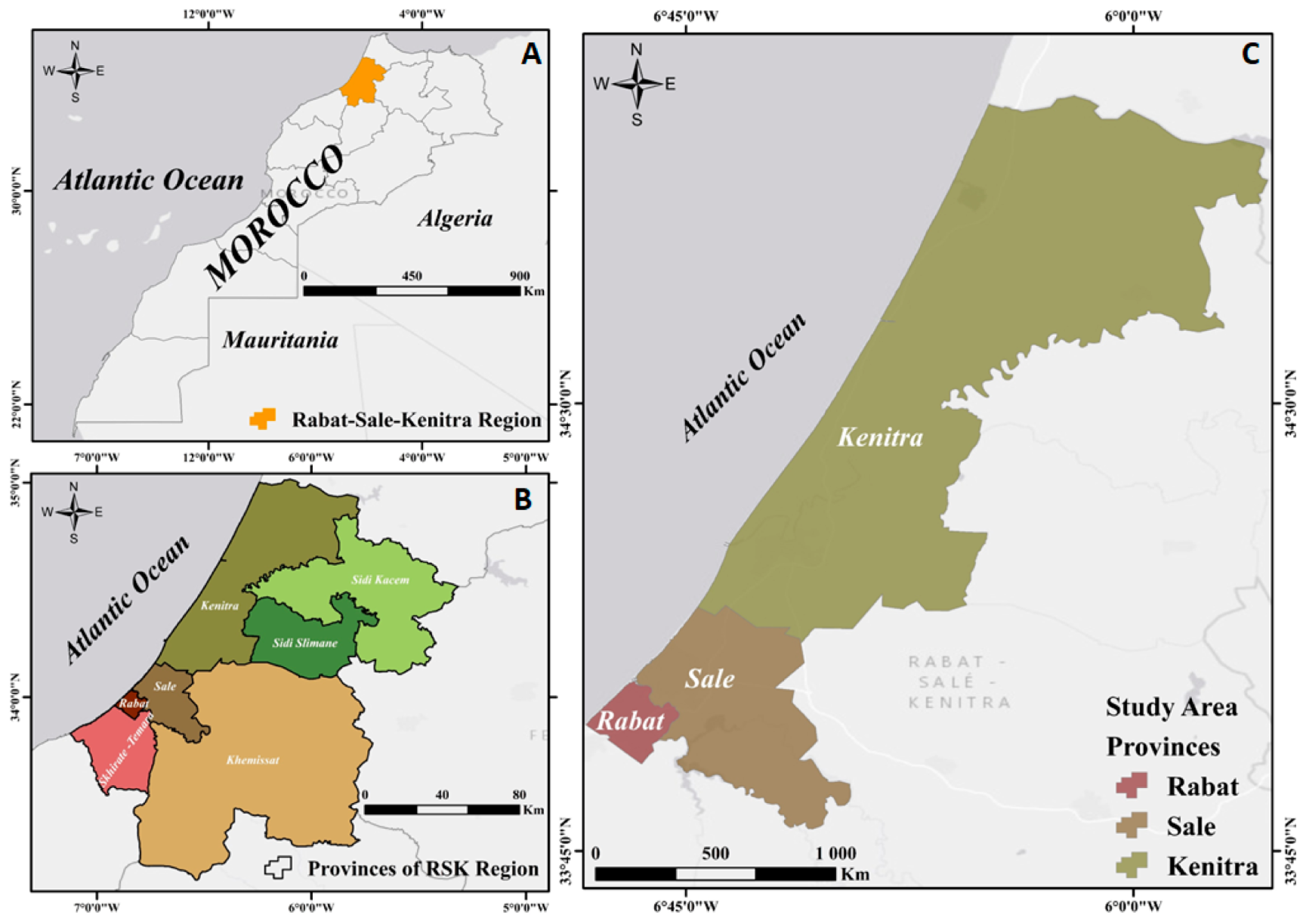
The study area, located on the north-western Atlantic coast of Morocco, covers the provinces/prefectures of Kenitra, Sale, and Rabat (Figure 1), parts of the RSK region. This region combines geographic diversity, active urbanization, and socio-economic dynamics that make it a particularly relevant territory for the analysis of SUHI phenomena. According to the latest census (2024), the legal population of these three cities is 2,865,045 inhabitants, representing 80% of the total population of the region and 10% of the national population [5]. Between 2014 and 2024, the urban population of the region rose from 3,198,712 to 3,627,178, corresponding to an average annual growth rate of 1.27%. These marked demographic and urbanization dynamics are key elements for the study of SUHIs, as the intensity and extent of urbanization strongly influence surface mineralization, built-up density, and thus the thermal balance of urban areas. As the study area constitutes a significant part of the RSK region, it plays an important role in the national economy by concentrating a vast portion of agricultural, industrial, and tertiary activities. In 2019, the region accounted for approximately 16% of the national Gross Domestic Product (GDP) according to the “High Commission for Planning”. The region is also characterized as the leading national agricultural sector in terms of utilized agricultural area, which implies that rural and peri-urban zones, particularly the Gharb plains associated with the province of Kénitra, remain very active in agriculture [21].
In the study area, in urban zones like Rabat, Sale, or Kenitra, activity linked to the tertiary sector, industry, services, and even logistics (coastal proximity, port/transport infrastructures, industrial zones) is predominant. Although precise figures by sector for each province are not always available, the regional weight in GDP testifies to a diversified economy.
These three provinces are characterized by a strong concentration of the urban population in a few specific large zones, which favors soil sealing, with a high built-up density and strong thermal reverberation. This situation is set within a context of rapid and contrasting urbanization, creating an urban continuum between dense historical centers, peri-urban extensions, a heavily populated coastline, and industrial zones [22]. The alignment of such conditions makes the study area a favorable and relevant setting to compare the intensity of surface urban heat islands thanks to the presence of a built-up-to-rural gradient. Furthermore, the coexistence of agricultural activities in rural zones and industrial and tertiary functions in the urban environment will allow for analyzing the influence of land uses and land cover on thermal dynamics. Finally, the geographic diversity, ranging from Atlantic coasts, alluvial plains, and coastal plateaus to urban and peri-urban spaces, offers a framework conducive to studying the interactions between morphology, oceanic proximity, urbanization, and vegetation cover in the modulation of heat island effects.

3. Methodology

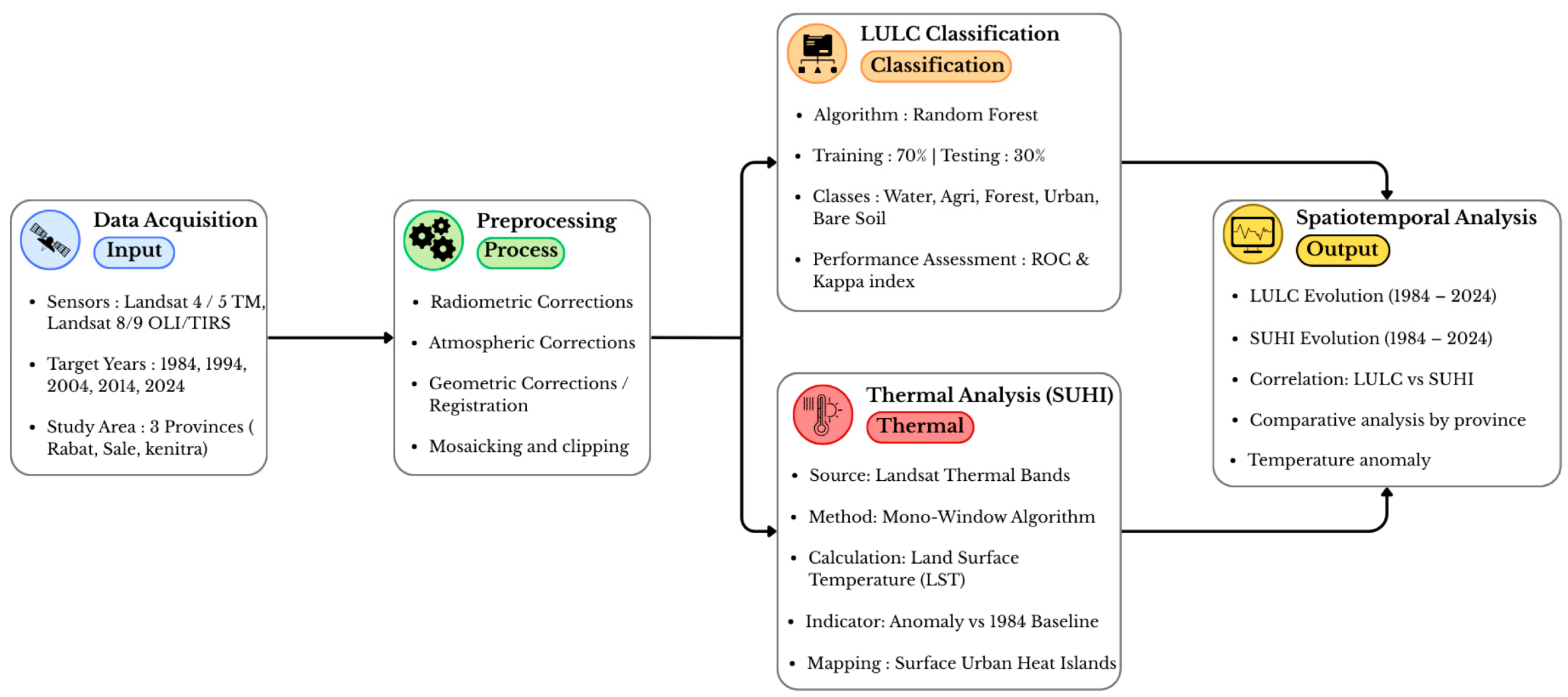
The methodology of this study is described in Figure 2 and based on the use of free and open-source Landsat data, which offers a valuable resource, especially for countries with low to very low income levels, allowing for thorough environmental monitoring at no cost of proprietary datasets. Based on a primarily geomatics approach, the methodology followed in this work consists of a succession of several phases; acquisition, preprocessing, processing, and classification of a set of satellite images from different sensors, using GIS (ArcMap 10.8), remote sensing tools and artificial intelligence.
The implementation steps of this methodology begin with the exploitation of Landsat satellite images from two different sensors, Landsat TM (Thematic Mapper) and Landsat OLI (Operational Land Imager), with the objective of conducting a spatiotemporal analysis to investigate the dynamics of LULC and SUHI effects over a period covering the last 40 years (1984 to 2024) across three provinces.
The selection of 10-year intervals was based on scientific and methodological considerations rather than arbitrary choice. Decadal intervals are commonly used in long-term LU/LC and urban growth studies because they allow the detection of significant structural transformations while minimizing the influence of short-term fluctuations and interannual variability [23,24]. Urban expansion processes typically follow medium- to long-term planning and infrastructure development cycles, which makes a 10-year temporal resolution suitable for capturing consolidated spatial changes. From a climatic perspective, decadal spacing enhances the robustness of SUHI trend analysis by reducing the impact of anomalous single-year meteorological conditions and emphasizing persistent thermal patterns linked to land surface transformation [25,26].
Initially, the satellite images were subjected to several preprocessing steps to correct radiometric, atmospheric, and geometric distortions [27]. Subsequently, a Random Forest algorithm was applied to classify land cover into primary categories. Thermal bands were then used to calculate Land Surface Temperature (LST) and assess SUHI intensity by employing established algorithms and vegetation-based emissivity adjustments [28]. The study explores the spatial and temporal evolution of both land use/land cover and surface urban heat islands, including correlation and comparative analyses across provinces, to identify urban thermal patterns and changes over a forty-year timeframe.

3.1. Data Acquisition & Preprocessing

A set of cloud-free multitemporal satellite data from the Landsat 4, 5, 8, and 9 missions has been used, following a decadal interval to analyze the long-term nature of LU/LC dynamics and track changes in SUHI across the RSK region’s provinces, spanning the years 1984, 1994, 2004, 2014, and 2024. A 10-year interval is generally regarded as suitable in developed nations for monitoring spatial and environmental changes, in that it strikes a balance between the frequency of temporal observations and the normal rates of urban expansion, land transformation, and climatic strain on urban systems. It is also a pragmatic choice from a methodological standpoint. Because if a shorter temporal interval is used, it would generate a larger number of images, substantially increase preprocessing, classification, and thermal retrieval workloads, while contribute only marginal improvements to long-term trend detection. The decadal approach therefore provides an optimal balance between analytical precision and operational efficiency. A 40-year Landsat archive preserves consistent spatial, spectral, and radiometric properties, allowing for the reliable identification of land-cover changes, plant growth patterns, and heat signatures.
The set of five satellite images used in this study underwent several preprocessing phases, specifically atmospheric and radiometric corrections. These steps ensure the images are clear, reliable, and physically interpretable by correcting sensor-related effects during acquisition, while removing atmospheric influences that can obscure spatial information. Clipping and mosaicking were also performed to generate images covering the entire study area for each period, defined by its specific boundary [29,30]. Furthermore, the satellite images used in this study have a significant resolution, reaching 30 m. With the objective of reducing spectral distortions and extracting the maximum spatial information from these images, the preprocessing steps include the application of the Gram-Schmidt pan-sharpening method (Table 1). This technique improves the image resolution by combining the panchromatic band (which has a high resolution of 15 m) with the lower-resolution (30 m) multispectral bands, resulting in a clear image with a spatial resolution close to that of the panchromatic band [31,32].
Additionally, the use of satellite imagery from various sensors is primarily dictated by the extent of the study period (1984 to 2024). Specifically, satellite imagery from the TM (Thematic Mapper) sensor only covers the period from approximately ~1982 to 2013, whereas the OLI (Operational Land Imager) sensor represents the new generation of Landsat imagery acquired after 2013. Based on this transition, we describe the specific characteristics of these different sensors. The spatial resolution enhancement using the Gram–Schmidt method was applied only to the multispectral bands. However, it was not applied to the thermal bands, since they measure emitted radiation and have a coarser native resolution [33].

3.2. Land Use and Land Cover Classification

Generally, LULC is a spatial representation of all the elements that compose a territory or a geographical unit. The methodology of this study proposes a cartographic approach to visualize and analyze the distribution and spatial dynamics of five main LU/LC components within the provinces of Rabat, Sale, and Kenitra over the last forty years, specifically between 1984 and 2024. The procedures of this approach are initially based on the extraction and definition of the main LU/LC components and classes present in the various satellite images from the study period, namely: water, forests, urban areas, agricultural land, and bare ground. These categories were identified as the dominant types in the RSK territory following preliminary field observations and recent satellite imagery analysis. These classes represent the key elements of the supervised classification performed by the Random Forest machine learning algorithms, in order to generate five LU/LC maps showing the spatial distribution of these classes for the years 1984, 1994, 2004, 2014, and 2024.
Furthermore, the creation of these maps relies primarily on a supervised classification approach for spatial data. Training elements play a central role, serving as references for the classification algorithm, guiding the identification of classes, and allowing each pixel of the image to be assigned to the most appropriate category [34,35]. In this study, 420 training elements were identified for each year in order to ensure a consistent and reliable classification process. Consequently, the quality, representativeness, and accuracy of the training elements directly determine the reliability of the maps produced and the relevance of subsequent spatiotemporal analyses.
The application of the RF model as the tool for this classification, based essentially on the significance and capability of this model’s algorithms in several studies with different approaches, reflects its high performance in data classification [36,37]. Following the standard procedures for this type of processing, we also defined a 70/30 data split, assigning 70% of the database or input classes as training elements and the remaining 30% for testing [38]. This provides the model with sufficient learning to better understand the different types of land use and to generate maps that closely reflect reality [39,40,41]. Furthermore, the technical aspect of this classification included a numerical evaluation of the model’s performance and its level of interaction with the data, through the use of two metric indices. These allowed for the definition of the performance level of the applied model through a graphical representation such as the “Receiver Operating Characteristic” curve and its AUC value, which indicates good model capability if it is greater than 0.75, as well as the Kappa index [42,43].

3.3. Surface Urban Heat Island (SUHI) Extraction and Intensity Classification

Generally, a satellite image is an assembly of different spectral bands such as visible, infrared, and panchromatic bands, where each band provides different information from the others depending on the type of band or spectrum. Among these, the thermal bands of this type of imagery (band 6 for Landsat 4 and 5, band 10 for Landsat 8 and 9) are widely recognized for their use in deriving Land Surface Temperature (LST), through the measurement of thermal infrared radiation emitted by the Earth’s surface.
In this study, the thermal band was used to derive surface temperature variations within the “RSK” study area, with the objective of visualizing the spatial distribution of the SUHI. This was achieved through a statistical normalization between the values extracted from the thermal band representing the LST, the mean temperature, and the standard deviation [14,44] (Equation (1)):
S U H I = L S T μ σ
where the following abbreviations are used:
LST: Land Surface Temperature.
μ: Mean Land Surface Temperature.
σ: Standard deviation.
Indeed, the assessment of SUHI variations is not performed directly, but relies on a structured radiometric processing chain derived from thermal remote sensing data. In this study, the estimation of Land Surface Temperature begins with the conversion of the thermal band Digital Numbers (DN) into top-of-atmosphere spectral radiance (Lλ) using the radiometric calibration coefficients provided in the metadata file [45,46] (Equation (2)):
L λ = M L × D N + A L
where the following abbreviations are used:
Lλ: Spectral Radiance (W/(m2_sr_µm));
DN: Digital Number;
ML, AL: Conversion coefficients (found in the metadata).
Subsequently, the spectral radiance is transformed into Brightness Temperature (BT) through the inversion of Planck’s law [47,48], based on the thermal calibration constants K1 and K2 specific to each sensor (Equation (3)). However, since real surfaces do not behave as ideal emitters, a correction for land surface emissivity is essential. Emissivity is commonly estimated using the NDVI Threshold method, which relies on the NDVI derived from the red and near-infrared bands to determine the fractional vegetation cover and assign an appropriate emissivity value to each pixel (Equations (4) and (5)):
B T   ( k ) = K 2 L n ( ( K 1 L λ ) + 1 )
where the following abbreviations are used:
BT (k): Brightness Temperature (Kelvin)
K1, K2: Calibration constants (from metadata)
N D V I = N I R R e d N I R + R e d
P v = ( N D V I N D V I m i n N D V I m a x   N D V I m i n ) 2
Finally, integrating emissivity into the thermal correction equation yields a more accurate LST (Equations (6) and (7)). This rigorous and sequential approach highlights the major contribution of satellite thermal remote sensing to the spatial analysis of surface thermal patterns, particularly in climatic, environmental, and urban heat island studies [49,50].
ε = 0.004 × P v × 0.986
L S T   ( k ) = B T 1 + ( λ . B T ρ ) ln ( ε )
where the following abbreviations are used:
BT (k): Brightness Temperature (Kelvin);
ρ: Constant derived from Planck’s law (=1.438 × 10⁻² m, Kelvin);
λ: Effective wavelength (=10.895 × 10⁻⁶ m);
LST in Celsius (°C) = LST(k) − 273.15.

4. Results & Discussion

4.1. LULC Classification

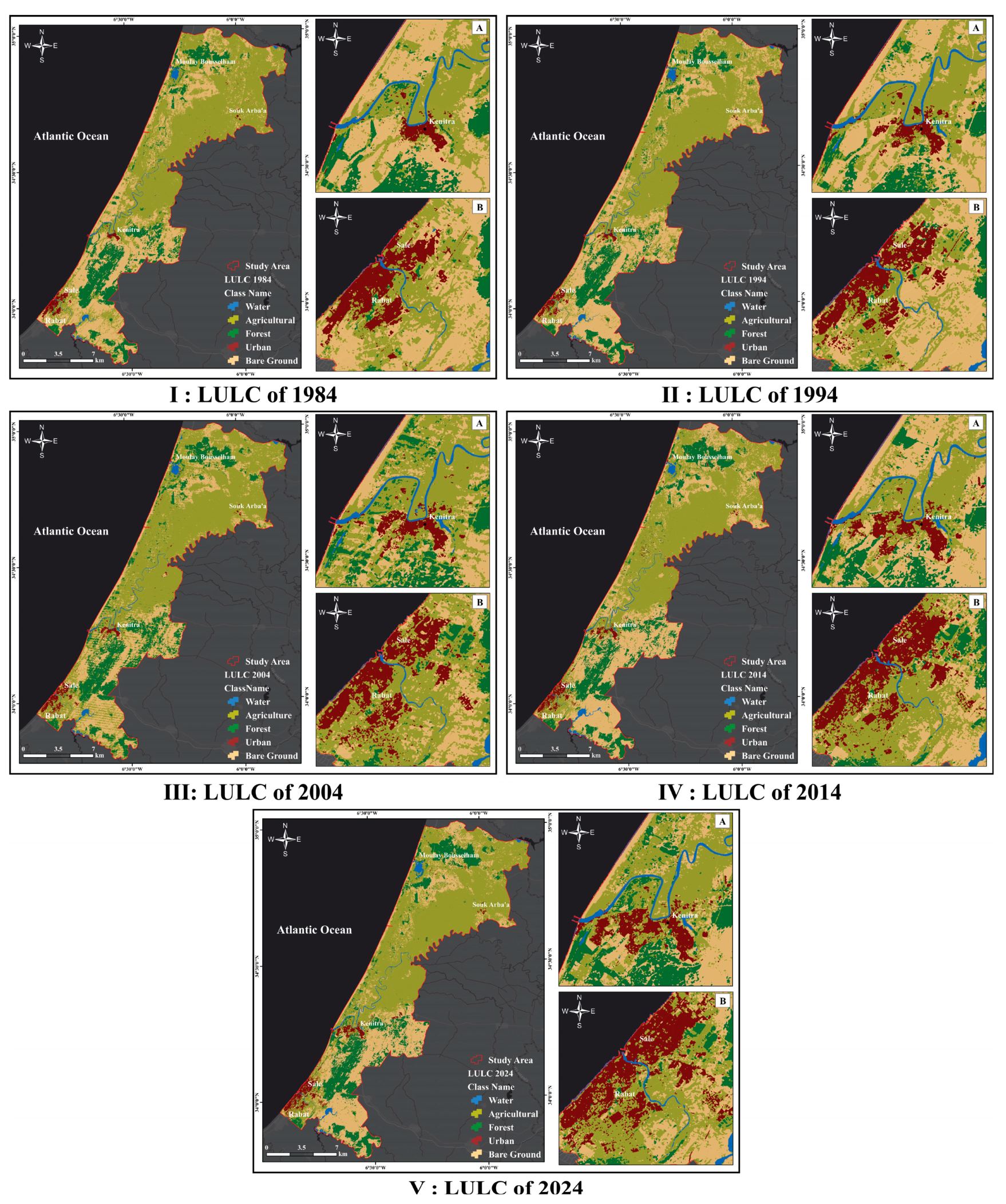
With the aim of producing LU/LC maps for the three studied provinces (Rabat, Sale, and Kenitra), the supervised classification performed by the RF model shows a clear and remarkable contrast in the spatial variation in all land components studied during the period from 1984 to 2024. The produced maps generally indicate that the city center of Kenitra, as well as the cities of Rabat and Sale particularly on the right bank of the Bouregreg river mouth, are the sections that experienced significant evolution in terms of land cover during the study period, specifically urbanization (Figure 3).
In 1984, the study area territory was characterized by the presence of all main land cover components, with a predominance of agricultural land, especially in the province of Kenitra. These lands covered almost 52.3% of the total study area and approximately 60% of the province’s area. Forests were also present with a notable concentration estimated at more than 13% of the total RSK area, they were clearly visible in the northern part of the study area, corresponding to the province of Kenitra, as well as in the city of Sale, which was also distinguished by significant forest cover. Regarding bare soil, this class covered almost 32% of the study area (Figure 3I). It included yellow lands, bare soils, and beaches, generally distributed in Sale, Kenitra, and along the coastal fringes. Urbanized zones, as indicated on the 1984 land cover map, were strongly concentrated near the rivers: the Sebou in Kenitra and the Bouregreg in Sale and Rabat. The total area of this category was estimated at 1.8% relative to the study area territory; urbanization in the southern part notably the cities of Rabat and Sale was higher compared to the other province. Regarding the water component, this class represented the variation in water levels in rivers and tributaries, lakes, and existing dams in the study area, such as the Sidi Moulay Abdellah dam, Lake Moulay Bousselham, etc. (Figure 3I).
After 10 years, the LU/LC map does not show a major difference in the distribution and spatial dominance of the studied classes. The results of the 1994 satellite image classification provide distributions similar to those of 1984, but with relatively slight variations in the areas and coverage of these classes (Figure 3II). For example, agricultural zones experienced a decrease in area of 2.5% in 1994, dropping from 52.25% in 1984 to 49.69% in 1994. Nevertheless, by analyzing the 1984 and 1994 LULC maps, a remarkable differentiation and spatial anomaly clearly appeared in the city center of Kenitra, as well as in Rabat and Sale. These areas experienced significant evolution and urbanization dynamics, with growth reaching 1.85% of the total RSK area (Figure 3II).
In 2004, the land cover map and statistics show that the two green space classes, whether agricultural lands or forests, are distinguished by a renewed growth in their area at the expense of the bare soil class, which lost 9% of its total area (Figure 3III). Furthermore, during this year, agricultural zones reached a significant and unprecedented coverage, estimated at more than 56% of the study area territory. Regarding the urbanization class, it maintained the evolution and dynamics observed in 1994 through an expansion of built-up areas in the surroundings of the Kenitra, Rabat, and Sale city centers, with an area increase exceeding 2% this time (Figure 3III).
Over the last twenty years, LU/LC in the RSK region’s provinces has experienced a notable evolution regarding the main classes, namely forests, agricultural lands, and, principally, urbanization (Figure 3IV,V). Analyzing the spatial distribution of these classes, we can deduce that the RSK region underwent a decrease in green spaces, whether through the abandonment of agricultural lands or deforestation. The areas of these two classes decreased notably compared to previous years: agricultural zones cover 46% of the total area (instead of 56% in 2004), and forests decreased from around 16% to 14.5% in 2014 (Figure 3IV). According to statistics, these losses of green surfaces occurred to the benefit of the urbanization class, where the area went from 2.04% in 2004 to reach over 2.5% in 2014 of the entire study area (Figure 3IV). Furthermore, the decrease in green space volume is also a direct cause of the increase in the bare soil class. This class increased by 10% compared to the previous period: while it covered only 24% of the study area in 2004, it reached over 34% ten years later. These soils are most likely being prepared for urban sprawl. Based on this year’s land cover map, the mouths of the two main rivers in the study area; Oued Sebou in Kenitra and the Bouregreg in Sale and Rabat have become the most urbanized and active zones in terms of dynamics and evolution of this class during the study period (Figure 3IV).
In 2024, urbanization in the provinces of Rabat, Sale, and Kenitra was remarkable and significant, covering more than a quarter of the total area of the Rabat province, with a significant expansion in the provinces of Sale and Kenitra, particularly towards the coastal fringes (Figure 3V). This map also reveals the presence of new urbanized units that have become very clear, namely the city of Souk Larba’a, which experienced significant urbanization over the last 10 years at the expense of forests and agricultural zones. In terms of figures, urbanization reached approximately 2.9% of the study area by the end of the studied period, with a decrease in the area of bare soils compared to previous years, as these lands had previously been reserved for urbanization. The other classes, such as forests and agricultural lands, also increased, but this time at relatively low rates, due to reasons associated with the economy and the local climatic situation (Figure 3IV).
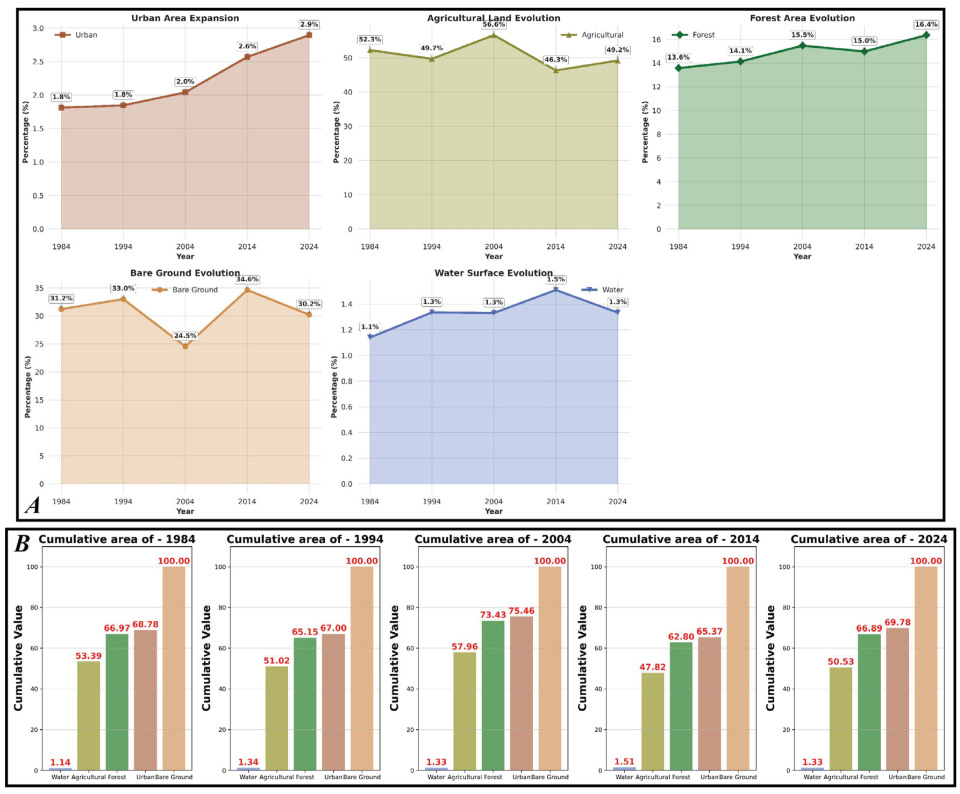
In terms of figures, the five land use classes reflect variations that change over time, due to economic, social, and climate change factors. The spatiotemporal analysis of these classes highlights that the three provinces studied have experienced significant urbanization expansion over the past four decades, ranging from 1.8% of the total area of the study zone in 1984 to approximately 3% in 2024, with continuous growth (Figure 4). The increased urbanization of the RSK provinces can be mainly explained by the statistics related to the other classes, namely bare soils and agricultural land, which have experienced a decrease in their areas during the study period, where the majority of the sections lost by these classes have been replaced by built-up areas [51,52]. In addition, the increase in the urbanization rate in the city center of Kenitra and also for Rabat and Sale has generally been at the expense of bare soils (Figure 4). The analysis of the statistical trends of bare soils and agricultural land reveals a contradictory and significant dynamic, characterized by a negative correlation between the evolution of their respective areas. Indeed, the increase in bare soils seems to coincide with a concomitant reduction in agricultural areas, suggesting an inter-class compensation phenomenon. This pattern can be attributed to the local climate situation, where climate fluctuations, namely prolonged drought periods, could lead to a degradation of agricultural land, making them less suitable for cultivation and promoting their classification as bare soils [53]. The reuse of agricultural land may also contribute to this trend, insofar as, after years of water stress, the land is left fallow or abandoned (Figure 4).
The provinces of Rabat, Sale, and Kenitra are distinguished by significant and extensive forest cover, notably the Maâmoura forest, which stretches from Sale to Kenitra, hosting numerous ecosystems. Between 1984 and 2024, this type of green space generally constituted an average of 15% of the total area of the study zone (Figure 4), concentrated exclusively in the Maâmoura forest and the Moulay Bousselham forest, located in the northern part of the study area (Figure 3). Over the study period, the forest class represented only 13.6% in 1984 and ended in 2024 with an area of 16.5% of the RSK provinces, which can be explained by the emergence of other forest areas that have been under development (Figure 4).
Regarding the blue element, i.e., water bodies, the observed variations are mainly due to fluctuations in the levels of the Bouregreg and Sebou rivers, as well as the filling levels of local lakes such as Moulay Bousselham and Sidi Boughaba (Figure 3 and Figure 4).
By highlighting the variations in five LULC classes in the provinces studied over the period from 1984 to 2024, the table below provides a summary of the nature and rate of evolution of each class over time (Table 2). Overall, it indicates that forests and urban areas have experienced an increasing trend, estimated at 2.78% (forests) and 1.1% (urban), compared to 1984, mainly at the expense of agricultural land and bare soils. The latter have indeed recorded a significant degradation in their areas, with a decrease of 3.05% for agricultural land and 1% for bare soils (Table 2) [54]. Furthermore, although the evolution of the water class in the RSK region is characterized by relatively weak growth, increasing from 1.1% in 1984 to 1.3% in 2024, this change is essentially explained by variations in the water levels of local rivers, lakes, and dams (Table 2). These variations may be linked both to the rise in ocean waters (Atlantic Ocean) and to precipitation, which has been particularly intense over the last twenty years.
From an overall perspective, the territory of the provinces of Rabat, Sale, and Kenitra appears to evolve according to a logic of unstable equilibrium: agriculture remains dominant, but it is in constant interaction with the transitional dynamics “bare soil”, ecological regulation “forest”, and anthropogenic pressure “urbanization”. This configuration reflects a territorial system in continuous adaptation rather than in radical transformation.
For territorial planning, several major implications emerge from these contrasting dynamics. First, the need for integrated planning becomes evident, coherently articulating agricultural production, ecological conservation, and urban development [55,56]. In a context marked by the progressive expansion of urban centers around Rabat, Sale, and Kenitra, the challenge lies not only in managing growth, but in ensuring a functional balance between the different vocations of the territory. It becomes essential to regulate urbanization in order to limit the fragmentation of agricultural land and natural areas, while ensuring the sustainable valorization of land resources [57].
Secondly, the identification of transitional spaces, particularly bare soils, emerges as a strategic axis of intervention. These “yellow spaces” constitute potential reserves for urban expansion, agricultural reconversion, or ecological restoration. Their intermediate status makes them sensitive areas, where planning decisions can durably shape the territorial structure [58,59]. Through anticipatory management of these surfaces, uncontrolled land artificialization can be avoided and structuring projects can be promoted within a long-term territorial vision.
Moreover, the consolidation of ecological and agricultural continuities stands out as a fundamental lever for strengthening territorial resilience in the face of climate change and socio-economic pressures. The maintenance of large forest complexes, such as the Maàmoura and Moulay Bousselham Forest, as well as the preservation of agricultural belts, helps regulate environmental balances, limit soil erosion, and support regional food security. In this sense, territorial planning must integrate a logic of connectivity between natural and productive spaces in order to ensure harmonious, sustainable, and adaptive development at the scale of the three provinces [59,60,61].
Beyond the classification of land use classes and the analysis of their statistics and spatial distributions, this study proposes an application of an innovative approach based on the exploitation of a machine learning model to improve the classification of different land use classes, namely random forests, which is recognized for its performance in supervised data classification.
In this sense, and to support the credibility of the results obtained by this model, a numerical evaluation of the performance was carried out using the ROC model. The curve of this evaluation model reflects, on the one hand, a normal graphical representation not expressing overfitting anomalies, and shows, on the other hand, very high AUC (Area Under the Curve) values estimated between 0.90 and 0.96, indicating that the model has processed the input data in an efficient and sufficiently trained manner, thus leading to the development of reliable and accurate maps for the five studied periods (Table 3). For information, previous works show that the designation of an artificial intelligence model as performing by evaluation models such as ROC, PRC, etc., requires AUC values greater than 0.75 [45], a condition that has been validated in this study thanks to the AUC values obtained (>0.90) which largely exceed this threshold.
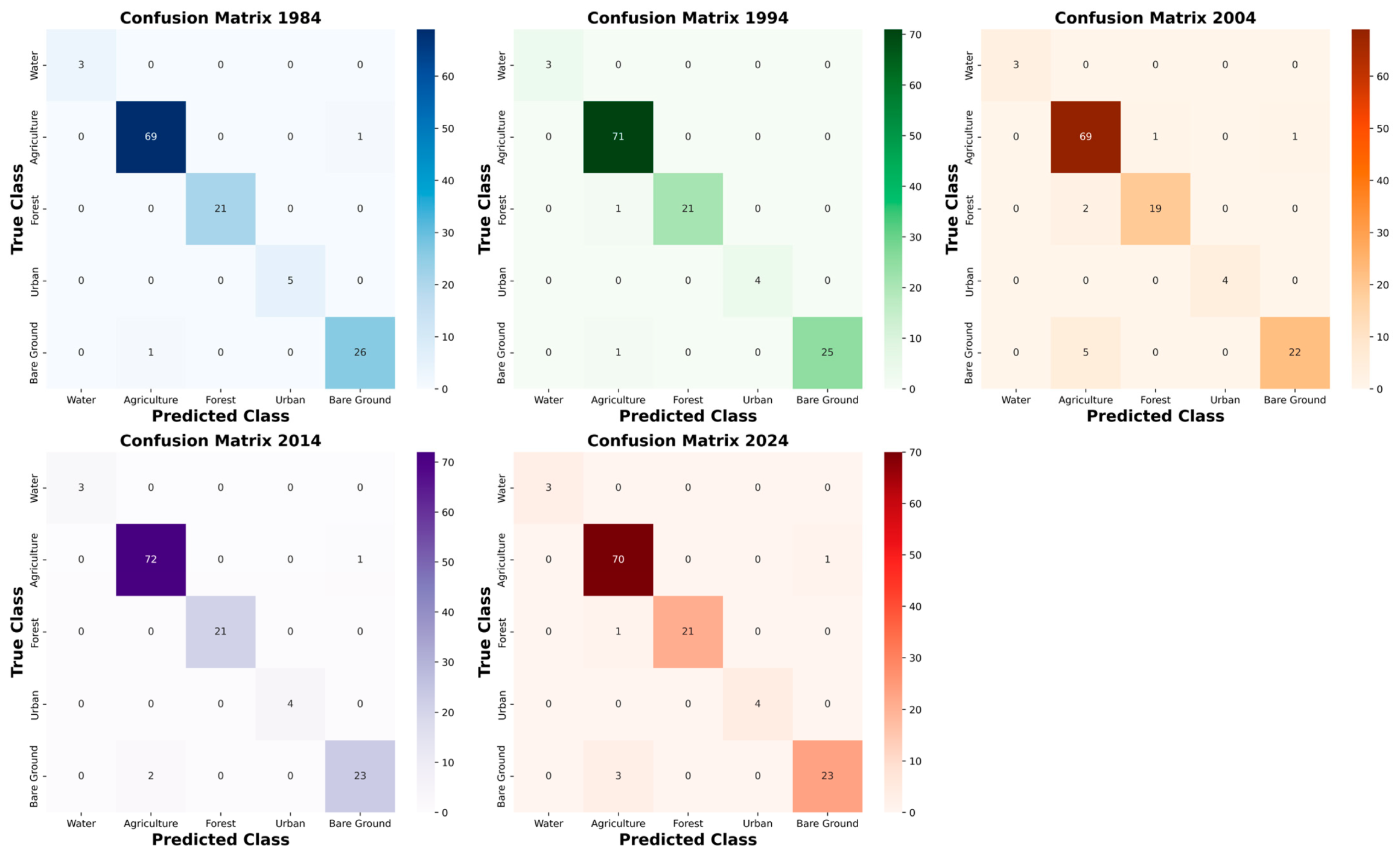
The classification process was performed on 30% of the dataset, corresponding to 126 training samples across five different land-use classes. The resulting confusion matrices demonstrate a robust and reliable classification, indicating that the model has effectively learned the spectral signatures of the different classes (Figure 5). These matrices exhibit high per-class accuracies, confirming that the model can accurately distinguish between key land-cover types. Overall, the results provide strong evidence that the trained model is capable of producing precise classifications and capturing the variability within the dataset, thereby validating its performance across the study area.
In addition, the Kappa index was also used in this evaluation process to assess the concordance between the classification elements, where the values obtained by this index could be classified into four distinct categories, according to the level of concordance and the link between the input data (Table 4) [62,63]. By evaluating the results obtained by the random forest classification of land use, we found that the classifications of five periods reveal very high indices, strictly greater than 0.81 (ranging from 0.88 to 0.93), which leads to report an excellent concordance and a good correlation between the input data and the results obtained (Table 3).

4.2. SUHI Modeling

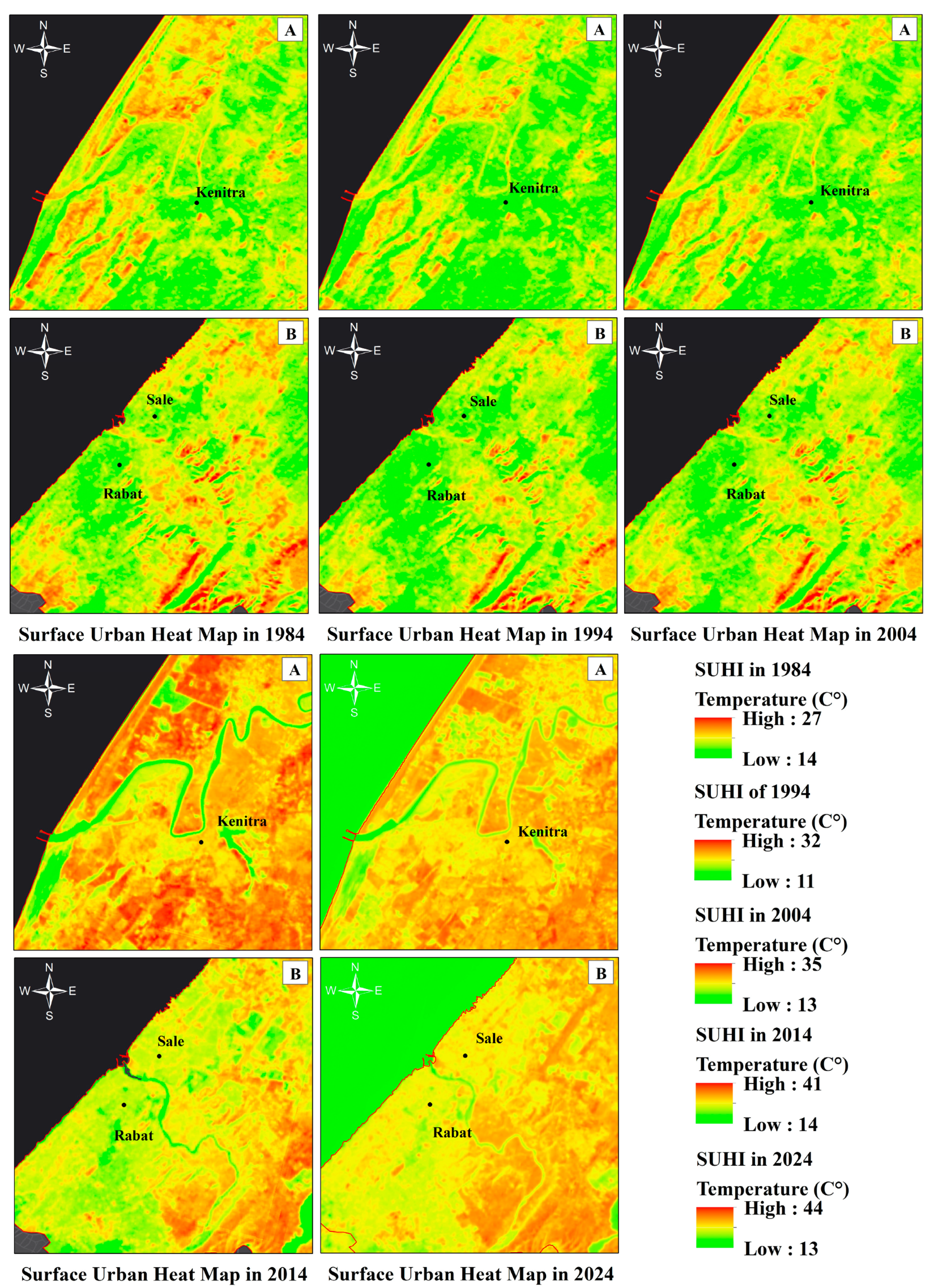
This study aims to analyze the LULC dynamics in one of the most dynamic regions in Morocco, focusing on the anomalies accompanying this dynamic, namely the physical variations in the environment, particularly in built-up areas or urbanized sectors. Using LU/LC maps obtained for the five studied periods (1984, 1994, 2004, 2014, and 2024), we observed that, over a total area estimated at 4200 km2 in the RSK region, urbanization was limited exclusively to three geographical units: the city center of Kenitra, Sale, and Rabat, with growing development over the studied period (Figure 3). Thanks to this urbanization rate in these three urban centers, which represent a case requiring study, we exploited the thermal bands of satellite images defined in the methodology section to deduce surface temperature variations over the study period and in parallel with urbanization dynamics, by developing SUHI maps (Figure 6).
Figure 6 presents 10 maps illustrating the spatial distribution of the SUHI in the city centers of Kenitra (“Figure 6A”), Rabat, and Sale (“Figure 6B”) for the five studied periods from 1984 to 2024. Analyzing surface temperature variations in these geographical units reveals a remarkable temperature increase, ranging from 14 to 27 °C in 1984, whereas by the end of 2024, temperatures reached up to 44 °C, representing the highest value over the 1984–2024 period (Figure 6). This surge is likely primarily driven by the observed urbanization rate and development during the same period.
Spatial analysis of surface heat island maps from 1984, 1994, and 2004 reveals that orange to red colors indicate the hottest areas, typically bare soils like beaches, wastelands, and built-up or urbanized areas, although with lower temperatures than bare soils (Figure 4 and Figure 6). This is likely due to the limited urbanization during these years, resulting in temperatures comparable to bare soils. Conversely, forests and agricultural lands exhibit lower temperatures, not exceeding 15 °C, as observed in the Maâmoura forest and surrounding agricultural areas near Kenitra (Figure 4 and Figure 6).
At first glance at the SUHI maps for 2014 and 2024, a quasi-total predominance of orange color was observed in the studied units, indicating a high temperature above 41 °C, unprecedented in previous years (Figure 6). In addition, these temperature levels have significantly affected new areas such as the cities of Sale, Rabat and its surroundings, as well as the city center of Kenitra, mentioning as areas with high surface temperature. It is obvious that we have previously mentioned that bare soils are the most affected by the absorption of solar rays which can lead to an increase in temperature. However, areas with high urbanization can also store heat through construction materials used in buildings and roads such as asphalt, concrete, etc., which are considered as elements favorable to receiving heat [64,65]. Based on this and also with the help of the LULC maps obtained which indicated an increase in urbanization at the level of these geographical units (Figure 4 and Figure 6), it can be noted that the increase in surface temperature within Rabat, Sale and the city of Kenitra is mainly caused by the explosion of urbanization during these last two decades and which leads to record a surface temperature varying between 41 and 14 degrees Celsius, knowing that the minimum value is just for the Bouregreg and Sebou rivers and lakes (Figure 6).
In terms of figures, Table 5 highlights, through clear variations, that the entire study area has experienced a significant and progressive increase in surface temperature over the past forty years, estimated at approximately 18 °C between 1984 and 2024. Moreover, the table below as well as the surface heat island maps indicate that these variations concern only the maximum temperature, which has shown a notable and continuous increase since 1984 (Table 5). In contrast, the minimum surface temperature has remained almost constant, varying only between 11 and 14 °C during the studied period (Table 5). This confirms the previous conclusions regarding the increase in surface temperature due to changes in land use.
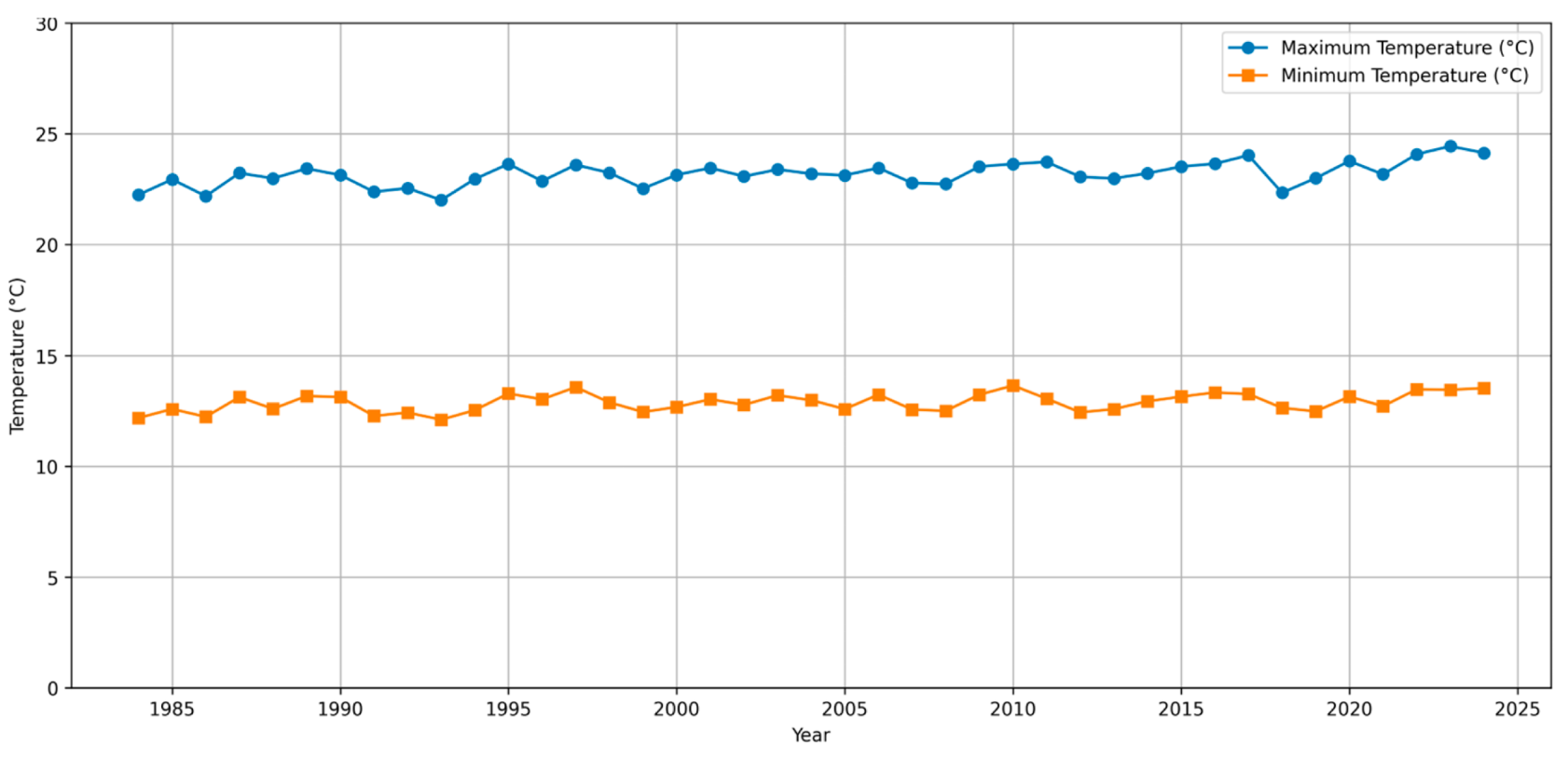
Climatic records indicate that the study area was not characterized by extreme thermal conditions during the investigated period. The maximum recorded temperature did not exceed 25 °C, while minimum temperatures ranged between 12 and 13 °C, reflect a relatively moderate thermal regime (Figure 7). Within this context, the spatial thermal variations identified in the SUHI maps cannot be attributed solely to regional climatic conditions. Notably, while the maximum recorded temperature remained below 25 °C, land surface temperatures locally reached up to 44 °C such as in 2024. This substantial discrepancy indicates that the observed thermal anomalies are predominantly driven by local-scale factors rather than background atmospheric conditions.
As we mentioned before, extensive research demonstrates that urbanization significantly alters the surface energy balance through soil sealing, reduced vegetation cover, and the widespread use of construction materials with high heat absorption and storage capacities, such as asphalt and concrete [25,26]. These materials are characterized by low albedo and high thermal inertia, promoting daytime heat accumulation and delayed nocturnal release, thereby intensifying the SUHI effect. The temporal analysis strengthens the interpretation of urbanization as a causal driver of warming. The progressive expansion of built-up areas corresponds closely with the increase in mean LST, indicating a cumulative thermal effect of land-cover conversion. This pattern aligns with empirical findings showing that SUHI intensity scales with urban extent and impervious surface fraction, particularly in rapidly developing regions [66,67].
Additionally, the geographical location of the study area on the Atlantic coast also played a key role in the variations in surface temperature and the distributions of heat islands (Figure 6). Indeed, the proximity to the Atlantic Ocean and the associated humidity strongly contribute to relatively mitigating these temperature degrees observed in the five studied periods, where this oceanic influence could explain why temperatures are relatively lower than those expected in an area located inland, thus highlighting the significant impact of geographical factors on the local climate.

5. Conclusions

Land Use/Land Cover changes and their associated impacts on LST constitute a major environmental challenge, particularly in rapidly transforming regions where urban expansion and landscape fragmentation intensify thermal anomalies. In this context, the present study aimed to analyze the spatiotemporal dynamics of LULC and the associated temperature variations in the RSK region over the past four decades (1984–2024), with a particular focus on identifying and mapping SUHI patterns.
To achieve these objectives, multi-temporal Landsat satellite imagery from different generations was processed and analyzed to produce representative LULC and SUHI maps for the years 1984, 1994, 2004, 2014, and 2024. The datasets were first corrected and preprocessed to improve spatial consistency and ensure the extraction of accurate spectral information. Supervised classification was then performed using the Random Forest algorithm, enabling the production of reliable land use maps and a consistent assessment of long-term landscape transformations. In parallel, thermal bands were exploited to estimate LST variations through the Mono-window method, allowing for the spatial characterization of heat islands within the study area.
The novelty and added value of this research lie in the integrated and long-term assessment of LULC dynamics and thermal behavior over a continuous 40-year period in the RSK region. Unlike previous studies that often focused on shorter time spans or addressed either land cover change or thermal dynamics separately, this study combines multi-generational Landsat data, machine learning classification, and thermal analysis to provide a comprehensive spatiotemporal evaluation of environmental change. This integrated approach offers a robust framework for understanding the interaction between urban growth and thermal anomalies at a regional scale.
The results of the applied approach indicate that the RSK region is characterized by an active dynamic involving five main land use classes: forests, bare soils, agricultural lands, urban areas, and water. The maps produced by the RF model show a notable increase in urbanized and forested areas during the study period, at the expense of agricultural lands and bare soils. Statistics for these classes also reveal that urban expansion is mainly concentrated around the centers of Kenitra, Sale, and Rabat, where the urbanized area reached 2.9% of the total area in 2024, compared to 1.8% in 1984. The evaluation of the model’s performance indicates that the RF model is particularly effective for this mapping. Indeed, the average values are very high, ranging between 0.90 and 0.96 for the AUC and between 0.85 and 0.93 for the Kappa index. These values demonstrate a high level of classification and a strong agreement between the results and the input data. Furthermore, the SUHI maps indicate a significant increase in surface temperature, particularly intense in highly urbanized areas, where it reached 44 °C in 2024. Variations in this parameter show that the RSK region experienced an average temperature increase of 18 °C between 1984 and 2024, mainly caused by urbanization.
The analysis of LULC in a given region, as well as the evolution of its physical parameters, constitutes an essential element of urban planning and public policies for the city. It makes it possible to better understand the spatial organization of the different land components and the dynamics that affect them. Through this approach, decision-makers are provided with a clear and structured vision that facilitates rational land management and a balanced distribution of land uses. This analysis thus contributes to the development of coherent planning schemes adapted to the needs of the daily lives of populations, while integrating contemporary social, economic, and environmental challenges.
Nevertheless, certain limitations should be acknowledged, including the moderate spatial resolution of Landsat imagery and potential uncertainties associated with atmospheric corrections and classification processes. Future research could benefit from the integration of higher-resolution satellite data, the incorporation of additional environmental variables (such as vegetation indices, albedo, or socio-economic indicators), and the application of advanced modeling techniques to better simulate future LULC and SUHI scenarios. Such developments would further strengthen the understanding of climate–land interactions and support sustainable territorial planning strategies in the RSK region.

Author Contributions

Conceptualization, S.A., A.Z., A.S., D.N.-S. and B.B.; methodology, S.A., A.S., D.N.-S. and B.B.; formal analysis, S.A., A.Z., H.L. and M.M.; investigation, S.A., H.L., B.B. and M.M.; data curation, S.A., A.S., H.L., D.N.-S. and M.M.; writing—original draft preparation, S.A., A.Z., A.S., D.N.-S. and B.B.; writing—review and editing, S.A., A.Z. and A.S. All authors have read and agreed to the published version of the manuscript.

Funding

This research received no external funding.

Institutional Review Board Statement

Not applicable.

Informed Consent Statement

Not applicable.

Data Availability Statement

All data are available from the corresponding authors upon reasonable request.

Conflicts of Interest

The authors declare no conflict of interest.

Abbreviations

The following abbreviations are used in this manuscript:
LU/LCLand Use/Land Cover
SUHISurface Urban Heat Islands
OLI Operational Land Imager
TMThematic Mapper
RFRandom Forest
LSTLand Surface Temperature
RSKRabat–Sale–Kenitra
ROC-AUCReceiver Operating Characteristic–Area Under Curve

References

  1. Change, I.C. Synthesis Report. A Report of the Intergovernmental Panel on Climate Change. Contribution of Working Groups I. II and III to the Sixth Assessment Report of the Intergovernmental Panel on Climate Change. 2023. Available online: https://www.ipcc.ch/report/ar6/syr/ (accessed on 4 March 2026).
  2. Rosenthal, J.K.; Kinney, P.L.; Metzger, K.B. Intra-urban vulnerability to heat-related mortality in New York City, 1997–2006. Health Place 2014, 30, 45–60. [Google Scholar] [CrossRef]
  3. Department of Economic and Social Affairs, United Nations. World Urbanization Prospects. Available online: https://population.un.org/wup/assets/WUP2018-Highlights.pdf (accessed on 4 March 2026).
  4. Gabriel, K.M.; Endlicher, W.R. Urban and rural mortality rates during heat waves in Berlin and Brandenburg, Germany. Environ. Pollut. 2011, 159, 2044–2050. [Google Scholar] [CrossRef]
  5. Haut-Commissariat au Plan (Maroc). RGPH Recensement Général de la Population et l’Habitat 2024. 2024. Available online: https://www.hcp.ma/Plateforme-interactive-du-RGPH-2024_a4026.html (accessed on 4 March 2026).
  6. Goeury, D. Maroc: De grandes divergences territoriales: À l’aune d’une décélération démographique. Popul. Avenir 2025, 773, 17–19. [Google Scholar] [CrossRef]
  7. Mazouz, M.; Mastere, M.; Ajjoul, S.; El Fellah, B. Le cycle de vie urbain et dynamiques de counter-urbanisation dans un contexte nord-africain: Cas du Maroc. Territoire en mouvement Revue de géographie et aménagement. Territ. Mov. J. Geogr. Plan. 2022, 52. [Google Scholar] [CrossRef]
  8. Mazouz, M.; Mastere, M.; Nel-Sanders, D.; Chaoui, G.; Allouche, A. Economic specialisation and complementarity dynamics in polycentric urban regions: A case study of the Rabat-Sale -Kenitraregion, Morocco. J. Urban Manag. 2025, 14, 1084–1098. [Google Scholar] [CrossRef]
  9. Chaoui, G.; Yaagoubi, R.; Mastere, M. Integrating geospatial technologies and multi-criteria decision analysis for sustainable and resilient urban planning. Chall. Sustain 2025, 13, 122–134. [Google Scholar] [CrossRef]
  10. Mastere, M.; Azguet, R.; Mekouar, S.; Nel-Sanders, D.; Ouchen, I.; El Ouali, A.; Pisa, P.F. Managing disaster risks in Moroccan Cities: Perceptions and preparedness with insights from the Rabat region. Int. J. Disaster Risk Reduct. 2025, 128, 105739. [Google Scholar] [CrossRef]
  11. Mastere, M.; Achbun, A.; El Fellah, B. Open Remote Sensing Image Classification Using NDVI and Thermal Bands. In Mapping and Spatial Analysis of Socio-Economic and Environmental Indicators for Sustainable Development: Case Studies from North Africa; Springer International Publishing: Cham, Switzerland, 2019; pp. 149–161. [Google Scholar]
  12. Spagnoli, L.; Mundula, L. Between urban and rural: Is agricultural parks a governance tool for developing tourism in the Periurban areas? Reflections on two Italian cases. Sustainability 2021, 13, 8108. [Google Scholar] [CrossRef]
  13. Zhang, X.; Estoque, R.C.; Murayama, Y.; Ranagalage, M. Capturing urban heat island formation in a subtropical city of China based on Landsat images: Implications for sustainable urban development. Environ. Monit. Assess. 2021, 193, 130. [Google Scholar] [CrossRef]
  14. Oke, T.R.; Cleugh, H.A. Urban heat storage derived as energy balance residuals. Bound.-Layer Meteorol. 1987, 39, 233–245. [Google Scholar] [CrossRef]
  15. Arnfield, A.J. Two decades of urban climate research: A review of turbulence, exchanges of energy and water, and the urban heat island. Int. J. Climatol. J. R. Meteorol. Soc. 2003, 23, 1–26. [Google Scholar] [CrossRef]
  16. Rizwan, A.M.; Dennis, L.Y. A review on the generation, determination and mitigation of Urban Heat Island. J. Environ. Sci. 2008, 20, 120–128. [Google Scholar] [CrossRef] [PubMed]
  17. Dahech, S.; Berriche, M.; Charfi, S. L’îlot de chaleur urbain à Gabès dans le contexte du changement climatique (Tunisie méridionale). Méditerranée Rev. Géographique Pays Méditerranéens/J. Mediterr. Geogr. 2025. [Google Scholar] [CrossRef]
  18. Li, L.; Ma, S.; Zheng, Y.; Xiao, X. Integrated regional development: Comparison of urban agglomeration policies in China. Land Use Policy 2022, 114, 105939. [Google Scholar] [CrossRef]
  19. Parsaee, M.; Joybari, M.M.; Mirzaei, P.A.; Haghighat, F. Urban heat island, urban climate maps and urban development policies and action plans. Environ. Technol. Innov. 2019, 14, 100341. [Google Scholar] [CrossRef]
  20. Passe, U.; Dorneich, M.; Krejci, C.; Koupaei, D.M.; Marmur, B.; Shenk, L.; Stonewall, J.; Thompson, J.; Zhou, Y. An urban modelling framework for climate resilience in low-resource neighbourhoods. Build. Cities 2020, 1, 453–474. [Google Scholar] [CrossRef]
  21. Loulad, S.; Nguyen, T.T.; Simou, M.R.; Rhinane, H.; Buerkert, A. Monitoring rural-urban transformation in the coastal region of Rabat-Sale-Kenitra, Morocco. PLoS ONE 2023, 18, e0290829. [Google Scholar] [CrossRef]
  22. Elhamdouni, S.; Idrissi, Y.; Cherkaoui, E.; Nounah, A.; Khamar, M. Dynamics of urbanization in the city of Rabat-Morocco, which sustainable transition? Civ. Environ. Eng. 2024, 20, 1140–1151. [Google Scholar] [CrossRef]
  23. Lambin, E.F.; Geist, H.J.; Lepers, E. Dynamics of land-use and land-cover change in tropical regions. Annu. Rev. Environ. Resour. 2003, 28, 205–241. [Google Scholar] [CrossRef]
  24. Seto, K.C.; Güneralp, B.; Hutyra, L.R. Global forecasts of urban expansion to 2030 and direct impacts on biodiversity and carbon pools. Proc. Natl. Acad. Sci. USA 2012, 109, 16083–16088. [Google Scholar] [CrossRef]
  25. Oke, T.R. The energetic basis of the urban heat island. Q. J. R. Meteorol. Soc. 1982, 108, 1–24. [Google Scholar] [CrossRef]
  26. IPCC. Climate Change 2022: Impacts, Adaptation and Vulnerability; Intergovernmental Panel on Climate Change: Geneva, Switzerland, 2022. [Google Scholar]
  27. Mastere, M.; Achbun, A.; El Fellah, S.; El Fellah, B. Multi-source object-based approach for spatio-temporal evolution of land cover. In Mapping and Spatial Analysis of Socio-Economic and Environmental Indicators for Sustainable Development: Case Studies from North Africa; Springer International Publishing: Cham, Switzerland, 2019; pp. 37–49. [Google Scholar]
  28. Hidalgo-García, D.; Arco-Díaz, J. Modeling the Surface Urban Heat Island (SUHI) to study of its relationship with variations in the thermal field and with the indices of land use in the metropolitan area of Granada (Spain). Sustain. Cities Soc. 2022, 87, 104166. [Google Scholar] [CrossRef]
  29. Kuchkorov, T.; Urmanov, S.; Kuvvatova, M.; Anvarov, I. Satellite image formation and preprocessing methods. In 2020 International Conference on Information Science and Communications Technologies (ICISCT); IEEE: New York, NY, USA, 2020; pp. 1–4. [Google Scholar]
  30. Sowmya, D.R.; Shenoy, P.D.; Venugopal, K.R. Remote sensing satellite image processing techniques for image classification: A comprehensive survey. Int. J. Comput. Appl. 2017, 161, 24–37. [Google Scholar] [CrossRef]
  31. Pinheiro, G.; Minz, S. Image quality evaluation of various pan-sharpening techniques using landsat-8 imagery. In Workshop on Mining Data for Financial Applications; Springer Nature: Singapore, 2022; pp. 391–403. [Google Scholar]
  32. Rokni, K. Investigating the impact of Pan Sharpening on the accuracy of land cover mapping in Landsat OLI imagery. Geod. Cartogr. 2023, 49, 12–18. [Google Scholar] [CrossRef]
  33. Hashim, F.; Dibs, H.; Jaber, H.S. Adopting gram-schmidt and brovey methods for estimating land use and land cover using remote sensing and satellite images. Nat. Environ. Pollut. Technol. 2022, 21, 867–881. [Google Scholar] [CrossRef]
  34. Nery, T.; Sadler, R.; Solis-Aulestia, M.; White, B.; Polyakov, M.; Chalak, M. Comparing supervised algorithms in Land Use and Land Cover classification of a Landsat time-series. In 2016 IEEE International Geoscience and Remote Sensing Symposium (IGARSS); IEEE: New York, NY, USA, 2016; pp. 5165–5168. [Google Scholar]
  35. Salata, S. The utilization of supervised classification sampling for environmental monitoring in Turin (Italy). Sustainability 2021, 13, 2494. [Google Scholar] [CrossRef]
  36. Avcı, C.; Budak, M.; Yağmur, N.; Balçık, F. Comparison between random forest and support vector machine algorithms for LULC classification. Int. J. Eng. Geosci. 2023, 8, 1–10. [Google Scholar] [CrossRef]
  37. Junaid, M.; Sun, J.; Iqbal, A.; Sohail, M.; Zafar, S.; Khan, A. Mapping lulc dynamics and its potential implication on forest cover in malam jabba region with landsat time series imagery and random forest classification. Sustainability 2023, 15, 1858. [Google Scholar] [CrossRef]
  38. Sbihi, A.; Mastere, M.; Sanders, D.N.; Ahamad, M.I.; Lu, S. In-Depth Analysis of Landslide Determinants and Susceptibility Assessment Using Machine Learning Models: Case Study of Bab Taza, Central Rif-Morocco. Earth Syst. Environ. 2026, 1–24. [Google Scholar] [CrossRef]
  39. Amini, S.; Saber, M.; Rabiei-Dastjerdi, H.; Homayouni, S. Urban land use and land cover change analysis using random forest classification of landsat time series. Remote Sens. 2022, 14, 2654. [Google Scholar] [CrossRef]
  40. Vahid, R.; Aly, M.H. A Comprehensive Systematic Review of Machine Learning Applications in Assessing Land Use/Cover Dynamics and Their Impact on Land Surface Temperatures. Urban Sci. 2025, 9, 234. [Google Scholar] [CrossRef]
  41. Zheng, Y.; Huang, X.; Yao, H. Towards Trustworthy Urban Land Use Classification: A Synergistic Fusion of Deep Learning and Explainable Machine Learning with a Nanning Case Study. Land 2026, 15, 158. [Google Scholar] [CrossRef]
  42. Talukdar, S.; Singha, P.; Mahato, S.; Pal, S.; Liou, Y.A.; Rahman, A. Land-use land-cover classification by machine learning classifiers for satellite observations. A review. Remote Sens. 2020, 12, 1135. [Google Scholar] [CrossRef]
  43. Ouma, Y.; Nkwae, B.; Moalafhi, D.; Odirile, P.; Parida, B.; Anderson, G.; Qi, J. Comparison of machine learning classifiers for multitemporal and multisensor mapping of urban LULC features. Int. Arch. Photogramm. Remote Sens. Spat. Inf. Sci. 2022, 43, 681–689. [Google Scholar] [CrossRef]
  44. Oke, T.R. The heat island of the urban boundary layer: Characteristics, causes and effects. In Wind Climate in Cities; Springer: Dordrecht, The Netherlands, 1995; pp. 81–107. [Google Scholar]
  45. USGS. 2013. Available online: https://www.usgs.gov/tools/spectral-characteristics-viewer (accessed on 4 March 2026).
  46. Barsi, J.A.; Schott, J.R.; Hook, S.J.; Raqueno, N.G.; Markham, B.L.; Radocinski, R.G. Landsat-8 Thermal Infrared Sensor (TIRS) Vicarious Radiometric Calibration. Remote Sens. 2014, 6, 11607–11626. [Google Scholar] [CrossRef]
  47. Fu, Q.; Johanson, C.M.; Wallace, J.M.; Reichler, T. Enhanced mid-latitude tropospheric warming in satellite measurements. Science 2006, 312, 1179. [Google Scholar] [CrossRef]
  48. Isaya Ndossi, M.; Avdan, U. Application of open-source coding technologies in the production of land surface temperature (LST) maps from Landsat: A PyQGIS plugin. Remote Sens. 2016, 8, 413. [Google Scholar] [CrossRef]
  49. Avdan, U.; Jovanovska, G. Algorithm for automated mapping of land surface temperature using LANDSAT 8 satellite data. J. Sens. 2016, 2016, 1480307. [Google Scholar] [CrossRef]
  50. Lucas Bonilla, M.; Nuevo-Gallardo, C.; Lorenzo Gallardo, J.M.; Montalbán Pozas, B. Urban Heat Islands: Their Influence on Building Heating and Cooling Energy Demand Throughout Local Climate Zones. Urban Sci. 2026, 10, 43. [Google Scholar] [CrossRef]
  51. Hidalgo García, D.; Rezapouraghdam, H.; Tahiri, M.; Rodríguez Bulnes, J.M.; López Cantero, R. Urban expansion and densification analysis of large Moroccan cities from 1994 to 2024: A case study of Rabat, Casablanca, and Marrakech. Environ. Plan. B Urban Anal. City Sci. 2025, 23998083251385281. [Google Scholar] [CrossRef]
  52. Thaiki, M.; Bounoua, L.; Cherkaoui Dekkaki, H. Using satellite data to characterize land surface processes in Morocco. Remote Sens. 2023, 15, 5389. [Google Scholar] [CrossRef]
  53. Ait El Haj, F.; Ouadif, L.; Akhssas, A. Monitoring land use and land cover changes using remote sensing techniques and the precipitation-vegetation indexes in Morocco. Ecol. Eng. Environ. Technol. 2023, 24, 272–286. [Google Scholar] [CrossRef] [PubMed]
  54. Zahra, L.; Hamid, B.; Mostafa, S. A Study of the urban dynamics of the city of Kenitra and its implications through the lens of remote sensing and survey data, Morocco. Multidiscip. Sci. J. 2025, 7, 2025424. [Google Scholar] [CrossRef]
  55. Naciri, M. L’aménagement de l’espace territorial au Maroc: Lieux d’autonomie et centralisation étatique. In Etats, Territoirs et Terroirs au Maghreb; CNRS: Paris, France, 1985. [Google Scholar]
  56. Adidi, A. De l’aménagement du territoire au développement territorial: Quelle transition et quelle articulation? In Proceedings of the 1ère Conférence Intercontinentale d’Intelligence Territoriale “ICI les Territoires, l’Intelligence, la Communication et l’Ingénierie Territoriales Pour Penser Ensemble le Développement des Territoires”, Gatineau, QC, Canada, 12–14 October 2011; p. 11. Available online: https://shs.hal.science/halshs-00960909v1 (accessed on 4 March 2026).
  57. Alillouch, R.; Lootvoet, B. «Régionalisation avancée» et rattrapage des politiques urbaines au Maroc. Eléments de réflexion à partir du projet d’aménagement du Bouregreg (Rabat-Salé) et du projet d’éco cité de Zenata (Grand Casablanca). Afr. Mediterr. J. Archit. Urban. 2020, 1–13. [Google Scholar] [CrossRef]
  58. Rachid, T. L’aménagement du territoire et la planification urbaine au Maroc: État des lieux et perspectives des nouveaux pôles urbains. مجلة دراسات في الاقتصاد وإدارة الأعمال/J. Stud. Econ. Business 2020, 3, 74–90. [Google Scholar]
  59. Mostafa, K.; Khalid, E.H.; Mostafa, C. L’expansion urbaine: Les facteurs, les enjeux environnementaux et spatiaux, cas de la ville de Kénitra. Espace Géographique Société Marocaine 2025, 1, 87–110. [Google Scholar]
  60. Elouali, A.; Hafidi Alaoui, S.; Kouzer, M.; Rahali, K. Le Marketing Territorial au Maroc, du projet partagé à la stratégie engagée: Cas de la Région Rabat Salé Kénitra (RSK). 2019. Available online: https://ideas.repec.org/p/pra/mprapa/97708.html (accessed on 4 March 2026).
  61. Benabdallah, N. Le renouvellement urbain de l’embouchure du Bouregreg: Contexte d’aménagement et approche adoptée. Afr. Mediterr. J. Archit. Urban. 2022, 107–122. [Google Scholar] [CrossRef]
  62. Mastere, M.; Sbihi, A.; El Ouali, A.; Bekkali, S.; Arab, O.; Nel Sanders, D.; Taj, B.; Ouchen, I.; Rebai, N.; Bounab, A. Statistical and geomatic approaches to typological characterization and susceptibility mapping of mass movements in Northwestern Morocco’s alpine zone. Geomatics 2025, 5, 51. [Google Scholar] [CrossRef]
  63. Landis, J.R.; Koch, G.G. The measurement of observer agreement for categorical data. Biometrics 1977, 33, 159–174. [Google Scholar] [CrossRef]
  64. De Mast, J. Agreement and kappa-type indices. Am. Stat. 2007, 61, 148–153. [Google Scholar] [CrossRef][Green Version]
  65. El Ghazouani, L.; Bounoua, L.; Nigro, J.; Mansour, M.; Radoine, H.; Souidi, H. Combining satellite data and spatial analysis to assess the UHI amplitude and structure within urban areas: The case of Moroccan cities. Urban Sci. 2021, 5, 67. [Google Scholar] [CrossRef]
  66. Zhou, D.; Zhao, S.; Liu, S.; Zhang, L.; Zhu, C. Surface urban heat island in China’s 32 major cities: Spatial patterns and drivers. Remote Sens. Environ. 2014, 152, 51–61. [Google Scholar] [CrossRef]
  67. Lachkham, M.A.; Bounoua, L.; Ed-dahmany, N.; Yacoubi Khebiza, M. Impact of Urbanization on Surface Temperature in Morocco: A Multi-City Comparative Study. Land 2025, 14, 1280. [Google Scholar] [CrossRef]
Figure 1. Location maps of Rabat-Sale-Kenitra (RSK) Region (A), the Provinces of the RSK Region (B), and the study area (C).
Urbansci 10 00237 g001
Figure 2. Research framework adopted for LULC and SUHI mapping in the RSK region.
Urbansci 10 00237 g002
Figure 3. Land Use/Land Cover of the RSK region’s provinces classified using Random Forest: (I). LULC 1984; (II). LULC 1994; (III). LULC 2004; (IV). LULC 2014; (V). LULC 2024—A. Kenitra City; B. Rabat & Sale City.
Urbansci 10 00237 g003
Figure 4. Statistics of the five land cover classes in the study area: (A) temporal evolution of the classes over the study period; (B) cumulative area of each class by year.
Urbansci 10 00237 g004
Figure 5. Confusion matrix of post-classification LULC classes using Random Forest for each year studied.
Urbansci 10 00237 g005
Figure 6. Surface Urban Heat Island Maps of the Study Area in 1984, 1994, 2004, 2014, and 2024; (A) Downtown Kenitra, (B) The intersection of Rabat and Sale provinces.
Urbansci 10 00237 g006
Figure 7. Annual Maximum and Minimum temperature of RSK provinces between 1984 and 2024.
Urbansci 10 00237 g007
Table 1. Sensor type, date of acquisition, and resolution of the used Landsat images.
YearSatelliteLevelAcquisition DateSpatial Resolution
(Before Gram Schmidt)
Spatial Resolution
(After Gram Schmidt)
1984Landsat 4—TMLevel 225 August 198430 m
1994Landsat 5—TM4 July 1994
2004Landsat 5—TM29 June 2004~15 m
2014Landsat 8—OLI12 August 2014
2024Landsat 9—OLI07 August 2024
Table 2. The variations in LU/LC class areas in the study area during the period 1984–2024.
RABAT–SALE–KENITRA
Class NameVariation 1984–2024 (%)Variation TypeActual Surfaces in 2024
Water+0.19%Increase56.0 km2 (1.3%)
Agricultural−3.05%Decrease2066.2 km2 (49.2%)
Forest+2.78%Increase687.0 km2 (16.4%)
Urban+1.08%Increase121.6 km2 (2.9%)
Bare Ground−1.00%Decrease1269.2 km2 (30.2%)
Table 3. The values of the RF performance evaluation models for LU/LC classification.
RF Classification by YearAUC Value (By ROC)Kappa Index
19840.960.93
19940.950.92
20040.900.85
20140.930.89
20240.920.88
Table 4. The categories of Kappa index concordance levels by [63] Landis & Koch, 1977.
Concordance LevelsKappa Index
Excellent>0.81
Good0.80–0.61
Moderate0.60–0.21
Very Poor<0.21
Table 5. Variations in minimum and maximum temperatures in the study area during the period 1984–2024.
RABAT–SALE–KENITRA
YearTemperature Max (°C)Temperature Min (°C)Variation with 1984
19842714-
19943211Increase (+5 °C)
20043513Increase (+8 °C)
20144114Increase (+14 °C)
20244413Increase (+18 °C)
Disclaimer/Publisher’s Note: The statements, opinions and data contained in all publications are solely those of the individual author(s) and contributor(s) and not of MDPI and/or the editor(s). MDPI and/or the editor(s) disclaim responsibility for any injury to people or property resulting from any ideas, methods, instructions or products referred to in the content.