
Article

Implications of CMIP6 GCM-Based Climate Variability for Photovoltaic Potential over Four Selected Urban Areas in Central and Southeast Europe During Summer (1971–2020)

by
Erzsébet Kristóf
1,2,* and
Tímea Kalmár
1,3
1
Department of Meteorology, Institute of Geography and Earth Sciences, ELTE Eötvös Loránd University, Pázmány Péter sétány 1/A, H-1117 Budapest, Hungary
2
Restoration Ecology Group, Institute of Ecology and Botany, HUN-REN Centre for Ecological Research, Alkotmány utca 2-4, H-2163 Vácrátót, Hungary
3
Institute of Atmospheric Physics of the Czech Academy of Sciences, Boční II/1401, 141 00 Prague, Czech Republic
*
Author to whom correspondence should be addressed.
Urban Sci. 2026, 10(4), 204; https://doi.org/10.3390/urbansci10040204
Submission received: 2 February 2026 / Revised: 15 March 2026 / Accepted: 17 March 2026 / Published: 5 April 2026

Abstract

In the last two decades, the utilization of solar energy has been growing rapidly worldwide, mainly due to the increasing adoption of photovoltaic (PV) systems. Since solar energy is one of the most weather-dependent renewable energy sources, an increasing number of meteorological studies have focused on PV potential (PVpot) and its projected changes under global warming. GCM outputs disseminated through the Coupled Model Intercomparison Project (CMIP) are often applied in energy-related urban climate studies, as they can be downscaled either statistically or dynamically. It is essential to evaluate raw (not bias-corrected) GCM data, which helps to determine the uncertainties in the GCM simulations before downscaling. Despite their coarse resolution, some studies even rely directly on the GCM grid cell time series to represent individual locations. Accordingly, this study evaluates 10 CMIP Phase 6 (CMIP6) GCMs with respect to some atmospheric variables (air temperature, solar radiation, and wind speed, which are the primary drivers of PVpot) in four lowland grid cells representing four major urban areas in Central and Southeast Europe: Belgrade (Serbia), Budapest (Hungary), Vienna (Austria), and Prague (Czechia). The use of solar energy has increased significantly in most of these regions in recent years; however, it remains less studied than in Western Europe. ERA5 reanalysis is used as the reference dataset. We analyzed the boreal summer (JJA) days of three overlapping 30-year time periods: 1971–2000, 1981–2010, and 1991–2020. Our main findings are as follows: GCMs tend to overestimate solar radiation and underestimate maximum near-surface air temperature relative to ERA5 in all time periods and in all the four urban areas, which leads to a significant overestimation of the number of JJA days with high PVpot (PVpot,90). PVpot,90 is increasing from 1971–2000 to 1991–2020 in the vast majority of GCMs, in all the four regions. EC-Earth3 and its different configurations (EC-Earth3-Veg, EC-Earth3-CC) are considered the most accurate GCMs relative to ERA5.

1. Introduction

Due to rising prices and the depletion of fossil fuels, as well as the need to meet climate protection goals such as those outlined in the Paris Agreement [1], renewable energy sources are gaining increasing importance [2]. For example, the commitment of the European Union (EU) to renewable energy is evident in its target to achieve a 42.5% share of renewables in its energy mix by 2030 according to the Renewable Energy Directive EU/2023/2413 [3]. Solar energy is the most abundant renewable resource worldwide, which can be utilized to some extent in all regions of the Earth, including the polar regions [4,5].
In recent years, significant developments in solar energy have taken place worldwide. In 2024, the photovoltaic (PV) sector recorded another year of unprecedented growth [6]. According to the latest International Renewable Energy Agency (IRENA) report [7], the global installed PV capacity exceeded 1.8 TW in 2024, with Asia and Europe as the two leading markets, accounting for approximately 60% and 20% of the global PV capacity, respectively. In 2024, Germany, Spain, and Italy were the leading European countries in the use of solar energy [7]. However, the PV market is also emerging in the eastern part of Central Europe. In 2024, the installed PV capacity reached 8.5 GW in Austria, 4.2 GW in Czechia, and 7.7 GW in Hungary [7]. Hungary—where solar energy can theoretically generate the highest amount of the renewable electricity [8]—has the highest share of PV electricity in the electricity mix globally (24.6%) [6]. Meanwhile Austria and Hungary rank 3rd and 9th, respectively, in installed PV capacity per capita among the EU-27 member states [9]. According to governmental energy strategies, Czechia, Hungary, and Austria have ambitious plans to further increase installed PV capacity in the near future: to 7 GW by 2030 in Czechia [10], and to 12 GW by 2030 in Hungary [11]. In Austria, achieving carbon neutrality would require increasing installed PV capacity to 41 GW by 2040 [12]. Serbia, a non-EU country, also plans to increase its installed PV capacity [13]. Therefore, assessing PV potential (PVpot) in Central and Southeast Europe is an important task.
PV systems exhibit vulnerability to climate change impacts, such as changes in the mean values of atmospheric variables (i.e., near-surface air temperature (tas), surface downwelling shortwave radiation (rsds), near-surface wind speed (wsp), and near-surface humidity), making the assessment of their performance under changing climatic conditions an important research topic in the field of renewable energy [14]. For that purpose, analyzing outputs from different generations of general circulation models (GCMs) disseminated through the different phases of the Coupled Model Intercomparison Project (CMIP) has gained increasing popularity in recent years. Several studies have assessed PVpot on global or continental scales by analyzing GCM simulation outputs from CMIP3 [15,16], CMIP5 [17], and CMIP6 [18,19]. On a global scale, [20] compared CMIP5 and CMIP6 simulation outputs under various future scenarios and found that CMIP6 GCMs show slightly better performance than their previous versions in CMIP5. At the regional scale, [21,22] explored CMIP6 projections for China, while [23] focused on Northern Europe. GCMs are also used to analyze PVpot for individual locations, such as the Canary Islands [24].
While numerous previously mentioned studies have discussed PVpot analysis, the majority have concentrated on the future trends and paid relatively little attention to the validation of PVpot. For example, [18] found that CMIP6 GCMs underestimate tas, slightly overestimate rsds and underestimate wsp in Central Europe compared to ERA5, but they did not mention the evaluation of PVpot itself. There are several studies evaluating atmospheric variables in GCM simulations. According to [25], CMIP6 GCMs underestimate maximum near-surface air temperature (tasmax) in Europe compared to ERA5 reanalysis. Li et al. [26] assessed the surface energy budget of CMIP6 GCMs at the regional scale and found that most GCMs overestimate rsds in Eurasia. He et al. [27] found that GCMs overestimate rsds in Europe mainly in summer, and that the EC-Earth3 and its different configurations (EC-Earth3-Veg and EC-Earth3-CC) showed the best agreement with rsds measurements. The study by [28] showed a lack of agreement among CMIP6 GCM simulations in representing wsp over Europe, with some GCMs overestimating and others underestimating the observed values. In contrast, [29] found a clear underestimation of wsp by the CMIP6 GCMs in Europe.
GCMs cannot reliably reproduce regional climate; therefore, GCMs are often the subject of statistical or dynamical downscaling, e.g., Ref. [30]. Machine learning-based downscaling methods are already well established in renewable energy research [31]. However, in some cases, biases inherent in the driving of GCMs can propagate into downscaled simulations, as errors may be transferred from the coarse GCM grid to the finer regional grid [32]. In other cases, GCM and RCM tendencies may differ from each other [30]. Consequently, choosing the best-performing GCMs relative to a reference dataset is also essential for downscaling.
Since there are a limited number of climatological studies on PVpot in the eastern part of Central Europe, see, e.g., Refs. [21,33,34] and in Southeast Europe [35], this study aims to analyze raw time series at a small number of GCM grid cells in this region. These grid cells are characterized by relatively similar low-elevated topography (thus, terrain smoothing by GCMs is less important) and climatic conditions, corresponding to the Cfa/Dfa (humid subtropical/hot-summer humid continental) and the Cfb/Dfb (temperate oceanic/warm-summer humid continental) climate types according to the Köppen–Geiger classification. GCM simulation outputs are examined over 30-year time periods between 1971 and 2020 to assess the ability of the GCMs to reproduce meteorological variables that primarily affect PVpot. The most accurate GCMs relative to the ERA5 reanalysis will be selected as potential candidates for future dynamical downscaling.
The paper is organized as follows: Section 2 describes the study locations, the data, and the methods used in this study; Section 3 presents our results, including the evaluation of the temporal variability of the meteorological variables (tasmax, rsds, and wsp) and PVpot. Section 4 presents the discussion and conclusions, along with suggestions for future research.

2. Materials and Methods

2.1. The Study Locations

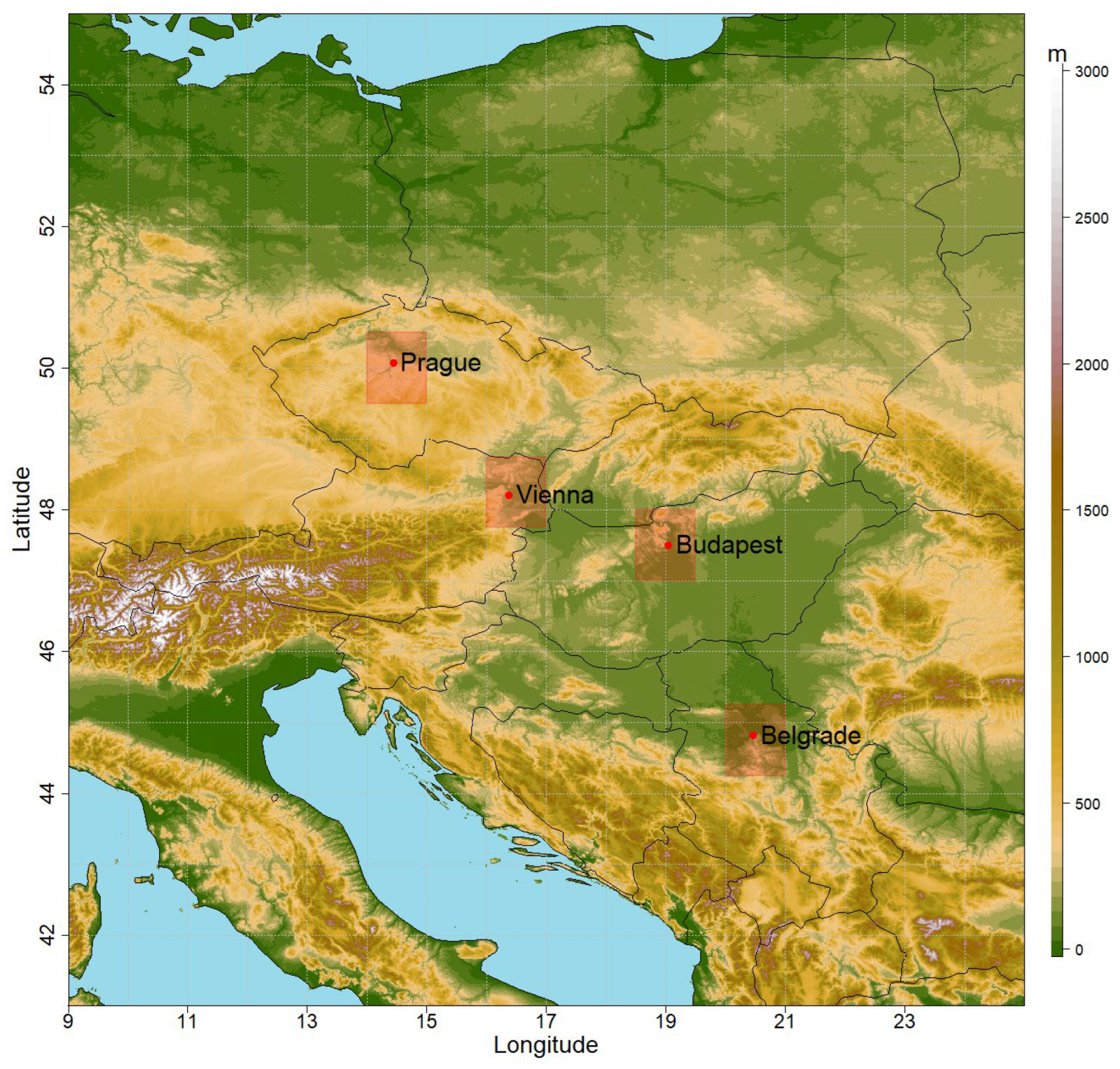
The selected GCM grid cells located in lowland areas cover densely populated urban areas. For simplicity, each selected GCM grid cell is hereafter referred to by the name of the major city located within it. However, a GCM grid cell—covering an area of 1.25° × 1.25°—cannot be considered to accurately represent the city itself. The coordinates and labels of the GCM grid cells from southeast to northwest are as follows: 44.75° N and 20.5° E, Belgrade (Serbia), 47.5° N and 19° E, Budapest (Hungary), 48.25° N and 16.5° E, Vienna (Austria), and 50° N and 14.5° E, Prague (Czechia), as shown in Figure 1. Belgrade and Budapest have Cfa/Dfa climate types, while Vienna and Prague have Cfb/Dfb climate types according to the Köppen–Geiger classification.
Because the selected grid cells are located in lowlands, there is no distortion due to terrain smoothing by GCMs. This approach helps to avoid masking meaningful spatiotemporal variability. Furthermore, the selection of the GCM grid cells minimizes the influence of complex, mountainous terrain that cannot be adequately resolved by GCMs.
All selected locations are characterized by transitional climatic position between Atlantic maritime influences from the west and continental air masses from Eastern Europe and Eurasia. This transitional setting results in seasonal variability in temperature, precipitation, and shortwave solar radiation, which are further modified by local topography and urban effects [36]. These metropolitan areas show the climatic gradient within Central and Southeast Europe, from increasingly continental and subtropical influences in Belgrade and Budapest to more oceanic conditions in Vienna and Prague. This climatic gradient strongly influences regional climate variability and sensitivity to climate change, particularly with respect to rising temperatures and changing precipitation regimes observed over recent decades [37].
Belgrade is located further southeast, at the confluence of the Sava and Danube rivers, where continental and subtropical influences overlap. This is the warmest and wettest metropolitan area in the study, with an average temperature of ~23 °C in July and annual precipitation of ~700 mm. Precipitation maxima typically occurring in late spring and early summer. The area experiences more than 2000–2100 sunshine hours annually, which is the highest value among the four locations [38]. Budapest is situated in the central part of the Carpathian Basin. Precipitation has a summer maximum linked to convective activity, while the annual total of sunshine duration exceeds 2000 h [39].
Vienna is located at the eastern margin of the Alps, along the Danube Valley, where Atlantic and continental influences interact. Summers are moderate, and precipitation is distributed evenly throughout the year. The sunshine duration is approximately 1900 h annually [40]. Prague is located in the Bohemian Basin. Precipitation maxima occur in summer and are linked to frontal and convective systems. The annual sunshine duration in Prague is ~1700 h [41], which is the lowest value among the four locations.
Figure 1. Topography map of Central and Southeast Europe based on GMTED2010 elevation data (m) [42]. The four examined GCM grid cells are indicated by red squares. For simplicity, these are referred to by the names of the major cities located within them, which are marked with red dots.
Urbansci 10 00204 g001

2.2. Data

2.2.1. CMIP6 GCMs

Daily data of the 10 GCMs from CMIP6 [43] were downloaded for the time period 1971–2020 from the ESGF node (https://esgf-node.ornl.gov/; last accessed on 30 January 2026). The list of GCMs can be found in Table 1.
Only GCMs with a horizontal resolution finer than 1.25° × 1.25° were included in the analysis. The GCM outputs were bilinearly interpolated to the exact geographic coordinates of the four selected locations (labelled as Belgrade, Budapest, Vienna, and Prague), obtaining one time series per location. These four time series were examined in this study.
The following three overlapping 30-year time periods were examined: 1971–2000, 1981–2010, and 1991–2020. For this purpose, historical GCM simulation outputs were used between 1971 and 2014. Although, the historical time period extends to 2014 for the CMIP6 GCMs, the current climatical normal is 1991–2020 [44]. Therefore, SSP2-4.5 and SSP5-8.5 [45] simulation outputs were applied for the time period 2015–2020. Accordingly, two versions of the 1991–2020 time period are considered hereafter referred to as 1991–2020 (SSP2-4.5) and 1991–2020 (SSP5-8.5). Only boreal summer days were considered in the analysis, corresponding to June, July, and August (30 + 31 + 31 = 92 days), hereinafter referred to as JJA days, resulting in a total of 92 × 30 = 2760 daily values for each time period and for each city.
The following variables were examined (their short names and units are given in parentheses): the maximum near-surface air temperature (tasmax, K; converted to °C), the surface downwelling shortwave radiation (rsds, W/m2), and the eastward and the northward near-surface wind components (uas and vas, m/s). Near-surface wind speed (wsp, m/s) was calculated as the square root of the sum of the squared wind components according to Equation (1):
w s p = u a s 2 + v a s 2 .
Table 1. List of the GCMs and their components used in this study. The number of vertical levels is in parentheses regarding the atmospheric and ocean model components. This information was obtained from the metadata of the GCM NetCDF files and from the CMIP6 source ID repository (https://wcrp-cmip.github.io/CMIP6_CVs/docs/CMIP6_source_id; last accessed on 30 January 2026).
GCMDeveloperOriginal Horizontal Resolution
(Lat × Lon)
Model Components
AtmosphericAerosolAtmospheric ChemistryLand
Surface
Land
Ice
OceanOcean
Biogeochemistry
Sea
Ice
BCC-CSM2-MR
[46]
CHN~1.12° × 1.13°BCC-AGCM3-MR (46)--BCC_AVIM2 -MOM4
(40)
-SIS2
CMCC-CM2-SR5
[47]
ITA~0.94° × 1.25°CAM5.3
(30)
MAM3-CLM4.5
(BGC mode)
-NEMO3.6
(50)
-CICE4.0
CMCC-ESM2
[48]
ITA~0.94° × 1.25°CAM5.3
(30)
MAM3-CLM4.5
(BGC mode)
-NEMO3.6
(50)
BFM5.1 CICE4.0
EC-Earth3
[49]
EU~0.7° × ~0.7°IFS cy36r4
(91)
--HTESSEL-NEMO3.6
(75)
-LIM3
EC-Earth3-Veg
[49]
EU~0.7° × ~0.7°IFS cy36r4
(91)
--HTESSEL,
LPJ-GUESS v4
-NEMO3.6
(75)
-LIM3
EC-Earth3-CC
[49]
EU~0.7° × ~0.7°IFS cy36r4
(91)
-TM5HTESSEL,
LPJ-GUESS v4
-NEMO3.6
(75)
PISCESv2
LIM3
GFDL-CM4
[50]
USA1° × 1.25°GFDL-
AM4.0.1 (33)
inter
active
-GFDL-
LM4.0.1
GFDL-LM4.0.1 GFDL-OM
4p25 (75)
GFDL
BLINGv2
GFDL-SIM4p25
GFDL-ESM4
[51]
USA1° × 1.25°GFDL-
AM4.1 (49)
inter-
active
GFDL-ATM
CHEM4.1
GFDL-
LM4.1
GFDL-LM4.1
GFDL-OM
4p5 (75)
GFDL-
COBALTv2
GFDL-SIM4p5
MPI-ESM1-2-HR
[52]
GER~0.94° × ~0.94°ECHAM6.3
(95)
prescribed MACv2-SP -JSBACH
3.20
none/
pre-
scribed
MPIOM
1.63 (40)
HAMOCC6 unnamed
MRI-ESM2-0
[53]
JPN~1.12° × 1.13°MRI-AGCM
3.5 (80)
MASINGAR mk2r4MRI-
CCM2.1
HAL1.0 -MRI.COM4.4
(61)
MRI.
COM4.4
MRI.
COM4.4

2.2.2. Reanalysis Datasets: ERA5 and ERA5-Land

ERA5 [54] was used as the reference dataset, and ERA5-Land [55] was also evaluated against it. ERA5 is the fifth-generation atmospheric reanalysis produced by ECMWF within the Copernicus Climate Change Service. It provides a globally consistent dataset of atmospheric, land, and ocean variables by combining numerical weather prediction models with a wide range of observations. ERA5 has a horizontal resolution of about 31 km (0.25°), covers the time period from 1950 to present, and is available at hourly and daily temporal resolutions. Daily values were downloaded from https://cds.climate.copernicus.eu/datasets/derived-era5-single-levels-daily-statistics (last accessed on 30 January 2026).
ERA5-Land is a land-only reanalysis dataset derived from ERA5, designed to provide a more detailed representation of land-surface processes. ERA5-Land uses the same atmospheric forcing as ERA5 but is produced with an enhanced land surface model. ERA5-Land has a higher spatial resolution of approximately 9 km (0.1°) and focuses on variables such as soil moisture, soil temperature, snow, evaporation, and surface fluxes. Like ERA5, ERA5-Land is available at daily resolution from https://cds.climate.copernicus.eu/datasets/derived-era5-land-daily-statistics (last accessed on 30 January 2026).
For each city, the nearest grid cell and its surrounding neighbours were selected, and their spatial mean values were calculated. By computing these spatial means, representative time series were obtained for the areas comparable to the GCM grid cells (1.25° × 1.25°) derived from the interpolated GCM outputs.
The following ERA5/ERA5-Land variables were downloaded, corresponding to the variables available for the GCMs: the maximum air temperature at 2 m based on the hourly air temperature at 2 m (t2m, K), the surface downwelling shortwave radiation (ssrd, originally provided in J/m2), and the eastward and northward wind components at 10 m (u10 and v10, m/s). The variables u10 and v10 were compared with the corresponding GCM variables uas and vas. Wind speed (wsp) was calculated according to Equation (1). The variables ssrd and t2m were converted to W/m2 and °C, respectively, to ensure comparability with rsds and tasmax. Henceforth, the abbreviations tasmax, rsds, uas, and vas will be used for the atmospheric variables.
Climate Data Operator (CDO; https://code.mpimet.mpg.de/projects/cdo; last accessed on 30 January 2026) software (version 2.5.0) was used for data preprocessing, while all subsequent data analysis and visualization were conducted in R programming language [56].

2.3. Evaluation Methods for GCMs

2.3.1. Distribution-Based GCM-Evaluation Using Daily Atmospheric Variables Influencing PVpot

At first, a probability distribution-based comparison was carried out between the GCMs and the ERA5-Land relative to ERA5 for each calendar day (N = 92 days for JJA), for each atmospheric variable, location, and time period. For each calendar day, empirical distributions were constructed from the corresponding 30-year time series. The distributions of the GCM simulations and the reanalyses were then compared using the Wasserstein distance of order 1 ( W 1 ) [57] defined by Equation (2) as follows:
W 1 F N , G N = R F N x G N ( x ) d x ,           x R ,
where F N and G N denote the empirical cumulative distribution functions (ECDFs) of the GCM simulations (or ERA5-Land) and ERA5, respectively. All observations were equally weighted in the ECDFs.
In general, the Wasserstein distance measures the “optimal transport cost” required to transform one distribution into another [58]. Thus, the value of zero indicates perfect match with the distribution of ERA5. The Wasserstein distance was computed using the wasserstein1d function implemented in the R package transport [59].
The comparison of the distributions resulted in a total of 92 distance matrices, corresponding to the 92 JJA days, for each variable, location, and time period. To summarize these results, the Wasserstein distances were averaged over the 92 JJA days for each GCM–ERA5 and ERA5-Land–ERA5 comparison.

2.3.2. Mean Seasonal Courses-Based GCM-Evaluation of Daily Atmospheric Variables Relevant to PVpot

The mean seasonal (JJA) courses of the atmospheric variables were examined by computing the mean values for each JJA day over the 30-year time periods, hereinafter referred to as mean daily values. This procedure provides time series for each GCM and reanalysis consisting of 92 values for each variable, location, and time period. The mean seasonal courses of the GCMs and the ERA5-Land were compared against the ERA5 computing Pearson correlation coefficients (r) and the ratio of standard deviations (sd ratio). The latter is defined as the ratio of the standard deviation of the given GCM (or ERA5-Land) time series to the standard deviation of ERA5.
The r compares the shape of the mean seasonal courses of the GCMs (and the ERA5-Land) against the ERA5, where r = 1 means perfect (linear) correlation, while r = –1 means perfect inverse (linear) correlation. The sd ratio quantifies the variability of the mean seasonal courses. If sd ratio = 1 for a given GCM or the ERA5-Land, then it captures the same variability as ERA5. Both r and the sd ratio are dimensionless; therefore, those are directly comparable across variables, despite the variables having different physical units.

2.3.3. PVpot-Based GCM-Evaluation

The mean daily PVpot values were calculated from the mean daily values of tasmax, rsds, and wsp for monocrystalline silicon PV module using the energy rating method based on Equation (3) [60]:
P V p o t = P R · r s d s   [ W / m 2 ] 1000   [ W / m 2 ] .
The rsds (W/m2) represents the surface downwelling shortwave radiation reaching PV modules under field conditions. The rsds is divided by 1000 W/m2, i.e., the rsds incidents on the PV module under standard test conditions (STC). The PR (performance ratio) is a dimensionless metric that can be calculated using Equation (4):
P R = 1 γ [ ° C 1 ] · T c e l l [ ° C ] 25 [ ° C ] ,
where Tcell is the temperature of the PV module under field conditions (°C), from which 25   ° C —corresponding to the T c e l l under STC—is subtracted. The γ is an efficiency factor [61], whose value for monocrystalline silicon PV module is 0.005 °C−1.
The Tcell was calculated based on the regression formula (Equation (5)) provided by TamizhMani et al. [62] for monocrystalline silicon PV module:
T c e l l = 0.942 · T a   ° C + 0.028 ° C · W 1 · m 2 · r s d s W m 2 1.509 ° C · m 1 · s · w s p m · s 1 + 3.9 ° C ,
where Ta denotes air temperature, for which tasmax is used in this study.
In this study, PVpot was used as a simplified climate-based indicator to compare GCMs against the reference dataset (ERA5), rather than as an estimate of actual PV electricity production. This means that Equations (3)–(5) do not account for site-specific factors affecting the actual PV electricity production, such as inverter losses, panel inclination, panel orientation, spectral response, or system configuration. The PVpot formulation is intended to capture the influence of key meteorological variables (tas or tasmax, rsds, and wsp) on PV performance.
According to Equations (3)–(5), PVpot increases with increasing rsds and PR. The PR increases with decreasing Ta. Higher rsds—e.g., due to reduced cloud cover or lower aerosol concentration—generally enhances PVpot; however, rsds also increases Tcell, which leads to a reduced PR; therefore, lower PVpot. The wsp lowers Tcell, consequently, increasing wsp increases PVpot.
Finally, the GCMs were evaluated based on the number of days with high PVpot (PVpot,90) following the concept of Feron et al. [17]. To calculate PVpot,90, the base value was defined as the 90th percentile of the 92 ERA5 mean daily PVpot values for 1971–2000, for each location. The mean daily PVpot values from the GCMs and ERA5-Land were compared against these location-specific base values for each time period. If the PVpot values exceed the base value on more (less) than 10 days within the selected time period and location, the given GCM or ERA5-Land overestimates (underestimates) the frequency of PVpot,90 relative to ERA5 (1971–2000). Thus, the base value is fixed for each location as the 90th percentile of the 92 ERA5 mean daily PVpot values for 1971–2000.

3. Results

3.1. GCM-Performance Based on Distributions of Daily Atmospheric Variables Relevant to PVpot

Differences between the probability distributions of daily atmospheric variables derived from the GCMs (and ERA5-Land) relative to ERA5 were quantified using Wasserstein distance of order 1. These distances were computed for each calendar day (JJA) and subsequently averaged over the 92 JJA days for each time period and location.
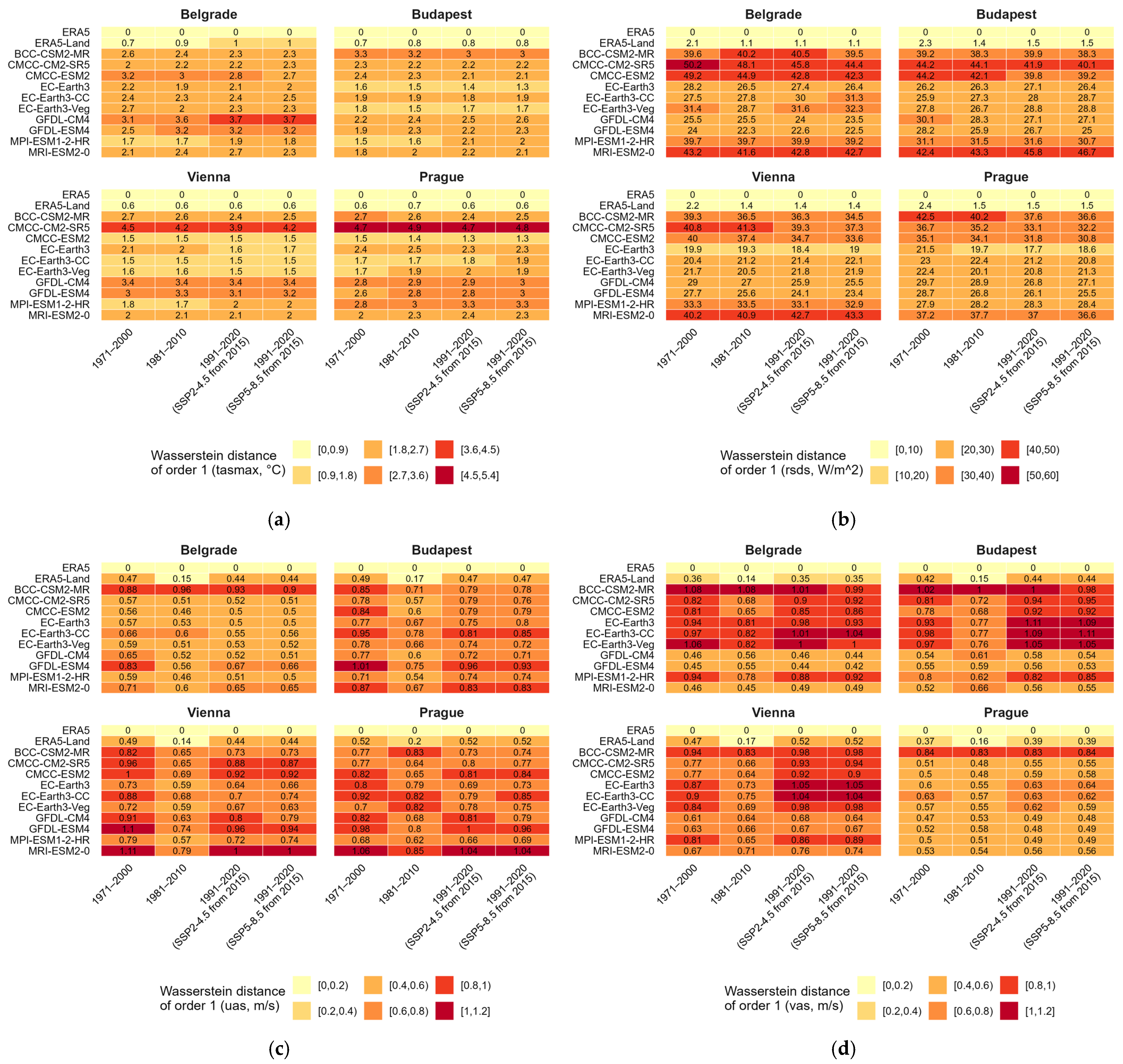
According to Figure 2, no distinct improvement or deterioration in GCM performance relative to ERA5 can be identified over time. In cases of tasmax and rsds, Wasserstein distances remain broadly similar across the analyzed time periods, indicating that the agreement between GCM simulations and ERA5 does not change substantially over time (Figure 2a,b). However, a slight improvement can be observed for uas and vas during 1981–2010 compared to the other time periods (Figure 2c,d). In addition, GCM performance is very similar for the two scenarios in the most recent time period (1991–2020 SSP2-4.5 and SSP5-8.5).
Spatial differences among the four locations are more pronounced than temporal differences. However, no systematic patterns are observable with respect to the variables, except for rsds. The Wasserstein distances for rsds tend to decrease from southeast to northwest across the four locations (Figure 2b). Wasserstein distances have similar ranges for uas and vas; however, even individual GCMs do not exhibit consistent performance between uas and vas across the locations (Figure 2c,d).
Based on the magnitude of the Wasserstein distances for tasmax and rsds, ERA5-Land shows greater similarity to ERA5 than the GCM simulations (Figure 2a,b). This advantage of the ERA5-Land is less pronounced for uas and vas (Figure 2c,d).
Table 2 summarizes the mean Wasserstein distances of the 10 GCMs relative to ERA5 to evaluate GCM performance. The relatively stable values across the analyzed time periods indicate that the differences between the GCM simulations and the ERA5 remain constant over time.
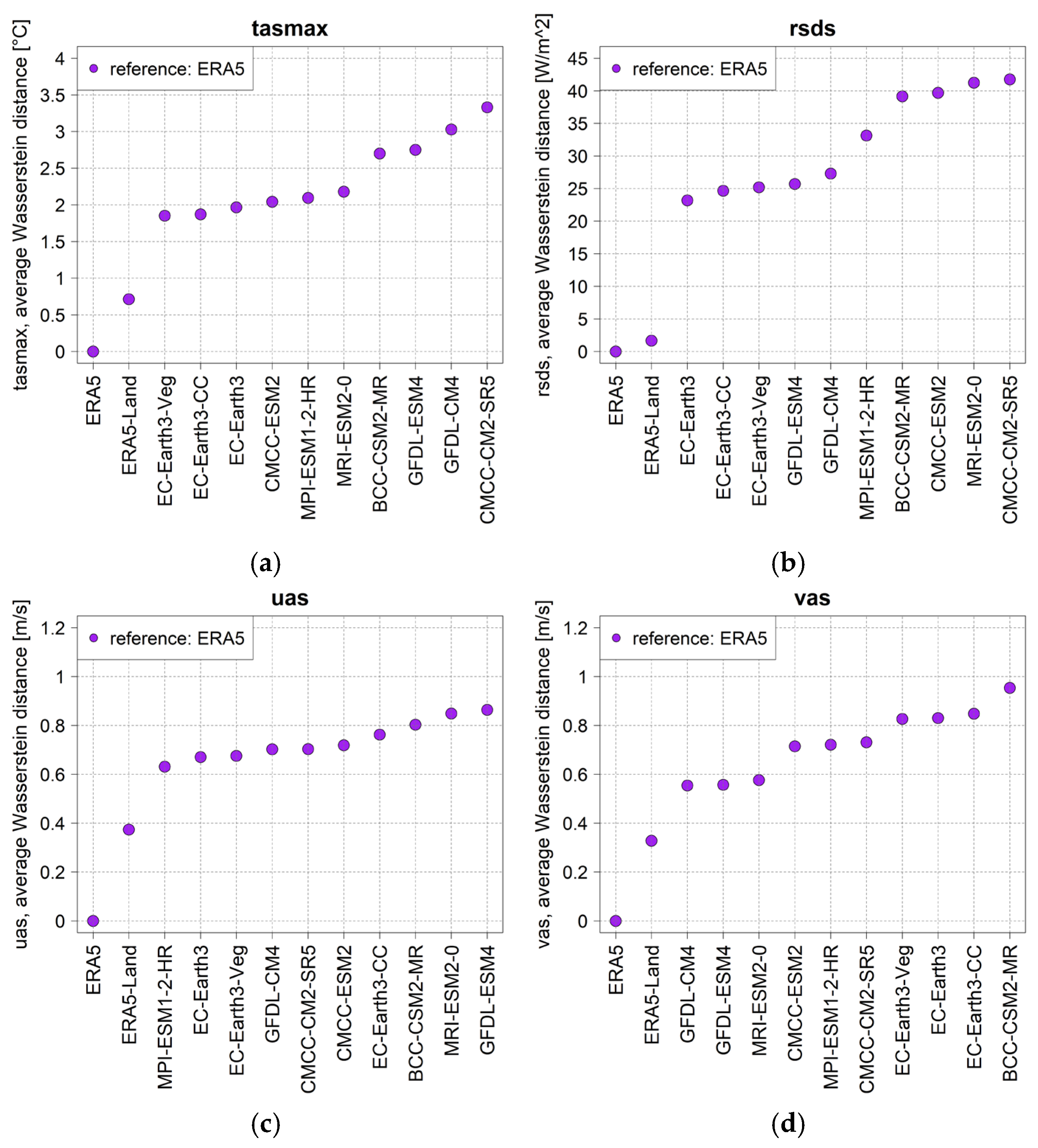
Figure 3 presents the GCM rankings relative to ERA5, quantified by Wasserstein distances averaged over the time periods 1971–2000, 1981–2010, and 1991–2020 (SSP2-4.5) across the four locations. Since the aim of this study was to identify GCMs with relatively high skill in reproducing PVpot, no formal statistical significance tests were performed to assess whether the Wasserstein distances of individual GCMs (or ERA5-Land) differ significantly from each other. Instead, the Wasserstein distances were used to indicate the relative position of the GCMs in terms of their similarity to ERA5.
For tasmax and rsds, the GCMs can visually be divided into two groups exhibiting higher and lower accuracy relative to ERA5 (Figure 3a,b). For uas and vas, GCM rankings are highly inconsistent across the two variables (Figure 3c,d). Despite the absence of a single outstandingly accurate GCM, EC-Earth3 and its different configurations (EC-Earth3-Veg, EC-Earth3-CC) are among the most accurate GCMs. The two reanalyses exhibit the highest degree of similarity to each other for all variables, consistent with the individual cases presented in Figure 2. The Wasserstein distances and GCM rankings remain very similar when 1991–2020 (SSP5-8.5) is used as the final averaging time period (see Figure S1a–d).
Detailed rankings relative to ERA5 based on Wasserstein distance for each variable, time period, and location—corresponding to Figure 2—are provided in Figure S1. It must be emphasized that differences between the top-performing GCMs in Figure 3 and Figure S1 are relatively small. Therefore, the ranking primarily indicates the GCMs with relatively high skill and it should not be interpreted as a definitive performance order.

3.2. GCM-Performance Based on Mean Seasonal Courses of Daily Atmospheric Variables

The mean seasonal (JJA) courses of ERA5, ERA5-Land, the 10 GCMs, and the GCM-ensemble mean are presented for each variable, location, and time period in Figure S2. In general, the GCMs tend to underestimate tasmax at locations labelled as Vienna and Prague in all time periods (Figure S2a), while overestimation is observable for rsds in all four locations and time periods (Figure S2b). The GCMs tend to underestimate uas and vas in all locations and time periods except in 1981–2010 (Figure S2c,d).
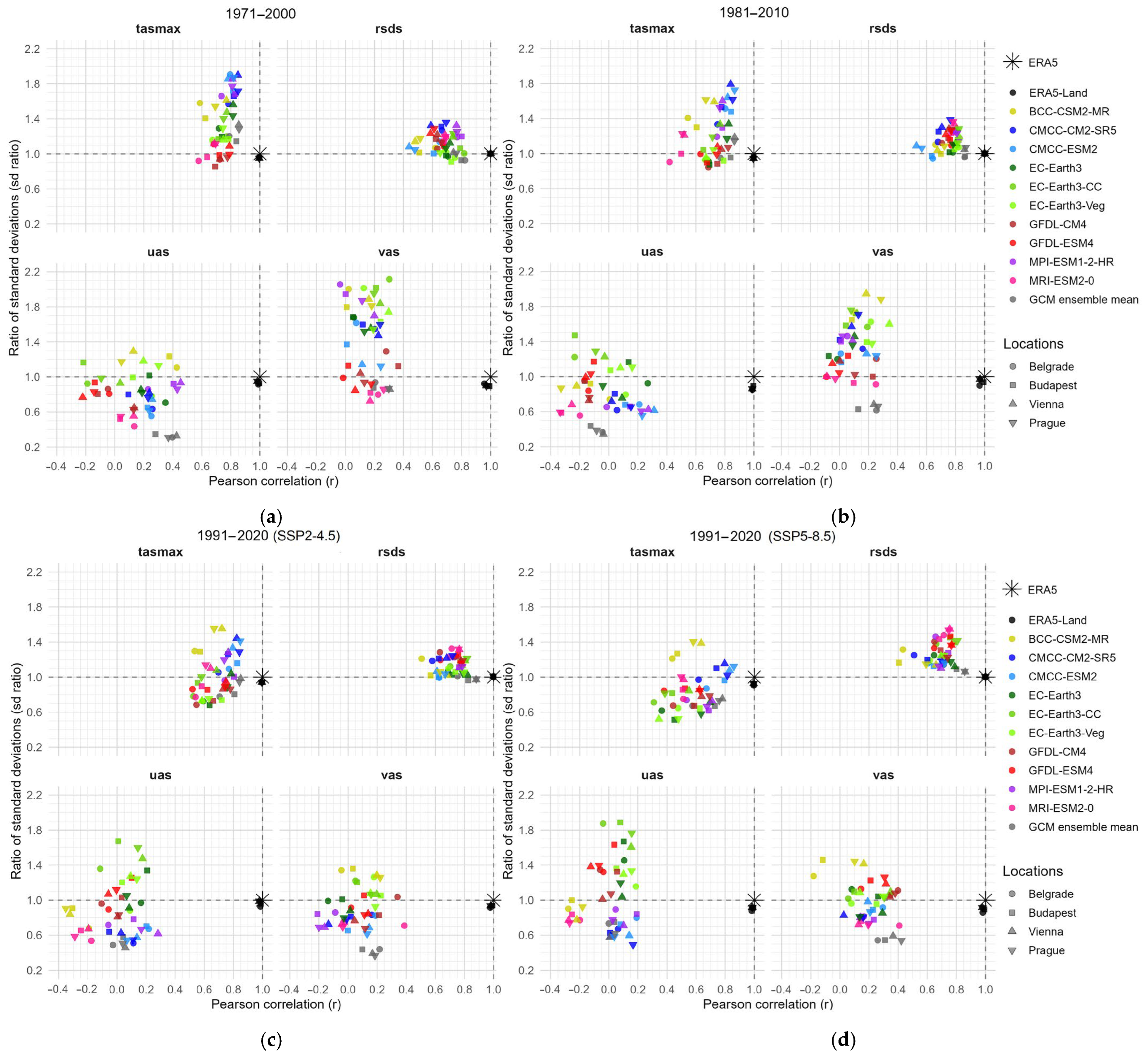
According to Figure S2, the shape and variability of the mean seasonal courses show considerable similarity over time and across locations. These characteristics are quantified by the Pearson correlations coefficient (r) and the ratio of standard deviations (sd ratio) as shown in Figure 4, thereby enabling the comparison of the GCM performance across variables. In general, the shape of the mean seasonal courses of the GCMs and ERA5-Land is the most similar to ERA5 for tasmax and rsds (r ≅ 0.6–0.8 in 1971–2000, 1981–2010, and r ≅ 0.4–0.8 in 1991–2020; Figure 4a,b. (For rsds the mean seasonal courses largely overlap; Figure S2b) Meanwhile substantially weaker (r < 0.5) or even negative correlations are found for uas and vas (Figure 4c,d).
The sd ratio mostly exceeds 1.2 for rsds and tasmax, indicating larger variability in the GCMs relative to ERA5 in 1971–2000 and 1981–2010 (Figure 4a,b). However, in case of tasmax and vas, the sd ratio decreases below 1 for the last time period, which is more pronounced for 1991–2020 (SSP5-8.5). The spread of the GCMs for tasmax and uas increases over time, while the largest inter-location differences are observed for uas and vas.
According to Figure 4, with respect to individual GCM performance, EC-Earth3, EC-Earth3-Veg, and EC-Eearth3-CC are among the most accurate GCMs (r ≅ 0.6–0.8, sd ≅ 1–1.4) relative to the ERA5 for rsds. However, for tasmax, the sd ratio decreases below 1 in 1991–2020. Consequently, GCMs may reproduce that variable more accurately in 1981–2010 than in the time periods 1971–2000 and 1991–2020. This can explain why Wasserstein distances in Figure 2 were smaller for uas and vas in 1981–2010 than for the preceding and succeeding time periods. Besides EC-Earth3 and its different configurations, GFDL-ESM4 and GFDL-CM4 perform relatively well for tasmax and vas, respectively. The 10 GCMs reproduce the mean seasonal course of uas the least accurately. Consistent with the findings in Section 3.1, no single GCM outperforms the others simultaneously across all variables, locations, and time periods.
According to Figure 4, the r values of the GCM ensemble mean are similar to those of the best performing individual GCMs. However, its sd ratio is typically below 1, as ensemble averaging reduces the amplitudes of the variability.
The mean seasonal courses of ERA5 and ERA5-Land are very similar (Figure S2), with the largest discrepancies observed for uas and vas (Figure 4).

3.3. GCM-Performance Based on PVpot

The mean seasonal courses of PVpot are shown in Figure S3. In most cases, the GCM simulations produce higher PVpot values than ERA5, indicating a tendency to overestimate PVpot. In contrast, the differences between the PVpot values for the ERA5 and ERA5-Land are negligibly small, resulting in almost overlapping courses in Figure S3.
According to Equation (3), PVpot is a dimensionless ratio varying within a relatively small range (0.13–0.32) for all time periods and locations. Consequently, to get physically interpretable values, the number of days with high PVpot (PVpot,90) was assessed.
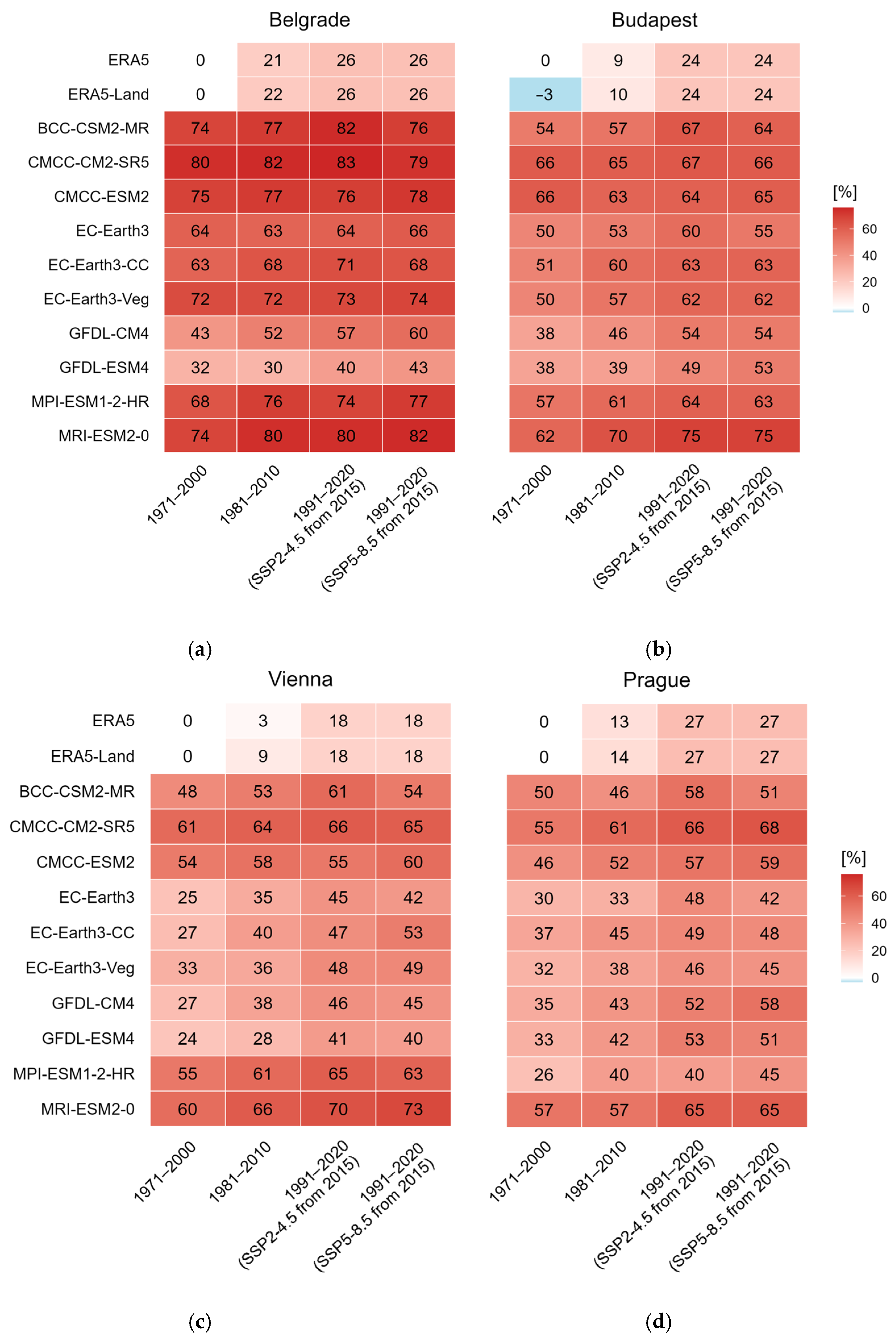
Figure 5 summarizes the relative changes in PVpot,90 compared with the PVpot,90 obtained from ERA5 for 1971–2000 (base value) for each location. For 1971–2000, the values obtained from the GCM simulations and ERA5-Land indicate how accurately PVpot,90 is reproduced relative to ERA5. A value of 0% would indicate perfect agreement with ERA5.
ERA5-Land reproduces the ERA5 values almost perfectly for Belgrade, Vienna, and Prague (Figure 5a,c,d), while a small underestimation is observed for Budapest (−3%). In contrast, all GCM simulations substantially overestimate PVpot,90 for 1971–2000 (reference time period). The overestimations—i.e., GCM biases—range from 24% to 80% depending on the GCM and the location.
ERA5 indicates a systematic increase in PVpot,90 from 1971–2000 to 1991–2020. According to Figure 5, PVpot,90 increases over time by 24–27% in Belgrade, Budapest, and Prague, while by 18% in Vienna. For example, in Prague, the number of days with high PVpot increased from 10 days (1971–2000) to 35 days (1991–2020), calculated as 10 days + (92 days × 0.27). This indicates an actual increase in favourable conditions for PV production in the study locations.
Although, most of the GCMs reproduce this increasing tendency from 1971–2000 to 1991–2020, they systematically overestimate PVpot,90 across all analyzed time periods, while the increase in PVpot,90 is generally smaller than that observed in ERA5. There are only slight differences in PVpot,90 for the time periods 1991–2020 (SSP2-4.5) and 1991–2020 (SSP5-8.5).
The largest overestimations occur for Belgrade and Budapest (Figure 5a,b), while smaller, but still considerable overestimations occur for Vienna and Prague (Figure 5c,d). Across all time periods and locations, GFDL-ESM4 is considered one of the most accurate GCMs, while EC-Earth3, EC-Earth3-Veg, and EC-Earth3-CC perform relatively well for Vienna and Prague for all time periods.
ERA5-Land reproduces very similar PVpot,90 values compared to ERA5; however, in 1971–2000, ERA5-Land contained only 7 days with high PVpot relative to the base value for the GCM grid cell labelled as Budapest, calculated as 10 days − (92 days × 0.03) (Figure 5b).

4. Discussion and Conclusions

The evaluation of GCM performance is a popular topic in climate research. However, GCM evaluation with respect to PVpot remains limited for our study locations (the eastern part of Central Europe [33,34] and Southeast Europe [35]). Existing studies typically provide only broad statements for this region based on multi-model ensembles, e.g., Refs. [17,18,63].
The main objective of this study was to evaluate GCM performance with respect to daily atmospheric variables that primarily drive PVpot. GCM rankings may fluctuate across regions, time periods, and variables see, e.g., Refs. [64,65,66] and Figure 3. Therefore, to gain a deeper understanding of the GCMs—which are often regarded as black boxes [67]—we restricted the analysis to GCM grid cells with similar topographical (Figure 1) and climatic conditions.
The use of the nearest grid cell to represent a specific location in GCM outputs is not an uncommon practice in climate studies; e.g., the nearest GCM grid cells were used for climate risk assessment in Taiwan [68]. This approach also formed the basis of a city-specific ranking of CMIP6 GCMs in Indonesia to support urban-scale climate applications [69].
The GCM evaluation comprised three steps. In the first step, the distributions of daily atmospheric variables mainly affecting PVpot (tasmax, rsds, uas, and vas) obtained from GCMs and ERA5-Land were compared with those of ERA5. The ERA5 reanalysis product is widely used as a reference dataset in PVpot-related studies, e.g., Refs. [18,19,20]. To compare the datasets—without making any assumptions about their underlying distributions—the Wasserstein distance was calculated, which has proven to be an effective metric for evaluating GCM performance [70,71].
In the second step, the mean daily values of the atmospheric variables were examined, and no pronounced outliers were detected (Figure S2). In the third step, PVpot was computed, with a key step being the assessment of Tcell. The PVpot values obtained from the GCM simulations and ERA5-Land were then compared with those obtained from ERA5.
To calculate Tcell, a linear regression model [62] was used, in which Tcell is a linear function of tas, rsds, and wsp. This approach has been widely adopted in PVpot studies worldwide, e.g., Refs. [17,18,19,72]. According to TamizhMani et al. [62], this linear regression model can be applied across different regions, as the coefficients are largely independent of site location. Korab et al. [73] evaluated several formulas for estimating Tcell in Poland (Central Europe). They concluded that TamizhMani’s equation is one of the best for estimating Tcell. In this study, humidity was not considered in the calculation of Tcell (Equation (5)). Although increasing humidity may reduce PVpot [74], this atmospheric variable was not included in the present study. This simplification is common in PVpot calculations (see e.g., Refs. [17,18,30]), as the influence of humidity on PVpot is generally negligible. Equation (5) was formulated using daily maximum air temperature, rather than daily mean temperature, as it better represents daytime thermal conditions relevant for PV module operation, while daily averages also include nighttime temperature values.
Several studies expressed changes in PVpot in percentage terms, e.g., Refs. [18,19], which can be difficult to interpret physically, as the base PVpot value itself is already expressed as a percentage. Consequently, the number of days with high PVpot, thus PVpot,90 [17] based on ERA5 (1971–2000) was analyzed. We found that all GCMs overestimate PVpot,90 for 1971–2000. One possible reason behind this GCM biases is the overestimation of rsds values in the GCMs relative to ERA5 (Figure S2b). Underestimation of tasmax by the GCMs relative to ERA5 contributes to the overestimation of the PVpot. This may explain the smaller PVpot,90 values in cases of Vienna and Prague (Figure 5c,d). The overestimation of wind speed reduces air temperature therefore also increases the PVpot (Figure S2c,d). These results are in accordance with the findings of [18].
The relatively small discrepancy between ERA5 and ERA5-Land for rsds, compared to the much larger spread among the GCM simulations (e.g., Figure S1), can be explained by the fundamentally different nature of these datasets. The rsds is an inherently uncertain variable, strongly controlled by cloud cover, which remains one of the largest sources of bias in GCMs [75]. Systematic cloud representation errors propagate directly into biases in simulated surface radiation fields, leading to substantial inter-model spread in GCM-based rsds estimates [76]. In contrast, ERA5 and ERA5-Land are produced within the same data assimilation framework, differing primarily in their land surface representation rather than in their atmospheric component. ERA5-Land was generated to better represent land processes, while largely preserving the atmospheric forcing of ERA5 [55]. Consequently, atmospheric variables controlling cloudiness—and thus rsds, tasmax—remain highly consistent between the two products, resulting in a small Wasserstein distance (see Figure 2 and Figure S1). Because PVpot is primarily influenced by tasmax and rsds (e.g., Ref. [20]), the PVpot values of ERA5 and ERA5-Land are also very similar (see Figure S3). This interpretation is supported by independent validation studies showing that both ERA5 and ERA5-Land exhibit similar performance in simulating incoming shortwave radiation and agree well with global reference datasets [77].
The 30-year time periods 1991–2020 (SSP2-4.5) and 1991–2020 (SSP5-8.5) differ from each other only in five years. No significant differences were obtained between them based on Wasserstein distances, r, and sd ratio values. However, the examination of PVpot,90 enabled us to distinguish them since PVpot,90 is slightly smaller for 1991–2020 (SSP5-8.5) than for 1991–2020 (SSP5-4.5) in case of the majority of the GCMs (Figure 5). This may be explained by the higher tasmax values in the SSP5-8.5 scenario than in SSP2-4.5, which reduces PVpot.
Our main findings based on the selected GCM grid cells representing lowland, highly populated urban areas in Central and Southeast Europe during JJA days, are as follows:
  • Spatial differences among the analyzed locations are more pronounced than temporal differences, particularly for rsds, where Wasserstein distances decrease from southeast to northwest across the study region (Figure 2).
  • For uas, and vas, the GCM simulations exhibit comparatively poorer performance than for tasmax and rsds, based on the magnitude of the Wasserstein distances. Furthermore, for tasmax and rsds, ERA5-Land shows greater similarity to ERA5 than the GCM simulations. This is not the case for uas and vas, where some GCMs exhibit smaller Wasserstein distances to ERA5 than ERA5-Land (Figure 3).
  • Although the GCMs overestimate rsds values relative to ERA5 (Figure S2b), the shape and variability of the rsds mean seasonal course are reproduced reasonably well by the GCMs (r ≅ 0.4–0.8; sd ratio ≅ 1–1.4) (Figure 4b).
  • The GCMs show a transition from overestimation to underestimation of the variability of the mean seasonal courses of tasmax and vas over time (from 1971–2010 to 1991–2020) relative to ERA5. In contrast, the variability of uas in the GCM simulations changes in the opposite direction (Figure 4a,c,d).
  • Since PVpot is mainly influenced by rsds and tasmax according to Equation (5), and the GCMs tend to overestimate rsds, while underestimating tasmax relative to ERA5, PVpot is also overestimated by the GCM simulations compared to ERA5. Consequently, the number of days with high PVpot (PVpot,90) is also overestimated, which can be interpreted as a GCM bias.
The PVpot,90 values obtained from ERA5 show an increase over time. The GCMs reproduce this increasing tendency from 1971–2000 to 1991–2020; however, the increase in PVpot,90 is generally smaller than that observed in ERA5. As it was pointed out in Section 3.2, the GCM ensemble mean may reduce the variability of daily mean seasonal courses; therefore, we avoid computing PVpot based on GCM ensemble means.
Furthermore, selecting the best-performing individual GCM is essential for statistical or dynamical downscaling. Although no individual GCM outperformed others across all four variables, time periods, and locations, the EC-Earth3 and its different configurations (EC-Earth3-Veg, EC-Earth3-CC) were chosen as the best-performing GCMs due to their relatively accurate performance with respect to rsds and tasmax, which are the most important variables calculating PVpot. Future plans include dynamical and statistical downscaling of the previously mentioned GCM simulations for more detailed studies.

Supplementary Materials

The following supporting information can be downloaded at: https://www.mdpi.com/article/10.3390/urbansci10040204/s1, Figure S1: GCM rankings based on mean Wasserstein distances averaged over 92 JJA days of the GCMs and the ERA5-Land relative to the ERA5 in 16 cases, thus for four locations labelled as Belgrade (1st row), Budapest (2nd row), Vienna (3rd row), and Prague (4th row), and three time periods: 1971–2000 (1st column), 1981–2010 (2nd column), 1991–2020 (SSP2-4.5) (3rd column), and 1991–2020 (SSP5-8.5) (4th column), for (a) maximum near-surface air temperature (tasmax), (b) surface downwelling shortwave radiation (rsds), (c) eastward near-surface wind (uas), and (d) northward near-surface wind (vas) components. Figure S2: Seasonal mean courses for (a) maximum near-surface air temperature (tasmax), (b) surface downwelling shortwave radiation (rsds), (c) eastward near-surface wind (uas), and (d) northward near-surface wind (vas) components in summer (JJA); derived from 10 GCMs, the ERA5, and ERA5-Land reanalyses for the periods 1971–2000 (1st column), 1981–2010 (2nd column), 1991–2020 SSP2-4.5 (3rd column), and 1991–2020 SSP5-8.5 (4th column), for the locations labelled as Belgrade (1st row), Budapest (2nd row), Vienna (3rd row), and Prague (4th row). Note that due to the high-degree of similarity of the seasonal mean courses for ERA5 and ERA5-Land, their curves overlap. Figure S3: Mean daily photovoltaic potential (PVpot) values in summer (JJA); derived from 10 GCMs, the ERA5, and ERA5-Land reanalyses for the periods 1971–2000 (1st column), 1981–2010 (2nd column), 1991–2020 SSP2-4.5 (3rd column), and 1991–2020 SSP5-8.5 (4th column), for the locations labelled as Belgrade (1st row), Budapest (2nd row), Vienna (3rd row),and Prague (4th row). Note that, due to the high-degree of similarity of the PVpot values for ERA5 and ERA5-Land, their curves overlap.

Author Contributions

Conceptualization, E.K.; methodology, E.K.; software, E.K. and T.K.; validation, E.K. and T.K.; formal analysis, E.K. and T.K.; investigation, E.K. and T.K.; resources, E.K. and T.K.; data curation, E.K.; writing—original draft preparation, E.K. and T.K.; writing—review and editing, E.K. and T.K.; visualization, E.K. and T.K.; supervision, E.K. and T.K.; project administration, E.K.; funding acquisition, E.K. and T.K. All authors have read and agreed to the published version of the manuscript.

Funding

For Erzsébet Kristóf, the research was performed in the framework of the EU co-financed project ‘Foundations for the strategic planning of ecosystem services-based green infrastructure developments supported by regularly updated datasets’ (KEHOP PLUSZ-3.2.2-24-2024-00002). Tímea Kalmár is funded by the National Multidisciplinary Laboratory for Climate Change, RRF-2.3.1-21-2022-00014 project.

Institutional Review Board Statement

Not applicable.

Informed Consent Statement

Not applicable.

Data Availability Statement

All datasets used in this study are publicly available through online databases. The data presented in this study were derived from the following resources available in the public domain: CMIP6 GCM data: https://esgf-node.ornl.gov/ (accessed on 30 January 2026). ERA5: https://cds.climate.copernicus.eu/datasets/derived-era5-single-levels-daily-statistics (accessed on 30 January 2026). ERA5-Land: https://cds.climate.copernicus.eu/datasets/derived-era5-land-daily-statistics (accessed on 30 January 2026).

Acknowledgments

We acknowledge the World Climate Research Programme, which, through its Working Group on Coupled Modelling, coordinated and promoted CMIP6. We thank the climate modeling groups for producing and making available their model output, the Earth System Grid Federation (ESGF) for archiving the data and providing access, and the multiple funding agencies who support CMIP6 and ESGF. We acknowledge the Copernicus Climate Change Service (C3S) for providing the ERA5 and ERA5-Land reanalysis datasets. We thank the three Reviewers for their helpful commentes on the manuscript.

Conflicts of Interest

The authors declare no conflicts of interest.

References

  1. UNFCCC (United Nations Framework Convention on Climate Change). Draft Paris Agreement; United Nations: Paris, France, 2015; p. 48. Available online: https://unfccc.int/files/bodies/awg/application/pdf/draft_paris_agreement_5dec15.pdf (accessed on 14 March 2026).
  2. Holechek, J.L.; Geli, H.M.E.; Sawalhah, M.N.; Valdez, R. A Global Assessment: Can Renewable Energy Replace Fossil Fuels by 2050? Sustainability 2022, 14, 4792. [Google Scholar] [CrossRef]
  3. Directive (EU) 2023/2413 of the European Parliament and of the Council of 18 October 2023 Amending Directive (EU) 2018/2001, Regulation (EU) 2018/1999 and Directive 98/70/EC as Regards the Promotion of Energy from Renewable Sources, and Repealing Council Directive (EU) 2015/652. 2023. Available online: https://eur-lex.europa.eu/eli/dir/2023/2413/oj (accessed on 14 March 2026).
  4. Edenhofer, O.; Pichs-Madruga, R.; Sokona, Y.; Seyboth, K.; Kadner, S.; Zwickel, T.; Eickemeier, P.; Hansen, G.; Schlömer, S.; von Stechow, C.; et al. (Eds.) Renewable Energy Sources and Climate Change Mitigation: Special Report of the Intergovernmental Panel on Climate Change; Cambridge University Press: Cambridge, UK, 2012; p. 1076. Available online: https://www.ipcc.ch/site/assets/uploads/2018/03/SRREN_Full_Report-1.pdf (accessed on 14 March 2026).
  5. Frimannslund, I.; Thiis, T.; Aalberg, A.; Thorud, B. Polar solar power plants–Investigating the potential and the design challenges. Sol. Energy 2021, 224, 35–42. [Google Scholar] [CrossRef]
  6. REN21. Renewables 2025 Global Status Report: Renewables in Energy Supply—Solar Photovoltaics (PV); REN21: Paris, France, 2025; p. 8. Available online: https://www.ren21.net/gsr-2025/downloads/pdf/supply/GSR_2025_Factsheet_Supply_SolarPV.pdf (accessed on 14 March 2026).
  7. IRENA (International Renewable Energy Agency). Renewable Capacity Statistics 2025; IRENA: Abu Dhabi, United Arab Emirates, 2025; p. 61. Available online: https://www.irena.org/-/media/Files/IRENA/Agency/Publication/2025/Mar/IRENA_DAT_RE_Capacity_Statistics_2025.pdf (accessed on 14 March 2026).
  8. Hungarian Government. National Energy Strategy 2030; Hungarian Government: Budapest, Hungary, 2012. Available online: https://2010-2014.kormany.hu/download/7/d7/70000/Hungarian%20Energy%20Strategy%202030.pdf (accessed on 14 March 2026).
  9. Photovoltaic Barometer 2025; Eurobserv’ER: Paris, France, 2025; p. 14. Available online: https://www.eurobserv-er.org/photovoltaic-barometer-2025/ (accessed on 14 March 2026).
  10. Dzikuć, M.; Piwowar, A.; Dzikuć, M. The Development of Photovoltaics in the Countries of Central and Eastern Europe in the Context of Regulatory Changes: A Case Study of the Czech Republic and Poland. Energies 2025, 18, 817. [Google Scholar] [CrossRef]
  11. European Comission. National Energy and Climate Plan of Hungary. 2024. Available online: https://commission.europa.eu/document/download/0a2953f8-5789-4f6f-9714-03df3d4cbbab_en?filename=HU_FINAL%20UPDATED%20NECP%202021-2030%20%28English%29.pdf (accessed on 14 March 2026).
  12. Konrad, A.; Gaugl, R.; Maier, C.; Wogrin, S. Implementing dynamic power feed-in limitations of photovoltaic systems in distribution grids for generation expansion planning. Energy Strategy Rev. 2025, 59, 101760. [Google Scholar] [CrossRef]
  13. Government of Serbia. Integrated National Energy and Climate Plan of the Republic of Serbia for the Period up to 2030 with a Vision to 2050. 2026; 326p. Available online: https://www.mre.gov.rs/extfile/sr/1139/INEKP_pre%C4%8Di%C5%A1%C4%87en_tekst_1.8.24_ENG.pdf (accessed on 14 March 2026).
  14. Patt, A.; Pfenninger, S.; Lilliestam, J. Vulnerability of solar energy infrastructure and output to climate change. Clim. Change 2013, 121, 93–102. [Google Scholar] [CrossRef]
  15. Crook, J.A.; Jones, L.A.; Forster, P.M.; Crook, R. Climate change impacts on future photovoltaic and concentrated solar power energy output. Energy Environ. Sci. 2011, 4, 3101–3109. [Google Scholar] [CrossRef]
  16. Gaetani, M.; Huld, T.; Vignati, E.; Monforti-Ferrario, F.; Dosio, A.; Raes, F. The near future availability of photovoltaic energy in Europe and Africa in climate-aerosol modeling experiments. Renew. Sustain. Energy Rev. 2014, 38, 706–716. [Google Scholar] [CrossRef]
  17. Feron, S.; Cordero, R.R.; Damiani, A.; Jackson, R.B. Climate change extremes and photovoltaic power output. Nat. Sustain. 2021, 4, 270–276. [Google Scholar] [CrossRef]
  18. Dutta, R.; Chanda, K.; Maity, R. Future of solar energy potential in a changing climate across the world: A CMIP6 multi-model ensemble analysis. Renew. Energy 2022, 188, 819–829. [Google Scholar] [CrossRef]
  19. Liu, C.; Chen, L.; Li, K.; Jin, X.; Chen, X.; Qiao, W.; Liao, H. Historical and future climate changes impact global solar photovoltaic power potential: Role of key meteorological variables. Atmos. Ocean. Sci. Lett. 2025, 18, 100619. [Google Scholar] [CrossRef]
  20. Ha, S.; Zhou, Z.; Im, E.-S.; Lee, Y.-M. Comparative assessment of future solar power potential based on CMIP5 and CMIP6 multi-model ensembles. Renew. Energy 2023, 206, 324–335. [Google Scholar] [CrossRef]
  21. Niu, J.; Qin, W.; Wang, L.; Zhang, M.; Wu, J.; Zhang, Y. Climate change impact on photovoltaic power potential in China based on CMIP6 models. Sci. Total Environ. 2023, 858, 159776. [Google Scholar] [CrossRef] [PubMed]
  22. Chen, Z.; Li, W.; Pan, Z.; Liu, C.; Wang, H.; Guo, J. Spatiotemporal changes in PV potential and extreme characteristics in China under SSP scenarios. Energy 2025, 320, 135215. [Google Scholar] [CrossRef]
  23. Ruosteenoja, K.; Räisänen, P.; Karhu, J.A.; Lindfors, A.V. Future PV production potential in Northern Europe under changing snow conditions: A multi-model assessment. Sol. Energy 2025, 301, 113896. [Google Scholar] [CrossRef]
  24. Pérez, J.C.; González, A.; Díaz, J.P.; Expósito, F.J.; Felipe, J. Climate change impact on future photovoltaic resource potential in an orographically complex archipelago, the Canary Islands. Renew. Energy 2018, 133, 749–759. [Google Scholar] [CrossRef]
  25. Carvalho, D.; Cardoso Pereira, S.; Rocha, A. Future surface temperatures over Europe according to CMIP6 climate projections: An analysis with original and bias-corrected data. Clim. Change 2021, 167, 10. [Google Scholar] [CrossRef]
  26. Li, D.; Folini, D.; Wild, M. Assessment of top of atmosphere, atmospheric and surface energy budgets in CMIP6 models on regional scales. Earth Space Sci. 2023, 10, e2022EA002758. [Google Scholar] [CrossRef]
  27. He, J.; Hong, L.; Shao, C.; Tang, W. Global evaluation of simulated surface shortwave radiation in CMIP6 models. Atmos. Res. 2023, 292, 106896. [Google Scholar] [CrossRef]
  28. Shen, C.; Zha, J.; Li, Z.; Azorin-Molina, C.; Deng, K.; Minola, L.; Chen, D. Evaluation of global terrestrial near-surface wind speed simulated by CMIP6 models and their future projections. Ann. N. Y. Acad. Sci. 2022, 1518, 249–263. [Google Scholar] [CrossRef]
  29. Miao, H.; Xu, H.; Huang, G.; Yang, K. Evaluation and future projections of wind energy resources over the Northern Hemisphere in CMIP5 and CMIP6 models. Renew. Energy 2023, 211, 809–821. [Google Scholar] [CrossRef]
  30. Jerez, S.; Tobin, I.; Vautard, R.; Montávez, J.P.; López Romero, J.M.; Thais, F.; Bartok, B.; Christensen, O.B.; Colette, A.; Déqué, M.; et al. The impact of climate change on photovoltaic power generation in Europe. Nat. Commun. 2015, 6, 10014. [Google Scholar] [CrossRef]
  31. Sailor, D.J.; Hu, T.; Li, X.; Rosen, J.N. A neural network approach to local downscaling of GCM output for assessing wind power implications of climate change. Renew. Energy 2000, 19, 359–378. [Google Scholar] [CrossRef]
  32. Sørland, S.L.; Schär, C.; Lüthi, D.; Kjellström, E. Bias patterns and climate change signals in GCM-RCM model chains. Environ. Res. Lett. 2018, 13, 074017. [Google Scholar] [CrossRef]
  33. Pintér, G.; Zsiborács, H.; Hegedűsné Baranyai, N.; Vincze, A.; Birkner, Z. The Economic and Geographical Aspects of the Status of Small-Scale Photovoltaic Systems in Hungary—A Case Study. Energies 2020, 13, 3489. [Google Scholar] [CrossRef]
  34. Varga, G.; Gresina, F.; Szeberényi, J.; Gelencsér, A.; Rostási, Á. Effect of Saharan dust episodes on the accuracy of photovoltaic energy production forecast in Hungary (Central Europe). Renew. Sustain. Energy Rev. 2024, 193, 114289. [Google Scholar] [CrossRef]
  35. Benović, A.; Miškić, M.; Pantović, V.; Vujičić, S.; Vidojević, D.; Opačić, M.; Jovanović, F. Assessment of the Impact of Solar Power Integration and AI Technologies on Sustainable Local Development: A Case Study from Serbia. Sustainability 2025, 17, 6977. [Google Scholar] [CrossRef]
  36. Kottek, M.; Grieser, J.; Beck, C.; Rudolf, B.; Rubel, F. World Map of the Köppen-Geiger climate classification updated. Meteorol. Z. 2006, 15, 259–263. [Google Scholar] [CrossRef]
  37. Kikstra, J.S.; Nicholls, Z.R.J.; Smith, C.J.; Lewis, J.; Lamboll, R.D.; Byers, E.; Sandstad, M.; Meinshausen, M.; Gidden, M.J.; Rogelj, J.; et al. The IPCC Sixth Assessment Report WGIII climate assessment of mitigation pathways: From emissions to global temperatures. Geosci. Model Dev. 2022, 15, 9075–9109. [Google Scholar] [CrossRef]
  38. Milovanović, A.; Babinský, T.; Sedmak, A.; Filipović, I.; Milošević, M. The effect of infill density on fracture toughness results of PLA material. Procedia Struct. Integr. 2025, 68, 922–928. [Google Scholar] [CrossRef]
  39. Probáld, F. The urban climate of Budapest: Past, present and future. Hung. Geogr. Bull. 2014, 63, 69–79. [Google Scholar] [CrossRef]
  40. Auer, I.; Böhm, R.; Jurkovic, A.; Lipa, W.; Orlik, A.; Potzmann, R.; Schöner, W.; Ungersböck, M.; Matulla, C.; Briffa, K.; et al. HISTALP—Historical instrumental climatological surface time series of the Greater Alpine Region. Int. J. Climatol. 2007, 27, 17–46. [Google Scholar] [CrossRef]
  41. Tolasz, R.; Míková, T.; Valeriánová, A.; Voženílek, V. (Eds.) Climate Atlas of Czechia; Czech Hydrometeorological Institute: Prague, Czechia; Palacký University: Olomouc, Czechia, 2007; 256p. [Google Scholar]
  42. Danielson, J.J.; Gesch, D.B. Global Multi-Resolution Terrain Elevation Data 2010 (GMTED2010); U.S. Geological Survey Open-File Report 2011–1073; U.S. Geological Survey: Reston, VA, USA, 2011; 23p. [CrossRef]
  43. Eyring, V.; Bony, S.; Meehl, G.A.; Senior, C.A.; Stevens, B.; Stouffer, R.J.; Taylor, K.E. Overview of the Coupled Model Intercomparison Project Phase 6 (CMIP6) experimental design and organization. Geosci. Model Dev. 2016, 9, 1937–1958. [Google Scholar] [CrossRef]
  44. World Meteorological Organization. WMO Guidelines on the Calculation of Climate Normals; World Meteorological Organization: Geneva, Switzerland, 2017; WMO-No. 1203; 29p, Available online: https://library.wmo.int/idurl/4/55797 (accessed on 14 March 2026).
  45. O’Neill, B.C.; Kriegler, E.; Riahi, K.; Ebi, K.L.; Hallegatte, S.; Carter, T.R.; Mathur, R.; van Vuuren, D.P. A new scenario framework for climate change research: The concept of shared socioeconomic pathways. Clim. Change 2014, 122, 387–400. [Google Scholar] [CrossRef]
  46. Wu, T.; Yu, R.; Lu, Y.; Jie, W.; Fang, Y.; Zhang, J.; Zhang, L.; Xin, X.; Li, L.; Wang, Z.; et al. BCC-CSM2-HR: A high-resolution version of the Beijing Climate Center Climate System Model. Geosci. Model Dev. 2021, 14, 2977–3006. [Google Scholar] [CrossRef]
  47. Cherchi, A.; Fogli, P.G.; Lovato, T.; Peano, D.; Iovino, D.; Gualdi, S.; Masina, S.; Scoccimarro, E.; Materia, S.; Bellucci, A.; et al. Global mean climate and main patterns of variability in the CMCC-CM2 coupled model. J. Adv. Model. Earth Syst. 2019, 11, 185–209. [Google Scholar] [CrossRef]
  48. Lovato, T.; Peano, D.; Butenschön, M.; Materia, S.; Iovino, D.; Scoccimarro, E.; Fogli, P.G.; Cherchi, A.; Bellucci, A.; Gualdi, S.; et al. CMIP6 Simulations With the CMCC Earth System Model (CMCC-ESM2). J. Adv. Model. Earth Syst. 2022, 14, e2021MS002814. [Google Scholar] [CrossRef]
  49. Döscher, R.; Acosta, M.; Alessandri, A.; Anthoni, P.; Arsouze, T.; Bergman, T.; Bernardello, R.; Boussetta, S.; Caron, L.-P.; Carver, G.; et al. The EC-Earth3 Earth system model for the Coupled Model Intercomparison Project 6. Geosci. Model Dev. 2022, 15, 2973–3020. [Google Scholar] [CrossRef]
  50. Held, I.M.; Guo, H.; Adcroft, A.; Dunne, J.P.; Horowitz, L.W.; Krasting, J.; Shevliakova, E.; Winton, M.; Zhao, M.; Bushuk, M.; et al. Structure and performance of GFDL’s CM4.0 climate model. J. Adv. Model. Earth Syst. 2019, 11, 3691–3727. [Google Scholar] [CrossRef]
  51. Dunne, J.P.; Horowitz, L.W.; Adcroft, A.J.; Ginoux, P.; Held, I.M.; John, J.G.; Krasting, J.P.; Malyshev, S.; Naik, V.; Paulot, F.; et al. The GFDL Earth System Model Version 4.1 (GFDL-ESM 4.1): Overall coupled model description and simulation characteristics. J. Adv. Model. Earth Syst. 2020, 12, e2019MS002015. [Google Scholar] [CrossRef]
  52. Müller, W.A.; Jungclaus, J.H.; Mauritsen, T.; Baehr, J.; Bittner, M.; Budich, R.; Bunzel, F.; Esch, M.; Ghosh, R.; Haak, H.; et al. A higher-resolution version of the Max Planck Institute Earth System Model (MPI-ESM1.2-HR). J. Adv. Model. Earth Syst. 2018, 10, 1383–1413. [Google Scholar] [CrossRef]
  53. Yukimoto, S.; Koshiro, T.; Kawai, H.; Oshima, N.; Yoshida, K.; Urakawa, S.; Tsujino, H.; Deushi, M.; Tanaka, T.; Hosaka, M.; et al. MRI MRI-ESM2.0 model output prepared for CMIP6 CMIP. Earth Syst. Grid Fed. 2019. [Google Scholar] [CrossRef]
  54. Hersbach, H.; Bell, B.; Berrisford, P.; Hirahara, S.; Horányi, A.; Muñoz-Sabater, J.; Nicolas, J.; Peubey, C.; Radu, R.; Schepers, D.; et al. The ERA5 global reanalysis. Q. J. R. Meteorol. Soc. 2020, 146, 1999–2049. [Google Scholar] [CrossRef]
  55. Muñoz-Sabater, J.; Dutra, E.; Agustí-Panareda, A.; Albergel, C.; Arduini, G.; Balsamo, G.; Boussetta, S.; Choulga, M.; Harrigan, S.; Hersbach, H.; et al. ERA5-Land: A state-of-the-art global reanalysis dataset for land applications. Earth Syst. Sci. Data 2021, 13, 4349–4383. [Google Scholar] [CrossRef]
  56. R Core Team. R: A Language and Environment for Statistical Computing; R Foundation for Statistical Computing: Vienna, Austria, 2024; Available online: http://www.R-project.org/ (accessed on 14 March 2026).
  57. Wasserstein, L.N. Markov processes with countable state space describing large systems of automata. Probl. Pered. Inform. 1969, 5, 64–73. (In Russian) [Google Scholar]
  58. Villani, C. Optimal Transport: Old and New; Springer: Berlin/Heidelberg, Germany, 2009; pp. 105–123. [Google Scholar]
  59. Schuhmacher, D.; Bähre, B.; Bonneel, N.; Gottschlich, C.; Hartmann, V.; Heinemann, F.; Schmitzer, B.; Schrieber, J. Transport: Computation of Optimal Transport Plans and Wasserstein Distances. R Package Version 0.15-4. 2024. Available online: https://cran.r-project.org/package=transport (accessed on 14 March 2026).
  60. Mavromatakis, F.; Makrides, G.; Georghiou, G.; Pothrakis, A.; Franghiadakis, Y.; Drakakis, E.; Koudoumas, E. Modeling the photovoltaic potential of a site. Renew. Energy 2010, 35, 1387–1390. [Google Scholar] [CrossRef]
  61. Tonui, J.K.; Tripanagnostopoulos, Y. Improved PV/T solar collectors with heat extraction by forced or natural air circulation. Renew. Energy 2007, 32, 623–637. [Google Scholar] [CrossRef]
  62. TamizhMani, G.; Ji, L.; Tang, Y.; Petacci, L.; Osterwald, C. Photovoltaic module thermal-wind performance: Long-term monitoring and model development for energy rating. In Proceedings of the NCPV and Solar Program Review Meeting 2003, Denver, CO, USA, 24–26 March 2003; p. 4. Available online: https://www.nrel.gov/docs/fy03osti/35645.pdf (accessed on 30 January 2026).
  63. Zuo, H.-M.; Lu, H.-L.; Sun, P.; Qiu, J.; Li, F.-F. Changes in photovoltaic power output variability due to climate change in China: A multi-model ensemble mean analysis. J. Renew. Sustain. Energy 2024, 16, 023503. [Google Scholar] [CrossRef]
  64. Nguyen-Duy, T.; Ngo-Duc, T.; Desmet, Q. Performance evaluation and ranking of CMIP6 global climate models over Vietnam. J. Water Clim. Change 2023, 14, 1832–1846. [Google Scholar] [CrossRef]
  65. Bastola, S.; Maharjan, K.R.; Choo, I.; Jung, Y. Comprehensive evaluation and ranking of CMIP6 global climate models for simulating climate extreme indices across diverse hydrological and geographical regions of Nepal. J. Hydrol. Reg. Stud. 2025, 61, 102717. [Google Scholar] [CrossRef]
  66. Kristóf, E.; Barcza, Z.; Hollós, R.; Bartholy, J.; Pongrácz, R. Evaluation of Historical CMIP5 GCM Simulation Results Based on Detected Atmospheric Teleconnections. Atmosphere 2020, 11, 723. [Google Scholar] [CrossRef]
  67. Touzé-Peiffer, L.; Barberousse, A.; Le Treut, H. The Coupled Model Intercomparison Project: History, uses, and structural effects on climate research. WIREs Clim. Change 2020, 11, e648. [Google Scholar] [CrossRef]
  68. Lin, C.Y.; Tung, C.P. Procedure for selecting GCM datasets for climate risk assessment. Terr. Atmos. Ocean. Sci. 2017, 28, 43–55. [Google Scholar] [CrossRef]
  69. Bhanage, V.; Lee, H.S.; Cabrera, J.S.; Kubota, T.; Pradana, R.P.; Fajary, F.R.; Nimiya, H. Identification of optimal CMIP6 GCMs for future typical meteorological year in major cities of Indonesia using multi-criteria decision analysis. Front. Environ. Sci. 2024, 12, 1341807. [Google Scholar] [CrossRef]
  70. Vissio, G.; Lembo, V.; Lucarini, V.; Ghil, M. Evaluating the performance of climate models based on Wasserstein distance. Geophys. Res. Lett. 2020, 47, e2020GL089385. [Google Scholar] [CrossRef]
  71. Ramdas, A.; García Trillos, N.; Cuturi, M. On Wasserstein two-sample testing and related families of nonparametric tests. Entropy 2017, 19, 47. [Google Scholar] [CrossRef]
  72. Chen, X.; Mao, H.; Cheng, N.; Ma, L.; Tian, Z.; Luo, Y.; Zhou, C.; Li, H.; Wang, Q.; Kong, W.; et al. Climate change impacts on global photovoltaic variability. Appl. Energy 2024, 374, 124087. [Google Scholar] [CrossRef]
  73. Korab, R.; Połomski, M.; Naczyński, T.; Kandzia, T. A dynamic thermal model for a photovoltaic module under varying atmospheric conditions. Energy Convers. Manag. 2023, 280, 116773. [Google Scholar] [CrossRef]
  74. Ayoola, A. Effect of ambient temperature and relative humidity on Photovoltaic system performance. SSRN Electron. J. 2021. [Google Scholar] [CrossRef]
  75. Ceppi, P.; Brient, F.; Zelinka, M.D.; Hartmann, D.L. Cloud feedback mechanisms and their representation in global climate models. Wiley Interdiscip. Rev. Clim. Change 2017, 8, e465. [Google Scholar] [CrossRef]
  76. Song, F.; Mao, Y.; Liu, S.; Wu, L.; Dong, L.; Su, H.; Wang, Y.; Chtirkova, B.; Wu, P.; Wild, M. A long-term decline in downward surface solar radiation. Natl. Sci. Rev. 2025, 12, nwaf007. [Google Scholar] [CrossRef]
  77. Valipour, M.; Dietrich, J. Developing ensemble mean models of satellite remote sensing, climate reanalysis, and land surface models. Theor. Appl. Climatol. 2022, 150, 909–926. [Google Scholar] [CrossRef]
Figure 2. Wasserstein distance values averaged over the 92 JJA days of the GCMs and ERA5-Land relative to ERA5 for locations labelled as Belgrade, Budapest, Vienna, and Prague, for the time periods 1971–2000, 1981–2010, 1991–2020 (SSP2-4.5), and 1991–2020 (SSP5-8.5), for (a) maximum near-surface air temperature (tasmax), (b) surface downwelling shortwave radiation (rsds), (c) eastward near-surface wind (uas), and (d) northward near-surface wind (vas) components. The colour categories are comparable across the four variables only in terms of being defined by the same number of intervals. However, Wasserstein distance values are directly comparable between uas and vas because their physical units are the same. The similarity of the distributions decreases from yellow to red shades.
Urbansci 10 00204 g002
Figure 3. GCM rankings based on the mean Wasserstein distances between the distributions of daily atmospheric variables of the GCMs relative to ERA5 for (a) maximum near-surface air temperature (tasmax), (b) surface downwelling shortwave radiation (rsds), (c) eastward near-surface wind (uas), and (d) northward near-surface wind (vas) components. ERA5-Land was also included in the ranking. The Wasserstein distances were averaged over three time periods: 1971–2000, 1981–2010, and 1991–2020 (SSP2-4.5), across four locations labelled as Belgrade, Budapest, Vienna, and Prague.
Urbansci 10 00204 g003
Figure 4. Pearson correlation coefficients (r) and the ratio of standard deviations (sd ratio) based on the mean seasonal (JJA) courses for maximum near-surface air temperature (tasmax), surface downwelling shortwave radiation (rsds), eastward near-surface wind (uas), and northward near-surface wind (vas) components for (a) 1971–2000, (b) 1981–2010, (c) 1991–2020 (SSP2-4.5), and (d) 1991–2020 (SSP5-8.5), for all locations (denoted by different symbols). The dashed lines show the perfect agreement with the ERA5 (reference dataset).
Urbansci 10 00204 g004
Figure 5. The relative changes in the number of days with high PVpot (PVpot,90) compared with the ERA5 PVpot,90 values in 1971–2000 (base value) for the locations labelled as (a) Belgrade, (b) Budapest, (c) Vienna, and (d) Prague, and for the time periods 1971–2000, 1981–2010, 1991–2020 (SSP2-4.5), and 1991–2020 (SSP5-8.5).
Urbansci 10 00204 g005
Table 2. Mean Wasserstein distances of the 10 GCMs relative to ERA5 for each time period and location. The spatial mean was computed based on the four locations, while the temporal mean was computed based on the time periods 1971–2000, 1981–2010, and 1991–2020 (SSP2-4.5). Similar results were obtained when 1991–2020 (SSP5-8.5) was used instead of 1991–2020 (SSP2-4.5).
VariablesTime PeriodBelgradeBudapestViennaPragueSpatial Mean
tasmax
[°C]
1971–20002.42.12.42.52.4
1981–20102.52.12.42.62.4
1991–2020 (SSP2-4.5)2.62.12.32.62.4
1991–2020 (SSP5-8.5)2.52.12.32.62.4
Temporal mean2.52.12.42.6
rsds
[W/m2]
1971–20003634313133
1981–20103533302932
1991–2020 (SSP2-4.5)3534302832
1991–2020 (SSP5-8.5)3433292831
Temporal mean35333029
uas
[m/s]
1971–20000.70.80.90.80.8
1981–20100.60.70.70.70.7
1991–2020 (SSP2-4.5)0.60.80.80.80.8
1991–2020 (SSP5-8.5)0.60.80.80.80.8
Temporal mean0.60.80.80.8
vas
[m/s]
1971–20000.80.80.80.60.8
1981–20100.70.70.70.60.7
1991–2020 (SSP2-4.5)0.80.90.90.60.8
1991–2020 (SSP5-8.5)0.80.90.90.60.8
Temporal mean0.80.80.80.6
Disclaimer/Publisher’s Note: The statements, opinions and data contained in all publications are solely those of the individual author(s) and contributor(s) and not of MDPI and/or the editor(s). MDPI and/or the editor(s) disclaim responsibility for any injury to people or property resulting from any ideas, methods, instructions or products referred to in the content.