1. Introduction
Infrastructure and construction play a substantial role in economic growth and community development [
1,
2,
3,
4]. In 2023, the carbon emissions generated from building construction accounted for approximately 18% of the global total [
5]. Negative effects created by the building construction sector include socioeconomic issues such as labour exploitation, health and safety problems, and cost overruns [
4], as well as environmental issues such as the depletion of natural resources [
6].
From an environmental viewpoint, building construction is a high-resource-demand and is a substantial waste producer and source of greenhouse gas emission and regional environmental degradation. Building construction directly affects energy and water resources, material efficiency, waste management, and environmental impacts [
7]. Unsustainable practices can lead to substantial material waste, increased pollution from equipment and transportation, soil erosion, and adverse effects on surface and groundwater. Adopting sustainable practices such as efficient material use, waste separation, and pollution control helps to minimise resource depletion and environmental damage from the outset [
8].
From an economic standpoint, incorporating sustainability during construction enhances cost efficiency and lowers project risks. Using materials, energy, and labour efficiently can decrease immediate construction expenses and reduce rework, delays, and material waste. Furthermore, sustainable construction practices often enhance build quality and durability, which reduces long-term maintenance and repair costs over the building’s life cycle [
9].
From a social perspective, it was highlighted that the building construction phase directly impacts communities, such as workers and neighbours [
10]. In addition, Ref. [
10] noted that implementing sustainable practices during building construction can reduce vulnerability to hazards by enhancing occupational health and safety, maintaining safety protocols, and supporting workers’ wellbeing through risk management, training, and preventive strategies. Proper occupational health and safety (OHS) management in construction projects is essential for social sustainability because it lowers the risk of accidents and injuries, and boosts worker morale and efficiency [
10].
Previous research found that sustainability during the building construction phase is a substantial aspect of the project life cycle. This highlights the significance of merging sustainable practices in the early stages of construction projects to ensure successful implementation and long-term viability [
11]. Furthermore, the development process is designed, constructed, maintained, and demolished. The project cannot be fully sustainable if the building construction phase is ignored, as a result, there is no consolidated guidance for contractors. Managing sustainability effectively during construction is crucial to ensure that environmental, economic, and social goals are met [
12].
Evaluating sustainability performance has recently become a major focus, particularly in the building construction sector [
13]. However, the concept of sustainability performance is difficult to define owing to its subjective and varying characteristics, which make it difficult to set guidelines for stakeholders to follow. Therefore, identifying key sustainable practices is important for developing a widely accepted set of guidelines that stakeholders in the building construction sector can follow to evaluate sustainability performance [
13].
This research aims to synthesise the existing scholarly literature on sustainability practices during the building construction phase. Sustainability practices are classified and categorised based on the three key pillars of environmental, economic, and social sustainability practices, as classified in previous studies. By consolidating findings from the literature, this review produces a clear list of sustainable practices that can be implemented by a contractor during building construction and also highlights current trends, gaps, and future research directions.
Accordingly, this research is guided by the following research questions:
What environmental, economic, and social sustainability practices can be implemented during the building construction phase and are reported in the existing literature?
How are sustainability practices conceptualised and addressed at the contractor level in existing studies and international sustainability frameworks?
What key gaps, challenges, and future research directions are identified in the literature regarding the implementation of sustainability practices in building construction?
This study aligns multiple scope areas through the lens of sustainability in the building construction phase. Building construction actions directly affect urban planning and land use through site construction and construction sequencing. Moreover, affecting urban mobility via temporary traffic disruption for material transportation. The classification of controlled contractor practices captures impacts on the urban environment, including pollution, waste management, and urban climate, as well as material choices, energy use, and on-site emissions. By structuring these practices within environmental, economic, and social pillars, the study contributes to the understanding of how the building construction stage shapes urbanisation processes and supports the delivery of sustainable cities.
Literature Review
Sustainable development is defined as meeting current needs without compromising the ability of future generations to meet their own needs, while balancing economic growth, environmental protection, and social equity [
14,
15]. Businesses can integrate sustainability through a long-term commitment to environmental, social, and economic practices [
16]. Sustainability can be defined as a dynamic balance of these three mutually interdependent elements: the conservation and enhancement of natural ecosystems and resources, economic development, and the provision of social infrastructure [
4,
17].
According to [
18], building construction involves the construction of both human settlements and infrastructure, encompasses the processes of extracting and processing raw materials, fabricating construction materials and components, constructing a building, and managing and operating the completed building. Therefore, implementing sustainable practices during these processes can help the building construction sector greatly reduce its environmental impact [
11].
While many studies have emphasised the importance of sustainability during the design phase, few have focused on the construction phase of a project [
12]. Ref. [
19] noted that the growing waste and unsustainable use of natural resources have necessitated a new approach to building construction projects that minimises carbon emissions, limits environmental damage, and minimises resource consumption.
Major international sustainability frameworks offer organised, structured guidance for improving environmental and energy performance in the built environment and related sectors. While rating tools like LEED and BREEAM evaluate and certify buildings based on a range of environmental, social, and economic factors. Although literature is available on sustainable construction, a list of practices that contractors can follow to enhance their sustainability performance during building construction has not yet been established. Furthermore, prior research focuses on the preconstruction (design phase) and the post-construction (post-closeout) phases [
12].
Ref. [
20] developed a model to help decision-makers select subcontractors for a project that uses the analytic hierarchy process, which methodically organises and assesses intricate decisions based on mathematical and psychological principles, highlighted the positive effects of this model on creating a more sustainable built environment, and examined the various economic, social, and environmental impacts that can occur when it is applied to projects [
20].
Ref. [
21] defined a building project as sustainable if it offers economic, social, and environmental benefits during both construction and operation. Ref. [
21] assessed the sustainability of prefabricated versus conventional buildings using 16 indicators, such as the use of formwork, containment of waste, pollution created, site disruption, labour, and energy. Data from 51 respondents showed that prefabrication was more sustainable, especially for the environment [
21].
In Indonesia, Ref. [
3] evaluated the effectiveness of green building concepts at enhancing the management of building construction projects by using important performance analysis, which identifies the attributes of a product or service that require the most improvement or that can be optimised to reduce costs without compromising overall quality [
22]. They found that evaluating contractor performance was critical to integrating green building concepts and improving the overall performance and sustainability of the project.
Research conducted by [
12] developed sustainability indicators to assess contractor performance during construction in Jordan. The study aimed to fill the gap in an integrated assessment approach using a literature review and surveys. The environmental practices were most critical at 39%, followed by social (24%), economic (19%), cultural (13%), and lean manufacturing (5%). The results of the survey developed key indicators that emphasised environmental protection, systemic changes in building legislation and updates, sustainability awareness, and the integration of these indicators into tender documents to promote sustainability and enhance contractor performance in Jordan.
2. Materials and Methods
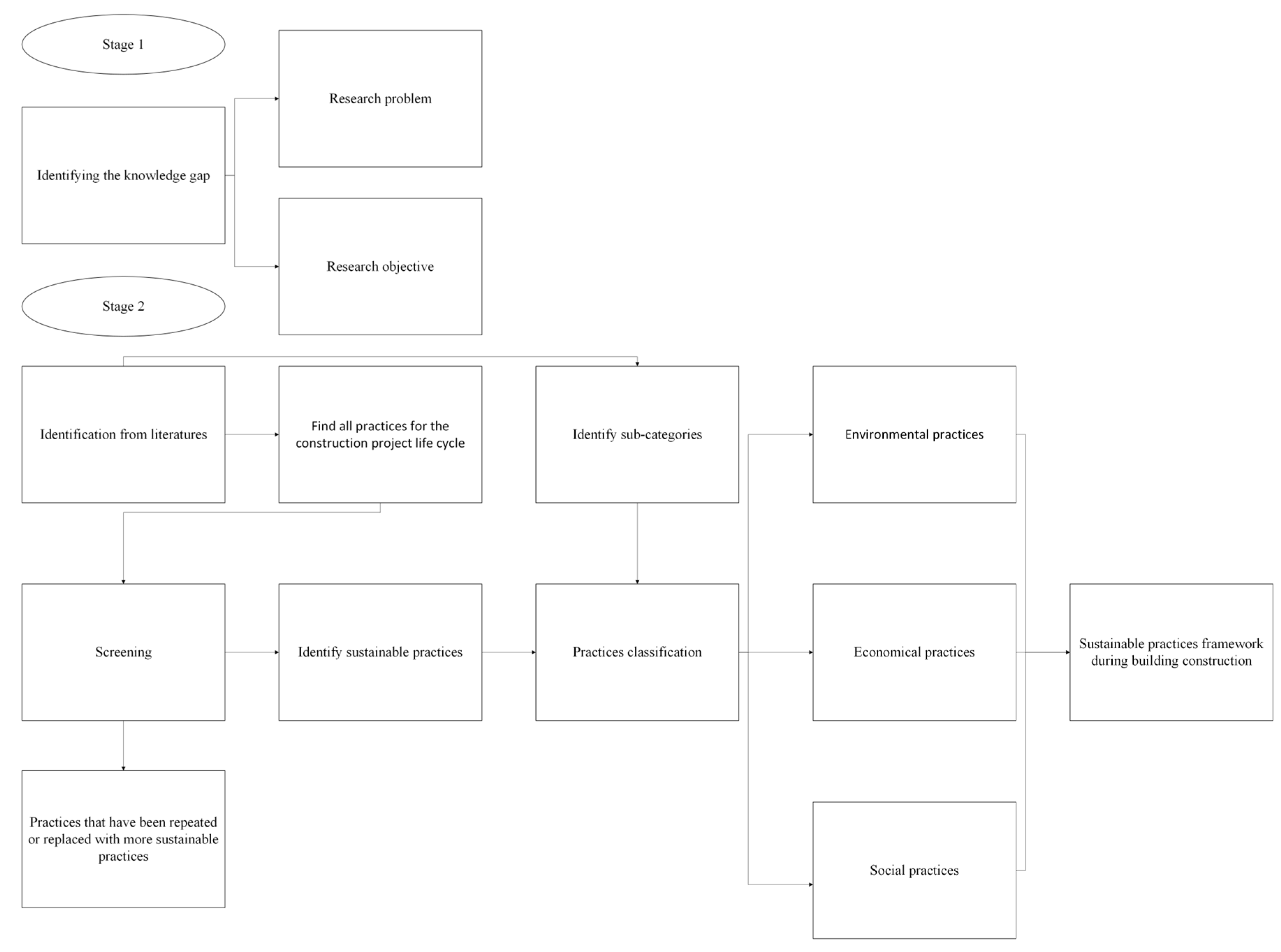
The strategy used in this research was to compile a comprehensive list of all possible practices employed by contractors throughout the construction of a building, informed by literature reviews, the authors’ expertise, and interviews. This expertise was used to make this list based on their own experiences, from the beginning of building construction to the end. Two key references [
23,
24] were used to align all practices during building construction and ensure no practice was missed. which illustrate and explain the methods and practices for each step during building construction, such as calculating the quantity, painting, and excavation work.
After reviewing the practices extracted from the literature, practices related to contractors were separated to avoid confusion between the typical role/tasks of the site engineer and those of the contractor. For example, practices such as material application, daily supervision of construction activities, and compliance monitoring are within the responsibilities of site engineers, while practices related to procurement strategies, disposal of used materials, subcontractor selection, and the implementation of sustainability policies fall under the contractor’s scope of responsibility.
Finally, the unsustainable or outdated practices employed by contractors during construction were replaced with sustainable practices supported by the literature, thereby eliminating or enhancing unsustainable practices.
Figure 1 outlines the review methodology for this paper.
2.1. Research Strategy
In this research, no single academic database was relied upon. Rather than that, an online literature search was conducted to determine relevant peer-reviewed journal articles, institutional reports, sustainability frameworks, green building rating systems, and building codes related to sustainability practices during the construction phase. This method has been used to identify and renew traditional building construction practices through the new-practice method. The authors have ensured that all practices considered during building construction are applicable worldwide.
Authors employed keywords and combinations such as “sustainable construction”, “construction phase sustainability”, “green building codes”, “sustainability standards”, “LEED”, “BREEAM”, and “ISO standards”, with the application of these terms to filter search results.
A thorough, comprehensive review of the available literature from 2006 to 2024 on the topic of sustainable practices in building construction, such as green building codes, scientific research and books. A lack of guidance and performance evaluation criteria for contractors to deliver sustainable construction projects has been observed. Consequently, there is no guidance on how to improve contractors’ performance during building construction in terms of sustainability [
12].
2.2. Inclusion and Exclusion Criteria
Inclusion criteria contained peer-reviewed journal articles, authoritative institutional reports, international sustainability standards, green building rating systems, and building codes addressing sustainability in building construction. Some of this is not published in English, with particular emphasis on contractor-related practices during the construction phase.
Exclusion criteria included studies concentrating on non-construction sectors, publications unrelated to the building construction phase, practices that are not related to the building construction phase in some codes, such as BREEM, and methods for building construction, such as 3D Construction Printing (3DCP), that are not available or applicable to all contractors worldwide.
2.3. Screening Process
The screening process was conducted in two stages. In the first stage, the titles and abstracts of the literature and relevant documents were reviewed to assess their relevance to sustainability practices in building construction and contractor-related activities during the construction phase. Only sources addressing contractors’ sustainability practices during the building construction phase were included in this review. In the second stage, the authors’ experience was used to help validate practices from the literature, which was reviewed to identify practices in the lists and to avoid repetition. All practices were documented and summarised into tables to present the final content, thereby making it easier for readers to follow.
2.4. Thematic Analysis
This research considers sustainable practices for building construction and then categorises these practices based on the sustainability pillars. Tables 1–3 detail the subcategories relevant to building construction and indicate how and from where these can be organised under the three main pillars: environmental, economic, and social. The subcategories were extracted from codes and references for sustainable green buildings during the design and operational phases. The purpose of identifying subcategories of the three pillars is to accommodate varying relevant practices and link these back to the main categories.
This enhances the analytical framework in Tables 1–3 by clearly explaining why each sustainability subcategory was selected and adapted, focusing on contractor-controlled on-building construction site activities. Although these subcategories are derived from broad sustainability codes mainly aimed at design and operations, they were carefully screened and modified by the authors to include only practices within the contractor’s direct responsibility during construction. For example, a subcategory like biodiversity protection is defined in terms of specific on-site-level actions able to classify many practices, such as “Use timber products derived from forests managed through sustainable practices,” which contractors can implement and track. This process ensures the framework considers how well contractors turn sustainability requirements into concrete construction actions. In this way, the framework remains aligned with established standards.
Each subcategory justifies the meaning in the “Description” column, and we label this meaning, for example, “energy efficiency”, while referencing the subcategory from which the code and reference were extracted. Some codes and references mention the subcategory by a different name (e.g., ecofriendly). Moreover, the names were standardised and given a single name with no different meaning to simplify the approach.
Sustainability practices are presented in Tables 4–6 in a structured form that directly recalls the references that placed the practice (in the reference column). This transparent presentation guides the reader clearly from the literature review to the reported findings.
Subsequently, the final list of practices was validated following discussions with industry representatives and sustainability experts in New Zealand to gather feedback and assess the importance of this research, with a focus on practices that need strengthening in New Zealand as a developed nation.
3. Results
3.1. Identification of Subcategories
Table 1 outlines the subcategories of environmental sustainability, providing their descriptions and the relevant references. It emphasises energy efficiency strategies, including the adoption of renewable energy sources and improvements in insulation during building construction, supported by standards and codes such as [
25]. The water conservation subcategory focuses on decreasing water use through techniques such as rainwater harvesting and low-flow fixtures, with references such as [
26]. The waste management subcategory outlines a reduction in waste through recycling, composting, and promoting a circular economy. Additionally, the pollution prevention subcategory outlines measures to reduce emissions and the release of harmful substances. Lastly, the biodiversity protection subcategory emphasises the preservation of natural habitats during building construction, with guidance from organisations such as [
26].
Table 1.
Environmental pillar subcategories.
Table 1.
Environmental pillar subcategories.
| Extracted Subcategories | Description | References |
|---|
| Energy efficiency | Decreasing energy consumption through measures such as energy-efficient appliances, renewable energy sources like solar and wind, and improved building insulation. | [25,27,28,29] |
| Water conservation | Reducing water consumption through measures such as rainwater harvesting, water recycling, low-flow fixtures, and drought-tolerant landscaping. | [25,26,29] |
| Waste management | Minimising waste production through measures such as recycling, composting, reducing packaging, and promoting circular economy principles. | [25,26,29,30,31,32,33,34] |
| Pollution prevention | Reducing emissions and harmful substances in the environment through measures such as cleaner production processes, reducing greenhouse gas emissions, and adopting green chemistry. | [25,26,29,31,35] |
| Biodiversity protection | Protect natural habitats during construction and planning land use during construction. | [25,26,29,31] |
Table 2 highlights the economic subcategories in the main economic pillar. The cost efficiency subcategory focuses on reducing operational costs through resource efficiency by supporting [
25,
32]. Also, sustainable supply chain management emphasises implementing reliable sourcing practices supported by [
24]. Finally, green innovation promotes sustainable technologies, such as green building materials, as evidenced by standards such as [
27].
Table 2.
Economic pillar subcategories.
Table 2.
Economic pillar subcategories.
| Extracted Subcategories | Description | References |
|---|
| Cost efficiency | Reducing operational costs through sustainable practices such as efficient resource management and waste reduction. | [25,29,32] |
| Sustainable supply chain management | Implementing responsible sourcing practices, using ethical suppliers, and promoting local sourcing. | [25,26,29,32,35] |
| Green innovation | Investing in sustainable technologies and innovations, such as green building materials or carbon capture technologies. | [25,26,29,36] |
Table 3 shows subcategories for social sustainability. Fair labour practices focus on fair wages, safe workplaces, and equal opportunities, with references from such sources as [
36]. Additionally, education and awareness emphasise sustainability education and programmes for labourers, which is supported by references such as [
36]. Moreover, health and wellbeing promote quality of life improvements like work–life balance and healthcare access, referencing [
36,
37]. Finally, corporate social responsibility (CSR) integrates social considerations into business strategies, guided by [
38].
Table 3.
Social pillar subcategories.
Table 3.
Social pillar subcategories.
| Extracted Subcategories | Description | References |
|---|
| Fair labour practices | Ensuring fair wages, safe working conditions, and equal opportunities for employees. | [25,29,36,39,40] |
| Education and awareness | Promoting sustainability through educational initiatives and awareness programmes. | [25,29,36,41] |
| Health and wellbeing | Improving health and quality of life, such as by encouraging work–life balance and improving access to healthcare. | [25,29,36,37,41] |
| Corporate social responsibility (CSR) | Integrating social considerations into business strategies, such as training labourers. | [25,29,38,42] |
3.2. Determination of the Practices Relevant to Building Construction
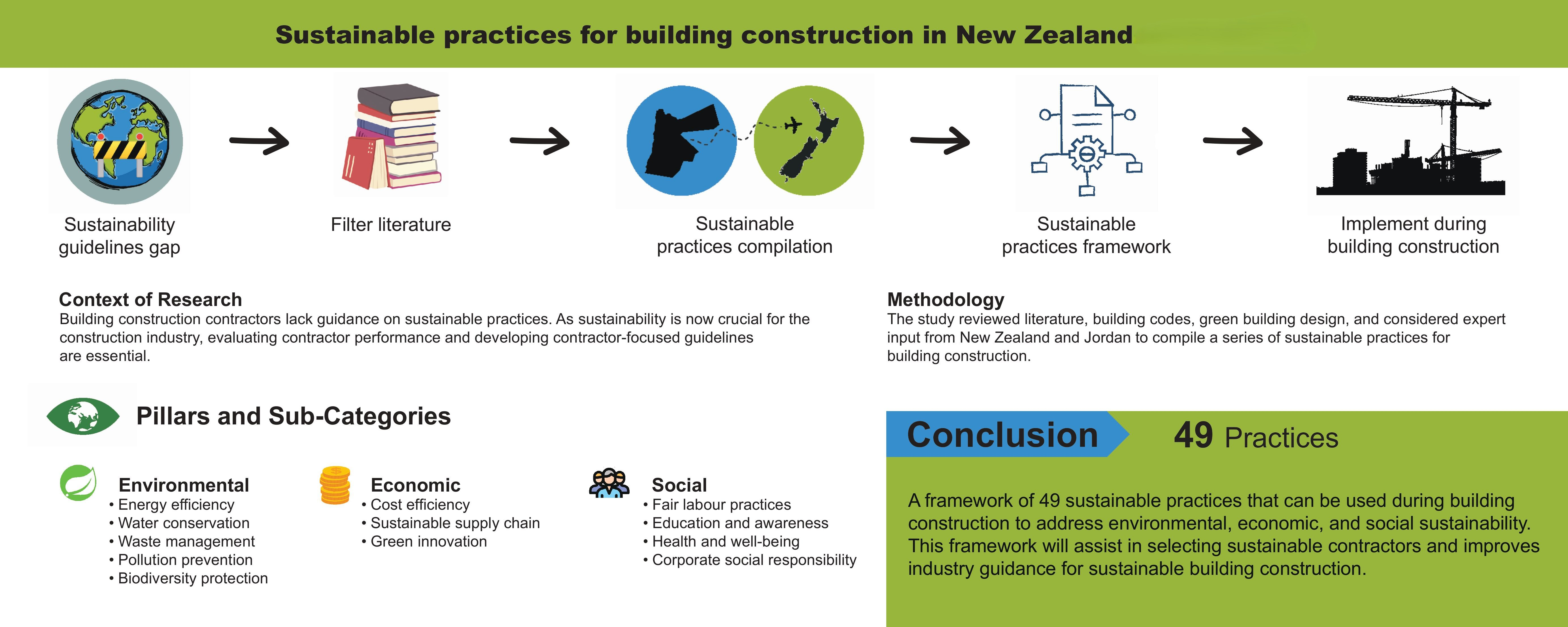
In this study, 49 sustainable practices relevant to building construction have been identified and categorised.
Table 4 summarises the sustainable practices in the environmental pillar and their associated subcategories. The key subcategories that appear from this categorisation are waste management and pollution prevention. For example, recycling plays a crucial role in reducing the volume of waste sent to landfills, conserving natural resources, and minimising environmental pollution [
43]. When recycling is neglected, valuable materials such as metals, plastics, and paper are lost, which increases demand for virgin resources and energy consumption to extract and process them. This depletes finite resources and increases greenhouse gas emissions [
43]. Collaborative initiatives such as public awareness campaigns and incentives for effective recycling are crucial for promoting behavioural shifts and positioning sustainable waste management as a collective responsibility shared by all stakeholders [
43].
Table 4.
Sustainable practices in the environmental pillar.
Table 4.
Sustainable practices in the environmental pillar.
| Practice | Subcategory | References |
|---|
| Secure the site by using a boundary fence constructed from recycled materials or by using a hired fence system. | Waste management, pollution prevention | [44,45] |
| Prohibit smoking across the entire site and within storage areas. | Pollution prevention | [46,47] |
| Engage an inspector to oversee overall safety, waste management, and environmental practices. | Waste management, pollution prevention | [45,48] |
| Develop a sustainable waste management policy in collaboration with responsible parties for the appropriate disposal or recycling of both non-hazardous and hazardous waste, preferably under the supervision of a specialist. | Waste management, pollution prevention | [45,48] |
| Develop a plan to recycle materials, including a section on environmental practices in the monthly project report summarising and/or quantifying materials that can be reused. | Waste management, pollution prevention | [48,49] |
| Recycle containers on site for paper, plastic, metals, organics, and e-waste; ensure every location within the construction site has sufficient free space to ensure strict compliance with the waste management plan. | Waste management | [48,50] |
| Sort waste on site as it is generated. | Waste management | [48] |
| Separate and store hazardous waste aboveground in suitable and clearly labelled containers. | Waste management, pollution prevention | [48] |
| Ensure all on-site staff are familiar with the waste management plan and actively contribute to meeting its requirements. | Waste management | [48] |
| Utilise LED lights within the building or when working at night throughout the project. | Energy efficiency | [49,51] |
| If night shifts are necessary, position artificial lights strategically to minimise light pollution. | Pollution prevention, energy efficiency | [49,51] |
| Consider the potential disassembly, reuse, or recycling of construction elements and materials in the future. | Waste management, biodiversity protection | [48] |
| Incorporate materials with recycled content and high durability as part of a product stewardship programme for reusing or recycling materials at the end of their useful life. | Waste management, pollution prevention | [50] |
| Avoid disposing of material waste in private properties adjacent to the site. | Pollution prevention, waste management | [51,52] |
| Precisely cut materials to minimise waste. | Waste management | [45,48,51] |
| Avoid the incineration of paper and plastic waste within the site. | Pollution prevention, waste management | [45,48,51] |
| Implement a daily water spraying system to mitigate dust generated during construction and reduce the impact on the surrounding community. | Pollution prevention | [49] |
| Regulate operations involving materials prone to generating dust by ensuring careful transportation and handling. | Pollution prevention | [49] |
| Secure any water resources, such as groundwater, that are discovered on site and promptly inform the relevant authorities. | Water conservation, biodiversity protection, pollution prevention | [45,48,53] |
| Secure a contract with the body responsible for transporting and treating grey or black water during building construction. | Waste management, water conservation, pollution prevention | [50] |
| Use timber products derived from forests managed through sustainable practices. | Biodiversity protection, waste management | [50] |
| Use green cement instead of traditional cement when possible. | Pollution prevention | [54] |
Table 5 lists sustainable practices categorised into the economic pillar. The key subcategories in this pillar are sustainable supply chain management and cost efficiency. For example, using potable water for construction rather than non-potable sources increases expenses while potentially reducing environmental sustainability. Ref. [
55] specifies that potable water is generally acceptable for concrete production because it ensures no negative effects on the concrete properties. Although this practice appears unsustainable, it also cannot be avoided due to building code requirements. However, the use of non-potable water may be possible under certain conditions, provided certain quality criteria for the water are met, such as limits on impurities like chlorides, sulphates, and alkalis that can negatively impact the durability or setting characteristics of the concrete [
56].
Table 5.
Sustainable practices in the economic pillar.
Table 5.
Sustainable practices in the economic pillar.
| Practice | Subcategory | References |
|---|
| Source building materials from nearby stores rather than transporting them from other regions. | Sustainable supply chain management | [57] |
| Use high-quality water pipes to minimise water wastage during construction. | Cost efficiency | [57] |
| Employ reusable steel moulds to pump concrete in lieu of wooden frameworks when feasible. | Green innovation, cost efficiency | [49] |
| Procure materials from certified factories or firms engaged in ecofriendly manufacturing processes to bolster sustainable development. | Sustainable supply chain management | [49,50] |
| Choose storage sites far from water erosion paths to mitigate damage to materials resulting from exposure to water, especially during the winter. | Cost efficiency | [53] |
| Conduct regular maintenance on plant and machinery to minimise harmful gas emissions. | Green innovation | [52] |
| Verify quantities before purchasing materials to minimise oversupply. | Cost efficiency | [57] |
| Prioritise the nearest authorised recycling depot for recycling waste. | Sustainable supply chain management | [48] |
| Use a pump to pour concrete instead of manual mixing. | Cost efficiency | [58] |
| Use water suitable for human consumption in construction activities. | Cost efficiency, sustainable supply chain management | [45,48,53] |
| Removing temporary site measures required for construction, such as used curbstones, pipes, and wires for potential reuse later. | Green innovation, sustainable supply chain management | [53] |
| Optimise the work schedule to prevent construction materials from being left on site for extended periods before use to avoid weathering and potential disposal. | Cost efficiency, sustainable supply chain management | [49,53] |
| Store materials and equipment in designated spaces for proper organisation and efficient storage. | Cost efficiency | [48,49] |
Table 6 lists the sustainable practices relevant to the social pillar. The key subcategories are fair labour practices, education and awareness, health and wellbeing, and corporate social responsibility (CSR). For example, a CSR relevant practice is to show regard for the local community and adjacent neighbours by disposing of topsoil or unsuitable materials properly after excavation work rather than dumping materials onto adjacent private property or reserves. This ensures compliance with social regulations and helps maintain good relations with neighbours while preventing potential legal issues and damage to the local community [
52]. Additionally, staff education is needed to improve site and community awareness of sustainability measures [
53].
Table 6.
Sustainable practices in the social pillar.
Table 6.
Sustainable practices in the social pillar.
| Practice | Subcategory | References |
|---|
| Arrange for an insurance policy to cover labourers [in New Zealand, all employees are automatically covered by a government-prescribed accident insurance]. | Health and wellbeing, fair labour practices | [52] |
| Grant [or supporting the granting of] work permits for labourers. | Fair labour practices | [52] |
| Supply staff with personal protective equipment that adheres to safety requirements including hi-vis vests, safety shoes, and hard hats. | Health and wellbeing | [48,52] |
| Adhere to health and safety codes, including providing an occupational health and safety officer. | Health and wellbeing | [48,51,52,57,59,60] |
| Establish job opportunities for residents, such as by engaging in contracts with local artisans, provided they possess the necessary competence, rather than contracting artisans from other regions. | Corporate social responsibility [CSR] | [53] |
| Offer environmental training opportunities for both labourers and residents to spread environmental awareness. | Education and awareness | [53] |
| Enhance communication skills among staff members, such as through weekly meetings. | Education and awareness | [48] |
| Use drawings on sheets and/or the site floor to illustrate the size and location of stockpiles, waste storage areas, and traffic pathways. | Education and awareness | [48] |
| Offer training to the local community to develop a local pool of labourers. | Corporate social responsibility [CSR], education and awareness | [53] |
| Confirm the availability of transportation services for site workers. | Fair labour practices, health and wellbeing | [61] |
| Minimise traffic disruption, loss of parking space, and detours due to transportation of material or concrete pumping work | Corporate social responsibility [CSR] | [62] |
| Employ indigenous people. | Corporate social responsibility [CSR] | [63] |
| Dispose of backfill properly after excavation work rather than dumping materials onto adjacent private property. | Corporate social responsibility [CSR], fair labour practices | [51,52] |
| Ensure cleanliness on site, in the vicinity, and along the streets to eliminate any potential hazards such as screws or steel fragments that could threaten the wellbeing of nearby residents and vehicles. | Corporate social responsibility [CSR], health and wellbeing | [52,57] |
3.3. Interviews
To achieve a deeper understanding of sustainability in building construction, a series of semi-structured interviews were conducted with experts in the field and civil engineers, including an environmental engineering specialist and a road engineering specialist. These interviews sought to summarise experiences and challenges concerning sustainability in New Zealand’s building practices, emphasising the most important strategies. This section presents a thematic analysis of the interview responses, emphasising the current situation of the projects, critical insights, and emerging trends that align with the research objectives.
An interview was conducted with an environmental engineer with experience in roading construction in Australia and New Zealand to gain insights into practical sustainability measures and to evaluate their applicability to construction. The interviewee highlighted that although various entities are involved in asphalt recycling in the country, significant challenges remain. One of the primary issues is that regulations were made by councils. The interviewee mentioned that local councils must update the existing regulations because the current recycling framework restricts the processes, making sustainable practices difficult to implement in reality.
In a more comprehensive discussion of sustainability practices during construction, the interviewee underlined the significance of integrating waste management practices not only in building projects but also in infrastructure works. Moreover, successful implementation depends on the overarching framework, which must be supported by councils or any other authorised association. These organisations play a crucial role in establishing and enforcing sustainability standards.
Another fundamental issue discussed was the role of contracts in supporting or restricting sustainability efforts. The interviewee indicated that contractual clauses can either facilitate or hinder sustainable practices in building construction. Consequently, contracts should be carefully outlined and enhanced to support sustainability. Without this, contractors might face constraints in implementing environmentally responsible measures.
In summary, the interviewee concluded that in New Zealand, the progress of recycling and sustainability in the construction sector is directly linked to regulatory changes, improved resource availability, enhanced contract structures, and strong institutional support. These factors are vital in ensuring that sustainable practices are not only encouraged but also practically achievable during construction projects. These insights help explain why several sustainability practices identified in this study are difficult for contractors to implement during construction.
An interview was held with an advisor specialising in people, capability, environment, and sustainability. The interviewee has academic expertise in geology, geography, and environmental science. The conversation centred on sustainable building practices and the wider context of environmental management in New Zealand’s construction industry.
The advisor described the multifaceted nature of construction work, which spans civil infrastructure, minor building works, and maintenance services for public assets. Managing such a diverse portfolio presents challenges, as changes in one operational area can produce unintended consequences elsewhere. This is further complicated by financial accountability to the local community, where most operational funding originates.
A key issue raised was the imbalance between environmental compliance and proactive sustainability. While sustainability is recognised as a priority, limited resources and organisational focus mean that most efforts are directed toward meeting regulatory requirements. Senior leadership often struggles to justify further investment in sustainability initiatives amid competing demands.
Legislative challenges were also discussed. The advisor criticised waste management regulations, particularly for clean fill and aggregate disposal, as impractical due to high costs and limited access to approved facilities. These constraints can unintentionally incentivise subcontractors to engage in non-compliant disposal practices.
Moreover, plastic recycling presents additional challenges. The advisor mentioned that recyclability depends on plastic being in top condition, which the contractors need to wash and protect, which is rarely the case because of weathering and contamination during building construction.
Additionally, costly and often inaccessible cleaning technologies struggle to achieve effective recycling, resulting in more plastic waste ending up in landfills. Furthermore, the interviewee pointed out a systemic issue, which is the conflict and tension between collaboration and competition. While sustainability benefits from shared knowledge and cooperative efforts, competitive pressures frequently prevent such collaboration, making it difficult to achieve widespread environmental improvements in the industry.
In summary, organisational complexity, financial accountability, and regulatory pressures impact sustainable construction outcomes. In addition, waste and plastic recycling are limited by high costs and limited access to facilities. These barriers highlight the challenges encountered in implementing certain sustainability practices observed in this research.
4. Discussion
This study draws on a wide range of sources, including case studies, academic journals, textbooks, and both national and international standards, to identify sustainable practices that contractors should adopt during the building construction phase. By incorporating global standards and experiences, the study presents 49 sustainable practices with potential applicability across diverse construction contexts worldwide, divided into three pillars of sustainability and linked with subcategories to comprehend each practice better, and where it is applicable. In this way, this research addressed the gap noted by [
12]; there is no comprehensive guidance for contractors, and most current research and sustainability assessment tools primarily target two phases: design or post-construction.
Moreover, this research addresses the gap identified by [
13]; many existing tools concentrate on a single dimension of sustainability, environmental, social, or economic, rather than addressing all pillars comprehensively. Therefore, the knowledge, understanding, and application of sustainability may vary considerably across countries. Some countries may prioritise one dimension over others based on their specific needs, policy frameworks, or development goals. This variation can cause sustainability indicators to fall short in explaining why different countries achieve different levels of sustainability [
13].
However, the study is limited by the shortage of references on sustainable practices during the construction phase, as access to the latest versions of green codes is restricted to paid subscriptions or institutional licences. As a result, the analysis relied on publicly accessible or earlier versions of these codes. Additionally, many existing tools do not account for the diverse construction requirements across regions.
Despite these challenges, the practices highlighted in this study help deepen understanding and enhance the implementation of sustainability in the construction industry. Environmental practices help reduce waste and resource consumption, economic practices support efficient project delivery, and social practices ensure safe and compliant working conditions. Together, they demonstrate the role of contractors in achieving sustainability objectives during building construction. Nevertheless, widespread adoption may remain limited until sustainability requirements are made mandatory. Furthermore, a shortage of expertise and public awareness could restrict the effective dissemination and adoption of sustainable practices.
Furthermore, future researchers can utilise the tables in this study to conduct surveys with engineers and contractors, pinpointing the most vital practices to improve in their regions. Future research should examine how sustainable practices vary across countries and identify the most effective strategies for contractors to implement locally to improve the uptake of sustainability in building construction.
The practices outlined in this paper can be used to form a framework to clarify the role of sustainability construction practices in urban resilience and of site management measures to enhance the adaptability of urban developments. Economic practices highlight the circular economy by focusing on material reuse, waste reduction, and cost-effective resource management during construction. Energy practices support urban energy solutions and transitions by encouraging efficient on-site energy use and low-impact construction methods, which affect long-term urban energy performance. Socially oriented practices relate to urban housing, worker welfare, and surrounding community conditions. The alignment of the practices with international standards supports the Urban Agenda by offering a reproducible guideline.
5. Conclusions
Sustainability has a vital role in global development, especially in the construction sector. However, there is a lack of clear, practical guidance for contractors on improving sustainability during construction. Current assessment systems, such as LEED and BREEAM, primarily focus on the design and operational phases, leaving a gap in sustainability guidance during building construction.
This research addresses this gap by developing a comprehensive, practical set of 49 practices for building construction. These practices are organised under the three pillars of sustainability: environmental, social, and economic. With a subcategories framework to provide structure and clarity. The authors, who are experts from New Zealand and a principal researcher from Jordan, conducted this research to understand regional practices and provide a valuable perspective that can advance the sustainability of building construction. Additionally, developing a standardised methodology to evaluate contractor performance on sustainability would provide valuable insights to advance sustainable construction practices.
The interviews conclude that the application of sustainable practices during building construction in New Zealand is constrained by a combination of old and unrealistic regulatory frameworks, specifically at the local government level, which limits the practical adoption of recycling and waste management practices, while insufficient institutional support and a lack of practical guidance further complicate consistent implementation. Restricting contractors’ ability to implement environmentally responsible practices leads to high disposal costs and significant waste management and recycling challenges, including limited access to approved facilities and technical barriers to material recycling, reducing the effectiveness of sustainability initiatives on construction sites. Collectively, these factors highlight the persistent challenges in implementing sustainability practices effectively in the New Zealand construction industry.
The accompanying tables can also be used as tools for regulatory organisations to monitor and assess the implementation of sustainable practices on construction sites. Ultimately, policymakers at local and national levels could use these practices as a basis for establishing clear goals and standards to enhance sustainability in the construction industry.
Author Contributions
Conceptualization, M.B., K.R., T.-A.B. and K.d.G.; methodology, M.B., K.R., T.-A.B. and K.d.G.; validation, M.B., K.R., T.-A.B. and K.d.G.; formal analysis, M.B.; investigation, M.B.; resources, K.d.G., K.R., and T.-A.B.; data curation, M.B.; writing—original draft preparation, M.B.; writing—review and editing, M.B., K.R., T.-A.B. and K.d.G.; visualisation, M.B.; supervision, K.d.G., K.R., and T.-A.B.; project administration, K.d.G.; funding acquisition, none. All authors have read and agreed to the published version of the manuscript.
Funding
This research received no external funding.
Institutional Review Board Statement
The study was conducted in accordance with the Declaration of Helsinki, and the protocol was approved by the Ethics Committee of HECS Human Ethics Committee, University of Waikato (Project identification code: HREC2023#63) on 1 December 2023.
Informed Consent Statement
Informed consent for participation was obtained from all subjects involved in the study.
Data Availability Statement
The data supporting the findings of this study are derived from publicly available sources, which are cited throughout the article.
Conflicts of Interest
The authors declare no conflicts of interest.
Abbreviations
The following abbreviations are used in this manuscript:
| CSR | Corporate Social Responsibility |
| Hi-vis | High Visibility (safety vest) |
| ISO | International Organisation for Standardisation |
| LEED | Leadership in Energy and Environmental Design |
| LED | Light-Emitting Diode |
| U.S. EPA | United States Environmental Protection Agency |
References
- Albtoush, A.M.F.; Doh, S.I.; Rahman, R.A.; Al-Momani, A.H. Critical Success Factors of Construction Projects in Jordan: An Empirical Investigation. Asian J. Civ. Eng. 2022, 23, 1087–1099. [Google Scholar] [CrossRef]
- Khanzadi, M.; Sheikhkhoshkar, M.; Banihashemi, S. BIM Applications toward Key Performance Indicators of Construction Projects in Iran. Int. J. Constr. Manag. 2020, 20, 305–320. [Google Scholar] [CrossRef]
- Sedayu, A.; Setiono, A.R.; Subaqin, A.; Gautama, A.G. Improving the Performance of Construction Project Using Green Building Principles. Asian J. Civ. Eng. 2020, 21, 1443–1452. [Google Scholar] [CrossRef]
- Sharifi Orkomy, A.; Sharbatdar, M.K. Identifying Effective Sustainable Development Indicators for Airport Construction Projects: Zahedan International Airport in Iran as Case Study. Iran. J. Sci. Technol. Trans. Civ. Eng. 2021, 45, 241–252. [Google Scholar] [CrossRef]
- United Nations Environment Programme. Not Just Another Brick in the Wall: The Solutions Exist—Scaling Them Will Build on Progress and Cut Emissions Fast. Global Status Report for Buildings and Construction 2024/2025; United Nations Environment Programme: Nairobi, Kenya, 2025; ISBN 978-92-807-4215-2. [Google Scholar]
- Shrestha, D.K.; Praveen, B.M.; Gorkhaly, G.P. Conservation of Natural Resources in Infrastructure Development and Climate Action—Practices in the Past and Present Scenario, and Forecast for Future. NPRC J. Multidiscip. Res. 2025, 2, 1–15. [Google Scholar] [CrossRef]
- Hasselsteen, L.; Stapel, E.B.; Birgisdóttir, H.; Sørensen, C.G.; Kanafani, K. Evaluating the Environmental Impact of Construction Waste: A Comprehensive Analysis of End-of-Life Scenarios in Environmental Product Declarations. Build. Environ. 2025, 280, 113159. [Google Scholar] [CrossRef]
- Rao, C. Optimal Design of Green Building Based on Digital Media Technology. In Proceedings of the 2022 International Conference on Artificial Intelligence in Everything (AIE), Lefkosa, Cyprus, 2–4 August 2022; pp. 357–361. [Google Scholar]
- Moshood, T.D.; Rotimi, J.O.; Shahzad, W. Enhancing Sustainability Considerations in Construction Industry Projects. Environ. Dev. Sustain. 2024, 27, 29287–29313. [Google Scholar] [CrossRef]
- Kumar Singh, A.; Aljohani, A.; Shakor, P.; Awuzie, B.O.; Uddin, S.M.J.; Shivendra, B.T. Study on Safety Health of Construction Workers at Workplace: A Sustainable Perspective Approach. Front. Built Environ. 2024, 10, 1451727. [Google Scholar] [CrossRef]
- Srivastava, S.; Raniga, U.I.; Misra, S. A Methodological Framework for Life Cycle Sustainability Assessment of Construction Projects Incorporating TBL and Decoupling Principles. Sustainability 2021, 14, 197. [Google Scholar] [CrossRef]
- Alnsour, M.; Zeidan, A.; Al Quwaider, B.; Alkubaisi, A.; Alreqeb, R.; Bader, M. Developing Sustainability Assessment Indicators for Measuring Contractor’s Performance during the Construction Phase of Construction Projects in Jordan. Asian J. Civ. Eng. 2023, 24, 245–266. [Google Scholar] [CrossRef]
- St Flour, P.O.; Bokhoree, C. Sustainability Assessment Methodologies: Implications and Challenges for SIDS. Ecologies 2021, 2, 285–304. [Google Scholar] [CrossRef]
- Heinberg, R.; Lerch, D.S. (Eds.) The Post Carbon Reader: Managing the 21st Century’s Sustainability Crises; Contemporary Issues Series; Watershed Media: Healdsburg, CA, USA, 2010; ISBN 978-0-9709500-6-2. [Google Scholar]
- Weltkommission für Umwelt und Entwicklung. Our Common Future; Reprinted; Oxford University Press: Oxford, UK, 2009; ISBN 978-0-19-282080-8. [Google Scholar]
- Bansal, P.; DesJardine, M.R. Business Sustainability: It Is about Time. Strateg. Organ. 2014, 12, 70–78. [Google Scholar] [CrossRef]
- Zakrzewska, M.; Piwowar-Sulej, K.; Jarosz, S.; Sagan, A.; Sołtysik, M. The Linkage between Agile Project Management and Sustainable Development: A Theoretical and Empirical View. Sustain. Dev. 2022, 30, 855–869. [Google Scholar] [CrossRef]
- Du Plessis, C. A Strategic Framework for Sustainable Construction in Developing Countries. Constr. Manag. Econ. 2007, 25, 67–76. [Google Scholar] [CrossRef]
- Oladokun, M.G.; Isang, I.W.; Emuze, F. Towards Sustainability Practices Deployment in Building Construction Projects in Nigeria. Smart Sustain. Built Environ. 2021, 10, 759–780. [Google Scholar] [CrossRef]
- Sarkis, J.; Meade, L.M.; Presley, A.R. Incorporating Sustainability into Contractor Evaluation and Team Formation in the Built Environment. J. Clean. Prod. 2012, 31, 40–53. [Google Scholar] [CrossRef]
- Jiang, Y.; Zhao, D.; Wang, D.; Xing, Y. Sustainable Performance of Buildings through Modular Prefabrication in the Construction Phase: A Comparative Study. Sustainability 2019, 11, 5658. [Google Scholar] [CrossRef]
- Abalo, J.; Varela, J.; Manzano, V. Importance Values for Importance–Performance Analysis: A Formula for Spreading out Values Derived from Preference Rankings. J. Bus. Res. 2007, 60, 115–121. [Google Scholar] [CrossRef]
- Allen, E.; Iano, J. Fundamentals of Building Construction: Materials and Methods, 7th ed.; Wiley: Hoboken, NJ, USA, 2019; ISBN 978-1-119-45025-2. [Google Scholar]
- Chudley, R.; Greeno, R.; Kovac, K. Chudley and Greeno’s Building Construction Handbook, 13th ed.; Routledge: London, UK, 2024; ISBN 978-1-003-39299-6. [Google Scholar]
- U.S. Green Building Council. LEED v4.1 BD+C Beta Guide (1.22.19)—With Requirements; U.S. Green Building Council: Washington, DC, USA, 2021. [Google Scholar]
- ISO 14001:2015; Environmental Management Systems—Requirements with Guidance for Use. International Organization for Standardization (ISO): Geneva, Switzerland, 2015.
- ISO 50001:2018; Energy Management Systems: Requirements with Guidance for Use. International Organization for Standardization (ISO): Geneva, Switzerland, 2018.
- I.S. EN 16001:2009; Energy Management Systems—Requirements with Guidance for Use. Sustainable Energy Ireland: Dublin, Ireland, 2009.
- Building Research Establishment. BREEAM International New Construction 2016: Technical Manual; BRE Global Ltd.: Hertfordshire, UK, 2018. [Google Scholar]
- ISO 14040:2006; Environmental Management—Life Cycle Assessment—Principles and Framework. International Organization for Standardization (ISO): Geneva, Switzerland, 2006.
- ISO 14055-1:2017; Environmental Management—Guidelines for Establishing Good Practices for Combating Land Degradation and Desertification—Part 1: Good Practices Framework. International Organization for Standardization (ISO): Geneva, Switzerland, 2017.
- ISO 20400:2017; Sustainable Procurement—Guidance. International Organization for Standardization (ISO): Geneva, Switzerland, 2017.
- ISO 21930:2017; Sustainability in Buildings and Civil Engineering Works—Core Rules for Environmental Product Declarations of Construction Products and Services. International Organization for Standardization (ISO): Geneva, Switzerland, 2017.
- California Building Standards Commission. CALGreen Code, Title 24, Part 11: California Green Building Standards Code; California Building Standards Commission (CBSC): Sacramento, CA, USA, 2022. [Google Scholar]
- U.S. Environmental Protection Agency. National Pollutant Discharge Elimination System (NPDES) Permit Program; U.S. Environmental Protection Agency (EPA): Washington, DC, USA, 2021.
- ISO 45001:2018; Occupational Health and Safety Management Systems—Requirements with Guidance for Use. International Organization for Standardization (ISO): Geneva, Switzerland, 2018.
- International WELL Building Institute. WELL Building Standard V2; International WELL Building Institute (IWBI): New York, NY, USA, 2020. [Google Scholar]
- ISO 26000:2010; Guidance on Social Responsibility. International Organization for Standardization (ISO): Geneva, Switzerland, 2010.
- Fair Trade International. Fair Trade Standards; Fair Trade International: Bonn, Germany, 2021. [Google Scholar]
- Social Accountability International. Social Accountability 8000 International Standard; Social Accountability International (SAI): New York, NY, USA, 2014. [Google Scholar]
- Occupational Safety and Health Administration. Resource for Development and Delivery of Training to Workers; US Department of Labor: Washington, DC, USA, 2021.
- ISO 37001:2016; Anti-Bribery Management Systems—Requirements with Guidance for Use. International Organization for Standardization (ISO): Geneva, Switzerland, 2016.
- Geyer, R.; Jambeck, J.R.; Law, K.L. Production, Use, and Fate of All Plastics Ever Made. Sci. Adv. 2017, 3, e1700782. [Google Scholar] [CrossRef]
- Akor, M.O. Business Sustainability: Understanding the Influence of Managers and Stakeholders on Adopting Sustainability Practices in Nigerian SMEs. Ph.D. Thesis, University of Wolverhampton, Wolverhampton, UK, 2023. [Google Scholar]
- El-Moghrabi, L.; Masri, I. Environmental and Social Impact Assessment (ESIA) for Shobak 45 mW Wind Power Project in Ma’an. Al-Shoubak Wind Energy PSC. 2017. Available online: https://tethys.pnnl.gov/sites/default/files/publications/elmograhbietal2017.pdf (accessed on 3 December 2022).
- Rahman, N.N.N.A.; Esa, N. Managing Construction Development Risks to the Environment. In Sustainable Living with Environmental Risks; Kaneko, N., Yoshiura, S., Kobayashi, M., Eds.; Springer Japan: Tokyo, Japan, 2014; pp. 193–202. ISBN 978-4-431-54803-4. [Google Scholar]
- Alsheikh-Salem, Y.M.-B. The Development of a Sustainability Risk Assessment Model for Construction Projects: A Case Study on the Jordanian Construction Industry. Ph.D. Thesis, University of Salford, Salford, UK, 2022. [Google Scholar]
- Gangolells, M.; Casals, M.; Forcada, N.; Macarulla, M. Analysis of the Implementation of Effective Waste Management Practices in Construction Projects and Sites. Resour. Conserv. Recycl. 2014, 93, 99–111. [Google Scholar] [CrossRef]
- U.S. Green Building Council. LEED v4 for Building Design and Construction: Guidelines and Standards for Sustainable Design; U.S. Green Building Council: Washington, DC, USA, 2019. [Google Scholar]
- Green Building Council of Australia. Green Building Checklist—Green Buildings for Tenants—Green Building Council Australia (GBCA). Available online: https://www.gbca.org.au/resources/green-buildings-for-tenants/green-building-checklist/ (accessed on 20 December 2025).
- Royal Scientific Society. Green Building Development in Jordan; The Royal Scientific Society of Jordan and the Friedrich-Ebert-Stiftung Amman Office: Amman, Jordan, 2013; ISBN 978-9957-484-37-8. [Google Scholar]
- Geach, I. Investigating the Role of Sustainability in Contractor Selection and Evaluation. Sustainability Scholarship. 2016. Available online: https://constructorscompany.org.uk/wp-content/uploads/2019/11/2015-16-Geach.pdf (accessed on 20 September 2023).
- Government Tenders Department. Contractor Contract for Construction Projects/2010; The Ministry of Public Works and Housing: Amman, Jordan, 2013. [Google Scholar]
- Suhendro, B. Toward Green Concrete for Better Sustainable Environment. Procedia Eng. 2014, 95, 305–320. [Google Scholar] [CrossRef]
- 318-19 Building Code Requirements for Structural Concrete and Commentary; American Concrete Institute: Farmington Hills, MI, USA, 2019; ISBN 978-1-64195-056-5.
- 2023 ACI Collection of Concrete Codes, Specifications, and Practices, 2023 ed.; American Concrete Institute: Farmington Hills, MI, USA, 2023; ISBN 978-1-64195-205-7.
- Institute for Sustainable Infrastructure. Guide to Envision Verification for Applicants; Institute for Sustainable Infrastructure: Washington, DC, USA, 2023. [Google Scholar]
- Waddell, J.J. Handling Concrete—Then and Now. J. Constr. Div. 1975, 101, 819–837. [Google Scholar] [CrossRef]
- Loeppke, R.R.; Hohn, T.; Baase, C.; Bunn, W.B.; Burton, W.N.; Eisenberg, B.S.; Ennis, T.; Fabius, R.; Hawkins, R.J.; Hudson, T.W.; et al. Integrating Health and Safety in the Workplace: How Closely Aligning Health and Safety Strategies Can Yield Measurable Benefits. J. Occup. Environ. Med. 2015, 57, 585–597. [Google Scholar] [CrossRef]
- Kühnel, J.; Zacher, H.; De Bloom, J.; Bledow, R. Take a Break! Benefits of Sleep and Short Breaks for Daily Work Engagement. Eur. J. Work Organ. Psychol. 2017, 26, 481–491. [Google Scholar] [CrossRef]
- Thakuriah (Vonu), P.; Persky, J.; Soot, S.; Sriraj, P.S. Costs and Benefits of Employment Transportation for Low-Wage Workers: An Assessment of Job Access Public Transportation Services. Eval. Program Plann. 2013, 37, 31–42. [Google Scholar] [CrossRef] [PubMed]
- Gilchrist, A.; Allouche, E.N. Quantification of Social Costs Associated with Construction Projects: State-of-the-Art Review. Tunn. Undergr. Space Technol. 2005, 20, 89–104. [Google Scholar] [CrossRef]
- Gray, M.; Hunter, B.; Biddle, N. The Economic and Social Benefits of Increasing Indigenous Employment; Centre for Aboriginal Economic Policy Research, The Australian National University: Canberra, ACT, Australia, 2014. [Google Scholar]
| Disclaimer/Publisher’s Note: The statements, opinions and data contained in all publications are solely those of the individual author(s) and contributor(s) and not of MDPI and/or the editor(s). MDPI and/or the editor(s) disclaim responsibility for any injury to people or property resulting from any ideas, methods, instructions or products referred to in the content. |