

Implications of CMIP6 GCM-Based Climate Variability for Photovoltaic Potential over Four Selected Urban Areas in Central and Southeast Europe During Summer (1971–2020)

Abstract
1. Introduction
2. Materials and Methods
2.1. The Study Locations

2.2. Data
2.2.1. CMIP6 GCMs

| GCM | Developer | Original Horizontal Resolution (Lat × Lon) | Model Components | |||||||
|---|---|---|---|---|---|---|---|---|---|---|
| Atmospheric | Aerosol | Atmospheric Chemistry | Land Surface | Land Ice | Ocean | Ocean Biogeochemistry | Sea Ice | |||
| BCC-CSM2-MR [46] | CHN | ~1.12° × 1.13° | BCC-AGCM3-MR (46) | - | - | BCC_AVIM2 | - | MOM4 (40) | - | SIS2 |
| CMCC-CM2-SR5 [47] | ITA | ~0.94° × 1.25° | CAM5.3 (30) | MAM3 | - | CLM4.5 (BGC mode) | - | NEMO3.6 (50) | - | CICE4.0 |
| CMCC-ESM2 [48] | ITA | ~0.94° × 1.25° | CAM5.3 (30) | MAM3 | - | CLM4.5 (BGC mode) | - | NEMO3.6 (50) | BFM5.1 | CICE4.0 |
| EC-Earth3 [49] | EU | ~0.7° × ~0.7° | IFS cy36r4 (91) | - | - | HTESSEL | - | NEMO3.6 (75) | - | LIM3 |
| EC-Earth3-Veg [49] | EU | ~0.7° × ~0.7° | IFS cy36r4 (91) | - | - | HTESSEL, LPJ-GUESS v4 | - | NEMO3.6 (75) | - | LIM3 |
| EC-Earth3-CC [49] | EU | ~0.7° × ~0.7° | IFS cy36r4 (91) | - | TM5 | HTESSEL, LPJ-GUESS v4 | - | NEMO3.6 (75) | PISCESv2 | LIM3 |
| GFDL-CM4 [50] | USA | 1° × 1.25° | GFDL- AM4.0.1 (33) | inter active | - | GFDL- LM4.0.1 | GFDL-LM4.0.1 | GFDL-OM 4p25 (75) | GFDL BLINGv2 | GFDL-SIM4p25 |
| GFDL-ESM4 [51] | USA | 1° × 1.25° | GFDL- AM4.1 (49) | inter- active | GFDL-ATM CHEM4.1 | GFDL- LM4.1 | GFDL-LM4.1 | GFDL-OM 4p5 (75) | GFDL- COBALTv2 | GFDL-SIM4p5 |
| MPI-ESM1-2-HR [52] | GER | ~0.94° × ~0.94° | ECHAM6.3 (95) | prescribed MACv2-SP | - | JSBACH 3.20 | none/ pre- scribed | MPIOM 1.63 (40) | HAMOCC6 | unnamed |
| MRI-ESM2-0 [53] | JPN | ~1.12° × 1.13° | MRI-AGCM 3.5 (80) | MASINGAR mk2r4 | MRI- CCM2.1 | HAL1.0 | - | MRI.COM4.4 (61) | MRI. COM4.4 | MRI. COM4.4 |
2.2.2. Reanalysis Datasets: ERA5 and ERA5-Land
2.3. Evaluation Methods for GCMs
2.3.1. Distribution-Based GCM-Evaluation Using Daily Atmospheric Variables Influencing PVpot
2.3.2. Mean Seasonal Courses-Based GCM-Evaluation of Daily Atmospheric Variables Relevant to PVpot
2.3.3. PVpot-Based GCM-Evaluation
3. Results
3.1. GCM-Performance Based on Distributions of Daily Atmospheric Variables Relevant to PVpot
3.2. GCM-Performance Based on Mean Seasonal Courses of Daily Atmospheric Variables
3.3. GCM-Performance Based on PVpot
4. Discussion and Conclusions
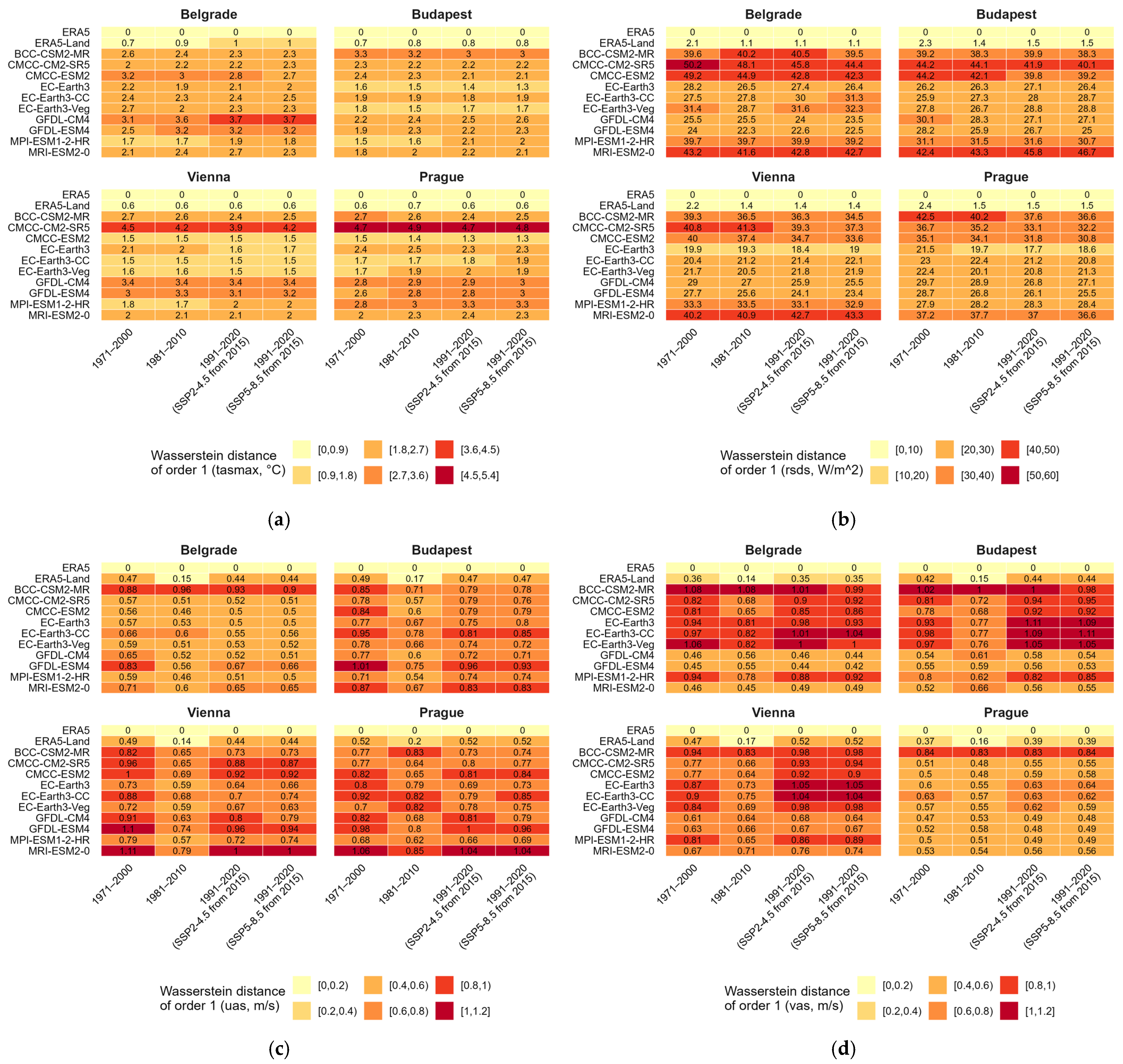
- Spatial differences among the analyzed locations are more pronounced than temporal differences, particularly for rsds, where Wasserstein distances decrease from southeast to northwest across the study region (Figure 2).
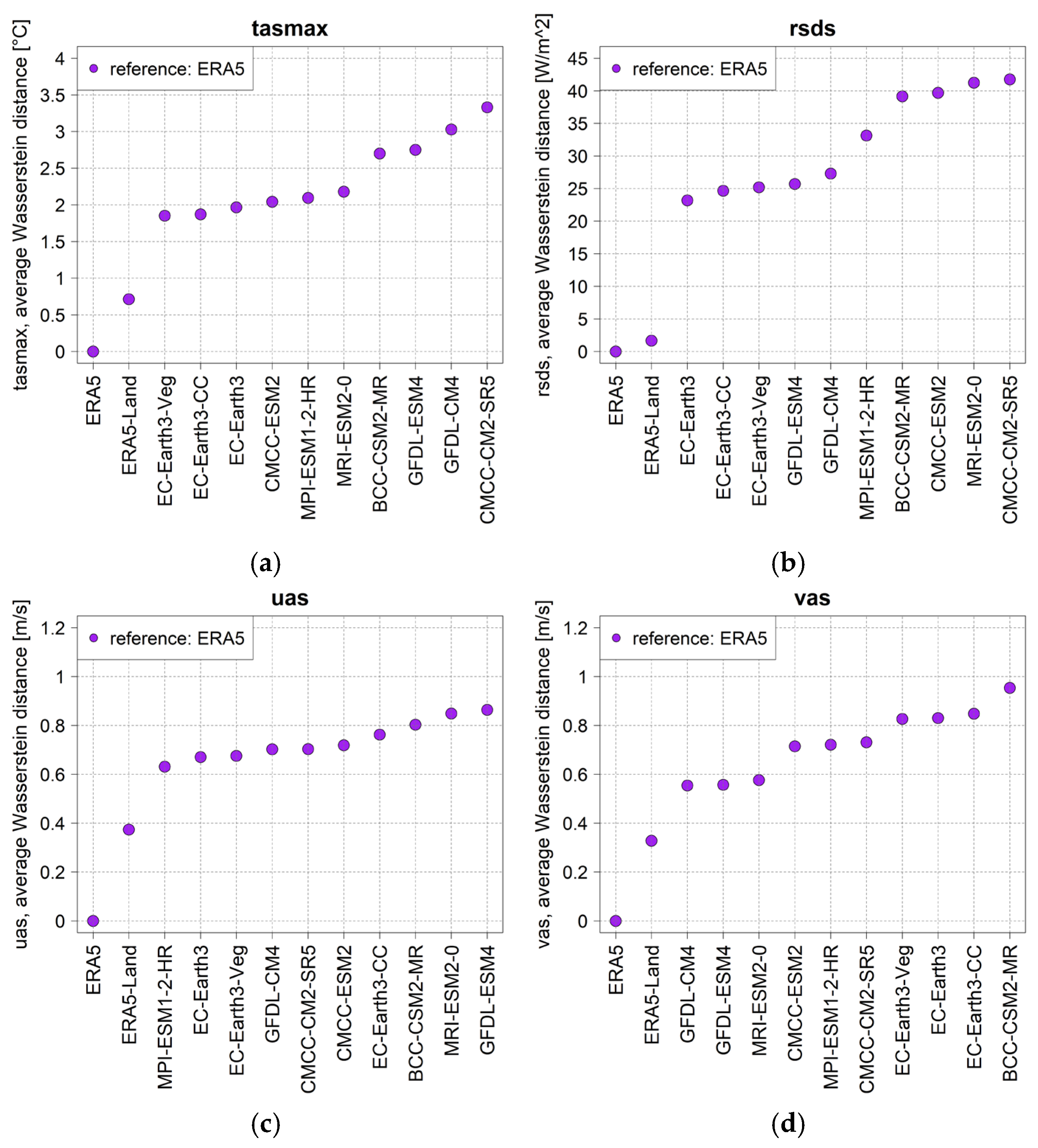
- For uas, and vas, the GCM simulations exhibit comparatively poorer performance than for tasmax and rsds, based on the magnitude of the Wasserstein distances. Furthermore, for tasmax and rsds, ERA5-Land shows greater similarity to ERA5 than the GCM simulations. This is not the case for uas and vas, where some GCMs exhibit smaller Wasserstein distances to ERA5 than ERA5-Land (Figure 3).
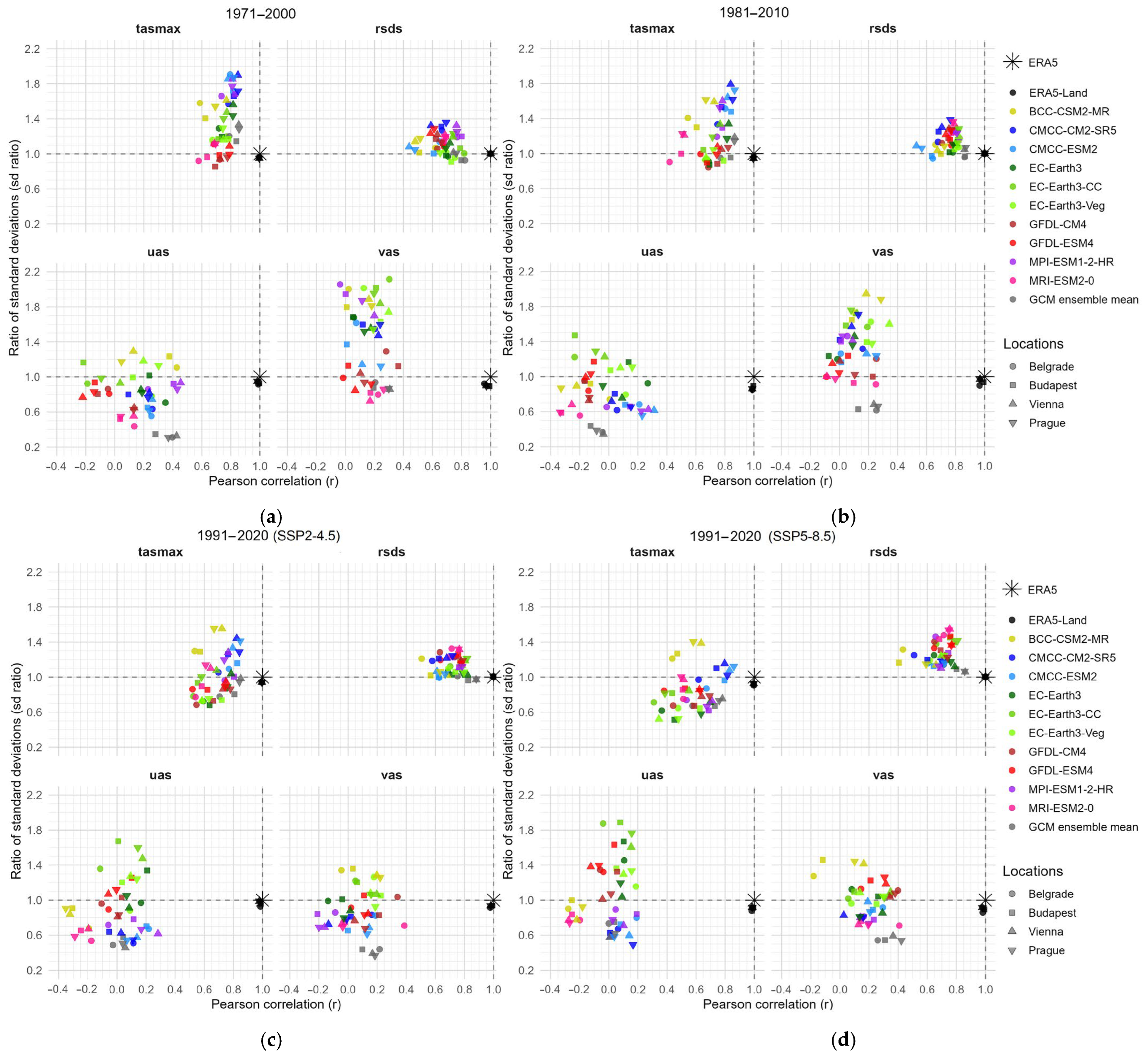
- Although the GCMs overestimate rsds values relative to ERA5 (Figure S2b), the shape and variability of the rsds mean seasonal course are reproduced reasonably well by the GCMs (r ≅ 0.4–0.8; sd ratio ≅ 1–1.4) (Figure 4b).
- The GCMs show a transition from overestimation to underestimation of the variability of the mean seasonal courses of tasmax and vas over time (from 1971–2010 to 1991–2020) relative to ERA5. In contrast, the variability of uas in the GCM simulations changes in the opposite direction (Figure 4a,c,d).
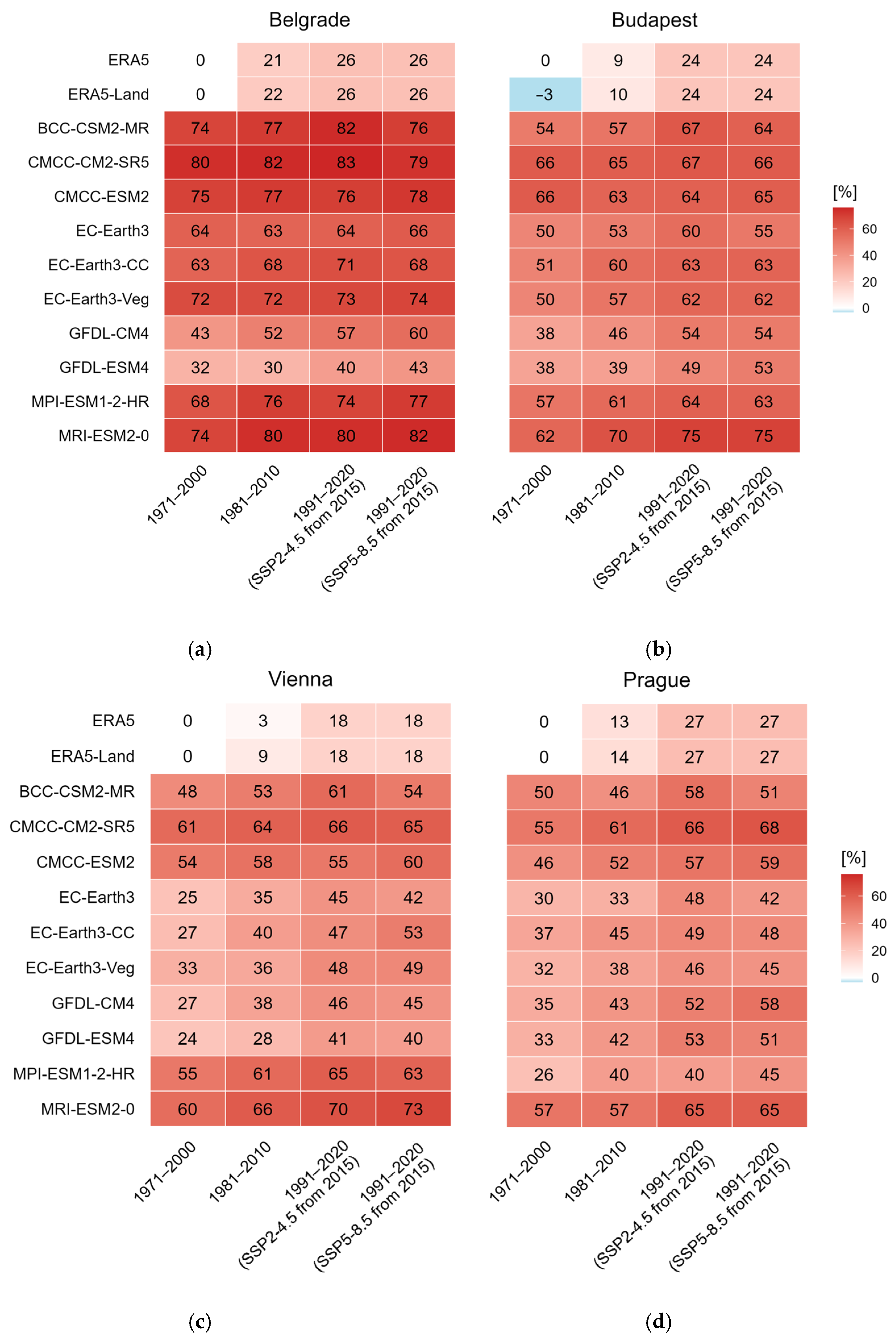
- Since PVpot is mainly influenced by rsds and tasmax according to Equation (5), and the GCMs tend to overestimate rsds, while underestimating tasmax relative to ERA5, PVpot is also overestimated by the GCM simulations compared to ERA5. Consequently, the number of days with high PVpot (PVpot,90) is also overestimated, which can be interpreted as a GCM bias.
Supplementary Materials
Author Contributions
Funding
Institutional Review Board Statement
Informed Consent Statement
Data Availability Statement
Acknowledgments
Conflicts of Interest
References
- UNFCCC (United Nations Framework Convention on Climate Change). Draft Paris Agreement; United Nations: Paris, France, 2015; p. 48. Available online: https://unfccc.int/files/bodies/awg/application/pdf/draft_paris_agreement_5dec15.pdf (accessed on 14 March 2026).
- Holechek, J.L.; Geli, H.M.E.; Sawalhah, M.N.; Valdez, R. A Global Assessment: Can Renewable Energy Replace Fossil Fuels by 2050? Sustainability 2022, 14, 4792. [Google Scholar] [CrossRef]
- Directive (EU) 2023/2413 of the European Parliament and of the Council of 18 October 2023 Amending Directive (EU) 2018/2001, Regulation (EU) 2018/1999 and Directive 98/70/EC as Regards the Promotion of Energy from Renewable Sources, and Repealing Council Directive (EU) 2015/652. 2023. Available online: https://eur-lex.europa.eu/eli/dir/2023/2413/oj (accessed on 14 March 2026).
- Edenhofer, O.; Pichs-Madruga, R.; Sokona, Y.; Seyboth, K.; Kadner, S.; Zwickel, T.; Eickemeier, P.; Hansen, G.; Schlömer, S.; von Stechow, C.; et al. (Eds.) Renewable Energy Sources and Climate Change Mitigation: Special Report of the Intergovernmental Panel on Climate Change; Cambridge University Press: Cambridge, UK, 2012; p. 1076. Available online: https://www.ipcc.ch/site/assets/uploads/2018/03/SRREN_Full_Report-1.pdf (accessed on 14 March 2026).
- Frimannslund, I.; Thiis, T.; Aalberg, A.; Thorud, B. Polar solar power plants–Investigating the potential and the design challenges. Sol. Energy 2021, 224, 35–42. [Google Scholar] [CrossRef]
- REN21. Renewables 2025 Global Status Report: Renewables in Energy Supply—Solar Photovoltaics (PV); REN21: Paris, France, 2025; p. 8. Available online: https://www.ren21.net/gsr-2025/downloads/pdf/supply/GSR_2025_Factsheet_Supply_SolarPV.pdf (accessed on 14 March 2026).
- IRENA (International Renewable Energy Agency). Renewable Capacity Statistics 2025; IRENA: Abu Dhabi, United Arab Emirates, 2025; p. 61. Available online: https://www.irena.org/-/media/Files/IRENA/Agency/Publication/2025/Mar/IRENA_DAT_RE_Capacity_Statistics_2025.pdf (accessed on 14 March 2026).
- Hungarian Government. National Energy Strategy 2030; Hungarian Government: Budapest, Hungary, 2012. Available online: https://2010-2014.kormany.hu/download/7/d7/70000/Hungarian%20Energy%20Strategy%202030.pdf (accessed on 14 March 2026).
- Photovoltaic Barometer 2025; Eurobserv’ER: Paris, France, 2025; p. 14. Available online: https://www.eurobserv-er.org/photovoltaic-barometer-2025/ (accessed on 14 March 2026).
- Dzikuć, M.; Piwowar, A.; Dzikuć, M. The Development of Photovoltaics in the Countries of Central and Eastern Europe in the Context of Regulatory Changes: A Case Study of the Czech Republic and Poland. Energies 2025, 18, 817. [Google Scholar] [CrossRef]
- European Comission. National Energy and Climate Plan of Hungary. 2024. Available online: https://commission.europa.eu/document/download/0a2953f8-5789-4f6f-9714-03df3d4cbbab_en?filename=HU_FINAL%20UPDATED%20NECP%202021-2030%20%28English%29.pdf (accessed on 14 March 2026).
- Konrad, A.; Gaugl, R.; Maier, C.; Wogrin, S. Implementing dynamic power feed-in limitations of photovoltaic systems in distribution grids for generation expansion planning. Energy Strategy Rev. 2025, 59, 101760. [Google Scholar] [CrossRef]
- Government of Serbia. Integrated National Energy and Climate Plan of the Republic of Serbia for the Period up to 2030 with a Vision to 2050. 2026; 326p. Available online: https://www.mre.gov.rs/extfile/sr/1139/INEKP_pre%C4%8Di%C5%A1%C4%87en_tekst_1.8.24_ENG.pdf (accessed on 14 March 2026).
- Patt, A.; Pfenninger, S.; Lilliestam, J. Vulnerability of solar energy infrastructure and output to climate change. Clim. Change 2013, 121, 93–102. [Google Scholar] [CrossRef]
- Crook, J.A.; Jones, L.A.; Forster, P.M.; Crook, R. Climate change impacts on future photovoltaic and concentrated solar power energy output. Energy Environ. Sci. 2011, 4, 3101–3109. [Google Scholar] [CrossRef]
- Gaetani, M.; Huld, T.; Vignati, E.; Monforti-Ferrario, F.; Dosio, A.; Raes, F. The near future availability of photovoltaic energy in Europe and Africa in climate-aerosol modeling experiments. Renew. Sustain. Energy Rev. 2014, 38, 706–716. [Google Scholar] [CrossRef]
- Feron, S.; Cordero, R.R.; Damiani, A.; Jackson, R.B. Climate change extremes and photovoltaic power output. Nat. Sustain. 2021, 4, 270–276. [Google Scholar] [CrossRef]
- Dutta, R.; Chanda, K.; Maity, R. Future of solar energy potential in a changing climate across the world: A CMIP6 multi-model ensemble analysis. Renew. Energy 2022, 188, 819–829. [Google Scholar] [CrossRef]
- Liu, C.; Chen, L.; Li, K.; Jin, X.; Chen, X.; Qiao, W.; Liao, H. Historical and future climate changes impact global solar photovoltaic power potential: Role of key meteorological variables. Atmos. Ocean. Sci. Lett. 2025, 18, 100619. [Google Scholar] [CrossRef]
- Ha, S.; Zhou, Z.; Im, E.-S.; Lee, Y.-M. Comparative assessment of future solar power potential based on CMIP5 and CMIP6 multi-model ensembles. Renew. Energy 2023, 206, 324–335. [Google Scholar] [CrossRef]
- Niu, J.; Qin, W.; Wang, L.; Zhang, M.; Wu, J.; Zhang, Y. Climate change impact on photovoltaic power potential in China based on CMIP6 models. Sci. Total Environ. 2023, 858, 159776. [Google Scholar] [CrossRef] [PubMed]
- Chen, Z.; Li, W.; Pan, Z.; Liu, C.; Wang, H.; Guo, J. Spatiotemporal changes in PV potential and extreme characteristics in China under SSP scenarios. Energy 2025, 320, 135215. [Google Scholar] [CrossRef]
- Ruosteenoja, K.; Räisänen, P.; Karhu, J.A.; Lindfors, A.V. Future PV production potential in Northern Europe under changing snow conditions: A multi-model assessment. Sol. Energy 2025, 301, 113896. [Google Scholar] [CrossRef]
- Pérez, J.C.; González, A.; Díaz, J.P.; Expósito, F.J.; Felipe, J. Climate change impact on future photovoltaic resource potential in an orographically complex archipelago, the Canary Islands. Renew. Energy 2018, 133, 749–759. [Google Scholar] [CrossRef]
- Carvalho, D.; Cardoso Pereira, S.; Rocha, A. Future surface temperatures over Europe according to CMIP6 climate projections: An analysis with original and bias-corrected data. Clim. Change 2021, 167, 10. [Google Scholar] [CrossRef]
- Li, D.; Folini, D.; Wild, M. Assessment of top of atmosphere, atmospheric and surface energy budgets in CMIP6 models on regional scales. Earth Space Sci. 2023, 10, e2022EA002758. [Google Scholar] [CrossRef]
- He, J.; Hong, L.; Shao, C.; Tang, W. Global evaluation of simulated surface shortwave radiation in CMIP6 models. Atmos. Res. 2023, 292, 106896. [Google Scholar] [CrossRef]
- Shen, C.; Zha, J.; Li, Z.; Azorin-Molina, C.; Deng, K.; Minola, L.; Chen, D. Evaluation of global terrestrial near-surface wind speed simulated by CMIP6 models and their future projections. Ann. N. Y. Acad. Sci. 2022, 1518, 249–263. [Google Scholar] [CrossRef]
- Miao, H.; Xu, H.; Huang, G.; Yang, K. Evaluation and future projections of wind energy resources over the Northern Hemisphere in CMIP5 and CMIP6 models. Renew. Energy 2023, 211, 809–821. [Google Scholar] [CrossRef]
- Jerez, S.; Tobin, I.; Vautard, R.; Montávez, J.P.; López Romero, J.M.; Thais, F.; Bartok, B.; Christensen, O.B.; Colette, A.; Déqué, M.; et al. The impact of climate change on photovoltaic power generation in Europe. Nat. Commun. 2015, 6, 10014. [Google Scholar] [CrossRef]
- Sailor, D.J.; Hu, T.; Li, X.; Rosen, J.N. A neural network approach to local downscaling of GCM output for assessing wind power implications of climate change. Renew. Energy 2000, 19, 359–378. [Google Scholar] [CrossRef]
- Sørland, S.L.; Schär, C.; Lüthi, D.; Kjellström, E. Bias patterns and climate change signals in GCM-RCM model chains. Environ. Res. Lett. 2018, 13, 074017. [Google Scholar] [CrossRef]
- Pintér, G.; Zsiborács, H.; Hegedűsné Baranyai, N.; Vincze, A.; Birkner, Z. The Economic and Geographical Aspects of the Status of Small-Scale Photovoltaic Systems in Hungary—A Case Study. Energies 2020, 13, 3489. [Google Scholar] [CrossRef]
- Varga, G.; Gresina, F.; Szeberényi, J.; Gelencsér, A.; Rostási, Á. Effect of Saharan dust episodes on the accuracy of photovoltaic energy production forecast in Hungary (Central Europe). Renew. Sustain. Energy Rev. 2024, 193, 114289. [Google Scholar] [CrossRef]
- Benović, A.; Miškić, M.; Pantović, V.; Vujičić, S.; Vidojević, D.; Opačić, M.; Jovanović, F. Assessment of the Impact of Solar Power Integration and AI Technologies on Sustainable Local Development: A Case Study from Serbia. Sustainability 2025, 17, 6977. [Google Scholar] [CrossRef]
- Kottek, M.; Grieser, J.; Beck, C.; Rudolf, B.; Rubel, F. World Map of the Köppen-Geiger climate classification updated. Meteorol. Z. 2006, 15, 259–263. [Google Scholar] [CrossRef]
- Kikstra, J.S.; Nicholls, Z.R.J.; Smith, C.J.; Lewis, J.; Lamboll, R.D.; Byers, E.; Sandstad, M.; Meinshausen, M.; Gidden, M.J.; Rogelj, J.; et al. The IPCC Sixth Assessment Report WGIII climate assessment of mitigation pathways: From emissions to global temperatures. Geosci. Model Dev. 2022, 15, 9075–9109. [Google Scholar] [CrossRef]
- Milovanović, A.; Babinský, T.; Sedmak, A.; Filipović, I.; Milošević, M. The effect of infill density on fracture toughness results of PLA material. Procedia Struct. Integr. 2025, 68, 922–928. [Google Scholar] [CrossRef]
- Probáld, F. The urban climate of Budapest: Past, present and future. Hung. Geogr. Bull. 2014, 63, 69–79. [Google Scholar] [CrossRef]
- Auer, I.; Böhm, R.; Jurkovic, A.; Lipa, W.; Orlik, A.; Potzmann, R.; Schöner, W.; Ungersböck, M.; Matulla, C.; Briffa, K.; et al. HISTALP—Historical instrumental climatological surface time series of the Greater Alpine Region. Int. J. Climatol. 2007, 27, 17–46. [Google Scholar] [CrossRef]
- Tolasz, R.; Míková, T.; Valeriánová, A.; Voženílek, V. (Eds.) Climate Atlas of Czechia; Czech Hydrometeorological Institute: Prague, Czechia; Palacký University: Olomouc, Czechia, 2007; 256p. [Google Scholar]
- Danielson, J.J.; Gesch, D.B. Global Multi-Resolution Terrain Elevation Data 2010 (GMTED2010); U.S. Geological Survey Open-File Report 2011–1073; U.S. Geological Survey: Reston, VA, USA, 2011; 23p. [CrossRef]
- Eyring, V.; Bony, S.; Meehl, G.A.; Senior, C.A.; Stevens, B.; Stouffer, R.J.; Taylor, K.E. Overview of the Coupled Model Intercomparison Project Phase 6 (CMIP6) experimental design and organization. Geosci. Model Dev. 2016, 9, 1937–1958. [Google Scholar] [CrossRef]
- World Meteorological Organization. WMO Guidelines on the Calculation of Climate Normals; World Meteorological Organization: Geneva, Switzerland, 2017; WMO-No. 1203; 29p, Available online: https://library.wmo.int/idurl/4/55797 (accessed on 14 March 2026).
- O’Neill, B.C.; Kriegler, E.; Riahi, K.; Ebi, K.L.; Hallegatte, S.; Carter, T.R.; Mathur, R.; van Vuuren, D.P. A new scenario framework for climate change research: The concept of shared socioeconomic pathways. Clim. Change 2014, 122, 387–400. [Google Scholar] [CrossRef]
- Wu, T.; Yu, R.; Lu, Y.; Jie, W.; Fang, Y.; Zhang, J.; Zhang, L.; Xin, X.; Li, L.; Wang, Z.; et al. BCC-CSM2-HR: A high-resolution version of the Beijing Climate Center Climate System Model. Geosci. Model Dev. 2021, 14, 2977–3006. [Google Scholar] [CrossRef]
- Cherchi, A.; Fogli, P.G.; Lovato, T.; Peano, D.; Iovino, D.; Gualdi, S.; Masina, S.; Scoccimarro, E.; Materia, S.; Bellucci, A.; et al. Global mean climate and main patterns of variability in the CMCC-CM2 coupled model. J. Adv. Model. Earth Syst. 2019, 11, 185–209. [Google Scholar] [CrossRef]
- Lovato, T.; Peano, D.; Butenschön, M.; Materia, S.; Iovino, D.; Scoccimarro, E.; Fogli, P.G.; Cherchi, A.; Bellucci, A.; Gualdi, S.; et al. CMIP6 Simulations With the CMCC Earth System Model (CMCC-ESM2). J. Adv. Model. Earth Syst. 2022, 14, e2021MS002814. [Google Scholar] [CrossRef]
- Döscher, R.; Acosta, M.; Alessandri, A.; Anthoni, P.; Arsouze, T.; Bergman, T.; Bernardello, R.; Boussetta, S.; Caron, L.-P.; Carver, G.; et al. The EC-Earth3 Earth system model for the Coupled Model Intercomparison Project 6. Geosci. Model Dev. 2022, 15, 2973–3020. [Google Scholar] [CrossRef]
- Held, I.M.; Guo, H.; Adcroft, A.; Dunne, J.P.; Horowitz, L.W.; Krasting, J.; Shevliakova, E.; Winton, M.; Zhao, M.; Bushuk, M.; et al. Structure and performance of GFDL’s CM4.0 climate model. J. Adv. Model. Earth Syst. 2019, 11, 3691–3727. [Google Scholar] [CrossRef]
- Dunne, J.P.; Horowitz, L.W.; Adcroft, A.J.; Ginoux, P.; Held, I.M.; John, J.G.; Krasting, J.P.; Malyshev, S.; Naik, V.; Paulot, F.; et al. The GFDL Earth System Model Version 4.1 (GFDL-ESM 4.1): Overall coupled model description and simulation characteristics. J. Adv. Model. Earth Syst. 2020, 12, e2019MS002015. [Google Scholar] [CrossRef]
- Müller, W.A.; Jungclaus, J.H.; Mauritsen, T.; Baehr, J.; Bittner, M.; Budich, R.; Bunzel, F.; Esch, M.; Ghosh, R.; Haak, H.; et al. A higher-resolution version of the Max Planck Institute Earth System Model (MPI-ESM1.2-HR). J. Adv. Model. Earth Syst. 2018, 10, 1383–1413. [Google Scholar] [CrossRef]
- Yukimoto, S.; Koshiro, T.; Kawai, H.; Oshima, N.; Yoshida, K.; Urakawa, S.; Tsujino, H.; Deushi, M.; Tanaka, T.; Hosaka, M.; et al. MRI MRI-ESM2.0 model output prepared for CMIP6 CMIP. Earth Syst. Grid Fed. 2019. [Google Scholar] [CrossRef]
- Hersbach, H.; Bell, B.; Berrisford, P.; Hirahara, S.; Horányi, A.; Muñoz-Sabater, J.; Nicolas, J.; Peubey, C.; Radu, R.; Schepers, D.; et al. The ERA5 global reanalysis. Q. J. R. Meteorol. Soc. 2020, 146, 1999–2049. [Google Scholar] [CrossRef]
- Muñoz-Sabater, J.; Dutra, E.; Agustí-Panareda, A.; Albergel, C.; Arduini, G.; Balsamo, G.; Boussetta, S.; Choulga, M.; Harrigan, S.; Hersbach, H.; et al. ERA5-Land: A state-of-the-art global reanalysis dataset for land applications. Earth Syst. Sci. Data 2021, 13, 4349–4383. [Google Scholar] [CrossRef]
- R Core Team. R: A Language and Environment for Statistical Computing; R Foundation for Statistical Computing: Vienna, Austria, 2024; Available online: http://www.R-project.org/ (accessed on 14 March 2026).
- Wasserstein, L.N. Markov processes with countable state space describing large systems of automata. Probl. Pered. Inform. 1969, 5, 64–73. (In Russian) [Google Scholar]
- Villani, C. Optimal Transport: Old and New; Springer: Berlin/Heidelberg, Germany, 2009; pp. 105–123. [Google Scholar]
- Schuhmacher, D.; Bähre, B.; Bonneel, N.; Gottschlich, C.; Hartmann, V.; Heinemann, F.; Schmitzer, B.; Schrieber, J. Transport: Computation of Optimal Transport Plans and Wasserstein Distances. R Package Version 0.15-4. 2024. Available online: https://cran.r-project.org/package=transport (accessed on 14 March 2026).
- Mavromatakis, F.; Makrides, G.; Georghiou, G.; Pothrakis, A.; Franghiadakis, Y.; Drakakis, E.; Koudoumas, E. Modeling the photovoltaic potential of a site. Renew. Energy 2010, 35, 1387–1390. [Google Scholar] [CrossRef]
- Tonui, J.K.; Tripanagnostopoulos, Y. Improved PV/T solar collectors with heat extraction by forced or natural air circulation. Renew. Energy 2007, 32, 623–637. [Google Scholar] [CrossRef]
- TamizhMani, G.; Ji, L.; Tang, Y.; Petacci, L.; Osterwald, C. Photovoltaic module thermal-wind performance: Long-term monitoring and model development for energy rating. In Proceedings of the NCPV and Solar Program Review Meeting 2003, Denver, CO, USA, 24–26 March 2003; p. 4. Available online: https://www.nrel.gov/docs/fy03osti/35645.pdf (accessed on 30 January 2026).
- Zuo, H.-M.; Lu, H.-L.; Sun, P.; Qiu, J.; Li, F.-F. Changes in photovoltaic power output variability due to climate change in China: A multi-model ensemble mean analysis. J. Renew. Sustain. Energy 2024, 16, 023503. [Google Scholar] [CrossRef]
- Nguyen-Duy, T.; Ngo-Duc, T.; Desmet, Q. Performance evaluation and ranking of CMIP6 global climate models over Vietnam. J. Water Clim. Change 2023, 14, 1832–1846. [Google Scholar] [CrossRef]
- Bastola, S.; Maharjan, K.R.; Choo, I.; Jung, Y. Comprehensive evaluation and ranking of CMIP6 global climate models for simulating climate extreme indices across diverse hydrological and geographical regions of Nepal. J. Hydrol. Reg. Stud. 2025, 61, 102717. [Google Scholar] [CrossRef]
- Kristóf, E.; Barcza, Z.; Hollós, R.; Bartholy, J.; Pongrácz, R. Evaluation of Historical CMIP5 GCM Simulation Results Based on Detected Atmospheric Teleconnections. Atmosphere 2020, 11, 723. [Google Scholar] [CrossRef]
- Touzé-Peiffer, L.; Barberousse, A.; Le Treut, H. The Coupled Model Intercomparison Project: History, uses, and structural effects on climate research. WIREs Clim. Change 2020, 11, e648. [Google Scholar] [CrossRef]
- Lin, C.Y.; Tung, C.P. Procedure for selecting GCM datasets for climate risk assessment. Terr. Atmos. Ocean. Sci. 2017, 28, 43–55. [Google Scholar] [CrossRef]
- Bhanage, V.; Lee, H.S.; Cabrera, J.S.; Kubota, T.; Pradana, R.P.; Fajary, F.R.; Nimiya, H. Identification of optimal CMIP6 GCMs for future typical meteorological year in major cities of Indonesia using multi-criteria decision analysis. Front. Environ. Sci. 2024, 12, 1341807. [Google Scholar] [CrossRef]
- Vissio, G.; Lembo, V.; Lucarini, V.; Ghil, M. Evaluating the performance of climate models based on Wasserstein distance. Geophys. Res. Lett. 2020, 47, e2020GL089385. [Google Scholar] [CrossRef]
- Ramdas, A.; García Trillos, N.; Cuturi, M. On Wasserstein two-sample testing and related families of nonparametric tests. Entropy 2017, 19, 47. [Google Scholar] [CrossRef]
- Chen, X.; Mao, H.; Cheng, N.; Ma, L.; Tian, Z.; Luo, Y.; Zhou, C.; Li, H.; Wang, Q.; Kong, W.; et al. Climate change impacts on global photovoltaic variability. Appl. Energy 2024, 374, 124087. [Google Scholar] [CrossRef]
- Korab, R.; Połomski, M.; Naczyński, T.; Kandzia, T. A dynamic thermal model for a photovoltaic module under varying atmospheric conditions. Energy Convers. Manag. 2023, 280, 116773. [Google Scholar] [CrossRef]
- Ayoola, A. Effect of ambient temperature and relative humidity on Photovoltaic system performance. SSRN Electron. J. 2021. [Google Scholar] [CrossRef]
- Ceppi, P.; Brient, F.; Zelinka, M.D.; Hartmann, D.L. Cloud feedback mechanisms and their representation in global climate models. Wiley Interdiscip. Rev. Clim. Change 2017, 8, e465. [Google Scholar] [CrossRef]
- Song, F.; Mao, Y.; Liu, S.; Wu, L.; Dong, L.; Su, H.; Wang, Y.; Chtirkova, B.; Wu, P.; Wild, M. A long-term decline in downward surface solar radiation. Natl. Sci. Rev. 2025, 12, nwaf007. [Google Scholar] [CrossRef]
- Valipour, M.; Dietrich, J. Developing ensemble mean models of satellite remote sensing, climate reanalysis, and land surface models. Theor. Appl. Climatol. 2022, 150, 909–926. [Google Scholar] [CrossRef]


| Variables | Time Period | Belgrade | Budapest | Vienna | Prague | Spatial Mean |
|---|---|---|---|---|---|---|
| tasmax [°C] | 1971–2000 | 2.4 | 2.1 | 2.4 | 2.5 | 2.4 |
| 1981–2010 | 2.5 | 2.1 | 2.4 | 2.6 | 2.4 | |
| 1991–2020 (SSP2-4.5) | 2.6 | 2.1 | 2.3 | 2.6 | 2.4 | |
| 1991–2020 (SSP5-8.5) | 2.5 | 2.1 | 2.3 | 2.6 | 2.4 | |
| Temporal mean | 2.5 | 2.1 | 2.4 | 2.6 | ||
| rsds [W/m2] | 1971–2000 | 36 | 34 | 31 | 31 | 33 |
| 1981–2010 | 35 | 33 | 30 | 29 | 32 | |
| 1991–2020 (SSP2-4.5) | 35 | 34 | 30 | 28 | 32 | |
| 1991–2020 (SSP5-8.5) | 34 | 33 | 29 | 28 | 31 | |
| Temporal mean | 35 | 33 | 30 | 29 | ||
| uas [m/s] | 1971–2000 | 0.7 | 0.8 | 0.9 | 0.8 | 0.8 |
| 1981–2010 | 0.6 | 0.7 | 0.7 | 0.7 | 0.7 | |
| 1991–2020 (SSP2-4.5) | 0.6 | 0.8 | 0.8 | 0.8 | 0.8 | |
| 1991–2020 (SSP5-8.5) | 0.6 | 0.8 | 0.8 | 0.8 | 0.8 | |
| Temporal mean | 0.6 | 0.8 | 0.8 | 0.8 | ||
| vas [m/s] | 1971–2000 | 0.8 | 0.8 | 0.8 | 0.6 | 0.8 |
| 1981–2010 | 0.7 | 0.7 | 0.7 | 0.6 | 0.7 | |
| 1991–2020 (SSP2-4.5) | 0.8 | 0.9 | 0.9 | 0.6 | 0.8 | |
| 1991–2020 (SSP5-8.5) | 0.8 | 0.9 | 0.9 | 0.6 | 0.8 | |
| Temporal mean | 0.8 | 0.8 | 0.8 | 0.6 |
Disclaimer/Publisher’s Note: The statements, opinions and data contained in all publications are solely those of the individual author(s) and contributor(s) and not of MDPI and/or the editor(s). MDPI and/or the editor(s) disclaim responsibility for any injury to people or property resulting from any ideas, methods, instructions or products referred to in the content. |
© 2026 by the authors. Licensee MDPI, Basel, Switzerland. This article is an open access article distributed under the terms and conditions of the Creative Commons Attribution (CC BY) license.
Share and Cite
Kristóf, E.; Kalmár, T. Implications of CMIP6 GCM-Based Climate Variability for Photovoltaic Potential over Four Selected Urban Areas in Central and Southeast Europe During Summer (1971–2020). Urban Sci. 2026, 10, 204. https://doi.org/10.3390/urbansci10040204
Kristóf E, Kalmár T. Implications of CMIP6 GCM-Based Climate Variability for Photovoltaic Potential over Four Selected Urban Areas in Central and Southeast Europe During Summer (1971–2020). Urban Science. 2026; 10(4):204. https://doi.org/10.3390/urbansci10040204
Chicago/Turabian StyleKristóf, Erzsébet, and Tímea Kalmár. 2026. "Implications of CMIP6 GCM-Based Climate Variability for Photovoltaic Potential over Four Selected Urban Areas in Central and Southeast Europe During Summer (1971–2020)" Urban Science 10, no. 4: 204. https://doi.org/10.3390/urbansci10040204
APA StyleKristóf, E., & Kalmár, T. (2026). Implications of CMIP6 GCM-Based Climate Variability for Photovoltaic Potential over Four Selected Urban Areas in Central and Southeast Europe During Summer (1971–2020). Urban Science, 10(4), 204. https://doi.org/10.3390/urbansci10040204