
Local-Scale Assessment of Urban Resilience and the Role of Nature-Based Solutions and Stormwater Modelling

 ,
,  ,
,  , , and
Abstract
1. Introduction
1.1. Urban Resilience
1.2. Relevance of NBSs for Resilience
1.3. City and Local Scales
2. Materials and Methods
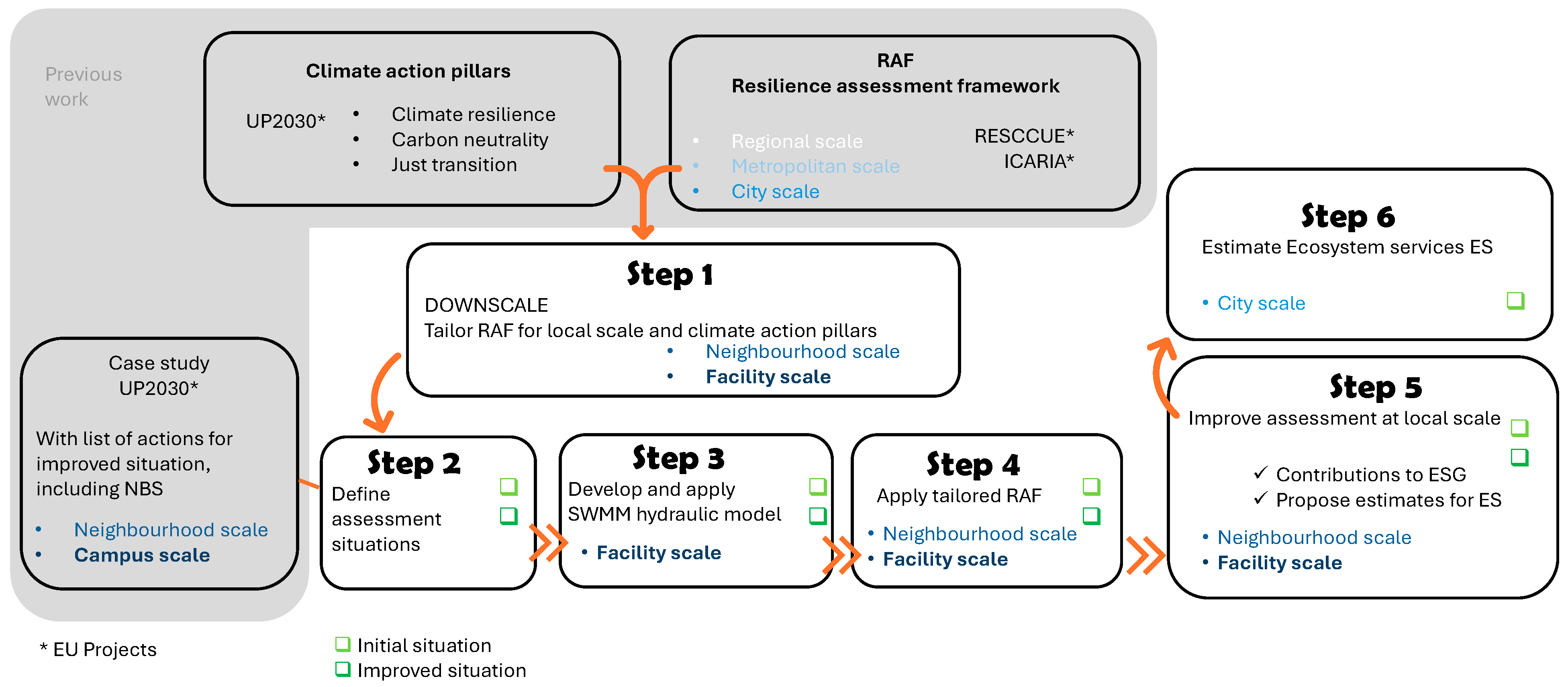
2.1. Overall Approach
- Step 1: tailor the RAF to local scale and climate action pillars;
- Step 2: define the initial and improved situations;
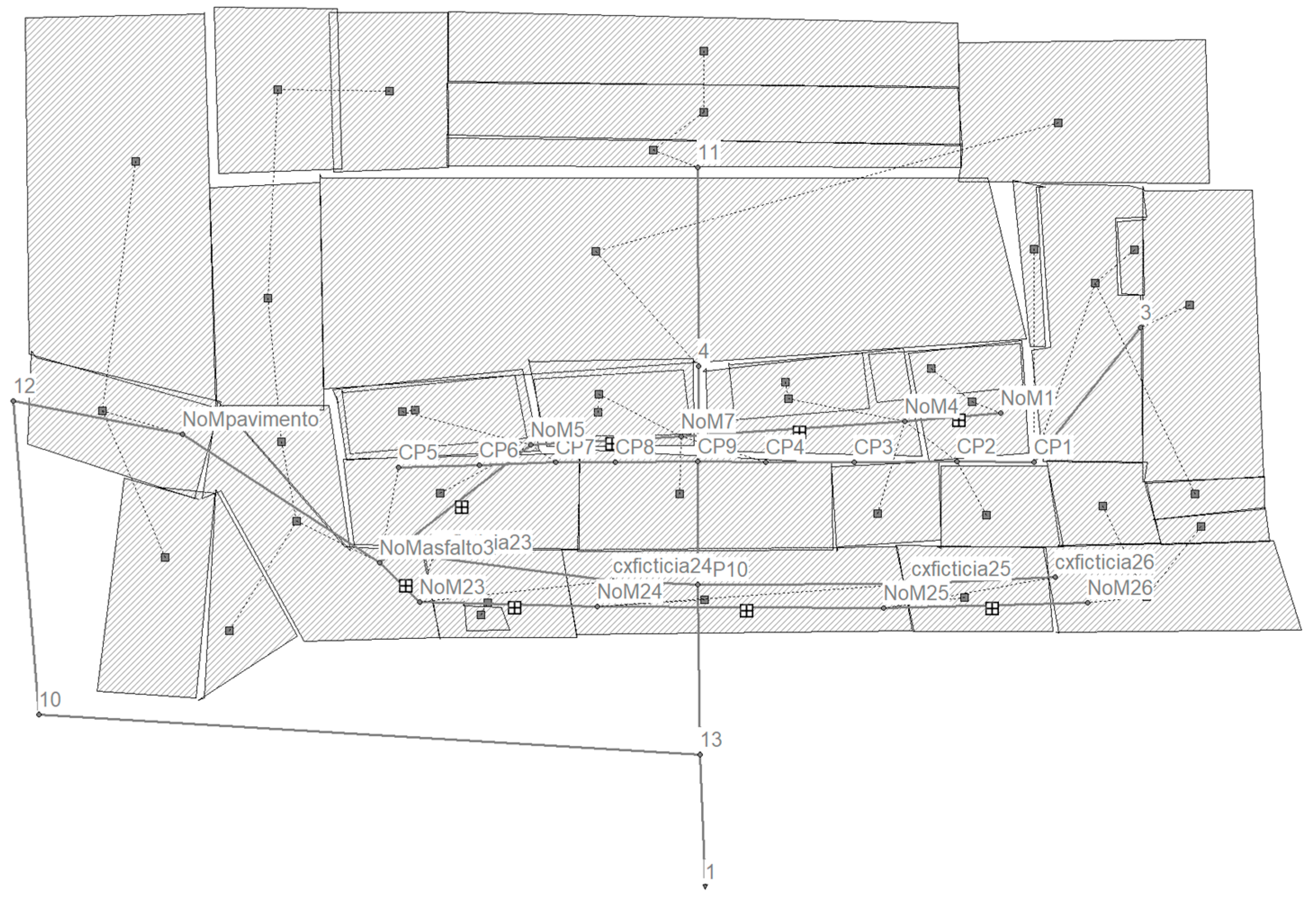
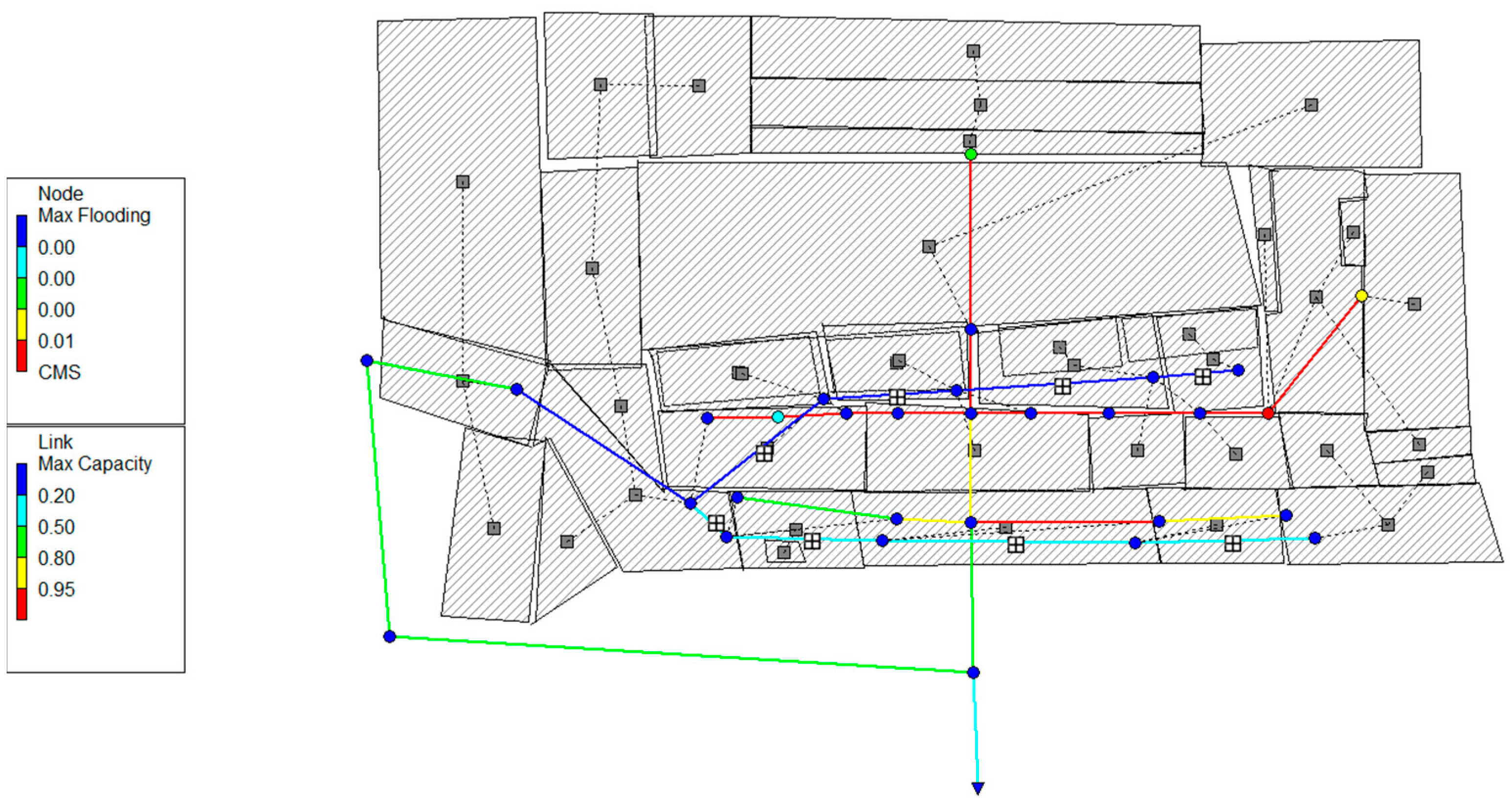
- Step 3: develop and apply the stormwater system model in SWMM;
- Step 4: apply the tailored RAF to the initial and improved situations;
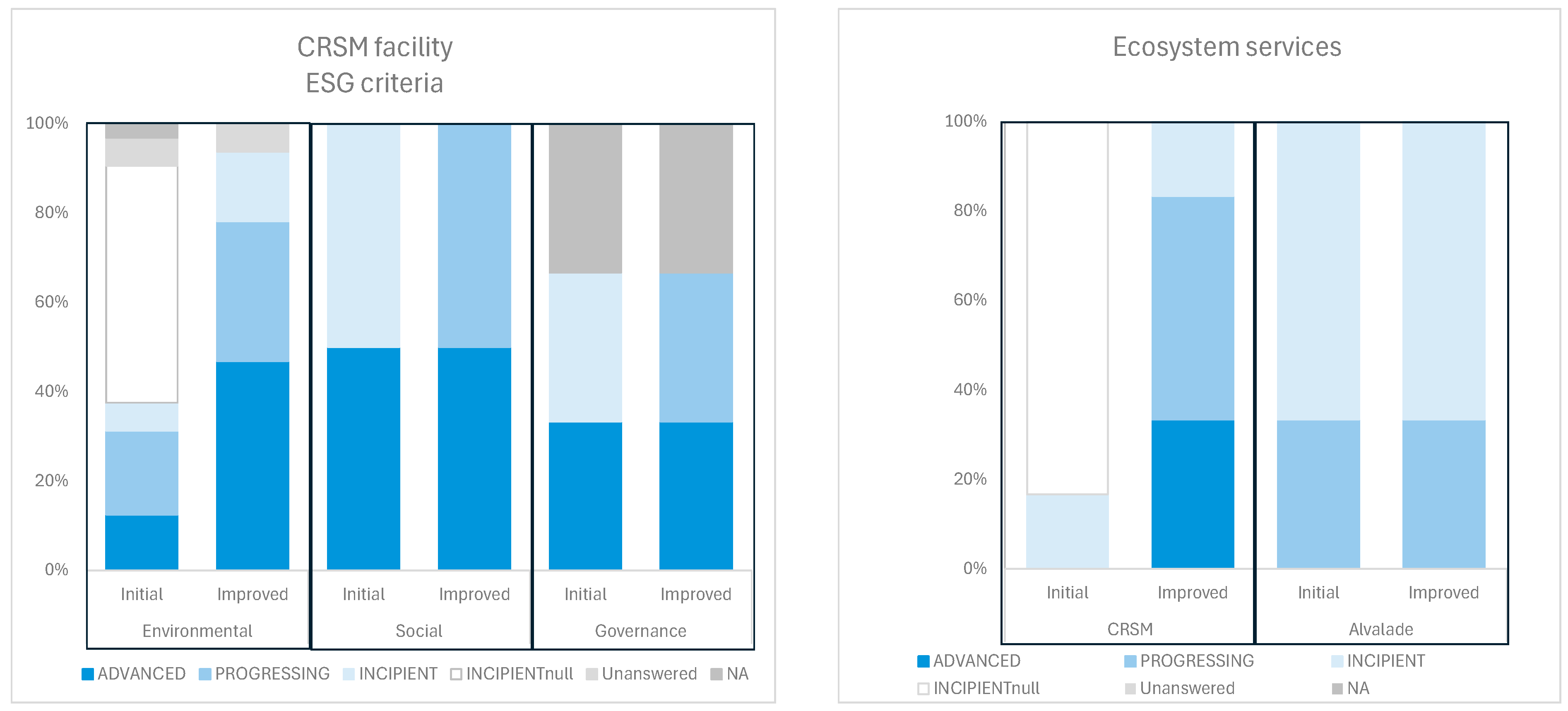
- Step 5: improve assessment at the local scale: identifying contributions to ESG criteria and estimating specific ecosystem services;
- Step 6: estimate ecosystem services at the city scale.
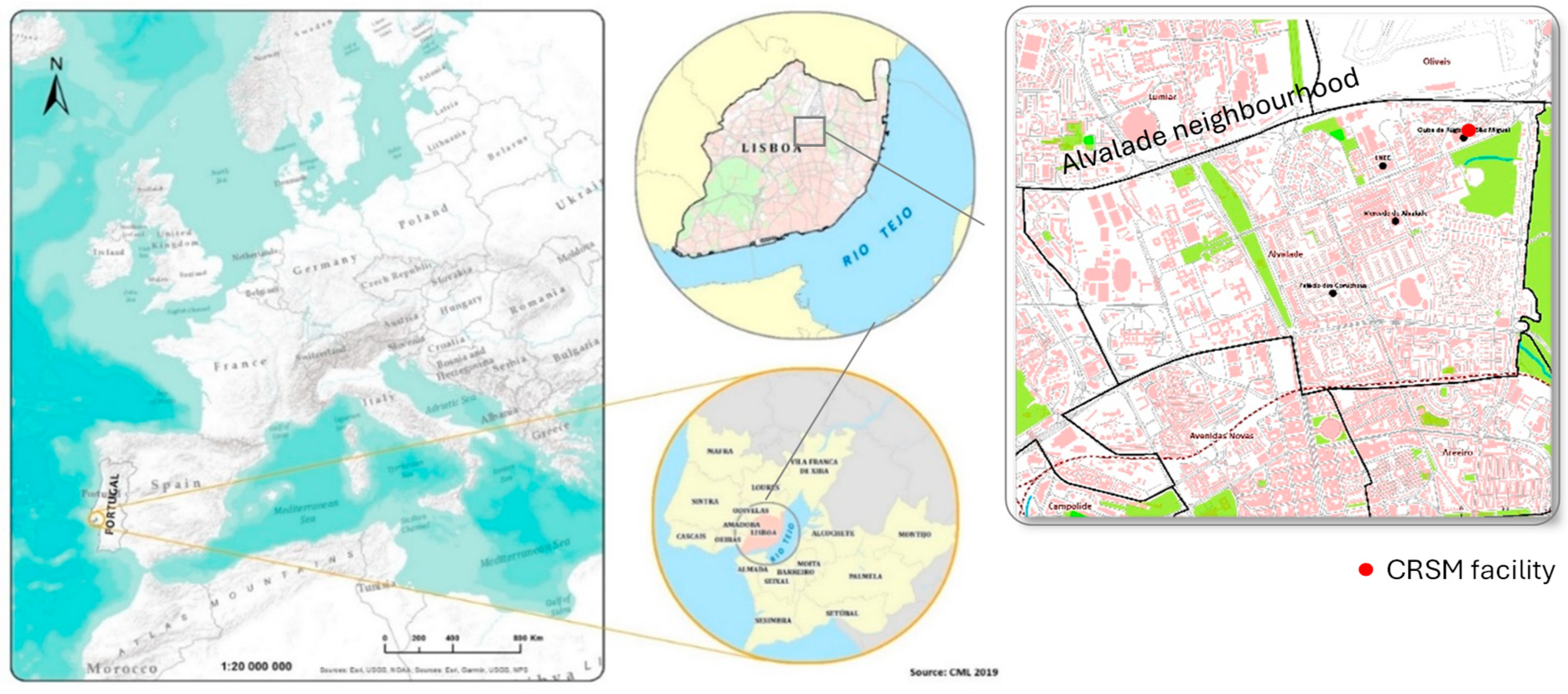
2.2. Case Study
2.3. Resilience Assessment
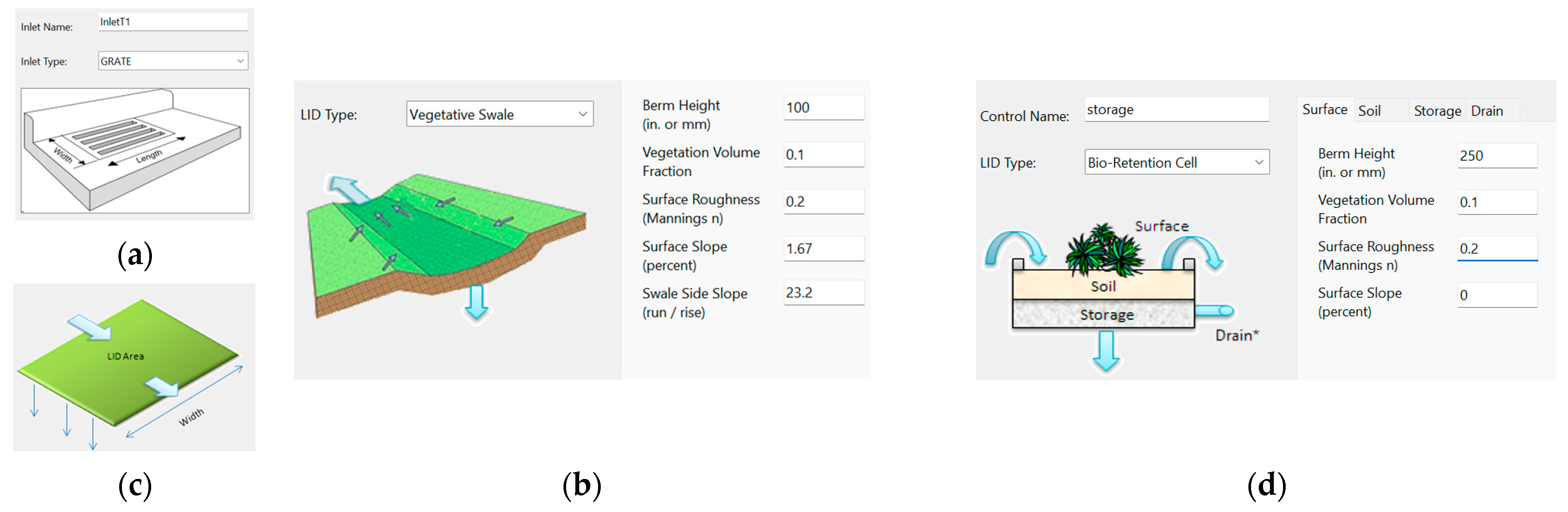
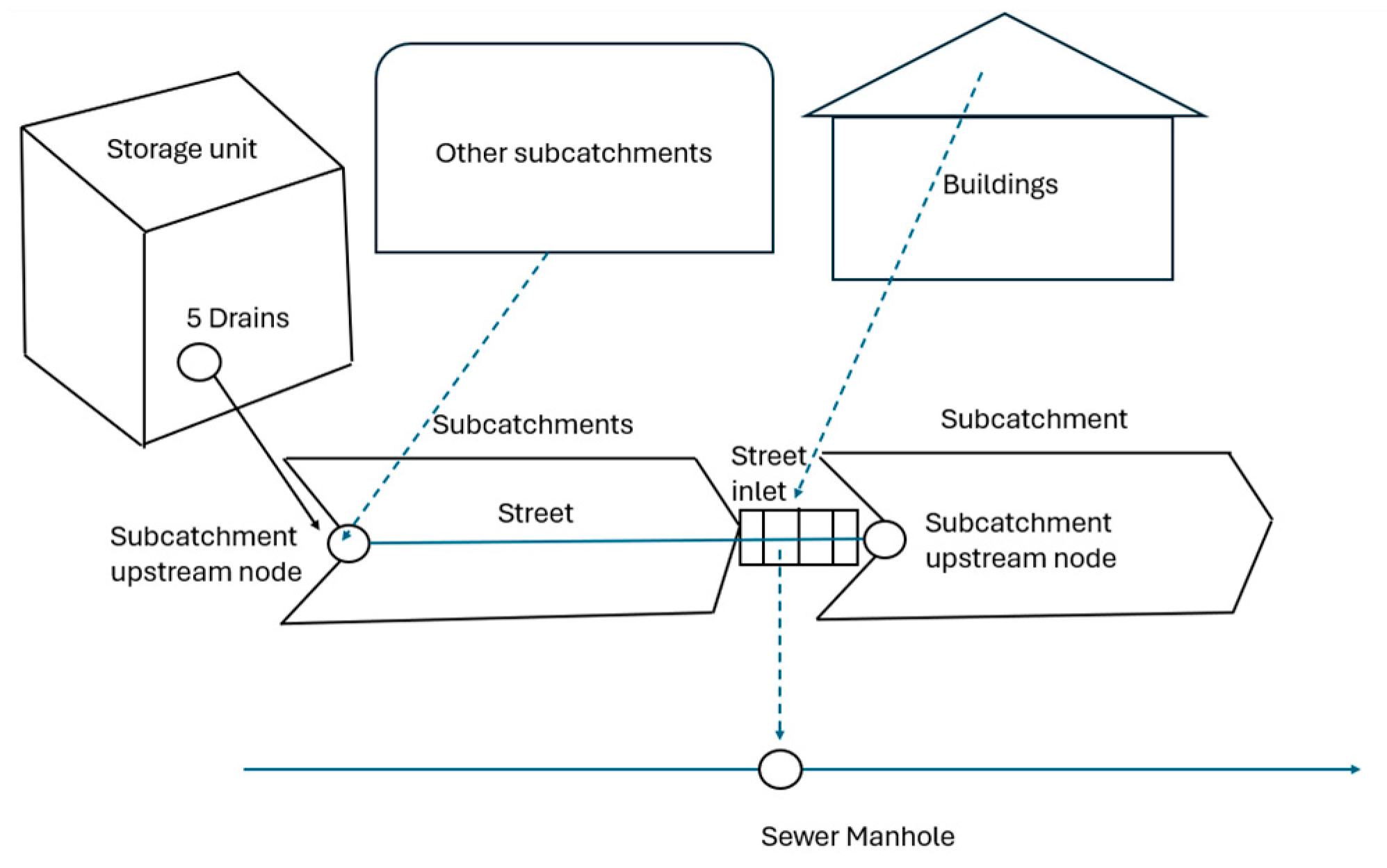
2.4. Stormwater Drainage Modelling
- Sub-catchments: Drainage basins, some with LID controls (vegetated swales or bioretention cells to represent flower and tree beds). Each one links to a rain gauge, for rain event representation, allowing for simulation of runoff to downstream nodes or other basins. SWMM computes subsequent hydrologic processes (infiltration, evapotranspiration, surface accumulation, and flow conveyance).
- Nodes: Junctions and outfall, including normal (with surface exchange allowed) and sealed manholes (auxiliary nodes when connections occur at intermediate sewer sections, with overflow restrained by high internal pressure thresholds).
- Links: Conduits between nodes to compute sewer hydraulics. Variables such as manhole depths were estimated when registry data was missing.
- Streets and inlets: Route surface runoff to conduits and simulate surcharge or bypass. Specific basins were associated to streets, the runoff of which is captured by inlets to the conduits or bypasses it to the streets if inlet capacity is exceeded. Different street cross-sections were defined.
3. Results
3.1. Resilience Assessment Metrics for Local Scale
3.2. Stormwater Drainage and NBS Models
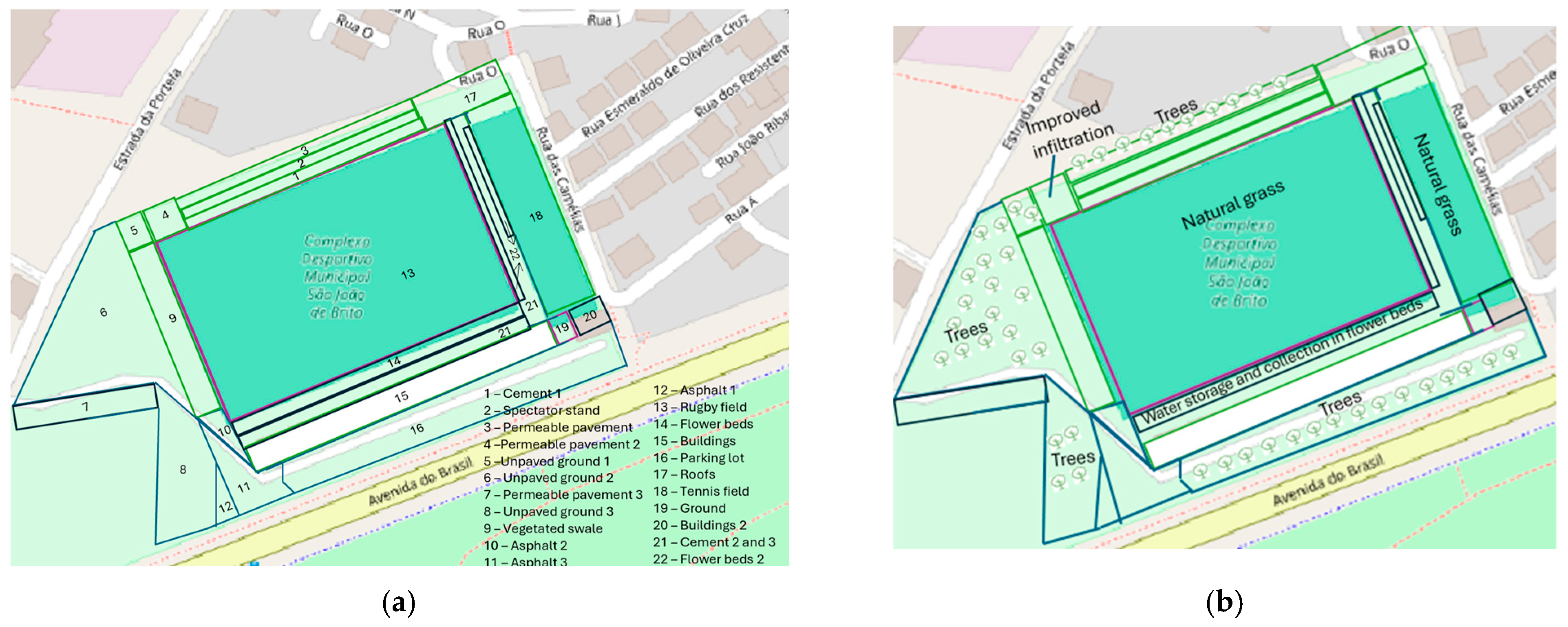
3.2.1. Definition of Modelling Situations
- Naturalized rugby and tennis fields, enhancing infiltration capacity and storage.
- Forestated derelict western area, increasing pervious surface, interception and evapotranspiration.
- Partially forestated lower western area, improving infiltration and reducing surface runoff.
- Collected water in existing large planters as shallow storage zones for temporary retention and delayed discharge.
- Added linear tree beds above spectator stands and in the parking lot, providing distributed infiltration and increased surface roughness.
- Rehabilitated permeable pavement above spectator stands, modelled by increased pervious area and adjusted Green–Ampt parameters, for restored infiltration performance.
3.2.2. Model Development and Results
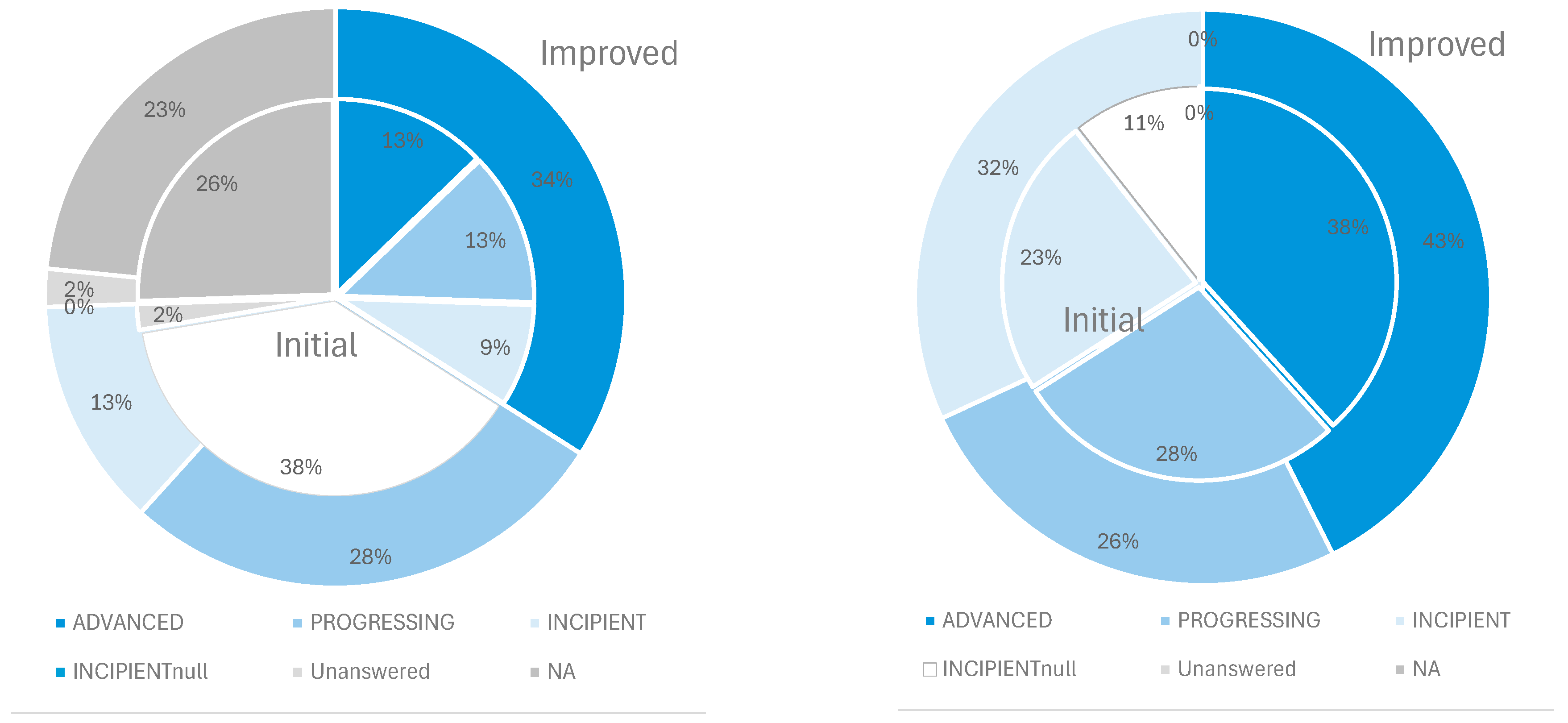
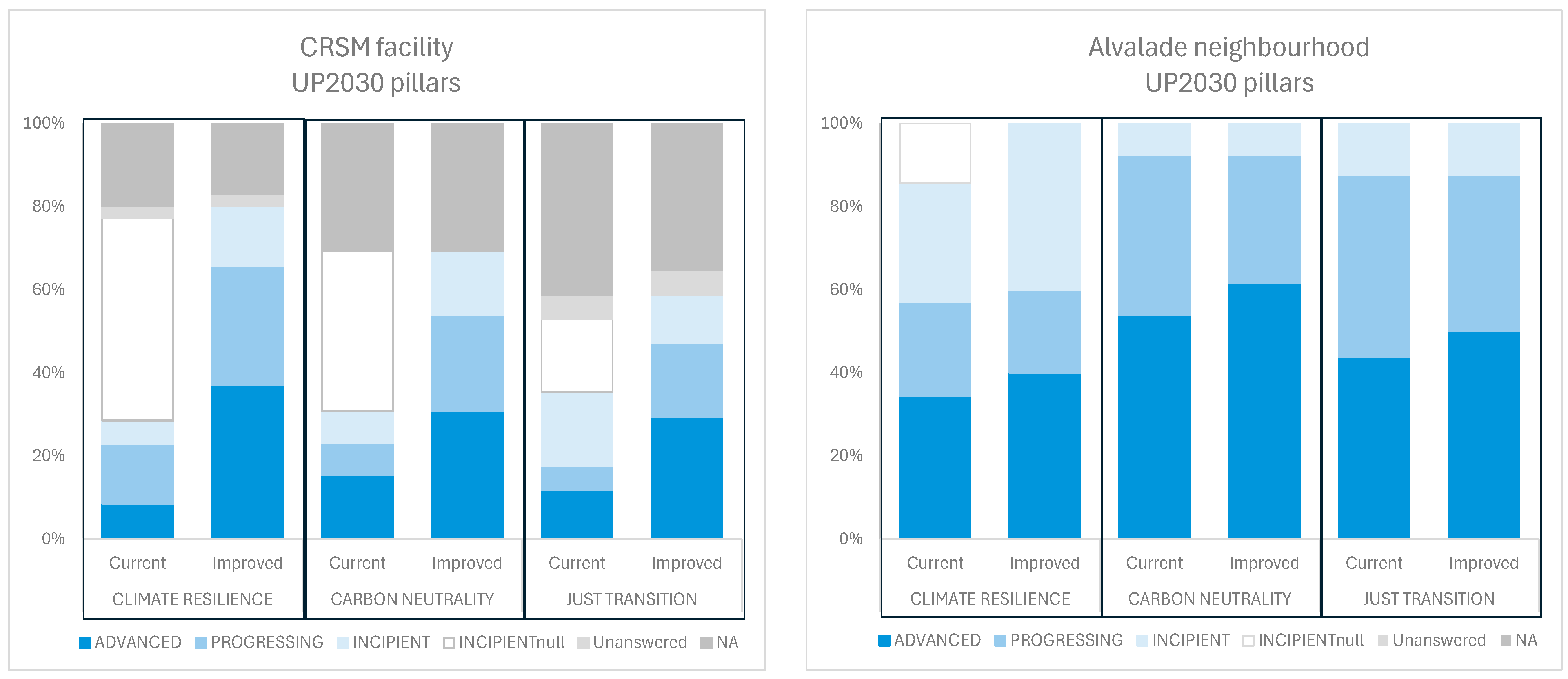
3.3. Resilience Assessment of the Case Study
- The Alvalade neighbourhood had already started its path for resilience some time ago; further advancement demands substantially greater effort to generate perceptible change; on the contrary, for locations in early resilience stages, even small efforts can lead to visible improvement.
- Many planned measures are designed for the facility scale; they can have clear effects locally, which tend to fade when viewed across the whole neighbourhood.
3.4. Improved Assessment at the Local Scale—ESG and Ecosystems Services
3.5. Contribution to the Resilience Assessment Related to Ecosystem Services at the City Scale
4. Discussion
5. Conclusions
Supplementary Materials
Author Contributions
Funding
Institutional Review Board Statement
Informed Consent Statement
Data Availability Statement
Acknowledgments
Conflicts of Interest
Abbreviations
| B-WaterSmart | European H2020 project, accelerating the transformation to water-smart economies and societies in coastal Europe and beyond |
| CC | Climate Change |
| CML | Lisbon Municipality (acronym in Portuguese) |
| CRSM | São Miguel Rugby Club (acronym in Portuguese) |
| ES | Ecosystem Service |
| ESG | Environmental, Social, and Governance criteria for sustainability |
| GHG | Greenhouse Gas |
| ICARIA | European HE project, Improving ClimAte Resilience of crItical Assets |
| NBS | Nature Based Solution |
| RAF | Resilience Assessment Framework |
| RESCCUE | European H2020 project, RESilience to cope with Climate Change in Urban arEas |
| SWMM | Storm Water Management Model, EPA |
| UP2030 | European HE project, Urban Planning and Design Ready for 2030 |
| UWWTD | European Directive on Urban Wastewater Treatment |
References
- Folke, C. Resilience: The emergence of a perspective for social-ecological systems analyses. Glob. Environ. Change 2006, 16, 253–267. [Google Scholar] [CrossRef]
- Meerow, S.; Newell, J.P.; Stults, M. Defining urban resilience: A review. Landsc. Urban Plan. 2016, 147, 38–49. [Google Scholar] [CrossRef]
- Bichueti, R.S.; Schoproni, W.; Leal Filho, W.; Gomes, C.M.; Kneipp, J.M.; Frizzo, K. Climate change and urban resilience in smart cities: Adaptation and mitigation strategies in Brazil and Germany. Urban Sci. 2025, 9, 179. [Google Scholar] [CrossRef]
- Chelleri, L.; Deshayes, E.; Echave, C. UP2030 benchmarking report against state-of-art and identification of pilot opportunities. In UP2030 Project Deliverable D2.3; Zenodo: Geneva, Switzerland, 2023; Available online: https://zenodo.org/records/15223219 (accessed on 2 November 2025).
- European Commission. European Water Resilience Strategy; Directorate-General for Environment; Publications Office of the European Union: Luxembourg, 2025; ISBN 978-92-68-28240-3. [Google Scholar] [CrossRef]
- European Union. Directive (EU) 2024/3019 on urban wastewater treatment. Off. J. Eur. Union 2024. Available online: https://eur-lex.europa.eu/eli/dir/2024/3019/oj/eng (accessed on 2 November 2025).
- Organisation for Economic Co-operation and Development. Local Data Portal. Available online: https://www.oecd.org/en/about/directorates/centre-for-entrepreneurship-smes-regions-and-cities.html (accessed on 2 November 2025).
- World Health Organization. Health Topics: Heatwaves. Available online: https://www.who.int/europe/health-topics/heatwaves (accessed on 2 November 2025).
- Boboc, L.; Dima, M.; Vaideanu, P.; Ionita, M. Trends and variability of heat waves in Europe and the association with large-scale circulation patterns. Weather Clim. Extrem. 2025, 49, 100794. [Google Scholar] [CrossRef]
- European Union. Regulation (EU) 2021/1119 establishing the framework for achieving climate neutrality. Off. J. Eur. Union 2021, L243, 1–17. [Google Scholar]
- European Union. Directive (EU) 2023/1791 on energy efficiency. Off. J. Eur. Union 2023. Available online: https://eur-lex.europa.eu/eli/dir/2023/1791/oj (accessed on 2 November 2025).
- Cardoso, M.A.; Brito, R.S.; Pereira, C.; Gonzalez, A.; Stevens, J.; Telhado, M.J. RAF Resilience Assessment Framework—A tool to support cities’ action planning. Sustainability 2020, 12, 2349. [Google Scholar] [CrossRef]
- Cao, Y.; Wilkinson, E.; Pettinotti, L.; Colenbrander, S.; Lovell, E. A Decade of Urban Resilience: An Analytical Review; United Nations Development Programme: New York, NY, USA, 2021; 74p, Available online: https://www.undp.org/sites/g/files/zskgke326/files/2021-12/UNDP-ODI-An-Analytical-Review-A-Decade-of-Urban-Resilience.pdf (accessed on 2 November 2025).
- European Union. Communication from the Commission: EU Biodiversity Strategy for 2030—Bringing Nature Back into Our Lives. COM/2020/380 Final, 2020. Available online: https://environment.ec.europa.eu/strategy/biodiversity-strategy-2030_en (accessed on 2 November 2025).
- TEEB. The Economics of Ecosystems and Biodiversity: Ecological and Economic Foundations; Earthscan: London, UK, 2011. [Google Scholar]
- European Environment Agency. Nature-Based Solutions in Europe: Policy, Knowledge and Practice for Climate Change Adaptation and Disaster Risk Reduction; EEA Report 01/2021; Publications Office of the European Union: Luxembourg, 2021; ISBN 978-92-9480-362-7. [Google Scholar]
- Turchi, A.; Tedeschi, A.; Leone, M.; Gregorio, D.; Zuccaro, G.; Coronas, A.; Bügelmayer, M.; Zarikos, I. ICARIA holistic modelling framework. In ICARIA Project Deliverable D1.1; UNINA: Napoli, Italy, 2023; Available online: https://www.icaria-project.eu/downloads/#deliverables (accessed on 2 November 2025).
- Aghaloo, K.; Sharifi, A.; Habibzadeh, N.; Ali, T.; Chiu, Y. How nature-based solutions can enhance urban resilience to flooding and climate change and provide other co-benefits: A systematic review and taxonomy. Urban For. Urban Green. 2024, 95, 128320. [Google Scholar] [CrossRef]
- Starkey, E.; Rollason, E.; Cotterill, S.; Sreenivas, P.; Bracken, L. Maximising urban resilience using sustainable drainage systems (SuDS): Making the case for community-led urban water management. Land Use Policy 2025, 158, 107732. [Google Scholar] [CrossRef]
- European Parliament. Regulation (EU) 2020/852 on the establishment of a framework to facilitate sustainable investment. Off. J. Eur. Union 2020, L198, 13–43. [Google Scholar]
- European Parliament. Regulation (EU) 2024/1991 on Nature Restoration. Off. J. Eur. Union 2024. Available online: http://data.europa.eu/eli/reg/2024/1991/oj (accessed on 2 November 2025).
- Society for Ecological Restoration. International Principles and Standards for the Practice of Ecological Restoration, 2nd ed.; Society for Ecological Restoration: Washington, DC, USA, 2019. [Google Scholar]
- Aboagye, P.D.; Sharifi, A. Post-fifth assessment report urban climate planning: Lessons from 278 urban climate action plans released from 2015 to 2022. Urban Clim. 2023, 49, 101550. [Google Scholar] [CrossRef]
- Fernandez, T.; Diaz, C.; Vera, C. The 5UP approach and its contextualisation in the project cities. In UP2030 Project Deliverable D2.1; Zenodo: Geneva, Switzerland, 2023; Available online: https://ec.europa.eu/research/participants/documents/downloadPublic?documentIds=080166e5fdeabcae&appId=PPGMS (accessed on 2 November 2025).
- Matulevičiūtė, A.; Grout-Brown, F.; Peters, C.; Murad, M.; Prentice, L.; Leithner, F.; Theobald, J.; Scheibstock, P. Report on vision co-design methodology and its application for pilot shared visions. In UP2030 Project Deliverable D2.1; Zenodo: Geneva, Switzerland, 2023; Available online: https://ec.europa.eu/research/participants/documents/downloadPublic?documentIds=080166e50eebd0f4&appId=PPGMS (accessed on 2 November 2025).
- Brown, W.; MacAskill, K. Digital planning and design tools for climate neutral cities. In UP2030 Project Deliverable D3.6; Zenodo: Geneva, Switzerland, 2023; Available online: https://up2030-he.eu/library-publications/ (accessed on 2 November 2025).
- Brito, R.S.; Cardoso, M.A.; Cruz-Coronas, A.; Leone, M.; Turchi, A.; Tedeschi, A.; Molina-Lopez, P. Blueprint for evaluating the climate resilience of natural areas. Blue-Green Syst. 2025, 7, 323–337. [Google Scholar] [CrossRef]
- Arya, S.K.; Arun, K. Evaluation of stormwater management approaches and challenges in urban flood control. Urban Clim. 2023, 51, 101643. [Google Scholar] [CrossRef]
- David, L.M.; Mota, T.M. Quality assessment of small urban catchments stormwater models: A new approach using old metrics. Hydrology 2022, 9, 87. [Google Scholar] [CrossRef]
- Dotto, C.B.S.; Kleidorfer, M.; Deletic, A.; Rauch, W.; McCarthy, D.T. Impacts of measured data uncertainty on urban stormwater models. J. Hydrol. 2014, 508, 28–42. [Google Scholar] [CrossRef]
- Environmental Protection Agency. Storm Water Management Model User’s Manual, Version 5.2; Environmental Protection Agency: Cincinnati, OH, USA, 2022. Available online: https://www.epa.gov/system/files/documents/2022-04/swmm-users-manual-version-5.2.pdf (accessed on 10 May 2025).
- Rossman, L.A. Storm Water Management Model Reference Manual, Volume I—Hydrology; U.S. Environmental Protection Agency: Cincinnati, OH, USA, 2015.
- CML. LISBON CCC2030—Lisbon Climate City Contract 2030; CML: Lisboa, Portugal; Lisboa E-Nova: Lisboa, Portugal; Net Zero Cities: Amsterdam, The Netherlands, 2024; Available online: https://netzerocities.app/resource-4423 (accessed on 24 June 2025).
- Telhado, M.J.; Morais, M.; Cardoso, M.A.; Brito, R.S.; Pereira, C.; Lopes, R.; Barreiro, J.; Pimentel, N.; Silva, I.C.; Duarte, N.; et al. Lisbon Resilience Action Plan. In Resilience Action Plans of the RESCCUE Cities; D6.2 RESCCUE project (Public); Lisbon City Council: Lisbon, Portugal, 2020; Available online: https://toolkit.resccue.eu/wp-content/uploads/2020/11/Lisbon-Resilience-Action-Plan_Toolkit.pdf (accessed on 2 November 2025).
- CRSM. Clube de Rugby de São Miguel. Available online: https://rugbysaomiguel.pt/ (accessed on 17 September 2025).
- Kaykhosravi, S.; Khan, U.T.; Jadidi, A. A Comprehensive review of Low Impact Development models for sustainable stormwater management. Water 2018, 10, 1541. [Google Scholar] [CrossRef]



| Measure | Actions |
|---|---|
| Increase water and energy efficiency |
|
| Improve climate resilience |
|
| Adopt a circular mindset |
|
| Promote soft mobility |
|
| Engage stakeholders with climate neutrality |
|
| Implement sustainable events |
|
| Event | Date | Duration | Return Period (Years) | Total Precipitation (mm) | Maximum Precipitation Intensity (mm/h) |
|---|---|---|---|---|---|
| P1 | 7 December 2022 00:00–8 December 2022 23:50 | 47 h 50 min | 100 | 58.9 | 73.8 |
| P2 | 29 October 2010 00:00–30 October 2010 02:10 | 26 h 10 min | 50 | 30.9 | 41.4 |
| P3 | 13 October 2014 00:00–14 October 2014 02:30 | 26 h 30 min | 20 | 23.8 | 75.6 |
| P4 | 26 November 2014 00:00–27 November 2014 01:30 | 25 h 30 min | 10 | 16.5 | 49.2 |
| P5 | 6 April 2020 00:00–7 April 2020 07:00 | 31 h 00 min | <2 | 20.20 | 32.4 |
| Perspective | Model A: Initial Situation | Model B: Improved Situation with NBSs |
|---|---|---|
| Unit effectiveness | Storage capacity (%) | NBS Storage capacity (%) |
| Volume retention (%) | NBS Volume retention (%) | |
| CRSM stormwater drainage performance | Variation in surcharged nodes (%) | |
| Variation in flooded volume (%) | ||
| Variation in surcharged pipes (%) | ||
| Av. Brasil public sewer performance | Reduction in output flow peak | |
| Reduction in output flow volume | ||
| Resilience Metrics | Scale | Alignments | ||
|---|---|---|---|---|
| UP2030 | ESG | ES | ||
| Co-ordination with other government bodies | N | R | - | - |
| Multi-stakeholder collaboration | F, N | J | G, S | - |
| Collaboration mechanisms | F, N | J | G, S | - |
| Status when addressing contribution to climate change | N | C | - | - |
| Design solutions that increase resilience | N | R | - | - |
| Implemented design solutions to increase resilience | F, N | R | E | - |
| Mitigation of perceived social detrimental effects of natural areas | N | J | - | - |
| Use of design solutions to improve the resilience of the area | F, N | R, C | E | - |
| Other contributions to city resilience | F, N | R | E | - |
| Infrastructural measures to address CC mitigation and adaptation | F, N | R, C | E | - |
| Infrastructural measures to address CC mitigation and adaptation of natural areas | F, N | R, C | E | - |
| Integration with other neighbouring natural areas | F, N | R, J | E | - |
| Natural areas’ autonomy from other services according to CC scenarios | F, N | R | - | - |
| Availability of green and blue infrastructures in the location per inhabitant | N | R, C | - | - |
| Ecosystem services | F, N | R, J, C | E | - |
| Natural areas’ alignment with ecosystem services | F, N | R, J, C | E | - |
| Health and well-being co-benefits | F, N | J | S | - |
| Biodiversity enhancement | F, N | R | E | - |
| Undesired species | F, N | R | E | - |
| Aesthetical and recreational importance | F, N | J | S | - |
| Regeneration of abandoned areas | F, N | J | E | - |
| Land slide and erosion prevention | F, N | R | E | - |
| Temperature reduction for local climate regulation | F, N | R, J | E | Y |
| Air quality improvement | F, N | R, J | E | Y |
| Carbon sequestration and storage | F, N | C | E | Y |
| Groundwater recharge | F, N | R | E | - |
| Estimated infiltration enhancement | F, N | R | E | Y |
| Estimated water retention enhancement | F, N | R | E | Y |
| Estimated evapotranspiration improvement | F, N | R | E | Y |
| Water uses | F, N | R | E | - |
| Water sources | F, N | R | E | - |
| Water reuse | F, N | R | E | - |
| Collected stormwater uses | F, N | R | E | - |
| Rainwater use | F, N | R | E | - |
| Rainwater uses | F, N | R | E | - |
| Stormwater management | F, N | R | E | - |
| Variation in drinking water consumption | F, N | R | E | - |
| Flooding incidents—rainfall-related | F, N | R | E | - |
| Alternative energy sources | F, N | C | E | - |
| Energy sources | F, N | C, R | E | - |
| Renewable energy production | F, N | R, C | E | Y |
| Public transport spatial coverage | N | J | - | - |
| Public transport daily coverage | N | J | - | - |
| Alternative mobility | N | J, C | - | - |
| Location mobility solutions | N | J, C, R | - | - |
| Modal split for location road based solutions | N | R, J | - | - |
| Waste separation | F, N | R | E | - |
| NBS | Model A: Initial Situation | Model B: Improved Situation with NBSs |
|---|---|---|
| Naturalization of rugby and tennis fields, with potential for collecting infiltrated volumes | %Imperv set to 80% for both rugby and tennis fields. | %Imperv modified to 10% to simulate naturalization |
| Forestation of derelict western area | %Imperv set to 90% and 80% of the area (unpaved ground) | %Imperv adjusted to 20% for both cases, LID type “storage with trees” incorporated, covering 100% of the area |
| Partial forestation of lower western area | %Imperv set to 90% in the lower western area | %Imperv adjusted to 20%, LID type “storage with trees” incorporated, covering half the area |
| Collection of water in existing large planters | No water collection considered | Water collection considered |
| Implementation of linear tree beds above the spectator stands | %Imperv set to 80% in the area | %Imperv adjusted to 20%, LID type “storage with trees” incorporated, covering 100% of the area |
| Implementation of linear tree beds in the parking lot | Only the pre-existing tree-covered area was considered, occupying a small fraction of the area | LID type “storage with trees” incorporated, covering a more significant area of the parking lot |
| Rehabilitation of permeable pavement west to the spectator stands | %Imperv set to 80% in the area | %Imperv modified to 50% |
| Resilience Metrics | CRSM Facility * | Alvalade Neighbourhood * | ||
|---|---|---|---|---|
| Initial Situation | Improved Situation | Initial Situation | Improved Situation | |
| Co-ordination with other government bodies | - | - | P | P |
| Multi-stakeholder collaboration | A | A | A | A |
| Collaboration mechanisms | I | P | A | A |
| Status when addressing contribution to climate change | - | - | P | P |
| Design solutions that increase resilience | - | - | A | A |
| Implemented design solutions to increase resilience | I | P | I | I |
| Mitigation of perceived social detrimental effects of natural areas | - | - | A | A |
| Use of design solutions to improve the resilience of the area | P | A | A | A |
| Other contributions to city resilience | A | A | A | A |
| Infrastructural measures to address CC mitigation and adaptation | I0 | A | A | A |
| Infrastructural measures to address CC mitigation and adaptation of natural areas | I | P | A | A |
| Integration with other neighbouring natural areas | - | I | P | P |
| Natural areas’ autonomy from other services according to CC scenarios | I0 | P | P | P |
| Availability of green and blue infrastructures in the location, per inhabitant | - | - | A | A |
| Ecosystem services | I0 | A | P | A |
| Natural areas’ alignment with ecosystem services | I0 | P | P | P |
| Health and well-being co-benefits | A | A | A | A |
| Biodiversity enhancement | P | P | A | A |
| Undesired species | P | P | P | P |
| Aesthetical and recreational importance | I | P | P | P |
| Regeneration of abandoned areas | P | A | I | I |
| Land slide and erosion prevention | - | - | I | I |
| Temperature reduction for local climate regulation | I0 | I | I | I |
| Air quality improvement | I0 | A | P | P |
| Carbon sequestration and storage | I0 | P | P | P |
| Groundwater recharge | I0 | A | A | A |
| Estimated infiltration enhancement | I0 | P | I | I |
| Estimated water retention enhancement | I0 | A | I | I |
| Estimated evapotranspiration improvement | I0 | P | I | I |
| Water uses | I0 | I | I0 | I |
| Water sources | I0 | A | I | A |
| Water reuse | I0 | I | I0 | I |
| Collected stormwater uses | I0 | P | I0 | I |
| Rainwater use | I0 | P | I0 | I |
| Rainwater uses | I0 | A | I0 | I |
| Stormwater management | I0 | A | P | P |
| Variation in drinking water consumption | - | - | I | I |
| Flooding incidents—rainfall-related | A | A | I | I |
| Alternative energy sources | A | A | A | A |
| Energy sources | A | A | A | A |
| Renewable energy production | I0 | I | I | I |
| Public transport spatial coverage | - | - | A | A |
| Public transport daily coverage | - | - | P | P |
| Alternative mobility | - | - | P | P |
| Location mobility solutions | - | - | A | A |
| Modal split for location road-based solutions | - | - | A | A |
| Waste separation | P | A | A | A |
| Resilience Metrics | Lisbon’s Neighbourhoods (Examples) | ||
|---|---|---|---|
| Ajuda | Misericordia | Olivais | |
| High green area, Lisbon’s largest park, silty sands and clays | Old town, densely urbanized; few, small, scattered green areas | Several green corridors; large trees; clayey soils | |
| Temperature reduction for local climate regulation | A | I | P |
| Air quality improvement | A | I | P |
| Carbon sequestration and storage | A | I0 | P |
| Estimated infiltration enhancement | P | I0 | I0 |
| Estimated water retention enhancement | P | I0 | I |
| Estimated evapotranspiration improvement | P | I0 | I |
Disclaimer/Publisher’s Note: The statements, opinions and data contained in all publications are solely those of the individual author(s) and contributor(s) and not of MDPI and/or the editor(s). MDPI and/or the editor(s) disclaim responsibility for any injury to people or property resulting from any ideas, methods, instructions or products referred to in the content. |
© 2026 by the authors. Licensee MDPI, Basel, Switzerland. This article is an open access article distributed under the terms and conditions of the Creative Commons Attribution (CC BY) license.
Share and Cite
Brito, R.S.; Cardoso, M.A.; Jorge, C.; Almeida, M.d.C.; Teixeira, P.; Telhado, M.J. Local-Scale Assessment of Urban Resilience and the Role of Nature-Based Solutions and Stormwater Modelling. Urban Sci. 2026, 10, 198. https://doi.org/10.3390/urbansci10040198
Brito RS, Cardoso MA, Jorge C, Almeida MdC, Teixeira P, Telhado MJ. Local-Scale Assessment of Urban Resilience and the Role of Nature-Based Solutions and Stormwater Modelling. Urban Science. 2026; 10(4):198. https://doi.org/10.3390/urbansci10040198
Chicago/Turabian StyleBrito, Rita Salgado, Maria Adriana Cardoso, Catarina Jorge, Maria do Céu Almeida, Pedro Teixeira, and Maria João Telhado. 2026. "Local-Scale Assessment of Urban Resilience and the Role of Nature-Based Solutions and Stormwater Modelling" Urban Science 10, no. 4: 198. https://doi.org/10.3390/urbansci10040198
APA StyleBrito, R. S., Cardoso, M. A., Jorge, C., Almeida, M. d. C., Teixeira, P., & Telhado, M. J. (2026). Local-Scale Assessment of Urban Resilience and the Role of Nature-Based Solutions and Stormwater Modelling. Urban Science, 10(4), 198. https://doi.org/10.3390/urbansci10040198