1. Introduction
Under the paradigm of the National Innovation System (NIS), regional science and technology (S&T) innovation is no longer viewed as a simple linear transformation of R&D inputs, but rather as a complex process of resource allocation influenced by institutional and environmental contexts [
1]. Against this backdrop, China has achieved rapid economic growth over four decades of reform and opening-up and is now transitioning toward an intensive, innovation-driven development model. However, despite continuous improvement in overall innovation capacity, regional S&T innovation efficiency in China remains constrained by pronounced imbalances and environmental pressures. Therefore, scientifically measuring regional S&T innovation efficiency and uncovering its spatiotemporal evolution patterns and spatial correlations holds substantial practical significance for optimizing innovation resource allocation and advancing regional collaborative innovation and sustainable development.
Improving S&T innovation efficiency is one of the primary tasks for regional development. Innovation efficiency represents the transformation efficiency of knowledge into new products, processes, and services, reflecting a region’s innovation capability [
2]. Regional S&T innovation efficiency refers to a region’s ability, acting as an innovation agent, to convert S&T innovation inputs into outputs during innovation activities. In a narrow sense, innovation efficiency refers to the ability of innovators to bring new products to market [
3], while in a broad sense, it encompasses both the technological innovation capability of new products and the capability to launch them [
4]. Building on these definitions, this paper posits that S&T innovation efficiency reflects more than just the core capacity to transform innovation resources—such as R&D personnel and capital—into patents, academic publications, and the economic benefits of new products. Crucially, it also encompasses the ability to mitigate environmental costs throughout the innovation process. Consequently, this study defines S&T innovation efficiency as a state of comprehensive resource allocation that, given a fixed set of innovation inputs, maximizes knowledge and technical outputs alongside market economic benefits, while simultaneously minimizing undesirable environmental outputs, such as industrial pollution.
Existing research predominantly adopts static cross-sectional or simple temporal comparisons, with limited application of dynamic distribution analysis, cluster identification, hotspot detection, and global spatial autocorrelation. Few studies integrate these methods to reveal multi-stage spatiotemporal evolution or the formation of innovation corridors in a large, unbalanced economy such as China over the recent decade. Consequently, the mechanisms underlying regional convergence and the policy levers required to avoid “gradient traps” remain insufficiently understood.
This paper applies the super-slack-based measure (Super-SBM) method, focusing on 30 provinces and municipalities in China (excluding Hong Kong, Macao, Taiwan, and Tibet), to explore regional S&T innovation efficiency and its spatiotemporal evolution characteristics. Empirically, it uncovers a clear four-stage evolutionary path from 2011 to 2022, documents the structural shift from a “pyramid” to a “spindle” distribution, and identifies the emergence of networked high-efficiency corridors, providing an integrated spatiotemporal and spatial-correlation portrait of China’s regional S&T innovation efficiency. From a policy perspective, the study derives actionable recommendations for a “trinity” development model and a four-level spatial governance system, directly informing balanced regional development strategies. The adaptation and innovation of relevant research methods in this study can also provide a methodological reference for researching the innovation efficiency of other large, diversified economies or international unions, such as the European Union, the Association of Southeast Asian Nations, and India.
The remainder of this paper is structured as follows.
Section 2 reviews the literature on innovation efficiency measurement and spatial analysis.
Section 3 describes the research design, including the selection of input–output indicators, the construction of the non-oriented Super-SBM model, the spatial autocorrelation analysis framework, and the data sources and regional classification for the 30 provinces.
Section 4 presents the measurement results of regional science and technology innovation efficiency based on the Super-SBM model.
Section 5 analyzes the spatiotemporal evolution characteristics using kernel density estimation, cluster distribution, hotspot identification, and Moran’s
I. The final section concludes the paper by summarizing the main findings, discussing policy implications, and outlining the study’s limitations and directions for future research.
2. Literature Review
Measuring regional S&T innovation efficiency is a vital component of regional innovation system research, primarily encompassing the following areas:
Scholars have applied various mathematical models to measure and predict innovation efficiency. The two most prominent approaches are Stochastic Frontier Analysis (SFA) [
5,
6] and Data Envelopment Analysis (DEA) [
7,
8].
SFA is a parametric method that effectively accounts for statistical noise and random shocks, making it robust against data anomalies. However, its primary limitation lies in the need to predefine a specific production function and in its inherent difficulty in handling multiple outputs simultaneously [
9].
In contrast, DEA (including traditional CCR and BCC models) is a non-parametric approach. Its significant advantage is the ability to easily evaluate decision-making units (DMUs) with multiple inputs and outputs without requiring a predefined functional form. Because regional S&T innovation is inherently a complex, multi-input and multi-output system, DEA has become the dominant method in the literature. Nevertheless, traditional radial DEA models fail to fully capture “slack adjustments,” which can lead to biased efficiency scores—a limitation that newer models like the super-SBM attempt to resolve [
10].
- (2)
Determinants and Spatial Spillover Effects
The core of regional S&T innovation research often focuses on identifying influencing factors and their underlying transmission mechanisms, typically measured by input-output ratios [
11]. Recent empirical studies emphasize the role of industrial agglomeration and financial support:
Financial and Digital Agglomeration: Zhang and Zhang found that credit scale expansion positively impacts S&T efficiency [
12]. Similarly, Zhao and Wu used the Spatial Durbin Model to demonstrate that the collaborative agglomeration of the digital and manufacturing industries not only boosts local efficiency but also generates positive spillover effects on neighboring regions [
13].
Transmission Mechanisms: Yu et al. verified that agglomeration influences efficiency through openness, ecological environment, and information services [
14]. Wang and Hu identified industrial structure upgrading as a key mediator, supported by government intervention and infrastructure [
15]. Bai and Wan further confirmed the spatial spillover effects of logistics agglomeration on innovation [
16].
Digitalization: Ouyang et al. observed that digitalization significantly enhances regional S&T innovation efficiency, though notable regional heterogeneity persists [
17].
- (3)
The Shift Towards Green and Sustainable Innovation
The classification of technological innovation has a long-standing history in academia. Building upon the seminal work of Schumpeter [
18], subsequent research has categorized innovation across multiple dimensions. Based on the degree of technological breakthrough, a distinction is drawn between incremental innovation and radical innovation [
19,
20]. Regarding the object of innovation, Utterback and Abernathy introduced a dynamic model that distinguishes between product and process innovation [
21]. In recent years, as global environmental challenges have intensified, scholars have increasingly recognized the negative environmental externalities inherent in traditional technological advancement. Consequently, the concept of green/eco-innovation has emerged, emphasizing the minimization of environmental costs while simultaneously generating economic value [
22,
23].
Exploring these innovation archetypes is highly salient for understanding China’s current stage of economic transformation and high-quality development [
24]. Over the past several decades, the Chinese industrial system has achieved rapid economic catch-up primarily through incremental process innovation. For instance, China’s high-speed rail network and 5G telecommunications absorbed advanced international technologies and, through continuous process optimization and systemic integration, eventually achieved a leap toward radical innovation [
25].
However, in the face of the current “dual carbon” goals and sustainable development strategies, green technological innovation has become the most critical driver for reshaping China’s regional economic competitiveness [
26]. Within this context, technological innovation no longer focuses solely on upstream R&D investment and singular economic outputs; instead, it must incorporate resource consumption and environmental pollutants—such as industrial wastewater and gas emissions—into its evaluative framework [
10,
27]. For example, China’s new energy vehicle industry and the photovoltaic sector have utilized deep green product and process innovations to significantly reduce reliance on fossil fuels and mitigate pollution, while simultaneously driving massive technical market diffusion and surges in new product sales revenue. Therefore, adopting a comprehensive measurement approach that accounts for undesirable outputs when evaluating China’s regional technological innovation efficiency is not only a frontier expansion of academic theory but also a precise response to the practical requirements of China’s industrial upgrading.
To clarify the current state of the research,
Table 1 summarizes the key studies concerning regional S&T innovation efficiency.
- (4)
Research Gaps and Motivation
Despite the wealth of existing literature, several critical research gaps remain, which motivate this study:
While scholars acknowledge the flaws of traditional DEA models and are adopting super-SBM models, there is a lack of consensus on indicator construction. Current frameworks either exclude undesirable outputs or aggressively pivot to green innovation, failing to strike a balance during transitional economic phases [
31].
There is a significant gap between classical innovation archetypes (incremental vs. radical) and modern empirical measurement that incorporates environmental externalities. Exploring how process or product innovations adapt to sustainable development metrics remains underexplored.
Most studies treat regional S&T innovation efficiency merely as a dependent variable within explanatory frameworks [
32,
33]. Research that positions the efficiency itself as the core observational object—systematically characterizing its dynamic evolutionary trajectory, spatial correlation networks, and responses to environmental constraints at the provincial level—is still relatively limited.
Consequently, there is a critical need to develop an indicator system to measure S&T innovation efficiency in line with sustainable development, to explore regional S&T innovation efficiency, its spatiotemporal evolution patterns, and its spatial correlation characteristics.
To systematically analyze regional S&T innovation, this study constructs a tripartite theoretical framework integrating National Innovation System (NIS), Sustainable Development (SD), and Spatial Spillover mechanisms. The synergy between these three elements creates a dynamic cycle: NIS generates the innovation, SD filters for quality and sustainability, and Spatial Spillover dictates the geographic distribution and regional convergence. This integrated logic provides the theoretical foundation for our empirical measurement and subsequent spatial econometric analysis.
3. Materials and Methods
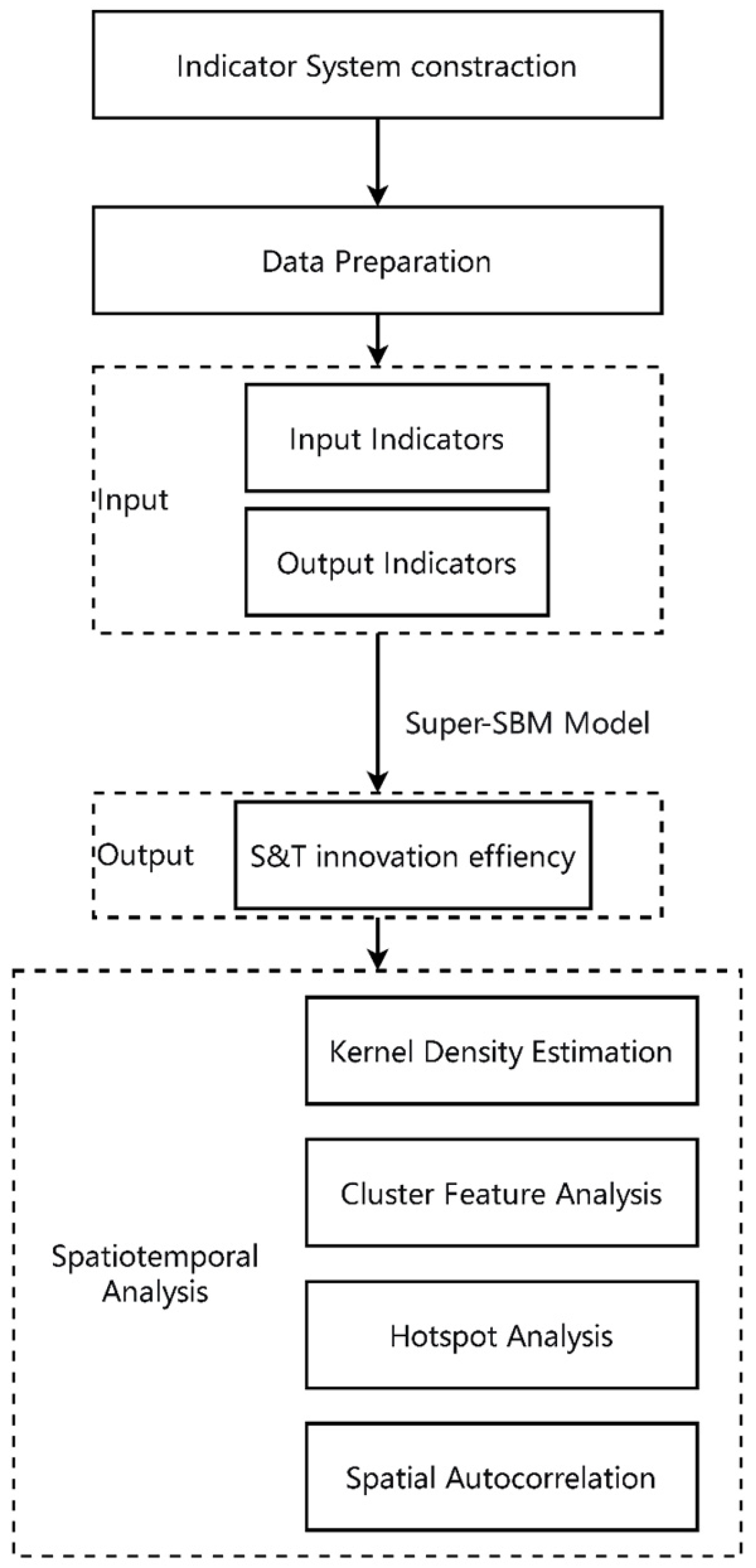
To systematically evaluate the spatiotemporal dynamics of China’s regional S&T innovation, the research adopts a structured design as illustrated in
Figure 1. The process commences with the development of a comprehensive indicator system that accounts for both economic returns and environmental constraints. These data are processed through a non-oriented Super-SBM model to generate precise efficiency scores. Subsequently, a suite of spatial econometric tools—including Kernel Density Estimation and Moran’s
I—is applied to reveal the evolutionary trajectory and spatial clustering mechanisms.
3.1. Selection of Indicators for Measuring Regional S&T Innovation Efficiency
To accurately evaluate the regional S&T innovation efficiency, this study employs the Super-SBM model. This approach is consistent with the standard DEA literature, which effectively treats the complex internal innovation process as a “black box” to measure the Total Factor Productivity of the entire system [
34,
35]. While this macro-level measurement does not delve into the micro-processes of internal R&D management, its focus on end-result macro-indicators ensures greater statistical objectivity and comparability across diverse provincial institutional environments [
36,
37]. As noted by Tone, such a methodology is particularly suitable for assessing efficiency at the regional level, as it mitigates potential biases arising from unobservable internal heterogeneity while providing a standardized benchmark for cross-regional analysis [
10].
The construction of the indicator system comprises two components: the selection of regional S&T innovation input indicators and regional S&T innovation output indicators. Currently, there is no universally accepted indicator system for measuring regional S&T innovation efficiency in existing scholarship. Therefore, this study refers to the indicator systems constructed by current researchers [
38] while considering that indicators with local characteristics often lack unified national statistical standards. Using unconventional indicators can undermine the objectivity of the evaluation system and lead to unverifiable results. Consequently, an indicator system for measuring regional S&T innovation efficiency is constructed from three dimensions: regional S&T innovation inputs, desirable regional S&T innovation outputs, and undesirable regional S&T innovation outputs. This approach better highlights the actual performance of regional S&T innovation across common indicators. The specific measurement indicator system is shown in
Table 2.
(1) Regional S&T Innovation Input Indicators. The knowledge production function categorizes inputs into human resources and financial resources [
39,
40]. Regarding human resource inputs, the full-time equivalent of research and development (R&D) personnel better reflects the actual labor input into innovation than the total number of R&D personnel. Therefore, the FTE of R&D personnel in industrial enterprises above a designated size is selected as the labor input indicator. For innovation financial inputs, internal expenditure on R&D funds measures the financial support for innovation activities within a region and is thus selected as the capital input indicator. These two indicators integrate the human and capital dimensions required for regional S&T innovation, ensuring both rationality and feasibility.
(2) Regional S&T Innovation Output Indicators. S&T innovation output indicators generally include patents, papers, new products, and awards. Considering the difficulty of regional data acquisition and the consistency required for comparative analysis, this study selects the number of patent applications, the number of S&T papers, the turnover in the technology market, and the sales revenue of new products as the desirable output indicators. These indicators effectively reflect regional S&T innovation output. Specifically, the number of patent grants and S&T papers objectively represents a region’s innovation capability and comprehensive S&T strength. New product sales revenue, representing the market performance aspect of S&T innovation efficiency, reflects the degree of coordinated development between S&T and the economy, as well as the transformation of innovation achievements into market value. Finally, turnover in the technology market measures the liquidity and activity of technology as a commodity, reflecting knowledge spillovers, technology transfer, and collaborative innovation capabilities to some extent. In terms of output indicators, to address the potential bias of raw quantity counts, this study employs authorized patent counts and verified academic papers as proxies for innovation quality. It is important to note that, constrained by the availability and authority of public statistical data at the provincial level, these metrics represent the most rigorous quality-adjusted data currently accessible.
(3) Sustainable Development Indicators (Environmental Constraint Indicators). Industrial wastewater discharge, industrial sulfur dioxide emissions, and industrial smoke (powder) dust emissions are selected as undesirable output indicators. First, these three types of pollutants are direct by-products generated during industrial production and possess significant negative environmental externalities. Second, if efficiency evaluations focus solely on economic or innovation achievements, the environmental costs of growth may be obscured, leading to the misidentification of high-emission regions as high-efficiency regions. By incorporating these three pollutants into the model, it becomes possible to identify and reward regions that achieve pollution reduction while increasing innovation output, thereby measuring regional S&T innovation efficiency more precisely. These indicators represent the pressure on environmental media such as water and the atmosphere, forming a multi-dimensional undesirable output system. Furthermore, these indicators are monitored by authoritative agencies and provide continuous, comparable data, which facilitates empirical analysis and ensures that the measurement of regional S&T innovation efficiency aligns with the requirements of sustainable development. While the inclusion of industrial pollution as an undesirable output may be linked to a region’s industrial composition, this study argues that the decoupling of innovation from pollution is inherently tied to industrial structural optimization.
3.2. Model Construction
3.2.1. Super-SBM Model
The SBM model is an extension of Data Envelopment Analysis (DEA) designed to evaluate the efficiency of Decision-Making Units (DMUs) by incorporating slack variables, particularly in cases involving undesirable outputs. Traditional DEA models typically focus only on desirable positive outputs and require all inputs or outputs to be adjusted proportionally, thereby ignoring differences in individual slack variables. In contrast, the super-SBM model integrates undesirable outputs, providing a more comprehensive and realistic efficiency measurement. Furthermore, by incorporating additional constraints and slack factors, the super-SBM model can precisely calculate efficiency values even when they exceed 1, offering higher accuracy than traditional DEA models. This model also excels in distinguishing among efficient units and provides better differentiation in efficiency scores. By allowing independent adjustments to input and output items and optimizing inefficient portions using slack variables, the model offers flexibility for analyzing the input-output efficiency of regional S&T innovation development. By constructing a Global Production Possibility Set—incorporating all decision-making units from 2011 to 2022 into a single reference set—this study ensures that efficiency scores are benchmark-comparable across the entire panel [
41]. This methodological design is particularly suited for spatial econometric analysis, as it allows for the precise mapping of regional efficiency trajectories and the identification of stable spatial clusters without the noise associated with annual frontier shifts. The linear programming model for the super-SBM [
42] is expressed as follows:
In Equations (1) and (2), the parameters are defined as follows: u represents the number of regional S&T innovation input indicators (u = 2 in this study); v denotes the number of desirable output indicators (v = 4 in this study); and k signifies the number of undesirable output indicators (k = 3 in this study). The variable xi0 represents the input values, specifically labor and capital inputs; yr0 denotes the desirable output values, including technology output, knowledge output, technology diffusion, and market performance; and pl0 indicates the undesirable output values, namely the “three industrial wastes.” The index j represents the number of research samples; s1, s2, and s3 are slack variables; and λ denotes the weight vector. Finally, z* represents the regional S&T innovation efficiency value; a larger z* value indicates higher regional S&T innovation efficiency.
3.2.2. Spatial Autocorrelation Analysis
Local and global spatial autocorrelations are the primary components of spatial autocorrelation analysis. These methods allow for the quantitative evaluation of the degree of spatial agglomeration, agglomeration characteristics, and the extent of differences within a region. The Moran’s
I and Local Indicators of Spatial Association (LISA) cluster maps are widely utilized by scholars to determine whether agglomeration occurs within a specific space and to assess the intensity of such phenomena. Therefore, this study employs ArcGIS 10.8.1 to analyze the spatial correlation characteristics of innovation levels across regional units in China. Specifically, efficiency classification, the Getis–Ord Gi* index, and the Moran’s
I are used to measure the spatial correlation of regional S&T innovation efficiency. Based on the efficiency measurement results, regional S&T innovation efficiency is classified to measure the spatial heterogeneity characteristics of high- and low-efficiency clusters. Furthermore, relevant Moran’s
I values are calculated to measure and analyze the spatial correlation characteristics of regional S&T innovation efficiency throughout the study area. The formula for calculating Moran’s
I is as follows:
In Equation (3), the parameters are defined as follows: I represents Moran’s I; n denotes the number of research regions (n = 30 in this study); wij signifies the spatial weight matrix. To measure the spatial dependence of regional S&T innovation efficiency, a spatial adjacency matrix wij based on Queen Contiguity was constructed. In this matrix, wij = 1 if province i and province j share a common boundary or vertex; otherwise, wij = 0; xi and xj represent the regional S&T innovation efficiency of region i and region j, respectively; and denotes the average value of regional S&T innovation efficiency.
Statistically, Moran’s I measures the correlation of a variable with itself in adjacent geographical locations, ranging from −1 to 1. Positive Autocorrelation (I > 0) indicates “Spatial Synergy,” where high-efficiency provinces are surrounded by similar high-performing neighbors, suggesting a “Clustering Effect.” Negative Autocorrelation (I < 0) suggests a “Siphoning Effect,” where a leading province may drain resources from its neighbors. The Z-score and p-value are used to reject the null hypothesis of Spatial Randomness. In our study, the consistently positive and significant Moran’s I confirms that regional innovation efficiency is not randomly distributed but is significantly influenced by geographical proximity.
3.3. Data Sources and Regional Classification
This study selects 30 provinces, autonomous regions, and municipalities in China as research samples. Due to data availability, Tibet, Hong Kong, Macao, and Taiwan are excluded. To facilitate a comparative analysis, the economic regions are divided into four major areas: Eastern, Central, Western, and Northeastern China. Specifically, the Northeastern region includes Liaoning, Jilin, and Heilongjiang. The Eastern region comprises Beijing, Tianjin, Hebei, Shanghai, Jiangsu, Zhejiang, Fujian, Shandong, Guangdong, and Hainan. The Central region includes Shanxi, Anhui, Jiangxi, Henan, Hubei, and Hunan. The Western region encompasses Inner Mongolia, Guangxi, Chongqing, Sichuan, Guizhou, Yunnan, Shaanxi, Gansu, Qinghai, Ningxia, and Xinjiang. To reflect the differences in regional innovation efficiency among these 30 regions, this study utilizes the super-SBM model to calculate the efficiency values for each region, followed by a systematic ranking and comparison.
Statistical data were obtained from the China Statistical Yearbook on Science and Technology, the China Statistical Yearbook on Environment, and the China City Statistical Yearbook for the period 2011–2024. These yearbooks are official documents formally published by the National Bureau of Statistics and relevant competent authorities, ensuring the highest level of authority and reliability. However, full electronic versions of these yearbooks are not publicly disclosed on official government websites. To ensure research replicability and standardized data acquisition, we utilized the EPS Data Platform (EPS data) as our primary data source [
43]. This professional statistical aggregation platform is officially authorized to collect and organize the complete datasets from the aforementioned yearbooks.
Missing data were primarily addressed using provincial statistical yearbook data, with any remaining gaps filled using interpolation. The administrative boundary vector data were sourced from the National Platform for Common Geospatial Information Services under examination number GS (2024) 0650 [
44] and processed using the WGS 1984 World Mercator projection coordinate system. Considering that regional innovation activities typically exhibit a time lag—where S&T innovation inputs require a certain duration to be transformed into innovation outputs—this study lags the output data by 1 year [
45]. The four specific time points of 2013, 2016, 2019, and 2022 were selected because they represent fixed intervals that facilitate the analysis of long-term trends and cyclical changes [
46]. This selection also enables a more intuitive comparison of periodic transitions in spatial structures, such as cold- and hot-spot distributions or gradient patterns.
4. Measurement Results of Regional Innovation Efficiency
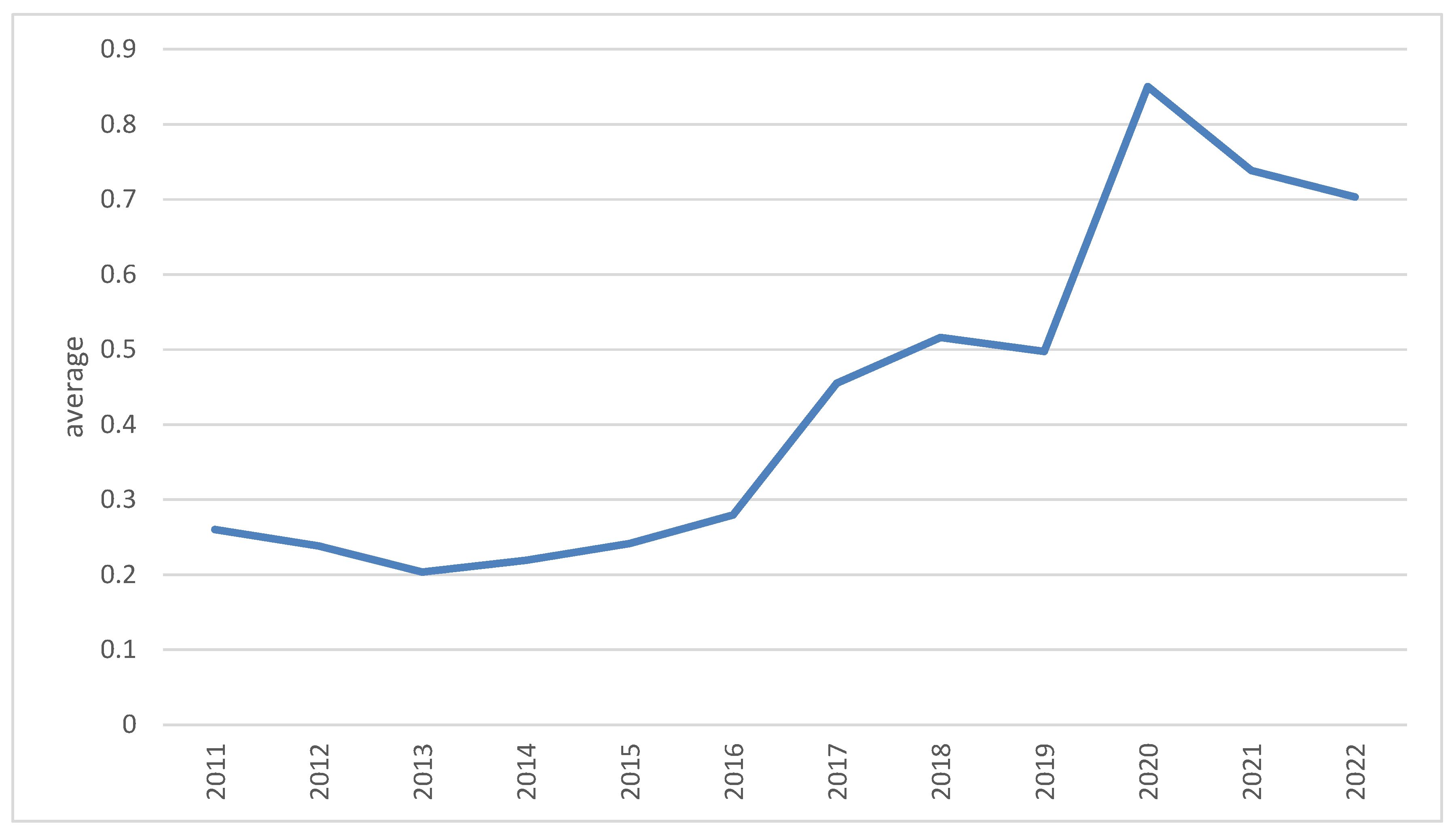
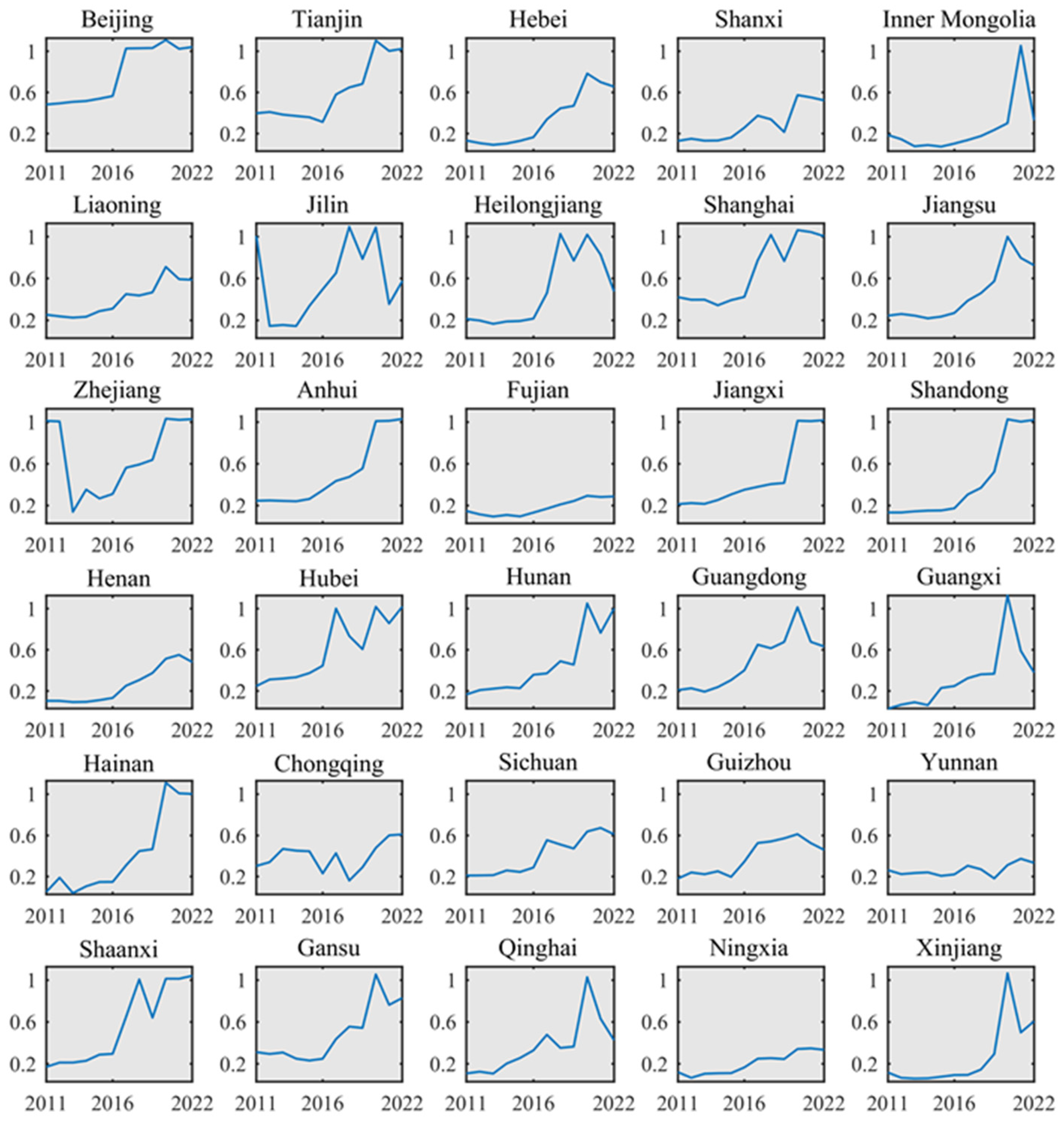
To ensure the comprehensiveness and comparability of measurement results, a super-SBM model that accounts for undesirable outputs was selected to calculate the regional S&T innovation efficiency for 30 regions in China from 2011 to 2022. The results are presented in
Table 3. The trends of average efficiency and the regional efficiencies are shown in
Figure 2 and
Figure 3.
Based on the analysis of the S&T innovation efficiency values for each province from 2011 to 2022, as shown in
Table 3 and
Figure 2 and
Figure 3, the overall regional S&T innovation efficiency in China exhibited a significant upward trend during the observation period. According to the annual mean values, the efficiency scores gradually improved from a relatively low level, with many provinces generally surpassing 1.0 after 2020. This trend reflects the substantial progress China has made in promoting regional S&T innovation, with a notable average annual growth rate in overall efficiency.
From a regional comparison perspective, provinces and municipalities with outstanding efficiency performance primarily include Beijing, Shanghai, Zhejiang, and Anhui. In most years, particularly during the later stages of the study, the efficiency values of these regions remained consistently above 1.0. Specifically, Beijing has maintained an efficiency value higher than 1.0 since 2017, reaching 1.109 in 2020 and consistently ranking among the top in the country for several years. This underscores Beijing’s leading role as a national S&T innovation center. Similarly, Shanghai, Zhejiang, and Anhui steadily entered the high-efficiency zone after 2020, demonstrating strong innovation sustainability.
Further analysis reveals that the S&T innovation efficiency of the eastern coastal regions and certain central provinces is generally higher than that of the western regions. This indicates a gradient difference from east to west, which correlates with economic development levels, the concentration of scientific research resources, and the intensity of policy support. Simultaneously, the mean efficiency of municipalities directly under the central government and developed coastal provinces is significantly higher than that of inland provinces. This further substantiates the spatial agglomeration effect of innovation resources and achievement transformation capabilities.
Overall, China’s regional S&T innovation efficiency has shown an integrated improvement across the temporal dimension. Regarding the spatial pattern, it exhibits a distribution characteristic of gradual decline from east to west. High-efficiency regions are predominantly concentrated in the Beijing–Tianjin–Hebei region, the Yangtze River Delta, and certain innovation-active provinces in central China. This distribution reflects the synergistic results of China’s S&T innovation system construction and regional development strategies. The measurement results from 2011 to 2022 reveal two key trends. National efficiency exhibited a steady “bottom-up” growth, significantly narrowing the gap between lagging and leading provinces. The distribution shifted from a polarized “pyramid” to a balanced “spindle-shaped” structure, with most provinces reaching mid- to high-efficiency levels.
To rigorously examine whether regional disparities in S&T innovation efficiency are diminishing over time, this study conducts an absolute β-convergence test. The results are presented in
Table 4. The test provides econometric evidence of the “catch-up effect” among Chinese provinces.
Absolute β-convergence examines whether provinces with lower initial efficiency grow faster than those with higher initial efficiency, eventually converging to a common steady state.
The regression results show that the βcoefficient is negative and highly significant at the 1% level. This result provides robust empirical evidence for absolute β-convergence across the 30 provinces. The findings confirm a strong “catch-up effect,” in which late-mover regions (e.g., Guangxi, Xinjiang, and Ningxia) leverage their late-mover advantages to achieve higher growth rates than the already high-efficiency frontier provinces. This statistical confirmation supports our earlier observation that China’s regional innovation landscape is transitioning from a polarized “pyramid” structure to a more balanced and integrated “spindle” distribution.
5. Spatiotemporal Analysis of Regional S&T Innovation Efficiency
5.1. Kernel Density Analysis
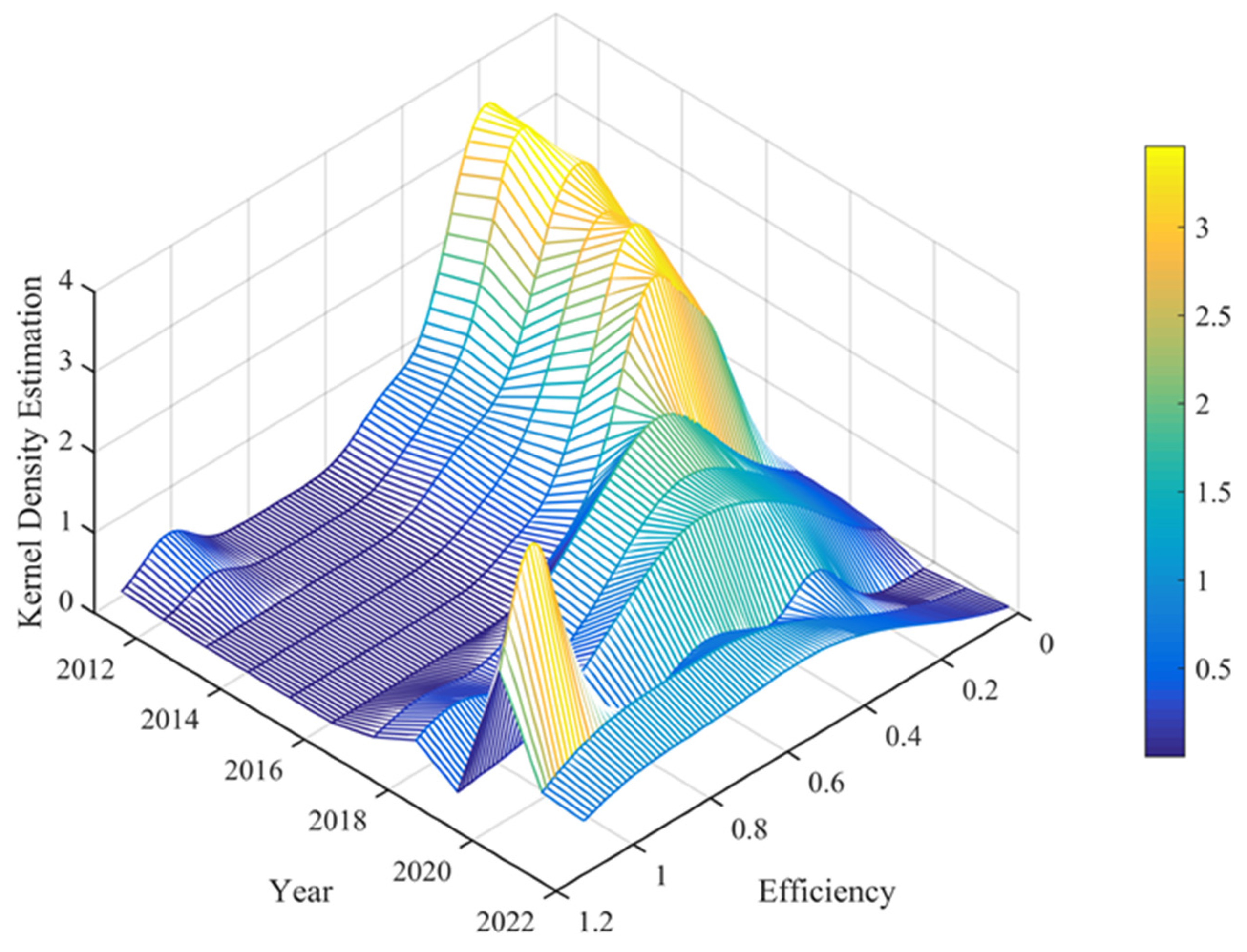
Based on the measurement of China’s regional S&T innovation efficiency and the analysis of basic evolutionary trends and regional differences, this study further employs the kernel density estimation method in MATLAB R2016a to explore the evolutionary trends of regional S&T innovation efficiency. This paper employs non-parametric kernel density estimation (KDE) to examine the spatiotemporal evolution of efficiency. The kernel function adopted is the Gaussian kernel. The selection of bandwidth follows the rule-of-thumb proposed by, which automatically determines the optimal bandwidth based on the distribution characteristics of the sample data to achieve a balance between prediction accuracy and smoothness [
47].
Kernel density estimation plots use smooth curves to describe the shape of the data distribution. Peak height reflects data concentration, peak position shows central tendency, and the number of peaks indicates multipolarity. Applying these principles, this study analyzes the dynamic spatiotemporal characteristics of China’s regional S&T innovation efficiency from 2011 to 2022, focusing on peak height, position, quantity, and temporal changes.
Figure 4 shows the temporal evolution of the kernel density.
For subsequent analysis, the parameters characterizing the distribution shape of the kernel density estimation were summarized, including the peak position, skewness and kurtosis. The specific parameters are listed in
Table 5.
5.1.1. Time-Series Analysis
According to
Figure 4 and
Table 5, the overall distribution morphology of regional S&T innovation efficiency in China shifted from a highly right-skewed distribution toward a convergent equilibrium during the period from 2011 to 2022.
In the early years (2011–2016), efficiency values exhibited strong right skew (skewness > 1.1). Peak density was very high (>3.0), and peaks were in the 0.1–0.3 range. Most provinces showed low S&T innovation efficiency. Only a few, such as Zhejiang, had high efficiency, creating a “long tail.”
In 2017, the distribution began to change. The peak height dropped below 2.0, and the peak shifted to the right (starting at 0.39). By 2021–2022, the distribution became nearly symmetric or left-skewed (negative skewness) and showed platykurtic tendencies (a flat peak). Efficiency values no longer centered at the low end, and were more balanced, with more provinces reaching higher efficiency.
The peak position shows the “center of gravity” of efficiency moving to higher values. From 2011–2016, the peak stayed in the low range (0.16–0.29). From 2017 to 2019, it shifted rapidly right, from 0.39 to 0.50, reaching a medium-efficiency level.
In 2020, the peak jumped to 1.045, passing into the high-efficiency range (>1.0) for the first time. This matches the raw data, as many provinces exceeded 1.0 that year, indicating that several regions (such as Anhui, Hubei, and Hunan) reached the efficiency frontier. In 2021–2022, the peak fell to 0.57–0.72 but stayed much higher than before 2019. This suggests S&T innovation efficiency stabilized at higher levels.
5.1.2. Spatial Evolution Analysis
(1) Overall efficiency mean shows a steady decline. The average value of kernel density estimates fluctuated within a narrow range around 0.76 between 2011 and 2020 (with a change rate within ±0.8%), exhibiting extremely high stability. However, in 2021 and 2022, the average value decreased significantly (by 3.44% and 2.61%, respectively), while the median (0.84 in 2022) surpassed the mean (0.72). Combined with the left-skewed distribution characteristic, this phenomenon of “decreasing mean and higher median” indicates that the growth momentum of efficiency improvement may be slowing down. The overall efficiency distribution has entered a stage of high-level convergence or a plateau period, where the number of high-efficiency regions is increasing while the growth rate of the overall mean efficiency is decelerating.
(2) The dispersion of efficiency values first expanded and then significantly contracted. This process can be divided into three distinct stages. In the early stage (2011–2016), the standard deviation remained high at 1.04–1.09, and the coefficient of variation (CV) consistently exceeded 1.35, reflecting substantial efficiency disparities and a highly fragmented distribution across provinces. During the middle stage (2017–2020), both the standard deviation and CV began to decline; notably, in 2018–2019, the CV dropped to 0.66–0.78, indicating a narrowing of both absolute and relative gaps between provinces. In the late stage (2021–2022), the degree of dispersion decreased sharply. By 2022, the standard deviation fell to 0.30 and the CV to 0.42—the lowest values in the entire observation period. This demonstrates that after years of development, regional S&T innovation efficiency has exhibited a clear convergence trend, with regional disparities significantly diminishing.
(3) The overall distribution morphology of efficiency values can be summarized as follows: it transitioned from an initial state of “high right-skewness, low-value clustering, and wide disparities,” through a middle “catch-up and diffusion” phase characterized by rightward peak shifts and narrowing gaps, and finally toward a relatively balanced state of “upward shift of gravity, concentrated distribution, and convergent disparities.” The year 2020 serves as an inflection point, while the 2021–2022 data suggest that efficiency improvement may be transitioning from a phase of universal high-speed growth to a new stage of balanced development. This process intuitively reflects the dynamic evolution of China’s regional innovation from being led by individual growth poles to achieving collaborative development.
In summary, the distribution of China’s regional S&T innovation efficiency has undergone a transformation from concentration to dispersion and, ultimately, toward gradual stabilization. The period of 2012–2015 saw the formation of individual efficiency centers (e.g., Zhejiang). 2016–2019 catalyzed a polycentric pattern, although large fluctuations in the primary peak reflected an unstable regional innovation landscape. Finally, the shift from a four-peak structure to a smooth plateau during 2020–2022 indicates that regional S&T innovation efficiency values have become more spatially balanced.
5.2. Analysis of Cluster Distribution Characteristics
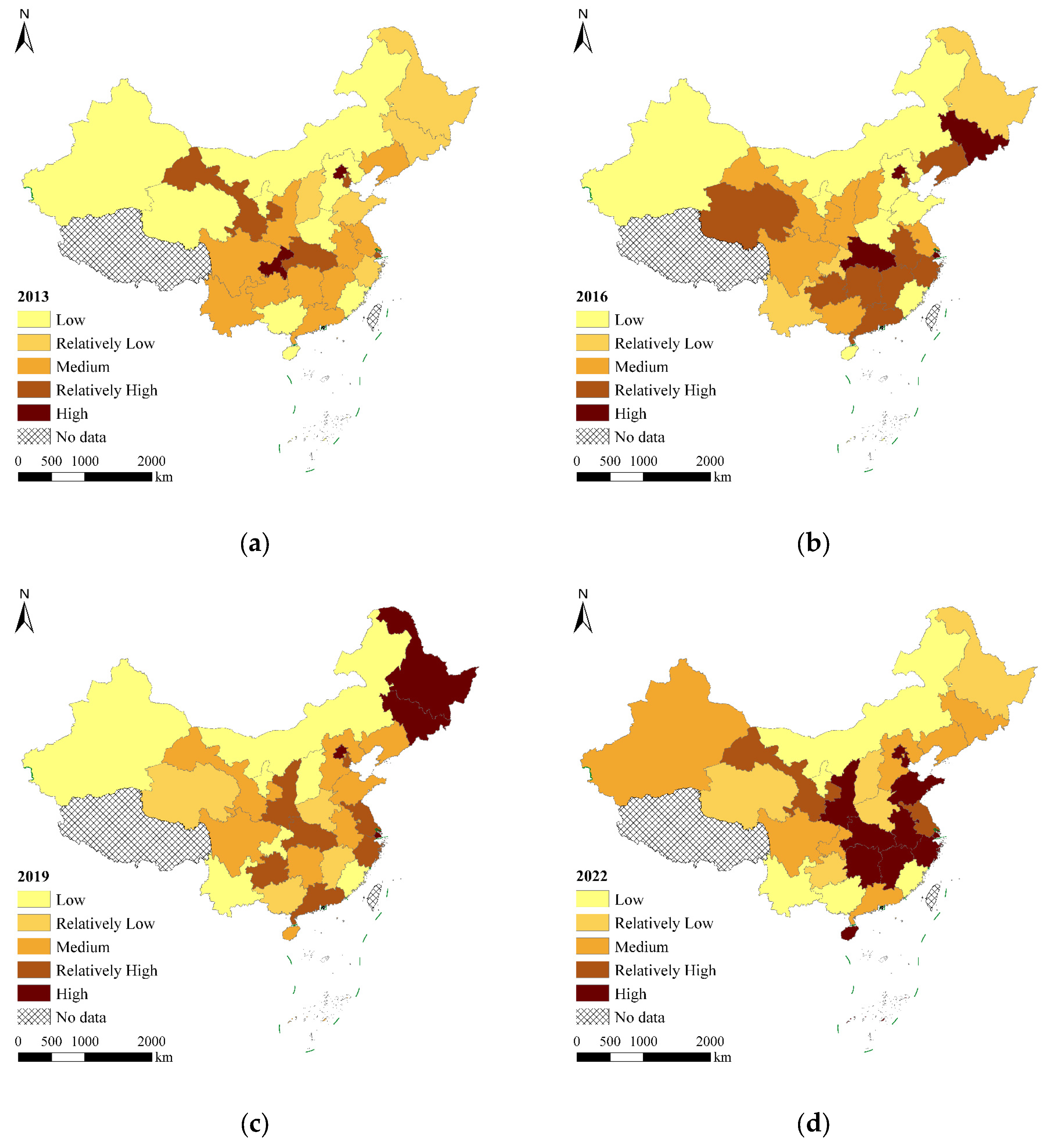
To more intuitively observe the spatial correlation characteristics of China’s regional S&T innovation efficiency and to reveal the evolutionary trends in spatial correlation patterns across regions, this study employed ArcGIS 10.8.1. Using the Natural Breaks (Jenks) classification method, the spatial evolution characteristics of S&T innovation efficiency levels for the years 2013, 2016, 2019, and 2022 were categorized. The color gradient, ranging from light to dark, represents the efficiency levels of different regions in a given year: low efficiency, relatively low efficiency, medium efficiency, relatively high efficiency, and high efficiency. The specific results are illustrated in
Figure 5.
(1) Significant regional disparities in S&T innovation efficiency persist, alongside a substantial increase in high and relatively high-efficiency regions. The number of high-efficiency provinces grew from two in 2013 (Beijing and Chongqing) to ten in 2022, covering vital regions such as the Beijing–Tianjin–Hebei region, the Yangtze River Delta, and the middle reaches of the Yangtze River. Concurrently, the number of “low-efficiency troughs” has decreased, indicating a rising baseline for national innovation efficiency. The distribution structure transitioned from a typical “pyramid” in 2013 (13 low/relatively low-efficiency provinces vs. 2 high-efficiency provinces) to a “spindle” shape in 2022. This shift, in which the numbers of high- and low-tier provinces are converging, suggests a more balanced overall distribution of efficiency.
(2) Notable diffusion and polycentricity of high-efficiency innovation zones. High-efficiency regions evolved from a mono- or dual-core state in 2013 (Beijing and Chongqing) to a multi-core coexistence in 2016 (Beijing, Jilin, Shanghai, and Hubei), ultimately forming a wide-ranging, polycentric network by 2022 (encompassing 10 provinces, including Beijing, Tianjin, Shanghai, Zhejiang, and Anhui). Furthermore, the low-efficiency areas have steadily contracted; the count of low-efficiency provinces fell from six in 2013 (including Hebei, Inner Mongolia, Fujian, Henan, Guangxi, and Hainan) to just two in 2022 (Inner Mongolia and Ningxia). By 2022, a continuous belt of high efficiency emerged, characterized by the Beijing–Tianjin innovation highland and the Yangtze River Delta innovation corridor (Shanghai, Zhejiang, Jiangsu, and Anhui), marking an evolution from point-like dispersion to belt-like agglomeration.
(3) S&T innovation efficiency exhibits a marked East–West gradient. In 2013, the distribution showed significant gradient differences and initial clustering: Beijing and eastern coastal provinces like Shanghai and Jiangsu displayed higher efficiency, while western and certain central provinces remained in the low-efficiency range. By 2016, the polarization effect of core hubs intensified, with Beijing and Shanghai consolidating their status as national innovation poles, while Hubei and Jilin emerged as new growth poles. In 2019, diffusion and restructuring effects became prominent; while the radiation from core areas lifted the efficiency of surrounding provinces like Tianjin and Anhui, regions like Heilongjiang and Chongqing experienced fluctuations or declines, reflecting intensified regional competition. By 2022, the landscape reached a networked equilibrium. The Yangtze River Delta (Shanghai, Jiangsu, Zhejiang, and Anhui) integrated into a continuous high-efficiency highland, and central provinces (Hubei, Hunan, and Jiangxi) rose collaboratively. However, internal differentiation in the Northeast and slower progress in southwestern provinces (e.g., Yunnan and Guangxi) indicate that challenges in regional coordinated development remain.
Overall, China’s regional S&T innovation efficiency clusters have exhibited significant efficiency improvements and spatial transformations over the past decade. The leading positions of first-tier cities such as Beijing and Shanghai have been continuously consolidated, while the outstanding performance of provinces like Zhejiang, Anhui, Hubei, and Hunan has become a key driving force for the overall national efficiency improvement. The evolution of regional S&T innovation efficiency is characterized by the “coexistence of spatial polarization and collaborative diffusion”: core areas continue to strengthen, and emerging growth poles continue to rise, forming multiple high-efficiency blocks such as Beijing–Tianjin–Hebei, the Yangtze River Delta, and the middle reaches of the Yangtze River. Conversely, some low-efficiency regions remain stagnant, highlighting the difficulty of breaking through developmental bottlenecks. The sustained leadership of Beijing and Shanghai underscores the powerful resource-aggregation and sourcing functions of national-level S&T innovation centers; meanwhile, the rapid rise in places like Anhui and Jiangxi demonstrates the feasibility of achieving innovation catch-up through industrial transfer and integration into core metropolitan circles. High-efficiency clusters are clearly aggregating toward advantageous regions like Beijing–Tianjin–Hebei and the Yangtze River Delta.
Ultimately, the cluster distribution of China’s regional S&T innovation efficiency has progressed through four evolutionary stages: “Gradient Emergence—Core Polarization—Diffusion and Restructuring—Networked Equilibrium.” The regional evolution data on cluster distribution reveal phenomena of multi-center breakthroughs and block-based linkage. Observations indicate that after core regions (e.g., Beijing and Shanghai) surpassed and stabilized at an efficiency value of 1.0 around 2017–2020, their surrounding and economically linked provinces showed a concentrated upward trend in efficiency levels in subsequent years (e.g., 2021–2022). This reflects the time lag of innovation spillovers and the significant spatial spillover effects of China’s regional S&T innovation efficiency. High-efficiency areas have expanded from a scattered point-like distribution in 2013 to a cross-provincial continuous belt-like distribution by 2022; meanwhile, low-efficiency areas have shrunk from a fragmented patch-like distribution in 2013 to scattered residual points in 2022. This represents the networking of China’s high-efficiency regional S&T innovation clusters.
5.3. Hot Spot Analysis
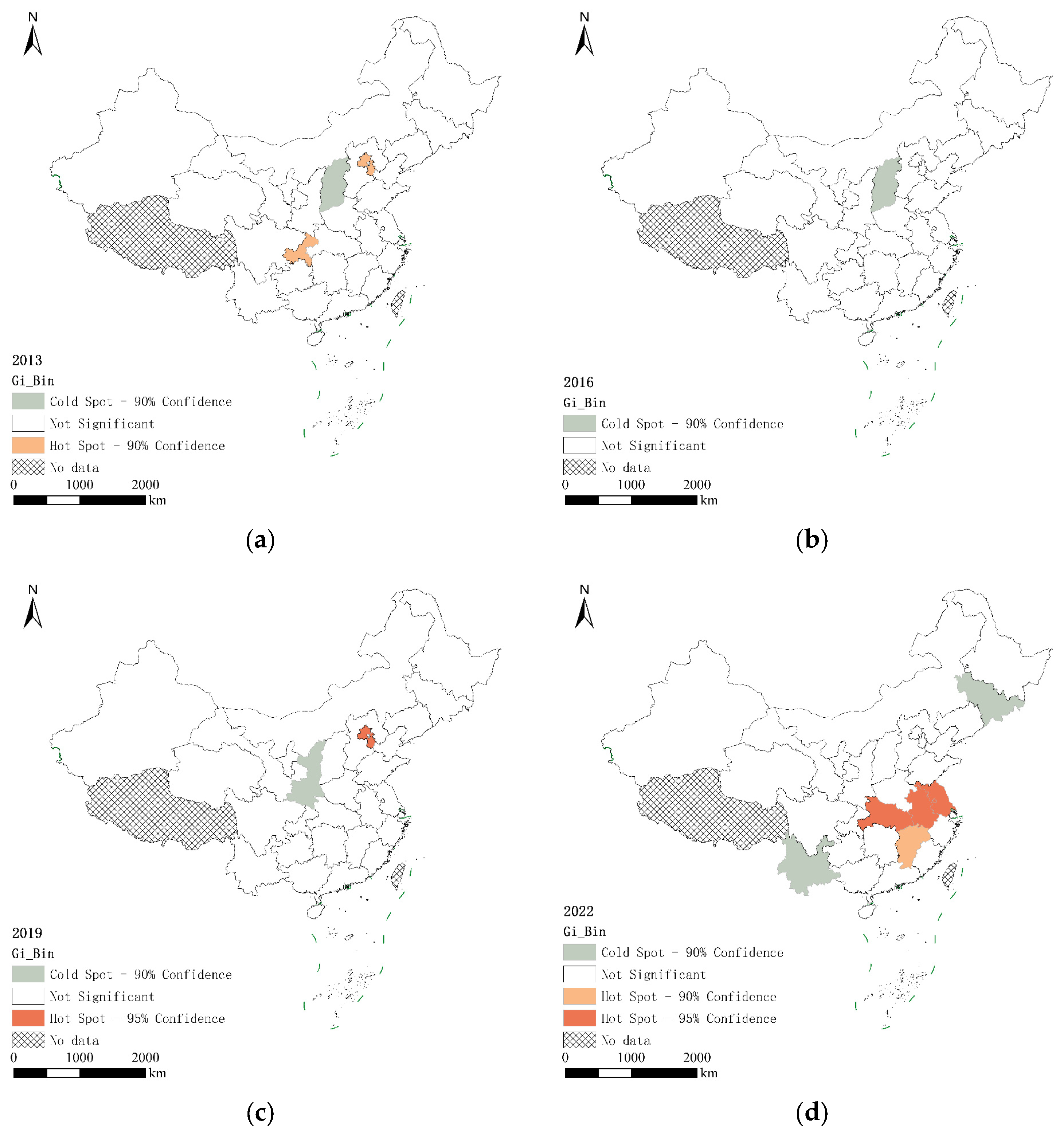
To better examine the relative relationships of S&T innovation efficiency among different sub-regions within China, the Getis-Ord Gi* local spatial autocorrelation index was employed. The Hotspot analysis is not merely an illustrative tool but a localized statistical test. For a location to be identified as a statistically significant “Hot Spot,” it must possess a high efficiency value and be surrounded by other high-value units such that the local sum deviates significantly from the expected local sum. This index was spatialized in ArcGIS to conduct a hotspot and cold spot analysis, as illustrated in
Figure 6.
In 2013, hot spots were concentrated in Beijing, Tianjin, and Chongqing, aligning with their categorized status as “high” or “relatively high” efficiency regions. Notably, while Chongqing emerged as a spatially isolated western hotspot, its efficiency values fluctuated drastically in subsequent years (shifting from high to relatively low, then low, and finally medium). This suggests that in the early stages, Chongqing functioned as a statistically significant “isolated peak” rather than a stable “growth pole” with sustained radiation capabilities. Conversely, cold spots appeared in Shanxi, consistent with its “relatively low efficiency” status and marking it as a local innovation trough.
During 2016 and 2019, hotspots remained stable within the Beijing–Tianjin–Hebei core (Beijing and Tianjin), confirming the area’s continuity and stability as a national-level innovation engine. Cold spots migrated from Shanxi (2016) to Shaanxi (2019). Interestingly, although Shaanxi was categorized as having “relatively high efficiency” in 2019, it was identified as a cold spot. This indicates that while its own efficiency was high, it was surrounded by lower-efficiency neighbors (e.g., Gansu, Ningxia, and Henan), failing to form a local high-efficiency cluster. This phenomenon substantiates earlier findings regarding “internal regional imbalance” and “geographic limitations of S&T innovation efficiency spillovers.”
By 2022, large-scale hotspots with high confidence levels emerged in the middle and lower reaches of the Yangtze River (Hubei, Anhui, Jiangsu, and Jiangxi), forming a continuous belt (Hubei, Anhui, and Jiangsu reached 95% confidence). This directly visualizes the formation of the “Yangtze River Delta–Middle Reaches of the Yangtze River Innovation Corridor.” Meanwhile, cold spots appeared in Jilin and Yunnan, provinces characterized by “medium” and “low” efficiency, respectively. This suggests that not only are these provinces underperforming individually, but their broader local regions have also stagnated, becoming efficiency cold spots in the national innovation network. The results show that in 2022, the number of provinces with Z-scores > 1.96 (p < 0.05) in the Yangtze River Delta increased significantly, confirming that the cluster is not a random occurrence but a result of strong spatial dependency and synergy.
In summary, prior to 2019, hotspots were largely confined to the initial cores (Beijing and Tianjin), indicating limited early-stage radiation. It was not until 2022 that extensive, high-significance hotspot regions appeared in the Yangtze River Delta and the middle reaches of the Yangtze River. This reinforces the kernel density analysis observation: significant diffusion effects occur only after core regions surpass an efficiency threshold of 1.0. It implies that core areas must accumulate sufficient innovation energy—reaching the efficiency frontier—before they can generate strong spatial spillovers through industrial chains, talent flow, and technical cooperation.
The contrast between Shaanxi (high efficiency but a cold spot) and the middle reaches of the Yangtze River (collaborative hotspots) highlights that spatial spillover requires more than just high individual performance; it necessitates geographical proximity, industrial correlation, infrastructure connectivity, and policy synergy. The regional connectivity and integrated economic ties in the Yangtze River Delta and its middle reaches provided the necessary conditions for this “resonant” efficiency overflow.
5.4. Moran’s I Analysis
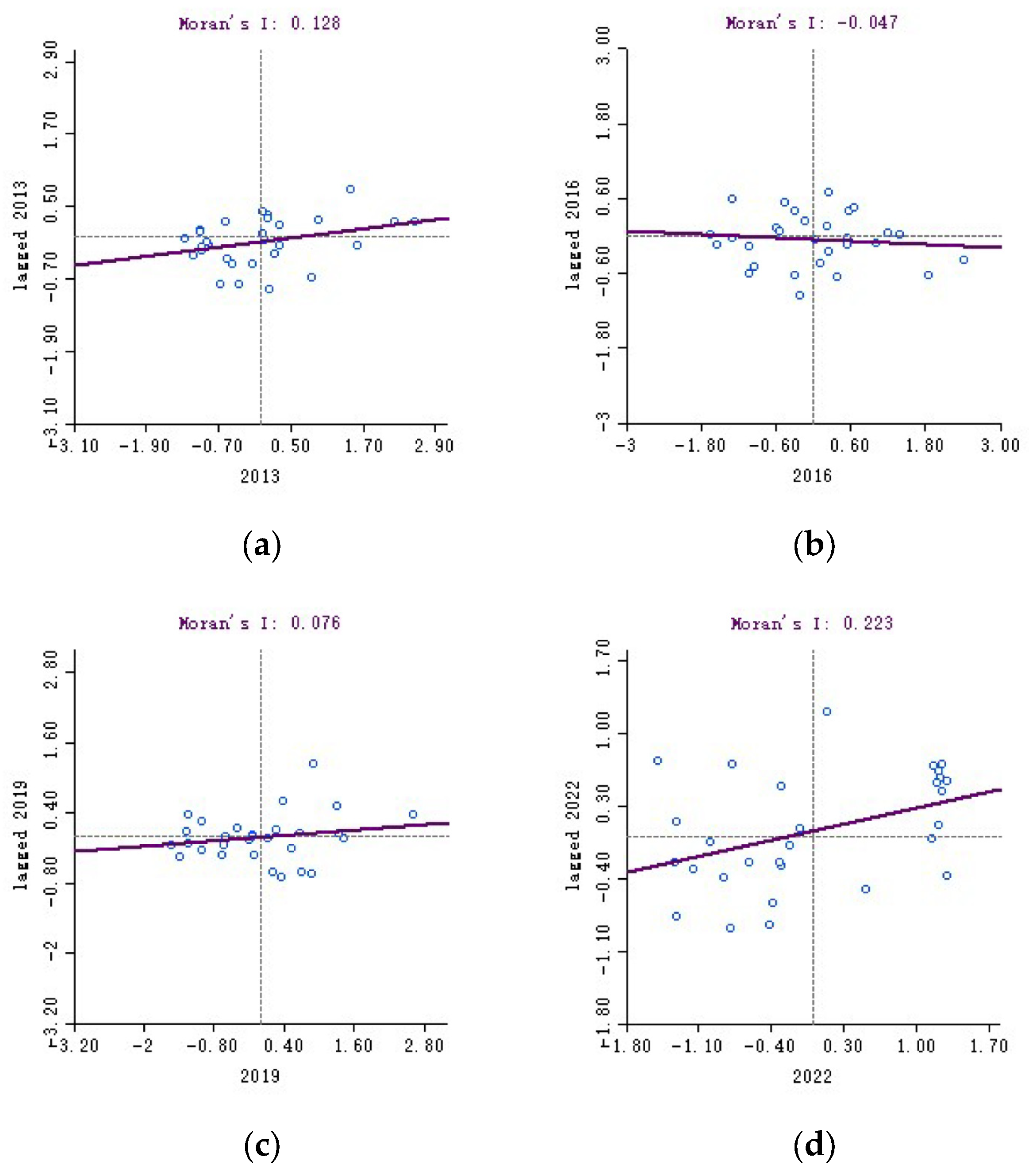
To further confirm the spatial correlation characteristics of China’s regional S&T innovation efficiency, a spatial autocorrelation analysis was conducted alongside the cluster characteristics discussed above. Moran’s
I scatter plots were generated, as shown in
Figure 7. Simultaneously, the global Moran’s
I values,
p-values,
Z-scores, and standard deviations (sd) for the selected years were recorded; the specific numerical results are presented in
Table 6.
In 2013, regional S&T innovation efficiency exhibited a weak positive spatial autocorrelation, indicating a slight tendency for high-efficiency provinces to cluster together and low-efficiency ones to do the same. However, the p-value (0.085) exceeded the standard significance level (0.05), suggesting that this positive correlation was not statistically significant. This aligns with previous findings: in 2013, high-efficiency “points” (e.g., Beijing, Chongqing) coexisted with low-efficiency “surfaces” (e.g., the vast central and western regions). Although embryonic hotspots were visible in the Beijing–Tianjin and Yangtze River Delta regions, high- and low-value areas were spatially interleaved, failing to form continuous, statistically significant clusters. Spatial spillover effects were weak, leaving the overall landscape relatively discrete.
By 2016, the Moran’s I turned negative and approached zero, with the p-value far exceeding 0.05, indicating a lack of significant spatial autocorrelation. The efficiency values across provinces essentially followed a random spatial distribution. This reflects a transitional phase characterized by “intensified polarization without widespread diffusion.” While core poles like Beijing and Shanghai strengthened and provinces like Jilin and Hubei surged, these high-efficiency “points” remained surrounded by lower-efficiency neighbors, failing to drive regional synergy. These high-efficiency provinces distributed like “islands,” breaking the global clustering patterns of high-high or low-low values and resulting in statistical randomness.
In 2019, the Moran’s I turned positive again, though the value remained small and the p-value, while lower, remained non-significant. Radiation effects from core areas (e.g., Beijing and Zhejiang) began to emerge, raising the efficiency of neighboring provinces like Hebei and Anhui from low to medium levels. However, this diffusion was limited and uneven. With some provinces (e.g., Heilongjiang, Chongqing) experiencing fluctuations and others (e.g., Shaanxi) remaining “isolated” despite high individual efficiency, the global spatial autocorrelation remained weak and unstable.
By 2022, the Moran’s I rose above 0.2, and the p-value (0.020) fell below the 0.05 threshold, confirming a statistically significant positive spatial autocorrelation. This signifies that high-efficiency provinces were significantly clustered with other high-efficiency provinces, quantifying the formation of the “block-based linkage and networked” pattern discussed earlier. In regions like the Yangtze River Delta and the middle reaches of the Yangtze River, multiple provinces simultaneously entered high-efficiency tiers, forming geographically continuous and statistically significant clusters. This result corroborates the Getis-Ord Gi* analysis, proving that spatial spillovers of innovation elements became significant and widespread after 2020, demonstrating clear agglomeration characteristics.
5.5. Robustness Test
To ensure that the observed spatial patterns are not sensitive to the definition of “neighborhood,” we substituted the Queen Adjacency Matrix with an Inverse Geographic Distance Matrix
wd, where
wij = 1/
dij (
dij represents the centroid distance between provinces). This matrix accounts for the diminishing intensity of spatial spillovers as distance increases, even between non-bordering provinces. Simultaneously, the global Moran’s
I values,
p-values,
Z-scores, and standard deviations (sd) for the selected years were recorded; the specific numerical results are presented in
Table 7.
Table 7 presents the comparison of Global Moran’s
I results under the two matrices. The results indicate:
Under the distance-based matrix, the Moran’s I for 2013 and 2016 remains statistically insignificant, mirroring the results of the adjacency matrix. Crucially, the results for 2019 (p = 0.019) and 2022 (p = 0.028) remain significantly positive.
Both tests reveal a “U-shaped” or upward evolutionary path of spatial dependence. The fact that significant spatial clustering is captured by both a “discrete” (adjacency) and a “continuous” (distance) matrix reinforces the validity of our finding. China’s regional S&T innovation efficiency has evolved into a significant networked structure.
It is noteworthy that while both matrices confirm a significant positive spatial correlation by 2022, the Inverse Distance Matrix wd identified this trend as early as 2019. This divergence offers profound insights into the spatial evolution of China’s innovation.
The earlier significance under
wd suggests that by 2019, the S&T innovation spillover had transcended immediate administrative borders. This might be due to the rapid development of high-speed transportation and digital infrastructure, which effectively shortened the “economic distance” between non-adjacent provinces, thereby promoting long-distance spatial interaction [
48]. This indicates that the regional innovation pattern shifted from “localized clustering” to “networked diffusion”, providing an empirical foundation for the subsequent emergence of integrated innovation corridors.
6. Conclusions and Discussion
6.1. Conclusions
(1) By applying a non-oriented Super-SBM model considering undesirable outputs to measure the regional S&T innovation efficiency in China, and analyzing the characteristics of its spatiotemporal evolution, this study draws the following conclusions:
(2) Based on the kernel density analysis, China’s regional S&T innovation efficiency has achieved an overall leap and structural reconfiguration during the observation period. The distribution of regional S&T innovation efficiency has undergone a significant transformation from an initial state of “high right-skewness, low-value clustering, and wide disparities” to “upward shift of gravity, concentrated distribution, and convergent disparities.” The dynamic evolution exhibits a clear four-stage characteristic: “Clustering–Polarization–Diffusion–Equilibrium.”
Early Stage (2011–2016): The distribution was characterized by significant right-skewness, with a high peak density concentrated in the low-efficiency interval, reflecting large inter-provincial disparities.
Middle Stage (2017–2020): The distribution morphology underwent a fundamental change. The peak shifted continuously to the right, leaping into the high-efficiency interval in 2020, while the degree of dispersion gradually narrowed.
Recent Stage (2021–2022): The distribution became approximately symmetric or even left-skewed, entering a state of high-level convergence and relative equilibrium. Although the mean decreased slightly, the median remained at a high level, indicating that the momentum for efficiency improvement has stabilized and regional gaps have significantly closed.
This evolutionary path reflects a transition in China’s regional S&T innovation from unipolar leadership driven by policy to a multi-point collaborative development stage accelerated by market activation and factor mobility, ultimately forming a new pattern of high-quality balanced development.
(3) Based on the cluster characteristic analysis, the overall distribution structure of China’s regional S&T innovation efficiency has evolved from an initial “pyramid” shape to a recent “spindle” shape. The number of high-efficiency provinces has increased significantly to 10, covering several vital regions such as Beijing–Tianjin–Hebei and the Yangtze River Delta. Meanwhile, the range of low-efficiency “troughs” has contracted substantially, indicating a rising baseline for national innovation efficiency and a more balanced overall distribution.
From the perspective of spatial evolution, high-efficiency clusters have undergone a diffusion and upgrading process, moving from a “mono/dual-core” state to “multi-core coexistence,” and finally forming a “networked continuous belt.” Notably, the Beijing–Tianjin–Hebei and Yangtze River Delta regions have matured into continuous innovation highlands. This evolution exhibits a four-stage characteristic of “Gradient Emergence—Core Polarization—Diffusion and Restructuring—Networked Equilibrium.” This validates the existence of a “core-periphery” structure in innovation activities while simultaneously demonstrating a new trend of multi-center breakthroughs and block-based linkages. Once the efficiency of core regions surpassed critical thresholds, their radiation and spillover effects drove the concentrated improvement of associated regions in subsequent years.
(4) Based on the hotspot analysis, the spatial correlation pattern of China’s regional S&T innovation efficiency underwent significant structural changes between 2013 and 2022. In the early stages (2013 and 2019), significant hotspots were highly concentrated in the initial core of Beijing and Tianjin, while cold spots appeared sporadically in provinces such as Shanxi and Shaanxi. This indicates that the spatial spillover of innovation activities was limited during this period, and the radiation effect had not yet fully materialized. It was not until 2022 that large-scale, high-confidence hotspots emerged in the middle and lower reaches of the Yangtze River (including Hubei, Anhui, Jiangsu, and Jiangxi), forming a continuous region. This marks a new phase where high-efficiency clusters have evolved from isolated points into multi-point, integrated areas.
(5) Moran’s I exhibited a fluctuating upward trend, with spatial autocorrelation characterized by the sequence of “weak positive correlation–random distribution–weak positive correlation–significant positive correlation.” This trajectory reflects the dynamic transition of China’s regional S&T innovation from polarization toward a balanced equilibrium. The statistically significant Moran’s I in 2022 provides robust global spatial evidence for the formation of “high-efficiency innovation corridors” and “block-based linkages.” It demonstrates that China’s regional innovation activities have evolved from a discrete, “point-like” distribution in the early stages into a “networked” structure characterized by strong spatial dependence and synergy.
6.2. Discussion
The spatiotemporal patterns described in the study—initial right-skewed low-efficiency clustering, mid-period rightward peak shift, and final high-level convergence—stem from a combination of structural, policy, market, and spatial factors that have evolved over time. These factors explain why provinces diverged sharply in 2011–2016 but converged markedly by 2021–2022. Key drivers include:
(1) Initial Resource Concentration and Policy Bias (2011–2016 “Clustering–Polarization” Stage). Beijing and Tianjin benefited from decades of accumulation of top universities, national labs, and central-government R&D funding (often >50% higher per capita than in inland provinces). Coastal location and early special economic zone policies amplified international technology transfer. In contrast, central and western provinces (Shanxi, Shaanxi) faced heavy reliance on resource-based industries, generating undesirable outputs (pollution, energy inefficiency) that the Super-SBM model penalizes, dragging efficiency scores down.
(2) Human Capital and Talent Migration Barriers. Provinces with dense higher-education institutions and high inflows of talent (Beijing, Shanghai, Jiangsu) achieved faster knowledge creation and commercialization. Inland provinces suffered brain drain; talent mobility was restricted by the household registration system and housing costs until post-2016 reforms eased cross-regional flows, enabling diffusion to Anhui, Hubei, and Jiangxi.
(3) Industrial Structure and High-Tech Industry Agglomeration. Eastern provinces host mature high-tech clusters (electronics, biotech, new energy) with high patent commercialization rates. Resource-dependent provinces (Shanxi, Inner Mongolia) remained locked in low-value chains, producing undesirable outputs that lower efficiency. After 2017, supply-side structural reform and “Made in China 2025” enabled some inland provinces to undertake industrial relocation and upgrade, lifting their scores.
(4) Infrastructure and Factor Mobility Costs. High-speed rail, 5G coverage, and logistics hubs in Beijing–Tianjin–Hebei and the Yangtze River Delta slashed transaction costs, turning geographic proximity into innovation-network advantages. Inland provinces initially lacked these, limiting spillover. Post-2017 national “innovation corridor” initiatives and inter-provincial R&D platforms dramatically reduced these barriers.
(5) Institutional and Marketization Differences. Eastern provinces exhibit higher marketization indices, easier access to venture capital, and stronger intellectual-property protection. Western provinces faced greater government intervention and slower SOE reform, constraining efficiency until market activation (2017–2020) and the growth of the digital platform economy enabled catch-up.
(6) Environmental and Undesirable-Output Constraints. The non-oriented Super-SBM explicitly penalizes pollution-intensive innovation paths. Provinces with strict environmental regulations (Jiangsu, Zhejiang) or green-tech pivots (Anhui’s quantum and new-energy industries) saw efficiency gains; coal-heavy provinces lagged until ecological-civilization policies forced green transformation after 2020.
These interacting factors produced the observed four-stage evolution: policy-driven single-core dominance, market-activated multi-core emergence, infrastructure-enabled diffusion, and networked equilibrium.
6.3. Implications
This study provides an evidence-based spatial governance framework intended for macro-level policymakers, regional urban planners, and micro-level innovation participants (enterprises, universities, and investors). By moving beyond theoretical efficiency measurements, the spatiotemporal evolution patterns identified in this research offer actionable guidance for diverse stakeholders:
For Government Agencies and Regional Planners. The confirmation of transitioning from “unipolar leadership” to “multi-center block linkage” indicates that traditional, isolated development models are becoming obsolete. Policymakers should shift their focus from intra-provincial resource allocation to the collaborative design of cross-jurisdictional “innovation corridors” (e.g., the Yangtze River Delta and emerging middle-reaches belts). Furthermore, the incorporation of undesirable outputs into the Super-SBM model serves as a quantitative mandate for local governments to enforce green-technology transitions, transforming ecological constraints into new developmental momentum. China’s trajectory—transitioning from unipolar polarization to a multi-center, networked equilibrium through targeted infrastructure and green-tech investments—serves as a replicable blueprint for spatial governance. It demonstrates that late-mover regions can successfully catch up not by duplicating the full R&D chains of core cities, but by functionally integrating into cross-regional innovation networks via asymmetric competition.
For Universities and Research Institutes. As the “radiation sources” of high-efficiency cores, academic institutions must recognize their critical role in the spatial spillover effect. The findings suggest that universities should actively expand industry-academia-research consortia beyond their immediate geographic boundaries, prioritizing the transfer of front-end R&D achievements to peripheral regions that possess the spatial carriers for pilot production and transformation.
For Businesses and Technology Entrepreneurs. The spatial autocorrelation results provide a clear location strategy. Businesses should strategically position themselves within or adjacent to recognized innovation corridors to maximize the absorption of technological and knowledge spillovers at lower transaction costs. For enterprises in historically low-efficiency or resource-dependent regions, the study strongly advocates for “asymmetric competition.” Instead of engaging in redundant, full-chain R&D competition, these firms should focus on integrating into the broader innovation network by specializing in specific transformation or green-manufacturing niches, thereby accelerating their catch-up process.
For Technology Investors. Tracking efficiency clusters (agglomeration, diffusion, reorganization, equilibrium) provides a macro-indicator for capital deployment. Investors should leverage the “late-mover advantage” by directing capital toward regions currently in the diffusion and reorganization phases, particularly those demonstrating a strong commitment to reducing undesirable outputs and integrating into cross-regional networks.
Furthermore, this study enriches the existing literature on innovation geography and sustainable development in two crucial ways. First, by embedding environmental constraints into the non-oriented Super-SBM model, we advance the theoretical framework of Economic Geography. The empirical results prove that sustainable practices and regional efficiency are not mutually exclusive; rather, green constraints act as an endogenous catalyst that forces technological upgrading. Second, tracing the spatiotemporal evolution from a “pyramid” to a “spindle-shaped” distribution provides a dynamic quantitative model for understanding how spatial spillover effects drive regional equilibrium over time.
6.4. Limitations and Future Outlook
While this study provides a comprehensive analysis, certain limitations remain to be addressed in future research:
Refinement of the Indicator System. The indicators selected for measuring regional S&T innovation efficiency could be further refined. Future studies should aim to incorporate more granular variables—such as qualitative measures of innovation output or specific indicators for digital transformation—to build a more sophisticated and robust evaluation framework. Despite efforts to ensure data quality, this research is limited by the lack of more granular, quality-adjusted metrics such as patent citation values at the provincial scale. Future research could utilize firm-level microdata to further disentangle the effects of specific industrial sub-sectors on overall green innovation efficiency.
Expansion of Geographic Scope. Due to data accessibility constraints, this study does not include Tibet, Hong Kong, Macao, or Taiwan. Consequently, the specific roles and evolutionary trajectories of these regions within China’s broader S&T innovation landscape remain unobserved. As data acquisition methods improve, integrating these regions will be a priority to provide a truly national perspective. Furthermore, this study relies on provincial-level data to capture macro-regional trends. However, this scale may mask significant intra-provincial disparities (e.g., the massive gap between a provincial capital and its surrounding counties). Future studies should utilize more granular city-level or enterprise-level panel data to provide a higher-resolution mapping of innovation networks.
Exploration of Influencing Factors. This study confirmed the existence of significant spatial spillover effects in regional S&T innovation efficiency. The results of the spatial evolution analysis imply that regional innovation is no longer confined to a certain city but is consolidating into Innovation Corridors. This agglomeration suggests a strengthening of cross-border functional links. However, the specific formation mechanisms—whether driven by market-led industrial relocation, government-led transport infrastructure, or institutional proximity—remain complex. Due to data limitations regarding cross-city flow elements, this paper focuses on identifying the existence and spatial characteristics of these corridors. Future studies should utilize multi-source big data to decouple the socio-economic drivers behind the transition from “points” to “corridors.”
While this study focuses on the measurement and spatiotemporal evolution of innovation efficiency, it provides a foundation for further econometric inquiry. Future work can further expand this analysis by applying the spatial Durbin model to systematically identify the driving factors behind these efficiency improvements. Specifically, we can study how factors such as digital infrastructure and environmental regulations exert spillover effects on neighboring provinces under different spatial weight matrices.