
Perceived Disorder, Fear of Crime, and Safety in Urban Parks: A Structural Equation Modeling Study from a Large Metropolitan Green Area in Florence, Italy

 , , , , and
Abstract
1. Introduction
2. Materials and Methods
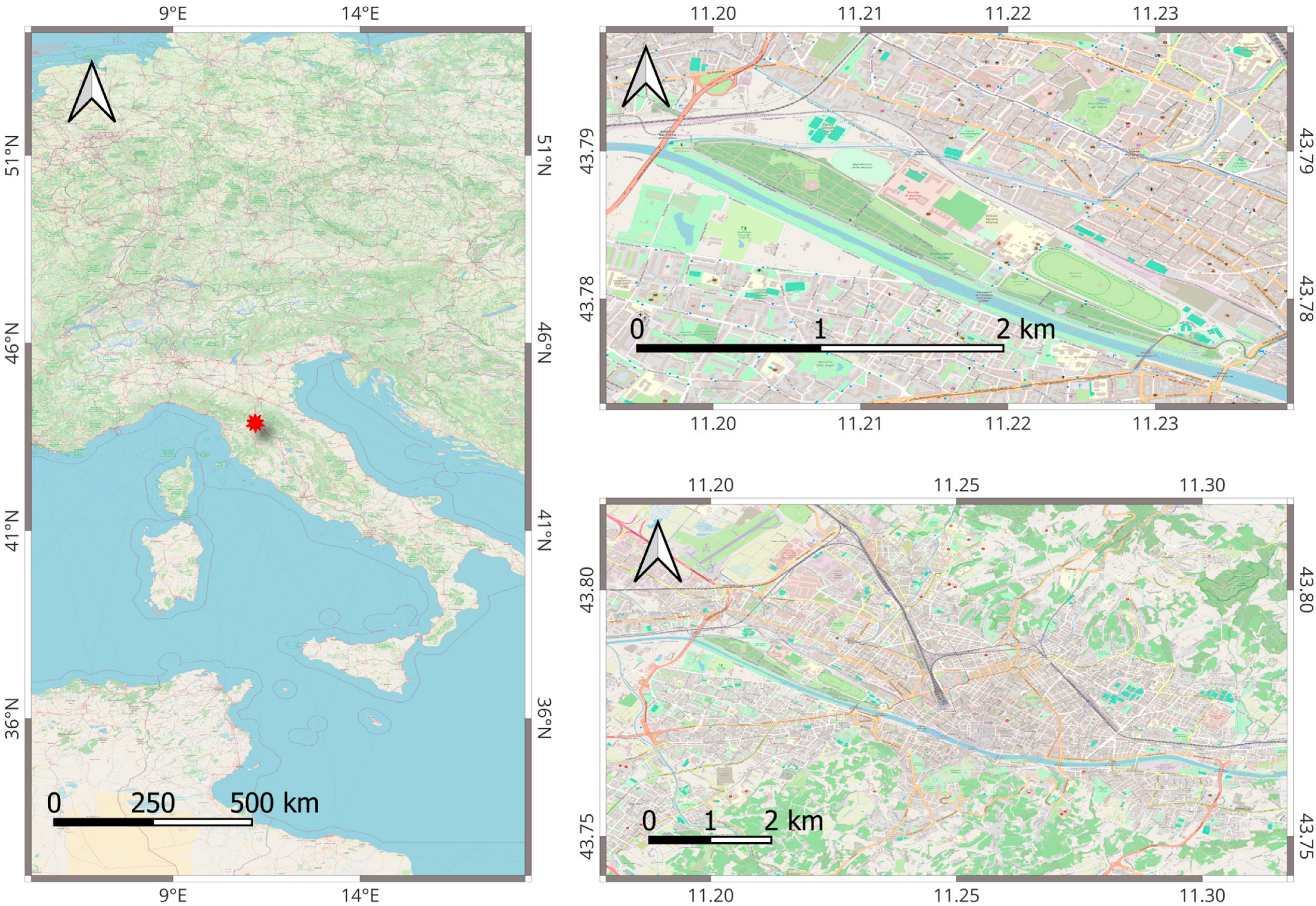
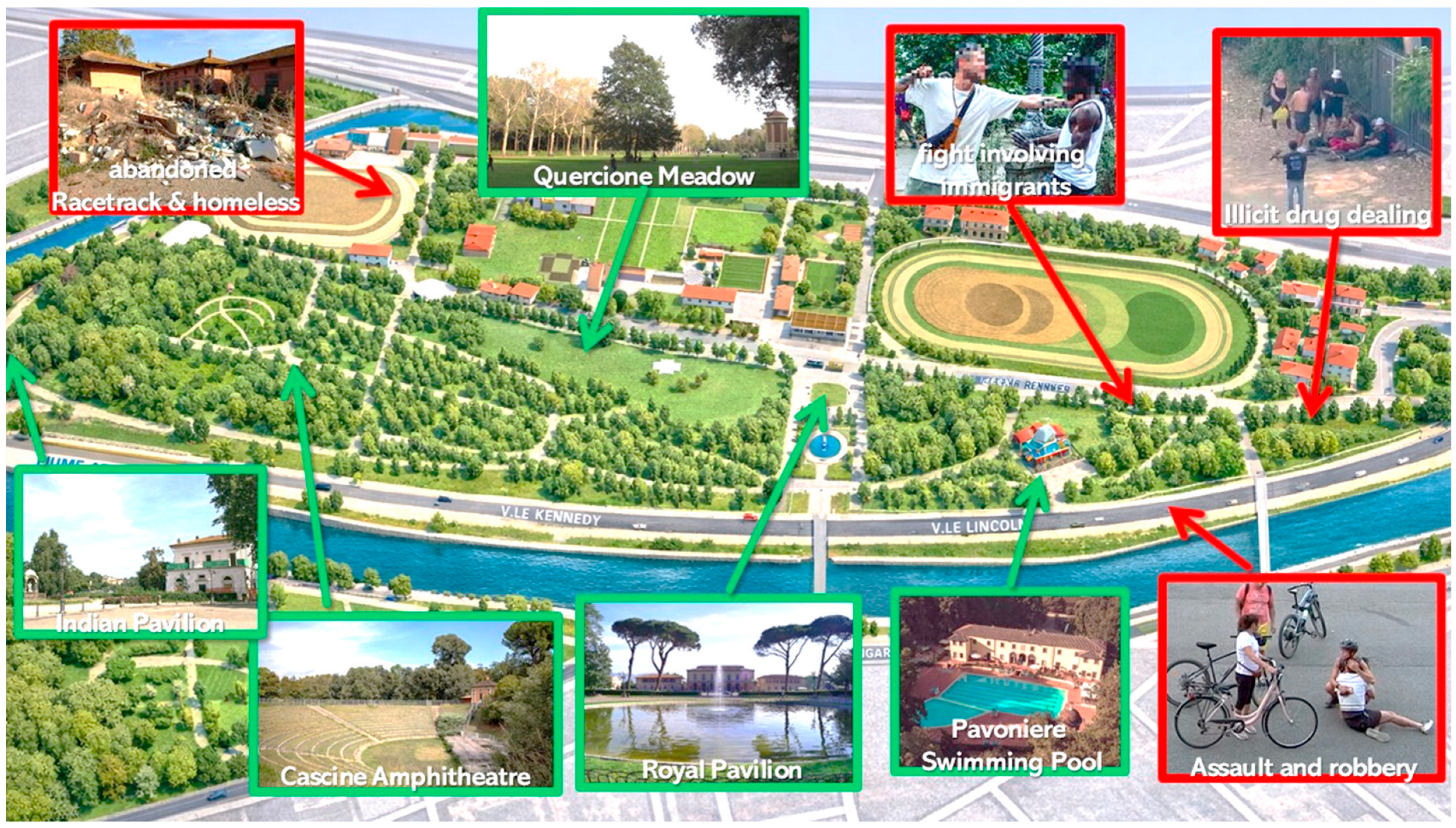
2.1. Cascine Park (Florence, Italy) as Case Study
2.2. Sampling Technique and Primary Data Collection
2.3. Measures
2.4. Data Processing and Analysis
2.4.1. Measurement Model
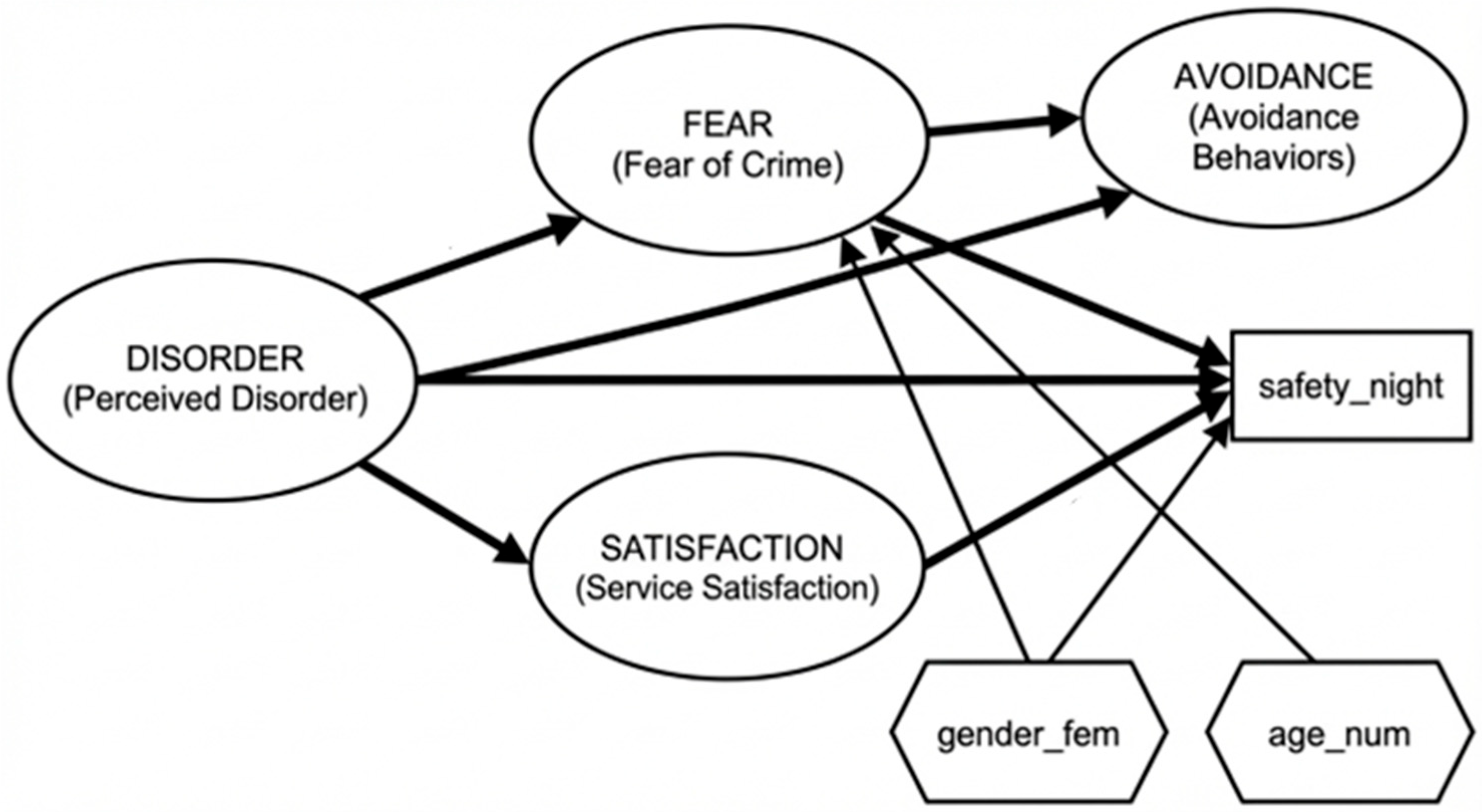
2.4.2. Structural Model
2.4.3. Model Evaluation
3. Results
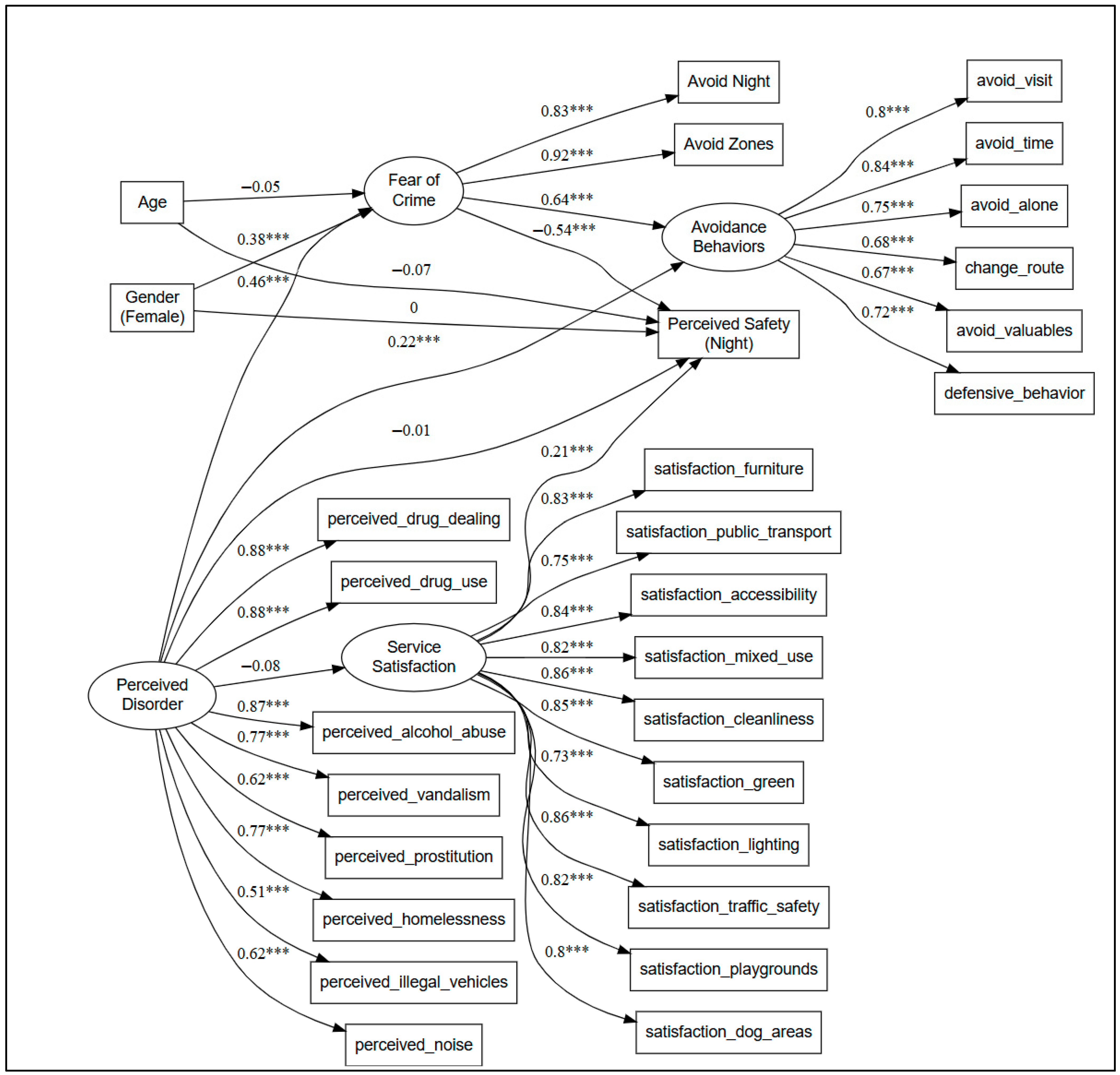
3.1. Measurement Model Assessment and Factor Analysis
3.2. Structural Relationships and Drivers of Safety
4. Discussion
4.1. Theoretical Insights: The Mediation of Fear and the Hierarchy of Disorder
4.2. Environmental Buffers and Demographic Determinants
4.3. Macro-Level Challenges in Urban Park Design and Safety Perception
4.4. Limitations and Future Research Directions
4.5. Policy Implications: From Data to Park Management
- Prioritizing Interventions: Insights from User Perception. The hierarchy of perceptions revealed by the CFA dictates a clear and evidence-based prioritization of resources. First, the dominance of social incivilities (drug dealing, ) over physical ones implies that strategies focused solely on purely cosmetic or surface-level interventions—such as removing graffiti—will be insufficient if the social environment remains unpredictable and weakly regulated. Park management must therefore prioritize active social control mechanisms and “soft” interventions (e.g., cultural programming, supervised activities, increased legitimate presence) aimed at re-establishing normative uses of space and displacing illicit practices. Second, the finding that Fear of Crime is predominantly spatial () suggests that insecurity is anchored to specific and recurrent “hotspots” rather than being a diffuse atmospheric condition. Consequently, security policies should adopt a targeted, place-based approach, concentrating resources on these nodes through localized CPTED interventions (e.g., adaptive lighting, pruning undergrowth, improving sightlines) rather than dispersing resources uniformly across the park. Such spatial precision increases both the efficiency and the perceptual impact of interventions.
- Breaking the “Fear Loop”: Insights from Structural Pathways. The structural relationships identified by the SEM provide critical guidance on how and why these interventions should be implemented. The observed “cascade effect”, whereby disorder triggers avoidance almost exclusively through fear, and the finding of full mediation, have direct operational implications. Since disorder does not degrade safety perception directly but only when it successfully instills fear, urban design and management strategies must prioritize emotional reassurance alongside physical remediation.
- It is therefore insufficient to simply remove signs of disorder; interventions must be visible, legible, and socially communicative in order to effectively lower users’ anxiety thresholds. For instance, replacing a broken fence (reducing physical disorder) may have less impact on perceived safety than improving visual permeability, enhancing escape routes, or installing emergency call stations, which directly address the fear-generating properties of space.
- Maintenance as an Active Security Strategy. The structural model identifies Service Satisfaction as a crucial opposing force to fear (), empirically validating the concept of “Care as Control”. High-quality maintenance is interpreted by users not merely as aesthetic enhancement, but as a signal of guardianship, institutional presence, and ongoing oversight. For park administrators, this elevates routine operations—such as waste removal, greenery management, lighting upkeep and transport accessibility—from background maintenance tasks to strategic components of urban safety policy. Investing in the functionality, cleanliness, and usability of the park is therefore not ancillary to security objectives; rather, it constitutes a preventive strategy capable of buffering the negative psychological effects of environmental and social stressors.
- Gender-Responsive Planning. The analysis of demographic controls highlights the necessity of gender-sensitive urban planning. The finding that the gender gap in safety perception is entirely mediated by fear suggests that women are not assessing risk differently from men, but are more strongly affected by environmental fear triggers. Planning interventions should therefore explicitly address these triggers—such as poor lighting, entrapment spots, visual obstructions and limited escape routes—to democratize access and use of the park across genders. Reducing these specific stressors represents a structurally effective way to narrow gender disparities in perceived safety, without resorting to paternalistic or exclusionary design solutions.
- Methodological Scalability. Beyond the local context, this research demonstrates the value of a rigorous, data-driven analytical workflow for urban governance. The pipeline employed here—structured survey CFA validation SEM causal testing—constitutes a scalable diagnostic framework for identifying the psychological mechanisms that link space, behavior, and perception. Unlike traditional descriptive surveys, this approach enables administrators to move beyond anecdotal evidence, pinpointing the specific environmental and social levers that drive avoidance and insecurity. As such, the proposed protocol offers a transferable model for “evidence-based urban design” and park management, allowing cities to tailor regeneration and governance strategies to the verified socio-psychological dynamics of their users, rather than relying on generalized or reactive security measures.
4.6. Policy Priorities Box—Evidence-Based Actions for Urban Park Governance
- Priority 1—Address social disorder as the primary driver of fear of crime: The most effective strategy to reduce fear and improve perceived safety is the credible and sustained reduction in social disorder, particularly drug dealing, drug use, and predatory behaviors. Given their dominant role in the disorder construct and their indirect but decisive effect on perceived safety through fear, these phenomena must be treated as core urban safety and planning issues rather than marginal social problems [7,41,48,49]. Crucially, however, addressing these issues requires profound ethical care. Urban governance must clearly distinguish between behaviors that objectively threaten safety (e.g., predatory crimes and aggressive drug dealing) and the mere presence of marginalized individuals (e.g., homelessness). Interventions must strictly target illicit activities without resorting to the social and spatial exclusion of vulnerable populations. Policies should avoid zero-tolerance policing that criminalizes poverty, focusing instead on integrated approaches that combine safety enforcement with social welfare and public health services.
- Priority 2—Place-based enforcement targeting fear hotspots: Fear and avoidance are spatially concentrated. Governance actions should therefore focus on specific zones and time periods perceived by users as unsafe, through targeted patrols, coordinated police presence, and repeated interventions that disrupt illicit routines rather than diffuse or symbolic control [50,51].
- Priority 3—Integrated governance: enforcement, management, and welfare: Reducing social disorder requires a coordinated approach combining law enforcement, continuous park management and guardianship, and social and health services, in order to address underlying vulnerabilities and avoid simple spatial displacement of the problem [48,50,52].
- Priority 4—Reduce opportunities for illicit activities through design and management: Urban design and park management should actively reduce the ease and invisibility of illegal activities by improving sightlines, limiting concealment, managing access points, and ensuring the legibility and supervision of pathways and nodes [6,53,54].
- Priority 5—Re-establish legitimate activities as a mechanism of social control: The provision of supervised cultural, recreational, and sporting activities—especially during late afternoon and evening hours—helps restore legitimate use of space, strengthens informal social control, and counteracts fear-driven avoidance [11,41,55].
5. Conclusions
Supplementary Materials
Author Contributions
Funding
Institutional Review Board Statement
Informed Consent Statement
Data Availability Statement
Acknowledgments
Conflicts of Interest
Abbreviations
| AVE | Average Variance Extracted |
| CAWI | Computer-Assisted Web Interviewing |
| CFA | Confirmatory Factor Analysis |
| CFI | Comparative Fit Index |
| CR | Composite Reliability |
| CPTED | Crime Prevention Through Environmental Design |
| DWLS | Diagonally Weighted Least Squares |
| GDPR | General Data Protection Regulation |
| PGIS | Participatory Geographic Information Systems |
| PLS-SEM | Partial Least Squares Structural Equation Modeling |
| RMSEA | Root Mean Square Error of Approximation |
| SEM | Structural Equation Modeling |
| SRMR | Standardized Root Mean Square Residual |
| TLI | Tucker–Lewis Index |
| WLSMV | Weighted Least Squares Mean and Variance Adjusted |
References
- Maruthaveeran, S.; van den Bosch, C.C. A Socio-Ecological Exploration of Fear of Crime in Urban Green Spaces: A Systematic Review. Urban For. Urban Green. 2014, 13, 1–18. [Google Scholar]
- Jacobs, J. The Death and Life of Great American Cities; Random House: New York, NY, USA, 1961. [Google Scholar]
- Loukaitou-Sideris, A. Hot Spots of Bus Stop Crime: The Importance of Environmental Attributes. J. Am. Plan. Assoc. 2007, 65, 395–411. [Google Scholar] [CrossRef]
- Pain, R. Place, Social Relations and the Fear of Crime: A Review. Prog. Hum. Geogr. 2000, 24, 365–387. [Google Scholar] [CrossRef]
- Navarrete-Hernandez, P.; Luneke, A.; Truffello, R.; Fuentes, L. Planning for Fear of Crime Reduction: Assessing the Impact of Public Space Regeneration on Safety Perceptions in Deprived Neighborhoods. Landsc. Urban Plan. 2023, 237, 104809. [Google Scholar] [CrossRef]
- Nasar, J.L.; Fisher, B.; Grannis, M. Proximate Physical Cues to Fear of Crime. Landsc. Urban Plan. 1993, 26, 161–178. [Google Scholar] [CrossRef]
- Skogan, W.G. Disorder and Decline: Crime and the Spiral of Decay in American Neighborhoods; Sage Communications in Society; University of California Press: Oakland, CA, USA, 1990. [Google Scholar]
- Ceccato, V.; Uittenbogaard, A.C. Space–Time Dynamics of Crime in Transport Nodes. Ann. Assoc. Am. Geogr. 2014, 104, 131–150. [Google Scholar] [CrossRef]
- Camacho Doyle, M.; Gerell, M.; Andershed, H. Perceived Unsafety and Fear of Crime: The Role of Violent and Property Crime, Neighborhood Characteristics, and Prior Perceived Unsafety and Fear of Crime. Deviant Behav. 2022, 43, 1347–1365. [Google Scholar] [CrossRef]
- Sampson, R.J.; Raudenbush, S.W. Systematic Social Observation of Public Spaces: A New Look at Disorder in Urban Neighborhoods. Am. J. Sociol. 1999, 105, 603–651. [Google Scholar] [CrossRef]
- Chen, X.; Marzbali, M.H. How Urban Park Features Impact Perceived Safety by Considering the Role of Time Spent in the Park, Gender, and Parental Status. Cities 2024, 153, 105272. [Google Scholar] [CrossRef]
- Bogar, S.; Beyer, K.M. Green space, violence, and crime: A systematic review. Trauma Violence Abus. 2016, 17, 160–171. [Google Scholar] [CrossRef]
- Kahila-Tani, M.; Broberg, A.; Kyttä, M.; Tyger, T. Let the Citizens Map—Public Participation GIS as a Planning Support System in the Helsinki Master Plan Process. Plan. Pract. Res. 2016, 31, 195–214. [Google Scholar] [CrossRef]
- Kahila-Tani, M.; Kytta, M.; Geertman, S. Does Mapping Improve Public Participation? Exploring the Pros and Cons of Using Public Participation GIS in Urban Planning Practices. Landsc. Urban Plan. 2019, 186, 45–55. [Google Scholar] [CrossRef]
- Perkins, D.D.; Florin, P.; Rich, R.C.; Wandersman, A.; Chavis, D.M. Participation and the Social and Physical Environment of Residential Blocks: Crime and Community Context. Am. J. Community Psychol. 1990, 18, 83–115. [Google Scholar] [CrossRef]
- Newman, O. Defensible Space: Crime Prevention Through Urban Design; Macmillan Publishing: New York, NY, USA, 1973. [Google Scholar]
- Iqbal, A.; Ceccato, V. Is CPTED Useful to Guide the Inventory of Safety in Parks? A Study Case in Stockholm, Sweden. Int. Crim. Justice Rev. 2016, 26, 150–168. [Google Scholar] [CrossRef]
- Mak, B.K.L.; Jim, C.Y. Examining Fear-Evoking Factors in Urban Parks in Hong Kong. Landsc. Urban Plan. 2018, 171, 42–56. [Google Scholar] [CrossRef]
- Jorgensen, A.; Hitchmough, J.; Calvert, T. Woodland Spaces and Edges: Their Impact on Perception of Safety and Preference. Landsc. Urban Plan. 2002, 60, 135–150. [Google Scholar] [CrossRef]
- Chen, X.; Hedayati Marzbali, M.; Armitage, R. Perceived Safety in Urban Parks: CPTED, Place Attachment and the COVID-19 Paradigm. Environ. Dev. Sustain. 2025, 1–26. [Google Scholar] [CrossRef]
- Mansouri Kermani, Z.; Pazhouhanfar, M.; Mustafa Kamal, M.S. Role of Esthetic Judgment on Perceived Safety of Urban Parks’ Users. Secur. J. 2022, 35, 1263–1287. [Google Scholar] [CrossRef]
- Türkseven Doğrusoy, I.; Zengel, R. Analysis of Perceived Safety in Urban Parks: A Field Study in Büyükpark and Hasanağa Park. METU J. Fac. Archit. 2017, 34, 63–84. [Google Scholar] [CrossRef]
- Pérez-Tejera, F.; Anguera, M.T.; Guàrdia-Olmos, J.; Dalmau-Bueno, A.; Valera, S. Examining Perceived Safety and Park Use in Public Open Spaces: The Case of Barcelona. J. Environ. Psychol. 2022, 81, 101823. [Google Scholar] [CrossRef]
- Dillman, D.A.; Smyth, J.D.; Christian, L.M. Internet, Phone, Mail, and Mixed-Mode Surveys: The Tailored Design Method, 4th ed.; John Wiley & Sons, Inc.: Hoboken, NJ, USA, 2014. [Google Scholar]
- Couper, M.P. Web Surveys: A Review of Issues and Approaches. Public Opin. Q. 2000, 64, 464–494. [Google Scholar] [CrossRef]
- Wilson, J.Q.; Kelling, G.L. Broken Windows: The Police and Neighborhood Safety. Atl. Mon. 1982, 249, 29–38. [Google Scholar]
- Sampson, R.J.; Raudenbush, S.W. Seeing Disorder: Neighborhood Stigma and the Social Construction of “Broken Windows”. Soc. Psychol. Q. 2004, 67, 319–342. [Google Scholar] [CrossRef]
- Harcourt, B.E. Illusion of Order: The False Promise of Broken Windows Policing/Bernard E. Harcourt; Harvard University Press: Cambridge, MA, USA, 2001. [Google Scholar]
- Ferraro, K.F. Fear of Crime: Interpreting Victimization Risk; SUNY Press: New York, NY, USA, 1995. [Google Scholar]
- Ferraro, K.F.; Grange, R.L. The Measurement of Fear of Crime*. Sociol. Inq. 1987, 57, 70–97. [Google Scholar] [CrossRef]
- Farrall, S.D.; Jackson, J.; Gray, E. Social Order and the Fear of Crime in Contemporary Times; Oxford University Press: Oxford, UK, 2009. [Google Scholar]
- Chiesura, A. The Role of Urban Parks for the Sustainable City. Landsc. Urban Plan. 2004, 68, 129–138. [Google Scholar] [CrossRef]
- Lorenc, T.; Petticrew, M.; Whitehead, M.; Neary, D.; Clayton, S.; Wright, K.; Thomson, H.; Cummins, S.; Sowden, A.; Renton, A. Fear of Crime and the Environment: Systematic Review of UK Qualitative Evidence. BMC Public Health 2013, 13, 496. [Google Scholar] [CrossRef]
- The R Core Team. R: A Language and Environment for Statistical Computing 2024. Available online: https://cran.rstudio.com/manuals.html (accessed on 13 January 2026).
- Rosseel, Y. Lavaan: An R Package for Structural Equation Modeling. J. Stat. Softw. 2012, 48, 1–36. [Google Scholar] [CrossRef]
- Li, C.-H. Confirmatory Factor Analysis with Ordinal Data: Comparing Robust Maximum Likelihood and Diagonally Weighted Least Squares. Behav. Res. Methods 2016, 48, 936–949. [Google Scholar] [CrossRef] [PubMed]
- Hu, L.T.; Bentler, P.M. Cutoff Criteria for Fit Indexes in Covariance Structure Analysis: Conventional Criteria versus New Alternatives. Struct. Equ. Model. 2009, 6, 1–55. [Google Scholar] [CrossRef]
- Fornell, C.; Larcker, D.F. Evaluating Structural Equation Models with Unobservable Variables and Measurement Error. J. Mark. Res. 1981, 18, 39–50. [Google Scholar] [CrossRef]
- Hair, J.F.; Black, W.C.; Babin, B.J.; Anderson, R.E. Multivariate Data Analysis, 5th ed.; Cengage Learning: Boston, MA, USA, 2022. [Google Scholar]
- Taylor, R.B. Breaking Away from Broken Windows: Baltimore Neighborhoods and the Transformation of the Urban Grime, Crime, Fear, and Decline Debate; Westview Press: Boulder, CO, USA, 2001. [Google Scholar]
- LaGrange, R.L.; Ferraro, K.F.; Supancic, M. Perceived Risk and Fear of Crime: Role of Social and Physical Incivilities. J. Res. Crime Delinq. 1992, 29, 311–334. [Google Scholar] [CrossRef]
- Sherman, L.W.; Gartin, P.R.; Buerger, M.E. Hot Spots of Predatory Crime: Routine Activities and the Criminology of Place. Criminology 1989, 27, 27–55. [Google Scholar] [CrossRef]
- Cozens, P.M.; Saville, G.; Hillier, D. Crime Prevention through Environmental Design (CPTED): A Review and Modern Bibliography. Prop. Manag. 2005, 23, 328–356. [Google Scholar] [CrossRef]
- Warr, M. Fear of Rape among Urban Women. Soc. Probl. 1985, 32, 238–250. [Google Scholar] [CrossRef]
- El-Metwally, Y.; Elshater, A.; Fahmy, M.; Elrahman, A.S.A.; AlWaer, H.; Elbardisy, W.M. Assessing the Impact of Urban Parks across Köppen Climatic Zones: A Systematic Review. Proc. Inst. Civ. Eng. Urban Des. Plan. 2025, 178, 6–20. [Google Scholar] [CrossRef]
- Sivakumar, T.; Raveendran, T.; Jayathilaka, R.; Wickramaarachchi, C.; Jayasuriya, N. Economic Growth, Poverty and Female Employment on Crime Rates at Global Level. Crime Law Soc. Change 2026, 84, 5. [Google Scholar] [CrossRef]
- Endalamaw, T.B.; Girma, G.; Darr, B. Visitor Preferences and Willingness to Pay for Urban Recreation: The Case of Entoto Recreational Park in Addis Ababa, Ethiopia. Discov. Sustain. 2026, 7, 121. [Google Scholar] [CrossRef]
- Braga, A.A.; Schnell, C.; Welsh, B.C. Welsh Disorder Policing to Reduce Crime: An Updated Systematic Review. Criminol. Public Policy 2024, 23, 745–775. [Google Scholar] [CrossRef]
- Gobaud, A.N.; Jacobowitz, A.L.; Mehranbod, C.A.; Sprague, N.L.; Branas, C.C.; Morrison, C.N. Place-Based Interventions and the Epidemiology of Violence Prevention. Curr. Epidemiol. Rep. 2022, 9, 316–325. [Google Scholar] [CrossRef] [PubMed]
- Braga, A.A.; Weisburd, D. The Effects of Focused Deterrence Strategies on Crime: A Systematic Review and Meta-Analysis. J. Res. Crime Delinq. 2012, 49, 323–358. [Google Scholar] [CrossRef]
- Turchan, B.; Braga, A. The Effects of Hot Spots Policing on Violence: A Systematic Review and Meta-Analysis. Aggress. Violent Behav. 2024, 79, 102011. [Google Scholar] [CrossRef]
- Ferraro, K.F. Women’s Fear of Victimization: Shadow of Sexual Assault? Soc. Forces 1996, 75, 667–690. [Google Scholar] [CrossRef]
- Egea-Cariñanos, P.; Calaza-Martínez, P.; Roche Daniel, L.; Cariñanos, P. Uses, Attitudes and Perceptions of Urban Green Spaces According to the Sociodemographic Profile: An Exploratory Analysis in Spain. Cities 2024, 150, 104996. [Google Scholar] [CrossRef]
- Cecere, L.; Grimaldi, M.; Lorusso, A.; Marra, A.; Stoia, F. Immersive Urban Planning: Evaluating Park Safety Perception with Digital Twins and Metaverse Simulation. Sustainability 2025, 17, 7608. [Google Scholar] [CrossRef]
- Pain, R. Social Geographies of Women’s Fear of Crime. Trans. Inst. Br. Geogr. 1997, 22, 231–244. [Google Scholar]



| Latent Construct | Indicator | Std. Loading (λ) | CR | AVE |
|---|---|---|---|---|
| Perceived Disorder | Drug Dealing | 0.88 | 0.910 | 0.565 |
| Drug Use | 0.88 | |||
| Alcohol Abuse | 0.87 | |||
| Vandalism | 0.77 | |||
| Prostitution | 0.62 | |||
| Homelessness | 0.77 | |||
| Illegal Vehicles | 0.51 | |||
| Noise | 0.62 | |||
| Fear of Crime | Avoid Zones | 0.92 | 0.870 | 0.770 |
| Avoid Night | 0.83 | |||
| Avoidance Behaviors | Avoid Visit | 0.80 | 0.882 | 0.557 |
| Avoid Time | 0.84 | |||
| Avoid Alone | 0.75 | |||
| Change Route | 0.68 | |||
| Avoid Valuables | 0.67 | |||
| Defensive Behavior | 0.72 | |||
| Service Satisfaction | Cleanliness | 0.86 | 0.954 | 0.675 |
| Greenery | 0.85 | |||
| Lighting | 0.73 | |||
| Traffic Safety | 0.86 | |||
| Playgrounds | 0.82 | |||
| Dog Areas | 0.80 | |||
| Furniture | 0.83 | |||
| Public Transport | 0.75 | |||
| Accessibility | 0.84 | |||
| Mixed Use | 0.82 |
| Path (Outcome ← Predictor) | β (Std.) | S.E. | z-Value | p-Value | Result |
|---|---|---|---|---|---|
| Fear of Crime | |||||
| ← Perceived Disorder | |||||
| ← Gender (Female) | 0.462 | 0.083 | 6.899 | <0.001 | Supported |
| Avoidance Behaviors | 0.378 | 0.151 | 6.268 | <0.001 | Sig. |
| ← Fear of Crime | |||||
| ← Perceived Disorder | 0.635 | 0.113 | 6.915 | <0.001 | Supported |
| Nighttime Safety | 0.216 | 0.082 | 4.073 | <0.001 | Supported |
| ← Fear of Crime | |||||
| ← Service Satisfaction | −0.536 | 0.078 | −10.831 | <0.001 | Supported |
| ← Perceived Disorder | 0.213 | 0.061 | 6.850 | <0.001 | Supported |
Disclaimer/Publisher’s Note: The statements, opinions and data contained in all publications are solely those of the individual author(s) and contributor(s) and not of MDPI and/or the editor(s). MDPI and/or the editor(s) disclaim responsibility for any injury to people or property resulting from any ideas, methods, instructions or products referred to in the content. |
© 2026 by the authors. Licensee MDPI, Basel, Switzerland. This article is an open access article distributed under the terms and conditions of the Creative Commons Attribution (CC BY) license.
Share and Cite
Fagarazzi, C.; Andaloro, M.; Cappelli, G.; Marini, N.; Olimpi, F.; Bernetti, I. Perceived Disorder, Fear of Crime, and Safety in Urban Parks: A Structural Equation Modeling Study from a Large Metropolitan Green Area in Florence, Italy. Urban Sci. 2026, 10, 170. https://doi.org/10.3390/urbansci10030170
Fagarazzi C, Andaloro M, Cappelli G, Marini N, Olimpi F, Bernetti I. Perceived Disorder, Fear of Crime, and Safety in Urban Parks: A Structural Equation Modeling Study from a Large Metropolitan Green Area in Florence, Italy. Urban Science. 2026; 10(3):170. https://doi.org/10.3390/urbansci10030170
Chicago/Turabian StyleFagarazzi, Claudio, Matteo Andaloro, Giacomo Cappelli, Nicola Marini, Federico Olimpi, and Iacopo Bernetti. 2026. "Perceived Disorder, Fear of Crime, and Safety in Urban Parks: A Structural Equation Modeling Study from a Large Metropolitan Green Area in Florence, Italy" Urban Science 10, no. 3: 170. https://doi.org/10.3390/urbansci10030170
APA StyleFagarazzi, C., Andaloro, M., Cappelli, G., Marini, N., Olimpi, F., & Bernetti, I. (2026). Perceived Disorder, Fear of Crime, and Safety in Urban Parks: A Structural Equation Modeling Study from a Large Metropolitan Green Area in Florence, Italy. Urban Science, 10(3), 170. https://doi.org/10.3390/urbansci10030170