1. Introduction
Intra-urban commuting is a fundamental process through which urban spatial structure is produced and reproduced. Daily commuting flows connect residential and employment locations, shape patterns of accessibility and socio-spatial inequality, and reflect broader economic and institutional arrangements within cities. In rapidly expanding and increasingly polycentric metropolitan areas [
1], commuting flows are no longer confined to simple centre-periphery patterns [
2] but form complex and interdependent systems of spatial interaction [
3]. According to the 2025 China Major Cities Commuting Monitoring Report, between 2020 and 2024, the average commuting radius in 45 major Chinese cities expanded by 1 to 3 km. And the proportion of extreme commuters (one-way travel time > 60 min) increased by 1 to 2 percentage points. In Hangzhou, the average one-way commuting time reached 34 min in 2024, with 11% of commuters experiencing extreme commutes. These trends highlight a growing spatial mismatch between affordable housing and employment opportunities. Understanding how these intra-urban commuting flows are formed is therefore critical for interpreting contemporary urban structure and for informing sustainable urban planning.
A substantial body of research has examined intra-urban commuting through the lens of job-housing relationship and spatial interaction. Classical approaches emphasize the role of distance decay and nodal attributes, typically employing gravity-type models or regression frameworks to explain commuting intensity between urban zones [
4]. While these approaches have generated important insights, they implicitly assume that commuting flows are conditionally independent observations shaped primarily by local attributes and spatial friction. This assumption becomes increasingly problematic in polycentric cities, where commuting flows are embedded within a dense web of interdependent interactions and where similar distances may correspond to markedly different commuting patterns [
5].
Two key analytical gaps remain. First, existing studies rarely account explicitly for endogenous network dependence in intra-urban commuting. Commuting flows collectively constitute a networked system [
6] in which ties are mutually conditioned, yet most empirical analyses treat each origin-destination flow as an isolated outcome. As a result, self-organising features [
7] such as reciprocity or mutual exchange between urban areas are often overlooked. Second, although institutional and social contexts are widely acknowledged as relevant to urban mobility [
8], they are seldom integrated into a unified analytical framework alongside nodal job-housing attributes and spatial proximity. Consequently, prevailing models struggle to capture the relational and embedded nature of commuting flows within urban systems.
Recent advances in urban network research provide an opportunity to address these limitations. Conceptualising cities as networks of flows rather than collections of discrete zones highlights commuting as a relational process shaped by interdependence among places [
9,
10]. Within this perspective, exponential random graph models (ERGMs) offer a powerful methodological framework for analysing network formation [
11,
12]. Unlike conventional regression or gravity models, ERGMs treat the observed network as the outcome of a stochastic generative process, enabling the simultaneous modeling of endogenous network structure, nodal attributes, and exogenous relational effects [
13]. In particular, valued exponential random graph models (valued ERGMs) allow weighted commuting flows to be modelled directly, preserving information on interaction intensity that is often lost when flows are reduced to binary ties [
14]. This capability is especially important for intra-urban commuting networks, which typically exhibit extreme heterogeneity and over-dispersion.
At the same time, the framework of multi-dimensional proximity [
15] extends the explanation of spatial interaction beyond geographic distance to include institutional and social relations. It argues that various forms of closeness between actors critically influence their ability to interact. However, this framework has rarely been systematically incorporated into analyses of intra-urban commuting. Integrating this perspective with a network-based modelling approach offers a promising avenue for advancing a relational understanding of urban mobility.
This study addresses these gaps by proposing an integrated analytical framework that conceptualises intra-urban commuting flows as the outcome of three interacting forces: endogenous network self-organization, nodal job-housing attributes, and exogenous multi-dimensional proximity. Empirically, we examine the case of Hangzhou, China. Hangzhou provides a theoretically informative context due to its rapid polycentric expansion, extensive metro development, and strong administrative governance, which together shape complex patterns of daily mobility.
Using anonymised mobile phone signalling data, we construct a weighted and directed subdistrict-level commuting network and apply a valued exponential random graph model (valued ERGM) to investigate its formation mechanisms. The study addresses two research questions: (1) What structural characteristics define the intra-urban commuting network? and (2) How do endogenous network effects, job-housing attributes, and different dimensions of proximity jointly shape the formation of commuting flows?
This paper makes two main contributions. First, it advances a relational explanation of intra-urban commuting by explicitly modeling network endogeneity and multi-dimensional proximity, moving beyond attribute-based and distance-centred accounts. Second, it demonstrates the methodological value of valued ERGMs for analysing weighted urban flow networks, highlighting their capacity to disentangle complex generative mechanisms underlying intra-urban mobility. Together, these contributions provide new insights into how everyday commuting is organised within large cities and offer implications for urban theory and planning practice.
2. Literature Review and Analytical Framework
2.1. From Job-Housing Attributes to Relational Commuting Flows
Classical migration theory highlights the role of distance decay and push-pull mechanisms in shaping population movements [
4]. This logic has strongly influenced subsequent empirical research on commuting. Within this tradition, commuting flows are typically analysed using gravity-type models or regression frameworks [
16,
17], in which the intensity of interaction between two urban areas is explained by their respective attributes, such as employment size or residential population, and the distance separating them.
Closely related to this perspective, urban economic theories conceptualise commuting as part of a spatial equilibrium resulting from households’ and firms’ location choices. Foundational models, including bid-rent theory and its extensions, explain urban spatial structure as the outcome of trade-offs between commuting costs, land rents, and agglomeration economies [
1,
2,
18,
19,
20]. Empirical studies grounded in this framework have examined how employment decentralisation, transport infrastructure, and labour market conditions influence commuting patterns and accessibility across urban space [
21,
22,
23].
While these attribute-based and distance-centred approaches have yielded important insights, they share a common analytical limitation. By treating commuting flows between urban zones as independent observations, they overlook the fact that commuting interactions collectively form a structured system. In polycentric cities in particular, commuting flows are interdependent: flows between one pair of areas may influence or reinforce flows elsewhere in the system. As a result, conventional regression-based frameworks are ill-equipped to capture endogenous dependence and self-organising features within commuting networks.
2.2. Commuting as a Networked and Relational Process
In response to these limitations, an emerging body of research has begun to conceptualise commuting as a relational phenomenon embedded within networks of spatial interaction. Influenced by the notion of the “space of flows” [
8] and developments in network science [
6,
24], this perspective views cities as constituted through flows of people, capital, and information rather than as collections of discrete spatial units [
25]. Within this framework, commuting flows are understood not merely as responses to nodal attributes or geographic distance, but as outcomes shaped by the interdependence among places.
Building on this relational view, a substantial and diverse literature has examined origin-destination (OD) flows using various analytical lenses. Three broad strands are particularly relevant. First, network science approaches have revealed the structural properties of commuting networks, including polycentric patterns, commuting communities, and functional regions that often transcend administrative boundaries [
26,
27,
28,
29]. These studies have substantially enriched our descriptive understanding of urban mobility and have convincingly demonstrated that commuting flows exhibit clear network characteristics, such as modularity, hierarchy, and heterogeneity. Second, studies employing data envelopment analysis (DEA) have evaluated the performance of public transport OD pairs [
30], assessing efficiency in terms of service quality and resource allocation. These analyses provide valuable benchmarks for transport operators but focus primarily on optimizing existing OD pairs rather than explaining why those pairs emerge in the first place. Third, research on the resilience of transportation networks [
31], has examined how OD flows reconfigure under disruptions such as natural disasters or infrastructure failures. While this work illuminates the adaptive capacity of urban mobility systems, its emphasis lies on network robustness and recovery rather than on the generative processes that produce observed flow patterns. Despite these important contributions, each body of literature leaves a critical gap unaddressed. While network science approaches describe network structure, DEA studies treat OD pairs as fixed units for efficiency evaluation, and resilience research focuses on flow responses to shocks. What remains underexplored across all three is the generative question: what relational mechanisms explain why specific OD pairs form and with what intensity?
Endogenous network dependencies, such as reciprocity, are rarely modelled explicitly. Moreover, institutional and social contexts are often treated as background conditions rather than as integral components of the analytical framework. Consequently, while we know that commuting flows are networked, we lack a systematic understanding of the processes that give rise to this networked structure.
These limitations point to the need for a more explicitly relational explanation of intra-urban commuting, one that integrates network dependence with nodal attributes and broader relational contexts. Addressing this need requires both a conceptual framework capable of articulating multiple interacting mechanisms and a methodological approach that can model network interdependence directly.
2.3. Multi-Dimensional Proximity and Intra-Urban Commuting
The concept of multi-dimensional proximity extends the analysis of spatial interaction beyond physical distance to incorporate relational dimensions that facilitate or constrain interaction [
15]. Originally developed in studies of innovation and economic networks, this framework highlights how different forms of proximity reduce coordination costs and shape interaction patterns [
32,
33]. Applied to intra-urban commuting, multi-dimensional proximity provides a useful lens for understanding why commuting flows may be more intense between certain urban areas than would be expected based on distance alone. At the intra-urban scale, several dimensions of proximity are particularly relevant.
Geographic proximity captures the fundamental effect of distance decay, consistent with the First Law of Geography [
34]. Physical separation continues to impose a strong constraint on daily mobility by shaping travel time, cost, and feasibility [
35]. In addition, public transit systems can mitigate spatial friction by expanding the effective commuting range and improving accessibility between locations [
36]. Together, these spatial dimensions define the physical constraints under which commuting occurs.
However, growing evidence suggests that spatial interaction within cities cannot be fully explained by spatial proximity alone. Commuting flows are embedded within broader institutional and social contexts that influence coordination, accessibility, and mobility choices [
37]. In cities characterised by strong administrative governance, such as those in China, administrative boundaries often function as de facto coordination units that influence human mobility [
38]. Commuting flows are therefore more likely to occur between areas embedded within the same institutional framework, even when geographic distance is held constant. Social proximity further conditions commuting flows through overlapping daily activity spaces and habitual interaction patterns [
39]. Areas connected by frequent non-work trips, such as shopping, leisure, or social visits, may exhibit stronger commuting ties due to familiarity, information exchange, and shared routines. These social interactions lower behavioural and informational barriers to commuting and reinforce functional linkages between places. Finally, economic proximity, reflected in inter-firm investment or production linkages, may align human mobility across space [
40]. While such linkages are more commonly examined at inter-city or regional scales, they may also influence commuting flows within metropolitan areas by structuring employment opportunities and labor-market integration across urban subareas.
Taken together, these dimensions suggest that intra-urban commuting is shaped by a combination of spatial constraints and relational embeddedness. Rather than operating independently, different forms of proximity interact to condition commuting flows within urban systems. Integrating multi-dimensional proximity into a network-based modeling framework allows these relational effects to be examined systematically alongside nodal job-housing attributes and endogenous network structure.
2.4. The Analytical Framework
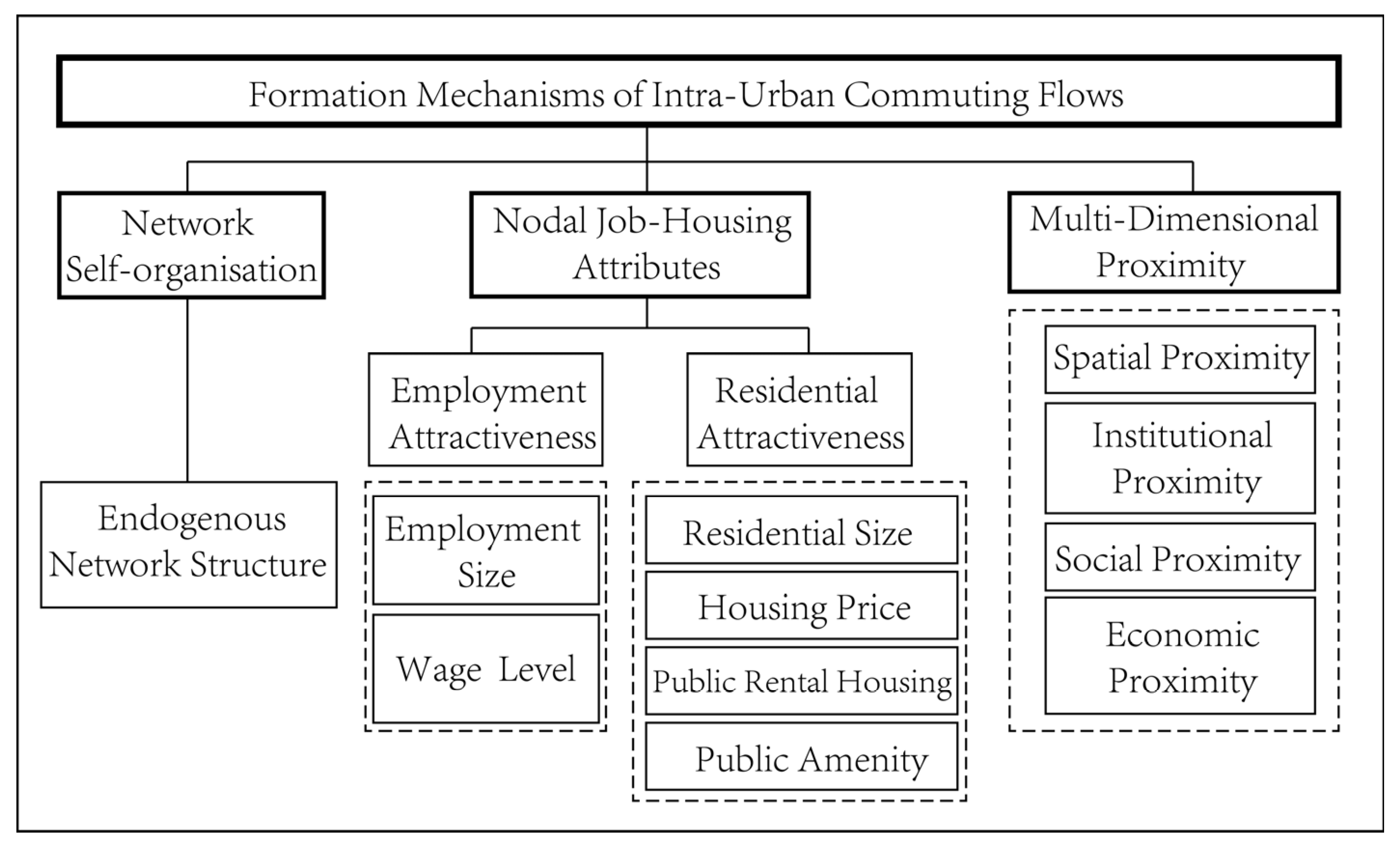
Building on this relational perspective, we propose an integrated analytical framework to explain intra-urban commuting flows. Moving beyond the treatment of commuting as independent origin-destination movements, we conceptualize these flows as an interdependent urban network. This network arises from the interplay of three forces: (1) network self-organization, (2) nodal job-housing attributes, and (3) exogenous multi-dimensional proximity. The conceptual structure is summarized in
Figure 1.
Intra-urban commuting networks exhibit self-organising characteristics that arise from repeated interactions among urban areas. Such characteristics reflect endogenous dependence, whereby the existence and intensity of a commuting flow between two areas may be conditioned by other flows in the network. One fundamental manifestation of this self-organization is reciprocity, capturing the tendency for commuting flows between two areas to be mutually reinforced. Reciprocal commuting may emerge from overlapping labor markets and distributed employment opportunities, and reflects bidirectional functional linkages rather than one-way dependency. Sattinger [
41] formalized the notion of overlapping labor markets, demonstrating that labor markets are structured as overlapping rather than discrete entities. In a spatial context, this overlap manifests as multiple areas sharing a common labor supply-demand pool through commuting networks [
42]. When residents of area A can commute to jobs in area B, and simultaneously residents of area B can commute to jobs in area A, i.e., reciprocal commuting ties, emerge as a necessary outcome. Thus, reciprocity is not merely an endogenous network statistic but a theoretically anticipated property of integrated urban labor markets characterized by overlapping structures. Accounting for such endogenous structure is essential for understanding commuting networks, as ignoring interdependence risks misattributing network effects to nodal attributes or spatial proximity.
Commuting flows are also shaped by the classic push-pull dynamics embedded in job-housing relationships. Within the proposed framework, these dynamics are captured through nodal attributes that influence the propensity of urban areas to generate outgoing commuting flows or to attract incoming flows. On the employment side, areas with stronger employment attractiveness, reflected in the concentration of job opportunities and wage levels, are expected to attract larger inflows of commuters. On the residential side, areas with greater residential attractiveness may generate more outbound commuting. Importantly, residential attractiveness extends beyond residential population size to include housing costs and access to public amenities. Theoretically, housing costs and residential amenities operate through distinct mechanisms. Higher housing prices are expected to reduce outbound commuting by making areas less affordable as residential locations, while public rental housing provision, by offering affordable options that enable lower-income, cost-sensitive residents to access employment opportunities across the city, may anchor commuting flows. Both mechanisms are consistent with standard residential location theory. The role of public amenities (e.g., healthcare, education, parks) is more complex. On the one hand, better-serviced areas attract more residents, which tends to increase outbound commuting as these residents seek employment opportunities across the city. On the other hand, for areas that already have a substantial employment base, high-quality amenities may attract workers from elsewhere to live locally, thereby internalizing what would otherwise be inter-subdistrict commutes into intra-subdistrict commutes and reducing observed cross-subdistrict flows. The net association between amenities and outbound commuting is therefore an empirical question, depending on the relative strength of these two opposing forces.
Beyond nodal attributes, commuting flows are embedded within a broader relational environment defined by multiple forms of proximity. Spatial proximity remains a fundamental constraint through distance decay, reflecting the physical costs of daily travel. Spatial connectivity through metro systems, in particular, can partially offset this constraint by expanding feasible commuting ranges and enhancing accessibility. At the same time, institutional proximity, social proximity and economic proximity represent non-spatial relational contexts that condition commuting interactions. Shared administrative jurisdictions may facilitate commuting by reducing institutional barriers, aligning public services, and enhancing policy coordination across urban areas. Social proximity, reflected in overlapping daily activity spaces and frequent non-work interactions, may further reinforce commuting ties by lowering informational and behavioural barriers. Economic proximity, reflected in inter-firm investment or production linkages, may align labor demand and supply across space. These proximity relations influence the likelihood and intensity of commuting flows in ways that are not reducible to geographic distance alone.
Taken together, the proposed framework emphasizes that intra-urban commuting flows are generated through the interaction of endogenous network dependence, nodal job-housing attributes, and multi-dimensional proximity. These mechanisms operate simultaneously rather than independently, shaping commuting patterns as relational outcomes embedded within urban systems. This integrated perspective has direct methodological implications. Analysing commuting flows requires an approach capable of modeling interdependence among flows while incorporating nodal attributes and dyadic relational effects. Valued ERGMs are particularly suited to this task, as they allow weighted and directed commuting flows to be modelled as outcomes of a stochastic network formation process. By jointly estimating endogenous network structure, nodal covariates, and exogenous proximity effects, the valued ERGM provides a coherent statistical framework for empirically testing the proposed analytical framework.
3. Materials and Methods
3.1. The Study Area
This study focuses on Hangzhou, a rapidly expanding Chinese city characterised by strong administrative governance, extensive metro development, and an increasingly polycentric spatial structure. With an urbanization rate of 85% in 2024 (compared to the national average of 67%), a metro network length of 516 km (ranking among the top five in China), and GDP per capita 1.8 times the national average, Hangzhou represents a developed coastal metropolis. These features make Hangzhou a theoretically informative case for examining the formation mechanisms of intra-urban commuting networks under conditions of rapid urban transformation.
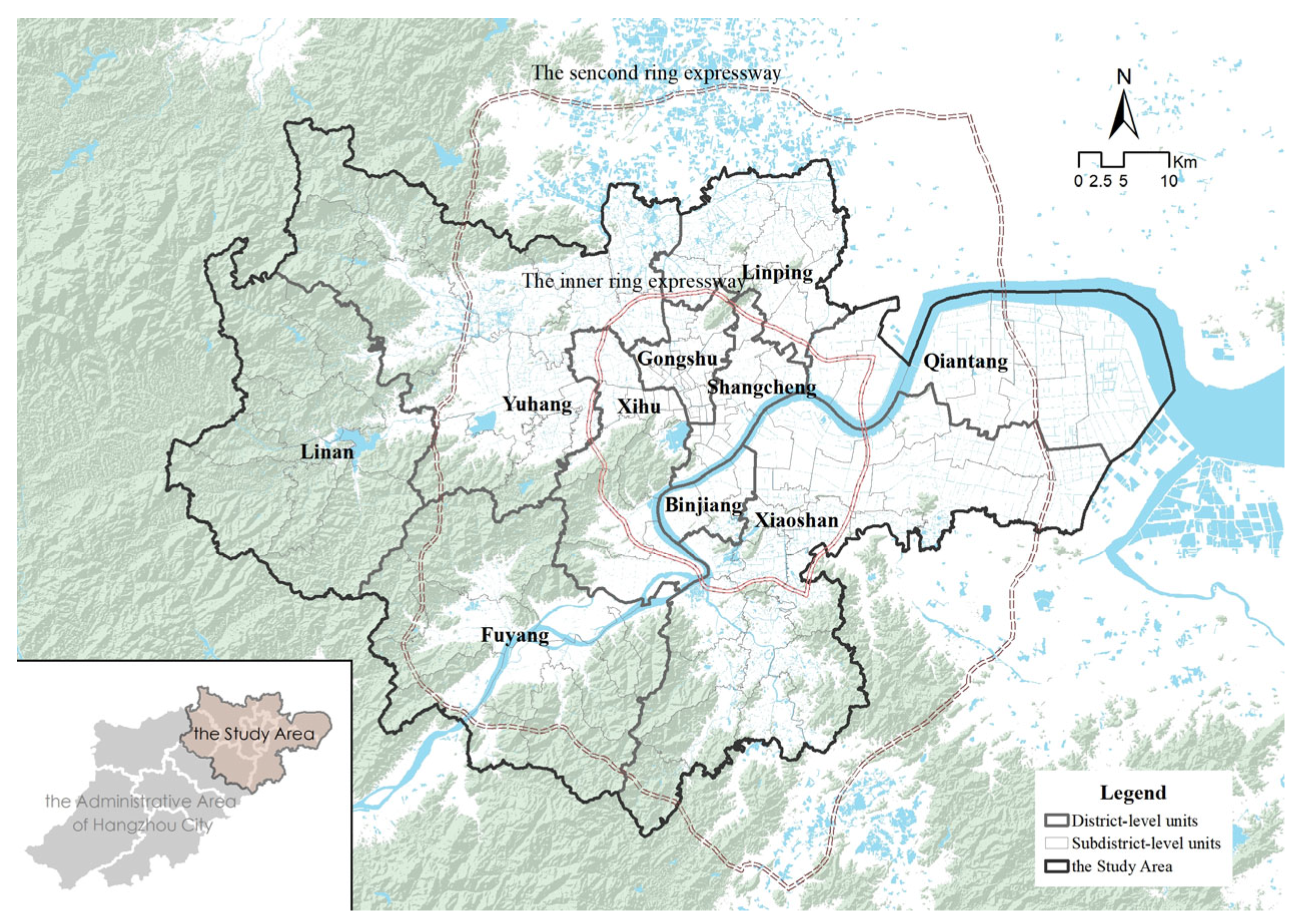
The analysis is conducted at the subdistrict level—the finest administrative unit with consistent demographic, housing, and public service data. Subdistricts also function as meaningful spatial units in residents’ daily activities and policy implementation, making them suitable for analysing commuting interactions. Using subdistricts as nodes allows the commuting network to capture fine-grained spatial variation while maintaining analytical tractability. The study area comprises 116 subdistricts across ten municipal districts (
Figure 2).
3.2. Construction of the Intra-Urban Commuting Network
An intra-urban commuting network is constructed using anonymised mobile phone signalling data, which record users’ locations based on interactions with cellular base stations. Individual home and work locations are identified based on repeated nighttime and daytime stay patterns over a one-month period in April 2021. Aggregating individual trajectories yields origin-destination commuting flows between subdistricts. The aggregated data are sourced from a major telecommunication operator in Hangzhou.
The resulting network is directed and weighted, in which each node represents a subdistrict and each edge represents the volume of commuting trips from a residential subdistrict (origin) to an employment subdistrict (destination). Edge weights correspond to the number of observed commuting trips between two subdistricts.
3.3. Network Characteristics and Descriptive Analysis
Prior to model estimation, we examine basic network characteristics to provide an overview of Hangzhou’s intra-urban commuting structure. Specifically, we focus on the weighted in-degree of nodes and the spatial distribution of edge weights. This descriptive analysis serves to identify key structural features, such as the prominence of certain subdistricts as commuting destinations, as well as the presence of mutual commuting ties and flow heterogeneity.
We identify community structure using the Louvain algorithm [
43], which efficiently maximizes network modularity through iterative local optimization and hierarchical aggregation. Modularity quantifies the extent to which the network partitions into groups with dense internal connections but sparse external ties, thereby revealing latent functional commuting communities. The analysis is implemented in Gephi (version 0.10.1).
This exploratory step does not aim to explain commuting patterns but rather to establish that commuting flows exhibit clear network properties and interdependence, which violate the independence assumptions of conventional regression-based spatial interaction models.
3.4. Modeling Approach: Valued ERGM
To analyse the formation mechanisms of the intra-urban commuting network, this study employs a valued ERGM. ERGMs conceptualise the observed network as a realisation from a stochastic process in which the probability of a given network configuration depends on a set of structural, nodal, and dyadic statistics [
13]. The key distinction from gravity models is that ERGMs treat the entire network as a single interdependent entity, rather than assuming each origin-destination flow is an independent observation. Gravity models are typically estimated via Poisson regression, where the log of the expected flow is modelled as a linear function of log-transformed origin and destination attributes and log-transformed distance [
16]. In contrast, ERGMs model the probability of the entire network configuration, where the sufficient statistics can include network structures like reciprocity that have no direct analog in gravity models. The ERGM thus addresses a fundamentally different question: “What network-generating processes produce the observed pattern of flows?” rather than “What factors predict the size of a given flow in isolation?”.
Formally, the probability of observing a given network
is defined as:
where
is a random network variable, and
is the observed network;
are network statistics capturing endogenous structures, nodal attributes, or dyadic covariates;
are the corresponding parameters; and
is a normalising constant.
The valued ERGM is particularly well-suited to this study, as commuting flows are inherently weighted and highly heterogeneous. Modeling edge values directly avoids information loss associated with dichotomising flows and enables the analysis to capture variations in commuting intensity. The model is estimated using the statnet (version 2019.6) and ergm.count (version 4.1.1) packages in R (version 4.2.3) via Markov chain Monte Carlo maximum likelihood estimation (MCMC-MLE) [
44].
The extreme heterogeneity and over-dispersion of the weighted commuting flows pose a key modeling challenge, as standard count models (e.g., Poisson) often fail to converge. To address this, we adopt a discretisation strategy: the raw flow values are discretised into 15 ordered categories based on a logarithmic scale, transforming the original distribution into a more tractable ordinal form for estimation with a uniform reference distribution. This transformation stabilises the model fitting process while retaining the essential ordinal information on flow intensity. To assess whether our core results are sensitive to this specific choice, we conducted a robustness analysis by re-estimating the valued ERGM using alternative binning schemes (5, 10, 15, 20 categories). The results of this analysis are presented in
Table S2. The direction and statistical significance of all key theoretical variables remain consistent across these alternative binning schemes, confirming that our core findings are not artifacts of the 15-category choice.
All continuous variables are standardised to facilitate the interpretation of coefficient magnitudes and to mitigate scale effects. Model convergence is examined via trace plots, while goodness-of-fit is compared using information criteria (Akaike Information Criterion, AIC, and Bayesian Information Criterion, BIC). Finally, to assess the robustness of the results, we fit a series of alternative models, including valued ERGMs with varying covariate combinations and a binary ERGM for comparison.
3.5. Variables and Measurement
Model variables are defined to correspond directly to the three components of the analytical framework: endogenous network structure, nodal job-housing attributes, and exogenous multi-dimensional proximity. Detailed definitions and data sources are summarised in
Table 1. The variables are selected based on our integrated conceptual framework (
Figure 1) and are consistent with prior studies on urban mobility and spatial interaction. The number of variables is determined by the need to represent each component of the framework parsimoniously. Variance inflation factor diagnostics indicate no severe multicollinearity.
The subdistrict level represents the finest administrative unit for which consistent data are available across all our variables. This scale aligns with the spatial resolution at which residents perceive neighborhood characteristics and at which many urban policies (e.g., school catchment areas, housing projects) are implemented. Importantly, this study adopts a meso-level perspective: we analyze aggregate commuting flows between subdistricts to understand system-level patterns and structural relationships within the urban commuting network, rather than modeling individual job-housing decisions. The subdistrict is therefore an appropriate unit for capturing the collective outcomes of commuting behavior and the relational interdependencies between urban subareas, which is the central focus of our network-based approach. However, we acknowledge that subdistricts exhibit internal heterogeneity. For example, wage levels and amenity access can vary within a subdistrict. Consequently, the findings should be understood as describing tendencies at the aggregate inter-subdistrict level, rather than as direct representations of individual-level decision-making processes.
3.6. Interpretation of Model Parameters
In the ERGM framework, parameter estimates should be interpreted as conditional tendencies in network formation, conditional on all other included effects, rather than as marginal causal effects. A positive coefficient indicates that a given structural feature or covariate is associated with the likelihood and intensity of commuting ties, while a negative coefficient suggests an inhibiting tendency.
This interpretative perspective aligns with the relational nature of commuting flows and avoids causal claims that are not supported by the cross-sectional design. The results are therefore discussed in terms of network mechanisms and relational contexts associated with intra-urban commuting, rather than as deterministic effects of individual variables.
For comparative purposes, we also estimate a binary version of the network, where any positive commuting flow is coded as 1, and zeros remain as 0. This binary ERGM uses the same exponential-family framework but is designed for binary tie variables. Including this comparison allows us to demonstrate the information loss that occurs when rich, weighted data on commuting intensity is dichotomized, underscoring the methodological value of the valued ERGM.
4. Results
4.1. Structural Characteristics of the Intra-Urban Commuting Network
The structural characteristics of Hangzhou’s subdistrict-level commuting network provide the empirical context for the subsequent modeling analysis (
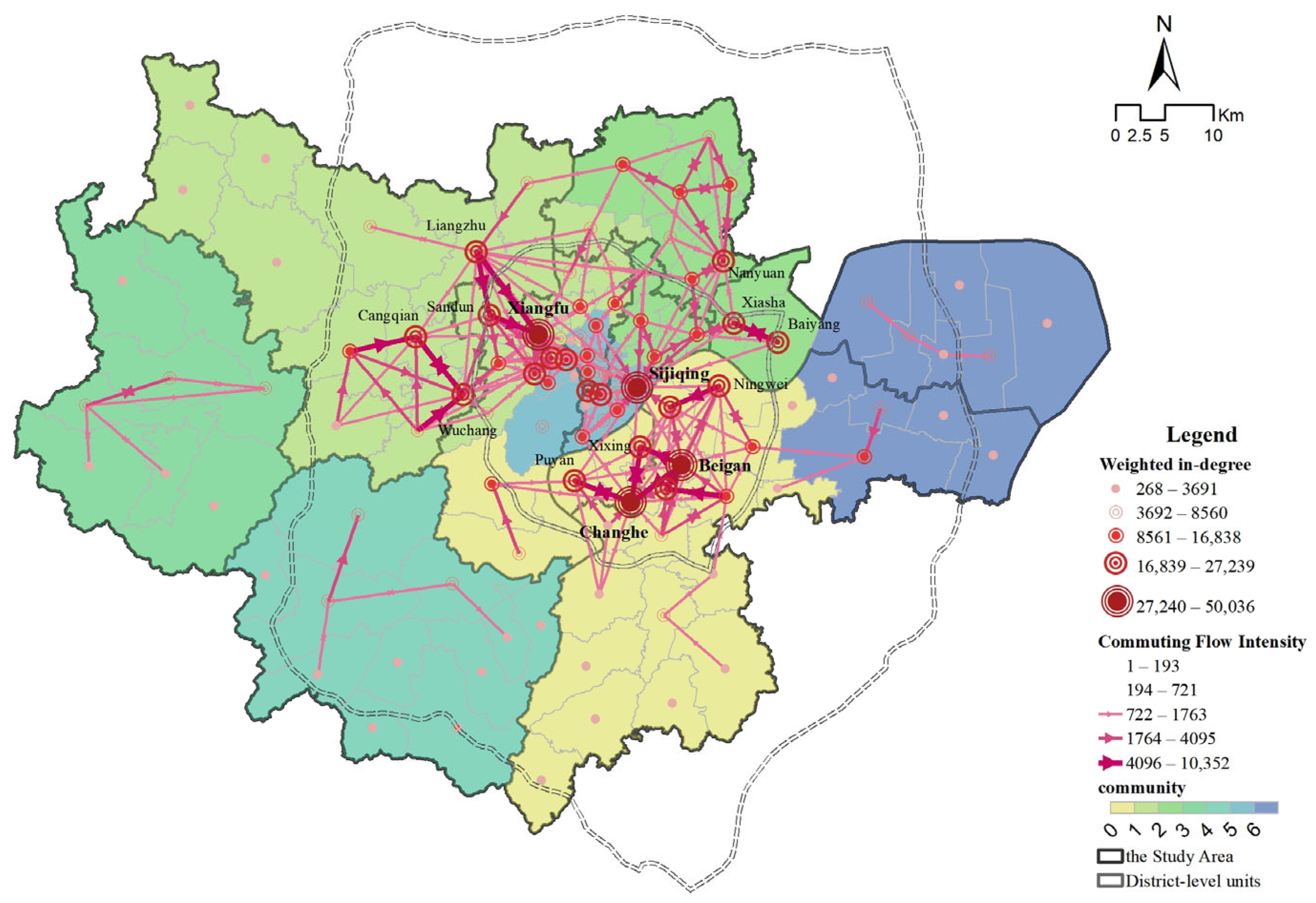
Figure 3). In the figure, node size is proportional to weighted in-degree and edge thickness denotes flow intensity, with both classified into five levels using the natural breaks method (the two lowest flow levels are omitted for clarity). The network comprises 116 nodes and 10,656 directed, weighted edges, capturing flows of approximately 1.08 million inter-subdistrict commuters. It exhibits pronounced heterogeneity in both outgoing and incoming flows, indicating a highly uneven spatial distribution of commuting intensity.
A small number of subdistricts concentrate a disproportionately large share of inbound commuting flows, functioning as dominant employment destinations, while a broader group of subdistricts simultaneously generate outbound flows and receive moderate inflows. This asymmetric configuration reflects a structurally imbalanced network in which concentrated employment centres coexist with multiple secondary nodes, rather than a simple centre-periphery structure.
From a spatial perspective, high-intensity commuting ties correspond closely to Hangzhou’s polycentric structure. Although the historic core within the inner ring expressway remains a primary attractor, several peripheral subdistricts, such as Liangzhu, Cangqian, Wuchang, Baiyang, and Nanyuan, have emerged as secondary hubs with strong inbound commuting ties. This pattern indicates that employment decentralisation has reconfigured commuting flows while maintaining hierarchical dependencies within the network.
The Louvain algorithm reveals a modular organization of the commuting network, partitioning it into seven spatially contiguous communities (modularity = 0.448). These communities are characterised by dense internal ties but relatively sparse external connections. This structure suggests that commuting interactions are organised into locally embedded relational clusters. Despite the central role of geographic proximity in shaping community boundaries, they do not coincide with administrative districts. In practice, some communities span multiple districts, whereas some administratively unified districts are internally fragmented into distinct functional clusters. This divergence underscores the tension between functional commuting regions and institutional boundaries within the urban system.
Taken together, these structural features indicate that Hangzhou’s commuting system is organised through a combination of spatial concentration, polycentric development, and modular network organization. Importantly, the observed patterns point to the presence of underlying relational mechanisms, such as reciprocal exchange, proximity-based interaction, and institutional embedding, that cannot be adequately explained through descriptive indicators alone. These characteristics motivate the use of a network-based modeling approach to formally assess the generative mechanisms shaping intra-urban commuting flows.
4.2. Network Formation Mechanisms: ERGM Results
To formally test the relational mechanisms implied by the observed structure, we estimate a valued ERGM. The model demonstrates satisfactory convergence, supported by diagnostic plots (Trace plots and density plots, see
Figure S1), and its core results are robust to alternative specifications (
Table S1). The parameter estimates are reported in
Table 2, with a binary ERGM provided for comparison. Most parameters are statistically significant, providing strong support for the proposed network-generative mechanisms. Crucially, ERGM parameters estimate conditional formation tendencies, not marginal effects. Thus, the model identifies the relational mechanisms, rooted in network structure, nodal attributes, and embeddedness, which are systematically associated with the formation and intensification of commuting ties.
The comparison between valued and binary ERGM results reveals important differences. Variables such as edgecov.DISTANCE (negative and significant in valued, non-significant in binary) and edgecov.ADM (positive and significant in valued, non-significant in binary) highlight that the binary model captures determinants of any connection, while the valued model captures determinants of connection intensity. Distance is a weak barrier to having any commuting link (as even distant subdistricts may have some workers), but it is a strong barrier to having a large volume of commuters. Similarly, being in the same administrative district does not make a link more likely to exist, but it does make an existing link significantly stronger. This contrast powerfully demonstrates the added value of preserving flow intensity information through valued ERGMs.
4.2.1. Endogenous Network Dependence: Self-Organization of Commuting Flows
The reciprocity term (mutual) shows a positive and highly significant coefficient, indicating a strong tendency for commuting flows between pairs of subdistricts to be mutually reinforced. Conditional on all other effects, the existence of a commuting flow from subdistrict i to j is associated with an increased likelihood and intensity of a corresponding flow from j to i. This pattern reveals that Hangzhou’s commuting network is characterised by bidirectional exchange rather than by predominantly one-way movements.
While this reciprocity effect reflects endogenous self-organization, we considered the possibility that it might be structurally overestimated due to scale effects associated with large bilateral commuting zones. To test this, we estimated an alternative model including an additional control for a dyadic covariate edgecov.SIZE_PROD (the product of origin residential population and destination employed population, both derived from mobile phone data), which directly captures the expected magnitude of commuting flows based on labor supply and demand. The inclusion of this control did not substantially alter the magnitude or significance of the mutual term (from 1.325 to 1.307,
p < 0.001; see
Table S3), reinforcing our interpretation that reciprocity represents a genuine structural tendency toward bidirectional exchange beyond what can be explained by zone sizes alone.
Such reciprocal structure reflects endogenous self-organization within the commuting system, and provides empirical support for overlapping labor market theory at the intra-urban scale. Mutual commuting ties likely arise from overlapping labor markets and the spatial distribution of employment opportunities across the city. The presence of strong reciprocity confirms that commuting flows are interdependent and cannot be adequately modelled as isolated origin-destination movements. Accounting for this endogenous network dependence is therefore essential for correctly interpreting the role of nodal attributes and proximity relations.
4.2.2. Nodal Job-Housing Attributes and Commuting Tendencies
Nodal attributes exhibit differentiated tendencies in shaping the formation and intensity of commuting ties. Employment agglomeration (nodeicov.IND_AGG) displays a positive and statistically significant tendency, indicating that subdistricts with higher concentrations of employment are more likely to attract commuting flows. Within the network framework, employment agglomeration contributes to a node’s attractiveness as a destination, reinforcing its centrality in the commuting system and structuring the overall flow configuration. This result reminds us that agglomeration remains the essence of cities [
45].
By contrast, wage level (nodeicov.WAGE) does not exhibit a statistically supported tendency. This suggests that, at the subdistrict scale, average offered wages may not systematically be associated with the formation of commuting ties once network structure and other attributes are taken into account. A plausible explanation is that subdistrict-level wage measures mask substantial internal heterogeneity in job types and income distributions, limiting their ability to capture perceived employment attractiveness. A commuter is attracted to a specific job’s wage, not the subdistrict’s average. In this context, the scale of employment opportunities appears more salient than average wage differentials in shaping commuting interactions.
Residential attributes primarily operate by modulating the generation of outbound commuting ties. Public rental housing provision (nodeocov.PUB_RENT) exhibits a positive tendency, indicating that subdistricts with greater affordable housing capacity are more strongly embedded in inter-subdistrict commuting networks. Affordable housing may enable labor mobility by enabling residents to access employment opportunities across space, thereby anchoring commuting flows within the urban system.
In contrast, higher housing prices (nodeocov.HOU_PRICE) are associated with a negative tendency in commuting tie formation. Subdistricts characterised by higher housing costs are less likely to generate or sustain inter-subdistrict commuting flows, suggesting that affordability constraints may limit labor mobility. This finding aligns with residential location theory: commuters tend to reside in more affordable areas, making high-price subdistricts less attractive as origins of outbound commuting.
The coefficients for residential amenities, however, present a more complex picture. Healthcare amenities (nodeocov.HOSPITAL) and green space amenities (nodeocov.PARK) also display negative tendencies, while educational amenities (nodeocov.SCHOOL) show a weakly positive association. From a conventional location-choice perspective, areas with better public services should attract more residents and thus generate more outbound commuting. The negative associations for hospitals and parks contradict this expectation. A possible explanation is the self-containment effect: residents in well-served subdistricts may find local employment opportunities that satisfy their daily needs, reducing their propensity to commute across subdistricts. This interpretation aligns with the notion of live-work-play communities where high-quality amenities support local job markets. However, we cannot directly verify this mechanism because our dependent variable captures only inter-subdistrict commuting flows; intra-subdistrict commutes are excluded from the analysis. Therefore, the negative coefficients may partly reflect a shift in commuting trips from inter-subdistrict to intra-subdistrict, which our model does not observe.
Population size (nodeocov.POP) does not exhibit a robust tendency. These findings indicate that residential scale alone does not translate into increased commuting interaction. Instead, commuting flows emerge from the interplay between employment concentration, housing affordability, and specific residential context, rather than from population size in isolation.
4.2.3. Multi-Dimensional Proximity and Relational Embedding
Geographic distance (edgecov.DISTANCE) remains the most pronounced inhibiting factor in the formation of commuting ties. The strongly negative distance parameter indicates that, even within a large and transit-oriented city, distance decay continues to impose a fundamental constraint on daily mobility. Within the network framework, greater spatial separation is associated with reduced likelihood and intensity of commuting ties between subdistricts. Transport proximity, captured by metro connectivity (edgecov.METRO), exhibits a strong positive tendency. Conditional on distance and other effects, subdistrict pairs with stronger metro connections are more likely to be linked by commuting flows, and these flows tend to be more intense. This result highlights the role of rail transit in reshaping the effective spatial structure of the commuting network by mitigating physical distance constraints.
Beyond spatial proximity, relational forms of proximity play a substantial role in embedding commuting interactions. Institutional proximity (edgecov.ADM) shows a positive and significant tendency, indicating that subdistricts located within the same district-level administrative unit are more strongly connected by commuting ties. While this association suggests that shared governance structures may condition labor mobility, we interpret this finding cautiously. A potential mechanism specific to Hangzhou is that district-level governments (e.g., Shangcheng, Xiaoshan) have implemented local employment and housing subsidy policies that often require residence and work within the same district, which may encourage intra-district commuting. Future research using more fine-grained indicators of inter-district policy coordination could unpack these mechanisms. Social proximity (edgecov.SOC), measured through baseline daily mobility interactions, also exhibits a strong positive tendency. Subdistrict pairs with more frequent interactions are more likely to develop and sustain commuting ties, suggesting that overlapping activity spaces and habitual interactions reinforce commuting relationships. In contrast, economic proximity (edgecov.IND) does not display a statistically supported tendency. This result may indicate that the economic proximity measure, based on investment ties of A-share listed firms, captures a scale of economic activity not strongly tied to the daily commuting patterns of the general workforce. These investment links may reflect high-level corporate strategy and management, generating business travel or relocation of key personnel, but not the mass commuting flows of rank-and-file employees. This suggests that drivers of corporate networks and commuting networks are distinct.
Collectively, these results demonstrate that intra-urban commuting is generated through the interaction of spatial constraints and relational embeddedness. Commuting flows are not solely determined by distance or nodal attributes, but emerge from a networked process associated with stronger integration of institutional alignment and social interaction.
5. Discussion and Conclusions
5.1. Theoretical Implications: Intra-Urban Commuting as a Relational Urban Process
This study reconceptualises intra-urban commuting as a relational process embedded within urban networks, rather than as a collection of independent origin-destination movements. The results demonstrate that commuting flows emerge from the interaction of endogenous network self-organization, nodal job-housing attributes, and multi-dimensional proximity. This integrated perspective advances existing approaches that privilege geographic distance or local attributes by showing that commuting is jointly structured by relational dependence and contextual embeddedness.
A central theoretical implication lies in the strong and robust reciprocity effect, which reveals commuting as a mutually constituted phenomenon. Bidirectional commuting ties indicate that urban subareas are linked through interdependent labor-market interactions rather than unidirectional residential-to-employment dependencies. This finding provides empirical support for overlapping labor market theory at the intra-urban scale, demonstrating that urban subdistricts function as shared labor supply-demand pools connected through bidirectional commuting flows. It challenges the implicit independence assumption underlying gravity-type and regression-based models and aligns with recent work emphasising the self-organising nature of urban flow systems. By explicitly modeling network endogeneity, this study demonstrates that commuting patterns cannot be fully understood without accounting for structural dependence within the network.
The differentiated effects of job-housing attributes further refine theories of residential location and commuting. Employment agglomeration and affordable housing provision are associated with deeper embedding of subdistricts within commuting networks, reinforcing their functional connectivity. In contrast, residential quality indicators, including healthcare, green space, and housing prices, exhibit negative associations with commuting interactions. For housing prices, this aligns with standard residential location theory: higher costs make areas less accessible as residential origins. For public amenities such as hospitals and parks, the negative associations suggest a possible self-containment effect, whereby well-served areas may support local employment or satisfy daily needs, reducing the need for cross-subdistrict commuting. Rather than contradicting job-housing theory, this pattern suggests a network-based interpretation of local self-containment, whereby high-quality residential environments are associated with reduced long-distance commuting by supporting local employment opportunities or satisfying daily activity needs within functional clusters. This finding extends job-housing balance theory by shifting attention from individual commuting outcomes to network-level patterns of mobility containment.
The significant roles of institutional and social proximity provide empirical support for multi-dimensional proximity theory at the intra-urban scale. Shared administrative jurisdictions and overlapping daily activity spaces are systematically associated with commuting interactions beyond what can be explained by geographic distance alone. These results highlight the embeddedness of urban mobility within governance structures and social routines. Although institutional proximity is operationalised through administrative districts in the Chinese context, analogous governance-induced boundaries exist in many metropolitan regions [
46], suggesting that the identified relational mechanisms have broader theoretical relevance beyond the case of Hangzhou.
5.2. Methodological Implications: Explaining Commuting Through Network-Generative Mechanisms
Methodologically, this study demonstrates the advantages of modeling intra-urban commuting as a weighted and directed network using valued ERGMs. By preserving information on flow intensity, valued ERGMs capture the highly uneven distribution of commuting flows that characterises urban mobility systems. The comparison with binary ERGM results shows that dichotomising flows obscures meaningful variation and underestimates the role of key generative mechanisms.
More importantly, the ERGM framework enables the simultaneous estimation of endogenous network structure, nodal attributes, and exogenous proximity effects within a unified statistical model. This integrated approach moves beyond attribute-centred or distance-based explanations and provides a coherent way to examine how commuting networks are formed through interacting relational processes. The use of discretisation strategies further ensures model stability under extreme over-dispersion, a common challenge in analyses based on large-scale mobility data.
As urban researchers increasingly rely on high-resolution mobility datasets, the findings underscore the methodological value of network-based models for advancing explanatory, rather than purely descriptive, analyses of urban flows.
5.3. Planning and Policy Implications: Towards Relational and Locally Embedded Mobility Strategies
The findings of this study offer actionable insights for urban planning and transport policy, particularly in the context of transit-oriented development (TOD), affordable housing placement, and cross-jurisdictional coordination. While the valued ERGM identifies conditional tendencies rather than predictive marginal effects, the relative magnitude and direction of coefficients can inform strategic priorities and guide integrated interventions.
First, leveraging metro connectivity in transit-oriented development. The positive coefficient of metro connectivity (edgecov.METRO = 0.039) indicates that stronger metro links between subdistricts are associated with more intense commuting flows, even after controlling for geographic distance. This suggests that metro investment can partially offset the friction of distance, especially when combined with employment concentration (nodeicov.IND_AGG = 0.013). Planners should prioritize TOD nodes that integrate high-capacity transit with job-rich environments, as such combinations are likely to amplify accessibility gains and attract commuting flows. In contrast, metro stations located in dormitory suburbs with limited local employment may function primarily as access points rather than as anchors of balanced urban development.
Second, strategic placement of public rental housing. Public rental housing (nodeocov.PUB_RENT = 0.016) is positively associated with outbound commuting, indicating that affordable housing enables residents to participate in citywide labor markets. To maximize its mobility-enhancing potential while avoiding excessive commuting burdens, public rental projects should be sited within reasonable proximity to major employment centers or along high-capacity transit corridors. For instance, locating affordable housing in subdistricts with strong metro connectivity can improve job accessibility for low-income residents without necessarily increasing extreme commuting. This aligns with the goal of spatial matching between housing and employment opportunities.
Third, addressing administrative fragmentation through Infrastructure Coordination. The positive effect of institutional proximity (edgecov.ADM = 0.026) shows that commuting flows are stronger within the same district-level administrative unit. This implies that administrative boundaries can act as either facilitators or barriers to mobility. To mitigate fragmentation, cross-district transport investments, such as express bus routes, synchronized metro extensions, or coordinated land-use planning, can help bridge institutional divides. The positive association of metro connectivity suggests that such investments may partially compensate for the absence of shared administrative affiliation, promoting more integrated regional labor markets.
Taken together, these results support a shift from isolated sectoral interventions toward integrated strategies that combine transit investment, affordable housing placement, and institutional coordination. By identifying the relative strength and direction of key factors, the model provides a basis for prioritizing investments and designing policies that enhance accessibility, reduce commuting burden, and promote more self-contained and sustainable urban mobility patterns.
5.4. Limitations and Future Research
Several limitations warrant consideration. First, the analysis is based on cross-sectional data, which precludes examination of the temporal evolution of commuting networks. Future research could employ longitudinal mobility data to explore how network structures and formation mechanisms change over time, particularly in response to infrastructure investments or policy interventions.
Second, while the ERGM framework identifies network-generative tendencies consistent with the proposed mechanisms, it does not directly capture individual decision-making processes. Integrating network modeling with survey data or qualitative approaches could provide deeper insight into the behavioural foundations of commuting interactions.
Third, this study focuses on a single metropolitan case. Hangzhou represents a specific urban context characterised by strong administrative governance, rapid rail transit expansion, and a developed economy. While the types of mechanisms identified are likely universal, their strength and specific manifestations are context-dependent. For example, the strong effect of administrative proximity (edgecov.ADM) might be weaker in metropolitan areas with fragmented local governments or weaker top-down governance, such as many US metropolitan regions. Similarly, the pronounced effect of metro connectivity reflects Hangzhou’s significant investment in rail transit and may differ in cities with different transport modal splits. Comparative analyses across cities with different governance structures, urban forms, and transport systems are needed to assess the scope conditions of our findings.
Fourth, the ERGM framework estimates conditional tendencies in network formation, not predictive coefficients suitable for quantitative scenario analysis. Deriving precise policy prescriptions (e.g., “10% increase in public rental housing reduces commuting by X%”) is not feasible from our model. Instead, we provide directional insights and relative effect sizes to inform policy thinking. Future research could combine ERGM with microsimulation or activity-based models to generate quantitative policy scenarios.
Fifth, while we have taken steps to address measurement concerns, some limitations remain. Subdistrict-level aggregation may mask internal heterogeneity in variables such as wages, housing prices, and amenity access. This aggregation could contribute to the non-significance of some variables (e.g., wage levels) and limits our ability to capture individual-level decision-making processes. Moreover, our analysis focuses exclusively on inter-subdistrict commuting flows, ignoring intra-subdistrict commutes. This omission is particularly relevant for interpreting the negative coefficients for healthcare and green space amenities: these may reflect a shift toward local employment in well-served areas (self-containment) that our model cannot observe. Future research using individual-level survey data or higher-resolution grid-cell data could overcome this limitation by directly observing commuting behavior and local characteristics at a finer scale, including both intra- and inter-subdistrict flows.
Sixth, while we have taken care to distinguish between the commuting network and the social proximity measure conceptually, by using different temporal aggregations and different trip purposes, both variables are derived from the same mobile phone signalling dataset. This shared data source raises the possibility of unobserved common biases that could affect both measures. Although we argue that the conceptual and temporal distinctions mitigate concerns about direct overlap, future research could strengthen the independence of these measures by using data from independent sources. For example, future research could combine mobile phone commuting data with social media check-ins, credit card transaction records, or survey-based activity diaries to construct more robust measures of social proximity.
5.5. Conclusions
By integrating endogenous network dependence with multi-dimensional proximity, this study provides a relational explanation of intra-urban commuting that moves beyond conventional attribute-based and distance-centred approaches. Empirically, it shows that commuting flows are associated with the interaction of self-organising network structures, job-housing dynamics, and spatial, institutional, and social embeddedness. Methodologically, it demonstrates the value of valued ERGMs for uncovering the generative mechanisms underlying weighted urban flow networks.
Taken together, the findings contribute to a deeper understanding of how everyday mobility is organised within large cities and offer a conceptual and methodological foundation for designing more sustainable, integrated, and context-sensitive urban systems.