Article

Evaluation of the Land Use Land Cover Impact on Surface Temperature and Urban Thermal Comfort: Insight from Saudi Arabia’s Five Most Populated Cities (2000-2024)


by
Amal H. Aljaddani
Department of Physical Sciences-Geographic Information Systems Program, College of Science, University of Jeddah, Jeddah 21589, Saudi Arabia
Urban Sci. 2026, 10(3), 157; https://doi.org/10.3390/urbansci10030157
Submission received: 28 January 2026 / Revised: 24 February 2026 / Accepted: 10 March 2026 / Published: 13 March 2026
(This article belongs to the Section Urban Environment and Sustainability)

Abstract

Since 2025, 45% of the world’s population of 8.2 billion people has lived in cities, and by 2050, that number is expected to increase to 66%. As the number of people living in cities increases, natural landscapes will be transformed into impervious surfaces, leading to serious challenges and resulting in a phenomenon named the urban heat island (UHI) effect. Although urban thermal variation has been studied globally, few studies have examined the impact of land use transitions on local surface temperatures. This study aims to address this gap by investigating the impact of LULC transitions on the land surface temperature (LST) and the urban thermal field variation index (UTFVI) in the five most populated cities in Saudi Arabia between 2000 and 2024: Riyadh, Jeddah, Makkah, Madinah, and Dammam. This study provides not only a comprehensive overview of the cities in Saudi Arabia but also a detailed analysis of each city using a novel approach that integrates thermal land use analysis. In this study, Landsat TM-5, OLI-TIRS-8, and OLI2-TIRS2-9 were used to process the LULC using random forest machine learning and thermal indices. Fifteen LULC maps were generated and assessed based on four classifications across the cities and time periods: urban area, barren land, vegetation, and water. The difference-in-difference (DiD) analytical approach was used to compute the thermal effect size and compare the specified changed pixels (barren-to-urban, vegetation-to-urban) with stable urban. Then, the relationship between the LST and the NDVI–NDBI were investigated. The results show that the overall accuracy of the 15 LULC classifications ranged from 89.00% to 97.00%. The urban area increased across all the cities, with the greatest changes being 448.84, 179.67, 177.96, 126.33, and 95.69 km2 in Riyadh, Jeddah, Dammam, Madinah, and Makkah, respectively. Furthermore, the vegetation cover increased in most of the cities over time. The LST of the urban areas increased by 8.31 °C in Riyadh, 5.24 °C in Jeddah, and 1.41 °C in Makkah in 2024 compared to 2000, while those in Dammam and Madinah decreased by 2.67 °C and 0.60 °C, respectively. This study delivers robust insights into two decades of urban surface temperature dynamics across major Saudi Arabian cities, offering critical evidence to inform UHI mitigation strategies and support the long-term sustainability of urban environments.

1. Introduction

Since 2025, 45% of the world’s population of 8.2 billion people has lived in cities, and by 2050, cities will be home to most of the world’s population; the fraction of people inhabiting urban areas is estimated to increase to 66% [1,2,3]. This increase in population and urban areas, in both size and magnitude, is expected to pose significant challenges and opportunities for city designers and planners as well as environmental developers, thus requiring intensified efforts to achieve sustainable city goals [4,5]. Urban land cover change is simultaneously a cause and an outcome of global environmental change, which modifies the Earth’s energy balance and biogeochemical flux dynamics, resulting in climate change and changes in the Earth’s surface properties [6]. Urban areas with various human activities are key drivers of climate change, including increasing greenhouse gas emissions (producing more than 60% of carbon dioxide), expanding impervious land cover, and reducing vegetative cover [7,8,9,10,11]. These drivers result in a phenomenon named the urban heat island (UHI) effect, which is explained as the cities encountering higher surface temperatures than the surrounding countryside areas, mainly because of human activities, buildings, pavement, and reduced vegetation. The UHI effect leads to urban environmental problems and a lack of urban human environment resilience, such as increases in solar radiation, reduction in surface permeability, and diminishing quality of life [12,13].
With these challenges in mind, several actions can be taken to diminish the effect of the UHI effect and improve the thermal comfort level in urban areas; examples of these actions include increasing urban greenness, using cooling and reflective materials, implementing green/cool roofs, improving urban design and planning, and lowering energy use and heat waste [14,15,16,17]. These mitigation measures are significantly related to the properties of the LULC classification, as the thermal behavior of each class directly shapes the urban heat intensity. In particular, as urban development expands, natural land is replaced with impervious surfaces, thus increasing the surface temperature of urban areas, whereas vegetation cover and water bodies help reduce heat effectively [18,19]. In addition, barren lands surrounding urban areas play a major role in increasing temperatures, especially in arid and semi-arid environments where desert dominance and surface water scarcity prevail [20,21]. Therefore, it is necessary to understand urban thermal environments by examining the dynamic transitions in LULC, both spatially and temporally, using urban thermal indices and remote sensing and geographic information science (GIS) technologies.
The development of remote sensing technologies has greatly assisted scientific communities by enhancing and accelerating computational processes for extracting spatiotemporal information from satellite imagery [22]. One example is the Google Earth Engine (GEE) platform for geospatial large-scale cloud processing. The GEE is characterized by its provision of petabytes of satellite imagery, powerful geospatial cloud computing, and being freely accessible to users [23]. These features have encouraged researchers to focus on research related to Earth observation on global, regional, and local scales using long historical satellite imagery. For example, Landsat has been one of the world’s longest-running Earth-observation satellites since 1972, recording the Earth’s environmental changes for over 50 years [24].
Building on this foundation, many global studies have investigated urban thermal environments in Asia [25,26], Africa [27,28], Europe [29,30], America [31,32], and in different climatic zones. While global studies have provided a synoptic view of the UHI effect, local studies in Saudi Arabia have addressed the characteristics of the urban thermal environment at the district, city, region, tourist-resort, and city-group levels, using different data sources and approaches [33,34,35,36,37,38,39]. Munir et al. (2025) [33] analyzed the six most populous cities in Saudi Arabia using the ERA5-land and CHIRTS-ERA5 temperature datasets to quantify and analyze the UHI effect intensity. Their results indicate that rural areas were hotter than urban areas by ~1.5–1.7 °C [33]. Two districts in Makkah, Al-Sharashef and Al-Eskan, were examined for their UHI effect using spatial network analysis. The results revealed that the Al-Eskan district has a higher mean LST by 1–1.5 °C due to the role of its urban rectilinear layout in increasing the temperature compared to the organic/compact urban fabric of the other district [34]. In another study, Miky (2019) [35] used Landsat 8 and Spot 5 in Jeddah. The results confirmed that the southern part of Jeddah, especially in the Petromin and Almohajer neighborhoods, has higher temperatures, with a temperature difference between urban and non-urban areas ranging from 4 to 7° [35]. The tourist resorts in Abha and Khamis Mushait have been investigated for their UHI effect by Arshad et al. (2021), who clarified that Khamis Mushait has a larger UHI effect than Abha city due to the topographic impact [36].
Many global and local studies have examined urban thermal indicators, providing valuable insights into the LST and the UHI effects. As noted, although local studies have demonstrated urban thermal indicators at the district, city, region, tourist-resort, and city-group levels, using different data and approaches, none have addressed the impact of the LULC transition on large cities in Saudi Arabia. Thus, this is the first study to gather data on Saudi Arabia’s five main cities (Riyadh, Jeddah, Makkah, Madinah, and Dammam) in order to examine the patterns and trends of the dynamic transitions in LULC and their impacts on surface temperature and the UHI effect over 24 years (2000–2024). This study attempted to answer the next questions: What are the characteristics of spatial and temporal LULC across the cities between 2000 and 2024? What are the estimated urban thermal indicators of the LST, the UHI effects, and UTFVI over the two decades? What is the impact of the LULC transition on the urban surface temperature? What is the relationship between the LST and the indices of vegetation (NDVI) and built-up (NDBI)? These questions help to guide our study toward providing valuable information to national government agencies, policymakers, stakeholders, and local agencies, including environmental departments, climate resilience offices, and public health agencies, in order to mitigate higher urban surface temperatures, advance the sustainability of Saudi cities, and promote a higher standard of human well-being.

2. Materials and Methods

2.1. Study Area

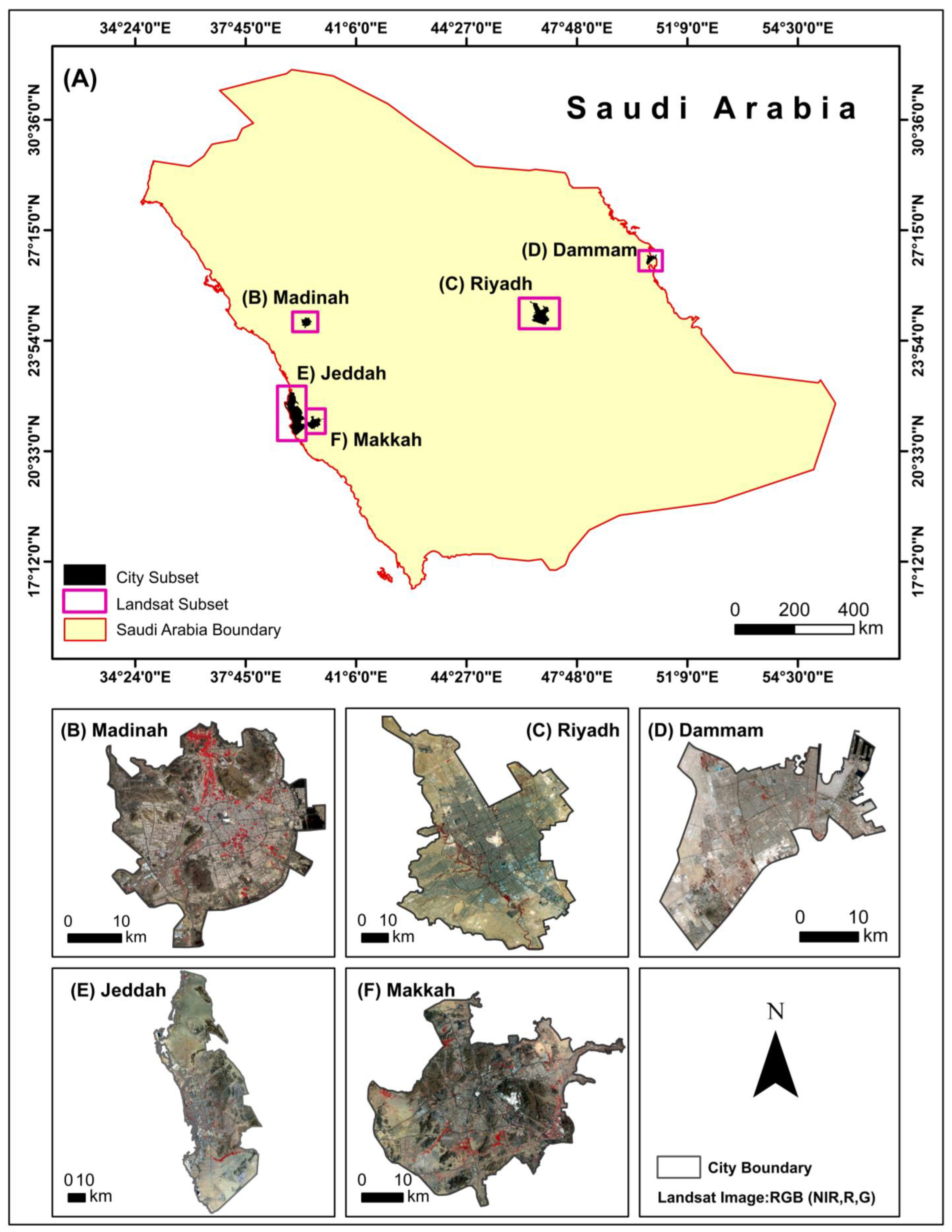
Saudi Arabia is situated in southwest Asia. Its total land area is about 2,149,690 km2, covering about 80% of the Arabian Peninsula. In 2024, Saudi Arabia’s population reached over 35,000,000 people [40], and the urban areas of the major cities have witnessed massive increases over 35 years, e.g., a 107% increase from 1985 to 2019 [41]. Thus, this study focused on the largest populous cities and rapidly growing urban areas in Saudi Arabia: Riyadh, Jeddah, Makkah, Madinah, and Dammam (Figure 1). The abovementioned characteristics contribute significantly to LULC transition from other classes to urban areas, which may lead to changes in the local climate of these cities. Given these specifications and the limited studies conducted in these cities, it is urgent to understand their urban thermal behavior and develop strategies to improve their sustainability.
The Saudi Arabian cities and their geographical locations are as follows: Riyadh is the capital of the country and is located in the country’s center, in the Riyadh region, with a population of about 6.9 million inhabitants, a city area of 2474.62 km2 and elevation of 600 m. Low elevations and vast flat areas characterize Riyadh’s terrain; the city is in the Najd plateau and includes the Tuwaiq mountains. Riyadh is a central hub for the government and administrative sector, as well as for various industries and services. Jeddah is the second largest city, with 3.7 million inhabitants, 4441.45 km2 for the city area and 12 m of elevation. The city is situated on the western side of the country. The terrain of Jeddah is primarily low-lying, with the Hejaz Mountains to the east and many valleys that flow into the Red Sea. It is an essential economic hub in the western part of the country, owing to its status as a commercial port on the Red Sea. Makkah is the capital of the Makkah administrative region and is located inland, southeast of Jeddah. It is ranked third among the country’s most populous cities, with a population of 2.4 million, a city area of 1124.06 km2 and 277 m of elevation. The terrain consists of scattered mountains, hills, and valleys. It is a financial and tourist center in addition to having real estate and services sectors. Madinah is the capital of the Madinah region with a population of 1.4 million, making it the fourth largest city in Saudi Arabia, with 685.71 km2 of city area and 608 m of elevation. Mountains and valleys are the city’s terrain features. Medinah is distinguished by a diversified economy encompassing agriculture, manufacturing, transportation and logistics. Finally, Dammam is recognized as the capital of the Eastern Province region and is the country’s fifth largest city, with about 1.4 million inhabitants, a city area of 561.52 km2, and an elevation of 10 m [40]. It is located adjacent to the Arabian Gulf on the country’s eastern side. Dammam is characterized by a desert plain overlooking the Arabian Gulf. Dammam is the hub of the oil and petrochemicals industries [41,42,43].
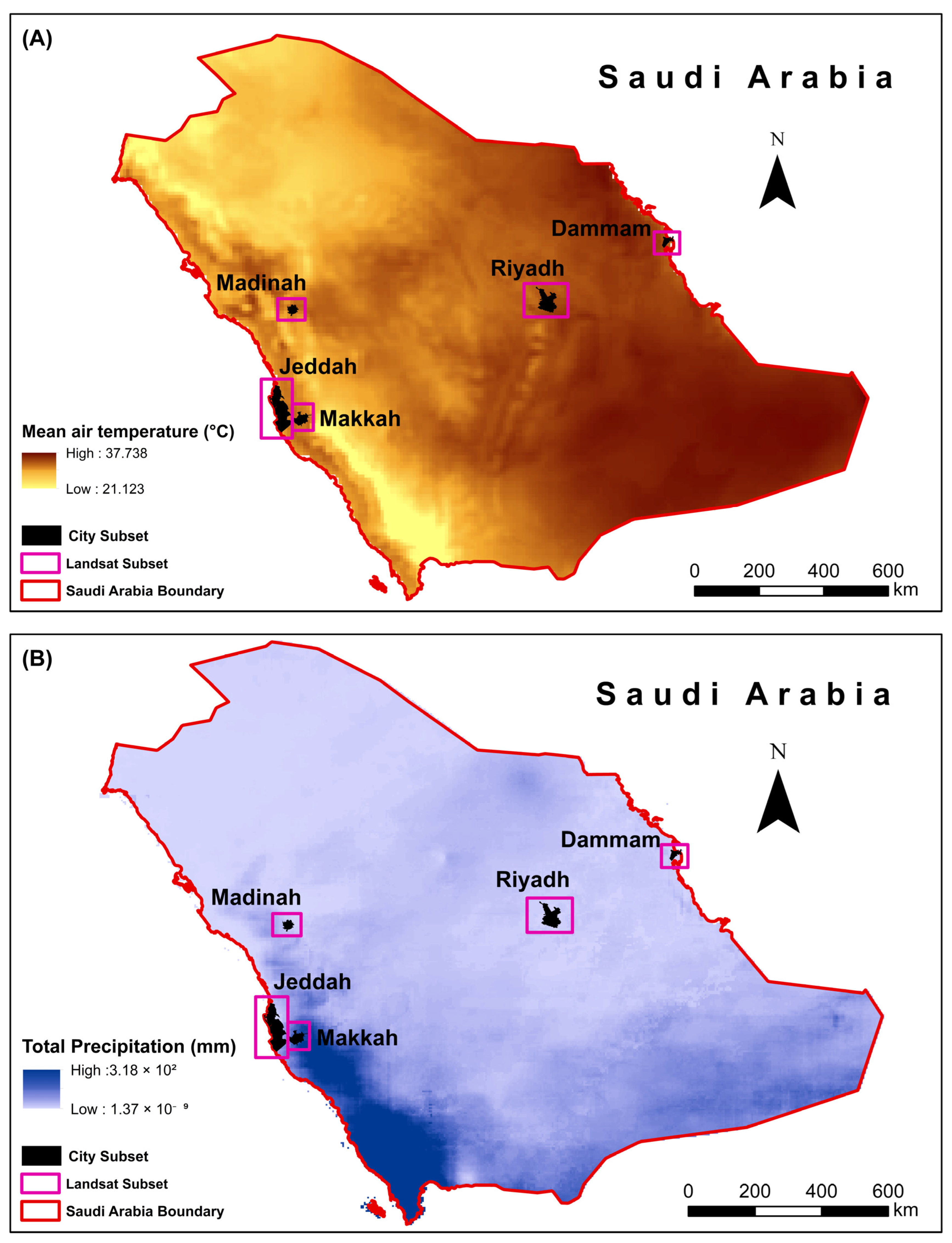
The national climate is arid and semi-arid, with extremely hot, dry summers and low humidity in the country’s interior. In contrast, the coastal side can experience high temperatures with higher humidity. In 2023, the annual average temperature in Saudi Arabia was about 26.1 °C, which was 0.9 °C higher than the average for the specified period (1991–2020), making it the fourth warmest year recorded for the country [44]. During the summer, the average temperature can range from 35 °C to 45 °C. Saudi Arabia’s precipitation is generally low and varies by year and region. In 2023, the country’s average annual precipitation reached 106 mm, a significant increase from 91 mm in 2022, and the mountains southwest of Saudi Arabia can receive about 300 mm annually [45]. Figure 2 shows the average air temperature in degrees Celsius (°C) (A) and total precipitation in millimeters (mm) for the summer season from 1 May to 31 August in the year 2024 (B), which were processed through the GEE and produced by ArcGIS Pro 3.6 [46,47].

2.2. Methodology

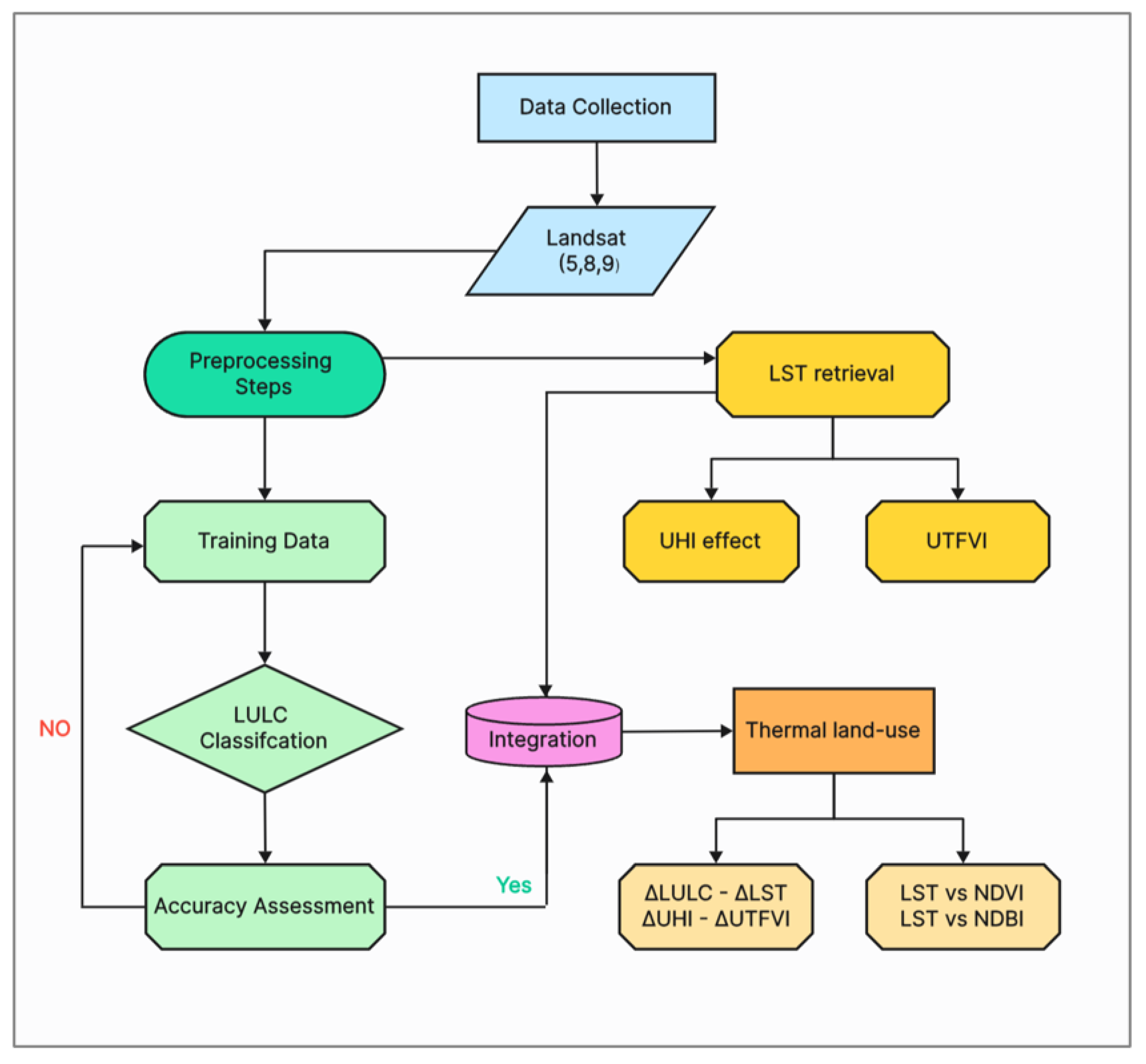
This study’s methods comprise the following components: data acquisition and preprocessing; LULC classification and accuracy assessment; thermal data and index analysis; and integration of a thermal–land-use analytical framework. The methodology is illustrated in a flowchart represented in Figure 3.

2.2.1. Data Acquisition and Preprocessing

In this research, image data from three sensors of Landsat satellites, Landsat 5 Thematic Mapper (5-TM), Landsat 8 and 9 Operational Land Imager 1 and 2 (OLI-OLI2) and Thermal Infrared Sensor 1 and 2 (TIRS-TIRS2), was used and provided by the United States Geological Survey [48]. All satellite images were level 2, collection 2, and tier 1. They were acquired utilizing the Worldwide Reference System-2 (WRS-2) and underwent geometric and atmospheric corrections. All the satellite images were level 2, collection 2, and tier 1, and were acquired utilizing the Worldwide Reference System-2 (WRS-2), which were geometrically and atmospherically corrected. These images were preprocessed through cloud and shadow masking, image compositing, spectral mosaicking, and temporal filtering. Cloud and cloud shadow masking were the first steps to mitigate the effects on Landsat images, which are required for subsequent processing. These Landsat images are characterized by their long historical records, continuity producers, consistent interval, and 30 m medium spatial resolution. These characteristics enabled this research to be conducted at the city scale over three time intervals spanning more than two decades, from 2000–2024, focusing on the LULC classification process and the urban thermal indices, including LST, UHI, and UTFVI. The LULC classification is based on multispectral bands from three sensor types: visible (VIS), near-infrared (NIR), and shortwave infrared (SWIR1 and SWIR2) (Table 1) [49]. The two indices of vegetation index ( N D V I ) and built-up index ( N D B I ) were also processed through this study. The N D V I was generated to assist in processing LST and used with the N D B I to examine the relationship between them and LST using regression analysis. They were calculated as follows [37]:
N D V I = β N I R   β R E D β N I R   + β R E D
N D B I = β S W I R β N I R β S W I R + β N I R
The Google Earth Engine platform was used in this research for large-scale geospatial cloud processing at different scales and analyzing Earth’s surface spatially and temporally. The maskClouds function was used to identify and remove pixels containing clouds and cloud shadows. As the five Saudi Arabian cities were characterized by clear skies throughout the year, especially in the summer, the Landsat images used for LULC, urban thermal indicators, and relation computation were collected during the summer, from the 1st of May to the 31st of August. Thus, the Landsat TM–TIRS–TIRS2 was chosen, as this is the hottest period in Saudi Arabia. For equivalent-season computation, the LULC classification was implemented for the summer season and provided accurate information on the characteristics and relationships between the urban thermal indicators and LULC. Landsat images were collected for the five cities, with the following time intervals: 2000, 2014, and 2024 for Riyadh and 2000, 2013, and 2024 for the remaining cities. These intervals were chosen to provide a synoptic view of these cities’ LULC and urban surface temperatures.

2.2.2. LULC Classification and Accuracy Assessment

Training Data
The training samples of LULC classification were collected for each selected year (2000, 2013, 2014, and 2024) for the five cities. The data were collected during the summer, from the beginning of May to the end of August, under clear skies. The Google Earth Engine was used to collect training samples from Landsat images and compare them with aerial images of higher geospatial resolution sourced from Google Earth Pro. If ambiguity or indistinctness was observed between them, the Landsat image was chosen. Four classes of LULC were used to obtain training samples at each location for the five cities, using level 1 of the USGS Anderson’s Land Classification scheme: urban areas, barren land, vegetation, and water, as shown in Table 2 [50]. At each stage of the training data collection, sufficient training data were acquired for each class to accurately represent the LULC mapping. In total, the numbers of samples collected for each class were as follows: 2392 for urban areas, 7183 for barren land, 1529 for vegetation, and 594 for water. Table 3 breaks down these numbers and lists the dates the training samples were collected, the Landsat sensors, and the paths/rows.
Random Forest for Supervised Classification
Many computational machine learning (ML) algorithms have been broadly adopted in remote sensing applications with supervised and unsupervised methods for LULC classification. This research applied supervised classification and the random forest algorithm to the five Saudi Arabia cities over the past two decades. This powerful algorithm has been applied to various applications, such as burned areas, deforestation, agriculture, urban growth, and LULC. Random forest is an ML technique that constructs an ensemble of decision trees during training that, in this study, is used to classify LULC [51]. This ensemble improves accuracy and reduces overfitting compared to using a single tree, thereby increasing classification power. The final results of the LULC classification can be decided via voting, where the classification category predicted by the most trees is selected. This study divided urban land cover mapping into four categories: urban areas, barren land, vegetation, and water. A random forest classifier was run using the smileRandomForest function [52], a supervised classification technique in Google Earth Engine’s geospatial platform, with 100 trees and three randomly selected predictors per split. These parameters were chosen after tested and evaluated other numbers which provided best model performance and higher validation accuracy. This function was used to designate the visible and near-infrared bands and the LULC properties for model training. The algorithm was trained on 80% of the training samples and tested on 20% to obtain the overall accuracy of each classification model. The classifier was implemented for each year, with the study areas and five individual cities selected, and it generated 15 classification maps, considering either four or three of the LULC categories.
Accuracy Estimation of LULC Classification
This study used a simple random strategy to validate the accuracy of the 15 classification maps for each selected year in each of the five cities; 200 pixels were randomly selected from each classification image for each year, for a total of 3000 sampling locations. Each sample pixel was examined through visual screening and interpretation, using prior knowledge of the study and reference details, which were then synthesized by assessing each sample pixel using higher-resolution aerial images from Google Earth Pro, alongside the Landsat images in Google Earth Engine. Then, the reference sample pixels were compared with the Landsat satellite images based on various spectral bands—such as a false-color composite including NIR, Red, and Green—to enhance visibility and distinguish features. This helped us to differentiate between the four classes in the study areas. When ambiguity occurred during the examination of each sample pixel, the Landsat image was used for the sample [41]. The classification categories were assigned after the reference data categories. Then, the reference sample pixels were labeled as one of the four classes: urban area, barren land, vegetation, or water. The classification results were evaluated based on the user, producer, and overall accuracy, as well as Cohen’s kappa coefficient [53]. After estimating the accuracy, the growth rate of urban expansion was computed to provide a key measure for assessing the LST, UHI effects, and UTFVI, thereby reflecting increases in impervious surfaces, vegetation loss, and rising local temperatures, which can be used to support mitigation strategies and urban planning.

2.2.3. Thermal Data and Indices

LST Retrieval
Infrared thermal bands were generated from Landsat 5 TM, Landsat 8 TIRS, and Landsat 9 TIRS-2 to compute the LST, UHI, and UTFVI. The thermal estimation focused on the summer season for Landsat thermal band collection, given the importance of analyzing thermal urban environments and the UHI effect in major Saudi cities. The LST was calculated for Riyadh, Jeddah, Makkah, Madinah, and Dammam between 2000 and 2024. The only thermal band on Landsat 5 TM is band 6, which was used for the computation. While Landsat 8 TIRS and Landsat 9 TIRS-2 have two bands (bands 10 and 11), band 10 was used because it provides a more accurate result than band 11 [54]. The Digital number (DN) should be converted to top of atmosphere (TOA) spectral radiance, which is required for processing Landsat 5, 8, and 9 [55,56]. However, the data used in this study were surface temperatures, which were converted into brightness temperatures (BTs) in Kelvin, as shown in the following equation [55]:
B T = k 2 l n k 1 L λ + 1
where B T denotes the sensor-measured brightness temperature (BT) in Kelvin (K); L λ , TOP radiance; and k 1 and k 2 , the thermal band calibration constants (generated from the metadata). Each value of Landsat 5 is in order ( k 1 → 607.76, k 2 → 1260.56), whereas the values of Landsat 8 and 9 for k 1 and k 2 are 774.885 and 1321.078, in corresponding order [57]. Then, the spectral emissivity ( ε ) correction algorithm proposed by [58] was employed in this research. The correction of land surface temperature depends on the LULC surface type and uses a common approach based on the NDVI threshold methods from the Red and NIR bands (Equation (1)). The fractional vegetation index (FVI) can be estimated using the following expression [59]:
F V C = n d v i     n d v i   m i n n d v i   m a x     n d v i   m i n 2
where F V C denotes the fractional vegetation coverage; n d v i , the NDVI; n d v i   m i n , the lowest value of the NDVI, referring to that of soil; and n d v i   m a x , the highest value of the NDVI, referring to that of vegetation cover. Next, the emissivity of land surface (ε) was determined as follows in order to measure the thermal radiation [60]:
ε = 0.004 F V C + 0.986
where ε denotes the emissivity of land surface range between 0.96 and 0.99, expressing the value between bare soil and vegetation areas. Lastly, the LST was calculated as follows:
L S T = B T 1 + λ B T ρ ln ε 273.15
where L S T and B T denote the computed surface temperature in units of degrees Celsius (°C) and the brightness temperature, respectively, as defined above; λ represents the wavelength corresponding to the emitted radiance (11.5 µm), ρ = 1.438 * 10−2 mk; and ε represents the emissivity of vegetation cover and bare soil [61]. The LST was mapped spatially and temporally. Then, the LST was utilized to calculate the UHI and UTFVI.
Estimation of UHI Effect and UTFVI
Urbanization plays a major role in Earth’s surface and modifies the surface by replacing natural surfaces with various impervious surfaces [62]. These modifications can increase heat absorption and reduce evaporation [63]. Hence, urbanized areas such as cities consistently show higher land surface temperatures than the surrounding countryside—a phenomenon named the UHI effect. These cities are characterized by low albedo of built-up areas, reduced vegetation cover and water bodies, and emission of anthropogenic heat. The differential surface temperature has an important implication for the environment and social studies. Understanding the spatiotemporal relationship between LULC patterns and thermal urban indices is therefore crucial for assessing the effects of urbanization on nearby climate and for developing sustainable urban planning strategies. Each UHI effect and the UTFVI was computed in GEE as follows [64]:
U H I c , i = T L T m T s t d .
where U H I c , i is the urban heat island effect for each city ( c ) and year ( i ); T L , the LST; T m , the mean LST; and T s t d . , the standard deviation of the LST. The UHI effect was computed for the five cities and the three time intervals.
After computing the UHI effect, its effect was investigated, and the UTFVI was crucial to understanding it. The UTFVI is the quantification index used to evaluate the thermal comfort level for each city and each three-year interval, and it was calculated using Equation (8) [65]:
U T F V I c , i = T L T m T L
where the parameters of this formula are defined as in Equation (7). The UTFVI was divided into six classes, ranging from none (representing excellent and very good ecological quality) to the strongest UHI effect classification (representing the worst thermal comfort level). The distribution of the six values, as presented in [66], is shown in Table 4.

2.2.4. Incorporated Thermal–Land-Use Analytical Farmwork

After generating LULC maps and calculating three urban thermal indicators, an incorporated analytical approach was developed that jointly investigates the thermal and land use variables to demonstrate geospatial patterns not captured through separate analyses.
LULC Transition and Thermal Effect Size
LULC is one of the important factors that help in understanding the dynamics of LST; however, while many studies have investigated the LULC classes [66,67,68], this study aims to represent changes in LULC transition between the two interval times (2000–2013/2014 and 2013/2014–2024) spatially for each specified city. In the same manner, the LST, UHI effect, and UTFVI were generated by computing the difference between the two-year intervals, considering the spatial dimension. Both the LULC transition and differences in thermal indicators (DTIs) (ΔLST, ΔUHI, and ΔUTFVI) were processed in ArcGIS Pro 3.6 using raster calculator tool in the map algebra expression interface. Cell information for the raster was extracted for each DTI image by defining a mask for each LULC transition: barren-, vegetation-, and urban-to-urban. This allowed us to generate geospatial and temporal information, which provides thermal behavior for each LULC transition. Then, the DTI statistics within a specified LULC transition zone were summarized and reported in a zonal statistics table. With tables for each city and time interval, the difference-in-difference (DiD) analytical approach was used to compare the specified change pixels (barren-to-urban, vegetation-to-urban) with the stable, unchanged urban pixels. The unchanged pixels served as a control background for local climate change and enabled causal inference. Through the application of the DiD analytical approach, this study provides a robust framework for isolating the surface thermal effect of urban transition from background temporal trends.
Analysis of LST and NDVI–NDBI Relationship
Vegetation and urban areas are among the most important variables that significantly influence surface temperatures. Therefore, regression analysis was performed between the LST and NDVI, which is used as a proxy for vegetation, and between the LST and NDBI, which is used as an indicator of built-up areas [69]. After generating the two continuous indices for each year and each city, a fishnet was applied with 100 rows and 100 columns, generating 10,000 points. These were then subset to the administrative boundaries of the five cities. Regression analysis was conducted across three time intervals for each of the five cities using ArcGIS Pro to understand the relationships between surface temperature, vegetation, and urban areas.

3. Results

3.1. Accuracy Assessment and LULC Analysis

In this study, fifteen LULC classification maps were generated for the cities of Riyadh, Jeddah, Makkah, Madinah, and Dammam for three time intervals. Each city has a unique pattern and trend over time. The accuracy of the maps was assessed and quantified for the cities over the study periods for urban areas, barren lands, vegetation, and water. Table 5 shows the overall accuracy and kappa coefficients of the five cities; they ranged from 0.89 to 0.97 and between 0.80 and 0.91, respectively. These accuracies reflect a higher overall LULC classification. In this study, the barren lands had a higher accuracy than the complex urban development areas, while the vegetation cover and water were limited and higher as well. The overall accuracy is in the acceptable range compared to other studies conducted by Ullah et al. (2025) [70] and Pushkar et al. (2025) [71]; the kappa coefficient is also in the acceptable range but lower than in those studies.
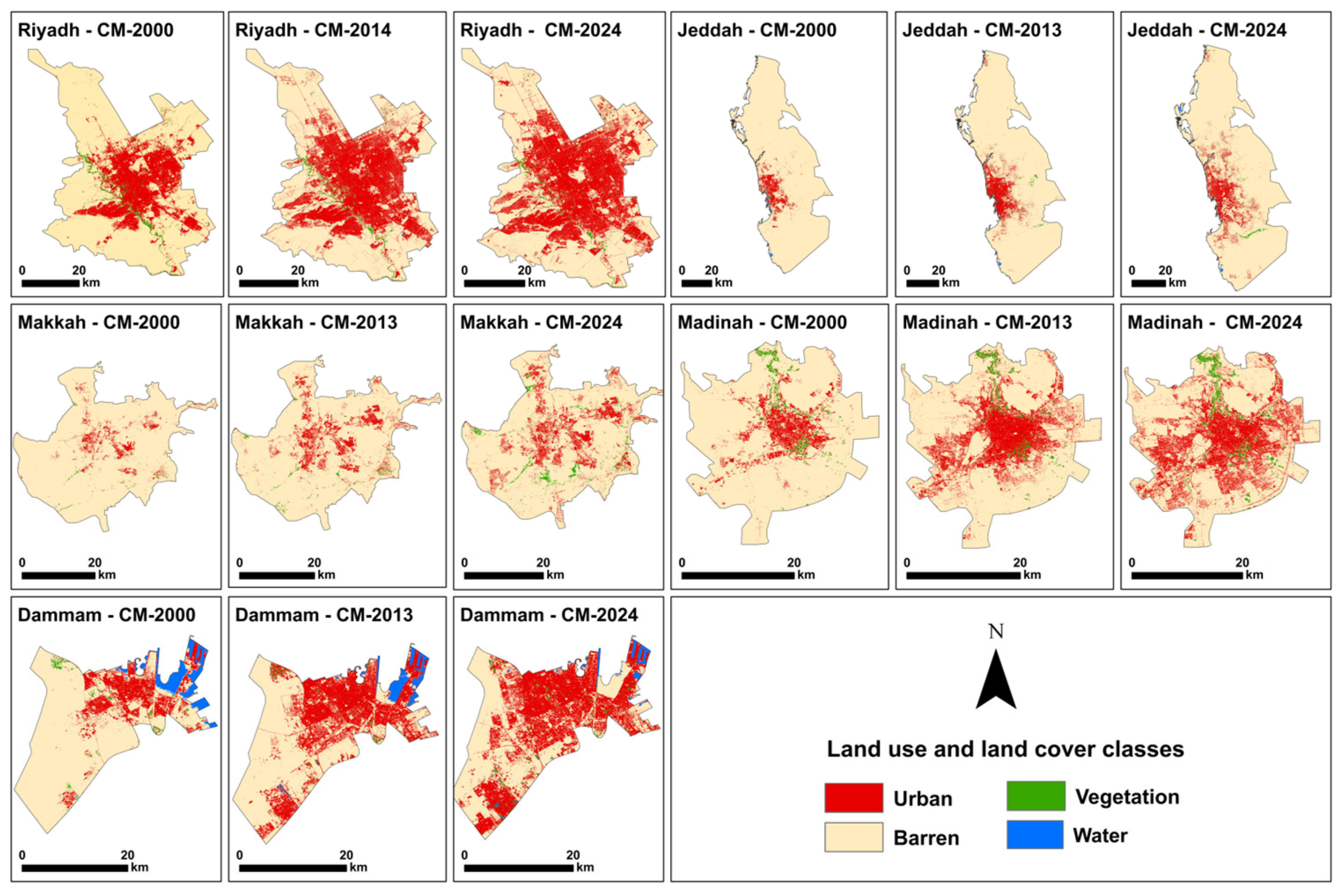
Figure 4 shows the spatial and temporal classification maps for the five cities from 2000 to 2024. Table 6 presents detailed information on the total area and the change in area, in square kilometers, of the LULC classes in each city throughout the study period. Each LULC map has either four or three major classes: urban areas, barren lands, vegetation, and water. The urban areas in the five cities expanded by 448.84 km2 (73.24%), 179.67 km2 (75.93%), 95.69 km2 (174.52%), 126.33 km2 (175.94%), and 177.96 km2 (169.47%) in Riyadh, Jeddah, Makkah, Madinah, and Dammam, respectively, from 2000 to 2024. In addition, the vegetation cover increased in Jeddah, Makkah, Madinah, and Dammam by 24.22 km2 (279.35%), 24.21 km2 (467.37%), 8.24 km2 (50.67%), and 1.94 km2 (24.12%), respectively, while Riyadh showed a decrease between 2000 and 2024. In arid and semi-arid regions, water bodies were limited to the inner cities, but Jeddah and Dammam featured water classifications due to their proximity to the Red Sea and Arabian Gulf.

3.2. Annual Variation in LST

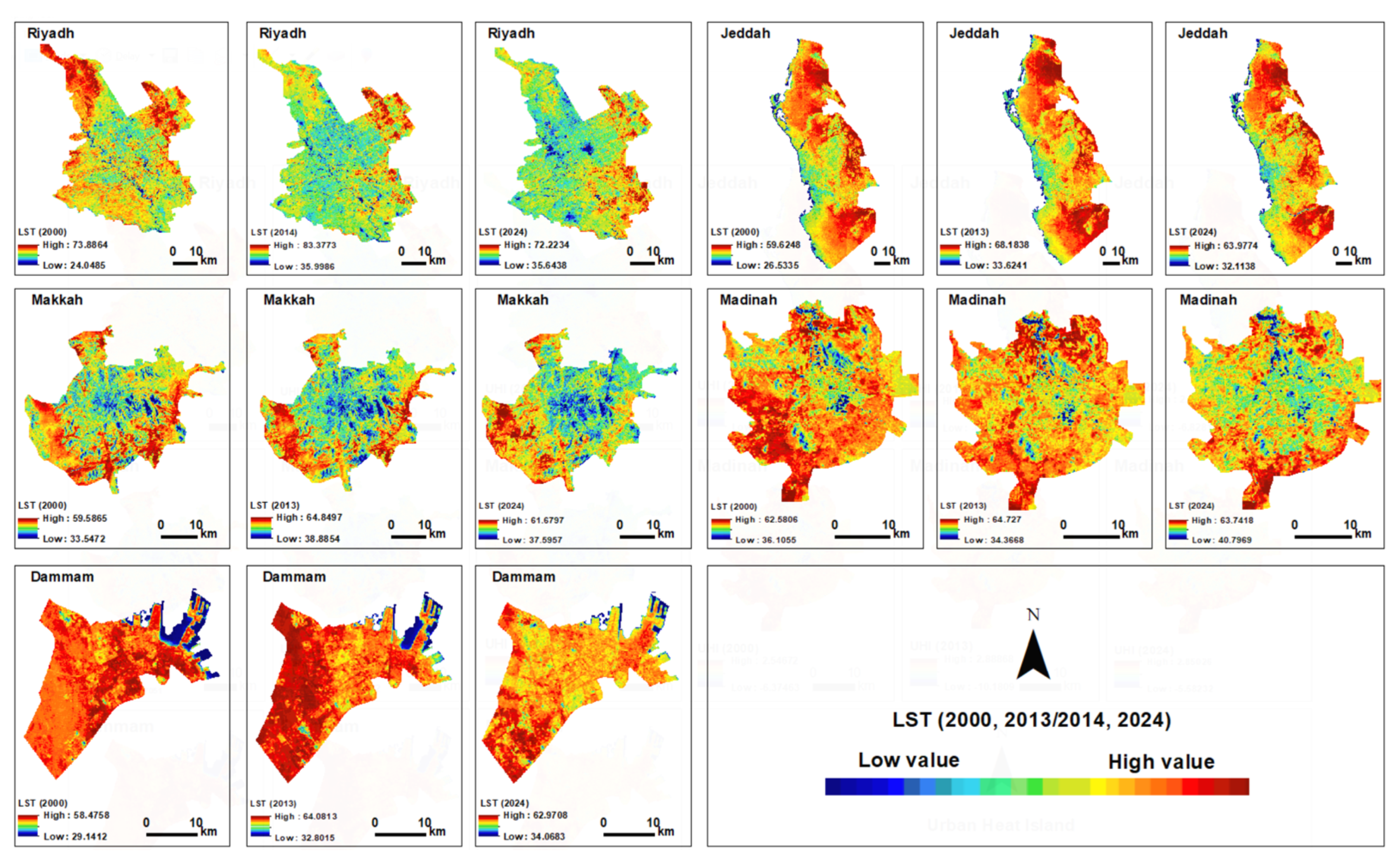
The annual LST was estimated using Google Earth Engine for the major populated cities in Saudi Arabia over three time intervals spanning 2000–2024. All the LST values were computed for the summer, from May to August. Saudi cities are situated in arid and semi-arid environments, and this factor, along with others, such as geographic location, urban expansion, vegetation cover, and proximity to bodies of water, influences the land surface temperature. Figure 5 shows the spatial and temporal maps of the LSTs of the cities over the study period. Table 7 provides the LST means (°C) for each LULC class in 2000, 2013/2014, and 2024, along with the change values over the study period. The urban areas increased over time in Riyadh (8.31 °C), Jeddah (5.24 °C), and Makkah (1.41 °C), but decreased in Madinah and Dammam compared to 2000–2024. The vegetation and water cover were limited, and the influence of dominant urban areas and barren lands was greater, as shown by the higher temperatures in all the cities, except Dammam, which had a lower temperature.

3.3. Analysis of UHI Effect Intensity and UTFVI

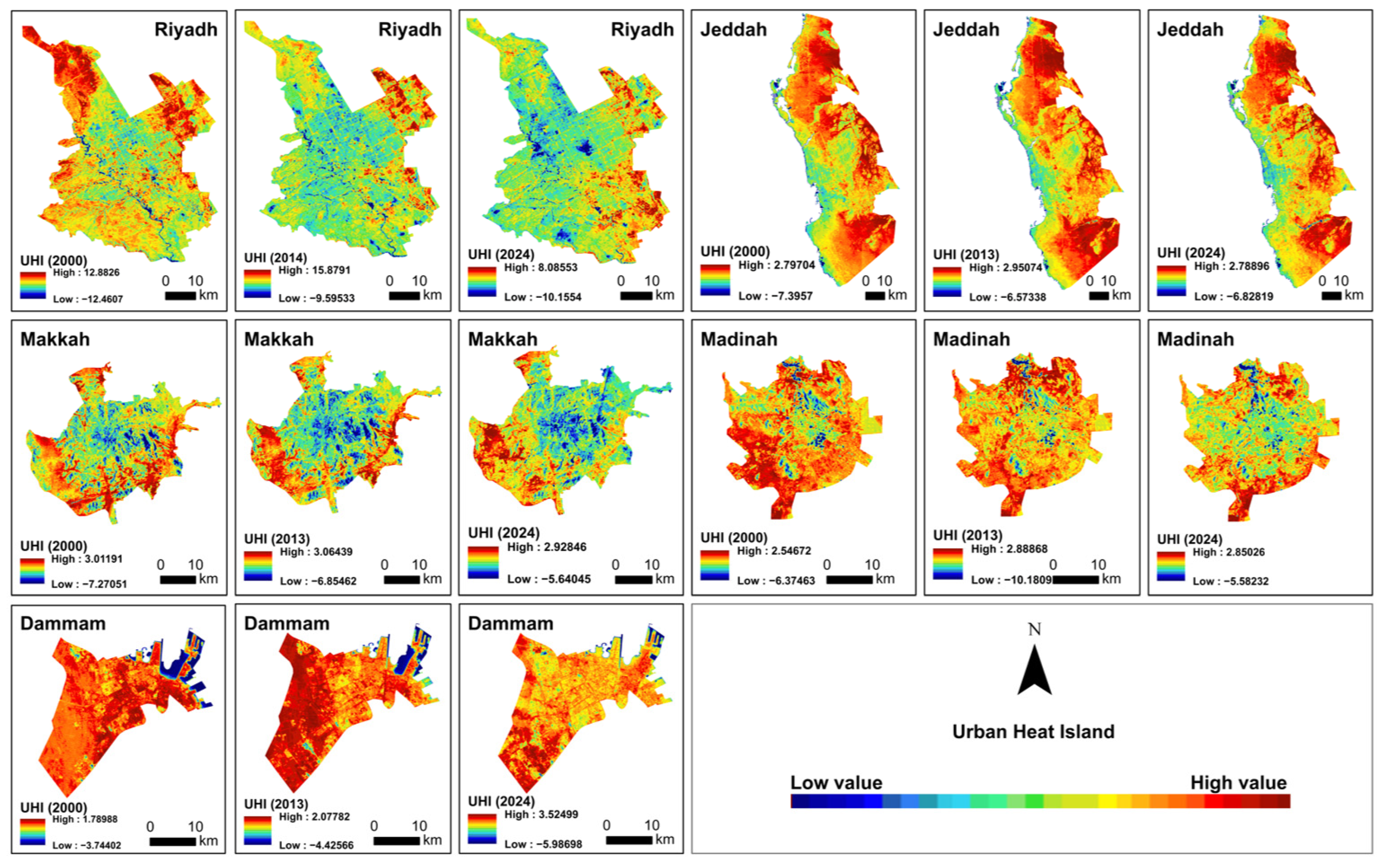
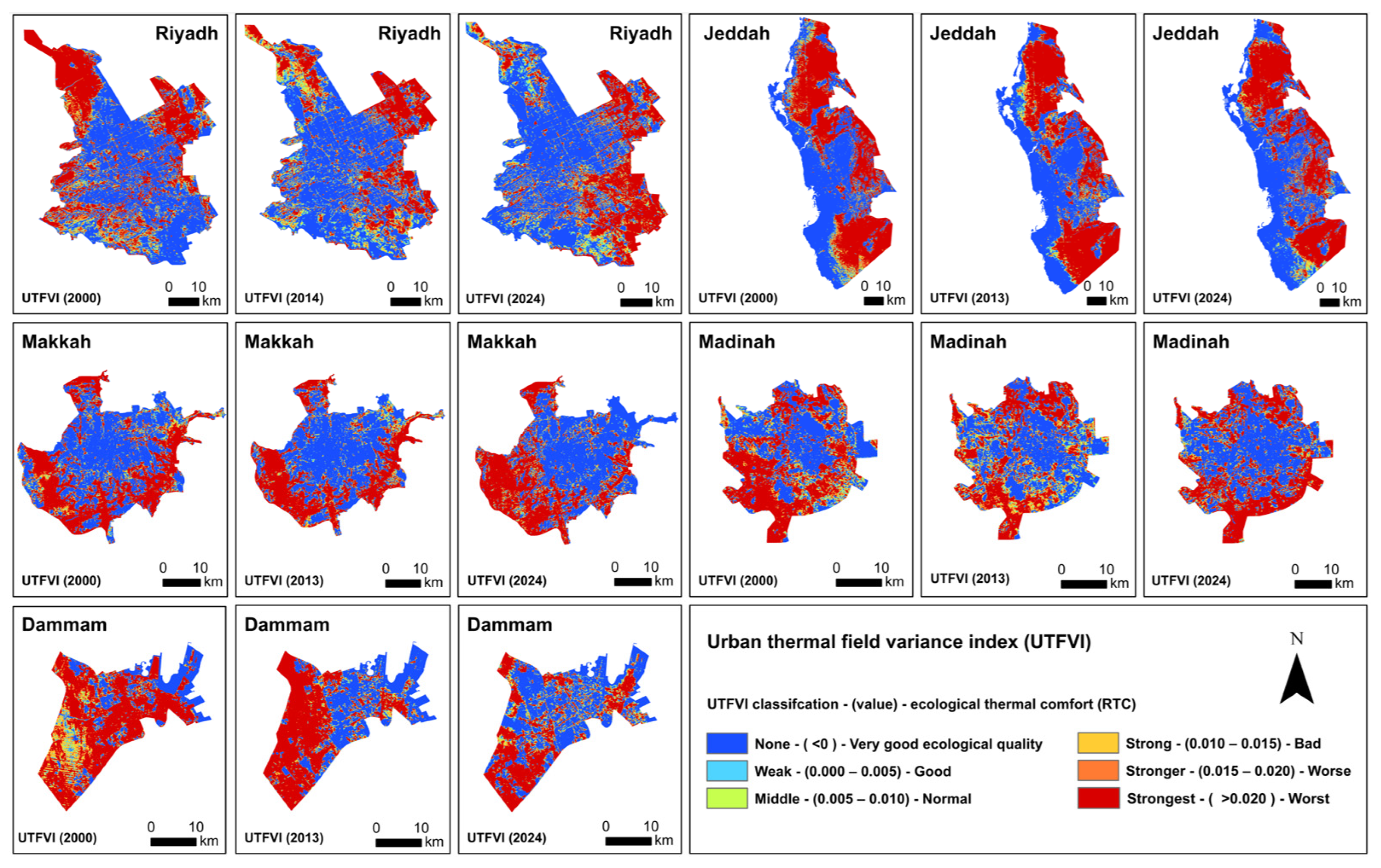
The UHI effect is a crucial metric used to define the thermal comfort in cities and compare urban areas with the surrounding LULC classes, such as barren lands, vegetation cover, and water bodies. The UHI effect can be measured across the three time intervals and used to enhance the quality of life across the five cities. Figure 6 presents the UHI effect in Riyadh, Jeddah, Makkah, Madinah, and Dammam over the study period. Overall, the UHI effect shows increased temperatures in some urban areas and barren lands, while its minimum values are concentrated around vegetation cover and water bodies. Figure 7 shows the UTFVI in the five major cities, which were classified into six ecological qualities of thermal comfort. The high and extreme values of the UTFVI indicate severe thermal stress and reduced thermal comfort, which is clearly evident in the urban areas across cities such as Riyadh, Makkah, Madinah, Dammam, and Jeddah, as well as in barren lands. At the same time, a low thermal discomfort was observed in some urban areas, especially around vegetation and water bodies.

3.4. Integrated Thermal–Land-Use Analysis

3.4.1. The DiD Approach and Thermal Effect Size

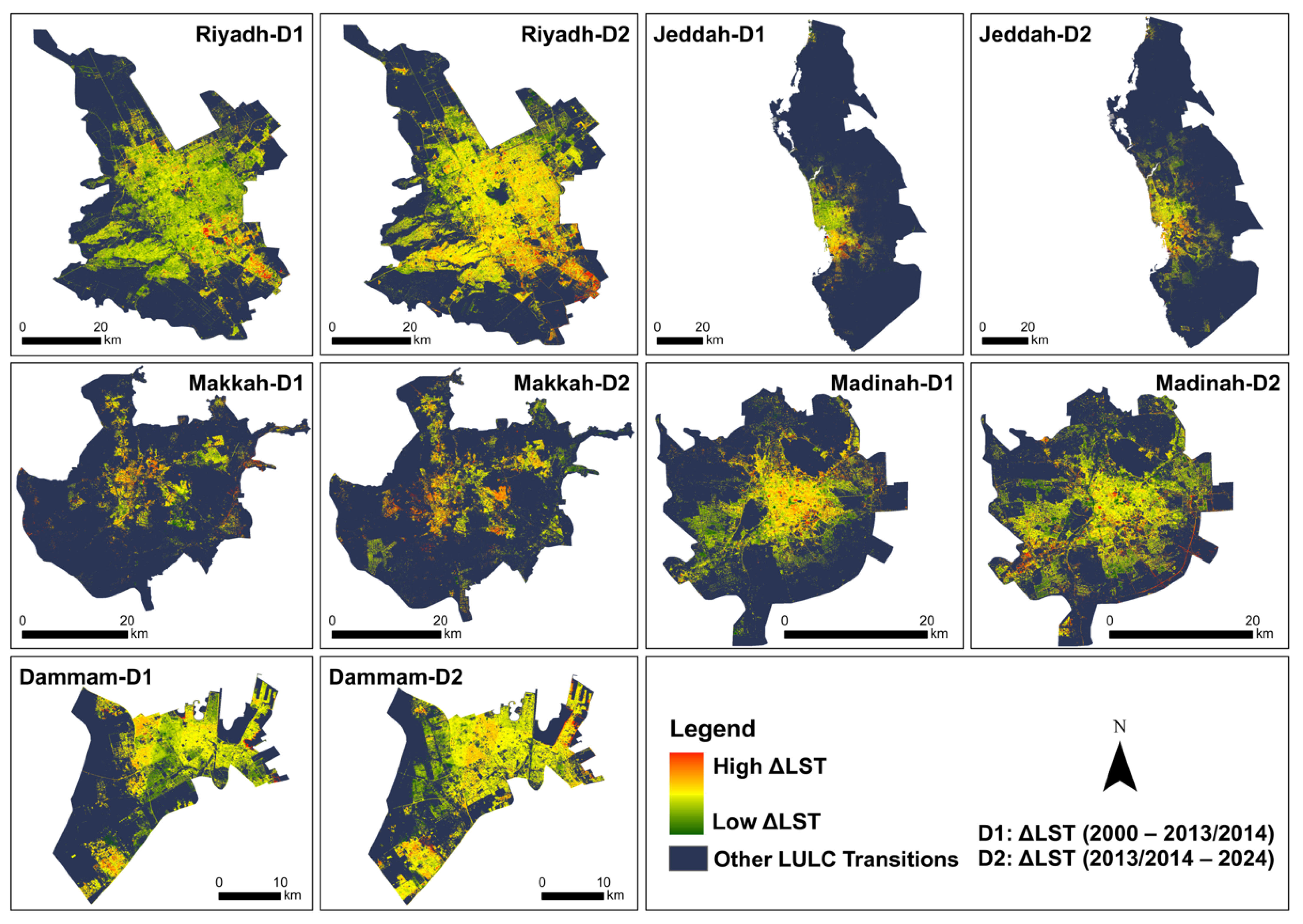
The DiD analytical approach was used to consider the three major LULC transitions, barren-to-urban, vegetation-to-urban, and urban-to-urban, through a spatial dimension based on the differences in the LST in two time intervals (2000–2013/2014 and 2013/2014–2024), as shown in Figure 8. The higher ΔLST values in the five cities were mostly associated with industrial regions (Riyadh, Jeddah, and Dammam), airports/seaports (Jeddah, Riyadh, and Dammam), transportation networks (Madinah), and residential areas with impervious surfaces and limited vegetation areas (Makkah, Madinah, and Jeddah).
Furthermore, the effect size used in this study considers the degree of LST change when the LULC is converted from one land type to urban, compared with stable urban areas. The effect sizes of the LST, the UHI effect, and the UTFVI across the three transitions were calculated by subtracting the conversion of barren lands and vegetation from the baseline stable urban areas. Table 8 shows three distinguishable patterns of the thermal effect size: (1) an increase due to the conversion from barren to urban compared with stable urban areas, (2) a decrease due to the conversion from vegetation to urban area compared with stable urban areas, and (3) other patterns where both factors either increase or decrease. Throughout this study’s time intervals, most of the cities exhibited the first pattern. Riyadh, Jeddah, and Madinah experienced an increase in the effect size of the thermal indicators from barren lands to urban areas, as urban impervious surfaces absorb, store, and trap more heat while reducing the vegetation’s cooling effect. Additionally, the second pattern, a decrease in the LST compared with stable urban areas as vegetation areas are converted to urban areas, was observed in most of the cities, especially in arid and semi-arid regions where the original vegetation is sparse, dry grass, shrub, or water-stressed and shows limited evapotranspiration. Conversely, the urban areas include irrigated green spaces, higher-albedo surfaces, and shading effects that help reduce surface heating. In the third pattern, the conversion of vegetated areas to urban areas significantly increases the LST by reducing the moisture cooling and increasing the solar radiation effect through urban impervious surfaces, thereby enhancing the urban heat island effects. The third pattern was also limited due to the observed decrease in the thermal effect size through the conversion from barren lands to urban areas. This can be attributed to the extremely high thermal response of dryness in arid and semi-arid lands and moisture-deficient barren surfaces compared to existing irrigated vegetation, higher-albedo surfaces, and shading in urban environments, leading to urban cooling in arid regions—this is called the oasis effect.

3.4.2. Relationship Between LST and NDVI–NDBI

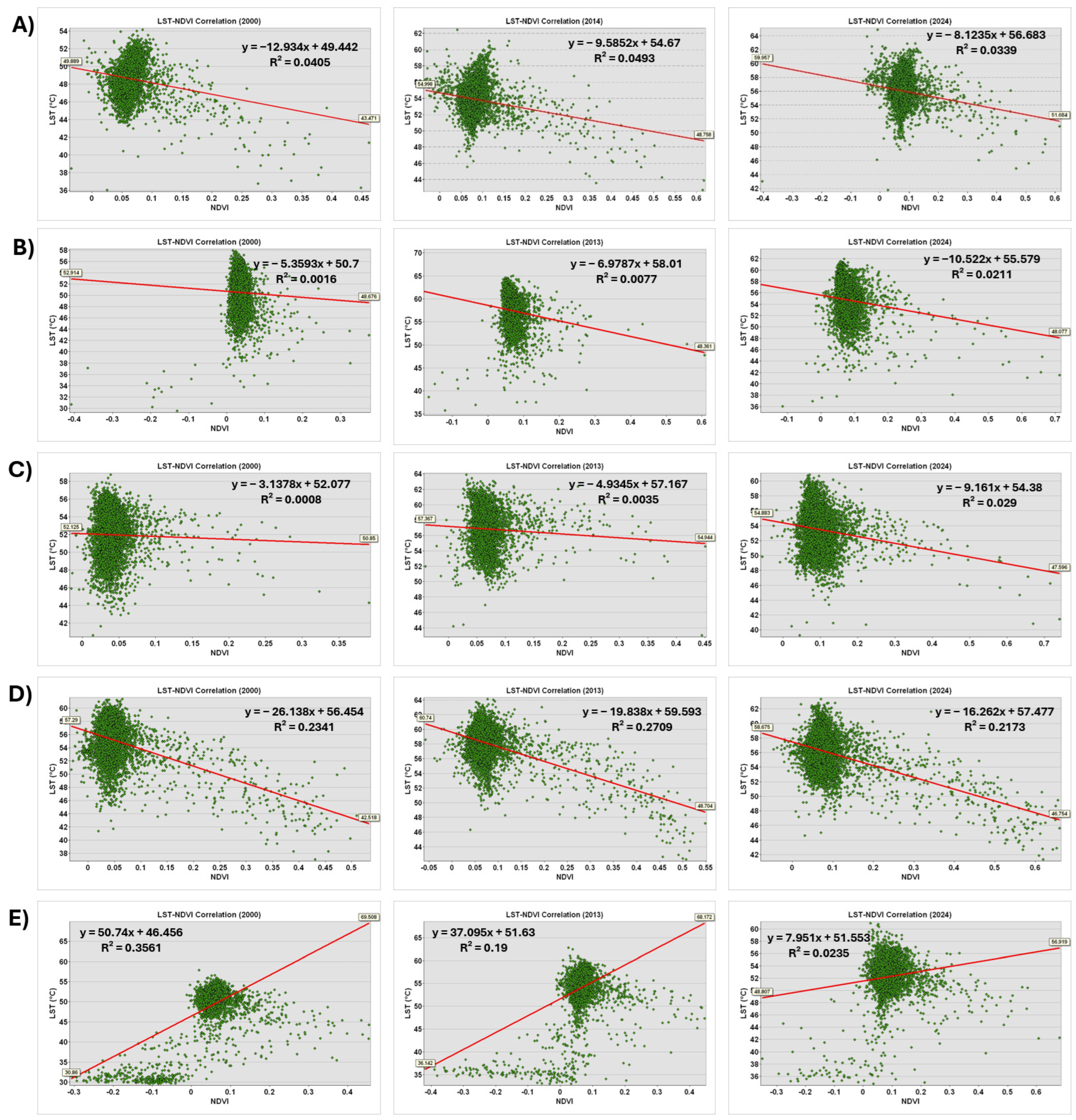
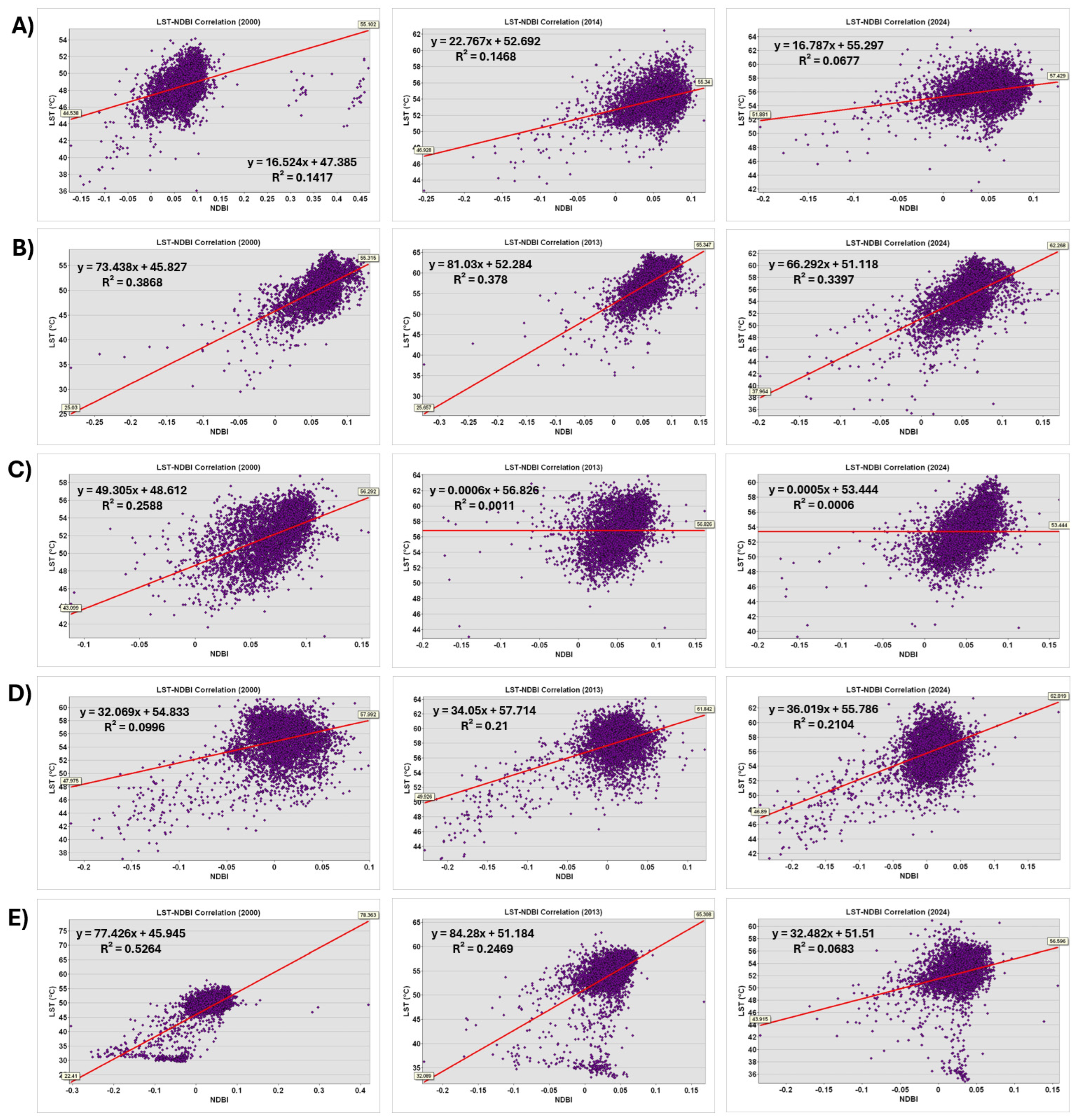
Figure 9 illustrates the LST and NDVI relationships across the five cities and three time intervals. The NDVI values were generally low across the observation cities, around 0.2, with a few points exceeding this value, indicating sparse and limited vegetated areas. The relationship shows a negative trend, indicating that even limited vegetated areas are associated with a slight reduction in the LST. The relationship varied across Makkah and Madinah during two time intervals, revealing a slightly weak, negative relationship, despite the NDVI values remaining within the same range. In addition, Dammam shows a positive trend across the three study periods, even though the NDVI values include some negative values within a range comparable to the other cities. These inconsistencies across cities and times indicate that dense vegetation cover is low and limited to specific areas, suggesting that the NDVI may not be the primary factor controlling the LST values. Other factors, such as built-up areas, barren lands, and seasonal change, may have a stronger influence on the LST values and patterns. Figure 10 shows a scatter plot of the relationship between the LST and the NDBI for the five cities across three time intervals: 2000, 2013/2014, and 2024. Riyadh, Jeddah, Madinah, and Dammam show a positive relationship across the intervals. The areas with a higher built-up intensity exhibit a higher LST, reflecting urban expansion and impervious surfaces that absorb and retain more solar radiation, thus contributing to the warming of the local urban thermal environment.

4. Discussion

This study provides a complete overview of the five cities and a detailed analysis of each city using a novel approach that integrates thermal–land-use analysis. The results indicate the existence of the heat island effect, which was significantly reflected in the higher surface temperature observed in densely built-up areas with impervious surfaces that trap heat and solar radiation, specifically in industrial areas, transportation infrastructure (airport, seaport, highway), and residential areas with limited vegetation. Urban areas increased across Riyadh, Jeddah, Makkah, Madinah, and Dammam between 2000 and 2024 (Table 6). In addition, the LST between 2000 and 2024 also increased in three cities, Riyadh, Jeddah, and Makkah, but also decreased slightly in Madinah and Dammam (Table 7). Although the vegetation cover contributes to reducing a city’s surface temperature and has a cooling effect, the limited, scattered, and shrub vegetation cover weakened its influence on the LST compared with that of the total urban area. Water bodies in the coastal cities such as Jeddah and Dammam played a crucial role in mitigating the surface temperatures. These roles can be limited in the inner cities such as Riyadh, Makkah, and Madinah. The location and characteristics of the urban areas in these cities play an essential role in shaping the land surface temperature, whereby they directly affect the intensity and extent of the UHI phenomenon.
Many studies have observed a rise in the surface temperatures of urban areas, especially in areas featuring the expansion of urban impervious surfaces, the reduction in vegetation area, the increase in building density, the change in building morphology, the variation in anthropogenic heat emissions, and the absence of water bodies. Most of these factors apply to Saudi cities and contribute to the observation of increases in surface temperatures. For example, Riyadh, Jeddah, and Dammam showed increases in surface temperatures in industrial regions; this aligns with the findings of a study conducted in Jeddah city by Miky (2019) that found that the southern part of Jeddah—especially in the Petromin and Almohajer neighborhoods—has higher temperatures [35]. This study confirmed that the relationship between the LST and urban areas/the NDBI has increased significantly; similar increases have been observed in other arid and semi-arid environments, including the Al-Kut Region, Iraq; Lahore, Pakistan; and Arizona, USA [72,73,74]. On the contrary, as Saudi Arabia shows increasing temperatures in urban areas, especially in areas with limited vegetation, the Tigray region in northern Ethiopia, located in an arid and semi-arid region, shows a negative and moderate relationship between the LST and the NDBI, due to the mix of urban areas with vegetation cover, which helps cool urban environments [75].
Transportation infrastructure, such as airports, seaports, and roads, also showed an increase in the surface temperature, emphasizing the UHI effect due to their use of impervious surface materials, resulting in anthropogenic heat emissions, limited vegetation cover, and large, exposed service areas, such as King Abdulaziz International Airport in Jeddah and the southern highway in Madinah, as shown in Figure 6. These observations are in agreement with a study conducted in two districts in Makkah, Al-Sharashef and Al-Eskan, that compared the two types of roads within the two districts. The results revealed that a rectilinear city layout increases the temperature more than the organic/compact urban fabric layout [34], and that high-density urban expansion clustering shows a higher surface temperature compared with other urban areas, as observed in Makkah city. Moreover, this also coincides with another study, one conducted in Ahsa Oasis, eastern Saudi Arabia by Hassaballa & Salih (2023) [38], which examined the spatiotemporal pattern of the UHI effect between 1990 and 2020. Its findings showed a clear association between urban areas and thermal load, evidenced by high-density clustering in highly urbanized areas [38].
This study’s findings revealed areas with high surface temperatures. Not only that, but also it was found that increasing the level of the UTFVI and intensifying the UHI effect may increase thermal discomfort, influencing human health and affecting urban sustainability. These high temperatures will make the population more vulnerable, especially children, the elderly, and in low-income communities. In addition, the higher surface temperatures may negatively affect the agricultural system in urban and peri-urban areas by increasing crop stress and reducing soil moisture, thereby influencing agricultural productivity, livestock products, and food security, especially in densely populated areas such as the major Saudi cities [76,77,78]. In light of this, it becomes clear that urban planners, municipalities, secretariats, and decision-makers must play important roles in reassessing these heat hotspots, reconsidering their development mechanisms, addressing the increasing surface temperatures, and requiring initiatives to improve the quality of Saudi cities.
For example, green-blue strategies, which involve nature-based solutions that aim to reduce heat in urban areas, should be implemented, with green representing vegetation and blue representing all forms of water bodies [79]. Recently, the Saudi Arabian government launched several initiatives, including the Saudi Green Initiative, Green Riyadh, and Urban Afforestation. These initiatives aim to plant billions of trees, expand garden parks and green corridors, and increase shading and evapotranspiration by 2030, helping lower surface temperatures, boost urban thermal comfort, and continue the pursuit of a sustainable environment and green cities, which will have a positive effect on human quality of life [80,81].
Moreover, both the oasis and inverse UHI (IUHI) phenomena were identified by monitoring the spatial variability in the surface temperature during the daytime in the summer months (May to August) in the arid and semi-arid climatic zones of Saudi cities across four LULC classes [82,83]. As shown in Figure 6, the oasis UHI effect was observed in Makkah and Jeddah; as the vegetated and water-covered areas consistently show lower surface temperatures compared to surrounding land use surfaces, a spatially confined cooling effect known as the oasis effect occurs, which is associated with higher evaporation and a reduction in the heat storage of these land cover areas. By contrast, in arid and semi-arid environments, barren lands—consisting of large desert and rocky mountain areas—show higher LST values than the city and the adjacent urban areas during the summer. Examples of this are clearly shown in Figure 4, Figure 5 and Figure 6 across all the major cities. These IUHI effect patterns are likely influenced by soil dryness, higher solar radiation exposure, limited vegetation, and shading area. According to a study conducted by Munir et al. (2025) [33], the six cities studied between 1994 and 2024, including Riyadh, Makkah, Madinah, Dammam, and Abha, show that overall temperatures increase significantly more in urban areas than in rural areas. However, the urban areas in the rural areas showed a significantly hotter reversal of the UHI effect by 1.5–1.7 °C. This confirmed the observed results: and increase in temperature in urban areas and the reverse UHI effect between rural and urban areas. These findings reveal the importance of the LULC transition and its composition in shaping LST behavior and the UHI effect intensity.
Finally, several challenges were encountered in achieving this study’s objectives. Specifically, due to its spatial resolution (30 m), the Landsat satellite imagery was unable to capture small details, such as the presence of limited urban areas within barren lands or limited vegetated areas and/or water bodies within urban areas, which may affect the LULC accuracy. In addition, the special resolution of the Landsat limited the detection of urban heterogeneity, especially in the dense arid urban areas. Additionally, the overlapping areas between two images located in the middle of a city, such as Riyadh and Dammam, may influence the processing of the thermal indicators, even when using an image enhancement technique. Thus, such issues need to be addressed and considered in future research. This study investigated the LULC and urban thermal indices within the city administration boundary, without accounting for the rural baseline, which would have improved the analysis if considered; it may need to be considered in forthcoming research. In addition, the DiD analytical framework used in this study is based on the two-period design, which limits the parallel trends assumption. Thus, the estimation of the thermal effect size was explained as an association rather than a direct causal effect. This research focused on the dynamics of LULC changes during the summer, which is known to exhibit certain urban thermal behaviors; however, many factors and drivers influence urban thermal indicators, and these should be addressed in future research, including the topography (slope, elevation, aspect), seasonality (winter season), soil characteristics (moisture condition), and anthropogenic activities (traffic and land use types). Considering these factors is expected to increase our understanding of surface temperature behavior and thermal comfort analysis.

5. Conclusions

This study observed the heat island effect, which was significantly evident in the higher surface temperatures of densely built-up areas with impervious surfaces that trap heat and solar radiation, particularly in industrial areas, transportation infrastructure (airport, seaport, highway), and urban areas with open space and limited vegetation cover. The LSTs of the urban areas of three cities, Riyadh, Jeddah, and Makkah, illustrate an increase between 2000 and 2024, while the other cities, Madinah and Dammam, show a decline over time. In addition, some areas across the cities experienced a decline in the level of thermal comfort, which requires more attention to improve it in the future. The DiD analytical approach shows that the impact of the three LULC transitions, especially from barren-to-urban and vegetation-to-urban, when compared with stable urban areas, is a clearly higher surface temperature. The relationship between the LST and the NDVI varies across the cities and has a weaker impact due to lower vegetation cover, whereas the relationship between the LST and the NDVI shows a clear increase. Although this work provides comprehensive information on the impact of LULC on surface temperature and thermal comfort across the five cities, future research should also consider other contributing factors and drivers, such as nighttime effects, seasonality, topography, and local climate. Considering such factors will likely provide a detailed, synoptic view of urban climate science across multiple dimensions in Saudi cities.

Funding

This research received no external funding.

Institutional Review Board Statement

Not applicable.

Informed Consent Statement

Not applicable.

Data Availability Statement

The contributions presented in this research are included within the article, and further inquiries can be referred to the corresponding author.

Acknowledgments

The author sincerely thanks the anonymous reviewers for their insightful comments and constructive feedback, which have significantly improved this article.

Conflicts of Interest

The author declares no conflicts of interest.

References

  1. United Nations. The World’s Cities in 2025 • Data Booklet—The United Nations. Available online: https://www.un.org/development/desa/pd/sites/www.un.org.development.desa.pd/files/undesa_pd_2025_data-booklet_world_cities_in_2025.pdf (accessed on 18 February 2026).
  2. Tian, P.; Li, J.; Cao, L.; Pu, R.; Wang, Z.; Zhang, H.; Chen, H.; Gong, H. Assessing Spatiotemporal Characteristics of Urban Heat Islands from the Perspective of an Urban Expansion and Green Infrastructure. Sustain. Cities Soc. 2021, 74, 103208. [Google Scholar] [CrossRef]
  3. United Nations. World Population Projected to Reach 9.8 Billion in 2050, and 11.2 Billion in 2100; UN: New York, NY, USA, 2025. [Google Scholar]
  4. Zhou, D.; Xiao, J.; Bonafoni, S.; Berger, C.; Deilami, K.; Zhou, Y.; Frolking, S.; Yao, R.; Qiao, Z.; Sobrino, J.A. Satellite Remote Sensing of Surface Urban Heat Islands: Progress, Challenges, and Perspectives. Remote Sens. 2018, 11, 48. [Google Scholar] [CrossRef]
  5. Sibandze, P.; Kalumba, A.M.; Aljaddani, A.H.; Zhou, L.; Afuye, G.A. Geospatial Mapping and Meteorological Flood Risk Assessment: A Global Research Trend Analysis. Environ. Manag. 2025, 75, 137–154. [Google Scholar] [CrossRef]
  6. Song, X.-P.; Hansen, M.C.; Stehman, S.V.; Potapov, P.V.; Tyukavina, A.; Vermote, E.F.; Townshend, J.R. Global Land Change from 1982 to 2016. Nature 2018, 560, 639–643. [Google Scholar] [CrossRef] [PubMed]
  7. Ghorbany, S.; Hu, M.; Yao, S.; Wang, C. Towards a Sustainable Urban Future: A Comprehensive Review of Urban Heat Island Research Technologies and Machine Learning Approaches. Sustainability 2024, 16, 4609. [Google Scholar] [CrossRef]
  8. Li, J.; Zheng, B.; Shen, W.; Xiang, Y.; Chen, X.; Qi, Z. Cooling and Energy-Saving Performance of Different Green Wall Design: A Simulation Study of a Block. Energies 2019, 12, 2912. [Google Scholar] [CrossRef]
  9. UN. Habitat Climate Change; UN: New York, NY, USA, 2026. [Google Scholar]
  10. Wang, Y.; Wang, H.; Yao, F.; Stouffs, R.; Wu, J. An Integrated Framework for Jointly Assessing Spatiotemporal Dynamics of Surface Urban Heat Island Intensity and Footprint: China, 2003–2020. Sustain. Cities Soc. 2024, 112, 105601. [Google Scholar] [CrossRef]
  11. Song, X.-P.; Sexton, J.O.; Huang, C.; Channan, S.; Townshend, J.R. Characterizing the Magnitude, Timing and Duration of Urban Growth from Time Series of Landsat-Based Estimates of Impervious Cover. Remote Sens. Environ. 2016, 175, 1–13. [Google Scholar] [CrossRef]
  12. Han, J.-Y.; Li, S.-Y.; Chen, Y.-C. Estimation of Solar Photovoltaic Efficiency under the Urban Heat Island Effect. Renew. Energy 2025, 242, 122492. [Google Scholar] [CrossRef]
  13. Wang, Y.; Zhang, Y.; Ding, N.; Qin, K.; Yang, X. Simulating the Impact of Urban Surface Evapotranspiration on the Urban Heat Island Effect Using the Modified RS-PM Model: A Case Study of Xuzhou, China. Remote Sens. 2020, 12, 578. [Google Scholar] [CrossRef]
  14. Shao, H.; Kim, G. A Comprehensive Review of Different Types of Green Infrastructure to Mitigate Urban Heat Islands: Progress, Functions, and Benefits. Land 2022, 11, 1792. [Google Scholar] [CrossRef]
  15. Gunawardena, K.R.; Wells, M.J.; Kershaw, T. Utilising Green and Bluespace to Mitigate Urban Heat Island Intensity. Sci. Total Environ. 2017, 584–585, 1040–1055. [Google Scholar] [CrossRef]
  16. Hayes, A.; Jandaghian, Z.; Lacasse, M.; Gaur, A.; Lu, H.; Laouadi, A.; Ge, H.; Wang, L. Nature-Based Solutions (NBSs) to Mitigate Urban Heat Island (UHI) Effects in Canadian Cities. Buildings 2022, 12, 925. [Google Scholar] [CrossRef]
  17. Leal Filho, W.; Echevarria Icaza, L.; Emanche, V.; Quasem Al-Amin, A. An Evidence-Based Review of Impacts, Strategies and Tools to Mitigate Urban Heat Islands. Int. J. Environ. Res. Public Health 2017, 14, 1600. [Google Scholar] [CrossRef]
  18. Zou, Z.; Yan, C.; Yu, L.; Jiang, X.; Ding, J.; Qin, L.; Wang, B.; Qiu, G. Impacts of Land Use/Land Cover Types on Interactions between Urban Heat Island Effects and Heat Waves. Build. Environ. 2021, 204, 108138. [Google Scholar] [CrossRef]
  19. Assaf, G.; Assaad, R.H. Modeling the Impact of Land Use/Land Cover (LULC) Factors on Diurnal and Nocturnal Urban Heat Island (UHI) Intensities Using Spatial Regression Models. Urban Clim. 2024, 55, 101971. [Google Scholar] [CrossRef]
  20. Tian, L.; Yang, J.; Jin, C. Dynamic Changes in Land Cover and Its Effect on Urban Heat Islands. IEEE J. Sel. Top. Appl. Earth Obs. Remote Sens. 2024, 17, 2386–2395. [Google Scholar] [CrossRef]
  21. Noreena; Moazzam, M.F.U.; Jamil, M.; Arshad, S. Dynamics of Land Cover/Land Use with Heat Islands Phenomenon and Its Ecological Evaluation Using Remote Sensing Data (1992–2022). Environ. Dev. Sustain. 2025. [Google Scholar] [CrossRef]
  22. Zhu, Z.; Zhou, Y.; Seto, K.C.; Stokes, E.C.; Deng, C.; Pickett, S.T.A.; Taubenböck, H. Understanding an Urbanizing Planet: Strategic Directions for Remote Sensing. Remote Sens. Environ. 2019, 228, 164–182. [Google Scholar] [CrossRef]
  23. Aljaddani, A.H. Geospatial Analysis of Patterns and Trends of Mangrove Forest in Saudi Arabia: Identifying At-Risk Zone-Based Land Use. Sustainability 2025, 17, 5957. [Google Scholar] [CrossRef]
  24. Zhu, Z.; Wulder, M.A.; Roy, D.P.; Woodcock, C.E.; Hansen, M.C.; Radeloff, V.C.; Healey, S.P.; Schaaf, C.; Hostert, P.; Strobl, P.; et al. Benefits of the Free and Open Landsat Data Policy. Remote Sens. Environ. 2019, 224, 382–385. [Google Scholar] [CrossRef]
  25. Khamchiangta, D.; Dhakal, S. Time Series Analysis of Land Use and Land Cover Changes Related to Urban Heat Island Intensity: Case of Bangkok Metropolitan Area in Thailand. J. Urban Manag. 2020, 9, 383–395. [Google Scholar] [CrossRef]
  26. Yeo, L.B.; Ling, G.H.T.; Tan, M.L.; Leng, P.C. Interrelationships between Land Use Land Cover (LULC) and Human Thermal Comfort (HTC): A Comparative Analysis of Different Spatial Settings. Sustainability 2021, 13, 382. [Google Scholar] [CrossRef]
  27. Arsiso, B.K. Urban Land Cover Transformations and Thermal Dynamics through Integrated LULC, UHI, and Ecological Vulnerability Assessment Using Remote Sensing Indices in the City of Addis Ababa, Ethiopia. Sustain. Cities Soc. 2025, 135, 107017. [Google Scholar] [CrossRef]
  28. Njoku, E.A.; Tenenbaum, D.E. Quantitative Assessment of the Relationship between Land Use/Land Cover (LULC), Topographic Elevation and Land Surface Temperature (LST) in Ilorin, Nigeria. Remote Sens. Appl. 2022, 27, 100780. [Google Scholar] [CrossRef]
  29. Grigoraș, G.; Urițescu, B. Land Use/Land Cover Changes Dynamics and Their Effects on Surface Urban Heat Island in Bucharest, Romania. Int. J. Appl. Earth Obs. Geoinf. 2019, 80, 115–126. [Google Scholar] [CrossRef]
  30. Silva, R.; Carvalho, A.C.; Pereira, S.C.; Carvalho, D.; Rocha, A. Lisbon Urban Heat Island in Future Urban and Climate Scenarios. Urban Clim. 2022, 44, 101218. [Google Scholar] [CrossRef]
  31. Li, X.; Zhou, Y.; Asrar, G.R.; Imhoff, M.; Li, X. The Surface Urban Heat Island Response to Urban Expansion: A Panel Analysis for the Conterminous United States. Sci. Total Environ. 2017, 605–606, 426–435. [Google Scholar] [CrossRef]
  32. Wang, C.; Myint, S.; Wang, Z.; Song, J. Spatio-Temporal Modeling of the Urban Heat Island in the Phoenix Metropolitan Area: Land Use Change Implications. Remote Sens. 2016, 8, 185. [Google Scholar] [CrossRef]
  33. Munir, S.; Habeebullah, T.M.A.; Zamreeq, A.O.; Alfehaid, M.M.A.; Ismail, M.; Khalil, A.A.; Baligh, A.A.; Islam, M.N.; Jamaladdin, S.; Ghulam, A.S. Cooling of Maximum Temperatures in Six Saudi Arabian Cities (1994–2024)—Reversal of Urban Heat Islands. Urban Sci. 2025, 9, 445. [Google Scholar] [CrossRef]
  34. Mohamed, M.; Othman, A.; Abotalib, A.Z.; Majrashi, A. Urban Heat Island Effects on Megacities in Desert Environments Using Spatial Network Analysis and Remote Sensing Data: A Case Study from Western Saudi Arabia. Remote Sens. 2021, 13, 1941. [Google Scholar] [CrossRef]
  35. Miky, Y.H. Remote Sensing Analysis for Surface Urban Heat Island Detection over Jeddah, Saudi Arabia. Appl. Geomat. 2019, 11, 243–258. [Google Scholar] [CrossRef]
  36. Arshad, M.; Khedher, K.M.; Eid, E.M.; Aina, Y.A. Evaluation of the Urban Heat Island over Abha-Khamis Mushait Tourist Resort Due to Rapid Urbanisation in Asir, Saudi Arabia. Urban Clim. 2021, 36, 100772. [Google Scholar] [CrossRef]
  37. Abd El-Hamid, H.T.; Arshad, M.; Eid, E.M. The Effects of Coastal Development on the Urban Heat Island in the Mangrove Ecosystem along the Jazan Coast, KSA. J. Coast. Conserv. 2022, 26, 70. [Google Scholar] [CrossRef]
  38. Hassaballa, A.; Salih, A. A Spatio-Temporal Analysis of Heat Island Intensity Influenced by the Substantial Urban Growth between 1990 and 2020: A Case Study of Al-Ahsa Oasis, Eastern Saudi Arabia. Appl. Sci. 2023, 13, 2755. [Google Scholar] [CrossRef]
  39. Alshayeb, M.J.; Bindajam, A.A.; Mallick, J.; Shohan, A.A.A. Integrating Fuzzy Logic and Land Use Dynamics to Delineate Urban Heat Island Formation Zones and Assess Land Surface Temperature Changes over Three Decades: A Case Study of Asir Region, Saudi Arabia. Stoch. Environ. Res. Risk Assess. 2025, 39, 3761–3780. [Google Scholar] [CrossRef]
  40. GAS. Population by Gender. Available online: https://www.stats.gov.sa/en/w/%D8%A7%D9%84%D8%B3%D9%83%D8%A7%D9%86-%D8%AD%D8%B3%D8%A8-%D8%A7%D9%84%D9%86%D9%88%D8%B9?tab=436332&category=417653 (accessed on 24 August 2025).
  41. Aljaddani, A.H.; Song, X.-P.; Zhu, Z. Characterizing the Patterns and Trends of Urban Growth in Saudi Arabia’s 13 Capital Cities Using a Landsat Time Series. Remote Sens. 2022, 14, 2382. [Google Scholar] [CrossRef]
  42. SGS. The Kingdom of Saudi Arabia: Facts and Figures. Available online: https://momah.gov.sa/sites/default/files/2021-10/%D8%A7%D9%84%D9%85%D9%85%D9%84%D9%83%D8%A9%20%D8%AD%D9%82%D8%A7%D8%A6%D9%82%20%D9%88%D8%A3%D8%B1%D9%82%D8%A7%D9%85%20%E2%80%93%20%D9%87%D9%8A%D8%A6%D8%A9%20%D8%A7%D9%84%D9%85%D8%B3%D8%A7%D8%AD%D8%A9%20%D8%A7%D9%84%D8%AC%D9%8A%D9%88%D9%84%D9%88%D8%AC%D9%8A%D8%A9%20%D8%A7%D9%84%D8%B3%D8%B9%D9%88%D8%AF%D9%8A%D8%A9.pdf (accessed on 23 February 2026).
  43. GEOSA. Official Map of Kingdom of Saudi Arabia. Available online: https://www.geoportal.sa/Geoportal/GeospatialOpenData/OfficialSaudiMap (accessed on 23 February 2026).
  44. NCM. A Summary of the Climatic Conditions in Argentina for the Year 2023. Available online: https://www.ncm.gov.sa/Ar/Climate/KSAClimate/Documents/%D9%85%D9%84%D8%AE%D8%B5%20%D9%85%D9%86%D8%A7%D8%AE%20%D8%A7%D9%84%D9%85%D9%85%D9%84%D9%83%D8%A9%20%D9%84%D8%B9%D8%A7%D9%85%202023%D9%85.pdf (accessed on 11 August 2025).
  45. NCM. Climate of the Kingdom of Saudi Arabia. Available online: https://www.mewa.gov.sa/en/Ministry/Agencies/EnvironmentAgency/Topics/Pages/KingdomClimate.aspx (accessed on 11 August 2025).
  46. CHIRPS. CHIRPS Daily Dataset. Available online: https://data.chc.ucsb.edu/products/CHIRPS-2.0/ (accessed on 23 February 2026).
  47. ECMWF. ERA5-Land Daily Aggregated Dataset. Available online: https://www.ecmwf.int/en/forecasts/datasets (accessed on 23 February 2026).
  48. USGS Landsat Images. Available online: https://developers.google.com/earth-engine/datasets/catalog/landsat (accessed on 5 June 2025).
  49. USGS. Landsat Satellite Missions. Available online: https://www.usgs.gov/landsat-missions/landsat-satellite-missions (accessed on 5 June 2025).
  50. Anderson, J.R.; Hardy, E.E.; Roach, J.T.; Witmer, R.E. A Land Use and Land Cover Classification System for Use with Remote Sensor Data; Professional Paper 964; USGS: Reston, VA, USA, 1976. [Google Scholar]
  51. Breiman, L. Random Forests. Mach. Learn. 2001, 45, 5–32. [Google Scholar] [CrossRef]
  52. Google Earth Engine. Ee.Classifier.SmileRandomForest; Google Earth Engine: Mountain View, CA, USA, 2023. [Google Scholar]
  53. Stehman, S.V. Sampling Designs for Accuracy Assessment of Land Cover. Int. J. Remote Sens. 2009, 30, 5243–5272. [Google Scholar] [CrossRef]
  54. Avdan, U.; Jovanovska, G. Algorithm for Automated Mapping of Land Surface Temperature Using LANDSAT 8 Satellite Data. J. Sens. 2016, 2016, 1480307. [Google Scholar] [CrossRef]
  55. Isaya Ndossi, M.; Avdan, U. Application of Open Source Coding Technologies in the Production of Land Surface Temperature (LST) Maps from Landsat: A PyQGIS Plugin. Remote Sens. 2016, 8, 413. [Google Scholar] [CrossRef]
  56. Rozenstein, O.; Qin, Z.; Derimian, Y.; Karnieli, A. Derivation of Land Surface Temperature for Landsat-8 TIRS Using a Split Window Algorithm. Sensors 2014, 14, 5768–5780. [Google Scholar] [CrossRef]
  57. Ihlen, V. Landsat 8 (L8) Data Users Handbook, Version 5.0.; Department of the Interior U.S. Geological Survey: Reston, VA, USA, 2019.
  58. Artis, D.A.; Carnahan, W.H. Survey of Emissivity Variability in Thermography of Urban Areas. Remote Sens. Environ. 1982, 12, 313–329. [Google Scholar] [CrossRef]
  59. De Almeida, C.R.; Teodoro, A.C.; Gonçalves, A. Study of the Urban Heat Island (UHI) Using Remote Sensing Data/Techniques: A Systematic Review. Environments 2021, 8, 105. [Google Scholar] [CrossRef]
  60. Najafzadeh, F.; Mohammadzadeh, A.; Ghorbanian, A.; Jamali, S. Spatial and Temporal Analysis of Surface Urban Heat Island and Thermal Comfort Using Landsat Satellite Images between 1989 and 2019: A Case Study in Tehran. Remote Sens. 2021, 13, 4469. [Google Scholar] [CrossRef]
  61. Jiang, J.; Tian, G. Analysis of the Impact of Land Use/Land Cover Change on Land Surface Temperature with Remote Sensing. Procedia Environ. Sci. 2010, 2, 571–575. [Google Scholar] [CrossRef]
  62. Zhang, Y.; Balzter, H.; Li, Y. Influence of Impervious Surface Area and Fractional Vegetation Cover on Seasonal Urban Surface Heating/Cooling Rates. Remote Sens. 2021, 13, 1263. [Google Scholar] [CrossRef]
  63. Dutta, D.; Rahman, A.; Paul, S.K.; Kundu, A. Impervious Surface Growth and Its Inter-Relationship with Vegetation Cover and Land Surface Temperature in Peri-Urban Areas of Delhi. Urban Clim. 2021, 37, 100799. [Google Scholar] [CrossRef]
  64. Waleed, M.; Sajjad, M.; Acheampong, A.O.; Alam, M.T. Towards Sustainable and Livable Cities: Leveraging Remote Sensing, Machine Learning, and Geo-Information Modelling to Explore and Predict Thermal Field Variance in Response to Urban Growth. Sustainability 2023, 15, 1416. [Google Scholar] [CrossRef]
  65. Amindin, A.; Pouyan, S.; Pourghasemi, H.R.; Yousefi, S.; Tiefenbacher, J.P. Spatial and Temporal Analysis of Urban Heat Island Using Landsat Satellite Images. Environ. Sci. Pollut. Res. 2021, 28, 41439–41450. [Google Scholar] [CrossRef]
  66. Khachoo, Y.H.; Cutugno, M.; Robustelli, U.; Pugliano, G. Unveiling the Dynamics of Thermal Characteristics Related to LULC Changes via ANN. Sensors 2023, 23, 7013. [Google Scholar] [CrossRef]
  67. Kaiser, E.A.; Rolim, S.B.A.; Grondona, A.E.B.; Hackmann, C.L.; de Marsillac Linn, R.; Käfer, P.S.; da Rocha, N.S.; Diaz, L.R. Spatiotemporal Influences of LULC Changes on Land Surface Temperature in Rapid Urbanization Area by Using Landsat-TM and TIRS Images. Atmosphere 2022, 13, 460. [Google Scholar] [CrossRef]
  68. Gemeda, D.O.; Kenea, G.; Teshome, B.; Daba, G.L.; Argu, W.; Roba, Z.R. Impact of Land Use and Land Cover Change on Land Surface Temperature: Comparative Studies in Four Cities in Southwestern Ethiopia. Environ. Chall. 2024, 16, 101002. [Google Scholar] [CrossRef]
  69. Onačillová, K.; Gallay, M.; Paluba, D.; Péliová, A.; Tokarčík, O.; Laubertová, D. Combining Landsat 8 and Sentinel-2 Data in Google Earth Engine to Derive Higher Resolution Land Surface Temperature Maps in Urban Environment. Remote Sens. 2022, 14, 4076. [Google Scholar] [CrossRef]
  70. Ullah, Z.; Mehmood, M.S.; Zhai, S.; Qin, Y. Analysis of LULC and Urban Thermal Variations in Industrial Cities Using Earth Observation Indices and Machine Learning: A Case Study of Gujranwala, Pakistan. Remote Sens. 2025, 17, 2474. [Google Scholar] [CrossRef]
  71. Pushkar, D.S.; Mishra, A.; Arya, D.S.; Jaiswal, S.; Kumar, A. Investigating the Effects of Land Use, Land Cover Change, and Urban Heat Island Effects in Agra City, India, Using a Remote Sensing Approach. Discov. Cities 2025, 2, 105. [Google Scholar] [CrossRef]
  72. Alzamili, M.H.E.; Mahammood, V.; Rao, P.J. Assessment of Urban Heat Island Based on Remote Sensing and Geo-Spatial Approach in Al-Kut Region, Iraq. J. Earth Syst. Sci. 2025, 134, 103. [Google Scholar] [CrossRef]
  73. Nasar-u-Minallah, M.; Haase, D.; Qureshi, S.; Zia, S.; Fatima, M. Ecological Monitoring of Urban Thermal Field Variance Index and Determining the Surface Urban Heat Island Effects in Lahore, Pakistan. Environ. Monit. Assess. 2023, 195, 1212. [Google Scholar] [CrossRef]
  74. Olgun, R.; Karakuş, N.; Selim, S.; Yilmaz, T.; Erdoğan, R.; Aklıbaşında, M.; Dönmez, B.; Çakır, M.; Ardahanlıoğlu, Z.R. Impacts of Landscape Composition on Land Surface Temperature in Expanding Desert Cities: A Case Study in Arizona, USA. Land 2025, 14, 1274. [Google Scholar] [CrossRef]
  75. Hishe, S.; Gidey, E.; Zenebe, A.; Girma, A.; Dikinya, O.; Sebego, R.; Lyimo, J. Urban Heat Island and Ecological Condition Modeling Using Thermal Remote Sensing in Tigray–Northern Ethiopia. Model. Earth Syst. Environ. 2024, 10, 735–749. [Google Scholar] [CrossRef]
  76. Singh, R.K.; Satyanarayana, A.N.V. Assessment of Seasonal and Spatial Patterns of AOD, Urban Heat Island and Urban Aerosol Pollution Island during Change in Agriculture Cycles over a City Region along Indo-Gangetic Plain. Air Qual. Atmos. Health 2025, 18, 971–993. [Google Scholar] [CrossRef]
  77. Piracha, A.; Chaudhary, M.T. Urban Air Pollution, Urban Heat Island and Human Health: A Review of the Literature. Sustainability 2022, 14, 9234. [Google Scholar] [CrossRef]
  78. de Sousa, A.C.; de Sousa, A.M.; Corrêa, W.C.; Marques, J.I.; de Meneses, K.C.; Pandorfi, H.; da Silva, T.G.F.; da Silva, J.L.B.; da Silva, M.V.; Machado, N.A.F. Bioclimatic Zoning and Climate Change Impacts on Dairy Cattle in Maranhão, Brazil. Animals 2025, 15, 1646. [Google Scholar] [CrossRef]
  79. Rahman, M.N.; Rony, M.R.H.; Jannat, F.A.; Chandra Pal, S.; Islam, M.S.; Alam, E.; Islam, A.R.M.T. Impact of Urbanization on Urban Heat Island Intensity in Major Districts of Bangladesh Using Remote Sensing and Geo-Spatial Tools. Climate 2022, 10, 3. [Google Scholar] [CrossRef]
  80. SMEGI. Saudi Green Initiative. Available online: https://www.sgi.gov.sa/about-sgi/?csrt=2952307911650368985 (accessed on 20 December 2025).
  81. RCRC. Green Riyadh Program. Available online: https://www.rcrc.gov.sa/en/projects/green-riyadh-project/ (accessed on 20 December 2025).
  82. Georgescu, M.; Moustaoui, M.; Mahalov, A.; Dudhia, J. An Alternative Explanation of the Semiarid Urban Area “Oasis Effect”. J. Geophys. Res. Atmos. 2011, 116, D24113. [Google Scholar] [CrossRef]
  83. Rahman, M.T. Examining and Modelling the Determinants of the Rising Land Surface Temperatures in Arabian Desert Cities: An Example from Riyadh, Saudi Arabia. J. Settl. Spat. Plan. 2018, 9, 1–10. [Google Scholar] [CrossRef]
Figure 1. The geographic locations of the largest populated cities in Saudi Arabia (A). The five cities of Saudi Arabia: Madinah, Riyadh, Dammam, Jeddah, and Makkah (BF).
Urbansci 10 00157 g001
Figure 2. The mean air temperature (in °C) and total precipitation (in mm) across Saudi Arabia.
Urbansci 10 00157 g002
Figure 3. A flowchart of the methodology.
Urbansci 10 00157 g003
Figure 4. LULC classification map (CM) for Riyadh, Jeddah, Makkah, Madinah, and Dammam.
Urbansci 10 00157 g004
Figure 5. Spatial and temporal annual variation in LST of the five cities over the study period.
Urbansci 10 00157 g005
Figure 6. Geospatial and temporal heterogeneity of the UHI effect across the cities and time.
Urbansci 10 00157 g006
Figure 7. Geospatial and temporal heterogeneity of UTFVI across the cities.
Urbansci 10 00157 g007
Figure 8. ΔLST in the five cities during two time intervals for the three LULC transitions: urban-to-urban, barren lands-to-urban, and vegetation-to-urban.
Urbansci 10 00157 g008
Figure 9. Relationship between LST and NDVI over the three time intervals for the five cities: (A) Riyadh, (B) Jeddah, (C) Makkah, (D) Madinah, (E) Dammam.
Urbansci 10 00157 g009
Figure 10. Relationship between LST and NDBI over the three time intervals for the five cities: (A) Riyadh, (B) Jeddah, (C) Makkah, (D) Madinah, (E) Dammam.
Urbansci 10 00157 g010
Table 1. Earth observation (EO) satellites, spectral bands (Bs), wavelengths (WLs), and spatial resolution (SR).
EO SatelliteSpectral BandWL (µm)SR (Meters)
Landsat 5 TMB1-Visible band: Blue0.45–0.5230
B2-Visible band: Green0.52–0.6030
B3-Visible band: Red0.63–0.6930
B4-Near-Infrared (NIR)0.76–0.9030
B5-Shortwave Infrared (SWIR-1)1.55–1.7530
B7-Shortwave Infrared (SWIR-2)2.08–2.3530
B6-Thermal10.40–12.5030
Landsat 8
(OLI-TIRS)
and
Landsat 9
(OLI2-TIRS2)
B2-Visible band: Blue0.45–0.5130
B3-Visible band: Green0.53–0.5930
B4-Visible band: Red0.64–0.6730
B5-NearInfrared (NIR)0.85–0.8830
B6-Shortwave Infrared (SWIR1)1.57–1.6530
B7-Shortwave Infrared (SWIR2)2.11–2.2930
B10-Thermal10.60–11.1930
Table 2. The LULC classes and their definitions.
Class CodeLULC Class NameDescription
1Urban areasThe development areas with a high percentage of construction materials, more than 30 percent, include residential, commercial, industrial, institutional, and transportation networks. Urban areas vary in size, trends, and patterns across cities.
2Barren landsThe barren land was the most dominant class in the five cities and comprises bare soil, rock areas, sand, desert, and vacant areas.
3VegetationVegetation is limited to farmland and public vegetation areas, as well as forests, grasslands, shrublands, and crops.
4WaterWater has the smallest area among the other classes and is defined as any permanent or temporary body of water, including marshes, lagoons, lakes, and seas, whether natural or artificial.
Table 3. The number of training samples collected for the five cities over the years. Note: samples vary in size and pixels.
City NameUrbanBarrenVegetationWaterDateLandsat (L)Path/Row
Riyadh137311141642000L 5 (TM)165/43
166/43
20732588882014L 8 (OLI)
8227745492024L 9 (OLI2)
Jeddah17383747502000L 5 (TM)170/45
227699134442013L 8 (OLI)
232653168862024L 9 (OLI2)
Makkah5624335-2000L 5 (TM)169/45
18034285-2013L8 (OLI)
166790160142024L 9 (OLI2)
Madinah116393100-2000L 5 (TM)170/43
248660145-2013L 8 (OLI)
111690140272024L 9 (OLI2)
Madinah10239165432000L 5 (TM)163/42
164/42
13226787392013L 8 (OLI)
22330589902024L 9 (OLI2)
Table 4. UTFVI value, UHI effect category, and their descriptions.
UTFVI ValueUHI Effect (Thermal Comfort Classification)Ecological Quality DescriptionReference
<0NoneExcellent/very good ecological quality[66]
0.000–0.005WeakGood
0.005–0.010Middle/ModerateNormal
0.010–0.015StrongBad
0.015–0.020StrongerWorse
>0.020StrongestWorst
Table 5. The overall accuracy and kappa coefficients of the five cities for each time interval.
CityDataOverall AccuracyKappa Coefficients
Riyadh200089.0080.00
201490.0080.00
202489.0081.00
Jeddah200097.0091.00
201396.0087.00
202492.0083.00
Makkah200093.0084.00
201396.0090.00
202492.0082.00
Madinah200094.0082.00
201392.0081.00
202493.0087.00
Dammam200094.0086.00
201394.0089.00
202493.0088.00
Table 6. Changes in LULC class areas of the cities throughout the study period.
City NameDateUrban Areas (km2)Change
(2000–2024)
(km2)
Barren Lands (km2)Change
(2000–2024)
(km2)
Vegetation (km2)Change (2000–2024)
(km2)
Water (km2)Change (2000–2024)
(km2)
Riyadh2000612.82448.842080.42−435.5748.17−13.280.830.02
2014980.601720.9739.860.81
20241061.661644.8434.880.85
Jeddah2000236.61179.674559.17−205.568.6724.2118.191.63
2013372.274408.7126.1115.55
2024416.294353.6132.8919.83
Makkah200054.8395.691158.38−119.985.1824.21-0.08
2013119.441088.979.97-
2024150.521038.3929.390.08
Madinah200071.80126.33671.97−134.6416.268.24-0.07
2013159.60585.8214.61-
2024198.13537.3324.500.07
Dammam2000105.01177.96476.77−150.4918.041.9443.23−29.41
2013222.83377.345.1627.72
2024282.98326.289.9813.82
Table 7. LST in °C for each LULC class in each city and over time.
City NameDateUrban AreasChange
(2000–2024)
Barren LandsChange
(2000–2024)
VegetationChange
(2000–2024)
WaterChange
(2000–2024)
Riyadh200047.618.3148.937.1843.988.9836.6117.53
201453.5254.1250.0244.09
202455.9256.1252.9754.15
Jeddah200045.655.2450.844.3442.135.8734.324.58
201352.6557.9352.0340.19
202450.8955.1948.0138.89
Makkah200049.931.4152.061.7350.361.61-
201351.0653.7252.26-
202451.3553.7951.9848.44
Madinah200055.43−0.6053.153.5546.313.32-
201358.4457.1550.18-
202454.8356.7049.6448.25
Dammam200052.39−2.6752.72−2.3149.96−4.5439.24−7.48
201353.7655.5750.1136.49
202449.7250.4045.4231.76
Table 8. Effect sizes (ΔLST, °C; UHI; UTFVI) associated with major LULC transitions across the cities.
CityLULC TransitionPeriodΔLST (°C)Effect SizeΔUHIEffect SizeΔUTFVIEffect Size
RiyadhStable urban2001–20145.815 0.253 0.012
Barren–urban5.1660.649−0.0680.322−0.0010.015
Vegetation–urban7.425−1.6101.055−0.8010.052−0.040
Stable urban2014–20242.559 0.214 0.007
Barren–urban2.0040.555−0.0800.294−0.0030.010
Vegetation–urban3.803−1.2450.927−0.7140.033−0.026
JeddahStable urban2001–20146.598 0.071 0.008
Barren–urban5.9490.649−0.1710.242−0.0110.019
Vegetation–urban6.715−0.1170.199−0.1290.023−0.015
Stable urban2014–2024−2.360 −0.078 0.003
Barren–urban−3.5901.230−0.0800.002−0.0180.021
Vegetation–urban−1.4520.908−0.3010.2230.023−0.019
MakkahStable urban2001–20144.070 −0.274 −0.011
Barren–urban3.6640.406−0.4590.183−0.0210.011
Vegetation–urban4.938−0.8690.049−0.3230.005−0.015
Stable urban2014–2024−3.677 −0.038 −0.009
Barren–urban−4.4100.732−0.3650.328−0.0210.011
Vegetation–urban−4.0240.347−0.2090.171−0.0130.004
MadinahStable urban2001–20143.593 0.072 0.014
Barren–urban2.0921.501−0.3430.415−0.0150.029
Vegetation–urban6.545−2.9510.815−0.7430.089−0.074
Stable urban2014–2024−2.604 −0.151 −0.012
Barren–urban−2.9270.323−0.3590.209−0.0170.005
Vegetation–urban0.648−3.2521.423−1.5740.054−0.066
DammamStable urban2001–20143.741 −0.268 −0.025
Barren–urban4.027−0.285−0.197−0.071−0.023−0.005
Vegetation–urban6.758−3.0170.290−0.5580.042−0.067
Stable urban2014–2024−1.337 0.130 0.010
Barren–urban−2.5901.253−0.1490.279−0.0130.023
Vegetation–urban0.776−2.1140.424−0.2940.051−0.041
Disclaimer/Publisher’s Note: The statements, opinions and data contained in all publications are solely those of the individual author(s) and contributor(s) and not of MDPI and/or the editor(s). MDPI and/or the editor(s) disclaim responsibility for any injury to people or property resulting from any ideas, methods, instructions or products referred to in the content.