Opinion

Urban Food Forests: From Theory to Empirical Research

by
Francesco Ferrini
1,2,*,
Antonella Gori
1 and
Ermes Lo Piccolo
1,2,*
1
Department of Agriculture, Food, Environment and Forestry, University of Florence, 50144 Florence, Italy
2
NBFC, National Biodiversity Future Center, 90146 Palermo, Italy
*
Authors to whom correspondence should be addressed.
Urban Sci. 2026, 10(3), 155; https://doi.org/10.3390/urbansci10030155
Submission received: 13 January 2026 / Revised: 26 February 2026 / Accepted: 27 February 2026 / Published: 13 March 2026

Abstract

Urban Food Forests (UFFs) are perennial, polyculture systems that integrate urban agriculture, forestry, and agroforestry. Like other urban green spaces, UFFs contribute to ecosystem services (i.e., enhancement of the urban resilience, biodiversity, social and health benefits) and additionally support the provision of food. Historically common in cities, urban food production is now reemerging as a public good and strategic green infrastructure. However, despite the growing interest, inconsistent definitions, limited design guidelines, and the scarcity of applied research hinder their implementation. Only by addressing these challenges can UFFs be better integrated into urban planning, enhancing their ecological and socio-economic contributions to sustainable and resilient cities.

1. What Are Urban Food Forests? A Conceptual Clarification

According to the latest United Nations estimations, the global population is expected to reach 9.7 billion by 2050, peaking around 10.4 billion in the 2080s [1]. Most of this growth will take place in cities and will be further intensified by the migration of the rural population to urban areas. At the same time, climate change is expected to increase risks for people, economies, and ecosystems. Together, these trends may slow global economic growth, undermining food security and contributing to increased poverty in cities.
Urban green spaces can contribute to multiple Sustainable Development Goals (SDG), including food security (SDG 2) and resilient cities (SDG 11) [2]. The United Nations Economic Commission for Europe (UNECE) emphasizes the benefits of fruit and nut trees, such as enhancing community well-being, climate mitigation, and biodiversity support [3]. Among the various expressions of edible urban landscapes, increasing attention has been directed toward Urban Food Forests (UFFs) due to their capacity to integrate food production into urban green infrastructure, thereby addressing food security while complementing the ecosystem services provided by conventional urban green solutions. [4,5,6]. Historically, urban food production was common across civilizations, from Egyptians to the Industrial Revolution [7]. In the modern era, however, food production has moved outside cities, creating a spatial and functional separation between production and consumption [2,8].
UFFs represent a recent innovation within edible landscapes, focusing on plants for food production in public (rarely private) urban areas [9]. Ebenezer Howard (1898) first proposed cities integrating food production in Tomorrow, a Peaceful Path to Real Reform, later published as Garden Cities of Tomorrow [10], envisioning cities that combine the advantages of urban life with those of the countryside. His garden city model aimed to reconcile the advantages of urban life with those of the countryside, counteracting both urban congestion and rural abandonment. Although the garden city movement strongly influenced European and North American urban development in the early twentieth century (e.g., Hampstead in London, Monte Sacro in Rome, Radburn near New York), most implementations selectively adopted the “green” dimension, neglecting the core principle of urban self-sufficiency that was central to Howard’s original vision.
In the 1960s, Mumford [11] advanced a comprehensive, territorial approach to urban planning in opposition to the functionalist reductionism that had emerged after the Athens Charter. Mumford conceptualized the city as an organic system and a space of active citizenship, integrating social, cultural, and ecological dimensions. However, despite this holistic perspective, the urban food system was never explicitly addressed as a planning concern.
In the 1980s, Robert Hart coined the term “Food Forest,” applying it to Britain’s temperate climate [12]. Nevertheless, urban food production largely remained confined to community gardens and allotments, falling short of the ecological and structural complexity characteristic of food forests. As a result, food forests remained marginal within urban planning theory and practice.
At the turn of the millennium, Pothukuchi and Kaufman [13,14] critically examined the persistent exclusion of food systems from urban planning. They identified several reasons for this: (i) food production was perceived as a predominantly rural issue; (ii) the food system was considered a private-sector domain beyond the influence of public planners; (iii) it was viewed as a well-functioning system not requiring intervention; and (iv) finally, food processes were largely invisible in everyday urban life.
Today, several operational Urban Food Forests illustrate how these concepts are implemented in practice. The Beacon Food Forest in Seattle is a multi-acre, community-led edible landscape developed on public land, providing free access to food while promoting food justice, biodiversity, and community engagement through open foraging and educational activities. Similarly, the Urban Food Forest at Browns Mill in Atlanta represents a large-scale initiative focused on the production of fruits, nuts, vegetables, and herbs for local communities, supported by structured community programmes. In a European context, the Picasso Food Forest in Parma (Italy) exemplifies a participatory Urban Food Forest integrated into a public green space, where multi-layered edible vegetation supports food production, biodiversity enhancement, and social interaction [15].
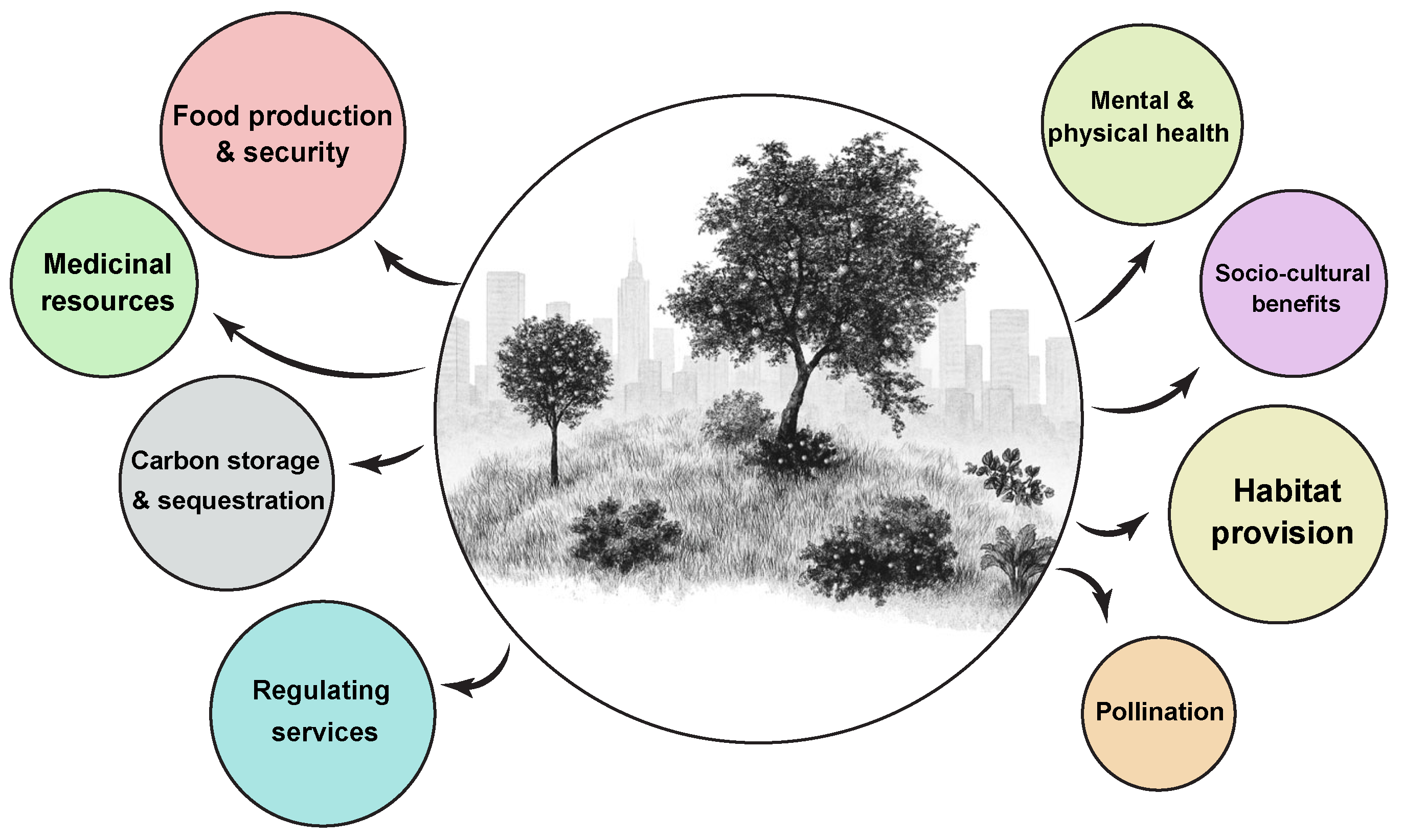
However, the definition of “Urban Food Forest” remains complex and is often the subject of debate. Clark and Nicholas [16] define UFF as “the intentional and strategic use of woody perennial food-producing species in urban edible landscapes to improve the sustainability and resilience of urban communities”. The emphasis on perennial woody fruit- and nut-producing species (food trees) distinguishes UFF from conventional forms of urban agriculture, and it effectively excludes perennial herbaceous species and seasonal horticultural plants. Other definitions also include non-woody species, thus broadening the concept. Unlike typical urban forests, whose primary purpose is ecological or recreational, UFFs are explicitly designed to produce food while providing ecosystem services (Figure 1). According to Park et al. [17], a food forest is a consciously designed polyculture primarily based on perennial plants that creates a diverse, self-replicating, and mutually beneficial system that directly or indirectly benefits humans. The species used within a UFF are often, but not exclusively, edible plants, which can include large trees, small trees, shrubs, herbs, roots, and vines. Each plant is placed to improve its interactions and contributions to the overall system, while reducing nutrient losses and negative impacts. Almost no biomass is taken out of the system, except for what is gathered during food harvests, which lets natural decomposition take place. Consequently, UFFs cannot be defined solely as a food production system, as they also use non-edible plants for specific purposes, such as nitrogen fixation, ground cover, or pest control, to benefit the entire system. From this perspective, urban food forests represent an integration of urban agriculture, urban forestry, and agroforestry [16]. If well designed, considering the ecological needs and the growth habit of the species, they can sustain themselves with minimal management interventions (e.g., no fertilization is required) [18].
Despite growing interest in UFFs, significant conceptual and empirical uncertainties remain. This opinion paper analyses these limitations by examining definitional ambiguities, methodological gaps, and little explored research domains, and suggests directions for future research and urban planning.

2. The Current State of UFFs Research: A Brief Systematic Overview

2.1. Materials and Methods

The literature search concentrated on peer-reviewed articles published in international scientific journals. The literature survey focused exclusively on documents indexed in the Scopus database and was conducted on 12 February 2026. Non-peer-reviewed sources and grey literature (e.g., technical reports, theses, policy documents) were not included. Records were identified using as a basic search query the following set of keywords: TITLE-ABS-KEY [“urban food forest” OR “food forest” OR “edible forest” OR “edible landscape” OR “urban fruit production”] (Supplementary Materials). This search approach ensured consistency, transparency, and reproducibility of the retrieval process. The initial query returned 282 records (Supplementary Materials). These were subsequently manually screened according to predefined eligibility criteria. The search criteria were designed to capture studies directly addressing urban food forests, with particular emphasis on urban fruit tree research. Indeed, only original research articles and conference papers explicitly focused on UFFS were retained. Studies on agroforestry in agricultural or non-urban contexts, as well as studies focusing solely on herbaceous or vegetable species, were excluded from the database. Following this selection process, 94 publications met all inclusion criteria and were considered suitable for detailed evaluation (Supplementary Materials). Included studies were manually evaluated to determine whether they performed analyses related to: (i) ecosystem services (including biodiversity support, carbon sequestration, and microclimate regulation), (ii) environmental parameters (encompassing investigations of soil characteristics, air quality, and water monitoring), and/or (iii) food safety and quality (addressing contamination risks, pollutant accumulation, and nutritional attributes). Articles were screened based on the presence of evidence corresponding to at least one of these domains.

2.2. Discussion

The creation of a food forest is based on the idea of recreating a forest system that functions as a multilayered ecosystem, where food-producing species are cultivated with little maintenance and limited human intervention. By applying the UFF cultivation principles, even small or large urban spaces can provide food, medicinal herbs, wood, habitat for animals, shade, and protection [19,20,21]. Species diversity is therefore essential in a UFF, both to expand the food produced and the harvest period, and to maximize the resilience and the ecosystem services while reducing management costs [12]. The success of UFFs relies on the capacity of urban communities and institutions to manage them as participatory systems, integrating research, design strategies, maintenance frameworks, and education initiatives into urban planning [6,22]. However, although many countries are increasingly adopting policies that support and promote UFF creation [23], substantial research gaps persist. Despite the interest shown by different researchers in this topic through the publication of narrative reviews and book chapters, the understanding of ecosystem services provided by UFFs (such as biodiversity support, carbon sequestration, and microclimate regulation) as well as their relations with the environment (i.e., soil, air, and water monitoring analyses) is still lacking. Moreover, aspects linked to food safety and quality, especially those concerning contamination risks and nutritional value, continue to be insufficiently explored. Indeed, these limitations clearly emerged from our systematic analysis of documents published between 1990 and February 2026. Among the 94 articles identified, only 30.8% analysed ecosystem services, 8.5% performed environmental analyses, and 6.3% investigated food safety and food quality aspects. Moreover, our results are consistent with those of Thwaites et al. [6], indicating that research on UFFs is still fragmented and geographically imbalanced. This geographical imbalance reflects the fact that UFF research has largely developed through site-specific case studies concentrated in world regions where such initiatives are already established. As a result, current findings may have limited generalizability and reduced applicability to urban contexts with different socio-ecological conditions. The limited quantification of ecosystem services, the insufficient investigation of soil health, and the scarcity of studies addressing socio-cultural and mental health outcomes can be attributed both to the heterogeneous nature of UFFs and urban contexts, and to the methodological challenges associated with assessing complex, multifunctional systems in urban environments. In the absence of robust quantification of ecosystem services, UFFs are difficult to compare with alternative urban green solutions within planning and investment frameworks. Furthermore, limited scientific evidence regarding soil conditions constrains the assessment of site suitability for UFFs and hampers the evaluation of potential environmental risks. Food safety may represent a serious concern in urban environments, where air and soil pollution may affect the quality and safety of food produced. Indeed, vehicular emissions, in particular, can release contaminants such as nitrogen oxides, heavy metals, and organic compounds (e.g., polycyclic aromatic hydrocarbons), which can compromise the safety of food grown in UFFs [7,24]. Nonetheless, Gori et al. [7] observed that heavy metal accumulation in edible parts of trees, such as fruits, was lower than in vegetables, as a considerable proportion of absorbed metals is stored in roots and leaves. This might suggest that tree species may be more suitable for cultivation in polluted urban settings than vegetable crops, considering both food safety and the overall health of urban green systems, although interspecific variation persists. As previously reported, the current understanding of uptake and translocation mechanisms is still very limited, and several factors influence the safety of fruits grown in urban and peri-urban areas. To optimise UFF planning and design, further research is needed on both individual species and species associations to assess their responses to pollutants and environmental stressors. In addition to empirical limitations, a further challenge affecting UFF research concerns the inconsistency of terminology. In a comprehensive review, Park et al. [17] highlighted the lack of consistency in the use of terminology, which can hinder the scalability and replicability of studies on UFFs. The authors also pointed out that UFFs can have different structures and compositions. These can range from individual food trees and shrubs to “food forestry” (perennial, multi-layered, and polycultural forest systems) and “agroforestry” (the integration of trees with crops or livestock, either at the same time or in sequence on the same land) Clark and Nicholas [16]. From a planning and research perspective, this terminological ambiguity complicates the interpretation of findings and limits the translation of scientific evidence into design principles, management strategies, and performance expectations. The absence of shared definitions may therefore contribute to fragmented research outcomes and inconsistent policy and planning applications.

3. Formulating a Future Research Agenda for UFFs

Despite the growing interest in UFFs, the existing body of research remains fragmented and uneven, limiting the consolidation of evidence needed to support their broader adoption. Consequently, several critical questions remain open:
How can Urban Food Forests be defined consistently across disciplines?
The lack of consistent terminology and system classification continues to hinder meaningful comparison across studies and the translation of research findings into planning-relevant knowledge. Future research agendas should prioritise clearer conceptual definitions (i.e., terminology).
How do ecosystem service outcomes vary with species composition and site conditions? Which indicators best describe the ecosystem services provided by UFFs?
Persistent gaps in ecosystem service quantification, environmental assessment (e.g., soil quality), and food safety studies reflect both methodological limitations and the inherently heterogeneous and context-dependent nature of UFFs. Future research should prioritise the development of integrated assessment frameworks capturing ecological and socio-environmental aspects of UFFs.
What are the primary contaminants that can potentially affect edible biomass in the urban environment? How do species selection and management practices influence food safety?
Greater attention is needed to understand how species selection, site conditions, and management practices influence ecosystem services, environmental risks, and the safety of food products derived from UFFs. Such methodological strengthening is essential not only for advancing ecological understanding, but also for enabling meaningful comparisons between UFFs and other nature-based solutions.
Without credible quantification of ecosystem services and environmental performance, UFFs risk remaining perceived as symbolic or experimental initiatives rather than evidence-based planning strategies. The value of future research on UFFs will depend on its ability to inform planning, design, and management practices. The integration of robust, context-sensitive evidence into urban planning and policy frameworks is essential for UFFs to move beyond isolated projects and become credible green solutions for food security, environmental sustainability, and social equity.

Supplementary Materials

The following supporting information can be downloaded at: https://www.mdpi.com/article/10.3390/urbansci10030155/s1.

Author Contributions

Conceptualization, F.F.; methodology, A.G. and E.L.P.; formal analysis, A.G. and E.L.P.; investigation, A.G. and E.L.P.; writing—original draft preparation, F.F., A.G. and E.L.P.; writing—review and editing, F.F., A.G. and E.L.P.; funding acquisition, F.F. All authors have read and agreed to the published version of the manuscript.

Funding

Project funded under the National Recovery and Resilience Plan (NRRP), Mission 4 Component 2 Investment 1.4—Call for tender No. 3138 of 16 December 2021, rectified by Decree n.3175 of 18 December 2021 of Italian Ministry of University and Research funded by the European Union—NextGenerationEU; Award Number: Project code CN_00000033, Concession Decree No. 1034 of 17 June 2022 adopted by the Italian Ministry of University and Research, CUP B83C22002910001, Project title “National Biodiversity Future Center—NBFC”.

Data Availability Statement

No new data were created or analyzed in this study.

Acknowledgments

During the preparation of this manuscript, the authors used ChatGPT 5.2 for text editing (e.g., regarding grammar, spelling, punctuation, and formatting) and for graphics (Figure 1). The authors reviewed and edited the output and take full responsibility for the content of this publication.

Conflicts of Interest

The authors declare no conflicts of interest.

References

  1. UN; United Nations Department of Economic and Social Affairs Population Division. World Population Prospects 2024: Data Sources. 2024. Available online: https://population.un.org/wpp/assets/Files/WPP2024_Data_Sources.pdf (accessed on 1 January 2026).
  2. Fini, A.; Ferrini, F.; Salbitano, F. Foreste Da Mangiare. Acer 2020, 2, 79–82. [Google Scholar]
  3. UNECE. The Edible City: Why Food Trees Matter. 2024. Available online: https://unece.org/sites/default/files/2025-02/2422244_E_PDF_WEB_0.pdf (accessed on 1 January 2026).
  4. Çelik, F. The Importance of Edible Landscape in the Cities. Turk. JAF Sci. Tech. 2017, 5, 118. [Google Scholar] [CrossRef]
  5. Sung, W.-P.; Liao, M.-C.; Peng, H.-L.; Huang, C.-T.; Chuang, Y.-J.; Wang, J.-J. The Role of Urban Food Forests in Promoting Environmental Sustainability and Public Health: A Focus on Temperature Regulation and Mental Health. Sustainability 2025, 17, 2875. [Google Scholar] [CrossRef]
  6. Thwaites, H.J.; Suh, J.; Coote, G.M.; Nursey-Bray, M.; Cavagnaro, T.R.; Salomon, M.J. Urban Food Forests: Seeing the Fruit for the Trees—A Systematic Quantitative Literature Review and Emerging Research Gaps. J. Clean. Prod. 2025, 501, 145358. [Google Scholar] [CrossRef]
  7. Gori, A.; Ferrini, F.; Fini, A. Growing Healthy Food under Heavy Metal Pollution Load: Overview and Major Challenges of Tree Based Edible Landscapes. Urban For. Urban Green. 2019, 38, 403–406. [Google Scholar] [CrossRef]
  8. Castro, J.; Krajter Ostoić, S.; Cariñanos, P.; Fini, A.; Sitzia, T. “Edible” Urban Forests as Part of Inclusive, Sustainable Cities. Unasylva 250 2018, 69, 59–65. [Google Scholar]
  9. Fetouh, M.I. Edible Landscaping in Urban Horticulture. In Urban Horticulture; Nandwani, D., Ed.; Sustainable Development and Biodiversity; Springer International Publishing: Cham, Switzerland, 2018; Volume 18, pp. 141–173. ISBN 978-3-319-67016-4. [Google Scholar]
  10. Howard, E.; Osborn, F.J. Garden Cities of Tomorrow; Swan Sonnenschein & Co., Ltd.: London, UK, 1902. [Google Scholar]
  11. Mumford, L. Utopia, the City and the Machine. Daedalus 1965, 94, 271–292. [Google Scholar]
  12. Hart, R.A. Forest Gardening—Rediscovering Nature and Community in a Postindustrial Age; Green Earth Books: Devon, UK, 1996. [Google Scholar]
  13. Pothukuchi, K.; Kaufman, J.L. Placing the Food System on the Urban Agenda: The Role of Municipal Institutions in Food Systems Planning. Agric. Hum. Values 1999, 16, 213–224. [Google Scholar] [CrossRef]
  14. Pothukuchi, K.; Kaufman, J.L. The Food System: A Stranger to the Planning Field. J. Am. Plan. Assoc. 2000, 66, 113–124. [Google Scholar] [CrossRef]
  15. Riolo, F. The Social and Environmental Value of Public Urban Food Forests: The Case Study of the Picasso Food Forest in Parma, Italy. Urban For. Urban Green. 2019, 45, 126225. [Google Scholar] [CrossRef]
  16. Clark, K.H.; Nicholas, K.A. Introducing Urban Food Forestry: A Multifunctional Approach to Increase Food Security and Provide Ecosystem Services. Landsc. Ecol. 2013, 28, 1649–1669. [Google Scholar] [CrossRef]
  17. Park, H.; Kramer, M.; Rhemtulla, J.M.; Konijnendijk, C.C. Urban Food Systems That Involve Trees in Northern America and Europe: A Scoping Review. Urban For. Urban Green. 2019, 45, 126360. [Google Scholar] [CrossRef]
  18. Crawford, M. Creating a Forest Garden: Working with Nature to Grow Edible Crops; Reprint; Green Books: Totnes, UK, 2016; ISBN 978-1-900322-62-1. [Google Scholar]
  19. Wehi, P.M.; Wehi, W.L. Traditional Plant Harvesting in Contemporary Fragmented and Urban Landscapes. Conserv. Biol. 2010, 24, 594–604. [Google Scholar] [CrossRef] [PubMed]
  20. Bukowski, C.; Munsell, J. The Community Food Forest Handbook: How to Plan, Organize, and Nurture Edible Gathering Places; Chelsea Green Publishing: White River Junction, VT, USA, 2018; ISBN 978-1-60358-644-3. [Google Scholar]
  21. McFaul, O. Improving Urban Green Spaces with Urban Food Forestry: How Nut Trees in Urban Green Spaces Might Affect Food Security; SLU, Department of Landscape Architecture, Planning and Management: Alnarp, Sweden, 2025. [Google Scholar]
  22. Shi, X. The Urban Food Forest: Creating a Public Edible Landscape. Urban Des. Int. 2023, 28, 189–201. [Google Scholar] [CrossRef]
  23. Camps-Calvet, M.; Langemeyer, J.; Calvet-Mir, L.; Gómez-Baggethun, E. Ecosystem Services Provided by Urban Gardens in Barcelona, Spain: Insights for Policy and Planning. Environ. Sci. Policy 2016, 62, 14–23. [Google Scholar] [CrossRef]
  24. Säumel, I.; Kotsyuk, I.; Hölscher, M.; Lenkereit, C.; Weber, F.; Kowarik, I. How Healthy Is Urban Horticulture in High Traffic Areas? Trace Metal Concentrations in Vegetable Crops from Plantings within Inner City Neighbourhoods in Berlin, Germany. Environ. Pollut. 2012, 165, 124–132. [Google Scholar] [CrossRef] [PubMed]
Figure 1. Multifunctional services given by Urban Food Forests.
Urbansci 10 00155 g001
Disclaimer/Publisher’s Note: The statements, opinions and data contained in all publications are solely those of the individual author(s) and contributor(s) and not of MDPI and/or the editor(s). MDPI and/or the editor(s) disclaim responsibility for any injury to people or property resulting from any ideas, methods, instructions or products referred to in the content.