1. Introduction
Tourism is a key economic sector in the Republic of Croatia. According to the latest data, tourism accounts for 24% of the national gross domestic product (GDP) [
1], highlighting its key importance to the Republic of Croatia’s economic development. The Croatian economy is strongly dependent on tourism, and among European Union nations, it has the highest tourism share of its GDP [
2]. Generally, tourism provides substantial economic benefits through increased employment, income, and investment.
Croatia’s high economic dependence on tourism has been particularly evident during the COVID-19 pandemic, when the sector suffered significant losses. Before the pandemic, tourism contributed around 20% to GDP and accounted for 35% of national exports [
3]. The pandemic has exposed the vulnerability of an economy that relies too heavily on tourism, which is why the Republic of Croatia has developed strategies for diversification and more sustainable tourism development [
4,
5]. However, Croatian tourism has shown exceptional resilience and experienced a rapid recovery after the pandemic, with a strong return of tourists by 2022 [
6]. This ability to recover quickly further confirms the strategic importance of tourism to the Croatian economy and its role in regional economic recovery [
7].
Economic success and the continued growth of tourism create new challenges. Tourist destinations are facing overcrowding, a phenomenon that threatens long-term sustainability [
8]. Of particular concern is the highly concentrated spatial and temporal pattern of tourist flows, which poses challenges and threats to the sustainability of destinations, especially in urban areas. Recently, the term overtourism has become more common in professional and scientific discussions, referring to a situation in which an excessive number of visitors negatively impacts local communities, the environment, and the tourist experience.
Overtourism occurs when an increase in the number of tourists in a particular area causes challenges [
9]. This form of tourism has evolved in different ways, with overtourism arising from changes in tourism offerings, increased tourist accommodations, and greater availability of low-cost airline services [
10]. To this end, more visitors are drawn to specific destinations, resulting in overtourism. Many locations have implemented strategies to address this issue, which often occurs during certain times of year or during short periods when large numbers of tourists arrive.
In tourist destinations, overtourism is largely an urban phenomenon. Its greatest effects are felt in cities and urban coastal areas. This is because urban areas face the challenges of tourist pressure, which directly affects everyday life [
11]. Therefore, overtourism should not be understood as a problem of tourism management but as a broader problem of urban management, which requires coordinated activities through the development of tourism policies, strategic planning in urban areas, and ecological management.
Overtourism is increasingly recognized as a challenge for managing urban areas, not just a matter of tourism management. Urban areas attract tourists by providing infrastructure and services, while residents face restrictions such as overcrowding and high population density, which degrade quality of life [
11,
12]. Strategies to reduce overtourism must first be evaluated, and the most effective ones implemented to maintain the economic benefits of tourism for a given urban community while protecting its resources through sustainable management, thereby reducing the negative impacts of overtourism.
Croatia, as a country heavily dependent on tourism, experiences seasonal overcrowding of its coastal areas, especially during summer. While financial indicators, such as the number of tourist arrivals and overnight stays, indicate success, non-financial indicators reveal the flip side of tourist growth: dissatisfaction among locals, increased pressure on infrastructure, environmental damage, and a decline in the quality of life in destinations. In many coastal cities and municipalities, infrastructure is not adapted to the growing number of visitors, leading to traffic congestion, waste management issues, parking shortages, and overloading of communal systems [
13]. This is especially noticeable in urban areas and poses a serious threat to their preservation. Therefore, there is a need for sustainable tourism management that does not rely solely on economic indicators but also considers social, spatial, and ecological aspects, aiming to improve the quality of life in urban areas [
14]. Tourism should be developed in a way that satisfies all involved residents, visitors, and entrepreneurs, while protecting natural and cultural resources [
15].
As sustainable tourism and digital monitoring systems develop, measures are being implemented to reduce the number of tourists at specific urban locations and spread visitors more evenly across an area, including spots that usually do not attract many tourists [
16]. For this purpose, several strategies for reducing the negative effects of overtourism have been developed through previous research, such as spatial and temporal dispersion of tourists, regulation of access and capacity, promoting tourism outside the peak season, educating visitors, and applying innovative digital solutions. The success of these strategies depends on the local context and priorities of each destination [
17]. The goal of these strategies is to balance economic, social, and environmental goals to positively impact a specific tourist destination and local urban community [
18]. In this way, by implementing strategies to address overtourism, sustainable tourism is promoted, aiming to preserve the natural and other resources of a specific tourist urban destination.
1.1. Research Motivation
The motivation for conducting this research comes from Croatia’s heavy reliance on tourism, particularly in its Dalmatian regions, and the challenges to the sustainability of urban areas in Dalmatia. Official data show a steady rise in tourist numbers; however, this increase negatively affects urban sustainability. Issues such as growing traffic congestion lead to environmental damage and lower resident satisfaction. Therefore, it is important to find a balance between attracting tourists and minimizing environmental harm. Developing and implementing strategies to address overtourism becomes essential. Previous studies on overtourism in Croatia mainly focused on measuring impacts and understanding public perceptions. However, they did not systematically approach the problem through tourism development strategies. The strategies used were only partially aimed at reducing negative effects and lacked a comprehensive framework, leading to decision-making under uncertainty. This gap motivates the present research, as strategies to prevent overtourism’s adverse effects remain largely in the planning stage and have limited practical implementation. To address this, this study incorporates intuitionistic fuzzy sets into multi-criteria decision-making (MCDM) methods, accounting for uncertainty throughout the decision process.
1.2. Research Objectives and Research Questions
The goal of this research is to identify and evaluate the most effective strategies to address overtourism in Zadar County, especially in the city of Zadar, one of Croatia’s most visited areas and a growing tourist destination. To choose this strategy, an IFS-based approach was used, along with assessments by tourism experts within the Zadar County tourist boards. To achieve the main goal of this research, specific research goals are set. First, to identify key strategies for managing overtourism that can be applied in Zadar County, a representative Mediterranean coastal destination, where urban coastal tourism dominates. Second, to select criteria for evaluating these strategies, considering different aspects. Third, to incorporate uncertainty into decision-making by applying IFS, offering a more realistic way to assess the importance of criteria and choose strategies. Fourth, to determine the significance of the criteria and identify the most effective strategies for managing overtourism using MCDM methods. Fifth, to provide recommendations for policymakers and management bodies on sustainable tourism development and ways to reduce the negative impacts of overtourism, especially in urban areas.
Based on the stated research objectives, research questions are also formulated to assist in achieving these objectives:
How can MCDM methods, together with the IFS approach, be used to select the most effective strategies for reducing the negative effects of overtourism in urban destinations?
Which strategies are most effective for reducing the negative impacts of overtourism in the context of a Mediterranean urban destination, with Zadar County as an example?
The answers to these research questions will help policymakers and management bodies direct their efforts toward the strategy that will have the greatest impact, i.e., conserving natural resources, maintaining tourism as the primary driver of this county in the long term, and preserving the quality of life in urban areas.
1.3. Research Contributions
By achieving the research objectives and answering the research questions, this study makes significant contributions to the theoretical and practical understanding of overtourism. First, it advances the methodological foundations of tourism management in the Republic of Croatia, particularly in coastal-urban tourism. By developing a robust decision-making system based on an IFS approach, it addresses the limitations of traditional decision-making methods under uncertainty. This enables decision-makers to use imperfect and incomplete information effectively. Applying the IFS approach increases the reliability of decisions made through this process. The empirical contribution lies in gaining knowledge of strategies to reduce the negative impacts of overtourism in Zadar County and urban areas. Through this research, the management staff of tourist communities will be involved to identify which strategies have the greatest effect on solving the problem of overtourism. The selection of strategies for Zadar County reveals the region’s priorities and limitations, providing a scientific contribution to understanding tourism in Croatia. The practical contribution of this research is to provide policymakers and local authorities with the information they need to address overtourism-related issues. Based on the research results, recommendations will be made on which strategies should be implemented to reduce overtourism. Applying these strategies will promote sustainable tourism and the preservation of natural resources, thereby positively impacting the county’s social well-being. These findings can also assist other counties in managing overtourism. This is especially true in Zadar County, which primarily relies on typical urban-coastal tourism. The specificity is that most tourist activities take place within the city’s historic urban cores, which have various negative impacts. These include increased waste generation, difficulty finding parking, and heavy congestion in the city core. Implementing overtourism strategies should improve the quality of life in urban areas, increase population satisfaction, relieve urban cores, and reduce negative impacts.
2. Literature Review
The term overtourism has become part of the scientific literature and tourism policy in recent decades, as it responds to the rapid increase in tourist arrivals and the pressure on popular destinations. Although there is no single definition, it can be described as a situation in which the impact of tourism in a given time and place exceeds what is acceptable to the local community, the environment, and visitors themselves. It is a complex and multidimensional phenomenon that needs to be addressed [
12,
18,
19].
Mihalič [
20] highlights that overtourism is not only a physical issue caused by too many tourists but also a perceptual phenomenon. It depends on feelings of overcrowding, saturation, and loss of authenticity at a destination. Milano et al. [
21] associate it with the emergence of “turismophobia,” meaning the growing dissatisfaction of residents toward tourists due to the perception that tourism benefits and costs are not shared fairly. However, the concept of sustainable tourism relies on balancing three dimensions: economic, social, and environmental. According to the World Tourism Organization [
18], sustainable tourism should meet the needs of current tourists and local communities while protecting and improving future opportunities. In other words, tourism development must generate economic profit without risking cultural authenticity, natural resources, or social cohesion.
The negative effects of Overtourism often manifest as higher housing and service prices, traffic congestion, pressure on communal infrastructure, environmental degradation, noise pollution, and reduced residents’ quality of life. Such phenomena have become characteristic of numerous Mediterranean centers such as Venice, Dubrovnik, Barcelona, and Santorini [
12,
22,
23]. In addition, overtourism negatively affects residents’ willingness to support tourism development. There is a direct correlation between tourist density and a decrease in local population satisfaction [
24]. The phenomenon of overtourism results from a combination of rapid growth in tourist demand, inadequate planning, and limited destination capacity to manage visitor numbers [
21,
23].
Strategies to reduce the effects of overtourism include regulatory measures such as visitor quotas, time-limited tickets, reservation systems, limiting the number of accommodation units, and regulating cruise tourism. Spatial and temporal dispersion plays an important role, directing tourists to less crowded areas and encouraging the development of tourism products outside the main season. Then there are digital and innovative solutions, such as the application of information technologies to manage crowds, monitor tourist movement, and optimize visitor flows in real time. Finally, education and stakeholder involvement are also important, which implies strengthening tourists’ awareness of responsible behavior [
17,
18,
25].
In the Croatian context, considering the high contribution of tourism to GDP, the sustainability of tourism becomes a strategic concern for the national economy. According to the Ministry of Tourism and Sports [
26], most tourist activity is concentrated in a few summer months and along a narrow coastal strip. It is therefore not surprising that Croatia has increasingly been cited in the literature as an example of a destination experiencing overtourism [
27]. Many cities and counties, especially in Dalmatia and Istria, are recording record-breaking numbers of arrivals and overnight stays. At the same time, residents express concerns about rising prices, overcrowding, and declining quality of life. Zadar County, with its well-developed coastal tourism and proximity to national parks (Paklenica, Kornati, Krka), exemplifies an area facing infrastructural congestion, crowds, and seasonal pressures during the summer. Similar issues are highlighted in research conducted in Dubrovnik, where an excessive number of one-day visitors arriving from cruise ships was identified as the leading cause of overloaded city centers. Local studies have shown that introducing quotas and reservation systems (such as time-slot access) helped reduce crowds and preserve cultural heritage [
19].
Although numerous studies address the phenomenon of overtourism [
12,
21], and methodological research on overtourism using MCDM methods is also available [
28], in practice, there is a lack of research that integrates these two research directions. This research fills this gap, offering a methodological framework not only for measuring strategies but also for selecting them, with special reference to the urban centers of Mediterranean destinations. In this way, this research marks a methodological breakthrough by using MCDM methods to identify and evaluate the most effective strategies for addressing overtourism. Such an approach integrates expert assessments and empirical criteria quantitatively and helps develop scientifically based recommendations for sustainable tourism management. In this case, the focus is on the Croatian context, specifically Zadar County, which can be observed in all Mediterranean tourist destinations.
3. Research Methodology
To determine which strategy should be applied to reduce the negative effects of overtourism in the Zadar County area, primary research was conducted. The research process itself went through the following phases:
Phase 1. Preparatory phase of the research
Phase 2. Conducting the research
Phase 3. Determining the results of the research
The first phase of this research is the preparatory phase. In this phase, it is first necessary to determine which strategies will be used to address overtourism, which criteria will be used to assess them, how the strategies and criteria will be evaluated, and who will perform the evaluation. This research has identified five strategies, as listed below:
Strategy A—Limiting access to the most popular areas (quotas, tickets, time limits)
Strategy B—Promoting tourism outside the season (e.g., events, cultural and health facilities)
Strategy C—Encouraging tourists to visit lesser-known spots within the county
Strategy D—Applying digital tools for crowd management (mobile applications, smart sensors)
Strategy E—Educating tourists and promoting campaigns on responsible behavior (communication strategies, signage)
These selected strategies for managing overtourism are based on established approaches promoted by international tourism organizations [
19] and on previous research and interviews with directors of tourist boards in Zadar County. Although widely discussed, their effectiveness may vary depending on the tourist destination in which they are applied. Therefore, evaluating these strategies in a specific example establishes the scientific contribution of this research, particularly by providing a scientifically grounded methodology that highlights uncertainty and its role in decision-making.
Strategy A is implemented in practice in tourist destinations that limit visitor numbers to reduce crowding, such as Dubrovnik, Venice, and Machu Picchu, due to concerns about the destination’s available resources. This strategy has been used in the research of the authors Hansen et al. [
29], Butler and Dodds [
30], and others who have studied overtourism. Strategy B is implemented in practice to ease the temporal concentration of visitors. This strategy aims to extend the tourist season, especially in urban areas that focus on the sea and summer. Most tourists visit these areas in the summer, which is why overtourism occurs. This strategy for studying overtourism has been applied by Rogowski et al. [
31], Gatto and Scorza [
32], and other authors. Strategy C represents an alternative by limiting the number of visitors at one location while redistributing tourists to less well-known locations that would be equally interesting to them. In this way, pressure on certain areas of urban areas is reduced, and the negative aspects of overtourism are partially addressed. An example of this strategy can be found in the case of Barcelona, which was covered by García-Buades et al. [
24]. In addition, this strategy was also used by Lin et al. [
33] and Ouyi and Jiaxue, W. [
34] in their research. Strategy D takes advantage of digital technologies and smart applications to provide tourists with comprehensive information, including crowd levels at specific locations. In this way, tourists could adjust their visits to certain locations to avoid crowds. In this way, digital technologies are used to solve the problem of overtourism in urban areas. Bollenbach et al. [
16] and García Revilla et al. [
35] also discuss the importance of this strategy for addressing overtourism in their research. Strategy E uses the behavioral dimensions of overtourism to influence tourists’ awareness and behavior. This is achieved by educating tourists and promoting responsible tourism campaigns to sustain tourism’s benefits and reduce the negative impacts of overtourism. The application of this strategy in practice was promoted by Wang et al. [
36] and Ruhanen and Bowles [
37] in their research.
Although the strategies used are not new and have already been used in practice, the contribution of this research is the systematic evaluation of these strategies to select the one that would be most effective in practice and that would give the best results, using an intuitionistic fuzzy set and the MCDM method to reduce the negative effects that overtourism has on urban coastal tourism, which represents the contribution of this research through the development of the research methodology.
From an urban perspective, the proposed strategies help manage overtourism by reducing tourist pressure on urban areas. Strategies A and C focus on spatial regulation and the redistribution of tourists from urban areas; strategy D seeks to implement smart tools for monitoring tourists in urban areas. In contrast, strategies B and E reduce this pressure by targeting tourists and shaping their decisions to visit through temporal and spatial dimensions.
To evaluate these strategies, it is necessary to determine the criteria by which they will be observed. In this research, the strategies were observed against seven criteria (
Table 1).
These criteria also support the preservation of the urban environment, where sustainability and resource management are key dimensions. In this way, selecting these criteria shapes tourism management in urban areas. In this way, criterion CR-1 helps select a strategy that reduces tourism pressures by easing congestion in urban cores, criterion CR-4 addresses resilience in sustainable urban systems, and criterion CR-7 helps use digital tools to monitor and manage tourism flows in urban areas. All of these criteria are grounded in previous research by various authors.
Table 1 presents only some of the authors who used these criteria in their research.
After deciding on the alternatives and criteria, the next step in this phase of the research is to develop a questionnaire that specifies the scoring system for the criteria’s importance and for each strategy’s performance in meeting them. The questionnaire was designed so that the first part identified the importance, while the second part evaluated strategies based on these criteria. To conduct this evaluation, scores were expressed as linguistic values ranging from very bad (lowest) to very good (highest), which were used to evaluate strategies, while linguistic values for evaluating criteria ranged from Extremely high importance to Extremely low importance. These scores were represented by seven linguistic values, combining the worst and best scores (
Table 2). When assigning scores, the values of intuitionistic fuzzy numbers (IFNs) were also calculated, and these linguistic values were then transformed to obtain the research results.
The final step in this phase is selecting the research participants. In Zadar County, there are a total of 29 members of the tourist boards of areas, cities, municipalities, and towns within the county. All these members make up the Tourist Board of Zadar County. Directors of tourist boards in Zadar County were selected for their roles in coordinating tourism activities, implementing measures to manage tourist flows, and positioning the destination sustainably in the market. The selection of directors of tourism communities was based on a purposive sample because they are key DMs in the management of tourism in this county. These boards are responsible for promotional, organizational, and management functions within tourism, providing them with comprehensive insight into current tourist demand and challenges such as overtourism. Their assessments serve as relevant indicators for evaluating strategies to reduce overtourism at the county level. Additionally, these directors aimed to complete questionnaires with their staff, incorporating the opinions of several tourism experts rather than relying solely on the directors’ own opinions. Of the total number of directors across all tourist boards, 12 accepted the invitation and participated in the survey, resulting in a response rate of 41.37%. This response rate would have been even higher, but, despite reminders, the remaining directors of tourist boards did not complete the questionnaire and participate in the survey.
The second phase of this research involves conducting the study itself. After developing the questionnaires and selecting the decision-makers (DMs) to participate, the questionnaires were distributed for completion. Distribution was scheduled for after the peak tourist season, with October chosen because Zadar County depends on sea and sun tourism. Initially, telephone calls were made to each tourist community to introduce the research and secure their consent to participate. Subsequently, the questionnaires were sent electronically to the directors of local tourist boards. To maximize response rates, reminders were issued, and 12 directors from Zadar County’s tourist boards completed the questionnaires. These responses were processed and prepared for the next phase.
The third phase of this research is to determine the results. Because no activities have been undertaken to address the problem of overtourism in Zadar County, the DMs did not have all the information about these strategies. Because of this, they had to make decisions with incomplete information, and the characteristic of those decisions was that the assessments were made under some uncertainty. To incorporate uncertainty into this decision, the IFS approach was applied. Therefore, this approach must first be explained, followed by the methods used to obtain the research results.
Unlike the fuzzy approach, which is used when it is not possible to define the boundaries of sets accurately, the IFS approach is used by determining the membership of a set
and the degree of non-membership of this set
. Based on the set’s membership and non-membership, the degree of uncertainty is also determined. Atanassov [
51] defined IFS through set
A as follows:
Based on this IFS formulation, the degree of uncertainty is calculated as follows:
To use this approach to obtain results, it is first necessary to transform IFNs into crisp values. The transformation procedure in this research was performed using the Euclidean equation, where the deviation from the positive ideal solution () and from the negative ideal solution () is determined. The steps for implementing this transformation are as follows:
Step 1. Evaluation of the importance of criteria or evaluation of alternatives according to specific criteria by DMs using linguistic values and forming a decision matrix.
Step 2. Transformation of linguistic values into IFNs (
Table 1).
Step 3. Definition of the positive ideal solution () and the negative ideal solution () in IFNs. The positive ideal solution is the maximally defined evaluation, which is very good, while the negative ideal solution is the minimally defined evaluation, which is very bad.
Step 4. Determining the deviation of the scores from the positive and negative ideal solutions by calculating the positive
and negative distance
from these ideal solutions.
Step 5. Calculating the closeness coefficient (
CC), which will be used as a crisp value in further analysis.
After calculating the CC coefficients in crisp values, the MCDM method is used to evaluate the importance of criteria and rank strategies. In this study, the SiWeC (Simple Weight Calculation) and TOPSIS (Technique for Order of Preference by Similarity to Ideal Solution) methods were chosen. The reason for selecting the SiWeC method is that it is very straightforward to use, requires no criteria evaluation, and determines the significance of the DMs’ ratings directly, which makes it different from other methods. On the other hand, the TOPSIS method is the most commonly used MCDM approach for ranking alternatives, supporting its application here. The steps for these methods are outlined below.
The SiWeC method was initially used by the author Puška et al. [
52] to determine the subjective importance of the criteria’s weights, using the DMs’ ratings of the criteria. This method has the following steps:
Step 1. Normalization of
CC coefficients
where
is the maximum value of the
CC coefficient for all criterion values.
Step 2. Determination of the standard deviation value () for DMs scores.
Step 3. Weighting of normalized values.
Step 4. Determination of the aggregate weight of individual criteria.
Step 5. Calculation of criterion weights.
The TOPSIS method was created by the authors Hwang & Yoon [
53], and its steps are as follows:
Step 1. Normalization of
CC coefficients.
Step 2. Weighting of normalized values.
Step 3. Determining the positive and negative ideal solution of the alternative.
Step 4. Calculation of deviations.
Step 5. Calculating the value of the TOPSIS method.
4. Results
After the responses from the Tourist Board directors have been collected, the research results are determined. The first step in choosing a strategy is to determine the weight of the criteria. To determine the weight of the criteria, an initial decision matrix with linguistic values is first constructed (
Table 3). These ratings are then prepared for the implementation of the SiWeC method. This is done by transforming linguistic values into crisp values using the IFS approach.
In the transformation, the ratings, expressed as linguistic values, are first converted to IFNs. This is done based on a certain membership and non-membership function for the set A. In this way, the linguistic value very good (V-G) is represented by IFN [0.9, 0.0], while the linguistic value good (G-O) is represented as [0.75, 0.15]. These membership and non-membership values in IFS are defined based on the standard approach developed by Atanassov [
51], where the sum of μ and ν does not exceed 1, and the difference up to 1 represents the degree of uncertainty π. Using this function, all IFN values are determined. Then the uncertainty values are determined, which are calculated, for example, for the rating very good
. Then the deviation from the positive and negative ideal solutions (
) is calculated. In the example of DM1 and the criterion CR-1, this is done as follows:
After the deviations have been determined, the
CC coefficient is determined. In the same example, it is calculated as follows:
Applying this procedure, the
CC values are calculated for all DMs and criteria, and an initial crisp decision matrix is formed (
Table 4). This decision matrix serves as the initial matrix for determining the criterion weights using the SiWeC method.
Since the highest value in this decision matrix (
Table 4) is 1000, no normalization will be performed because dividing by the highest value will not change the values of the decision matrix. The importance of the DM’s ratings is then determined by calculating the standard deviation value (St.dev.). Based on the obtained standard deviation, it can be concluded that the ratings of DM 12 are the most significant, as this director had the greatest deviation from the central value, and thus will have the greatest impact on the final criterion weights. The ratings for DM 7 will be completely disregarded because the standard deviation is zero, meaning their weight during rating calculations will be zero.
The next step of the SiWeC method is to weight the normalized values using the obtained standard deviation values. This is done in the following way for the example of DM1 and the CR-1 criterion:
All other normalized values are weighted in the same way. After this step, the aggregate criterion weight is determined by summing the individual criterion weights. In the example of criterion CR-1, this is done as follows:
In the last step, the aggregate value of the individual criteria is divided by the total aggregate value of all criteria, and the resulting values form the criterion weights. By applying this step, the sum of all criterion weights is one.
The results from the SiWeC method show that the most important criterion is Digital Support (CR-7), followed by Environmental Sustainability (CR-4), while the least important criterion is Local Community Acceptance (CR-2) (
Table 5).
After the criteria weights are assigned, the strategies are ranked using the IFS and TOPSIS methods. The first step in this ranking process is the DMs’ evaluation of the strategies. Since qualitative criteria are used in this evaluation, the same linguistic values are applied. Therefore, linguistic decision matrices are first created for each DM (
Table 6).
The process of transforming linguistic value scores to determine strategy rankings is the same as that for determining criterion weights, so it will not be explained again. After transforming linguistic values into crisp values using the IFS approach, the TOPSIS method is applied (
Table 7).
After the initial decision matrix is formed, it is normalized. In the example of Strategy A and criteria CR-1, this is done as follows:
Then, the normalized values are weighted by the appropriate weights (
Table 8). In the same example, this is done as follows:
After the weighted values are calculated, the positive and negative ideal solutions are determined. These solutions are determined for each criterion separately by finding the largest weighted value representing the positive ideal solution and the smallest weighted value representing the negative ideal solution (
Table 8).
Then, the deviation from the ideal and the negative-ideal alternative is calculated. The calculation is performed as follows, using Strategy A as an example.
After calculating the deviations for all strategies, the final TOPSIS scores are also computed. For the same strategy, it is calculated as follows:
Based on the TOPSIS results (
Table 9), Strategy C provides the best outcomes and is the top choice for reducing the negative impacts of overtourism, followed by Strategy A, while Strategy D has the worst results.
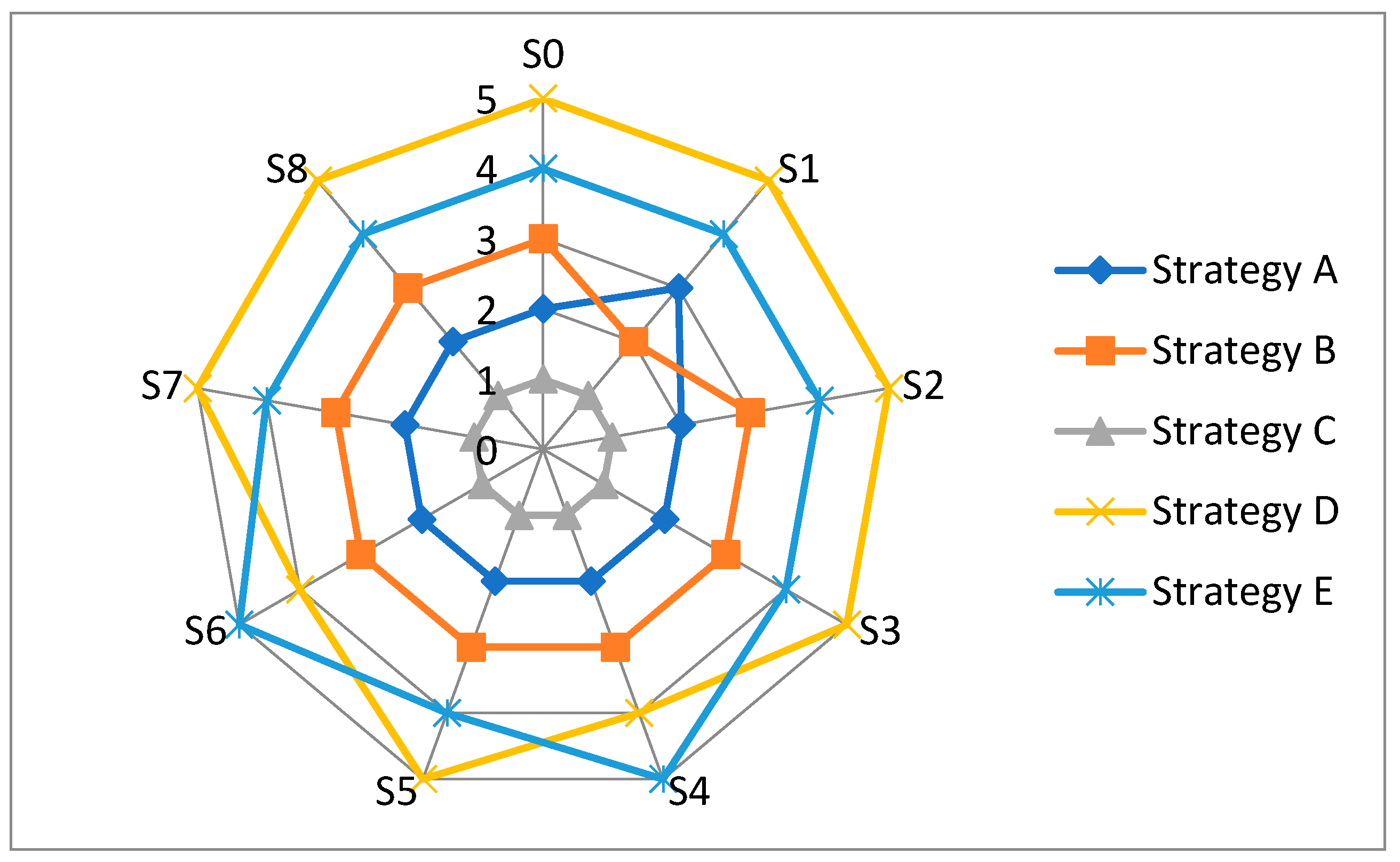
To further examine these strategies, a sensitivity analysis is conducted. This analysis aims to examine how sensitive the ranking is to changing the importance of the criteria. The sensitivity analysis is performed by first reducing the weight of each criterion by 90%. Since there are seven criteria, seven scenarios are formed. In all scenarios, it is assumed that all criterion weights are the same, so that each criterion equally affects the ranking of the strategies. The analysis showed that only strategy C remained unchanged, which was the best in all scenarios (
Figure 1). When the weight of the CR-1 criterion was changed, strategy A swapped places with strategy B. In this way, it was shown that strategy B has worse indicators than strategy A under the CR-1 criterion, so the reduction in the weight of this criterion led to this strategy being ranked higher. The situation is similar to strategies D and E, where they changed the ranking order by reducing the importance of criteria CR-4 and CR-6. In this way, it was shown that strategy D must improve both criteria to be ranked higher.
5. Discussion
Tourism is becoming increasingly important, as it contributes to a country’s GDP growth and enhances its population’s living standards [
54]. Additionally, the development of tourism and the rise in tourist visits boost employment opportunities. As a result, greater emphasis is being placed on tourism, and extensive efforts are underway to attract visitors. However, some tourist destinations experience excessive crowds in urban areas, leading to overtourism. In these areas, efforts are made to control tourist numbers, and initiatives are implemented to ease pressure on popular spots and encourage tourists to visit other locations. As a result, various strategies are being developed to address the issue of overtourism affecting urban tourist destinations. These problems mainly relate to sustainable resource management, especially the protection of natural resources. Additionally, Tandamrong et al. [
55] state in their research that increased tourist numbers lead to higher CO
2 emissions, which in turn contribute to greater air pollution. In this way, the increase in the number of tourists negatively affects the quality of life of the city’s inhabitants. It is anticipated that more people will have increased needs, requiring more food and drinks, and that more waste will be generated, negatively impacting the environment in other ways [
56]. As the authors Melasari et al. [
57] mention, it is therefore necessary to adopt sustainable practices to reduce the environmental impact of tourism.
Sustainable tourism is both an imperative and a goal guiding the development of tourist offers. Croatia is actively working to transform tourism through strategic initiatives and to reduce the negative effects of overtourism. This is because coastal urban tourism is most common in Croatia, and most tourist activities take place in urban areas. This research uses Zadar County as a case study because coastal urban tourism is the most widely used form of tourism there. Based on that, this paper aimed to identify the most effective strategy for reducing over-tourism in urban areas. The county’s rich natural resources support a diverse tourist offer, with most visitors attracted by the sea and the sun. In addition, tourists are drawn to Zadar’s historical sites. However, this popularity has led to overcrowding in certain areas. To address this, this study employed MCDM and IFS analyses to evaluate and select the optimal strategy to address overtourism.
In this study, five strategies were identified and evaluated against seven criteria. To assess these strategies, the expert opinions of the directors of the tourist boards in this county, who are the DMs in this research, were used. In addition to the directors’ input, they were asked to include other employees from these communities to gather opinions from more experts. Since these strategies have not yet been implemented in this county, the DMs lacked complete information, and the evaluation was affected by uncertainty. Therefore, this research used the IFS approach, which incorporates uncertainty into the decision-making process. Using the IFS approach, the goal was to incorporate uncertainty into the DMs’ assessments, resulting in more reliable decisions.
When evaluating the importance of the criteria, the SiWeC method was used. Unlike other methods that subjectively determine the weight of criteria, this approach offers several advantages, including ease of application and calculation of the criteria’s weights, as well as the integration of ratings provided by decision makers [
58]. Applying this method to the CC coefficients, derived by first transforming linguistic values into IFNs and then into crisp values, shows that the most important criterion for developing these strategies is Digital Support. This support is crucial for monitoring tourist numbers in a specific area, enabling timely measures to reduce overtourism. In this context, information and communication technology (ICT) aids tourism development management, as demonstrated by Noti & Hasrama [
59] in their research. Following digital support, the most important criterion is Ecological sustainability, which is vital for the sustainable development of tourism by preserving natural resources. Therefore, balancing tourism and environmental conservation is necessary, and integrating tradition as a key element of tourism, while maintaining this balance, is achievable, as shown by Edi Susilo et al. [
60] in their study. These findings also revealed that acceptance by the local community is the least important to DMs. This is because a larger number of tourists generates higher income, increasing the area’s GDP and enhancing the quality of life. On the other hand, it remains uncertain whether local communities will accept strategies to manage overtourism, as these strategies might also reduce their income.
This research aimed to identify the most effective strategy for managing overtourism, especially in urban areas. To this end, the observed strategies were ranked using DMs scores, the IFS approach, and the TOPSIS method. The results indicated that Strategy C would produce the best outcomes. This strategy involves redirecting tourists to less popular locations within the same county, thus maintaining the overall number of tourists while distributing them more evenly. In this way, tourists are trying to avoid the urban centers of this county and head to other locations to reduce the county’s negative impact, especially in the city of Zadar. Implementing it requires marketing efforts to promote less-visited areas of the county. Therefore, expanding offerings and providing more diverse content for tourists is necessary to reduce pressure on popular spots, as demonstrated by Novakivskyi et al. [
61], who showcased a supply-demand relationship in the tourism market. Thus, in Zadar County, other regions should also be promoted, along with rural tourism and the county’s natural resources.
In addition to Strategy C, Strategy A has also shown promising results. With this strategy, access to specific locations would be limited by introducing quotas, selling a limited number of tickets, and limiting visit times. This would increase the fluctuations in tourist numbers in a given area and reduce tourist retention. In this way, tourists would stay in Zadar County’s urban centers for a shorter period, reducing congestion in these areas. However, the worst results in this research were shown by Strategy D, which manages the number of tourists using digital tools. Here, tourists would be offered mobile applications that provide information on crowds at specific locations and which other locations to visit. In this way, strategy D could be implemented in strategy C. At the same time, digital technologies should help tourists find less crowded places, thereby relieving the urban core of this county. The results obtained using the TOPSIS method showed a clear difference between the strategies, so a comparative analysis was unnecessary. Applying other methods, such as VIKOR, SAW, ARAS, or others, would have produced a result in which Strategy C would be ranked best. Therefore, a comparative analysis was not carried out because there are too many differences between this and the other strategies. The results of the sensitivity analysis showed that in all scenarios, Strategy C gives the best results. This has been confirmed in practice, with many tourist destinations facing the negative consequences of overtourism and many implementing this strategy to protect urban historical and cultural cores while maintaining overall tourist demand. Such examples can be found in cities such as Barcelona and Amsterdam. Observing the urban cores of Zadar and other cities in this county, it can be said that the application of Strategy C is not only theoretically correct but also practically feasible. In this way, the dissatisfaction of the local population and the overloading of certain urban areas would be reduced, while natural resources would be protected.
5.1. Research Implications
This research has significant theoretical, methodological, and practical implications for managing overtourism, primarily in urban areas. Although focused on a specific location, its findings apply to any Mediterranean tourist destination experiencing urban overtourism. This study highlights a noteworthy issue of overtourism in Croatia, particularly in counties reliant on sea and sun tourism, where most of the tourist offer is concentrated in the urban areas, while the rural areas are not sufficiently promoted. Addressing this challenge requires systematic strategies and informed decision-making. The guidelines developed here offer solutions to promote sustainable tourism models that prioritize environmental protection and resource conservation. Moving beyond merely tracking tourist overnight stays and revenue, it is essential to incorporate broader metrics that evaluate economic, environmental, and social impacts. The evaluation strategies introduced, utilizing the IFS approach and MCDM methods, establish a methodological foundation for future research on addressing overtourism. By developing models based on criteria and strategies for managing overtourism, this study advances both theoretical understanding and practical applications, enabling other destinations to adopt similar approaches. In practice, the guidelines outline specific strategies for local authorities and tourism boards to reduce negative impacts on urban communities. Results indicate that Strategy C, which redirects tourists to lesser-known locations, is most effective. For optimal results, this strategy should be combined with others to generate synergistic effects, fostering balanced tourist distribution and easing pressure on popular sites, especially urban centers. Implementing these strategies supports the long-term sustainability of tourism development in Zadar County and promotes overall sustainable growth in tourist destinations.
5.2. Research Limitations
When conducting research, it is impossible to cover every aspect of a given area, which naturally imposes limitations. The main limitation of this research concerns the selection of DMs. Although they possess knowledge of tourism flows and marketing activities, the strategies they choose may be driven by their managerial perspective, which may be detrimental to operational efficiency and economic outcomes. In this way, the views of the population are not included; future research should therefore include other tourism stakeholders, such as local community representatives, urban planners, ecologists, cultural and historical experts, and others who can help address the negative aspects of overtourism. This could overcome this research limitation. The primary limitations encountered when applying MCDM methods relate to the selection of criteria and alternatives. Although it is always possible to explain why specific criteria were chosen over others, this study is conceptual, offering postulates for further development of the overtourism concept in both theory and practice. While other criteria could be considered in strategy evaluation, the selection should align with the research objectives. Similarly, multiple strategies exist for managing overtourism, and their applicability depends on the specific context. When evaluating strategies, one should consider whether they are suitable for the particular case; if so, more strategies can be analyzed. It is important to note that implementing only a single strategy often produces a lesser effect than when combining several. Therefore, strategy ranking should favor the most effective option while using others to achieve the desired outcome. When employing MCDM methods, researchers can justify their choice of one method over another, recognizing that each has its advantages and disadvantages. Ultimately, the selection of methods should be justified, as was done in this study.
5.3. Directions for Future Research
Guidelines for future research often derive from the limitations identified in previous studies. To this end, the initial step in future research is to examine selected criteria and strategies independently. It is essential to systematically classify all potential criteria for evaluating management strategies for overtourism in urban areas. Next, it is necessary to identify which criteria will be used and in what research context they will be applied. Following this, future research should evaluate possible strategies and determine which ones to implement and under what circumstances. Since strategies may vary across tourism types, it is crucial to determine which are appropriate for each type. The following guideline involves developing a methodological foundation. Given that this study was conceptual and linked overtourism analysis with MCDM methods, further development of this relationship is needed. It is necessary to apply this model to other tourist destinations that primarily rely on urban tourism, especially if this type of tourism is also linked to the sea. Ideally, MCDM methods should also be used to address other issues related to overtourism beyond strategy selection.